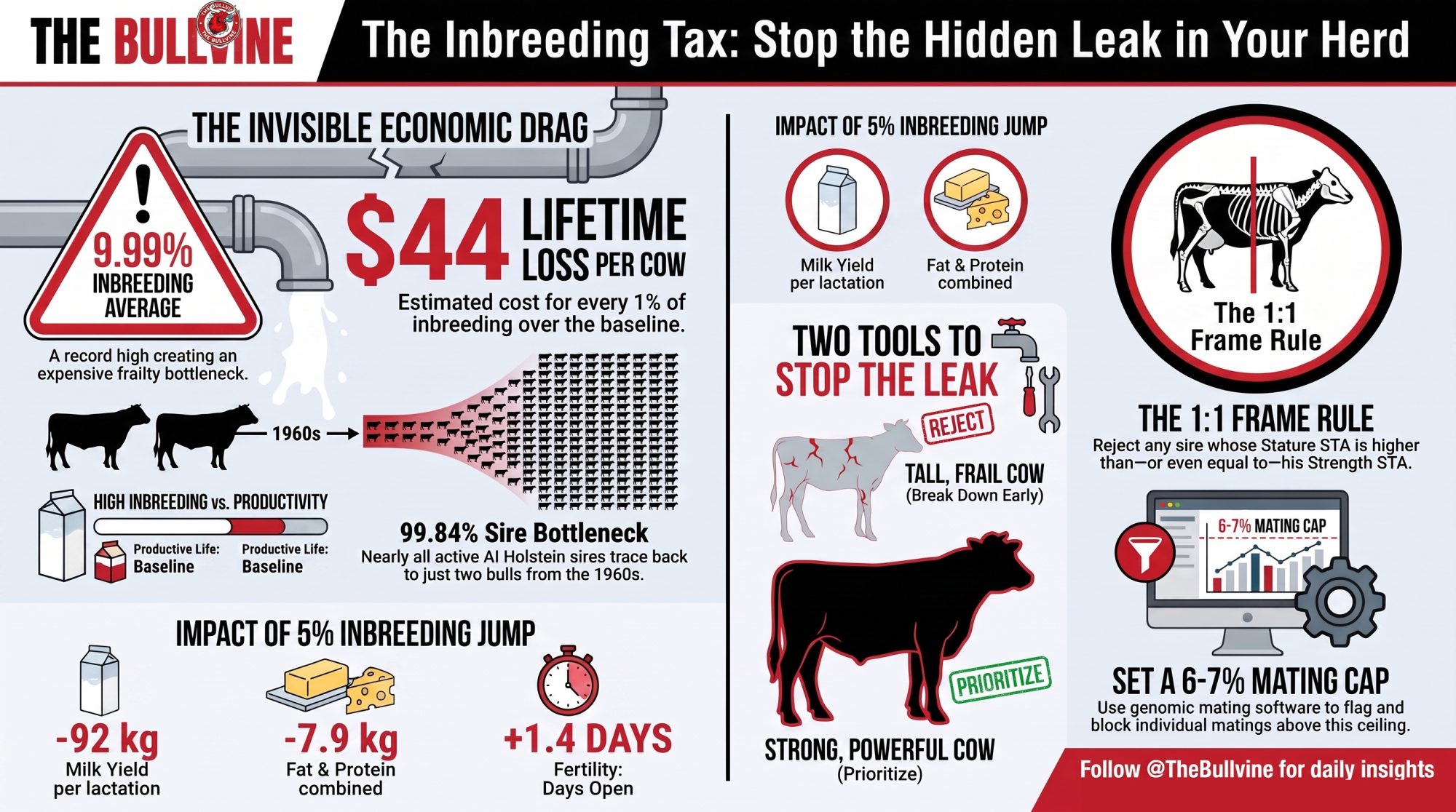
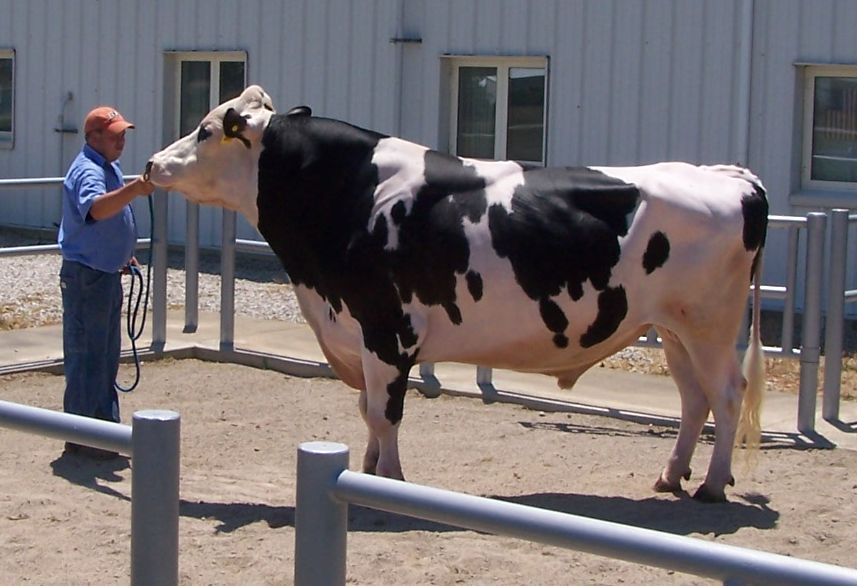
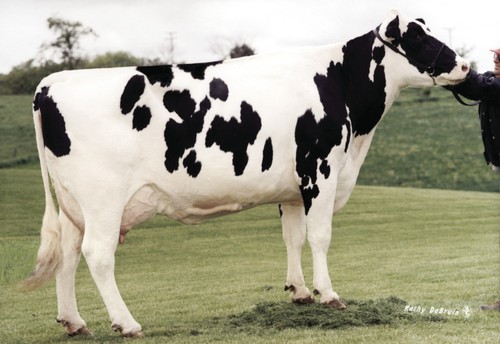
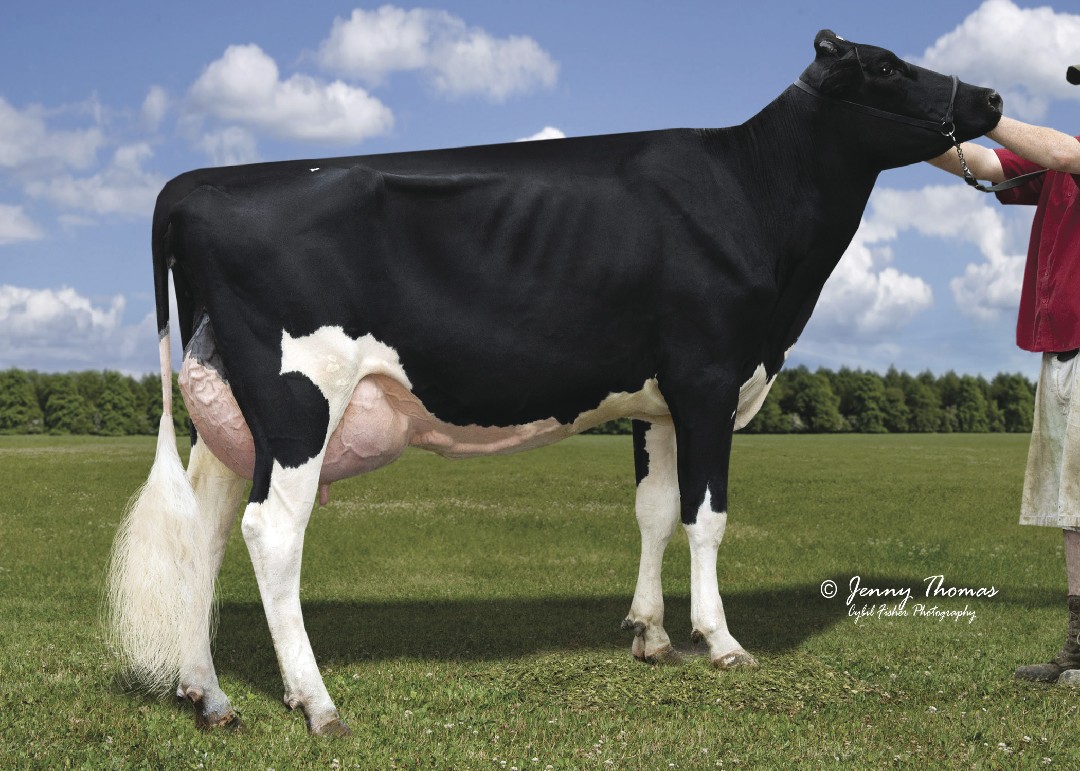
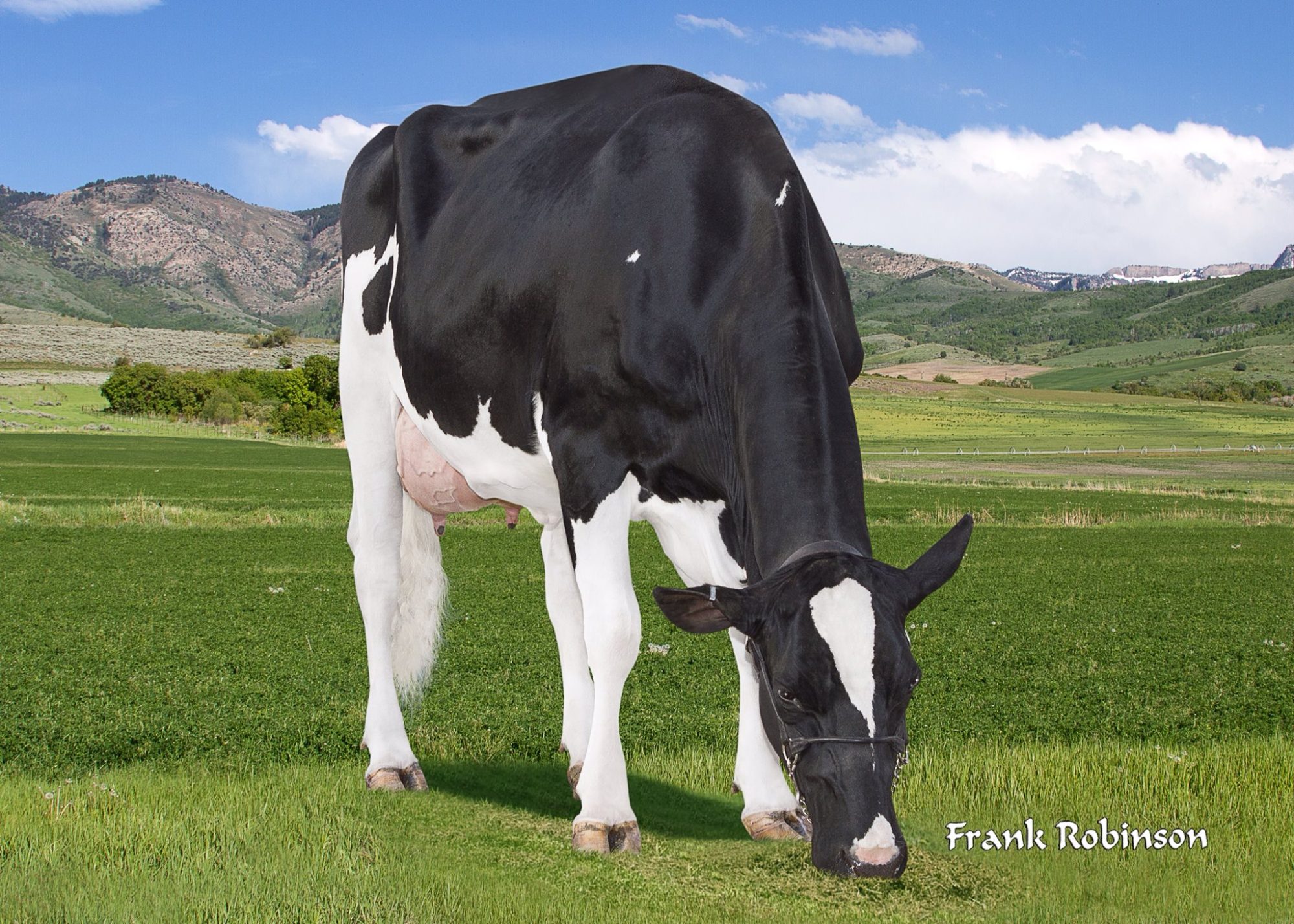
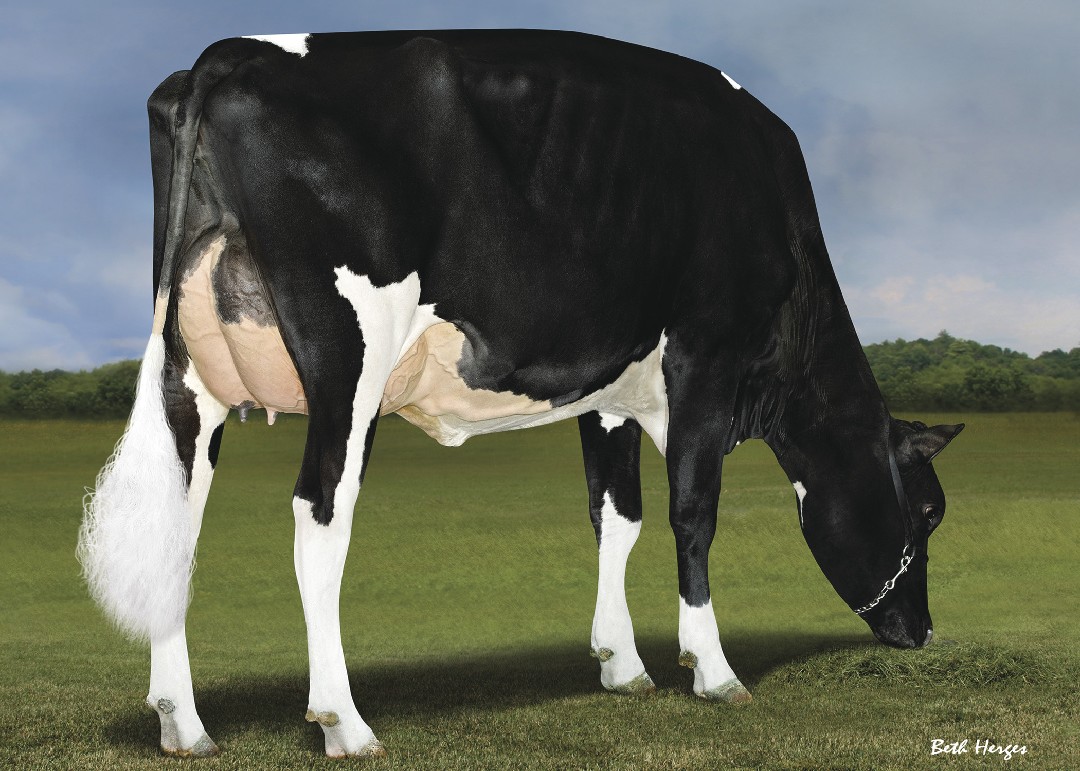
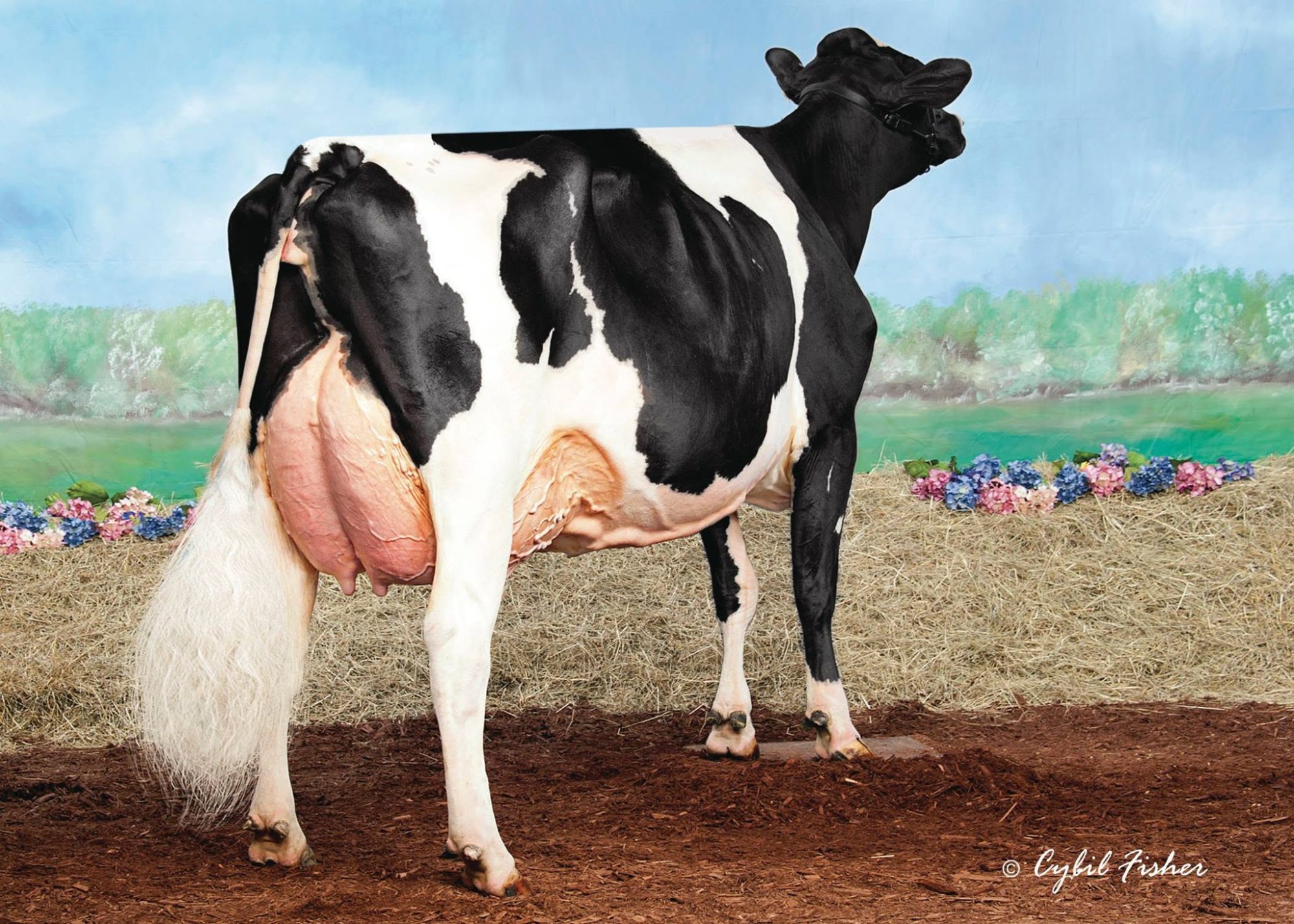
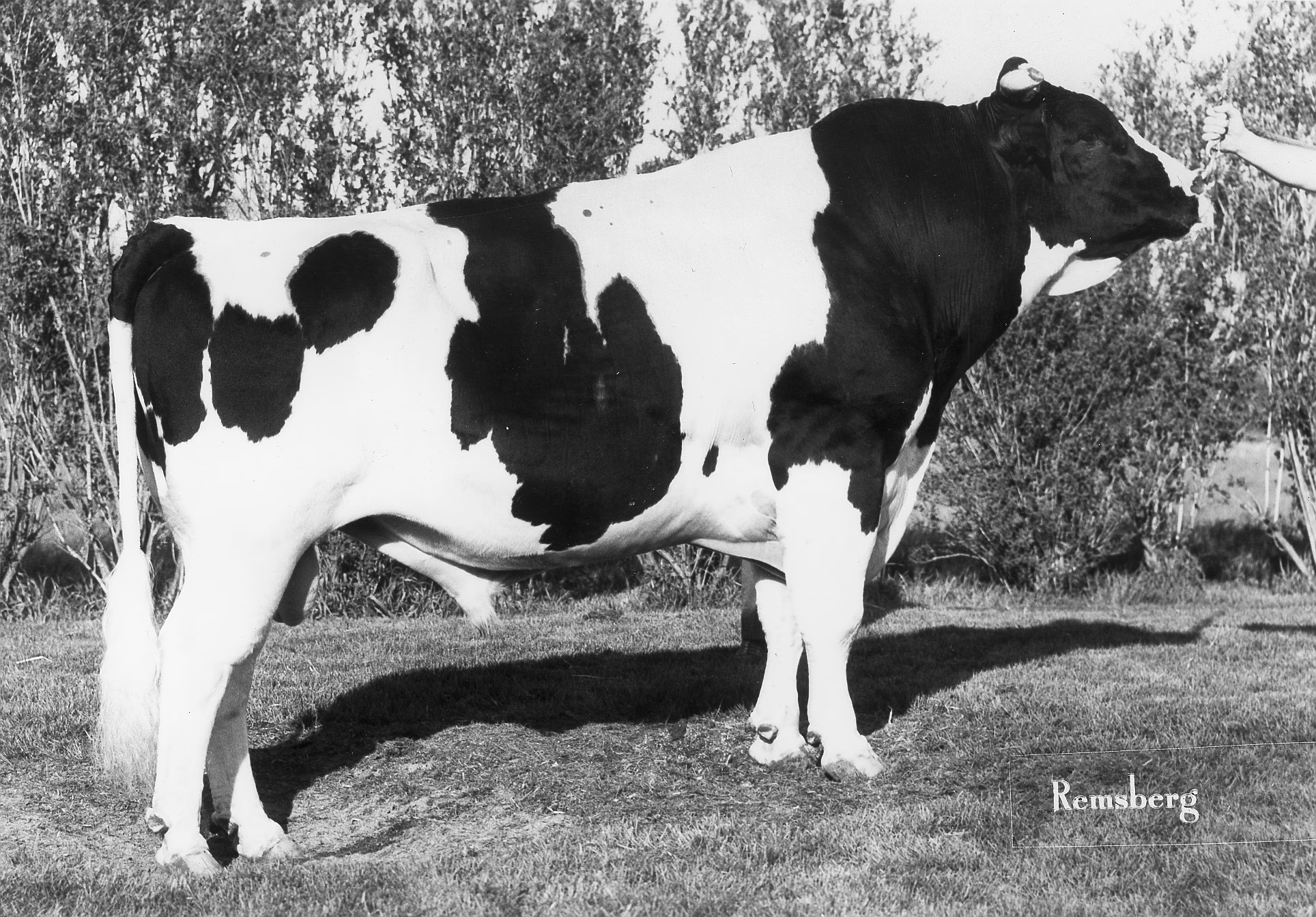
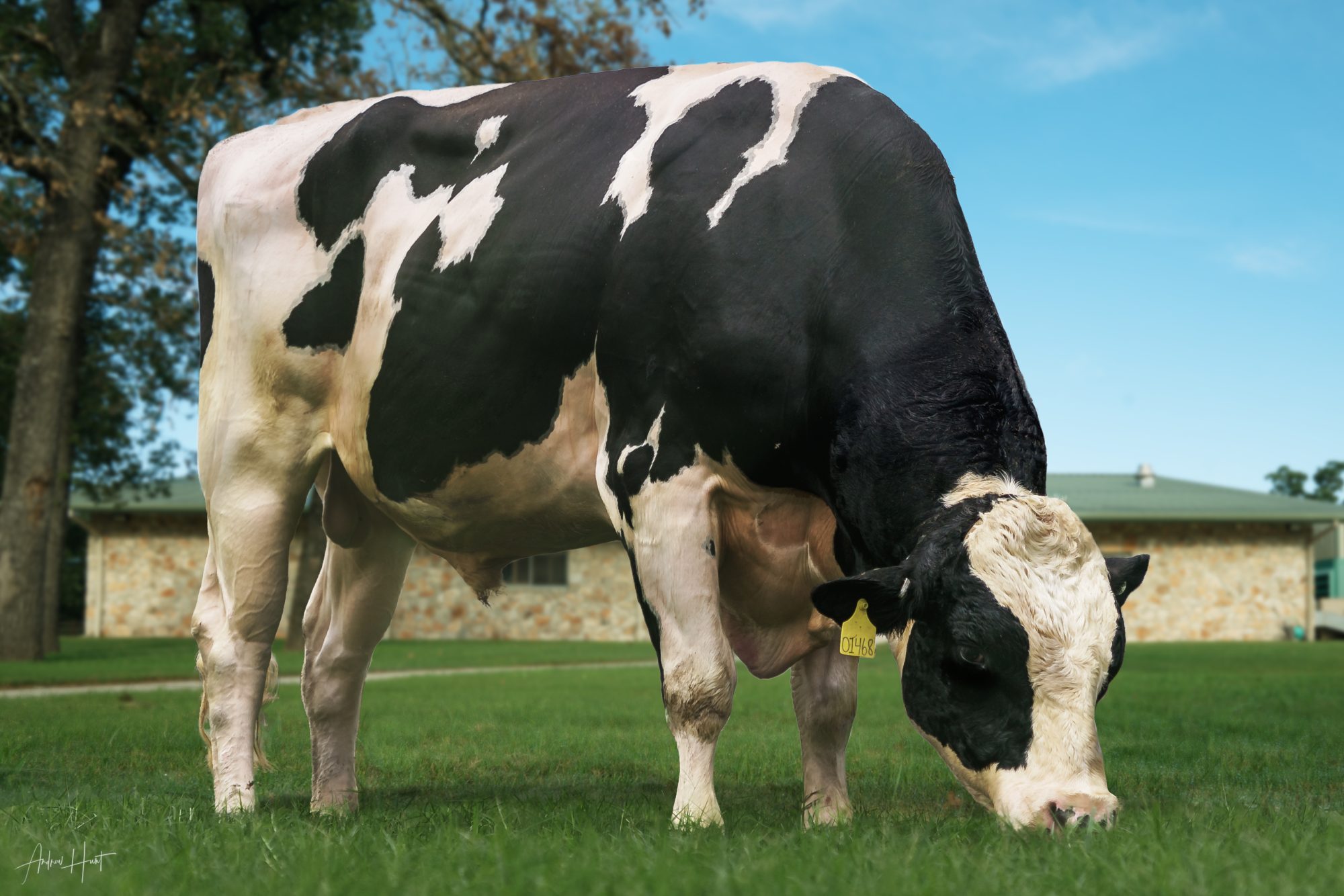
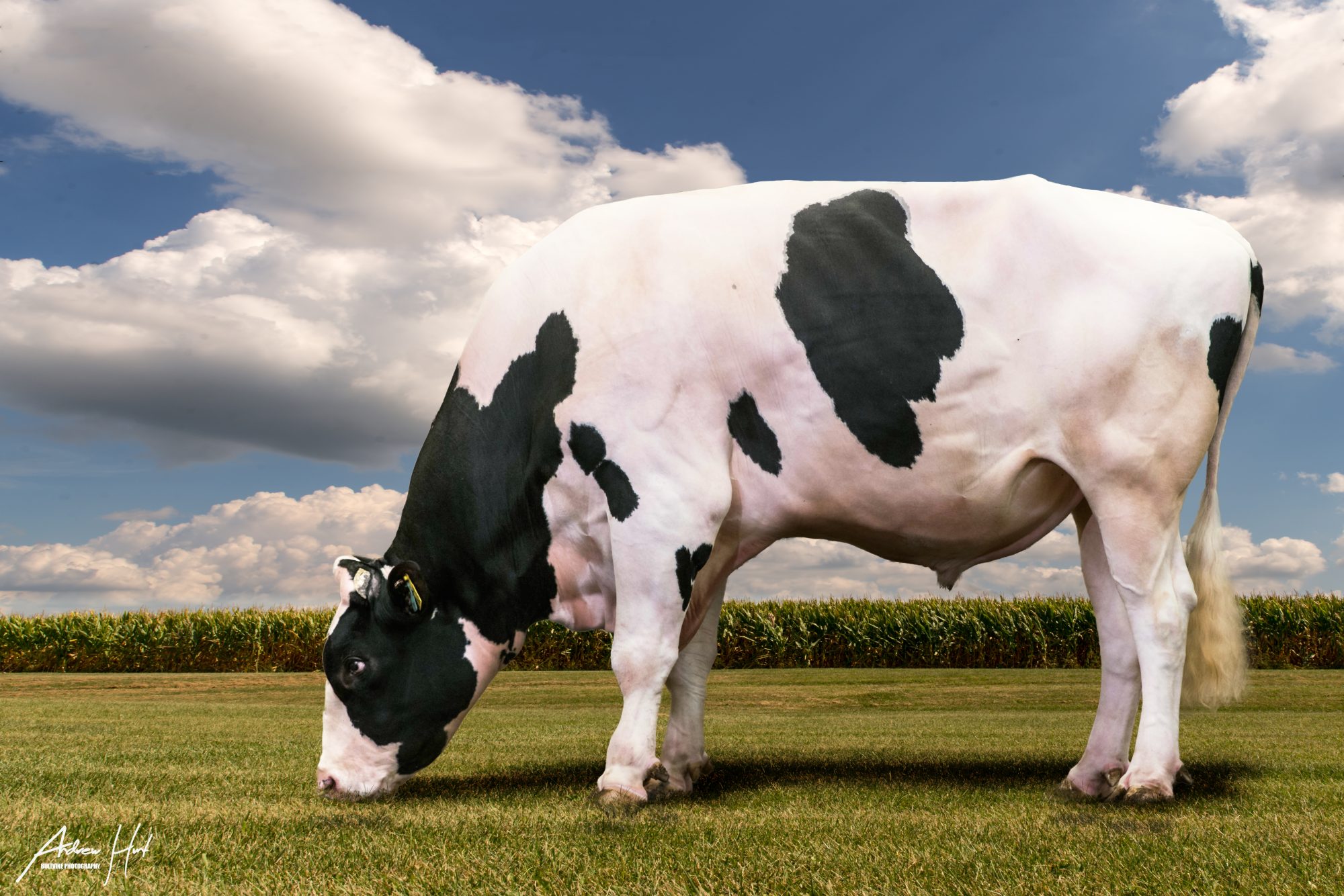
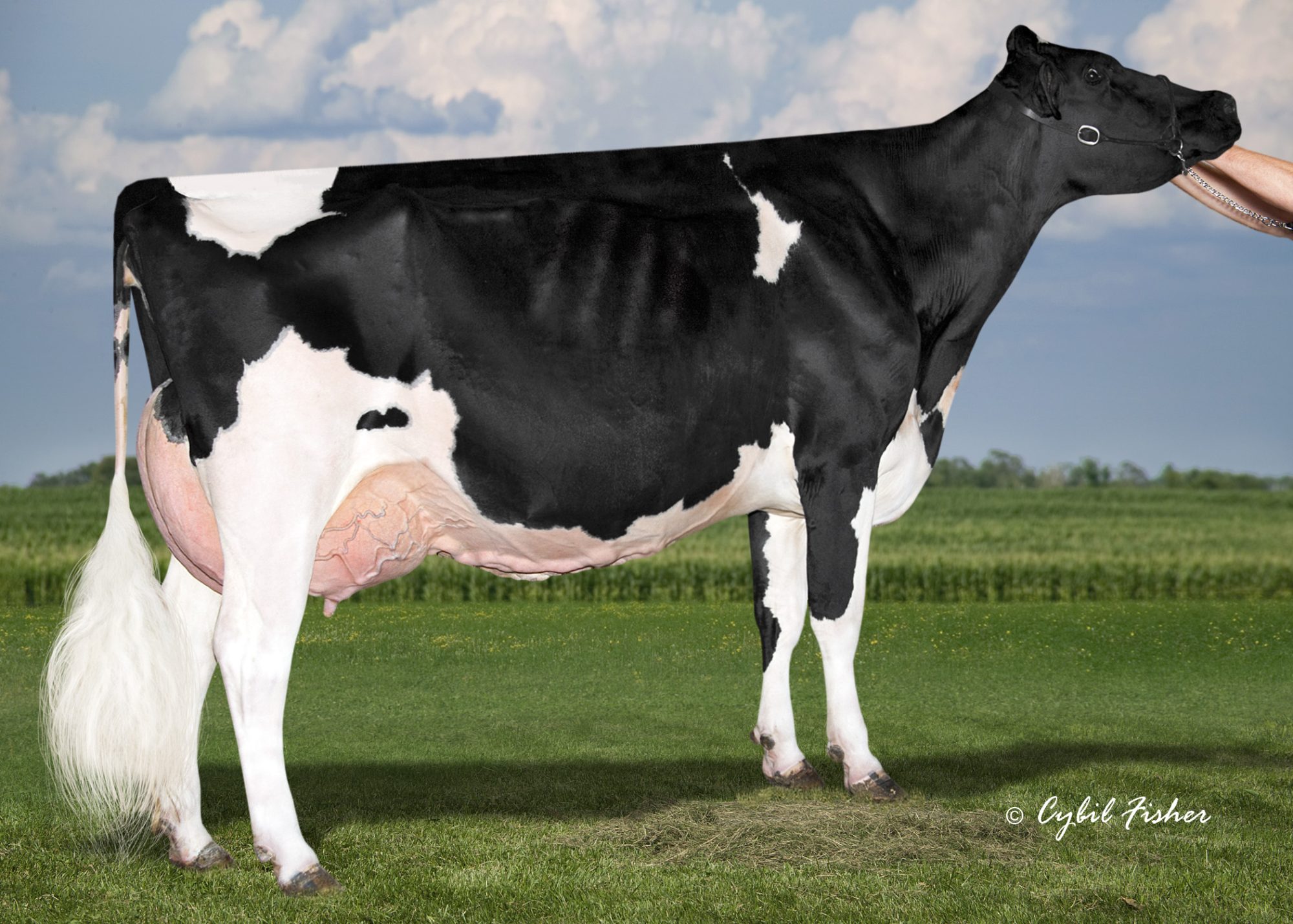
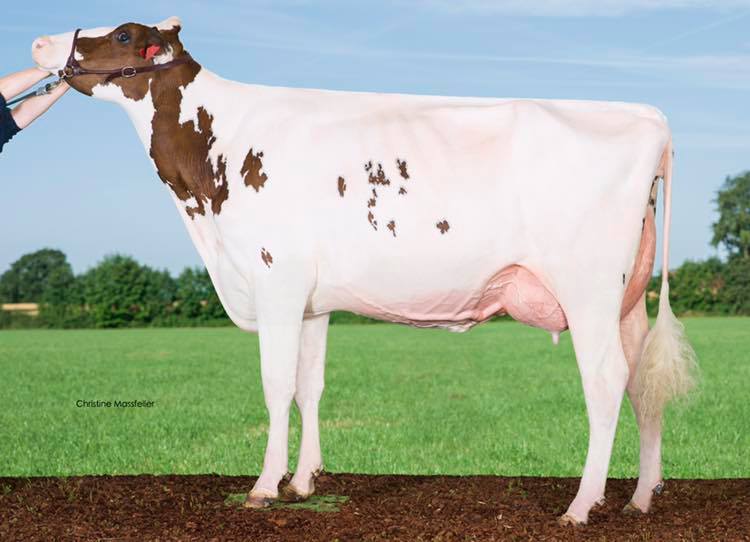
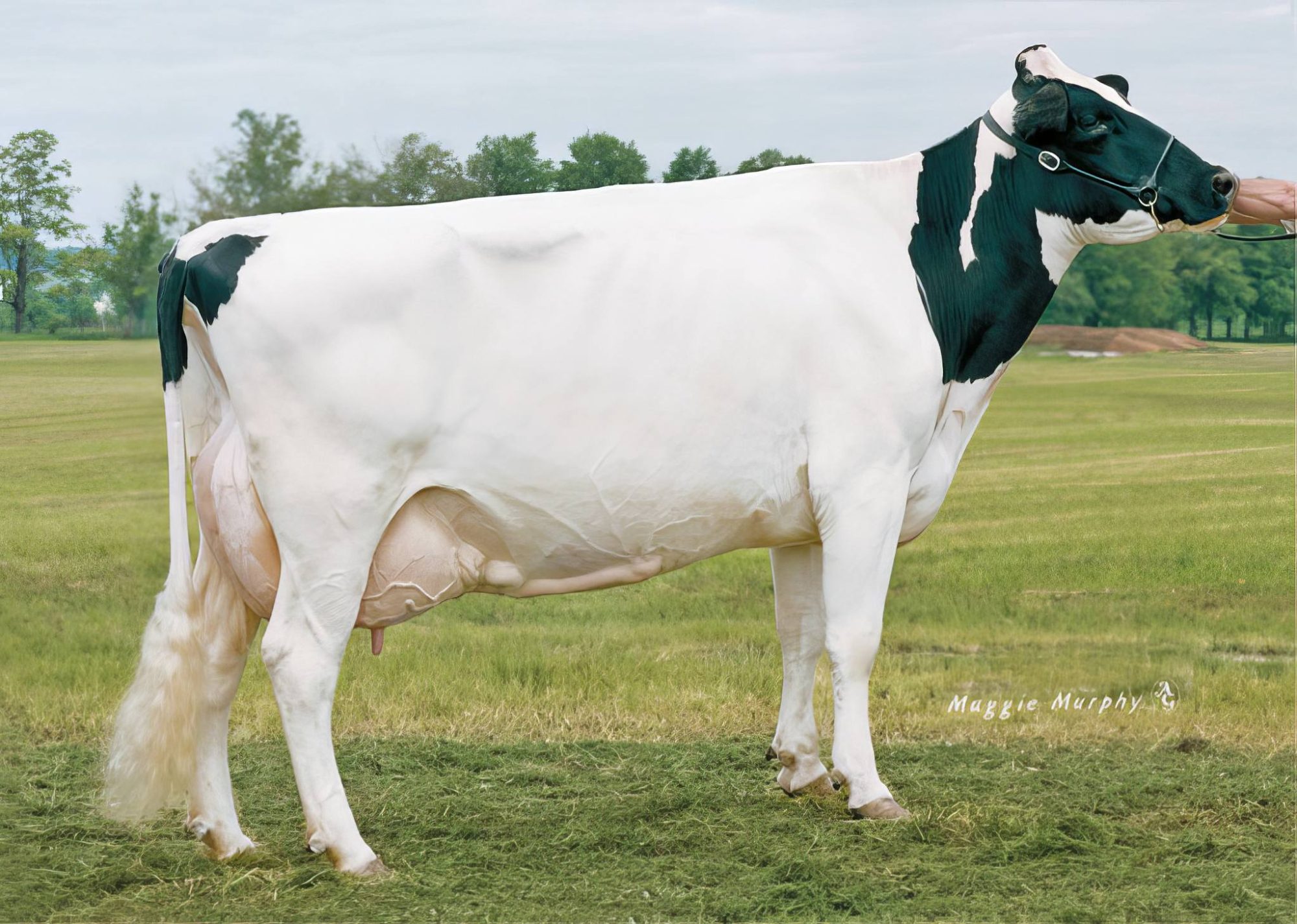
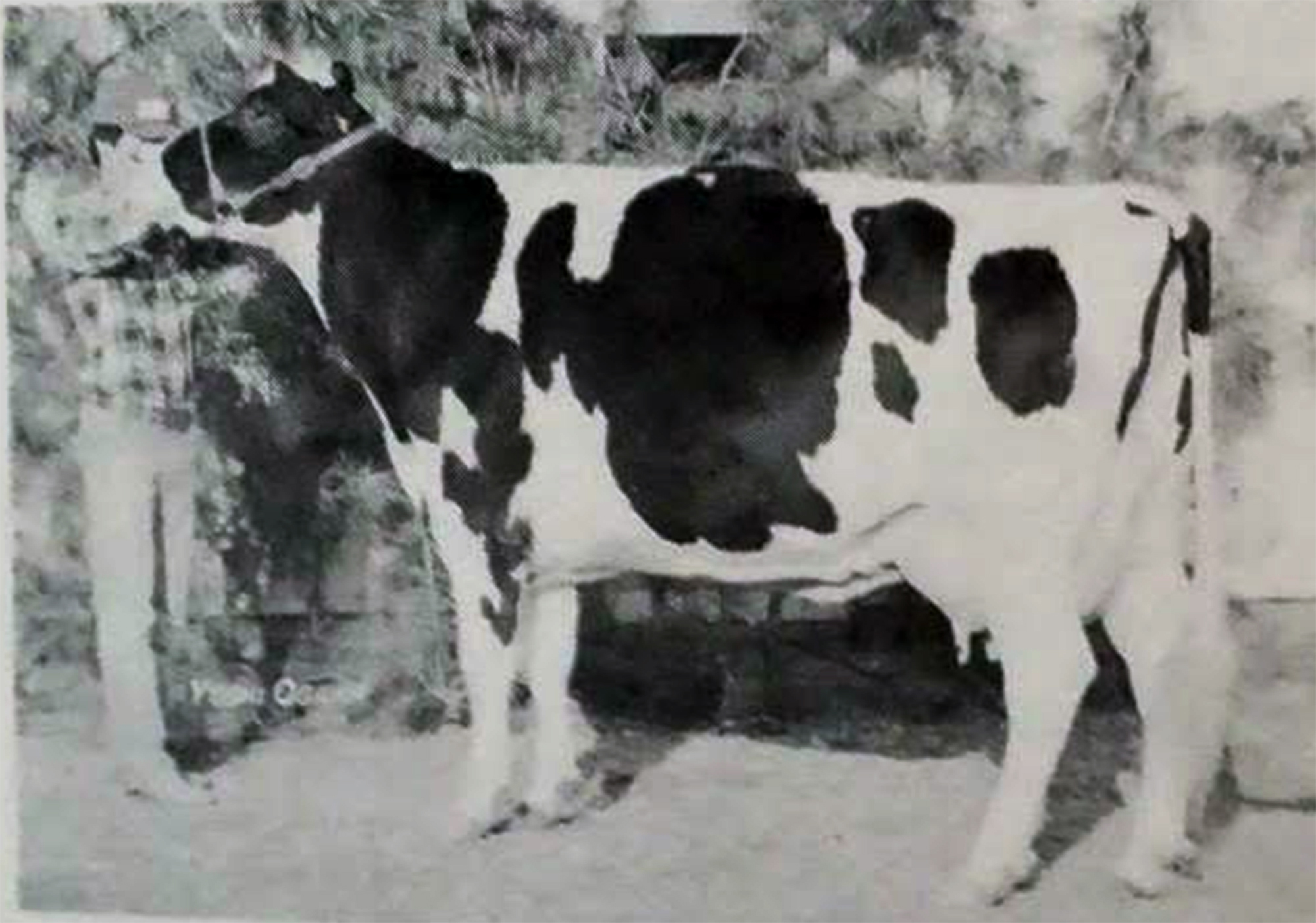
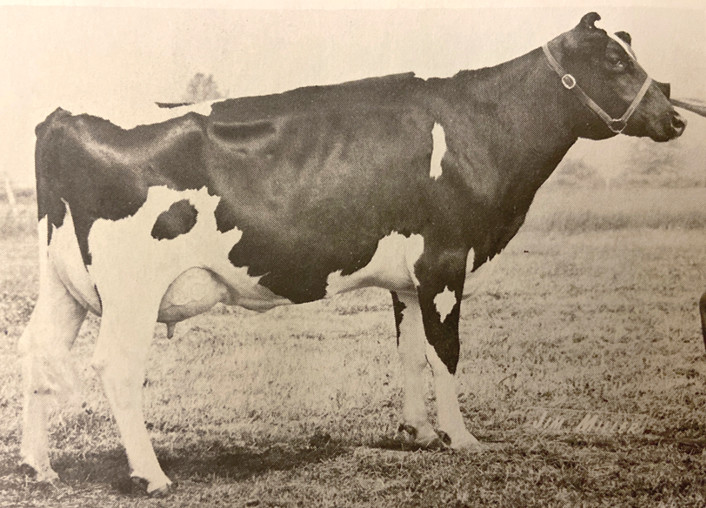
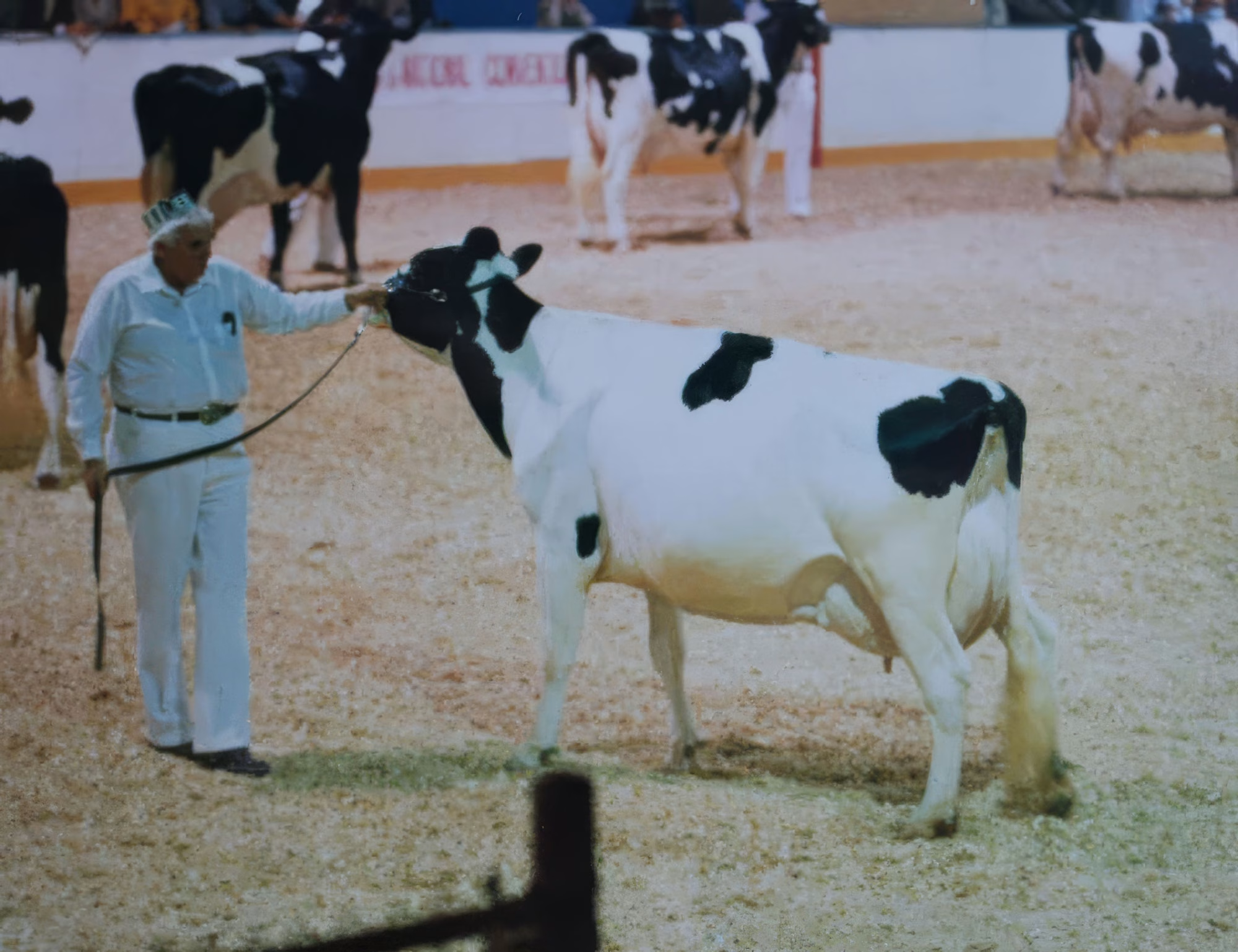
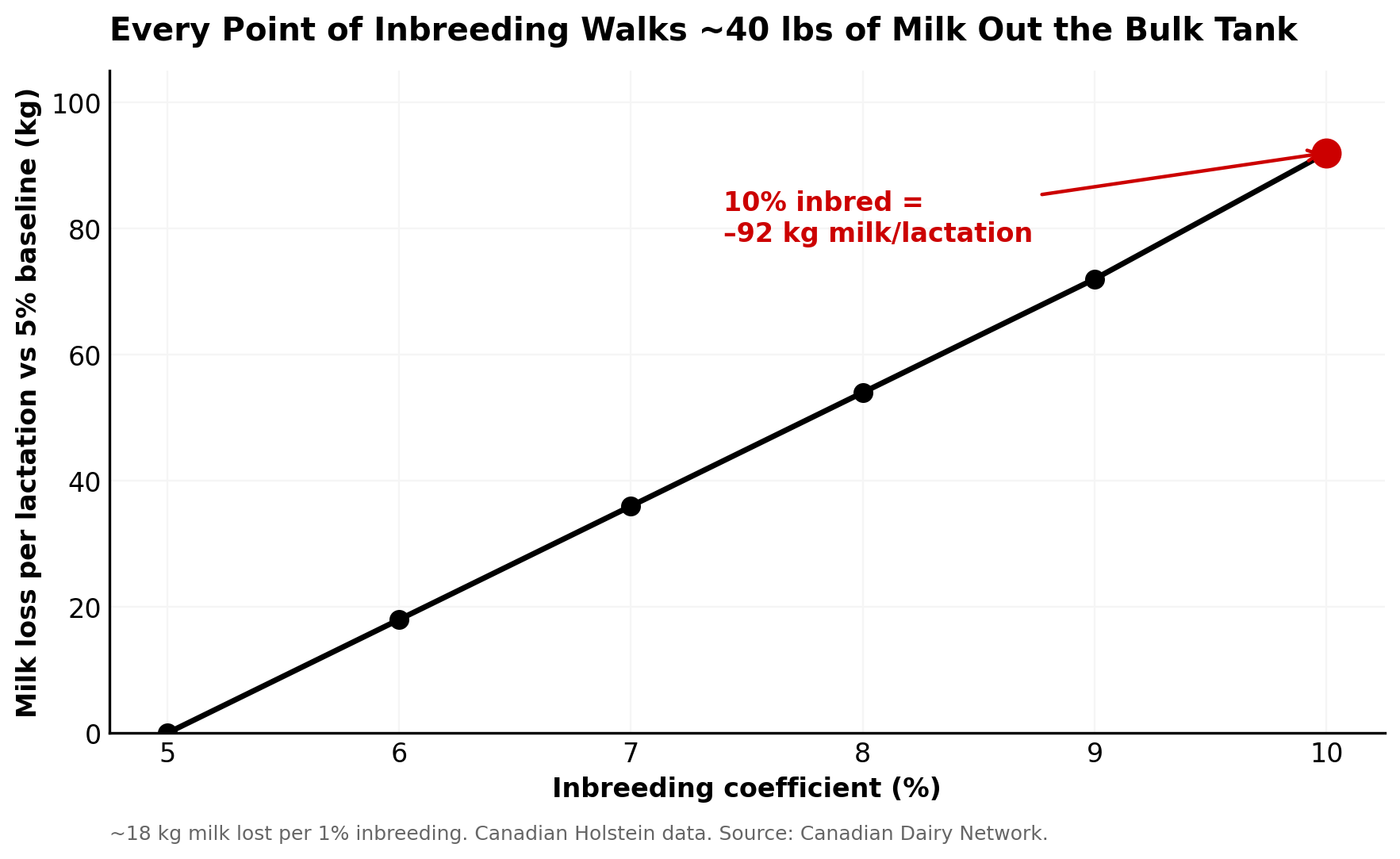
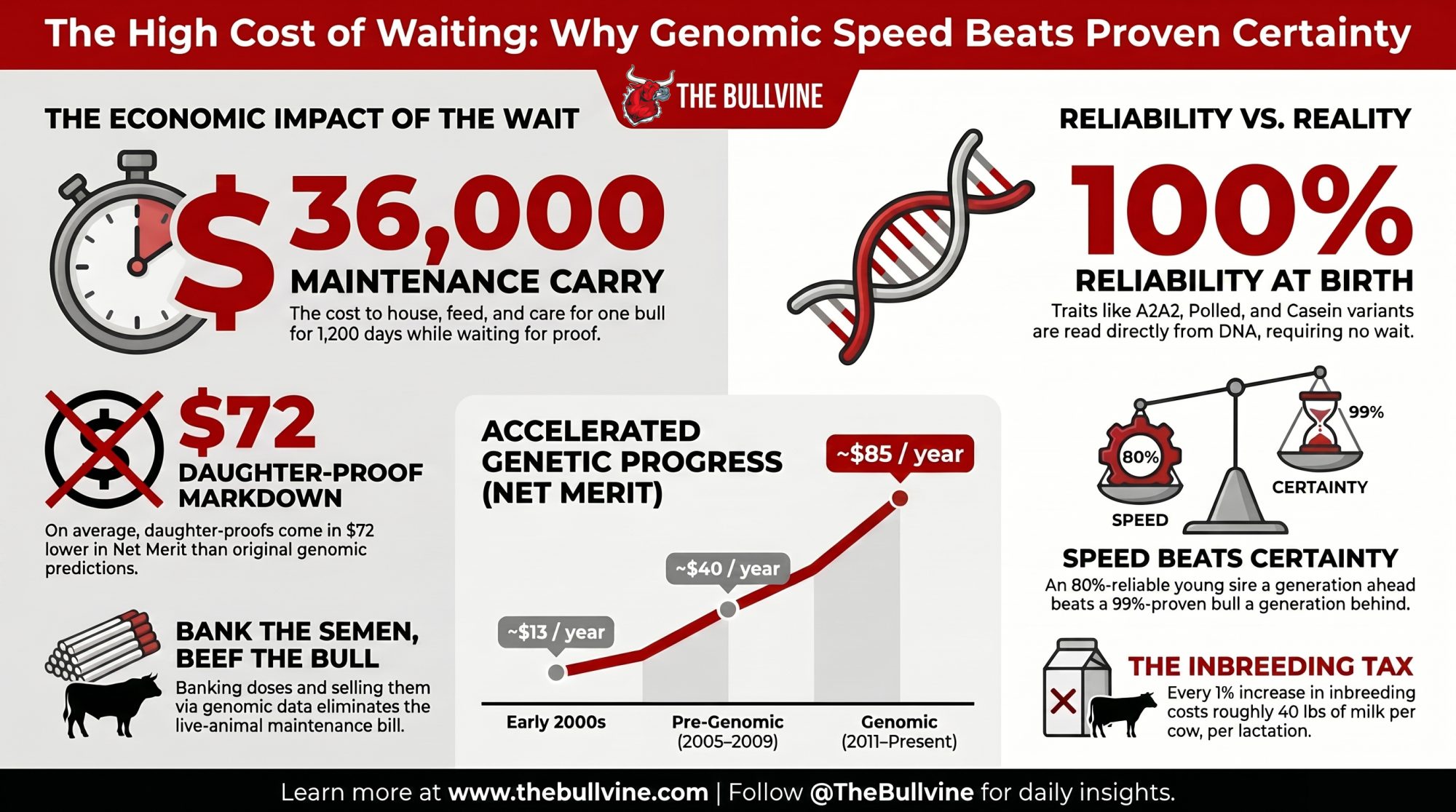
Emeric Lebacle, a Quebec breeder, dropped it into our comment section almost as an afterthought, and it turned out to be the most important thing anyone said about Holstein’s new stature penalty. His point: stature inherits more than twice as reliably as feet and legs, so if you actually want to move a herd, you pull the lever that responds. That’s exactly what Holstein USA did in its May 2026 classification run — and if your bull lineup still leans tall, this is the number that should stop you cold.
Stature
Point deduction from Final Score
60″ and under
0.00 (no penalty)
61″
−0.15
62″
−0.30
64″
−0.90
65″
−1.20
68″
−2.55
70″
−3.45
We figured the thread would split the usual way. Show people furious, commercial people cheering. That’s not what came back.
The One Number That Explains the Whole Penalty
What came back was working breeders doing the genetics math the association never spelled out. Stature is one of the most heritable traits on the card. Feet and legs? Not close. And that gap is the whole argument.
The data backs the Lebacle, hard. Lactanet pegs stature heritability at 53% — the highest of any Holstein type trait — with frame/capacity at 41%, while the Feet & Legs major score sits at just 21% and Foot Angle drops to 13%. Holstein USA runs the same direction: U.S. studies put stature in the low-to-mid 0.4 range, and the association states flatly that “it is difficult to make much genetic progress through selection and mating unless a trait has a heritability of .10 or higher”. This isn’t a 2026 discovery, either. Cassell reported back in 1973 that “stature showed the highest heritability while estimates for udder quality, hind legs, feet… were low”.
Keep the borders straight — Canada’s 53% and the U.S.’s low-0.4 range aren’t the same figure, but they tell the same story. Selecting hard on feet and legs is like pushing a rope. You can weight them heavy in your index and still crawl, because a 21% trait doesn’t inherit the way a 53% trait does. Stature does. So the association went after the trait that actually responds, knowing it drags a lot of correlated durability along with it.
Trait
Lactanet heritability (Canada)
U.S. studies (Holstein USA)
Selection response
Stature
53% — highest of any type trait
Low-to-mid 0.4 range
Fast — moves the herd
Frame / Capacity
41%
Comparable frame estimates
Moderate
Feet & Legs (major score)
21%
Below stature
Slow — like pushing a rope
Foot Angle
13%
Near the .10 floor
Barely responds
Does the Penalty Punish a Good Tall Cow?
This was the loudest fear in the thread, and one farm answered it with a real classification result. A producer walked into this spring’s round braced for damage and didn’t get it. Her classifier docked stature — then handed it right back on front-end capacity and width. Her balanced cows came out neutral.
That’s one farm’s experience, not a controlled study. But it lines up with how Holstein USA actually builds its numbers. Both the Udder Composite and the Feet & Legs Composite carry a −0.20 weight on stature — on purpose, so breeders can “improve udders and feet & legs without making their cows taller”. The penalty isn’t anti-tall. It’s anti-tall-and-narrow. A wide, strong, deep-ribbed cow who happens to stand over 60 inches carries her frame, and the score shows it. The cow it’s aimed at is the narrow one riding on height alone.
Another breeder made the same case from the skeptic’s chair. He doesn’t care how big a cow is, long as she’s got the width and strength to last — and frail, he noted, comes in every size. He’s right. And the penalty agrees with him. Height was never the disease. Height without substance is.
Is the Real Problem Height — or the Feet Nobody’s Culling?
The sharpest pushback deserves a full hearing, because it’s fair. One breeder’s argument: this penalty makes classifiers look political, and it’s aiming at the wrong target. Pull up the current top-GTPI list, he says, and look at the feet and legs on that group. Weak. Nobody’s thinning the sorry-walking bulls hard enough. So why chase height when the real durability killer is legs?
Here’s the honest answer, and it’s a “yes, and” — not a rebuttal. He’s right that top-GTPI feet and legs have slid; genomics chased production and type composites while feet and legs quietly eroded, a drift Holstein USA’s own million-cow conformation study laid bare. But the stature penalty and the feet-and-legs problem aren’t competing fixes. They’re the same fight. Height-for-height’s-sake breeding is part of what wrecked the legs in the first place — and at 53% against 21%, stature is the trait you can move fast. The lever this breeder wants pulled directly, feet and legs, responds less than half as well. So push both. Just don’t mistake the more-heritable tool for a distraction. “Watch how they walk and get up and down, not the number on the stick,” another put it — and he’s making the same point. Mobility is what matters. Height is the proxy the system can actually select on.
The Barn-Floor Longevity File
You can argue heritability estimates all day. It’s harder to argue with a cull sheet. Several breeders volunteered the same pattern from their own alleys.
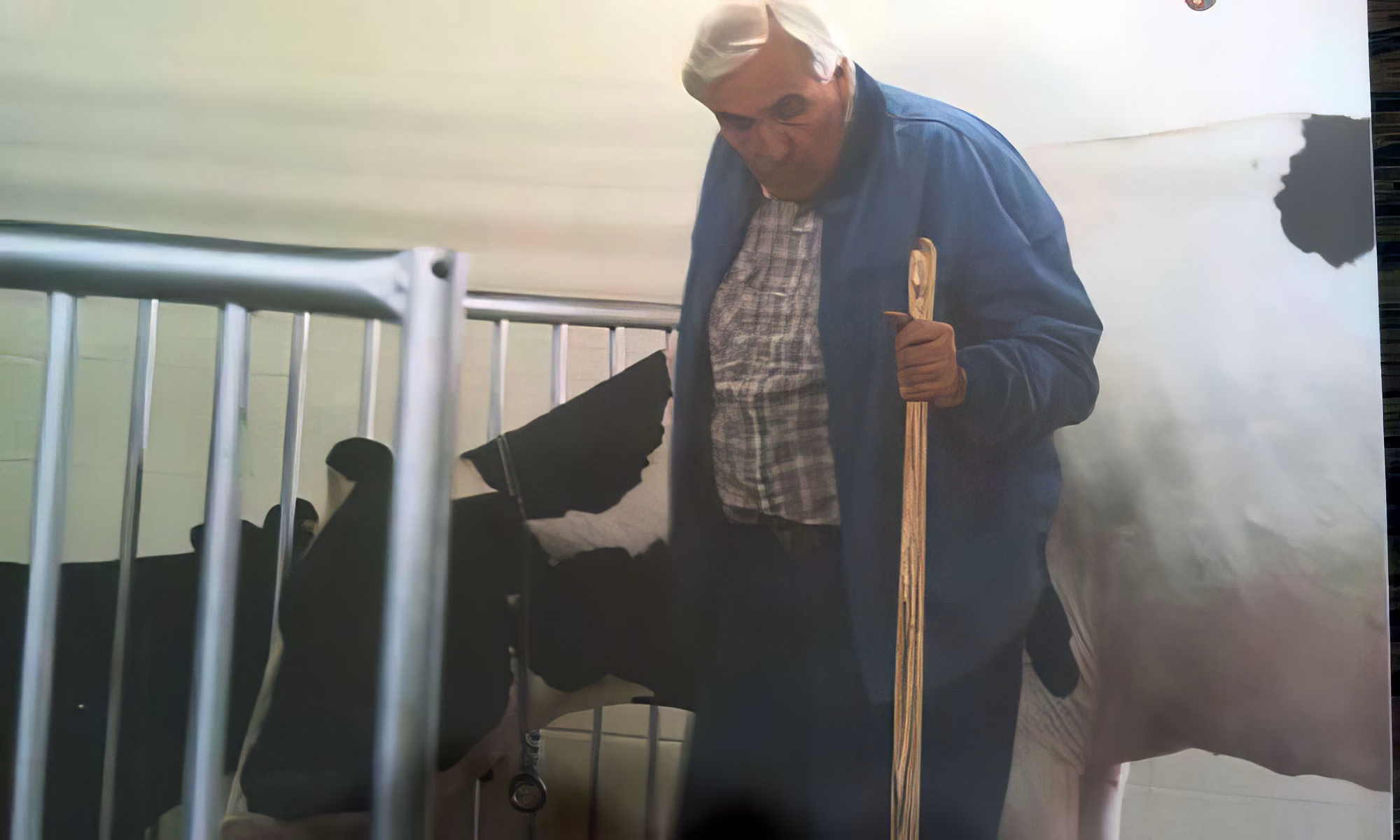
One producer runs an older freestall barn — shorter stalls, slatted floor. His read was blunt: tall cows leave earlier than short cows, so he now hunts for a minus on stature when he buys Holstein semen. That’s a breeder rewriting his own index based on what the stalls told him. Another gave the version with detail. Years back he had a cow that flirted with 70 inches — big producer, decent career, until her joints gave out. Her daughter, still tall but not as extreme, aged better and stayed athletic to the end. His verdict: somewhat-tall cows with good feet and legs generally weren’t the problem. Tall plus weak legs was. A third put it flatter — taller cows go down more, and they’re less likely to get back up.
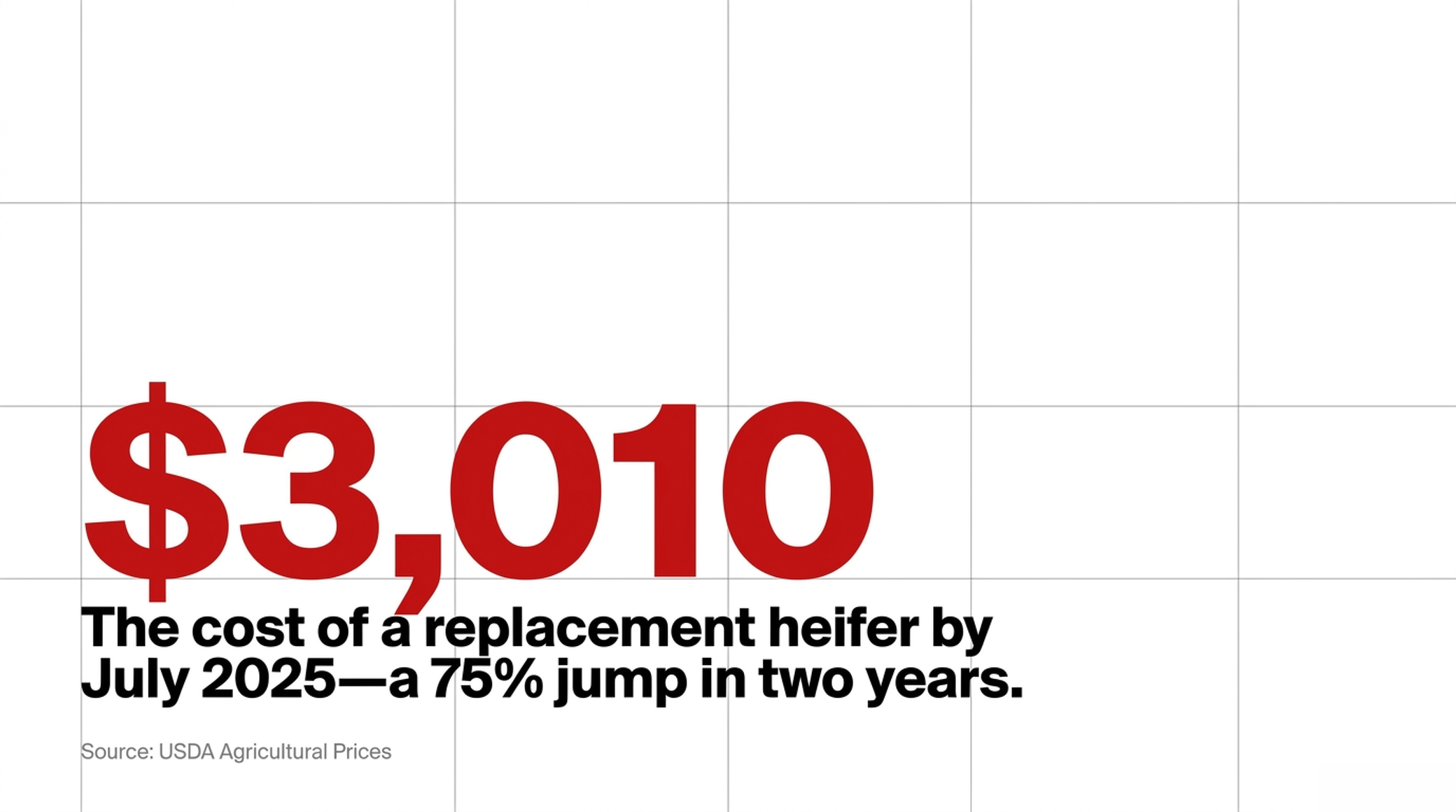
Now put a number on “they leave earlier.” Raising a Holstein replacement to calving runs about $2,016 in confinement, and anywhere from $1,700 to $2,400 depending on your setup (Overton, Journal of Dairy Science, 2020) — and recent land-grant figures have crept to the $2,400–$2,500 range as feed costs climbed. A cow culled a full lactation early strands a chunk of that before she’s paid you back. On a 100-cow herd, cutting five early exits a year protects roughly $10,000 in replacement investment — call it the ceiling, not the take-home, since salvage value and the milk she already shipped claw some of it back. That’s why breeders in older, shorter stalls treat a stature minus as risk management, not fashion. None of these are studies. They’re decades of watching cows come and go, and they all point where the data already does.
Don’t Blame the Ring
Here’s where this whole conversation usually goes sideways. The show ring gets blamed for every tall, narrow, fragile Holstein in the country. That’s too easy. And it lets everyone who actually built her off the hook.
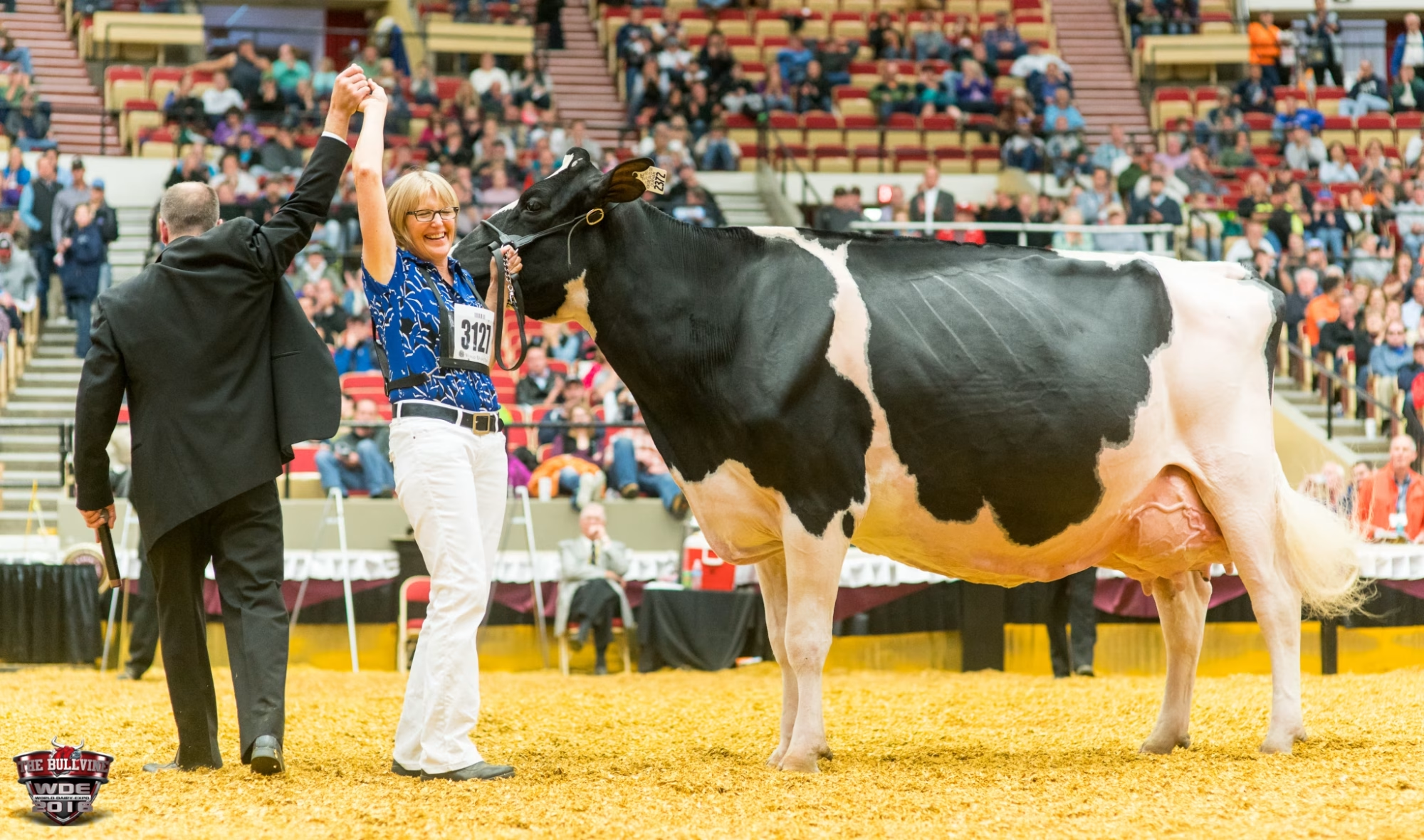
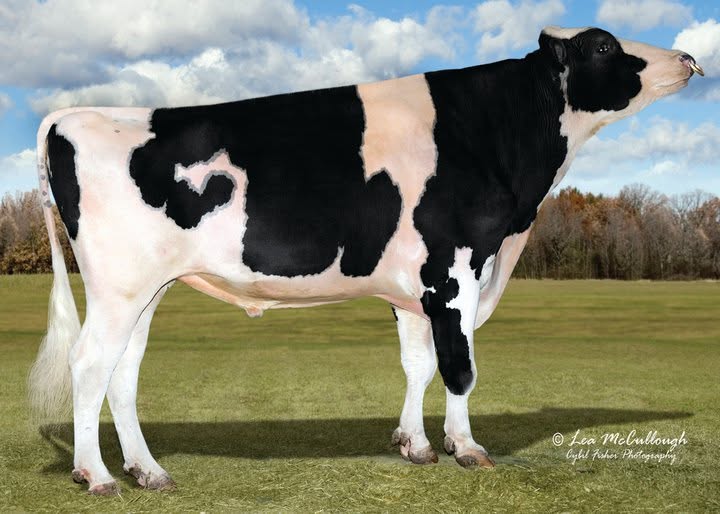
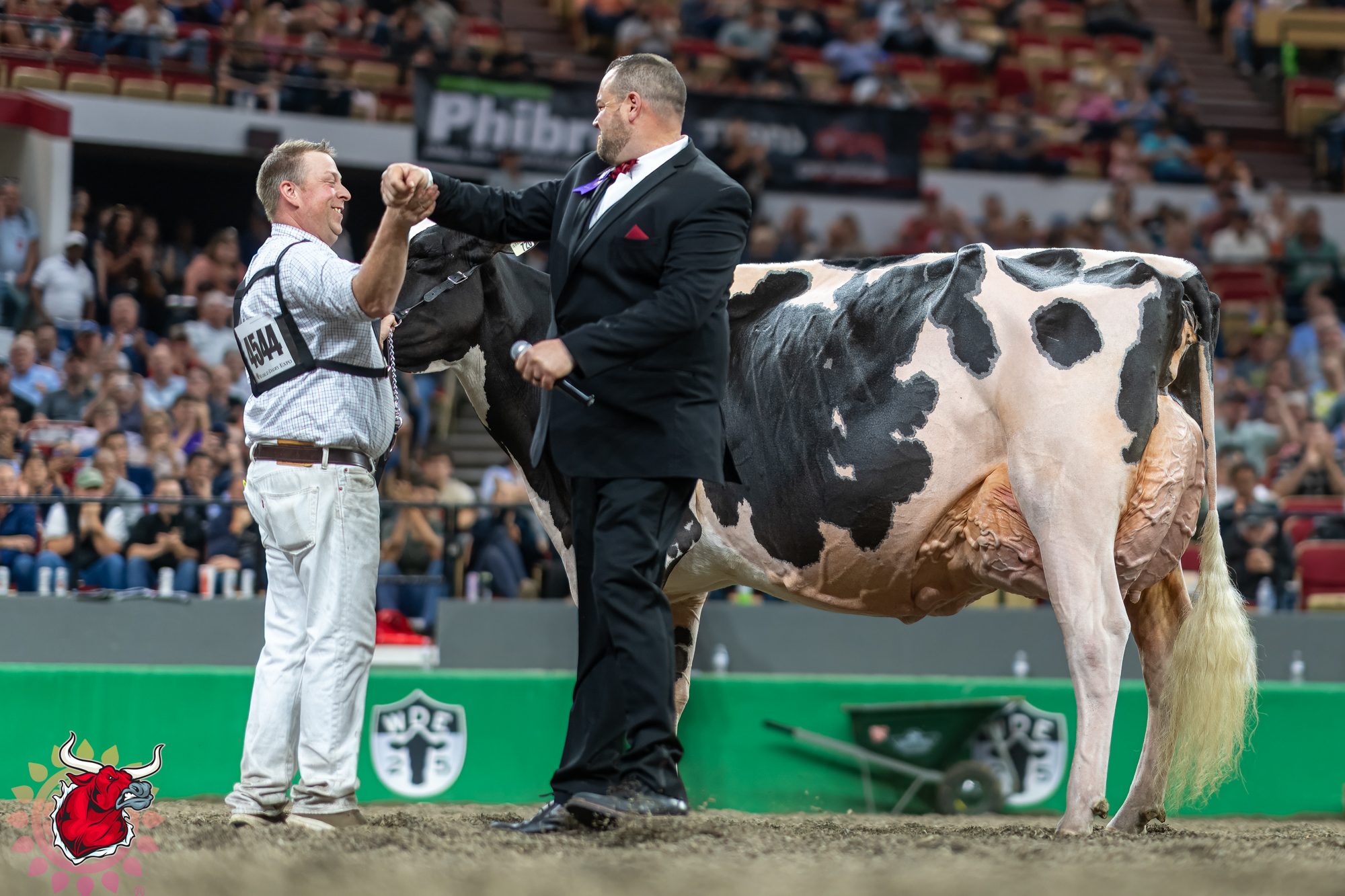
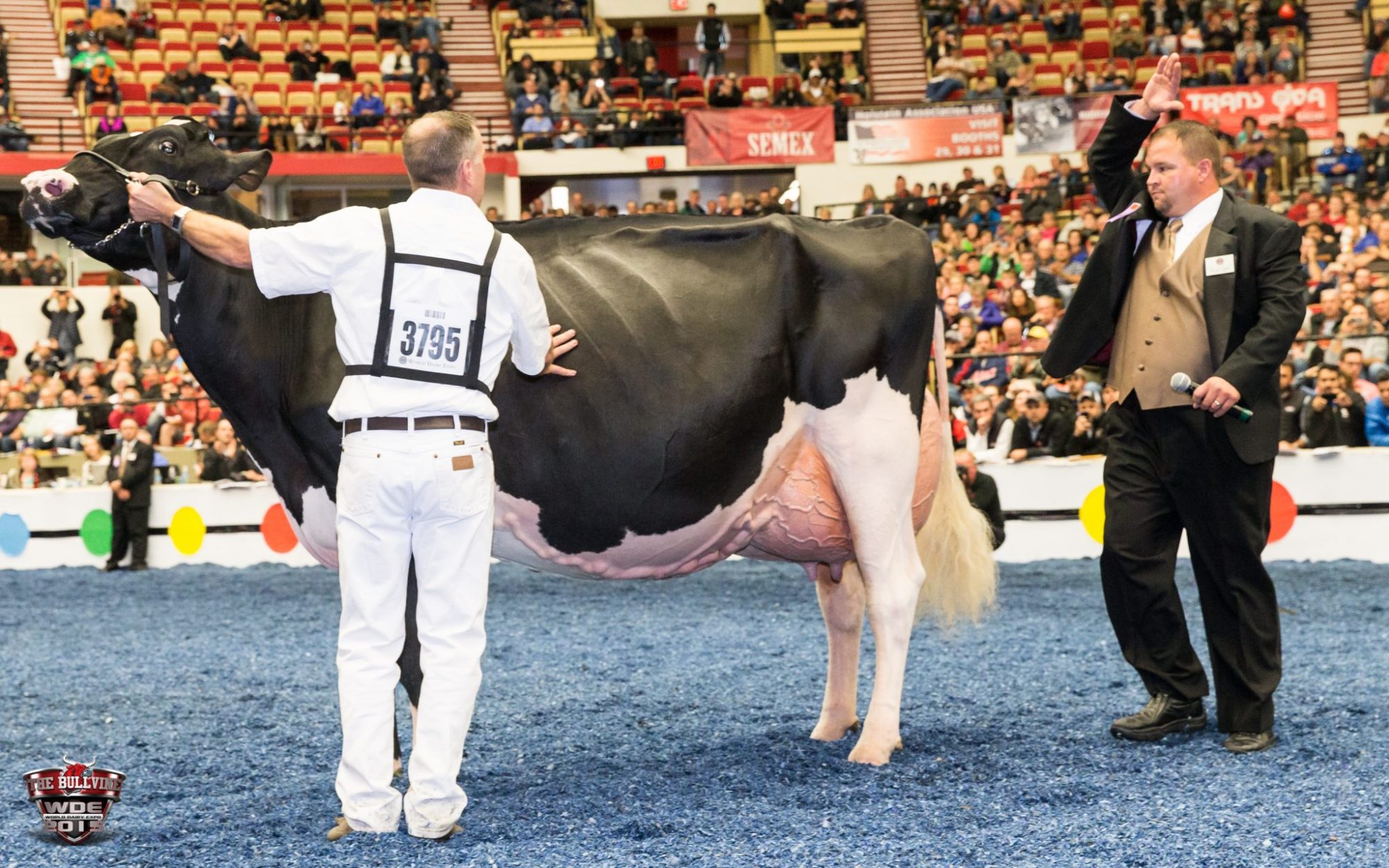
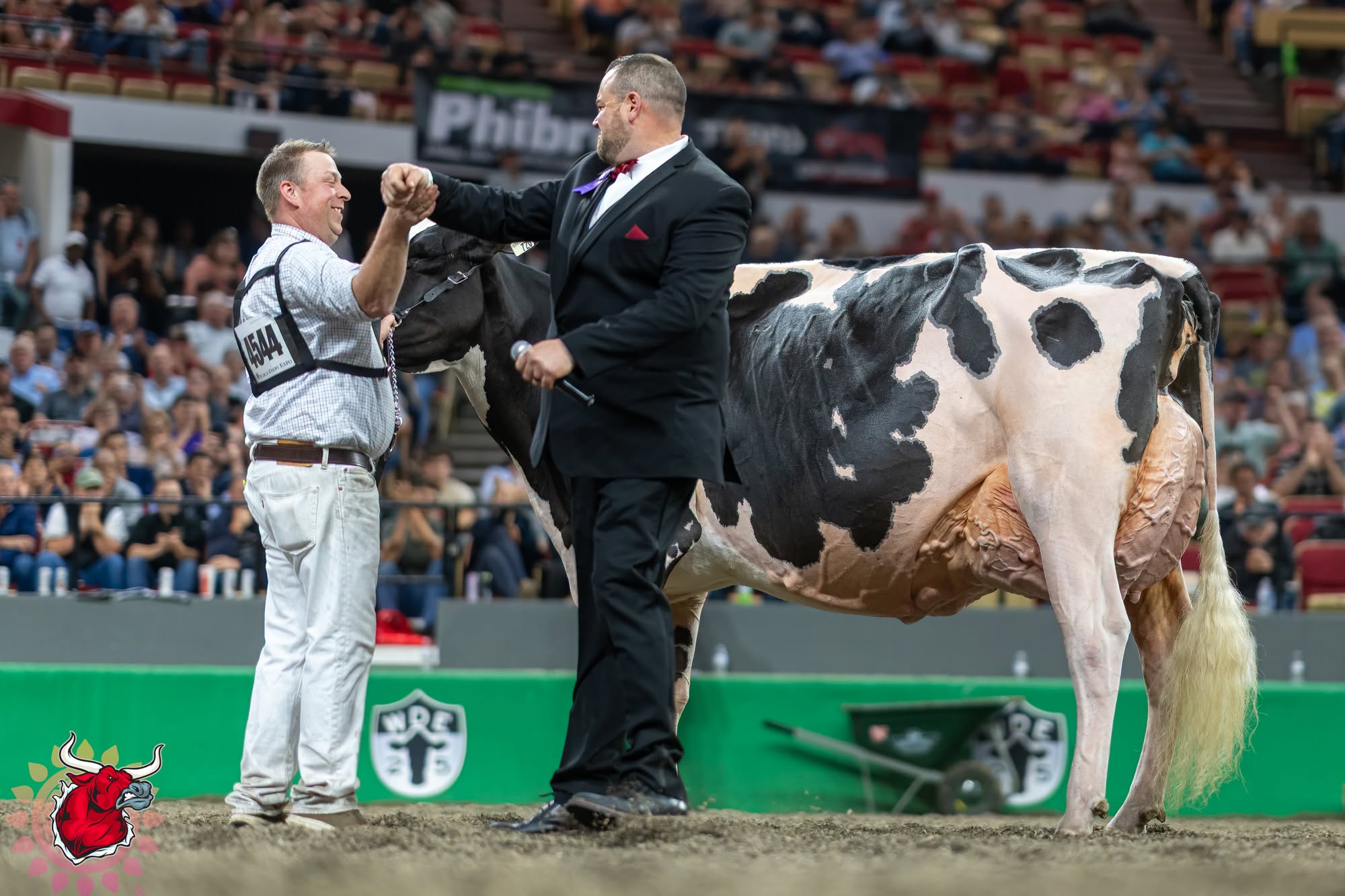
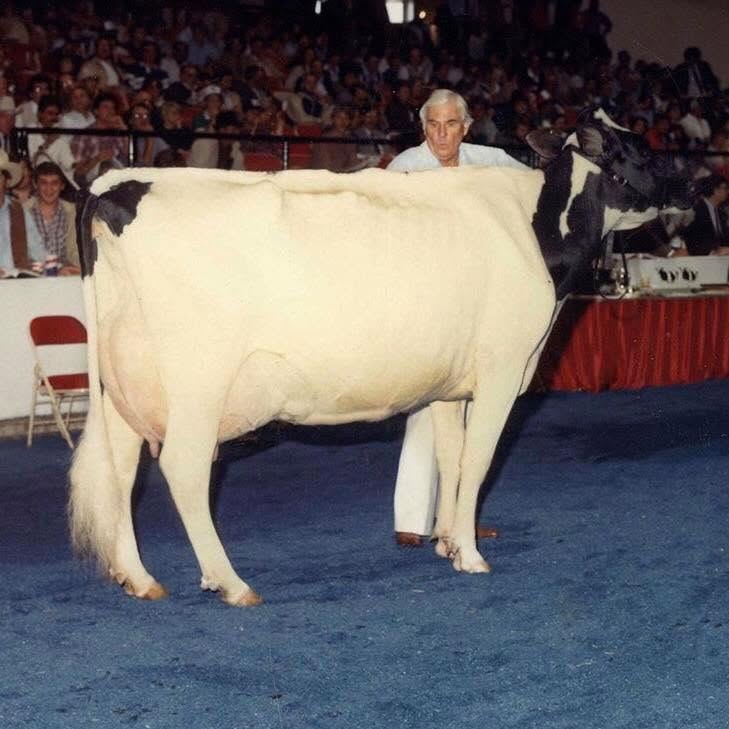
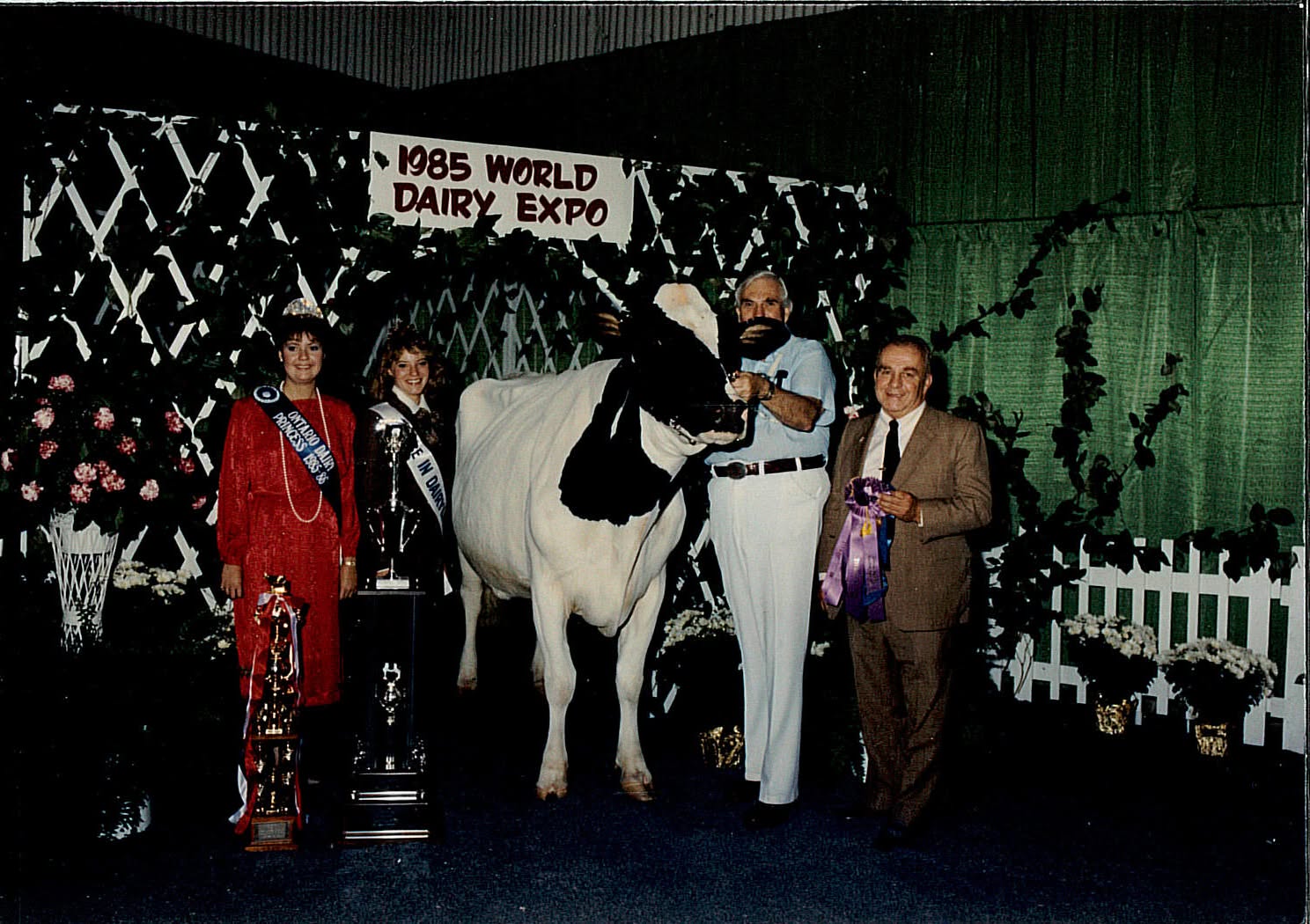
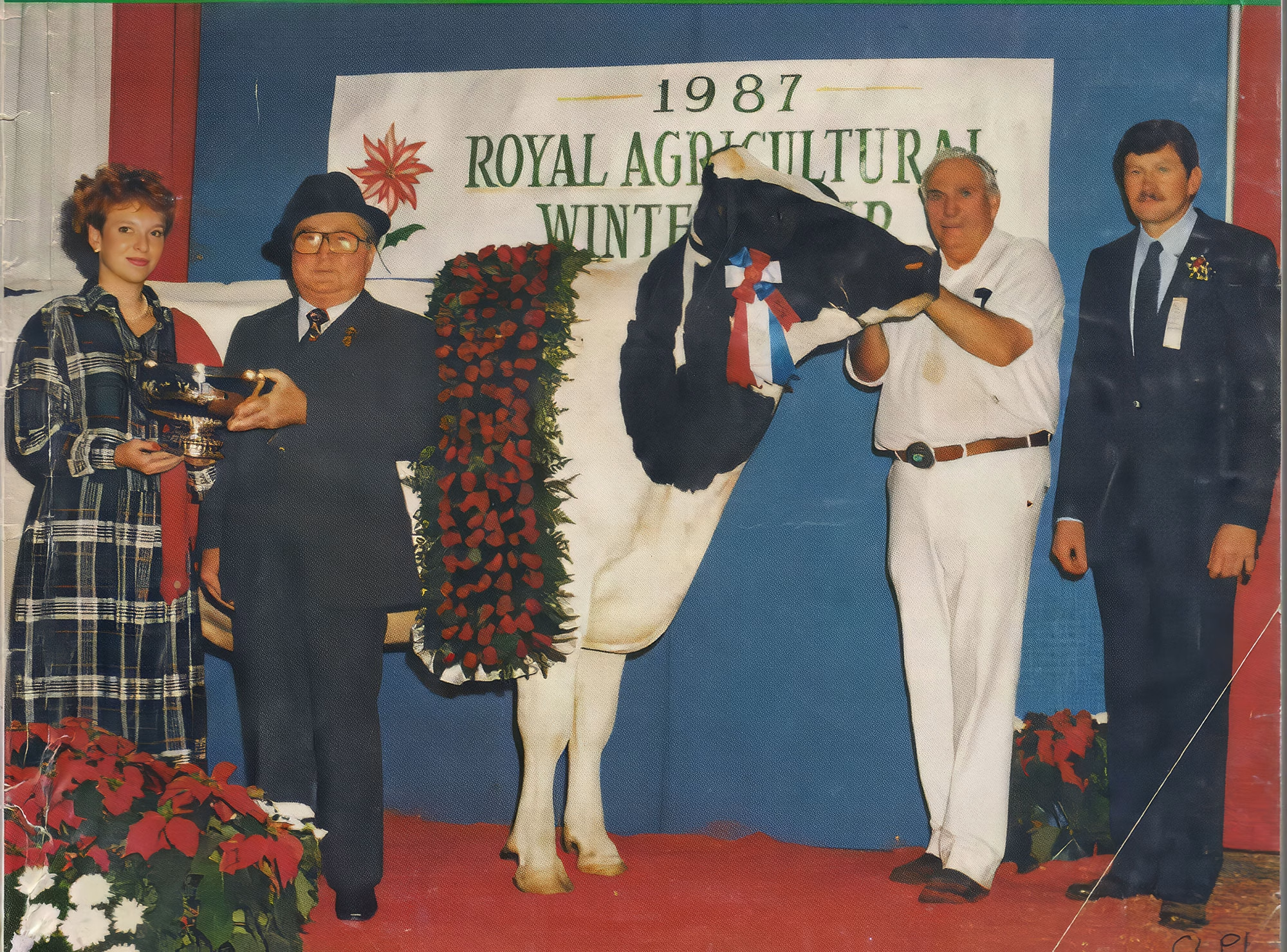
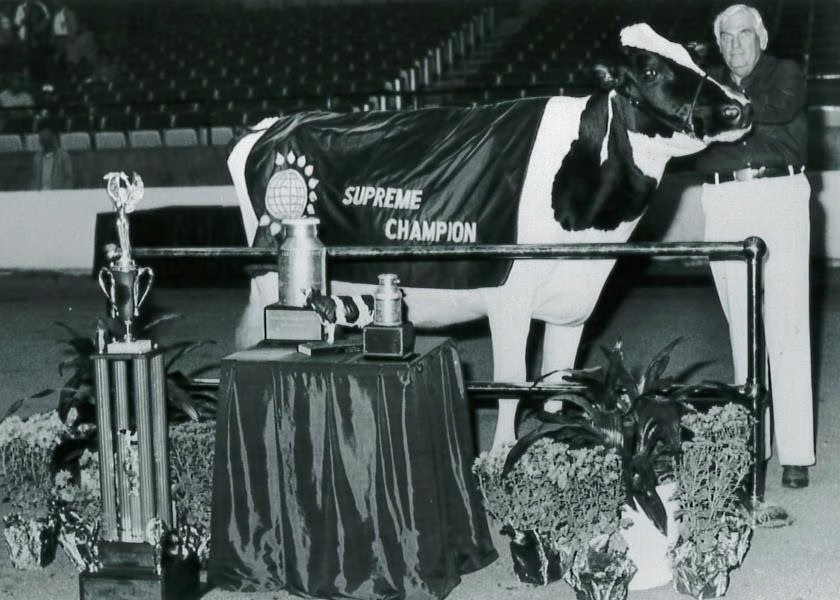
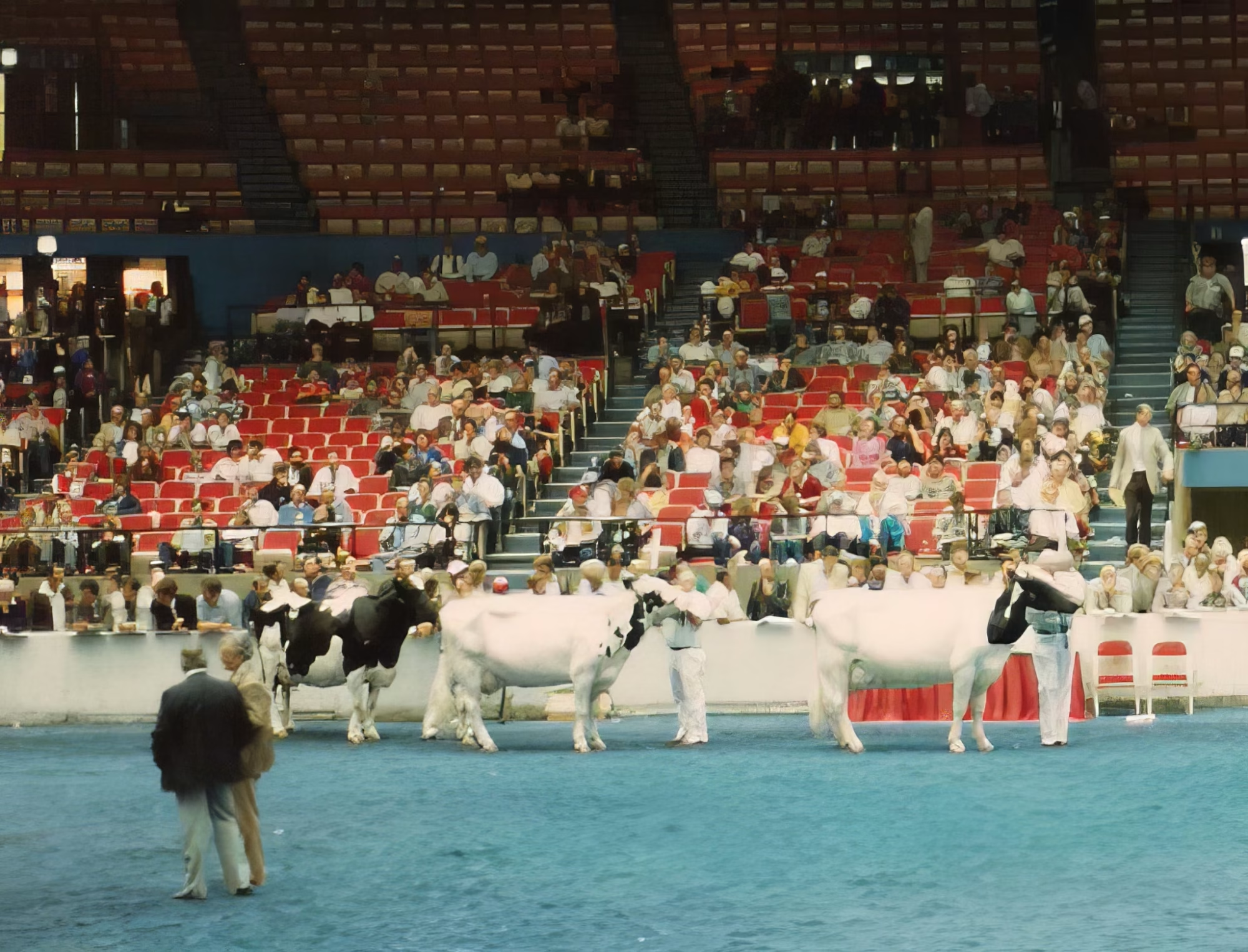
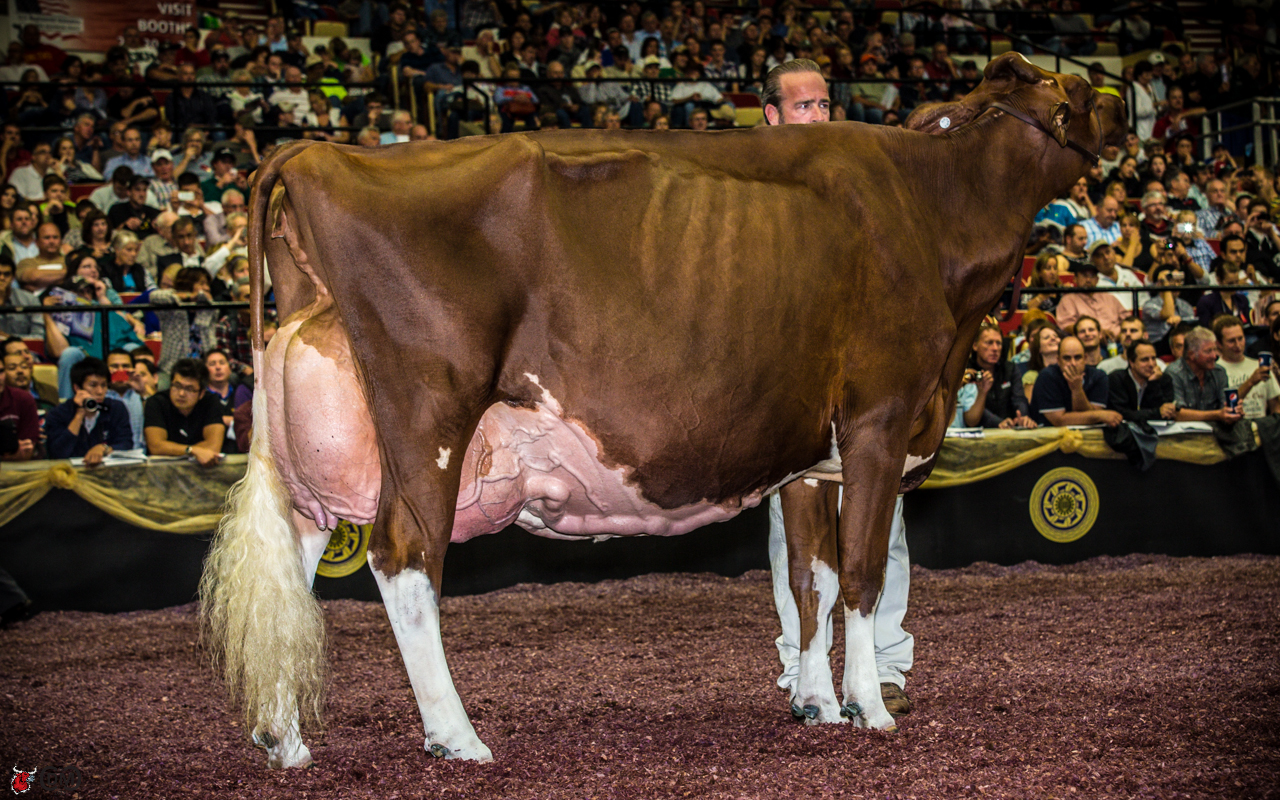
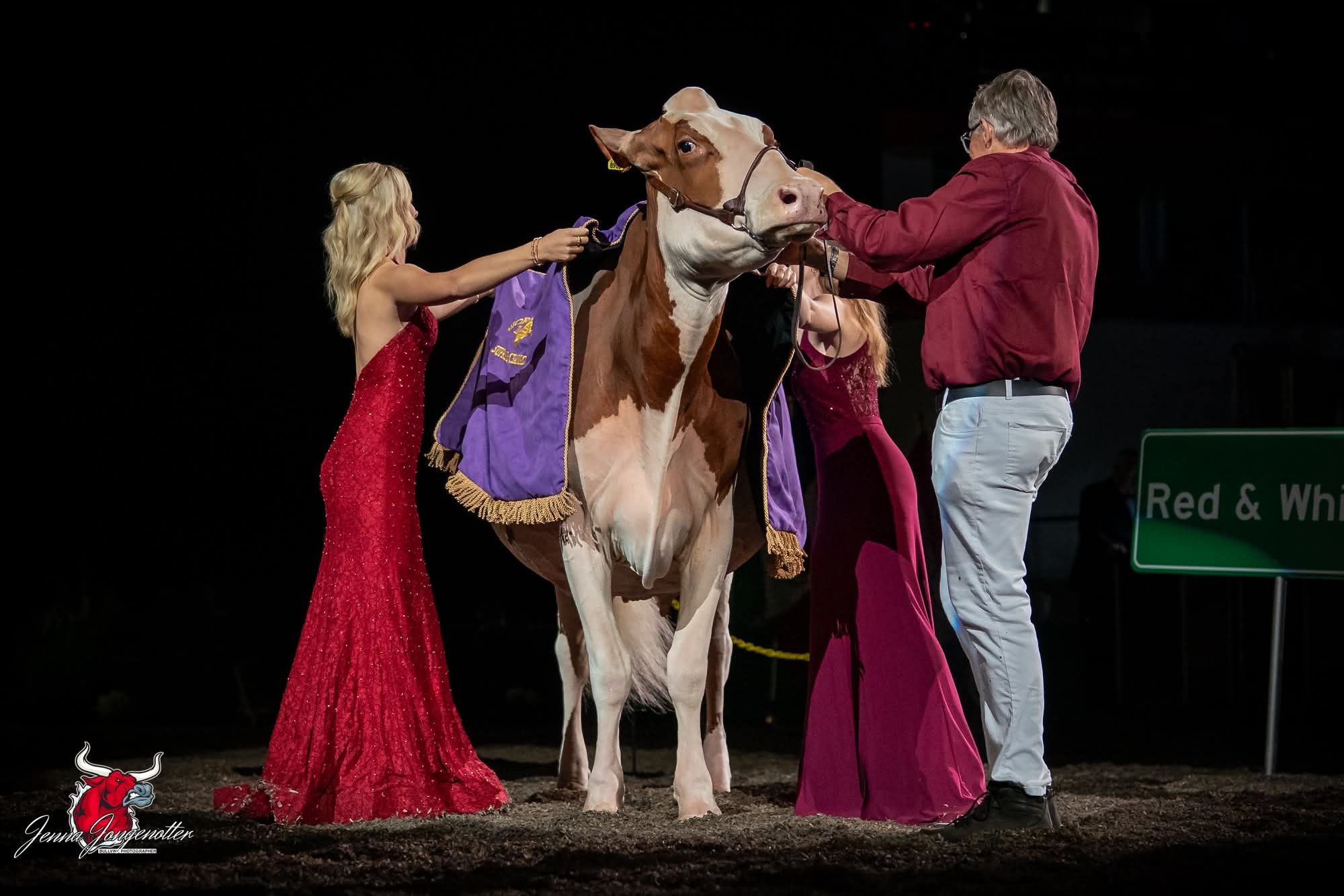
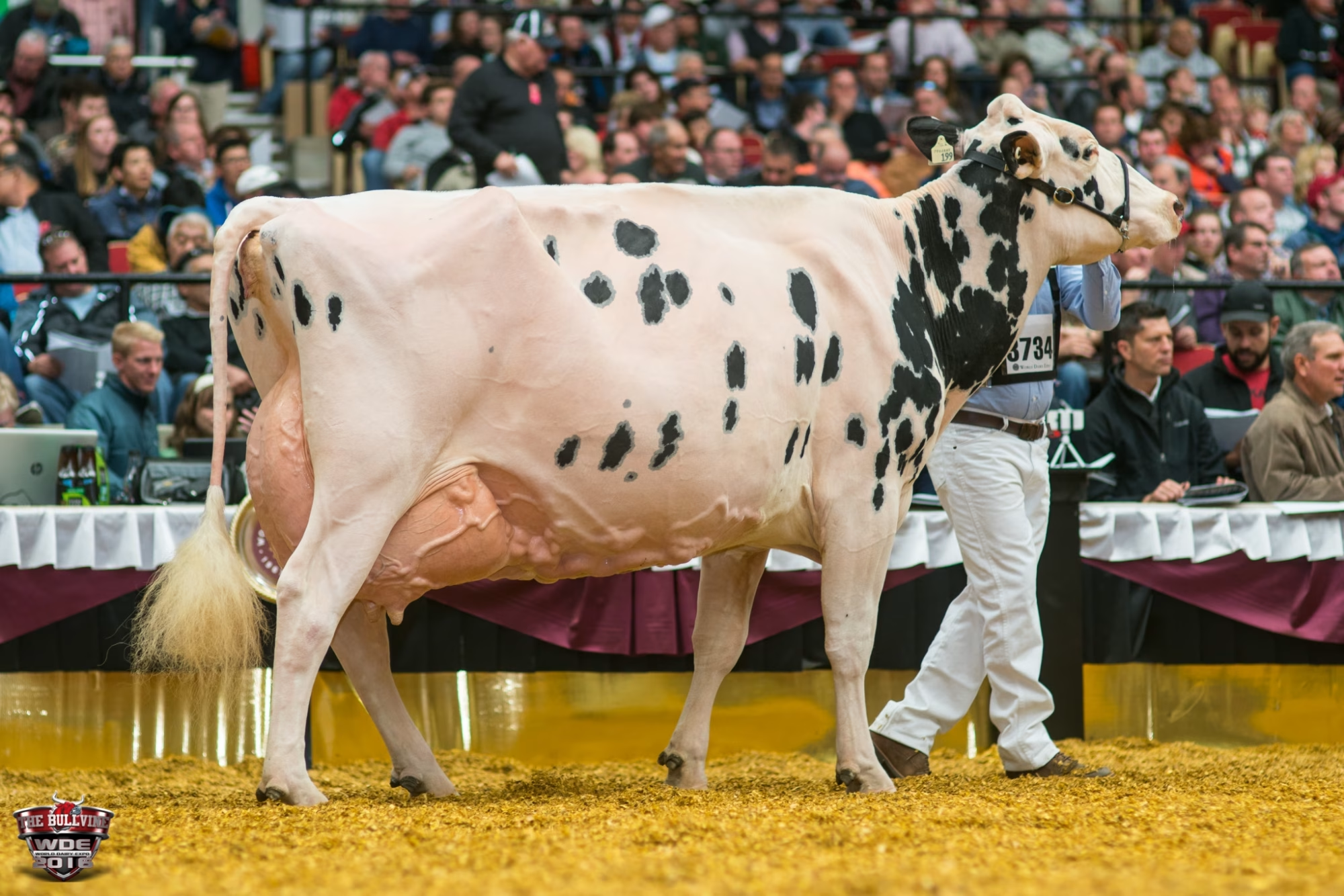
Lovhill Sidekick Kandy Cane takes Grand Champion at the Largest Dairy Show in the world— The ring is a mirror — it rewards the cow breeders, studs, and buyers chose to build. The only question that matters walking out: would she still be here in her fifth lactation?
The ring rewarded what breeders walked into it. Breed associations printed the scorecards. AI companies marketed the pedigrees. Commercial herds kept buying daughters of bulls that looked impressive at 24 months — before anyone asked how they’d hold up through three lactations. We chased bigger for 30 years, then the math caught up: big cows eat more just to exist, and the science flipped so hard the industry now docks stature and even built a whole trait, Feed Saved, to reward the opposite of what it rewarded for a generation. Same people. Opposite advice.
So don’t blame the ring. The ring is a mirror. It shows you exactly what you selected for — and the penalty is just the glass finally being honest.
The Cow That Still Stings
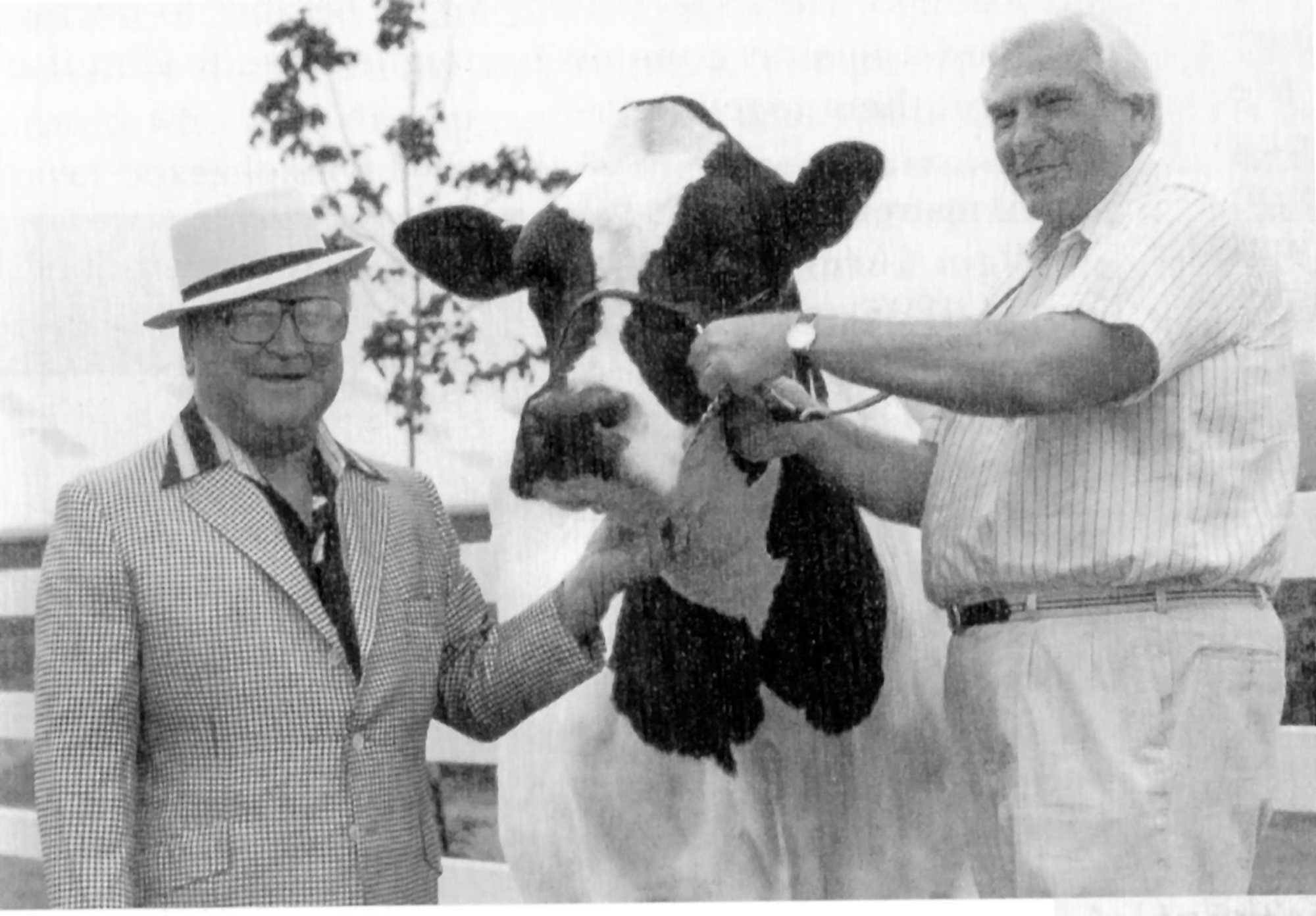
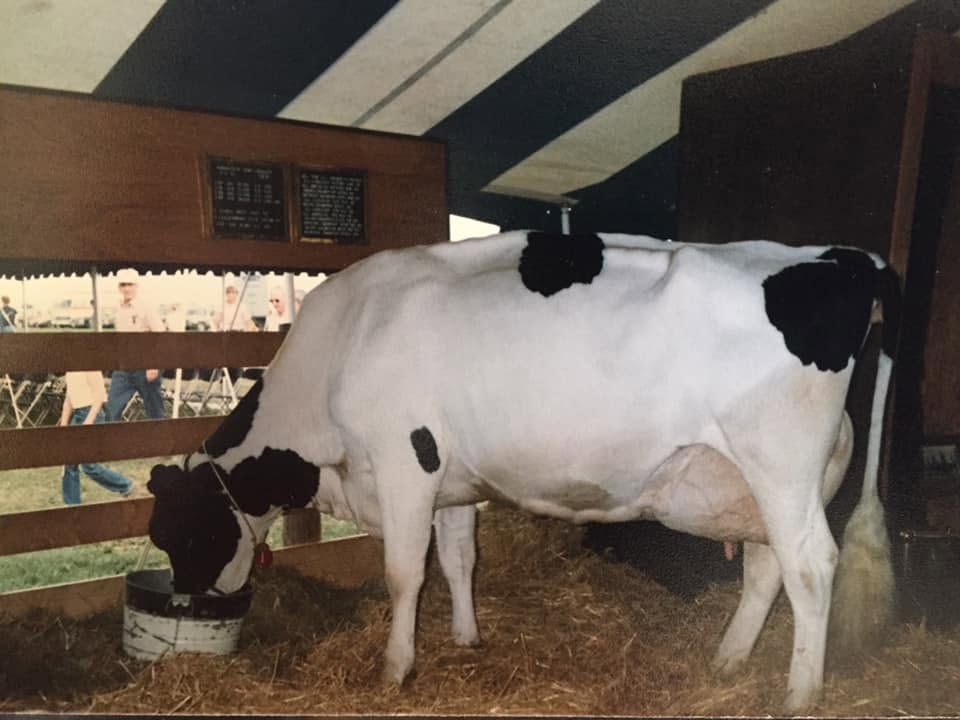
Then there’s the story that stopped the thread cold. A longtime breeder recalled hauling a cow to slaughter decades back — an 18-year-old downer, a small black cow, scored 88, with strength, width, and a beautiful udder. By his telling, she was among the first cows in Wisconsin to top 300,000 pounds of milk lifetime. Yet she never scored Excellent, he says, because she wasn’t tall enough. U.S. bull studs wanted nothing to do with a son of hers. That son went to Europe and did great things.
We couldn’t independently verify the record, so take it as one breeder’s memory, not documented history. But the shape of it rings true to anyone who bred cows in that era. One of the most productive cows in her state, denied the top score and shut out of the bull pipeline for a single reason — too short — back when short was the sin. The pendulum that beat her is the same one now swinging back to penalize the cows that replaced her. The trait didn’t change. The fashion did.
Options and Trade-Offs for Your Herd
The thread wasn’t just venting. Read together, your peers left a working playbook.
Your situation
Recommended move
The trade-off you accept
Warning flag
Weighting F&L hard, no progress
Push stature (53%), work the cull sheet for legs
Legs still improve slowly
21% won’t move on its own
Older / shorter stalls, slatted floor
Treat a stature minus as a feature
Pass on tall pedigrees
Tall cows leave earlier here
Want durability, no show hit
Breed width, strength, capacity first
Skip flashy narrow-tall bulls
Balanced tall scores neutral
Breed show-type
Price the penalty before you commit
Read linear traits, not just composites
64–65″ ≈ −1 Final Score point
Run the 30-day sire audit — do this before your next semen order. Pull your bull list this month. Sort by stature PTA, and on your tallest transmitters check productive life and the Feet & Legs Composite too. If you’re in older, shorter stalls on slatted floors, do what that breeder did and treat a stature minus as a feature, not a flaw. Costs you an evening. It’s the fastest way to see whether your lineup is still ordering the cow the scorecard now penalizes.
Chase substance, let height fall where it lands. Best for herds that want durability without a show hit. Select for width, strength, and capacity first — a balanced tall cow scores neutral, as that spring classification proved. The trade-off is real: you’ll pass on flashy, narrow, tall pedigrees that still photograph like a magazine cover.
Push feet and legs directly, too — the critics earned that. Don’t let the stature debate become an excuse to ignore legs. But know the catch going in: at 21% against stature’s 53%, progress comes slow, so lean on the composite and your own cull records rather than chasing one bull’s foot-angle number.
If you breed show-type, price the change with your eyes open. A daughter at 64–65 inches now gives back close to a full point of Final Score she’d have kept a year ago. Read the individual linear traits, not just the composites, and decide the trade honestly.
Key Takeaways
If you’re weighting feet and legs hard and seeing no herd progress, that’s the heritability talking. F&L sits at 21%; stature runs 53% in Canada and low-0.4 in the U.S.. Push where it moves, and work the cull sheet for the rest.
If you’re scared the penalty guts a good tall cow, breed width and strength and quit worrying. Both composites carry a −0.20 stature weight by design, so capacity earns back what height docks.
If you run older or shorter stalls, treat a stature minus as risk management, not heresy. At roughly $2,000 a replacement, early exits are the expensive kind of tall.
If your best-ever cow would’ve been too short for Excellent a generation ago, ask what today’s fashion is costing you that you can’t see yet. Fashions reverse. Function doesn’t.
What Fashion Is Your Herd Really Built For?
The best breeders can stand in front of a gorgeous cow and still ask the only question that pays the bills on Monday morning. So walk out to your tallest, flashiest heifer — the one that photographs like progress — and ask it straight: would you want 500 more of her in the milking string? If the answer’s no, that was never the ring’s mistake. It was yours.
Pull ten of your best cows this week and run the stick next to the cull history. See which fashion your herd is actually built for. We laid out the full penalty schedule and the Net Merit math in our earlier breakdown of Holstein’s 60-inch line — this piece was your answer to it, and the reply thread isn’t closed. Keep it coming.
Hold-to-Proof Cost Simulator
Calculate the structural retention balance of your replacement pipeline
% of annual culls leaving before Lactation 3 due to frame/leg weakness
Operational Capital Impact
Annual Replacement Pipeline Requirements:175 heifers / year
Stature-Linked Early Exits:9 animals / year
Stranded Heifer Investment:$18,144
Formula assumes early structural exits fail to fully amortize their initial $2,016 rearing asset cost prior to third lactation. Benchmark figures adapted from Overton & Dhuyvetter, Journal of Dairy Science.
Complete references and supporting documentation are available upon request by contacting the editorial team at editor@thebullvine.com.
Learn More
HCC vs. PTAT: Holstein’s 2026 Stature Penalty and the New 60-Inch Line — Arms you with a diagnostic tactical breakdown to separate physical classification risk from paper genetic evaluations. This evaluation explains how high-stature bulls mask weak traits and why the new Holstein Conformation Composite index corrects this blind spot.
Ed Bos Picked the Same Traits for 50 Years. A Million-Cow Study Just Proved He Was Right — Delivers an unvarnished data analysis proving that intermediate-framed cows generate an extra $2,678 in lifetime revenue over heavy-framed contemporaries. This massive multi-year dataset validates the economic benefit of rejecting extreme height for functional durability.
The Sunday Read Dairy Professionals Don’t Skip.
Every week, thousands of producers, breeders, and industry insiders open Bullvine Weekly for genetics insights, market shifts, and profit strategies they won’t find anywhere else. One email. Five minutes. Smarter decisions all week.
Six times All-Canadian. One of the most formidable bulls ever shown. Then his daughters freshened—and Rocket Tone couldn’t breed. Only 1 in 6 champions ever could.
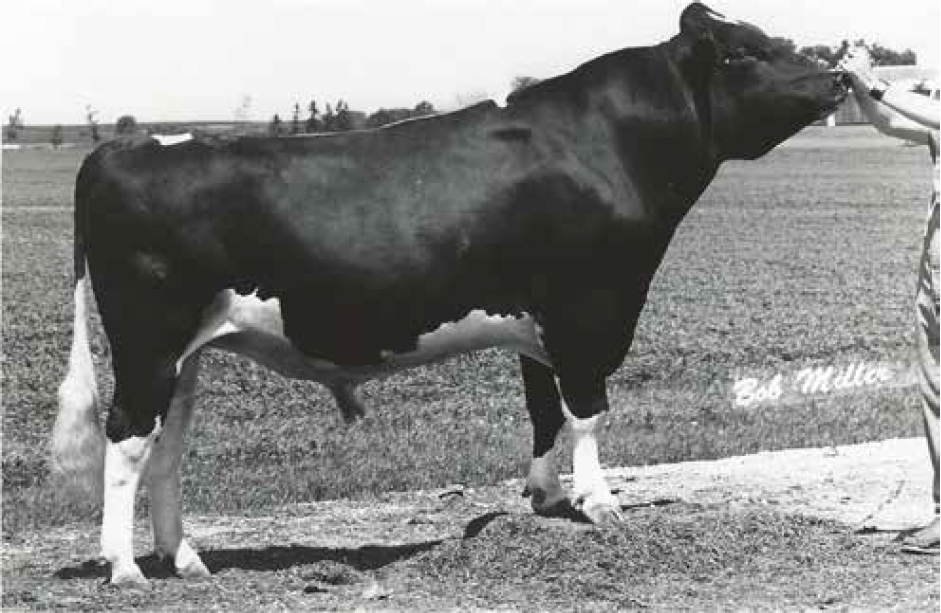
Rockwood Rocket Tone on the tanbark—six times All-Canadian and one of the most formidable bulls ever shown. The crowd could read his greatness at a glance. His daughters, freshening years later, would tell the truth the show ring couldn’t.
The crowd could see Rockwood Rocket Tone before he ever truly entered the ring.
That was the thing about the great show bulls of that vanished era. They didn’t just walk onto the tanbark—that soft brown bark-dust footing spread across the show floor. They arrived. Big necks, hard toplines, sweeping ribs, hides rubbed to a shine, handlers leaning into the halter just enough to make the whole performance look effortless. In those days—before bull classes disappeared from the major fairs and left the males to the semen catalogs—a champion male could still stop traffic at the Royal Winter Fair or the Canadian National Exhibition. And Rocket Tone was one of the most formidable ever to set foot on that floor.
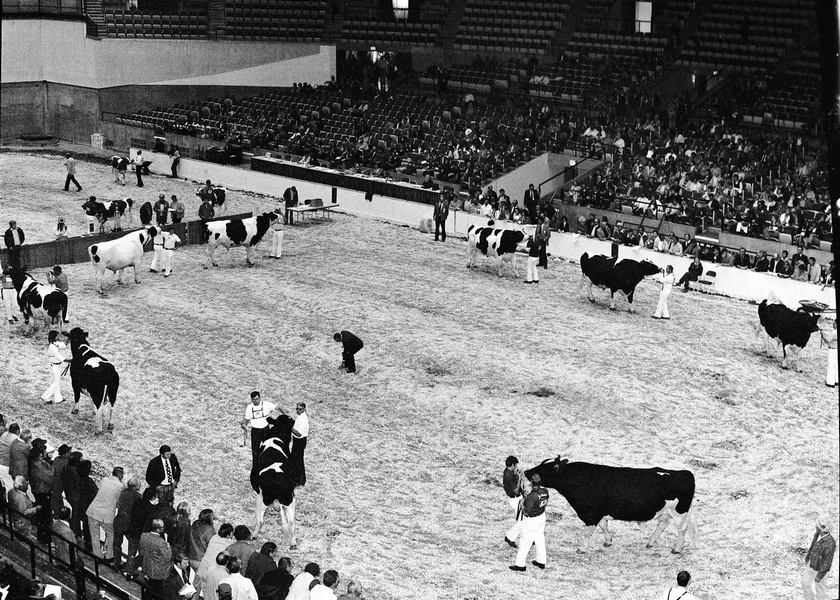
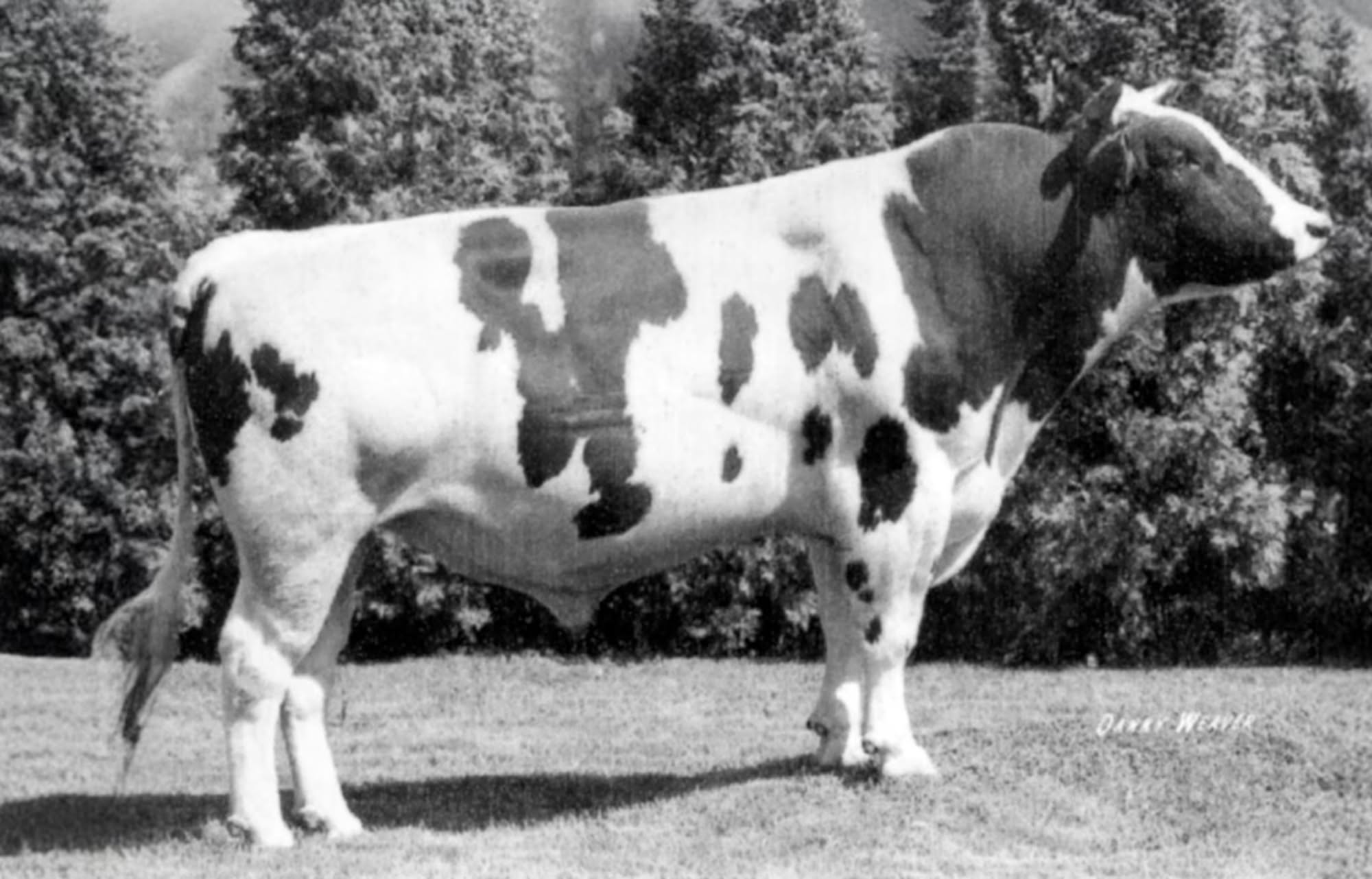
Look hard—you won’t see this again. A full class of aged bulls works the tanbark at the 1975 World Dairy Expo, before a coliseum that came just to watch the males. Within a generation these classes all but vanished from the great fairs, and with them went the stage where a bull could stop traffic on looks alone.
He was a son of Houckholme Sovereign Sky Rocket, bred at Rockwood Holsteins in St. Norbert, Manitoba, later proven at the Quinte District stud in Belleville, Ontario. Junior champion at the Toronto Royal Winter Fair in 1949. Then All-Canadian six times running—senior yearling, two-year-old, three-year-old, aged bull—a record beaten only by Montvic Rag Apple Marksman and Spring Farm Juliette.
Six times. Let that sink in. This was back when hauling cattle was real work, fitting was closer to art than science, and a bull had to whip other great bulls face-to-face—not win a photograph contest.
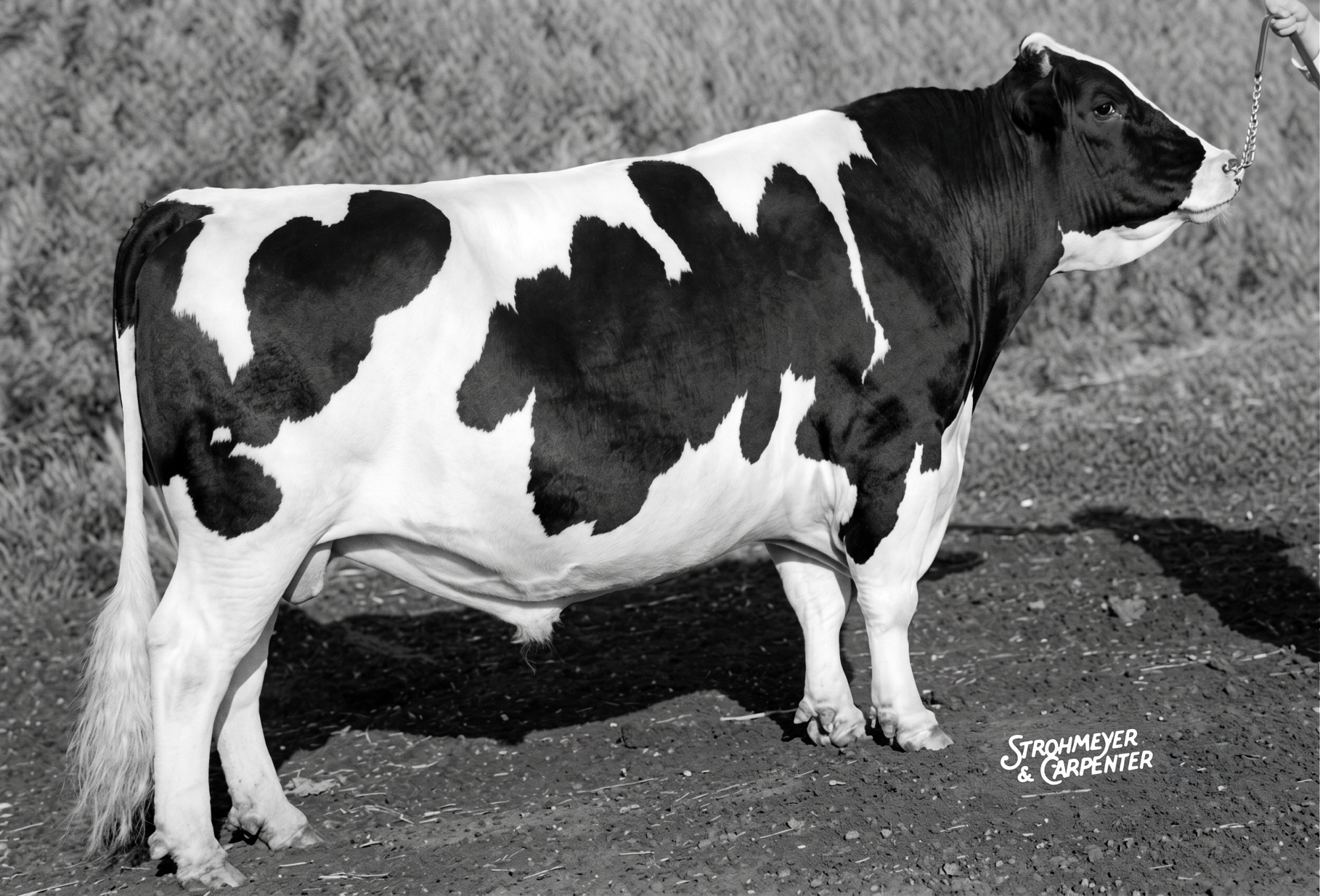
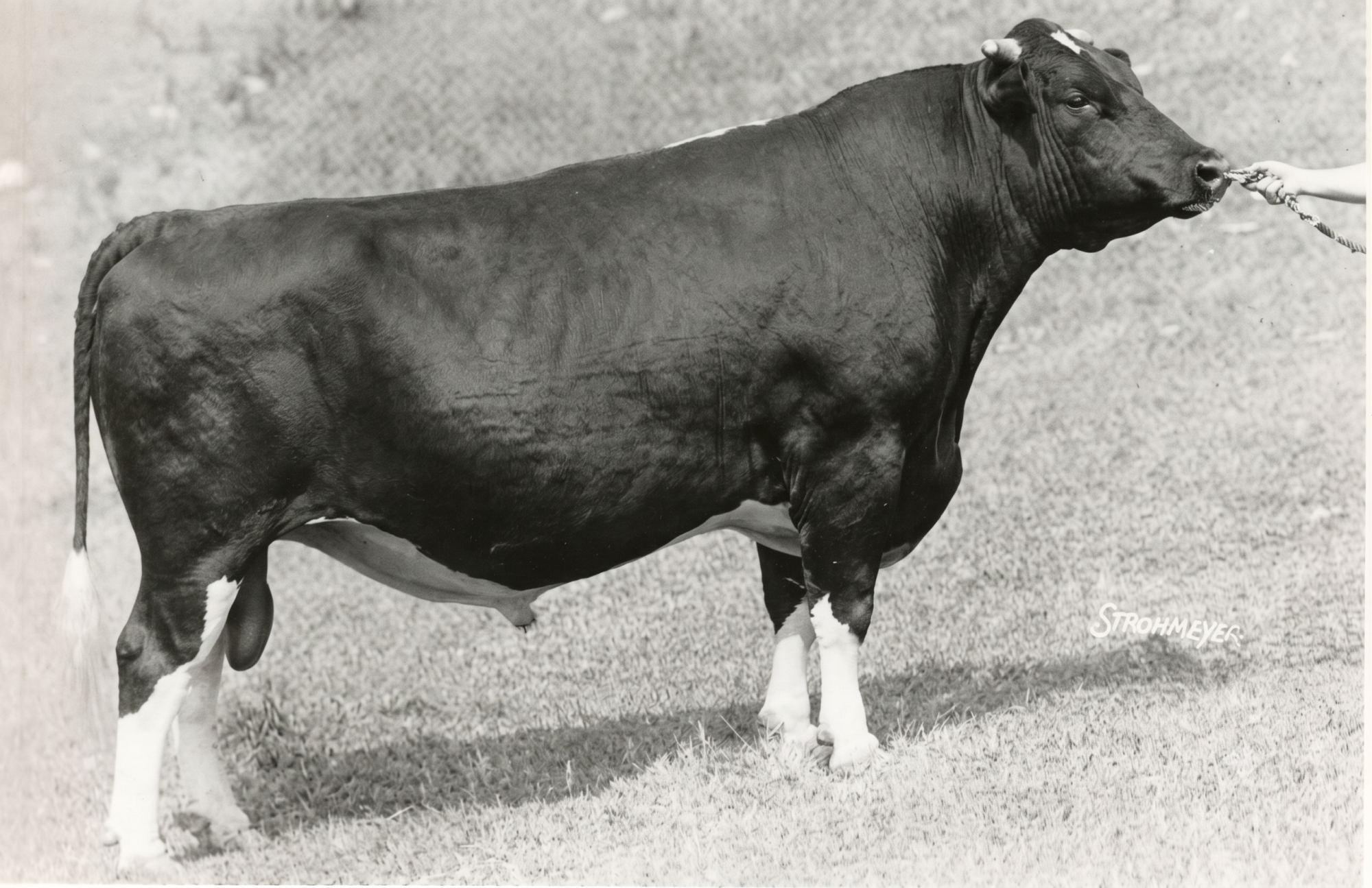
Rockwood Rocket Tone, immortalized by Strohmeyer & Carpenter. Study that topline, those ribs, that scale—this is the picture that won six All-Canadian banners. It’s also the picture that couldn’t tell you a single thing about what he’d breed.
And then, when the ribbons were boxed up, and his daughters began to freshen, the truth came in quiet.
Rocket Tone couldn’t breed.
Not the way breeders needed him to. Not the way that magnificent body promised he would.
“A dud, just an absolute disaster.” — E.Y. Morwick, on Rockwood Rocket Tone as a transmitter of desirable qualities
E.Y. Morwick—one of the sharpest students of Holstein history this continent ever produced—didn’t soften it. That line still lands like a cold pail of water down the back of the neck. The old bull had fooled the eye. Or maybe, more honestly, the eye had fooled the men who trusted it too far.
Now set him beside Smithcroft Snowball Rocket.
Snowball Rocket didn’t carry quite the same thunder. Gordon Smith of Milverton, Ontario bred him, a paternal grandson of Rockwood Rag Apple Remus, and Morwick described him as long, stylish, and beautifully balanced. He won All-Canadian as a two-year-old in 1956, then Reserve All-American and Reserve All-Canadian aged bull the year after. A lovely bull, sure. But not the mythic beast Rocket Tone appeared to be.
Then his daughters started winning. And they didn’t stop.
Smithcroft Snowball Rocket—long, stylish, beautifully balanced, but never the thunder Rocket Tone carried into a ring. He didn’t need it. His daughters went on to win the only contest that ever counted.
Greenden Rocket, All-American two-year-old in 1958. Delightful Rocket, grand champion at Chicago and Reserve All-American four-year-old in 1960. His gets of sire—that’s a group of a bull’s offspring shown together as proof of what he stamps into them—were nominated for All-Canadian honors in 1960, 1961, 1962, 1963, and 1966, and he pulled off the rare trick of nominating two separate gets in a single year, 1963. Four times his gets were nominated All-American, headlined by that intimidating string Green Meadow Farms of Elsie, Michigan brought out in 1960.
So there it is, laid out plain as a fresh classification card. Two related, structurally similar bulls from the same broad Canadian tradition. One a legend of the ring who left almost nothing. One a quieter champion who helped remake the breed.
That’s where this story really begins. Not in a straw-bedded calf pen—but in a warning. Admire the phenotype. Then interrogate the pedigree.
Act I: When the Ring Ruled
Most modern breeders can’t quite picture how much authority the show ring carried back then.
Today, a breeder studies genomic predictions, linear type breakdowns, daughter fertility, health traits, and production data that pours in faster than a barn cat at feeding time. Back then? A great bull standing under the lights at the Royal or the Waterloo Dairy Cattle Congress could become a breeding proposition almost entirely on the strength of looking the part.
And the part mattered enormously.
A show bull was supposed to project power without coarseness, breed character without weakness, enough scale to promise a next generation of big, durable, profitable cows. The tanbark was theatre. But it was also the marketplace. A championship raised semen demand, lifted sale prices, and earned bragging rights that traveled from the county line clear across national borders.
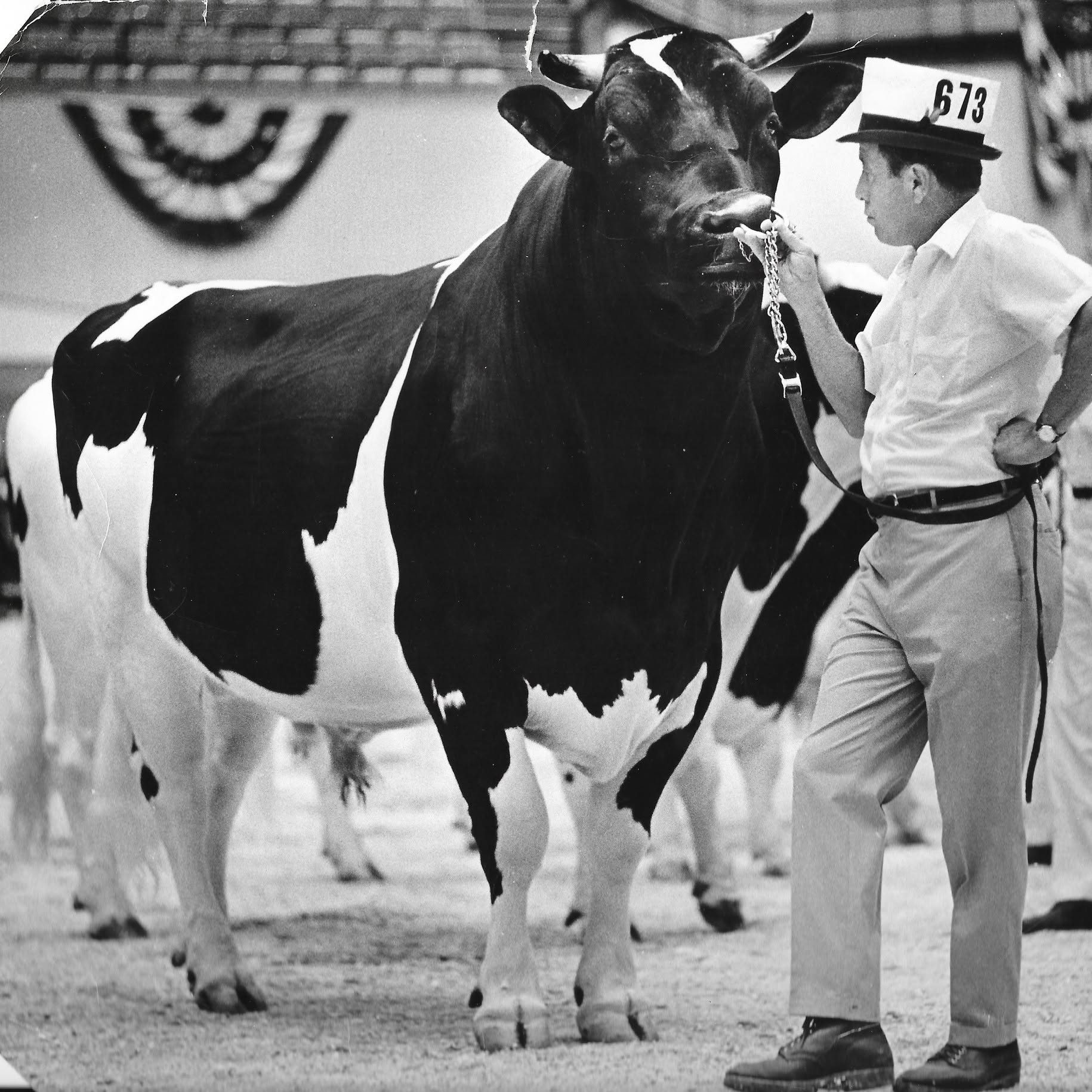
The whole theatre in one frame: Allen Hetts, one hand steady on the chain, walks Crescent Beauty Talent past the bunting—Reserve Grand Champion Bull in 1967, Grand Champion by 1969. That fall, Talent shipped to Japan, because a title like this didn’t just win a banner. It could move a bull halfway around the world.
Artificial insemination was beginning to change everything. The Oxford District Cattle Breeders Association, under herdsman Paul Jensen, did something almost no other Ontario stud bothered with—it actually campaigned its bulls at the shows. Snowball Rocket was one of those Oxford bulls, keeping company in the record with Baker Reflection Jerry, the All-Canadian two-year-old of 1960, and Clearcreek Model, Reserve All-Canadian bull calf in 1956. That mattered, because A.I. was becoming the bridge between a bull admired by a few thousand people at ringside and a bull whose daughters milked in barns from Ontario to Oregon.
But the old question wouldn’t lie down.
Did the glamour bulls breed?
Morwick chewed on that through eleven of the most prominent Holstein breeding establishments in North America—six Canadian, five American—and his verdict was blunt. Most didn’t. By his own reckoning, only about half of the famous show bulls proved reliable transmitters, and only about a third of that half—call it one in six overall—ever reached the exceptional class. A follow-up analysis put numbers to the whole roster, scoring each institution’s show bulls from five, for a superior transmitter of type and production, down to zero, for a bull who as a breeder did next to nothing.
So yes. The tanbark could crown a champion.
But the breeding shed kept its own book, and it balanced to the penny.
Here’s how the eleven houses finished, best to worst:
Breeding establishment
Principal breeder
Score
Daughter Verdict & Key Sires
Rosafe Farms
Dr. Hector I. Astengo
17
Citation R. scored a perfect 5; Preceptor, Signet, and Shamrock Perseus each earned 4 off the A.B.C. Reflection Sovereign blood.
Mount Victoria
T.B. Macaulay
16
Marksman a 5, Sovereign and Monogram 4s, Hartog a 3—the Rag Apple dynasty at full power.
Carnation Milk Farms
E.A. Stuart
16
Governor Imperial and Royal Master perfect 5s, Homestead Revelation a 4, Matador Masterpiece a 2.
Pabst Farms
Fred Pabst
15
Sir Roburke Rag Apple and Roamer Dean Walker Lad 5s—yet four-time All-American Fobes Burke managed a 1.
Elmwood Farm
Robert V. Rasmussen
14
King Bessie Korndyke Ormsby a 5; Progressor, Senator, Gypsie each a 3.
Spring Farm
J.M. Fraser
14
Inka Jewel and Fond Hope 5s, Reflection a 4—and Sovereign Supreme, for all his ribbons, a 0.
Romandale Farm
Stephen B. Roman
9
Marquis a 5, Dividend a 4, while Governor and Argus both scored 0.
Franlo Farm
F.W. Griswold
8
Roebuck Regent and Gen Treasure Model 4s; Chip Douglas King and Chip Montvic Royal, 0s.
Cash-Mar
C.M. Bottema Jr.
8
Ormsby Jerry and Jerry Darky Lassie 4s; Jerry Delight and TM Pell City, 0s.
Sheffield
John Malcolm
8
Crown Prince, Dusty, Monarch, Chico—four pretty bulls, four scores of 2.
Glenafton Farm
J.J.E. McCague
5
Rag Apple Alert a 5; eight other campaign sires, all 0.
Rosafe seventeen. Glenafton five. Sit with that gap a moment, because the whole story lives inside it.
The best sires all shared something the failures didn’t. Deep maternal families. Linebred strength that held up. Daughters and sons who proved the body wasn’t just a lucky roll of the genetic dice. The great ones stood behind cows like Montvic Rag Apple Colantha Abbekerk, Lakefield Fobes Delight, Bonnie Lonelm Texal High, Soo Rag Apple Princess. The duds? Often glamorous enough to win—but without the additive power to stamp a daughter.
That’s the whole difference between a great photograph and a great sire.
Act II: The Bulls Who Kept Faith—and the Ones Who Broke It
Mount Victoria: The Cathedral of the Rag Apples
If this story has a cathedral, it stands at Mount Victoria.
T.B. Macaulay’s herd at Hudson Heights, Quebec became the home of the Rag Apple blood that shaped North American Holstein breeding for decades, concentrating the line of Johanna Rag Apple Pabst into cattle that looked important before the records even confirmed it. And then came the brothers.
Big, black, and beautiful. That’s exactly the feeling Morwick reached for when he wrote about Montvic Rag Apple Marksman and Montvic Rag Apple Sovereign, both sons of the great cow Montvic Rag Apple Colantha Abbekerk. They formed the All-Canadian produce of dam—the top-placed pair of offspring from one cow—in 1945, 1946, and 1947. Other famous male pairs had come before: Hays Taxpayer and Hays Alamoda, Hays Sensation and Hays Supreme, Man-O-War Progressor and Sir Man-O-War Heilo. Put them side by side and photographed against Marksman and Sovereign? Morwick said no contest.
But the brothers had something those pairs didn’t. They bred.
Montvic Rag Apple Marksman—big, black, and beautiful, and rarest of all, a champion who bred as well as he looked. Seven times All-Canadian, then sire of five All-Canadian gets. This is what it looks like when the eye and the pedigree finally agree.
Marksman went All-Canadian seven times as an individual and then sired the All-Canadian gets of 1946, 1947, 1949, 1950, and 1951. Sovereign sired A.B.C. Reflection Sovereign and Houckholme Sovereign Sky Rocket—two of the most prolific sources of show-winning stock the breed had. And there’s a twist worth savoring: Sky Rocket was Rocket Tone’s own sire. The same family that produced the breed’s great disappointment also produced its engine. Blood is like that. Generous and cruel in the same breath.
Now, the sad one.
Montvic Rag Apple Hartog spent too many of his best days on the show circuit and not enough at Hays Farms doing bull’s work. He wasn’t used nearly as hard as he should’ve been. And yet even from that neglect he threw Hays Supreme—the best bull, Morwick said, the Hays boys ever bred. Hays Supreme sired Supreme Ruby Echo, Canada’s first 200,000-pound milk cow, and anchored a line running down through Inka Supreme Reflection, A.B.C. Reflection Sovereign, Glenvue Nettie Jemima, and Spring Farm Fond Hope. A half-wasted bull. A river still deep enough to cut through generations.
Carnation: Stacking the Production Deck
Swing south and west now, to Carnation Milk Farms in Washington.
E.A. Stuart wasn’t only chasing ribbons—he was building production and scale into cattle that had to hold up in real, commercial dairying. And at Carnation, the proof didn’t come from the show string. It came stacked three generations deep. Carnation Governor Imperial won All-American three times and sired seven Gold Medal sons—Gold Medal being the old honor for a bull whose daughters proved themselves in both the show ring and the milk pail. His son carried it forward, and his grandson, Carnation Homestead Revelation, topped the Honor List—the annual roll of the top proven sires by daughter records—in 1958, completing the breed’s first three-generation string of Honor List-leading sires. Grandfather, father, son, each ranked first in the nation. Nobody had ever stacked three like that, and the men in the Carnation barn knew exactly what they were standing on.
Then came Royal Master, and this time the proof arrived in a sale ring.
Carnation Royal Master sired two world-record sellers at once—Don Augur Mothermarthas Pride at $108,000 in 1966, and Oak Ridges Royal Linda at $62,000 in 1968. Picture the Don Augur ring that day: the bidding cracking past every previous mark, the crowd going still, an auctioneer’s voice climbing into territory nobody in the barn had ever heard for a female. That wasn’t showring smoke. That was hard cash betting on a bloodline that had already proven it delivered.
The Wisconsin Invasion and the Illusion of Fobes Burke
Pabst Farms taught maybe the sharpest lesson of all—and it cut the opposite way.
Fred Pabst’s herd at Oconomowoc, Wisconsin, bred cattle of tremendous uniformity, and Pabst quietly produced non-show sires like Pabst Regal and Pabst Roamer who each threw two All-American gets. But the bull everyone came to see was Pabst Fobes Burke, classified EX-96—an outstanding score for a bull in that day.
What a sight he must’ve been. He was All-American four times between 1953 and 1957, and he headed the Wisconsin invasion of the 1956 Royal Winter Fair, the year Pabst walked into Toronto and presented both grand champions—Fobes Burke and Plain View Inga. One can only imagine the mood at ringside for the Ontario men that afternoon. Wisconsin hadn’t come to compete. Wisconsin had come to take the flags home, and did.
Then the daughters freshened.
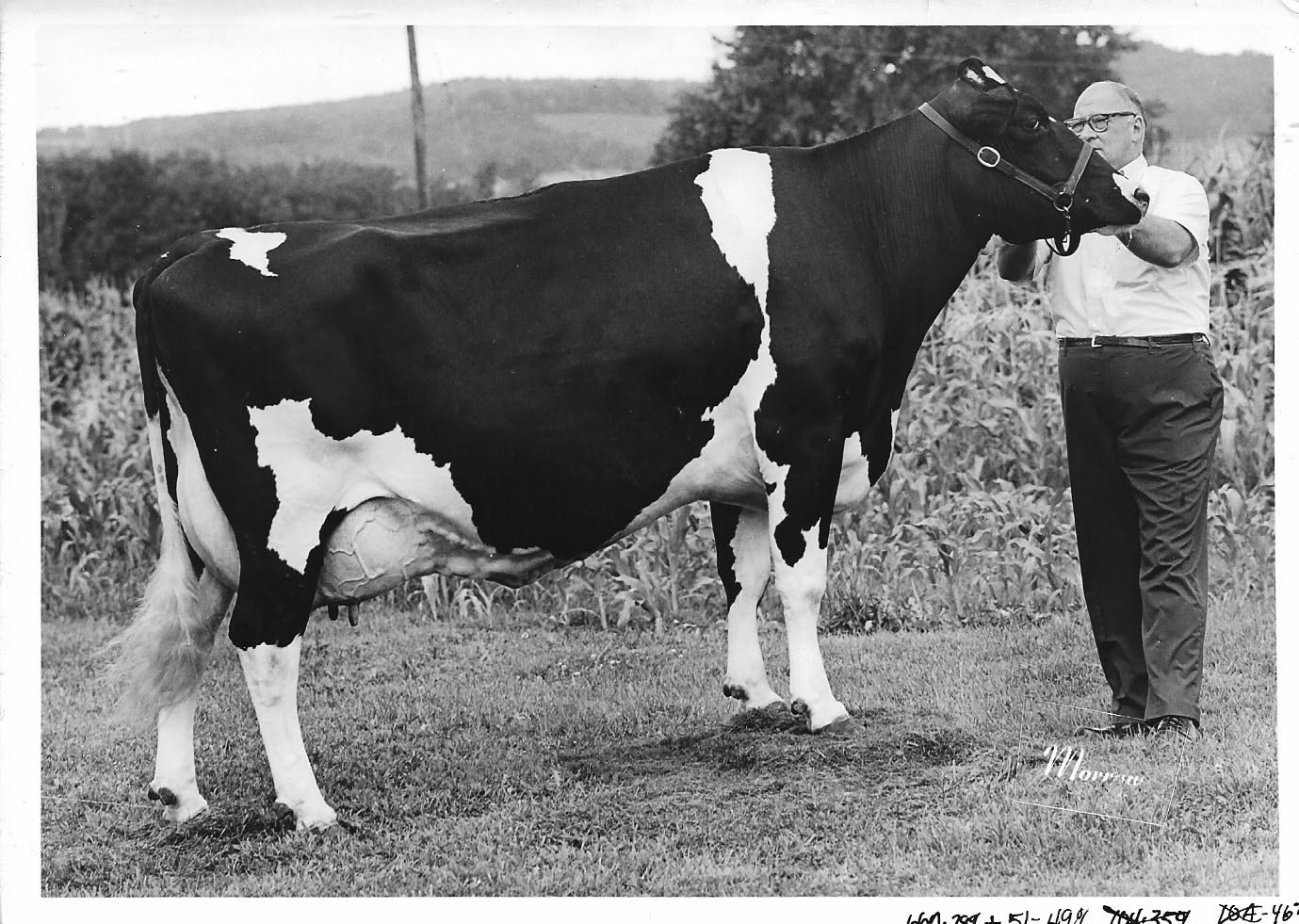
Pabst Fobes Burke, classified EX-96—four-time All-American and the bull everyone crowded the rail to see when Wisconsin took both grand championships at Toronto in 1956. The body was flawless. What his daughters freshened into would tell a very different story.
And Fobes Burke—by the good sire Sir Regal Fobes, out of a Wisconsin Admiral Burke Lad daughter—did next to nothing. What stung most was where the real breeding power sat: not in the champion, but in the father who’d never drawn half the crowds. Sir Regal Fobes left thirty-four classified daughters averaging 82.7 points, six of them Excellent. Walk that number back to what it meant. In an era when a solid working cow scored in the high seventies, a bull who could pull a whole barn of daughters up past eighty-two—with a half-dozen going Excellent—was a genuine type-builder. Pabst Sir Roburke Rag Apple was better still: three All-Americans, fifteen Gold Medal daughters, 230 daughters over 100,000 pounds lifetime, and leading Honor List sire in 1961, 1962, and 1964. Roamer Dean Walker Lad ranked second on the Honor List in 1954 with nine Excellent offspring and Class Extra sons—Class Extra being the Canadian rating reserved for sires whose progeny stood out most sharply. The glamour bull in the middle of all that? A footnote.
Maybe there’s nothing mysterious there. Maybe some bulls are simply great without being able to hand it down. That’s the uncomfortable part every breeder eventually swallows: an animal can be excellent without being prepotent.
Spring Farm: The Costliest Decision Jack Fraser Ever Made
Spring Farm made that same point—and it must have cost Jack Fraser some sleep.
Fraser, of Streetsville, Ontario, bred cattle that became part of the breed’s foundation memory. His Spring Farm Inka Jewel was an All-American bull calf in 1935, then opened in 1937, winning grand at Ottawa and reserve grand at the C.N.E. And then, at the Lindsay Fair, the bull got hung up in his halter, wrenched his back, and had to be destroyed.
Read that again. One tangled halter, one bad wrench, and a young sire of enormous promise was gone.
Except he wasn’t, really. In just three herds and a short life, Inka Jewel sired Inka Supreme Reflection and Inka Supreme Lillian for Jim Henderson, plus lines feeding into A.B.C. Reflection Sovereign, Spring Farm Juliette, and Spring Farm Fond Hope. Short life. Long shadow. That’s how it goes with the real ones.
But the harder story—the one that stings—was Sovereign Supreme.
Spring Farm Sovereign Supreme, a son of Montvic Rag Apple Sovereign, went All-Canadian four times and All-American three. Fraser believed in him. The Herd Book from the late 1940s shows more than 100 Sovereign Supreme calves registered by Fraser—against just five he registered by Elmcroft Voyageur M, the other bull sharing his herd-sire duties.
Picture Fraser years later, thumbing back through those pages. A hundred-plus by the bull who couldn’t transmit. Five by the bull who could.
“Using Sovereign Supreme to the near-exclusion of Voyageur M was probably the biggest mistake Jack Fraser ever made.” — E.Y. Morwick
Sovereign Supreme was a write-off in the breeding shed. Voyageur M sired Spring Farm Fond Hope.
And Fond Hope changed the arc of everything. All-Canadian as calf, senior yearling, and two-year-old, he and his full sister Spring Farm Juliette formed the All-Canadian produce of dam four years running, 1950 through 1953. His influence ran so deep that Senator Harry Hays drew on his sons as foundation stock for a whole new beef breed, the Hays Converter. When a Holstein bull leaves his mark outside the Holstein breed entirely, you know the ground moved under everyone’s feet.
The Same Tune, Four More Times: Romandale, Franlo, Cash-Mar, Sheffield & Glenafton
The other houses kept singing verses of the same tune, so let’s take them together, because by now the pattern needs no introduction.
Stephen Roman—the mining magnate who poured a fortune into building Romandale at Unionville, Ontario—bred eight bulls that won twelve All-Canadian awards, and only two, Reflection Marquis and Dividend, truly cut through as sires. Marquis was the crown jewel, siring Agro Acres Marquis Ned and a string of sons, plus a daughter, Agro Acres Marquis Patsy, who went All-Canadian two years running. But Romandale Reflection Governor, three-time All-Canadian himself, left thirty-nine classified daughters averaging a dismal 51 percent Good Plus and better. Same prefix. Same glamour. And when the classifier worked down those Governor daughters, the cards came back with the kind of scores that make a breeder go quiet, set down his coffee, and rethink a whole mating plan. Argus, another All-Canadian, contributed nothing worth remembering.
A Canadian bull, an Iowa coliseum, a crowd on its feet—Romandale Reflection Marquis stands Grand Champion at the 1962 National Dairy Cattle Congress in Waterloo, led by Mac Logan and breeder Dave Houck. Of eight Romandale bulls that won twelve All-Canadian banners, Marquis was one of only two who bred as well as they showed—the crown jewel of Stephen Roman’s Holstein empire, and living proof of the rule this whole story turns on. (Read more: THE ROMANDALE REVOLUTION: How a Uranium Billionaire & Cow Sense Conquered the Holstein World)
Griswold’s Franlo, in Hopkins, Minnesota, ran under manager Henry Bartel Sr.—a fitter’s fitter—who turned out show-winning males with cookie-cutter consistency, and most were write-offs in the shed. They mirrored their ancestor, Chip of Nettie Aaggie, the bull who whipped both Marksman and Sovereign at the 1946 Royal yet failed as a breeder. Franlo Chip Douglas King and Chip Montvic Royal looked unbeatable and bred like fence posts. The two exceptions, Roebuck Regent and Gen Treasure Model, both traced their strength to one good cow, Browns Mistress Corrine—the maternal line steadying what the glamour line couldn’t.
Cash Bottema could fit and lead a bull with anybody who ever gripped a lead strap—”his bulls, not his own,” as Morwick dryly put it, needling the man who won on cattle he hadn’t bred. His Cash-Mar Ormsby Jerry and Jerry Darky Lassie proved solid, the latter posting a daughter-dam gain of 3,259 pounds of milk in a Montana herd. But Jerry Delight, three-time All-American, and TM Pell City left nothing behind.
John Malcolm’s Sheffield gave us the prettiest cautionary tale of the lot—and it came with the biggest cheque. The 1960 Sheffield Dispersal averaged $3,154 on 75 head—the highest North American auction average to that time—but that money rode on the magnificent females, not the bulls. Crown Prince, Dusty, Monarch, Chico—four handsome sons of Rosafe Sovereign Supreme who caught every eye and changed nothing.
And Glenafton. J.J.E. McCague bred nine bulls that won ten All-Canadian awards, and exactly one—Glenafton Rag Apple Alert—became an exceptional sire. Alert, a Marksman son, topped the 1944 All-Canadian Sale as a three-month calf at $5,100, then topped it again in 1947 selling to Chile for $11,500; he stayed under McCague–McIlquham ownership right through that fall’s Royal Winter Fair, where he placed first in the two-year-old class and stood reserve grand champion. His gift to the breed was Maplenix Rag Apple Mercury, a key sire of show type across Eastern Ontario in the 1960s.
The other eight Glenafton show bulls won their banners and left the barn silent behind them.
That contrast, all by itself, might be the whole article in miniature.
A generation after Rocket Tone, the tanbark still crowned its kings—Zeldenrust Fond Memory, Champion Bull at the 1974 World Dairy Expo. New decade, new coliseum, new champion under the lights. But the only verdict that ever counted was still waiting out in the barn, in the daughters he’d leave behind.
Act III: What the Daughters Always Knew
So the ledger closes on eleven great houses—and every one of them keeps circling back to a single, stubborn truth. A daughter doesn’t care about ribbons.
She either freshens with the udder, the feet and legs, the strength and production and staying power to make a breeder nod—or she doesn’t. A son either breeds beyond himself or he fades into yellowed photographs and old catalogs. The bull classes could honor a magnificent body, and sometimes the body told the truth. But the daughters spoke a language no judge could overrule.
Rosafe: When Beauty and Blood Finally Agreed
Rosafe Farms showed the dairy world what happened when beauty and breeding power finally lined up.
Dr. Hector Astengo, of Brampton, Ontario, bred bulls Morwick called scintillating and unequaled as breeders—most of them sons of A.B.C. Reflection Sovereign. Rosafe Signet was grand champion at the Royal in 1958 and 1959, and then his daughter Bond Haven Signet Sally took the Royal grand championship as a four-year-old in 1961. And this is the detail that ought to raise the hair on any breeder’s arm: that was the first time in history a Royal grand champion male had sired a Royal grand champion female. The photograph proved itself. The blood backed the beauty.
Rosafe Citation R., Signet’s full brother, sired All-Canadian gets across four different years and led Canada’s Honour List in 1966, 1967, and 1969. And that’s exactly where the past reaches out and lays a hand on the present—because Citation R.’s blood didn’t stay in the 1960s.
Rosafe Citation R.—the bull who ended the argument. Where so many champions couldn’t breed on, he earned a perfect transmitter score and topped Canada’s Honour List three times. This is what beauty and blood look like when they finally agree—and his blood was about to walk straight into the modern era.
The Genetic Echo: Where They Live Today
Follow Citation R. forward, and you arrive at Glenridge Citation Roxy.
Roxy was a Citation R. daughter out of Norton Court Model Vee. She classified EX-97, produced 209,784 pounds of milk and 9,471 pounds of fat in her lifetime, and became the first cow in the world to have ten daughters classified Excellent. Ten daughters, all Excellent. Mention that in a serious breeder’s barn today and watch the eyebrows climb, because plenty of good cows never leave one. Her maternal grandsire, Springbank Model Fame, traced straight back to that Franlo exception, Gen Treasure Model—the very bull whose good maternal foundation had rescued a risky glamour line a generation earlier.
So the old debate between glamour and transmission didn’t end in some dusty essay. It walked, on four black-and-white legs, right into the pedigrees breeders still chase.
And Roxy wasn’t the only one carrying that blood forward, which is the part that always stops me cold. Trace the maternal line of Walkway Chief Mark—a bull whose name a lot of older breeders can still rattle off from memory, one of the great proven sires of his day—and it runs back through Cash-Mar Reflection Triune to Franlo’s Gen Treasure Model, that same steadying cow family, turning up in the pedigree of a household name where you’d never think to look. Then there’s Round Oak Rag Apple Elevation—the bull who became one of the most influential sires in the history of the breed, a name sitting behind an enormous share of modern North American Holsteins. His maternal granddam? Glenafton Gaiety. An uncampaigned Glenafton cow who never chased a single ribbon in her life. The best animal in the barn, it turns out, isn’t always the one wearing the sash.
And if you think all that belongs safely in the past—that genomics finally settled the argument—look closer.
The Same Bet, Now in a Genomic Suit
The tools changed beyond recognition. The wager didn’t.
Today the glamour comes wrapped in a genomic test instead of a show halter. A chart-topping GTPI number, a headline LPI figure, an IVF-fueled flush program pulling dozens of embryos from a single donor, a six-figure genomic heifer changing hands before she’s ever milked—these are the modern equivalents of that big-necked bull stopping traffic on the tanbark. And the modern show ring still crowns its own royalty: names like Erbacres Snapple Shakira and Blondin Goldwyn Subliminal draw the same crowds, the same awe, the same assumption that a phenotype this good must breed on. Sometimes it does. Sometimes, just like Rocket Tone, it doesn’t.
The mandate hasn’t budged an inch. If the maternal line underneath all that data lacks the additive power to stamp the next generation, you aren’t buying breed improvement—you’re buying a very expensive lottery ticket with a prettier envelope. Genomics narrowed the odds. It never repealed the rule.
The Lesson That Outlived Them All
So what did the glamour bulls finally teach us?
To admire a great phenotype—and then interrogate it. That a bull’s own body is one performance, while his daughters are the encore that actually matters. That deep cow families and repeatable transmission must outweigh one perfect afternoon under perfect lights.
And they taught humility. Because no honest breeder reads about Rocket Tone, Sovereign Supreme, Fobes Burke, Reflection Governor, or those eight silent Glenafton bulls without a chill of recognition. Those weren’t ugly animals. They weren’t nobodies. They were often magnificent. The trouble was never bad eyes. The trouble was trusting the eye, alone, to tell the whole story.
But don’t mistake this for a scolding. It’s a tribute.
Because the bulls that did transmit gave the Holstein breed its backbone. Marksman and Sovereign lit the Rag Apple name for generations. Governor Imperial, Homestead Revelation, and Royal Master carried Carnation production down through record-shattering sales. Sir Roburke Rag Apple and Roamer Dean Walker Lad proved a show bull could be more than a pretty picture. And Citation R. carried Astengo’s genius into daughters and gets, and into one of the most revered cow families the breed has ever known.
Maybe that’s the lesson still standing after all these years. Genomics changed the tools. Classification changed. The bull classes have all but vanished from the great fairs, and semen now travels farther than any show string ever could. But the old question hasn’t aged a day. Every time a breeder squints at a proof, watches a heifer cross the concrete, and wonders whether her beauty will outlast the photograph, that same quiet question is doing its work at the very heart of breed improvement—the one Rocket Tone’s daughters answered the hard way. Does she transmit?
Rockwood Rocket Tone deserves to be remembered—not for failing, but because his failure taught a lesson too expensive ever to forget. Smithcroft Snowball Rocket deserves to stand right beside him, not as the prettier legend, but as the bull who reminded everyone that the true champion is often crowned years after the judge’s hand comes down. Between the two of them lives the great and permanent lesson of Holstein history: the tanbark can crown the body, but only the daughters can crown the blood. The breed we milk today wasn’t built by the bulls who merely looked immortal—it was built by the ones whose daughters made them so.
Key Takeaways
A show banner tells you what a bull is, not what he’ll leave behind—Rockwood Rocket Tone won All-Canadian six times and still bred like a fence post, while quieter Snowball Rocket remade the breed through his daughters.
Only about 1 in 6 of history’s most decorated show bulls became exceptional sires. Before you chase a phenotype, dig into the maternal line—deep, proven cow families are what separated Rosafe’s 17 from Glenafton’s 5.
The rule didn’t change with genomics. A chart-topping GTPI heifer or a six-figure flush donor still has to transmit, or you’ve bought a very expensive lottery ticket with a prettier envelope.
Continue the Story
The Vision of Mount Victoria: T.B. Macaulay’s Holstein Legacy – Long before Rocket Tone fooled the eye, T.B. Macaulay was using strict mathematical principles to build the foundational Rag Apple dynasty, proving that true breeding power is engineered through rigorous maternal selection rather than show-ring glamour.
The Bull Who Changed Everything: The Johanna Rag Apple Pabst Story – Walk the old barns of the 1920s Wisconsin circuit to see how a single prepotent sire defied the odds of Morwick’s one-in-six rule, anchoring the entire genetic framework of the modern Holstein breed.
Rosafe Citation R – Discover how Hector Astengo’s linebred masterpiece carried the ultimate triumph of blood over beauty forward through time, leaving an omnipresent blueprint of excellence that still dominates pedigrees in today’s genomic era.
The Sunday Read Dairy Professionals Don’t Skip.
Every week, thousands of producers, breeders, and industry insiders open Bullvine Weekly for genetics insights, market shifts, and profit strategies they won’t find anywhere else. One email. Five minutes. Smarter decisions all week.
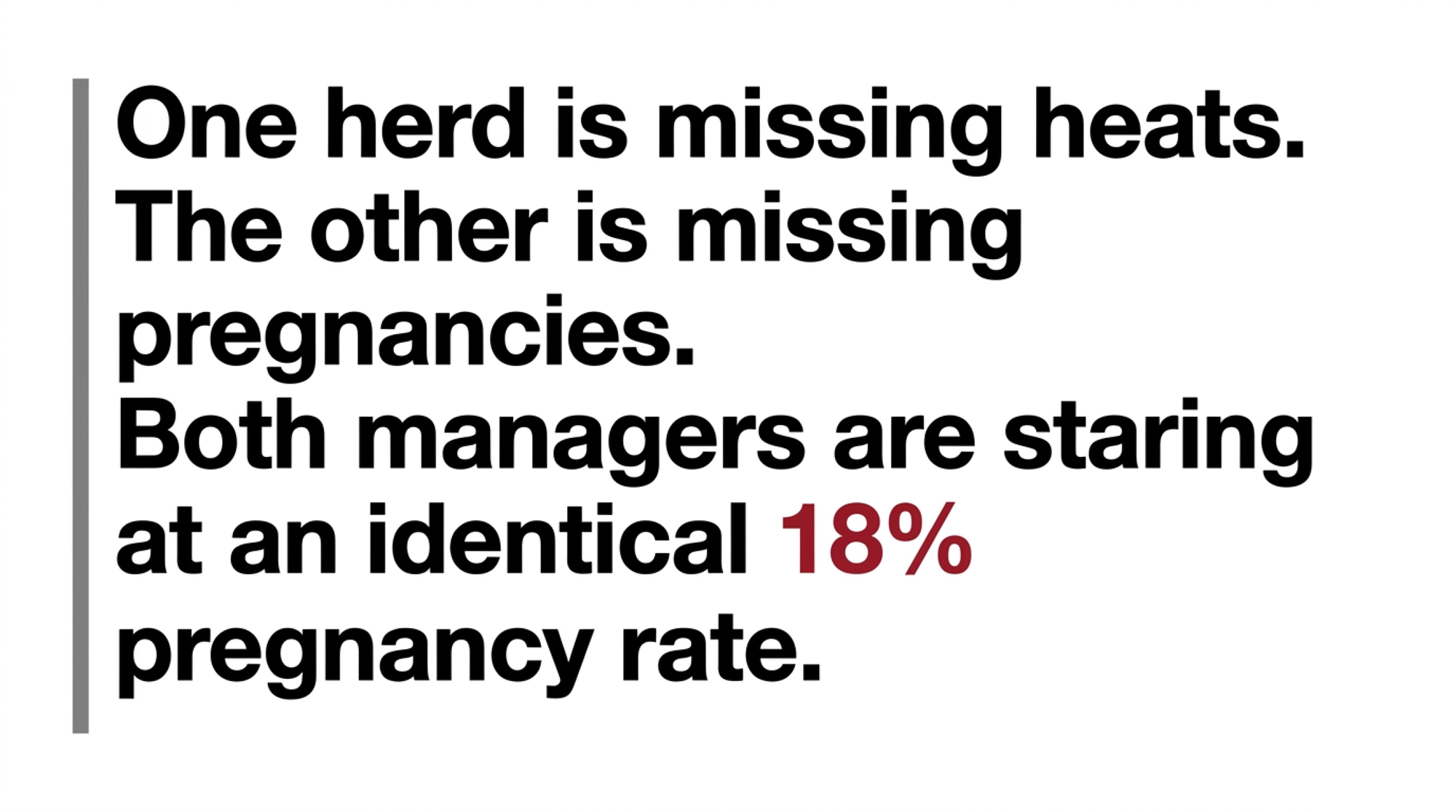
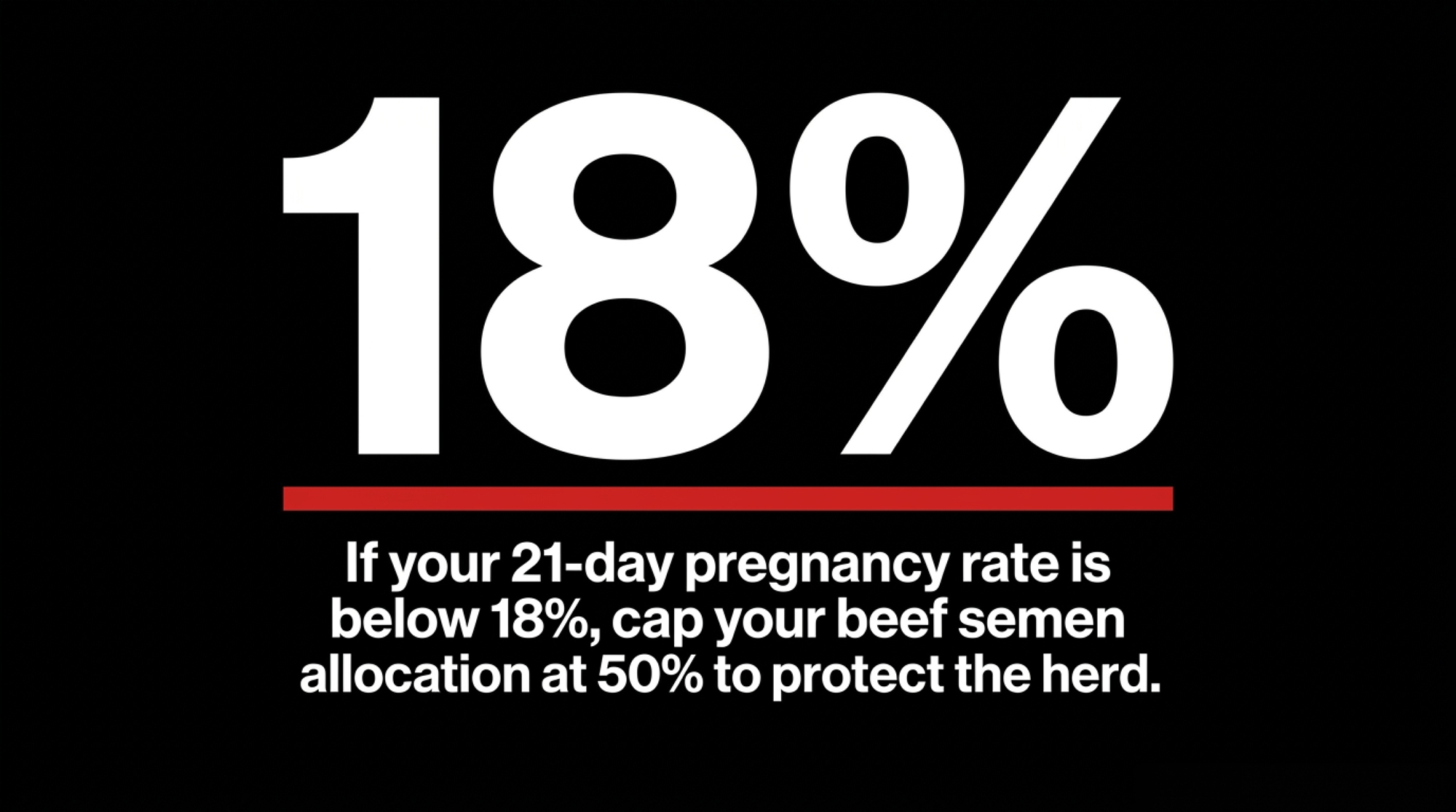
Two herds. Same 18% pregnancy rate. One’s missing heats, the other’s missing pregnancies — and the manager watching conception rate can’t tell which. The fix for one is the wrong move for the other.
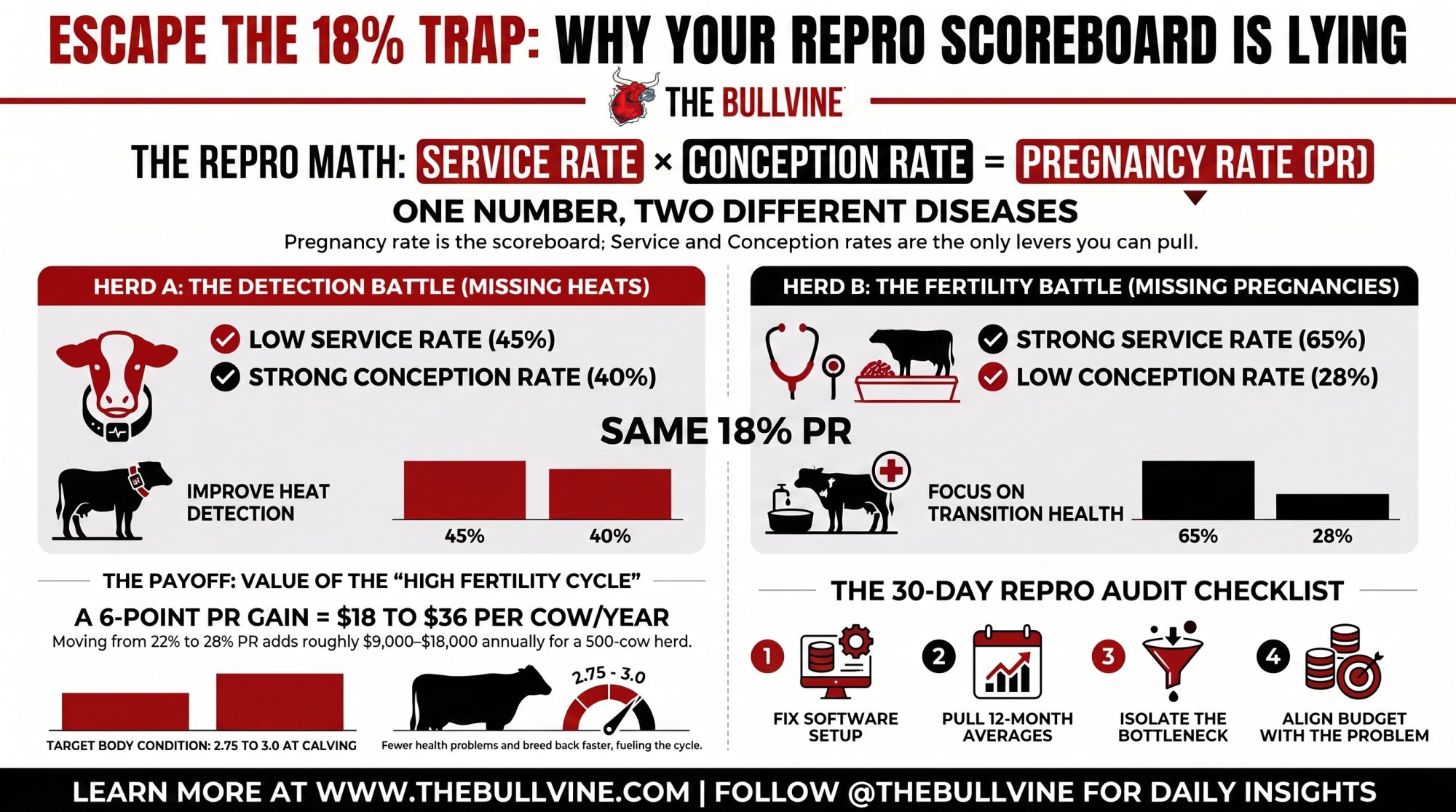
Picture two herd managers at the same repro meeting, both staring at a 21-day pregnancy rate of 18%. Same number, same screen, same shrug. One of them is missing heats. The other is missing pregnancies. And neither one can see it, because they’re both watching conception rate instead.
That’s the trap. It quietly costs herds real money while the actual problem hides one column over — and the fix for one manager is the exact wrong move for the other.
The Number Everyone Quotes, and Few Actively Manage
Ask a herd manager for their conception rate, and you’ll get an answer before you finish the question. Ask for their 21-day pregnancy rate and watch them reach for the software. That gap tells you how the industry got trained.
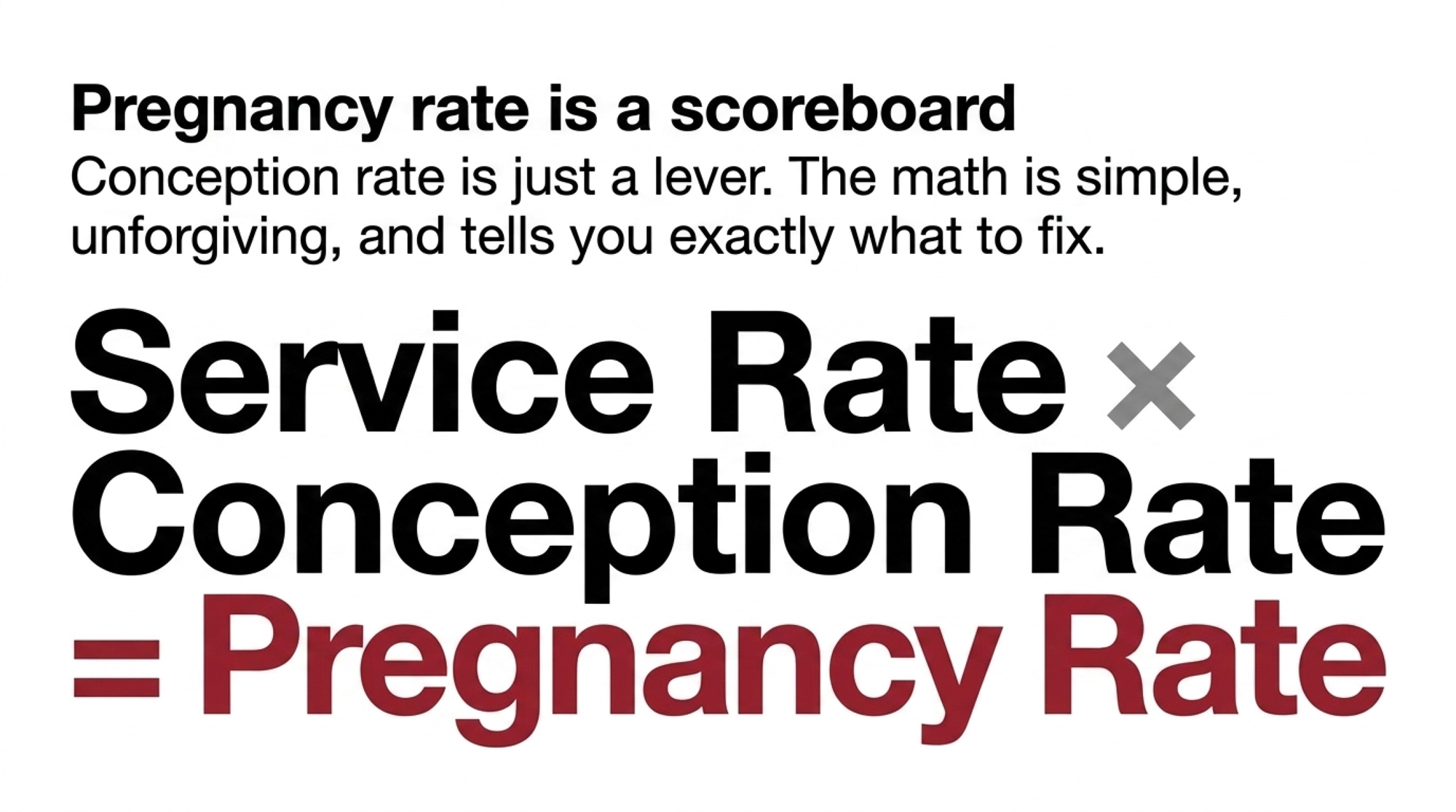
Conception rate is a fine number. It’s just answering the wrong question. It tells you how well a breeding worked — nothing about how many cows were even in the room when the breeding happened. Paul Fricke’s framing at the 1999 Western Canadian Dairy Seminar laid this out decades ago: pregnancy rate is the product of two levers — service rate (the share of eligible cows bred in a 21-day window) and conception rate (the share of those breedings that hold).
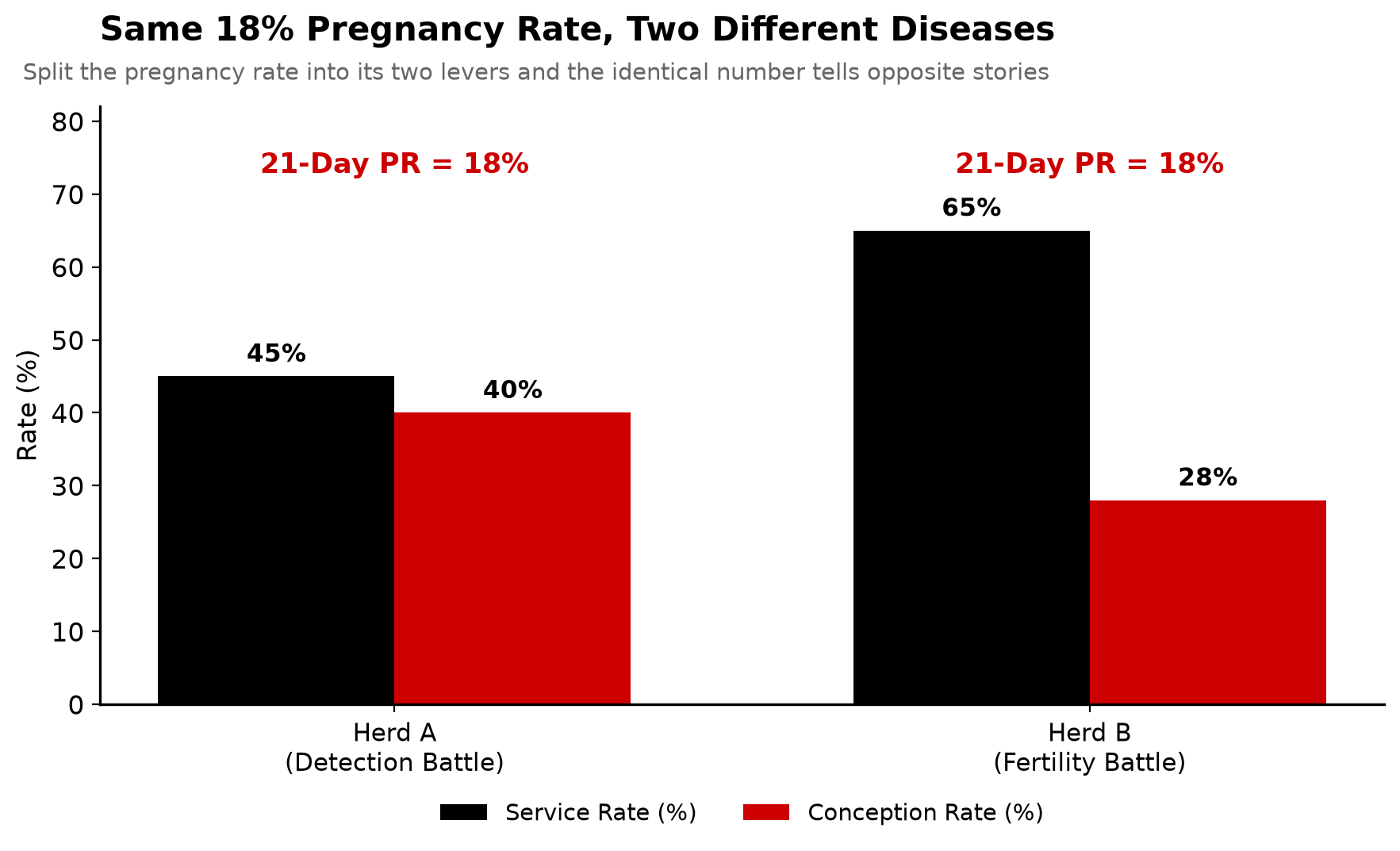
So the math is simple and unforgiving. Breed 40% of your eligible cows, get 50% of them pregnant, and your 21-day PR is 20%. Conception rate is a lever. Pregnancy rate is the scoreboard.
Here’s the piece worth sitting with. The whole ecosystem was built to celebrate the outcome of a single breeding, not the flow of cows from open to pregnant. The U.S. Council on Dairy Cattle Breeding’s Cow Conception Rate PTA is defined per-insemination. Extension bulletins teach it cow-by-cow — “two pregnant out of four bred, that’s 50%.” Even the ultrasound hands you a verdict on one animal at a time. It’s no surprise many managers think in cows, not in cycles.
Two Herds, One Number, Two Different Diseases
This is where the diagnostic gets clean once you know to look. Take those two 18% herds.
Metric
Herd A (The Detection Battle)
Herd B (The Fertility Battle)
21-Day Preg Rate
18%
18%
Service Rate
45% (low)
65% (strong)
Conception Rate
40% (strong)
28% (low)
The real disease
Missing heats (detection / rebreeding)
Missing pregnancies (transition / health)
The wrong move
Spending on Double-Ovsynch
Doubling down on heat detection
Multiply the two levers and both herds land at 18%. Identical from the outside. Completely different problems underneath.
Herd A has a heat-detection problem — cows aren’t getting bred often enough. Herd B has a fertility problem — cows are getting bred plenty, but too few pregnancies stick.
The 18% is just the symptom. The two levers tell you where the disease actually lives.
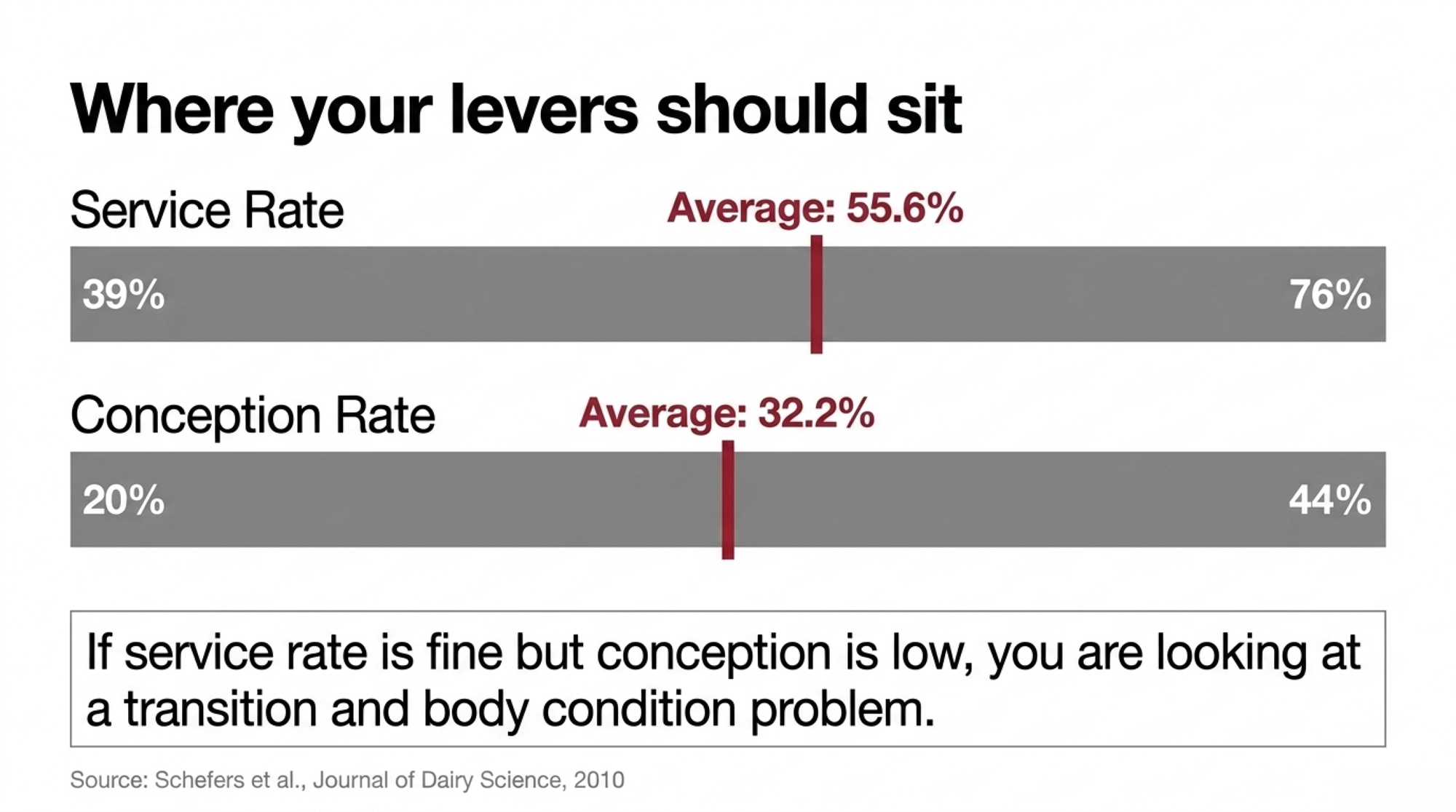
Schefers and colleagues (Journal of Dairy Science, 2010) put real ranges around this across 200 U.S. Holstein herds. Conception rates ran from 20% to 44%, averaging 32.2%. Service rates ranged from 39% to 76%, with an average of 55.6%. They also found that herds rebreeding quickly after a non-pregnant diagnosis pushed their service rate up — proof that one of these levers is a management decision, not a biological ceiling.
So when a repro report lands in front of you, split the PR back into its two parts and check each against those ranges. Service rate low, conception fine? You’ve got a detection and rebreeding problem. Service rate fine, conception low? Now you’re looking at transition health, body condition, and protocol design — a different barn, a different budget, a different conversation.
Lever
Schefers Range (200 US Holstein herds)
Target Threshold
If You’re Below → The Real Fight
Service Rate
39% – 76% (avg 55.6%)
Above ~55%
Under 50%: heat detection, rebreeding intervals, detection discipline
Conception Rate
20% – 44% (avg 32.2%)
Above ~32%
Under 30%: transition health, bunk, body condition 2.75–3.0
21-Day Preg Rate
~14% (2000s) → 21%+ today
20%+ (60% of DRMS herds now clear it)
Split into the two levers above before spending a dollar
Value of +1 point PR
$3–$6/cow/yr (conventional)
Six-point gain ≈ $18–$36/cow/yr
Doing nothing is the expensive choice
Where Do You Actually Pull These Numbers?
This is the part the textbooks skip. The diagnostic only works if you can get the two levers from your herd software, and the definitions have to be clean, or the whole thing lies to you.
In DairyComp 305, the workhorse command is BREDSUM\E — it runs the 21-day pregnancy rate and insemination (service) rate broken out by heat interval, with conception rate pulled from the same breeding analysis. In PCDART, it’s Standard Report 126, the Pregnancy Rate Summary, which calculates PR over 21-day intervals. Either way, use the rolling figure, not last week’s snapshot. A single 21-day cycle is too noisy to act on — a heat wave, a bad semen-tank week, one tech on vacation, and your PR bounces. Pull the trailing year and the signal steadies.
The trap is the eligibility definition. Service rate depends entirely on which cows the software counts as “eligible” in each 21-day window. If your voluntary waiting period is set incorrectly, or do-not-breed cows aren’t flagged, the service rate will read high or low for reasons unrelated to your heat detection. Before you trust either lever, confirm the VWP, the breeding cutoff, and the do-not-breed list are current.
The Cycle Most Managers Never See
Here’s the piece that runs underneath everything. Fixing pregnancy rate doesn’t just improve one lactation. It rewires the herd’s biology going forward.
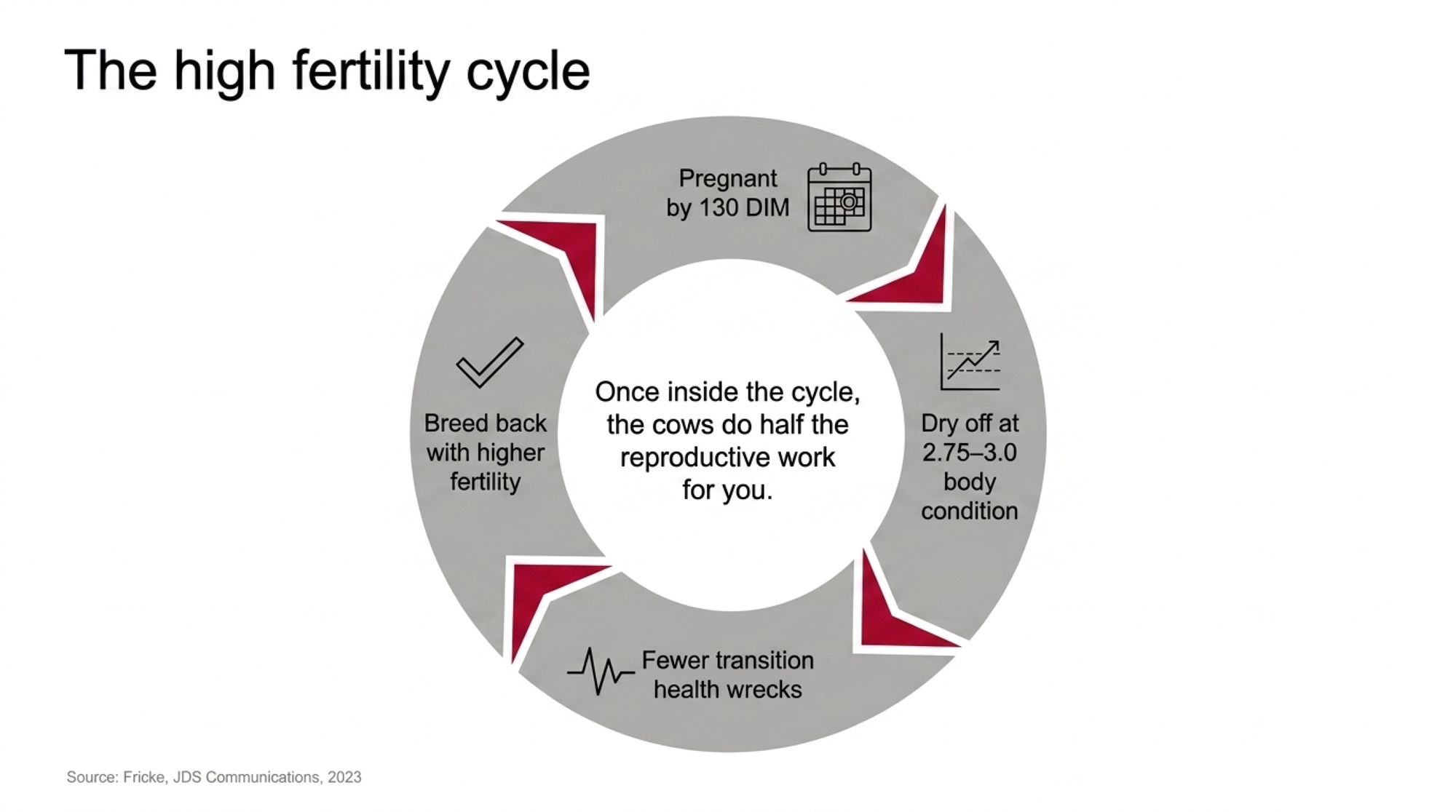
Fricke calls it the high fertility cycle, and his 2023 JDS Communications mini-review defines it precisely. Cows that establish pregnancy by 130 days in milk have shorter calving intervals, gain less body condition during the lactation, and dry off and calve at a lower body condition score — 2.75 to 3.0. After calving, those cows lose less condition, hit fewer health problems, breed back with greater fertility, and lose fewer early pregnancies, which lets them get pregnant again by 130 DIM.
That’s the loop. And it’s self-reinforcing in a way that makes it genuinely hard to break into from the outside. Middleton and colleagues (Journal of Dairy Science, 2019) tracked body condition change from a week before calving to 30 days after in 851 Holstein cows in a single herd, and the cows that held or gained condition bred back better with lower pregnancy loss.
Once a herd is inside that cycle, the cows are doing half the repro work for you. Good energy balance produces better embryos and fewer losses, resulting in more timely pregnancies and preventing cows from getting too fat at the tail end of lactation. The herds stuck outside it are fighting the reverse: long days open, over-conditioned cows, transition wrecks, poor fertility, more long days open.
The scale of the shift is real. Fricke’s UW-Madison Extension work on the high fertility cycle (updated August 2025) reports that the U.S. average 21-day pregnancy rate now exceeds 21%, with more than 60% of DRMS Holstein herds above 20% — a long way from the roughly 14% average of two decades ago, when 20% was a stretch goal few herds hit.
When Does Double-Ovsynch Actually Earn Its Keep?
This is where the protocol conversation gets sharp, because it’s really a sequencing problem. Too many farms reach for the most sophisticated tool first, before they’ve earned the right to use it.
The evidence for Double-Ovsynch is genuinely strong in the right herd. Nowicki’s 2017 review in the Journal of Veterinary Research reported final pregnancy rates of 49.7% for Double-Ovsynch versus 41.7% for Presynch-Ovsynch across the summarized trials, crediting the edge to better handling of anovular and inactive-ovary cows. A 2024 Frontiers in Veterinary Science study (Z. Li et al.) in high-producing cows found Double-Ovsynch cut follicular cysts to 0.8% (from 2.8%) and inactive ovaries to 0.2% (from 1.7%), with a numerically — though not statistically — higher pregnancy rate, 48.2% versus 41.8%.
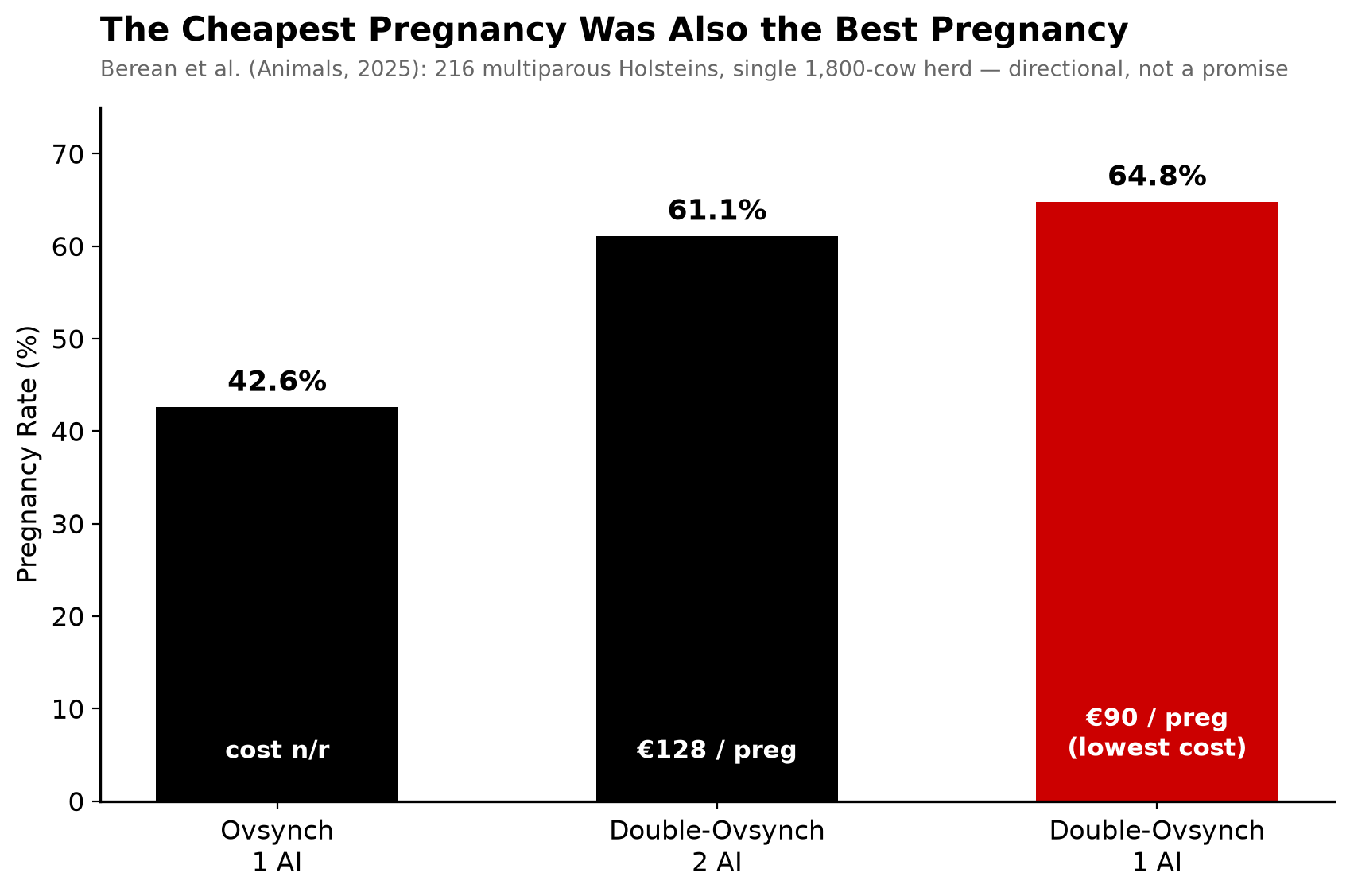
The most striking recent result comes from Berean and colleagues (Animals, 2025), who compared four protocols in 216 multiparous Holstein cows at a single 1,800-cow farm in Alba County, Romania, between October 2023 and May 2024. Double-Ovsynch with a single timed AI hit a 64.8% pregnancy rate — well ahead of standard Ovsynch with one AI at 42.6% — at the lowest cost per confirmed pregnancy, €89.51 (roughly $97 at the 2024 average euro-dollar rate). Adding a second insemination didn’t help. Double-Ovsynch with two AIs came in slightly lower at 61.1% and pushed cost per pregnancy up to €127.65 (about $138). One healthy-cow, single-herd result in one country. Read it as directional, not a promise for your barn.
The economics back it up where fertility is the true bottleneck. Ricci and colleagues (Journal of Dairy Science, 2020) modeled seven programs and found Double-Ovsynch+PGF more profitable than Presynch-Ovsynch — earning about $42 more profit per cow per year than one Presynch-Ovsynch variant — and calculated that U.S. hormone costs would need to run 5 to 14 times higher (2 to 6 times higher in the European market) before any Presynch program overtook it. Borchardt and colleagues (Journal of Dairy Science, 2021) pooled data from 9,735 cows across 11 studies and found that adding a second PGF dose during Ovsynch increased pregnancy per AI by 5.6 percentage points and was profitable in 95% of their scenarios.
The Seasonal Caveat: Why Those Returns Move With the Calendar
None of those economics hold still through the year. Heat stress hammers conception — cows in summer show weaker heats, more silent ovulations, and lower fertility to detected estrus. UW-Madison’s own DairyComp heat-stress work shows the pattern in hard numbers: one herd holding a 36% 21-day pregnancy rate in the cooler months dropped to 27.5% across June, July, and August.
That’s part of why the timed-AI advantage widens in hot months. When cows aren’t expressing strong heats, a program that breeds every eligible cow on schedule protects your service rate in the exact window when estrus detection falls apart. The Z. Li 2024 work pointing to fewer cysts and inactive ovaries under Double-Ovsynch matters most in the herds and seasons where ovarian function is already under strain. A protocol that looks like overkill in October can look like insurance in July.
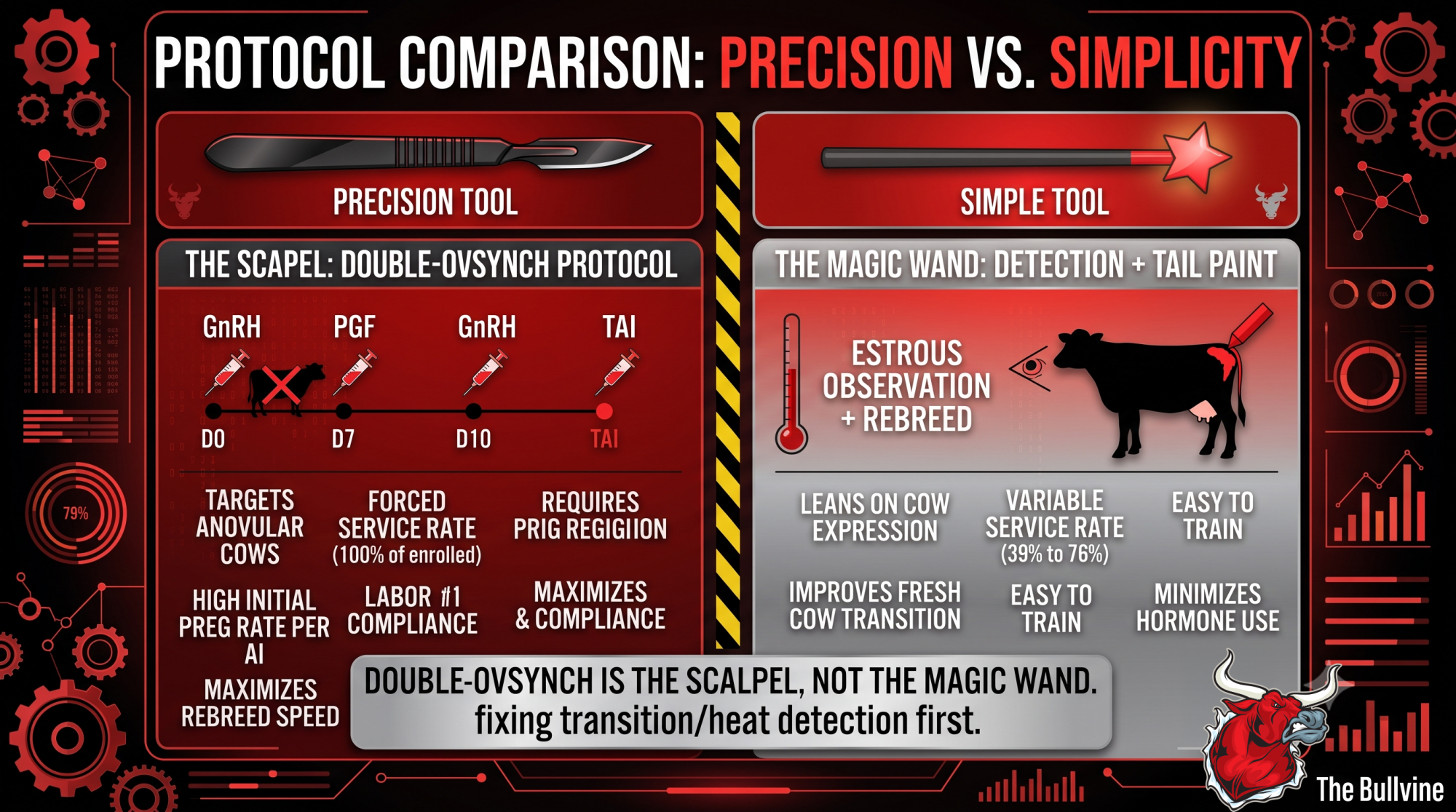
But none of that rescues a broken foundation. Double-Ovsynch is a scalpel, not a magic wand. If your service rate is stuck at 45% because heat detection is broken, more hormones won’t fix cows that never get bred. If your transition pens are throwing metritis and ketosis, and cows are dropping a full point in body condition, the protocol is decorating a problem that lives in the close-up pen. The honest sequence: fix body condition and transition, tighten detection and rebreeding, then reach for the scalpel.
The Barn Math That Stops the Shrug
At some point, a manager sitting at 22% PR decides that’s fine. Here’s the number that tends to change the conversation — a line item with a herd size attached, not a simulation.
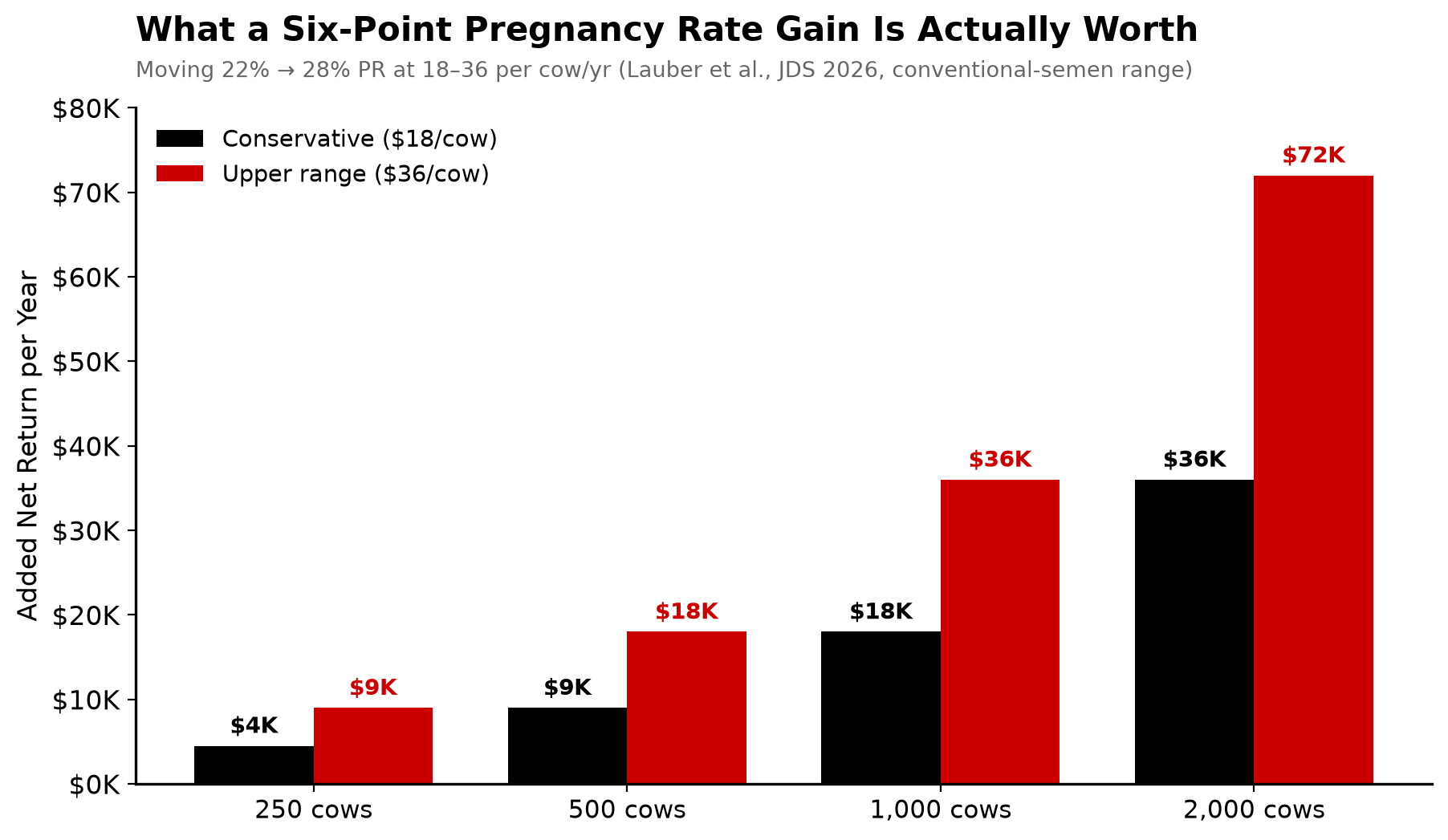
Lauber and colleagues (Journal of Dairy Science, 2026) modeled net return per one-percentage-point gain in 21-day PR: $3 to $6 per cow per year for conventional-semen herds, $2 to $7 for sexed-plus-beef scenarios, depending on the starting point. An earlier Lauber stochastic evaluation (Canadian Journal of Animal Science, 2015) pegged the gain from moving PR from 10% to 30% at roughly US$75 per cow per year, driven mostly by fewer days open and fewer reproductive culls.
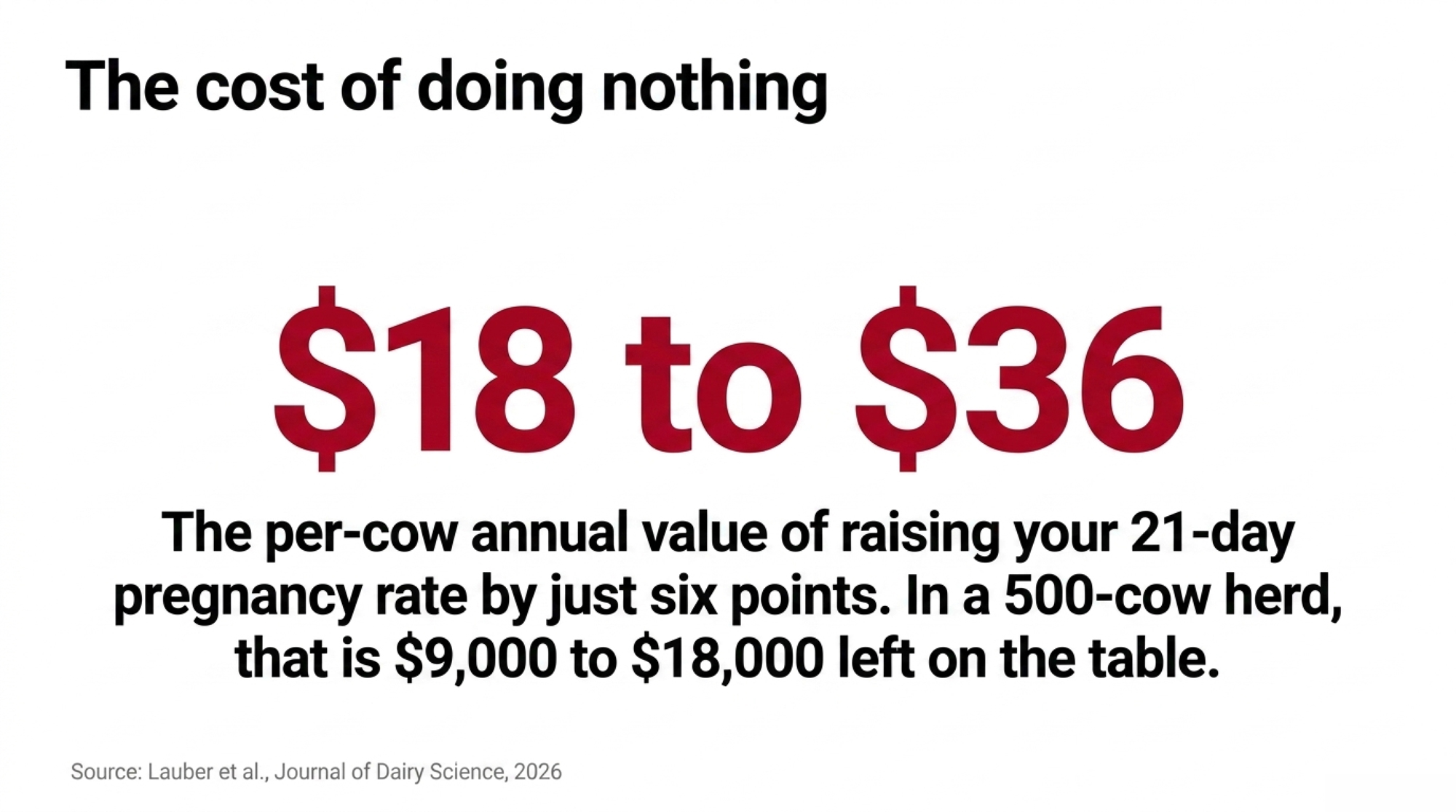
Run it on your own herd. A move from 22% to 28% PR — six points — lands somewhere near $18 to $36 per cow per year in Lauber’s 2026 framework. In a 500-cow herd, that’s roughly $9,000 to $18,000 a year. In a 1,000-cow herd, double it. And Cabrera’s reproductive economics work (Animal, 2014) puts the value of a single pregnancy in high-yielding confined herds at roughly $128 to $232 — so a few points of PR across hundreds of eligible cows is dozens of pregnancies you didn’t have before.
The sharp part isn’t the cost of doing something wrong. It’s the cost of doing nothing differently.
Your 30-Day Repro Audit Checklist
▢ Check the software setup first. Before running any numbers, confirm your voluntary waiting period (VWP), breeding cutoffs, and do-not-breed flags are accurate in DairyComp or PCDART — so your service-rate calculation isn’t lying to you.
▢ Pull the trailing 12-month average. Run BREDSUM\E or Report 126. Don’t act on a single 21-day cycle snapshot — it’s too noisy.
▢ Isolate your bottleneck. Compare your service and conception rates against the Schefers benchmarks (targets: service rate above ~55%, conception rate above ~32%).
▢ Align your checkbook with your bottleneck. If service rate is under 50%, fix heat detection, rebreeding intervals, and detection discipline (tail paint, activity monitors, whatever your barn runs) before buying more hormones. If the conception rate is under 30%, focus on fresh-cow transition, bunk management, and body condition (aim for 2.75 to 3.0 at calving) before implementing a complex timed AI protocol.
▢ Do the barn math. A six-point PR gain — say 22% up to 28% — is worth roughly $18 to $36 per cow per year on Lauber’s 2026 conventional-semen range. Multiply the low end by your herd size for a conservative budget — 500 cows × $18 = $9,000 a year just off the floor of the range — then use that figure to size your next protocol change.
When your next repro report lands, you’ll face a quiet choice most managers never notice they’re making: read the number the tech hands you, or read the two numbers your milk cheque is actually keeping score with. One of them tells you the herd is stuck. The other tells you where to dig. Which one are you going to manage to this breeding season?
Key Takeaways
Conception rate tells you how well a breeding worked, not how many cows got bred. Split your 18% into service rate and conception rate before you spend a dollar — the number alone hides which problem you actually have.
If service rate is under 50%, fix heat detection and rebreeding first; more hormones won’t get open cows bred. If conception rate is under 30%, the fight is in the close-up pen — transition, bunk, and body condition at 2.75–3.0.
Double-Ovsynch earns its keep when fertility is the real bottleneck, especially through summer heat stress. It’s a scalpel, not a rescue for a barn that never gets cows bred.
Pull your trailing 12-month BREDSUM\E or PCDART Report 126 this month, check both levers against the Schefers ranges, and a six-point PR gain is worth roughly $18–36 per cow a year on Lauber’s 2026 numbers.
Complete references and supporting documentation are available upon request by contacting the editorial team at editor@thebullvine.com.
Learn More
Dairy herd health and reproduction 2026 benchmarks – The Bullvine — Deliver an immediate operational edge using concrete thresholds for blood BHB screening, Brix refractometer colostrum values, and Double-Ovsynch cost-per-pregnancy targets to eliminate fresh cow transition failures before breeding.
Daughter Pregnancy Rate | The Bullvine — Uncover a hidden genetic bottleneck where subclinical heat stress at a THI of 60 silently cripples conception rates, allowing you to filter out vulnerable cow families and select sires built for hot-weather fertility.
The Sunday Read Dairy Professionals Don’t Skip.
Every week, thousands of producers, breeders, and industry insiders open Bullvine Weekly for genetics insights, market shifts, and profit strategies they won’t find anywhere else. One email. Five minutes. Smarter decisions all week.
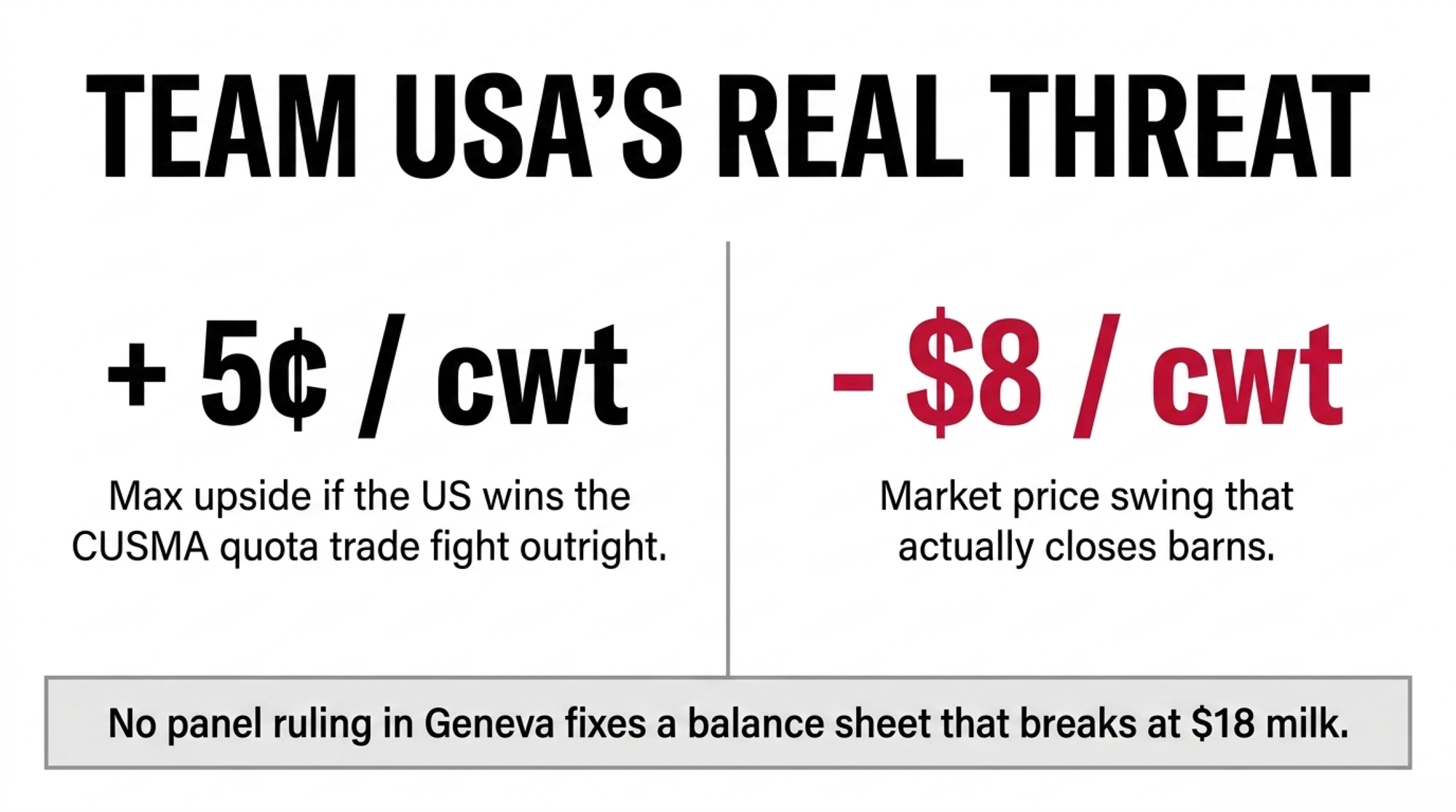
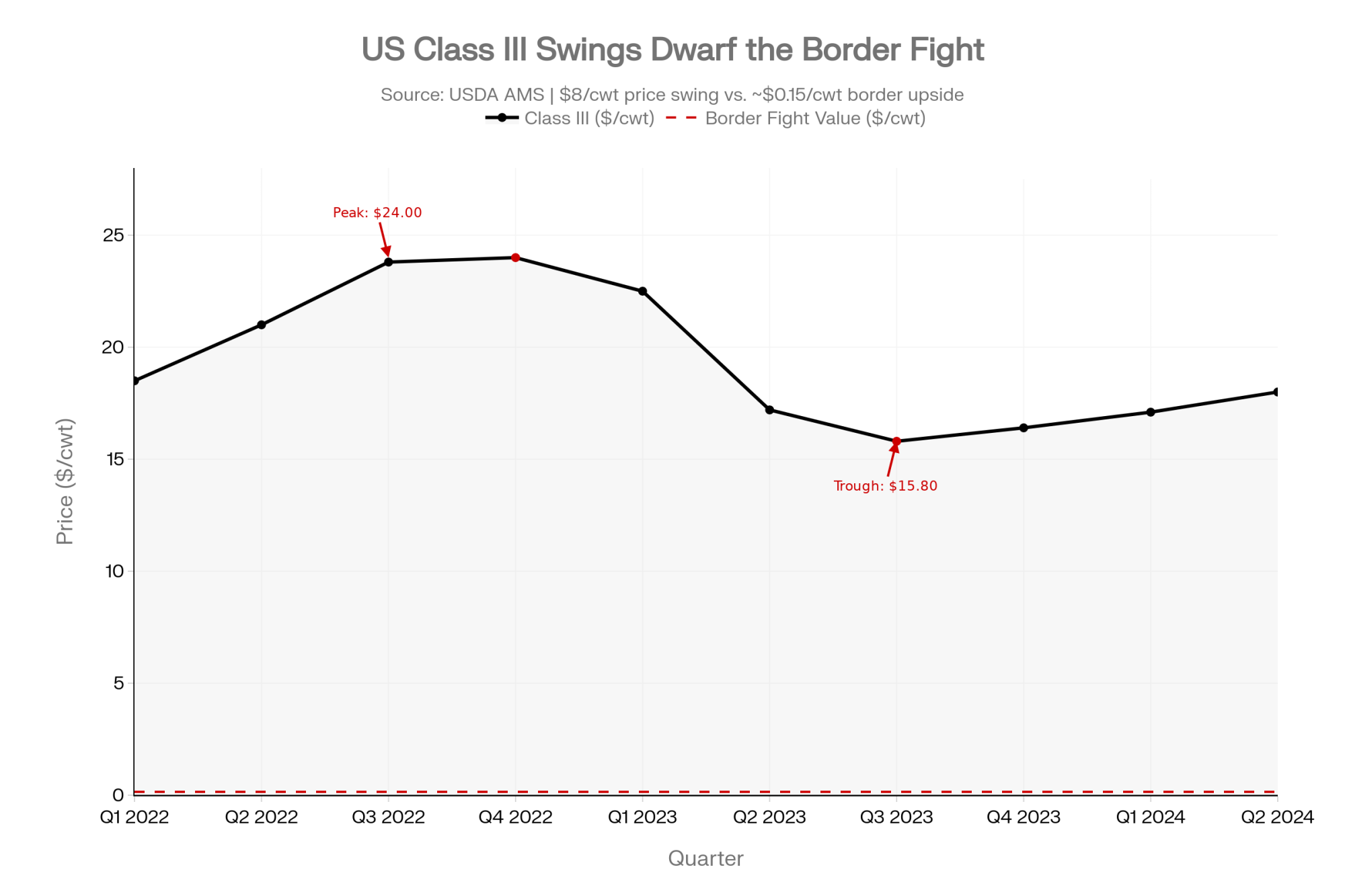
That border fight is worth about 5¢/cwt. The $96,000 hole already in your milk check is the one that decides if you’re still milking in 2030.
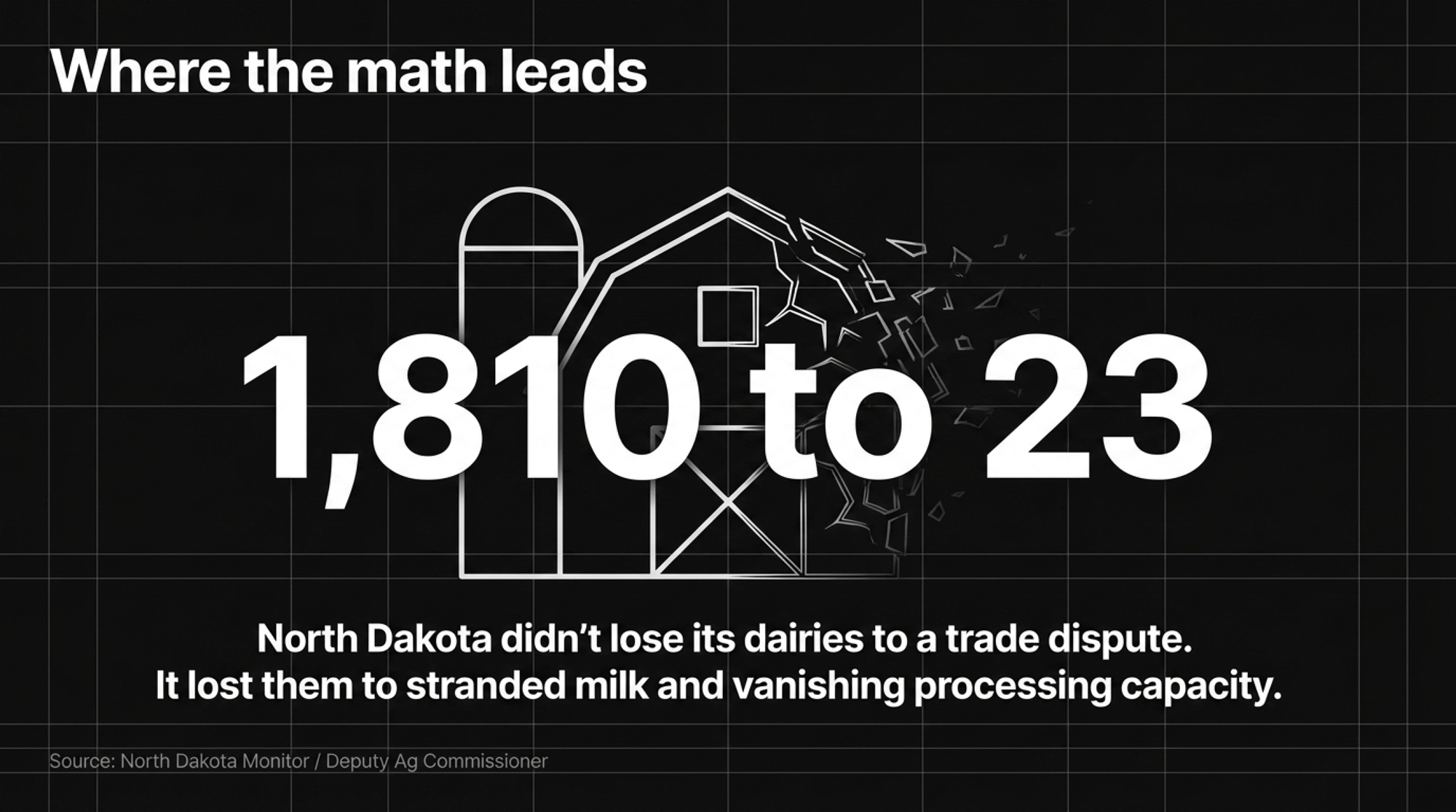
North Dakota once counted 1,810 dairy farms. By March 2025, Deputy Agriculture Commissioner Tom Bodine told state lawmakers just 23 permitted operations were left — one of them not even milking — running about 8,700 cows between them (North Dakota Monitor). That’s not a rough market cycle. That’s a state’s dairy industry going quiet, one processing plant and one lender conversation at a time.
Here’s the part that should stop you cold. While farms like those disappeared, the loudest fight in dairy policy has been about Canadian tariff quotas — a dispute that, run through the actual numbers, lands on your milk check as a nickel per hundredweight (USDA milk production data). The border fight has a flag and a villain. The thing pulling barns under has a spreadsheet and a month-end accounting entry. And it’s winning.
Do the Math on the $200 Million and It Shrinks to a Nickel
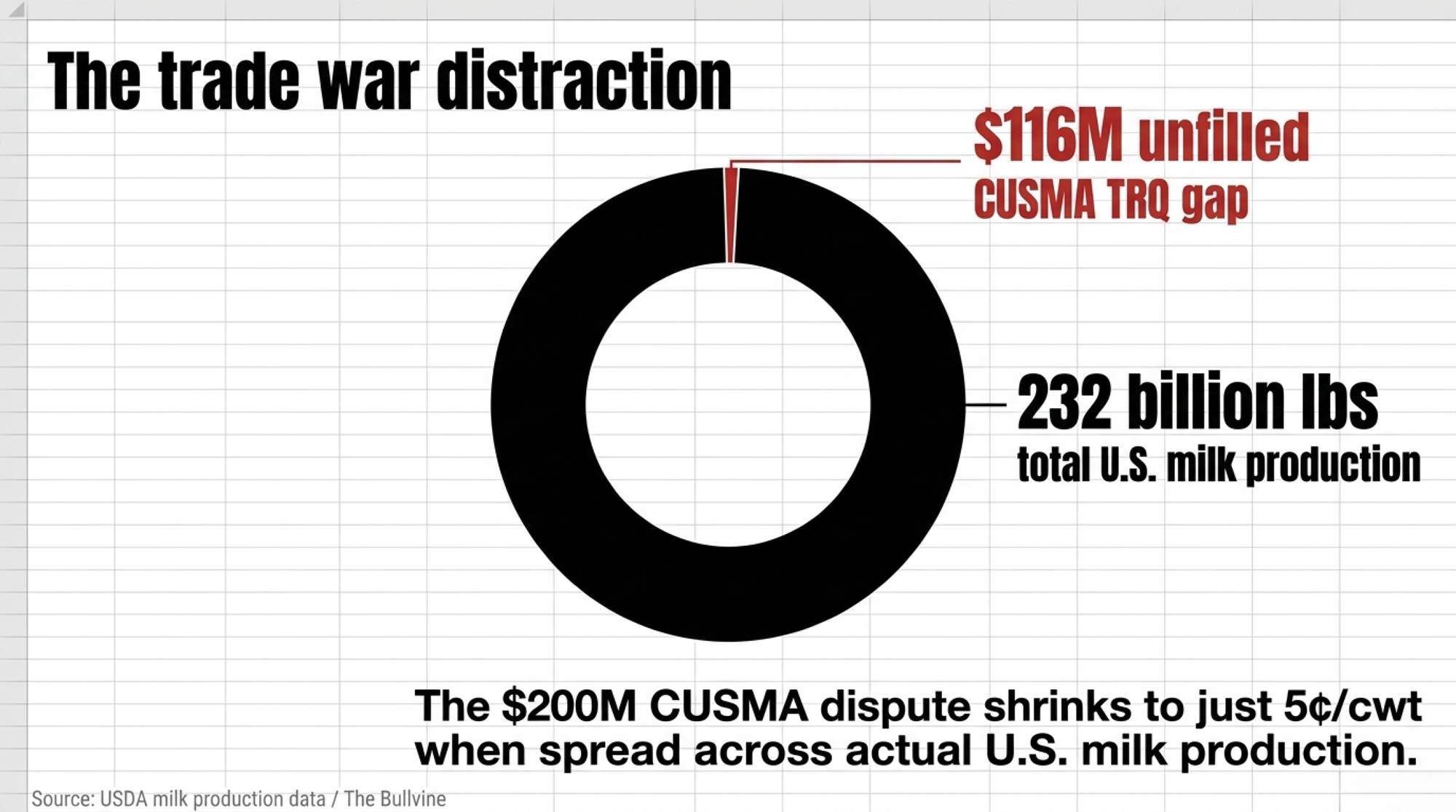
U.S. dairy groups say Canada owes them roughly $200 million a year in market access under CUSMA. Real money — until you spread it across the 232 billion pounds of milk this country produced in 2025. Divide the full $200 million across that production and you get about 8.6 cents per hundredweight. Because only 42% of the access actually gets used, though, roughly $116 million goes unfilled each year — and spread across production, that’s about a nickel per cwt.¹ (The Bullvine: North American dairy trade)
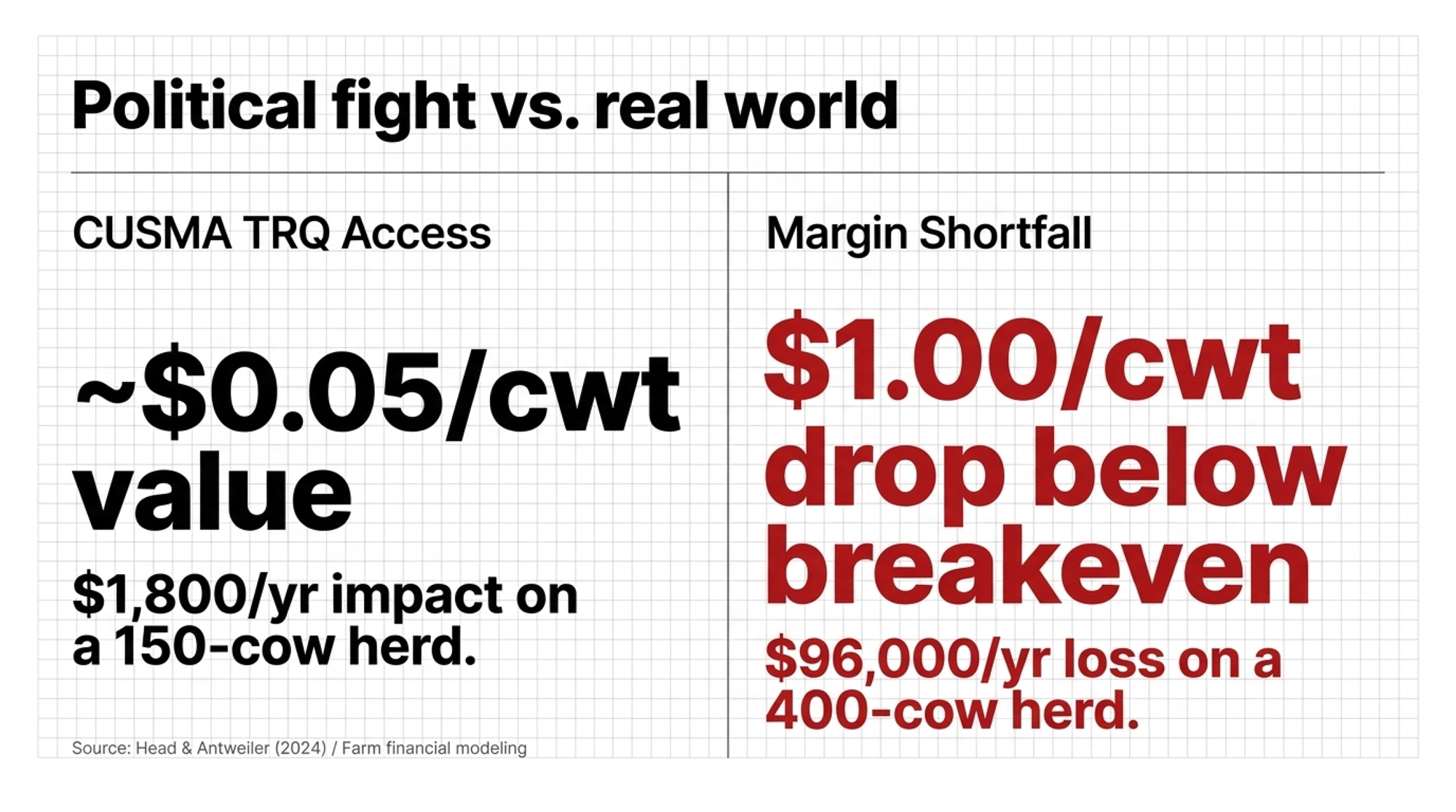
Economists Keith Head and Werner Antweiler said it plainly in a 2024 working paper: any remedy to the TRQ dispute “would likely result in only modest economic gains to the United States.” On a 150-cow dairy shipping around 24,000 pounds per cow, that nickel is worth roughly $1,800 a year (Head & Antweiler, SSRN 2024). That’s the fight burning political capital in Washington and Ottawa through the 2026 review.
Dimension
The Political Fight (CUSMA TRQ)
The Real-World Margin Pressure
Value per cwt
~$0.05/cwt
Class III drop to $14.59/cwt (Jan 2026)
Annual impact, 150-cow herd
~$1,800/yr
—
Annual impact, 400-cow herd
—
$96,000 lost on a $1/cwt shortfall
What it actually decides
Burns political capital in DC & Ottawa
Whether the bank pulls your credit line
Now hold that nickel next to what’s happening inside your own milk check.
Fewer Farms, More Milk — and No Column for the Ones That Vanish
From the outside, dairy looks healthy. U.S. exports hit a record $9.51 billion in 2025, up 15% over the year before, and production set its own record (IDFA). Zoom in and the story flips.
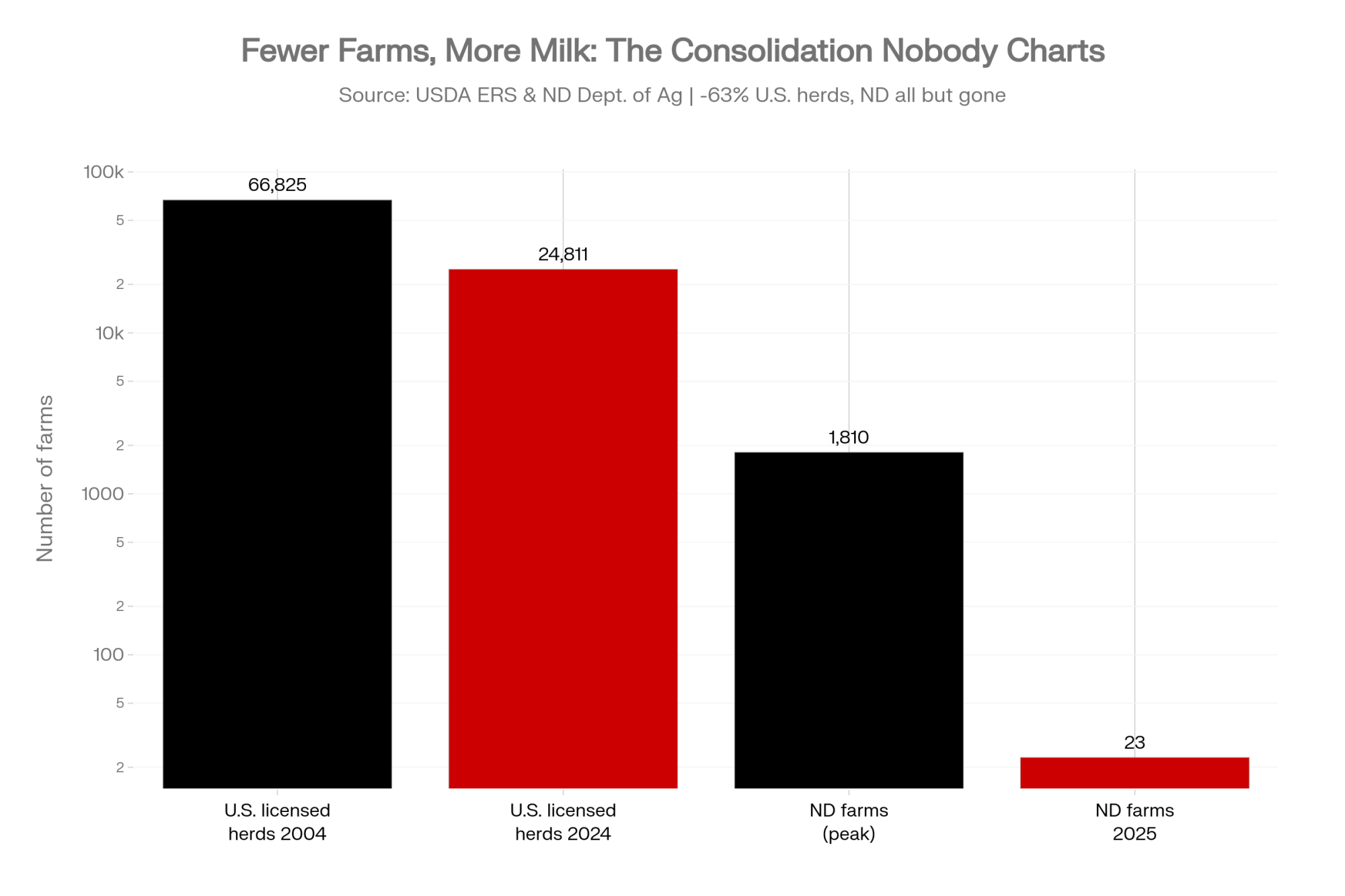
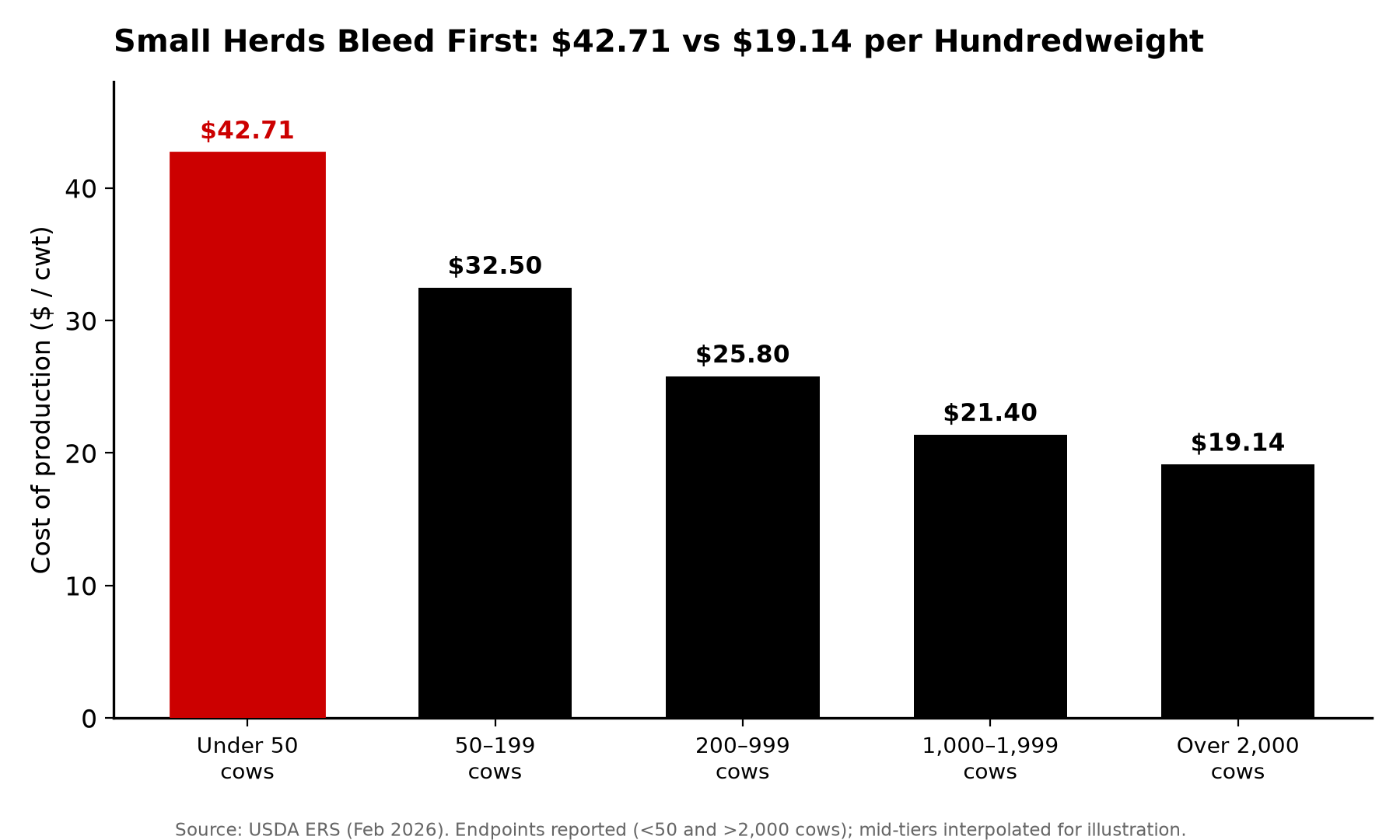
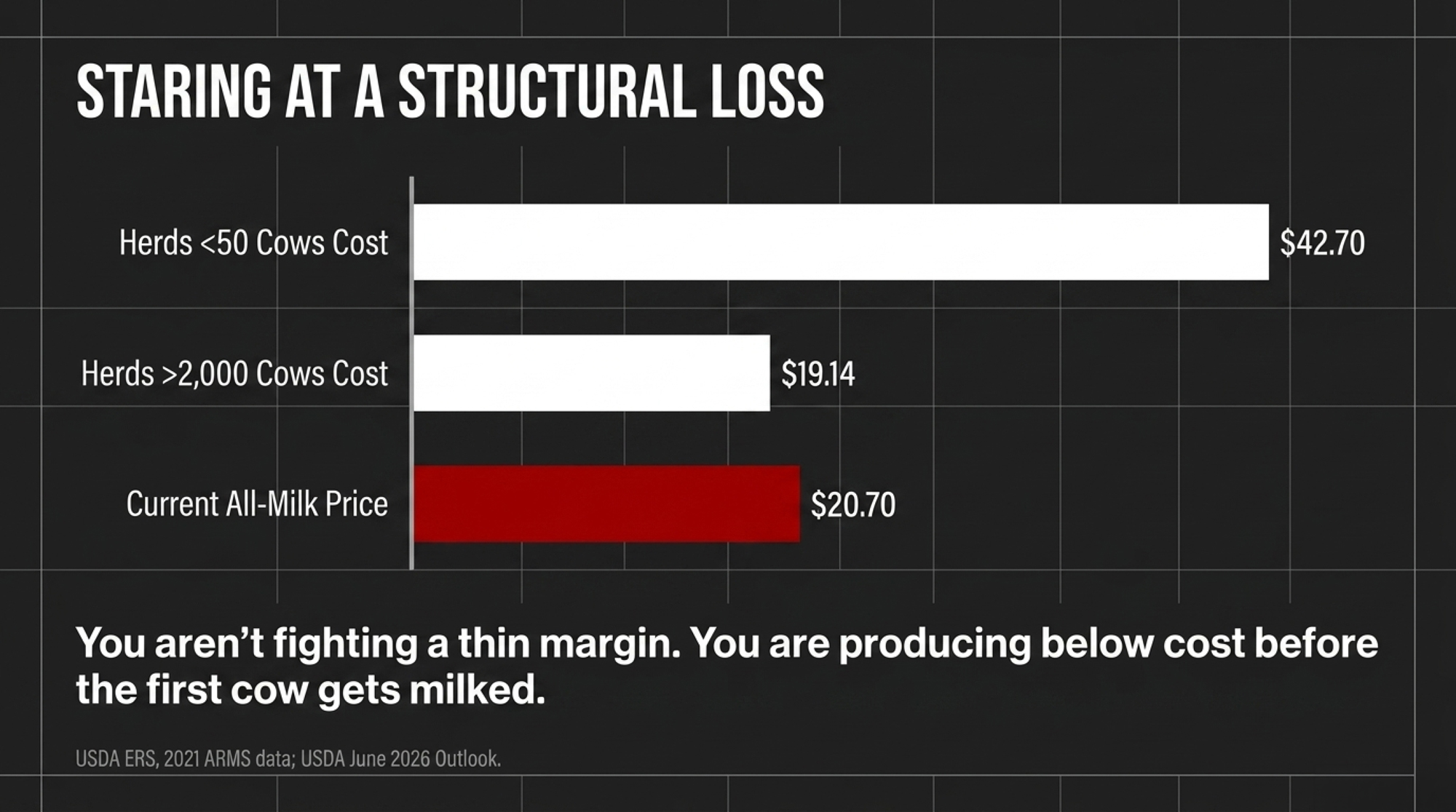
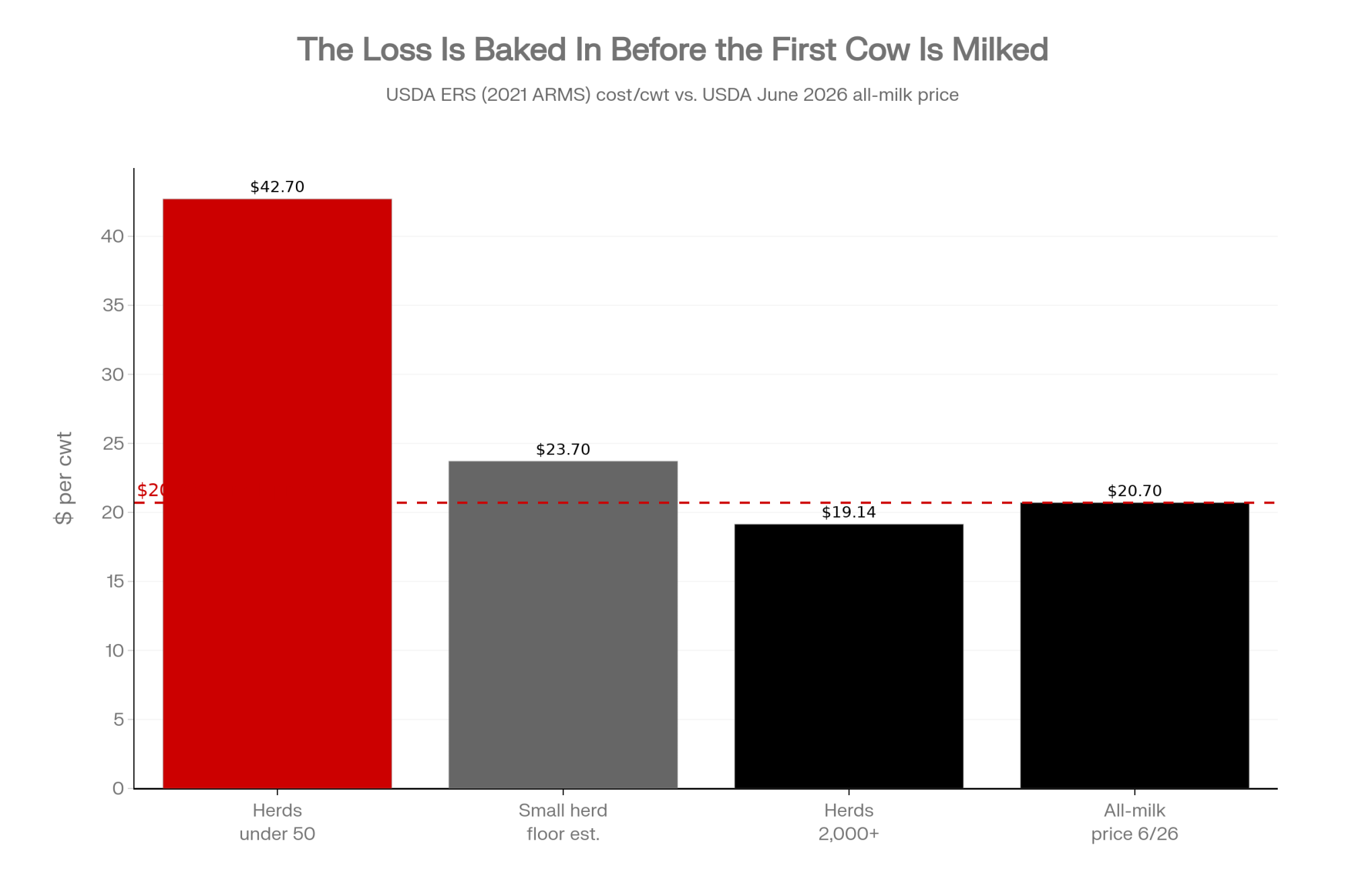
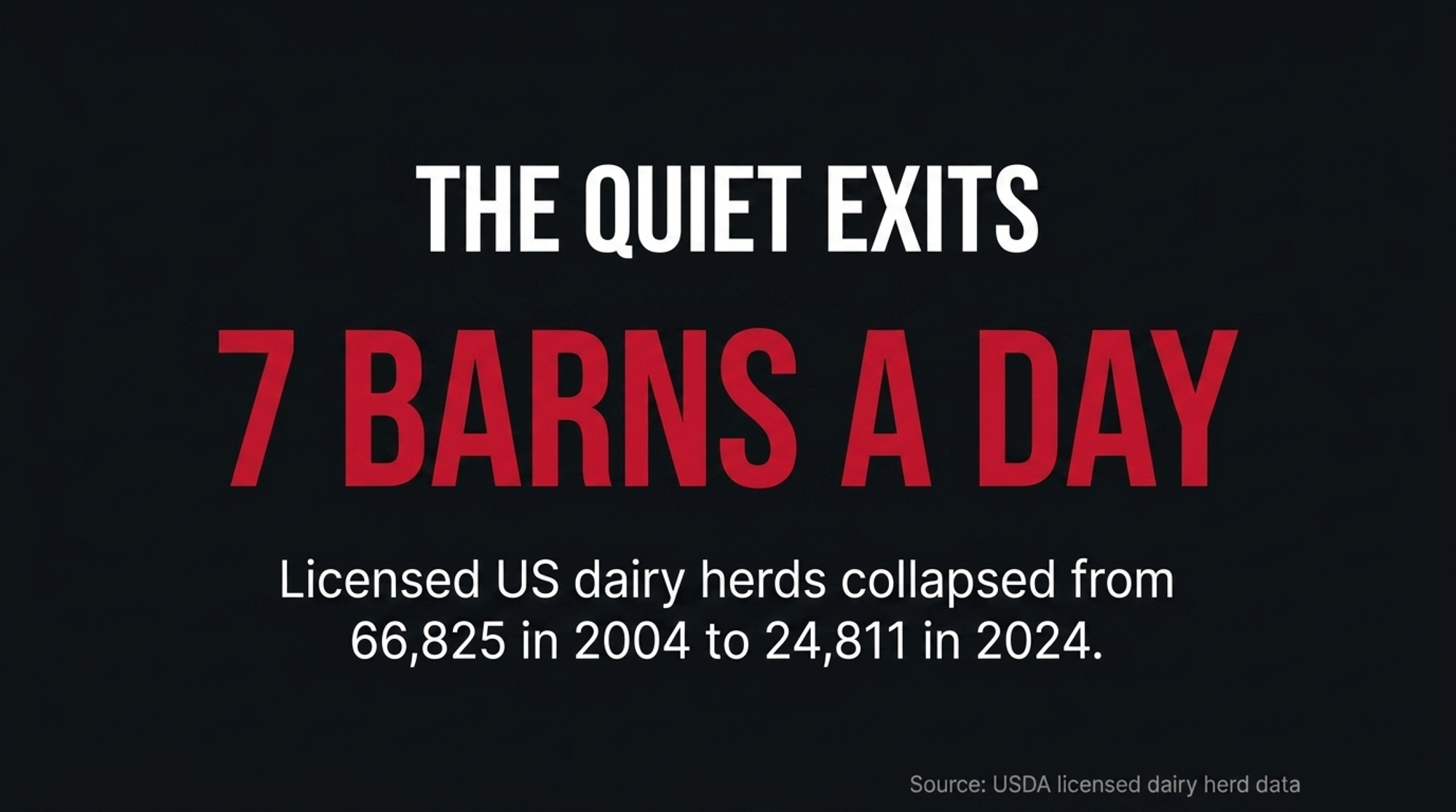
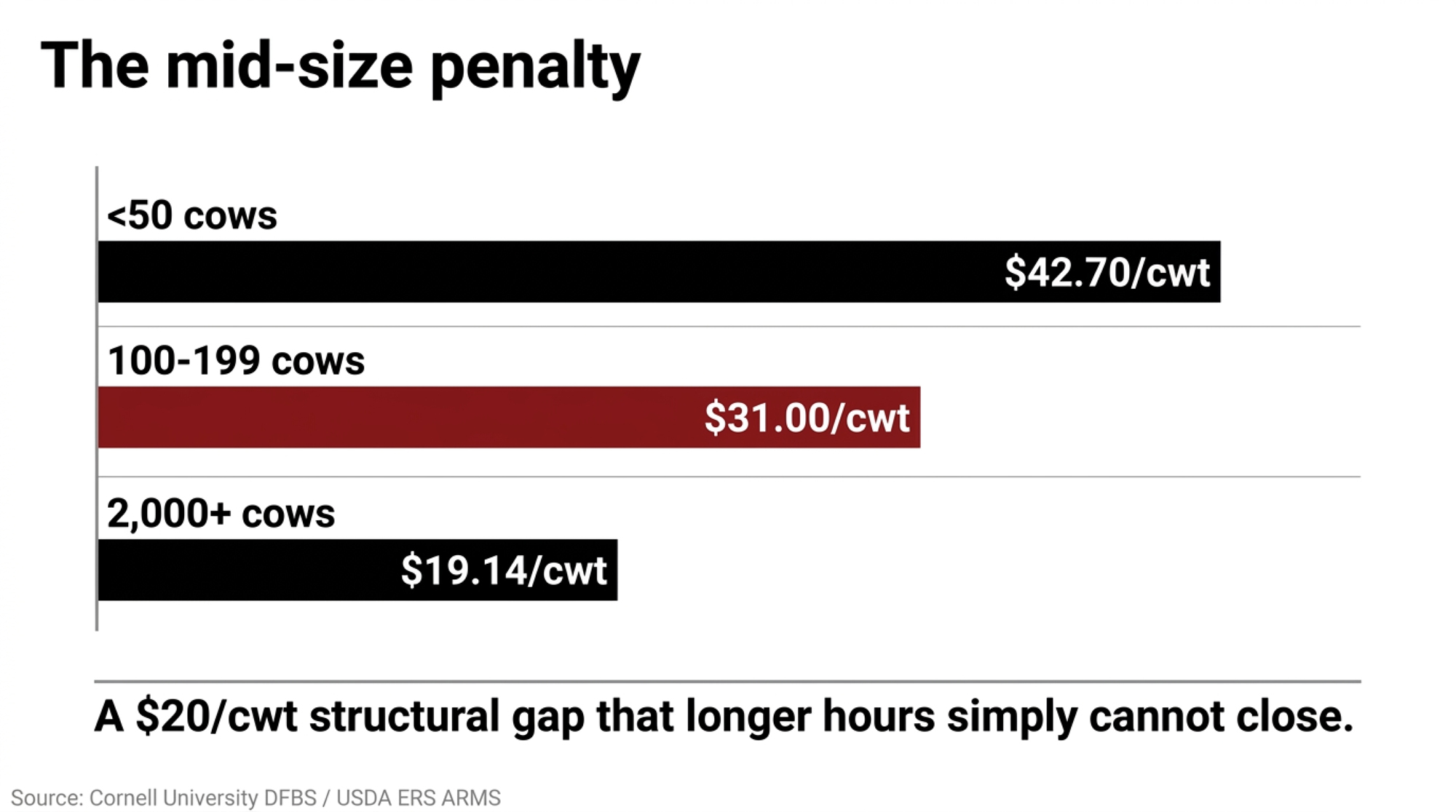
USDA’s Economic Research Service reports the number of licensed U.S. dairy herds fell 63% — from 66,825 in 2004 to 24,811 in 2024 — even as output climbed. The 2022 Census of Agriculture put the drop at 39% in just five years, with farms selling milk falling from about 39,000 in 2017 to 24,000 in 2022. Every herd size shrank except operations with 2,500 cows or more (USDA ERS). The dashboards driving dairy policy measure production, exports, and cost per unit — not how many families stay in business. ERS frames it as efficiency, and the numbers back that framing: in 2021, producing 100 pounds of milk cost $42.71 on herds under 50 cows versus $19.14 on farms with 2,000-plus. By that math, fewer, larger farms making more milk is a win. There’s just no line on the spreadsheet for North Dakota’s missing 1,787 dairies — where the consolidation curve is heading by 2035.
How This Plays Out on a Real Farm
A DSCR breach isn’t a number. It’s a sequence that lands on a real family over months.
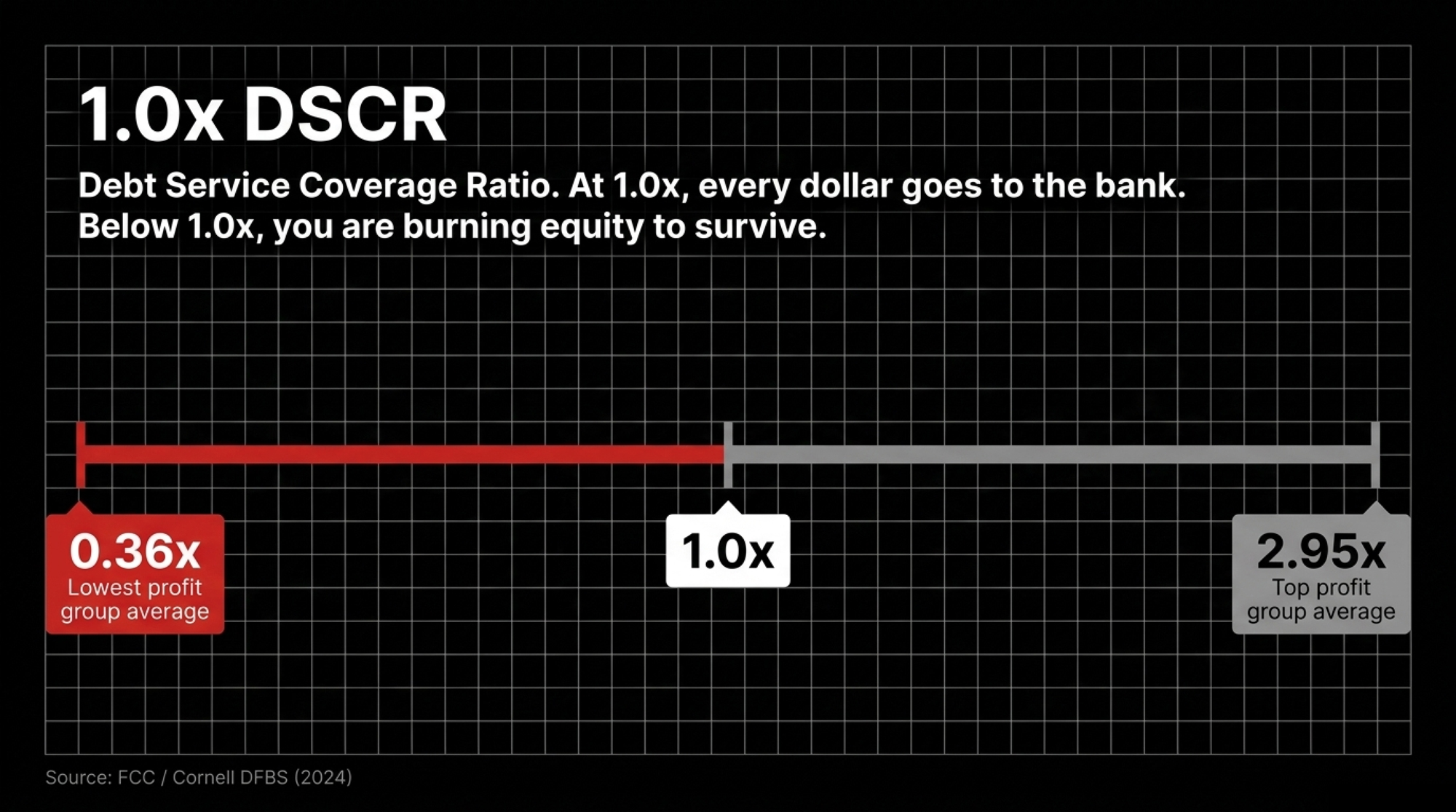
What DSCR means: Your debt service coverage ratio is the cash your operation throws off measured against the loan payments you owe. At 1.0×, every dollar of margin goes straight back to the bank — you’re running the parlor to break even with the lender, nothing left over. Below 1.0×, the milk check no longer covers the debt, and you’re pulling from equity to make the payment. (FCC)
North Dakota shows the squeeze in real time. As local processing capacity thinned out, the January 2026 Class III price had already dropped to $14.59 per hundredweight — the lowest since April 2021 — leaving farms with fewer places to send milk at a workable price. It got tight enough that Dawson Holle, whose family runs the 1,000-cow Northern Lights Dairy near Mandan, told a House committee they’d researched building their own processing — after being forced to switch milk markets twice (North Dakota Monitor). That’s the trap: it isn’t always low prices alone. Sometimes it’s the buyer disappearing and stranding your milk.
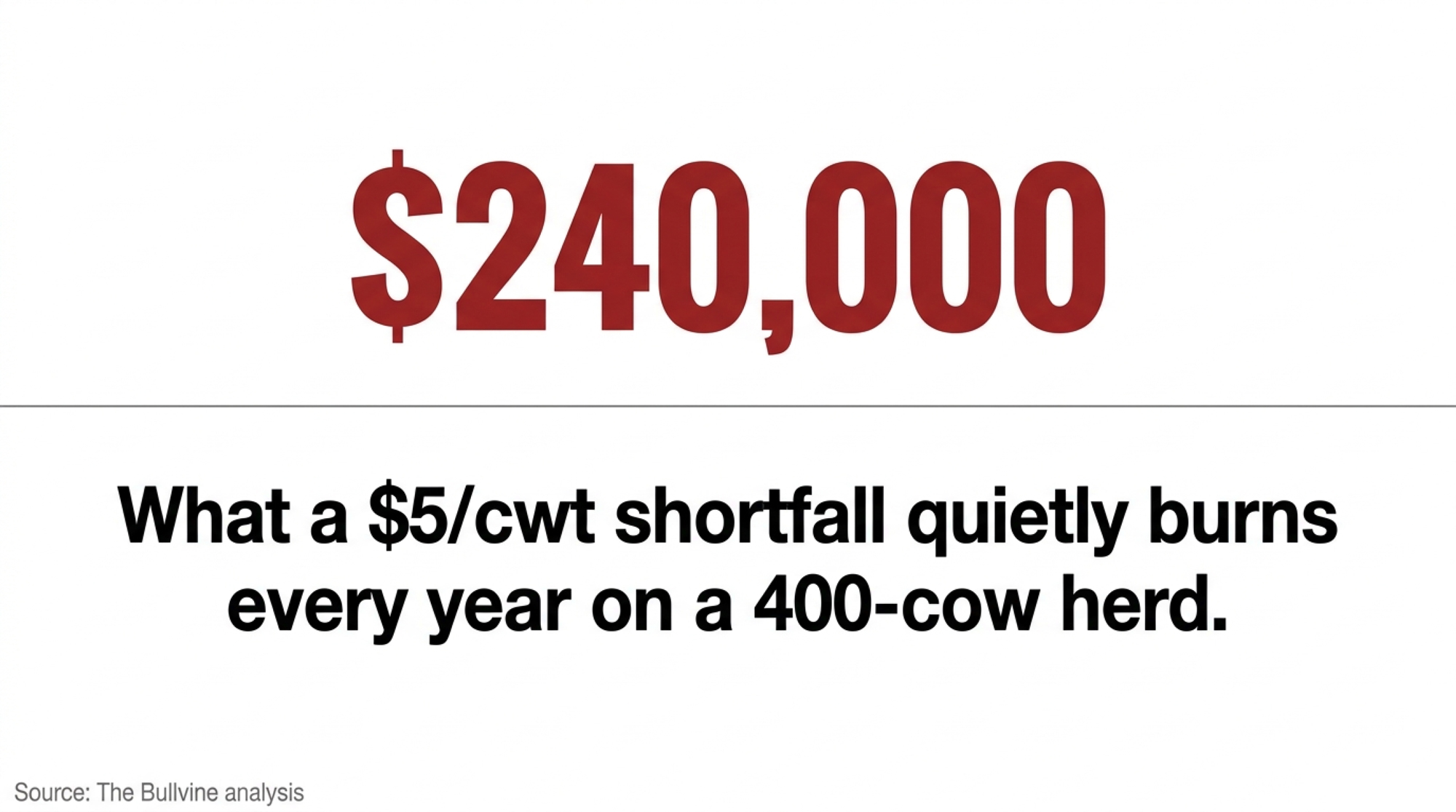
Run the barn math on a herd that size. On a 400-cow dairy shipping roughly 96,000 hundredweight a year — that’s about 24,000 pounds per cow — a $1/cwt shortfall against your breakeven is about $96,000 gone in twelve months. Stack that against the nickel the TRQ fight might return. One of those numbers decides whether you re-amortize the parlor note. The other you’ll never feel — how North Dakota’s processing collapse played out.
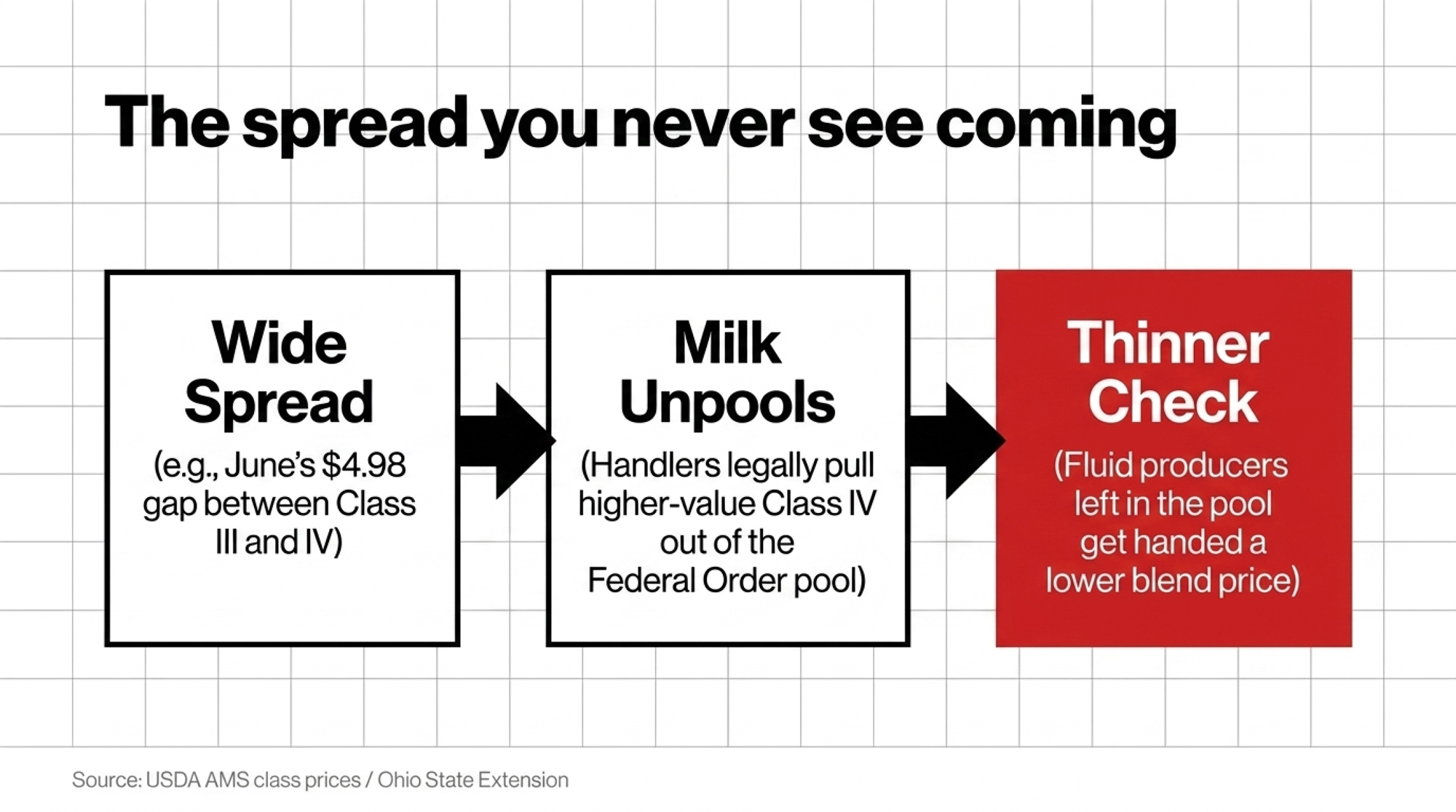
The $4.98 Spread Most Producers Never See Coming
Here’s the mechanism almost nobody in the trade conversation talks about: depooling. It’s a legal, disclosed feature of how voluntary pooling works — and it’s where the structural pressure quietly builds, in plain sight.
Under Federal Milk Marketing Orders, fluid milk has to be pooled, but manufacturing milk — Classes II, III, and IV — is pooled voluntarily. When a manufacturing-class price climbs well above the order’s blend price, a handler can simply choose not to pool it. As Ohio State’s dairy economists put it, “A Class II, III, or IV price which exceeds the Uniform price signals reduced pooling of that class.” The call gets made at month’s end, once every price is known. (Ohio State Extension)
Watch what happens when the spread blows out. In June 2026, USDA announced Class III at $15.98/cwt and Class IV at $20.96/cwt — a spread of $4.98 (USDA AMS class prices). That gap is a green light for handlers to pull their higher-value Class IV milk out of the Order pool. And when that milk walks out the door, the money it would have contributed to the blend walks with it — so the fluid producers left in the pool get handed a thinner blend price and choppier basis they never voted on. The decision is lawful and routine. But it’s made quietly at month-end, and the first place you notice it is your own check — how depooling thins your blend price.
How Much Does the TRQ Fight Actually Change Your Bottom Line?
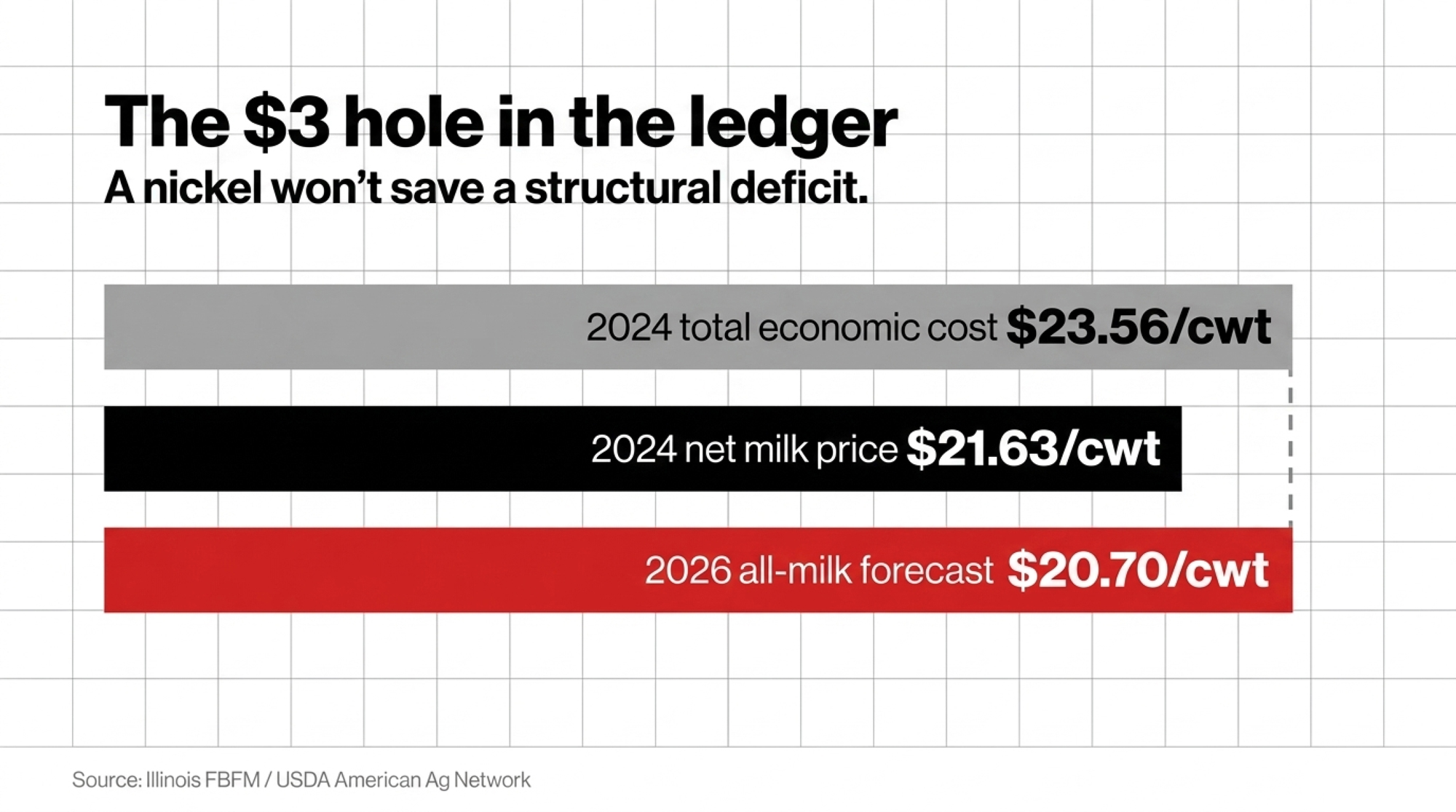
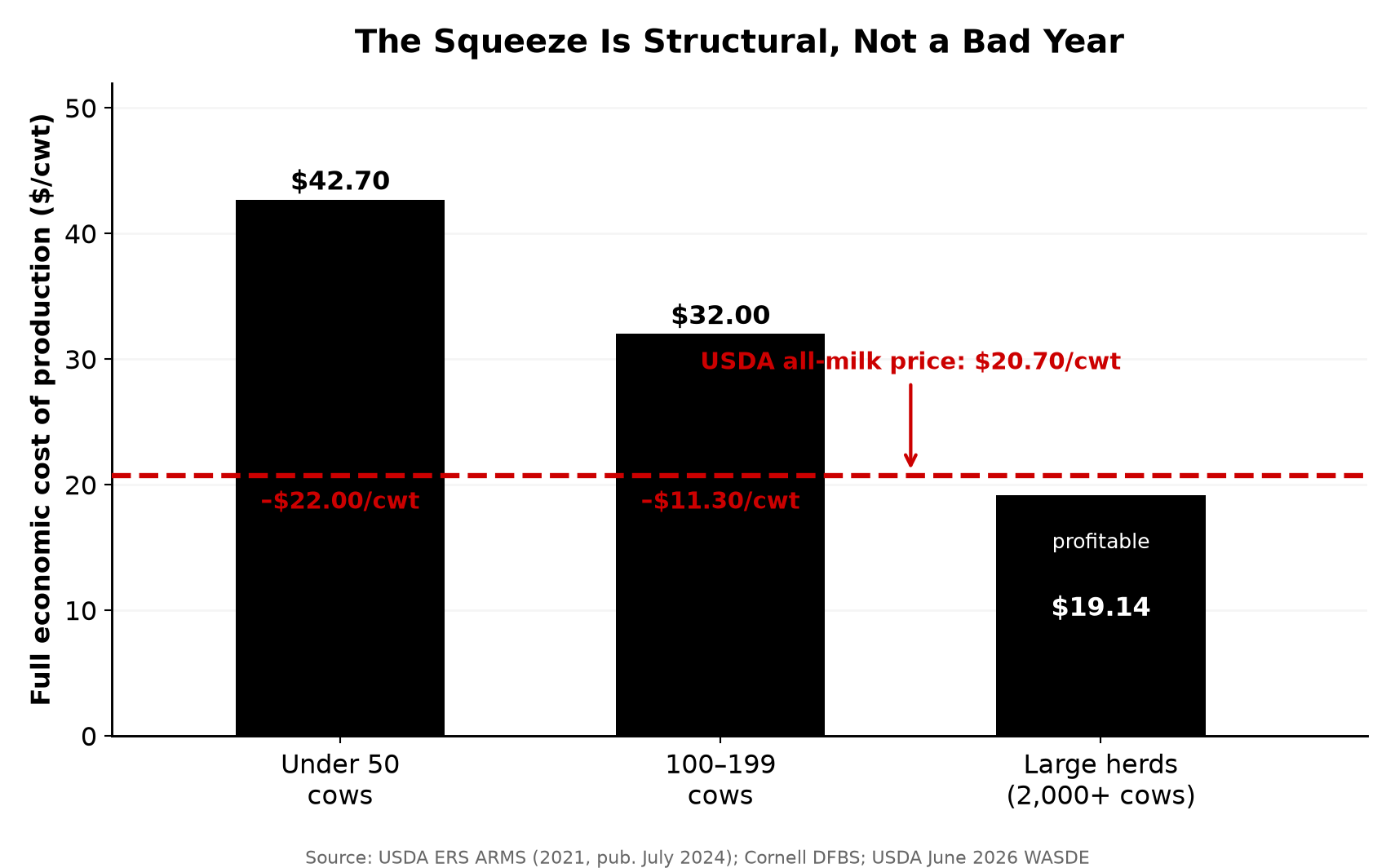
The answer is a hard no. Line up that political nickel against a real-world cost structure — Illinois FBFM pegged total economic cost, unpaid family labor and equity included, at $23.56/cwt for 2024, against a net milk price of $21.63, a loss of $409 per cow — with an all-milk price USDA now forecasts at $20.70/cwt for 2026 (American Ag Network). That gap is measured in dollars, not cents.
So if both sides “win” their version of the CUSMA review — full enforcement for the U.S., intact supply management for Canada — it doesn’t fix either farmer’s structural problem. It just decides who bleeds a little slower. Chasing the border fight while your own cost of production runs $3 over your milk price is a losing trade. Where does your breakeven actually sit right now?
Is Your Lender Already Seeing Trouble You Haven’t Named Yet?
Probably. Farm financial research shows lenders often see the strain building well before producers are ready to name it — they’re running rolling DSCR and margin models most farms aren’t (The Bullvine: The 18-Month Window). In that gap, the story a farmer tells himself is simple: we’ve milked through worse, we’ll milk through this. The bank’s spreadsheet already knows a multi-dollar structural gap doesn’t close with more hours in the parlor.
Metric
Healthy Position
Watch Zone
Distress / Act Now
DSCR (Cornell DFBS 2024)
2.95× (top group)
~1.0× breakeven
0.36× (lowest-profit group)
What the milk check covers
Debt + margin left over
Debt only, nothing left
Pulling from equity to pay
Total economic cost (IL FBFM 2024)
Below milk price
$23.56/cwt vs. $21.63 net
–$409 per cow
Lender response
Restructuring room
Stress test at $16 milk
Gets the letter, not the plan
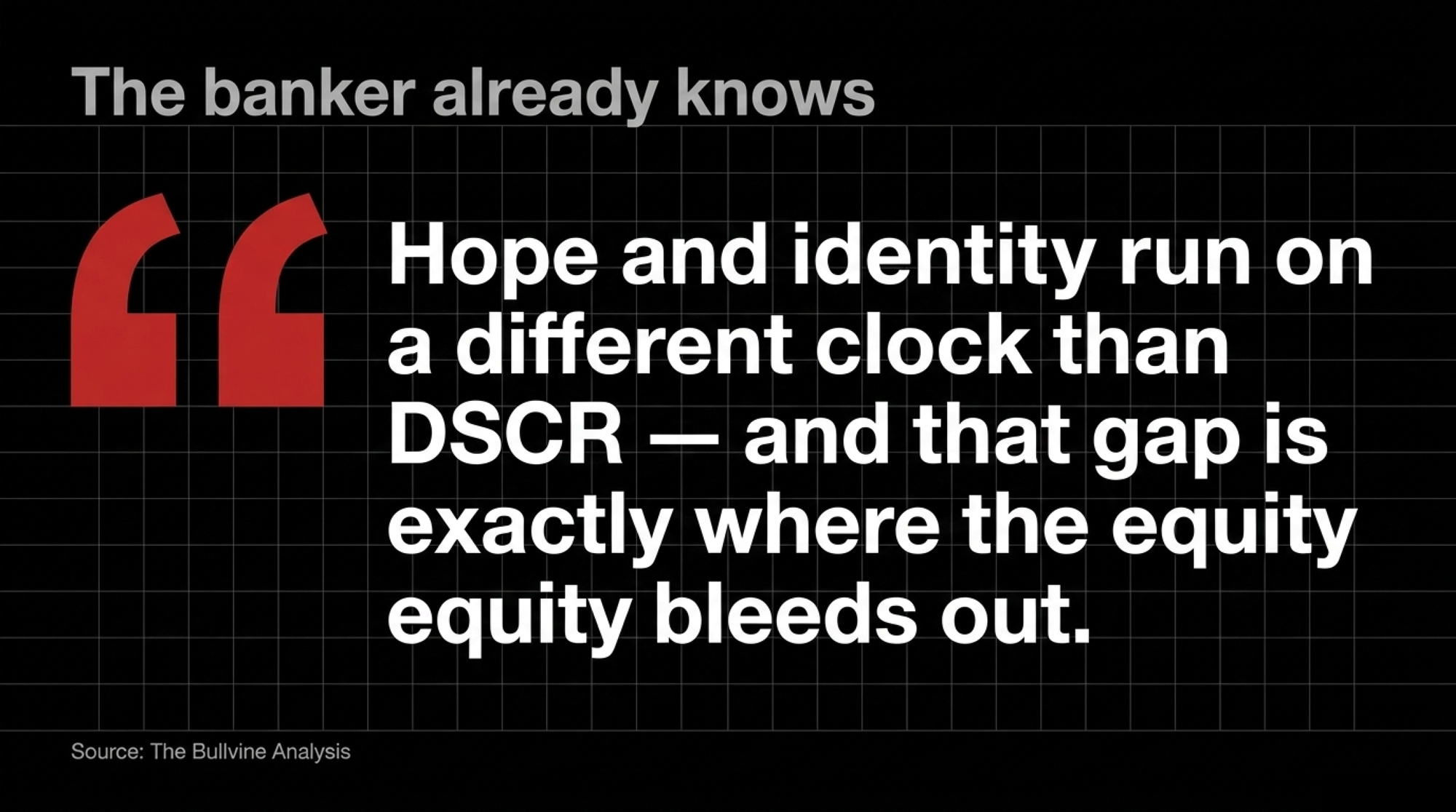
Cornell’s Dairy Farm Business Summary shows how thin the bottom end runs. In the 2024 DFBS, the lowest-profit group averaged about 0.36× debt coverage — roughly a third of what a healthy loan needs — while the top group ran 2.95×. The farms that get restructuring room walk into the bank with a stress test at $16 milk and a real plan. The ones that get letters walk in saying “it’ll turn around.” Hope and identity run on a different clock than DSCR — and that gap is exactly where the equity bleeds out. Run your DSCR before your lender does.
Your Four-Step Survival Blueprint
Nobody’s hopeless here. But the farms that get flexibility show up with numbers, not hope. Work these in order.
1. Run a rolling DSCR stress-test — within 30 days. Calculate your honest 12-month cost per cwt, then re-run your last twelve milk checks against $20.70, $18.00, and $16.00 milk (USDA ERS dairy outlook). Pay close attention if you’ve recently repriced operating or term debt into 7–8% money. The number might rattle you — that’s the point. On a leveraged herd, acting now instead of six months from now can preserve well into six figures of equity, per Bullvine’s exit-timing analysis.
2. Audit your handler’s utilization reports — monthly. Ask your cooperative or independent handler exactly where your milk pools each month. Watch whether Class IV depooling is shaving your basis when the Class III–IV spread stretches past normal — it hit $4.98 in June (USDA AMS). You may not have leverage to change it, but you can’t manage what you can’t see.
3. Layer secondary margin protection — quarterly. Basic Dairy Margin Coverage offsets just 67–74% of total costs for many operations, leaving a quarter or more of your real economic cost exposed (Farm Bureau). Stack Dairy Revenue Protection or LGM underneath DMC to floor the balance during sustained down-cycles. Premiums cost money up front, and no TRQ win rescues a negative-margin farm — survival still comes down to cost control.
4. Set a hard balance-sheet threshold — strategic horizon. Not everyone should stay, and the worst exit is the one the bank times for you. Identify the exact equity floor where a structured, 12-to-24-month orderly exit preserves family wealth. If your models show DSCR sliding past 0.86× with no processing relief in sight, transition early rather than letting a forced liquidation dictate terms (The Bullvine: 18-month countdown).
Key Takeaways
If you haven’t run your DSCR at $20.70, $18.00, and $16.00 milk in the last 90 days, do it this week — that’s the number your lender is already watching.
If your blend price or basis has gotten erratic, ask your handler where your milk pools before you blame the market — the June III–IV spread hit $4.98.
If DMC is your only coverage, check whether it’s leaving a quarter of your costs uncovered, and whether DRP fills the gap.
If your stress test drops below 1.0× DSCR, treat it as urgent, not strategic — acting at month 8 instead of month 14 can save well into six figures of equity on a leveraged herd.
If you’re tracking CUSMA headlines closer than your own cost of production, you’re guarding the nickel and ignoring the $3/cwt hole.
Where’s Your Breakeven — Really?
North Dakota didn’t lose 1,787 dairies to a trade dispute. It lost them to processing that dried up, prices that ran under cost, and lenders who saw the math before the families were ready to name it. Even the Holles — a 1,000-cow operation with a legislator in the family and a state grant program on the books — looked at the cost of building their own plant and told The Bullvine, “We don’t know what we are going to do” (The Bullvine: From 1,810 Dairy Farms to 18). The 2026 review will keep making headlines. Your DSCR won’t make a single one.
A note on the count: North Dakota’s dairy tally varies by definition — Bodine’s March 2025 testimony cited 23 permitted operations, the Holles reported 18 Grade A farms in early 2026, and Dairy Star put the figure at 25 in mid-2025. All three describe the same collapse from a peak of 1,810. (North Dakota Monitor)
¹ Nickel math: $200M ÷ 232B lb = $200M ÷ 2.32B cwt ≈ $0.086/cwt. At 42% TRQ utilization, ~$116M goes unfilled, so the realized gap is roughly $0.05/cwt.
Learn More
Small herd cost of production: the $20.70 milk trap — Exposes the deep structural asymmetries and processing limitations that leave mid-sized herds highly vulnerable, delivering a clear framework to evaluate whether scaling up or a planned transition protects your family equity.
Class III Milk Price, DRP, and Your Spring 2026 Risk Plan — Reveals how identical 500-cow operations end up $15,000 apart in a single month based on pooling exposure, sorting your risk management into actionable defensive, balanced, or aggressive paths.
Every week, thousands of producers, breeders, and industry insiders open Bullvine Weekly for genetics insights, market shifts, and profit strategies they won’t find anywhere else. One email. Five minutes. Smarter decisions all week.
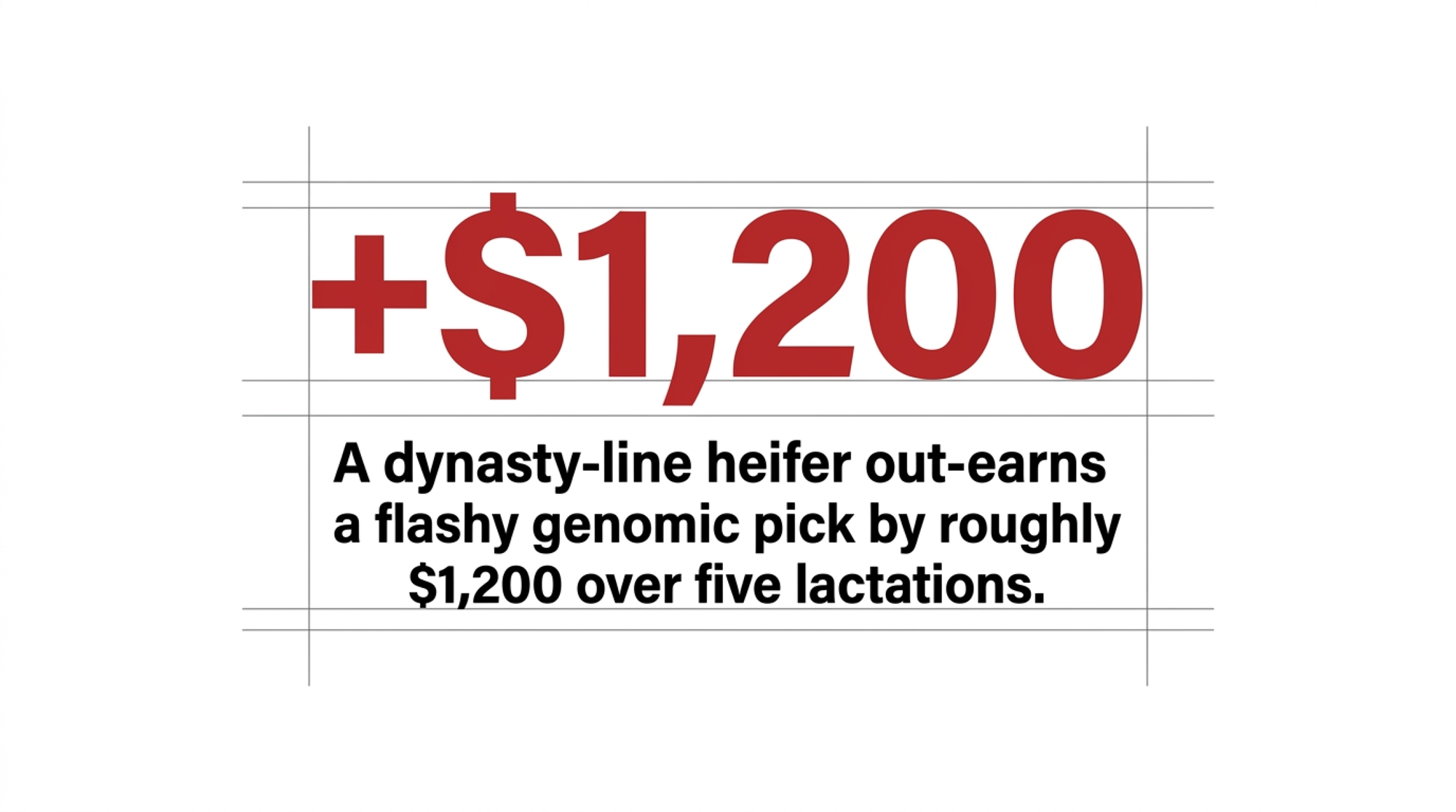
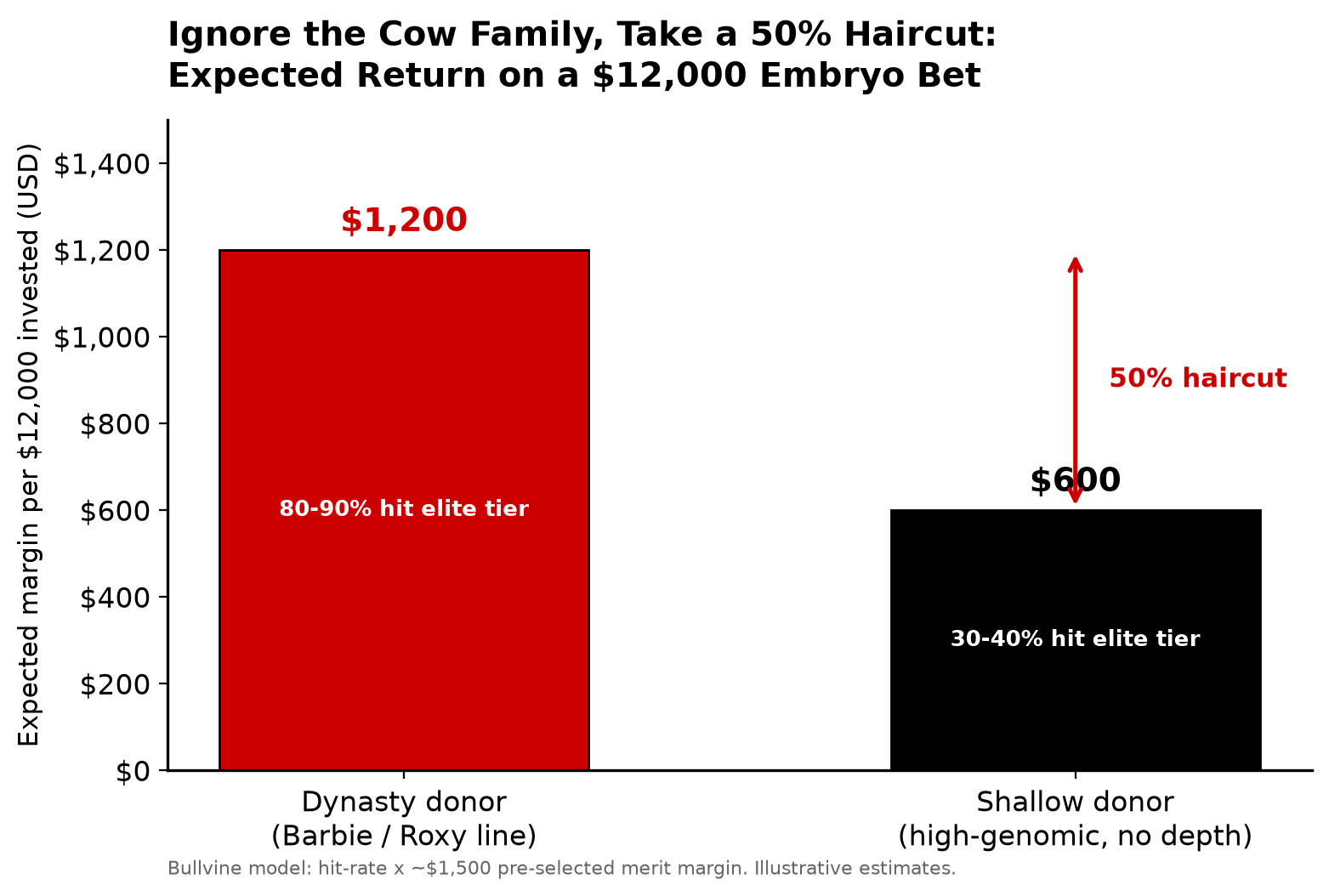
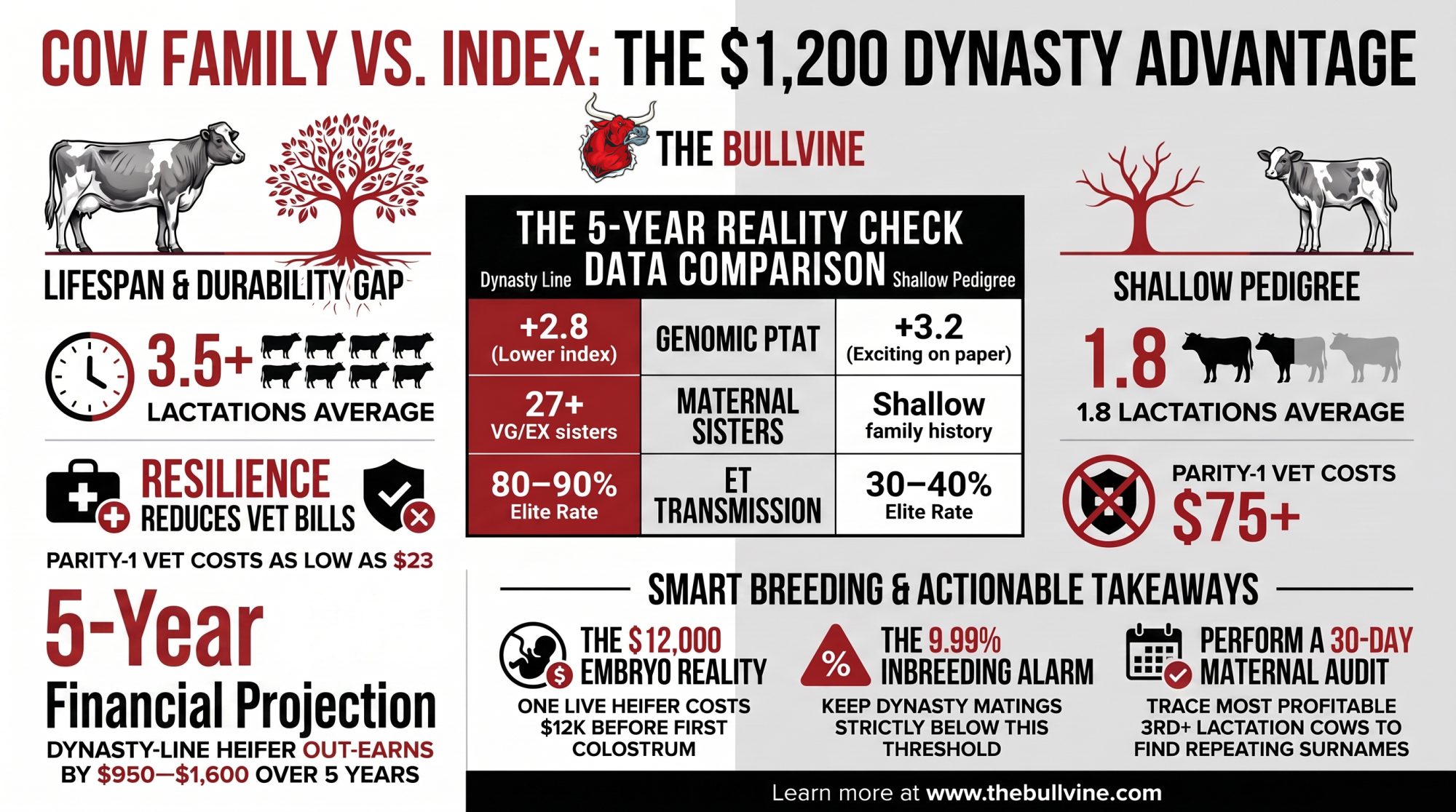
A dynasty-line heifer can out-earn a flashier genomic pick by roughly $950 to $1,600 over five years — here’s the barn math, and why the surname on your best cow’s ear tag matters more than the index on top.
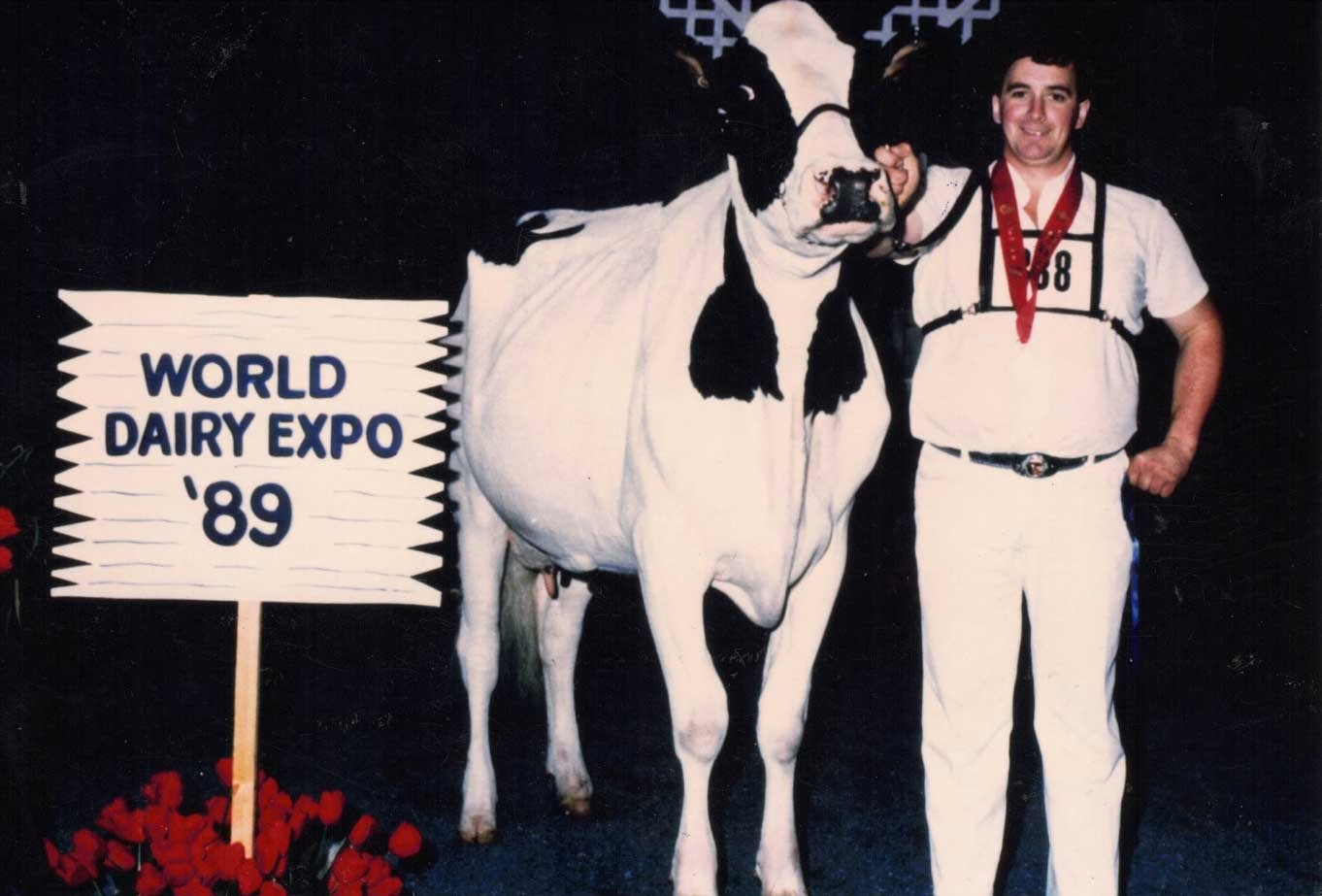
Marc Comtois with Comestar Laurie Sheik VG-88-23* at World Dairy Expo, 1989 — second in her Senior 2-Year-Old class. The judge put another cow ahead of her that day. History didn’t. This is the cow that would go on to anchor 14 Semex Class EXTRA bulls and four millionaire sires — the living proof, decades before genomics, that cow family beats a flashy card. (Read more: The Cow That Built an Empire: Comestar Laurie Sheik’s Unstoppable Genetic Legacy)
The best argument for cow family over index sheets showed up on Marc Comtois’s trailer in 1985. It was Elysa Anthony Lea EX-15*, one of Willowholme Mark Anthony’s best daughters, and the most important thing he ever bought. Bred to Puget-Sound Sheik, she produced Comestar Laurie Sheik VG-88-23* in December 1986. That one cow went on to anchor 14 Semex Class EXTRA bulls and four millionaire sires — Leader, Lee, Lheros, and Outside. That’s a maternal dynasty, fully cashed in.
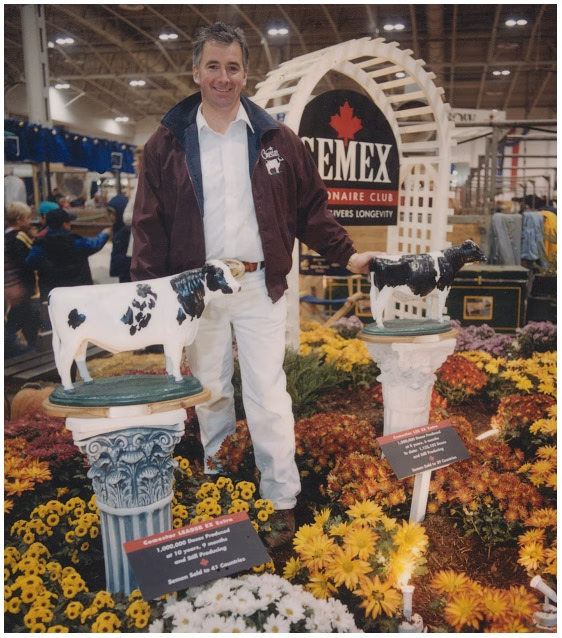
Marc Comtois at the Semex Millionaire Club display, flanked by models of Lee and Leader — two of the four millionaire sires bred off Comestar Laurie Sheik. The placards tell the story in numbers: over a million doses, semen sold in 43 countries. No single index built that. One cow family did — which is exactly the case this article makes
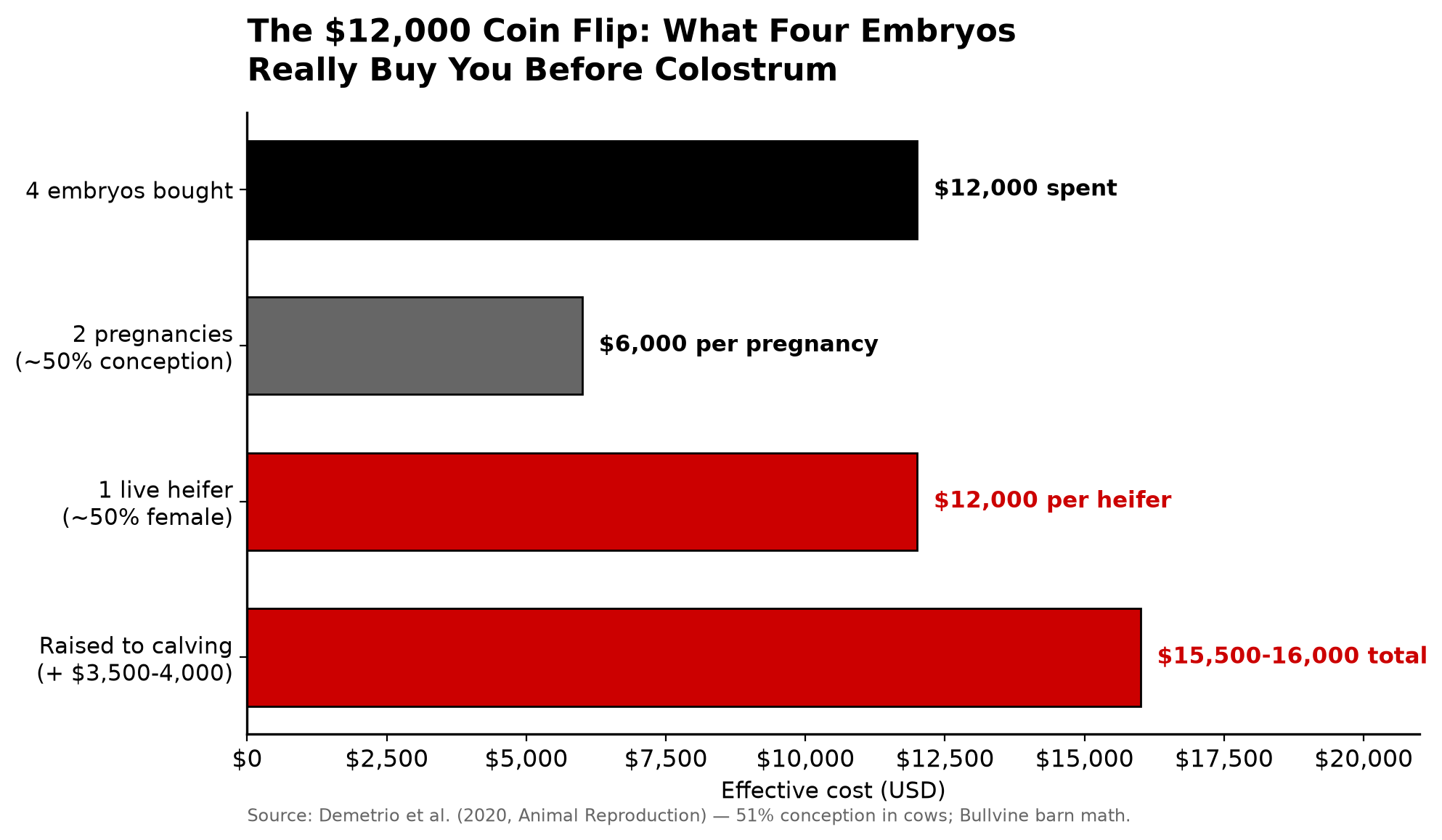
The uncomfortable question is what’s happening in your own barn right now. You’re spending on genomic tests, elite semen, and $3,000-plus embryos without asking whether the cow family underneath those numbers can actually stay in your barn for three or four lactations. That gap between paper merit and staying power is what this piece is about.
From Bull-of-the-Month to Cow Families That Don’t Miss
Genomics promised we could skip generations of slow, patient pedigree-building. But as the index race speeds up, a paper-thin pedigree is turning into a high-maintenance luxury. Let’s look at the real math of what a shallow family costs you once the honeymoon of her first proof wears off.
The industry still runs on a four-month heartbeat — new proofs in April, August, December, fresh catalogs, a fresh list of must-use sires. CDCB’s April 2025 base change reset every TPI value in the system, moving the reference point from cows born in 2015 to those born in 2020, and the April 2026 run reshuffled the rankings again, with STgen alone holding 36% of the proven TPI top 100. By design, you’re pushed to think bulls first.
Glenridge Citation Roxy EX-97 — the American answer to the same argument. No genomic test ever scored her; her record did. Generations of Goldwyns, Atwoods, and show-ring champions trace to this one cow, proof that a great maternal line compounds value long after the index that ranked her contemporaries has been forgotten. Read more: Glenridge Citation Roxy: The Legendary “Queen of the Breed”
The cows quietly driving your margins don’t turn over every four months. Strip the brand names off the catalogs, follow the cow side, and the same surnames keep surfacing: Comestar Laurie Sheik, Snow-N-Denises Dellia and her granddaughter Regancrest-PR Barbie, Glenridge Citation Roxy. These families do what no single sire can — throw profitable daughters, generation after generation, through changes in feed cost, housing, indexes, and tools. For the wider story of how 16 years of genomics rewrote which bulls get used — and what it didn’t touch on the cow side — see The Great Holstein Shakeup.
Snow-N Denises Dellia, EX-95-2E-GMD-DOM—Walkway Chief Mark out of Snow-N Dorys Denise, with Carlin-M Ivanhoe Bell as maternal grandsire. “Tall, sharp, clean, beautifully uddered, and trouble-free,” judge Niles Wendorf called her the day she stood grand champion at the 1991 Wisconsin Spring Show. This is the cow Select Sires had passed on. (Read more: Three Gold Medal Sons From One Cow the Studs Didn’t Want)
How Does a Shallow Pedigree Actually Cost You Money?
Bring it down to two heifers walking into your parlor next spring.
Heifer A is +3.2 PTAT on a genomic-only proof. Her dam’s a GP cow with two quick lactations and not much behind her. On paper, she’s exciting. In reality, you’ve got no idea whether that maternal line survives heat, robot glitches, or your transition pen. Heifer B is +2.8 PTAT — less flashy on the sheet. But she comes from a Barbie-type line where more than 27 daughters have been scored, all but one landing VG or EX on first classification, and where the family now sits behind roughly 36% of top-tier PTAT rankings.
Regancrest-PR Barbie — the cow family that refused to be made obsolete. When genomics arrived promising to replace pedigree with a number, Barbie answered by stacking her sons and daughters at the top of the same index lists. The dynasty didn’t fight the new system. It won inside it — which is the whole point. (Read more: When Breeding Genius Meets Perfect Timing: How Regancrest-PR Barbie Shaped the Future of Holstein Genetics)
Heifer Comparison: Dynasty vs. Shallow Pedigree
Attribute
Heifer A (Shallow Pedigree)
Heifer B (Dynasty Line — “Barbie/Roxy”)
Genomic PTAT
+3.2 (exciting on paper)
+2.8 (slightly lower index)
Maternal backing
GP dam, shallow family
Deep line (27+ VG/EX maternal sisters)
Expected lifespan
~1.8–2 lactations (early cull risk)
3.5+ lactations (proven durability)
Parity-1 vet costs
~$75+ (higher stress susceptibility)
~$23–$35 (resilient, low drama)
ET/IVF viability
High risk (unproven transmission)
High reward (80–90% elite transmission)
5-year est. margin
Baseline
+$950 to +$1,600 (midpoint +$1,200)
Note: Parity-1 vet costs (Blom et al., 2023) and maternal backing reflect documented records. Expected lifespan and ET transmission rates are Bullvine illustrative estimates comparing dynasty and shallow lines — not measured population values.
Fast-forward five years. The Barbie-line heifer is far more likely to still be milking in her third or fourth lactation. Published herd-life economics — De Vries (2017, Journal of Dairy Science) on the longevity-versus-genetic-gain trade-off, and Gazzarin et al. (2025, JDS) on optimal productive lifespan — consistently show that spreading rearing cost across more lactations while banking extra peak-milk cycles adds real profit per cow. Our Bullvine analysis, built on those ranges, pegs each additional successful lactation at roughly $400 to $600 per cow, depending on your system.
Health stacks on top. A 2023 study of eight high-performance Minnesota Holstein herds (Blom et al., Animals) found parity-1 treatment costs ranging from about $23 to $75 per cow — and that’s direct vet cost only, before lost milk, discard, and breeding delays. Add it up across three or four lactations and the dynasty cow pulls clear. Our model lands the five-year cash gap between a dynasty-line heifer and an equally fancy but shallow-pedigree heifer at roughly $950 to $1,600 per head — call it $1,200 at the midpoint. Hold that in pencil. It moves with your feed cost, your milk price, and how hard you lean on ET.
On a 300-cow herd raising 40 to 50 donor-candidate heifers over a few years, that gap scales into five-figure territory. The genomic test bills you today. The shallow family bills you in year three.
Three Fingerprints a Dynasty Can’t Fake
The Comestar, Regancrest, and Roxy families don’t look alike. One leans functional type, one extreme PTAT, one fertility and herd-life. Lay their histories side by side, though, and the same fingerprints show up.
A historic moment for the Comtois family as they receive Holstein Canada’s most prestigious individual honor for Comestar Lamadona Doorman EX-94-2E 27*. The presentation marks a remarkable full-circle achievement, as Lamadona becomes the 2022 Cow of the Year exactly 27 years after her ancestor, Comestar Laurie Sheik, received the inaugural award in 1995.
Depth, not a spike. In the Laurie Sheik family, herdbook stars stack in a way most herds never see once. Laurie Sheik carries 23 brood-cow stars, her Blackstar daughter Laura Black topped her with 24, and L Or Black earned 16. Holstein Canada named Laurie Sheik the inaugural Cow of the Year in 1995; her descendant Comestar Lamadona Doorman took the same title in 2022 — 27 years apart. That one purchase Comtois made in 1985 is still winning national hardware nearly four decades later. Not a one-hit wonder. A conveyor belt. The full story lives in The Cow That Built an Empire.
Barbie’s line runs the same pattern — dams, daughters, granddaughters carrying multiple Excellent daughters and top PTAT slots, not one freak cow surrounded by also-rans. Glenridge Citation Roxy EX-97-4E had 16 Excellent daughters, over 300 Excellent descendants, and a 30-star brood cow in Mil-R-Mor Roxette EX. Families that flat-out refuse to miss.
Volume with the same result. Dynasties don’t get judged on three daughters. Barbie produced more than 27; all but one classified VG or better on first lactation, and by 2010 she’d stacked eight Excellent and nineteen Very Good, with at least eleven daughters in the top-25 PTAT rankings. Give a family 20 to 30 daughters by different bulls and they still hit 80 to 90% of the time — that’s zero-failure transmission in barn terms. No genomic prediction fakes that.
And here’s the real separator: the results hold across different sires and different barns. In the Barbie family, Goldwyn and Shottle daughters both show the same mammary quality. In the Laurie Sheik line, Blackstar, Prelude, and Storm all threw daughters and sons that lifted herds from Quebec to Belgium to modern robot barns — at Bois Seigneur Holstein, roughly 70% of the herd traces back to her. Roxy’s descendants have milked in tie-stalls, free-stalls, and on pasture without losing their reputation for fertility and low SCC. A printout ranks a calf in a population. It can’t tell you how her granddaughters behave across 30 matings and five proof runs. That’s where dynasties live. Read the family trees in Roxy, Dellia and The Mothers Who Built the Breed.
Dynasty family
Depth (brood-cow stars / EX daughters)
Volume tested
Repeatability signal
Comestar Laurie Sheik
23 brood stars; Laura Black 24, L Or Black 16
Anchored 14 Class EXTRA bulls
2 Cow-of-the-Year titles, 27 yrs apart
Regancrest-PR Barbie
8 EX + 19 VG daughters by 2010
27+ daughters classified
All but 1 hit VG/EX on 1st lactation
Glenridge Citation Roxy
16 EX daughters; 300+ EX descendants
Mil-R-Mor Roxette = 30-star brood cow
Held type across tie-stall, free-stall, pasture
Millionaire sires produced
Leader, Lee, Lheros, Outside (Laurie Sheik)
Comestar Lee: 1.5M doses
Same result across Goldwyn, Shottle, Blackstar
What Does a $3,000 Embryo Really Buy You?
Here’s the flip side, and it’s the other half of our $93,300-a-year “three cow families” warning. Not the trap of leaning too hard on a handful of dynasties — the opposite mistake, ignoring proven cow families entirely.
Hand over $3,000 for an embryo and you’re not buying a guarantee. You’re playing biological telephone. Here’s how the cash actually drains:
The Cold Math on $3,000 Embryos
The buy-in: 4 embryos × $3,000 = $12,000 spent
The reality check: ~50% conception rate = 2 pregnancies
The coin flip: ~50% heifer rate = 1 live heifer
You just paid $12,000 for one live heifer before she drinks her first bag of colostrum — and that’s before the $3,500 to $4,000 to raise her to calving. If her donor’s a one-generation wonder, you’ve got a real shot at that $12,000 washing out early. If she’s a Roxy or a Barbie, she’s got the maternal infrastructure to back the price tag. Those conception rates aren’t guesses, either: Demetrio et al. (2020, Animal Reproduction) put in vivo pregnancy at about 51% in lactating cows and 63% in virgin heifers.
Now overlay the family. From a Barbie/Laurie/Roxy-level dynasty, family data suggests 80 to 90% of those embryo-derived daughters land in your top tier. From a high-genomic young cow with nothing behind her, that “elite” hit rate can realistically slide to 30 to 40% once health, fertility, and cull reasons pile on. Using the upper end of our earlier range — roughly $1,500, since embryo heifers are pre-selected for merit rather than average — the expected margin per $12,000 investment looks like this:
Ignore maternal proof and you’ve taken a 50% haircut, purely because you never asked whether the donor’s family had proven anything past three generations of names on paper. Run 20 embryos a year in a 300-cow herd and that’s five-figure lost upside over five years — before you count the drain of watching can’t-miss heifers turn into problem cows.
How Do You Lean on Dynasties Without Breeding Yourself Into an Inbreeding Hole?
There’s a real catch. Double down on a few cow families, ignore the sire mix, and you dig an inbreeding hole fast.
Canadian Holstein heifers born in 2024 now average 9.99% inbreeding, per Lactanet’s August 2025 update — up from 9.61% the year before, and nearly double where it sat 15 years ago. The US doesn’t publish one breed-average figure, but CDCB’s base-change work tells the same story: average Expected Future Inbreeding jumped from 7.5% to 9.4% between the 2015 and 2020 cow bases. Different yardstick. Same direction.
The Inbreeding Alarm: With breed averages sitting at a historic 9.99%, doubling down on “popular” branches of a dynasty without a strict mating guardrail is genetic self-sabotage. Virginia Tech’s benchmark work (Smith et al., 1998, JDS) pegged each 1% rise in inbreeding at roughly $22 to $24 in lost lifetime net income per cow — but that’s in 1999 dollars. Inflation-adjusted and paired with newer genomic milk-loss data, real-world estimates now run about $44 to $100 per cow. And it hits exactly where dynasties are supposed to protect you: fertility, stillbirths, immune-system slack.
So you manage a dynasty like a long-term investment, not a shortcut:
Track inbreeding animal by animal, not just as a herd average.
Hold expected heifer-crop inbreeding well below the 9.99% breed average — treat whatever number you pick as a brake pedal, not a target.
Don’t blackball elite carrier bulls. A +3,200 GTPI carrier mated only to clear (Code 0) cows beats a +2,800 GTPI clean bull — you bank the genetics and dodge the homozygous risk.
Use genomic relationship data to find less-related bulls that still fit your dynasty’s type and production goals.
Every herd sits in a different spot on the genetics curve. Three paths fit most 200- to 1,500-cow operations staring at this maternal blind spot.
The 30-Day Maternal Audit (start here). Print three to four years of cows sorted by lifetime milk or margin. Highlight the ones in third lactation or better with solid components and no chronic problems. Trace them back three maternal generations and circle the surnames that repeat. When it makes sense: any herd over ~150 cows with a few years of records. What it takes: a couple hours with herd software and a pen — no consulting fee. The limit: if your records don’t track lifetime performance well, you’ll lean on cull notes and memory as a stopgap. Even that beats flying blind. Tag those dynasty animals in your software this month, and you’ve already started changing daily decisions.
The Dynasty-First Semen Plan. Redirect the budget you already spend. Sexed, high-end semen goes to your top 20 to 30 dynasty cows and heifers first; conventional Holstein or beef goes on the rest unless one has a clear role. Cap expected inbreeding well under 9.99% on dynasty matings, and when a sire pushes those animals toward the line, swap him. When it makes sense: herds already spending real money on elite or sexed semen. The trade-off: you give up chasing every new bull and run a tighter sire list longer. As genomic evaluations put more weight on health and fertility, the smartest move won’t be overriding maternal proof — it’ll be sharpening which sires you use inside families that have already earned their spot in your barn.
The “Stop Guessing” Embryo Rule. Write one rule before the next sale catalog hits: if the donor’s family can’t show three generations of daughters with solid production, decent classification, and real herd life, you don’t write a $3,000 check. When it makes sense: any herd using ET/IVF or tempted by purchased embryos. The trade-off: you’ll walk past a hot donor with sizzling numbers and no cow-family proof, and you might miss the rare new family that would’ve panned out. You’ll dodge far more expensive disappointments. As more ET programs chase feed efficiency and sustainability, donors from proven dynasties are the ones that hit under real-world stress.
Key Takeaways
If you can’t name the maternal lines behind your top 10 cows without opening the herd book, run the 30-day audit before you spend another dollar on semen or embryos.
If a donor’s family can’t show three generations of daughters that milk, breed back, and stay out of the dead pile, don’t pay brood-cow prices for her embryos.
If you’re running more than 15 to 20 Holstein sires in a 300-cow herd over two or three years, you’re spreading the budget too thin — tighten the list and aim it at your top three families.
If your embryo-derived heifers aren’t beating your herd’s average retention to a third lactation, your program’s riding shallow families. Rebuild it around lines that have proven they stay.
If your herd inbreeding is creeping toward 9.99%, cap dynasty matings below that line, mate elite carriers to Code 0 cows only, and check inbreeding animal by animal — not just as a herd average.
Nobody’s arguing whether Barbie, Laurie Sheik, and Roxy created value. Four millionaire sires — with Comestar Lee alone reaching 1.5 million doses — 16 Excellent daughters in one family, a third of the elite PTAT list: that answer’s already written. The open question is whether your program is built to reward the dynasties quietly carrying your barn, or whether you’re still spending 2026 money like it’s 1998, letting catalogs call the shots instead of the surnames on your best cows’ tags.
So here’s the one to sit with before the next proof run lands in your inbox: print that three-to-four-year cow list tomorrow morning and see which three families are actually holding your barn together. Once you see it, you can’t unsee it. And when you want the full model — exactly how much extra profit per lactation a dynasty cow throws off at 200 cows versus 1,500 — that’s the deeper per-cow math we’re building next, and where Bullvine Weekly readers get it first.
Run Your Numbers
Genomic Testing ROI Calculator — Before you flush a donor or write another $3,000 embryo check, run the numbers on which animals are actually worth testing. It puts a dollar value on the spread between your best and worst genetic quartiles, flags where inbreeding risk needs tighter control, and pressure-tests whether the decision pencils under conservative assumptions — not just the aggressive ones.
Complete references and supporting documentation are available upon request by contacting the editorial team at editor@thebullvine.com.
Roybrook 2026: The $15000 Holstein Cow Family Test — Delivers a strict three-strike diagnostic framework to audit your own herd, helping you cull underperforming maternal lines and construct a highly profitable, self-replacing breeding nucleus.
The Great Holstein Shakeup: How 16 Years Rewrote Breeding Rules — Breaks down how genetic concentration collapsed since 2008, arming you with long-term strategic insights into how top-tier commercial operators now bypass single super-sires to manage multi-generational genetic risk.
The Sunday Read Dairy Professionals Don’t Skip.
Every week, thousands of producers, breeders, and industry insiders open Bullvine Weekly for genetics insights, market shifts, and profit strategies they won’t find anywhere else. One email. Five minutes. Smarter decisions all week.
Two robots, 100 cows, a calm barn — and a milk cheque that only balances because mom, the kid who “helps out,” and the farmer at hour fourteen all work for free.
Scroll through the parenting and ethics corners of Reddit, and you’ll keep hitting the same question: is more humane, ethical dairy even possible? Every so often an actual dairy farmer wanders in to answer it, describing a cow‑health‑first operation milking around 100 cows on a pair of robots — cows coming and going as they please, nobody setting a 4 a.m. alarm. It’s the dream a lot of tired producers and ethics‑minded consumers want to believe in. And honestly, parts of it are real.
Here’s the part those threads never price. At 100 cows on commodity milk, that “ethical robot dairy” usually only balances because somebody’s labor is valued at zero. USDA’s Economic Research Service shows small herds carry far more labor cost per hundredweight than big ones — and on the smallest operations, most of it is the imputed value of unpaid family hours that never hit a payroll line. Robots don’t erase that line. They make it easier to pretend the time is free. Who’s actually paying for the “ethical” part is the question this whole story turns on.
What’s Changing and Why
Robotic milking has stopped being exotic. USDA’s ERS reports box robots milked about 6% of U.S. milk by 2021, with the fastest uptake on 150‑to‑499‑cow farms. And the headline finding everyone repeats holds up: in ERS’s June 2026 analysis, robotic milking raised dairy net returns by $3.15/cwt on average, relative to non‑adopters.
That number’s real. It’s just shown at the wrong resolution. ERS measures it as an average across adopters — and the strongest returns lean toward larger, well‑utilized herds, not the 80‑to‑120‑cow place. The “ethical robot” dairy that keeps getting shared online sits on commodity milk, often with no premium channel at all. That average wasn’t built on farms like that one.
So the farms most exposed to the gap are exactly the ones the humane‑dairy story celebrates — small, family‑run, welfare‑forward, betting on robots to make the lifestyle last. They’re not wrong that robots improve daily life. They’re wrong if they assume the average return shows up on their balance sheet just because they bought the box.
How This Plays Out on Real Farms
Iowa State extension economist Larry Tranel has run AMS cash flow for years, and his models tell the part the dealer’s payback chart skips.
“Cash flow of a robot tends to be very negative in the first seven years, then pretty positive for the rest of the life of the AMS — but that is dependent on many variables, especially repair costs across the whole life of the robot.” — Larry Tranel, Iowa State University Extension.
Two robots plus barn work routinely lands a family $400,000 to $550,000 in new or refinanced debt. And there’s a trap hiding inside the production bump. Tranel warns that “much of the increase reported on AMS is due to the new cow housing facility, not just the AMS, as new facilities often increase production 6 to 8 percent over old, worn‑out facilities.” In plain terms: families credit the robot for gains the new barn delivered, then build their projections on repeating them.
Smaller robot stories can work — but rarely on the dairy alone. The ones that hold together almost always have a second income stream quietly carrying the cash‑flow valley. Marcus and Paige Dueck of Four Oak Farms near Kleefeld, Manitoba are the cleanest example you’ll find. When Western Canada’s first rail‑mounted Robomax milker rolled into their old tie‑stall barn in July 2020, it wasn’t a freedom play — it was a math problem. “My parents were looking to slow down their involvement in the barn, we had a new baby, and we had to make a decision,” Marcus told Farm Forum. “Expanding just wasn’t a financially feasible option.”
Notice what they didn’t do. They didn’t scale up to chase the robot’s economics — they kept a herd of about 50 cows and changed almost everything else. They swapped Holsteins for Brown Swiss, betting on temperament and component premiums over volume. “You don’t need more cows,” Marcus says. “You just need the right cows — ones that make milk that pays better.” Production per cow climbed roughly 40% over five years, driven by a shift to three‑times‑a‑day milking and cow‑level data — not more animals.
The dairy alone still wouldn’t carry it, and the Duecks are blunt about that. Half their roughly 900 acres goes to a high‑value hay business aimed at performance‑horse owners across Canada and the U.S., built around a German composite baler nobody else in their market runs. The other half is cash crop. On top of that sits Four Oak Ag Solutions, a manure‑and‑nutrient consulting firm Marcus grew from helping one neighbor with a manure plan. “In dairy, you can’t have all your eggs, or your milk, in one basket anymore,” he says. That diversification — not the robot — is what makes a 50‑cow operation work. It earned them Manitoba’s 2024 Outstanding Young Farmers title and a philosophy worth stealing: “We see a lot of farms chasing size, not sanity,” Paige says. “You can scale without losing peace.” Their model is the exception that proves the rule — robots fit inside a diversified business; they don’t rescue a bare commodity dairy.
Now the micro barn‑math that should stop the room cold. USDA lowered its 2026 all‑milk forecast by 55 cents in June to $20.70/cwt, and the market’s still drifting. Say your 100‑cow place runs cash costs near $19/cwt and looks like it’s clearing a couple of dollars. Then you price the family hours honestly.
Run your own version: 60 family hours a week at $20/hour is about $62,400 a year — spread across roughly 2.2 million lbs of milk, that’s near $2.80/cwt you’re absorbing before you’ve paid a robot loan. ERS’s own cost‑of‑production work shows the smallest herds carry the heaviest labor load per hundredweight, much of it unpaid family time. Add that real labor bill back, and a comfortable‑looking margin can flip negative in a hurry. On 100 cows, that’s money leaving the family every month. It just never arrives as a bill.
The Mechanics Behind the Outcomes
Three hidden subsidies make the ethical robot story pencil on paper. None of them show up in the brochure, and all of them are load‑bearing.
Hidden Subsidy
Who Pays It
What The Data Says
Unpaid family labor
Mom, the kid, the farmer at hour 14
Robots cut milking labor 21%+, but U. of Minnesota found robot herds less profitable per cow — the edge only appears per full-time worker
Paid-off land / off-farm income
The second business or the mortgage-free balance sheet
Four Oak Farms carries the cash-flow valley on hay + consulting income — not the robot
Welfare premium that never arrives
The farmer’s conviction, priced at commodity
70% say they’ll pay more; only 14% trust the label; 60% think brands are “just pretending”
Unpaid family labor. Robots cut hands‑on milking sharply — adopters in one multi‑box study reported labor‑cost cuts of over 21% — but they shift the rest of the work from physical to managerial and on‑call: the 2 a.m. alarm, the software, the fetch cows. University of Minnesota work found robot herds were actually less profitable per cow than conventional herds; the advantage only showed up once profit got measured per full‑time worker. Robots make your people more productive. They don’t make the labor free. They make it invisible.
Paid‑off land or off‑farm income. The small robot farms that genuinely work tend to own their ground outright or run a second paycheck that quietly absorbs the cash‑flow valley. The Duecks’ hay and consulting income is exactly this — and they’ll tell you so. That’s an exception worth naming honestly, not a model to bolt onto a leveraged start‑up.
The welfare premium that never reaches the milk cheque. A November 2025 study in the Journal of Dairy Research found 70% of consumers say they’ll pay more for animal‑welfare‑certified dairy. But only 14% of U.S. consumers fully trust sustainability claims on labels, and 60% figure companies are “just pretending.” The farmer carries the cost and the conviction of high‑welfare care while the market prices it at commodity. The handful who capture real premiums — Jasper Hill, Maple Hill, Alexandre Family Farm — do it through certification and brand, not by owning a robot.
Metric
Figure
What It Means For The Cheque
Consumers who say they’ll pay more for welfare-certified dairy
70%
Stated intent — the brochure number
Consumers who fully trust sustainability label claims
How Much Does Your “Ethical” Story Cost Once You Price the Labor?
Run the reality check this month. Three questions, three numbers, and you’ll know more than most operators who’ve already signed.
What’s your true cost per cwt at your actual cows‑per‑robot utilization — not the dealer’s glossy target? How many unpaid family hours are propping up the story, and what are they worth at your local wage? And what premium per cwt would a processor or direct customer need to pay before the welfare narrative covers its own freight? If you can’t answer all three, you don’t yet know whether you own a business or a very expensive family project. Where does your breakeven actually sit right now?
Is the Robot the Reason Your Kids Stay — Or the Reason They Can’t Leave?
The succession pitch is powerful, and it’s not cynical: your kids won’t have to milk at 4 a.m. There’s real signal behind it. Bullvine’s own reporting has tied a tech‑savvy, balanced approach to a sharp rise in next‑generation interest — one figure put it as high as a 340% jump, though that stat traces to a single source and is best treated as directional, not gospel. Robots can genuinely make dairy a life a young person chooses instead of endures.
But technology doesn’t fix succession — economics and planning do. Only a small fraction of family operations survive to the third generation, and a robot doesn’t change those odds. When a heavily leveraged robot barn becomes the reason the next generation signs on, the “freedom” can quietly turn into a golden handcuff. They didn’t inherit cows and choice. They inherited $400,000‑plus in tech debt and an obligation to make it pay. The robot keeps them on the farm. It doesn’t necessarily keep the farm viable past their watch.
Options and Trade-Offs for Farmers
There’s no single right answer here. There are three honest paths, and your own math points to the one that fits.
Path
Works When
Required Condition
The Risk
1 — Scaled, cost-competitive
Climbing toward larger, well-utilized herds
~55 cows/robot utilization; labor valued at $27.05/hr breakeven
Below ~140 cows on commodity milk, the math rarely closes
2 — Robot + 2nd income / real premium
You have a genuine second business or a paying market channel
The Four Oak model: diversified revenue + component-premium breed
WTP collapses at checkout — 67% demand third-party certification
3 — Stop pretending robots fix it
Structurally negative 100-cow operation
Run true cost/cwt with family hours priced in
Waiting 18 months too long burns ~$575,000 in equity
Path 1 — Robots as a scaled, cost‑competitive system. Makes sense if you’re climbing toward the larger, well‑utilized herd size where ERS sees the strongest returns, with utilization near the 55 cows per robot extension benchmarks favor. Requires ruthless cost tracking and labor valued at market — University of Minnesota pegs the breakeven labor cost around $27.05/hour. The risk: below roughly 140 cows on commodity milk, the math rarely closes.
Path 2 — Robots plus a second income or a real premium. This is the Four Oak Farms model — a robot paired with diversified off‑farm revenue (the Duecks’ hay business and Four Oak Ag Solutions consulting) and a breed strategy built on butterfat and protein premiums rather than volume. Requires either a genuine second business or a market channel paying a measurable $/cwt over commodity. The risk: stated willingness‑to‑pay collapses at the checkout without a trusted third‑party label — 67% of consumers in American Humane’s 2024 survey specifically emphasized third‑party certification.
Path 3 — Stop pretending robots fix an unprofitable commodity dairy. Sometimes the honest move within the next 30 days is to run your true cost per cwt — family hours priced in — and accept that a structurally negative 100‑cow operation needs a different decision than more debt. Bullvine’s exit‑math work shows waiting 18 months too long on a negative position can quietly burn around $575,000 in equity; a planned transition preserved $765,000 versus $255,000 in a forced liquidation. No robot out‑runs that gap.
We’re building the full seven‑year cash‑flow valley behind that $3.15/cwt return — laid out year by year by herd size — as a follow‑up; watch for it in the coming weeks.
Key Takeaways
If your robot herd “breaks even” on paper, rerun it with every family hour priced at your local wage. If that move pushes you into the red, you’re subsidizing the operation, not running it.
If you’re below ~140 cows on commodity milk with no premium channel, treat the $3.15/cwt average net return as somebody else’s number until your own utilization and labor math say different.
If you’re banking on a welfare premium, get the contract or certification in writing first — 70% say they’ll pay, only 14% trust the label, and your co‑op rarely converts welfare compliance into $/cwt.
If you’re going to make a small robot herd work, copy the Duecks before you copy the brochure: a second income stream and a component‑premium breed strategy did the heavy lifting, not the robot.
If your operation’s been structurally negative for 18 months or more, run the exit‑versus‑reinvest math before you sign robot debt. The equity gap between a planned and a forced transition runs into six figures.
If robots are the reason your kids are staying, separate the lifestyle promise from the balance sheet. Make sure they’re choosing a viable business, not inheriting an obligation.
The Question to Take to the Kitchen Table
That farmer answering the “is ethical dairy even possible” question isn’t wrong to want a calmer barn and cows that get to be cows. The question that decides whether the dream survives contact with the milk cheque is the one nobody in the showroom asks: at your herd size, your milk price, and your real labor bill, who’s quietly paying for the “ethical” part — the market, or your own family?
Run those three numbers this week. Then take them to your lender and your kids before you take them to the equipment rep. And if you want to see how a robot, Brown Swiss, hay, and consulting actually came together on one real Manitoba farm, read how the robots hum and the cows stay calm at Four Oak Farms.
Complete references and supporting documentation are available upon request by contacting the editorial team at editor@thebullvine.com.
How 5 Dairy Farmers Got Out While They Were Still Winning — Exposes the massive $575,000 equity gap between a strategic, planned dispersal and a forced liquidation when a financially strapped operation waits too long to transition.
Every week, thousands of producers, breeders, and industry insiders open Bullvine Weekly for genetics insights, market shifts, and profit strategies they won’t find anywhere else. One email. Five minutes. Smarter decisions all week.
Cows healthy, tank full, bills paid — and a 70-cow dairy still lost about $237,000 last year. At $16.92 per cwt for milk against Cornell’s $31/cwt, here’s the bill your milk check never shows you.
The dairy farmers in this scene aren’t real, but every number behind them is. Picture a family that’s milked 70 cows in the same tie-stall barn for 25 years, sitting across the kitchen table from an advisor who’s just run their numbers. They’re good farmers. Cows are healthy, the bulk tank’s full, the bills got paid last year. Then the spreadsheet says they lost money — real money — and the look on their faces is the whole problem with small commodity dairy in 2026.
They didn’t lie when they said “We paid our bills.” They did. But paying the bills and turning a profit are two different questions, and the gap between them is where small commodity dairies quietly bleed equity. At 60 to 150 cows shipping to a co-op with no premium, that gap can run well past $130,000 a year — and you can lose it without ever feeling the hit. This is the cost of production math nobody wants to run. It’s also the only math that tells you which of three paths you’re actually on.
What’s Changing and Why
The structural numbers don’t leave much room for argument. USDA’s Economic Research Service reported in February 2026 that licensed U.S. dairy herds fell from 66,825 in 2004 to 24,811 in 2024 — a 63% drop — while total milk production climbed from 170.8 to 225.9 billion pounds over the same stretch. Fewer farms. More milk. And the herds that disappeared were overwhelmingly the small ones.
Look closer at which farms vanished and the pattern sharpens. Farmdoc’s read of the 2022 Census of Agriculture found the 20–49 cow class declined the most on a percentage basis, with 50–99 cow herds right behind — the exact bracket our 70-cow family sits in. In total, 39% fewer U.S. farms sold milk in 2022 than two decades earlier. The milk didn’t disappear with them. It moved to bigger barns.
The cost gap is why. ERS data from its 2021 ARMS survey put the total cost to produce 100 pounds of milk at $42.71 per cwt for herds under 50 cows, against $19.14 for herds with 2,000 or more. That’s not a rough patch you outwork. It’s a roughly $23/cwt structural disadvantage built into scale itself, and it doesn’t care how hard you hustle in the parlor.
Our 70-cow family sits right in the teeth of it. So does anyone running 50 to maybe 500 cows, shipping bulk milk with no value-added product and no direct premium. You’re competing on cost against operations that make milk for less than half what you spend, then selling into the same market at the same price.
How a Profitable-Looking Farm Loses Six Figures
Here’s the part that blindsides families. On a cash basis, a small dairy can look fine — the milk check covers feed, the vet, the loan payment, and there’s something left to live on. But the cash basis leaves out two enormous costs: the family’s own labor and honest depreciation on barns and equipment bought decades ago. According to Illinois Farm Business Farm Management data released in December 2024, even farms with positive cash returns posted negative economic returns averaging –$686 per cow over five years, including –$758 per cow in 2023.
So run the barn math on that 70-cow family. At roughly 24,000 lbs per cow, they ship about 16,800 cwt a year. Anchor it to a real price: USDA’s Agricultural Marketing Service reported Class III milk closed May 2026 at $16.92/cwt — the number a cheese-market commodity shipper actually lives on, even as USDA’s headline all-milk forecast sat higher at $20.70. At $16.92, that’s about $284,000 in revenue. For full economic cost, use a real benchmark instead of a guess: Cornell’s Dairy Farm Business Summary puts the 100–199 cow class at $31–33/cwt once labor and capital are counted, and a 60–150 cow operation sits at or above the top of that band. Take the low end — $31/cwt — and this herd’s cost runs about $521,000. The hole is roughly $237,000 a year. Even at the rosier $20.70 forecast, you’re still down more than $170,000.
The number that trips up commodity operators: $20.70 is the forecast. $16.92 is the check. Now, all-milk and Class III aren’t a clean apples-to-apples subtraction — all-milk blends every class and folds in premiums. But the gut-check holds: if you budget your year on the price you actually get paid, not the forecast headline, you’re planning around roughly $3.78/cwt you may never see. On 16,800 cwt, that’s about $63,000 between the plan and the mailbox.
So why don’t they feel the loss? Nobody writes the family a paycheck at $18–22 an hour, and the barn’s still on the books at 1990s prices instead of today’s rebuild cost. The signs show up before the spreadsheet does. Deferred vet calls. Peeling paint on the milkhouse. A spouse’s town job quietly covering the feed bill some months.
That last one is the clearest diagnostic there is. Farm Credit Canada’s BeefResearch.ca team flagged the gut-check back in September 2022: if off-farm income has covered farm operating losses in three or more of the last five years, you’re looking at a structural problem, not a tight stretch — the farm isn’t paying its own way. The benchmark is Canadian, but the logic crosses the border intact. A farm leaning on a town paycheck to cover operating losses, not just household groceries, isn’t carrying itself. That doesn’t make it worthless. Plenty of families decide, eyes open, to subsidize a life they love, and that’s a legitimate call when you make it on purpose. The trouble starts when the subsidy is invisible — when a farm runs a decade on borrowed equity while everyone at the table calls it “tight but okay.” Name it out loud, and the question shifts from “are we failing?” to “what do we actually want this to be?” That’s a far better question to answer while you’ve still got options on the board.
What Does the Same Barn Look Like at 40 Cows and a Cheese Vat?
Now flip the model. Take a 40-cow herd that never sees a co-op truck — every drop goes direct-to-consumer, into a cheese vat, or onto a farm-store shelf. Fewer cows, radically different math. At 24,000 lbs/cow, that’s 9,600 cwt a year, against the 70-cow herd’s 16,800. On commodity terms it’d be a rounding error. The point is that this farm isn’t selling a commodity.
Here’s where the numbers diverge hard. NODPA reported organic and grass-fed pay prices running $38–60/cwt this spring — more than double the $16.92 a conventional cheese shipper saw. Say half this herd’s milk — 4,800 cwt — moves as branded fluid or direct sales at an organic-grade $45/cwt: that’s about $216,000. Turn the other 4,800 cwt into farmstead cheese, and the leverage compounds, because roughly 10 lbs of milk makes 1 lb of cheese. That’s about 48,000 lbs of cheese; even at a conservative farm-store $12/lb, you’re looking at another $576,000 in gross sales off the same volume that would’ve fetched maybe $81,000 as bulk milk. (These 40-cow figures are illustrative, built on conservative assumptions — a 50/50 fluid-to-cheese split, mid-range NODPA organic pay price of $45/cwt, and $12/lb farm-store cheese — not a single sourced operation.)
But before anyone trades the parlor for a make-room, read the trade-off honestly. That cheese revenue isn’t margin — it’s gross, and the costs behind it are brutal. A Journal of Dairy Science study pegged artisan cheese plant startup at $267,248 to $623,874, and that’s a 2013 figure, so budget higher today. Then add the labor: aging, packaging, food-safety compliance, farmers’-market booths, and the website that drives the whole thing. You’re not adding a revenue stream. You’re bolting a second business — manufacturing and retail — onto a dairy farm, and plenty of operators discover they like cows a lot more than they like invoicing. The upside is real. So is the failure rate.
The Mechanics Behind the Outcomes
So why is the deck stacked this way for the commodity shipper? Part of it is plain scale economics. Bigger farms spread fixed costs across more cows and buy feed, semen, and supplies cheaper per unit. RaboResearch puts that edge at roughly $10/cwt for 2,000-plus-cow farms over 100–199 cow herds. But part of it is the pricing system itself, which shifted again in 2025 — and most farmers never saw it move.
The Federal Milk Marketing Order changes that took effect June 1, 2025, raised the “make allowances” — the manufacturing-cost credits processors keep before paying for your milk’s components. The American Farm Bureau Federation calculated the change lowered Class III prices by 92¢/cwt in the first three months and pulled roughly $337 million out of producer pool revenues nationwide, per economist Daniel Munch’s September 2025 Market Intel analysis. On our 70-cow family’s 16,800 cwt, 92¢ is about $15,500 a year — gone, off a check that was already underwater.
Here’s why that 92¢ stings a small herd worse than a big one. The cut comes off everyone’s component price the same way — but large operations have buffers small shippers don’t. The Bullvine’s own market reporting notes smaller farms take disproportionate hits, and scattered producers routinely pay higher per-cwt hauling charges than the big routes. Volume herds negotiate over-order and quality premiums that claw back some of the loss; many small bulk shippers don’t have that leverage. And hedging tools like Class III futures or Dairy Revenue Protection can offset a price drop — but as risk-management firms like CIH lay out, they take a broker relationship, a written margin-management policy, and enough volume to make the contracts worthwhile. A 70-cow herd rarely has all three. So the same 92¢ that a mega-dairy partly absorbs or hedges away lands full-force on the small commodity shipper’s mailbox check.
And it arrived almost invisibly. The change came inside dense formula language and a single up-or-down producer vote on the whole order — so on most farms it showed up simply as a lower milk price, not as a line item anyone flagged. There’s no entry on a milk check that reads “this is the day margin moved from your bulk tank toward the plant.” The system keeps your eye on the gross price while the real action happens three layers down in the formula.
How Much Does Waiting Actually Cost?
More than most families expect — and the meter runs whether you look at it or not. Cornell’s Dyson School research, as reported by The Bullvine in December 2025, found that well-planned transitions preserve $400,000 to $680,000 more wealth than distressed sales, and that delaying an exit by three years can destroy roughly $450,000 in family equity. Forced sales make it worse. When assets sell on a lender’s timeline instead of yours, Calder Capital’s March 2025 distressed-sale analysis pegs auction recovery at just 23–51% of fair market value, versus far more in an orderly going-concern sale.
There’s a quieter cost too. Farm advisors note that producers who have an exit plan — even one they never pull the trigger on — make calmer, sharper daily decisions, because the desperation’s gone. The plan isn’t a white flag. It’s a steering wheel you keep in your own hands instead of handing to the bank.
Staring at numbers like these and feeling the weight of them? You’re not the only one, and you don’t have to sort it out alone. Farm Aid (1-800-FARM-AID) and Do More Ag connect farm families with both financial and mental-health support.
So Which Path Are You Actually On?
There are three real paths here — not a fourth one where milk prices ride in and rescue a small commodity herd. Each one works for some operations and quietly destroys others. The honest part is matching the path to who you actually are. Read the prerequisite first: if it doesn’t describe you, that’s not your path.
Path
Best for
Prerequisite to even start
What it requires
The risk
1. Go big & efficient (commodity)
Operators who want to compete on cost at scale
A balance sheet that pencils well below the $20.70 forecast — extension economists advise stress-testing expansion against milk as low as $16/cwt
500–1,000+ cows, strong equity, low cost per cwt
You stop being a “small dairy” entirely, and the debt is real the day milk drops
2. Go radically niche (high margin, low cow count)
Operators near affluent/health-minded buyers who genuinely like marketing
$267,248–$623,874 in processing capital for modest artisan cheese volumes — and that’s a 2013 figure, so budget higher today (Journal of Dairy Science, 2013)
Brand work, regulatory know-how, and patience through years of thin returns
Premium transitions often lose money for years before they turn; the upside is real — organic and grass-fed ran $38–$60/cwt this spring per NODPA, against that $16.92 check
3. Exit while you still have equity
Farms with no successor and a breakeven stuck above market
An honest valuation and a timeline you control, before the lender sets one for you
A real tax conversation and lead time
None, if done early — strategic exits have preserved $400,000–$680,000 more than forced liquidations (Bullvine, March 2026)
Our 70-cow family at the kitchen table? On these numbers, with no off-farm buyer lined up and no appetite for building a brand, they’re a Path 3 candidate — unless someone’s willing to pay a premium for the story behind that milk, which moves them toward the 40-cow value-added model and Path 2. What they can’t be is Path 0: a commodity tie-stall that pays all the bills at $16.92. That option left the table years ago.
And the choice isn’t only about this year’s check. Each path carries a different forward bet. Path 1 is a bet that you can keep driving cost per cwt down faster than milk prices fall — RaboResearch’s $10/cwt scale gap says the big farms will keep pressing that advantage. Path 2 is a bet that the organic and direct-to-consumer premium holds; NODPA’s $38–60/cwt spread is real today, but it rides on consumer demand you don’t control. Path 3 is the only one that locks in what you’ve already built before the next down-cycle takes another bite. Pick the bet you can live with.
The 30-day move that fits all three: Calculate your true cost of production. Price your own labor at $18–22 an hour, depreciate the barn at replacement cost, and stack the result against the price you actually get paid — not the forecast headline. Cornell Cooperative Extension recommends a full production-and-financial analysis plus a sit-down with your lender as the first moves for farms under pressure. You can’t pick a path until you know which side of the line you’re standing on.
Key Takeaways
If you can’t state your cost per cwt with your own labor priced in and depreciation at replacement cost, that’s your first 30-day project — Cornell pegs the 100–199 cow class at $31–33/cwt, so if your number is lower, prove it before you bank on it.
If you’re budgeting off USDA’s $20.70 all-milk forecast instead of the Class III strip your check actually tracks ($16.92 in May 2026), rebuild the plan on the lower number before you commit a dollar.
If off-farm income has covered farm operating losses in three or more of the last five years, treat it as a structural signal and run the full economic analysis, not just the cash flow.
If niche is the dream, price the second business honestly — $267K-plus in processing capital plus the marketing and food-safety load — before you fall for the $38–60/cwt headline.
If there’s no successor and equity’s sliding, get a valuation now — a planned exit can hold six figures that a forced sale at 23–51% of value won’t.
If you’re staying commodity, book the lender conversation with real numbers before a covenant breach books it for you.
So where does your breakeven actually sit right now — not the cash version, the real one with your wage and your depreciation in it? That single number tells you whether you’re running a business, subsidizing a way of life, or slowly handing your equity to someone further up the chain. None of those three is wrong. But you ought to know which one you’ve chosen, instead of finding out when the bank does.
Complete references and supporting documentation are available upon request by contacting the editorial team at editor@thebullvine.com.
Learn More
Small herd cost of production: the $20.70 milk trap — Arms you with a hard look at the structural barriers facing small dairies, proving why a family farm succession proxy like building an on-farm creamery rarely resolves underlying equity leaks.
The $19 Milk Trap: How 2026 Prices Quietly Drain a 400‐Cow Dairy’s Equity — Exposes the deep structural asymmetries and processing plant mechanics that leave smaller herds exposed to intense margin squeezes, delivering an immediate financial stress-test playbook to protect your long-term balance sheet.
Every week, thousands of producers, breeders, and industry insiders open Bullvine Weekly for genetics insights, market shifts, and profit strategies they won’t find anywhere else. One email. Five minutes. Smarter decisions all week.
Select Sires passed on her—her two-year-old milk didn’t clear their index. Bob Snow’s 35-cow herd bred her anyway. She threw three Gold Medal sons. The eye beat the formula.
Snow-N Denises Dellia, EX-95-2E-GMD-DOM, pauses at the water’s edge at Regancrest—a quiet echo of the sandy creek back at Bob Snow’s, whose grit nearly killed her two months after her 1991 grand championship. The cow Select Sires passed on threw three Gold Medal sons and 76 daughters.
The rain had quit by noon, and Frank Regan figured his fresh-cut hay was a lost cause anyway. So he loaded up the family and pointed the car toward West Salem for the 1989 Wisconsin Championship Show. They walked into the arena right as the senior two-year-olds were filing through the gate.
That’s when he saw her.
Snow-N Denises Dellia. A tall, jet-black cow—longer through the body than most Bell daughters, wider through the chest, carrying an udder that looked sculpted rather than grown. She moved through that gate like she owned the building. Regan said it to himself, half under his breath: “Wow. Who is that cow?”
Here’s the part nobody in that arena could have known: the big A.I. studs had already looked her over and taken a pass. Select Sires wasn’t interested. Yet this “nobody” cow, from a 35-head herd in the Wisconsin coulees, would go on to breed three Gold Medal sons, leave 76 registered daughters, and become the foundation of one of the most consequential Holstein families of the modern era.
Frank Regan just knew he couldn’t stop thinking about her.
Where the Sandy Creek Ran
To understand Dellia, you’ve got to understand Bob Snow’s place. His farm sat in the coulees of southwestern Wisconsin—hilly, modest, the kind of outfit where a man milked 35 head and knew every one by her walk. There was a creek behind the barn where the cattle waded in to drink. Remember that creek. It matters later.
Bob Snow’s dairy near Sparta, Wisconsin—the 35-cow outfit in the coulees where Snow-N Denises Dellia was bred. No franchise money, no famous address: just a modest hillside barn, a good plan followed with patience, and a sandy creek out back that would one day nearly cost Dellia her life.
Snow wasn’t chasing the sire-of-the-month. What he did was almost musical—follow a strength bull with a dairy one, then swing back toward strength, keeping the pendulum moving toward balance. Functional dairy type, always. He’d bought his foundation stock at the Adolph Buergi dispersal on August 24, 1970—the sale records name Buergi as the herd dispersed—bringing home a three-year-old, Ce-Buerg Creator Hartog Fobes, and her daughter, Ce-Buerg Creator Fobes Garnet. Two quiet cows from a quiet sale. Nobody wrote them up in the breed magazines. Nobody needed to. They’d become Dellia’s seventh and sixth dams.
Then came the patient work. From Garnet, Snow bred to Cedardale Corporal—chosen for one plain reason, calving ease on a virgin heifer. That gave him Snow-N Garnet Corporal Edith. Next, Harborcrest Happy Crusader, a bull who stamped strength, square rumps, and especially good udders. Then Arlinda Commander to clean up the bone and add stature. Then MD-Sunset-View RA Wonder, an Elevation son known for big frames, wide chests, and ample bone.
Here’s where most folks’ eyes glaze over—five generations of cows nobody’s heard of, bred by a man milking three dozen head in the hills. But the late Peter Blodgett, who spent decades tracking cow families inside the A.I. business, saw the architecture for what it was. As he was quoted as saying in the contemporary account of Dellia’s life, “It’s rare that you combine a bull like Wonder with Bell. The fact that those two bulls were combined is the work of a ‘master breeder’ for sure.”
Snow-N Ellas Dory, the Wonder daughter, was the cow who’d close the circle.
How Do You Breed a Dynasty Cow? It Started With Two Straws.
Winter of 1983. Bob Snow went to a barn meeting and won two units of Carlin-M Ivanhoe Bell semen. That was the whole prize. Two straws. He drove home and used them on his two best animals. One was Snow-N Ellas Dory, still a virgin at the time.
Think about that for a second. Two donated straws, won at a local meeting, used on a heifer from a 35-cow herd. No grand plan. No embryo-transfer syndicate. No six-figure purchase at a national sale. Just a working dairyman making a smart mating with exactly what he had in his hand.
Snow-N Dorys Denise, EX-90-2E-GMD-DOM—the Bell daughter that came of Bob Snow’s two donated straws, posed here with the strength and well-hung udder that ran in the family. Bred to Walkway Chief Mark, she gave one calf that changed everything: Dellia. Her own best record read 33,350 lbs of milk in 365 days. (Photo: Peters Photo)
The heifer that came of it was Snow-N Dorys Denise—a typey Bell daughter, but with more strength than most of her sire’s get, a shapely udder, correct feet and legs. And when John Steinhoff, a kid fresh out of high school who’d come to work for Snow, picked the next bull for Denise, he reached for Walkway Chief Mark. The Mark-Bell cross was already whispered about as one of the golden combinations in the breed—Mark bringing width, capacity, and udders; Carlin-M Ivanhoe Bell bringing those correct feet and legs.
On December 20, 1986, the resulting heifer calf was registered as Snow-N Denises Dellia.
That calf—the one from a barn-meeting prize—would change everything. Three Gold Medal sons, though no one in that barn could have dreamed it yet. Nobody saw it coming.
The Nobody From Nowhere
Steinhoff liked to show cattle, and he talked Snow into hauling a string out. The first animal they took anywhere was Dellia, as a winter yearling in 1988. Second in a class of 25 at the Wisconsin Champion Show under Howard Binder. Sixth in a class of 31 at Madison under Bert Stewart. Reserve All-Wisconsin senior yearling.
Not bad for a cow from a herd nobody’d heard of.
Snow figured she had something. He flushed her—and on that first flush, Dellia dropped a dozen embryos. Some went to Europe. Snow implanted others himself. Over time she’d be flushed to Blackstar twice and once to Nowerland Trifecta.
Then came the first sting. Select Sires took a look and passed. Their benchmark for a two-year-old back then ran 23,000 to 25,000 pounds of milk, and Dellia hadn’t hit that number yet. And that’s the thing about the late ’80s A.I. business—the studs were leaning hard on production indexes, PTA milk chief among them, to decide which cows were worth a bull contract. A cow got screened by her numbers on paper first. Dellia was a visual masterpiece with deep maternal architecture behind her, but a young cow who hadn’t yet posted a big milk figure didn’t light up a corporate index model. The eye saw a bull mother. The formula saw a two-year-old short of the milk cutoff. So the stud that would one day beg for her sons wanted nothing to do with her.
But the show ring was telling a different story. As a two-year-old in 1989, Dellia won grand at the Wisconsin District 2 show at Viroqua and again at the Wisconsin Spring Show. At the Championship Show that fall, under Loren Elsass, she stood second in a senior two-year-old class of 23—and walked out with the best udder award.
And that’s the day Frank Regan walked in out of the rain.
“Who Owns This Cow?”
Regan followed her back to the barn after the class. He found Bob Snow and asked what he wanted for her. The number was high—too high for a spur-of-the-moment buy. So Regan pivoted: Snow was flushing Dellia to Blackstar, so how about a Blackstar daughter instead? Snow agreed.
But Dellia had lit a fire. Sire analysts came calling. Visitors kept showing up at the farm. Snow started fielding offers. “I started at $10,000,” he recalled in the contemporary account. “And every so often I boosted it by $5,000. I got up past $50,000 pretty quick.”
Back home, Dellia classified VG-89 as a two-year-old. “We just about lived in the pen with her that day,” Snow remembered. “I always clipped and washed on classification day. I figured it was always worth an extra point or two. The initial impression is so important.”
The next year, 1990, Snow didn’t show her—she was busy being flushed. But Regan kept coming back. The Snow farm was only a hundred miles from his own place at Waukon. Cross the Mississippi at Prairie du Chien, drive an hour, and there you were. Regan was hunting a franchise cow—a herd-building female he could flush and build a program around. He’d looked hard at Dixie-Lee Chief Liza, who’d sold through the 1990 Top Ten Breeders Invitational with $106,000 in signed contracts. But it always circled back to the black cow at Bob Snow’s.
One visit, he found Dellia standing in a stanchion, due in December to Stardell Valiant Winken. He told Snow she was too big to be tied in a stall like that—it was apt to ruin her. The truth, of course, was simpler. He wanted her. And a couple of weeks before the 1991 Wisconsin Spring Show, the two men finally shook on a price. The deal: Snow would own her through the show, Regan would lead her, and afterward she’d ride home to Iowa.
The Night Before the Show
Now here’s where it gets interesting.
The day before the show, Orville Kemmink—a name that carried weight around Wisconsin—walked up to Regan and squinted at him. “Are you the kid who bought this cow?” Regan said he was. “Don’t you think you paid too much?” Kemmink pressed, pointing out that Dellia had been flushed several times already and a pile of embryos had gone out the door. “You won’t get your money back,” he warned.
That evening, Frank Regan and Bob Snow sat down to supper at a place called the Country Kitchen. Regan told Snow about Kemmink’s warning. The doubt was creeping in. This cow’s apt to embarrass me, he thought. So he asked Snow point-blank if he’d guarantee several embryos. Dellia had done right by Snow over the years, so he just said, “How many do you want?”
But the more immediate trouble was this: Dellia looked empty. Flawless udder—but she could go a little shallow in the body, and right then she looked more like a racehorse than a champion.
So Regan went and bought four bales of hay. Three of grassy hay, one of alfalfa, to fill her out. He hit a feed store for a bag of calf feed to mix into her grain. “She likes warm water with her beet pulp,” Snow told him.
He started feeding her that night. By morning she was straightening out. By ten a.m., people were drifting back to the far barn to look at her—back where the 4-H kids usually kept their calves. Word had gone through the aisles: there’s an outstanding cow back there. And instead of a racehorse, Dellia was starting to look like a winner.
Grand Champion — and Then, Three Gallons of Sand
With Niles Wendorf judging, Snow-N Denises Dellia topped the four-year-old class, took the best udder trophy, and was named grand champion of the 1991 Wisconsin Spring Show. Wendorf called her tall, sharp, clean, beautifully uddered, and trouble-free.
Snow-N Denises Dellia, EX-95-2E-GMD-DOM—Walkway Chief Mark out of Snow-N Dorys Denise, with Carlin-M Ivanhoe Bell as maternal grandsire. “Tall, sharp, clean, beautifully uddered, and trouble-free,” judge Niles Wendorf called her the day she stood grand champion at the 1991 Wisconsin Spring Show. This is the cow Select Sires had passed on. (Photo: Kathy DeBruin / Agri-Graphics)
Afterward, Bob Snow had to back his car right into the arena to fit all the hardware in the trunk. And plenty of folks weren’t happy about it—upset that a “nobody” could waltz in and clean up. So much so that Ray Kuehl came over to Regan and asked flat out, “Who owns this cow? A lot of people are talking about it.” Regan explained the arrangement. “That’s all I want to know,” Kuehl said, and walked off.
Dellia went home to Regancrest, the champion of Wisconsin. But a champion in the ring is one thing—a cow tough enough to build a dynasty is another, and the breed was about to find out which one Dellia really was. Two months later, she nearly died.
She took a crampy spell. Started kicking at her belly. The vet recommended surgery, and she looked like she might not pull through. So the veterinarian opened her up—and pulled three gallons of sand out of her stomach.
That creek behind Bob Snow’s barn. The cattle would wade in, stir the sandy bottom, and the cows drinking after them swallowed the grit. It had been settling into Dellia’s gut, silent, for years.
After the operation, she bounced right back. Of course she did. Dellia was never a cow who knuckled under.
Building the Dynasty at Regancrest
Now the real work started. Frank Regan chased bulls that sired good type, and he mated Dellia wide—76 registered daughters by 21 different sires. She averaged fifteen embryos a flush. One time she gave 25 on a single flush to Arlinda Melwood.
Not every cross worked, and here’s a lesson worth pinning to the barn wall: the Melwood and Maizefield Bellwood matings threw heifers that freshened with udders “like balloons,” as Regan put it. He sent them to the stockyard. No sentiment. A breeder who builds a dynasty knows exactly when to cull—even out of a great cow.
But when Dellia clicked, the results stopped people cold. Picture a Dellia daughter going down the alley on classification day—the classifier working her over slow, then straightening up and calling it: Excellent-94. Then another, by a different sire. Then another. Darlene classified EX-94. Della, Dolly, Denyse, Deborah down the line—daughter after daughter, each by a different bull, each stacking up records that’d be the pride of any herd. Think about what that took. Not one lucky nick. Different bulls, same result, over and over. Type and production, handed down like she couldn’t help herself.
Snow-N Dellias Darlene, EX-94-GMD-DOM—Dellia’s Blackstar daughter and, by Frank Regan’s own reckoning, maybe the finest cow the Regans ever led. She made 32,080 lbs at 4.1% fat as a two-year-old and bred Regancrest Jed Deborah, EX-95, before a twisted caecum took her early. Proof the type carried straight down the line.
Her Blackstar daughter, Snow-N Dellias Darlene (EX-94-GMD-DOM—Gold Medal Dam and Dam of Merit, the era’s marks for a cow who both scored high and transmitted it, back when those letters were earned the hard way over a whole string of daughters), might have been the finest cow the Regans ever led—32,080 pounds at 4.1% fat and 3.6% protein as a two-year-old, and dam of Regancrest Jed Deborah (EX-95), a cow Frank Regan flat-out called one of the nicest you’d ever see. But they lost Darlene to a twisted caecum. Even in a story like this one, the dairy business exacts its toll.
The others kept climbing. Regancrest Tesk Della (EX-90-GMD-DOM) made 35,510 pounds as a mature cow and produced the Gold Medal bull Regancrest RBK Die-Hard. Regancrest Leadman Dolly (EX-90-GMD-DOM). Regancrest Starbk Denyse (EX-92-3E). One after another, the Dellia daughters stacked up records that’d be the pride of any herd—and then they threw sons that went to A.I. studs around the world.
What Made Dellia’s Sons — Durham, Dundee, Derry — So Valuable?
Here’s what really set Dellia apart from every other great brood cow of her time. The bulls.
Forty-four of her sons were sampled in A.I. Three of them earned Gold Medals. And those three—Regancrest Elton Durham, Regancrest Dundee, and Regancrest Emory Derry—didn’t just make the lineup. They redrew it.
Durham, by Emprise Bell Elton, was proven at Select Sires—the very stud that had once passed on his dam. His Durham daughters were the kind commercial men dream about: good-uddered, trouble-free, the sort that blend into a herd and keep milking. Tim Abbott of A.B.S. Global summed up the barn-floor verdict this way in the contemporary account: “People consistently say their Durham daughters are trouble-free cows… The milk volume is lower but the fact is they last a little longer and have a little more stable type pattern.”
Dundee, by Marcrest Encore, was proven by A.B.S./St. Jacobs in Canada and scored an eye-popping EX-95-ST. He was a full brother to Regancrest Encore Dahlia (VG-89) and Regancrest Encore Darel (EX-91-GMD-DOM). Between the two of them, Durham and Dundee stamped a generation of Holsteins on two continents.
Derry, by MJR Blackstar Emory, went to Select Sires. A third Gold Medal bull, from the same cow, by a third sire. Most breeders go a whole lifetime without producing one Gold Medal sire. Dellia produced three.
“Dellia’s impact through her daughters has sent more dollars back into farmers’ pockets across the world than any other cow.” — Scott Culbertson, then sire analyst at Select Sires, in the contemporary published account.
And it was the Durham daughters above all—their longevity, their trouble-free udders—that turned that impact into dollars in working herds.
Sheeknoll Durham Arrow, EX-96—a Durham daughter, Grand Champion at the 2016 World Dairy Expo. Twenty-five years after Dellia took her own grand banner at a Wisconsin spring show, her son’s daughter stood atop the tanbark in a packed Coliseum. That’s the maternal architecture from Bob Snow’s coulees, still doing its quiet work.
And here’s what makes her more than a history lesson. Dellia’s influence didn’t stop when the genomic era arrived. The traits her sons and Regancrest daughters carried—sound feet and legs, stable, trouble-free udders, the kind of durability that keeps a cow in the string for extra lactations—are exactly the functional traits breeders still chase on today’s proof sheets. Every time a Durham-descended cow freshens quiet and lasts, that’s the same maternal architecture Bob Snow built in the coulees, still doing its quiet work three decades on.
DH Gold Chip Darling, EX-96—a European show champion said to trace back to the Dellia family. If the pedigree holds, she’s the far side of the story Bob Snow started: Durham and Dundee stamped Holsteins on two continents, and here’s that same architecture standing under the lights an ocean away.
And the pipeline didn’t stop with those three. Erbacres Damion (EX-94-GM). Regancrest-HHF Mac (EX-92-GM), out of her Rudolph daughter. England-Ammon Million, a Comestar Outside son from Mac’s full sister. In the year she died, a look through the 2001 Red Book turned up six of Dellia’s sons and four grandsons already graduated into A.I., with more waiting on proofs.
Snow-N Denises Dellia — The Record Final classification: EX-95-2E-GMD-DOM Lifetime production: 180,240 lbs milk · 7,108 lbs fat (3.9%) · 5,723 lbs protein (3.2%) Best lactation (6 yrs): 35,230 lbs milk at 4.0% fat Registered daughters: 76, by 21 different sires Sons sampled in A.I.: 44 — including three Gold Medal sires Born: December 20, 1986 · Died: December 8, 2001
December 8, 2001
Snow-N Denises Dellia died on December 8, 2001. She was nearly fifteen years old.
The record above tells you what she did. What it can’t quite capture: even nearing fifteen, she still walked on a perfect set of feet and legs—the same sound frame that carried her through a decade of flushing and never once let her down.
It was never just that she had those traits. It’s that she handed them down, generation after generation—and that’s the thing that set her apart from every contemporary she ever stood beside.
In her obituary that ran in Holstein World following her death in December 2001, the Regans wrote: “We at Regancrest have been blessed by God to have had the opportunity to work with such a unique animal… Her legacy will live on not only through her offspring but in the lesson she taught to many—that the demand for high type plus production never goes away.”
What Dellia’s Story Means for Your Barn
Strip away the show trophies and the Gold Medal sons, and Dellia leaves working breeders three plain lessons—as true in your barn today as they were in Bob Snow’s:
Breed for balance, not for the trait of the month. Snow’s patient pendulum—strength, then dairy, then strength—built a cow that transmitted. Look at your best cow’s whole mating history, not just her last score.
Judge a cow by what she throws, not just what she scores. Dellia’s EX-95 was lovely. Her transmitting ability was priceless. Ask what your donor’s daughters actually look like in second lactation.
Cull like you mean it—even out of your best. Regan shipped Dellia’s balloon-uddered daughters without a second thought.
And don’t ever let a fancy address decide for you. The best cow in your county might be standing in a 35-cow tie-stall right now, ignored by the big studs.
A Permanent Place
Here’s what a cow like Snow-N Denises Dellia teaches you about this breed, if you’re paying attention.
She didn’t come from money. She came from a sandy farm where the creek ran behind the barn, and a man won two straws of Bell at a meeting and used them wisely. She was bred by people whose names never rode the cover of a sale catalog, developed by a kid fresh out of high school who knew which bull to reach for, and sold to a man with the eye to see what she’d become. She stands today among one of the most consequential Holstein families the breed has ever known.
Durham. Dundee. Derry. Damion. Mac. Die-Hard. Read that roll call slow. Every one of those bulls traces to her. And every time a good-uddered Durham daughter freshens quiet in somebody’s parlor and goes to work, that’s Dellia—still milking, in a way, twenty-some years after they laid her to rest.
Snow-N Denises Dellia. EX-95-2E-GMD-DOM. Born December 20, 1986. Gone December 8, 2001. The black cow nobody wanted, who proved—for every breeder who ever looked at a plain barn and a plain pedigree and dared to see more—that greatness never did require a famous address. Just the right blood, the right hands, and the patience to let a good plan unfold.
So here’s the question worth chewing on tonight: who’s the unheralded cow standing in your barn right now—and are you breeding her the way Bob Snow bred Dellia?
Your turn. Did a “nobody” cow ever surprise you and build something real in your herd? Drop her name and her story in the comments—The Bullvine wants to hear about the next Dellia hiding in a tie-stall somewhere.
Key Takeaways
The best brood cow in your county might be standing in a 35-cow tie-stall right now. Snow-N Denises Dellia was home-bred nothing-special on paper—and she threw three Gold Medal sons.
Select Sires passed on her because her two-year-old milk didn’t clear their PTA-milk cutoff. A single number screened out a cow the eye would’ve kept. Watch what a formula alone might cost you.
Judge a cow by what she transmits, not just what she scores. Dellia’s value showed up in 76 daughters and 44 sampled sons—transmitting ability the index couldn’t see at two years old.
If you’ve got a cow the studs won’t sample but your gut won’t quit on, that’s the whole story here. Bob Snow flushed her anyway, and Durham, Dundee and Derry trace back to that call.
Continue the Story
Hanoverhill Tony Rae: The Story of a Legend – Built in the very same era when rigid production indexes threatened visual masterworks, this profile captures another legendary cow family that defied corporate formulas through pure, functional maternal architecture.
The 10 Greatest North American Holstein Brood Cows of All Time – Deepen your understanding of the fierce type-production debate that defined late-twentieth-century breeding circles, and see how Dellia’s transmitting ability earned her a permanent place alongside the absolute giants of the breed.
Regancrest S Chassity – 2012 Golden Dam Contest Finalist – Discover how the genetic line from Bob Snow’s coulee farm carried forward into the high-stakes genomics era through Dellia’s direct descendant, proving that her legendary foundation of sound feet and udders held true across generations.
The Sunday Read Dairy Professionals Don’t Skip.
Every week, thousands of producers, breeders, and industry insiders open Bullvine Weekly for genetics insights, market shifts, and profit strategies they won’t find anywhere else. One email. Five minutes. Smarter decisions all week.
That’s how many people walked onto the colored shavings in 2014 versus 2025. The cattle are still magnificent — so why is the world quietly walking away, and why has nobody done a thing about it?
This is the World Dairy Expo Holstein Show — the marquee event of dairy’s premier week. The best cattle on the continent are in the ring. Look at the seats around them.The 2025 International Holstein Show at the Alliant Energy Center Coliseum, Madison. The stands sit barely a quarter full for one of the most prestigious classes in the world. Photo: The Bullvine.
Editor’s note: This is an opinion piece. The observations, arguments, and recommendations here — including the “four fixes” below — are solely those of the author and The Bullvine. They are not a position, statement, or viewpoint of World Dairy Expo, which did not request, authorize, or contribute to this article. In keeping with our standards, we shared the article with World Dairy Expo ahead of publication and invited their comment; they reviewed it and provided feedback, and this piece reflects our independent editorial judgment. World Dairy Expo has not issued a statement for publication. Every attendance, trade-show, and cattle-entry figure cited is drawn from World Dairy Expo’s own publicly published show summaries and anniversary materials; how those numbers are interpreted is our opinion alone.
You know the feeling. The lights come up over the Coliseum. Your heart’s going before your heifer ever hits the gate. The colored shavings stretch out in front of you like the most important stage in the dairy world — because for one week in Madison, that’s exactly what it is.
That part hasn’t changed. The cattle are still the best in North America. The competition is still ferocious. The 4 a.m. trailer-loading, the clipping, the nerves at ringside — all of it is exactly as good as it ever was.
So here’s the question that should stop every one of us cold.
If the cattle are this good, why has World Dairy Expo lost one in three of the people who used to come watch them?
The faithful still fill the front rows. It’s everything behind them that should scare us.A Holstein heifer class at the 2025 World Dairy Expo, Alliant Energy Center Coliseum, Madison. A loyal crowd rings the sand while the rest of the coliseum sits nearly empty. Photo: The Bullvine.
In 2014, Expo pulled 77,204 through the gates. In 2025, an estimated 51,525 (WDE Show Summaries 2014; World Dairy Expo homepage). That’s a 33% collapse in eleven years. And the trade show — the floor that used to have companies on a waiting list begging to get in — has gone from 884 companies in 2017 to 461 in 2025 (WDE 49th anniversary materials; WDE homepage). Nearly half. Gone. In eight years.
We are quietly letting the greatest show in our world slip away. One empty seat and one dark booth at a time. And the silence about it is the most alarming part of all.
The cattle didn’t fail us. Let’s be clear about that.
Before anybody gets defensive — this is not a knock on the show ring. Read that twice.
The cattle show is thriving. Head on the grounds ran 2,434 in 2016, 2,331 in 2019, and 2,625 in 2025 — flat-to-up across a whole decade (WDE Dairy Cattle Show). The breeders kept their end of the bargain. Every single year, the families still hitched up and hauled the best genetics on the continent to Madison.
So sit with what that actually means. The competition held. The crowd around it cratered. The companies bailed.
That’s not a cattle problem. That’s everyone around the cattle quietly deciding Expo isn’t unmissable anymore — while the people who love it most kept showing up and assuming somebody, somewhere, was minding the store.
Were they? Let’s look.
Two of the sport’s best, working the ring in front of a house that’s mostly empty seats.Judge Adam Hodgins and associate judge Joel Phoenix evaluate the 2025 Red & White Holstein Show at World Dairy Expo, Madison — a red-carpet performance for a Coliseum with more empty chairs than fans.
From “you’re on the waiting list” to “please, take a booth”
Picture 2014. Eight hundred thirty-five companies on the floor (WDE 2014 Show Summary) — and a line of others behind them, because Expo “typically sells out very early in the year” and runs a formal waiting list, in its own words (WDE exhibitor information). That’s how badly the world wanted in.
Now look at 2025. 461 companies — roughly what the floor looked like in the mid-1990s (WDE 1999 Show Summary). Thirty years of growth, erased. The waiting list is a memory. The homepage now advertises the open space.
And here’s what should really light a fire: this started before COVID. The 2019 show was already down to 859 companies and 62,240 people (WDE 2019 Show Summary). The first full show back in 2022 — when pent-up demand should have packed the place — managed just 672 companies, already a quarter below the peak. Then 563. Then 551. Then 461.
Do that arithmetic and it’s chilling. From 672 companies in 2022 to 461 in 2025 is 211 exhibitors gone in three years — the trade floor is losing roughly 70 companies every single year, right now. This isn’t a slow historical fade. It’s an active bleed, accelerating while we watch.
That’s not a pandemic dip anyone can blame and move on from. That’s a slide that’s been running for the better part of a decade in plain sight. The pandemic was just a convenient place to hide it.
“But the industry’s shrinking” — no, it isn’t. And that’s the gut-punch.
Here’s the excuse you’ll hear at every coffee shop and committee table: fewer farms, fewer people, what do you expect.
It does not hold up. Yes, the number of dairy farms fell hard — 39,303 in 2017 to 24,094 in 2022 (USDA via Farmdoc Daily). But the cows didn’t go anywhere. The U.S. still milks about 9.4 million of them — same as before — and produces more milk than ever, around 226 billion pounds (USDA NASS Census Highlights).
Read that again. Same cows. More milk. More work to do than ever.
The customers didn’t disappear — they got bigger. The 40,000 farmers who used to walk the aisles are now a few thousand large operations, and the genetics and equipment companies serving them merged to match: Select Sires swallowed Accelerated, ABS took De Novo, BouMatic bought SAC, DeLaval took milkrite | InterPuls. Every merger turned four booths into one.
But — and this is the part that should make every enthusiast furious — those big barns need the latest genetics and technology more than any tie-stall ever did. Robots. Sensors. Sexed semen. The TPI and NM\$ proofs everybody’s chasing. The demand for everything Expo exists to showcase didn’t shrink. It exploded. A half-empty trade floor isn’t the market saying nobody cares. It’s the market saying the people who care most found a better room to do it in.
And while we coasted, the rest of the world turned the lights on
This is the part that stings the most, so brace for it.
This is a cattle show. Spotlights, a stadium-sized LED screen, a crowd lit like a rock concert — for Holsteins.The 2025 Cremona international show, Italy: a fully produced arena where the ring itself is the main event. It’s the experience North America stopped building.
Go to Cremona, Italy, in late November. They run their show ring like a rock concert — darkened arena, theatrical lighting, music cues, giant LED screens. Fitters who’ve led at the top called the atmosphere “unreal” and “unbelievable.” And here’s the twist of the knife: Judge Nathan Thomas, fresh off a World Dairy Expo championship, said the spectacle is exactly why he took the Cremona assignment (The Bullvine’s Cremona coverage called it “a fashion runway built for Holsteins”).
Cremona is a show a third Madison’s size — about 200 exhibitors. It isn’t beating Expo on scale. It’s beating it on show. On the experience. On making people feel something special walking into the building.
Now look at Cremona. A third of Expo’s size — and the house is packed, lit like a concert, roaring.The 2025 Cremona international show in Italy draws a full, standing-room crowd under theatrical lighting. This is the same sport, the same time of the year, a fraction of the scale.
It’s not just Italy. EuroTier in Hanover pulled roughly 120,000 visitors from 149 countries in 2024 (EuroTier 2024). SPACE in Rennes set a record 102,528 visitors in 2025 (SPACE 2025). Those are broad livestock shows, not pure dairy — fair enough. But the direction of the number lines is the whole point. Theirs go up. Ours goes down.
And don’t tell me it’s a European thing. Drive to Denver. This January, the National Western Stock Show packed 750,039 people through the gates over 16 days — an all-time record that finally broke a mark standing since 2006 (National Western Stock Show; Denver7). Same continent. Same cold January. The difference is that Denver treats its show like a 16-day event the whole city can’t miss — rodeo, horse show, trade floor, the works (NWSS) — while we treat ours like a cattle competition with a trade hall attached. One of those models is setting records. The other is dyeing shavings.
When did our signature become the color of the shavings?
Ask anyone what makes World Dairy Expo special and you’ll hear it: the colored shavings. Stop and really feel how strange that is. The single most iconic thing about the world’s premier dairy event is the color they dye the wood chips — Hoard’s Dairyman literally ran a feature on how they’re made.
And here’s the maddening part: Expo knows how to do spectacle. The one-ton, 20-foot revolving globe has spun over the show since 1967. The themed backdrops have become a simple backdrop where once a full construction-site build for “Excitement is Building” (Hoard’s Dairyman). They do a supreme-champion moment — lights down, single spotlight, the music swelling as she walks in — gives everyone in that Coliseum chills.
So the talent is there. The history is there. The capability has always been there. The question isn’t whether Madison can light up a ring like Cremona. It’s why, year after year, we let more of our identity ride on the shavings and less on everything the rest of the world is now building around them.
That’s not bad luck. That’s a choice nobody’s owned.
So how did this happen on our watch?
Be fair: some of this nobody could stop. Farm consolidation and supplier mergers are real forces, and no show committee could have frozen them.
But “it’s structural” became the comfortable story everyone hid behind — because it lets all of us off the hook. And it doesn’t survive the timeline. The decline started before COVID. It kept rolling for three straight years after the farm shakeout was already over: 563, 551, 461. The cows never left. The milk never left. The hunger for genetics and technology only grew.
So no — this didn’t just happen to Expo. It happened while the people who love it assumed it was somebody else’s job to fix. The breeders kept showing. The enthusiasts kept buying tickets. And the slow leak kept leaking, because outrage requires somebody to first say the number out loud.
Consider it said.
What it would take to make Expo great again — four fixes that already work
To be clear: what follows is our opinion — a set of ideas drawn from what’s working at other shows, not a plan endorsed by or affiliated with World Dairy Expo.
Here’s the hopeful part, and it’s real: almost nothing here is fatal, and almost every fix already exists somewhere in the show world. The decline is a choice. Which means it can be un-chosen — if enough of us push.
Turns live judging into a broadcast-ready moment worth sharing.
2. Prove value to brands
Give exhibitors modern digital lead data, plus a dedicated ag-tech pavilion.
Pulls back the commercial companies chasing real ROI.
3. Rebuild the kid pipeline
Champion a dairy version of the beef jackpot circuit — frequent, cheap, low-stakes youth shows.
Restores the fading youth crowd that fills the seats in 2045.
4. Capture the afterglow
Launch an official, app-integrated flash sale right after the Supreme selection.
Redirects the genetics surge back into the show that created it.
No single lever saves Expo. Together, they turn a show that’s playing defense into an event the commercial world can’t afford to miss. Here’s the evidence under the four moves:
Light up the ring (Lever 1). Expo’s own ExpoTV livestream drew about 56,935 unique viewers and 212,916 views in 2023 — an online audience already rivaling the in-person gate. The reach is sitting there untapped. It also highlights that more people would like to watch from home than live, similar to the challenges the NFL have, something we have made suggestions in the past for: From Football Field to Dairy Show Ring: Translating NFL Marketing Prowess into Tanbark Success
Prove value to brands (Lever 2). 79% of exhibitors say they want attendee buying-cycle data; fewer than half get it (Exhibitor Advocate). And remember the earlier math — the big commercial barns didn’t stop needing genetics and automation, they need more of it than ever. Expo has to prove those buyers are standing in the aisles.
Rebuild the kid pipeline (Lever 3). Expo youth showmanship plateaus near 450 entrants while a single beef event runs 7,000-plus kids (Oklahoma Youth Expo). By 2023, only 1 in 7 Dairy Challenge students came from a dairy background. That’s the crowd that fills the seats in twenty years.
Capture the afterglow (Lever 4). You can’t buy the Grand Champion while she’s standing on the shavings — nor should you. But the moment the judge’s hand hits her hip, the private texts, breeder groups, and third-party sale platforms light up to trade her embryos and offspring. The infrastructure already exists: elite Madison-week sales like the Top of the World Sale have gone all-virtual with online bidding. Expo builds the marketing moment; an official flash sale ties that financial heat back to the entity that built the stage.
This is the part where you stop nodding and do something
If you’ve read this far, you’re not a bystander. You’re the person who actually cares whether your kids get to feel what you felt walking onto those shavings. So don’t just share this and sigh. Find your role below and do the one thing next to it.
If you’re on a board, committee, or breed association: Put the production question on the next agenda. Ask out loud why Cremona outshines us at a third our size — and what a lit-up ring would actually cost. Somebody has to ask. Let it be you.
If you exhibit or sponsor: Renewal contracts for the 2027 show go out this coming winter, with deposits due by early spring. Before you sign the next one, tell Expo exactly what would make the floor worth it again — lead data, a dedicated tech pavilion, a real reason to be there. They have every reason to be listening now, because they have to.
If you’re a breeder or a fan: Say the quiet part loud. Bring it up in the barn aisles, in the online groups, and anywhere breeders gather. The single biggest reason nothing’s been done is that nobody has demanded it as a community. A hundred voices that love this show beat any consultant’s slide deck.
Because the cows were never the problem. They still show up — the same nine and a half million of them, making more milk than ever.
The only question left is whether we show up for the show the way the breeders always have. Whether we make enough noise, soon enough, that Madison remembers it’s supposed to be the place nobody can stay away from.
The clock’s running. And right now, by default, we’re letting it slip.
What are you going to do about it?
Key Takeaways
The cattle never left — attendance fell a third since 2014 and the trade floor is bleeding ~70 companies a year, while cow numbers and milk output held. This is a show-experience problem, not a dairy problem.
Cremona runs a ring a third of Expo’s size and packs the house with lights, screens, and atmosphere. The capability exists in Madison too; the will to use it hasn’t.
The next real window is the 2027 renewal cycle — contracts go out this winter, deposits early spring. If you exhibit or sponsor, that’s when your feedback actually moves the room.
Nothing here is fatal, and every fix already works somewhere. Whether it turns around depends on whether the people who love this show start saying so out loud, now.
Methodology note: Attendance, trade-show company, and cattle-entry figures come from World Dairy Expo’s own published show summaries except where noted. Farm count, cow numbers, and milk output are from the USDA Census of Agriculture and USDA NASS. Show-ring history (the globe, themed backdrops, colored shavings) is drawn from Hoard’s Dairyman and WDE’s published anniversary record. Comparative attendance for other shows comes from each event’s official reporting (EuroTier, SPACE, and the National Western Stock Show). National figures may not reflect your region or operation. Year-by-year gate counts vary by source: the 2024 show reported 55,209 attendees including 2,731 international visitors, WDE has not published a clean public 2022 gate count, and the 2023 figure ranges from “over 54,500” to ~56,250 depending on the source; these are flagged rather than smoothed over. World Dairy Expo was contacted for comment prior to publication.
Is the World Dairy Expo Really the Super Bowl of the Dairy Industry? — Contrasts the critical metrics of commercial relevance with global attendee profiles, exposing why the legendary event’s economic impact transcends the niche show ring despite an increasingly loud chorus of modern skeptics.
Every week, thousands of producers, breeders, and industry insiders open Bullvine Weekly for genetics insights, market shifts, and profit strategies they won’t find anywhere else. One email. Five minutes. Smarter decisions all week.
Same barn, same week: the poorest calves on one program held 1.38 lb/day. On the other, 0.90. That floor — not your average — is what shows up in the heifer pen two years later.
Picture the calf every feeder loves. Four weeks old, slick-haired, bright-eyed, draining the bottle and bawling for more. Nobody worries about her. She gets weaned around six weeks, moved to a group pen, and forgotten — because she never got sick and never gave anyone trouble.
Then somebody puts a scale under the group, and the calves split into two stories. That’s the shape of what one Midwestern dairy found when it ran a 39-calf comparison of two commercial calf programs, tracked on average daily gain (ADG). It was one farm’s report, not a controlled multi-herd trial — so read the size of the gap as directional, not gospel. But the point at which calves separate is the part of any calf-weaning program that almost nobody measures: right around week six.
The three numbers that tell the story. Overall ADG: 1.73 vs 1.39 lb/day (+0.34). Late pre-weaning phase: 2.07 vs 1.31 lb/day. Poorest calves in each group: 1.38 vs 0.90 lb/day (Program A vs. Program B; single Midwestern farm, 39 calves).
What the Report Showed — and How to Read It
Across the full pre-weaning period, the calves on Program A gained 1.73 pounds per day, compared with 1.39 pounds per day for Program B — a 0.34-lb/day edge. Over a 56-day pre-weaning window, that’s about 19 extra pounds of calf, built during the weeks that matter most.
The more telling number is when the gap opened. Early on, the groups ran close. In the late pre-weaning phase — the week-six window — the Program A calves surged to 2.07 lb/day, while Program B stalled at 1.31 lb/day. One group accelerated into weaning; the other flattened. Same barn, same week, opposite direction.
And look at the bottom of each group, because that’s where a program is really judged. The poorest-performing calves on Program A still gained 1.38 lb/day. The poorest on Program B dropped to 0.90. Your worst calves tell you whether a program protects the whole group or flatters the average — and a floor of 1.38 versus 0.90 is the difference between a slow calf and a stalled one.
The Program A calves also grew differently in frame — about 0.084 inches a day of height versus 0.061 — finishing taller and leaner rather than just heavier. One caveat worth saying out loud: this was a single farm, 39 calves. It’s a real result, not a guarantee your barn will see the same spread, and it isn’t repeatable trial data.
The Calf That Looks Fine and Still Falls Behind
The trap is that pre-weaning ADG doesn’t announce itself. A dead calf gets noticed. A calf gaining 1.31 pounds a day instead of 2.07 looks completely normal in the pen — she’s just a little smaller, and “small for her age” rarely earns a phone call.
That’s why the week-six stall survives on so many farms. Most herds answered a decade of calf research by feeding more milk; feeding 3 quarts twice a day is common now, where two quarts twice a day used to be the rule. Fewer changed how, or when, they wean. So the front half of the program improved, and the back half didn’t — and the seam between them is exactly where calves stall. The report didn’t just show a winner. It showed where and when the second program lost the calves.
The Stall Starts Before You Think — Day One, Actually
Here’s the part that catches good managers off guard: the week-six stall often gets set in motion in the first 24 hours of a calf’s life. Get colostrum wrong, and you’ve handicapped the calf before she’s ever offered a handful of starter.
The target is well established, and it scales to the calf. Most extension programs feed colostrum at roughly 10% of body weight in the first feeding — so a 90 lb Holstein calf takes about a gallon, while a 70 lb calf needs closer to 3 quarts, not four. What matters is clean, high-quality colostrum testing above 22% on a Brix refractometer, fed within the first 2 hours, with passive transfer confirmed in the first few days. Calves that miss that window absorb fewer antibodies, get sicker more often, and — critically — eat less starter feed in weeks two and three. Less starter means a slower-developing rumen heading straight into weaning. The first feeding and the week-six gain are the same story, just told 40 days apart.
The day-one rule that shows up at week six: feed colostrum at about 10% of body weight (≈3 quarts for a 70 lb calf, a gallon for a 90 lb calf), testing above 22% Brix, in the first 2 hours. Then feed transition milk (milkings 2–6) for two to three days before switching to milk or replacer.
Step
Target
Timing
Why it drives week-6 gain
Colostrum volume
~10% of body weight (≈3 qt for a 70 lb calf; 1 gal for 90 lb)
First feeding, within first 2 hours
Antibody absorption window closes fast; miss it and starter intake drops in weeks 2–3
Colostrum quality
Above 22% Brixrefractometer
First feeding
Below-22% colostrum = weaker passive transfer, more sickness, slower rumen
Transition milk (milkings 2–6)
Feed 2–3 days before switching
Days 2–4 of life
Richer in fat, protein, growth factors; most farms dump this down the drain
Passive transfer check
Confirmed adequate
First few days
Failed transfer = sicker calf, lower early intake, stalled rumen into weaning
Transition milk — the second through sixth milkings after calving — is the bridge most farms still pour down the drain. It’s richer in fat, protein, and bioactive growth factors than the milk or replacer that follows, and feeding it for two or three days after colostrum has been associated with improved early gut development and higher early intakes. You’re not buying anything new. You’re just not throwing away something the cow already made.
Why Starter Beats Milk for Building Week-6 Calves
Two things run underneath all of this, and neither cares how your barn is laid out.
First, calves are born with a rumen that barely works. The papillae — the projections that absorb energy from fermented grain — only grow when there’s grain in the rumen producing volatile fatty acids. So starter intake, not milk, is what builds the rumen heading into weaning. Penn State Extension puts it bluntly: no matter how much milk you feed or what age you wean, calves whose rumens aren’t ready will struggle afterward. That’s the mechanism behind a 0.90 lb/day floor.
Second, that same window appears to shape the udder. Reviews from UF/IFAS and others suggest that nutrition and stress during the first six to eight weeks influence mammary development. You’re not just building a bigger calf — you may be shaping how much milk-making machinery she carries as a cow. That’s the working theory behind why early gain tracks with later milk.
There’s a tension here worth naming, because it bites a lot of well-meaning farms. The same heavy milk feeding that drives those gorgeous four-week calves can suppress starter intake if you’re not careful — a calf full of milk doesn’t go looking for grain. That’s why the step-down matters so much. Pull the milk too fast, and the rumen isn’t ready; leave it high too long, and the calf never learns to eat. The herds that thread that needle are the ones whose calves don’t stall.
Now stack management on top. Wean by age and pen space, not starter intake. Cut milk over two or three days instead of stepping it down. Move, mix, and disbud in the same week. Push calves onto a forage-heavy grower ration before the rumen can handle it. Do enough of that at once, and you get the stall: rumens that never got enough grain, intake dropping just as the milk goes away. The calf survives. The growth curve flattens right when it counts.
Why That 0.34 Pounds Is a Lever You Actually Control
The skeptic’s question is fair: Does a third of a pound a day in the calf barn really show up in the tank two years later? The research says it’s linked — and it’s been quantified.
In the foundational Cornell work (Soberon and Van Amburgh, Journal of Dairy Science, 2012), every additional kilogram of pre-weaning ADG was associated with about 1,113 kilograms more milk in first lactation in the commercial herd, and across both herds studied, pre-weaning gain explained 22% of the variation in first-lactation yield. That slope works out to roughly 1,100 pounds of first-lactation milk per additional pound of daily gain at the high end; more conservative pooled analyses land lower, bracketing a working range of about 600 to 1,300 pounds per pound of gain (roughly 60–130 lb for every 0.10 lb/day).
Run the report’s edge through that range. A 0.34 lb/day advantage projects to roughly 205 to 440 pounds of additional first-lactation milk per heifer, depending on which published slope you use. Raise 100 replacements a year on that better curve, and you’re looking at 20,000 to 44,000 pounds of milk — somewhere around $4,300 to $9,200 a year at $21/cwt, with no new barn and no new genetics.
One honest line on that number: the report measured calf growth, not these calves’ actual milk records. The milk figure is a projection from outside research, not something this farm has weighed in the tank. That’s still the right argument — genetics, transition, and breeding decisions all come later and cost more to move. Pre-weaning gain is one of the few levers you can pull before the heifer is even bred.
How Much Does the Week-6 Stall Actually Cost You?
Run the report’s spread through your own herd, and it stops being abstract. A 250-cow dairy raising 60 heifers a year, with a 0.34 lb/day gap, is projecting roughly 12,000 to 26,000 pounds of first-lactation milk left behind per cohort. A 600-cow herd raising 140 heifers? Roughly 29,000 to 64,000 pounds.
Then there’s the rearing bill. Iowa State Extension pegged the cost of raising a heifer in 2024 at about $2.65 a day for a good genetic heifer, or $3.15 with labor, and heifer raising is the second-largest expense on most U.S. dairies, behind only the milking herd’s feed. A stalled calf doesn’t just milk lighter; she tends to breed and calve late, stacking more of those $2.65-to-$3.15 days onto a heifer that isn’t earning yet. So the week-six stall bills you twice — once in a softer first lactation, once in the extra rearing days before she enters the parlor.
Herd size
Heifers raised / yr
Projected first-lactation milk left behind / cohort
Rearing cost exposure ($2.65–$3.15/day)
250 cows
60
12,000 – 26,000 lb
Stalled calves breed & calve late, stacking extra $2.65–$3.15 days
20,000 – 44,000 lb (≈ $4,300 – $9,200/yr at $21/cwt)
No new barn, no new genetics — pure management lever
Per heifer
1
205 – 440 lb
Late calving adds unearned rearing days on top
What the Report Doesn’t Tell You — and Why That Matters
Be honest about the limits of a single-farm comparison, because your own numbers will carry the same caveats. This report tracked growth — ADG and frame — not health events, not feed cost per pound of gain, not what these specific calves eventually milked. A program can post a great ADG and still cost more per pound, or run into a scours break the numbers don’t show.
It also can’t separate the feed from everything around it. Same barn, same crew, same season — but we don’t know how the two groups were split, whether one got slightly better hutches, or how the weather hit the trial window. Thirty-nine calves are enough to see a clear pattern and not enough to rule out luck. Treat the size of the gap as directional and the shape of it — a stall versus a surge right at week six — as the part worth trusting.
None of that sinks the story. It sharpens what you should take from it: not “switch feed and gain 0.34 pounds,” but “find out whether your own calves stall at week six, and if they do, fix the handoff.” The report is a prompt to measure your barn, not a promise about it.
Is Your Weaning Plan Ready for the Milk You’re Feeding?
You don’t need to recite papillae biology to answer this. You need four blunt answers about your own barn.
When do calves start eating starter, and are they really eating it before week three? How many days have they been on grain before you pull the milk? Are you weaning on age because that’s when the pen needs to turn — or do starter intake and ADG get a vote? And what else hits those calves that same week: disbudding, regrouping, a move somewhere colder?
Stack all of that around an unfinished rumen, and you’ve built a stall, not a handoff. The herds pulling ahead aren’t the ones with the fanciest sensors. They’re the ones where somebody can tell you, without opening a laptop, what their ADG to weaning is, what happens the week after, and what they changed last time the curve went flat.
How Do You Measure Starter Intake Without Losing Your Mind?
This is where most programs quit, because “measure intake” sounds like a research trial. It doesn’t have to be. You’re chasing a trend and a trigger, not a number to three decimals.
Pick a representative pen or a set of individual calves. Weigh the starter you put out, weigh back what’s left and wasted, and you’ve got daily intake per calf close enough to act on. Watch for the moment a calf reliably eats 2 to 3 pounds a day for three straight days — the practical green light that the rumen is doing real work. Pair that with a weigh tape or scale at a few fixed points, and you see both halves: is she eating, and is she growing? The herds that do this well don’t measure every calf every day. They sample, chart the trend, and let intake and ADG — not the calendar — decide when milk comes off.
Sponsored Post
Three Changes That Help Calves Power Through Week 6
You can close most of this gap without rebuilding the calf barn. But you have to decide what becomes a non-negotiable habit.
Earn the right to wean. Switch the trigger from age alone to starter intake plus age. Don’t fully wean before calves eat 2 to 3 pounds of starter a day for three straight days, and step milk down over 7 to 10 days rather than yanking it. USDA APHIS data on preweaned Holstein heifers show that higher planes of liquid feeding support the kind of gains — pushing toward 1.8 to 2 pounds a day — that Program A landed in. The trade-off is real: intake-based weaning disrupts tight pen-move schedules, and someone actually has to monitor intake.
Unstack the week-six pile-up. Keep dehorning, big group changes, and major pen moves out of the week before and after milk withdrawal. Hold calves on a starter-heavy diet for a week or two post-weaning before loading in forage. Headed to group housing? Move them before the step-down so they’re already eating well in the new pen. The limit is logistics — spreading jobs out feels inefficient until you price in the lost gain and the vet calls.
Make one person the owner of the curve. Name one person to record weights, review ADG by group monthly, and flag the slumps — then give that person a real slot in the herd meeting, next to somatic cell count and repro. The risk: with no backup, the whole system rides on one person and dies fast if leadership never acts on the numbers.
What This Means for Your Operation
If you can’t state your herd’s pre-weaning ADG off the top of your head, you don’t have a calf program — you have a calf routine. Measuring is the first decision.
If your late pre-weaning gain looks more like 1.31 than 2.07, the week-six handoff — not the calf — is probably the problem.
If you’re weaning strictly by calendar age, check starter intake first: under 2 to 3 pounds per day for three days likely means the rumen isn’t ready.
If you’re dumping transition milk, you’re throwing away the cheapest gut-development tool you’ve got — feed milkings two through six for a couple of days before you change anything else.
If you want to know whether a program protects every calf, look at your bottom tier, not your average — 1.38 versus 0.90 is the whole ballgame.
If a chunk of your heifers calve late, trace them back and ask whether they were the calves that stalled at six weeks — because at $2.65 to $3.15 a day, those extra rearing days aren’t free.
Key Takeaways
If you only change one thing this month, weigh 10 heifers at weaning and again a week later, calculate ADG, and find your week-six slope before you touch anything else.
If your colostrum isn’t testing above 22% Brix and going in within two hours — at about 10% of the calf’s body weight — fix the first feeding before you fuss over the weaning end. The stall often starts on day one.
If your bottom-tier calves gain under 1.0 lb/day, that floor — not the group average — is your real target, and it’s a feed-and-weaning problem before it’s a genetics problem.
If your weaning is age-triggered, switch to intake-plus-age: 2 to 3 pounds of starter for three straight days before milk comes off.
If you’re carrying heifers past 24 months at first calving, the calf barn is a likelier culprit than the breeding pen — start there.
The Midwestern dairy in that report didn’t find a magic calf. It found a 0.34-pound-a-day fork in the road, most of it opening in a single week — and it could see the fork only because it put a number on the part of the program everyone else eyeballs. So here’s the question worth chewing on at your next herd meeting: do you actually know what your calves gain between week four and week six, or are you trusting that the slick-haired ones are telling you the truth?
Complete references and supporting documentation are available upon request by contacting the editorial team at editor@thebullvine.com.
Learn More
Calf Weaning by Starter Intake: Jim Quigley’s 15 kg NFC Threshold — Arms you with the biological threshold needed to eliminate post-weaning growth checks. You will discover why calendar-driven milk pull creates an energy deficit and how tracking fermentable carbohydrate intake protects your heifers from stalling.
Every week, thousands of producers, breeders, and industry insiders open Bullvine Weekly for genetics insights, market shifts, and profit strategies they won’t find anywhere else. One email. Five minutes. Smarter decisions all week.
Eight minutes, four strange cows, no notes, and a stranger who’ll push back on every word. That’s not a nightmare — it’s the best manager-training dairy has, and we’re defunding it.
Somewhere in a university barn this fall, a nervous 19-year-old is going to open her mouth and defend — out loud, on the spot, in front of a stranger who knows more than she does — a decision she made in eight minutes about four cows she’d never seen before. She doesn’t know it yet. But that two-minute speech is worth more to her career than anything she’ll do in a lecture hall this semester.
There’s a workforce problem sitting at the heart of dairy right now, and it has nothing to do with genomics, robots, or milk price. It’s about people. Specifically, it’s about building confident individuals who can walk into any barn, any boardroom, any hard conversation, and hold their ground.
Clipboards out, four cows in the ring, and a wall of students working the class: more than 100 schools contested the FFA Dairy Cattle Judging Contest at World Dairy Expo in 2025. This is the crowd the industry keeps saying it can’t find — the communicators and decision-makers, still showing up coast to coast.
Dairy cattle judging has been quietly building exactly those people for over a century. The 104th National Intercollegiate Dairy Cattle Judging Contest ran at World Dairy Expo in September 2025, with 16 university teams competing for the title. But who won is almost beside the point. The story worth telling is where the participants end up — and once you follow that thread, you start to wonder why an industry this starved for talent treats its best development pipeline like an afterthought.
Suits, laptops, notes in hand, and the Madison skyline behind them: collegiate competitors work the room at World Dairy Expo, 2025. This is the part no ribbon photo shows — where you stand up and defend the call you just made. Call it the best business school in dairy.
This Has Never Just Been About Cows
Ask serious dairy professionals how they got their start, and a remarkable share point back to a 4-H barn, an FFA chapter, or a college judging team. Breed association executives. AI company reps. Geneticists. Farm lenders. Classification managers. Extension educators. Veterinarians. The talent pipeline runs straight through the ring.
Sixteen university teams contested the 104th National Intercollegiate Dairy Cattle Judging Contest at World Dairy Expo in September 2025 — the University of Minnesota won for the third straight year. (Source: World Dairy Expo)
Three people who’ve spent their lives in and around the ring — longtime coaches Brian Kelly and Bonnie Ayars, and former competitor-turned-professor Madison Dyment — laid out exactly why on a recent Dairyvoice Podcast about dairy cattle judging. Their firsthand accounts anchor what the data underneath already shows.
Take Kelly. He’s coached the University of Wisconsin–Madison dairy judging team since 2010, but the ring built his own career first — eight years as a Holstein Association classifier, then Select Sires, and now a dairy production specialist role at Zoetis.
“Dairy judging, dairy shows, dairy cattle evaluation — you get to meet a lot of great people and see a lot of great cows. A lot of life lessons come with it.” — Brian Kelly, UW–Madison judging coach since 2010
Coach Brian Kelly (far right) with his University of Wisconsin–Madison squad after taking High Team Overall at the Southwest Dairy Judging Contest, Fort Worth Stock Show & Rodeo, 2023. Kelly — a former Holstein classifier now with Zoetis — is exactly the kind of hiring manager who scans a résumé for judging: “That’s the line I always look at.”
The reason it works is structural, not sentimental. Judging forces a set of skills most career-prep programs never touch head-on — and it forces them young, under pressure, with something on the line.
What a Set of Oral Reasons Actually Teaches You
Here’s the mechanic that makes it work — and if you want the full technical version, The Bullvine has already mapped the systematic “assess, prioritize, decide, and explain” process elite judges run every time. The short version: you walk into the class. You get eight to ten minutes — a hard clock — to evaluate four animals you’ve never seen, rank them best to worst against a specific, learnable set of criteria, and get ready to defend that ranking to an official who will push on every claim you make. No notes when you deliver. No hedging. You pick a position, plant your feet, and make your case in under two minutes.
Kelly puts the value of that exercise bluntly. “Reasons are such a powerful impact, and one of the biggest life lessons you’ll get from dairy judging,” he says. “You’re always going to have to tell someone why you’re doing something, or defend your thought process throughout life.”
Watch what the drill actually builds:
Decision-making under a hard clock. You don’t get a week to deliberate. You gather what you can see, form a view, commit, and move. Bonnie Ayars, who’s held a staff appointment at Ohio State for 20 years, likes to point out just how little time the ring gives you. “You only get 12 to 15 minutes to make a choice on four cows,” she says — then, half-joking, compares it to picking a spouse. The point stands: it’s a system that teaches you to explain and justify a decision in a very limited timeframe.
“You only get 12 to 15 minutes to make a choice on four cows.” — Bonnie Ayars, The Ohio State University
Bonnie Ayars, center, received the American Dairy Science Association’s Hoard’s Dairyman Youth Development Award in 2015, recognizing more than 40 years spent pulling kids into the dairy industry — the exact work this article is about. Hoard’s Dairyman’s Amanda Smith and Corey Geiger made the presentation. (Photo: Journal of Dairy Science)
Persuasion, unrehearsed. You’re not reading a script. You’re building a case live, in a room where the listener has the authority to disagree and the knowledge to smell a bluff. That’s a job interview. That’s a sales call. That’s every high-stakes conversation that actually moves a career. “You have to be able to communicate,” Ayars says. “And if you don’t think you need communication, don’t become a parent — because eventually they become teenagers.”
Using discomfort instead of freezing under it. The unofficial reasons score — the one no ribbon reflects — is the moment you stand in front of someone who knows more than you do, say your piece, and hold your ground when they push. For most young people, it’s genuinely terrifying. Ayars has watched it turn kids around one set at a time, describing students who arrived convinced they couldn’t give reasons at all, went to the contest, delivered several sets, and came back changed by having done the thing they feared. Her measure of success isn’t the placing — the goal, as she frames it, is blue-ribbon kids more than blue ribbons.
Defending a position without going defensive. There’s a precise line in oral reasons between confident and combative — and learning to walk it is the whole game.
A good set of reasons grants the opponent’s real strengths honestly, then explains why the placing still holds. The grant earns trust. The pivot wins the argument. Now run that exact structure through a hard performance review, a lender meeting, or a disagreement with a herdsman who doesn’t want to hear it. Same move.
A 1997 Journal of Dairy Science paper said it flat out: dairy judging teaches critical life skills that carry across industries. Nearly three decades on, that hasn’t aged out — and the more recent research on youth livestock programs backs it, tracing durable leadership and communication gains straight to the structured stress of competition. It’s also why oral reasons carry roughly half the score in a modern contest — the industry figured out long ago that the talking isthe skill.
Ask the People Who Lived It
Bryce Windecker was named high individual at the 2021 National Intercollegiate Dairy Cattle Judging Contest — the best cow evaluator in the country that year. Ask him what it prepared him for, and he doesn’t talk about cattle. He talks about the bad days.
“You have good and bad days, and you have to take the bad days and learn from them. We all make mistakes, but you have to be able to take constructive criticism.” — Bryce Windecker, 2021 national high individual, now at ever.ag
He now works at ever.ag, a commodity brokerage and risk-management firm — a job that has nothing to do with picking the sharper udder and everything to do with the skills the ring drilled into him. “Talking and interacting with people, working with others, being a part of a team, having a boss or coach, working toward a common goal and getting a job done,” he told Progressive Dairy. “These skills are all developed in dairy judging.”
That’s the whole argument in one alum. The cattle were the hook. The transferable skills were the point.
The Team Dimension Nobody Fully Accounts For
Judging gets talked about as an individual skill. That misses half the value.
At the college level, teams run three to four deep and scores combine. Which means the result rides on everyone, not just the star. Somebody carries a rough day so the rest can score. Somebody watches a teammate post a personal best on the same class where they placed second — and celebrates it anyway.
“When we think about where we’re at right now, we’re in that team environment throughout the dairy industry — a lot of organizations are pushing that team environment,” Kelly says. “When you think about a judging team, there are relationships within that team. Combine that, and it’s just such a nice life lesson.” That dynamic — individual performance measured inside a shared result, week after week — is rare in structured training. Every dairy runs on it. So does every sire company, every co-op board, every management team. The judging contest is just the controlled environment where a kid rehearses it before the stakes get real.
The Networking Effect Is Bigger Than It Looks
For Madison Dyment, the ring wasn’t mainly about placings. It was about people.
Madison Dyment competed for the University of Kentucky — a judging win there put her on Bonnie Ayars’ radar and set up the mentorship that led to grad school and, today, a professorship at New Mexico State. The ring built the network.
Dyment grew up in Burgessville, Ontario — “you can throw a stone in either direction and you’re probably going to hit a dairy farm” — competed for the University of Kentucky, and is now an assistant professor of agricultural communications at New Mexico State University. Her whole career traces back to a network the contests built. “One of the greatest things that I gained was access and networking with a lot of different people from all over the place,” she says. “You’re meeting kids from Illinois, from Ohio, from Wisconsin, California — for someone from Ontario, that was mind-blowing. These were people I wasn’t going to run across in my day-to-day life.” (Read more: From Calf to Classroom: Madison Dyment’s Journey to Impact Agricultural Communications in Canada)
That web of relationships is the part alums rank highest, and it compounds. “I can chalk up so many different opportunities to Bonnie alone — keeping me plugged in, mentioning me, encouraging me to go after things,” Dyment says of Ayars, who sought her out after she won at Kentucky and steered her toward grad school at Ohio State. “Ultimately, whenever I look at whatever success I’ve had, I am who I am because of the people who shaped me.”
Kelly draws the same line from the other side of the desk — as the guy doing the hiring. “I’ve hired some of them, I’ve managed some of them, I’ve worked with some of them,” he says of his former judging-team students. “When I’m looking at resumes, dairy judging is something I always look at, because I think they’re going to have those skill sets.” His advice to young people is disarmingly simple: ask questions. “If you can find someone that’s been successful and you want to follow that path, don’t be afraid to go up to them and start asking questions. You might develop a lifelong friendship.”
Ayars frames the payoff in language every operator should recognize.
“It’s not just like going to the bank and making a deposit. Dairy judging is an investment. It permeates every step of your life.” — Bonnie Ayars
The return horizon on that investment runs 10 to 30 years — compounding through every negotiation, every hard conversation, every hire a judging alum handles better than they otherwise would have.
The Barn Math on Not Building This
Now flip it. What does it cost the industry to not build this pipeline? That number isn’t theoretical.
The average U.S. dairy runs turnover of 38.8% a year, according to the FARM Program’s Nationwide Dairy Labor Survey on Workforce Development — nearly four of every ten positions refilled annually. Cornell Extension’s cost framework puts each departed worker at $15,000 to $25,000 once you count recruiting, training, lost productivity, equipment damage, and quality slips. On a farm with 10 employees, that’s about four departures a year — $60,000 to $100,000 walking down the driveway, annually, a lot of it because people were hired without the communication skills, decision habits, and team instincts the job actually demands.
This is a leaking bucket. You can pour wages, benefits, and signing perks in the top, but if four of every ten hires walk out the bottom every year, you’re not staffing a dairy — you’re refilling a hole. And you plug that hole from the intake side: hiring and building people who can communicate, decide, and stick.
Here’s the ROI in one line: on that same farm, developing or hiring one judging-trained employee who sticks and leads well can offset an entire $15,000–$25,000 turnover event by itself. One retained hire pays for a lot of contest entry fees.
Meanwhile the structural squeeze keeps tightening. U.S. licensed dairy herds fell 63% between 2004 and 2024 — from 66,825 to 24,811 — even as milk output climbed, according to the USDA Economic Research Service. Fewer, bigger operations mean each one runs more like a mid-size business and less like a family chore chart. Those businesses need managers who can lead people, defend a decision to a lender, and communicate under pressure.
That’s the exact skill set a judging kid spends years drilling. The industry is paying, right now, in six-figure turnover bills and thin management benches, for a talent shortage it has a proven, century-old answer to — and it’s under-investing in that answer anyway. Cheap now, expensive later. The bill shows up on a different line than you’d expect.
The Honest Catch
Here’s the part the cheerleaders skip: the pipeline is under strain at exactly the moment dairy needs it most. As ag colleges consolidate departments and squeeze budgets, funding a judging team — coaching stipends, travel, cattle access, entry fees — is increasingly treated as a discretionary line rather than a core one, and some smaller programs have quietly scaled back or dropped teams entirely. That’s the argument, not against it. If the machine that reliably produces communicators and decision-makers is being defunded while the workforce gap widens, the case for operators, breed associations, and alums to step in with sponsorship and access isn’t sentimental. It’s self-interested.
Seeing the Whole Industry Before Your Career Starts
Here’s something rarely said about judging contests: for a lot of participants, the first plane they ever board is for a judging trip.
Teams compete coast to coast — the All American in Harrisburg, Expo in Madison, Louisville, Fort Worth. The geographic reach isn’t incidental. It’s formative. A student who’s only ever seen big freestall Holsteins walks into a New England tiestall barn and starts to grasp that the industry is a spectrum, not a type. Dyment lived exactly that arc — Ontario, then Kentucky, now New Mexico, a state she was surprised to learn is one of the national leaders in cheese production. “People who are invested and passionate about dairy are everywhere,” she says, “even in the most unexpected places.”
She’s found a specific kind of talent in the places without award-winning herds down the road. “These folks have so much grit — a raw passion and determination, and they want to prove themselves,” she says of New Mexico’s dairy youth. “When I’m looking at kids I want to work with, I want the ones who are in it for the love of the game, not just because it was a family legacy expected of them.” Multiple farms, multiple breeds, multiple regions seen young — that compresses years of field exposure into a few contest seasons, and the graduate starts their career already fluent in an industry most people take a decade to see fully.
What the Canadian Model Gets Right
Ontario and Quebec youth programs are unusually strong feeders into elite judging and industry careers, and Dyment is a walking case study for why.
“I am so incredibly blessed to have been a byproduct of all of that youth programming,” she says. “You don’t really realize it until you’re gone from it, because it was just normal — it was what I did as a kid growing up. Once I was removed from it, you really come to appreciate how much investment is put in our dairy youth.” The Canadian model does two things better than most: it starts early, and it builds continuity across age cohorts instead of treating each year’s team as a blank slate. Holstein Canada’s Young Leaders program alone runs roughly 100 youth aged 12 to 21 through competitive judging, showmanship, and clipping every year, on top of 4-H programming that begins in childhood.
By the time a Canadian kid reaches the intercollegiate level, the reps are already banked — thousands of cows seen, hundreds of reasons given, contests lost and won and coached back from both times. That depth is why Canadian competitors routinely show up at U.S. contests and perform outside their home context. It isn’t talent alone. It’s a system that never lets a promising kid coast — the same 4-H leadership crucible The Bullvine has documented at events like the TD Canadian 4-H Dairy Classic, where the real lesson was never about the cattle.
The Coaching That Happens After the Contest
Experienced coaches will tell you, nearly to a person, that what happens after the contest matters more than the prep before it. The academic work agrees: youth livestock programs deliver their most durable benefits from the structured reflection and accountability that follow the competition, not from the competition itself.
A kid who won needs a different conversation than a kid who bombed. Both need a coach playing the long game — and both need someone willing to talk them out of their own fear first. “Most courage develops in fear,” Ayars says. “Nobody’s just courageous on their own.” She frames coaching as providing enough comfort for a scared kid to step out of a comfort zone — and describes education itself as a productive struggle, arguing that shielding students from that struggle robs them of its rewards.
Holding a group together through uneven outcomes, then pushing the scared kid out of the comfort zone anyway — that’s a leadership skill with a name in management research. In judging, it happens organically, repeatedly, under stakes that feel real to the kids living them, which is exactly why it sticks. A coach who does that well isn’t just producing judges. They’re producing managers, and the industry gets both.
The Ring That Builds Careers Is Still Open
There’s a skill gap in dairy that quietly worries serious people — not a gap in genomics knowledge or milking technology, but in the human pipeline. Fewer, larger operations need more managers who can communicate, decide under pressure, and lead a team, and the supply isn’t keeping pace.
Dairy cattle judging has been solving part of that problem for more than a hundred years. It’s proven. It’s everywhere. And measured against what it produces, it’s badly under-invested in by an industry that should know the difference between a deposit and a compounding return better than anyone.
The ring is open every fall. The only question is whether we fill it.
Your Next Move
If you own or manage an operation: weigh dairy judging on the résumés that cross your desk — it’s the line coaches like Kelly scan for, and it predicts communication, decision-making, and the steadiness of someone who’s been wrong in public and recovered. Then go further: call the nearest university or 4-H program and offer what they’re short on — cattle access, a practice venue, travel sponsorship, or a paid summer role for a team member. Strong communication is one of the cheapest retention upgrades a dairy can make; hiring someone who already has it is cheaper still.
If you have kids — or know one — curious about dairy: get them to the ring. FFA runs dairy judging in all 50 states, and the 2026 FFA Dairy Cattle Judging Contest at World Dairy Expo is set for Tuesday, September 29, with team registration open through September 11. The 4-H national contest runs the same week. It doesn’t matter whether they grew up on a farm — the non-farm kids with something to prove often go the furthest.
If you coach or teach: keep hunting for the kid who won’t self-select in. As Kelly’s own roster proves, the payoff shows up in unlikely places — he once coached a business major who’d barely judged since her 4-H days into an All-American finish; she now works finance in downtown Chicago. Both the farm-raised and the newcomers have something to prove. That mix is why the programs work — Ayars, by her own account, recruits promising judges “from under a rock.”
The 2026 National 4-H and Intercollegiate Dairy Cattle Judging Contests run during World Dairy Expo in Madison, Wisconsin, September 26–29, 2026.
Key Takeaways
Judging isn’t about ribbons — it builds the communication, fast decision-making, and defend-your-position skills that later show up in every lender meeting, sales call, and hard barn-aisle conversation.
With turnover averaging 38.8% at $15,000–$25,000 a head, one judging-trained hire who sticks and leads can pay back a full turnover event by itself. Weight it on resumes.
The pipeline that produces those people is getting defunded as colleges cut teams. If you run cattle, offer a program what it’s short on — access, a practice venue, or travel money.
Get a kid to the ring this fall, farm-raised or not. FFA runs judging in all 50 states, and the non-farm kids with something to prove often go the furthest.
Every week, thousands of producers, breeders, and industry insiders open Bullvine Weekly for genetics insights, market shifts, and profit strategies they won’t find anywhere else. One email. Five minutes. Smarter decisions all week.
Holstein heifers just crossed 9.99% inbreeding — and the drift is quietly dragging money off every cow. Here’s the one linear rule that keeps “dairy strength” from turning into expensive frailty.
O-Bee Manfred Justice-ET — look at that deep, powerful front end. That’s the strength the breed was starving for, so it bred him, his sons, and his grandsons into damn near everything. Twenty years later, the bill for all that concentration shows up as 9.99% inbreeding on the milk check.
There was a stretch, not that long ago, when you could feel smart just rattling off O-Man’s proof. O-Bee Manfred Justice-ET. Fat, protein, health traits, calving ease — the exact toolkit the breed was starving for — wrapped around type nobody bragged about. He fixed real problems. So the industry did what it always does with a bull that fixes real problems. It bred him, his sons, and his grandsons into damn near everything.
And that’s the part nobody was pricing at the time. Somebody, somewhere, is at a bull catalog this morning stacking a mating a shade more inbred than the last one. Not on purpose. It never is.
The Bull the Breed Couldn’t Stop Using
O-Man was born in 2004. By the back half of that decade his sons stacked the top of the lists — Snowman, Man-O-Man, the whole run — while O-Man himself kept climbing on health and components long after most bulls his age had faded. And his daughters became brood-cow royalty: Seagull-Bay Oman Mirror, an O-Man daughter, went on to anchor a family that threads through modern sire stacks.
One semen order at a time, the breed wired one bull deep into nearly every pedigree. That’s not a knock on O-Man. He earned the demand. But here’s what should land differently than it would have five years ago: the bill for all that concentration is finally showing up on the milk check.
What’s Really at Stake
The problem and its price tag sit side by side. Here’s the bottleneck on the left, and the money it’s pulling off your cows on the right.
Metric / Horizon
The Current Bottleneck (2025/2026)
The Invisible Economic Drag
Breed Baseline
Canadian Holstein heifers average 9.99%inbreeding (Lactanet, Aug 2025)
$44 per cow, per point in lifetime drag over baseline
AI Lineup Shrink
Female inbreeding now climbs ~3× fasterthan the pre-genomic era (~0.3–0.4%/yr)
$60 to $100 loss per cow, per lactation in high-inbreeding herds
Pedigree Core
99.84% of active AI sires trace to just two male lines — Elevation and Chief
−92 kg milk, −65 days productive life per 5% inbreeding jump (CDN)
That 9.99% is nearly double where the breed sat 15 years ago. And it’s not a Holstein-only story — the black-and-whites lead Jersey (7.56%), Brown Swiss (7.10%), and Ayrshire in the same 2024 crop. That Canadian figure from Lactanet tracks the same direction U.S. data shows through CDCB and Holstein USA, so this isn’t a border quirk.
Who eats the cost first? The smaller and mid-size herds. USDA ERS reported in February 2026 that cost of production runs about $42.71 per hundredweight in herds under 50 cows versus $19.14 in herds over 2,000. When your breakeven’s already thin, this drift stings more.
Have You Ever Called a Cow “Too Strong”?
Inbreeding depression doesn’t knock. It’s the cow that milks fine but won’t settle. The calf that never quite thrives. The good one that leaves a lactation early. And it has a look — as inbreeding climbs, that depression tends to surface as narrow, frail cows that impress on height and wear out faster. Hold that thought. It’s the bridge between the DNA problem and the type sheet.
Ask yourself two questions standing at the pen. Have you described a cow recently as “too strong”? Have you seen cows that are “too frail”? Almost nobody says yes to the first. Everybody’s seen the second. That tells you which way the breed’s been drifting.
Here’s what a jump from 5% to 10% inbreeding costs on a single cow, every lactation, per Canadian Dairy Network:
−92 kg milk · −5.3 kg fat · −2.6 kg protein · +1.4 days open · −65 days of productive life
None of those alone ends a cow. Stack them across a whole heifer crop, though, and you’re running a herd that milks a little lighter, breeds back a little slower, and turns over a little faster than the one your neighbor built off a wider gene pool. That’s the tax. It’s quiet, it’s cumulative, and it never sends an invoice.
The Barn Math: Two Numbers That Stack
You’ll bump into two different dollar figures, and they measure different windows. Don’t let them cancel out in your head — they add.
The lifetime number comes from Virginia Tech’s VanRaden and Smith (1998), who pegged the cost at $22 to $24 per cow for every 1% of inbreeding. Adjusted for inflation to 2026 dollars, that becomes roughly $44 per cow, per point — a lifetime figure, not an annual one. Run it on a real herd: a 200-cow herd that’s drifted from 6% to 10% — four points — carries about 200 × 4 × $44 = $35,200 in lifetime drag. Money you never see leave, because it never shows up as a line item.
The second figure is a per-year bleed, and it’s grounded in peer-reviewed production losses, not guesswork. Makanjuola and colleagues (2020) found each 1% jump in genomic inbreeding cut first-lactation 305-day milk by roughly 40–50 kg in Canadian Holsteins; Doekes et al. (2019) landed in the same range. Add lost protein, extra days open, and shorter productive life, and Bullvine’s worked barn-math lands at roughly $60 to $102 per cow, per lactation for a herd carrying about two points of excess. On a 300-cow herd, even the $60 floor is about $18,000 a year until your mating strategy changes.
Some herds have pushed back and watched it pay. Bullvine’s coverage of the Birkstead and North Florida operations documented both farms using tighter inbreeding management — tracking coefficients on every mating, steering clear of closely related sires — to stop that per-cow leak. The peer-reviewed research prices the cost of ignoring it. The herds show what managing it looks like.
Why the Gene Pool Keeps Shrinking
The root cause isn’t any one bull — not even O-Man. It’s a base that keeps narrowing. A Y-chromosome study of 62,897 bulls (Yue et al., 2015, Journal of Dairy Science) found virtually every active North American Holstein AI bull traces its paternal line to two grandfathers born in the 1960s: Round Oak Rag Apple Elevation and Pawnee Farm Arlinda Chief. Bullvine’s analysis of that dataset puts the figure at 99.84% — split almost evenly between the two.
Read that again. Nearly the entire active AI Holstein population funnels back through two bulls. Every “outcross” you order is, at the male-line level, probably a cousin of the last one. That’s the bottleneck O-Man got poured into. Not the cause of it.
Genomics sped this up; it didn’t slow it down. Under progeny testing, a bull took years to prove out before he could flood the market — a brake nobody appreciated until it was gone. Now the sires of sons turn over in a fraction of that time, and female inbreeding climbs about three times faster than it did in the pre-genomic era. Faster genetic progress, thinner gene pool. Same coin, two sides.
And the index won’t rescue you. Net Merit added Daughter Pregnancy Rate in 2003 and Feed Saved in 2021, and NM$ 2025 cut Body Weight Composite to −11% emphasis while lifting Feed Saved to 17.8%. But catch the gap: Net Merit prices size and efficiency. It carries no penalty for inbreeding. That part lives entirely in your matings and your stud’s lineup.
Two Tools for Two Different Problems
Here’s where catalog decisions go sideways. The frail, hollow cow inbreeding produces is a physical symptom. But inbreeding itself is a pedigree problem. You need two separate tools, and one won’t cover for the other.
Tool 1 — the linear filter — treats the symptom. In the U.S. linear system, Body Weight Composite weights strength three times heavier than stature — 0.72 versus 0.23. A bull who’s tall but only moderately strong is building his daughters out of height, not working power.
🛑 The 1:1 Frame Rule
If a bull’s Stature STA is higher than — or even equal to — his Strength STA, you’re paying for frame height, not working capacity. In an era of high beef-cross values on cull cows, you want a deep, powerful, wide-chested front end — not a hollow, tall cow that overshoots the stalls and breaks down early.
Tool 2 — pedigree mating software — treats the cause. The 1:1 Frame Rule can’t read relationship. Only a mating program running genomic inbreeding on each specific pairing catches the DNA bottleneck before you order semen. Run the linear filter to fix how the cow is built. Run the mating software to fix how related she is. Skip the second, and you’ll breed strong-looking cows that quietly stack coefficients.
So Where Do You Actually Find Strength?
Talk about strength long enough and it stays abstract. So here are four real, active sires, each run through both tools — the phenotype (does Strength beat Stature?) and the pedigree (how much of that narrow base is stacked in?).
S-S-I PR Renegade (250HO14134) — The Baseline.
Phenotype: Strength +0.96 barely edges Stature +0.94 (CDCB/Holstein, April 2026). He passes the physical test — just.
Pedigree: His maternal line runs back through the Seagull-Bay Oman Mirror family, so there’s O-Man on the bottom of his pedigree. Use him with caution if your herd already runs close to the 9.99% ceiling.
Aurora Sheepster Robo (796HO10201) — The Trap.
Phenotype: A genuine powerhouse — strength, milk, and teat placement in one package.
Pedigree: The Renegade blood stacks in through his dam side — his MGS is Siemers Rengd Parfect, a Renegade son. For herds already deep in Renegade, that triggers immediate relationship flags on a big chunk of the cows you’d point him at.
Dulet King (799HO112) & Peak Glowup (1HO17864) — The Alternates.
Phenotype: Both bring strength off a different profile — King is Alcove-sired and A2A2; Glowup leans health and components with lower milk. Pull each bull’s live linear card to confirm the strength-over-stature ratio matches your cows.
Pedigree: Both sit off the Renegade line, which makes them genetic relief valves — a way to add strength without stacking the same family you’re already carrying.
The point isn’t “buy these four.” It’s the method. Renegade shows how thin the strength-over-stature margin can be even on a bull everyone calls strong. Robo shows a phenotypic powerhouse can still be the wrong bull once you run the relationship test. King and Glowup show you can hunt strength off a different family — if you verify the ratio yourself. Two tools, every time.
Options and Trade-Offs for Your Operation
No single move fixes this. A few are working right now.
Cap inbreeding on every AI mating. Ask your mating program or rep to flag anything projected above your ceiling; many breeders aim to keep a mating under roughly 6–7%. Cheap and immediate. The catch: it protects your herd, not the breed, and you’ll pass on a hot bull now and then.
Run the 1:1 Frame Rule. Best for herds fighting cows that overshoot the stalls and eat more without lasting longer. Costs nothing but discipline at the catalog. Where it backfires: it’s structure, not relationship, so pair it with the inbreeding check.
Diversify your bull team on purpose. Makes most sense for herds with the scale to run several sire lines at once. Costs homework, and sometimes a few index points traded for lower future coancestry.
Lean on Net Merit for commercial goals. NM$ 2025’s Feed Saved and BWC weights point at the moderate, efficient cow the economics now reward. The limit is blunt: even flawless NM$ selection won’t manage inbreeding for you.
Three Things to Do Before You Order Semen Again
Audit your tank (next 30 days). Pull your herd’s average inbreeding coefficient. If you’re hovering at or above 9.99%, set a hard mating ceiling in your software immediately — many breeders hold matings under 6–7%.
Apply the strength filter. Reject any incoming catalog sire whose Stature outpaces — or even ties — his Strength. Even Renegade’s +0.96 over +0.94 is a razor’s-edge pass.
Never let a line card substitute for software. A bull can look beautifully wide on paper and still be a first cousin to the heifer you’re trying to correct. Use linear filters to design the cow; use genomic mating tools to protect the pedigree.
O-Man’s real lesson isn’t that he got overused. It’s that the breed only noticed after the fact — years after the semen was in the tanks and the daughters were in the barns. So walk your holding pen some morning and count honestly: how many separate families are actually standing there, and how many are the same handful wearing different names? The studs decide how wide the pipeline runs. Your call at the catalog decides how much of that bottleneck your own cows carry. Which bull are you about to order — and do you actually know how related he is to the cow he’s going on?
Key Takeaways
Canadian Holstein heifers hit 9.99% inbreeding — the drift costs about $44/cow per point over a lifetime, plus $60–100 per cow per lactation in the herds carrying the most of it. Pull your herd average before your next semen order.
Run two separate tools, because they fix two different problems: the 1:1 Frame Rule (if Stature STA beats or ties Strength STA, you’re buying height, not cow) fixes how she’s built; genomic mating software fixes how related she is. Neither covers for the other.
A strong bull can still be the wrong bull. Robo checks every phenotype box but stacks Renegade through his dam — and even Renegade’s own +0.96 strength over +0.94 stature is a razor-thin pass. Look off the line (King, Glowup) when your herd’s already near the ceiling.
Estimated total cumulative lifetime drag across this generation if mating strategies are not capped.
Data Matrix verified via peer-reviewed JDS literature. Source: The Bullvine
Complete references and supporting documentation are available upon request by contacting the editorial team at editor@thebullvine.com.
Learn More
The Shottle Legacy: A Lesson in Balance — Arms you with a masterclass in outcross selection by studying the precise sire line that resisted the O-Man onslaught, delivering a roadmap to inject structural soundness and functional width back into your stalls this week.
The Genomic Revolution: 15 Years Later — Exposes the long-term structural blind spots created by aggressive turnaround times in young sires, positioning your 5-year mating strategy to survive the hidden coancestry collapse that current major index formulas completely ignore.
Is Linebreeding Dead or Just Rebranded? — Dismantles standard catalog marketing by pulling back the curtain on modern “outcross” claims, revealing how elite operations leverage controlled relationships to lock in high-margin consistency without triggering catastrophic inbreeding depression.
The Sunday Read Dairy Professionals Don’t Skip.
Every week, thousands of producers, breeders, and industry insiders open Bullvine Weekly for genetics insights, market shifts, and profit strategies they won’t find anywhere else. One email. Five minutes. Smarter decisions all week.
He classified VG-85, fought for every straw of semen, and died at eight. Then his daughters rewrote the sire lists—and quietly built the pedigree of the bull in your tank today.
Long-Langs Oman Oman-ET, VG-85-GM — the bull the breed simply called Man-O-Man. He never looked like a show-ring statue, and that was the point: a moderate, honest, functional sire whose genius lived in his daughters, not his own frame. From this unassuming O-Man son came the daughters that became bull mothers and still anchor today’s top pedigrees, from Numero Uno to the Renegade line.
Nobody writes a bull’s obituary while he’s still delivering daughters.
But that’s almost what happened in the spring of 2012. The genomic era had arrived, young sires were being ranked by DNA before their daughters ever freshened, and every serious breeding program was learning a new language of reliability and risk. Then the April sire summaries dropped, and there he was: Long-Langs Oman Oman-ET, VG-85-GM, the bull everyone simply called Man-O-Man—standing as the No. 2 U.S. TPI sire at +2247. He was also the highest proven bull in the breed for TPI on a 100% RHA basis: a fully Registered Holstein pedigree, no grade blood anywhere behind him.
And then he was gone.
Accelerated Genetics announced his death that same spring, before the breed had really finished measuring him. He was only eight years old. Respiratory trouble had dogged him most of his life, making semen production a constant battle and limiting the inventory breeders could actually get their hands on. In a business where one great bull can shape millions of cows, that kind of scarcity changes everything. Every straw mattered. Every mating carried a little more weight.
Here’s the thing—Man-O-Man wasn’t the biggest, flashiest, prettiest bull the Holstein world had ever seen. He classified VG-85, respectable but hardly the stuff of show-ring mythology. His genius was quieter than that. It lived in daughters that milked hard, held together, bred back, and then turned around and became the mothers of the next generation of elite sires. He wasn’t just a bull you used. He was a bull you built from.
Act I — Before Genomics Had a Name
To understand Man-O-Man, you have to go back to the early 2000s, when Holstein breeding was having one of those uncomfortable conversations it seems to have every couple of decades. Production had climbed beautifully. The milk was there. But the cows, too often, weren’t sticking around long enough to pay the bills the way dairymen needed them to.
Fertility was slipping. Productive life mattered more than it had in years. Somatic cell score was no longer a footnote buried at the bottom of the proof sheet. The commercial dairyman—the one milking twice or three times a day, watching the cull list with a pencil in his hand—wanted more than a cow that peaked high. He wanted a cow that came back tomorrow. And the lactation after that. And the one after that.
Into that moment walked O-Bee Manfred Justice-ET. O-Man.
O-Bee Manfred Justice-ET — “O-Man,” the bull one source called the “fitness saviour of the breed.” When he broke through in 2003 he handed Holstein breeders the health and durability they’d been starving for, and by August 2009 his sons held five of the top ten spots on the high-ranking sire reports — one of them the bull they’d call Man-O-Man.
His proof looked different because his daughters were different. They brought production, sure, but they also carried the health traits the breed was starving for: productive life, daughter fertility, somatic cell score, the kind of quiet durability that turns a good cow into a profitable one. One source calls him the “fitness saviour of the breed” when he broke through in 2003, and AI organizations around the world answered by sampling hundreds of his sons. By August 2009, O-Man sons would hold five of the top ten spots in the high-ranking sire reports—and the pull toward shorter, stronger, more functional Holsteins was on in earnest.
Meier-Meadows El-Jezebel EX-92-GMD — the cow sire analyst Charlie Will called “just an awesome individual,” who gave milk “without even stressing herself at all.” The Obert family of Dakota, Illinois bought her as a three-month-old calf because, as Gaylon put it, “it was that clear-cut” — and from her came O-Man, and from O-Man came the bull they’d call Man-O-Man
Now, O-Man’s own story had a bit of magic in it. His dam, Meier-Meadows El-Jezebel EX-92-GMD, was the kind of cow people remembered long after they’d left the barn. Sire analyst Charlie Will called her “just an awesome individual,” saying she gave a lot of milk “without even stressing herself at all”. The Obert family of Dakota, Illinois—Gaylon, Gary, and Steve—had bought Jezebel as a three-month-old calf at the Illinois State Sale, and Gaylon put it the way only a cattleman would: any 4-H group would’ve picked her out of the lineup, because “it was that clear-cut”. No spreadsheet poetry there. Just a calf you couldn’t walk past.
Mated to Ha-Ho Cubby Manfred, Jezebel produced O-Man—and O-Man sent his sons to the top of sire lists on four continents.
One of those sons arrived April 30, 2004: Long-Langs Oman Oman-ET, registration HOUSA000135746776, NAAB code 014HO04929, UK AI code FH3100. His sire was O-Man. His dam was Winning-Way Marci-ET (VG-89), bred by Randy Blodgette —a Dixie-Lee Aaron daughter. Look one generation deeper and the cow power keeps coming: Marci traced through PETICOTE BWOOD MOZZETTA a VG Bellwood daughter, then PETICOTE MASCOT MAYDAY an EX Mascot daughter. This wasn’t a lucky outcross. It was stacked, proven female depth behind a fashionable young sire.
Look at that sire stack for a second. O-Man brought health and function. Aaron brought production snap. Bellwood, further back, added structural foundation and production credibility that ran to one of the great fitness-and-yield families of the late twentieth century. And the cow-family depth behind it was something else again. The pedigree traces back through Pond-Oak Elevation Pumpkin VG-87, her Valiant daughter Mandy, Mandy’s Bell daughter Melody, and the famous donor Al-Hart Rotate Martha VG-88.
Picture that last one. A late afternoon in 1990, the light going soft, a visit to Bill Pettit’s Huff’n Puff ET/Peticote Farm in New Jersey—and there stands Rotate Martha, one of America’s most popular donors of her day, chewing her cud in the fading light. Nobody standing in that pen knew they were looking at the sixth dam of a bull who’d shake the breed a generation later. That’s usually how it goes. Tomorrow’s history stands around looking like today’s good cow.
And this is where it gets interesting.
Modern genomics weren’t in the picture yet when Man-O-Man was born. What the AI organizations did have was a precursor—the marker test. Crude next to today’s genomic evaluations, but useful enough to make sire analysts lean in. Man-O-Man had a full brother who showed better on conformation. Accelerated Genetics chose Man-O-Man anyway, because his marker test came back higher.
Think about that for a second. Before the genomic age truly opened, before every calf arrived with a spreadsheet of promises attached, somebody stood between two brothers and trusted the test over the prettier package.
They were right.
Act II — Scarcity, Suspense, and the Number That Changed Everything
Great bulls usually earn their chance through sheer volume. Semen gets collected, shipped, sampled, proven, then used harder and harder. Man-O-Man never had that clean road.
His respiratory issues fought him from the start, and they changed the way his genetics could move through the breed. The waiting period—that long stretch when AI organizations sit on a young bull’s semen while his daughters are born, freshen, and slowly write his proof—was tighter for him than anyone wanted. There was no deep tank waiting for the whole world. Breeders who wanted him often found demand had already run out ahead of supply.
That obstacle could’ve buried him. Plenty of useful bulls have vanished into bad timing, thin inventory, or plain biology. Man-O-Man had all three leaning on him at once.
So Accelerated Genetics had to be surgical about it. The semen that existed went mostly to elite, high-index females, which meant a lot of his daughters came out of some of the deepest cow families available. That wasn’t luck. That was triage. When you don’t have enough of a great bull, you don’t scatter him around—you put him where the odds of breeding the next great one run highest.
Then came August 2009.
Five years after that marker-test gamble, Man-O-Man became the No. 1 TPI sire among all American tested sires. Not a fashionable young genomic bull. A daughter-proven bull, sitting on top of the tested list—and he got there at the precise moment modern DNA technology stepped onto the stage.
That was the turning point. The whole story bends right here.
Picture the breeder at his kitchen table that fall, coffee going cold beside the proof sheets, trying to make sense of a breed that had suddenly changed its own rules. Genomics was starting to whisper what calves might become before the parlor ever confirmed a thing. And there, bridging the old world and the new, stood a bull chosen by a marker test and validated by his daughters—suddenly one of the most wanted sires of sons on earth.
What no one fully saw coming was how well he’d fit that new genomic machinery. As the No. 1 TPI sire, he became one of the most heavily used sires of sons, and genomics let the AI companies sort his highest-testing sons early. In country after country, young Man-O-Man sons climbed the DNA rankings, making him one of the first major sires of sons in the genomic era to throw a whole crop of high-testing sons. Looking back, that plain little marker-test decision from 2004 doesn’t look like a gamble anymore. It looks like a door swinging open.
But daughters still had to speak. They always do. And his did.
Walk into a freestall barn milking his daughters and you’d have seen it before you saw a single number—black-and-white cows filing in on sound feet, filling the parlor without fuss, the kind of herd that doesn’t make a herdsman’s morning harder than it has to be. His UK evaluation, under AHDB and Holstein UK, put figures to that impression: a Milk PTA of +193 kg at 99% reliability, built on 10,446 daughters across 1,617 herds. Read those numbers again. Ten thousand daughters. Sixteen hundred herds. Somewhere in Cheshire there was a herdsman pulling clusters in the gray morning light who’d never once said the bull’s name, who just knew the black-and-white cow in the third stall bred back clean every year and never gave him trouble—and multiply that quiet trust by sixteen hundred barns and you understand what the number really means. That’s not a kitchen-table impression or a lucky first crop; that’s enough cows, in enough barns, under enough different management, that excuses get very hard to find. His Australian proof told the same story from the other side of the world: 363 daughters in 73 herds, 99% production reliability. The bull traveled.
And his daughters weren’t bred for applause first. They were bred for work. The records and the breeder reports describe hard-working, trouble-free cows—functional udders, useful feet and legs, the O-Man family habit of staying useful instead of just looking good on one September afternoon. They weren’t flawless. Breeders learned to watch rump angle, since pin setting could run a touch high, and that became a standard corrective-mating note for any serious Man-O-Man program. No real legend is perfect. The useful ones almost never are.
Freurehaven LaBelle — a Man-O-Man daughter, and the whole argument in one cow. Not bred for a September afternoon in the show ring but for the parlor: sound, functional, trouble-free, the kind of daughter that milked hard, held together, and turned around to become a bull mother. Multiply her by the thousands and you understand why a VG-85 bull reshaped the breed.
What set him apart was the combination. Some bulls give you health. Some give you milk. Some give you daughters people love to look at but don’t necessarily want a whole barn of. Man-O-Man landed in that narrow, valuable middle—enough production, enough health, enough function, enough pedigree horsepower to be dangerous in the very best sense.
And then his daughters started becoming bull mothers.
By December 2012, The Bullvine had counted six Man-O-Man daughters worldwide carrying genomic LPI numbers higher than his own index: Comestar Lautamai Man O Man, Stantons Manoman Ezra, Seagull-Bay Shauna Saturn, Benner Manoman Janesse, Donnandale Manoman Jakarta, and Ste Odile Manoman Model Saphir. That’s the moment a bull’s whole reputation shifts. He’s not just making daughters anymore. He’s making launchpads.
Seagull-Bay Shauna Saturn — a daughter who outran her own sire. By December 2012 she was one of just six Man-O-Man daughters worldwide carrying a genomic index higher than the bull himself — the moment his reputation shifted from “great sire” to “maker of bull mothers.” She wasn’t the end of his story. She was a launchpad for the next one.
Then came the August 2012 Canadian genomic list. Imagine the analyst running a highlighter down the top 50 that morning and slowly realizing he’d shaded the same sire’s name eighteen times—eighteen of the top 50 bulls were Man-O-Man sons, averaging +3038 gLPI, +1728 kg milk, +94 kg fat, +81 kg protein. One. Two. Five. Ten. Eighteen. One sire, over and over, until you set the paper down and just shake your head.
That kind of repetition gets a breed’s full attention.
Act III — The Clone, the Daughters, and the Long Echo
There’s a cruelty in the timing that still stings. The very year Man-O-Man’s sons were flooding the top of the lists—the year the breed finally understood what it had—the bull himself couldn’t hold on to see it. He died before his second-crop proof ever arrived. The daughters were still coming in, still confirming everything the marker test had promised back in 2004, and the animal who made them was already gone.
Accelerated Genetics had seen it coming, though. Man-O-Man 2, clone code 014HO06429, was already two years old when the original died, offered to breeders as early as 2011. And here’s the quiet irony: the clone was expected to produce so much semen that his lifetime total would soon pass the original’s limited output entirely. Later classified VG-86 at two years and five months, Man-O-Man 2 even scored a point higher than the bull he was copied from. One can only imagine the mixed feelings around the stud that day—pride that the copy had held up, maybe even bettered the model, tangled with something quieter about the original who’d never get the chance to prove what those extra straws might’ve built.
Cloning always makes cattle people argue, and it should. Is the clone really “the same” bull? How do you think about proof, identity, and inbreeding risk when a handful of great sires already dominate global use? Those weren’t idle debates in a breed watching its elite base narrow. Man-O-Man himself carried haplotype considerations that demanded careful mating, a reminder that no great sire gives without asking for discipline in return.
But for the breeder with a string of Man-O-Man daughters milking away without complaint, the clone wasn’t a philosophy seminar. It was access. It meant the genetics he’d bet on weren’t disappearing just because one bull’s lungs had failed him.
The real memorial, though, was never the clone. It was the daughters.
Four of Eastside Lewisdale Gold Missy’s milking daughters in 2013 carried Man-O-Man’s name—and in a cow family as celebrated as Gold Missy’s, nobody uses a bull four times by accident. His top genomic daughters became the cows AI organizations circle in red: high enough to flush, high enough to build sons from, high enough to move a whole family forward. Rivendell Oman Oman Pussy-ET, a New Zealand-bred daughter out of Rivendell Farm Ltd, earned EX classification and was still a Cow of the Year finalist as a 12-year-old in 2024. That last part matters, because longevity was part of the promise from the beginning. These daughters didn’t just come in hot and fade. A lot of them aged right into their usefulness.
Then came the sons and the grandsons, and the story stopped being about one bull at all.
Amighetti Numero Uno — the son who proved Man-O-Man could build sires, not just daughters. His leading son by parent-average GTPI at +2587, out of Amighetti Shottle Ave Ty VG-89-ITA, Numero Uno went on to carry a PLI of +529, a TPI of +2381, and an LPI of +3012 by December 2017. This is where a great sire becomes a dynasty.
At the time of his death, Man-O-Man’s leading sons by parent average GTPI included Amighetti Numero Uno at +2587 gTPI, Ladys-Manor Man-O-Shan, Texel Beauty Cosmo, and GenerVations Lexor. Numero Uno—a Man-O-Man son from Amighetti Shottle Ave Ty VG-89-ITA—later carried a PLI of +529, a TPI of +2381, and an LPI of +3012 in his December 2017 evaluations. Other sons and descendants spread the influence across borders: Delta G-Force, Marbri Facebook, Gen-I-Beq Lavaman, Famous Man, Firmin Pom, Maserati.
The Marbri Facebook branch deserves a moment of its own. One of Facebook’s notable daughters was Ransom-Rail Paris—dam of JaltaOak, the sire of S-S-I PR Renegade, and third dam behind Global Cow Siemers Lambda Paris EX-91, herself the dam of Parfect. That’s not a footnote in a pedigree book. That’s a bridge straight into today’s active sire stack.
S-S-I Renegad 8235 10203-ET — the echo, still milking. A daughter of S-S-I PR Renegade, the modern transmitter whose first four generations carry Man-O-Man twice, and whose rare +1.04 strength traces back through JaltaOak, Facebook and the O-Man lines behind them. This is what a 2004 bull looks like in today’s barn: not a memory, but a cow filling the tank right now.
And Renegade walks that bridge right into the barn you’re standing in this morning.
S-S-I PR Renegade, one of the most popular transmitters of the modern era, has already thrown a long line of influential sons—Trooper, Parfect, Rupert, Taos, Conway—and those sons are throwing sons of their own. In Renegade’s first four generations, only two sires show up twice: Man-O-Man and Shottle. The strength conversation around Renegade is where it really comes home. His +1.04 strength linear is rated rare in today’s Holstein market, and it traces back through JaltaOak, AltaOak, Facebook, Millington, Davinci, Snowman, and the O-Man lines behind them.
Here’s what that means in plain barn talk: when breeders today argue about putting strength back into Holsteins—real strength, not just more stature—they’re still circling the same questions O-Man and Man-O-Man forced onto the table twenty years ago. Not every answer runs through them. But a surprising number of the important arguments still do.
Cookiecutter Mom Halo VG-88 — the most glamorous proof of Man-O-Man’s maternal power. A direct daughter, she earned Global Cow recognition in 2019, ranked among Holstein International’s 2021 top ten most influential brood cows, and her great daughter S-S-I Doc Have Not 8784-ET EX-94 EX-96-MS topped the 2022 Ducket Holstein Sale at $1,925,000. Read that price again, then remember where it started: a short-lived bull who fought for every straw.
Cookiecutter Mom Halo VG-88 might be the most glamorous proof of Man-O-Man’s maternal power. A direct daughter, Halo earned Global Cow recognition in 2019, landed in the top ten of Holstein International’s 2021 competition for the world’s most influential brood cows, and her great grand daughter S-S-I Doc Have Not 8784-ET EX-94 EX-96-MS topped the 2022 Ducket Holstein Sale at $1,925,000. Read that price again and remember where it started—a short-lived, hard-to-collect bull who fought for every straw. Her half-sister Clear-Echo M-O-M 2150 VG-87, out of the famous Clear-Echo Ramos 1200, became a foundation cow behind a cluster of influential sires; her granddaughter De-Su Delta 4900 placed three sons—Tahiti, Venture, and Ginetta—in the TPI top 20 in 2022. That’s how a maternal sire proves himself. Not with one headline. With layers, stacked generation on generation.
The records tell us one thing—birth date, stud code, proof, score, daughter counts, son lists. But cattle people know the record never tells the whole story. It doesn’t catch the breeder standing over a scarce straw, deciding which donor it’s worth spending on. It doesn’t show the AI staff nursing a limited inventory and hoping the daughters would justify the faith. It doesn’t capture that first fresh Man-O-Man daughter walking into the parlor and making somebody stop and think, “All right. There’s something here.”
One can imagine those moments, because every breeding program has lived some version of them. The calf you almost passed on. The mating you argued over longer than you’d admit. The bull you used carefully because there wasn’t much semen and the invoice wasn’t small. The daughter who freshened and made you wish you’d bred ten more just like her.
That was Man-O-Man’s whole territory.
The Fine Print That Refused to Fade
You won’t find Long-Langs Oman Oman at the top of any active sire directory today. Proof sheets move on—they always do. The breed keeps a short memory the moment the next genomic numbers hit, and dairy farmers have bills due long before nostalgia can pay them.
But pedigrees remember what proof sheets forget.
Follow the maternal side of enough high-ranking Holsteins and Man-O-Man keeps surfacing right where the deepest influence usually hides—not always as the headline sire, but as the daughter-maker, the cow-family amplifier, the bull whose females handed later sires a platform to stand on. He’s there behind Renegade through the Facebook–Ransom-Rail Paris–JaltaOak line, he anchors the maternal side of Cookiecutter Mom Halo and Clear-Echo M-O-M 2150, and he turns up again in Numero Uno and Facebook—right at the heart of the argument breeders are still having about strength, health, and honest production.
That’s his permanent place. Not a flawless bull. Not a show-ring statue. A genetic hinge—the point where the door of the breed swung from one era into the next.
The Holstein world before O-Man and Man-O-Man was learning the hard, expensive way that production without function doesn’t pay. The world after them had real proof that fitness, production, and maternal power could be stacked together—if breeders were disciplined enough to manage the trade-offs. Man-O-Man didn’t solve every problem. What he handed the breed was a better set of tools, and maybe more valuable than that, a better set of questions.
Every mating meeting worth having still wrestles with which cow truly pays her way. Every serious breeder still hunts for the bull whose daughters become mothers. We’re all still trying to build production without draining the strength out of our cows, and still learning how to use greatness without narrowing the breed too far. Those questions belong on the table today just as much as they did in 2009.
Long-Langs Oman Oman-ET came into the world April 30, 2004—an O-Man son from Winning-Way Marci-ET, bred by Darin and Sonya Burnikel of Da-So-Burn Holsteins in Iowa, USA, registered HOUSA000135746776 and marketed as 014HO04929. He left it far too soon, with respiratory trouble strangling the very semen breeders wanted most. On paper, he departed a VG-85-GM bull ranked No. 2 for U.S. TPI at +2247, with a clone already waiting in the wings and daughters just beginning to reshape the breed.
But that’s only the official record.
The truer tribute is simpler. Man-O-Man made the whole breed reconsider what a great sire could be. He carried O-Man’s health revolution into the genomic age, turned a handful of scarce straws into lasting influence, and left behind daughters whose names still anchor the pedigrees of the bulls that matter most. And every time a strong, profitable Holstein walks out of the parlor looking better than she did the day before—every cow that milks, lasts, and raises the next one—you can still hear the quiet echo of the bull they called Man-O-Man.
Key Takeaways
The best sires aren’t always the prettiest ones—Man-O-Man classified VG-85 but built a dynasty because his daughters milked, lasted, and bred back, then became the mothers of the next great bulls. Chase daughter-proven functionality, not just a flashy proof card.
If you’re using popular O-Man-line genetics like Renegade for strength, watch your inbreeding and mate carefully around known haplotypes—that’s the discipline this bloodline demands in return for what it gives.
When you look at a young sire, ask the Man-O-Man question: will his daughters become bull mothers, or just fill your parlor? The families that stack proven cows generation after generation are where lasting value hides.
Continue the Story
The Golden Age of the Holstein: Farmer‑Bred Sires Who Built the Genomic Era – Long before spreadsheets took over, visionary breeders laid down the durability traits that defined an entire generation of cattle. This profile explores the era’s great master-maters—men who trusted functional conformation over flashy show banners—shaping the exact world that produced O-Man and Man-O-Man.
MAN-O-MAN will he turn Platinum? – Written in the winter of 2012 as second-crop daughter proofs were arriving, this archival snapshot captures the electric tension, economic frenzy, and staggering international demand that surrounded Man-O-Man’s scarce semen supply just after his untimely death.
They Called Mogul’s Heifers Fat. Then Came the Million Doses. – Follow the genetic trail forward into the full realization of the genomic age, where the industry applied the precise lessons learned from Man-O-Man. Discover how subsequent legendary sires utilized that stacked maternal power to completely dominate today’s active AI tanks.
The Sunday Read Dairy Professionals Don’t Skip.
Every week, thousands of producers, breeders, and industry insiders open Bullvine Weekly for genetics insights, market shifts, and profit strategies they won’t find anywhere else. One email. Five minutes. Smarter decisions all week.
This Independence Day, the beef-on-dairy calf check is the quiet reason a lot of American dairy families still own their barns. But every beef straw you put in a viable dairy cow trades away roughly $585 in future heifer value — so the real question on the Fourth isn’t whether it works. It’s whether that calf check is funding your independence or slowly mortgaging it.
Ken McCarty used to barely glance at what his bull calves brought. On the McCarty family’s roughly 20,000-cow operation near Colby, Kansas, those calves were something you loaded out and forgot about. Then the math flipped. Today, McCarty shared that calf sales “went from something that you basically ignored in your budget to something that really today accounts for, depending on the month in the market, somewhere around 50% of our overall revenue”.
Half the revenue. From the calf nobody used to write up.
There’s something fitting about telling this story on the Fourth. Independence, for a dairy family, has never been an abstraction — it’s whether you still hold the deed, still call the shots, still decide what gets bred to what. And right now, for thousands of U.S. operations, the thing keeping that independence intact isn’t the milk check. It’s the calf that used to ride out on the cull trailer.
On a lot of American dairies this Fourth of July, that calf check isn’t a bonus — it’s the reason the family still owns the barn. And that’s exactly what’s worth pausing on. Independence you didn’t quite decide to buy can turn into dependence you never saw coming. Replacement heifers now run around $3,010 a head (USDA Agricultural Prices, mid-2025), up from $1,140 back in April 2019. So every time you breed a cow that could’ve thrown a viable dairy heifer to beef instead, you’re handing over roughly $585 in expected future value (Bullvine analysis; see Methodology Note). It’s a great trade until it isn’t. And most farms never sat down and decided to lean this hard on the calf check — they slid into it, one semen straw and one good sale barn check at a time.
From Throwaway to Half the Check
Beef-on-dairy stopped being a side hustle years ago. In 2014, U.S. dairies used around 50,000 units of beef semen. By 2024, the NAAB report put total U.S. beef units at 9.7 million — with 7.9 million going straight onto dairy cows and 1.8 million into beef herds (NAAB 2024 Regular Members Semen Sales Report). Beef-on-dairy now accounts for roughly a third of all U.S. dairy services (NAAB 2025), and about 72% of U.S. dairy herds run some beef genetics (American Farm Bureau). Nobody drifted into that by accident. They followed the check.
And the check got serious. Dairy market analyst Mike North lays out the scale plainly: beef revenue has climbed from around $1.00 to $1.50 per hundredweight of milk-equivalent in late 2022 to roughly $5.00 to $5.50/cwt today — tripled, in some cases quadrupled, in four years (Mike North interview, June 2, 2026). University of Wisconsin Dairy Research pegs the strategic beef-cross premium at $350 to $400 per calf (University of Wisconsin Dairy Research, 2025). When a calf line moves your milk-equivalent needle by five bucks a hundredweight, your lender stops treating it like pocket change.
The timing is what makes this urgent right now. USDA cut its 2026 all-milk forecast to $20.70/cwt in June — down $0.55 in a single report — while CME spot milk sat near $16/cwt (USDA Economic Research Service, June 17, 2026;Southeast AgNET, June 22, 2026). For a lot of operations, the calf check is the thin line between red ink and black. That’s the reason it deserves a hard look, not a victory lap.
It’s Not Just the 20,000-Cow Crowd
Randy Ebert saw this coming before most. He milks about 6,800 Holsteins at Ebert Enterprises near Algoma, in Kewaunee County, Wisconsin, and he’s been breeding Angus crosses for 14 years — back when the neighbors still treated a crossbred calf as a curiosity. He calls beef-on-dairy “one of the few things that is helping us combat inflation costs of what we do” (Brownfield Ag News, July 9, 2025). He didn’t chase a fad. He made a bet more than a decade ago and watched the market walk over to meet him. That runway matters — the farms doing this well didn’t start last Tuesday.
Smaller operations are in it too. Glacier Edge Dairy near Milton, Wisconsin was a 300-cow farm when the Wisconsin Beef Council profiled it, and it built beef cattle into the income “shortly after we started” — a plan, not a panic move. The Metcalf family has since grown the herd to about 750 registered Jerseys (The Bullvine, February 24, 2026). Different scale, different breed, same lesson: this works when you build it in on purpose instead of bolting it on in a bad month.
The Micro Barn-Math Breakdown
Independence looks great on a banner. It looks different on a spreadsheet. Here’s the piece you can map straight onto your own place. Take one viable dairy dam. At today’s prices, here’s what each breeding decision is really worth:
Service Type
What It Can Become
Expected Value
Sexed dairy service
A $3,010 replacement heifer
$854
Beef straw
A beef-cross calf
$271
The opportunity gap
Value handed over per service
~$585
Bullvine analysis; components round independently. See Methodology Note.
The whole-herd cost: Run 200 of those beef services a year on a mid-sized dairy and you’ve handed over about $117,000 in expected replacement value. On a 300-cow family herd making just 60 of those calls against its best cows, it’s still roughly $35,000 a year. That’s not cash out of the checkbook today. It’s heifers you won’t have tomorrow.
Herd profile
Beef services/yr on viable dams
Annual value handed over
Warning flag
300-cow family herd
60
~$35,000
Manageable if repro is strong
Mid-sized dairy
200
~$117,000
Calf check funding heifer drain
~170+ service threshold
170+
North of $100,000
Premium funded by your pipeline
1,500-cow @ 40% beef
Oct 2025 price break
~$196,000 revenue wiped
~$130.72/cow in 12 days
Now here’s the part that gets forgotten when the calf check is fat: the beef market can turn on you inside two weeks.
⚠ Twelve days. One import headline. Last October, crossbred calf values fell 11.5% — from about $1,400 to $1,239 a head — in roughly 12 days, after a market break tied to signals about reopening cattle and beef imports. For a modeled 1,500-cow herd breeding 40% to beef, that swing wiped out around $196,000 in annual calf revenue — about $130.72 per cow across the whole herd (The Bullvine, October 28, 2025, citing USDA ERS and CME data).
The futures moved just as hard. CME December Live Cattle dropped from $247.88/cwt on October 16 into the mid-$220s inside two weeks. None of that volatility shows up in the premium when the calf buyer quotes you a friendly price on a Tuesday.
How Much Does That Beef Straw Actually Cost You?
Start with why one straw is worth $585 in the first place. Two markets are fighting over the same cow. The replacement heifer pipeline is the tightest it’s been in nearly half a century — about 3.905 million dairy replacements as of January 1, 2026, the lowest count since 1978. CoBank projects the pipeline entering the milking herd shrank by a combined 796,000 head across 2025 and 2026 — 357,490 fewer in 2025, 438,844 fewer in 2026 (CoBank Knowledge Exchange, June 17, 2026). Fewer heifers, pricier heifers. Which makes the dairy pregnancy you didn’t create worth more every year the shortage runs.
The math itself is just arithmetic once someone lays out the pieces. A beef service is worth your calf price times the odds it becomes a sellable calf. A sexed-dairy service is worth your local heifer cost times a stack of probabilities — conception, calf survival, heifer survival, and the share that actually make it all the way to first calving. That last one is where most people fool themselves. It’s roughly 79% (interquartile range 74–84%), out of Dr. Michael Overton’s 85-herd study presented at the 2026 High Plains Dairy Conference. Plug in a $3,010 heifer and a $500 calf, and a beef calf would have to clear about $1,580 a head to break even against sexed dairy. Most markets aren’t paying that right now.
So run your own version. The $585 isn’t a universal constant — it moves with your heifer price, your calf price, and your conception rates. But at today’s roughly $3,010 heifer and $500 calf, that’s where it lands. Multiply it by how many viable dairy dams you bred to beef last year. North of $100,000 in traded-away value — roughly 170-plus beef services at the $585 gap — and your calf premium is quietly being funded by your own heifer pipeline. Most producers have never run that exact multiplication. This week’s a good week to.
Here’s a faster gut check, the kind of stress test a lender runs. Take your last 12 months of calf and cull revenue per cwt and knock 35% off it. If that single change flips you from positive to negative cash flow, you’re not just a dairy anymore — you’re a leveraged beef play (The Bullvine, February 21, 2026). If you can’t answer that off the top of your head, that’s the first number to find.
Is Your Breeding Barn Quietly Working Against You?
There’s a deeper mechanic hiding under the dollars, and it’s easy to miss until calf revenue climbs toward half your top line. When that happens, the buyer at the far end of the chain starts writing your breeding decisions for you. Packers pay for calves that hit carcass specs, so feedlots chase the calves most likely to hit them — and that pressure runs all the way back to the straw your breeder picks up at your farm gate. You still own the cows. But somewhere in there, the spec started co-authoring your breeding sheet.
That’s exactly why operations like McCarty’s genomic-test every female, breed the top half to sexed dairy and the bottom to beef, and match sire selection to what the feedlot and packer actually want. The discipline isn’t optional at that scale. It’s the whole reason the 50%-of-revenue calf check is an asset instead of a liability. Even the researcher who built the industry’s beef-on-dairy model thinks the pendulum swung too far: “We used too much beef semen,” Dr. Victor Cabrera of UW-Madison told The Bullvine. “We entered into the problem — which I think now we are coming out of.” The farms that get burned are the ones running beef by feel, breeding good cows to Angus because last month’s check felt good — and not noticing they’ve over-beefed their best genetics until the heifer bill lands.
Options and Trade-Offs for Your Herd
There’s no single right answer here. There’s a right answer for your fertility, your debt, and your heifer needs — and it probably isn’t your neighbor’s. Here’s how farms are actually playing it.
Strategy
Best-fit herd
When it works
Where it bites
Genomic-tier it (top½ dairy, bottom⅓ beef)
Any herd with repro discipline
Best genetics build your line; calf check rides the rest
Skip the annual recheck and you over-beef your best cows by drift
Rank every female. Breed the top half to sexed dairy, the bottom third to beef, and post the policy where the breeding calls actually get made. This fits almost any herd with reproductive discipline. It needs genomic testing and a written plan.
When it works: You keep your best genetics building your line while the calf check rides on the animals you weren’t keeping anyway.
Where it bites: Skip the annual recheck and you’ll over-beef your best cows by drift — and catch it too late.
2. Cap the beef share around one-third of pregnancies
Hold beef to roughly a third of pregnancies, in line with the broader industry mix — sexed dairy runs about 37% of the market and beef-on-dairy about 32% (Ag Proud, 2024; NAAB 2025).
When it works: You bank calf income without draining the replacement tank in a $3,000-plus heifer market.
The trade-off: You leave some short-term premium on the table today to keep from being a forced springer buyer tomorrow.
3. Insure the calf stream
Once beef is a real revenue line, price Livestock Risk Protection on it the way you’d run Dairy Revenue Protection on milk. Ag lenders are increasingly pushing producers to do exactly that.
When it works: It insulates cash flow from a sudden break like last October’s.
The trade-off: It costs premium dollars in the calm years — and last October is the entire reason it exists.
4. Push beef harder — but only if your reproduction has earned it
A genuinely high-fertility herd that consistently makes more dairy heifers than it needs can run more beef with a clear conscience, because it isn’t borrowing from a pipeline it can’t refill. Fix repro first. Cabrera’s peer-reviewed modeling found beef semen is an attractive proposition only for herds with at least a roughly 20% 21-day pregnancy rate — and that the return turns negative or marginal for low-performance herds around 15%, while herds at 30% can generate the strongest calf income (Cabrera et al., JDS Communications, 2021). The right beef share for a 30% pregnancy-rate herd is simply not the right share for one sitting at 17%.
One forward-looking piece to fold into all of this: don’t count on the heifer market bailing you out. CoBank projects the rebuild finally starts in 2027 and 2028 — but adds back only about 360,200 head over the two years, with 285,400 entering the milking herd in 2027. Enough to slow the bleeding against a 796,000-head hole. Nowhere near enough to refill the tank. Budget replacements at $3,800 to $4,800 a head through the 2027 peak, and pencil it in before anyone at the kitchen table wants to say that number out loud.
Key Takeaways
If you bred more than a handful of your good cows to beef last year, run the $585 multiplication before your next repro meeting. North of $100,000 in traded-away value means your calf premium is funded by your own heifer pipeline.
If knocking 35% off last year’s calf and cull revenue would flip your cash flow negative, you’re a leveraged beef play — cap the exposure now.
If your 21-day pregnancy rate is under 20%, park the beef-share debate and fix reproduction first.Cabrera’s modeling says beef semen’s return goes marginal or negative below that line.
If you haven’t repriced replacements lately, budget $3,800–$4,800 a head through the 2027 peak. The rebuild is a crawl of about 360,200 head over two years, not a comeback.
If beef sales clear ~20% of your revenue, price the LRP this quarter. Lenders already treat that income like milk. So should you.
If you can’t state your beef-share ceiling out loud, you don’t have one. Write it down before drift decides it for you.
The Real Independence Question
There’s a fitting irony for the Fourth. The trade keeping so many farm families independent — on their own land, on their own terms — is the same trade that can hand your fate to one volatile market overnight. Independence was never the calf check. It’s knowing your own numbers well enough that no single price swing gets to decide whether you’re still farming next year.
McCarty sits at 50% of revenue from calves because he built a system precise enough to carry that weight. Plenty of farms never built the system — they just leaned harder on the beef straw because the check cleared and the milk price didn’t. So the honest question this Independence Day isn’t whether beef-on-dairy works. It clearly does. The sharper one: if calf prices dropped 11.5% again next month, would your operation feel a dip — or a hole?
Pull your last breeding records and 12 months of calf revenue before your next repro meeting, run both the $585 math and the 35% test against your own numbers, then take them to your genetics rep and your lender in the same week. While the big systems argue over where dairy’s headed — the War of the Worlds fight over the industry’s future playing out over your head — this is how one farm actually survives the crossfire, one breeding decision at a time. We’re breaking down the full per-service and whole-herd model by herd size in the next Bullvine Weekly. That’s where the real numbers live.
Methodology Note. The $585-per-service figure and its components come from a single Bullvine model and are illustrative at today’s prices, not fixed constants. The model assumes a roughly $3,010 national-average replacement heifer (CoBank Knowledge Exchange, mid-2025) and a roughly $500 beef-cross calf. Expected value of a sexed-dairy service (about $854) is heifer cost times conception probability, calf survival, heifer survival to breeding, and heifer completion to first calving — the last using the ~79% completion rate (IQR 74–84%) from Dr. Michael Overton’s 85-herd dataset presented at the 2026 High Plains Dairy Conference. Expected value of a beef service (about $271) is calf price times beef conception and calf-survival probabilities. The components round independently, so the gap prints as roughly $583–$585. The ~$117,000 (200 services), ~$35,000 (60 services on a 300-cow herd), and $1,580 breakeven calf price all shift with your own inputs. Recalculate with your numbers. The arithmetic, not the specific dollar figure, is the part that transfers.
Complete references and supporting documentation are available upon request by contacting the editorial team at editor@thebullvine.com.
Learn More
Transform Your Dairy Economics: How Beef-on-Dairy Crossbreeding Delivers 200% ROI — Arms your breeding program with actionable crossbreeding metrics like average daily gain and feed conversion. This protocol shifts focus onto genetic selection science, showing how matching specific beef sires can cut down feed costs by over $100 per head.
$3010 Per Heifer. 800000 Short. Your Beef-on-Dairy Bill Is Due. — Exposes the long-term structural reality of the nation’s 800,000 missing replacements against a massive $10 billion processing plant expansion. Learn how to navigate four concrete paths to protect your herd turnover without sacrificing cash flow.
Every week, thousands of producers, breeders, and industry insiders open Bullvine Weekly for genetics insights, market shifts, and profit strategies they won’t find anywhere else. One email. Five minutes. Smarter decisions all week.
At 9.99% inbreeding, every extra point can quietly strip up to $44 per cow — before you even argue TPI vs Net Merit.
Lovhill Sidekick Kandy Cane takes the fist-bump and the banner — Grand Champion of the International Holstein Show at World Dairy Expo. Bred by Michael and Jessica Lovich on 72 tie-stall cows in Balgonie, Saskatchewan, and later classified EX-97, she’s living proof that a deep, functional udder and real longevity still win the ring — the same traits a narrowing gene pool is quietly pricing every breeder out of.
Michael and Jessica Lovich milk 72 cows in a tie-stall barn in Balgonie, Saskatchewan. They mostly ignore genomics. They breed off cow families and their own eye. And they’ve now bred two separate World Dairy Expo Holstein Grand Champions — Lovhill Goldwyn Katrysha in 2015 and Lovhill Sidekick Kandy Cane in 2025. They’re the first and only breeders in history to pull that off. (Read more: Lovholm Holsteins: The Only Farm to Breed 2 World Dairy Expo Holstein Champions Milks 72 Cows in Tie-Stalls)
Here’s the part that should make you pause. The herd that walked away from the index list ended up breeding the kind of functional, long-lasting cows the commercial indices are quietly moving toward anyway. They succeeded by breeding out of a broader, more diverse gene pool — the exact opposite of where the rest of the industry is rushing. And while everyone keeps arguing about show cattle versus commercial cattle versus “just use the index,” a number nobody chose keeps climbing in the background: Holstein inbreeding hit 9.99% for Canadian heifers born in 2024 — the highest of the four major breeds, ahead of Jersey at 7.56%, and up from 9.61% the year before — according to Lactanet’s August 2025 update. That number lands on all three camps at once, no matter which side of the argument you stand on.
What’s Changing and Why
For thirty years, the dairy genetics argument has had two sides. One camp says the show ring proves what a valuable cow looks like. The other says the milk cheque does. This summer a third voice got loud enough to matter: “Both of you are wasting time — just breed off the top GTPI or Net Merit list.”
All three are answering different questions, and the numbers now prove it. In April 2026, Holstein Association USA changed its TPI formula to weight protein at 24% and fat at just 14%, up from a 19/19 split. CDCB’s Net Merit 2025 revision went the opposite direction — fat at 31.8%, protein down to 13.0%, with Feed Saved climbing to a combined 17.8% and Body Weight Composite at −11%. Two flagship indices, both claiming to describe a profitable cow, now point in genuinely opposite directions on fat versus protein.
Then there’s the classification change most show barns are still processing. Starting with the May 2026 run, HAUSA set 60 inches as the ideal stature and applied a sliding-scale penalty for cows taller than that — shaving points off the final classification score as height climbs past the limit, so a tall, extreme-framed cow that once scored well can now come in lower on paper for the exact trait that used to help her. The official language is about normalizing size. But underneath it is a harder admission: decades of breeding taller cows collided with feed cost, stall fit, and longevity. The breed association put a measurable penalty on the exact trait the show ring spent a generation chasing.
How This Plays Out on Real Farms
The Lovich story looks like a fairy tale until you read the fine print. They sold both champions. Katrysha went south, and Kandy Cane went to Oakfield Corners Dairy in New York as a four-year-old, well before she walked into Madison as a five-year-old and later reclassified EX-97. For a lot of small tie-stall herds, selling your best cows is how the barn stays viable — the premium on an elite animal funds the operation. And their cows tend to milk well past the age most Holsteins are culled, which flips the whole economics toward longevity rather than peak yield.
The tap that started a dynasty: Lovhill Goldwyn Katrysha is confirmed Grand Champion of the International Holstein Show at World Dairy Expo 2015. Her win put a 72-cow tie-stall herd in Balgonie, Saskatchewan on the map — the first of two World Dairy Expo Grand Champions Michael and Jessica Lovich would breed off cow families and their own eye, not a genomic list, while the rest of the breed narrowed toward it.
The number that reaches every barn is inbreeding, and it carries a real bill. The Virginia Tech research pegged it at $22 to $24 in lifetime net income per cow for each 1% rise in inbreeding — but that’s in 1999 dollars. Adjust it forward on cumulative inflation alone and the same drag lands near $44 per cow per 1% today (a Bullvine CPI-based estimate — layer in higher modern milk and feed values and the case for the top of that range only gets stronger). Run the math your own way. On a 200-cow herd that lets average inbreeding drift up four points, that’s roughly $35,000 in lost lifetime net income across the herd — not index points on a page, real money bleeding out of the barn. Newer Canadian work backs the mechanism: the Canadian Dairy Network found a cow that’s 10% inbred, versus 5%, loses about 92 kg of milk, 5.3 kg of fat, and 2.6 kg of protein per lactation, adds 1.4 days open, and loses roughly 65 days of productive life. It never shows up on a semen invoice. It hides in open days, mastitis cases, and calves that don’t make it.
Metric (per lactation unless noted)
5% Inbred Cow
10% Inbred Cow
Loss at 10%
Milk yield
Baseline
−92 kg
−92 kg
Fat
Baseline
−5.3 kg
−5.3 kg
Protein
Baseline
−2.6 kg
−2.6 kg
Days open
Baseline
+1.4 days
+1.4 days
Productive life
Baseline
−65 days
−65 days
That’s why this reaches every camp. The show breeder, the Net Merit devotee, and the top-50-list herd are all pulling from an increasingly related bull population, and the compounding cost lands the same way on all of them.
Think of it as three different experiments, not three answers to one question. Show-and-type selection asks whether breeding for conformation and classification produces cows that win and sell. The commercial camp runs a different test entirely: through Net Merit or LPI, does a cow throw the most profit under your actual costs? And the index-first crowd is betting on speed — trust the highest-ranked young bulls, shorten the generation interval, and try to outrun everyone else’s genetic gain.
None of those experiments settles the others, because each measures something different. A judge at World Dairy Expo isn’t scoring feed intake per day or days open. Net Merit ignores ring presence entirely. And the index itself isn’t neutral — it’s an editorial choice about what matters, built on national-average price assumptions that may not match your processor. So when TPI says protein and Net Merit says fat, a breeder who “just uses the index” without checking which one fits their cheque is quietly optimizing for someone else’s barn.
The inbreeding problem sits underneath all three. The top of any genomic list — GTPI or Net Merit — isn’t a random draw. It’s a tight cluster of high-relationship sires that trace back through a handful of grandsires, and the concentration is stark: research finds the vast majority of today’s Holstein AI bulls funnel back to just two ancestral sires, with a single foundation bull, Pawnee Farm Arlinda Chief, still echoing through the population decades later. Ride the list harder, and you stack that relationship faster. CDCB has confirmed its genetic base changes now include Expected Future Inbreeding (EFI) adjustments to account for future inbreeding, not just observed genetic trends — which is why individual PTAs no longer track the base change as cleanly as they once did. When the statisticians pre-discount the future, that tells you something.
How Much Does Sticking With the Wrong Index Actually Cost?
More than most herds realize, and the loss is invisible because it’s “index-approved.” A herd that keeps breeding off TPI out of habit, while getting paid on butterfat, can drift toward higher protein ratios its cheque doesn’t reward at current component prices. Bullvine’s own modeling of the 2026 TPI shift put the exposure as high as $17,500 for a mid-size herd chasing the protein signal in a fat-heavy market — a figure that depends on your herd size and your component spread, so treat it as a scenario, not a guarantee.
The mirror image is just as real. A cheese-plant herd still breeding off Net Merit’s fat signal can leave protein premiums on the table — a gap Bullvine modeled at roughly $134 per cow per lactation, or about $67,000 across 500 cows. Either way, nobody traces it back to the semen order. They blame feed, labor, the processor — everything except the objective function they never chose on purpose.
Barn Situation
Index Being Used
Where It Leaks
Modeled Cost Exposure
Fat-heavy market, chasing protein
HAUSA TPI (2026)
Higher protein ratios the cheque doesn’t reward
~$17,500 (mid-size herd)
Cheese plant, breeding for fat
CDCB Net Merit (2025)
Protein premiums left on the table
~$134/cow/lactation
Same, scaled to the barn
CDCB Net Merit (2025)
Compounded across the herd
~$67,000 (500 cows)
Any herd, wrong index by habit
Either
Blamed on feed, labor, processor — never the semen order
Maybe — and the tie-stall clock makes it more urgent for some. Canada’s updated code of practice requires that continuously tethered cows get untethered freedom of movement, with the key provisions phasing in by 2027.
Connect the dots and the three storylines turn out to be one. HAUSA’s 60-inch stature penalty isn’t an aesthetic call — it’s a structural necessity, because modern Holsteins have been outgrowing the physical dimensions of the tie-stalls and freestalls North American barns were built around. That’s the same logic driving Net Merit’s −11% Body Weight Composite: a bigger cow costs more to feed and fits the barn worse. The logic points one way — a shorter, more genetically diverse cow should fit a retrofitted stall better and carries less of the fertility and health drag that inbreeding stacks on, which is exactly what you want walking into the 2027 deadline. Head in tall and closely related, and you’re solving two problems at once, with only one of them showing up on your classification report.
Options and Trade-Offs for Farmers
Path 1: Pick your index deliberately, then match it to your pay stub. This is the 30-day move. Pull last year’s milk cheques and figure out your actual dollar-per-pound split on fat versus protein. If you’re component-heavy on butterfat, Net Merit’s 31.8% fat weighting likely fits better than TPI’s protein-heavy 2026 formula. It takes an afternoon with your statements and your rep. Skip it, and you leak margin for years while your cows look better on paper.
Path 2: Build an explicit inbreeding ceiling into your mating program. This one’s for any herd riding the top of the GTPI or Net Merit lists year after year. It means telling your mating software — or your rep — a hard limit and holding to it, even when a high-index bull is closely related to your cows. Lactanet notes the average inbreeding level today is roughly 9% and advises aiming matings below that average; its own tools flag %INB so you can screen out mates that push a calf too high. You may give up a few index points per mating. The payoff is not stacking that $22-to-$24-per-cow-per-percent bill — closer to $44 in today’s dollars — that you won’t feel for three years.
Path 3: Borrow across camps instead of picking a tribe. Take the show world’s eye for udders and legs, the commercial index’s discipline on feed efficiency and longevity, and genomic testing’s speed on sorting replacements. Works for most mid-size herds. The trap is doing it by accident — a little TPI, a little Net Merit, a little show type — and ending up with a bull battery optimized for nothing. Lovhill reached the top of the show ring twice by holding one clear standard, not by hedging across three — and that discipline is the part worth copying, whichever camp you land in.
Key Takeaways
If you don’t know your actual dollar-per-pound split on fat versus protein from last year’s cheques, run that number before your next semen order — it decides whether Net Merit or TPI fits your barn.
If your herd’s average inbreeding is at or above the 9% breed average, pull your number from your genetic-management software this month and ask your rep to project it forward before your next mating run.
If your cows skew tall, factor in that the May 2026 stature penalty and Net Merit’s −11% Body Weight Composite now both work against extreme size.
If you show and sell as part of your business model, be honest about whether your plan includes selling your best cows the way the Lovich family did — that’s what made their math work.
If your index “feels safe” because it’s familiar, remember the TPI and Net Merit formulas both changed in the last 18 months — familiarity isn’t the same as fit.
If you’re shipping to a cheese plant with a protein-to-fat ratio below 0.80, run the per-cow math on your own component prices — that’s the danger band where the wrong index quietly costs the most.
Here’s the uncomfortable question worth sitting with. The show breeder confuses a ring result with an economic verdict. The index-first herd confuses trusting the formula with running a strategy. Both outsourced their judgment — one to a judge, one to a formula — and neither stopped to ask whether the thing they trusted still fits the cows they actually need. So which one are you? And when did you last check whether the tool you rely on is optimizing for your barn, or for the average barn someone modeled years ago?
The short version: genetics is an economics question, and the only real mistake is not knowing which experiment you’re running. The longer version — the full cost-per-cow inbreeding math, broken down by herd size and index choice — is where the decisions actually get made. We’re running those numbers in next week’s Bullvine Weekly. If you want to map this to your own operation, that’s where the real math lives.
Hold-to-Proof Cost & Inbreeding Drag Simulator
Map the 2026 TPI/Net Merit formula updates and genetic drag directly to your herd’s bottom line.
200
9.5%
8.0%
Annual Inbreeding Penalty
$0
Annual Index Revenue Leak
$0
Total Invisible Annual Margin Leak
$0
Calculated using updated 2026 genetic values and modern inflationary baselines.
Complete references and supporting documentation are available upon request by contacting the editorial team at editor@thebullvine.com.
Learn More
Dairy Cattle Genetics Explained: TPI, NM$, GTPI and Genomics — Arms you with an immediate operational blueprint to navigate the 2026 formula divergence, showing exactly when to deploy TPI’s high-protein selection versus Net Merit’s aggressive butterfat and feed-efficiency weighting.
Net Merit 2025 — Exposes why national genetic indexes lag behind current marketplace realities, tracking the multi-year commodity averages that create a hidden financial mismatch between your tank’s actual value and your long-term breeding goal.
The Proof You Waited Three Years For Averaged a $72 Markdown — Delivers a brutal, data-driven reality check on daughter-proven strategies, demonstrating how holding famous bulls to proof stacks an expensive maintenance bill while sacrificing an entire generation of genetic velocity.
The Sunday Read Dairy Professionals Don’t Skip.
Every week, thousands of producers, breeders, and industry insiders open Bullvine Weekly for genetics insights, market shifts, and profit strategies they won’t find anywhere else. One email. Five minutes. Smarter decisions all week.
At $42.70 to make and $20.70 to sell, even a tight 110-cow herd erodes ~$90K a year. The chain above runs smoother when you don’t quit — here’s your move before the bank makes it.
Picture a 110-cow family herd in a county that used to support 35 licensed dairies and now has 9. Two owners, one hired hand, a high-school kid on the morning milking. They’ve run negative on a full-cost basis two years in a row, and the banker’s been warmer about expansion than about “we’ll just keep doing what we’re doing.” Nobody at that kitchen table has said the quiet part out loud: staying small on commodity milk without a plan is already a decision. It’s just the one with the worst odds.
A dairy farmer still captures about 51 cents of every retail dollar spent on fresh fluid milk, but only about 25 cents across the full basket of dairy products people actually buy — cheese, butter, yogurt, ice cream (USDA ERS Food Dollar / price-spread data, 2024 release, March 2026). They milk below the national herd-size average, and they stay in anyway, because “dairy farmer” isn’t a job to them. It’s who they are. And somewhere up the chain, the system runs smoother when you don’t quit.
What’s Changing and Why
The math on small herds turned hard, and it turned fast. USDA’s Economic Research Service reports the average U.S. dairy herd grew from 112 cows in 2000 to 283 by 2021 (USDA ERS, Amber Waves: Fewer Farms, More Milk, Feb. 2026). Progressive Dairy’s annual stats push it further — about 377 cows on average in 2024, around 402 in 2025 (U.S. Dairy Statistics). Licensed herds fell from roughly 45,000 in 2014 to 24,811 in 2024, then to 23,609 in 2025.
So if you’re milking 60 to 140 cows — like our composite family — you’re not behind the curve. You’re a statistical outlier. And the cost curve doesn’t love outliers: in 2021, ERS pegged the total cost to produce 100 pounds of milk at $42.70 for herds under 50 cows, versus $19.14 for herds of 2,000 or more (USDA ERS, Amber Waves, Feb. 2026, from 2021 ARMS survey data). Set that against USDA’s June 2026 outlook — a $20.70/cwt all-milk price, revised down 55 cents from the month before (USDA Livestock, Dairy, and Poultry Outlook, June 16, 2026) — and the smallest herds aren’t fighting a thin margin. They’re staring at a structural loss baked in before the first cow gets milked.
Who’s most exposed? Commodity producers under roughly 200 cows, especially anyone carrying land and equipment debt refinanced at 6.5–7% instead of the 3–4% that felt routine a decade ago. The farms in real danger aren’t the ones who can’t read a balance sheet. They’re the ones who never ran the full number — cash costs, unpaid family labor, depreciation, interest — until the lender ran it for them.
How This Plays Out on Real Farms
Here’s where it gets concrete. The Bullvine already ran the barn math on this once — the 143-hour week at Clark Farms laid out what “fixing” thin margins with an on-farm creamery actually costs in hours and equity. When full-cost breakeven sits above the all-milk price for two years running, that gap comes straight out of family equity, while the processing side continues to benefit from relatively cheap raw milk. Now shrink it back to that 110-cow kitchen table.
First, understand how the gap scales, because there’s a wide band between the headline number and what a well-run small herd actually lives. That $42.70 ERS figure is the structural ceiling — the absolute worst-case for an ultra-small or heavily indebted setup — and, against a $20.70 price, it implies a brutal ~$22/cwt hole. And since that cost figure is from 2021 while the price is current, the real-world gap today is more likely wider than narrower. Most small herds don’t sit at the ceiling. But here’s the uncomfortable floor: even a tight, efficient small operation, once you load in unpaid family labor, depreciation, and interest, is leaking at least $3/cwt on full economic cost. So $3 isn’t the likely number — it’s the best case, the smallest gap a sharp small-herd manager can expect once the real costs are counted.
Quick barn math, at that conservative floor. On a 110-cow herd shipping ~75 lbs/cow/day, you’re moving roughly 30,000 cwt a year. A $3/cwt gap amounts to about $90,000 per year from family equity. Now slide that number up the band — at $6/cwt it’s $180,000; nearer the ERS ceiling it’s a figure no family balance sheet survives for long. Either way, the best case is a second mortgage you never signed.
🛠️ Toolroom: Don’t guess your equity drain. Run your numbers through The Bullvine Dairy Profit Projector to calculate your IOFC, true breakeven milk price, and whole-herd margin in under three minutes.
Often the thing keeping that farm afloat isn’t the milk check at all. The Dairy Margin Coverage figure — milk price over feed cost — is projected to bottom out as low as $7.09/cwt in 2026, with the low point landing early in the year (Farm Credit East, Dairy Industry Snapshot, Feb. 2026). So the spouse’s town job quietly covers the loan payment, the health insurance, the shortfall. On paper that’s “household diversification.” In the barn, it’s the invisible subsidy that lets the identity keep running after the milk stopped paying for it.
The Mechanics Behind the Outcomes
Why does cheap milk keep flowing if so many small herds lose money on it? Because the rest of the chain works better when the milk shows up no matter what. After the Federal Milk Marketing Order amendments took effect June 1, 2025, increased processor make allowances immediately squeezed the farm gate, cutting average class prices across the first quarter by:
Class I: −$0.89/cwt
Class II: −$0.85/cwt
Class III: −$0.92/cwt
Class IV: −$0.85/cwt
That pulled $337 million out of producer pool revenues nationwide in just the first three months (American Farm Bureau Federation, Market Intel, Sept. 2025). And this isn’t the story of one co-op’s policy — it’s the architecture of a consolidated system doing what it’s built to do. In fiscal 2024, S&P Global Ratings reported that Dairy Farmers of America generated $485 million in free operating cash flow and cut net debt by $315 million. That’s the scale a member-owned co-op operates at; The Bullvine’s reporting puts DFA at roughly 30% of U.S. milk and 44 processing plants. Whether that scale is returning enough to the farm gate is the open question — DFA has publicly positioned itself as a single, connected cooperative built to return value to its member-owners (DFA public communications, 2024).
Here’s the uncomfortable read, offered as analysis rather than accusation: intentional or not, the structure rewards farmers who keep producing below cost. And inertia is just as costly as design when the bill lands on someone else’s kitchen table. The concentration is real and documented — University of Illinois researchers, working from the 2022 Census of Agriculture, found that the 2,013 farms running 1,000 or more cows accounted for 66% of all U.S. milk sales in 2022, up from 57% in 2017 (farmdoc daily, Feb. 2024). The fastest-growing tier sits even higher up: the number of dairies milking 2,500-plus head actually grew — from 714 to 834 between 2017 and 2022 — even as every smaller size class shrank, with herds of 20 to 99 cows declining the most (farmdoc daily, Feb. 2024). Roughly 23,000 smaller farms now split what’s left. That trajectory — 15,000 U.S. farms by 2035 and under 10,000 by 2050 — is already priced into the industry’s planning.
Retail category
Farmer’s share of retail $
What the rest of the chain keeps
Direction
Fresh fluid milk
51¢
49¢
Highest farm share
Full dairy basket (cheese, butter, yogurt, ice cream)
~25¢
~75¢
Where most volume actually sells
All U.S. food (2024)
11.8¢
88.2¢
Down from 12.1¢ in 2023
Net effect on 110-cow commodity herd
Price-taker, no pricing power
Processor gains from cheap raw milk
Structural, not cyclical
The food-dollar trend tells the rest without spin. Across all U.S. food, the farm share fell to just 11.8 cents in 2024, down from 12.1 cents the year before; for the broad dairy basket, the farm-value share sits near 25% (USDA ERS Food Dollar, 2024 data, March 2026). That’s not a bad year. That’s the shape of the gap.
How Much Is “Staying Small Without a Plan” Actually Costing You?
Run the real number, not the feed-bill-plus-vet version. Pull two years of records and add all of it: cash costs, family labor at a fair illustrative wage (say $18–22/hour), depreciation at replacement cost, a management return, and every dollar of interest and principal. Divide by hundredweights shipped. Then set that against the $20.70 all-milk outlook — if your full breakeven lands above it, you’re selling below cost, and the first problem isn’t efficiency. It’s the price you’re accepting.
There’s a faster version you can run this week — call it the 50¢ co-op check. It requires no complex spreadsheets — just two milk checks and a calculator.
The 50¢ Co-op Check
Pull your January 2025 and January 2026 milk statements.
Divide net pay by total hundredweights (cwt) shipped on each.
Subtract the 2026 value from the 2025 value.
If you find an unexplained gap of roughly 50¢/cwt or more — outside normal Class III, Class IV, and butter swings — a good chunk of it is likely the post-June 2025 FMMO make-allowance drag, not just a soft month.
Land underwater and didn’t know it? That’s not a character flaw — it’s the most common spot for herds your size. But it changes what your next move should be.
Is a Creamery Plan Actually a Succession Plan in Disguise?
A lot of families — our 110-cow couple included — reach for the creamery, the robots, or the expansion because it looks like one lever that fixes three problems at once: thin margin, dependence on one buyer, and a reason for the kids to come back. It’s not irrational. It’s a pretty elegant theory of the farm. The trouble is it usually solves the wrong constraint, because the hardest problem isn’t price. It’s whether anyone’s actually committed to running this thing in five years.
The succession numbers are sobering. Farm-transition research consistently finds that only about 30% of family farms survive into the second generation and roughly 12–16% into the third, that a large majority of farmers have no formal estate or transition plan, and that most family dairies never complete a successful transfer — usually because the real conversation never happened (widely reported farm-succession research; see The Bullvine succession coverage, 2025). The conversations that work start ugly and specific: “Are we trying to continue this farm, or cash it out well?” Then, one-on-one with each kid: “Do you actually want this — and on what terms?” A creamery plan isn’t a succession plan. It’s a succession proxy families grab when they’re scared to ask the question straight.
Options and Trade-Offs for Farmers
There’s no “back to 1985” lane. The credible analysis keeps landing on three live paths — scale, niche, or a planned exit. Each one is legitimate. Each one can fail. Here’s how they line up side by side:
Path
Capital Required
Labor / Time Commitment
The Fatal Flaw / Primary Risk
1. Scale up (300–500+ cows)
~$3,000–$3,500/stall before electrical and plumbing (Dairy Challenge / extension, 2022); one expansion budget ran $1.5–$2M for facilities plus $1.3M for cattle (The Bullvine, May 2025) — often refinanced at 6.5–7%
Shifts from physical farming to managing a 4–8 person team
A sub-$20 milk year stacked on high interest can force a distressed sale — or leave you with a massive facility and a dropped milk contract
2. Go niche (on-farm / value-add)
~$315K for equipment inside a ~$1.5M facility (UT Institute of Agriculture); or skip on-farm pasteurization ($30K–$50K+) and use a co-packer (The Bullvine, Dec. 2025)
~70–90 extra hours/week for processing, bottling, delivery, and marketing
Running out of hours, not milk — failure lands in the bottling room, licensing office, and customer pipeline
3. Planned exit (protect equity)
$0 — equity-preservation mode
30 days to run true costs and start an intentional transition
Waiting too long, until the lender or processor forces the exit on their terms
A few things the table can’t carry. Scaling makes sense only when you can pencil a credible path toward that $19.14 ERS cost benchmark, and you’ve locked a milk home first — the same genetics-and-capital shakeout that’s reshaping herd values is the backdrop for that bet. Niche makes sense when you’re within driving distance of population and genuinely want to run a food business on top of a dairy. And the exit path — the one the industry rarely says to a farmer’s face — makes sense when you don’t see a committed successor or a route to competitive cost, and you’d rather protect equity, relationships, and your own health than grind another decade. It’s not hypothetical: five farmers walked away with $575,000 in preserved equity precisely because they left on their own terms.
Not sure which path your own numbers point to? Answer five questions in the Consolidation Clock, and it’ll tell you whether your farm’s signal reads expand, optimize, pivot, transition, or exit.
That third path isn’t failure. A planned exit belongs on the same whiteboard as a new parlor. And if the weight of that decision gets heavy, you’re not carrying it alone — the Farm Aid hotline (1-800-FARM-AID / 1-800-327-6243), the 988 Suicide & Crisis Lifeline, and most state extension programs offer free, confidential support.
Key Takeaways
If your true cost of production — family labor, depreciation, and interest included — lands above the $20.70 all-milk outlook, run the scale-vs-niche-vs-exit comparison now, not after the next refinance.
If your unexplained January-over-January milk-check gap runs around 50¢/cwt or more, treat a good chunk of it as make-allowance drag and bring those two statements to your next co-op meeting.
If a spouse’s town job is quietly covering loan payments or insurance, name it out loud and decide whether it’s a temporary bridge or a permanent subsidy.
Before you spend a dollar on a creamery, robots, or expansion, confirm in writing who’s committed to running the farm in five years. Capital should follow a succession decision, not stand in for one.
If you’re eyeing a niche, budget 70–90 extra hours a week before you budget for equipment — and check whether a real customer base is within reach before you pour concrete.
Have a one-on-one conversation with each family member, not just the group one, and treat “I don’t want in” as useful information rather than a betrayal.
Put a planned, dignified exit on the table as a valid outcome you’re allowed to design — not a failure you delay until someone forces it.
So — Which Future Do You Actually Belong In?
The honest answer isn’t pick-a-side. Staying, scaling, going niche, or leaving are all legitimate. The only wrong move is refusing to decide until the bank or the processor decides for you. The 2035 trajectory — fewer farms, bigger herds, co-op tables run by the operations shipping two-thirds of the milk — is already largely locked in. The open question is which side of it your operation lands on, and whether you chose it.
So where does your breakeven actually sit this morning? And if the DMC margin really does sink toward $7/cwt early next year, how many months of equity do you have before the choice gets made for you? Pull the two-year number first, then have the conversation you’ve been putting off.
Should You Expand, Hold, or Exit?
5 questions. 60 seconds. Get your signal.
Editor’s note: The 110-cow family in this story is a composite, modeled from multiple Upper Midwest and Northeast herds and the USDA cost-of-production data cited throughout. The numbers are real. The single farm is illustrative. Financial figures attributed to S&P Global Ratings and the American Farm Bureau Federation reflect those organizations’ reporting as of June and September 2025, respectively.
Robotic milking ROI: the 7-year $8776 cash-flow hole — Dismantles aggressive equipment sales pitches by mapping the severe, seven-year capital valley that traps independent producers when heavy automated debt service outpaces real-world parlor labor savings.
The Sunday Read Dairy Professionals Don’t Skip.
Every week, thousands of producers, breeders, and industry insiders open Bullvine Weekly for genetics insights, market shifts, and profit strategies they won’t find anywhere else. One email. Five minutes. Smarter decisions all week.
The CUSMA review lit the fuse on July 1, 2026 — but the fight that decides which farms survive isn’t at the border. It’s a nickel per cwt versus a 15% quota drop that quietly turns a bankable 55% balance sheet into 60.4% — and wipes out CA$300K in equity.
Picture two farms — composites, but built from real numbers. A 150-cow operation in Wisconsin, watching Washington rail against Canada “stealing billions” in dairy trade, thinking: finally, somebody’s fighting for us. And a 100-cow farm in Ontario, watching Ottawa hold the line with a brand-new law protecting supply management, thinking: our system won. Both proud. Both patriotic. Both watching the wrong battle while the real risk sits quietly on their own asset line.
Neither farm is a single real operation — they stand in for thousands on each side of the line. But the numbers behind them are real, and they’re the numbers the July 1 CUSMA review dragged into the open. Not a border war over milk. A question about which system leaves its farmers more exposed when the fighting drags on. So let’s put both flags on the table and settle it. Who’s actually winning? And who’s lying to themselves harder?
The “Cliff” That Wasn’t
First, kill the headline that had everyone reaching for the fireworks and the pitchforks. CUSMA didn’t die July 1. The deal runs a 16-year term to July 1, 2036, and July 1, 2026 was a scheduled joint review under Article 34.7 — a checkpoint, not a guillotine. Canada’s chief trade negotiator Janice Charette has framed the review the same way — a checkpoint rather than a cliff. The Bank of Canada’s April 2026 report flagged the review as a significant risk but maintained its base case that the core of the agreement will remain in effect.
But here’s what should worry both camps. If the three countries don’t sign a full extension, CUSMA slips into annual joint reviews — potentially every single year until 2036. Farm Credit Canada’s read: the grievances won’t be settled come July, so tariffs and uncertainty drag on through 2026 and into 2027.
So this isn’t one battle. It’s a ten-year war of attrition. Which makes the only question that matters this: who’s actually exposed when the clock keeps resetting?
Team USA’s Case — And the Gut-Punch Underneath It
Fly the stars and stripes for a minute, because the American producer has a real grievance. USMCA promised US dairy roughly US$200 million a year in new tariff-free access to Canada. Canadian fill rates have run near 42%, meaning more than half of the promised access goes unused — an estimated US$116 million a year left on the table. And in 2024, a CUSMA dispute panel again took up how Canada allocates its dairy import quotas — the core of a years-long fight over whether Ottawa is honoring the deal it signed. That’s not nothing. That’s a deal Canada signed and then, in the US view, quietly boxed shut.
Now the gut-punch. Spread that whole fight across US milk production, and it works out to about five cents per hundredweight. On a 150-cow herd shipping roughly 24,000 lb per cow a year — call it 36,000 cwt — that’s around US$1,800. Real money, sure. Call it a month of feed. But it won’t move the needle on a farm that’s bleeding from somewhere else.
And somewhere else is where American farms actually bleed. US milk prices swing hard — Class III ran near US$24/cwt in mid-2022 and slid to around US$16 by 2023. That’s a US$8 swing per hundredweight, dozens of times larger than the entire border fight — a different order of risk entirely.
Licensed US dairy herds have collapsed from 66,825 in 2004 to 24,811 in 2024 — roughly 2,500 to 2,800 exits a year lately. About seven barns a day.
The border fight is the loud war. The price cycle is the quiet one that actually closes those barns — and no panel ruling in Geneva fixes a debt-service coverage ratio that breaks at US$18 milk.
What Does the Border Fight Actually Change on a US Milk Cheque?
Not much — and that’s the whole point. Say the US wins the TRQ fight outright and Canada fills every basket tomorrow. The most credible estimates put the upside at five to fifteen cents per hundredweight spread across US production. On that same 150-cow farm — the same 36,000 cwt, just at 15¢ instead of a nickel — the top of the range is roughly US$5,400 a year. A nice cheque. Not a strategy.
Line that up against what the price cycle already does to the same farm. A US$8/cwt swing on that milk is the difference between a comfortable year and a call to the lender. So if you’re American, the honest question isn’t whether Ottawa plays fair. It’s whether your operation clears its debt service when Class III drops back toward US$16 — the number that’s actually been closing seven barns a day. The border is the fight you can watch. Your DSCR is the fight you can win.
Why Aren’t More US Farms Using the Tools Built for Exactly This?
Here’s the frustrating part. The federal programs designed to blunt that US$8 swing already exist — and plenty of farms leave them on the shelf. Dairy Margin Coverage pays out when the national milk-feed margin falls below the coverage level you buy, and Dairy Revenue Protection lets you lock a floor under your quarterly milk revenue. Neither is a handout, and neither is complicated once you’ve run it once.
The catch producers cite is cost and paperwork — premiums due when margins look fine, forms that feel like busywork in a good year. That’s exactly the wrong time to judge them. And the program’s most affordable coverage tier is built for the family-scale operation — it applies to a base slice of your production history, which, for a herd the size of that 150-cow Wisconsin farm, covers all of its milk at essentially the cheapest rate. If that’s your farm and you’re not enrolled, you’re leaving your best-fit risk tool on the shelf while arguing about a nickel at the border.
Team Canada’s Case — And Its Own Gut-Punch
Now raise the Maple Leaf. The Canadian producer’s pitch is stability, and the numbers back it. Supply management delivers a steadier milk cheque, and Ottawa just made it law that nobody can trade it away. Bill C-202 received Royal Assent on June 26, 2025, replacing an earlier version that died when Parliament was prorogued. The trade minister now legally can’t raise import quotas or cut over-quota tariffs on dairy, poultry, or eggs. That’s settled law now, not a proposal — which is what makes the “off the table” framing real. Fortress sealed. Flag planted.
Here’s the gut-punch for Team Canada. That protected system runs on quota — and quota is where the real exposure hides. Farm Credit Canada’s 2026 report pegs mid-size quota holdings near CA$2.5 million, at CA$24,000 to CA$27,000 per kilogram of butterfat. Our 100-cow Ontario example runs a bit higher — about CA$3 million in quota — which is where the barn math below starts. Either way, it’s the biggest asset on the balance sheet. And it’s not a commodity price you can hedge — it’s a value that exists only because the political system says it does.
That system’s already been chipped away three times.
CETA, CPTPP, and CUSMA combined opened access equal to about 8.4% of national milk production. Ottawa’s answer each time: up to CA$4.8 billion in compensation to producers, plus CA$497.5 million to processors.
Concede a slice, pay the compensation, declare the fortress intact. The new law even hints at the fear underneath it. If quota value were truly bulletproof, you wouldn’t need a statute swearing you’ll never trade it away.
Could Quota Values Actually Re-Rate — Or Is That Fear Talking?
Fair question. Nobody’s predicting a crash, and no lender or ag-economics body has published a model calling for one. But you don’t need a crash to feel it — you need a slow squeeze, and the pieces for one are already on the board. Three trade deals have opened access equal to about 8.4% of production, and C-202 has removed dairy as a bargaining chip for the next round. Each concession moves more foreign product inside the fence; the guarantee behind your quota gets a little thinner each time.
Here’s why that matters for the price of a kilogram of butterfat. Quota holds its CA$24,000-to-CA$27,000/kg value because the system guarantees you a buyer at a set return. Weaken that guarantee — more import share, a thinner effective utilization rate — and the asset starts to look less bulletproof to the next buyer, and to your lender. Provincial boards cap how fast quota prices can move, which slows any re-rate but doesn’t put a floor under the underlying value. And with Ottawa’s only remaining tool being the compensation cheque, the political durability of quota value sits dead center of the next decade. The data on exactly how past concessions moved quota values is thin — but the direction of the pressure isn’t in dispute.
How Much Would a 15% Quota Drop Actually Cost Your Equity?
Here’s the barn math that should make a Canadian producer put down the flag and pick up a calculator. Take that 100-cow Ontario farm: CA$5.0 million in assets, CA$3 million of it quota, CA$2.75 million in debt, CA$2.25 million in equity. Debt sits at about 55% of assets — comfortable, bankable, nothing a lender blinks at.
Now knock 15% off the quota. CA$3.0 million becomes CA$2.55 million. Same cows. Same milk. Same components. But equity drops to CA$1.80 million, and debt climbs to roughly 60.4% of assets — the kind of shift that moves a farm from a routine renewal to a sit-down with the bank. A 10-to-20% haircut on that CA$3 million is a CA$300,000 to CA$600,000 hit to your equity, with zero warning on the milk cheque.
And here’s the part that makes it personal: that same cut lands differently depending on where your leverage sits. A farm that paid its quota down over the years absorbs the hit and stays comfortably bankable. A farm that expanded recently at peak quota prices — far more debt against the same asset — can get pushed from a routine renewal into a hard conversation with the lender. Same milk cheque. Same haircut. Wildly different phone call. The question isn’t whether quota drops. It’s where your leverage sits when it does — which is exactly what the 30-day stress-test below is built to tell you.
So Who’s Actually Winning the Border War?
Depends on which risk scares you more. Here’s the honest scoreboard, side by side.
Risk Dimension
🇺🇸 Team USA (150-cow Wisconsin)
🇨🇦 Team Canada (100-cow Ontario)
Milk Price Stability
Volatile — US$8/cwt swings in a single year
Regulated, formula-based — predictable
The Trade Fight’s Real Value
~5–15¢/cwt upside if US wins outright
8.4% of production already conceded
Annual Impact on 150/100-cow Farm
~US$1,800–$5,400/year max gain
Quota re-rate risk: CA$300K–$600K equity
Debt-to-Asset at Risk
Dependent on milk price / DSCR
55% → 60.4% on a 15% quota drop
Biggest Structural Threat
Price cycle + ~2,500–2,800 farm exits/yr
Quota value linked to political system
Freedom to Grow / Export
High — open market, export upside
Capped — C-202 seals dairy as non-tradeable
Government Risk Backstop
DMC, DRP — voluntary, no price floor
CA$4.8B in compensation paid to date
What Producers Are Watching
Ottawa’s TRQ fill rates
Washington’s tariff threats
What They Should Be Watching
Their DSCR at US$18 milk
Their D/A ratio after a quota haircut
Read it straight, and nobody sweeps. On price stability, Canada wins — no argument. On scale, export upside, and freedom to grow, the US wins. But on the risk each side refuses to look at? It’s a tie in the worst way. The American’s chasing a rounding error at the border while the price cycle eats his neighbors. The Canadian’s sleeping on a six-figure asset he’s never once stress-tested. Both flags flying. Both fighting the wrong battle.
Is Your Farm Watching the Wrong Border?
The instinct on both sides is to watch the other country. Americans watch Ottawa’s “unfair” quota walls. Canadians watch Washington’s “400% tariff” soundbites and Trump’s threats. But for the US producer, the milk cheque barely moves either way — the real war is a debt-service coverage ratio nobody’s tested against the next price dip. And for the Canadian producer, Washington’s mood is a sideshow. The variable that could reset your net worth is whether quota values hold through ten years of annual reviews. Everyone’s watching the border. The risk is in the barn.
Options and Trade-Offs: Your Move by Border
Panic isn’t the point. Nobody can put a probability on a quota re-rate, and no lender or ag-economics body has published a formal model predicting one. Most farms on both sides have rehearsed the wrong risk. Here’s the playlist — Canadian balance-sheet homework first, then the American risk-management moves.
If you farm in Canada:
Farm Size
Quota Value (Baseline)
Equity (Baseline)
D/A (Baseline)
–10% Quota Drop
–15% Quota Drop
–20% Quota Drop
60-cow (Starter)
CA$1.8M
CA$1.0M
~55%
–CA$180K → 58.9%
–CA$270K → 61.3%
–CA$360K → 63.8%
100-cow (Mid-size)
CA$3.0M
CA$2.25M
~55%
–CA$300K → 58.2%
–CA$450K → 60.4%
–CA$600K → 62.5%
200-cow (Large)
CA$6.0M
CA$4.5M
~55%
–CA$600K → 57.8%
–CA$900K → 59.7%
–CA$1.2M → 61.6%
Run the haircut stress-test yourself — within 30 days. Take your current quota value, cut it 10%, 15%, and 20%, and recalculate your debt-to-asset ratio and loan-to-value.
When it makes sense: any farm carrying quota as major collateral.
What it takes: an afternoon and your last balance sheet.
The risk of skipping it: you learn where your covenants sit from your lender, not from yourself.
Ask your lender their own haircut assumptions. Your bank or FCC may already discount the quota internally when sizing up your position.
When it makes sense: before your next operating-line renewal.
What it takes: one direct conversation.
The payoff: you find out if the bank already values your equity lower than you do.
If you farm in the US:
Treat the TRQ fight as gravy, not a plan. Even a fully “fixed” quota system moves you five to fifteen cents per cwt.
The real levers: your DSCR, and whether you’re actually enrolled in DMC and DRP.
The limit: no ruling in Geneva saves a balance sheet that breaks at US$18 milk.
Check your risk-management coverage before the next sign-up window. DMC and DRP are built to blunt exactly the price swings that close barns, and the most affordable coverage favors family-scale herds.
When it makes sense: any herd exposed to margin collapse — which is all of them.
What it takes: a sign-up window and premiums paid even when margins look fine.
The trade-off: small guaranteed cost now versus an uncovered margin collapse later.
For both sides:
Grow margin before volume. For Canadians, C-202 walls off big export-driven growth, so the edge is cost per litre and better components. For Americans, chasing volume into a price trough is how good herds go under.
The Canadian catch: financed quota at around 6% interest already bleeds cash on a negative carry, so buying more into a possible re-rate stacks the risk.
Key Takeaways
If quota is your largest asset and a 15% cut pushes your debt-to-asset ratio past your lender’s comfort zone, you’ve found your real exposure — not the one on the news.
If you bought quota recently at peak values with high leverage, you’ve got the thinnest equity cushion to absorb a re-rate. Model it before your next renewal.
If you’re American and your DSCR can’t survive a US$18 milk year, fix that before you spend one more minute on a TRQ fight worth about 5¢/cwt.
If you’re not enrolled in DMC or DRP, you’re leaving the tools built for exactly these price swings unused — check your coverage before the next sign-up window.
If you see dairy compensation getting reframed as “temporary” or “transitional” in Canada, or risk-tool cuts moving through a US Farm Bill, that’s your signal the ground is shifting under your system.
The border war makes for great fireworks on both sides. But the fight that decides whether your farm will still be standing in ten years isn’t happening in Washington or Ottawa. It’s happening on your own balance sheet — and most operations on both sides of the line have never run the numbers.
So pick your battle, but pick the right one. If you’re American, would your farm survive the next price crash without a single Canadian container crossing the border? And if you’re Canadian, if your quota value dropped 15% tomorrow, would your lender notice before you did? We’re breaking down the full head-to-head — the quota-haircut model by herd size beside the US risk-tool playbook — in an upcoming Bullvine deep-dive. That’s where the real numbers live, for both flags.
The Bullvine Balance Sheet Stress-Tester
Stop watching the news. Run your actual numbers below.
USMCA 2026: The $200M Question – Why Only 42% of U.S. Dairy Access to Canada Gets Used — Exposes the hidden regulatory loopholes keeping over half of the promised $200 million trade access out of reach. It delivers the precise timeline and market-positioning rules needed to coordinate long-term pricing adjustments directly with your milk processor.
What Lactalis’s 270-Farm Cut Really Means for Every Producer — Dismantles the belief that hard work beats scale by breaking down the structural shift forcing mid-size operations to adapt. You gain specific strategies to pivot toward premium divisions boasting high 15% to 20% operating margins.
The Sunday Read Dairy Professionals Don’t Skip.
Every week, thousands of producers, breeders, and industry insiders open Bullvine Weekly for genetics insights, market shifts, and profit strategies they won’t find anywhere else. One email. Five minutes. Smarter decisions all week.
An 8‑farm, 4,495‑cow trial shows how changing fresh‑cow and dry‑off protocols can turn metritis costs and withdrawal milk into about $111 of margin per cow — without adding a single stall.
Steve Jaeger used to joke that United Vision Dairy was “always cutting the check, not collecting it.” After he put every fresh cow on a proactive protocol and switched dry-off to StopLac, the 1,000-cow Wisconsin herd sold 70 animals at premium prices in six months — and the dry barn finally went quiet.
When a 1,000‑cow Wisconsin dairy stopped dumping fresh‑cow milk to withdrawal and changed how cows were dried off, pregnancy rates climbed to 61–62%, the barn went quiet, and the herd started collecting premium checks instead of just writing cull checks.
You track SCC. You watch the preg rate. You probably know your days open and death loss. But do you actually know how many dollars in withdrawal milk your fresh‑cow protocol quietly takes out of your tank every month — and what would change if you didn’t?
At United Vision Dairy in Wisconsin, herd manager Steve Jaeger used to joke that they were “always the ones cutting the check, not collecting it.” It’s a 1,000‑cow herd, well‑run and shipping good milk. But every freshening brought the same routine: treat the sick ones with antibiotics, pull their milk, listen to a noisy dry barn for a couple of days, and sign off on cull checks that felt too frequent. That started changing when Jaeger put every fresh cow — twins, triplets, all of them — on AHV’s proactive fresh‑cow protocol and switched his dry cows to StopLac. His first‑service conception rate climbed to about 61–62%, and in six months, they sold 70 dairy animals at premium prices instead of shipping them on a cull truck. After their first StopLac dry‑off day, the barn that used to be full of bawling cows just…stayed quiet.
Jaeger’s story fits a bigger pattern. In Oostburg, Wisconsin, herd manager Karl Gabrielse at Quonset Farms (1,350 cows) describes the change the same way: fewer fresh‑cow issues, less antibiotic use, calmer dry‑off, and a six‑point jump in first‑service conception, from 47% to 53%. And when eight Western U.S. dairies — 4,495 cows total — ran a controlled trial on their fresh cows, the numbers behind those barn stories became hard to ignore.
The Fresh Pen Math You’re Probably Not Doing
Metritis doesn’t look like a margin line when you’re treating one cow in one pen. But it is. Pérez‑Báez and colleagues estimated the average economic cost of metritis at $511 per affected cow, with a range of $240 to $884 when accounting for treatment, discarded milk, reproductive delays, and culling risk (11,733 cows across 16 U.S. farms). Depending on how you define and track postpartum uterine disease, up to 40% of cows can end up with metritis or endometritis in early lactation.
That’s just the obvious cost. The number almost nobody sees is the milk that never leaves the hospital list. Every time you treat a fresh cow with antibiotics, you pull her milk. On a 1,000‑cow operation freshening close to 1,000 cows a year, even a modest metritis and retained‑placenta rate means a lot of milk quietly going down a separate line. And because most herds don’t track withdrawal milk as its own line item, it never shows up on your P&L as “lost revenue.” It just hides inside the lower ship weight.
What’s different now is that the evidence for a different way to handle that fresh pen — a proactive, zero‑withdrawal approach built around quorum sensing inhibition (QSI) instead of blanket antibiotics — isn’t just a nice theory or a tie‑stall study anymore. In 2024, AHV USA ran an eight‑farm, 4,495‑cow commercial trial in the Western U.S. using a simple odd‑week/even‑week design. It’s company‑run data, not yet independently peer‑reviewed, but it’s one of the largest controlled looks at proactive fresh‑cow protocols in real freestall herds we’ve seen.
On top of that, a USDA SARE‑funded project (OS24‑178) is underway with Texas A&M at a certified organic dairy, measuring bacteriology, PCR, SCC, and economics around similar compounds. Results are expected by March 2026, so the independent check is coming.
What 4,495 Cows on Eight Dairies Actually Showed About Fresh Cow Protocol ROI
The 8‑farm design is one you could copy without hiring a statistician. Cows calving in odd‑numbered weeks went on a zero‑withdrawal oral protocol: AHV Metri Bolus, Aspi Bolus, and Fresh Start (Milk Start) Paste. Even‑week calvings stayed on each farm’s existing fresh‑cow program. Eight dairies, all in the Western U.S., ranging from 1,000‑cow herds up to 20,000; the average herd size was around 5,700 cows, with about 45,000 cows total behind the gate.
Here’s what they saw across 4,495 fresh cows (2,240 AHV, 2,255 control):
8‑Farm Trial Results at a Glance
Metric
Control Group
AHV Protocol
Improvement
Metritis incidence
7.0%
4.6%
–34% (P<0.001)
Retained placenta
1.4%
0.4%
–71% (P<0.001)
Milk yield, first 100 DIM
8,083 lb
8,751 lb
+668 lb (+6.7 lb/day)
1st‑service conception
47.5%
48.4%
+1.9 points (P=0.70, NS)
Net gain (all 4,495 cows)
—
—
+$111.17 per cow
The 1.9‑point lift in first‑service conception didn’t reach statistical significance (P=0.70), so you shouldn’t treat this dataset as proof that conception will jump on every herd. In well‑run herds, even a couple of points can matter — which lines up with the six‑point gain Gabrielse reports at Quonset — but the strongest signals here are health and production: metritis, retained placenta, and early milk yield.
On the 2,240 protocol cows, AHV’s modeled 100‑day results looked like this:
$566,370 in additional milk value
$86,903 in retained‑placenta savings
$8,258 in metritis treatment savings
$22,475 in conception‑related gains
Total gross gain: $684,006. Subtract $184,295 for protocol cost, and the net comes to $499,712. Spread across all 4,495 cows in the trial — both protocol and control — that’s where the $111.17 per cow figure comes from.
Now plug that into your own barn. On a dairy freshening 1,000 cows a year — roughly the size of United Vision Dairy — the trial’s average net gain of $111 per cow works out to about $111,000 in annual margin without adding a single stall. Using USDA’s February 2026 WASDE forecast of $18.95/cwt for all‑milk and ERS cost‑of‑production estimates around $19.14/cwt for large herds, that extra $111,000 is the difference between red and black for a lot of U.S. operations this year.
Why This Matters More Now Than It Did 5 Years Ago
The economics around replacement heifers have changed the stakes on fresh‑cow survival and longevity.
USDA’s January 2025 Cattle Inventory report puts dairy replacement heifers at 3.914 million head — the lowest level since the late 1970s. In 2025, replacement heifers were selling for well over $2,900 per head in many U.S. regions, roughly double what many producers were paying in 2020. Most analysts expect the pipeline to stay tight, with hundreds of thousands fewer heifers available than historical norms.
That means every cow you keep alive and milking past her payback point is a cow you don’t have to replace at $3,000–$4,000 — and in some regions, even more. A 70% reduction in 60‑day death loss on a 1,000‑cow herd with 3–5% fresh‑cow mortality translates to 21–35 fewer dead cows per year. At today’s replacement prices, that’s not a rounding error. It’s a six‑figure capital line over a few years.
What the Survival Data Said About Keeping Fresh Cows Alive
The 8‑farm trial looked at metritis, retained placenta, and early milk. A separate AHV trial across California, Idaho, and Wisconsin focused on the first 60 days after calving.
That study tracked 2,703 cows. Of those, 1,134 received at least one AHV Extra Bolus in the first 14 days after calving; the remaining 1,569 cows were managed under each farm’s normal protocol.
Compared with controls, cows that received at least one Extra Bolus showed:
70% lower mortality in the first 60 DIM (P<0.001)
41% fewer cows sold in the first 60 DIM (P=0.006)
14% fewer udder‑health issues in the first 60 DIM (P<0.001)
On a 1,000‑cow herd, if your current 60‑day death loss is 3%, that’s 30 cows. A 70% reduction would bring that down to about 9 deaths, saving 21 cows in that window. At 5% mortality (50 cows) dropping to around 15, you’re saving 35 cows. Multiply that by even a conservative replacement value, and you’re quickly into tens of thousands of dollars — before you count milk and genetic potential.
When Bird Flu Turned into a Protocol Stress Test
You don’t get to schedule a perfect stress test. Sometimes it shows up as a virus you never asked for.
In late 2024, California dairyman Joe Soares watched both of his herds be hit by H5N1 avian influenza: about 2,500 cows at Turlock and 5,500 at Chowchilla. Same owner. Same management. Similar genetics. Very different treatment protocols.
Turlock was on AHV protocols: one Booster Bolus and two Aspi Boluses per cow — no drenching, single‑day application with a multi‑bolus gun. Cost: about $54.02 per cow.
Chowchilla ran a traditional approach: electrolytes, NSAIDs, and a vitamin B12 injection given via drench over two days. Cost: about $26.71 per cow.
The cheaper protocol looked cheaper on paper until the numbers came back.
Turlock’s cows recovered milk production within days. SCR collar data showed improvement the day after treatment and full recovery by day three. Chowchilla saw months of up‑and‑down production.
Over the nine months after the outbreak:
Milk yield: Turlock Holsteins averaged about 88 lb/cow/day vs. Chowchilla’s 77 lb/cow/day — an 11 lb/day gap.
Culling: Turlock averaged 55 cows sold per month vs. Chowchilla’s 120.
Deaths: Turlock averaged 12 deaths per month vs. Chowchilla’s 25.
Using conservative U.S. replacement economics, AHV’s analysis estimates that the Turlock dairy saved roughly $1.5 million in reduced culling costs and about $350,000 in reduced death losses compared to the Chowchilla protocol over that period. And that’s before you add the milk revenue from 11 extra pounds per cow per day, which AHV’s breakdown pegs at about $670,000 per 1,000 Holsteins at a 20¢/lb milk price.
“We were able to bounce back quickly,” Soares says. “The cows didn’t suffer much, and we didn’t lose nearly the amount of milk that a lot of other facilities did.”
It’s not a randomized university trial. But it is two large dairies under the same management, hit by the same virus at the same time, running two different protocols. And the direction of the difference is hard to argue with.
How a Plant-Based Product Can Disrupt an Infection
If you’re skeptical that a bolus based on plant compounds can compete with injectable antibiotics, you’re not alone. Most of us were raised on the idea that you kill bacteria with drugs, or they kill the cow.
Here’s what AHV is actually doing instead.
Bacteria talk to each other. They use chemical signals — quorum sensing — to coordinate when to build biofilms, when to stick to tissue, and when to ramp up toxin production. Individually, they’re not that dangerous. In a coordinated biofilm, they’re hard to treat and hard for the cow’s immune system to clear. That’s why chronic infections feel like they sit there no matter how many times you hit them.
AHV’s QSI (quorum sensing inhibition) products don’t kill the bacteria outright. They use a purified allium‑derived extract to block those communication signals. Independent lab work, including external testing, has shown that AHV’s QSI molecules disrupt virulence in both gram‑positive and gram‑negative bacteria without killing them or creating antimicrobial resistance.
Dr. Geoff Ackaert, AHV’s technical director and global head of ruminants, puts it this way: “If you have a group of nasty people, you blindfold them and make them deaf. They can’t communicate anymore, so they’re immediately harmless. That’s what we do with these little nasty microorganisms — they can’t work as a group anymore.”
Once you’ve broken the communication, the cow’s own immune system — with a little help from supportive products like Aspi — can clean things up. Because the QSI products are classified as specialty feed additives, there’s no milk or meat withdrawal.
The core QSI technology is covered by several patents and has been validated in AHV’s in‑house microbiology, cell culture, and analytical labs, with external collaborations at places like Leiden University and Utrecht University. In the field, it showed up in that longevity study by Herrema and colleagues: 2,161 cows across 22 Dutch farms treated with the AHV concept had 8,653 kg higher lifetime production, a 19.8‑point lower replacement rate, and an estimated 11.1:1 ROI, with revenue per day of life up from €5.87 to €6.37.
Is This Really About Using Fewer Antibiotics?
No fresh‑cow article is honest if it pretends you can toss all your antibiotics. You can’t, and you shouldn’t.
In the 8‑farm trial, plenty of cows still needed intervention. And in a real fresh pen, you’ll always have a handful of train‑wreck cows that need a vet, a bottle, and sometimes a cull truck.
Here’s the honest middle ground the data supports:
The metritis and retained‑placenta improvements came from treating every fresh cow proactively — not just reacting to the obviously sick ones.
Antibiotics still had a role for true clinical cases.
The real economic win wasn’t “never use antibiotics.” It was using fewer of them on fewer cows, and dumping a lot less milk to withdrawal.
AHV’s CEO Jan de Rooy says it this way in internal presentations: antibiotics remain an important tool, but they should be reserved for severe cases; the company’s goal is to keep its use to an absolute minimum. That’s a very different message from “antibiotics are bad.”
Meanwhile, regulators are watching. FDA data show that U.S. sales of medically important antibiotics for food‑producing animals jumped 16% in 2024 after several years of decline, with tetracyclines accounting for 69% of those sales and increasing by 20% year‑over‑year. That’s exactly the kind of chart that gets people in Washington and Brussels asking hard questions.
So this isn’t a moral argument against antibiotics. It’s an economic and regulatory argument for saving them for the cows that actually need them.
What Happens to Your Margin If You Don’t Count Withdrawal Milk?
You’d never sign a milk contract and ignore the component schedule. But a lot of herds effectively do something similar with withdrawal milk. They accept the hospital list, they dump the milk, and they never look at the line where that volume would’ve hit their pay stub.
If your fresh‑cow metritis rate is running north of 5%, your dry‑off program is still built around tubes, and you’re treating a decent chunk of fresh cows with systemic antibiotics, withdrawal milk is one of your biggest invisible cost centers. That’s true whether you’re milking 250 cows or 2,500.
The 8‑farm trial’s $111/cow net and the survival trial’s 70% mortality reduction are company numbers, not independent university trials — yet. But even if you cut those numbers in half, they still point in the same direction: for a lot of commercial herds, fresh‑cow and dry‑off protocols are now a six‑figure annual decision, not a footnote in the vet bill.
What Actually Changes in Your Dry-Off and Fresh Cow Routine?
On paper, protocols can sound like more work. Jaeger thought that at first. Then he realized what was going away.
At United Vision Dairy, StopLac replaced dry tubes. Instead of orchestrating a whole team around a tube routine and then listening to cows bawl and kick for days, his crew gives a single oral dose. Utrecht University and AHV’s broader StopLac data show about a 56% reduction in milk yield within 24 hours in treated cows, with no spike in leaks or mastitis when the dry period is managed sensibly; in one Utrecht study, 47 cows dried off with StopLac dropped milk quickly and then returned to normal production with no long‑term udder damage. On Jaeger’s farm, that translated into something you can hear: no more noisy dry barns, no more post‑dry‑off “ballering” and discomfort.
In the field, StopLac has now been used on more than 52,700 cows across 14 countries, with U.S. and German data showing 62–70% reductions in milk leakage and fewer new intramammary infections at calving. Across two U.S. farms (404 cows), abrupt dry‑off with StopLac cut 60‑day death loss almost in half and reduced milk leakage, while maintaining next‑lactation yield with a 3 kg/day advantage over controls.
On the fresh‑cow side, both Jaeger and Gabrielse describe a similar practical shift. Instead of waiting for sick cows and then reacting, every fresh cow gets a bolus protocol at calving. That doesn’t remove all problems — you still have twins that go sideways and the occasional disaster — but it changes your default from “treat the sick ones” to “protect all of them.”
What’s the Smartest Way to Test a New Fresh Cow Protocol on Your Farm?
You don’t have to swallow the entire protocol story in one gulp. If you’re interested but skeptical, the most honest thing you can do is run a clean, on‑farm trial.
The odd‑week/even‑week design from the 8‑farm trial is simple enough for most record systems. Pick a start date and agree that cows calving in odd weeks get the proactive protocol, while even‑week calvings stay on your current program. Then track four things for at least 60–100 days: metritis, retained placentas, antibiotic treatments, and milk per cow at 100 DIM. You can add survival and culling in the first 60 DIM if you want to push it.
Within 30 days, you can at least see if protocol cows are showing up on the sick‑cow list less often and whether you’re dumping fewer pounds of withdrawal milk. By 60–100 days, you can compare milk and repro with enough cows to see whether the pattern lines up with the trial data or not.
How Much Should You Change at Dry-Off Before You Fix the Fresh Pen?
For some herds, dry‑off is the biggest pain point — labor, cow comfort, animal welfare pressure, or tube management — even more than metritis or mastitis. In that case, it can make sense to start there.
If you’re used to tubes, switching to a bolus that drops milk 50‑plus percent in one day feels like a big leap. That’s why many herds start by running StopLac alongside tubes for a few weeks, monitoring for leaks and mastitis, then phasing tubes out as they get comfortable with the results. You still need sound transition nutrition and stocking density in your dry pens; StopLac isn’t a fix for bad diets or overcrowding. But if you can get to quiet dry barns, fewer leaks, and no spike in mastitis, you’ve taken a lot of stress off your cows and your crew.
Sponsored Post
Options and Trade-Offs for Farmers
You don’t have to do everything at once. Here are four realistic paths — and what each one asks of you.
Path 1: Run a controlled on-farm trial this month.
When it makes sense: You’re interested but skeptical, or your vet is. You want data from your own cows, not just somebody else’s case study.
What it requires: Pick a start date and follow the odd‑week/even‑week design. Odd‑week calvings follow the AHV fresh‑cow protocol; even‑week calvings stay on your current program. Track metritis and RP within 21 DIM, antibiotic use, milk per cow at 100 DIM, and, if you can, culls and deaths in the first 60 DIM.
Risks/limits: You need clean records and discipline to avoid “contaminating” the control group. And it takes 60–100 days to see meaningful trends.
30‑day action: Commit to a start date, set up the treatment codes in your software, and agree with your vet on what counts as “metritis,” “retained placenta,” and “fresh‑cow problem” before you start.
Path 2: Start at dry-off and work forward.
When it makes sense: Your biggest pain is dry‑off — labor, cow comfort, animal welfare pressure, or tube management — more than metritis or mastitis.
What it requires: Replace tubes with StopLac where your vet is comfortable, and monitor cows closely for the first 5–7 days post‑dry‑off. Make sure your transition nutrition and stocking density are in good shape first.
Risks/limits: StopLac handles the milk drop; it doesn’t fix a bad transition diet or overcrowded dry pens. You still need to watch for metabolic issues and leaks as you dial it in.
Forward signal: If you see quieter barns, fewer leaks, and no uptick in mastitis through the dry period, you’ve earned the right to look harder at fresh‑cow protocols next.
Path 3: Fix your tracking before you change anything.
When it makes sense: You can’t easily answer “What’s my metritis rate?” or “How many pounds of milk do I dump to withdrawal every month?” from your current records.
What it requires: Build three simple reports: metritis cases within 21 DIM, average hospital days per fresh cow, and total pounds (or liters) of milk tagged as “do not ship” per month.
Risks/limits: You’ll probably uncover some uncomfortable numbers. But without them, you’re guessing.
Forward signal: Once you know those three numbers, you can run any protocol comparison — AHV or otherwise — like a grown‑up business experiment.
Path 4: Keep your current program — but make it an explicit choice.
When it makes sense: Your metritis rate is under 5%, fresh‑cow mortality is under 2%, and your withdrawal milk losses are already tracked and modest.
What it requires: Verify those numbers, ideally for the last 12 months, and stress‑test them with your vet or adviser.
Risks/limits: The main danger is complacency. If heifer prices keep rising and antibiotic rules tighten, the cost of sticking with “what’s always worked” could change fast.
Forward signal: Re‑run your numbers annually. If you see metritis or early culls creeping up, or if your heifer pipeline tightens, revisit the other three paths.
Key Takeaways
If your fresh‑cow metritis rate is above 5% and you don’t know how much milk you’re dumping to withdrawal, you’re guessing on one of your biggest controllable cost centers. Pull those numbers over the next 30 days and treat them like components.
If you’re paying $2,900–$4,100 for replacement heifers, any protocol that cuts 60‑day mortality by even half of the 70% shown in the 2,703‑cow survival trial will pay for itself in avoided replacements alone. Don’t shrug off death loss at those prices.
If your main concern is the strength of the evidence, treat AHV’s 8‑farm trial and survival study as what they are: large company‑run datasets pointing in a clear direction, backed by a peer‑reviewed longevity paper and an ongoing SARE/Texas A&M project. Then run your own odd‑week/even‑week trial to see if your herd lines up.
If you’re not ready to switch protocols across the board, start where your pain is loudest — dry‑off stress, fresh‑pen chaos, or the hospital list — and use that as your test area. You don’t have to do everything at once to learn something real.
Steve Jaeger didn’t tackle any of this with a whiteboard full of equations. He started with a barn full of cows that calved and cleaned on their own, a dry barn that went from loud to quiet, and a mailbox that started seeing more premium checks than cull checks. The eight‑farm trial and the survival and bird‑flu numbers say his experience isn’t a fluke.
Complete references and supporting documentation are available upon request by contacting the editorial team at editor@thebullvine.com.
Your Repeat Mastitis Cows Have a 72-Hour Secret – Here’s How to Break It — Explains how pathologically synchronized bacteria build defensive biofilm fortresses within three days, breaking down the mechanical reality of quorum-sensing disruption to eliminate chronic hospital pen repeaters.
The Sunday Read Dairy Professionals Don’t Skip.
Every week, thousands of producers, breeders, and industry insiders open Bullvine Weekly for genetics insights, market shifts, and profit strategies they won’t find anywhere else. One email. Five minutes. Smarter decisions all week.
On a 140-cow herd, that −$8,776/year robot valley isn’t theory — it’s seven milk checks’ worth of red ink before the dealer’s “payback” ever shows up.
Editor’s note: The farmer and his daughter described below are a composite scenario modeled from typical 120–160-cow Midwest and Ontario family operations, not a single real individual. All farm cases drawn from named, published sources are identified as such.
Picture a 58-year-old farmer at the kitchen table on a 140-cow operation, a robot dealer’s proposal sitting between the coffee cups. Two boxes, a tidy three-year payback, and that line everybody’s heard: “the labor savings pay the payment.” His daughter’s leaning in the doorway, half-deciding whether there’s a future here worth coming home to. That’s where robotic milking actually gets decided. Not in a spreadsheet — at a table, with a payment book on one side and a balance sheet on the other.
Here’s the number that should be sitting there too. Across Iowa State surveys and Bullvine’s own analysis, 86% of robot owners are satisfied — but only 28% find it profitable. That gap is the reason you can love your robot and still be patching cash-flow with off-farm income.
What’s Changing — and Why the Gap Is So Wide
Robotic milking has gone mainstream fast, and the appeal is real: fewer 4 a.m. shifts, more flexibility, a barn that runs while you sleep. A 2021 University of Guelph study of 28 Ontario robotic-milking farms, published in Animal Welfare, found that farmers who paired robots with automated feeding reported lower stress, anxiety, and depression — and that better farmer well-being tracked with healthier, less-lame cows. That’s the kind of thing the 86% satisfaction number is really capturing. Quality of life. And on that score, robots usually deliver exactly what they promised.
Profitability is a different ledger. In January 2026, USDA’s Economic Research Service published ERR-356 — the first nationally representative study of its kind — and found that box robots increase dairy net returns by 13% — about $3.15 per cwt — relative to nonadopters. But that’s an average built on average assumptions. What your farm actually sees rides on your herd size, your capital cost, and how well you run the barn.
One number is about your life — your sleep schedule and who’s in the barn at 4 a.m. The other is about your loan — the payment book on the fridge. You need to be clear which ledger you’re really buying in before you sign.
How This Plays Out on Real Farms
Iowa State dairy economist Larry Tranel has been running AMS economics for years, and his cash-flow model tells the part of the story the payback chart skips. A typical two-robot install — about $400,000 all-in — carries roughly $62,000 a year in ownership costs plus $69,000 in loan payments, against only a slim net financial benefit in those early years: about $1,391 a year in the partial-budget run this article follows, and $1,472 in Iowa State’s published 2018 example, depending on herd size and inputs. Run Tranel’s full model — ownership, payments, labor savings, and production gains all netted together — and you land on a cash-flow gap of about $8,776 a year for seven years before the math turns positive. That $8,776 isn’t payments minus benefit; it’s the net annual shortfall after every offset is counted.
Stack it up and that $8,776 hole runs to roughly $60,000 before the valley ends. You don’t need a consultant to tell you what that would feel like on your own balance sheet. Tranel’s modeling shows robot cash flow running sharply negative for roughly the first seven years before turning positive, and he’s clear that the swing depends heavily on lifetime repair costs across the whole life of the machine.
Run it on your own herd. Average AMS labor savings come in around $1.50/cwt across surveyed herds — but debt service on the robots runs $2.60 to $3.99/cwt. On a 140-cow herd shipping roughly 8 million pounds a year, that $1.50/cwt of labor savings is about $120,000. Real money. But if your robot debt service lands at $3.00/cwt, that’s $240,000 going the other way. The production bump and the management value have to cover the difference. Sometimes they do. Often they don’t.
The Dealer Pitch vs. Extension Reality
Put the brochure side by side with the university numbers and the gap stops being abstract. Here’s where the two stories diverge on the figures that actually drive your payment book:
Financial Metric
Dealer Proposal Pitch
University Extension Reality
Projected payback
3 years
7 years — the cash-flow valley
Milk yield bump
5% to 10% increase
3% to 5%; near zero if you’re already milking 3x
Cows per robot box
Up to 70 cows
55 to 60 high-producing cows
Break-even labor wage
“Pays for itself”
Only balances if current labor costs $27.05/hr
Net early annual return
Highly positive
$1,391 to $1,472/year net cash flow
None of the dealer’s numbers are lies, exactly. They’re best-case inputs presented as expected ones. The extension column is what the same machine does in an average barn with average cows and an average loan — which is the barn most of us actually farm.
What Does a Robot Actually Cost Per Cwt — and What Does It Really Save?
This is where the dealer math and the extension math part ways. Iowa State pegs the AMS milking cost at about $1.80/cwt, with a realistic range of $1.36 to $2.00 once you account for a leased two-robot setup at roughly $32,819 per unit per year. The labor savings that are supposed to offset it? Iowa State puts those at $1.06 to $1.36/cwt on a 120-cow herd — real, but thinner than the pitch implies. Line those bars up against debt service and the early-year squeeze stops being abstract.
Look at the gap and the lesson lands without anybody having to spell it out. The cost of running the robot plus the cost of financing it sits well above what you claw back in labor on most family-scale herds. That’s not an argument against robots. It’s an argument for knowing exactly where your own numbers fall inside those ranges before you treat the dealer’s single tidy figure as gospel. Pull your real labor hours and your real quoted payment, drop them onto this chart, and see whether your bars cross.
The most fragile number on a typical robot ROI proposal is the assumed milk-yield bump. Proposals routinely pencil in a 5 to 10% production increase. Tranel and the extension data put the realistic gain at 3 to 5% for herds coming off twice-daily milking — and for herds already on 3x, that per-cow response can run lower still. If you’re milking 3x in a good parlor today, that gap can shrink toward zero. And every other line on the spreadsheet is riding on it.
Tranel points to a cleaner predictor anyway: milk per robot box, not milk per cow. He’s blunt that milk per AMS unit is “very highly correlated” with profitability, more so than per-cow yield. Dealers rate the boxes for up to 70 cows. Extension guidance from Iowa State, Wisconsin, and Lactanet pegs the realistic profit sweet spot closer to 55 to 60 high-producing cows per robot. Push past that to make the numbers sing, and box time climbs, fetch lists grow, and the system quietly bleeds.
Then there’s the labor assumption holding the whole thing up. University of Minnesota Extension’s Jim Salfer found robots and a well-run parlor only break even when you’re paying milkers $27.05 an hour — or gaining about 3 pounds per cow per day more milk than your current 3x system. For you, if you’re not paying $27 an hour for milking labor, robots are first a lifestyle call. That’s a fair reason to buy one. It’s just not the same as a profit upgrade, and it’s worth being honest with yourself about which one you’re signing for.
Does the Math Change North of the Border?
It does, and not in the direction most people assume. Under Canada’s quota system, the constraint isn’t selling more milk — it’s making more fat per kilogram of quota you already own. That flips the robot equation from “milk more cows” to “push more fat through each box.” A Lactanet-profiled farm in Lambton County, Ontario, shows what that looks like in practice: they grew from 90 cows producing 130 kg of fat a day to 120 cows on 175 kg of quota, lifting output per robot from 65 to 87 kg of fat a day. Same hardware, far better economics — because they optimized fat per box, not headcount.
But quota cuts the other way on the debt side. Lactanet has warned that with $20,000 of debt per kilogram of quota, a 2% interest-rate bump can add $225 per kilogram per year, and for a 100-cow farm with 113 kg of quota that’s an extra $2,000 to $3,500 a month before you’ve bought a single robot. Stack a $400,000 AMS loan on top of an already quota-leveraged balance sheet and the seven-year valley gets steeper, not shallower. If you farm under quota, you need to run the robot decision as a fat-per-box question and a debt-stacking question at the same time — not as the volume play the US extension models describe.
Options and Trade-Offs for Your Operation
There’s no single right answer here. There’s a right answer for your barn, your labor market, and your balance sheet. Four paths producers are actually walking:
Path
When It Fits
Capital / Payback
The Risk (flagged)
Buy the robots
Labor scarce, wages mid-$20s, purpose-built barn
~$400,000, 2 boxes
Retrofit + cheap labor = financing the problem
Go hybrid (parlor + tech)
Herds under 180 cows
Monitors: 7–14 mo payback
Manages a shortage; doesn’t solve a true one
Fix the herd first
Lameness or poor cow flow
Near-zero (audit only)
Skip it and the 7-yr valley gets deeper, fast
Wait & stress-test
Tight finances
Model at $18 milk
$18 milk pushed one pitch from $2.03 to $4.07/cwt
Buy the robots — when labor is scarce and expensive. Makes sense when you genuinely can’t hire or keep milkers, wages are pushing into the mid-$20s, and you’ve got a purpose-built barn with good cow flow and low lameness. Needs a strong start: a manager who likes living in the data, sand-bedded freestalls, tight box utilization. The risk — in a retrofit barn with cheap labor, you’re financing your problems, not fixing them.
Go hybrid — parlor plus targeted tech. For herds under the 180-cow threshold where activity monitors and precision feeding consistently out-return robots, you can capture much of the benefit at a fraction of the capital. The Bullvine’s 2025 tech-ROI analysis puts the automation sweet spot squarely between 180 and 400 cows — below it, monitors with a 7- to 14-month payback usually win. The risk — it manages around a labor shortage; it doesn’t solve a true one.
Fix the herd first — and start this month. Before you sign anything, run a real milking-routine and lameness check. Tranel’s seven-year valley gets deeper fast if cows won’t walk to the box. This is the cheapest move on the list, and it tells you whether your throughput problem is a robot problem or a management problem.
Wait and stress-test. If your finances are tight, model the proposal at $18 milk before you commit. A 240-cow Upper Midwest family ran their dealer’s four-robot pitch at $18 instead of the dealer’s $22 and watched the projected milking cost jump from $2.03 to $4.07/cwt. The risk cuts both ways — waiting costs you too if your labor situation is actively falling apart.
How Much Does That Seven-Year Valley Actually Cost a Family?
Year three is where it gets real. The robot has kept its promise on lifestyle — the early mornings are gone, the data’s slick, the barn looks modern enough that the neighbors slow down to look. But the bank’s promise on profitability is still on layaway. The monthly reality is $8,000-plus in annual red ink getting patched with off-farm income, a deferred repair, or a quiet draw on equity that nobody mentions at supper.
Try the debt-service coverage check your lender actually runs. DSCR is just your net farm income available for debt service divided by your total annual payments. Say you’ve got $260,000 available and $200,000 in existing payments — that’s a 1.30x ratio, comfortable. Add, say, an $80,000 robot payment and the same income now covers $280,000 of debt, dropping your DSCR to roughly 0.93x. Below 1.0x means the farm isn’t generating enough to cover its own payments, and that’s when a lender turns cautious. The University of Waterloo’s dairy-robotics case study put it bluntly: adopting AMS “may require a transition period of up to four years to achieve profitability.” That’s a polite description of the same valley.
Is Your Barn Already Telling You the Answer?
You can spot the fit before the decision’s even made — no hindsight required. The farm that should buy robots has high, hard-to-fill labor, a DSCR comfortably above 1.25x, sand-bedded stalls, clean feet, and cows already hitting strong milk per box. The infrastructure was doing the hard work. Robots just monetize it. Walk that barn and the cows are calm, the alleys flow, the fetch list is short.
The farm that shouldn’t is the tie-stall retrofit with cheap labor, a debt-service ratio already flirting with 1.0x, lameness in every alley, and a fetch list that’d make a robot tech wince. There’s a hard infrastructure truth underneath this, too: Bullvine’s 2025 tech-ROI work found 62% of automated-milking difficulties trace back to inadequate electrical and connectivity setup, not the purchase decision. Robots won’t fix lameness or a weak service panel. They’ll just put interest on it. Here’s what the glossy proposal tends to underplay: the robot is an amplifier, not a cure. Watch a milking, walk the alleys, look at the feet — your barn usually answers the question before the dealer does.
What About the Next Generation Standing in the Doorway?
Now put the daughter back in the picture. Only about 16.5% of dairy farms make it to the third generation — the other 83.5% don’t, and it’s usually planning and debt structure that sink them, not markets. Lenders generally want debt-to-EBITDA under 4:1 and term-debt coverage of at least 1.25x before they’ll bless new debt. So the question across that table isn’t really “robots or no robots.”
It’s whether you want to hand her a business with room to breathe — or a high-tech barn strapped to a payment schedule she’ll spend her thirties servicing. A clean balance sheet with good cows is a bigger inheritance than a laser arm. Robots can absolutely be part of a strong handoff. But only when they’re turning a real labor crisis into durable margin in a barn that already works — not when they’re bolting cutting-edge debt onto a structure that was already wobbling.
The DSCR target: If your debt-service coverage ratio sits below 1.15x before adding robot debt, treat it as a flashing yellow light — model the new payment against your income before you fall for the technology.
The stress test: Run the proposal at $18 milk, not $22 — then add one $10,000-to-$15,000 maintenance spike. If it still covers payments and family living, proceed. If it only works at $22, you’ve found your real answer.
The yield assumption: Make the dealer put the milk bump in writing. If it’s above 3 to 5% and you’re already milking 3x, demand retrofit-specific data before you sign.
Operational Realities
The break-even wage: Check your actual milking-labor wage. If you’re paying well under $27/hour, you’re buying a lifestyle upgrade, not a profit margin — fine, as long as you decide with that clear.
Box efficiency: Keep plans capped at 55 to 60 high-producing cows per box. Push past that and your fetch lists spike while box utilization tanks.
The quota flip (Canada): Judge the system on fat per box, not head count. Follow the Lambton County model — they hit 87 kg of fat per robot per day by optimizing that, not headcount.
Before You Sign
Infrastructure first: Have an electrician audit your service panel and connectivity. 62% of automated-milking failures trace back to poor electrical/connectivity setup, not the purchase.
The free option: Book a comprehensive milking-routine and lameness audit this month. If cows won’t walk to the box voluntarily, your cash-flow valley gets deep, fast — and it’s the cheapest check on this list.
The One Question to Put on the Table
So if you could ask just one thing across that kitchen table, make it this: If I plug my own last 12 months of milk checks, my real labor cost, and my actual barn into Tranel’s cash-flow model and Salfer’s breakeven wage, does this robot still make money — or am I just financing a lifestyle upgrade? It’s a fair question. It just forces the dealer’s averages to collide with your numbers — which is exactly the collision a glossy proposal is built to avoid.
So where does your breakeven really sit? Before you sign a $400,000 note, run your own numbers against the ones the brochure left out, and have that conversation with your lender and your kid in the same week. We’ve built the full cost-per-cwt model by herd size — plus the $18-milk stress test and the quota-side fat-per-box math — in this week’s Bullvine Weekly breakdown. That’s where the real numbers live, and it’s worth an evening before the dealer’s truck comes back down the lane.
Key Takeaways
If your DSCR is under roughly 1.15x before the robot note, treat that as a yellow light and run the $18 milk stress test before you sign.
Robots make the most sense where labor is truly scarce and expensive, cows are sound, and you can keep box use in the 55–60 high-producing cows range.
If you’re paying well under $27/hour for milking labor, be honest that you’re mostly financing lifestyle, not margin, and decide with that clear.
Before any AMS contract, do the cheap work first: a full milking-routine, lameness, and infrastructure audit in the next 30 days to see if you’re fixing management or just buying hardware.
Run Your Numbers
Before you accept any dealer’s three-year payback, drop your own installed cost, labor wage, milk price, interest rate, and downtime into the Robot ROI Reality Check. It turns the dealer’s averages into your breakeven and shows whether the seven-year valley is real on your balance sheet.
Learn More
Dairy Tech ROI: The Questions That Separate $50K Wins from $200K Mistakes — Arms you with a strict filtering protocol to evaluate alternative automation, showing why lower-capital activity monitors and precision feeding systems frequently out-return automated milking boxes on herds under 180 cows.
Every week, thousands of producers, breeders, and industry insiders open Bullvine Weekly for genetics insights, market shifts, and profit strategies they won’t find anywhere else. One email. Five minutes. Smarter decisions all week.
They mocked Mountfield SSI Dcy Mogul-ET for siring “fat heifers”—then his daughters made him the youngest millionaire in Select Sires history and reshaped four generations of Holsteins.
Mountfield SSI Dcy Mogul-ET, photographed in his prime at Select Sires in Plain City, Ohio. Moderate, deep-bodied, built to last—the very frame breeders once mocked as “fat” before his daughters made him the cooperative’s youngest millionaire at age seven.
One million doses by age seven—the youngest in Select Sires history. Not bad for the bull breeders mocked for siring “fat heifers” before his daughters shut them up.
They called his heifers fat.
That was the word making the rounds through AI desks and breeding circles in 2013 and 2014, back when the first crop of Mountfield SSI Dcy Mogul-ET daughters were developing on farms across the Midwest and Northeast. Thick, deep-bodied heifers that didn’t fit the angular dairy frame most classifiers rewarded. Breeders who’d paid top-shelf semen prices were getting nervous. Select Sires themselves would later acknowledge it with unusual candor: their marquee genomic sire had been “criticized for siring ‘fat bred heifers.'”
Three years after that whisper campaign, the same bull became the youngest millionaire in Select Sires history. One million doses at seven years old. Only nine sires in the cooperative’s existence had ever reached that number, and the earlier ones typically needed a decade and a half to get there.
The distance between “fat heifers” and “youngest millionaire” is really the story of genomic-era Holstein breeding itself. And what happened in between—vindication, sons that reshaped international genetics, dominance that touched 16% of the breed’s pedigree architecture, and the inbreeding bill that came due—tells you as much about this industry’s strengths and blind spots as it does about any single bull.
The Dam Who Knew First
You can’t understand Mogul without understanding his mother. And you can’t understand his mother without understanding the moment in Holstein breeding when genomic testing was still something people argued about at open house tours and over bad coffee at cattle sales.
Mountfield Marsh Maxine-ET scored Very Good-88 with an Excellent Mammary System—VG-88-EX-MS-DOM, in the shorthand that keeps proof-sheet readers up past midnight. A daughter of Pasen Marsh-ET, she carried the maternal influence of Pine-Tree Missy Miranda-ET (VG-86-VG-MS-DOM), who traced back to one of the breed’s most consequential matriarchs: Wesswood-HC Rudy Missy EX-92-3E USA DOM GMD. That Missy cow family would eventually produce both Mogul and his stablemate Seagull-Bay Supersire—two bulls who’d combine for over 2.5 million doses and 16% of Holstein USA’s pedigree influence among top bulls. (Read more: The Phone Call That Built a Genetic Empire: The Wesswood-HC Rudy Missy Story)
Roger and Phil Marshfield ran their operation in Marcellus, New York, under the “Mountfield” herd prefix. They bred Maxine to Coyne-Farms Dorcy-ET (VG-87), a Bolton son known for transmitting functional type. A sound mating on paper. What walked out of it was something else entirely.
The Marshfields knew. Or at least they suspected.
You can picture how that suspicion took hold—not in a lab, but in the alley, over years of watching Maxine’s calves grow out. A breeder learns a cow by living with her. The way her bull calves carried more than her heifers did, season after season, until the pattern was impossible to ignore. By all accounts, that’s exactly the read Roger and Phil Marshfield made long before a chip could confirm it.
“We did realize early on that Mogul’s dam was an extraordinary cow that had that rare ability to transmit her extreme genetics no matter what bull is used,” Roger and Phil said after the millionaire milestone. “Before the science was available to prove it, we knew that her bulls seemed to transmit higher genetic traits than her heifer offspring.”
Before the science was available to prove it. One sentence, and you’ve got the entire fault line this industry was straddling in 2010—breeder eye on one side, genomic revolution on the other. Mogul was born June 22, 2010, right at the crossing point.
Select Sires purchased him as an embryo and enrolled him in their Aggressive Reproductive Technologies program—ART, the pipeline built to develop Holsteins that were genetically distinct from the general population. Nobody designing that program could’ve known what was sitting in that particular calf. Mogul would eventually become the first ART-program bull to ever hold the #1 GTPI spot among daughter-proven sires. But in the summer of 2010, he was just a calf with a pedigree and a genomic chip result.
The Promise on Paper
Mogul’s genomic evaluation dropped in December 2011: second-highest young sire in the breed. The numbers—+1,469 pounds milk, +87 fat, +52 protein, +3.55 PTAT—lit up every breeding desk in the country.
Now, you have to remember what December 2011 felt like. Half the industry still trusted only daughter proofs and treated genomic predictions like a weather forecast for next month—interesting, maybe directionally right, but you wouldn’t bet the mortgage. The other half was placing that bet every time they loaded an AI gun. Planet was still king of the proven sire list. Shottle daughters were the gold standard for type. And here comes this Bolton-grandson genomic calf out of Marcellus, New York, with numbers that said he might outdo them all.
But genomic numbers are promises. Daughters are proof.
When those first daughters freshened through 2013 and 2014, the initial reaction wasn’t standing ovations. It was skepticism. Walk a pen of first-calf Mogul heifers in those years and the frame hit you first—broader and deeper through the chest than the sharp, angular silhouette the show ring had trained an entire generation of breeders to prefer. These weren’t dairy princesses. They were built like middle linebackers.
Then those heifers started milking. And calving. And breeding back. And the talk changed fast.
“His daughters quickly turned heads, calving in with extraordinary udders and feet and legs, with great milking ability and reproductive performance that made them standouts in the herd,” said Jeff Ziegler, Select Sires’ genomics program manager. Whatever those bred heifers had looked like standing in a development pen, they were turning into exactly what commercial dairymen actually needed: moderate-framed, durable cows with mammary systems that looked engineered and feet that held up on concrete year after year.
Cookiecutter Mogul Handy, a Mogul daughter posed on the colored shavings—look at that mammary system and the depth of body. This is what “fat heifers” turned into: the engineered udder, the strength, the moderate frame commercial dairymen actually wanted. The build the show ring once questioned became the build that filled tanks and held up on concrete. (Photo: Cybil Fisher)
The fat heifers were becoming the best cows in the barn.
The Warning in the Fine Print
Here’s the part of the story that matters more than the glory.
By April 2015, Mogul received his first official daughter proof: #2 on the U.S. TPI (Total Performance Index, the Holstein Association’s composite ranking) proven sire list behind only Supersire, 313 daughters in 130 herds, 97% reliability, +2.85 PTAT. The type was undeniable. He was everything the genomic prediction had promised and then some.
But The Bullvine said it plainly that same month: “You will need to watch the SCS score as well as the DPR when using Mogul.”
DPR—Daughter Pregnancy Rate. The number that tells you whether a cow breeds back on schedule or eats your margins in extra straws, extended days open, and vet calls. Not a footnote. A warning.
Most breeders looked at the headline number instead. Honestly? Look at what Mogul was doing in type transmission and try to blame them.
Rick VerBeek, sire analyst for Select Sires, put it in historical context: “His ability to dominate a mating, regardless of the type of cow he is used on, has been shown by very few sires in Holstein history. He is referred to as the modern day Elevation because of that consistent dominance.”
Round Oak Rag Apple Elevation, the 1965-born sire who still turns up in roughly 15% of modern Holstein pedigrees. When Select Sires’ Rick VerBeek called Mogul “the modern-day Elevation,” this is the standard he was reaching for—the rare bull who dominates a mating no matter the cow underneath him. Nobody in this business invokes that name lightly. (Read more: Round Oak Rag Apple Elevation: The Bull That Changed Everything)
Nobody in this business invokes Elevation casually. Round-Hill Rag Apple Elevation reshaped the breed from the 1960s forward and still shows up in roughly 15% of modern pedigrees. When a sire analyst—not a marketing team, a sire analyst—puts that name next to your bull’s name on the record, people pay attention.
Three Sons, Three Different Answers
What happened next proved Mogul was more than a great transmitter of udders and frame. He was a genetic platform—and one that adapted its output to whatever maternal line you put underneath it.
Mr Mogul Delta 1427-ET at ST Genetics in Texas, tag 01468 still in his ear. Mogul’s first great son—out of the Robust brood cow Miss OCD Robst Delicious—debuted at #2 among genomic sires in April 2015 and was pressed into duty as a sire of sons before his own daughters finished proving him out. The production specialist of the three: 58,000-plus daughters in over 2,000 herds, and a pipeline that ran straight to Captain.
The April 2015 proof run didn’t just confirm Mogul. It unveiled his first great son. Mr Mogul Delta 1427-ET debuted at #2 among genomic sires over one year of age, out of Miss OCD Robst Delicious-ET VG-86 DOM, a Robust daughter who would prove herself one of the elite brood cows of the genomic era. Delta’s numbers landed hard: CM$ 899, +1,487 milk, +90 fat, +52 protein, +8.0 Productive Life, SCS 2.84. And the industry moved on him immediately—Delta was pressed into heavy service as a sire of sons during Mogul’s peak years, reordering young-sire lists and seeding the next genomic generation before his own daughters had finished proving him out. Mogul’s frame and udder architecture channeled through Robust’s production engine. A bull designed to make milk.
Sixteen months later, the August 2016 proof run introduced a completely different kind of Mogul son. S-S-I Mogul Multiply debuted at #10 TPI, and the story his proof told had almost nothing to do with raw production. Multiply transmitted +7.5 Productive Life and over +2.0 DPR—health and fertility numbers that keep cows in the herd instead of on the cull truck. Carrying a double dose of Oman through his maternal line, Multiply was the anti-Delta. Not a milk machine. A longevity machine. Same sire. Opposite emphasis. The Bullvine noted you’d need to watch Multiply daughters on their high pins and straight legs—the Mogul signature showing up again, filtered differently through different maternal genetics.
And then there was Montross.
Bacon-Hill Montross-ET came from royalty on both sides, and his dam’s record proves it wasn’t just pedigree talk. Unique-Style Bolton Money—EX-93-2E-EX-MS-GMD-DOM—milked 38,430 pounds at 4.2% fat in a 365-day record at three years old, three times a day. Sit with that for a second. A first-rate aged-cow record produced by a three-year-old. New York Holstein later named her their Cow of the Century. She wasn’t a brood cow who happened to throw good bulls; she was an elite producer in her own right who became one of the most sought-after bull mothers in the breed, with sons standing at multiple AI units. Bred under the Bacon-Hill prefix in Schuylerville, New York, by the Peck family of Welcome-Stock Farm with partners Tom Kugler and Jim Copper, Bolton Money was the kind of cow who makes a herd prefix famous.
Mogul on Bolton Money. That cross worked like it had been engineered in a lab. Montross rose all the way to #1 on the TPI list—he topped Holstein Association USA’s ranking in December 2016 at +2,771 GTPI, claimed the #1 TPI spot a second time, and held a place inside the industry’s top 10 across multiple sire summaries. Back at Welcome-Stock in Schuylerville, that December 2016 list meant something else entirely. The Pecks, Tom Kugler, and Jim Copper had bred Bolton Money, watched her milk like an aged cow at three, sent her to Mogul—and now her son sat alone at the top of the entire breed. By all accounts, a moment like that doesn’t feel like a marketing milestone to the people who lived with the cow. It feels like vindication you can taste. “He’s a bull that really modernized the Holstein cow with moderate stature, tremendous depth, width, strength and power,” VerBeek said. “His daughters convert that strength into production performance and make milk with ease.”
Bacon-Hill Montross-ET, Excellent-92 Gold Medal—the Mogul son who sat alone at #1 TPI in December 2016 at +2,771 GTPI. Look at the depth, width, and power through that barrel: the “modernized Holstein” VerBeek described, the complete-package answer to Delta’s milk and Multiply’s longevity. Out of the EX-93 cow Unique-Style Bolton Money, bred by the Pecks at Welcome-Stock, he topped a million units before his death in 2021.
By September 2020, Montross reached millionaire status—the 12th sire in Select Sires history, following the trail his own sire had blazed three years earlier. Two Mogul sons, both millionaires. And it didn’t stop with them—Delta sons and Montross sons fanned out across AI units on both sides of the border, with Montross alone putting seven sons into a single Canadian evaluation. That’s not a hot bull-of-the-month. That’s a genetic system reproducing itself.
Montross was classified Excellent-92 Gold Medal with nearly 30,000 daughters before his passing in July 2021. Select Sires called him a “genetic giant.” VerBeek, the same analyst who’d compared Mogul to Elevation four years prior, noted that Montross had “sold over one million units throughout his career” and that producers around the world offered “ultra-positive remarks.”
Cookiecutter Mog Hanker, another Mogul daughter from the same herd that bred Handy—and that’s exactly the point. Same dairy strength, same high-wide udder, same moderate frame, a barn apart. This is what earned Mogul the “Mr. Consistency” tag: daughters who looked cut from one template across herds, management systems, and climates. The repeatability, not any single standout, is what moved a million doses. (Photo: Cybil Fisher)
The Peck family and their partners had bred one of the most impactful sires in breed history. And Mogul had proved something the industry was still learning: same sire, different dam, radically different outcomes. Delta for production. Multiply for durability. Montross for complete packages. Three tools built on the same platform, each shaped by what the cow brought to the mating.
September 2017: The Youngest Millionaire
The moment that crystallized everything came in September 2017. Select Sires announced Mogul had exceeded one million units in semen sales—the tenth sire in the cooperative’s history, following Shot, Planet, Million, Moscow, O-Man, Blitz, Integrity, Mathie, and Mandingo. The youngest of them all. Not by a little.
Picture the Plain City office that week—the sales charts and proof sheets spread across a desk under fluorescent light, a coffee going cold beside them, the same staff who’d fielded those early “fat heifer” calls three years back now staring at a million-dose tally next to a seven-year-old bull’s name. Nobody crosses that line in seven years. Nobody had.
“Skeptics were quickly shown the value of genomic testing, and Mogul was a serious example of the power genomics could give to us,” Ziegler said.
Those skeptics he’s referencing? Some were the same people who’d whispered about fat bred heifers three years earlier.
By that August 2017 proof run—his peak—Mogul’s numbers read like a breed-shaping résumé: +2,504 GTPI, +1,220 milk, +119 Combined Fat & Protein, +2.22 PTAT, +3.08 UDC, +2.35 FLC, +4.1 Productive Life. He’d earned Excellent-93 Gold Medal classification himself. World Wide Sires called him “Mr. Consistency”—a bull who sired “consistent daughters that are moderate in size, great producers and have the functional type traits breeders love.” Number 2 on the TPI list, number 3 for Feet and Legs, transmitting exceptional udders across every herd type, management system, and climate he was used in.
Seagull-Bay Supersire, grazing past the Select Sires sign in Plain City, Ohio—tag 7HO11351, his stud code, still in both ears. Mogul’s stablemate traced to the same Wesswood-HC Rudy Missy cow family, and together the two bulls topped 2.5 million doses and 16% of Holstein USA’s pedigree influence among top bulls. One maternal line, two giants—and the concentration that would later force breeders to watch how much of it stacked up behind their best cows.
The influence didn’t plateau. By 2021, combined with Supersire—both tracing to that same Missy cow family—their total exceeded 2.5 million doses. Together they accounted for 16% of influence in Holstein USA’s pedigree analysis of top bulls. Two bulls from the same maternal line, commanding one-sixth of the breed’s genetic architecture.
By April 2019, Mogul held the most sons among the Canadian Top 100: 11 for LPI and 15 for Pro$. S-S-I Montross Duke-ET—a Montross x Supersire cross—stood at #1 for both LPI and Pro$ in Canada. Seven Montross sons received their first official Canadian proofs in that single evaluation.
The Bill That Comes Due
Every bull who dominates at this scale leaves marks you don’t frame on the wall.
Mogul’s linear profile carried pronounced straight rear legs and short teats from the earliest proofs. The Bullvine flagged it with the body depth and rear legs warnings. The August 2016 review said the same about Multiply: “high pins and some curve to their legs, as he tends to produce high-rumped straight legged daughters.” The signature followed the sire line like a family nose you can’t breed away without thinking about it.
Breeders who checked linear breakdowns before every mating and used Mogul only on cows with adequate leg set and teat length? They managed fine. Those who treated him as a blanket sire learned what they’d missed at the hoof trimmer’s chute.
But the fertility trade-off cuts deeper than feet and legs.
Current CDCB data (April 2025, 99% reliability, 99,999+ daughters in 16,683 herds) tells the whole story: Daughter Pregnancy Rate -2.8. Cow Conception Rate -3.4. Productive Life -2.1. Somatic Cell Score 3.22. Net Merit: -$65. NAAB status: Inactive.
Negative NM$ doesn’t mean Mogul was a bad bull. It means the breed moved past his baseline—partly because of what he helped build. But the fertility numbers weren’t artifacts of base change. They were real in 2015 when The Bullvine flagged DPR. They’re real now.
And here’s the math that gets uncomfortable: when two related bulls command 16% of a breed’s pedigree influence, and one carries negative fertility and negative productive life at current evaluation, the breed absorbs those weaknesses at scale. Over a 50-year window, Holstein inbreeding has climbed from roughly 0.5% to approximately 10%. Mogul isn’t solely responsible. But his dominance—and the industry’s habit of stacking his genetics across multiple generations without corrective mating—is threaded through that trajectory.
This isn’t a criticism of the bull. It’s a criticism of how parts of the industry used him. Mogul was always a precision tool. Too many treated him like a silver bullet.
The Grandson Test
The real measure of a foundation sire isn’t his daughters or even his sons. It’s what happens two and three generations out.
Delta accumulated over 58,000 daughters in more than 2,000 herds before his own passing. He was used heavily as a sire of sons during Mogul’s peak years, and the pipeline he established kept producing elite animals long after Mogul’s NAAB status turned Inactive.
Genosource Captain reached #1 TPI among proven sires and held that position for seven consecutive proof runs through December 2024—a streak STgenetics called “historical.” Nearly two years of unbroken dominance at the top of the breed, two full generations downstream from a calf born on a farm in Marcellus, New York.
The GenoSource team throws up #1 alongside Genosource Captain at their Blairstown, Iowa facility—biosecurity suits, booties, and all. This is the Mogul grandson who held #1 daughter-proven TPI for seven straight proof runs through December 2024, a streak STgenetics called “historical.” Two generations downstream from a calf born in Marcellus, New York, the eight-family operation built in 2014 had the breed’s top proven bull standing in its own barn. (Read more: CAPTAIN: The Bull That Rewrote the Rules for Modern Breeding)
Walk through GenoSource’s own barns near Blairstown, Iowa—the operation eight dairy families pooled their resources to build in 2014, now run by CEO Tim Rauen and a team that turned genomics into a global business—and you can see it in the flesh: pens of Captain daughters, high-wide rear udders, cows built to milk—the Mogul template carried two generations forward and refined. And the line kept building on itself. SDG Cap Garza-ET, a Captain son, debuted in December 2024 and climbed to #1 daughter-proven TPI by August 2025 at +3,488 TPI on 406 daughters with 98% reliability. OCD Thorson Ripcord-ET—Captain on the sire side again—pushed past +3,400 GTPI as one of the top genomic sires of the same era. That’s Maxine’s family, four generations down through Mogul and Captain, still parked at the top of the breed.
Then April 2026 happened. Holstein USA moved PTA Protein from 19% to 24% of the TPI formula and dropped Fat from 19% to 14%, and Garza—a fat-heavy bull—lost roughly 125 TPI points overnight without a single daughter changing. That’s the honest footnote to any “still on top” claim: rankings move when the industry rewrites what it values. But the family didn’t vanish from the leaderboard. Bolton Money’s own blood still surfaces in the modern proven ranks—FB 8084 Adebayo P, the breed’s top polled proven bull in 2025 at +3,170 TPI, traces back to that same EX-93 cow who gave Mogul his greatest son.
When a sire’s grandsons hold #1, his great-grandsons headline the genomic lists, and his best son’s dam still threads through the polled leaders a decade later, you’re not looking at a lucky cross. You’re looking at a foundation sire’s proof of concept.
What This Means at the Breeding Desk
Mogul’s legacy carries specific lessons for every mating decision made today:
Match the son to the problem. Mogul produced specialists—Delta for production, Multiply for longevity, Montross for balanced merit. Sorting them required reading the full proof breakdown, not the TPI headline. And none of this is a knock on the bull. The herds that won with Mogul didn’t avoid him—they mated him with intent, on the right cows, with their eyes open. The same principle applies to whatever dominant sire line sits in your tank right now.
Protective mating isn’t optional with this line. If you’re using any Mogul-line genetics—sons, grandsons, great-grandsons—check Rear Legs Side View and Teat Length on the individual animal’s linear. Don’t stack multiple generations of straight-legged, short-teated genetics. The breeders who skipped this step paid for it in trimming bills and milking speed. Here’s the 90-day version: before your next sire order goes in, pull the linear on the last two generations behind every Mogul-line bull on your shortlist, and refuse to put a straight-leg, short-teat sire on a cow already carrying that signature. One round of discipline now beats three years of correction later.
Watch your pedigree concentration. Mogul and Supersire together represent 16% of pedigree influence and both trace to the same Missy cow family. Inbreeding math tightens fast. Before selecting any young genomic sire, check how much Mogul appears in the maternal pedigree.
A negative NM$ on a legacy sire is evolution, not failure. Mogul’s current GTPI of +2,335 and NM$ of -$65 (April 2025, CDCB, 99% reliability) reflect what he helped build. But they also mean the breed doesn’t wait. Neither should your matings.
The Permanent Record
Excellent-93 Gold Medal. North of 99,999 daughters across 16,683 herds on six continents. A son who reached #1 on the daughter-proven TPI list. Another son who became a millionaire in his own right, classified Excellent-92 Gold Medal, before passing at the age of 11. A grandson who held #1 TPI for seven consecutive proof runs. First ART-program bull to ever top the proven sire rankings. One million doses by age seven.
But strip the numbers away and what stays is the thing Roger and Phil Marshfield recognized in a VG-88 cow named Maxine before any genomic test existed to confirm it: that some genetics transmit beyond what evaluations capture, that the best breeders know it before the science catches up, and that the distance between a doubted calf and a generational sire is sometimes nothing more than the patience to let the daughters prove the doubters wrong.
KWH Goldina-Red (VRC), VG-89, a rare Red & White–carrier Mogul daughter who took the overall Red Holstein crown at the Danish National Show. Bred on a Braxton x Pronto line tracing to Stoneden Fools Gold Red, she shows the balance and rear-udder height that won the ring. Mogul didn’t just stamp the black-and-white population—he reached the Red & White breed and the European show floor too. Tahora Mogul Paris, Grand Champion Holstein and Supreme All-Breeds Champion at the 2024 New Zealand Dairy Event—a Mogul daughter winning at one of the biggest ring in the Southern Hemisphere. Exhibited by the Fullerton and Dreadon partnership, she pairs massive dairyness with a high, flawless udder. The frame the show ring once called “fat” just beat the specialized type bulls on their own stage, half a world from Marcellus.
Decades from now, someone will pull a pedigree on their best cow and trace it back through Captain, through Delta, through the bull the industry first dismissed for making fat heifers—all the way to a family farm in Marcellus. And they’ll understand something about this breed that no proof sheet fully explains.
Mogul didn’t just change the cows. He changed what we believe they can be.
Key Takeaways
Mogul proved genomics could be trusted before his daughters did—but his real lesson is that a dominant sire is a precision tool, not a blanket bull. Match the son to the job: Delta for milk, Multiply for longevity, Montross for the full package.
The bill came due in the fine print. If you’re stacking Mogul-line genetics—Captain, Garza, Ripcord and back—pull the linear on the last two generations and don’t double up straight legs, short teats, or that −2.8 DPR on a cow already carrying it.
A −$65 NM$ on a legacy sire isn’t a failure; it’s the breed moving on. When two related bulls touch 16% of the pedigree, and inbreeding has climbed from 0.5% to about 10%, watch how much Mogul hides in your maternal lines before you order.
Continue the Story
Seagull-Bay SUPERSIRE Dominates US Registrations for Past 30 Days – Running parallel to Mogul’s rise, this snapshot from the height of the genomics boom captures the fierce registration battles and explosive commercial demand for the two dominant matriarchal branches of the Wesswood-HC Rudy Missy cow family.
CAPTAIN: The Bull That Rewrote the Rules for Modern Breeding – Trace the line from then to now by examining how Mogul’s direct grandson shattered all industry records to become a historic multi-proof champion, cementing Maxine’s family line at the absolute peak of modern global genetics.
The Sunday Read Dairy Professionals Don’t Skip.
Every week, thousands of producers, breeders, and industry insiders open Bullvine Weekly for genetics insights, market shifts, and profit strategies they won’t find anywhere else. One email. Five minutes. Smarter decisions all week.
At about 25 extra miles, the haul line stops being noise. Past that, a 500-cow herd starts losing 1% of gross before feed or labor. Where’s your nearest plant now that four are gone?
Franklin County is Vermont’s dairy capital, and in roughly 18 months, Vermont has watched four processing plants go dark or announce closures — three of them in Franklin County alone. The cows didn’t leave. The plants did. And when local processing disappears, but the milk keeps coming, that milk has to travel — at a per-cwt cost that lands on the farmer, not the co-op press release. The jobs make the headlines. The hauling math is what keeps costing money long after the cameras pack up. If you ship milk anywhere in the Northeast, the mechanics of what’s happening here are worth your attention this month, not next year.
What’s Changing and Why
Start with the scale of what’s gone. In about a year and a half, the corner of Vermont that runs more dairy farms than anywhere else in the state has lost or is losing four plants. Booth Brothers in Barre — operated by HP Hood, in Washington County, not Franklin — closed in April 2026 after roughly 80 years, becoming the state’s last commercial fluid bottler. Franklin Foods in Enosburg Falls, a 125-year-old cream cheese maker, is closing this summer. DFA’s St. Albans plant idles on August 17 with about 80 jobs lost, and Perrigo’s infant formula plant rounds out the four.
Each closure has its own story, and they aren’t the same story. Booth Brothers was fluid milk — the bottling end. Franklin Foods and DFA St. Albans were further down the value chain, turning raw milk into cream cheese and other products that travel and store. Lose the bottler, and you lose a fluid outlet; lose the cheese and Class III homes, and you lose the plants that soak up volume when fluid demand dips. Four plants, one stretch of the map, eighteen months — and a county that suddenly has far fewer doors for its milk to walk through. Three of the four sit in Franklin County; Booth Brothers was a county over. But the milkshed doesn’t care about county lines — pull this much processing out of the region and the milk drives farther regardless.
Here’s the part that lands on your operation. Vermont still produces around 2.4 to 2.5 billion pounds of milk a year — roughly two-thirds of New England’s total. What’s vanishing is the local capacity to do something with it. Vermont Daily Chronicle estimates the four closures represent close to 4 million pounds a day of processing tied to the region, though those plant-level figures are the columnist’s estimates, not company-confirmed numbers, so treat them as scale, not gospel.
When processing leaves but milk stays, the milk has to travel. DFA says milk from St. Albans will be handled at plants in New York, Massachusetts, or Maine, “ensuring a market for regional dairy farmers and continued service to customers without disruption.” DFA’s statement speaks to market access — that your milk will still have a buyer. It doesn’t address hauling cost or basis, and the company didn’t detail per-farm hauling impact in its public statements. That’s the part that lands on your check. Here’s the math.
How This Plays Out on Real Farms
Tim Smith has watched the whole run from the front row. As executive director of the Franklin County Industrial Development Corporation, he’s spent years recruiting and keeping employers in the county. “We’ve had years of good news, and now we’re riding a wave of bad news, for sure,” he told Vermont Public. That wave is the backdrop. The hauling math is the bill.
Milk hauling under Federal Order 1 comes straight out of your check and scales with distance. USDA’s Agricultural Marketing Service sets a mileage rate factor of $0.00824 per hundredweight per mile, effective March 2024. The National Milk Producers Federation pegs real-world hauling higher — roughly $0.92 to $1.00 per cwt per 100 miles — and says those costs have “almost tripled” since the original price differentials were set. The table below uses the USDA regulatory factor, which sits a notch below NMPF’s real-world figure. So if anything, these numbers are conservative — your actual hauler invoice may run higher.
Run it on your own barn. Take a 500-cow herd shipping 70 pounds a cow — figure your own herd’s average, but this runs 350 cwt a day, about 127,750 cwt a year. If your milk now has to travel an extra 50 miles to reach the remaining plant, that’s roughly $52,600 a year in added hauling costs. Stretch it to 100 miles, and you’re near $105,300. Push to 180 miles — not far-fetched if loads head into New York or coastal New England — and you’re looking at close to $189,500.
Smaller operation? The number shrinks but doesn’t disappear. Here’s the same math across three herd sizes and four added distances so that you can find the line closest to your own:
Added One-Way Miles
Added Cost per cwt
150-Cow Herd
300-Cow Herd
500-Cow Herd
+25 miles
$0.21
$7,900 / yr
$15,800 / yr
$26,300 / yr
+50 miles
$0.41
$15,800 / yr
$31,600 / yr
$52,600 / yr
+100 miles
$0.82
$31,600 / yr
$63,200 / yr
$105,300 / yr
+180 miles
$1.48
$56,800 / yr
$113,700 / yr
$189,500 / yr
Method: each herd at 70 lb/cow/day, 365 days, times the USDA AMS Federal Order 1 mileage rate factor of $0.00824/cwt/mile. Miles are added one-way to your nearest remaining plant. Swap in your own production, and you’ve got your number.
Notice what the table does and doesn’t say. It doesn’t claim every Franklin County farm faces $52,600 — that’s the 500-cow herd at 50 added miles, nothing more. A 150-cow operation 25 miles farther out is looking at closer to $7,900. The point isn’t the headline figure. It’s that you can run your own line in about two minutes, and the closer your remaining plant, the smaller the bite — but at current Northeast prices, even a 25-mile stretch starts showing up on the year-end statement.
For the full per-cwt breakdown on a single named closure, see our earlier hauling-cost analysis of the DFA St. Albans plant.
The Mechanics Behind the Outcomes
One reroute can hit your milk check twice. There’s the cost you see on the deduction line, and the cost you have to dig for in the differential tables.
The visible cost — hauling. This shows up on your stub as a per-cwt deduction that climbs with every mile. It’s the $0.00824/cwt/mile factor, the number in the table above, the line you can point to.
The invisible cost — basis and location differentials. This one doesn’t announce itself. It’s baked into your base price through where your milk is pooled, and it usually only surfaces when a letter shows up.
Here’s why a plant idling shifts the pricing map so hard. Under Federal Order 1, the location of the plant receiving your milk helps drive Class I differentials and is part of your basis. When a nearby plant idles, your milk doesn’t just drive farther — it gets pooled at a different point on the map, and that point carries its own location adjustment. So the closure quietly resets two inputs at once: the miles you pay for, and the price zone you’re paid from.
Both moved in 2026, in opposite directions. The June 2025 FMMO reform raised Class I location differentials across the Northeast, thereby lifting the Class I price and the producer price differential for the order. But pulling the other way, recent FMMO make-allowance changes trimmed class prices by roughly $0.85 to $0.93 per cwt nationally in their first three months, pulling an estimated $337 million out of producer pools, according to American Farm Bureau analysis. Less money in the pool, more cost credited to the processor. You feel both ends — the longer haul and the thinner pool. For a plain-language walk-through, here’s how the new FMMO make-allowance math hits your check.
Then there’s a piece of regional history worth keeping handy, because it’s the closest thing the Northeast has to a dress rehearsal for what tight processing does to a co-op’s rules. In October 2019, Agri-Mark told its members that, starting in January 2020, any milk shipped above each farm’s base would incur a $5/cwt penalty. The co-op tied it directly to what it called “significant losses on excess milk” — too much milk, not enough room to process it. Farms under 2 million pounds a year were exempt; bigger herds felt it. The lesson wasn’t that one co-op got tough. It was that when a region runs short on plants, the math eventually shows up in the rules members live by.
DFA says it doesn’t cap how much milk a member can produce, and it hasn’t announced any base or penalty program tied to these closures. The Agri-Mark episode isn’t a prediction about DFA. It’s a reminder that across the Northeast, base programs have historically shown up when processing tightens — so it’s a fair question to put to your own co-op, whoever that is.
How Many Extra Miles Before It Actually Hurts Your Milk Check?
Closer than you’d guess. On that same 500-cow herd, gross milk revenue at a blend forecast of $21.07 per cwt runs around $2.69 million a year. A 1% hit — the kind your lender notices on the year-end statement — is about $26,900. Plug in the FMMO mileage factor, and that threshold shows up at roughly 26 extra miles of haul. Run it against USDA’s lower 2026 all-milk forecast of $20.70, and the trigger barely moves — about 25 miles.
Scenario
Blend price (USD/cwt)
Gross revenue (USD/year)
Extra miles (one-way)
Hauling cost as % of gross
Baseline, no reroute
21.07
2,691,000
0
0.0%
“Pain line” threshold
21.07
2,691,000
26
1.0%
USDA all-milk forecast lower case
20.70
2,643,000
25
1.0%
Long-haul case (+100 miles, current price)
21.07
2,691,000
100
4.5%
So the working rule is blunt. Once your milk is traveling more than about 25 miles farther than it used to, the hauling line stops being background noise and starts being a line item you manage. At 100 to 180 miles, you’re handing over roughly 4 to 7% of a year’s gross before you’ve touched feed, labor, or interest. And that’s haul alone — fold in a basis swing from the new plant’s location, and the real number sits higher. Where does your breakeven sit if hauling jumps 40 to 80 cents a cwt? If you can’t answer that fast, it’s the number to find this week.
What’s the One Question Almost Nobody Asks Their Co-op?
Most farmers will now ask where their milk is headed. Far fewer ask the harder one: how will you tell me when the route changes again?
That’s the dangerous gap. The first reroute, you’ll see coming — it’s in the news. It’s the second and third, the quiet ones, six or twelve months out, when shipping requirements shift and the milk gets moved again without much notice, that catch you behind the math. You want a written commitment on how and when you’ll be notified. Without it, you find out when the check arrives with a new hauling deduction, a different basis, and maybe a note explaining why you’re suddenly over base.
There’s a counter-story running underneath all this, and it’s worth holding onto. John Ovitt has walked into the same Enosburg Falls cream cheese plant for 37 years. When Hochland, the German company that owns Franklin Foods, decided to shut its U.S. operations this year, Ovitt didn’t just stay through the closure — he moved to buy the building himself. On September 1, he plans to reopen it as Franklin County Cheese with about 20 workers, down from the nearly 100 the plant employed before. “I have worked here for 37 years and been through all the changes and did not want to see it close,” he told VTDigger. His bet on a small local plant is, in its own way, a vote that nearby processing matters for more than jobs — it’s what keeps milk from having to drive three states to find a home.
Options and Trade-Offs for Farmers
No path here is free. Each one trades one thing for another.
Stay with your co-op and demand better numbers. Makes sense if your co-op still gives you the best market access and the relationships are solid. What it requires: you treat hauling like a feed cost — tracked, questioned, and pinned down in writing. The risk is that co-ops don’t always move fast on transparency, and you might be the one asking uncomfortable questions. With milk prices projected to be $2.50 to $3.00 lower in 2026 than in 2025, there’s no slack to leave on the table. Squeaky beats silent.
Shop for a different plant within your radius. Makes sense if there’s another processor within 75-100 miles. What it requires: the same barn math on the new option — basis, premiums, volume commitment, hauling. The catch is real, though. Vermont Daily Chronicle notes the Northeast conventional market is “essentially closed” as co-ops limit new members. Worth a phone call. Don’t assume the door’s open.
Move a slice of volume into shorter, higher-value milk. Makes sense if you’re near schools, direct markets, or a small processor like Ovitt’s Franklin County Cheese. What it requires: a home for the rest of your milk and the appetite to manage two channels. It won’t replace a big contract. But shaving 10 to 15% off to go to closer, higher-value outlets can buy room when long-haul costs spike.
The 30-day move: Before any of the above, sit down with your field rep and get a written, farm-specific routing and hauling profile for the next 12 months — what plant, how many miles, what rate per cwt, what location differential, and how you’ll be told when it changes. That single conversation exposes your real exposure before the next reroute, not after.
Key Takeaways
If your milk route lengthens by more than about 25 miles and your hauling line doesn’t change clearly to match, treat it as a flag and ask for the numbers in writing — that’s roughly where a 500-cow herd starts losing 1% of revenue to haul.
If your co-op can’t name the specific plant taking your milk, you can’t run real hauling or basis math. “New York, Massachusetts, or Maine” isn’t an answer you can budget against.
If your milk moves to a plant in a different Order 1 location, pull both Class I location adjustments and price the swing — the basis shift hides where the haul deduction doesn’t.
If you don’t have a written routing-and-notification agreement for the next 12 months, that’s the single most important ask to put on the table this month.
If you ship above the base level, pull the Agri-Mark 2019 precedent ($5/cwt over base) and ask your co-op directly how it would handle excess milk if regional processing continues to tighten.
If a large share of your volume rides with a single buyer, run your concentration risk now — before a closure forces the question for you.
A Franklin County farmer reads this tomorrow morning. The plants are closing, whether or not anyone runs the numbers — but the farmer who pulls three milk stubs, sketches what another 25, 50, or 100 miles does to his own herd, and walks into the co-op office with that math is sitting in a very different chair than the one who waits for the letter. John Ovitt looked at a shuttered plant and saw something worth saving. The question for the rest of us is quieter: when your milk starts driving farther, will you be the first to know, or the last?
Dairy Hauling & Basis Impact Calculator
Adjust the sliders to mirror your barn’s current metrics and evaluate your real financial exposure under the new regional processing footprint.
Annual Volume
0 cwt
Added Hauling Cost
$0
Basis Equity Loss
$0
Total Annual Hit
$0
Complete references and supporting documentation are available upon request by contacting the editorial team at editor@thebullvine.com.
Learn More
DFA St. Albans closure: the hauling math farms inherit — Arms you with a farm-level calculator to simulate transportation surcharges ranging up to $3.15 per hundredweight. This playbook maps out the precise legal language needed to audit your handler’s contract clauses.
The $11 Billion Reality Check: Why Dairy Processors Are Banking on Fewer, Bigger Farms — Exposes the long-term structural alignment between global capital and mega-dairies, revealing how processing integration threatens mid-sized survival. This strategic forecast delivers the exact metrics required to position your operation for the year 2030.
Every week, thousands of producers, breeders, and industry insiders open Bullvine Weekly for genetics insights, market shifts, and profit strategies they won’t find anywhere else. One email. Five minutes. Smarter decisions all week.
One Ohio dairy lost $737,500 in 60 days to H5N1 — and in June 2026, fresh detections are landing in Texas, Idaho, and Utah just as federal testing gets pulled back. Here are the three questions to bring to your vet this week.
Figures reflect published research and federal data current as of June 25, 2026. The Ohio herd described below is the real, anonymized operation documented in Cornell University’s peer-reviewed July 15, 2025 Nature Communications study — not a composite.
In the spring of 2024, a roughly 3,900-cow Ohio dairy started seeing something its team couldn’t explain. Stubborn mastitis. Milk crashing across the string. About 20% of the herd clinically sick, and cows leaving the barn faster than anyone wanted to count. By the time the cause came back as H5N1, the damage ran to roughly $737,500 over 60 days— about $950 per affected cow (Cornell University, Nature Communications, July 15, 2025, U.S.). That farm did everything a good operation does. It still got hit.
Here’s the part that should stop you cold. While farms like that one were chasing “mystery mastitis,” federal scientists pulled 168 cartons of pasteurized milk off retail shelves and tested them. More than a third — 36.3% — came back positive for H5N1 RNA. The official outbreak map at that moment said fewer than one-tenth of one percent of U.S. herds were infected (CDC/USDA/FDA, Emerging Infectious Diseases, January 30, 2026, U.S. national). The virus wasn’t trailing the surveillance system. It was months out in front of it. Two years on, more than 1,000 herds across 19 states have been confirmed (Ontario Ministry advisory, May 5, 2026), and this isn’t past tense — Texas logged its first dairy-cattle case of the year in early June 2026, with 15 dairies across Texas and Idaho confirmed positive in a single 30-day window (CIDRAP, June 3, 2026).
Why Does H5N1 Hit the Udder and Not the Lungs?
H5N1 doesn’t act in cows the way it acts in anything else. In cats, foxes, and people, it’s a respiratory virus — it goes for the lungs. In dairy cows, it goes for the udder.
The Biological Blind Spot: H5N1 latches onto N-linked sialic acid receptors that are “virtually absent in cow airway tissue, but pervasive in udders” (University of Pittsburgh Health Sciences, lead researcher Suresh Kuchipudi, June 18, 2026). The lungs — the organ every flu surveillance protocol was built to watch — get skipped.
Think about what that does to detection. The mammary gland is the landing pad. So when a herd’s production tanks and cows go down with mastitis, nobody’s first call is the federal lab. It’s your vet, your mastitis protocol, your nutritionist.
That blind spot is how the virus traveled. Genomic work points to a single spillover from wild birds in late 2023, spreading quietly for months before anyone connected “bad mastitis” to “bird flu” (CDC/USDA/FDA, Emerging Infectious Diseases, January 30, 2026). The herds that got caught weren’t careless. They were doing ordinary things — sharing equipment, sharing labor, moving cattle down the road.
How This Plays Out on Real Farms
Go back to that Cornell-documented Ohio herd. The farm tried to isolate sick cows once it knew something was wrong. The virus still moved across the herd in 23 days (Cornell University, Nature Communications, July 15, 2025). Infected cows lost roughly 945 kg of milk apiece over about two months, with peak daily yield cratering close to 70% early on. And the production hole didn’t fully close — cows kept coming up short for months after they looked fine.
Run it against your own barn. Say you milk 200 cows and 20% get clinically hit — that’s 40 head.
The Barn Math: At about $950 per affected cow (a blended average), 40 sick cows runs roughly $38,000 before the leftover production drag. But cows that die or get culled cost more; cows that recover cost closer to $367 in lost milk alone (Cornell University, 2025). A 1,000-cow dairy at the same 20% morbidity? Around 200 affected cows — somewhere near $190,000.
So your real number swings on how many animals bounce back.
And the milk itself becomes the hazard. Infected cows shed virus at staggering concentrations — peaking above 10¹¹ TCID50 per milliliter in cows whose udders were experimentally infected (Ohio State University, May 2026). That’s exactly why retail sampling lit up at 36%. Pasteurization handles it; FDA testing has repeatedly confirmed the commercial supply is safe (FDA, 2025). Raw milk is a different story, and that’s a conversation for another day.
What Recovery Actually Looked Like on That Ohio Herd
The Cornell write-up doesn’t end when the cows stop looking sick — and that’s the part most producers underestimate. On that Ohio dairy, cows that survived the acute phase didn’t snap back to where they’d been. The milk they made after recovery stayed below their old curve, and the lost production stretched out past the eight-week window the headline loss number covers (Cornell University, Nature Communications, July 15, 2025).
That’s the trap in the $737,500 figure. It captures the 60-day crater, not the long tail. A cow that drops 945 kg over two months and then milks light for the rest of the lactation costs you twice — once on the spreadsheet you can see, and again on the one you won’t fully tally until cull time. When you price your own exposure, the recovery drag is the line item that quietly doubles the bill.
The Mechanics Behind the Outcomes
Strip it down and the failure has a clean shape.
The biology changed. The diagnostics didn’t. The outbreak lived in the gap between them.
Surveillance was tuned for respiratory disease and built on passive reporting — somebody notices something odd and sends a sample in. An udder-first virus throwing off “ordinary” mastitis walks right past that trigger.
Then there’s the messaging, and this is where it gets interesting for any size operation. The nuance is real at the top of the chain. The CDC says plainly that general-public risk is low, but that “people who have job-related or recreational exposure to infected birds or animals, including cows, are at greater risk” (CDC dairy-cow situation summary, July 22, 2025).
But watch what survives the trip from federal advisory to trade headline to your kitchen table. The split between public risk and worker risk gets flattened. The genotype detail drops out. What’s left is “mild cases, safe milk.” Not because anyone lied — the comfort clause is just shorter and cleaner. And you’re already triaging a dozen things that put people in the hospital every year, so a threat wrapped in “low risk” gets filed below the tractor, the manure pit, and next year’s feed bill.
How Much Does Reading “Mild” Wrong Actually Cost You?
“The dairy cases were mild” is true — for one genotype. As of June 2026, the CDC has confirmed 71 U.S. human A(H5) cases since February 2024, of which 41 are tied to dairy cattle exposure — almost all the B3.13 genotype, mostly conjunctivitis, with no known person-to-person spread (CDC, A(H5) Bird Flu Current Situation, accessed June 25, 2026). That’s the strain behind the reassuring headlines.
Here’s why the genotype label isn’t trivia. B3.13 is the strain that has actually circulated in dairy cattle, and the workers it infected mostly got red, weepy eyes and went home. So when somebody says “the dairy cases were mild,” what they’re really saying is “the B3.13 cases were mild.” That’s a statement about one virus on one set of farms — not a forecast about whatever shows up next.
Characteristic
B3.13
D1.1
Primary host reservoir
Dairy cattle (U.S. herds)
Wild/backyard birds
U.S. dairy-cattle detections
Dominant strain since Mar 2024
Nevada, Arizona, early 2025
Human cases linked to dairy
~41 confirmed (Feb 2024–Jun 2026)
Dairy-linked exposures so far mild
Typical human illness severity
Mostly conjunctivitis; no deaths
Serious illness; 1st U.S. H5N1 death (Louisiana, Jan 2025)
Human adaptation (lab evidence)
Baseline reference
“Better adapted to human nasal/airway organoids” (JID, Mar 2026)
Worker risk category
Moderate — PPE + monitoring
Elevated — same protocols, higher vigilance
Key message for operations
Know your region’s strain
Don’t assume “mild” applies to D1.1
But a second genotype, D1.1, turned up in dairy cattle starting in early 2025 — first Nevada, then Arizona (AVMA, September 15, 2025).
The Genotype Gap: D1.1 is the strain behind the most serious H5N1 illness in North America — including the Louisiana patient who became the first U.S. bird-flu death in January 2025 (CDC, January 6, 2025). That case was tied to backyard and wild birds, not dairy cattle, and it happened before D1.1 ever reached a milking parlor. A peer-reviewed study found D1.1 “better adapted to human nasal and airway organoids than genotype B3.13” (Journal of Infectious Diseases, March 16, 2026).
The dairy-linked D1.1 exposures so far have stayed mild — so this is a documented risk pathway, not a confirmed harm in cattle settings. But “mild” was never the whole story, and treating it as the whole story is the cheap-now move that carries an expensive-later tab. The honest read for your operation: which genotype is in your region changes how hard you lean on worker protection, and that’s a question with a real, knowable answer.
Is Your Detection Strategy Even Looking in the Right Place?
Ask yourself a plain question. If H5N1 walked into your herd next week, would your current testing find it before it spread? If your answer leans on watching for respiratory signs or assuming “we’d notice,” the Cornell case says otherwise — 23 days, herd-wide, despite isolation.
The Dose Bar Is Brutally Low: An Ohio State team led by Prof. Andrew Bowman found that just 10 infectious particles infused into a single udder quarter triggered severe clinical mastitis within three days — while a massive aerosolized dose to the nose produced no overt disease at all (Ohio State University, May 2026).
The udder isn’t just vulnerable — it’s the path of least resistance. That’s the trap. A cow can look fine, test clean on a nasal swab, and still be loading your bulk tank. Standard respiratory panels were built for the wrong organ. So the real question isn’t whether your herd looks healthy this morning — it’s whether you’re sampling the place the virus actually lives.
Detection Method
What It Finds
What It Misses
Speed
Cost Signal
Nasal swab / respiratory panel
Respiratory H5N1 shed
Udder-first infection (cow looks fine)
24–48 hrs
Low sensitivity for dairy strain
Bacterial mastitis culture
Staph, Strep, Klebsiella
H5N1 (virus, not bacteria)
48–72 hrs
Misses virus entirely
Composite bulk-tank PCR
Pooled milk virus signal
Early-stage cows not yet milking into main tank
24 hrs
Best herd-level screen available
Individual cow milk PCR
Active udder shedders
Pre-clinical animals, dry cows
24–48 hrs
Gold standard for case confirmation
Pre-movement testing (cattle)
Infected cows before transport
No longer federally required in 41 “unaffected” states (WPR, May 2026)
Varies
Responsibility now on producer
USDA National Milk Testing (silo)
Plant-level bulk detection
Time gaps between sampling rounds
Days–weeks
Catches herds, not individual cows
Questions to Ask Your Vet This Week
Which H5N1 genotype is circulating in our region right now — B3.13, D1.1, or both? (The answer changes how seriously to treat any worker exposure.)
How would we detect a udder-first infection here — are we set up for composite bulk-tank and milk PCR, not just nasal swabs and bacterial culture?
What’s our actual plan for people — PPE, 10-day monitoring after exposure, and antiviral access — if this shows up in our parlor?
Why Is Testing Being Cut Back Right as New Herds Light Up?
Here’s the development that should sharpen your attention this summer. In May 2026, USDA dropped the requirement that lactating cows be tested for H5N1 before crossing state lines — for any farm in the 41 states now classed as “unaffected” under the National Milk Testing Strategy (Wisconsin Public Radio, May 6, 2026). Cows moving in and out of those states no longer need a negative test. State vets asked for the change, citing a real drop in activity since 2024 and the cost and logistics of the testing burden (Dr. Darlene Konkle, Wisconsin State Veterinarian, WPR, May 6, 2026).
That’s a defensible call on the numbers — but listen to the people running the labs. Keith Poulsen, who directs the Wisconsin Veterinary Diagnostic Laboratory, says the threat from migratory birds and persistently infected farms isn’t going away, and that officials are “hedging everything on the success of the National Milk Testing Strategy” while more than 24,000 people have left USDA since the administration took office (WPR, May 6, 2026). His worry, in plain terms: the testing pullback may have more to do with thin staffing than with lower risk. So the net is loosening at the same moment Texas, Idaho, and Utah are posting fresh detections — Utah confirmed its first-ever dairy case on June 1, 2026 (The Bullvine, June 2026). That’s the 2024 mistake threatening to rhyme.
What Does the National Milk Testing Strategy Actually Ask of You?
Since USDA launched its National Milk Testing Strategy in December 2024, bulk-tank milk has become the front line of surveillance — silo samples and on-farm bulk tanks get pulled and screened to flag infected herds before clinical signs blow up (USDA, December 2024). For most producers that means your milk is already being sampled somewhere in the chain, whether you’ve thought about it or not.
What it doesn’t do is replace your own vigilance. A negative bulk-tank screen at the plant tells you about the day it was pulled, on the cows that were milking into that tank. With a 10-particle infection threshold and a virus that hides in early-stage cows, the gap between sampling rounds is exactly where an outbreak gets its head start. And with pre-movement testing now optional across 41 states, that gap just got wider. The strategy is a net, not a fence — useful, but not something to lean your whole biosecurity plan against.
Options and Trade-Offs for Farmers
No widely deployed cattle vaccine exists yet — none is approved for U.S. dairy cattle, though candidates are in development and field trials are underway (AVMA, September 15, 2025). Until that lands, your real levers are detection, separation, and people. Here’s how the three stack up.
Option 1 — Tighten milk-based detection(start this within 30 days)
Trigger: Any herd with unexplained mastitis clusters and milk crashes.
Action: Composite bulk-tank PCR and targeted milk sampling from suspect cows — what nasal swabs miss (Vet Clinics of North America, July 2025). Loop in your vet and USDA’s National Milk Testing Strategy.
The Catch: A clean bulk-tank test isn’t a permanent all-clear. It’s a snapshot — and with a 10-particle infection threshold, that snapshot can go stale fast.
Option 2 — Close the farm-to-farm doors(higher priority now that pre-movement testing is optional)
Trigger: Always, but especially if you swap equipment or staff with neighbors, or bring in cattle from another state.
Action: Cleaning protocols and your own pre-movement testing — no longer federally required for “unaffected” states, which means the responsibility has quietly shifted onto you (WPR, May 6, 2026). Federal reimbursement still helps: USDA offers up to $1,500 per farm toward a biosecurity plan and 90% of lost milk production on affected herds (USDA APHIS, 2025).
The Catch: It slows you down, and now nobody’s mandating it. That friction is the pay-now cost most farms will be tempted to skip precisely because the rule went away.
Option 3 — Build a worker plan before you ever need it
Trigger: Now — not after the first positive. This is the gap most operations haven’t closed, and it’s the cheapest insurance on the list.
Action: PPE, 10-day post-exposure monitoring, prompt antivirals for symptomatic exposed workers (CDC worker-safety page, June 23, 2025). The real work is the logistics — which clinic takes the case, which test they run, who calls public health.
The Catch: With two confirmed U.S. H5N1 deaths now on the books — the first being the Louisiana patient, killed by the same D1.1 genotype now circulating in cattle — and lab work showing that strain reads more human-adapted, “we’ll figure it out if it happens” isn’t a plan.
Key Takeaways
If you’ve had unexplained mastitis clusters paired with a sharp milk drop, ask your vet for milk-based H5N1 PCR — not just a bacterial culture and a nasal swab.
If you bring cattle in from another state, don’t assume the dropped federal testing rule means low risk — run your own pre-movement test, because the responsibility just shifted to you.
If you share vehicles, equipment, or labor with a neighboring operation, treat that as your single highest transmission risk and price out a cleaning protocol this month — USDA will still cover up to $1,500 of it.
If you’ve never walked through a worker-safety plan with your vet — PPE, monitoring, antivirals, who to call — close that gap before a case, not after.
If your region has confirmed cases, find out which genotype is circulating; B3.13 and D1.1 don’t carry the same human-risk profile.
If your state shows “unaffected” status, treat that as a reporting metric, not a biological guarantee — cows shed virus with no clinical signs and clean nasal swabs, and the testing net just got looser.
What’s Your Herd’s Real Risk Picture — Today?
So here’s the question worth sitting with over coffee tomorrow: if the official map ran three months behind the milk in 2024, and federal testing is being scaled back in 2026 while Texas, Idaho, and Utah post fresh cases, how confident are you that your own herd’s risk picture is current right now? Not the national number. Yours. For most operations the honest answer is “I’m not sure” — and that’s the right place to start, because it’s a question your vet can actually help you answer this week.
We’re breaking down the herd-by-herd detection-cost math below with a full model by herd size, including where your breakeven on testing actually sits now that the federal mandate is gone. That’s where the real numbers live.
H5N1 Financial Risk & Surveillance Calculator
Input your herd parameters to model your baseline exposure and find your testing breakeven threshold.
Cornell study documented a 20% clinical infection rate across the string.
Composite bulk-tank milk PCR screening.
Projected Outbreak Cost$0
Blended baseline losses including lost milk production, treatments, and culls.
Annual Testing Investment$0
Cost of proactive bulk-tank monitoring to catch the virus before clinical spread.
Complete references and supporting documentation are available upon request by contacting the editorial team at editor@thebullvine.com.
How Canada Keeps Its Dairy Cows Free from Bird Flu — Explores the policy and biosecurity mechanics protecting international borders, providing a strategic blueprint for long-term regional containment through mandatory pre-movement screening and supply chain regulations.
Every week, thousands of producers, breeders, and industry insiders open Bullvine Weekly for genetics insights, market shifts, and profit strategies they won’t find anywhere else. One email. Five minutes. Smarter decisions all week.
Three Wisconsin farmers — led by the man who beat USDA in 11 months — just asked a federal judge whether your 15¢/cwt can bankroll dairy’s Net Zero machine. The bill runs either way.
This article is based on the complaint and public court records as of June 24, 2026. The allegations described have not been tested or proven in court.
On June 9, 2026, Abby Swan, a dairy farmer from Westfield, Wisconsin, put her name on a federal lawsuit that could reshape what every checkoff-paying producer in the country is funding. She’s the lead plaintiff in Swan et al. v. Rollins et al., filed in the U.S. District Court for the Eastern District of Wisconsin, Green Bay Division, against USDA and the National Dairy Promotion and Research Board, alongside two other Wisconsin dairy farmers — Adam Faust of Chilton and Christopher Baird of Ferryville. We told you in May this case was coming. Now it’s on the docket, and the argument fits on the back of a milk check: the dairy checkoff was sold to producers in 1983 as money for promoting and researching dairy, and the plaintiffs argue it shouldn’t be bankrolling a private group’s climate and ESG programs.
For a 500-cow dairy, this isn’t a debate for the lawyers to have in a vacuum. You’re paying roughly $18,000 a year into the checkoff, and not a nickel of it pauses while the case runs. Whatever the judge eventually decides, the real question beneath the dairy checkoff lawsuit is bigger than any single program: who gets to decide what your mandatory dollars are spent on?
What’s Actually Being Challenged Here
Start with the part nobody’s fighting over. Under the Dairy Production Stabilization Act of 1983, every U.S. farmer who markets milk commercially pays 15¢ per hundredweight into the checkoff, and importers pay 7.5¢. You can direct up to 10¢ to your state or regional program, and the rest — about 5¢ — goes to the national program run by Dairy Management Inc., or DMI. That structure built “Got Milk?” and forty years of generic dairy advertising.
What’s changed is where some of that money flows now. DMI’s 2025 program budget runs about $121.4 million, and its 2024 audited financials show total expenditures of $254.6 million once state and regional pass-throughs are folded in — with the largest slice, $110.5 million or 43.4%, booked to “Reputation” work and another $57.9 million to “Innovation.” DMI’s annual report doesn’t break out how much of that flows to the Innovation Center for U.S. Dairy. But the plaintiffs contend some of it underwrites the Center’s Net Zero work, which they argue looks less like advertising and more like environmental policy than the 1983 law allows. The Innovation Center is a private nonprofit founded in 2008 through the checkoff, and its U.S. Dairy Net Zero Initiative is aimed at the industry’s voluntary goal of greenhouse-gas neutrality by 2050.
The lawsuit doesn’t try to kill the checkoff. The plaintiffs are asking the court to declare that using checkoff funds to support the Innovation Center violates federal law and the Constitution, and to permanently prohibit future checkoff funding of the organization — leaving promotion, research, and nutrition education alone. So who’s exposed to the outcome? Every producer, because everyone pays the same nickel, whether you milk 80 cows in a tie-stall or 8,000 in a freestall.
How This Lands on Real Farms
Here’s where it gets concrete. The case will probably take 18 to 24 months to resolve. Over that window, a 500-cow operation sends $27,000 to $36,000 in checkoff payments out the door — with no refund mechanism, win or lose. The assessment is mandatory, deducted automatically off your milk check, and not held in escrow while a judge thinks it over.
In the WILL release announcing the suit, Swan put it plainly. “Dairy farmers like me are being forced to subsidize private organizations pushing climate change research and ESG mandates for our farms, even though the Dairy Checkoff program is just supposed to market and promote our milk,” she said. “So not only are we funding a threat to our own existence, but these unrelated priorities increase my costs—and therefore yours.” That’s one camp. But it isn’t the whole barn, and pretending it is would miss the real story.
Plenty of producers engage with the Net Zero goals — not out of ideology, but because their buyers want them. Swan’s own complaints trace back to buyer-imposed ESG data demands: a processor letter asking for twelve months of natural gas, diesel, propane, biodiesel, and electricity use, with milk pickup hanging in the balance. So the tension usually isn’t the goal itself. It’s the structure — being compelled to fund a private ESG operation, hand over your farm-level data, and see no clear payback for it. Look across the Atlantic for the contrast: FrieslandCampina paid its members more than €245 million in sustainability premiums in 2023 — an average of €2.63 per 100 kg of milk, which works out to about €1.19/cwt — as a separate, results-based line on the milk check. That’s ESG with a price signal attached. Most U.S. farmers don’t get one.
Feature
U.S. Dairy Checkoff / Net Zero Initiative
FrieslandCampina (Netherlands)
Funding mechanism
Mandatory 15¢/cwt deducted from milk check
Cooperative membership, voluntary programs
Sustainability premium paid to farmers
None — no direct payment to producers
€245M+ paid in 2023 (~€2.63/100 kg avg)
Premium per cwt equivalent
$0
~€1.19/cwt (approx. $1.28 USD/cwt)
Top performer premium (Foqus planet)
N/A
Up to €3.50/100 kg for highest scores
Producer data required
Yes — energy, GHG, scope 1–3
Yes — verified by independent auditors
Producer can opt out
No
Partial — some programs are opt-in
Price signal attached to compliance
No
✅ Yes — explicit per-cwt premium line
ESG governance
USDA-supervised via DMI + Innovation Center
FrieslandCampina member board accountability
The Mechanics Behind the Case
Two legal levers make this more than the usual checkoff grumbling at the coffee shop. The first is the statute itself. The 1983 Act authorizes spending on the advertising, promotion, research, and nutrition education tied to selling dairy products. DMI’s honest, defensible position is that protecting dairy’s reputation and market access — including sustainability credibility — is just modern promotion. The plaintiffs counter that funding a private Net Zero and ESG framework stretches the word “promotion” past anything Congress signed off on.
The second lever is newer, and it’s the one that turns a long-shot into a live round. In Loper Bright Enterprises v. Raimondo (2024), the U.S. Supreme Court overruled the Chevron doctrine. For forty years, Chevron told courts to defer to a federal agency’s “reasonable” reading of an unclear statute. So before, USDA could essentially say “trust us, ESG counts as promotion,” and a judge would likely go along. Not anymore. Now the court in Green Bay has to decide for itself what the 1983 Act means, with USDA’s interpretation as just one voice in the room.
There’s a third wrinkle most coverage skips, and it may give the plaintiffs their strongest footing. WILL’s own argument leans on it: traditional checkoff campaigns were tightly controlled by USDA and generally treated as “government speech,” but funneling mandatory dollars to a private third party like the Innovation Center turns it into compelled funding of private speech. That matters because the Supreme Court upheld the beef checkoff back in 2005, in Johanns v. Livestock Marketing Association, largely on that government-speech rationale. Take away the government-speech shield, and the plaintiffs get a much cleaner First Amendment argument.
Why Adam Faust’s Name Carries Weight Here
You can’t read this case without reading the man sitting in the plaintiff lineup next to Swan. Faust and WILL beat USDA in 11 months on a separate fight over race- and sex-based preferences in federal farm programs — the Justice Department abandoned its defense and USDA settled on May 18, 2026. That’s the same farmer and the same law firm now running the playbook that worked before: a targeted constitutional challenge backed by plaintiffs willing to see it through, pushed hard before the government decides the fight is worth it. WILL frames the new case as protecting family dairy farms from being compelled to fund ideological speech they disagree with — and now Swan v. Rollins is on the docket as Case No. 1:2026cv01033.
How Much Does This Lawsuit Cost You Before It’s Even Decided?
Run it on your own herd. The math is simple and it doesn’t move with the verdict. At 15¢/cwt and a U.S. average of 24,178 lb per cow in 2024, here’s what the checkoff pulls off your milk check — and what it adds up to across an 18-to-24-month case window.
Herd Size
Annual Checkoff Bill
18–24 Month Case Window Cost
National (5¢) Share
80 cows
$2,904
$4,356 – $5,808
~$968
200 cows
$7,252
$10,878 – $14,504
~$2,417
500 cows
$18,127
$27,190 – $36,254
~$6,042
1,000 cows
$36,254
$54,381 – $72,508
~$12,085
2,500 cows
$90,636
$135,954 – $181,272
~$30,212
5,000 cows
$181,272
$271,908 – $362,544
~$60,424
Figures calculated at 15¢/cwt on the USDA NASS 2024 average of 24,178 lb/cow/year — about 120,900 cwt for a 500-cow herd. On the 500-cow line, roughly $6,000 goes to the national program and $12,100 is credited at the state level. None of it is refundable while the case is pending.
Read the table the right way: these are your total checkoff dollars. The lawsuit targets only how the national share — about 5¢ of the 15¢ — gets spent at the Innovation Center. Win or lose, it would not change the amount you pay; it would change where a slice of the national nickel is allowed to go.
Dynamic Checkoff Exposure Calculator
Evaluate your herd’s financial exposure while Swan v. Rollins runs its course in federal court.
Estimated Annual Volume:120,890 cwt
Annual Total Checkoff (15¢):$18,133.50
↳ State/Regional Share (10¢):$12,089.00
↳ National Share Under Challenge (5¢):$6,044.50
Total Case-Window Exposure:$36,267.00
*Calculations are based on statutory checkoff deduction logic ($0.15/cwt gross assessment, split $0.05 national / $0.10 state credit). Funds are non-refundable during litigation.
That reframes the whole thing. This case won’t put money back in your account next quarter. So the practical question isn’t “will I get a refund?” — you won’t. It’s whether you keep treating those dollars like background static, or start treating them like an investment you’re allowed to interrogate. Where does your own checkoff bill sit right now, and could you say with a straight face what it buys?
Is the Cure Worse Than the Disease If the Checkoff Loses?
Here’s the trade-off nobody’s putting on the table. Right now, FARM Environmental Stewardship and the Innovation Center’s tools give U.S. dairy roughly one shared ESG framework — companies representing more than 77% of U.S. milk production have adopted the U.S. Dairy Stewardship Commitment. If a court cuts off checkoff funding, that work doesn’t vanish. Your buyers still want the data. The cost just shifts to co-ops and processors, who may each go build their own carbon calculator and their own audit standard.
That’s the fragmentation risk, and it’s real. One mandatory ESG machine you didn’t vote for is a governance problem. Five competing systems pulling on the same 500-cow barn — each with its own forms, data fields, and farm visit — is a different and possibly heavier burden. The viral “no data, no milk” letter that kicked off Swan’s fight is exactly that kind of demand: privatized reporting enforced by contract, not by law. So a narrow legal win could leave you doing more compliance, not less — unless the industry uses the moment to standardize and finally attach real money to the ask. That’s the part worth watching.
You can’t opt out of the nickel today. But you’ve got real choices about how you handle it while this plays out.
Keep paying — and start asking. This is the do-it-this-month move. Skipping the checkoff just creates enforcement headaches with your handler and buys you nothing while the law stands. What changes is your posture. Pull three recent milk checks, confirm exactly how your 15¢ splits between state and national, and ask your co-op or board rep what share of the national dollars funds ESG work versus straight promotion. Low cost, fast clarity, and it puts your board on notice that someone’s actually reading the line items.
Treat your sustainability data like cash. If you’re enrolled in FARM Environmental Stewardship or a Net Zero pilot, keep copies of every report and the underlying data, and ask in writing who can see your farm-level numbers. This matters most the moment a buyer asks for more data on top of your money. The risk it manages is simple — handing over a valuable asset for free while someone downstream monetizes it.
Push for explicit value on any ESG ask. Where a buyer wants stewardship participation, press for a clear premium, contract advantage, or documented benefit. FrieslandCampina’s roughly €1.19/cwt sustainability line — and its maximum Foqus planet premium of €3.50 per 100 kg for top scores — shows ESG can carry a real per-cwt premium overseas. The limit: U.S. programs vary widely, and many don’t itemize a sustainability premium yet — so treat this as a negotiation target, not a promise.
Watch the docket without betting the farm on it. Track Swan v. Rollins (Case No. 1:2026cv01033) for two trigger events only — a preliminary injunction aimed at Innovation Center funding, and any final judgment or settlement. Faust’s last fight moved faster than anyone expected — the government folded before trial — so a mid-case settlement isn’t far-fetched here either. Until one of those triggers lands, nothing about your obligations changes. Keep your cash-flow decisions anchored to milk price, feed, and debt service, where the real risk on your place lives anyway.
📋 Audit your checkoff split. Pull three recent milk checks this week. If you can’t see exactly how your 15¢/cwt splits between state and national funds, make your handler walk you through the line items.
🛑 Don’t stop paying in protest. The assessment remains completely mandatory. Halting payments buys you zero legal leverage and immediately exposes your operation to regulatory enforcement.
🔒 Protect your farm data. If you’re actively enrolled in FARM ES or a Net Zero pilot, download and save every report. Get a written agreement clarifying exactly who has access to your farm-level data before submitting the next round.
💰 Demand the price signal. If a buyer or co-op pressures you to join a new sustainability framework, ask one direct question: what specific premium, contract advantage, or risk reduction comes with it?
👀 Watch only two triggers. Follow Swan v. Rollins for a preliminary injunction on Innovation Center funding or a final ruling — and tune out the noise in between.
🧮 Budget as if nothing changes. Plan the next two years as though the full checkoff bill for your herd size goes out the door regardless of outcome, because it will (see the cost table above).
What You Do After the Ruling Matters More Than the Ruling
The court opinion is the easy part. A judge will eventually answer, in plain English, what dairy’s mandatory nickels are legally for — and that alone makes this the most consequential checkoff question in forty years. The harder part comes after the gavel: whether producers use the decision as leverage at the co-op table, or just file it under “something I heard on the radio once.”
So before your next board meeting, sit with this one. Do you actually know what your checkoff dollars buy — and could you defend that spending to your own banker? If the answer is “not really,” that’s not a failing. It’s a starting point. We’re breaking down the full barn-math model by herd size — 200, 500, and 1,000 cows — plus the realistic range of outcomes for the case, in our deeper Bullvine analysis. That’s where the real numbers live.
Complete references and supporting documentation are available upon request by contacting the editorial team at editor@thebullvine.com.
Learn More
Adam Faust Beat USDA in 11 Months. The Checkoff May Be Next. — Arms you with immediate operational blueprints to audit your handler’s checkoff routing within 30 days, shielding your state-level 10¢ allocation from defaulting into DMI’s national pool.
Net Merit: The $100000 Cull Gate Your Index Misses — Exposes the strategic financial risk of breeding heifers today for a $0 regulatory methane market, contrasting current index limits against real-world sustainability premiums paid overseas.
The Sunday Read Dairy Professionals Don’t Skip.
Every week, thousands of producers, breeders, and industry insiders open Bullvine Weekly for genetics insights, market shifts, and profit strategies they won’t find anywhere else. One email. Five minutes. Smarter decisions all week.
A Wisconsin farm kid anchored UW-River Falls to a historic Division III championship — and heads home this spring to a dairy where the succession math will define what happens next.
On January 4, 2026, UW-River Falls beat North Central College 24–14 at Tom Benson Hall of Fame Stadium in Canton, Ohio — capturing the program’s first-ever NCAA Division III national championship and capping a historic 14-1 season. Kevin Spahn, a 6-foot-3, 282-pound senior center out of Middleton, Wisconsin, was on that offensive line. So was the work ethic he’d built on his family’s dairy.
“It was really surreal,” Spahn told Dairy Star. “Growing up, you always dream of being able to play at a big stadium…Walking out and playing on that field at night, it was such a surreal moment that most of us on the team dreamed about since we were kids.”
He’s expected to graduate this spring with a bachelor’s degree in dairy science, management option. The trophy goes on a shelf. The question now is whether the family operation — Spahn Dairy, approximately 180 cows milked through a double-12 herringbone parlor near Middleton — can build a path that brings him back.
Kevin Spahn holds the Stagg Bowl trophy in the UW-River Falls locker room after the Falcons’ 2025 NCAA Division III football title. It’s the high point of a career built on early mornings in the barn — and the moment before the harder decision starts: what comes after football for a farm kid weeks from a dairy science degree.
The Season Nobody Saw Coming
UW-River Falls hadn’t made the playoffs since 1996. This team went 14-1, knocked off defending national champion North Central College — who had won 29 straight games — and did it on the biggest stage Division III football has. In the semifinal against Johns Hopkins, Blaha threw for 520 yards and five touchdowns in a 48-41 shootout that racked up 632 total yards for the Falcons. The championship was more controlled but no less dominant.
Quarterback Kaleb Blaha finished that title game with 419 total yards and three touchdowns, and broke the NCAA single-season total scrimmage yards record at 6,189 — surpassing the mark Joe Burrow set at LSU in 2019. Spahn didn’t throw any of those passes. He’s the guy who made sure nobody got to the guy who did.
UW-River Falls recognized Kevin Spahn as an All-WIAC second-team offensive lineman, the conference honor that capped his role on a national-title team. The discipline behind it — graduating to college ball after early mornings in the parlor — is the same trait every dairy succession plan is quietly betting on.
Offensive linemen don’t make highlight reels. They make everything else possible. That tracks pretty cleanly with how dairy farms work, too.
“Growing up as a farm kid, it’s embedded to do things that aren’t going to come easy,” Spahn told Dairy Star. “That doesn’t mean you need to quit. Stay with it…You may not be better than everybody, but you can outwork everybody because hard work can beat talent if you just put your head down to work.”
What Kevin’s Dad Made Possible
Kevin Spahn (left) and his father, Joe, on the field in Canton, Ohio, after UW-River Falls captured the 2025 NCAA Division III football national championship at the Stagg Bowl. Joe runs the family’s 180-cow dairy near Middleton, Wisconsin — the operation that raised the lineman now weighing whether he can ever come home to milk it.
Here’s what doesn’t show up in the box score.
A 180-cow dairy near Middleton doesn’t run itself. Kevin balanced summer workouts, a job near River Falls, and academics during the school year. He returned home to help on the farm during breaks — but not during football season. That means Joe Spahn, Kevin’s father, shouldered the full operation through fall practices, road games, and a playoff run nobody planned for in September.
Joe traveled to Canton for the championship game — one of the few times he’d left the farm for more than a day, according to the Dairy Star profile. Kevin described his father as someone he couldn’t remember ever taking a full day off.
“I always offered [to help],” Kevin told Dairy Star. “But my dad said no, I didn’t need to rush home to help with chores and [that I should] enjoy it [school and football] a bit.”
That one line tells a bigger story than it looks like on first read. Kevin’s account, as reported by Dairy Star, describes a father who consistently prioritized his son’s development over his own convenience — on an operation where every pair of hands matters. The labor gap was real. Joe absorbed it. Whether that dynamic translates into a workable succession plan — a question the family hasn’t addressed publicly — is the chapter that matters most.
Can Your Kid Afford to Come Home?
Weeks after winning a national title, Kevin Spahn cleans a cluster in the double-12 herringbone parlor at Spahn Dairy near Middleton, Wisconsin, milking the family’s roughly 180 cows over winter break Jan. 13. He graduates this spring with a dairy science degree — and the same question facing thousands of farm kids: whether the math will ever let him come home for good.
This is where the Spahn story becomes every dairy family’s story. And the math is blunt.
Dane County — where the Spahns farm near Middleton — saw agricultural land average $7,401 per acre in 2024 based on actual sales data (UW Extension Farm Management Program). But that average masks an enormous range: parcels traded for as little as $546/acre on marginal ground and as high as $15,440 where Madison’s suburban growth pushes prices. Near Middleton, where development pressure meets dairy country, usable farmland likely trades well above the county average.
Grab a napkin: 200 acres × $7,401 = $1,480,200. Land only. No cows. No parlor. No feed storage. No equipment.
Now stack that against the available financing. USDA’s Farm Service Agency offers two direct loan programs — ownership loans for buying land and buildings (capped at $600,000) and operating loans for livestock, equipment, and feed (capped at $400,000). Combined ceiling on direct loans: $1 million. Guaranteed loans through a cooperating lender can go higher, but the borrower still needs the down payment and cash flow to qualify. The gap on direct financing alone — $480,200 before your kid buys a single cow — is where succession plans go to die.
And those numbers assume the county average. If you’re looking at parcels closer to Middleton at $10,000–$15,000/acre, the gap widens fast. Wisconsin’s statewide average runs about $6,363/acre (UW Extension, 2024 sales data), but the math doesn’t get friendlier in most active dairy counties. Revenue from 180 cows has to cover two households once the next generation arrives. Not one household and an unpaid apprentice.
Family equity, co-signing arrangements, graduated buy-in formulas, and land contracts aren’t optional workarounds. For most families without outside wealth, they’re the only way the numbers close.
Mechanism
How It Works
Best For
Key Risk
Typical Gap Coverage
Family Equity Transfer
Parents gift/transfer equity stake at below-market value
Equity-rich operations with strong parent-child trust
Tax exposure; sibling conflict
Up to 40–60% of gap
Land Contract / Installment Sale
Parents “hold the mortgage” directly; buyer pays over time
Families where parents want income stream in retirement
Requires parent liquidity reserves
Full gap, if structured well
FSA Guaranteed Loan (lender-backed)
USDA guarantees up to 95% of loan; lender sets terms
Returning farmer with some equity but no bank relationship
Higher total interest; still needs down payment
Up to ~$2.1M (2026 limits)
Co-Signing Arrangement
Parent co-signs commercial loan; kid qualifies for larger note
Families where kid has income history but limited collateral
Parent’s retirement assets at risk if operation fails
Depends on lender terms
Graduated Buy-In (sweat equity)
Kid earns ownership % annually via labor contribution
Operations where cash is tight but labor is the real constraint
No legal structure = no protection for either party
Slow; 10–15 year horizon
Outside Investor / Custom Farming
Third party provides capital; family retains operating control
Large-scale operations; families comfortable with shared control
Loss of autonomy; exit clauses can be punishing
Partial; covers capital, not land
5,100 Herds Left. Who’s Next?
Kevin Spahn wants to stay in dairy. He told Dairy Star he hopes to remain involved in working with dairy farms after graduation. But hoping and affording are two different problems — and the state-level data doesn’t make them any easier.
Wisconsin entered 2026 with roughly 5,100 licensed dairy herds. The state lost 455 herds in 2023 alone — a 7% decline that year (DATCP). By August 2025, the count sat at 5,222, down from 5,895 at the start of 2024. The pace has moderated, but the direction hasn’t changed. For perspective: Wisconsin had 16,264 licensed herds in August 2003. Two-thirds of the state’s dairies are gone in barely two decades.
The 2022 USDA Census of Agriculture — still the most recent — pegs the average age of U.S. principal operators at 58.1. Only 9% of all producers are under 35. Beginning farmers average 47.1 years old, which means most people the USDA classifies as “new” to farming are already middle-aged. The pipeline isn’t empty. But it’s arriving late, underfunded, and walking into an industry where the price of entry keeps climbing.
USDA’s February WASDE projects 2026 all-milk at $18.95/cwt. January’s actual all-milk price already came in at $17.50/cwt (USDA NASS, February 27, 2026) — down $6.60 from January 2025 and well below what most operations need. USDA’s own numbers suggest the 2026 all-milk forecast still leaves the average dairy in the red. Not a great backdrop for asking the next generation to buy in.
A Packers Legend Started on a 70-Cow Dairy. The Herd Didn’t Survive.
Wisconsin has seen this intersection of dairy and football before. Different era, different ending.
Mark Tauscher grew up on a roughly 70-cow dairy near Milladore, in Wood County. He walked on at UW-Madison after a Badger recruiting coordinator spotted him at the 1995 state basketball tournament. “Two weeks later, they asked me to walk on, and I decided to take it,” Tauscher recalled in a recent Dairy Star profile. That long shot turned into a seventh-round NFL Draft pick, 11 seasons with the Green Bay Packers, and a Super Bowl XLV ring. But the Tauscher family’s herd had been sold in 1990, while Mark was still a kid.
Growing up on his family’s dairy farm, Mark Tauscher never dreamed he would one day cap off an 11-year career with the Green Bay Packers, part of a team that brought the coveted Lombardi Trophy home to Wisconsin.
The dairy built the player. Tauscher told Dairy Star he was assigned to watch the barn cleaner chute at the age of 5. He recalled complaining to his dad about unloading hay on his birthday. His father’s response: “He told me the cows probably didn’t care it was my birthday, that you just have to go about doing your business every day.”
The work ethic carried Tauscher to the NFL. It didn’t carry him back to dairy. There was nothing to come back to — the herd was gone before he ever left home. That’s not about desire. It’s about timing and structure. And it’s the pattern that repeats across Wisconsin dairy country when the economics don’t leave anything for the next generation to return to.
Kevin Spahn has something Tauscher didn’t — a living herd, a father still milking, and a dairy science degree. His story doesn’t have to follow the same arc. But it won’t diverge by accident. The distance between those two outcomes isn’t talent or desire — it’s whether the family builds a structure that gives the next generation a reason to return and a way to afford it.
Options and Trade-Offs for Your Operation
If you’ve got a kid in college, playing a sport, working off-farm, or still figuring things out — and you want them to have a genuine option to come back — here’s what the economic math demands.
Within 30 days: Write a one-page return plan. Not a vague conversation. A document. What’s the role? What’s the pay? What decisions does the returning generation own? What’s the timeline to real equity? If you can’t fill one page, you’re not ready to have the conversation. This works whether you milk 80 cows or 800.
Within 90 days: Run the transition math. What does the operation need to generate to support two households, not two people, two households? If your county’s land runs anywhere near Dane County’s $7,401/acre average and FSA direct ownership loans cap at $600,000, your kid needs a bridge. Family equity, co-signing, graduated buy-in, or land contracts.
Pull up your county’s numbers from the UW Extension land price data and calculate the gap yourself. If your kid looks at the financials and sees 15 years of labor before any ownership stake, you’ve answered the succession question for them. They just haven’t told you yet.
Within 12 months: Build the legal structure. LLC or partnership shares. A buy-in formula. An exit clause for both sides. And at least one operational area — youngstock, cropping, parlor management, whatever fits — handed off with real decision-making authority. Not “help me with” authority. Actual authority over outcomes and accountability.
One more thing worth sitting with. Kevin Spahn’s dad modeled something that doesn’t show up in any financial plan: he gave his kid room to build something outside the barn, then kept the lights on while he did it. On a 180-cow operation with no taxi squad, that’s a real sacrifice. And it may be the part of succession that determines whether the next generation comes home because they want to, or doesn’t come home at all.
Key Takeaways
If your succession plan is a conversation but not a document, it’s not a plan. Write the one-pager this month.
If FSA’s $600,000 direct ownership loan cap doesn’t cover your county’s land prices — and in most active dairy counties, it won’t — you need a bridge mechanism (family equity, co-signing, graduated buy-in, or land contracts) identified before your kid graduates.
If the operation can’t cash-flow two households at current milk prices, the financial structure needs to change before the next generation arrives — not after.
If your kid sees no path to ownership within 5–7 years of returning, they will find one elsewhere. Timeline matters as much as the dollar figure.
The Harder Game Starts This Spring
Succession Factor
Green Flag ✓
Red Flag ✗
Documented return plan
Written 1-page role/pay/equity doc exists
Succession is “understood” but unwritten
Land financing gap
FSA + family equity covers 80%+ of land cost
Gap exceeds $500K with no bridge identified
Two-household cash flow
Operation generates $180K+ net at current milk price
Single household barely cash-flows at $18–19/cwt
Equity timeline
Returning gen reaches 25%+ ownership within 7 years
No ownership stake projected before year 10+
Legal structure
LLC or partnership in place with buy-in formula
Farm is sole proprietorship with no succession docs
Decision authority
Returning gen owns at least one operational area outright
All decisions still run through the senior generation
Milk price stress test
Operation cash-flows at $17/cwt all-milk
Breakeven requires $20+/cwt with no margin buffer
Operator age gap
Senior operator under 62 with 5+ active years ahead
Operator 65+ with no formal transition timeline
Kevin Spahn graduates this spring. He told Dairy Star he wants to stay in dairy. His family milks 180 cows near one of the most expensive land markets in Wisconsin. The championship is over. The harder game — the one where a 22-year-old with a dairy science degree tries to build a career in an industry that’s lost two-thirds of its Wisconsin herds in 20 years — is just starting.
So here’s the question for your operation: if your kid came home tomorrow, could you hand them a one-page document outlining the role, pay, equity path, and timeline? If you can’t, the Spahns’ story isn’t just their story. It’s yours.
More Milk, Fewer Farms, $250K at Risk: The 2026 Numbers Every Dairy Needs to Run — Exposes the brutal structural mismatch between optimistic federal milk forecasts and lower futures market realities. Arms you with specific cost-mitigation benchmarks to eliminate a quarter-million-dollar cash-flow gap on mid-sized operations.
Every week, thousands of producers, breeders, and industry insiders open Bullvine Weekly for genetics insights, market shifts, and profit strategies they won’t find anywhere else. One email. Five minutes. Smarter decisions all week.
Seventeen genotyped Holstein heifers. Gone from a Bliss Road calf barn between 1 and 3 a.m., every ear tag cut out before the trailer reached the highway. They were home within days — and here’s the part nobody expects: the DNA didn’t find them. The dairy network did, one phone call at a time. But the genetics? That’s the reason a thief can’t sell them, can’t register them, and can’t ever make them disappear clean. Ask the Ohio farm still missing 64 calves what that’s worth.
A dense community network got them back. A quiet genomic trap is why they were never going to disappear clean. The herds without either are the ones quietly paying for it.
Sometime between 1 and 3 a.m. on Sunday, May 24, 2026, 17 five-month-old Holstein heifers were hauled out of a pen at Lamb Farms in Oakfield, New York. Every one was genotyped. Every one was a registered replacement from Oakfield Corners Dairy’s elite herd. By the time the theft was discovered, they were already on their way to another state.
A neighbor’s camera on Lockport Road in Alabama, New York, caught it: a heavy-duty pickup pulling a cattle trailer around 1:21 a.m., a second vehicle following close behind. The Genesee County Sheriff’s Office put the loss at $41,000. And here’s the part that should stop you cold — three weeks earlier, a dairy near Coldwater, Ohio, lost 64 calves the same way. Oakfield got all 17 back within days. Ohio, as of early June, got nothing.
Same overnight method. Two completely different endings. The distance between them is the whole story.
Within hours of discovering the theft, Lamb Farms put out an alert. Not a vague “please share” post — a specific one that names the calves’ ages, weights, and the ID system in their ears, and asks anyone who’d seen cattle being moved to call it in.
That alert turned a regional theft into a multi-state watch. Sale barns, order buyers, haulers, and market staff from New York through Pennsylvania were suddenly looking for the same thing: a group of young Holsteins arriving without clean paperwork. On Wednesday, May 27, the calves were located at Lebanon Valley Livestock Market in Pennsylvania — a several-hour haul to the southeast — and were returned to Lamb Farms. The Genesee County Sheriff’s Office confirmed the recovery, kept the case open, and credited the ag community with the tips that moved it forward.
Think about how that actually worked. Stolen cattle have to go somewhere to become money, and for young Holsteins, that somewhere is a sale barn. The moment a detailed, specific alert reaches every market manager and buyer, that conversion point becomes a trap rather than an exit. The thieves needed the calves to look ordinary. The alert made them the most-watched animals in three states.
That tip network isn’t a feel-good footnote — it’s infrastructure, and it’s free. The same Facebook groups, breed pages, and text chains you use to chase a loose bull or find a used skid steer are the fastest recovery tool you’ve got. Oakfield’s alert worked because it was specific enough to act on and because the people who saw it actually picked up the phone. A vague post a day late doesn’t do that. A precise one within the hour does.
Torrence A. Schmitt, 25, and Kerisa J. Schmitt, 26, both of Lockport, NY. The Genesee County Sheriff’s Office arrested the pair on June 3 and charged them with third-degree burglary, grand larceny, tampering with evidence, and falsifying business records in connection with the Oakfield calf theft. The charges have not been tested in court. According to investigators, the tampering count relates to ear tags allegedly removed before the calves reached the sale barn — the visible ID that came off, while the DNA record that didn’t is the reason the case holds together. (Read more: BREAKING: 17 Genotyped Holstein Heifers Stolen from Oakfield Corners Dairy — Industry-Wide Alert Issued)
On June 3, deputies arrested Torrence A. Schmitt, 25, and Kerisa J. Schmitt, 26, both of Lockport, in Jamestown, New York, with help from Chautauqua County deputies. According to the Genesee County Sheriff’s Office, the charges are third-degree burglary, third-degree grand larceny, tampering with evidence, and falsifying business records. The Schmitts have been charged, not convicted; they’re due back in court at a later date, and the allegations haven’t been tested. But one detail in the case points straight at why this story should have your attention. Investigators say the tags on 16 of the calves had been removed before the animals reached the market — the very tags meant to make them traceable.
Cutting tags off 16 calves takes time and nerve. Nobody takes that risk for animals that aren’t worth it — and right now, replacement heifers are worth more than they’ve been in years. That’s the piece that turns a quiet calf pen into a target.
Why Your Heifers Are Worth Stealing Right Now
The timing isn’t random. The heifer side of the market has rarely been tighter, and that’s exactly what turns a calf pen into a target.
National average replacement prices hit $3,010 per head as of July 2025 — up 75% from $1,720 in April 2023, and near record highs, according to USDA Agricultural Prices data tracked by CoBank. When the pipeline gets that tight, stolen animals get that much harder to replace at any price. A pen of 17 registered, genotyped Holsteins stops looking like future milk and starts looking like a one-night payday.
There’s a wrinkle in the Oakfield numbers worth naming, though. The sheriff valued the 17 calves at $41,000 total — roughly $2,400 a head, the kind of figure that goes into a felony charge. The Bullvine’s own reporting on the herd’s genetics put elite registered heifers of this caliber at $3,500 to $5,000 per head. Both can be true. One is commodity replacement value; the other reflects genomic merit and cow-family pedigree. That gap will matter a lot when we get to insurance.
How One Night Plays Out on Two Different Farms
Now look at the Ohio case. A farm outside Coldwater in Mercer County was hit sometime between 10 p.m. Saturday, May 2, and the early hours of May 3. Sixty-four Holstein steer calves — about 13 weeks old, roughly 250 pounds each — gone in a single load-up from a converted calf barn on Coldwater Creek Road. Mercer County Sheriff Doug Timmerman called it “highly coordinated” and valued the group at up to $128,000. As of early June, the investigation was still active, with no recovery and no suspects publicly named.
Same playbook. Bigger haul. But no herd names the wider dairy world recognized from the colored shavings at World Dairy Expo, and no genotyping trap waiting downstream — these were beef-cross steers bound for feedlots, not registered Holsteins headed for a breed registry. Different animal, different escape route, different ending.
This isn’t a hypothetical for either farm — it’s two real losses, three weeks apart, with two very different checks at the end. Start with a real, sourced number before you model your own. Sheriff Timmerman put that Ohio group at up to $128,000 for 64 head — around $2,000 a calf at the top end, with no genetics premium attached. Call that the floor for what a stolen calf is worth. Now run it on your own barn, where the genetics premium is the whole point.
Take your 20 best heifers — the contract matings, the daughters of your best cows, the first calves out of a bull you’re excited about. Put a conservative $2,500 replacement value on each.
That’s $50,000 standing in one or two pens.
If your farm policy values them as generic replacements at $1,500 a head, your insurance check after a theft is $30,000.
You eat the $20,000 gap. Plus the genetic momentum you can’t buy back at any price.
On a 200-cow farm, $20,000 isn’t a rounding error. It’s roughly a year of activity collars for a herd that size. It’s the difference between riding out a soft milk price and booking a meeting with your lender. A large operation with reserves and a sharp policy absorbs that. The mid-size family dairy already squeezed on feed, labor, and loan payments might not. That’s how a theft story quietly becomes a consolidation story — the risk reads the same on paper, but the recovery odds don’t.
Farm Profile
Top 20 Heifers (Actual Value)
Typical Policy Payout
Uninsured Gap
Months of Feed Cost Lost
Recovery Resilience
100-cow family dairy
$50,000 @ $2,500/head
$30,000 @ $1,500 cap
🔴 $20,000
~4–5 months
Very low
250-cow mid-size
$85,000 @ $4,250/head (registered)
$30,000 @ $1,500 cap
🔴 $55,000
~6–8 months
Low
600-cow regional
$85,000 @ $4,250/head
$60,000 (higher limits)
$25,000
~2–3 months
Moderate
1,500+ cow large operation
$100,000+ @ elite genomics
$85,000+ (scheduled policy)
$15,000 or less
<1 month
High
The Genomic Trap Most Producers Are Already Carrying
Lovhill Sidekick Kandy Cane, EX-97 — Oakfield Corners Dairy’s Grand Champion at the 2025 World Dairy Expo. This is the kind of genetics that turns a calf pen into a target. Steal the heifers, cut every tag, and you’ve still stolen nothing the registry can’t trace back. The tags come off. The DNA doesn’t. (Read more: International Holstein Show – World Dairy Expo 2025)
Here’s where the Oakfield ending gets interesting. When you genotype a calf, you pull a small tissue core from the ear, and that sample runs on a chip that reads tens of thousands of genetic markers — her SNP profile, her DNA fingerprint. Holstein Association USA stores that profile tied to her official ID and her parents, and lets you link the tissue-sample number to ID and test ordering through its Enlight system.
Capability
Breeding Use (Current)
Security/Theft Recovery Use (Untapped)
SNP profile stored
✅ Used for EBV calculations
✅ Proves ownership from one hair/tissue sample
Parent verification
✅ Confirms sire/dam match
✅ Flags stolen animal registered under fake parents
Registry linkage (HAUSA Enlight)
✅ Ties sample ID to EID
✅ Creates untamperable chain of custody for law enforcement
Ear tag dependency
❌ Tag links sample to animal
✅ Tag not needed — DNA survives tag removal
Sale barn utility
❌ Not visible at point of sale
✅ One swab at market = proof of origin
Active theft deterrence
❌ No
✅ Makes elite Holsteins near-impossible to launder
Cost per calf
~$20–$35 (routine)
$0 additional — already paid for
You probably did it for breeding. To sharpen selection, rank your heifers, make better mating calls. But that same record quietly became one of the strongest theft-proof systems livestock has ever had. Cut every ear tag, and the DNA still ties her back to your herd — one hair or tissue sample at any sale can prove who she is. Try to register stolen genetics under fake parents, and the profile generally won’t line up with the recorded sire and dam — when those parents are on file, the registry can flag the mismatch. And for known cow families, the genotype is effectively a biological brand; selling them with fresh tag holes and no papers is practically an invitation to get caught.
In the Oakfield case, the tags were allegedly cut from 16 calves, which, intentional or not, would have stripped the animals’ visible ID. The DNA didn’t move. That’s the quiet reason a load of stolen elite Holsteins is so hard to turn into cash through any legitimate channel — and it’s a tool sitting unused in the herd software of thousands of farms that genotype for breeding and never think of it as security.
Is Your Herd’s Security Still Just a Padlock and a Prayer?
Be honest about what you’d actually do if a truck backed up to your calf barn at 2 a.m. tonight.
Could someone reach your most valuable pen without a neighbor, a night feeder, or a camera ever clocking them? If you woke up to an empty pen, could you send photos and ID numbers to your sheriff and the regional sale barns within an hour? Most operations can’t, and that’s not a character flaw — nobody’s ever made them sit down and answer it. The Oakfield recovery worked because the pieces were already in place: everything genotyped, the alert clean and fast, and a network that trusted the tip and moved on it. None of that is automatic. It’s a string of choices, some made years ago, some made that morning.
How Much Would Waiting Cost You If It Happened Next Week?
The uncomfortable version of the question is about money, not security. Penn State Extension’s farm-insurance guidance is blunt about it: property coverage may include theft, but policies vary by company, limits cap what you can collect, and losses get valued at actual cash value, replacement cost, or functional replacement cost depending on the policy. If you’ve never asked your agent specifically how stolen registered heifers get valued, you don’t actually know what check is coming.
And there’s a sharper trap stacked on top. Penn State warns that animals being hauled in a truck or trailer often aren’t covered by the vehicle policy unless they’re specifically listed, so farms that move stock regularly need to confirm they’re covered under the farm owner’s policy. Until somebody connects the security value of your genomics to the actual numbers on your declarations page, you’re carrying a powerful recovery tool and a quiet underinsurance problem at the same time.
Options and Trade-Offs: Where to Start
You can’t stop every thief. But you can decide how exposed your genetics are if one shows up. Here are four paths, ordered from fastest to slowest — start at the top and work down as far as your operation needs to go.
Path 1 — Start here, within 30 days: build a packet on your top 20 to 50 heifers.
When it makes sense: if a handful of elite calves would genuinely hurt to lose.
What it takes: for each calf — a recent photo, the official ID, the visual tag number, the genotype sample ID, registration, dam and sire, birth date, and ownership docs — stored where your team can pull them at 2 a.m. Holstein USA lets you tie tissue-sample numbers to ID and ordering through Enlight, which takes some of the grind out of it.
The limit: it won’t stop a thief. It makes the animals far harder to launder and far easier to prove in court. The only real cost is an afternoon of admin, which is exactly why it keeps getting pushed to next month. Don’t.
Path 2 — This month or next: point your cameras at the exit.
When it makes sense: if you’ve had near-misses, or local thefts are showing up in your county.
What it takes: the footage that broke Oakfield open came from a road camera, not the front gate. Put your lenses where animals actually leave, add gates and load-out points that lock, and write a simple call list — who you phone, in what order, when a pen turns up empty.
The limit: cameras only help if someone reviews the footage before it overwrites.
Path 3 — The default you’re probably already on: genotyping for breeding only.
When it makes sense: if you’re testing for selection and mating and nothing else.
What it takes: nothing new — you’ve already done it.
The limit: you’ve built an ownership-proof system but aren’t using it. No current photos, no off-farm backup of IDs, no protocol for handing genomic data to law enforcement. The tool exists; nobody can find it at 2 a.m. Paths 1 and 2 are what close that gap.
Path 4 — The long game: push the registry and the sale barn to change.
When it makes sense: if you’re active in your breed association and your regional markets.
What it takes: tell your Holstein Association USA rep you want a simple consignment-integrity check for animals showing fresh tag holes. Tell your sale barn manager they won’t be hung out to dry for slowing a load down to make a call.
The forward signal: the more Oakfield-style recoveries pile up, the more examples there are to point to. And the cattle-rustling law is catching up — the Combating Organized Retail Crime Act (CORCA), the federal cattle-theft and cargo-crime bill, passed the U.S. House in May 2026 and, as of early June 2026, is pending in the Senate, where a coalition of nearly 200 groups is pushing for a vote. It targets organized cargo-theft networks, not barn-level rustlers, but it signals that moving stolen freight is getting harder to do quietly.
Key Takeaways
If you genotype for breeding but have no theft file, you’re carrying the tool, not the plan — build a digital packet for your top 20 heifers this month before you need it.
If you’ve never asked your agent how stolen registered heifers are valued, assume it’s at a commodity rate and run the gap yourself; Penn State warns that hauled animals often aren’t covered unless they’re scheduled on the farm policy.
If a stranger could back a trailer to your most valuable pen unseen, that’s the blind spot to fix first — one evening, drive in like a thief and look at where the cameras aren’t.
If a pen ever comes up empty, the first hour decides everything; have the alert — ages, weights, IDs, photos — ready to fire to your sheriff and regional sale barns before you need it, the way Oakfield did.
If your breed rep can’t tell you how your genomic records would help recover stolen animals, that’s feedback worth sending up the chain.
If animals come back with cut or altered tags, ask law enforcement and your vet how to document DNA samples without breaking the chain of custody — that’s what turns “looks like ours” into proof.
The real question isn’t whether thieves are getting bolder — the heifer shortage and the Mercer County haul already answered that. It’s whether the genetics you’re investing in this year would have a way home, or whether they’d disappear into someone else’s inventory, as 64 calves did in Ohio. One of those farms had a system. The other had a padlock.
Run Your Numbers
Bullvine Pipeline Index Calculator — Score how exposed your herd really is if a trailer backs up to your calf barn. The BPI tool puts a number on your replacement pipeline, heifer value, and cull pressure so you can see what a “17‑head night” would cost your operation and where to shore up the weak spots before someone else finds them.
Learn More
Heifer calf mortality: the $40,000 barn math — Reveals how to plug the structural cash leaks in your youngstock pipeline, using simple Brix and serum testing protocols to ensure a $3,010 heifer replacement actually makes it to the milking string.
The CTS Saw 58 Missing Calves Before APHA Reached the Cornwall Gate — Exposes how modern database tracking acts as a 24/7 surveillance network, demonstrating the massive regulatory and legal risks when on-farm physical realities mismatch your digital traceability records.
The Sunday Read Dairy Professionals Don’t Skip.
Every week, thousands of producers, breeders, and industry insiders open Bullvine Weekly for genetics insights, market shifts, and profit strategies they won’t find anywhere else. One email. Five minutes. Smarter decisions all week.
Two bulls born in the 1960s—Chief and Elevation—sit behind 99.84% of today’s AI sires. The gift: more milk, better udders. The bill: a 9.99% inbreeding tab now in your heifer pen.
Picture every Holstein in North America walking into one barn for Father’s Day dinner.
Millions of black-and-white cows, shoulder to shoulder, in a building the size of a county. They’ve come to toast their fathers, the way families do this time of year. And here’s the part that ought to stop you cold while you’re scraping the parlor this Sunday: almost every animal in that impossible room would be raising a glass to the same two dads.
Not two dozen. Not two hundred. Two.
Their names were Pawnee Farm Arlinda Chief and Round Oak Rag Apple Elevation. One arrived on an Indiana spring morning in 1962. The other showed up in 1965, on a modest Virginia farm nobody had heard of. Neither ever knew the other. And yet a Y-chromosome study that combed through 62,897 bulls born between 1950 and 2013 found that virtually every active North American Holstein AI bull traces its paternal line back to just these two grandfathers. The Bullvine’s own analysis of that work puts the figure at 99.84% of active AI bulls — split almost eerily down the middle, roughly half Chief and half Elevation.
Read that number again. Ninety-nine point eight four percent. It’s as if the entire breed flipped a coin sixty years ago and has been living with the result ever since.
So, before you pour your coffee and head out to check the fresh pen, let me properly introduce you to the two dads at the head of your herd’s table. Once you know their story, you’ll never look at your milking string the same way again.
The $4,300 gamble that started a dynasty
Pawnee Farm Arlinda Chief (1962–1982). The bull behind half the breed. From a dam who sold for $4,300, Chief sired 16,000 daughters and more than two million great-granddaughters—and carried a hidden HH1 recessive that the breed wouldn’t decode for fifty years. Read more: The $4,300 Gamble That Reshaped Global Dairy Industry: The Pawnee Farm Arlinda Chief Story
Start with the elder. In a family reunion, you always start with the elder.
Here’s the thing about Chief, though — the gamble that made him happened before he ever drew breath. At the Pawnee Farm dispersal, his dam, Pawnee Farm Glenvue Beauty (EX-90), crossed the auction block and sold for $4,300. Now, picture what that meant in 1962. You could buy a new car twice over. You could put serious money down on land. Somebody stood at that ring, looked at a cow, and decided she was worth more than a house lot.
They turned out to be right in a way nobody could have predicted.
Because Beauty’s son became a kind of one-animal continent. By the time the dust settled, Chief had produced 16,000 daughters, 500,000 granddaughters, and more than two million great-granddaughters. Stack that against the cow your grandfather was proud to own, and you start to feel the gravity of the thing. This wasn’t a good bull. This was a whole population’s worth of fatherhood compressed into one animal.
And his daughters could milk. The proof has a name — Beecher Arlinda Ellen. In 1975, on Harold Beecher’s farm near Rochester, Indiana, Ellen completed a lactation of 55,661 pounds, the first cow in the entire Holstein breed to crack 55,000 in a single year — a world record that would stand for nearly two decades.
Here’s the part worth sitting with. Reporters came calling, the way they do when a farm makes history, and asked what magic ration he’d been feeding her. By Harold Beecher’s own account, he hadn’t done anything special at all. Think about that for a second. A humble Indiana dairyman, a world record standing in his tie-stall, and his honest answer was a shrug. He knew what every good cowman knows — you don’t feed your way to a number like that. You breed your way there. Ellen wasn’t a fluke. She was Chief’s signature, written in the milk tank.
And here’s what made Chief’s story the hard one. This was the era before genomics — no DNA test to whisper which young bull was worth sampling. You bred him, you waited, and you milked his daughters for years before the herd finally told you whether you were holding a fortune or a flop. Chief’s people waited. And the daughters kept coming back with the same verdict, herd after herd, in barns that had never heard of Pawnee Farm: more milk, again, and again. A father proves himself slowly. Chief proved himself the only way the times allowed — and the breed was never the same after the proof came in.
When sons become legends in their own right
Great fathers don’t just have great children. They have children who become great fathers themselves — and that’s where Chief’s story gets bigger than one bull.
His most influential sons read like a roll call: Walkway Chief Mark, S-W-D Valiant, Glendell Arlinda Chief, and Milu Betty Ivanhoe Chief. Take Walkway Chief Mark. He was only ever sampled because his full brother died, and somebody needed a backup. The spare. That backup bull accounted for roughly 7% of every Holstein genome on this continent. (The Bullvine has told that whole strange, wonderful story in full in Walkway Chief Mark’s profile — it’s one of the great accidents in breeding history.)
Seven percent. From the understudy.
Walkway Chief Mark (VG-87 GM). The spare that ran the breed. Only sampled because his full brother died and Foster Walk’s Illinois herd needed a backup, Mark went on to account for roughly 7% of every Holstein genome in North America. Select Sires later named him an Impact Sire of the Breed. The understudy nobody saw coming. Photo: Remsberg. Read more: Walkway Chief Mark: The Backup Bull Behind Seven Percent of Every Holstein Cow
A powerful father’s influence doesn’t stop with his own kids. It compounds. It ripples down through sons, and their sons, until you can’t open a modern catalog without bumping into the old man’s name a dozen times over. Chief didn’t just have a big family. He had a big family that kept having big families, branch after branch — one line eventually threading down to To-Mar Blackstar, himself one of the most heavily used bulls in breed history. Generation after generation, the table just kept getting longer, and the gambler who paid $4,300 for a cow back in 1962 kept looking smarter.
To-Mar Blackstar. The branch that kept growing. Down one of Chief’s many lines, Blackstar became one of the most heavily used bulls in breed history—proof of how a great father’s influence doesn’t stop with his sons, but compounds, generation after generation, until you can’t open a catalog without bumping into the old man’s name. Photo: Remsberg. Read more: To-Mar Blackstar: The One-Embryo Holstein Sire Behind 15.8% of Today’s DNA – and the Genetic Debt in Your Herd
The B-team mating that produced the Bull of the Century
Round Oak Rag Apple Elevation (1965–1979). The Bull of the Century. He came from a fertility-troubled sire and a “B-team” dam nobody expected anything from—then sired over 10,000 AI sons across 45 countries and an estimated nine million descendants worldwide. The cousin’s hunch that built the barns at Select Sires. Photo: Remsberg. Read more: Round Oak Rag Apple Elevation: The Bull That Changed Everything
Now, meet the other grandfather. And get ready to be surprised, because Elevation’s beginning was the opposite of a sure thing.
Down on Round Oak Farm in the Virginia piedmont, Ronald A. Hope and his family were running a working dairy, not a genetics empire — the kind of modest operation you’d have driven past a hundred times without a second look. The mating that produced Elevation wasn’t some master plan off a proof sheet. It came from Ron Hope’s cousin, George Miller, who suggested the cross. Just a hunch, passed down within the family. Try this one.
And honestly, on paper, you’d have shrugged and moved on. The sire, Tidy Burke Elevation, had fertility trouble. The dam, Round Oak Ivanhoe Eve, had been shuffled onto the farm’s B-team because she matured too slowly. A questionable father. An overlooked mother. A cousin’s offhand suggestion.
What walked out of that barn in 1965 changed the world.
I don’t say that lightly. He would later be named the “Bull of the Century.” But forget the title for a second and walk into a parlor full of his daughters instead. Look up. There it is — the udder. High, wide, held tight to the body, still bolted on the way you’d want it two and three lactations after the cows around it had broken down and shipped. Watch one of those daughters walk: sound on her feet into her sixth lactation, settling back in calf as if it were nothing, walking up to milk at an age when her contemporaries were long gone. That’s what Elevation transmitted — and the remarkable thing is he transmitted it all at once: production, udder quality, mobility, fertility, and longevity, in one package, when breeders had spent generations trading one good trait away to get another.
Put numbers on it, and your cup goes down on the table. His daughters averaged about 29,500 pounds in their first lactation — roughly 15% above their contemporaries in the 1970s. And while the industry average was near 2.8 lactations per cow, Elevation’s daughters averaged 4.2.
Do the barn math on that. Your average cow leaves after 2.8 lactations. Your neighbor’s Elevation daughters are still walking into the parlor at 4.2. Same feed bill to raise the heifer, same calving, and he’s getting roughly half again the productive life out of every replacement. That’s not a show-ring statistic. That’s a mortgage payment. For the farmer living it, the whole thing came down to a simple difference: a cow you fought all year, versus one you forgot to worry about.
A father whose children fill 45 countries
If Chief built his dynasty through a few towering sons, Elevation built his through sheer abundance.
Over 10,000 of his sons became registered AI sires. His semen was shipped to 45 countries. And his descendants — brace yourself — run an estimated 8.8 to 9 million worldwide. There are whole nations with fewer people than this one bull has grandchildren.
Hanoverhill Starbuck (1979–1998). Elevation’s most famous son. A $2,500 calf whose semen would eventually sell for roughly $25 million, Starbuck sired over 200,000 daughters across 45 countries—and by the early 2000s, some 93% of Canadian Holsteins traced back to him. The Canadian Holstein Association called him, simply, “the Best.” Shown here at five. Photo: Jim Rose. Read more: Hanoverhill Starbuck’s DNA Dynasty: The Holstein Legend Bridging 20th-Century Breeding to Genomic Futures
The most famous of those children crossed the border into Canada and became a legend in his own right: Hanoverhill Starbuck, a $2,500 calf whose semen eventually sold for roughly $25 million. (Starbuck’s story deserves its own evening — The Bullvine has told it in full.) Through Starbuck and ten thousand other sons, Elevation became the patriarch at the head of dinner tables from Wisconsin to the Netherlands to Japan.
Johanna Rag Apple Pabst, Grand Champion, mid-1920s. Where the family tree begins. The “Rag Apple” buried in Chief’s name and the bloodline behind Elevation’s dam both run back to this one Wisconsin bull—undefeated in 1924 and the foundation ancestor whose name still rides in pedigrees a century on. Walk far enough up the tree, and both grandfathers shake hands here. Read more: The Bull Who Changed Everything: The Johanna Rag Apple Pabst Story
And here’s a detail that ties the whole tree together. Eve — the overlooked B-team mother nobody expected anything from — traced back twenty times to a foundation cow named Johanna Rag Apple Pabst. The “Rag Apple” buried in Chief’s name comes from the same deep well. These two grandfathers, born to different farms in different decades, weren’t strangers at all. Walk far enough up the family tree, and they shake hands. The reunion was always a family affair.
Northcroft Ella Elevation (EX-97 4E GMD DOM). Both grandfathers in one cow. Born February 26, 1974, Ella carried Elevation on top and an EX-91 Chief daughter underneath—the two bloodlines that fathered half the breed, shaking hands in a single pedigree. The reunion, made flesh. Photo: Remsberg.
Two fathers, two temperaments
Set the two old bulls down at the same table, and you’d have spotted the difference fast. They were nothing alike.
Chief was the quiet workhorse — a production sire whose genius announced itself in the milk tank, lactation after lactation, value measured in pounds and years rather than ribbons. Elevation was the showman with substance, one of the first proven bulls of the modern era who could put a daughter in the ring and fill the bulk tank. One made cows that paid. The other made cows that paid and turned heads on the colored shavings.
Elevation did something else, too — he changed the very machinery that moves genetics around the world. His semen, by one account, helped finance Select Sires and solidify it as a cooperative during its fragile early years. As his own breeder’s cousin, George Miller, put it: “It’s been said that Elevation built the barns at Sire Power and Select Sires.”
And his fingerprints are still all over the modern toolbox. Here’s the mind-bender: by The Bullvine’s analysis, Elevation’s DNA makes up about 8.3% of the CDCB’s genomic reference population — the very dataset that modern genomic predictions are trained on. Think about that the next time a young genomic bull’s numbers flash up on your screen. The math ranking him was partly based on his own great-great-grandfather.
The roots run deeper than you think
Speaking of walking up the tree, the story doesn’t actually start with these two.
Dr. Chad Dechow’s work shows that all the great 1960s pillars of the breed trace their male lines back to just two bulls born in the early 1880s: one called Neptune H, born in 1880, and one named Hulleman, born in 1881.
Sit with that. The Father’s Day table you’ve been picturing doesn’t have two chairs at the head — it has two chairs in this generation. Keep walking back, and the whole enormous family narrows again and again until, in the 1880s, it comes down to a pair of bulls who lived before the automobile, before the milking machine, before electricity reached most farms.
We like to think we’re steering. Our index, our matings, our careful selection — surely that puts us in the driver’s seat. And it does, a little. But we’re steering a river that’s been running in the same channel for nearly 140 years. Someday, a breeder none of us will ever meet will trace a herd back to a bull you used this week, and they’ll feel exactly the way you feel as you read these names right now. That’s the strange gift of a breed this old. You’re never just raising cattle. You’re handing something down.
The morning the numbers didn’t add up
Now comes the hard part of every honest Father’s Day — the part where you love somebody and still have to tell the truth about them.
It started, in a way, with researchers staring at a spreadsheet that made no sense.
In 2011, USDA scientists were studying haplotypes — long stretches of chromosome inherited as a single block — when they noticed something wrong on chromosome 5. A particular haplotype was common across the breed. Carriers were everywhere. By the plain arithmetic of inheritance, there should have been thousands of living animals carrying two copies of it. They went looking for those animals. There were none. Not a single one. The double-carriers weren’t dying young or growing up sickly — they were never being born at all.
Five years later, a team led by Heather Adams with USDA’s Paul VanRaden ran the cause to ground: a single “nonsense” mutation in a gene called APAF1, a typo that truncates more than half the protein it’s supposed to build.
One copy, and a calf is just a carrier — perfectly healthy. But breed a carrier to a carrier, which is heartbreakingly easy when half the breed descends from the same grandfather, and two copies quietly kill the embryo before it’s ever born.
They traced the haplotype straight back to Chief. And before anyone knew it was there, that single inherited flaw is estimated to have caused roughly half a million spontaneous abortions worldwide — and about $420 million in losses over 35 years. The flip side runs staggeringly in the other direction: the same researchers estimate that Chief’s beneficial genetics added about $30 billion in increased milk production. The gift and the bill, written into the same animal.
Half a million calves conceived and quietly lost. Half a million heat checks that came up empty — a farmer standing in the barn at dusk, wondering what went wrong, never knowing the answer had been written into the breed’s most celebrated father sixty years before he was born.
That’s no reason to resent Chief. A father doesn’t choose the genes he carries. But it’s the unavoidable math of a narrow family tree: when everyone shares the same grandfather, his hidden flaws stop being rare. The good news — once the mutation had a name, breeders could test for it and breed around it, and U.S. carrier frequency fell from roughly 8% to about 2% within a few years. The defect didn’t end Chief’s legacy. It just made us smarter about how we carry it forward.
The number landing in your heifer pen right now
Here’s where the history stops being history.
According to Lactanet’s August 2025 update, the average pedigree-based inbreeding of Canadian Holstein heifers born in 2024 hit 9.99%. Nearly ten percent. A generation ago, that figure would have set off alarms. Today it’s just Tuesday.
That’s what two grandfathers at the head of the table eventually costs a family. Every percentage point of inbreeding chips away at fertility, at calf vigor, at the very longevity that made Elevation famous in the first place. The traits these great fathers gave us are exactly the ones a too-narrow pedigree slowly takes back. By the USDA’s measure, Dr. Dechow puts both Chief and Elevation at a genetic relationship of about 14% to the modern Holstein cow. Two bulls, wearing different hides, make up a huge chunk of your herd. (The Bullvine has run the dollars-and-cents of where this is heading in its breakdown of Holstein’s inbreeding bill.)
Maxima de Bois Seigneur. Sixty years later, still in the room. A daughter of Stantons Chief—and a direct descendant of Pawnee Farm Arlinda Chief—Maxima stands in a Belgian farmyard as living proof that the old grandfather never left the table. Every time you see a modern cow like her, you’re looking at his influence. Photo: Guillaume Moy. Read more: From Laurie Sheik to Robotic Milking: Bois Seigneur Holstein’s Journey of Innovation
What this means for your operation
Here’s the good news in all of this: knowing the family history is exactly what lets you manage it. So you’ve met the grandfathers — what do you actually do with this on Monday morning? A few concrete things.
Run your matings through a genomic inbreeding tool, not just a pedigree check. With 99.84% of AI sires tracing to two bulls, pedigree alone hides how related your “outcross” really is. The genomic future inbreeding value tells the truth.
Check carrier status for HH1 (APAF1) before you breed a deep-Chief cow. Most catalogs list it. Avoiding carrier-to-carrier matings is the cheapest insurance you’ll ever buy against an empty calving pen.
Put a hard ceiling on expected progeny inbreeding. Many breeders aim to keep a mating under roughly 6–7%. With the Canadian average heifer already at 9.99%, every mating you pull below that line is a small win for the next generation.
Actively hunt the rare outcross lines. They exist. They’re harder to find, and they’re worth the search — the breed’s long-term fertility depends on the breeders who refuse to let the family tree narrow any further.
None of this is a knock on Chief or Elevation. You’d have made the same call any of those old breeders made — the production was real, the longevity was real, the money was real. This is simply the next chapter of stewardship: honoring what the grandfathers built while quietly widening the table for everyone who comes after.
The reunion, and what we owe the dads at the table
Come back to that impossible barn one last time.
The millions of cows. The two chairs at the head. The two old bulls who never met and yet fathered nearly all of it — one a $4,300 gamble out of Pawnee Farm, one a cousin’s hunch off a modest Virginia hillside that had no business working and changed everything anyway. Between them, they handed the dairy world more milk, better udders, longer-lasting cows, and a uniformity that built the modern industry. They also handed down a narrower gene pool and a few hidden flaws their children are still reckoning with. Both things are true. That’s what it means to inherit from a great father — the gifts and the burdens come in the same package, and the work of a lifetime is sorting out what to do with each.
So this Sunday, when somebody asks what you do for a living, tell them the truth. You’re raising the great-great-grandchildren of two bulls born in the 1960s — who themselves came down from a pair born in the 1880s — in a family reunion that has never once adjourned, and never will.
Pour a little extra in the cup. The grandfathers earned it.
Key Takeaways
That “outcross” bull on your mating list probably isn’t one — 99.84% of active AI sires trace to Chief or Elevation, so run matings through a genomic inbreeding tool, not just the pedigree.
Before you breed a deep-Chief cow, check HH1 (APAF1) carrier status on both sides; a carrier-to-carrier mating is the cheapest way to end up with an empty calving pen.
The traits these two gave us — milk, udders, longevity — are the same ones a narrow pedigree quietly takes back, so aim to keep expected progeny inbreeding under roughly 6–7%, against a breed-average heifer already at 9.99%.
The breed’s long-term fertility depends on the breeders who hunt and use the rare outcross lines — they’re harder to find, and they’re worth the search.
Methodology Note
This article uses several distinct measures of genetic influence that should not be conflated. The 99.84% figure is a paternal Y-chromosome lineage measure derived from Yue et al. (2015, Journal of Dairy Science 98(4):2738–2745, examining 62,897 bulls) — it describes male-line descent, not total genome share; the 99.84% / roughly-half-each breakdown is The Bullvine’s analysis of that dataset. The genetic relationship to the modern Holstein cow (~14% for both bulls) comes from Dr. Chad Dechow’s USDA-affiliated analysis, as reported in Hoard’s Dairyman. The Bullvine reports that Elevation accounts for approximately 8.3% of the CDCB genomic reference population. The HH1/APAF1 facts come from the 2011 USDA haplotype discovery (VanRaden et al., J. Dairy Sci. 94:6153–6161) and Adams et al. (2016, J. Dairy Sci. 99(8):6693–6701), which identified the causative APAF1 nonsense mutation. The estimates of roughly half a million abortions, about $420 million in losses over 35 years, and about $30 billion in beneficial milk production are reported by UC Davis (2016). The 9.99% inbreeding figure is a pedigree-based coefficient for Canadian Holstein heifers born in 2024 (Lactanet, August 2025) and may differ from U.S. CDCB genomic measures. National figures may not reflect your region or herd; verify carrier status and inbreeding values against current CDCB/Lactanet data for your own matings.
Questions, corrections, or a number you’d like us to double-check? Reach out to editor@thebullvine.com
Round Oak Rag Apple Elevation: The Bull That Changed Everything — Shines a deeper light on the world Ron Hope and George Miller were navigating, revealing how their B-team mating slowly overcame early show-ring skepticism to ultimately construct the physical foundation of the modern global industry.
Every week, thousands of producers, breeders, and industry insiders open Bullvine Weekly for genetics insights, market shifts, and profit strategies they won’t find anywhere else. One email. Five minutes. Smarter decisions all week.
CoBank projects 360,200 more replacement heifers over 2027 and 2028 — just 3.75% of the national herd. Enough to stop the bleeding. Not enough to refill the pipeline. Here’s what it means for your breeding sheet this year.
Picture a 400-cow operation in central Wisconsin that’s been holding heifers like gold bars since 2024. The owner did everything CoBank’s models would applaud — genomic tested, sexed the top end, beef-bred the bottom. And he’s still staring at $3,100 replacement values and a pipeline that won’t feel “rebuilt” for years. If you’re milking cows anywhere in the U.S. right now, that’s your story, too.
The question isn’t whether replacements come back. It’s how little, how slow, and what you do about it in the meantime.
On June 18, 2026, CoBank’s Corey Geiger and Abbi Prins published their read on it: dairy replacements “should begin a slow rebuild in 2027 and 2028.” They’re right about the biology. They’re right about the timeline. But “rebuild” is a generous word for what the numbers actually deliver.
Disclosure: CoBank is a major agricultural lender to the U.S. dairy and livestock industries, so it has a commercial interest in how the dairy outlook is read. That’s a reason to check the numbers against independent data — not to assume bias. We did, and CoBank’s figures track USDA and NAAB reporting.
What CoBank Is Actually Saying
Give CoBank credit before you challenge them, because the framework is sound. Semen sales in a given year set replacement heifer availability roughly 30 months later — that biological lag doesn’t negotiate. Raising a dairy replacement from birth to maturity is a two-year investment, while a beef-on-dairy cross calf is “essentially an instant one-time revenue source,” as Geiger and Prins put it — and that timing gap is the whole story.
Their case rests on a few legs. The triple-play breeding shift — sexed dairy semen on elite cows, genomic testing to sort keepers, beef on the rest — has been reshaping the national mix since 2022. Retained dairy cows have plugged the gap, holding the milking herd above 9.6 million head, the highest in 30 years, even as replacement inventories fell to their lowest level since 1978. The beef pivot is what dug the hole, and it ran deep: beef-on-dairy semen sales grew 62% from 2020 to 2025, while gender-sorted dairy semen climbed 53.6% and conventional dairy semen collapsed 47.4% over the same window.
Here’s the headline number. Dairy replacements entering the milking herd shrink by a combined 796,000 head across 2025 and 2026, then rebuild by 360,200 head in 2027 and 2028. Call it 285,400 in 2027 and roughly 74,900 in 2028. CoBank’s read on geography holds up too — the wave of new dairy processing investment in New York, Texas, Wisconsin, Michigan, Idaho, and the I-29 corridor keeps replacement demand hotter in those zones than anywhere else.
The diagnosis is accurate. The fight is over what “rebuild” means once you run it forward — and over one thing CoBank’s own data quietly undercuts, which we’ll get to: beef isn’t going anywhere.
Where the Math Agrees With CoBank
Run CoBank’s numbers through The Bullvine’s BPI Index — the composite that scores a replacement pipeline on heifer supply, price signal, culling pressure, and semen mix momentum — and the early read matches CoBank almost exactly. The mid-2025 trough lines up with CoBank’s biology window. The beef-on-dairy surge of 2022–2023 locked in the 2025–2026 shortage before most producers felt it in their pens.
Price is where the agreement is tightest. CoBank’s own model puts dairy heifer replacement prices above $3,000 per head this year, driven by the ratio of dairy heifers expected to calve falling to 26.1% of the cow herd — down from above 30% as recently as 2022. And those USDA figures run conservative next to the auction barn: top-quality replacements cleared $3,400 to $4,400 in Minnesota and Wisconsin markets this spring. CoBank traces the whole arc — replacements ran $1,200 a head in 2019, when dairy heifers were worth more in a feedlot than a dairy barn, which is exactly what kicked off the beef-semen-on-dairy movement in the first place.
So the disagreement isn’t about today. It’s about what 360,200 head actually buys you.
Is CoBank’s “Rebuild” Big Enough to Move Your Replacement Costs?
Short answer: barely. Here’s the arithmetic, and you can map it to your own barn.
360,200 head ÷ 9.6 million cows = 3.75%. That’s the rebuild — two years of heifers entering the herd, measured against today’s 9.6-million-cow milking base. Now set it against the hole. The industry drained 796,000 replacements over 2025–2026. So the recovery gives back, over two years, less than half of what got pulled out in the prior two. You lost ground roughly twice as fast as you’re projected to win it back.
Zoom out, and it’s worse. CoBank pegs the inventory of dairy heifers 500 pounds and over as down 909,400 head — a 19% drop from 2016 to 2026. A 3.75% bump doesn’t undo a 19% slide. It dents it.
The BPI dial tells the same story. Plug CoBank’s 2028 assumptions into the national-average inputs, and the Index moves from 43.4 to 48.7 — a 5.3-point lift that never leaves the Yellow Zone. No scenario reaches Green. Here’s how the paths shake out:
Scenario
Heifer ratio
Cull %
Heifer cost
Sexed %
BoD %
BPI
Zone
National — today (mid-2026)
0.42
29%
$3,100
52%
31%
43.4
Yellow
National — CoBank 2028 rebuild
0.45
32%
$2,800
55%
32%
48.7
Yellow
Stress test — cull rate 33%
0.45
33%
$2,800
55%
32%
47.7
Yellow
I-29 corridor — demand stays hot
0.45
32%
$3,200
55%
32%
42.0
Yellow
Beef futures crash by late 2027
0.45
34%
$2,600
58%
22%
52.5
Yellow
The BPI is built around four levers, in order of weight: heifer supply carries the most, followed by culling pressure, then the price signal, then semen-mix momentum.
Here’s the part that should change how you read CoBank’s report. The rebuild is a quantity forecast — more heifers. But the price signal still moves the composite, and CoBank doesn’t forecast heifer prices at all. If demand stays hot in the processing-investment zones and prices hold near $3,100 instead of softening to the $2,800 CoBank’s math implies, the Index barely twitches — that’s the I-29 row sitting at 42.0. More water in the tank doesn’t help if the demand side keeps the price of that water high.
What Happens to the Math If Your Cull Rate Snaps Back?
This is the operational trap, and it’s already in motion. From August 2023 through August 2025, U.S. dairy farmers collectively retained more than 600,000 cows by sending fewer to slaughter — the pullback that pushed the national herd past 9.6 million head. Those retained cows are exactly what’s been holding the milking herd at a 30-year high.
But the drain is reopening. CoBank notes cull cow slaughter has risen in 35 of the last 38 weeks from mid-September through mid-June 2026 — a net 83,100 more dairy cows sent to slaughter, even if that’s still well off the 2022–2024 pace. Run it through the Index: take CoBank’s rebuilt 2028 heifer supply, then move the cull rate from today’s 29% retention mode back toward a more historical 33%, and the BPI drops a full point — 48.7 to 47.7. You’re filling the bathtub while someone reopens the drain. On your farm, the math runs the same direction, so want a faster read on where you sit?
Check your replacement-to-cull ratio with the RC Snapshot to see whether your heifer pipeline is short, tight, balanced, or long.
The Wild Card CoBank Doesn’t Model: Beef
The most interesting line in that table isn’t the rebuild. It’s the bottom row.
Live cattle futures hit a record $251 per cwt in May 2026, riding the smallest U.S. beef cattle herd in 75 years. As long as beef pays like that, dairy farmers keep beef-breeding the bottom of the herd — and the replacement pipeline stays starved. The beef check is now driving margins more than the milk check on many operations: five years ago, calf and cull sales accounted for about 5% of the dairy’s bottom line; today, they run 12–15%, with some operations near 20% on a per-hundredweight basis. No surprise the U.S. dairy herd has grown by 254,000 head since January 2025.
Metric
5 years ago (~2021)
Today (mid-2026)
What it signals
Calf + cull share of dairy bottom line
~5%
12–15% (up to 20%)
Beef now rivals milk as the margin driver
Live cattle futures
well below record
$251/cwt (record, May 2026)
Peak incentive to beef-breed the bottom
U.S. beef cattle herd
larger
smallest in 75 years
No relief on cattle prices coming
Beef heifers retained for herd growth
—
+1% vs. 2025
Ranchers aren’t rebuilding — incentive holds
U.S. dairy herd vs. Jan 2025
baseline
+254,000 head
Retained cows, not new heifers, fill the gap
But if beef rolls over before 2027, the whole incentive structure flips. Push beef-on-dairy down from 31% to 22% of matings, let sexed dairy climb to 58%, and the BPI jumps to 52.5 — the highest of any scenario here. Sit with that. The fastest path to a pipeline rebuild isn’t the patient triple play. It’s a beef market correction that drags farmers back into making dairy replacements.
Now here’s what makes CoBank’s own data so revealing. The beef herd isn’t rebuilding — heifers retained for beef cow replacement are up just 1% from 2025. Ranchers aren’t holding back females to grow the herd, which keeps cattle prices sky-high and keeps the beef-on-dairy incentive locked in. CoBank’s forecast quietly assumes those beef economics hold through 2028, and their own numbers say that’s the likely case, which means the slow rebuild, not the fast one, is the base case. But the report never models the flip side, and that flip is the single biggest swing factor in whether your heifer costs ease in 2028 or stay stuck.
Barn Math: A 400-Cow Midwest Herd
Run the same logic on the Wisconsin operation from the top of the page. It starts ahead of the national average — disciplined breeding, strong calf care — but watch where CoBank’s rebuild leaves it.
Apply CoBank’s 2028 rebuild: ratio rises 3.75% to about 0.73; heifer cost softens to $2,800; cull rate normalizes to 33%, sexed bumps to 62% → BPI 65.9, Yellow Zone.
Net move: +4.1 points. Zone change: none. Even the well-run herd that started above average doesn’t reach Green by 2028 on CoBank’s numbers. The rebuild is real. It just doesn’t close the gap. The other lever the well-run herd can still pull is sorting — deciding which heifers are worth the two-year carry in the first place.
That’s where the Genomic Testing ROI Calculator earns its keep: it weighs testing cost against avoided poor replacements and beef-on-dairy premiums.
Methodology note: the BPI uses a herd-level replacement-to-cow inventory ratio in the farm example (0.70), which is a different measure than the national heifer-availability ratio in the scenario table (0.42–0.45). The calculator reproduces the published mid-2025 national trough within roughly 3.7 points using national-average inputs; the directional findings hold.
Options and Trade-Offs for Your Operation
Three real paths, depending on where you farm and how you read beef.
If you’re inside the processing-investment corridor — New York, Texas, Wisconsin, Michigan, Idaho, or the I-29 stretch through western Iowa, Minnesota, and South Dakota — processor demand is locking in replacement demand through 2028 and probably past it. Heifer prices in those markets likely won’t soften to CoBank’s implied $2,800, which keeps your local BPI down near 42 even after the national rebuild. What it requires: holding heifers and not selling into the peak. CoBank’s Ben Laine framed the scale of the squeeze plainly at World Dairy Expo last October — “We haven’t seen heifer supplies this tight since 1978.” The risk: the next window to add quality genetics at a sane price may not open until late 2028 at the earliest. Score your herd now so you know which animals are worth holding.
If you’re outside those zones, the rebuild may show up as modest price relief — but later than you’d like, more like 2028 or 2029, and only if culling doesn’t normalize faster than the pipeline recovers. What it requires: budgeting honestly. Don’t pencil in $3,000 heifers unwinding fast. Treat $2,600–$2,800 as the optimistic case, not the base case. The margin for error is thin, and the BPI math says so.
For everyone, beef futures are the variable to watch — and this is the 30-day move. Pull up the live cattle board this week and write down your tipping point. With futures at that May 2026 record of $251/cwt and the beef herd showing only a 1% heifer-retention bump, the incentive to beef-breed isn’t fading on its own. But if futures drop 15% or more before the end of Q1 2027, shifting more breeding weight to sexed dairy stops being a nice-to-have and becomes the play — that’s the path to BPI 52.5, the fastest recovery modeled. Decide your number now, while the market’s calm, so you’re not reacting in a panic later.
Key Takeaways
If you farm in a processing-investment zone, don’t plan around softening heifer prices. Your local pipeline likely stays below BPI 45 through 2028 — hold heifers and score your herd this month.
If your cull rate sits near 29% because you’re retaining cows, know that normalizing to 33% costs you roughly a full BPI point of recovery. Make that call deliberately, not by drift.
If live cattle futures fall 15%+ from $251/cwt before Q1 2027, accelerate sexed-dairy matings. That single shift moves the pipeline faster than CoBank’s entire patient-rebuild scenario.
If beef-heifer retention stays near +1%, plan for the slow rebuild, not the fast one. The cattle herd isn’t growing, so the beef-on-dairy incentive holds — and so does your replacement cost.
If you’re budgeting replacements for 2027–2028, use $2,600–$2,800 as the optimistic case — not the number you bank on.
Where Does Your Pipeline Actually Sit?
CoBank’s biology is right and their timeline is probably right. But a 5.3-point BPI gain that keeps the national replacement pipeline in the Yellow Zone for another two-plus years isn’t a rebuild. It’s the end of the freefall — and honestly, that’s worth something. The freefall was the scary part.
So where does your barn land on that dial right now — green, yellow, or already flashing red? Run your herd through the BPI Index Calculator before you finalize a single 2027 breeding decision, because the national average is a story about everyone and nobody in particular.
If you want the backstory on how the pipeline got drained in the first place, the 800,000-Heifer Crisis pillar walks through the whole unwind. And for the full model behind these scenarios — the lever weights, the price-sensitivity curves, the regional adjustments — that’s where Bullvine Weekly digs in. Subscribe, and we’ll send the deeper math the week it drops.
Every week, thousands of producers, breeders, and industry insiders open Bullvine Weekly for genetics insights, market shifts, and profit strategies they won’t find anywhere else. One email. Five minutes. Smarter decisions all week.
The state set the premium at 50¢/cwt. Espenshade’s March check showed 13. On July 1 even that vanishes — and most of your tank never qualified for it anyway. Go read your last statement.
Matt Espenshade, told the Milk Board his March milk check showed just 13¢ of the state’s 50¢ over-order premium — the gap at the heart of a program that sunsets July 1.
Matt Espenshade told the Pennsylvania Milk Board this June that his March milk statement showed an over-order premium of about 13 cents per hundredweight (cwt). The state had set that premium at 50 cents. So where did the other 37 cents go?
Espenshade runs the Pennsylvania State Grange and ships to a DFA-affiliated co-op, and he put that number on the record in sworn testimony. That gap — 50 cents promised, 13 delivered — is the whole story of Pennsylvania’s over-order premium in one line. And on July 1, 2026, even that 13 cents disappears. The Milk Board deadlocked and, as of the June 12 special sunshine meeting, signaled there will be no over-order premium after June 30, ending a program that’s ridden on Pennsylvania fluid milk since the 1988 drought. If you ship Class I milk in this state, that’s money coming off your check in less than two weeks.
What’s Changing and Why
The over-order premium — OOP, on your statement — is a state add-on that sits on top of the federal minimum for Class I milk: the drinking milk produced, processed, and sold inside Pennsylvania. That federal base ran $22.18/cwt for June 2026, up $2.03 from May; the state premium stacked on top. The program was born in 1988 to help farmers cover costs, and the Milk Board has renewed it by order every six months ever since.
For most of that recent stretch, the number didn’t move. The Board held the premium at a flat $1.00/cwt through 2022, 2023, 2024, and all the way to the end of 2025 — order A-1015, A-1017, A-1019, A-1020, A-1021, each one essentially rubber-stamping the last. Then in December 2025, it broke the pattern. General Order A-1022, published December 17 after a December 3 hearing, split the decision in two: $1.00/cwt for January through March, then halved to $0.50/cwt for April through June — the first sub-dollar premium since 2021. One board member, James Van Blarcom, dissented and pushed for zero, calling the whole system flawed. He didn’t get zero in December. He’s effectively getting it now.
Then June happened. The Board split at its hearing, no new order followed, and the program ran out of road. Lancaster Farming reported the premium is “likely to sunset July 1 because the Milk Board is deadlocked.” Farmshine’s Sherry Bunting put it flat after the June 12 meeting: “At this time, it appears there will be no over-order premium as of July 1, 2026. The farms on the hook are PA Class I shippers. But who actually felt that premium has always been a different question than who paid for it.
How This Plays Out on Real Farms
Here’s the part that stings. Most Pennsylvania farmers were never getting the full premium to begin with — and the Board said so in writing. In General Order A-1019, dated June 2024, it found that “none of the three producers who testified at this hearing receive even a quarter of the over-order premium.”
The June 2026 testimony backs that up with real checks. Espenshade reported about $0.13/cwt in over-order premium on his March statement against a 50-cent rate — roughly 26%. Paul Hartman, testifying for Farm Bureau off his Berks County operation shipping to Clover Farms Dairy, described the same gap between the stated premium and what actually reached his check. Same program, two farms, neither close to the headline. Larry Stoner, who runs Apple Valley Creamery, summed up the frustration in a January interview: “You never really know how much of the over-order premium you actually get.”
Now the barn math, because that’s what your banker cares about. Using the Center for Dairy Excellence’s 2025 state average — 21,121 lbs per cow per year, or about 17.6 cwt per cow per month — here’s the hole on July 1. At the 13-cent capture most co-op members actually saw, a 200-cow herd loses roughly $458 a month — about $5,500 a year. A 400-cow herd, about $915 a month, call it $11,000 a year. Were you one of the rare farms capturing the full 50 cents? Quadruple it. Run your own number against the table below.
Your July 1 Hole, By Herd Size
Herd size
At 13¢/cwt capture (typical co-op)
At full 50¢/cwt (rare)
100 cows
~$229/mo · ~$2,750/yr
~$880/mo · ~$10,560/yr
200 cows
~$458/mo · ~$5,500/yr
~$1,760/mo · ~$21,120/yr
400 cows
~$915/mo · ~$11,000/yr
~$3,520/mo · ~$42,240/yr
800 cows
~$1,830/mo · ~$22,000/yr
~$7,040/mo · ~$84,480/yr
The math: cows × 17.6 cwt/month × your capture rate. Pull your own capture rate off your last three statements — don’t use 50 cents unless your check proves you earned it.
The Realities of Multi-State Pooling
So why the leak? Two reasons. First, only a slice of the state’s milk ever qualifies. A Pennsylvania legislative review found just 15–20% of all Pennsylvania-produced milk goes to Class I use, and the OOP only rides on milk produced, processed, and sold as fluid inside the state. For national context, Class I ran about 22.68% of all U.S. milk as of March 2025 — fluid is a shrinking slice everywhere, and PA’s qualifying share sits below even that. Most of your tank never triggers the premium.
Second — and this is the one that surprises people — the co-op isn’t sitting on your money, it’s blending it. State law deems a cooperative a “producer,” so when a dealer pays the premium, it pays the co-op, which then settles with its members through the same pooling machinery that runs under the Federal Milk Marketing Orders. When DFA pools Pennsylvania Class I premium dollars across its entire Northeast Area — Federal Order 1 — those PA fluid dollars get spread across every hundredweight in the pool: Class II, III, and IV milk, and members in other states who never shipped a drop of PA Class I. DFA’s dairy economics manager Drew Frommelt acknowledged in the A-1019 hearing record that this pooling spreads the premium beyond the in-state fluid milk it was collected on.
That’s the mechanism, and it cuts both ways. Co-ops argue pooling spreads premium dollars and price risk evenly across a multi-state membership — your check is steadier because it isn’t riding on one state’s fluid utilization alone. Critics, including the dissent written into General Order A-1018, argue that every Pennsylvania consumer pays the premium at the dairy case while not every Pennsylvania farmer sees a direct benefit — which is how 50 cents on paper becomes 13 in the mailbox. Neither side is making it up. The dollars are real; they’re just diluted across a much bigger pool than the state line the premium was collected behind.
There’s a wrinkle that explains why some farmers can read their leak and others can’t. When a milk dealer pays a producer — including a co-op — the law requires the premium shown as a line item. But when a cooperative then pays its own members, that disclosure historically wasn’t required, which is exactly the gap the Board’s Regulation 47-20 “Cooperative Over-Order Premium Line Item” rulemaking set out to close. That’s why Espenshade and Hartman could read theirs and testify to what landed — and why plenty of co-op members still can’t.
None of this is a secret. Agriculture Secretary Russell Redding told the Board in December that replacement of the current over-order premium structure is overdue. Everybody named the leak years ago. Nobody plugged it before the program died. pa
What About the Fuel Adjuster Everybody Forgets?
Tucked alongside the headline premium is a second piece most coverage skips: the diesel fuel add-on. Under General Order A-999, in place since 2017, the adjuster sits at $0.00/cwt while average diesel stays below $2.70/gallon, then climbs $0.02/cwt for every 10-cent jump in the monthly average price — $0.02 in the $2.70–$2.799 bracket, $0.04 at $2.80, and up the ladder from there. That’s not trivial in a high-fuel year. Pennsylvania’s on-highway diesel was running around $5.59/gallon in mid-June 2026, which puts the adjuster near the top of its range — real cents stacked on the premium. Back in April 2023, with diesel elevated, the add-on ran $0.44/cwt on top of the $1.00 premium.
Here’s the part that matters for July 1. The fuel adjuster has never been a standalone program — it’s renewed as part of the same over-order premium package and tied to the same dates. When Farm Bureau described the deal in 2023, it put the premium and the fuel adjuster in one breath, supporting “the existing over-order premium of $1.00 for the next six months, along with the fuel adjuster.” So if the base premium lapses at midnight June 30 with no successor order, the fuel add-on lapses with it — and at today’s diesel, that’s not pocket change you’re losing alongside the premium. Don’t bank on a quiet fuel line surviving the deadlock. Confirm it with your handler.
Who Actually Dropped the Ball Here?
If you’re hunting for one villain, you’ll be disappointed. The gap exists because three parts of the system each chose to wait. The Board knew the premium leaked — it wrote a dissent saying exactly that into General Order A-1018 back in 2023 — and still rolled the premium forward six months at a time rather than force a redesign. When the reform question finally hit the table this June, the Board deadlocked and let the calendar make the call.
The legislature had a fix in hand and parked it. Senators Elder Vogel and Judy Schwank introduced Senate Bill 689 in 2025 to let the state collect the premium at retail and distribute it directly to Pennsylvania producers — aimed squarely at the leak everyone keeps describing. It was laid on the table in June 2025 and never got a vote. And the co-ops operated within the FMMO pooling structure the law allows, where the per-farm share is set by co-op policy. Follow who could treat July 1 as an option instead of a deadline. The Board could. The legislature could. The co-ops could. The 400-cow family running on a $21 cost structure couldn’t.
How Much Does the July 1 Cliff Actually Cost Your Herd?
Map it to your own tank. Take your cows, times 17.6 cwt a month, times whatever capture rate your statements actually show. A direct shipper capturing the full 50 cents loses nearly four times what a pooled co-op member at 13 cents does — same cows, same milk, different marketing arrangement.
Here’s the honest framing, though. The Center for Dairy Excellence pegs net cost of production at $21.01/cwt for smaller PA herds and $20.87/cwt for larger ones — against an all-milk price USDA put near $21.60/cwt for 2025. That premium was never the thing making you profitable. It was a buffer. Losing it doesn’t kill a healthy farm. But for an operation already running on fumes, it’s the gust of wind that pushes a fire through the last fence line.
Is the Premium’s End the Cause — or Just the Reveal?
Pennsylvania lost 490 dairy farms in 2025. That’s an 11.7% drop in a single year, and it accounts for 41% of every U.S. dairy exit. That collapse was rolling long before this hearing, and the PA milk price story in 2026 is bigger than any single line item. The OOP sunset won’t be the headline cause of the next round of exits — milk prices stuck near cost of production will be.
But July 1 does something useful, in a hard way. It exposes which operations were quietly leaning on that buffer to make the loan payment. If your survival math depended on a premium where you captured 13 cents on the dollar, the real question isn’t aimed at the Milk Board. It’s whether the underlying business works without it.
Options and Trade-Offs
You can’t break the Board’s deadlock. You can control what you know about your own check before the cliff. Here’s what producers are doing.
Confirm your real capture rate — this week. Pull your last three statements and find the PMB over-order premium line. If you ship to a dealer it’s required to be there; if you ship through a co-op it may not be, so ask for it in writing. Know whether you got 13 cents, something higher, or something lower. Costs you 20 minutes, risks nothing, and it’s the only way to size your actual exposure.
Call your handler or co-op before June 30. Ask straight: is the premium continuing past June 30, does the fuel adjuster survive, and when does my settlement change? You may not love the answer. You’ll like a surprise in your July check even less.
Rebuild your cash flow with the OOP line at zero. If your lender’s model assumed any premium income, update it now. For a leveraged operation sitting near a 1.0x debt-service coverage ratio, this is the difference between a planned conversation and a panicked one.
Push on reform — the long game. SB 689 is the vehicle that would’ve fixed the leak, but it’s parked, and reviving it is a 2027 fight at the earliest. Worth your voice if you believe a fixed, transparent premium beats no premium. Don’t count on it for next month’s cash flow.
Key Takeaways
If any over-order premium showed on your last statement, call your handler or co-op before June 30 and confirm exactly when and how your check changes on July 1 — and whether the fuel adjuster goes with it.
If you haven’t checked your actual capture rate, do it this week — and if it came in under a quarter of the stated premium, you’re in the majority, losing less than the headline but losing it all the same.
If your 2026 cash flow assumed any OOP income, rerun it at zero. If that drops your debt-service coverage below 1.0x, talk to your lender before August, not after.
Use your own number: cows × 17.6 cwt/month × your capture rate. If you’re penciling in 50 cents without a statement to prove it, you’re budgeting on a premium you never got.
If you want a fixed premium back, SB 689 is the only live path — but treat it as a 2027 conversation, not a July fix.
Party
What they had in hand
What they did
Could’ve treated July 1 as a choice?
PA Milk Board
Its own A-1018 dissent naming the leak (2023)
Rolled premium forward 6 months at a time; deadlocked June 2026
Yes
State legislature
SB 689 — collect at retail, pay producers directly
Laid on the table June 2025; never voted
Yes
Co-ops
FMMO pooling discretion; per-farm share is policy
Blended PA Class I dollars across the Northeast pool
Yes
The 400-cow family ($21 cost)
A milk check and a loan payment
Absorbs the loss with no lever to pull
No
The premium’s gone either way. The question your statement answers in about 20 minutes is the one that matters: how much of it were you ever actually getting — and can your operation carry that loss at today’s feed costs without flinching? Where does your breakeven sit right now if the buffer’s gone?
If you want the full model — every capture rate, every herd size, run against current mailbox prices and the fuel adjuster — that’s the next piece. Our Tier 3 breakdown walks the whole calculation by operation size and marketing arrangement, and it’s worth your time before you sit down with your banker.
Class III Milk Price, DRP, and Your Spring 2026 Risk Plan — Arms you with a defensive playbook to protect your mailbox price against widening pooling spreads, illustrating how two identical herds can drift thousands of dollars apart based purely on federal utilization.
Your Cows Are Comfortable. The Milk Check Doesn’t Know It Yet. — Dismantles the volume-only commodity treadmill by following the money to premium organic, regenerative, and grass-fed contracts that yield up to $50-plus per hundredweight, bypassing traditional federal pricing constraints completely.
The Sunday Read Dairy Professionals Don’t Skip.
Every week, thousands of producers, breeders, and industry insiders open Bullvine Weekly for genetics insights, market shifts, and profit strategies they won’t find anywhere else. One email. Five minutes. Smarter decisions all week.
On a 400-cow herd, a $5/cwt shortfall quietly burns about $240,000 a year — and value-added only saves you if the math, the market, and your labor all line up.
On her 25th birthday — April 18, 2026 — Natalie Paino became licensed to make cheese curds from her family’s own milk. Getting there took six years: grant applications, a creamery built inside a shipping container, the full 423-page Pasteurized Milk Ordinance, and two kids born along the way.
Paino runs Hightail Delivery near Plainfield, Iowa, selling ice cream and fresh cheese curds straight to consumers off the family’s dairy. She didn’t build it because direct sales are trendy. She built it because the commodity milk check stopped making sense — and that’s the same quiet conclusion many mid-size operators are reaching at their own kitchen tables right now. “Milk prices have been pretty poor over the last 40 years,” she told Iowa Food & Family in March 2026. “In fact, they’ve stayed about the same throughout that time, even adjusting for inflation.” That’s not a complaint. It’s a diagnosis — and the numbers back her up.
Natalie Paino, packs a tub of ice cream to go at Hightail Delivery near Plainfield, Iowa — soft-serve machine humming behind her, the family dairy’s milk turned into something the commodity check never paid for.
Her work didn’t go unnoticed, either. Iowa State University Extension and Outreach named her a 2025 “Women Impacting Ag” honoree, and in 2026 she took a $10,000 Iowa Farm Bureau “Grow Your Future” award toward the operation. The recognition matters less than what it signals: a 25-year-old built a working dairy business out of a milk check that, by her own account, hasn’t paid in decades.
What’s Changing and Why
Here’s the gap driving it all. For a 100-199-cow operation, Cornell University’s most recent Dairy Farm Business Summary puts the full cost of production at $31-33/cwt for that size class. USDA’s June 2026 WASDE projects this year’s all-milk price at $20.70/cwt — up from the $18.95 it forecast back in February, but still well short. Even big, efficient herds run $19.14/cwt in full economic cost, per USDA ERS’s 2021 ARMS survey published in July 2024. So the loss shows up before you count a single hour of family labor.
And this isn’t a rough patch you wait out. That same USDA ERS ARMS data shows herds under 50 cows carry full economic costs near $42.70/cwt, while 2,000-plus-cow operations sit at $19.14/cwt — a structural gap of more than $20/cwt that longer hours can’t close. The mid-size disadvantage is baked into purchasing power, labor efficiency, and scale, not effort. A cycle ends. This one hasn’t ended for small- to mid-sized commodity dairy in over a generation.
The squeeze lands hardest in the middle. Big enough to be a full-time business, too small to hit the cost efficiencies of a 2,000-cow operation. The 2022 USDA Census of Agriculture counted 24,082 dairy operations, down from 39,303 in 2017 — roughly a 39% drop in five years. The mid-size herd is standing right in its path.
That exit rate isn’t spread evenly. The farms disappearing fastest are the ones too big to run as a hobby and too small to out-buy and out-scale a mega-dairy on feed, labor, and capital. Paino’s own read on the long arc — four decades of flat, inflation-adjusted prices — is exactly the math that’s been quietly thinning that middle for years. Where does your breakeven actually sit? If you haven’t run that number against $20.70 milk lately, that’s the first thing this piece should push you to do.
How This Plays Out on Real Farms
Keegan Donovan works her Millbrook Beef and Dairy stand at a farmers market in Dutchess County, New York — coolers of product, a board of fresh cheese, and the first-generation bet that direct sales beat shipping commodity milk.
Paino isn’t a one-off. Keegan Donovan was 22 when she and her husband, Brian, launched Millbrook Beef and Dairy in Dutchess County, New York, in 2022 — first-generation farmers who quickly found that the cost of producing their milk outran what they were paid for it. Their answer was to stop shipping commodity milk entirely and sell beef, dairy, pork, and eggs directly off the farm. “You have to be able to bet on yourself,” Keegan told Main Street Magazine in 2024. For two people who started with no land base and no inherited herd, that bet was the whole business plan.
Emily Mullen-Niccum takes a quiet minute with the farm dog in the tractor cab at her family’s Butler County, Ohio dairy — one of the two operations left in a county that once ran 88, now turning 4,000 pounds of milk a week into 35 flavors.
Then there’s Emily Mullen-Niccum, who came back to her family’s Butler County, Ohio, dairy knowing exactly how the commodity story ends there. Her county had gone from 88 dairies in 1970 down to two. She runs about 65 cows through a robotic milker and turns 4,000 pounds of milk a week into 35 product flavors. Her line to DTN/Progressive Farmer in January 2025 lands harder than any margin chart: “Average was over. Nothing bad about Dad or that generation of farmers… However, that generation has forgotten their worth.”
What ties these three together isn’t age or geography. It’s the same calculation, run independently, ending the same way: the milk check alone doesn’t clear the cost of producing the milk, so they each found a buyer who’d pay for something more than a tanker pickup. None of them set out to be a movement. Each one just looked at the same spread between cost and check and decided the tanker wasn’t the only way off the farm.
Now the barn math — and watch what it does to the dream version. Take a slightly bigger herd than the one in the headline — 500 cows — and carve off 20% into a direct channel netting an extra $1.50 a gallon. At roughly 70 lbs of milk per cow, that slice is about 800 gallons a day (at 8.6 lbs per gallon), which throws off close to $1,200 a day.Sounds like the problem’s solved. It isn’t. You’re still shipping the other 80% into the same commodity market that’s bleeding money, and that premium only shows up if you actually sell every gallon you process. The direct channel doesn’t replace the milk check. It patches part of the hole the check leaves — and only when the selling works.
The Mechanics Behind the Outcomes
So the first thing to get straight: value-added is a wedge, not a replacement. A 300-cow herd makes around 21,000 lbs of milk a day — far more than a farmstead creamery typically moves. Most operations at this scale process only a fraction of their own volume through premium channels and ship the rest conventionally; UMass Extension warns producers outright that a value-added business may not turn a profit in its first five years. The co-op check doesn’t vanish. It shrinks while a higher-margin slice grows beside it.
The capital math is humbling, too. A traditional on-farm creamery build runs $1.5-2.5 million, and the average USDA Dairy Business Innovation grant works out to roughly $112,600 per funded entity — about 4-7% of the bill. That’s the number that should stop people cold. Paino dodged it by going small on purpose. “Building a traditional creamery could easily cost millions of dollars,” she said. “So I started researching micro-dairies.” A shipping container isn’t a romantic origin story. It’s how you keep the entry cost from burying you before the first batch sells.
Then there’s the cost nobody pencils in. A Bullvine analysis of a documented creamery operation found that on-farm processing added 70-90 hours per week to a full dairy workload. That’s not a side hustle. That’s a second business stapled to the first one — and somebody in the family has to run it, or you’re hiring it out and watching that $1.50 premium shrink.
Paino’s six-year timeline tells you the rest. The grant applications, the 423-page PMO, the licensing that didn’t clear until her 25th birthday — that’s not slow execution, that’s the actual length of the on-ramp. Anyone who thinks value-added is a quick pivot out of a bad milk year has the timeline backwards. You start building before the crisis, or you’re building during it with no runway left.
What Does This Mean for Your Co-op?
Here’s the angle that doesn’t get talked about enough. Every gallon a young member routes into ice cream or curds is a gallon that doesn’t ride the co-op tanker. And the members most likely to peel off are exactly the ones a co-op needs for the next 30 years — the under-35 crowd, who already make up just 9% of U.S. producers (USDA 2022 Census). When your youngest, most adaptable members start carving off volume, the erosion isn’t just this year’s pounds. It’s the future supply base.
Run the co-op-side math, using that same 500-cow member from above. Shift 20% — roughly 7,000 lbs a day — out of the commodity pool and into their own creamery. Over a year, that’s about 2.5 million pounds of fluid milk leaving the co-op’s book from one farm (7,000 lbs × 365 days; illustrative, built on the herd assumptions above). One farm won’t move a regional co-op. But ten or twenty of them, clustered near the same metro markets where value-added actually works, start to thin the fluid pool on which a balance sheet was built.
The honest read for co-op supply managers: this isn’t a stampede, and there’s no clean public figure yet on how much volume direct channels are pulling out of co-op pools. But the direction is one-way. The members leaving the commodity pool aren’t the ones retiring out — they’re the ones who were supposed to be still shipping in 2050.
Is Value-Added Actually Right for Your Farm?
Before you price a single tank, run the operation through five honest filters. Each one has killed more creamery dreams than bad product ever has. Lay them out as a vertical checklist block — one card per filter, each with the question on top and the hard number underneath — so a reader has to slow down and answer each before scrolling on.
Filter
The Question
Hard Number
Kill Signal
1 — Market Access
Within reach of a metro market that’ll pay a premium?
Needs a farmers-market track record, not a hunch
No market = no margin
2 — Capital
Can you fund the build without betting the dairy?
Grant covers only 4–7% of a $1.5–2.5M build
Full-scale number sinks most first-timers
3 — Labor
Who runs the second business?
On-farm processing adds 70–90 hrs/week
“We’ll figure it out” = unstaffed second business
4 — Regulatory Load
Ready for the PMO, licensing, inspections?
The PMO runs 423 pages; on-ramp ran 6 years for Paino
Treating compliance as a footnote, not the job
5 — Margin Breakeven
At what volume/price does the premium clear costs?
Budget for no profit in years 1–5 (UMass)
Can’t write the number = a hope, not a plan
FILTER 1 — MARKET ACCESS Are you within reach of a metro market with buyers who’ll pay a premium — and can you prove it with a farmers-market track record, not a hunch? UMass Extension’s first question is blunt: are your locations convenient to the consumer? No market, no margin.
FILTER 2 — CAPITAL Can you fund the build without betting the dairy? The grant covers 4-7%, not half. The rest is on you and your lender — a micro-build like Paino’s container creamery exists precisely because the full-scale number sinks most first-timers.
FILTER 3 — LABOR Who’s running the second business — the processing, deliveries, licensing paperwork, and marketing? If the answer is “we’ll figure it out,” that’s 70-90 hours a week with no name attached to it.
FILTER 4 — REGULATORY LOAD Are you ready for the Pasteurized Milk Ordinance, state licensing, and inspection cycles? Paino read all 423 pages of the PMO. That’s the job, not a footnote.
FILTER 5 — MARGIN BREAKEVEN At what volume and price does the premium actually cover processing, labor, packaging, and spoilage? UMass tells producers straight: budget for no profit in the first five years. If you can’t write that number down, you don’t have a plan — you have a hope.
Clear all five, and value-added is a real wedge against the squeeze. Miss two or more, and you’re building a money pit with a freezer attached.
How Much Does Waiting Actually Cost You?
This is where the clock matters. There’s no tidy figure for how long a struggling dairy drifts before it exits, but the pattern advisors describe is consistent: if off-farm income has bailed out farm operating losses in three or more of the last five years, that’s structural, not a tight stretch. Put real numbers on it. For a 400-cow herd shipping 120 cwt per cow, a $5/cwt full-cost shortfall amounts to about $240,000 a year — straight out of family equity, not the feed mill or the co-op. Every year you call that “a cycle,” that’s the bill.
So the honest question isn’t “will prices come back?” It’s “what is this gray zone costing me every year I keep deciding not to decide?” Bullvine’s modeling puts the critical threshold at two consecutive years of full cost above the all-milk price — past that, you’re funding someone else’s business plan with your own balance sheet. The direction is one-way, and the value-added on-ramp that might offset it runs for years, not months. So the decision and the build can’t be the same conversation.
Is Your Inheritance Plan Built on a Real Conversation?
Plenty of operators absorb losses on the quiet assumption that a son or daughter will take over. Be careful with that one. Only 9% of U.S. producers are under 35, and the average age of producers is 58.1 years (USDA 2022 Census). Iowa State research found a daughter’s odds of being the chosen successor climb from about 5.4% to 20.7% when she has real farm experience — though the experience and an explicit plan have to come first, and that figure is Iowa-specific, so treat it as directional rather than national.
Here’s the sharper question underneath it. What are you actually trying to pass on — the land and the history, or this exact commodity business model? They’re not the same thing. Families hand down land and paid-off equipment all the time. Far fewer manage to hand down an unchanged model that’s losing money at today’s prices, and asking a 25-year-old to inherit a margin gap isn’t much of a gift. The young operators in this piece didn’t reject the family farm — they rejected the part of it that didn’t pay, and kept the cows.
Options and Trade-Offs for Farmers
When the commodity math breaks, four structural responses exist. Not all of them are open to every farm. Present these as four side-by-side path cards — each with the move, when it works, and the trap — so a reader can scan straight to the one that fits their balance sheet.
Path
The Move
Works When
The Trap
Scale Up
Chase size efficiency — big herds run $19.14/cwt vs. $42.70 for the smallest
You’ve got equity and lending room
Borrowing toward efficiency you can’t service — millions of capital on an already-underwater sheet
Specialize (Value-Added)
Capture the premium — diversified dairies report $25K–$300K/yr in non-commodity income
You’ve cleared all five filters
Build the creamery before proving demand and you’ve bought a pricier way to lose money
Cut the Cost Base
Attack feed and labor — the two biggest cost lines
You need a bridge while you decide
Stalls as a standalone — most survivors already trimmed what they can; there’s a floor
Exit on Your Terms
Sell while land values hold
No viable successor, no capital for specialization
Waiting until a lender forces the sale instead of choosing the timing
PATH 1 — SCALE UP The move: Chase the cost efficiency of size. The biggest herds run at $19.14/cwt full cost while the smallest sit near $42.70, and that gap is widening, not closing. Works when: You’ve got equity and lending room. The trap: Borrowing your way toward an efficiency you can’t service — reaching cost-competitive scale can mean millions in capital on a sheet that’s already underwater.
PATH 2 — SPECIALIZE (VALUE-ADDED / DIRECT) The move: Capture the premium. Diversified dairies have reported anywhere from $25,000 to $300,000 a year in non-commodity income, depending on scale and channel, while commodity producers fought for pennies at the milk check. The road Paino, the Donovans, and Mullen-Niccum each took. Works when: You’ve cleared all five filters above. The trap: Build the creamery before you’ve proven the demand and you’ve just bought a more expensive way to lose money.
PATH 3 — CUT THE COST BASE The move: Attack feed and labor — the two biggest lines in cost of production. Works when: You need a bridge while you decide. The trap: As a standalone strategy it stalls — most farms still running have already trimmed what they can, and there’s a floor under how lean you can get.
PATH 4 — EXIT ON YOUR TERMS The move: Sell while land values hold. Land has held or risen across most regions even as margins fell. Works when: There’s no viable successor and no capital for specialization. The trap: Waiting until a lender forces the sale instead of choosing the timing yourself.
The move that fits any of these — and you can start it this month: pull your last 12 months of milk checks, feed bills, debt service, and labor, and calculate your real cost per hundredweight, your own and your spouse’s labor included at $18-22/hour. Most operators in trouble are flying on feel instead of a current number. You can’t pick a path until you know which side of breakeven you’re actually standing on.
Run Your Own Number First
Dairy Profit Projector — This whole piece comes down to one question: would your farm make money at $20.70 milk? Run your herd through the Projector to pressure-test breakeven milk price, IOFC, and your next 12 months of margin before you pick a path — or decide value-added is worth the six-year build.
Key Takeaways
If you haven’t calculated full cost per cwt — family labor included at $18-22/hour — in the last 12 months, do it before month’s end. Every other decision waits on that number.
If your full cost of production stays above the $20.70 all-milk projection for two consecutive years, the gap is coming out of family equity — treat that as the line, not a rough patch.
If government payments (nearly 29% of net farm income nationally in 2026) are covering operating losses rather than topping up profit, read that as a signal, not a cushion.
If you’re eyeing value-added, model it on a slice of your volume — not all of it — clear all five filters, and budget for no profit in years one through five.
If a grant is what makes your creamery plan pencil, the plan doesn’t pencil. The average DBI grant covers about 4-7% of the build.
If you’re starting a value-added build to escape a bad year, you’re already too late for that year — Paino’s on-ramp ran six years. Start before you need it.
If you’re a co-op supply manager and your under-35 members are floating direct-channel ideas, treat retention of that group as a volume-planning issue now, not a problem for later.
If you’ve got no named, willing successor who’s actually seen the numbers, stop absorbing losses “for the next generation” until you’ve had that talk.
What’s Your Number?
So here’s what’s worth sitting with tonight. Strip out the off-farm paycheck and the government check — would this farm still make money at $20.70 milk? And if not, which of the four paths actually fits your balance sheet and your zip code? Most operators already know the answer in their gut. The numbers just make it sayable — and they tell you which door to walk through while you still get to choose. Natalie Paino ran her version of that math at 18 and spent six years acting on it. The question isn’t whether she’s unusual. It’s whether the math that pushed her is sitting on your kitchen table too.
If you want the deeper math — the full cost-per-cwt model broken out by herd size, plus the real capital and labor behind a value-added build before you sign anything — that’s where the next pieces pick up. Start with our breakdown of why the milk-check math stopped working, run the numbers in our honest creamery ROI piece, and if you’re a co-op member or manager, the milk-price coverage is where the supply-side story keeps developing.
Complete references and supporting documentation are available upon request by contacting the editorial team at editor@thebullvine.com.
Learn More
Dairy Tech ROI: The Questions That Separate $50K Wins from $200K Mistakes — Arms you with the exact formulas to evaluate automation, showing why unglamorous tech like activity monitors beats robots with a fast 7-to-14-month payback while highlighting how infrastructure failures wipe out potential margins.
Every week, thousands of producers, breeders, and industry insiders open Bullvine Weekly for genetics insights, market shifts, and profit strategies they won’t find anywhere else. One email. Five minutes. Smarter decisions all week.
A contract driver died hauling dry ice in 2016. The $241M bill just landed on 500 farm families who never voted on the call — and a one-line board rule could’ve capped it.
Eric Johnson didn’t know what was filling the cab of his vehicle.
Johnson, 64, was a courier hauling frozen strawberries packed in dry ice from St. Charles, Missouri, toward Fayetteville, Arkansas, for PFD Supply, a distribution subsidiary of Prairie Farms Dairy. About 90 minutes into the August 5, 2016, drive, he was found unconscious at the wheel after the dry ice sublimated into carbon dioxide inside the vehicle; he died in the hospital three days later. Dry ice does that. It turns into CO2 gas, pools in an enclosed space, and can cause loss of consciousness without warning. By his family’s account, relayed through their attorneys, he left behind his wife, Paula, and five children — two of them disabled and in his care.
On February 27, 2026, a Madison County, Illinois, jury decided that Prairie Farms and PFD owed his family $241 million — $49.5 million compensatory and $191.5 million punitive. Here’s the part that should stop every member-owner cold. Prairie Farms is a farmer-owned cooperative, founded in 1938, owned by the families who ship it milk. That verdict didn’t hit a faceless corporation. It hit them.
And the member-families didn’t make the call that led to Johnson’s death. Most of them likely never knew the lawsuit was building. That’s exactly what makes this a governance story, not just a courtroom one — and why the smart question for your own co-op isn’t “could this happen to us,” but “would we even know in time.”
$241 million = about 5.1% of Prairie Farms’ reported annual sales. That’s not a line-item. That’s a structural event landing on 500 farm families who never saw it coming.
What’s Changing and Why
Prairie Farms isn’t small. The co-op reports more than 500 farm families as member-owners, roughly 7,000 employees, 48 manufacturing plants, and over $4.69 billion in annual sales. Those are self-reported figures — the co-op doesn’t publish audited financials — but even at face value, the verdict equals about 5.1% of a year’s sales.
The legal theory was almost mundane. Federal OSHA’s Hazard Communication Standard (29 C.F.R. 1910.1200) requires employers to identify chemical hazards, train workers, and warn people about foreseeable exposures. Dry ice in a sealed vehicle is a textbook foreseeable exposure — one pound produces roughly 250 liters of CO2 gas, and in an enclosed cab, a dangerous concentration can build quickly, with OSHA and safety literature describing hazardous levels developing within minutes, depending on volume and ventilation. It’s a hazard OSHA has cited elsewhere in nearly identical terms — its own records describe a worker rendered unconscious by open boxes of dry ice in a walk-in freezer. At trial, the plaintiffs argued — and the jury agreed — that PFD Supply failed to warn or train Johnson about that hazard, against a backdrop of OSHA citations involving the standard both before and after his death.
And the size of the punitive number isn’t random. The jury settled on a punitive-to-compensatory ratio of 3.87-to-1($191.5M to $49.5M). That matters because the U.S. Supreme Court, in BMW of North America, Inc. v. Gore and State Farm Mutual Automobile Insurance Co. v. Campbell, has signaled that single-digit ratios are generally constitutional. Translation for a board: Prairie Farms’ best hope of slashing this on appeal — arguing the punitive award is grossly excessive — is weaker than you’d assume, because 3.87:1 sits comfortably inside the range courts have tolerated.
The co-op most exposed to a story like this isn’t the 80-cow operation down your road. It’s any cooperative big enough to own subsidiaries and distribution arms, where the loading dock sits a long way from the boardroom.
Three Failures, One Group of Farm Families
This is more than a bad-luck verdict. Three separate fights are stacked on top of each other, and every one lands on the same 500 families. Here’s how the safety net is coming apart, layer by layer.
The Failure
Where It Stands
What’s at Stake for Member-Owners
1. The verdict
Madison County, IL Circuit Court, Case 2017 L 001562; PFD Supply found liable Feb. 27, 2026
$241M judgment ($49.5M compensatory + $191.5M punitive) against the co-op
2. Alleged insurance failure
U.S. District Court, S.D. Ill., Case 3:26-cv-00384 (Judge J. Phil Gilbert); alleges Travelers refused to settle within limits ~10 yrs
Co-op loses its first line of protection if primary coverage is compromised
3. The coverage fight
U.S. District Court, N.D. Ill., Case 1:2026-cv-02816; excess insurers argue they owe nothing on punitive award
$191.5M punitive layer could drop straight onto the co-op’s balance sheet
Combined exposure
All three live and unresolved as of publication
A potential $191.5M uninsured punitive hit with the insurance tower collapsing underneath
Stack those three, and you get a co-op potentially holding a $191.5 million punitive judgment with the insurance tower collapsing underneath it. None of the farm families voted on PFD Supply’s safety program, the settlement strategy, or the policy language. They just own the balance sheet it all flows into. That’s the trap — and it’s structural, not unique to Prairie Farms. Prairie Farms has not issued a public statement on the verdict, and neither the company nor Travelers responded to requests for comment as of this writing; this story will be updated if either responds.
How This Plays Out on Real Farms
Here’s the uncomfortable part for member-owners. Your personal assets aren’t on the hook — cooperative structure limits a member’s liability to their investment. But “limited liability” isn’t the same as “no impact.” A nine-figure judgment flows straight into the things you actually feel: patronage payments, equity redemption schedules, and the co-op’s room to pay a competitive milk price.
When a major loss lands, a co-op reaches for blunt tools. It can draw down retained earnings, write down members’ allocated equity accounts, or — worst case — assess patrons directly. None of that shows up as a dramatic line on your milk cheque. It shows up as the equity redemption that arrives late, the revolving-fund payment that gets pushed a year, or the capital retain that doesn’t come back on schedule. For an older member counting on equity redemption as part of a retirement or exit plan, that timing isn’t an abstraction — it’s the difference between a clean handoff and a delayed one.
Put a number on it. The verdict equals about 5.1% of Prairie Farms’ reported annual sales — a hit larger than many processor cooperatives clear in net margin in a good year. As secondary context, CoBank’s Knowledge Exchange team, in a 2025 analysis, pegs co-op capital retains at $0.20 to $0.40 per cwt for large cooperatives. A 300-cow herd shipping around 90,000 cwt a year would have roughly $18,000 to $36,000 in retained equity riding on the co-op’s financial health. That’s the annual contribution — a member’s total equity on the co-op’s books builds up over the years, so the cumulative amount exposed to a catastrophic loss is larger. Real money, tied up in a balance sheet you don’t control.
The Mechanics: How a Loading-Dock Incident Becomes an Existential Threat
So how does a single lawsuit sit for nine years and grow into $241 million without the people who own the co-op ever hearing about it? That’s the real story — and it isn’t really about dry ice. Trace the climb:
2016 — The incident. A contract courier dies of CO2 exposure hauling dry ice for a co-op subsidiary several steps removed from the parent’s safety review.
The years in between — The silent gap. The claim moves through litigation. The estate alleges that Travelers had repeated opportunities to settle within policy limits but didn’t, while Prairie Farms allegedly wanted to settle. No co-op governance rule requires that this exposure be reported up to the board at a set dollar threshold.
Feb. 27, 2026 — The verdict. The Madison County jury returns a $241 million verdict, including $191.5 million in punitive damages at a 3.87:1 ratio, which falls within the range courts have upheld.
March 31, 2026 — The bad-faith suit. Paula Johnson, now suing as Prairie Farms’ assignee, files in federal court, seeking more than $2 billion, alleging that Travelers’ decade of refusals exposed the co-op.
After the verdict — The coverage fight. Prairie Farms’ own excess insurers go to federal court, arguing they don’t cover the punitive award at all.
Here’s the mechanism most boards miss. Most cooperatives set a dollar threshold for capital spending — spend more than $X on a new dryer, and the board has to sign off. But almost no co-op governance document sets a parallel threshold for litigation exposure: a written rule that says, “If a claim against us could exceed $X, the board must be told, in writing, within Y days.” USDA’s Co-ops 101 and Kansas State’s co-op board guide both describe directors’ fiduciary duty to protect members’ equity from major loss, yet neither sets a concrete litigation-reporting trigger. No widely adopted co-op governance standard requires one, which is exactly the gap this case exposes.
That gap has a quiet consequence. OSHA’s entire enforcement model assumes that a citation reaches someone with the authority and motivation to fix the hazard. In a subsidiary structure with no upward-reporting requirement, that assumption fails silently — until a jury makes it loud.
How Much Does One Missing Sentence Actually Cost?
Potentially, the difference between a manageable insurance claim and an existential one. The Travelers bad-faith suit makes that concrete. Paula Johnson, suing as Prairie Farms’ assignee, alleges in federal court (S.D. Ill. 3:26-cv-00384) that Travelers had numerous opportunities over nearly a decade to settle within policy limits — and that Prairie Farms wanted to settle but was allegedly blocked from doing so by its insurer. The suit seeks more than $2 billion.
Those are unproven allegations from plaintiff’s counsel, an advocacy source — read them as claims, not findings, and ones Travelers has not answered in court. The plaintiffs go further, citing an email they say pegs the verdict’s true cost above $380 million once Illinois prejudgment interest and an appeal bond are factored in — again, their characterization, not an established figure. But the decision logic for a board is plain. A written notification rule wouldn’t have prevented the death, but it might have given the board years to push for an early settlement while it was still cheap. The missing sentence didn’t cause Johnson’s death. It removed a brake.
Now layer on the coverage fight. After the verdict, Prairie Farms’ own excess insurers — Berkeley National and an Endurance American (Sompo) unit — went to federal court in the Northern District of Illinois (Case No. 1:2026-cv-02816), arguing in their complaint that their policies don’t cover the $191.5 million punitive award, on the position that they insure only vicariously-assessed punitive damages, not a company’s own conduct. Illinois holds a strong public policy against insuring directly-assessed punitive damages. If those insurers win, that $191.5 million drops straight onto Prairie Farms’ balance sheet. No coverage, no offset — just the co-op and the judgment.
Is Your Co-op’s Loading Dock Outside the Boardroom’s Line of Sight?
Worth sitting with this one. Prairie Farms’ exposure didn’t come from a dairy barn — it came from PFD Supply, a food-service distribution subsidiary several steps removed from the parent’s safety review. That distance is common in large cooperatives, and it’s exactly where hazards slip through unnoticed.
The regulatory warning every board should read twice: OSHA’s Hazard Communication Standard (29 C.F.R. 1910.1200) covers foreseeable non-employee exposures — couriers, contract truckers, seasonal help — not just your own payroll. A written program that trains employees but stays silent on the contractor backing a trailer up to your dock is exactly the gap the jury found at PFD Supply.
The practical move is a one-page inventory: every subsidiary and distribution facility, the OSHA-regulated hazards at each (dry ice, ammonia refrigerant, CO2 in confined spaces), and which are actually covered by the parent co-op’s hazard-communication program. If management can’t produce that page, you’ve found a blind spot before a jury does. The Bullvine has watched this subsidiary-to-parent pattern before — the ByHeart infant-formula recall followed the same architecture: a plant-level failure with consequences that cascaded up the chain.
Options and Trade-Offs for Farmers
You can’t fix OSHA from your kitchen table, and you can’t rewrite an insurer’s claim file. But there’s plenty a member-owner or director can actually do. Here are the paths producers and boards are weighing right now.
Demand a written litigation-notification threshold (do this within 30 days). Adopt a one-sentence amendment: any claim with potential exposure above a set dollar figure triggers mandatory written board notification within a defined window, with quarterly updates until it’s resolved. When it makes sense: always, and especially for co-ops with subsidiaries. What it requires: a board motion at the next meeting. Where it fails: if nobody verifies it’s actually followed instead of just filed.
Read the settlement-authority clause in your liability policy. Standard commercial policies hand settlement authority to the insurer. Most boards have never read that language. When it makes sense: before any large claim is pending — which means now. What it requires: pulling the policy and asking your CEO what happens if the co-op wants to settle and the insurer says no. Where it fails: you may not like the answer, but learning it now beats learning it at a verdict.
Retain independent coverage counsel for big claims. The insurer’s defense attorney works for the insurer. When interests diverge — exactly what Prairie Farms now alleges happened with Travelers — the co-op needs its own lawyer. When it makes sense: any claim where primary limits are in play. What it requires: a relationship with a coverage attorney, not a standing retainer. Where it fails: it costs money — trivial money next to a nine-figure exposure, but a line item somebody has to approve.
Audit hazard communication for third-party and contract workers. OSHA 1910.1200 covers foreseeable non-employee exposures — couriers, contract truckers, seasonal help. When it makes sense: any operation handling dry ice, ammonia, or confined-space hazards. What it requires: a written program that names those exposures, not just employee training. Where it fails: nowhere worth mentioning. This is the exact gap the jury found at PFD Supply.
The Move
Board Action (holds the pen)
Member Action (holds the questions)
Where It Fails
Litigation-notification threshold
Adopt a 1-sentence amendment within 30 days: claims over $X trigger written board notice
Ask: “At what claim size are we guaranteed written notice?”
If nobody verifies it’s followed, not just filed
Settlement authority
Pull the policy; confirm in writing who controls settlement across the tower
Ask: “Can we force a settlement if the insurer says no?”
You may not like the answer — but learn it before a verdict
Independent coverage counsel
Build a relationship with a coverage attorney for big claims
Ask: “Do we have counsel separate from the insurer’s defense lawyer?”
Costs money — trivial next to nine-figure exposure
OSHA haz-comm audit
Demand a 1-page subsidiary hazard inventory under 29 C.F.R. 1910.1200
Ask: “Does our program cover contractors, not just employees?”
The exact gap the jury found at PFD Supply
Equity-redemption stress test
Model how a catastrophic judgment moves through patronage accounts
Ask: “How would a big judgment change my redemption schedule?”
$18K–$36K/yr riding on co-op stability for a 300-cow herd
The Board-Level Checklist
Take this into your next board or district meeting. If your leadership can’t answer all five on the spot, you’ve found your homework.
Settlement authority: In our insurance tower, who actually decides whether a claim settles — the co-op or the carrier? Is it in writing?
Notification threshold: At what dollar amount are directors guaranteed written notice of a lawsuit, and how often thereafter?
Excess-layer coordination: If our primary carrier refuses to tender limits, what triggers our excess layers — and who’s watching that handoff?
Coverage counsel: Do we have independent coverage counsel on retainer for large claims, separate from the insurer’s defense lawyer?
OSHA haz-comm self-audit: Does our written hazard-communication program (29 C.F.R. 1910.1200) name every asphyxiant and confined-space hazard across all subsidiaries — and does it cover contractors, not just employees?
Two Roles, Two Different Jobs
This story splits cleanly into two audiences, and the work isn’t the same for each.
If you sit on the board, you hold the pen. You can change the policy at the next meeting — nobody else can. Three moves are yours to make:
Move the one-sentence litigation-notification amendment at your next meeting and get it into the minutes.
Pull the liability policy and confirm in writing who controls settlement authority across the entire insurance tower.
Ask management for the one-page subsidiary hazard inventory under 29 C.F.R. 1910.1200 — and don’t accept “we’ll get to it.”
If you’re a member-owner, you hold the questions. You don’t set policy, but you can stand up at the annual district meeting and put the right ones on the record:
“At what claim size are we guaranteed to hear about a lawsuit against our co-op — in writing?”
“Do we carry independent coverage counsel for big claims, separate from the insurer’s own defense lawyer?”
“How would a catastrophic judgment change our equity redemption schedule?”
If nobody on the board can answer those from the floor, you’ve just told 500 families where the blind spot is. That’s not a small thing to do with five minutes and a microphone.
Key Takeaways
If your co-op’s governance documents don’t set a dollar threshold for mandatory board notification of lawsuits, that’s the directors’ single highest-priority fix — bring the one-sentence amendment to the next board meeting.
If you’re a member-owner, ask at your next district meeting: “At what claim size are we guaranteed to hear about a lawsuit against our co-op, in writing?” If nobody can point to the page, you’ve found your job.
If your board has never read its own liability policy, pull it and confirm who controls settlement authority — and whether the co-op can force a settlement when the insurer won’t.
If your co-op leans on the insurer’s defense lawyer for big claims, ask whether it also retains independent coverage counsel. Those are not the same job.
If your operation or co-op handles dry ice, ammonia, or other asphyxiants, confirm your written hazard-comm program names third-party drivers and contractors — not just employees.
If you’re an older member counting on equity redemption, ask how a catastrophic judgment would affect the redemption schedule — because at $0.20-$0.40/cwt in retains, a mid-size herd can have $18,000 to $36,000 riding on co-op stability each year.
The Question to Carry In
Prairie Farms didn’t invent this governance gap. It just put a number on it — $241 million, and possibly more, depending on how three separate courtrooms land. The verdict isn’t final; post-trial motions and an appeal remain available, and the allegations against Travelers and the excess insurers are unproven.
So carry one question into your next board or district meeting. If a lawsuit started building against your cooperative tomorrow, how many years could it grow before the people who own the co-op found out? If you can’t answer that, you already know where to start.
We’re breaking down the full member-equity exposure model — how a catastrophic judgment actually moves through patronage accounts and equity redemption, sized by co-op — in next week’s Bullvine Weekly. That’s where the deeper numbers live.
Complete references and supporting documentation are available upon request by contacting the editorial team at editor@thebullvine.com.
The $300 Million Overrun You’re Paying For: Inside Dairy’s $11 Billion Labor Crisis — Arms you with a blueprint to confront over-expansion risk and unapproved capital overruns at district meetings. Reveals how structural governance failures permit boards to pass massive building liabilities down to individual patron equity accounts.
Every week, thousands of producers, breeders, and industry insiders open Bullvine Weekly for genetics insights, market shifts, and profit strategies they won’t find anywhere else. One email. Five minutes. Smarter decisions all week.
A 100-cow pen short on rest leaks up to $2,300 a month at $14.70 milk — before the $38–$60/cwt some farms earn just for proving how their cows live.
At The Lands at Hillside Farms in Shavertown, Pennsylvania, the milking herd carries a credential most dairies don’t: Certified Animal Welfare Approved by AGW — the only U.S. animal-welfare label Consumer Reports rates “excellent.” Hillside is a 412-acre nonprofit educational dairy that bottles its own herd’s milk and sells it straight from the farm store, which means it pockets the value of that label instead of watching a processor capture it. That’s the whole argument in one barn. While USDA’s June 2026 outlook pegs the 2026 all-milk price at $20.70/cwt, NODPA’s May 2026 report had grass-fed organic-certified dairies earning $38 to $50-plus per cwt — and regenerative organic herds running $50 to $60 per cwt.
Same cows. Same chores. A pay gap wide enough to decide which barn is still milking in 2030. The difference isn’t the genetics standing in the stalls — it’s whether the operation can prove how its animals live, and sell that proof. You can fill those stalls with the best-bred cows in the country, but a broken comfort environment or a dead-end marketing channel caps what that genetic horsepower can ever earn. That’s the part most of the industry is still leaving on the table.
The Death of the Volume-Only Mindset
For decades, how you cared for your cows lived on the cost side of the ledger — overhead first, then compliance, then a line to shave when the milk cheque got thin. The Federal Milk Marketing Order, established in 1937, pays you on volume and components, not on welfare. There’s no column on the pay stub for a comfortable cow. So producers chased the only incentive the system actually rewarded: more milk, at a lower price. That’s not anybody’s villainy — it’s how the system was wired.
But the premium tier keeps paying, and the capital is following it. Horizon Family Brands — owned by Platinum Equity — acquired the grass-fed organic pioneer Maple Hill Creamery on December 1, 2025, according to the company’s announcement. Organic mailbox prices climbed $8 to $15/cwt year-over-year heading into 2026, AgProud reported in March 2026. When private equity buys grass-fed brands and pays prices that jump into double digits, the market’s telling you where it sees value heading.
That capital story isn’t all upside, and it’s worth saying so. Watchdog group OrganicEye filed an FTC complaint in January 2026, arguing the Horizon–Maple Hill deal could lessen competition in organic fluid milk — by OrganicEye’s account, Horizon already controls the largest organic share in the country. Consolidation can lift prices and concentrate buyer power simultaneously. The premium is real — so is the risk of fewer buyers holding the pen.
Here’s the harder part for anyone running the conventional treadmill. USDA’s June 2026 all-milk forecast of $20.70/cwt is a long way from the $38–$60 organic and grass-fed pay prices that NODPA tracked this spring. The gap between the two markets isn’t closing. If anything, the premium tier is pulling away while the commodity tier fights over fractions of a cent — and absorbs make-allowance hits the premium farms largely sidestep.
Welfare Pays in the Barn Before It Ever Hits a Label
Here’s the part that needs no certificate, no new buyer, no transition paperwork. Welfare pays inside the barn first. Work from Cornell, the University of Wisconsin’s Dairyland Initiative, and the Miner Institute shows that every extra hour a cow spends lying down returns roughly 1.7 to 3.5 lbs more milk per day. Comfortable cows make more milk. That’s physiology, not ideology.
This is also where your genetics either earn out or sit idle. You can chase a high-PTA-milk bull and still strand that potential in a crowded pen — the cow can’t express what the environment won’t let her. Put numbers on it. Take a 100-cow pen running a 1.5-hour daily rest deficit — cows standing in alleys, waiting on crowded stalls, fighting heat. At those lying-time rates, that’s roughly 255 to 525 lbs of milk a day left in the alley. We’ll run the dollars at the $14.70 Class I floor, not the $20.70 forecast, so the number’s conservative on purpose: you’re still looking at about $1,100 to $2,300 a month in gross revenue gone, on cows you already paid top dollar to breed. Use your own mailbox price, and it climbs.
And the rest deficit rarely travels alone. The same crowded pen that costs you lying time tends to push up lameness and somatic cell counts, drag down heat detection, and shorten productive life — every one of them a quiet drain on the same milk cheque. Cornell Pro-Dairy modeling pegs the payback on basic stall fixes — neck rails, bedding depth, airflow — inside a few months. None of it requires a label or a conversation with a buyer. It’s money already on your farm that better cow comfort lets you keep.
The retail spread is where the bigger money lives. NODPA reported organic half-gallon milk averaging $5.24 to $5.43 at retail through early 2026 — against conventional jugs that rarely clear $2. Spot fluid organic was reportedly running in the $60/cwt range this spring, with supply short across the Northeast and nationally. The premium isn’t hypothetical anymore. It’s sitting in the dairy case, and right now the market can’t make enough of it.
The Grocery Store Hypocrisy
Shoppers will tell a pollster they care about animal welfare and then reach for the cheapest jug on the shelf. A 2024 study in Food Quality and Preference — run across the UK, Sweden, Spain, the Czech Republic, and Switzerland by researchers including Agroscope and the University of Portsmouth — found consumers consistently ranked animal welfare among the top purchase drivers, ahead of food miles, carbon footprint, and organic production. And then plenty of those same shoppers grab the $1.90 jug anyway. Call it grocery store hypocrisy: what people say at the survey table and what they do at the cooler door are two different animals.
That gap is exactly why third-party validation isn’t optional — it’s the enforcement mechanism. A label like organic, certified grass-fed, AWA, or Regenerative Organic forces the issue: if a shopper wants the welfare claim, they have to pay the price attached to the certified product. No certificate, no premium, no way to make the hypocrisy pay you back. Economist Nicolas Treich, in his 2025 book Animal Economics (Cambridge University Press), frames the root cause in structural terms — welfare behaves like a public good, so voluntary markets chronically under-pay for it. You don’t need the theory to feel it at the dairy case, though. The behavior is the proof.
That’s the wall most producers hit. Only 14% of U.S. consumers fully trust grocery sustainability claims, according to RELEX Solutions’ 2025 survey. “We care about our animals” on a carton earns nothing without a third party standing behind it. Credible certification is the bridge between a welfare practice and a welfare premium. Without it, the practice is just an expense you can’t bill for.
There’s a warning shot buried in here, too. If markets structurally under-pay for welfare, the pressure to close that gap doesn’t vanish — it migrates to regulation. The EU has already moved that way on housing and transport, and a producer who builds a provable welfare system now is buying optionality: a premium today, and a head start if the floor rises tomorrow.
How Much Does Waiting Actually Cost You?
Run your own version of the barn-math before you write this off as somebody else’s strategy. If your cows are short on rest, the conventional milk you’re already shipping is worth less than it should be — revenue walking out the door today, at today’s price, no certification required. On a 100-cow pen at the top of that estimate, that’s roughly $2,300 a month at the $14.70 floor. Scale it to a 300-cow barn with the same deficit, and you’re somewhere between $3,400 and $7,000 a month, depending on where your lying-time loss actually sits. Twelve months of “we’ll get to it” isn’t neutral. It’s a number with your name on it.
The transition question is harder to time, and caution is fair. The University of Vermont’s grass-fed production guide is blunt about it: most farms see production costs rise and milk volume fall under grass-fed management. Organic also runs 36 months of organic-rule costs before organic pay arrives — a real cash-flow hole that’s sunk plenty of well-meaning transitions. The lower-risk sequence: bank the free in-barn gains first, then use that stronger cash flow to fund a slower, deliberate call on certification. You don’t have to bet the farm to start.
Is Your Welfare Story Provable, or Just Stated?
Here’s the gut-check. Walk your barn as a skeptical buyer — or a reporter — would, beside you. Can you show, not just say, how your animals live? Longevity, culling rates, lying time, clean housing, calf protocols, lameness scores? A provable welfare story is a marketable asset. A stated one is marketing copy nobody believes.
Worth knowing where the floor already sits. About 99% of U.S. milk production already participates in the National Dairy FARM program — more than 31,000 farms — and in Canada, proAction is mandatory on every licensed dairy. FARM and proAction are table stakes, not brand assets. They solve the floor, not the premium. The money lives in the layer you build on top — exactly what Hillside did when it stacked AGW certification onto a working dairy — and whether you can prove that layer to someone who walked in not believing you.
The proof has to be legible to an outsider, not just obvious to you. You know your cows are well cared for. The shopper at the dairy case doesn’t; the buyer signing a premium contract doesn’t, and, at 14% trust, neither assumes the best. A third-party audit is what turns “trust me” into “here’s the certificate” — and that’s the difference between a practice that costs you and one that pays you.
Four Strategic Paths: Where Does Your Barn Fit?
There’s no single right move. There’s a calculation that depends on your balance sheet, your buyer relationships, and your geography. Here’s what farms are actually doing.
Strategic Path
Pay Premium
Up-front Cost / Cash-flow Risk
Certification Hurdle
Best Fit
Capture in-barn ROI first
None directly; recovers lost milk revenue
Near zero — payback in months (Cornell Pro-Dairy)
None
Every barn, this month
Animal Welfare Approved (AGW)
Premium only if a buyer/farm store pays
Free to farmer — application, cert & annual audit (AGW)
Pasture-based required; confinement won’t qualify
Pasture herds w/ direct sales
Transition to organic / grass-fed
$38–$50+/cwt (NODPA)
36 months of organic costs first; volume typically drops (UVM)
High; multi-year
Strong balance sheet + buyer lined up
Direct / regional channel
Full retail spread captured ($5.24–$5.43/half-gal)
Marketing + food-safety burden most farms lack
Self-managed
Operators wanting pricing control
Capture the in-barn ROI first — start this month. Walk your stalls and pens this week. Measure lying time, check stocking density, look hard at neck rails and airflow. Almost no capital, no certification, payback in months per Cornell Pro-Dairy. Risk is near zero — and it’s the one path that unlocks the genetics you’ve already paid for. The only thing in the way is the half-day it takes to look honestly at your own barn.
Certify with Animal Welfare Approved. A Greener World’s AWA program is free to the farmer — the application, certification, and annual audit run at zero cost, per AGW — and it’s the label Consumer Reports rates highest. Hillside runs it on a working dairy herd and sells the milk directly. The hard limit: AWA requires pasture-based, high-welfare systems, so confinement operations won’t qualify, and the label only pays if a buyer — or your own farm store — turns it into a price.
Transition to organic or grass-fed. Biggest premium, biggest risk. NODPA had grass-fed organic certified pay at $38 to $50-plus this spring, but organic runs 36 months of organic costs first, and UVM warns that volume typically drops under grass-fed. Don’t start without a buyer relationship lined up — Maple Hill, for one, built its supply on roughly 140 small farms across upstate New York. And watch the consolidation: the OrganicEye FTC complaint is a reminder that fewer, bigger buyers can mean less leverage when your contract comes up for renewal.
Build a direct or regional channel. Farm-direct fluid, on-farm processing, and artisan cheese — exactly Hillside’s model — let you own more of the chain, so the premium is actually captured rather than absorbed by a processor or retailer. It demands marketing muscle and food-safety compliance that most farms don’t have in-house. But it’s the path with the most pricing control, and the one least exposed to a processor cutting your premium on 30 days’ notice.
Key Takeaways
If your pens are crowded or your cows are short on rest, run the lying-time math this month — at the $14.70 floor, a 100-cow pen with a 1.5-hour deficit may be leaking up to $2,300/month, and a 300-cow barn $3,400 to $7,000.
The best genetics you can buy are capped by the barn they live in and the channel you sell into — fix the environment before you blame the cow.
Treat stall comfort, airflow, and stocking density as a revenue decision, not a cost line — Cornell pegs the payback in months, not years.
Before chasing any premium, ask one question: Will a credible third party certify my claim? At 14% consumer trust, an unverified story earns zero.
If you’ve got pasture access, the AWA audit is free to the farmer — call A Greener World for an eligibility check before you assume it doesn’t fit your operation.
If you’re weighing organic or grass-fed, line up the buyer before you start the 36-month clock — budget for lower volume, not just a higher price, and factor in who’ll still be buying after the next acquisition.
Don’t assume FARM or proAction earns you a premium. They’re the floor. Name the differentiating layer you can actually prove on top — and make sure an outsider can read it.
A nonprofit dairy in Shavertown sells milk from a herd certified under the label Consumer Reports calls the best in the country, straight to the people who drink it. A buyer paying north of $50/cwt does it for milk it can vouch for. And the herd down the road ships into a $20.70 pool and never tells a soul how those animals live. The difference isn’t the genetics in the stalls — it’s whether the operation decided that the way it cares for its cows is worth proving and selling. So where does your operation sit on that line right now, and what would it take to move it ten feet?
Run Your Numbers
Dairy Profit Projector — This article runs the math at a $14.70 floor. Now run yours. Drop in your herd size, milk price, and ration to see your real breakeven, IOFC per cow per day, and 12-month margin — then stress-test what a premium contract would actually change.
If you want the deeper math — the full cost-per-cwt model by herd size, the 36-month transition cash-flow timeline, and which certifications actually pencil out at your scale — that’s what we’re building in the next Bullvine Weekly. That’s where the real numbers live.
The Sunday Read Dairy Professionals Don’t Skip.
Every week, thousands of producers, breeders, and industry insiders open Bullvine Weekly for genetics insights, market shifts, and profit strategies they won’t find anywhere else. One email. Five minutes. Smarter decisions all week.
Learn More
Concrete, Air, and Shade: The Real Drivers Behind Milk Yield — Reclaims $1,100 to $2,300 in monthly revenue leaks by executing low-cost, 90-day payback stall modifications. This blueprint breaks down the exact dimensions, airflow settings, and bedding targets needed to force immediate lying-time production responses.
She walked into that 1981 sale ring with recently swollen hocks and a cooling crowd. Heffering paid $47,000 anyway. Four years later, half of her sold for $1.45 million.
Brookview Tony Charity, EX‑97‑3E — the cow Bob Murphy called “probably the best one ever.” Not a freak of height, but a masterpiece of width: the depth of body, the high, wide rear udder, the quiet balance that made hardened judges run out of words. (Photo: Maggie Murphy)
The classifier went quiet.
Bob Murphy had spent the better part of his life crouched behind Holstein cows—running a hand down a topline, stepping back to read the set of a hock, studying the way an udder cleaved and carried. By his own reckoning, he’d put a score on something close to half a million head. A man who’s seen that many cows doesn’t rattle easily. He’s watched the great ones come and go. He knows that “perfect” is a word you save, because the day you spend it carelessly is the day it quits meaning anything.
It was the mid-1980s, in a barn at Hanover Hill Farm outside Port Perry, Ontario. The cow in front of him had already worn more banners than most herds win in a generation. Murphy walked around her. Walked around her again. Then he said the thing breeders still repeat, word for word, more than forty years on—that of the tiny handful of cows ever rated at 97 points, “she’s probably the best one ever,” with the most correct overall conformation of any cow he’d ever seen.
Think about that for a second. Not the best he’d seen that year. Not the best in the barn. The best he’d ever laid eyes on—and this was a man who’d seen damn near everything the breed had to offer.
Her name was Brookview Tony Charity. And here’s the thing most folks get backward: the score didn’t make her. By the time she settled at her famous mark of EX‑97‑3E, the number was just the paperwork catching up. When she was scored on the American system in June 1984, she became the 21st Holstein in the U.S. ever to reach Excellent‑97—the highest score their program had ever awarded. The truth had been spotted years earlier—in a cold sale ring, on a cow nobody else was quite sure about.
The Night Nobody Was Sure
Now, you’ve got to understand the era to understand the gamble.
This was the early 1980s—the golden age of the North American show cow. A great female could become a household name in dairy circles. The Royal Winter Fair and World Dairy Expo were cathedrals, and a Grand Champion banner could rewrite a farm’s future. Embryo transfer was still young enough to feel like wizardry; flushing a single great donor to a half-dozen elite sires was rewriting what one cow could be worth. The big Ontario and New York outfits were assembling the cow families that would shape the breed for decades. And the people doing the buying weren’t gambling on spreadsheets. They were gambling on the eye.
Charity was born on August 6, 1978, bred by John D. and Karl E. Havens at Brookview Farm in Fremont, Ohio. Look at how she was bred, and you’ll see why old-timers nod: she was a Kanza Matt Tony daughter out of Leaderwood Elevation Charmer—and that puts Round Oak Rag Apple Elevation, the most important type bull the breed has ever known, right there as her maternal grandsire. Here’s the bittersweet part: Charmer made nearly 19,160 pounds as a three-year-old and was shipped off to Japan in 1979. Charity was the only daughter she’d ever leave behind on this continent. Matt on Elevation. Bull-power married to the great type-transmitting foundation of the era. The blend that made her wasn’t an accident.
The dam who left only one. Leaderwood Elevation Charmer, VG — a Round Oak Rag Apple Elevation daughter who milked close to 19,160 pounds before she was sold to Japan in 1979. Study the frame and the udder: this is the Elevation strength and dairy quality that would come together one more time, in the white-marked heifer calf she left behind on this continent. Charmer gave the breed exactly one daughter here before she shipped out. That daughter was Charity.Where it all started. Leaderwood L Charmer Dora, born in 1970 — the matriarch standing behind Charity’s dam, and the foundation the whole family was built on. Look at the strength through her body and the quality of that udder for a cow of her era; this is the deep, durable Leaderwood type that Round Oak Rag Apple Elevation would later amplify into Charity herself. Greatness like Charity’s rarely comes from nowhere. Usually, it comes from a cow like this one — a generation or two back, doing the quiet work no banner ever records.
And here’s where the story damn near ended before it began.
By the fall of 1981, she came up for sale as a young cow—and she’d developed fluid in her hocks. Anyone who’s raised cattle knows that sinking feeling. Your best young cow, the one you’ve been bragging on at every coffee shop in the county, suddenly walking out stiff and swollen right when the whole world’s about to look at her. The swelling came down on its own out at pasture—slow, stubborn, on the cow’s own schedule. By sale day, she walked clean.
She didn’t start out as anybody’s sure thing. As a heifer in Ohio she was good, not great—first senior yearling and reserve junior champion at the Ohio District 9 Show, and that was the end of her early show honours. Roger Schug bought her as a bred heifer in 1980. Then, in March 1981, Albert Cormier of Cormdale Farms in Georgetown, Ontario, brought her across the border—the first Canadian chapter in a cow who’d become Canada’s most famous. (Read more: How Albert Cormier Rewrote the Rules of Global Holstein Business – and Made the Whole Industry Catch Up)
Under the Cormdale banner she had her one real humbling. At the Kitchener Championship Show, milking better than nine months, she placed tenth in the three-year-old class. Tenth. The cow who’d go on to never lose her class again, buried in the middle of a Kitchener lineup.
By that fall she was catalogued for the Designer Fashion Sale in Syracuse, New York, on November 21, 1981—and she’d developed fluid in her hocks..By sale day, she walked clean.
But word travels in this business. The buzz had cooled. A few of the buyers who’d circled her were looking elsewhere now.
Not Peter Heffering.
Heffering ran Hanover Hill with Ken Trevena, and he had the gift—the one you can’t teach, the one that separates the breeders we remember from the ones we don’t. He looked past the hocks. He saw the depth through her body, the spring of rib, that rear udder hanging high and wide like somebody had drawn it off the breed standard instead of off a living animal. He saw the way she stood—not nervous, not showing off, just there, filling the space with the kind of quiet authority great cows carry, and lesser ones never learn. (Read more: How Hanover Hill Holsteins Revolutionized the Dairy Breeding Industry)
Heffering didn’t buy her alone, and he didn’t buy her cheap-easy—he outlasted a syndicate of Ontario breeders headed by Ken Empey Jr., and a New York breeder, George Morgan of Tyrbach Farms, who wanted in too. In the end Heffering and Morgan took her in partnership for $47,000, and Charity went home to Port Perry. Two years later, when her brightest days were already showing, Hanover Hill bought out Morgan’s half for $250,000 U.S.
Read those two numbers back to back. Forty-seven thousand for the whole cow in 1981. A quarter-million for half of her by 1983. And we’re only getting started.
Looking back, what they paid would seem almost funny. We’ll get to why.
The eye that saw it: Peter Heffering leads Brookview Tony Charity out at the Ontario Spring Show, a ring of good cattle strung out behind her. This is the quiet authority he’d bought into when others backed away — a cow who didn’t fidget or grandstand, just walked to the front like the front was where she’d always stood.
What Made Breeders Drive All Night to See Her
She walked into the show ring in 1982. And here’s the line you’ll hear repeated wherever old show people gather: in her own class, she was never beaten. Not that year, not the next, not ever—across her whole career, the judge’s hand never came down on another cow in her class.
Look at the width — and look how small the man behind her seems. Brookview Tony Charity takes her second Supreme Champion at World Dairy Expo in 1984, Peter Heffering nearly swallowed up behind that barrel of a body. It’s remembered as the first time Expo crowned its Supreme on the colored shavings rather than the tanbark — a fitting stage, because there wasn’t a cow in the building who belonged on it more.
Let that settle, because in the show business, it borders on impossible. Everybody gets beaten eventually. The good ones get beaten by the great ones, and the great ones get beaten by youth, an off day, or a judge who saw it differently. Charity just… didn’t. Year after year, ring after ring, the placing came back the same.
Supreme at Madison, 1985 — one of four. Peter Heffering steadies Brookview Tony Charity while Stephen Roman holds the purple rosette, flanked by the Ontario Dairy Princesses and a bank of silver. The banner behind them says World Dairy Expo; the cow in front of it said something louder. On this floor, against the best the continent could ship to Wisconsin, she simply didn’t get beaten in her class.
Read the ledger and try not to blink:
The Triple Crown (1982): Grand Champion at all three U.S. National Shows—Harrisburg in the East, Madison in the middle, Fresno out West—in a single calendar year.
The Royal Dominion: Grand Champion at the Royal Agricultural Winter Fair four times—1983, 1984, 1985, and 1987—the first Holstein ever to do it.
World Dairy Expo: Supreme Champion honours four times on the tanbark at Madison.
The full reckoning: Six superior production awards and a string of All-American and All-Canadian nominations, a résumé few cows in history can touch.
The fourth one — the one that made history. Brookview Tony Charity stands Grand Champion at the 1987 Royal Agricultural Winter Fair under Judge Jeff Nurse, draped in roses, with Peter Heffering on the halter and Stephen Roman (in the hat) accepting the trophy. No Holstein had ever won the Royal four times. When the rosette went on that November, no one ever had to wonder again.
And lest anyone think she was all ribbon and no milk pail: at five years old, she pumped out 39,015 pounds of milk at 3.6%, with 1,422 pounds of fat, milking 3X over 365 days—a record that earned her the Erle Kitchen production trophy, putting her among the most productive cows in the world in the 1980s. Show banners and a milk record like that, in the same animal. That’s the part that ought to stop a working breeder cold.
Now, about that “never beaten” business—there’s one honest asterisk, and it’s worth telling straight, because it makes the record more impressive, not less. One cow in history topped Brookview Tony Charity: Continental Scarlet-Red. But read how it happened. Charity was a four-year-old that day; Scarlet was a five-year-old. They never met in the same class. They met only at the Grand Champion drive—the final walk, where age and class fall away, and the best of everything stands together—and there, Scarlet took Grand with Charity standing Reserve. So the in-class record holds, clean and untouched. The only cow ever to beat her had to wait until the very last walk of the show to do it, across an age line, with everything on the line. That’s how close to flawless she really was.
Picture the kind of evening that made her a legend. The Royal Coliseum in Toronto—banks of seats packed in tight, the ring lights burning white against a black November evening outside. The smell of clipped hair and cedar shavings, and that low electric hum a crowd gives off when a great class is grinding toward its finish. Charity led them in. And when the judge made his walk, the hand came down where it always came down—on her.
Supreme Champion, World Dairy Expo — a banner Brookview Tony Charity carried out of Madison four times. The trophies bank at her feet; the seats behind her have emptied. And the cow herself stands the way she always did when the noise died down: calm, square, and done arguing the point.
That’s how you measure a legend, by the way. Not just by the banners she carried. By how rarely, and how narrowly, anybody got close enough to take one from her.
So what made breeders load the truck and drive half the night to stand in front of one cow? Listen to the men who judged her. At Madison, Fred Foreman put it plainly: “When a cow has milked for nearly 14 months we have no trouble starting the class with her and naming her grand champion of the show.” Lowell Lindsay called her flat out “the greatest cow of the breed I’ve seen.” And Loren Elsass said her form would “make her the standard of comparison for a long time.” These weren’t soft men. They didn’t hand out words like that. They just couldn’t find a way around her.
The cathedral she filled: Peter Heffering and Brookview Tony Charity in the lineup at World Dairy Expo, the great class strung across the colored shavings under the Coliseum tiers. This was the room breeders drove all night to reach — and the cow at the end of the strap was the reason the seats stayed full long after the easy classes had emptied them.
The Year She Almost Didn’t Come Back
Here’s the part the show programs never printed.
In 1983 it nearly all ended. A reaction to some of the antibiotics she’d been given cost her her appetite and her strength, and for a stretch of dark days the breed’s living definition of perfection was just a sick animal in a stall. Ken Trevena and Willis Conard practically lived with her through it—not the cow on the magazine cover, just a cow who needed them.
And that ought to stop us, because it’s easy—too easy—to talk about a legend like Charity as if she were a trophy on a shelf instead of a living thing that bled and breathed and could be lost. Anybody who’s ever had a great one knows the truth of it. Great cows aren’t made in the ring. They’re made in the dark mornings and the long nights. In the watching. In the worrying. In that flood of relief when she finally stands, eats, and walks back to being herself.
She came back.
Not just survived—came back to the ring and kept right on winning. And the breeders watching took note, because that kind of resilience isn’t a footnote to them. It’s a trait. The deep, stubborn constitution to take a hard knock and still throw strength to the next generation—you can’t pin a banner on it, but you can build a cow family on it. They would.
There’s one more decision tucked in here that tells you everything about how Hanover Hill saw her. With Charity still capable of winning anywhere they pointed her, they pulled her off the show string for a stretch and put her on an intensive embryo program instead. Sit with that for a moment. The most undefeated cow in the breed, standing home in the barn while lesser cattle paraded for banners she’d have won at a walk. It was the right call, and it was a brutal one—the kind most people can’t make even when they know in their gut they should.
Two bets, one cow. Stephen B. Roman (right), the uranium magnate whose Romandale Farms paid a record $1.45 million for half of her, and Peter Heffering (left) of Hanover Hill, the cattleman who’d staked $47,000 on a swollen-hocked unknown four years earlier — flanking Brookview Tony Charity, EX‑97. Whatever Bay Street thought she was worth, these two had their hands on the halter.
The Financial Shockwave
We said we’d get back to what she cost. Here’s why it matters.
July 15, 1985. The Hanover Hill Dispersal, Port Perry. Some 2,500 people had come from Canada, the United States, England, South and Central America—and about an hour into the second day, the cow they’d all really come for walked in. When Heffering led Charity into that sale ring, the “king and queen of the dairy world” were met with a standing ovation. Auctioneer Bob Shore opened the bidding at $50,000—and it climbed from there until a Canadian record fell. When it was over, Stephen B. Roman’s Romandale Farms had half of her for $1,450,000, outlasting a syndicate headed by Richard Witter of Taurus Service—the bidding handled, remarkably, by Witter’s 14-year-old son, John.
A million-dollar cow, eating her hay. Brookview Tony Charity in her pen at the 1985 Hanover Hill Dispersal, her records tacked to the board behind her, a couple of onlookers studying her through the rail. An hour later she’d walk into the ring to a standing ovation and a Canadian-record bid. Right here, though, she’s just a cow with her head in a bucket — which is exactly what the best of them never forget how to be.
When a single cow walks the road from a sale-barn purchase to an international financial instrument, you’re not watching the dairy world anymore. […] Lay it out, and the line tells its own story:
Year
Financial Event
Value
1981
Purchased by Hanover Hill (Heffering & Trevena) at the Designer Fashion Sale
$47,000
1985
Stephen B. Roman’s Romandale Farms buys a 50% share, July 15
$1,450,000 (CAD), a record
1986
Bay Street limited partnership built on frozen semen from six of her ET sons
$3,500,000
Read that 1986 line again. Stockbrokers in a Toronto financial district, writing up share offerings on the genetics of a cow bred in Fremont, Ohio. The breed had spent a hundred years putting prices on bulls. Now the suits were trying to turn perfection herself into stock certificates.
But none of that—not the million-four, not the three-and-a-half—is really the heart of this. It’s just the world admitting, late and loud, what one cattleman had seen quietly in a sale ring with his own two eyes, years before the rest of them caught on.
The People Who Loved Her
A cow like Charity belongs to history now. But she was never alone in it, and the people around her are half the reason the story still lands the way it does.
The Havens family bred her in Ohio. Heffering saw her when others blinked. Roman backed her with a fortune. And through all the championship years at Hanover Hill, it was Ken Trevena who knew her best—not the cow on the magazine cover, but the cow in the stall at five in the morning. (Read more: THE ROMANDALE REVOLUTION: How a Uranium Billionaire & Cow Sense Conquered the Holstein World)
Away from the tanbark: a quiet morning in the barn at Port Perry, the great cow in her stall and the man who knew her best leaning in to check her over, fork in hand. This is where legends are actually made — not under the lights, but here, in the early quiet, with someone who cared enough to look twice before the day began.
He’s the one who saw the mornings. The feed bunk. The udder filling. The way she handled the trailer, the noise, and the strange barns, and settled in anyway. By every account, she was level-headed—all business, no foolishness, a cow who went about being great without a lick of drama. The kind you could trust at the halter, the kind that never made you nervous walking into a ring full of people.
What none of them knew, in those good years, was how little time was left.
A Photo From a Barnyard, Forty Years On
Here’s something that happened while we were writing this.
When this story first ran, a reader named Cyrus Conard picked it up and recognized a family name in it: Willis Conard, one of the two men who’d nursed Charity through the 1983 illness that nearly took her. Willis was Cyrus’s uncle — brother to his father, Wayne, who himself spent years connected to Hanover Hill. When Wayne passed away last year, the family found this photograph among his things — Charity being classified right there in the Hanover Hill barnyard, the wash water still flecking the air, the classifier working his card at the edge of the frame. By family account, it’s the day she scored the 97.
Think about what that means. The most documented cow of her generation, and the truest picture of her highest moment sat in a family’s keeping for forty years — not in an archive, not on a magazine cover, but with the people who’d been close enough to the cow to be part of her story. That’s where greatness actually lives. Not in the record book. In the family that kept the photo
The moment the number happened. Brookview Tony Charity is classified in the Hanover Hill barnyard — wash water still in the air, the classifier’s card already filling in at right. By the family’s account, this is the day she scored EX‑97. The photograph was kept for forty years by the Conard family — relatives of Willis Conard, the Hanover Hill stockman who helped nurse her through her darkest week — and surfaced only when Wayne Conard’s son found it after his father’s passing. Courtesy of the Conard family.
Twilight
She died on August 10, 1988, at Hanover Hill Farm in Port Perry. She was ten years old. Cancer.
Ten. Think about that—a cow who’d won the breed’s biggest banners four times over, whose genetics got underwritten on Bay Street, gone before she’d reached an age plenty of ordinary cows pass without anyone marking the day. There’s a particular ache in that for anybody who’s lost a good one too soon. All that public glory, the headlines and the seven-figure prices, and it ended in the most private way there is: an empty place in a barn where greatness used to stand, and a man who’d cared for her for most of her life left to find the words.
Trevena buried her right there on the farm, marked by a rock and a plaque on the idyllic Hanover Hill ground in Port Perry.
Incredible Perfection—that’s what they called her, and you could write a whole book around those two words and not improve on them. That’s not ad copy. That’s grief, trying its level best to be precise.
Where She Lives Now
Here’s the thing about a truly great brood cow, though. The finest monument to her was never going to be a plaque on a fence post. It was always going to be a daughter who makes you stop mid-stride and look twice—and then a granddaughter, and then a great-granddaughter you stumble onto three generations down a pedigree when you weren’t even hunting for her.
Now, Wikipedia will tell you her genetic history was “unremarkable” and that none of her offspring matched her own show-ring heights. And on the banner count, that’s fair. But walk the maternal line out forty years and tell me it didn’t matter.
Over in the Netherlands, Charity 504 EX‑94 stood Grand Champion at the National NRM Show back in 2004, carrying the line into a fresh generation of European admiration. In 2022, Het Uilenreef Charity 16 was named Grand Champion at the Neppelenbroek Holstein Show—another branch, still wearing the name like it means something, because it does. That same year in Austria, Jomargo Goldendreams Cheyenne‑RC took Grand Champion at the Austrian Dairy Grand Prix, tracing right back to Charity through the European family. And in Wisconsin, Sellcrest D Cheeto‑Red carried the old blood back toward the coloured shavings at Madison—her owner, Trish Brown, admitting she hadn’t even realized how remarkable Charity’s legacy was when she first bought the cow.
Forty years later, the line still wins. Jomargo Goldendreams Cheyenne‑RC, EX‑90, is mobbed with a high-five the moment she’s named 2022 Grand Champion at the Austrian Dairy Grand Prix for Bernard Unterhofer in South Tyrol — banner on her back, udder swung full. Trace her sires back — Golden Dreams on a Texas‑Red, a Kite‑RC, a Rubens‑RC — and the line runs straight home to Brookview Tony Charity. Look closely at the handler’s number, too: 97. Some things a pedigree doesn’t have to explain.
That’s what a real cow family does. It outruns the people who started it. It crosses oceans and languages and housing systems and forty years of shifting type fashion.
And here’s a word for the present, while we’re at it. Modern Holstein breeding often chases extreme stature—taller, sharper, more. Old-school breeders remember Charity differently. She wasn’t a freak of height. She was a masterpiece of width—chest width, body depth, dairy strength, the whole package in balance. Complete cows age better in pedigrees than flashy ones ever will. Every time a breeder today picks balance and longevity over the freak of the moment, they’re chasing something Charity already had figured out.
Brookview Tony Charity in 1982, 1984, 1985 and 1987 — four lactations apart. Look at what time did to her: more depth, more strength, the udder still riding high and level. This is the difference between a cow who’s merely fashionable and one who’s correct. The fashionable kind break down. Charity just kept getting truer.
The Cow They Built a Statue For
In 2017, nearly thirty years after she died, something happened that no other cow in this breed can claim. They built her a statue—a real one, eight metres tall.
It stands in Cathedraltown, a neighbourhood in Markham, Ontario, built on the former grounds of Romandale Farm. Charity, Perpetuation of Perfection, the sculptor Ron Baird called it—a life-sized Holstein worked in gleaming stainless steel, mounted high on 26-foot posts so she floats above a little parkette, catching the cold Canadian light against the open sky. It was a gift from Helen Roman-Barber, Stephen Roman’s daughter, to the land her father once farmed.
Home, at last, to the right barn. Ron Baird’s stainless-steel Charity — Perpetuation of Perfection — on display beneath the rafters of the Royal Agricultural Winter Fair, draped in a fresh garland like the four she earned here in the flesh. The permanent statue stands in a Markham subdivision she never visited. But for a few November days, eight metres of polished steel came back to the one Coliseum that was always, unmistakably, hers.
And here’s the irony only a dairy person fully feels. Charity never set hoof in Markham. Not once. From the day she landed in Canada to the day she died, she lived at Hanover Hill in Port Perry, and that’s where she’s buried. “She never went to Romandale Farm,” Ken Trevena said years later, standing by her grave. “Anyone in the Holstein business knows that.” The neighbours grumbled about the giant chrome cow on stilts; the city even talked of moving her. None of it touched the truth underneath. You don’t raise eight metres of stainless steel over a subdivision for a cow that didn’t matter.
To somebody outside the dairy world, a monument like that might seem a little strange. A statue. Of a cow.
But ask a Holstein breeder, and you won’t have to explain a thing.
Because they understand it in their bones. They’ve had one like her, or they’ve spent a lifetime hoping they would—the cow that changes how the whole barn feels, the one visitors ask to see before they’ve got their boots off, the one whose daughters you keep when good sense says sell, the one whose name turns up three generations down and makes you smile before you even know why. Charity was that cow, multiplied by history. The one who made a hardened classifier reach past his own vocabulary. The one who made judges keep arriving at the same answer—and made the one cow who ever topped her wait until the final walk of the show to do it. The one who made financiers write numbers that sounded ridiculous right up until the pedigree proved them conservative.
And maybe that’s the truest measure of her—truer than the EX‑97‑3E, truer than the four Royals and the four Madisons, truer than a record million-four for half a cow. It’s that nearly forty years after Ken Trevena laid her to rest on that farm in Port Perry, serious breeders on two continents still argue about her, still breed toward her, still run a finger up a maternal line and go quiet when they hit her name.
Brookview Tony Charity. Incredible Perfection.
She did exactly what her legend promised.
She compelled our imaginations to carry her on—and we’re still carrying.
Ken Trevena — Reveals the operational management and day-to-day husbandry strategies behind Hanover Hill Holsteins, detailing how meticulous transition nutrition and rigorous structural care converted high-potential genetic purchases into legendary, multi-year show ring champions.
Blondin Goldwyn Subliminal EX-97: A Final Bow for the Queen — Dismantles the modern obsession with genomics-only indexing by proving how an elite maternal line delivered over 310,000 pounds of lifetime milk while maintaining a flawless physical score across eight lactations.
The Sunday Read Dairy Professionals Don’t Skip.
Every week, thousands of producers, breeders, and industry insiders open Bullvine Weekly for genetics insights, market shifts, and profit strategies they won’t find anywhere else. One email. Five minutes. Smarter decisions all week.
Outlook had 55 on payroll at sunrise and 20 by sundown. The parlor didn’t blink. If your crew vanished tomorrow, who runs the next six milkings — and what’s it cost by dark?
On June 4, 2025, Outlook Dairy outside Lovington, New Mexico, had 55 people on the payroll. By the time the dust settled, 35 of them were gone — Homeland Security Investigations agents arrested 11 workers while executing a search warrant, and the dairy terminated 24 more whose work-authorization documents could not be verified, according to the agency’s announcement and subsequent reporting. HSI said the arrested workers had used counterfeit documents to obtain work; as of this reporting, the public record does not indicate any charges against the dairy’s owners. Owner Isaak Bos didn’t soften the impact on the operation. Milk production, he told reporters, “didn’t just slow down, it effectively ceased.”
That’s two-thirds of a workforce, gone before the day was out. Family, office staff, and local high school kids on summer break kept the cows alive in the days after. The parlor didn’t care that immigration enforcement had just gutted the crew. Cows still lined up. Calves still needed feeding. Somebody had to show up at 4 a.m.
This is the sharp edge of a labor reality that touches nearly every hired-labor dairy in the country. About half of all hired dairy workers are immigrants, and the farms that employ them produce roughly 79% of the nation’s milk. When enforcement lands — or even when the rumor of it lands — your operation isn’t on a five-year labor trend anymore. It’s on a 72-hour clock. And most farms are only mentally prepared for half of what that clock measures.
What’s Changing and Why
For years, immigration enforcement mostly skipped dairy barns. Raids hit meatpacking plants and construction sites. That assumption broke in June 2025.
This wasn’t one farm having a bad week. It was a wave. Within weeks it had touched four states. New Mexico on June 4. Then Nebraska and California the same week — ICE arrested more than 70 at an Omaha plant, with farm operations hit out West. South Dakota came last, after a quieter Homeland Security audit landed at Drumgoon.
President Trump publicly acknowledged the bind: “We can’t take farmers and remove all their workers and send them back just because they might not have the necessary documentation,” he said on June 12. The directive paused, then reversed, inside a week. The cows didn’t.
Drumgoon Dairy near Lake Norden, South Dakota, shows what the quieter version looks like. After a Homeland Security audit, the farm let 38 workers go — cutting staff from more than 50 down to 16, according to local reporting. Co-owner Dorothy Elliott told local media the farm spent more than $110,000 on recruiters and transportation trying to rebuild the crew. That’s a 6,500-cow operation with 20 robotic milking units already installed. Tech-forward, well-run, and still knocked sideways by a single paperwork action.
Stack that on the structural math, and you see why this isn’t a New Mexico problem or a South Dakota problem:
A National Milk Producers Federation/Texas A&M study, published in 2015 and still the most-cited industry estimate on record, put immigrant workers at 51% of hired dairy labor on farms producing 79% of U.S. milk — and the industry still leans on those figures today.
Dairy wages have climbed to roughly $19.52/hour, up about 30% since 2020, per USDA Farm Labor Survey data.
ICE and Border Patrol are slated for a $170 billion funding increase through 2029, with workplace enforcement explicitly named as a priority.
More pressure on the same workforce you already can’t easily replace. That’s the short version.
How This Plays Out on Real Farms
The Outlook and Drumgoon stories sound extreme because they are. But the mechanics showing up around them are quieter and more common.
In Idaho, one dairy reportedly lost about a third of its crew over three weeks. No raid. No warrant. No agents on the property. Workers stopped showing up after an enforcement action 50 miles away rattled the community, according to reporting on the incident. Fear became a labor event all by itself.
Beverly Idsinga, who works with New Mexico dairy producers, put the whole problem in five words after the Lovington raid: “You can’t turn off cows.” That’s the line every owner-operator already knows in their gut. The biology doesn’t pause while you sort out the paperwork.
Here’s the barn math that makes it real. Take a 500-cow herd:
At 24,000 lbs per cow per year, you’re shipping roughly 32,900 lbs a day.
At $18.95/cwt — USDA’s 2026 all-milk forecast — that’s about $6,230 in milk sales per day.
Now say a chaotic milking, run by people who’ve never touched your parlor, spikes mastitis. A clinical case in early lactation runs in the $400–$450 range once you add treatment, dumped milk, and lost yield. A 10% spike on that herd is 50 cases — call it $20,000 to $22,500 at $400 to $450 a case — before you count somatic cell penalties on your next load.
Don’t take our 500-cow example. Run your own herd size and milk price through the interactive calculator on this page and you’ll get your own daily exposure in about ten seconds.
And the production hit doesn’t bounce back the next morning. DairyNZ research found that roughly a quarter of cows not milked for seven days will develop mastitis, and the lost yield drags on through the lactation. You don’t get a do-over on a missed milking.
The Mechanics Behind the Outcomes
Two clocks start the moment enforcement touches your farm. The legal one is paperwork — an I-9 notice gives you 72 hours to produce documentation for every worker on the payroll, and ICE recently reclassified several I-9 error types as “substantive violations,” with fines running $288 to $2,861 per form (penalties current as of 2025; adjusted annually). The biological one is the parlor. It runs on schedule, or the cows pay for it — a few rough milkings push somatic cell counts high enough to trigger quality penalties or force you to dump milk you already paid to make.
And if agents show up with a warrant instead of a notice? Your morning comes down to one question: is it a judicial warrant signed by a judge, or an administrative one? Without a judicial warrant, agents can’t compel entry into the non-public areas of your operation — and knowing that difference buys you the minutes to get an attorney on the phone.
Dimension
The Legal Clock (paperwork)
The Biological Clock (the parlor)
Trigger
I-9 Notice of Inspection
Missed or chaotic milking
Deadline
72 hours to produce documents
Next milking, every ~8–12 hrs
Cost of failure
$288–$2,861 per form
~25% of unmilked cows develop mastitis in 7 days
Who controls it
Your attorney + records
Nobody — “you can’t turn off cows”
Can automation help?
No
Partial — robots don’t cover crisis pens
Here’s what most coverage misses: the raid isn’t the main event anymore. The audit is. In Texas, at least nine dairies received I-9 Notices of Inspection over a single weekend in 2025. Drumgoon’s audit arrived with no sirens and no TV cameras — just a notice that, per local reporting, cost the farm 38 people and more than $110,000.
Automation helps, but don’t mistake it for armor. Robotic milking can cut milking labor hours by up to 75% and lift net returns on the right farms. Drumgoon had 20 robots running when the audit hit. They still couldn’t keep the operation whole, because robots don’t feed calves, catch every sick cow, or cover a fresh-cow pen during a crisis.
How Much Does Waiting 30 Days Actually Cost?
This is the question most farms never run the numbers on.
Say you already know your I-9 system is messy. The files live in a drawer. You’re not sure every re-verification got done on time, and a couple of workers had documents that never quite matched on day one. You keep meaning to get counsel to review it. Something more urgent always wins — a forage test, a breakdown, a banker meeting.
Here’s the cost of waiting, built only on numbers we can source. If an audit forces out even five full-time workers at $19.52/hour — roughly $203,000 a year in labor capacity walking out the gate — that’s before recruiting costs, training time, or the elevated mastitis and injury risk that come with running thin. Drumgoon’s real-world rebuild topped $110,000 in recruiters and transport alone, by its co-owner’s account. Set that against the cost of a legal I-9 review now, and the “we’ll deal with it later” math stops looking cheap.
Scenario
Trigger
Direct Cost
Source basis
Proactive I-9 legal review
Your choice, this month
Attorney review fee (modest)
30-day move
5 full-time workers lost
Audit forces exits
~$203,000/yr labor capacity
$19.52/hr × 5 FTE
Drumgoon crew rebuild
Post-audit recruiting
$110,000+
Co-owner, local reporting
Per-form I-9 penalty
“Substantive” violation
$288–$2,861 each
ICE, 2025
Is Your Parlor Ready for a 72-Hour Shock?
Labor isn’t a slow leak anymore. It’s a burst pipe. We’re trained to think of it as a slow grind — hard to hire, hard to keep, margins eroding over the years. Enforcement flips that into a same-day emergency. So ask three honest questions about your own parlor.
If you lost a quarter to a third of your crew tomorrow, who runs the next six milkings? Not who could in theory — names, shift by shift. Where does your I-9 paperwork live, and who could pull a complete, clean file set in under an hour? And if enforcement hit your county and workers 50 miles out started leaving, how many of your people would have enough reason to stay that they’d ride out the fear?
None of those questions asks you to take a side on national policy. They’re strictly operational. But the answers tell you exactly how exposed your herd really is.
Options and Trade-Offs for Farmers
There’s no single fix for a labor shock. But the farms that ride one out tend to have a few things in place before anything happens.
Cross-training and written SOPs. This works when you can lose 20–30% of your crew and still get cows milked without an immediate welfare problem. It takes written standard operating procedures for the critical jobs — milking, fresh-cow checks, treatment protocols — in language every employee can follow, plus enough rotation that more than one person can run each core task. The limit is honest: cross-training doesn’t create hours in the day. If your hit is Outlook-sized, you still need bodies. But it buys time and protects cow health while you find them.
Mutual aid and relief-milker networks. Best for short disruptions — illness, a small audit, fear-driven absenteeism — where you need one or two extra people for a week or two. It requires relationships built before the crisis. After Drumgoon’s audit, neighboring farms sent workers over in shifts to keep things moving, according to reporting on the operation. In Vermont, NOFA maintains a list of trained relief milkers who step in during emergencies. The catch: in a regional enforcement surge, everyone’s short at once.
A tightened I-9 and legal-response plan — this is your 30-day move. Don’t wait for a notice. In the next 30 days, pull a sample of your I-9s and have an immigration attorney review them. Designate one person to handle agents or auditors while everyone else stays with the cows, and post a simple protocol: where the warrant gets checked, who calls the lawyer, who documents what. It won’t fix a broad labor shortage, but it stops you from losing people over errors you could have caught.
Automation as a partial hedge. Makes sense when milking labor is your biggest bottleneck and you’ve got the scale and capital. It demands real money up front and several years before the efficiency shows up in the bank, and you still need skilled people to run it. Useful — just not a shield, as Drumgoon proved.
Key Takeaways
If your plan for a labor raid starts with “we’ll see what happens,” you don’t have a plan — you have a hope. Build the shift-by-shift coverage map this week.
If more than half your milk depends on immigrant labor, put that on paper. That’s not a political statement; it’s the starting line for any real contingency plan.
If you haven’t had an immigration attorney review your I-9s in the past 12 months, that’s overdue. Book it before the month is out — cleanup now almost always beats rebuilding after an audit.
If one person’s absence can shut down your parlor, that’s your highest-risk role. Cross-train it first, not eventually.
If you can’t name at least two neighboring operations that would pick up the phone at 5 a.m., your mutual-aid network isn’t built yet. Make those calls while things are calm.
If you’re pricing robots, price the people too. Automation cuts milking hours, but Drumgoon had 20 units and still got knocked down.
The Question Worth Sitting With
ICE and CBP have already touched agriculture, the funding to do more is on the books, and the fear effect doesn’t even require an agent in your driveway. So the question isn’t whether this reaches your county. It’s whether your operation can take the hit — an audit, a rumor, a Tuesday you didn’t see coming — and still get every cow milked on time without burning out the people who stay.
Pull your own numbers this week. Count your single points of failure in the parlor, then ask the neighbor down the road how many milkings they could cover if you called at 5 a.m. We’re breaking down the full 72-hour play-by-play — the I-9 fine brackets, the legal-response steps, and labor-cost benchmarks by herd size — in an upcoming Bullvine deep dive. That’s where the spreadsheets live.
So here’s the one to chew on, and we genuinely want your answer in the comments: if HSI knocked on your door tomorrow morning, how many milkings could you cover before you’d have to call for help — and who’s the first name on that list?
Methodology note: This account is based on Homeland Security Investigations’ public statements, contemporaneous news reporting, and the operators’ own public comments, as of June 2025. Production and cost figures for the 500-cow example are illustrative barn-math estimates drawn from cited industry data, not figures from the named farms.
Dairy Technology 2026: Robotics, Sensors, AI and Real-World ROI — Dismantles standard automation claims with concrete operating cost brackets, providing individual cow sensor data models and accurate box hardware evaluations required to hit a projected 6.4-year payback timeline.
The Sunday Read Dairy Professionals Don’t Skip.
Every week, thousands of producers, breeders, and industry insiders open Bullvine Weekly for genetics insights, market shifts, and profit strategies they won’t find anywhere else. One email. Five minutes. Smarter decisions all week.
Texas, Idaho, and Utah confirmed fresh detections this spring. The science says the riskiest spot on your farm is the one place your crew protects least – the parlor.
A dairy in Cache County, Utah, shipped milk like any other morning this June. Then the bulk-tank test came back hot — confirmed by the Utah Department of Agriculture and Food on June 1, 2026, the first H5N1 in a Utah dairy herd since the eight-farm Cache County cluster back in October 2024. Nearly twenty months of quiet, and the virus walked right back in. Now the herd’s quarantined, the milk’s getting diverted, and the owner is doing exactly what you’d do: scrambling to figure out where it came from and who got exposed.
Here’s the part that should stop you cold. By the time that tank tested positive, the cows had likely been shedding virus for days — and most of them never looked sick. That’s the trap with H5N1 in dairy cattle right now. It’s quiet, it’s already moving, and the spot on your farm where it’s most dangerous to your people is the one place nobody’s geared up.
15 Herds in 30 Days Isn’t a Trend. It’s a Live Outbreak.
For the first time in 2026, H5N1 hit Texas dairy cattle again — confirmed by the Texas Animal Health Commission and USDA APHIS in late May. Idaho’s been the bigger story: APHIS tracked the virus through Idaho herds throughout May, and across both states, 15 dairies were confirmed positive in a single 30-day window (14 in Idaho, 1 in Texas). Utah’s Cache County case landed days later.
This isn’t new territory. H5N1 first appeared in U.S. dairy cattle in March 2024, and by December 2025, it had reached roughly 1,790 herds across 18 states, per CIDRAP. What the spring 2026 cluster tells you is simple: the virus never left, and “unaffected” status is a snapshot, not a guarantee. Utah went nearly twenty months between dairy detections — and still got hit again.
Quarantine and milk diversion are the standard playbook. When a herd tests positive, the operation goes under state quarantine, milk from affected animals gets diverted from the commercial tank or destroyed, and positive cattle can’t move interstate for 30 days. None of that milk reaches the store — but all of that disruption lands on the farm.
How Idaho Became the Epicenter
Idaho’s spring run didn’t come out of nowhere. The state has been a recurring H5N1 hotspot since 2024, and the 2026 cluster concentrated in its dense south-central dairy counties, where herds sit close together and equipment, trucks, and crews move between them constantly. That density is the accelerant. When operations share a milk hauler, a hoof trimmer, or a relief milker, the virus gets a ride from one bulk tank to the next without a single bird involved.
Investigators tracking earlier Idaho spread pointed to lateral transmission — cattle movement, shared milking equipment, and worker traffic between premises — as much as to wild birds. That matters to you because it rewires your mental model. Plenty of producers still picture H5N1 as something that drops out of the sky with a migrating flock. Sometimes it does. But once it’s in a region, the bigger threat is the truck backing up to your bulk tank and the contractor who was at a positive farm yesterday.
The takeaway from Idaho isn’t “be afraid of geese.” It’s “know who and what crossed your fence line this week.”
The Human Tally: Real, but Smaller Than the Headlines
The honest version of the human risk helps more than the panic version. The CDC reports 71 human H5 cases in the U.S. since 2024, with 41 tied specifically to dairy cattle exposure — most presenting as mild conjunctivitis. There have been two U.S. deaths over that period, and neither was linked to dairy cattle. The dairy-related cases clustered in California, Michigan, Colorado, Nevada, and Texas, almost entirely in workers with direct cow contact.
No sustained human-to-human spread has been detected, and the CDC still rates the general-public risk as Low. The people carrying real, moderate-to-high exposure risk are the ones in your parlor every day. That’s the honest scope: low for the public, not low for your crew.
One scientific wrinkle is worth watching, stated plainly because the data is still emerging. A peer-reviewed PLOS Biology surveillance study published in May 2026 found H5N1 in California parlor air and detected an HA mutation (position 189) in one air sample associated with better binding to human-type receptors. Whether that change actually improves the virus’s ability to infect people “remains to be determined,” the authors write. Emerging signal — not a reason to panic. But a reason to protect your people.
Is Pasteurized Milk Actually Safe — or Is That Just the Official Line?
Pasteurized milk is safe, and the data backing that is unusually strong. The FDA tested 464 retail dairy products and found no viable virus in a single sample. PCR did pick up viral fragments — dead genetic remnants — in retail milk at the peak: 36.3% of samples in late April 2024, dropping to 6.9% by the December 2024–January 2025 round, per Emerging Infectious Diseases. But the gold-standard egg-inoculation test grew no live virus from any of them.
Raw milk is the opposite story, and that’s where the science gets pointed. Infected cows shed enormous viral loads directly into their milk, which makes raw milk the primary vehicle for spreading H5N1 cow-to-cow and farm-to-farm. If you’re feeding raw waste milk or colostrum to calves, you’re potentially running a transmission line through your own herd. Heat-treat or pasteurize waste milk before it goes anywhere near a calf — and remember the public-health risk only stays Low when that raw line is closed.
Here’s the finding that should reshape how you think about worker safety. In the PLOS Biology surveillance work across positive California farms, researchers found H5N1 viral RNA in 21 of 35 air samples taken in milking parlors — and confirmed live, infectious virus in four of them. The virus isn’t just on surfaces. It’s airborne, right where your crew is breathing.
Forestripping and routine milking aerosolize raw milk into fine droplets. The parlor’s usually enclosed, so those droplets hang and settle on faces, eyes, and equipment. Open-air housing pens were far lower risk — it’s the parlor that concentrates exposure. The same team also found infectious virus in farm wastewater and lagoons that migratory birds use, closing a loop right back to wild-bird reintroduction.
And the cows hiding it? The Cornell University team that studied a 3,876-cow Ohio herd saw clinical disease in only about 24% of cows, while roughly 76% of infections ran silent. So your eyes aren’t a screening tool. A cow can be shedding into the tank and into the air while chewing cud like nothing’s wrong.
Population studied
Showed clinical signs
Ran silent / asymptomatic
What it means for you
Dairy cows (3,876-cow Ohio herd)
~24%
~76% infected, no signs
A cow can shed into the tank looking healthy
Exposed workers (MI & CO serology, n=115)
4 of 8 recalled illness
4 of 8 felt nothing at all
Half of infected workers never knew
Workers wearing an N95
26%
74% unprotected
The exposed majority has no barrier
Retail pasteurized milk (FDA, n=464)
0 viable virus
6.9–36.3% PCR fragments (dead)
Store milk is safe; the farm is where it moves
That’s exactly why Utah moved straight to mandatory weekly bulk-tank testing for every dairy in Cache County. State Veterinarian Daniel Christensen, DVM, has said mandatory surveillance and animal-movement restrictions are the key steps to stopping further spread. Visual inspection alone isn’t enough — by the time a herd shows a drop in production, the virus has usually been amplifying in the milking environment for days.
Getting Your Crew to Actually Wear the Gear
Here’s where good intentions go to die. You can stock every shelf with N95s and face shields, and compliance still slips by mid-shift — and it’s rarely about carelessness. A respirator gets hot under a hose-down. Fogged-up eye protection in a 100-cow parlor is a hazard in itself. And a crew running 14-hour days will shed anything that slows them down by the third turn.
Treat it as a systems problem, not a discipline problem. The farms that hold compliance tend to do a few unglamorous things: they fit-test respirators so they actually seal, they keep spares within arm’s reach of the pit, and they put one person in charge of restocking instead of hoping it happens. In parlor heat, some operations swap N95s for powered air-purifying respirators (PAPRs) and build in mask breaks so the gear stays on through the shift. The barn-floor truth is that PPE only protects the workers who’ll wear it through the last cow of the night — so the goal isn’t a one-day rollout, it’s a habit that survives a bad week.
How Much Does One Skipped Respirator Actually Cost You?
The exposure math is brutal in its simplicity. A CDC study published in Morbidity and Mortality Weekly Report(November 2024) found only 26% of dairy workers exposed to infected cows wore an N95 respirator — roughly one in four. A companion CDC serology study of 115 workers in Michigan and Colorado found 8 (7%) had antibodies showing recent H5N1 infection — and half of them, four of eight, didn’t recall feeling sick at all. Low PPE adherence and silent infection, side by side, in the same workforce.
Now the dollars. Cornell University researchers, publishing in Nature Communications on July 15, 2025, pegged the loss at $950 per clinically affected cow — about $737,500 for the single Ohio herd they studied. On a 500-cow dairy, if 24% show clinical signs like that Ohio herd, that’s roughly 120 cows at $950 — about $114,000 in direct losses before you count labor, vet bills, and quarantine disruption. A $15 box of N95s and a face shield is the cheapest line item you’ll ever weigh against that. The full breakdown of the biosecurity math every dairy should run goes well past that first $950.
What Actually Happens When Your Tank Tests Positive?
Knowing the sequence ahead of time takes some of the panic out of the phone call. A confirmed detection triggers a state quarantine on the premises — your animals stay put, and lactating cows can’t move interstate until they test negative and clear the 30-day window. Milk from clinically affected cows gets diverted or dumped; milk entering the commercial supply still goes through pasteurization, which is why your detection doesn’t become a grocery-store problem.
Picture how that quarantine week actually runs on a herd like the Cache County operation. The milk check takes an immediate hit while affected cows are diverted. The state vet’s office wants samples, movement logs, and a list of every truck and contractor that crossed the yard. Your crew is nervous and asking questions you may not have answers to yet. And you’re still milking three times a day through it all, because the cows don’t care that you’re under quarantine. That’s the real shape of the disruption — not one dramatic event, but a couple of weeks of running your operation with one hand tied behind your back while the paperwork stacks up.
There’s money on the table to soften the blow, and many operators leave it there. USDA’s Emergency Assistance for Livestock, Honeybees, and Farm-raised Fish (ELAP) program reimburses 90% of the per-cow milk-loss rate, calculated using a 21-day no-production window plus 7 days at half production, paid once per cow during the 120-day window after your first positive test. You file a notice of loss within 30 days after the loss becomes apparent, and the application deadline runs through January 30 of the following year. To qualify, you need a confirmed positive test and documentation of eligible cows, so the time to understand the paperwork is before you’re standing in a quarantined parlor, not after. Producers who came through earlier outbreaks in better shape generally had two things going for them: a written response plan and a relationship with their state animal-health office before the call came.
Options and Trade-Offs: What You Can Actually Run This Week
You don’t need a biosecurity consultant to start. You need to pick the path that fits your operation and move on it.
Move
Cost / effort
Where it fails
Run it if…
Gear up parlor crew (N95 + eye protection)
Low cost, high effort to sustain
Compliance craters when no one’s watching
Anyone forestrips or pulls units — do this first
Lock down the waste-milk line
Pasteurizer, or citric acid to pH 4.1
Closes one route, not all
You feed raw waste milk/colostrum to calves
Tighten shared-equipment & vehicle hygiene
Moderate — slows the day
Busy operations skip the wash step
Trucks or crews move between sites
Bulk-tank surveillance over visual checks
Enroll in National Milk Testing Strategy
Confirms infection, doesn’t prevent it
Everywhere — silent infection makes eyes useless
Map ELAP eligibility before you need it
Paperwork, done in advance
No payout without a confirmed positive + docs
You want the 90% milk-loss reimbursement
Gear Up the Parlor Crew — Your 30-Day Move
Do this first: Eye protection and N95s on anyone forestripping or pulling units. Lowest cost, highest return, because the virus is airborne in the parlor.
What it takes: A stocked PPE supply, fit-tested respirators, and a crew that’ll actually wear them.
Where it fails: Compliance craters the second a supervisor looks away — treat it as a culture fix, not a supply order.
Lock Down the Waste-Milk Line
When it makes sense: Any farm feeding raw waste milk or colostrum to calves — a documented cow-to-cow transmission route APHIS flags explicitly.
What it takes: A pasteurizer or an acidification protocol — UC Davis showed citric acid to pH 4.1 inactivates H5N1 in six hours, a cheaper alternative for some operations.
The limit: It closes one route, not all of them.
Tighten Shared-Equipment and Vehicle Hygiene
When it makes sense: If trucks, feed equipment, or crews move between sites — the exact path that spread H5N1 across Idaho’s hotspot counties.
What it takes: Power-wash and disinfect tires and equipment that cross on-farm vehicle paths; require clean, dedicated footwear.
The trade-off: It slows your day, and busy operations skip that.
Lean on Bulk-Tank Surveillance Instead of Your Eyes
When it makes sense: Everywhere — silent infection makes visual screening nearly useless.
What it takes: Enrolling in the National Milk Testing Strategy sampling that already caught Nevada’s D1.1 outbreak; Utah now mandates it weekly for every dairy in Cache County.
The catch: A positive tank confirms you’re already infected, so surveillance buys response time, not prevention.
Where’s this heading? Utah’s jump to mandatory weekly testing after one detection is the direction of travel — the early-warning system leans harder on bulk-tank surveillance every season, so the farms treating their tank data as a smoke detector, not a formality, are the ones that’ll catch the next spread early. And the ELAP backstop means the prevention spend isn’t all on you: document your biosecurity costs and milk losses now so you can recover them if the worst happens.
Key Takeaways: Decisions to Make This Week
If anyone in your parlor forestrips or pulls units without eye protection and an N95, fix it before your next milking — the CDC found only 26% of exposed workers wearing one, and the virus is airborne in the parlor.
If you’re feeding raw waste milk or colostrum to calves, stop until you can heat-treat, pasteurize, or acidify it — APHIS calls it a documented cow-to-cow transmission route.
If you’re relying on spotting sick cows to gauge your herd’s status, recalibrate: only about 24% show clinical signs, so the tank tells you more than your eyes do.
If trucks or crews move between your sites uncleaned, build in a power-wash and disinfection step now — shared equipment and worker movement drove spread across Idaho’s hotspot counties.
If you haven’t mapped ELAP eligibility, do it before you need it — the 90% milk-loss reimbursement requires a confirmed positive test and documentation, and the notice-of-loss clock starts at 30 days.
If you think 18 quiet months mean you’re clear, ask Cache County, Utah — it went nearly 20 months between dairy detections and still got hit again this June.
The Question Worth Asking at Tomorrow’s Milking
Walk into your parlor tomorrow morning. Count how many of your people are wearing eye protection and a respirator while the units are running. If the honest answer is “about one in four” — the exact number the CDC found in the field — then you already know where your weakest link is, and it isn’t your bulk tank.
The barn-level question isn’t whether H5N1 is coming back. Texas, Idaho, and Utah already answered that this spring. It’s whether your parlor crew is protected before it returns to your county — and whether your tank surveillance is a real early-warning system or just a box you check. The Wayne County safety playbook every operation should stealpairs with the full bulk-tank surveillance and parlor-PPE breakdown by herd size in the next Bullvine Weekly. That’s where the operational detail lives.
Run Your Numbers
Herd Health ROI Calculator — Before you decide a $15 box of N95s and tighter biosecurity isn’t worth the hassle, run the numbers. The calculator puts a per-cow dollar value on lower culling, fewer health losses, and the replacement cost an outbreak forces on you — so you can weigh prevention against the $950-a-cow hit before it lands.
Complete references and supporting documentation are available upon request by contacting the editorial team at editor@thebullvine.com.
How Canada Keeps Its Dairy Cows Free from Bird Flu — Delivers a blueprint for long-term biosecurity positioning, outlining the strict animal movement regulations, supply chain pressures, and national surveillance testing keeping international herds clean.
Every week, thousands of producers, breeders, and industry insiders open Bullvine Weekly for genetics insights, market shifts, and profit strategies they won’t find anywhere else. One email. Five minutes. Smarter decisions all week.
U.S. dairies bought 45.8M semen units in 2025, down 6% — and NAAB’s Jay Weiker says that’s a win. Fewer straws settled the same cows. Here’s what your breeding mix should do next.
Jay Weiker has spent 40 years watching how dairy farmers breed cows. So when the president of the National Association of Animal Breeders sat down with CDCB CowCast host Katie Schmidt and was asked what’s behind the latest sales figures, his answer cut counter to the usual gloom. Total U.S. semen sales fell about 6% in 2025, down to 45.8 million units, and Weiker’s read is that part of that drop is a win. Dairies are settling cows with fewer straws because they’ve gotten better at reproduction. “If you’re doing a better job, you’re actually losing some of your market if you’re an AI company,” Schmidt said on the episode. “Putting ourselves out of business,” Weiker agreed — “but keeping dairymen in business.”
There’s the tension worth your time. The same skill that tightens your conception rates is shrinking a supplier’s order book. And the mix underneath that 45.8 million — sexed, beef, conventional — tells you exactly how fast your breeding calls are reshaping the calves that hit your barn floor. Weiker’s organization isn’t guessing at these numbers, either. NAAB members produce about 95% of the semen used in the U.S. and roughly 99% of what’s exported, and they report units quarterly.
What’s Changing and Why
Start with the headline number. Weiker reported 2025 sales of 45.8 million units, down about 6% from 2024 — though 2024 itself ran roughly 4% ahead of 2023. So this isn’t a collapse. It’s a herd that held steady and is now getting bred more efficiently.
Split that 45.8 million three ways and it sharpens. Just under 17 million units sold domestically — about 37% of all dairy semen. Exports accounted for the bigger share, at roughly 28 million units, or 63%. The rest was custom collection for non-members. Here’s the part to sit up for: over the past four or five years, domestic dairy semen use has been declining, which is why exports keep climbing as a share of the total.
Who’s affected? Just about every U.S. dairy that’s sharpened its repro program — which is most of them. Weiker pointed to three forces pulling straws-per-pregnancy down: producers selecting harder for female fertility, AI companies leaning into bulls with positive daughter pregnancy rate, and steady work on semen quality through the lab and bull health. Stack those on a herd that isn’t expanding, and the result is blunt. Weiker’s phrase: “It’s just a mathematical fact.” Fewer units to settle the same cows.
How This Plays Out on Real Farms
What producers are actually buying isn’t “less breeding” — it’s smarter sorting. Gender-selected (sexed) semen is now the top-selling dairy semen type in the country. It grew by about 6% last year and accounts for 64% of dairy units sold domestically. Producers genomic-test their cows and heifers, decide which females are worth raising replacements from, and put sexed semen on exactly those animals.
The flip side is the bottom of the herd. Beef-on-dairy held constant in 2025, Weiker said, but it’s still the number-two category — beating conventional dairy semen by 2.1 million units. Feedlots want a black-hided crossbred calf, not a purebred dairy steer. So conventional dairy semen erodes from both ends: sexed on the top cows, beef on the bottom.
How fast did that shift happen? Look at the national breeding record. USDA’s data shows beef semen used on dairy cows climbed from essentially a rounding error a decade ago to more than 8 million units a year by the mid-2020s, while dairy-cow numbers barely moved. That’s not a few early adopters — that’s the herd at large rewriting its own breeding sheet inside ten years. Weiker’s “equilibrium” comment is the key tell here: producers are now backing off the gas, doing the replacement math first and only then deciding how many cows go to a beef bull.
Here’s a barn-math moment you can map to your own parlor. Take a 100-cow herd that needs about 30 replacement heifers a year. If you can cover those 30 by aiming sexed semen at your top 35–40 genomic-tested cows over the breeding season — building in conception and the roughly 90% female skew sexed semen throws — every remaining breeding is freed up for beef. And that’s where the money moved. Through early 2026, Holstein bull calves that once brought $300–$450 have been running $700–$1,000 in stronger markets, while well-bred beef-cross calves topped $1,500–$1,750 in parts of Wisconsin and cleared $1,000 in Pennsylvania — a real premium spread of roughly $200 to $700 a head depending on quality and region. Push 30 to 40 crosses through in a year instead of dairy bull calves, and you’re swinging calf revenue well into five figures on a 100-cow herd.
But the same call quietly raises the cost of the heifers you didn’t make. Replacement heifers averaged $3,010 a head in USDA’s July 2025 Agricultural Prices report — a national figure — and quality heifers have been commanding $2,500–$3,000-plus into 2026, with top genetics nearer $4,000. The calf check you cash today is also a bet on what it’ll cost to refill your parlor in two years. Weiker and Schmidt kept circling that point: the beef decision you make this month is really a replacement-pipeline decision down the road.
The Mechanics Behind the Outcomes
The whole system runs on a sorting logic that genomics has unlocked. Asked which technology surprised him most in four decades, Weiker didn’t hesitate: genomic selection. Sexed semen was “a game changer” on its own, he said, but genomics “moved the needle much more than anything else.” It’s what lets you decide, with real confidence, which females become the next generation and which get bred beef.
Keep one thing straight, because it’s easy to muddle. Genetics and immediate semen savings are two different levers. When Weiker points to AI companies pushing bulls with positive Daughter Pregnancy Rate (DPR), that’s a long-game genetic trait. It shows up years out in how your daughters settle. The drop in straws-per-pregnancy you’re seeing right now is mostly due to near-term factors: service sire fertility, semen quality, and sharper heat detection on your end. Schmidt made the same point on the episode, noting how low the heritability of female reproductive traits is — meaning management and environment drive most of what you see this season. DPR builds the herd you’ll milk in 2029. Your protocol and the bull’s fertility are what led to fewer straws in fewer cows this year.
That confidence is why conventional semen keeps sliding. Why gamble on a coin-flip Holstein calf when you can aim for a heifer from your best cow or a marketable cross from the rest? One wrinkle most producers never see: a lot of that beef semen now ships as heterospermic straws — semen from several bulls mixed in one dose. And there’s a reason it caught on specifically for beef-on-dairy. Beef-cross conception can lag your dairy semen, partly because a beef bull collected for the dairy market can have an off day — a fever weeks before collection that never shows under a microscope. Motility looks fine; conception doesn’t. Mix several bulls in one straw, and the others cover for him, pulling the group’s conception close to the best bull in the dose instead of dragging on the worst.
You give up knowing the exact sire. For a calf bound for a feedlot, most producers take that trade to claw the fertility back. There’s a real cost, though, and Schmidt named it: without a sire ID on a beef-cross calf, the industry can’t easily learn which beef bulls produce the most productive crosses. That gap doesn’t close until parent verification gets cheap enough to genomic-test calves routinely — and it isn’t there yet.
How Much Is the China Closure Costing the Export Side?
If you want the number that genuinely jolts this story, it’s not domestic — it’s China. In February 2025, China closed its market to U.S. semen. Members had shipped maybe two months’ worth, Weiker said, then nothing for the 15 months since. China had been the number-one export market by both volume and dollar value in 2024. By 2025, it dropped to number 15. If it doesn’t reopen — and there’s no sign it will — it likely won’t even make the export list in 2026.
So how did total exports hold flat anyway? The rest of the world picked up the slack. Members export to more than 120 countries, with over 40 markets each importing more than $1 million in product in 2025. The current top 10 by dollar value: the UK at number one, then Italy, Mexico, Russia, Brazil, Canada, France, Japan, Australia, and Poland. Not every China unit found a new home — but enough did to keep the total steady. That’s resourcefulness, not luck.
Why does that matter to a producer who never exports a straw? Because export demand is part of what keeps a deep bull lineup commercially viable for the studs you buy from. When a top market vanishes overnight, it changes which bulls get sampled, housed, and marketed — and Weiker noted that some members are already weighing where they physically house bulls to avoid trade barriers. The semen catalog you order from doesn’t exist in a vacuum. It’s shaped by demand from 120 countries, and right now, one big buyer just walked off the board.
Is Your Herd’s Breeding Mix Keeping Up With the Country?
Pull your breeding records and run a quick count. What share of last year’s services were sexed, beef, and conventional? Hold it against the national pattern Weiker laid out: sexed at 64% of domestic dairy units and climbing, beef holding strong and beating conventional by 2.1 million units, conventional fading. If you’re still running a heavy book of conventional dairy semen on cows you’d never raise a replacement from, you’re breeding against the grain of where the data says the value sits.
Semen Type
Share of U.S. Domestic Dairy Units
2025 Direction
What It Signals for Your Book
Sexed (gender-selected)
64%
Rising (+6% in 2025)
Top genomic-tested cows — your replacement engine
Beef-on-dairy
~24% (beats conventional by 2.1M units)
Holding steady
Bottom of the herd → marketable feedlot calves
Conventional dairy
~12%
Declining (multi-year)
Needs a real outlet — “we’ve always done it” isn’t one
All dairy semen (total)
45.8M units (down ~6%)
Down on better repro
Fewer straws settling the same cows
That doesn’t make you wrong — your costs, your heifer needs, and your feedlot outlets all factor in. But it’s a question worth asking before your next semen order, not after. Weiker’s own read: conventional will likely continue to decline, sexed will likely continue to rise, and beef-on-dairy will settle into an equilibrium once producers finish calculating how many replacements they actually need versus how many cows they can hand to a beef bull. Worth noting one quirk he flagged — overseas, the mix runs backward, with roughly two-thirds of exported dairy units still conventional and only 13% sexed, mostly down to feedlot preferences and cheaper semen abroad.
Metric
U.S. Domestic
Export
Takeaway
Sexed share
64%
~13%
Mirror image — home sorts hard, world doesn’t
Conventional share
~12%
~67%
Cheaper semen + feedlot preferences abroad
Share of total units
~37% (~17.0M)
~63% (~28.0M)
Export now carries the volume
Top market shift
n/a
China #1 (2024) → #15 (2025)
Demand from 120+ countries shapes your catalog
Your 30-Day Playbook
Forget the long-range philosophizing. Here’s what to actually do this month and the trade-off for each move. Pull your breeding records and your last 12 months of calf-sale receipts before you read the table — you’ll need both.
Move
Do this in 30 days
When it pays
The catch
Count your real replacement need first
Run Penn State Extension’s replacement formula: herd size (milking + dry) × cull rate × (age at first calving ÷ 24) × (1 + heifer non-completion rate). Lock that number before you reorder
Always — every move below depends on it, and Weiker says beef-on-dairy equilibrium is being set by farms doing exactly this math
Guess high and you over-make heifers you can’t afford to raise; guess low and you’re bidding $3,010-plus to refill your parlor
Sexed on top, beef on the bottom
Map your sexed-vs-beef split against that replacement number; sexed on your top genomic-tested cows, beef on the rest
When you’ve genomic-tested enough to know your top females cold; 64% of domestic dairy units are already sexed
Over-breeding beef on viable dams trades away replacement value at $3,000-plus heifer prices
Audit the conventional book
Pull what share of last year’s services were straight conventional dairy, and on which cows
Only where you’ve got a real outlet for purebred dairy bull calves or a genuine cost case
Nationally it’s a multi-year decline — “we’ve always done it” isn’t an outlet
Price heterospermic vs. single-sire beef straws
Ask your rep for both and check your beef-cross conception trend
When your beef-cross conception’s been streaky and the calves are feedlot-bound
You lose sire ID — a real cost only if you’re building beef-on-dairy performance data
Key Takeaways
If conventional dairy semen still fills a big share of your book, ask what real outlet justifies it — nationally, it’s losing ground to sexed on top and beef on the bottom, and habit isn’t an outlet.
If you haven’t counted your exact annual replacement need lately, run the Penn State formula before your next order — the whole sexed-vs-beef ratio hangs on that one number.
If your beef-cross conception’s been streaky, price heterospermic against single-sire — but only accept the lost sire ID if you’re not trying to build beef-on-dairy performance data.
If any of your decisions touch your bull lineup or export marketing, watch China — a number-one market that went to number 15 in a year, with the rebound riding on 40-plus smaller markets, not one big buyer.
So here’s the question to carry into your next breeding meeting: does your sexed-beef-conventional split actually match the number of replacements your herd needs in 2027 — or are you breeding on last decade’s habits? Weiker’s been right about the direction for 40 years, and the direction is more sorting, not less. The farms that come out ahead are the ones that run their own ratios instead of guessing them.
Complete references and supporting documentation are available upon request by contacting the editorial team at editor@thebullvine.com.
Learn More
Beef-on-Dairy Math: $25200 Rides on Your Semen Order — Delivers a strict spreadsheet audit that converts your 21-day pregnancy rate and semen allocation into verifiable cash flow, protecting your replacement pipeline from expensive heifer shortages.
Every week, thousands of producers, breeders, and industry insiders open Bullvine Weekly for genetics insights, market shifts, and profit strategies they won’t find anywhere else. One email. Five minutes. Smarter decisions all week.
A young bull sells semen from first release to proof and beyond — he’s earning the whole time. So the only thing the wait actually buys you is the proof itself. And on average, the proof tells you less than his DNA already did.
Editor’s Note: The stud manager in the opening is a composite scenario modeled on publicly reported AI-stud practices, used to illustrate a real industry dynamic. It does not depict a specific individual.
Run the scenario at a typical mid-size AI stud in spring 2026. The manager’s got roughly 100 young bulls in the lineup, each one a genomic bet placed two or three years ago. Every one was genotyped as a calf. He already knows, to a tight reliability band, what most of them transmit — and their semen has been selling the whole time. The question isn’t whether they earn their keep; they do. The question is what he’s still paying for on the ones he holds all the way to a traditional daughter-proof. Because that wait carries a cost almost nobody puts a number on — and buys something worth less than most people assume.
Holstein International ran a tidy table on this. Fifty studs, one column, retention rates running from “less than 5%” to a flat 100%. Aberekin keeps everything. Elitest and VikingGenetics keep almost nothing. The takeaway, more or less: proven bulls still sell, philosophies differ, isn’t that interesting.
It is interesting. It’s also a snapshot dressed up as an answer.
What does the wait for a proof actually buy?
Less than you’d think — and here’s the number nobody puts on it.
Start with what the proof costs to chase. A peer-reviewed decision tool, BullVal$, published in Animals in 2023, uses an AI company’s own estimate of $30 per bull per day to cover physical maintenance — feeding, housing, and veterinary care. That $30 is one company’s published figure, not an industry average, so treat it as order of magnitude. Hold a bull from his genomic debut as a yearling until his daughters milk and a proof lands — three to four years, call it 1,200 days — and that’s roughly $36,000 in maintenance.
The carry, in one line
$30/day × 1,200 days ≈ $36,000 per bull in maintenance — running on top of, not instead of, the semen he’s selling the whole time. The doses earn; the wait is the cost.
His semen sells the entire time he stands, often at full price from first release. So the $36,000 isn’t money spent on an idle animal — it’s the overhead of running him long enough to reach a daughter-proof. Which raises the real question: what does that proof actually tell you that his genotype didn’t?
Here’s the answer, with a number on it. Virginia Tech tracked the December 2011 proofs on more than 2,400 genomic-tested Holstein bulls — bulls already marketed on their genomic predictions. When the daughters finally milked, the average daughter-proof came in $72 lower in Net Merit than the genomic figure those bulls had been sold on, and dropped nearly a month of Productive Life (Cassell, Virginia Tech / Virginia Dairy). You waited three to five years, paid the carry, and the proof’s headline news was a markdown.
That’s the trade nobody prices. As the same analysis put it, waiting to lift reliability from about 70% to about 85% is “a questionable decision on young bulls with some pretty fantastic genomic predictions.” Genomic young-sire semen often sells at a premium before a proof; the proof, on average, doesn’t add value — it regresses the bull toward the mean and sometimes docks his price just as his daughters arrive.
Proof-Chasing Overhead Simulator
Progeny Testing Carry Costs vs. Accelerated Genomic Pipelines
Pipeline Input Variables
100 bulls
10350 bulls
$30 / day
$10$60/day
1,200 days
8001,600 days
10%
5%30% select
Total maintenance overhead to reach proof
$3,600,000
Maintenance overhead while holding to proof — incurred on top of ongoing semen sales.
Amortized Burden Per Active Catalog Survivor
$360,000
The overhead penalty each successful genomic survivor must recoup to clear out the bulls culled down the road.
Pipeline Efficiency Balance MatrixHigh Structural Capital Drag
🔴 Overhead on bulls that don’t make the final catalog (90%)🔵 Active Revenue Sires (10%)
Equations Formulated from Peer-Reviewed BullVal$ Financial Datasets (Animals, 2023).
Why did genomics speed up genetic gain — better predictions, or less waiting?
Less waiting. That's the part the proven-bull conversation keeps skipping.
When the U.S. moved to genomic selection, the rate of genetic progress jumped a gear. The Net Merit trend tells it plainly:
The why is where the genetics literature stops arguing. A 2024 review in the Journal of Animal Science concluded that "most of the increased genetic gain is attributed to reduced generation intervals." VanRaden's group put it plainer — genomics doubled gain "primarily through halving the generation interval," with bull-parent ages "now near the biological minimum." The landmark García-Ruiz study in PNAS measured U.S. Holstein generation intervals collapsing right after 2009.
So sit with the contradiction. The engine of modern progress is turning generations faster. The sample-and-prove model does the opposite — it deliberately slows the interval back down on the bulls it holds. A bull you keep until proof is, by definition, old by the time that proof lands. You bought a little certainty with a lot of time, and time is the one input genetics can't spare anymore. Peer-reviewed simulation work confirms the mechanism: pairing genomic selection with a sharply shorter generation interval can double the rate of gain.
"But genomic reliability is only 70%" — true, and mostly beside the point
This is the proven-bull camp's strongest card. Genomic indexes sit around 70–80% reliability, so there's roughly a 30% chance a bull transmits differently than predicted. Proven bulls hit 90–99%. Why gamble?
Fair question. But it quietly assumes every trait you care about is equally uncertain at the genomic stage. It isn't. Sort the traits, and most of the gamble evaporates:
On production, 80% is plenty. Milk, fat, and protein are moderately heritable — CDCB uses 15–29% for yield, with butterfat and protein around 20–25%. When you're chasing pounds of components, an 80%-reliable young sire who's three years of gain ahead beats the proven option that's three years behind. You give up a sliver of per-bull certainty and pick up a generation of population progress.
And on the traits that increasingly decide whether your milk gets sold at all, reliability isn't 70% — it's effectively 99–100%. Take BB kappa-casein, the "cheese-yield gene." Peer-reviewed work confirms the long-cited Ng-Kwai-Hang finding: milk with the BB variant shows roughly 10–40% shorter coagulation time and 20–140% greater curd firmness than AA milk, with BB delivering the highest curd firmness of any genotype. A2A2 beta-casein, beta-lactoglobulin, polled, clean haplotype status — you don't wait three years for a proof to know any of it. You know the day you genotype the bull. UW–Madison Extension reports that a quick survey of five AI stud websites turned up over 800 A2A2 Holstein bulls — "by far the most common" genotype — and says the breed "is quickly moving to be an A2A2 only breed."
Reliability is also a moving floor. Genotyping has collapsed in price — commercial dairy panels now run around $43/head, down from roughly $100 a decade ago — so genotyping every heifer calf at birth is becoming routine. That flood of female records is exactly what lifts accuracy on the health and fertility traits genomics is weakest on. Push young-bull reliability up 10 points, and the case for waiting on a proof gets thinner still.
The clearest signal isn't in the survey answers — it's in what the inventory tanks already show. Serious studs freeze deep inventory on a bull — a few thousand doses on a routine young sire, tens of thousands on the high-genomic standouts — then send the bull himself to beef. The semen sits in a tank and keeps selling; the bull doesn't keep eating. And every one is genotyped, so the DNA's on file for re-analysis as new traits get added. You never needed the live, housed bull to keep selling him — the banked doses sell whether he's standing in a stall or sitting in a freezer. The only thing the live bull adds is the maintenance bill while you wait for a proof that, on average, docks his value.
Factor
Hold to daughter-proof
Bank semen + beef the bull
Maintenance cost to reach decision
~$36,000/bull (≈$30/day × 1,200 days)
$0 — doses sell from the tank
What the wait adds to value
Average −$72 Net Merit + ~0.8 mo Productive Life
Nothing lost; DNA on file for re-analysis
Reliability gained
~70% → ~85%
Stays ~70–85% (plenty for yield)
Position on the gain curve
A full generation behind
A generation ahead
Single-gene / contract traits
Already known at genotyping
Already known at genotyping
Are you keeping proven bulls for a customer who's disappearing?
Maybe. The honest core of the proven-bull case is that they "continue to sell" — and that's true and current. Cogent's December 2025 sire summary still leads with proven sires "for farmers who value consistency," and Semex still markets daughter-proven bulls at the top of its lineups. Real demand is real demand. Nobody should torch a profitable product line on theory.
There's a fair argument on the other side, too. The American Jersey Cattle Association's own Jersey Journal breed-improvement series argues that breeders have leaned too heavily on individual young sires and should use high-ranking proven bulls heavily while sampling young bulls lightly to find the next great ones. The AJCA has since backed that with hard structure — its new GenProgress sampling program, announced in late 2025, requires nominated young bulls to come from proven A.I. sires and documented maternal lines. That's disciplined sampling working as designed. The question this piece raises isn't whether to sample — it's who should carry the cost of that sampling, and whether a live, housed bull is still the cheapest way to do it when the semen can sit in a tank instead.
Then look at who that customer is becoming. U.S.-licensed dairy farms have fallen by about 45% since 2014, down to roughly 24,800, while average herd size has climbed to about 377 cows. Per the American Farm Bureau's analysis of USDA data, the largest operations now make most of the milk. The 200-to-500-cow family dairy buying a "safe" proven bull from a catalog — the exact customer this model was built for — is the segment getting squeezed hardest as consolidation grinds on. The buyer of the 2030s runs two or three times today's herd, employs a nutritionist and a geneticist, and thinks in rate-of-gain and component contracts. That buyer pays for speed, not for the privilege of waiting.
Are you still breeding to a bull that died in 2008?
Here's where this stops being a story about studs and starts being about you. The proven-bull instinct doesn't live only in semen barns — it lives in mating decisions made by breeders who reach for a name they trust rather than a plan they follow. Goldwyn. Lambda. Captain.
Braedale Goldwyn was born on January 3, 2000, and died in 2008. Chase his look in 2026, and you're linebreeding to a 26-year-old pedigree while the genomic frontier has moved three or four full generations past him. We get the romance — a favorite sire is a relationship, a genomic list is a spreadsheet. But the habit carries a bill most breeders don't see until it lands.
That bill is inbreeding. When everyone piles onto the same admired sire, the pool narrows fast:
Here's the barn-math version you can map to your own herd. A Canadian Dairy Network analysis found that cows that are 10% inbred lose about 92 kg of milk per lactation compared with cows at 5% inbreeding — roughly 18 kg, or about 40 lbs, of milk for every 1% inbreeding climbs. On a 100-cow herd, a single point of avoidable inbreeding is roughly 4,000 lbs of milk per lactation walking out the bulk tank. Keep it in proportion, though: fewer than 5% of Canadian Holsteins are even above 10% inbred. This is a real, manageable leak — not a catastrophe. (Those figures are Canadian Holstein data; the biology travels, but U.S. herds should confirm against their own evaluations.)
And the legends carry hidden debts. Goldwyn is a known carrier of Cholesterol Deficiency (HCD), a lethal recessive traced to the APOB gene. Breed unthinkingly toward his pedigree, and you stack carrier on carrier without meaning to.
Options and trade-offs
There's no single right answer here — there's the answer that fits your operation, your breed, and what your milk buyer pays for. A few honest paths:
Stud running Holstein: go all-genomic, bank deep, keep the DNA. Makes sense when production traits dominate your breeding goal, and you've got the deepest reference population on earth working for you. What it requires is the discipline to send good-looking bulls to beef once their semen is banked. The risk: you give up a legacy product line some loyal clients still want — so hold a handful to proof if a profitable market asks, but call it a niche, not your gain engine.
Stud in Jersey, Brown Swiss, or a colored breed: lean hard on genomics, but sample with intent. Same $30/day housing cost, smaller population, higher stakes per decision. The Jersey camp makes a real case for disciplined sampling to find the next proven sires — the open question is whether you need a live bull in a stall to do it, or whether banked semen and DNA-on-file get you there more cheaply. For most thin-market breeds, the cost math leans hard toward banking.
Breeder with a favorite sire: trade the scrapbook for a plan. The fix isn't a different favorite — it's not having one. Set your breeding goal first, then refresh the bull team after each proof run against it, using the best young genomics available now and managing relationships to keep inbreeding down. The cow doesn't care that the bull is famous; she cares that he's the right outcross at the right reliability for the trait you're chasing.
Do this within 30 days: before your next mating run, pull your current sire shortlist and flag any bull born before 2015 or any sire you're using mostly out of habit. Run those matings through your herd's inbreeding/outcross tool against this season's young-genomic options. If a young sire gives you equal or better merit on your priority traits with lower inbreeding, the loyalty pick is costing you — and now you can see exactly how much.
Key Takeaways
The bull sells the whole time he stands, so the $36,000 hold-to-proof cost buys you one thing: the proof. And Virginia Tech found the average daughter-proof came in ~$72 lower in Net Merit than the genomic prediction the bull was sold on. Bank the semen, beef the bull, keep the DNA.
If your breeding goal is pounds of components, an ~80% genomic young sire a generation ahead beats a 99% proven bull a generation behind. Reliability is the wrong thing to optimize when speed is what pays.
If a trait decides whether your milk sells — A2A2, BB kappa-casein, polled, clean haplotypes — buy it straight off the genotype today at 99–100%. There's no proof worth waiting three years for on a single-gene trait.
If you've used a sire born before 2015 mostly out of loyalty, price the habit: roughly 40 lbs of milk per cow per lactation for every 1% of inbreeding you stack, plus the carrier risk a famous pedigree can hide.
So, where does your bull team actually sit? Pull your last three mating runs and check how many of your top sires are genomic young bulls versus names you've trusted for years — then ask whether that ratio is a plan or a habit. If you want the full per-bull hold-cost model, the trait-by-trait reliability breakdown, and the thin-market-breed numbers worked all the way through, that's the deeper dive in The Bullvine's genetics coverage and the weekly newsletter — where this argument gets the spreadsheet it deserves.
Methodology note: The opening stud manager is a composite scenario modeled on publicly reported AI-stud practices, not a specific individual. Genomic young-sire semen is sold continuously from first release; the per-bull figure here is maintenance overhead concurrent with semen sales, not idle carry. The $30/bull/day maintenance estimate is from the peer-reviewed BullVal$ decision-support tool (Animals, 2023) — one company's figure, not an industry average — applied over a ~1,200-day hold-to-proof window; actual costs vary widely by facility, country, labor model, and bull. The proof-regression figure (average ~$72 Net Merit drop and ~0.8-month Productive Life drop from genomic prediction to daughter-proof, on December 2011 proofs of 2,400+ genomic-tested Holstein bulls) is from D. Cassell's Virginia Tech / Virginia Dairy analysis; individual bulls vary and regression direction can differ by trait and era. Genetic-trend figures (~$13/year early 2000s, ~$40/year pre-genomic, ~$85/year genomic) and the generation-interval/gain-doubling claims are drawn from the peer-reviewed sources linked throughout (PNAS — García-Ruiz et al.; a 2024 Journal of Animal Science review; Frontiers in Genetics — VanRaden; and peer-reviewed simulation work); Net Merit values shift with each base change, including the April 2025 rebasing to 2020-born cows. The inbreeding-on-milk figure (~18 kg of milk per 1% inbred, derived from a 92 kg loss between 5% and 10% inbreeding) is from the Canadian Dairy Network's "Quantifying Inbreeding Depression" analysis and reflects Canadian Holstein data; U.S. herds should confirm against their own evaluations. Kappa-casein BB cheese-yield effects (~10–40% shorter coagulation time; ~20–140% greater curd firmness vs AA, per Ng-Kwai-Hang) are reported in peer-reviewed work (Animals, 2023). Single-gene trait status (A2A2, kappa-casein, beta-lactoglobulin, polled, haplotypes) is determined by direct genotyping rather than genomic prediction reliability. The proven-bull product lines of Cogent and Semex are confirmed against the companies' own 2025 sire summaries; the disciplined-sampling argument is from the AJCA's Jersey Journal breed-improvement series and its GenProgress program; the Global Alliance housing-cost quote and the retention percentages by stud originate with Holstein International. National averages may not reflect your region, breed, or operation. Spot an error or have stud or on-farm numbers that sharpen the math? Tell us — corrections and counter-data are welcome.
Learn More
Inbreeding by the Numbers: What Your Bull Proofs Aren't Telling You — Delivers a blueprint to trace the silent $23-per-cow annual financial hit caused by homozygosity. Breaks down exact lactation loss equations on milk, fat, and fertility parameters to prevent relationship selection errors.
Dairy Cattle Genetics Explained: TPI, NM$, GTPI and Genomics - The Bullvine — Dissects the commercial trade-off between genetic speed and proof certainty across modern selection frameworks. Demonstrates how to capture an $869 lifetime profit advantage per cow using lower-density genotype tracking strategies.
Beef-on-Dairy Math: $25200 Rides on Your Semen Order - The Bullvine — Reveals how to exploit terminal cross carcass quality traits to extract up to $150 extra per head on crossbred beef calves. Provides direct, actionable protocols to capitalize on Choice-Select spreads via verified sire grouping.
The Sunday Read Dairy Professionals Don't Skip.
Every week, thousands of producers, breeders, and industry insiders open Bullvine Weekly for genetics insights, market shifts, and profit strategies they won't find anywhere else. One email. Five minutes. Smarter decisions all week.
Same nitrogen law, same critical-load maps. Microsoft’s data center got a “tolerance decision” to keep building. The dairy down the road got a buyout letter and an EU-wide ban on ever milking again.
How a court ruling, a vanishing manure exemption, and a cross-border non-compete clause are redrawing dairy country in the Netherlands — and what that pattern looks like, very early, in your region.
Across Dutch dairy country in early 2026, kitchen tables have been carrying the same letter. It isn’t from the bank. It’s from the state, qualifying the operation for “termination with compensation” under the LBV-plus scheme — the Dutch buyout program targeting peak emitters near Natura 2000 reserves. This isn’t a single farmer’s story. It’s the composite scene from the January 2026 Omroep Gelderland / NRC / Follow the Money investigation, walking through how Dutch nitrogen policy actually lands on a fourth-generation dairy.
By the time those letters started moving in volume, the cold version of the story looked like this: that same investigation found that the Dutch Ministry of Agriculture had spent €1.81 billion to close 723 farms, resulting in an estimated 8% reduction in the national nitrogen surplus. To understand how a buyout letter ends up on a kitchen table, you have to follow the legal chain backward from 2025.
Why the Dutch Nitrogen Crackdown Started in Court
Dutch nitrogen policy didn’t start as a political program. It started as a permit collapse. In May 2019, the Council of State ruled that the country’s existing framework — the Integrated Approach to Nitrogen, or PAS — violated the EU’s Habitats Directive by issuing permits based on promised future emissions cuts. About 18,000 housing, industrial, and farm projects were paused almost overnight, according to Dutch government estimates, in what locals nicknamed the “nitrogen lockdown.”
The ruling created a new legal category overnight: the “PAS-melder.” Under the prior Programmatic Approach to Nitrogen, the Dutch government had told thousands of farmers and rural businesses that they could expand or modernize simply by reporting their nitrogen emissions rather than applying for a full environmental permit. After May 2019, those same operations — thousands of them, spanning dairy, pig, poultry, contracting, biomass, and infrastructure — were retroactively found to be without secure permits. Many formally requested legalization. Years on, most still don’t have secure permits. They spent that time in regulatory limbo, having done exactly what the state had asked them to do.
The follow-up came on January 22, 2025, when the District Court of The Hague ruled in favor of Greenpeace and ordered the state to bring at least half of all nitrogen-sensitive nature areas below their critical deposition thresholds by the end of 2030, attached to a €10 million penalty for non-compliance. The court told the government to act with immediate effect, regardless of any pending appeals.
None of this means the underlying ecological pressure isn’t real. Dutch nitrogen deposition has measurable impacts on Natura 2000 ecosystems, and the science behind critical loads isn’t seriously contested. The fight is over which sectors carry the cost of the response — and on what timeline.
The math is where the asymmetry shows up. Agriculture accounts for roughly 46% of national nitrogen deposition, primarily as ammonia from livestock manure. But under the framework designed to meet those 2030 targets, the sector has been assigned up to 70% of the required cuts. Aviation, with around 13% of nitrogen oxides per RIVM data, has received structural leniency. Heavy industry, at roughly 2.1% per RIVM data, sits inside national economic competitiveness rules that buy it time. That mismatch is the engine driving everything else in this story.
What the Manure Derogation Collapse Means for Dutch Dairies
For Dutch dairy producers, the pressure shows up in three reinforcing layers. The first is the manure derogation collapse. Since 2006, Dutch dairies have been legally allowed to apply 230–250 kg of manure nitrogen per hectare on high-yield grass under a special EU exemption. In September 2022, the European Commission set a phase-out: the ceiling drops back to the standard 170 kg N/ha by 2026. By 2024, about 87% of Dutch dairy farms and 94% of pig and poultry operations were producing more manure than they could legally apply on their own land.
The second layer is price. USDA FAS reporting and Wageningen analysis confirm that slurry disposal costs reached €25–30 per cubic meter by 2024, roughly double 2022 levels, with costs varying by region. Try this barn-math moment: a 200-cow Dutch dairy producing slurry at the Wageningen planning norm of 24–30 m³ per cow per year is staring down something on the order of 4,800–6,000 m³ a year. Even partially exporting that volume at €25–30/m³ stacks five- to six-figure annual costs on top of normal operating expenses, before a single new compliance investment.
Run it the other way, and the pinch gets sharper. At the low end — 4,800 m³ at €25 per m³ — that’s €120,000 per year. At the high end — 6,000 m³ at €30 — it’s €180,000. Even if the farm only has to export a third of its slurry because it can still spread the rest on its own ground, you’re looking at €40,000 to €60,000 in additional annual costs for a 200-cow operation. That’s not a line item. That’s the difference between a profitable year and a loss for many family-scale dairies, and it shows up before anyone even factors in the buyout conversation.
Scenario (200-cow dairy)
Volume (m³/yr)
Rate (€/m³)
Annual disposal cost
Low end, full export
4,800
€25
€120,000
High end, full export
6,000
€30
€180,000
Export ⅓ only, low rate
1,600
€25
€40,000
Export ⅓ only, high rate
2,000
€30
€60,000
Per-cow planning norm
24–30 m³/cow
—
Profit-vs-loss swing for family-scale
Here’s the part that should land hardest for a North American reader. The same cost mechanism is embedded in California’s spread limits, Ontario’s nutrient management plans, and Ireland’s own derogation fight — Ireland’s exemption was cut to 220 kg N/ha in its most recent European Commission review, and Dutch producers are watching it because they’ve already lived through the next chapter. When application ceilings tighten, manure flips from a free fertilizer asset to a metered disposal liability almost overnight. The Dutch just hit the wall first.
The third layer is the buyout itself. The EU-approved LBV (€500 million) and LBV-plus (€975 million) schemes target livestock sites near vulnerable Natura 2000 areas. LBV pays up to 100% of “losses incurred” on closure; LBV-plus pays up to 120% for peak emitters, plus demolition costs. The catch is in the covenant. Signing means permanent closure of that production capacity and a legal ban on restarting the same livestock activity anywhere in the Netherlands or the wider EU. The state buys the business, not the land — leaving the underlying parcel free to be rezoned for housing, industry, or data infrastructure.
Why the Same Nitrogen Law Treats Two Emitters Very Differently
Why does this travel? Three structural reasons.
Once a court locks in a hard cap on local nitrogen deposition, somebody has to allocate scarce “nitrogen space” between sectors. Agriculture turns out to be the cheapest, fastest place to extract reductions. It’s spatially diffuse — tens of thousands of small point sources you can shut one at a time without triggering a single big political fight. And it’s politically fragmented — dairy, pig, and poultry producers don’t show up as one unified corporate lobby; they show up as individual permit holders. It’s also already heavily monitored — every animal is registered, every cubic meter of manure is tracked, and the RIVM’s National Emission Model for Agriculture (NEMA) links farm-level inputs to specific Natura 2000 polygons.
That last point is the quiet kicker. The same precision data that earned Dutch farmers their reputation as world-leading sustainable producers — a 64% drop in NOx and ammonia emissions between 1990 and 2018, and a 57% drop in nitrogen surplus by 2023 — also pinpointed them as the most cleanly quantifiable units to remove. The system rewarded them with maps that made them targetable.
Large industrial projects have faced very different rules on the same legal turf. Microsoft’s Hollands Kroon hyperscale data center, built on agricultural land roughly 50 kilometers outside Amsterdam, was granted a “tolerance decision” by the local environment authority — the regulator’s own term — that permitted construction to continue while its nitrogen footprint was still being assessed. In Amsterdam, the FTM/NRC investigation reported that a three-tower Microsoft project was approved as three separate smaller permits during the same period the 2022 national hyperscale moratorium was in effect. In Zeewolde, a Meta campus equal to 310 American football fields was planned on reclaimed agricultural polder land before being canceled in 2022 amid political pushback.
Look at what the construction phase alone demands. A hyperscale data center build runs diesel generators, hundreds of truck movements, and heavy machinery for months — all nitrogen-emitting, all on the same critical-load maps that flag a dairy barn. The difference isn’t the chemistry. It’s that a data center arrives as one large applicant a government wants to keep, with lawyers and a permitting strategy, while a dairy arrives as one of tens of thousands of individually liable permit holders. Same nitrogen law. Two enforcement cultures. Neither Microsoft nor Meta responded to questions about those decisions in time for publication.
Factor
Dairy operation
Hyperscale data center
Regulatory treatment
Retroactively unpermitted; buyout letter
“Tolerance decision” — build continues during assessment
Status under the law
One of tens of thousands of liable permit holders
Single large applicant the government wants to keep
Permitting strategy
Individual; limited national appeal
Lawyers; 3-tower project split into 3 smaller permits
Nitrogen-emitting construction phase
Standing barn on critical-load map
Diesel generators, hundreds of truck trips — same maps
Land outcome
Closed, rezonable for housing/industry/data
Built on former agricultural land
How Much Does the Math Actually Punish the Middle?
The number that should land hardest is buried in the per-farm math. Dividing the €1.81 billion across the 723 closed farms works out to roughly €2.5 million per operation, based on a blended average that includes scheme spending, administration, and demolition support, as reported in the Omroep Gelderland / NRC / FTM investigation. On paper, that sounds generous. The covenant is what reframes it. Read against the covenant terms, the payment functions as compensation for exit, not transition — it ends the business, locks the land out of livestock use, and bars the family from restarting the same activity anywhere in the EU.
The same investigation flagged a sharper alternative. Mediator Johan Remkes argued that targeting only the largest peak emitters near Natura 2000 borders could have delivered the same 8% nitrogen reduction by closing roughly 133 farms for €330 million. That’s a €1.5 billion gap between two policy choices — wide net versus precise scalpel — and it isn’t an environmental cost. It’s a political one. For producers in North America, this is the math worth memorizing: when a regime decides to cast a wide net rather than a precise one, mid-sized family operations are exactly the size that gets caught first — and as the PAS-melder cohort learned, the risk isn’t only that the rules tighten. It’s that the rules you currently comply with can be retroactively invalidated by a single ruling on the framework itself.
Is Your Operation in the “Easy to Remove” Band?
Dutch farmers ran the wrong diagnostic five years too late. The one worth running today comes down to three structural features that made certain farms the first targets:
Highly invested mid-to-large family farms with recent CAPEX in low-emission housing, robots, and nutrient tech, making them visible in every dataset.
Locations near sensitive ecosystems, water sources, or other regulated zones where future buffer requirements could compress operations regardless of compliance history.
Reliance on regulatory exemptions — like the manure derogation — whose removal could be triggered by a single EU- or court-level decision, with limited national appeal.
If two or three of those describe your operation, you’re in the same structural band that took the heaviest hit in the Netherlands. That doesn’t mean exit. It means being deliberate, now, about leverage and visibility before the lines on a map are drawn.
Structural feature
Lower exposure
Higher exposure (Dutch-pattern)
Capital profile
Older facilities, low recent CAPEX
Recent low-emission housing, robots, nutrient tech — visible in every dataset
Location
Distant from sensitive zones
Near Natura-style reserve, water source, or buffer zone
Regulatory footing
Owns full permit, no exemption reliance
Depends on a derogation removable by one court/EU ruling
Herd size band
<80 or >800 cows
80–800 mid-family band — big enough to track, small to lobby
Verdict
Watch and document
Prioritize legal/policy engagement now
Options and Trade-Offs for Farmers
The Dutch story doesn’t predict what happens in Wisconsin, Ontario, Cork, or California. But the early signals are visible enough to act on. California’s SB 1383 mandates a 40% cut in dairy and livestock methane from 2013 levels by 2030. Canadian federal climate policy commits to a 30% reduction in methane emissions from 2020 levels by 2030 under the Global Methane Pledge, with longer-horizon discussions tied to the 2050 net-zero target. Ontario continues to review and tighten its nutrient management framework under the existing Nutrient Management Act. Four paths are emerging.
Path 1 — Read the policy language, not just the rules. Watch for the shift from “emissions intensity per kg of milk” to “absolute sector reductions by year X.” Intensity targets reward efficiency. Absolute targets reward removal. The Dutch experience shows how fast that quiet linguistic shift translates into farm closures. Risk: this means real time spent reading consultation drafts and provincial or state climate plans, not just farm media summaries.
Path 2 — Build leverage you don’t currently have. (30-day action.) Dutch farms were structurally exposed because they were spatially diffuse and politically fragmented. Mid-band family operations sit in the same vulnerable middle — big enough to show up in every dataset, small enough to lack corporate-scale lobbying clout. Within 30 days, take a hard look at where your operation has irreplaceable value: an anchor supplier to a regional plant, a watershed steward, an employer in a rural municipality, a source of distinct genetics. Document it. If you can’t name three institutional parties — processor, municipality, watershed group — who would experience real loss if you closed, you have a leverage gap to fix this month. Trade-off: this strengthens your political position, but it also reveals your dependency map to potential acquirers.
Path 3 — Don’t volunteer your data without understanding the long arc. ESG dashboards, sustainability premiums, and methane-reduction cost-shares all require detailed barn- and field-level reporting. Today, that data flows into corporate sustainability reports. The Dutch case is a warning that the same datasets will serve as the basis for future regulatory targeting. Trade-off: you may need that data to access premiums or grants, but it’s worth asking — in writing — exactly how regulators will and won’t use it downstream.
Path 4 — Engage upstream, not downstream. Dutch farmers lost the legal architecture fight before they realized it was happening. The Greenpeace ruling, the Habitats Directive interpretation, and the LBV covenant design were all settled in courtrooms and ministries — not in barns. When it makes sense: now, while methane and nutrient frameworks in your region are still in pilot or consultation phase. What it requires: working with your dairy organizations on the legal and judicial side, not just the agronomic one. Central trade-off: every hour spent on policy is an hour not spent on barn-level efficiency, but the Dutch case shows efficiency alone doesn’t buy you a future when the legal architecture has already been written. The PAS-melders are the proof: thousands of farms that followed the law to the letter were left in legal limbo not because they did anything wrong, but because the framework they relied on was struck down above their heads.
Key Takeaways
If your regional climate or nutrient policy is shifting from “intensity per unit” to “absolute sector reductions by date,” treat that as a Dutch-pattern signal worth tracking month by month.
If your jurisdiction tightened application or storage rules, run the manure cost math at current rates and project it forward for 24 months before signing your next CAPEX commitment.
If you can’t name three institutional parties — processor, municipality, watershed group — who’d experience real loss if your farm closed, you have a leverage gap to fix in the next 30 days.
Before signing up for any sustainability program that requires barn- or field-level emissions data, ask in writing how regulators may use that data over the next 5–10 years.
If your operation falls in the 80–800-cow mid-family band and has recent environmental CAPEX near a sensitive area, prioritize legal and policy engagement through your dairy organization over the next 90 days.
Map your 2030 compliance scenario against two cases: a 30% absolute reduction target and a hard local deposition cap. If neither fits your balance sheet, you have a strategy gap, not a compliance gap.
If your dairy organization isn’t currently tracking the legal framework itself — not just the emissions rules but the court rulings and consultation drafts that shape them — that’s the PAS-melder gap. Close it before the next ruling, not after.
A Question Worth Asking Before the Letter Arrives
The Dutch story isn’t really about the Netherlands anymore. It’s about which parts of that pattern arrive in your region, in what order, and how much warning you get.
So here’s the question worth carrying back to your kitchen table this week: what would it take for your farm to be structurally un-replaceable in your region — not just efficient, not just compliant, but so woven into the local food system, land base, and community that you’re the last operation a planning office could justify pushing out?
Run Your Numbers
Consolidation Clock — 5-Question Decision Engine — Five questions, sixty seconds. It turns herd size, cost position, succession, and capital access into one signal: expand, hold, pivot, transition, or exit. Find out which structural band you’re in before a planning office decides for you.
Complete references and supporting documentation are available upon request by contacting the editorial team at editor@thebullvine.com.
Ireland’s 54000 Missing Calves Signal the Regulatory Storm Heading Your Way — Explores how European environmental mandates force massive pre-emptive herd culls across Ireland, arming global producers with a clear timeline of how regional processing sectors contract when nitrogen limits drop from 250kg to 170kg.
Every week, thousands of producers, breeders, and industry insiders open Bullvine Weekly for genetics insights, market shifts, and profit strategies they won’t find anywhere else. One email. Five minutes. Smarter decisions all week.
In the fall of 1972, a bright-red calf walked into a New York sale ring where the whole Holstein establishment still called his color a defect to be bred out. When the gavel cracked at $60,000—a world record—the barn erupted: “They paid WHAT for a red calf?” The ABS man holding the card had just blown clean past what his boss authorized. That calf was Triple Threat. And the bet everyone laughed at? It runs in your barn today.
The air in that old New York barn had the usual mix—coffee, tobacco smoke, sawdust, and the sharp warm smell of washed Holsteins standing under bright sale-ring lights. Men flipped through catalogs with rough thumbs, tracing pedigrees while the auctioneer’s voice bounced off the rafters. Then a calf stepped into the ring that didn’t belong.
Bright red in a sea of black-and-white fashion, he moved across the shavings as if he’d wandered into the wrong sale. Heads turned, not because the crowd wanted him, but because they wanted to see who would be foolish enough to pay serious money for a “defect.”
That calf was Hanover-Hill Triple Threat-Red.
The man holding the bidder’s card was Ken Young from American Breeders Service.
Young hadn’t come to Hanover Hill to become a story. He came with a job and a limit. Back in Wisconsin, Dr. Bob Walton had given him the go-ahead for a “certain price” on a red calf—enough to show ABS was serious about the color, not enough to gamble the company on a long shot .
Now, the thing about that era is simple: Red & Whites weren’t just unfashionable. The Holstein establishment still treated the red gene as undesirable. There wasn’t a Red & White program to build around. Red calves were the kind of thing breeders usually tried to breed out, not lean into.
So when the bidding started, most people in that barn treated it like a curiosity. The high money that day was supposed to go to black-and-white sons of great cow families. This red calf was just there to make people talk.
The number started to climb anyway.
Past what a sensible buyer should pay for a red calf. Beyond what anybody expected an AI company to risk on something the rulebook still called a mistake. Past the figure Walton had in mind when he’d hung up the phone.
Young kept his hand in the air.
You can almost hear the cadence change as the auctioneer leans into it—fifty… fifty-five… pushing into a range usually reserved for the very best black-and-white pedigrees. In the seats, you’d have seen raised eyebrows, quick head shakes, maybe a few muttered comments about ABS losing the plot.
When the gavel finally came down at 60,000 dollars—a world record for a Red & White calf at the time—the barn didn’t just hum. It erupted. Some men clapped. Some whistled. Quite a few turned in their seats and said, “They paid WHAT for a red calf?”
Think about that for a second.
Sixty thousand 1972 dollars, for a calf whose color pattern the establishment still called a defect. This was the kind of money farms and studs were putting into fashionable black-and-white sons of great cow families, not into a calf that looked wrong the moment he stepped into the ring.
Young walked out of that sale knowing two things. He had the calf. And he had gone beyond what his boss meant by “a certain price.”
According to ABS’s own retelling, Walton asked one simple question when Young got home: “How much did you pay?” The answer—60,000—was more than the number Walton had in his head when he’d said yes . The exact words that followed have been polished in every retelling, but the sentiment everyone remembers is the same:
Sometimes it’s easier to ask for forgiveness than to ask for permission.
One can imagine the silence on the other end of that line.
If Triple Threat had been a dud, that’s all Ken Young would be remembered for: the ABS buyer who blew 60,000 dollars on a calf the breed register still called defective.
What people don’t always realize is that this wasn’t a one-person gamble. Young’s bid was the last domino in a line that started years earlier, with a young Swiss breeder who got off a Greyhound bus three miles too early and walked toward a company that had no reason to take him seriously.
The Swiss Who Wouldn’t Take “No”
In 1968, a young Swiss dairyman named Jean-Louis Schrago boarded a Greyhound bus in Wisconsin with a problem in his head and not much more than a suitcase in his hand .
Back in Europe, Red & Whites weren’t a joke. Farmers liked them. Some markets preferred them. There was real demand for cows with red coats and Holstein capacity. The problem was brutal: the top Holstein genetics—the cows rewriting the record books on type and production—were almost all black-and-white.
Most of the world had shrugged and accepted that. Schrago hadn’t.
He and a Swiss friend rode that bus toward Madison, got off in DeForest—three miles too early—and, as ABS’s own history tells it, walked the rest of the way along the side of the road, two young foreigners hauling suitcases in a country they barely knew . They finally arrived at ABS’s door, tired and probably wondering if they looked as out of place as they felt.
Dr. Bob Walton could have brushed them off. Instead, he did something small that ended up mattering a lot. He picked them up. Took them to dinner. Then paid for their rooms at the YMCA in Madison .
The next day, over a table instead of a barn rail, Schrago laid out a plan that must have sounded crazy. He wanted ABS to help him build Red & Whites that didn’t look like second-rate Holsteins. To do that, he needed the very cow families that North America had spent a generation turning into global royalty.
That brought him to Hanover Hill Holsteins.
Hanover Hill, co-owned by R. Peter Heffering, was home to some of the most talked-about cows in the world. The Barb family, in particular, had become a signal of quality in every catalog they appeared in. The idea of “wasting” one of those pedigrees on a red-factor mating sounded like heresy.
On that first go-round, Schrago asked to use a top Barb cow on a red-factor mating. Heffering said no . In his world, that was the responsible answer. Why risk the reputation of your best cow family on a color the rulebook still calls undesirable?
Here’s what made Schrago different. He didn’t throw up his hands and go home for good. He went back to Switzerland, kept working, kept talking, kept pulling together data and demand from Europe. Then he came back. And came back again. Over the next three years—not the “decade” some versions claim, but three focused years between 1968 and 1971—he stayed on it .
By 1971, he had something new to put on the table.
He’d secured two units of semen from Canadian superstar Roybrook Telstar. Getting those two units took an international phone call that, according to ABS’s own records, cost 2,500 U.S. dollars in call charges alone . Two units. 2,500 dollars. In that era, that’s the kind of bill that makes accountants nervous.
This time, the target wasn’t just any Barb descendant. It was C Tara-Hills Pride Lucky Barb EX-94—the greatest daughter in that family at Hanover Hill. Different sources list her prefix slightly differently, but everyone agrees on two things: she was a Barb, and she was very, very good.
This is the cow that made the request sound like heresy. Pride Lucky Barb, EX-94—the greatest daughter of the Barb family at Hanover Hill, and exactly the kind of pedigree the establishment said you didn’t “waste” on a red-factor mating. Schrago wanted her bred to Telstar to make a red calf. Heffering’s first answer was no.
Suggesting a Telstar × Pride Lucky Barb mating to produce a red-factor calf wasn’t a polite request. It was a challenge.
Something shifted. Whether it was the picture Schrago painted of the European market, the credibility he’d built by showing up in person and not sulking after that first “no,” or simply the attraction of Telstar’s proof, Heffering finally said yes.
The moment that calf hit the straw in April 1972, a lot of quiet bets came due. A flat-coated red bull calf out of Pride Lucky Barb, by Telstar, in a barn that lived and breathed black-and-white fashion. On paper, he was one of the most daring matings Hanover Hill had ever made. In practice, he was a calf that didn’t fit any existing marketing plan.
Six months later, that calf walked into the Hanover Hill sale ring and into history.
By the time the gavel fell at 60,000 dollars and Ken Young walked out with Triple Threat on ABS’s account, three different people’s convictions had fused into one moment.
Schrago’s belief that red cattle deserved world-class genetics.
Heffering’s willingness to risk his best cow on a mating the rest of the industry mocked.
Young’s decision to blow past a “certain price” because his eye told him this calf was different.
Look at the depth, the udder, the sheer presence—then remember the establishment once wanted this color bred out. KHW Regiment Apple-Red-ET, the “Million Dollar Cow,” carries Triple Threat’s blood in her pedigree. The red calf nobody wanted in 1972 helped build a cow the whole world wanted half a century later.
Today, you can trace that line straight into cows every breeder knows by name. Triple Threat’s blood shows up throughout the modern Red & White population, including cows like KHW Regiment Apple-Red-ET—the Apple-Red who became known as the Million Dollar Cow and changed the way the world viewed red Holsteins. Every time you see a Red & White with type and production that can stand alongside the best black-and-whites, you’re looking, in part, at the shadow of that three-mile walk from DeForest and that $60,000 bid.
This is where that 1972 sale ring leads. A Red & White Holstein—the very color the establishment once called a defect to breed out—draped in the Supreme Champion banner, the highest honor the show ring offers. Ken Young bet his job on a red calf nobody wanted; generations later, red cattle don’t just compete with the best black-and-whites, they beat them.
The Farmer Who Wouldn’t Let Go
If Schrago’s story is about refusing to accept someone else’s limits, Aldo Panciera’s is about what it costs to trust your own.
April 26, 1952. Osborndale Farms in Derby, Connecticut.
A bull calf landed in the straw that morning, which did not look like anyone’s idea of a future legend. Too long in the legs, too short on strength, the kind of calf that makes a seasoned breeder mutter “too bad” under his breath and start thinking about the next one.
On paper, the mating had been special enough that Professor Osborn had reserved the calf before birth. He walked into the pen, took one look at the reality before him, and backed out of the deal.
That should have been the end of it.
The calf had one thing going for him: a pedigree that, even in that moment, couldn’t be undone by long pasterns and a narrow frame. The cows behind him had already proven they could transmit what the breed needed. Where most people saw disappointment, Aldo Panciera saw that paper and refused to ignore it.
He talked another breeder, Causey, into coming along for the ride. Between them, they bought quarter interests in the calf for 1,250 dollars each—a serious outlay in 1950s New England. For that kind of money, a young dairyman could have bought land, equipment, or a lot of feed. Instead, they bought a scrawny bull that almost everybody else had written off.
That calf grew into Osborndale Ivanhoe.
Hard to believe this is the same calf his breeder almost couldn’t give away. Osborndale Ivanhoe—long-legged and narrow at birth, rejected by the man who’d reserved him—grew into the bull that topped the U.S. Type-Production Sire Summary eight straight years, a run still unmatched. Read more: Osborndale Ivanhoe: How a “Scrawny Bull Calf” Revolutionized an Entire Breed
If this were a tidy story, Ivanhoe’s first daughters would have hit the ground looking like walking proofs, and Panciera’s neighbors would have been lining up to apologize. Reality was rougher.
The early daughters were nothing to brag about. As yearlings, they were as awkward as their sire had been. Narrow. Shallow. The kind of heifers that make AI reps shake their heads and say, “See? We told you.” The studs that had turned Ivanhoe down bragged publicly about their good judgment.
You can picture the coffee shop conversations.
“That’s the bull you spent your money on, Aldo?”
“Those Ivanhoe heifers of yours don’t look like much.”
Those years must have been heavy. Every new crop of mediocre yearlings was another round of evidence that Panciera had made an expensive mistake. There were no genomic evaluations to whisper “trust the process” to him. Just heifers, and the memories of a decision he couldn’t take back.
He didn’t bail.
Not because he was sure he was right, but because something in that pedigree and a few hints in those calves told him the story wasn’t finished yet. He held on long enough to see the daughters freshen.
That’s when everything changed.
The same heifers that had looked like poor yearling bets walked into the milking string with udders the breed badly needed—high, tightly attached, with quality and strength. They had the frame and power to go with them. They didn’t just avoid the cull rail; they started pulling up the herd average.
Here’s the answer to every coffee-shop crack about Aldo Panciera’s bet. Miss Ivanhoe Scranton, EX-94—Osborndale Ivanhoe’s standout show daughter—stood Grand Champion at the 1969 Central National and earned All-American Aged Cow honors that same year, all while milking well over 100,000 pounds in her lifetime. The scrawny calf had bred a champion who could fill a tank, too.
From 1964 through 1971, Osborndale Ivanhoe sat at the top of the U.S. Type-Production Sire Summary eight consecutive years—a run that, to this day, has never been matched. Eight years of data saying, “That scrawny calf you laughed at is the best sire in the business.”
The vindication was spectacular. But the heart of Panciera’s story isn’t the eight-year reign. It’s the quiet mornings in the middle, standing by fences looking at underwhelming heifers, knowing everyone thought he’d made a mistake, and choosing, day after day, to hold his ground.
If you’ve ever bred a group of heifers to a young bull that didn’t impress early, listened to the local commentary, and still decided to give those daughters another lactation, you’ve already walked a mile in his boots.
The Family Who Trusted What They Knew
By the late 1990s, the Holstein world was running on speed.
Shorter generation intervals. Young sires on the hottest heifers. Genomic testing was starting to whisper to breeders that they could see the future in a strand of hair. The line at many barns was, “Why waste semen on old cows when you can breed your best heifers to the newest #1?”
Inside that mindset, an eight-year-old cow might as well have been a piece of furniture.
Condon Aero Sharon didn’t look like furniture to the Pickford family at Spot Acre Grange near Stafford, England. She looked like the kind of cow most herds pray for—a Holstein who had come back, year after year, with a sound udder, decent feet and legs, and milk that kept the tank honest.
Condon Aero Sharon (EX-91) – The eight-year-old Canadian cow deemed “ancient by artificial insemination standards” whose breeding to Carol Prelude Mtoto defied every convention in the AI industry. When the Pickfords and Judges Choice program chose to “give excellence a chance” with this aging matriarch, on what would become “arguably the most powerful brood cow in United Kingdom history” – a gamble that produced Picston Shottle and revolutionized global Holstein genetics.
The Pickfords had been breeding Holsteins long enough to remember before TPI was a household term. Over kitchen tables and milking parlors, they’d seen hot young sires drop out of sight when the second or third proof came. They’d also seen “unfashionable” cow families quietly keep herds profitable.
Their records told a clear story about Sharon: years of solid production and trouble-free health. Visitors didn’t stop to take pictures of her. But when you watched her walk or looked at her udder attachments after that many lactations, you knew you were looking at something that mattered more than a moment in a show ring.
Here’s what most people don’t realize: when you’ve watched a cow like that hold herself together through that many calves, that’s data no proof sheet can match.
Around that time, many AI reps were pushing the same plan: flush your youngest high-index heifers to the latest genomic star. The Pickfords listened, nodded, and then did something different. Working with ABS’s Judges Choice program—a channel designed to find alternative pedigrees the mainline sampling pipeline might miss—they made the case that Sharon, an older cow well past the fashionable age, was exactly the kind of cow who deserved a shot.
By all accounts, the logic at their table the night they signed off ran something like this: they knew this cow, they’d watched her work, and if it didn’t pay they’d live with it—but if it did, it might be something special.
They bred her to Carol Prelude Mtoto, a bull with his own twist of irony. In the UK, Mtoto had been so lightly regarded at one point that he was sold as “The £40 failure”—forty pounds sterling for a bull who would later be recognized as one of the most important sires of his time. Pairing an unfashionable older cow with a bull that had been sold off for £40 wasn’t the mating a risk-averse herd makes.
Forty pounds sterling. That’s what this bull was sold for when the establishment decided he wasn’t worth keeping around. Carol Prelude Mtoto—”The £40 failure”—who turned out to be one of the most important sires of his era. The Pickfords were about to pair him with an old cow nobody else would have bothered to flush.
They did it anyway.
On July 23, 1999, that mating produced Picston Shottle.
The £40 bull’s son, out of a cow most breeders thought was past her prime. Picston Shottle went on to become a millionaire sire with EX daughters by the thousands worldwide—cows people remembered less for their scores than for the fact that they bred back, walked sound, and stayed out of the sick pen. Read more: From Depression-Era Auction to Global Dominance: The Picston Shottle Legacy
Looking back now, it’s easy to say “of course.” ABS called him a “world-famous” and “millionaire” sire. Holstein International and other analysts later ranked him among the most influential Holstein bulls in the world, one of the few European-based sires to crack that echelon in lists dominated by North American names.
His daughters piled up Excellent classifications by the thousands, all over the world—the kind of EX-daughter count that belongs in an official registry table, not a sentence pretending we re-counted it tonight. But whatever the exact tally, it was a flood of genuinely good cows.
Ask the people who milked them what they remember, and the answers sound familiar.
“They bred back.”
“They walked out sound.”
“They stayed out of the sick pen.”
This is what those words look like in the flesh: Huntsdale Shottle Crusade EX 95 3E, a Picston Shottle daughter, working the colored shavings at World Dairy Expo, where she was named Nasco International Type and Production Award Winner. Look at the udder—the same kind of attachment that kept Shottle daughters in the milking string long after the show banners were packed away.
In an era obsessed with squeezing one more notch on the genetic progress meter, Shottle’s story—and Sharon’s—reminds you of a simple truth: there’s real power in betting on the cows you know, not just the heifers with the newest numbers.
The Hard Lessons We Didn’t See Coming
Of course, not every bull that shaped this breed leaves you with a warm glow.
Hanoverhill Starbuck is a good place to start. On the surface, he’s an almost perfect success story. Farmers loved his daughters. They worked in commercial herds and looked the part on show strings. AI studs pushed him hard. By the time the dust settled, Holstein Canada analysis and follow-up reporting showed that more than 80 percent of North American Holsteins carried Starbuck’s DNA, and in Quebec, his influence in sequenced cows was in the mid-90 percent range by 2000.
Hanoverhill Starbuck (EX-Extra) at 15 years old with Carl Saucier in 1994, photographed at Mount Victoria Farm in Quebec—the same ground where his ancestor Johanna Rag Apple Pabst posed 66 years earlier. This legendary bull exemplifies Ivanhoe’s compound genetic influence: sired by Round Oak Rag Apple Elevation (EX-96 GM), whose dam was Round Oak Ivanhoe Eve, and out of Anacres Ivanhoe Astronaut (VG-88), a daughter of Hilltop Apollo Ivanhoe (VG-GM). With Ivanhoe genetics flowing through both sides of his pedigree, Starbuck generated his own revolution—siring over 200,000 daughters across 45 countries and establishing a lineage now present in over 80% of North American Holsteins. His extraordinary impact demonstrates how Ivanhoe’s genetic gifts continued to compound across generations, proving that the “earth-shaking” begun in 1952 reverberates through modern dairy herds worldwide. (Read more: Hanoverhill Starbuck’s DNA Dynasty: The Holstein Legend Bridging 20th-Century Breeding to Genomic Futures)
That’s the dream if you’re trying to build a global sire. It’s also a reminder of how quickly influence can become saturation.
When you lean that heavily on one bull, you’re not just getting more of his good traits. You’re squeezing your gene pool around him. Today, managing inbreeding back to Starbuck is basic mating-program hygiene.
Carlin-M Ivanhoe Bell tells a harder story.
Carlin-M Ivanhoe Bell. Big production, daughters that filled tanks, a milk check that told breeders to use him hard—so they did, all over the world. Nobody in this photo knew what he was also passing along, hidden in a single recessive gene. He wasn’t a villain. He was the best bull of his moment, doing exactly what the industry asked of him. Read more: Bell’s Paradox: The Worst Best Bull in Holstein History
Bell looked like the complete package for his time. Big jumps in production. Daughters who filled tanks. Breeders used him heavily because the milk checks said they should. For a while, it felt like you couldn’t afford to.
Then calves started coming wrong.
Stillborn. Twisted spines. Severe spinal deformities that punched you in the gut the second you saw them. It took years—and a lot of heartbreak—before geneticists identified Complex Vertebral Malformation, a lethal recessive mutation in the SLC35A3 gene, and traced its worldwide spread back to Bell.
If you’ve ever had to pull one of those calves, Bell’s name doesn’t feel theoretical. You remember the cow, the night, the smell in the pen. You remember the cost.
Pawnee Farm Arlinda Chief is a different kind of warning.
When UC Davis researchers examined the modern U.S. Holstein genome, they found that Chief and his son, Walkway Chief Mark, each account for about 7 percent of it. Taken together, that’s roughly 14 percent—nearly a sixth—of what we now call the Holstein gene pool tracing back to one sire line.
Walkway Chief Mark (VG-87-GM) — the backup bull from Foster Walk’s Neoga, Illinois herd whose genetics now account for roughly seven percent of every Holstein genome in North America. Named one of Select Sires’ “Impact Sires of the Breed,” his udder-transmitting brilliance and structural trade-offs shaped the modern Holstein in ways nobody saw coming when this photo was taken. Read more: Walkway Chief Mark: The Backup Bull Behind Seven Percent of Every Holstein Cow
Chief’s descendants gave the breed a lot of what it wanted. But now, decades later, you can’t sit down with mating software without constantly watching how often Chief and Mark show up in the background. Every time you see a high inbreeding number, you’re often looking at a pedigree that circles back to them too many times.
None of these bulls were villains.
They were outstanding sires used by breeders who, to a large extent, were doing their best with the information they had. It’s what happened afterward that matters.
Bell’s fallout pushed the industry to adopt routine genetic testing for lethal recessives. CVM, BLAD, DUMPS—those acronyms moved from obscure papers into sire cards and then into everyday farm talk. Chief and Mark’s dominance pushed conversations about diversity from genetics conferences into AI sampling rooms. Starbuck’s saturation made it impossible to ignore the need for tools that treat inbreeding as more than an afterthought.
The lesson isn’t “don’t use popular bulls.” The lesson is that every time we pile a generation’s hopes on a short list of sires, we’re not just shaping the next proof run—we’re deciding what the breed will look like a generation or two down the road.
Where We Are Now
Genomics was supposed to change everything.
In a lot of ways, it did.
Instead of staring at a yearling bull in a stud barn and trying to read his future off his legs and his head, you can stare at a screen full of numbers: GTPI, NM$, DPR, health traits, feed efficiency. You can make decisions on calves that don’t have a single daughter on the ground yet.
But the risk didn’t disappear. It just moved.
GenoSource Captain is a good example of what the new system looks like when it works as intended.
The proof sheet, made flesh: GenoSource Captain in front of a wall of his daughters’ udders—the first Holstein bull to top Holstein USA’s International TPI list for seven straight proof runs. But before any of those daughters existed, somebody had to look at his genomic numbers and decide to use him anyway. Same leap of faith Panciera and the Pickfords made—just with a screen full of data instead of a pedigree on paper. Read more: CAPTAIN: The Bull That Rewrote the Rules for Modern Breeding
By GenoSource’s own account, Captain became the first Holstein bull to sit #1 on Holstein USA’s Top 100 International TPI list for seven consecutive proof runs—a run that spans the genomic-young-sire-to-daughter-proven divide. As those daughters came in, he held his place among the breed’s elite for both overall merit and production, with reliability building on his core traits the way a proven sire’s does.
What does that mean when you’re standing in your own parlor?
It means that, in herds milking Captain daughters, you’re seeing cows that put extra milk in the tank compared to your herd average, convert feed into that milk more efficiently, and carry health and fertility traits that keep them out of the vet’s notebook and in the milking line. Those aren’t abstract gains. They’re dollars.
But here’s the part that feels a lot like the old stories: before anybody had proof sheets in hand on Captain’s daughters, somebody had to decide to use him anyway.
Sire analysts in AI offices and breeders in kitchen chairs looked at his genomic profile and chose to trust it. They didn’t have daughter pictures. They had numbers and a gut feeling about those numbers. They were doing, in a different key, exactly what Panciera did with Ivanhoe and what the Pickfords did with Sharon.
The tools have changed. The courage required to act on them hasn’t.
OCD Captain Rae 63785-ET: The genetic powerhouse behind RIPCORD. This exceptional Captain daughter isn’t just continuing her sire’s legacy – she’s amplifying it. As the dam of the high-ranking TPI sire RIPCORD (+3399 GTPI), Rae embodies the multi-generational impact of CAPTAIN’s genetics.
What These Stories Mean for Your Operation
It’s easy to treat this kind of history like something that belongs in breed books and old sale catalogs. The truth is, you’re living the same patterns every time you sit down with your mating list or flip through a sire directory.
Here’s what all of this looks like in your own barn:
Question what everyone else ignores. Every era has its “defects” and unfashionable traits. A2A2 before processors started paying attention. Polled before labor and welfare pressures made dehorning a hot topic. Today, it might be moderate-sized, high-health cow families that don’t photograph well. Before you ship those genetics, ask yourself if you’re walking past your own version of Triple Threat because the package doesn’t fit the current fashion.
Don’t confuse awkward with hopeless. Ivanhoe’s yearling daughters didn’t look like much. They became some of the best cows in the barn once they freshened. In a genomic world, there’s a temptation to make permanent decisions early. If a line comes from proven cows and the first calves are underwhelming, give them a fair trial through that first lactation before you write the family off.
Balance your sire lineup like a portfolio. Starbuck and Chief teach the same lesson from different angles: leaning too hard on a short list of bulls can paint you into a corner, even when those bulls are very good. Use your Captain-type sires. Use the ones that pencil out best for your goals. Just spread the risk. Check inbreeding coefficients honestly. Make sure your future herd isn’t hanging off the same branch of the family tree.
Make one deliberate “Sharon move” a year. Once a year, look around and pick out the cow that’s quietly done everything you’ve asked for six or eight lactations. The one who calves back, stays healthy, and raises daughters you don’t cuss at. Ask yourself what would happen if you flushed that cow or bred her to a complementary sire with your best semen, instead of always saving those doses for the newest heifer. Sharon says that kind of move can change things.
Use genomics as a tool, not a crutch. Bulls like Captain show that genomic predictions can nail it. Bell reminds us we can still miss things. Use your genomic tests. Use your proofs. Then stack them alongside what your cows are actually doing—days open, mastitis cases, feet and legs, cull reasons. Trust the math without firing your eyes and your gut.
Whether you’re milking eighty cows or eight hundred, you’re sitting in the same seat these people sat in decades ago: making calls that will still be walking your alleys long after this month’s milk price is forgotten.
The Heart Behind the Numbers
When you sit with these stories long enough, the numbers start to fall away, and the people remain.
A young Swiss breeder walking three miles from a DeForest bus stop after getting off the Greyhound too early, carrying an idea about red cows that nobody wanted to hear .
A Connecticut dairyman leaning on a fence while neighbors question his sanity over a skinny calf he can’t quite bring himself to give up.
An English family sitting at the table, looking at an older cow who’s been there for them every season and deciding, against the grain, that she deserves the best mating they can give her.
None of them had a guarantee.
Schrago didn’t know that Triple Threat, born in 1972 would help build a Red & White market where cows like Apple-Red could sell for six figures and win on the world stage. Panciera had no promise that Ivanhoe wouldn’t end up as a story people told about an expensive mistake. The Pickfords couldn’t see Shottle’s daughters filling herds far beyond Stafford when they bred Sharon to Mtoto.
They had pedigrees. Records. The evidence of their own eyes. And the willingness to live with the outcome.
Trust your judgment—but remember it’s not infallible.
Persist through doubt—but let real evidence change your mind when it comes.
And every so often, look hard at what’s standing right in front of you. Don’t let the hunt for the next big thing blind you to the quiet excellence that’s already working in your own barn.
Every time you choose a bull, keep or cull a cow, or decide which calf gets another chance, you’re writing a tiny piece of the breed’s future. Most of those decisions will never be famous. Some of them, though, will turn out to matter more than you can see from where you’re standing.
Somewhere today, a calf is lying in a pen that doesn’t look special yet. Maybe it’s out of a cow that your neighbors don’t notice. Maybe it’s by a bull that the coffee shop crowd doesn’t like. Maybe it carries a trait nobody’s paying much attention to.
Somebody’s going to see it anyway.
Somebody always does.
Key Takeaways
The genetics in your barn today came from people who bet on animals the experts wrote off—Triple Threat, Ivanhoe, and Shottle were all “mistakes” before they were legends.
Don’t cull a family on first impressions. Ivanhoe’s awkward yearlings became the breed’s best udders, so give daughters from proven cows an honest shot through that first lactation.
Make one deliberate “Sharon move” a year: flush or breed your best to the quiet cow who’s calved back and stayed sound for six-plus lactations, not just the newest high-index heifer.
Run your sires like a portfolio. Starbuck, Chief, and Mark show how fast a great bull becomes an inbreeding problem—spread the risk and check your coefficients honestly.
The Sunday Read Dairy Professionals Don’t Skip.
Every week, thousands of producers, breeders, and industry insiders open Bullvine Weekly for genetics insights, market shifts, and profit strategies they won’t find anywhere else. One email. Five minutes. Smarter decisions all week.
A breed registry built on pedigree just gave its top 2026 award to CoBank’s economist — the same guy who’ll tell you why a $1,720 heifer now costs $3,010.
Same podium, different math. Corey Geiger — past president of Holstein Association USA, now CoBank’s lead dairy economist — receives the association’s 2026 Distinguished Leadership Award in Orlando on June 24. He’s pictured at the 2019 National Holstein Convention in Appleton, Wisconsin, an event he co-chaired.
Six generations of Geigers have milked cows on the same patch of Wisconsin ground near Reedsville. On Wednesday, June 24, in Orlando, the sixth generation collects the highest career honor the world’s largest dairy breed association gives — and the job he holds today is read in basis points, not classification scores.
Holstein Association USA presents its 2026 Distinguished Leadership Award to Corey Geiger — Omro, Wisconsin; CoBank’s lead dairy economist; 28 years a fixture at Hoard’s Dairyman, ultimately as lead editor, where he launched the publication’s fourth language edition. Behind the byline sits a decade-plus of national board service — Holstein Association USA president from 2019 to 2022, plus seats across the Holstein Foundation, the Council on Dairy Cattle Breeding, World Dairy Expo, and the Klussendorf Association — and, since July 2023, the role of lead dairy economist at one of agriculture’s largest lenders. Read the standard announcement and you get a career retrospective: editor, association president, author, board member. All true.
The award itself is a full-career honor — Holstein USA hands it to one person for “outstanding and unselfish leadership for the betterment of the dairy industry,” and Geiger’s case for it includes a stint as the association’s own president from 2019 to 2022. So this isn’t an outsider being let in. It’s the same man, recognized for what his career became.
And what it became is the story. A breed registry built on type and pedigree just handed its top leadership award to someone whose current value to the industry is measured in heifer-inventory models and milk-cheque math. That’s not a footnote about one man. That’s a signal about where influence in this business has migrated — and why your operation should care.
The award is the story, not the résumé
Strip away the ceremony and ask a blunt question: what is Holstein Association USA actually rewarding?
Not banners. Geiger’s deepest mark on the industry in the last three years hasn’t come from a show ring or a classification call. It’s come from analysis — the kind that tells a lender whether to extend credit, tells a processor whether the cows exist to fill a new plant, and tells a producer whether to breed for protein or butterfat heading into a base change. The association that registers the cows is honoring the man who explains what those cows are worth to the people holding the cheque-book.
For most of its history, the prestige in the Holstein world flowed toward breeders and bloodlines. The 2026 award says the quiet part out loud: in a consolidating, capital-intensive dairy economy, the person who can translate the herd into a balance sheet carries as much weight as the person who bred it.
You don’t have to agree with every call he’s made to recognize the reach. We don’t always. The influence is real regardless.
Follow the numbers he’s actually moved
Skeptical that an economist belongs in the same sentence as a breed-leadership award? Look at the specific calls his analysis has put in front of the industry. These aren’t opinions. They’re the figures shaping decisions on real farms right now.
Start with the genetic base change. In April 2025, the Council on Dairy Cattle Breeding reset its evaluation baseline from cows born in 2015 to cows born in 2020 — and Holsteins led every breed with a 44-to-45-pound rollback on butterfat and a roughly 30-pound rollback on protein (The Bullvine: 2025 U.S. Genetic Base Change). Geiger was among the first to translate the size of that rollback into plain terms: the bigger the rollback, the bigger the underlying genetic gains, and Holstein butterfat could push past 5% within a decade if nutrition keeps pace with genetics. That’s a breeding-strategy signal dressed as a statistical footnote — and most producers needed someone to decode it.
Then the heifer crunch, where the math gets uncomfortable. U.S. dairy replacements have fallen to roughly 3.9 million head, a multi-decade low, while the average replacement heifer climbed from $1,720 in April 2023 to $3,010 by July 2025 — a 75% jump in just over two years, per USDA Agricultural Prices . CoBank’s own modeling projects roughly 438,000 fewer dairy replacements entering the herd in 2026 than in 2025, with no real relief until 2027. When The Bullvine ran the math on UW–Madison’s beef-on-dairy assumptions, it was this same CoBank and sale data that reset a $2,355 textbook heifer to a $3,000–$4,100 real-world line item (The Bullvine: UW–Madison’s $51/Cow Beef-on-Dairy Trap).
Now layer the third number on top, because it’s where the first two collide: more than $11 billion in new dairy processing capacity is under construction across roughly 53 facilities in 19 states, and the national cow herd isn’t on track to fill it (The Bullvine: Processing Capacity Gap Dashboard). Record components, a heifer shortage, and a building boom all hitting at once. That collision — not a show placing — is the story the industry needs read correctly. Geiger is one of the voices doing the reading.
The beef-on-dairy loop the press release will never explain
Here’s the piece that ties the heifer shortage to your own breeding decisions — and it’s the kind of causal chain a career announcement skips entirely.
The heifer shortage didn’t happen by accident. It’s the direct, rational result of a decision millions of dairy producers made one straw at a time. Beef semen sales to dairy farmers climbed from 5 million units in 2020 to 7.9 million of the 9.7 million total units sold in 2024, while conventional dairy semen sales collapsed nearly 47% over roughly the same stretch, according to National Association of Animal Breeders data compiled in CoBank’s analysis. Every one of those beef straws is a dairy replacement that was never conceived.
Why would a rational operator breed away from his own future milk supply? Because the math, in the moment, is overwhelming. A beef-on-dairy calf has fetched well over $1,000 at under a week old in recent data, and the beef-on-dairy revenue stream now adds an estimated $5 per hundredweight or more to dairy farm income. Run that against a 1,000-cow herd shipping 240 hundredweight per cow per year: $5/cwt across 240,000 hundredweight is roughly $1.2 million in additional annual revenue, before you’ve sold a single drop more milk. No producer ignores a number like that.
But here’s the trap Geiger’s work keeps surfacing: the same decision that pads this year’s cash flow is the engine draining next year’s milking string. CoBank’s modeling puts the cost of that collective choice at roughly 438,000 fewer dairy replacements entering the herd in 2026 alone. Multiply that shortfall across a herd that’s also trying to feed $11 billion in new processing capacity, and you understand why a springer that sold for $1,720 in 2023 commands $3,010 today. The beef cheque and the heifer crisis aren’t two stories. They’re the same story, told from opposite ends of the calving pen. Reading them as one — not as separate headlines — is exactly the translation work the industry now prizes.
What this means for your operation
Forget the trophy. Here’s how the man getting it should change what you do this quarter.
Breed for the pay driver that’s actually coming, not the one that just paid. As Geiger laid out in a February 2026 dairy outlook presentation, his read is that protein — not butterfat — is set to be the leading milk-cheque driver in 2026, as a butterfat oversupply pulls fat values down while protein demand from ready-to-drink shakes and powder products keeps climbing . If your breeding program is still chasing the butterfat that drove your last few cheques, run your sire selection against where the premium is heading, not where it’s been.
Stop selling replacement inventory at convenience prices. With springers near $3,010 and CoBank modeling a structural shortage through 2026, don’t let your extra heifers go cheap just to clear slot space. Calculate your exact 24-month herd replacement needs plus your historical mortality rate. If you have a surplus, price it like the appreciating asset it now is. If you’re short, lock in purchases before the $11 billion processing build-out starves the market further — the model says no real relief until 2027.
Invest in translators, not just specialists. The most valuable people left in this business aren’t the deepest specialists — they’re the ones who move knowledge across silos. Geiger reads a pedigree and a basis spread with equal fluency, and that combination is what carried him from journalism to governance to finance. If you’re deciding which young person on your operation to develop, the Geiger template says push them to learn the whole chain, not one link.
The shift the trophy is really naming
Barn to byline to balance sheet. That arc is the whole story — and the institutions are voting with their trophies.
In barely two years, three different pillars of the breed-and-show establishment have converged on the same economics-first figure: National Dairy Shrine made Geiger its Guest of Honor in 2024, and World Dairy Expo named him Industry Person of the Year in 2026, citing a career that landed him “where capital meets cows” (The Bullvine: WDE Names Its 2026 Award Winners).
Now Holstein Association USA hands him its Distinguished Leadership Award. When the show barn, the dairy hall of fame, and the breed registry all reach for the same financial analyst within a 24-month window, it isn’t coincidence. It’s a white flag from the traditional establishment — an official acknowledgment that in 2026, understanding the biological cow and mastering the financial cheque are no longer separate skills. They’re the exact same job.
The 2026 National Holstein Convention runs June 22–25 in Orlando, Florida, with the award presented Wednesday, June 24 (2026 National Holstein Convention).
Key Takeaways
When the show barn, the dairy hall of fame, and the breed registry all hand their top honors to a balance-sheet economist inside 24 months, the message is clear: knowing the cow and knowing the cheque are now the same job.
Protein is set to lead the milk cheque in 2026, not butterfat. If your sire selection is still chasing the fat that paid your last few cheques, you’re breeding for a premium that’s already cooling.
Don’t dump replacement heifers at convenience prices. With springers near $3,010 and a structural shortage modeled through 2026, run your real 24-month replacement need first — then decide if you’re a seller or a buyer.
Geiger’s CoBank work is free and it’s what your banker is already reading. Get your eyes on the same heifer, component, and processing-gap numbers before your next credit conversation, not after.
Learn More
Heifer calf mortality: the $40,000 barn math — Arms you with a concrete protocol to stop leaking high-value genetics in the hutch row. Learn why a 2% spike in calf mortality drains $40,000 from your pipeline in a $3,010 replacement market.
$3,010 Per Heifer. 800,000 Short. Your Beef-on-Dairy Bill Is Due. — Delivers a clear 3-to-5-year framework to navigate the unprecedented national replacement shortage. This strategic assessment lays out four operational paths to defend herd size against soaring springer costs.
Beef-on-Dairy Math: $25200 Rides on Your Semen Order — Reveals how data-verified sire choices can capture up to $25,200 in premium carcass value on a typical crop. Dismantles generic-cross discounts by implementing exact electronic identification and genetic verification steps.
The Sunday Read Dairy Professionals Don’t Skip.
Every week, thousands of producers, breeders, and industry insiders open Bullvine Weekly for genetics insights, market shifts, and profit strategies they won’t find anywhere else. One email. Five minutes. Smarter decisions all week.
One Panhandle dairy pulled its full-year closeout — 168 head, too much Select, almost no Prime. The gap between a +0.65 marbling bull and a bargain straw? Up to $25,200 a year.
A 480-cow Holstein operator pulls up a chair at a Texas Panhandle packer’s procurement desk, a little after dawn, and asks to see the cumulative closeout on his entire year’s beef-on-dairy crop — 168 head, twelve months of kill dates, every grading line tallied. It’s the kind of plant visit you arrange when you finally want to know what 18 months of beef semen decisions actually paid.
What’s on the screen isn’t a wreck. It’s worse, in a way. The cattle are stuck in the middle — too much Select, almost no Prime, a clutch of yield grade 4s pulling discounts. And right beside it sits a verified beef-on-dairy closeout from another dairy: heavier carcasses, higher marbling, a clean Prime/CAB column. Same plant. Same twelve months. Very different cheques. In scenarios like this, the dairy without a sire record is usually the one that bought beef bulls on price.
(Editor’s note: this 480-cow operator is a composite, representative of mid-size Panhandle herds running about 35% beef-on-dairy, built from NAAB, USDA AMS, CoBank, Premier Select Sires, and Penn State data — not a single real farm.)
Beef-on-Dairy Stopped Being a Side Hustle
The numbers behind the trend are no longer small. NAAB’s 2025 year-end report shows 8.1 million units of beef semen went into U.S. dairy herds, up from 7.9 million in 2024 — and on the national dairy cow, the semen mix now runs 43% sexed, 24% conventional, and 33% beef. CattleFax data, cited by American Farm Bureau, put crossbred calf production climbing from roughly 50,000 head in 2014 to about 3.22 million in 2024.
So the dairy barn quietly became a year-round terminal beef factory. And packers price it accordingly.
Here’s the part that’s shifting fastest: the data trail. Plants increasingly know which dairy a load came from, which sires those cattle trace to, and how the source’s earlier loads closed out. CoBank’s February 2025 Knowledge Exchange report found program-verified beef-on-dairy averaging slightly above purebred beef and well above straight dairy steers. Without that paperwork, your calves get bucketed as a generic “beef/dairy cross” — and that’s exactly where the discount lives.
The herds most exposed are the mid-size and large operations running 25–40% beef-on-dairy without verification, mixing sires by price, and assuming “Angus” on the invoice does the work. It usually doesn’t.
What Actually Drives the Spread on the Rail?
Three things move the cheque, and none are mysterious.
Sire Breed
Marbling Score (USDA)
Grade Outcome (typical)
ADG (kg/day)
Est. Extra Days on Feed
Grid Risk
Red Angus × Holstein
5.03
Low Choice / CAB eligible
1.69
+3 vs. Angus
🟢 Low
Angus × Holstein
4.82
Choice / CAB threshold
1.76
Baseline
🟢 Low
Simmental × Holstein
4.57*
Select / Low Choice
1.60
+8
🟡 Moderate
Charolais × Holstein
4.30*
Select
1.58*
+10
🟡 Moderate
Limousin × Holstein
4.14
Select / Slight
1.55
+13
🔴 High
Wagyu × Holstein
6.50+ (est.)
Prime / Upper Choice
1.39
+26
🔴 High (DOF cost)
Marbling does the heavy lifting. The Penn State sire-breed comparison published in Translational Animal Science(Basiel et al., 2024) ran 262 beef × Holstein steers and found Red Angus × Holstein at a marbling score of 5.03 — right at the bottom of low Choice — Angus × Holstein at 4.82, brushing the Choice line, and Limousin × Holstein at 4.14, sitting in Slight territory below the threshold most grids reward. A University of Minnesota trial of 50 beef × dairy steers (Sharpe & Heins, 2025) landed the same way: Angus-sired calves marbled at 616.9, well ahead of Charolais (521.3), Simmental (547.1), and Limousin (426.9).
Limousin and Continental sires get selected for cutability and yield, not marbling — different trait priorities, different grid outcomes. None of that is a knock on those breeds. It’s just that on a Choice/Select grid, marbling is the line that pays.
Dressing percentage and feedlot efficiency follow sire breed too. Beef-on-dairy cattle still run about a point lower in dressing percentage than purebred beef — that’s structural to the dairy dam, not something a sire fixes. But average daily gain shifts with the bull. In the Penn State trial, Angus crosses gained 1.76 kg/day while Wagyu crosses gained 1.39 kg/day, needing roughly 24–26 extra days on feed. The feedlot pencils every one of those days into next year’s bid.
Verification is the third lever, and it’s the cheapest. Penn State Extension’s own marketing guidance is blunt about it: when you select beef bulls, ribeye area and frame score (5 or under for feed-efficient, moderate cattle) belong on the sheet right next to calving ease. Calves that leave without sire records and EID tags can’t prove any of it at the rail.
How Much Is the Wrong Bull Really Costing You Per Head?
The key threshold is Certified Angus Beef’s “Targeting the Brand” Marbling EPD floor of +0.65. A high-marbling Angus sire at or above that line can put the majority of his calves into Choice or better; a bargain bull at +0.30 to +0.45 leaves a far thicker tail stuck in Select.
On a typical grid — featuring a $12/cwt Choice/Select spread, a $4/cwt CAB premium, and a $15/cwt Prime premium — the distribution gap between a high-marbling sire (+0.65 EPD) and a bargain bull (+0.30 EPD) is worth $50 to $100 per head. The catch is that the Choice/Select spread is a moving target: it set a record near $38/cwt in late 2025, but USDA AMS had its weekly figure down at just $5.76/cwt at the end of May 2026. When the spread is wide, the per-head gap stretches past $150; when it’s this thin, the marbling premium narrows with it. Run your own grid before you bank any single figure.
Scale those numbers across the composite’s 168-head crop:
Grid & market conditions
Per-head revenue gap
Annual value on 168-head crop
Thin spread (~$5–6/cwt, spring 2026)
$20 – $50
$3,400 – $8,400
Normal Choice/Select spread (~$12/cwt)
$50 – $100
$8,400 – $16,800
Wide spread (Q4 2025 peak, ~$38/cwt)
$150+
$25,200+
Program-verified & tagged (ceiling)*
$190 – $210
$31,920 – $35,280
*The bottom row is a different animal from the rest. The $190–$210/head figure comes from Premier Select Sires’ April 2024 ProfitSOURCE brochure, comparing its program carcasses against non-program cattle — so these are the company’s own program results, measuring verification plus carcass uplift, not a single-bull marbling gap. We’re not aware of independent, third-party replication, so read that row as a best-case ceiling rather than a typical outcome. Other major studs run comparable verified programs — ABS Global’s Beef InFocus, for one, hand-picks beef sires on carcass performance and tags the resulting calves — so the principle, not any one brand, is the point.
So the honest range is the one in the deck: in normal-to-wide markets the defensible grid math runs $8,400–$25,200 a year on this crop, and the program-tagged ceiling pushes toward $33,000. In a thin-spread spring like this one, the gap compresses hard. Either way, it’s a grid line item already getting paid to somebody. The only open question is whether it’s getting paid to you.
A fair caveat: not every trial finds a windfall. The Minnesota study concluded that total revenue across Angus, Charolais, Hereford, Limousin, and Simmental crosses netted out statistically similar — $2,650 to $2,779/head — once carcass weight, days on feed, and yield grades balanced against each other. The spread is real, but it’s conditional. It pays out most when grids reward marbling hard, when you ship full loads, and when your alternative is genuinely bottom-tier commodity straws.
The Other Side of the Ledger Nobody Brags About
The calf cheque looks great until the replacement bill comes due.
Beef-on-dairy calves carried roughly $400–$1,000+ premiums over straight dairy calves through 2025’s strong market. On the composite’s 168 beef matings, that premium alone is real money. But then springers showed up at a historic national average near $2,870/head in late 2025, with some markets pushing toward $3,000 and beyond.
Line Item
Metric / Assumption
Figure
Signal
Beef calves sold (168 head × $700 premium)
35% beef share, 480-cow herd
+$117,600
Revenue win
Missing heifers replaced (~50 head × $2,870)
Springer market, late 2025 avg
−$143,500
Replacement liability
Net before other costs
Break-even zone
~−$25,900
⚠️ Not a win
Pregnancy rate floor to run >50% beef
UW Cabrera research threshold
18% 21-day PR
Hard cap
Crossbred calf production projection (2026)
CattleFax
5–6M head
Springer market stays tight
Here’s the simple version of the trap. At 35% beef share, this herd is steering a big slice of its breedings away from making replacements — and University of Wisconsin work led by Dr. Victor Cabrera shows the flip side: herds holding 30%+ pregnancy rates can clear over $6,200 in net calf income a month through optimized beef-on-dairy. Push beef share too high without the repro to back it, and you trade that calf income for a replacement shortage. Below an 18% pregnancy rate, the research says cap beef allocation at 50%.
Line item
Figure (illustrative)
~50 missing heifers × $2,870 springer
~$143,500 replacement liability
168 beef calves × $700 premium
~$117,600 added calf revenue
Net before any other cost
roughly breaks even
That’s the whole point: at the wrong beef share, the calf “win” gets eaten by the replacement bill. And CattleFax projects crossbred production climbing toward 5–6 million head by 2026, so the springer market won’t loosen up to bail you out.
Is Your Breeding Sheet Already Behind the Market?
Quick gut check. Pull last year’s beef semen invoices and ask three questions: How many different bulls are on it? What’s the average Marbling EPD across them? How many calves left with sire ID and program tags?
If the honest answer is “more than five bulls, mixed carcass EPDs, no program,” your cattle are almost certainly in the bucket buyers price as generic beef-on-dairy. The fix isn’t a new system. It’s the next semen order.
What This Means for Your Operation
If your beef calf cheque is funding more than 60% of your projected replacement liability, the breeding sheet — not the calf market — is the lever to pull first.
If any beef bull on your sheet posts a Marbling EPD below +0.65, either replace him or run the math on what his Select-heavy tail costs on your buyer’s grid — remembering that in a thin-spread spring, that cost shrinks.
If your 21-day pregnancy rate is under 18%, cap beef allocation at 50% — the economics stop favoring more beef below that line.
If your calves leave without EID tags and sire records, you’re forfeiting the verification premium that tagged loads from the same dairy can already earn.
If your 2027 plan leans on buying replacement springers near $3,000, the cheaper fix is on this year’s semen order, not next year’s purchase ledger.
If you’ve never seen one of your loads grade, that’s the gap to close first — because every decision above is a guess until you do.
The Bottom Line: Your 30-Day Action Plan
If you’re running a 25–40% beef program, your next semen order shapes your 2028 bottom line. Three moves you can start this month:
Audit the heifer pipeline. If your 21-day pregnancy rate is soft and beef use is above 30%, rebalance toward sexed dairy on your top cows before chasing calf prices — protect the replacements first.
Capture the verification premium. Stop selling generic crossbreds. EID tags plus verified sire records let your loads be priced on what they are, not on a generic-cross discount.
Test the channel. If you’ve never tracked carcass performance, ship a verified load and an unverified load through the same channel this quarter — and let the real closeout decide your genetics program.
🛑 5 Beef Bulls to Pull From Your Tank This Week
Next time your genetics rep stops by, cross these five liabilities off the order:
The sub-floor sires — any beef bull with a Marbling EPD below +0.65, the Certified Angus Beef “Targeting the Brand” baseline.
The “bargain” straws — any bull picked strictly on volume pricing rather than a verified, published carcass index.
The data blanks — bulls with no published Ribeye Area (REA) or Yield Grade (YG) EPDs in their breed-association database.
The “black-hide only” bulls — sires whose sole selling point on the sheet is coat color, with no carcass genetics behind it.
The unvetted clean-up crew — the cheap, unscrutinized straws quietly thrown in the bottom of the tank to catch repeat services.
Key Takeaways
If grids are rewarding marbling and you ship full loads, tightening to 2–3 sires above +0.65 Marbling EPD is worth roughly $50–$150/head — but in a thin-spread market like spring 2026, run your own grid before you bank it.
If your pregnancy rate can’t support it, capping beef share protects your 2027–28 heifer pipeline more reliably than chasing this year’s calf premium.
You don’t need to own the feedyard to own your data — EID tags plus sire records let your loads be priced on what they are, not on what a generic-cross discount assumes.
The carcass-value gap is real but conditional. One trial found similar total revenue across beef breeds, so read your own grid and load size before banking the high number.
The producer in the composite isn’t a villain. He’s the rare one who actually went to the plant and pulled the cumulative closeout — most never do, which is exactly why most never learn their breeding sheet is 18 months behind the market. The next load off your dairy is already being graded in someone’s head, whether you’ve seen the data or not. So when your next 168 head close out at the rail, what will the grading sheet say about the bulls you ordered last fall? If you’re not sure, that’s your answer.
Complete references and supporting documentation are available upon request by contacting the editorial team at editor@thebullvine.com.
Learn More
Beef-on-Dairy’s $6,215 Secret: Why 72% of Herds Are Playing It Wrong — Arms you with precise reproduction benchmarks by matching your 21-day pregnancy rate to a viable beef allocation strategy, proving why poor reproductive management completely deletes the monthly financial upside of crossbred calves.
$3,010 Per Heifer. 800,000 Short. Your Beef-on-Dairy Bill Is Due. — Exposes the severe capital deficit facing operations that depleted their replacement heifer pipelines for quick calf checks, delivering four strategic paths to protect your balance sheet from surging springer costs.
Every week, thousands of producers, breeders, and industry insiders open Bullvine Weekly for genetics insights, market shifts, and profit strategies they won’t find anywhere else. One email. Five minutes. Smarter decisions all week.
To provide the best experiences, we use technologies like cookies to store and/or access device information. Consenting to these technologies will allow us to process data such as browsing behavior or unique IDs on this site. Not consenting or withdrawing consent, may adversely affect certain features and functions.
Functional
Always active
The technical storage or access is strictly necessary for the legitimate purpose of enabling the use of a specific service explicitly requested by the subscriber or user, or for the sole purpose of carrying out the transmission of a communication over an electronic communications network.
Preferences
The technical storage or access is necessary for the legitimate purpose of storing preferences that are not requested by the subscriber or user.
Statistics
The technical storage or access that is used exclusively for statistical purposes.The technical storage or access that is used exclusively for anonymous statistical purposes. Without a subpoena, voluntary compliance on the part of your Internet Service Provider, or additional records from a third party, information stored or retrieved for this purpose alone cannot usually be used to identify you.
Marketing
The technical storage or access is required to create user profiles to send advertising, or to track the user on a website or across several websites for similar marketing purposes.
To provide the best experiences, we and our partners use technologies like cookies to store and/or access device information. Consenting to these technologies will allow us and our partners to process personal data such as browsing behavior or unique IDs on this site and show (non-) personalized ads. Not consenting or withdrawing consent, may adversely affect certain features and functions.
Click below to consent to the above or make granular choices. Your choices will be applied to this site only. You can change your settings at any time, including withdrawing your consent, by using the toggles on the Cookie Policy, or by clicking on the manage consent button at the bottom of the screen.
Functional
Always active
The technical storage or access is strictly necessary for the legitimate purpose of enabling the use of a specific service explicitly requested by the subscriber or user, or for the sole purpose of carrying out the transmission of a communication over an electronic communications network.
Preferences
The technical storage or access is necessary for the legitimate purpose of storing preferences that are not requested by the subscriber or user.
Statistics
The technical storage or access that is used exclusively for statistical purposes.The technical storage or access that is used exclusively for anonymous statistical purposes. Without a subpoena, voluntary compliance on the part of your Internet Service Provider, or additional records from a third party, information stored or retrieved for this purpose alone cannot usually be used to identify you.
Marketing
The technical storage or access is required to create user profiles to send advertising, or to track the user on a website or across several websites for similar marketing purposes.









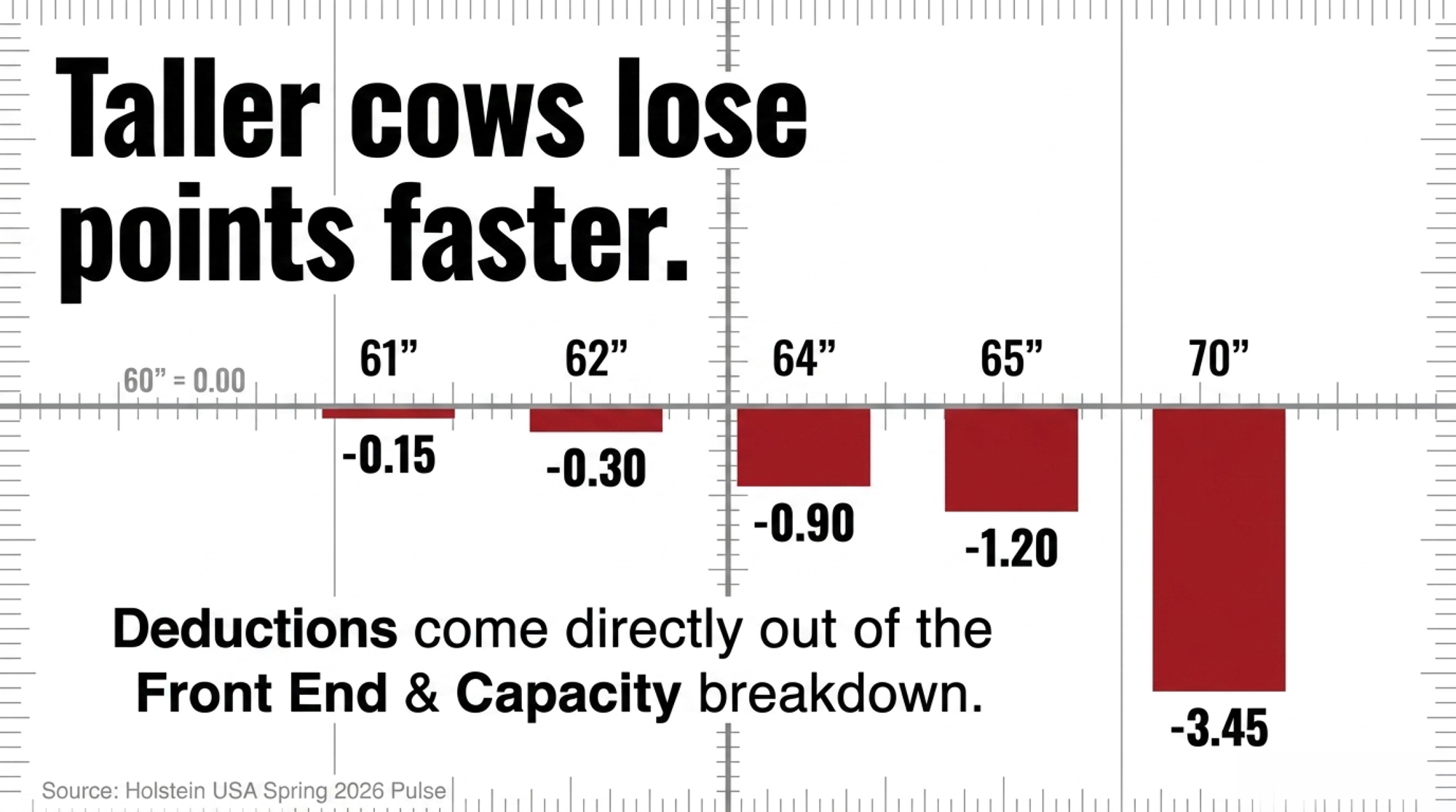
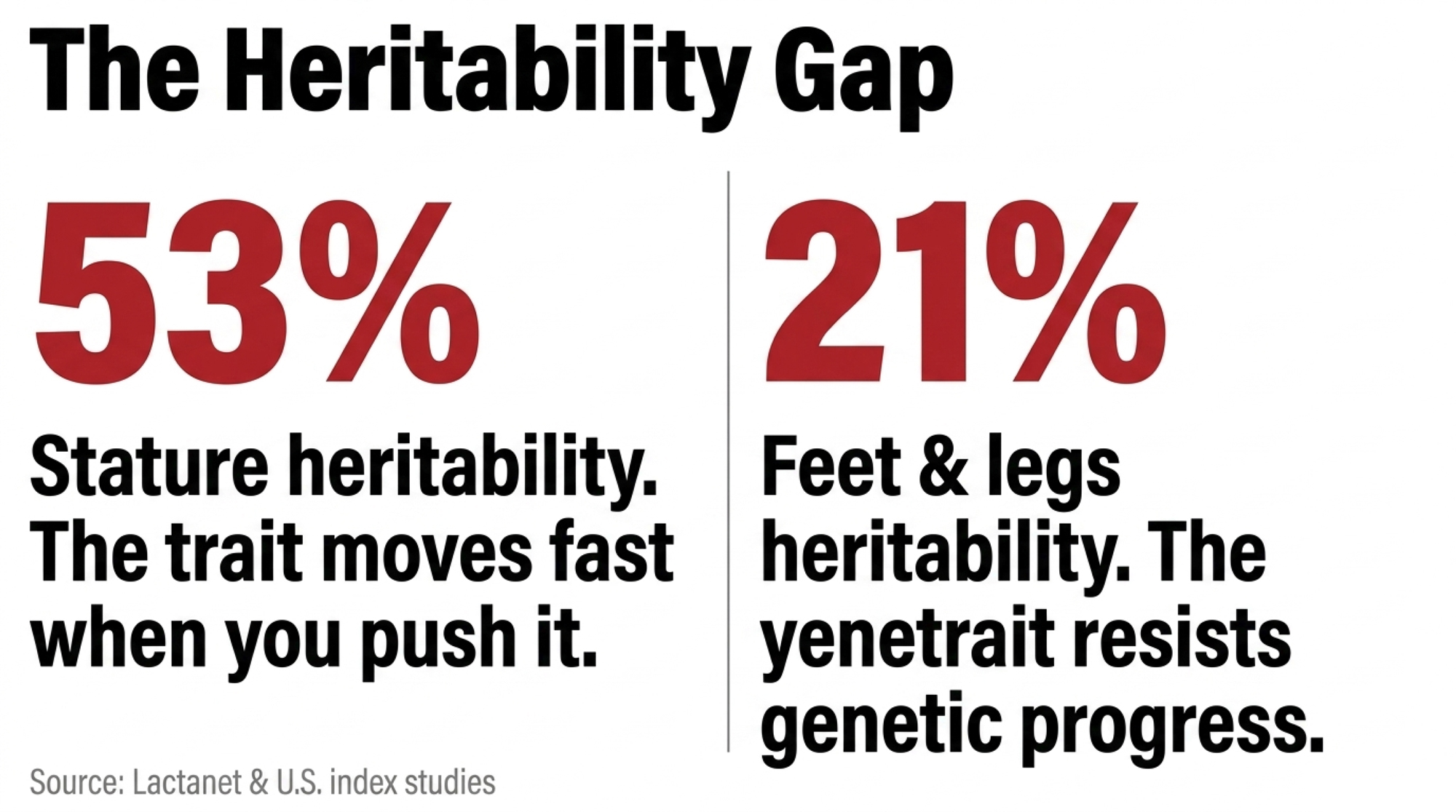
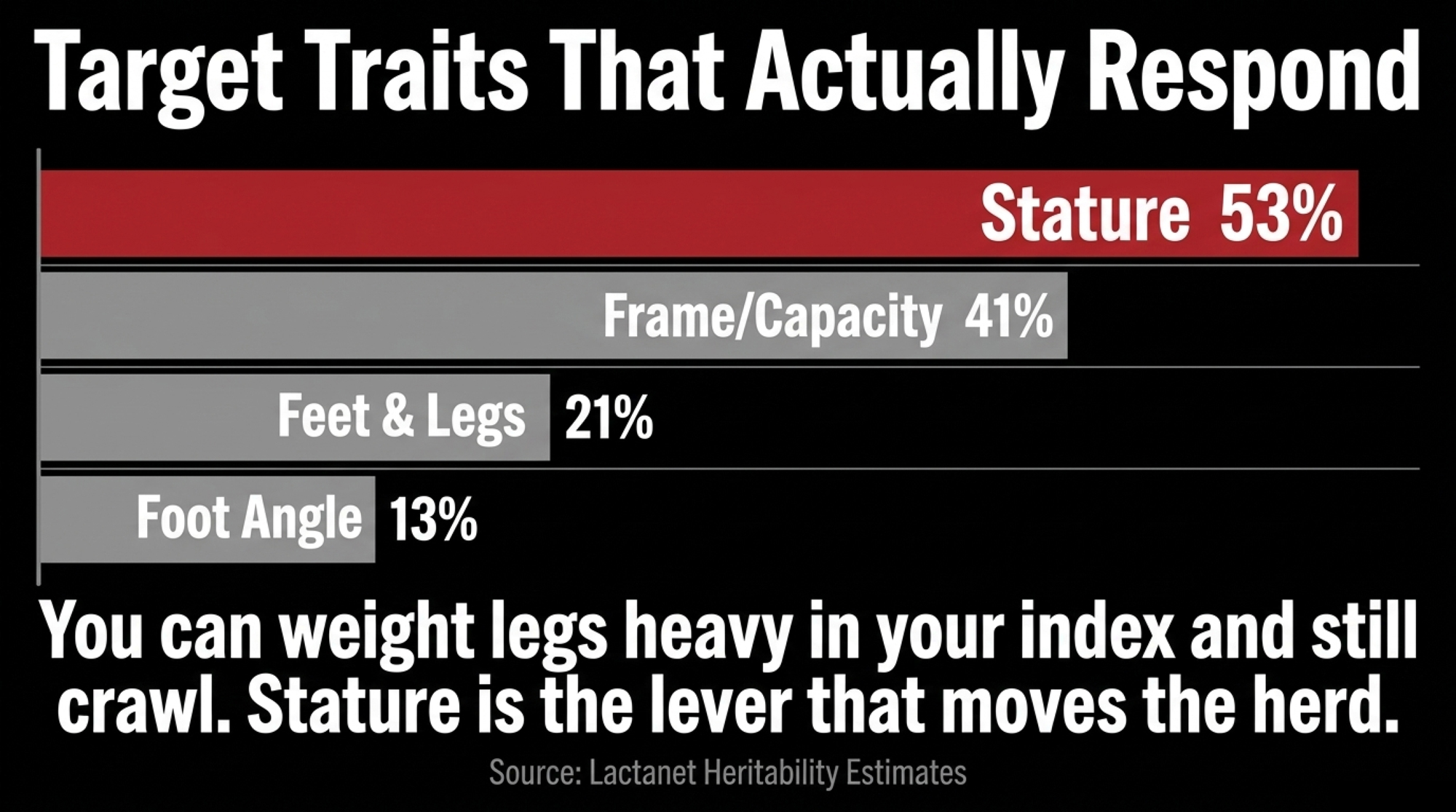

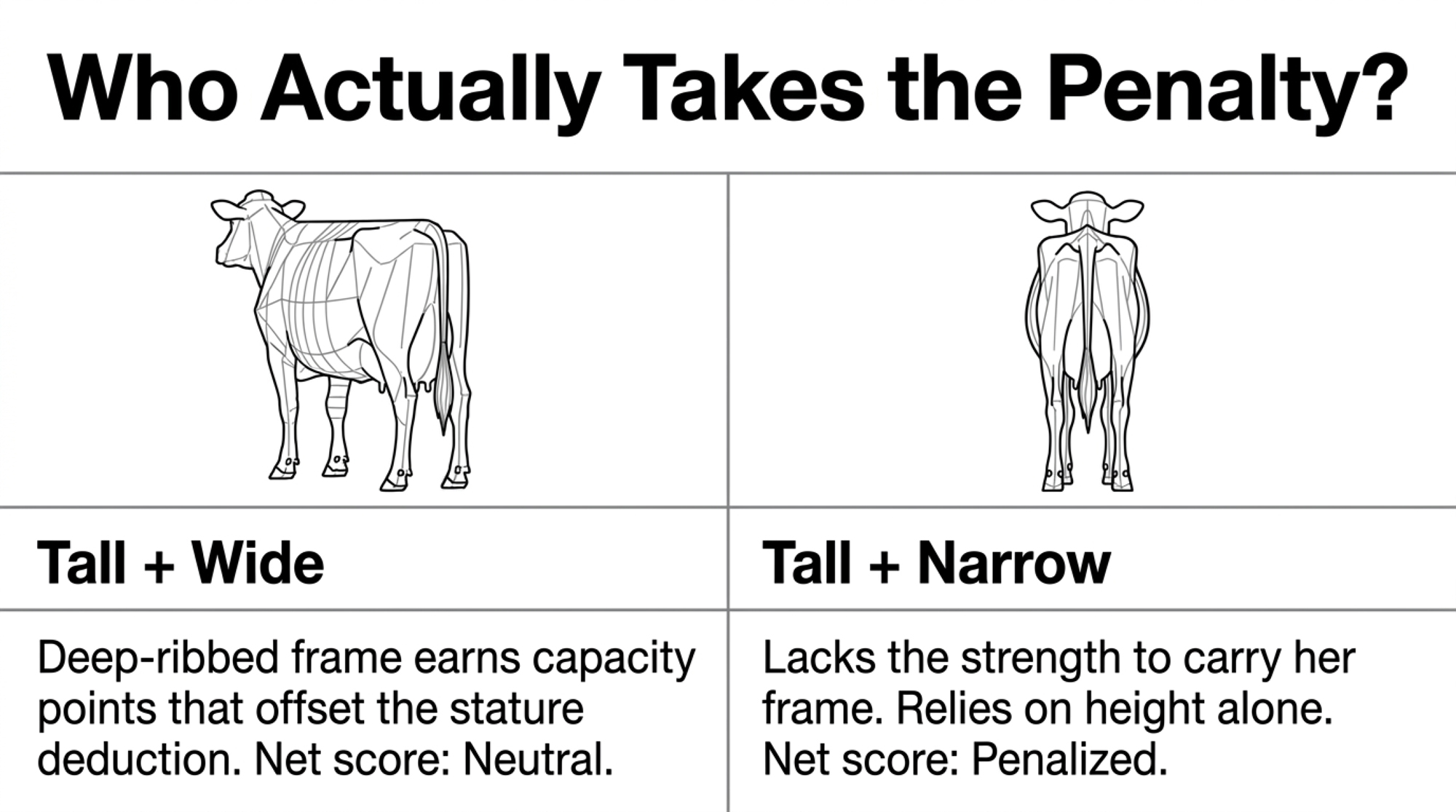
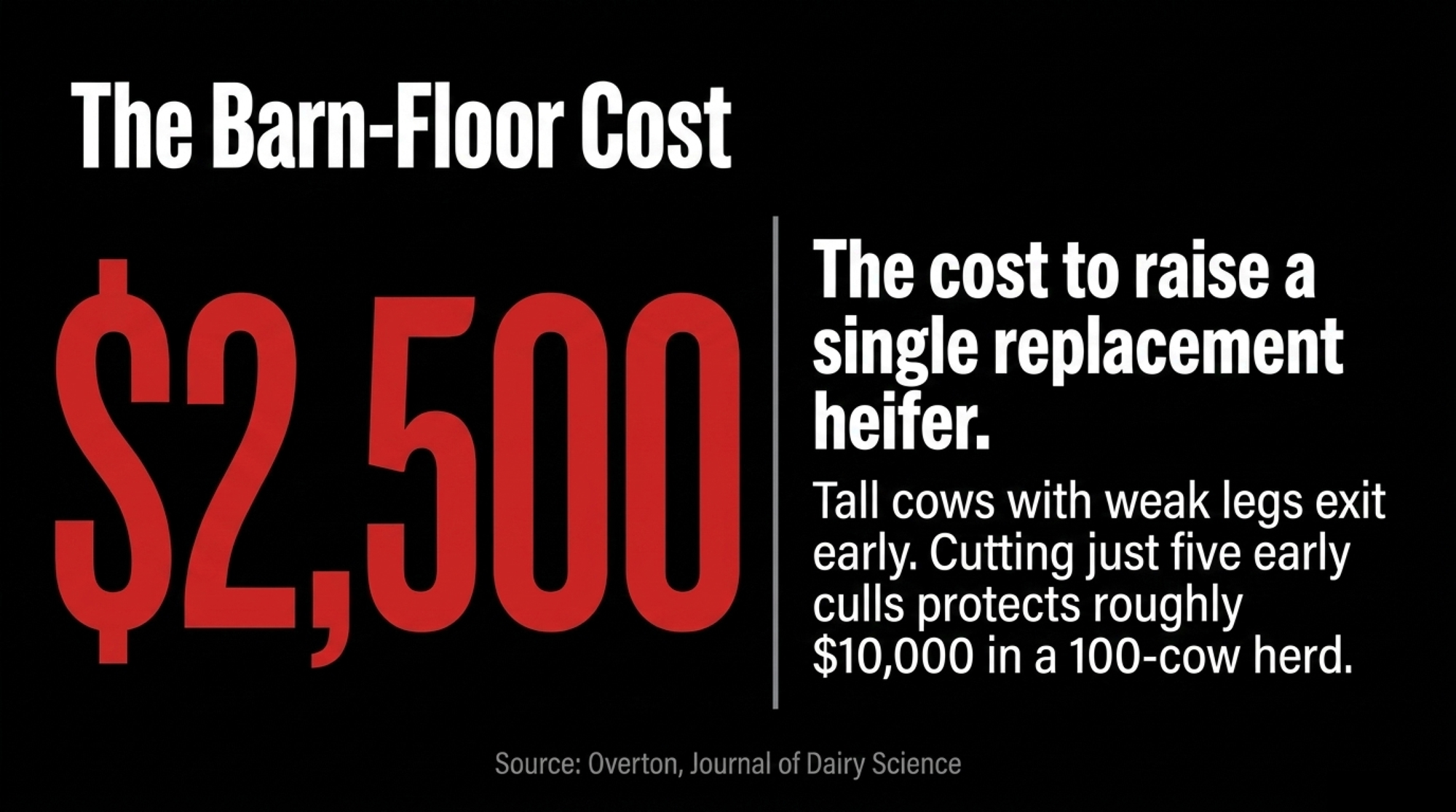
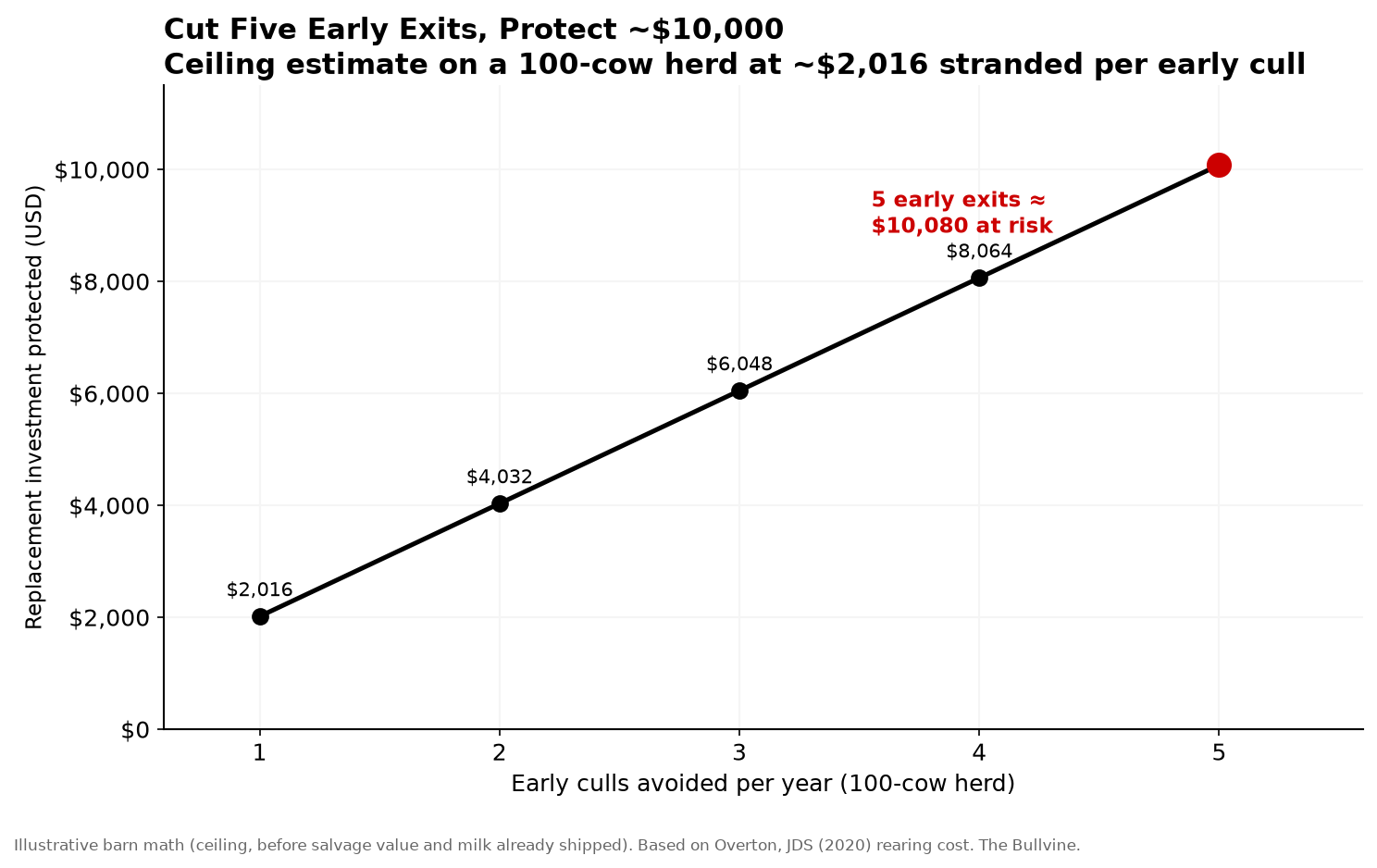
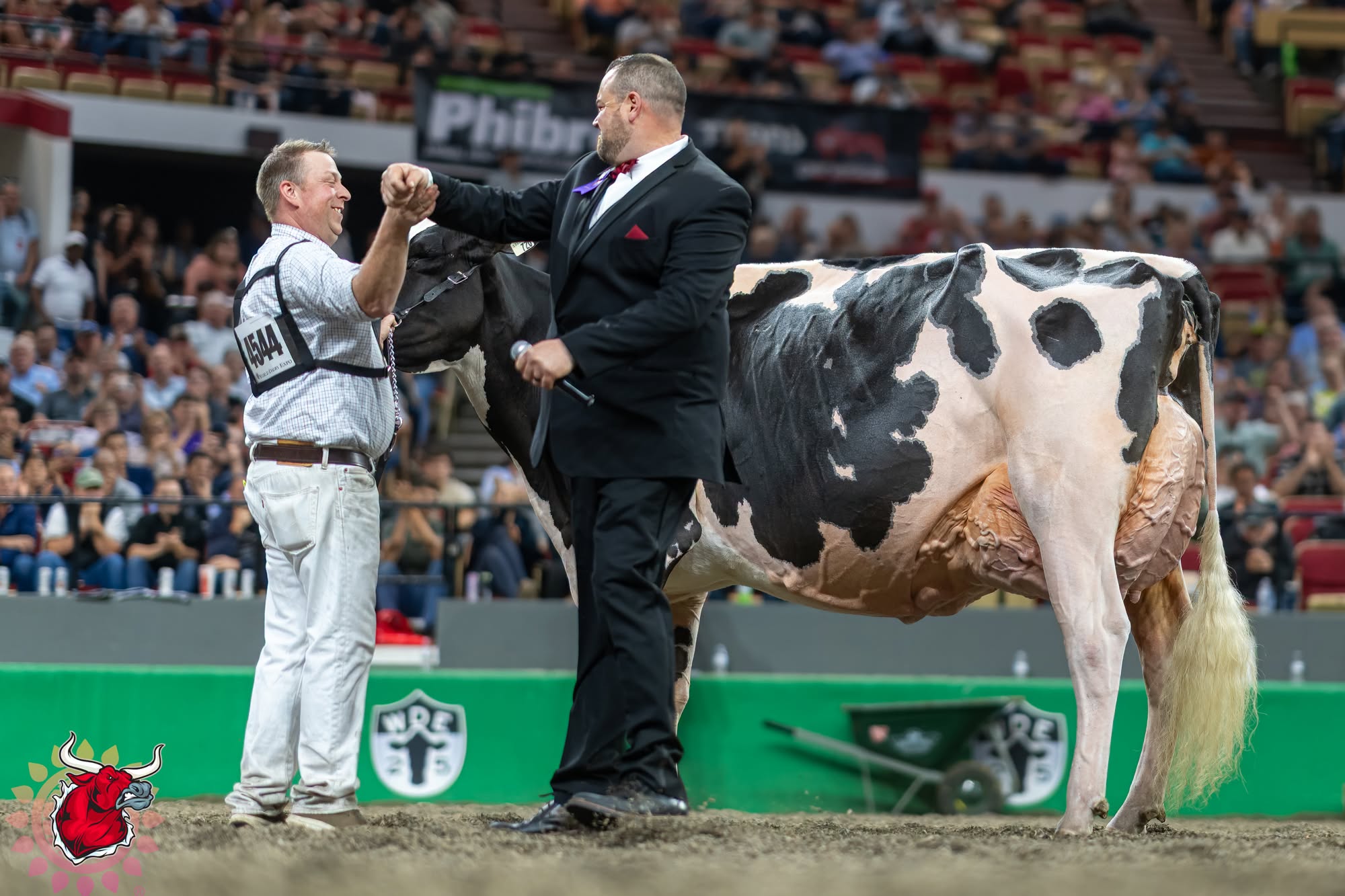
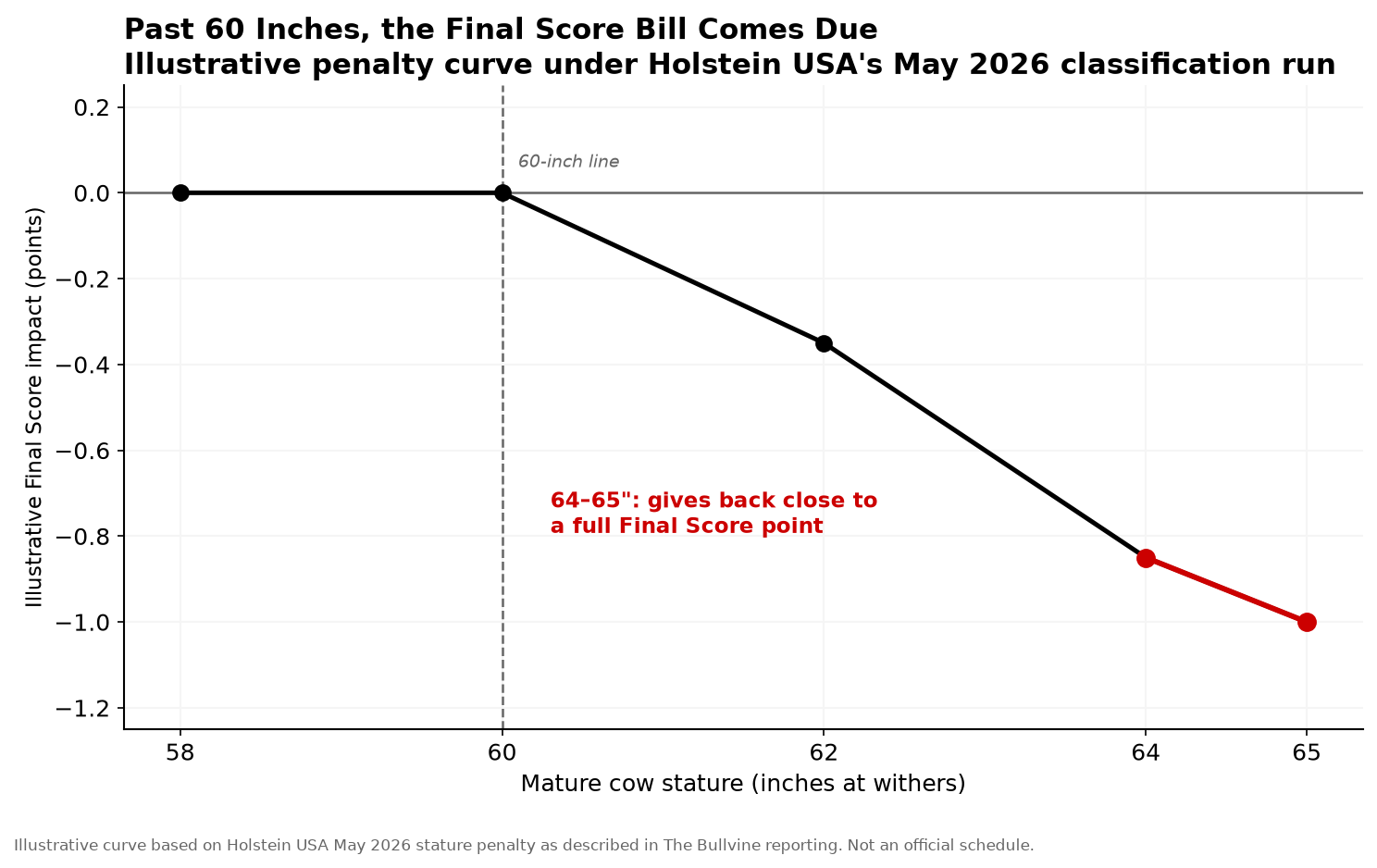
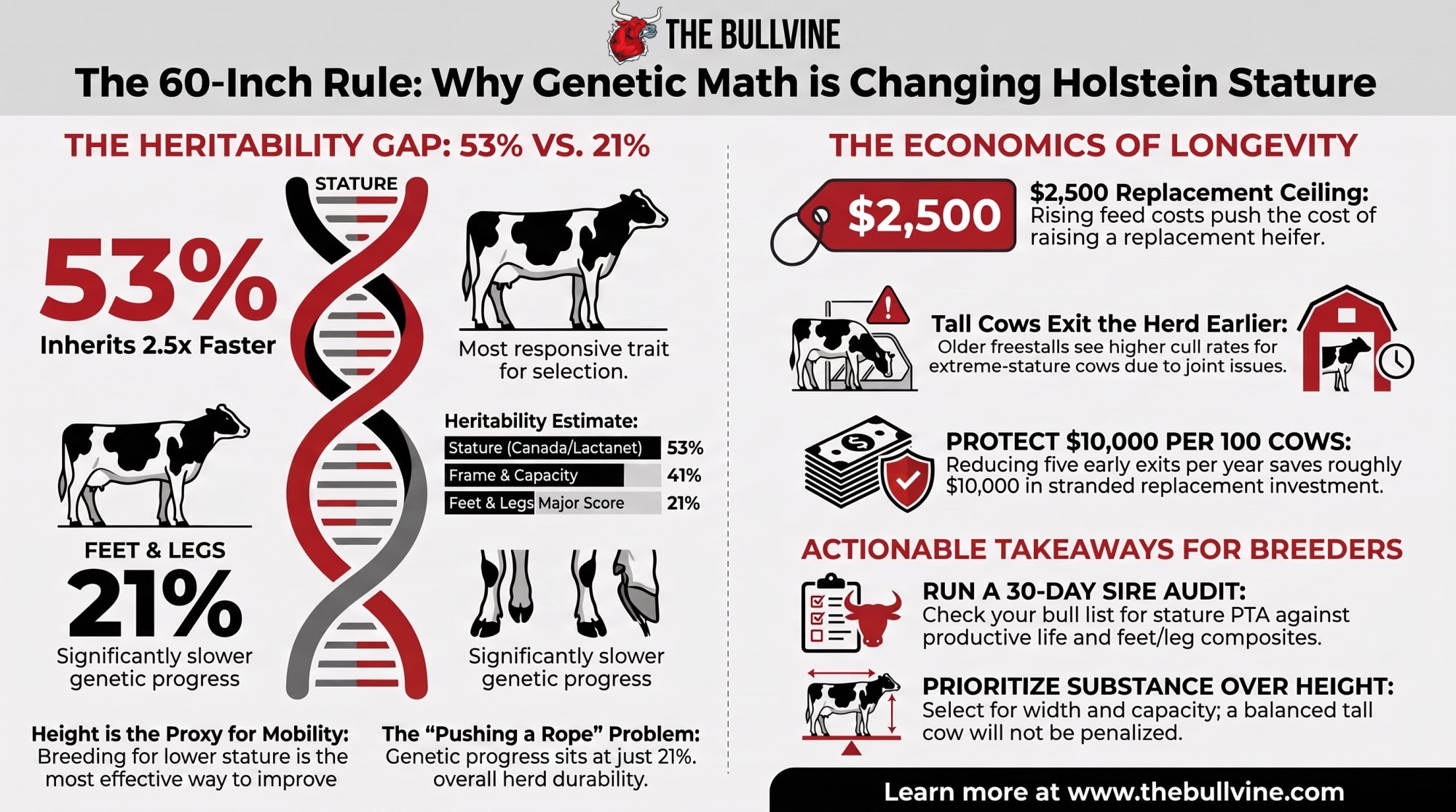
 The Sunday Read Dairy Professionals Don’t Skip.
 The Sunday Read Dairy Professionals Don’t Skip.