

Archive for cow comfort ROI

Your Cows Are Comfortable. The Milk Check Doesn’t Know It Yet.

A 100-cow pen short on rest leaks up to $2,300 a month at $14.70 milk — before the $38–$60/cwt some farms earn just for proving how their cows live.

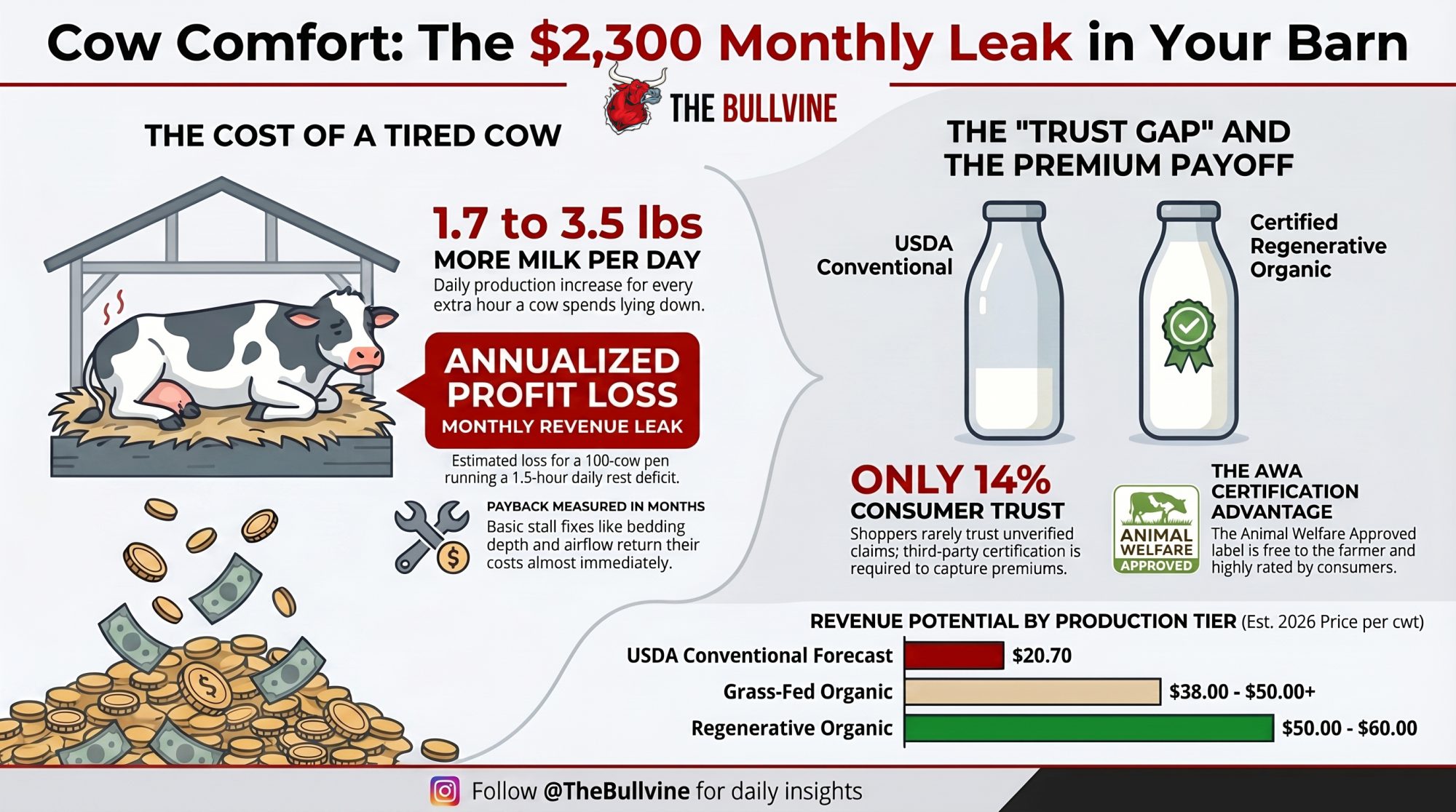
At The Lands at Hillside Farms in Shavertown, Pennsylvania, the milking herd carries a credential most dairies don’t: Certified Animal Welfare Approved by AGW — the only U.S. animal-welfare label Consumer Reports rates “excellent.” Hillside is a 412-acre nonprofit educational dairy that bottles its own herd’s milk and sells it straight from the farm store, which means it pockets the value of that label instead of watching a processor capture it. That’s the whole argument in one barn. While USDA’s June 2026 outlook pegs the 2026 all-milk price at $20.70/cwt, NODPA’s May 2026 report had grass-fed organic-certified dairies earning $38 to $50-plus per cwt — and regenerative organic herds running $50 to $60 per cwt.

Same cows. Same chores. A pay gap wide enough to decide which barn is still milking in 2030. The difference isn’t the genetics standing in the stalls — it’s whether the operation can prove how its animals live, and sell that proof. You can fill those stalls with the best-bred cows in the country, but a broken comfort environment or a dead-end marketing channel caps what that genetic horsepower can ever earn. That’s the part most of the industry is still leaving on the table.

The Death of the Volume-Only Mindset

For decades, how you cared for your cows lived on the cost side of the ledger — overhead first, then compliance, then a line to shave when the milk cheque got thin. The Federal Milk Marketing Order, established in 1937, pays you on volume and components, not on welfare. There’s no column on the pay stub for a comfortable cow. So producers chased the only incentive the system actually rewarded: more milk, at a lower price. That’s not anybody’s villainy — it’s how the system was wired.

But the premium tier keeps paying, and the capital is following it. Horizon Family Brands — owned by Platinum Equity — acquired the grass-fed organic pioneer Maple Hill Creamery on December 1, 2025, according to the company’s announcement. Organic mailbox prices climbed $8 to $15/cwt year-over-year heading into 2026, AgProud reported in March 2026. When private equity buys grass-fed brands and pays prices that jump into double digits, the market’s telling you where it sees value heading.

That capital story isn’t all upside, and it’s worth saying so. Watchdog group OrganicEye filed an FTC complaint in January 2026, arguing the Horizon–Maple Hill deal could lessen competition in organic fluid milk — by OrganicEye’s account, Horizon already controls the largest organic share in the country. Consolidation can lift prices and concentrate buyer power simultaneously. The premium is real — so is the risk of fewer buyers holding the pen.
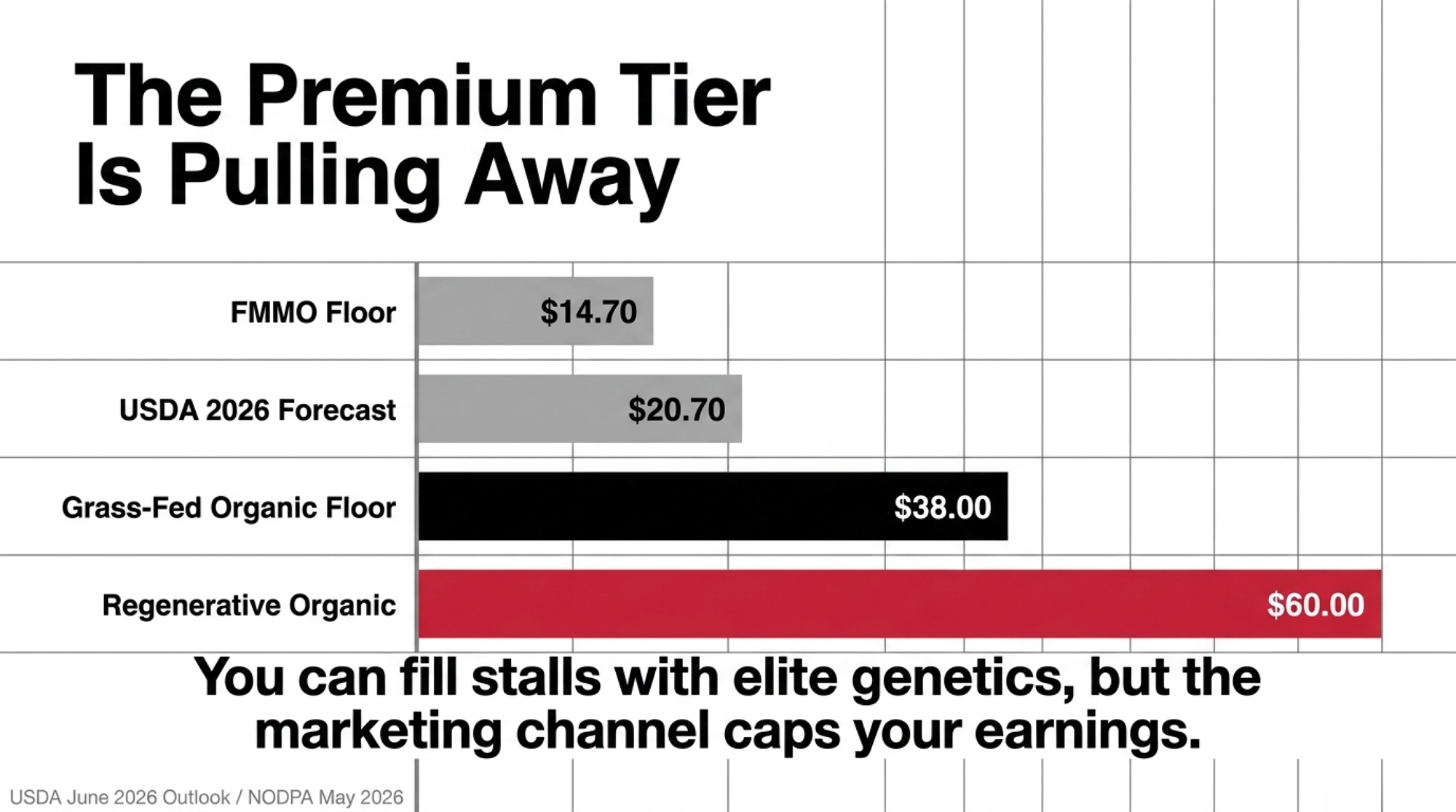
Here’s the harder part for anyone running the conventional treadmill. USDA’s June 2026 all-milk forecast of $20.70/cwt is a long way from the $38–$60 organic and grass-fed pay prices that NODPA tracked this spring. The gap between the two markets isn’t closing. If anything, the premium tier is pulling away while the commodity tier fights over fractions of a cent — and absorbs make-allowance hits the premium farms largely sidestep.

Welfare Pays in the Barn Before It Ever Hits a Label

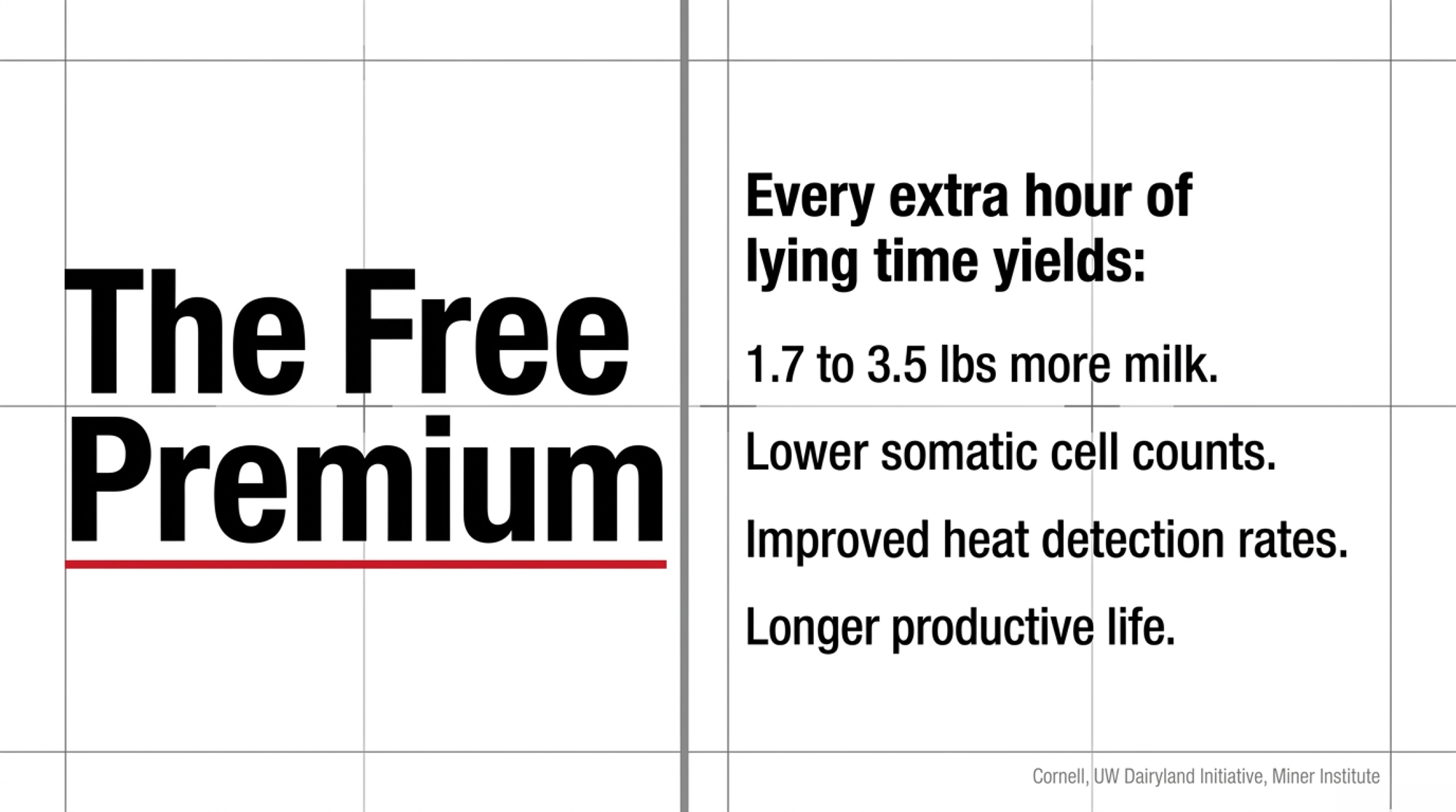
Here’s the part that needs no certificate, no new buyer, no transition paperwork. Welfare pays inside the barn first. Work from Cornell, the University of Wisconsin’s Dairyland Initiative, and the Miner Institute shows that every extra hour a cow spends lying down returns roughly 1.7 to 3.5 lbs more milk per day. Comfortable cows make more milk. That’s physiology, not ideology.
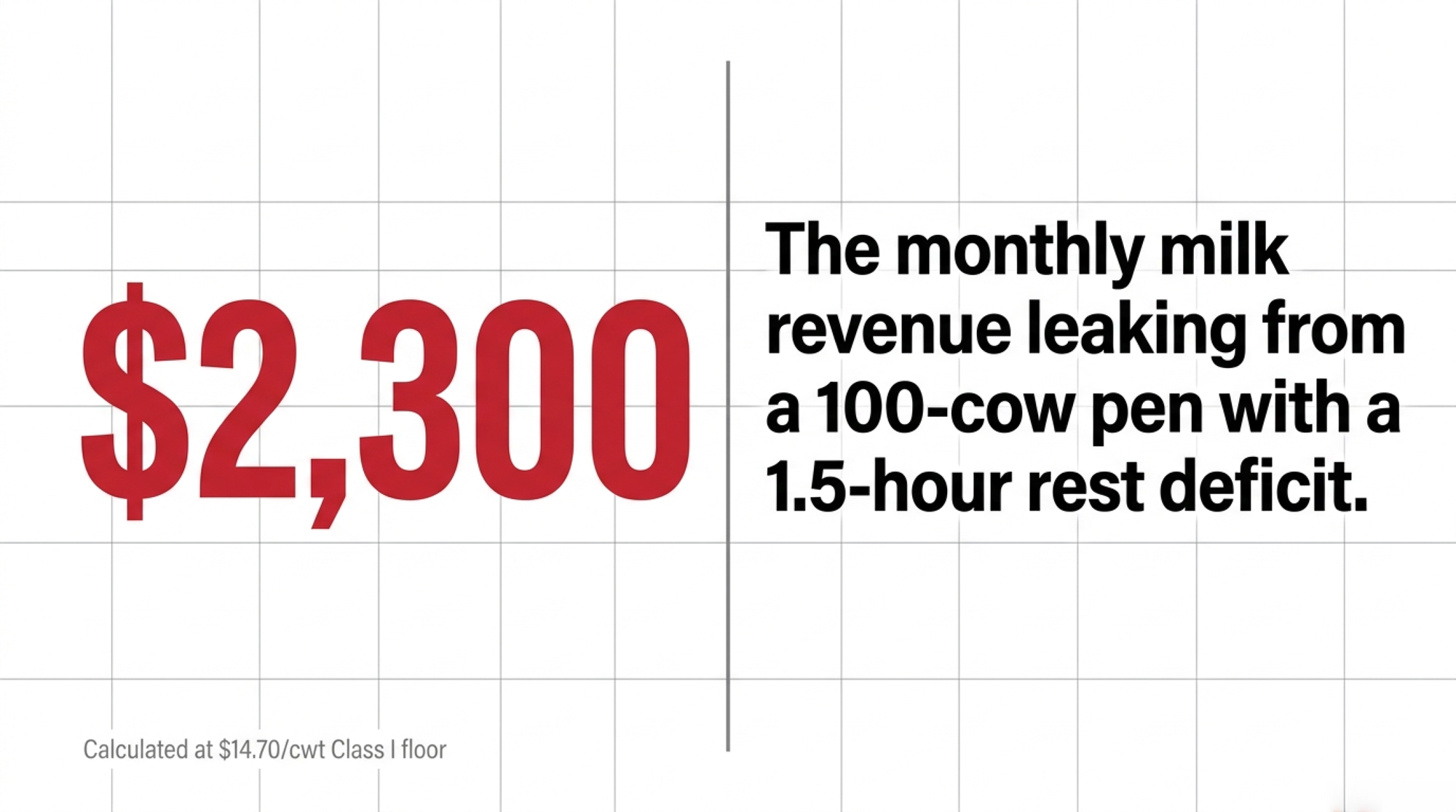
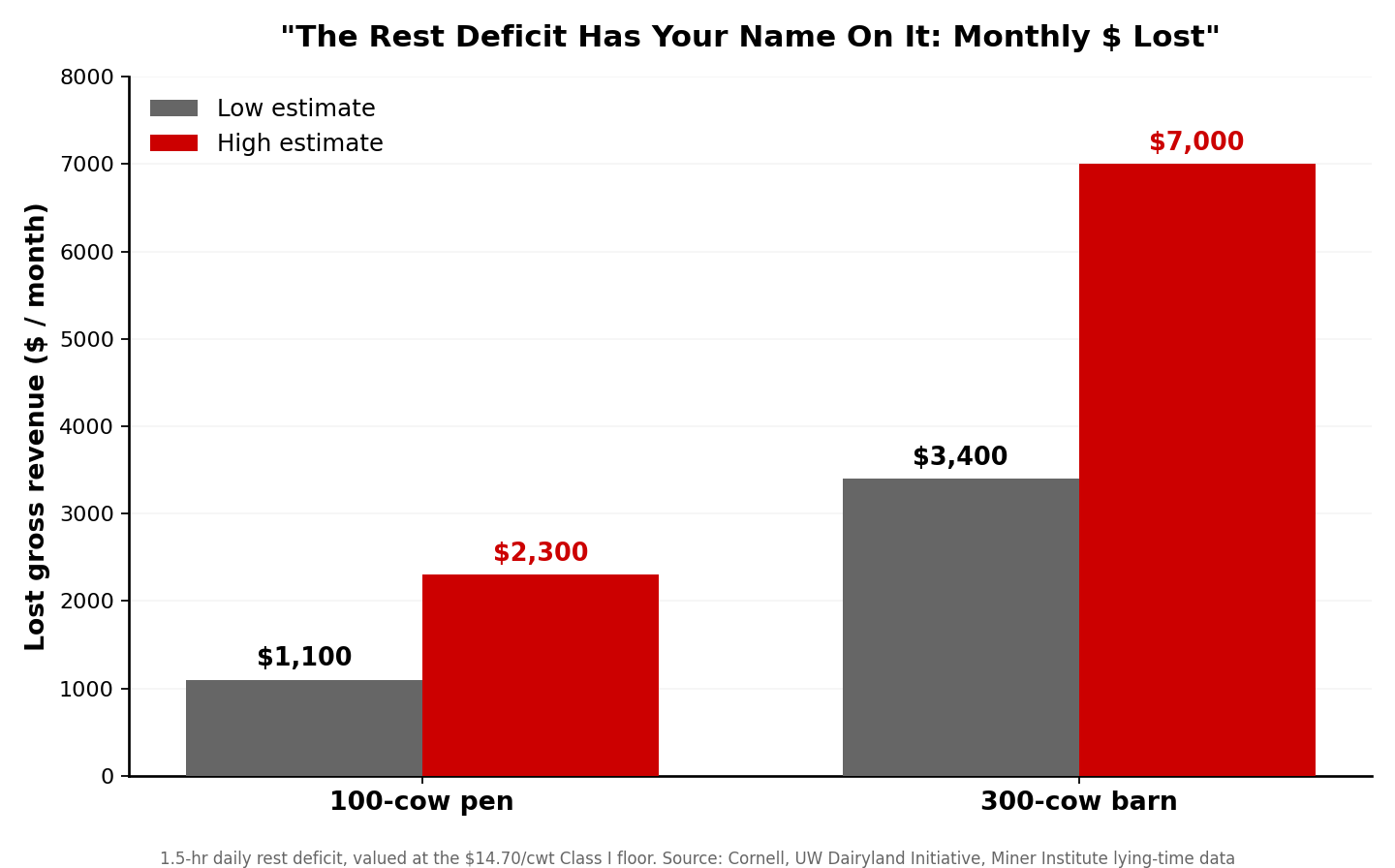
This is also where your genetics either earn out or sit idle. You can chase a high-PTA-milk bull and still strand that potential in a crowded pen — the cow can’t express what the environment won’t let her. Put numbers on it. Take a 100-cow pen running a 1.5-hour daily rest deficit — cows standing in alleys, waiting on crowded stalls, fighting heat. At those lying-time rates, that’s roughly 255 to 525 lbs of milk a day left in the alley. We’ll run the dollars at the $14.70 Class I floor, not the $20.70 forecast, so the number’s conservative on purpose: you’re still looking at about $1,100 to $2,300 a month in gross revenue gone, on cows you already paid top dollar to breed. Use your own mailbox price, and it climbs.
And the rest deficit rarely travels alone. The same crowded pen that costs you lying time tends to push up lameness and somatic cell counts, drag down heat detection, and shorten productive life — every one of them a quiet drain on the same milk cheque. Cornell Pro-Dairy modeling pegs the payback on basic stall fixes — neck rails, bedding depth, airflow — inside a few months. None of it requires a label or a conversation with a buyer. It’s money already on your farm that better cow comfort lets you keep.
The retail spread is where the bigger money lives. NODPA reported organic half-gallon milk averaging $5.24 to $5.43 at retail through early 2026 — against conventional jugs that rarely clear $2. Spot fluid organic was reportedly running in the $60/cwt range this spring, with supply short across the Northeast and nationally. The premium isn’t hypothetical anymore. It’s sitting in the dairy case, and right now the market can’t make enough of it.

The Grocery Store Hypocrisy

Shoppers will tell a pollster they care about animal welfare and then reach for the cheapest jug on the shelf. A 2024 study in Food Quality and Preference — run across the UK, Sweden, Spain, the Czech Republic, and Switzerland by researchers including Agroscope and the University of Portsmouth — found consumers consistently ranked animal welfare among the top purchase drivers, ahead of food miles, carbon footprint, and organic production. And then plenty of those same shoppers grab the $1.90 jug anyway. Call it grocery store hypocrisy: what people say at the survey table and what they do at the cooler door are two different animals.

That gap is exactly why third-party validation isn’t optional — it’s the enforcement mechanism. A label like organic, certified grass-fed, AWA, or Regenerative Organic forces the issue: if a shopper wants the welfare claim, they have to pay the price attached to the certified product. No certificate, no premium, no way to make the hypocrisy pay you back. Economist Nicolas Treich, in his 2025 book Animal Economics (Cambridge University Press), frames the root cause in structural terms — welfare behaves like a public good, so voluntary markets chronically under-pay for it. You don’t need the theory to feel it at the dairy case, though. The behavior is the proof.
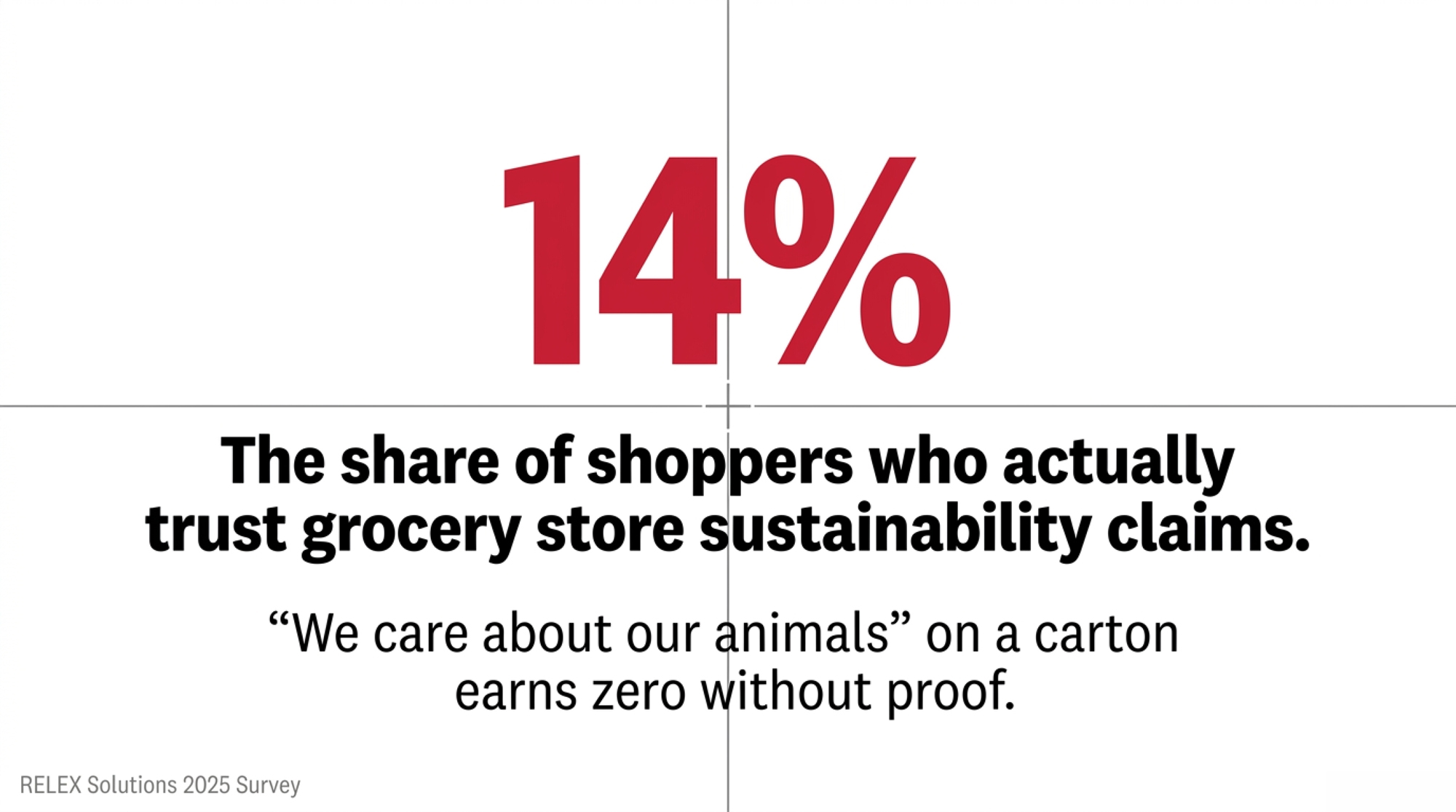
That’s the wall most producers hit. Only 14% of U.S. consumers fully trust grocery sustainability claims, according to RELEX Solutions’ 2025 survey. “We care about our animals” on a carton earns nothing without a third party standing behind it. Credible certification is the bridge between a welfare practice and a welfare premium. Without it, the practice is just an expense you can’t bill for.
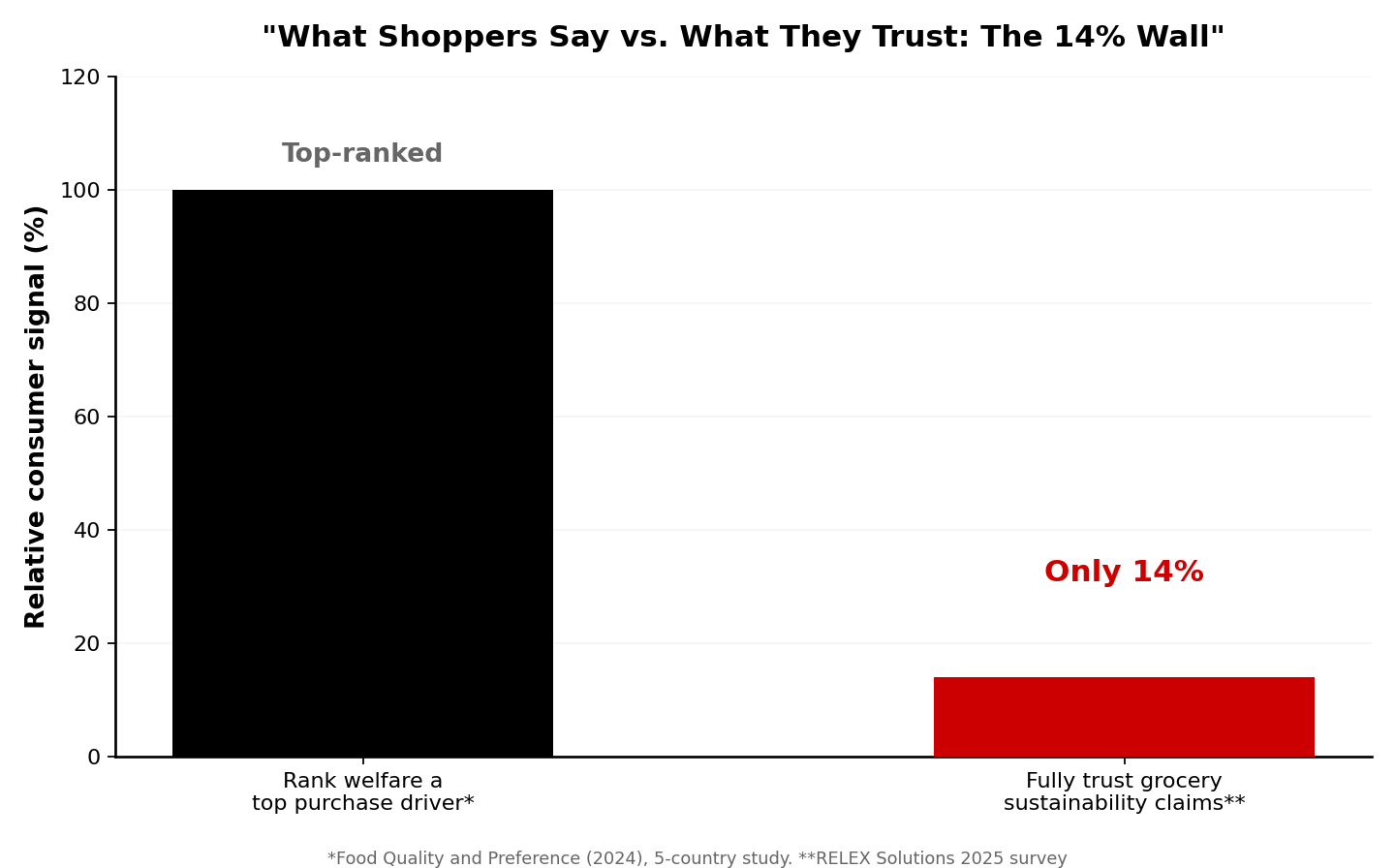
There’s a warning shot buried in here, too. If markets structurally under-pay for welfare, the pressure to close that gap doesn’t vanish — it migrates to regulation. The EU has already moved that way on housing and transport, and a producer who builds a provable welfare system now is buying optionality: a premium today, and a head start if the floor rises tomorrow.

How Much Does Waiting Actually Cost You?

Run your own version of the barn-math before you write this off as somebody else’s strategy. If your cows are short on rest, the conventional milk you’re already shipping is worth less than it should be — revenue walking out the door today, at today’s price, no certification required. On a 100-cow pen at the top of that estimate, that’s roughly $2,300 a month at the $14.70 floor. Scale it to a 300-cow barn with the same deficit, and you’re somewhere between $3,400 and $7,000 a month, depending on where your lying-time loss actually sits. Twelve months of “we’ll get to it” isn’t neutral. It’s a number with your name on it.

The transition question is harder to time, and caution is fair. The University of Vermont’s grass-fed production guide is blunt about it: most farms see production costs rise and milk volume fall under grass-fed management. Organic also runs 36 months of organic-rule costs before organic pay arrives — a real cash-flow hole that’s sunk plenty of well-meaning transitions. The lower-risk sequence: bank the free in-barn gains first, then use that stronger cash flow to fund a slower, deliberate call on certification. You don’t have to bet the farm to start.

Is Your Welfare Story Provable, or Just Stated?

Here’s the gut-check. Walk your barn as a skeptical buyer — or a reporter — would, beside you. Can you show, not just say, how your animals live? Longevity, culling rates, lying time, clean housing, calf protocols, lameness scores? A provable welfare story is a marketable asset. A stated one is marketing copy nobody believes.
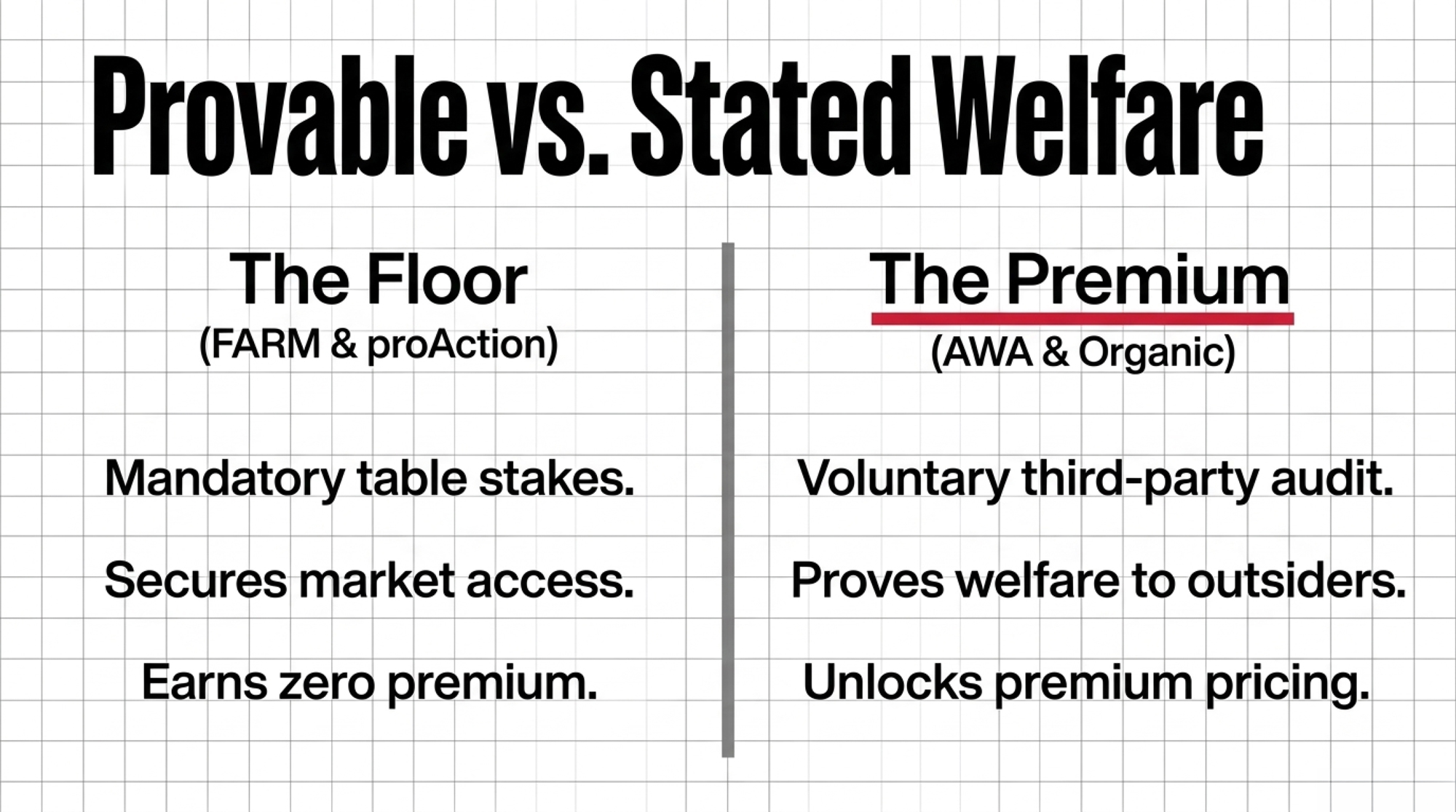
Worth knowing where the floor already sits. About 99% of U.S. milk production already participates in the National Dairy FARM program — more than 31,000 farms — and in Canada, proAction is mandatory on every licensed dairy. FARM and proAction are table stakes, not brand assets. They solve the floor, not the premium. The money lives in the layer you build on top — exactly what Hillside did when it stacked AGW certification onto a working dairy — and whether you can prove that layer to someone who walked in not believing you.

The proof has to be legible to an outsider, not just obvious to you. You know your cows are well cared for. The shopper at the dairy case doesn’t; the buyer signing a premium contract doesn’t, and, at 14% trust, neither assumes the best. A third-party audit is what turns “trust me” into “here’s the certificate” — and that’s the difference between a practice that costs you and one that pays you.

Four Strategic Paths: Where Does Your Barn Fit?

There’s no single right move. There’s a calculation that depends on your balance sheet, your buyer relationships, and your geography. Here’s what farms are actually doing.

Strategic PathPay PremiumUp-front Cost / Cash-flow RiskCertification HurdleBest Fit
Capture in-barn ROI firstNone directly; recovers lost milk revenueNear zero — payback in months (Cornell Pro-Dairy)NoneEvery barn, this month
Animal Welfare Approved (AGW)Premium only if a buyer/farm store paysFree to farmer — application, cert & annual audit (AGW)Pasture-based required; confinement won’t qualifyPasture herds w/ direct sales
Transition to organic / grass-fed$38–$50+/cwt (NODPA)36 months of organic costs first; volume typically drops (UVM)High; multi-yearStrong balance sheet + buyer lined up
Direct / regional channelFull retail spread captured ($5.24–$5.43/half-gal)Marketing + food-safety burden most farms lackSelf-managedOperators wanting pricing control
  • Capture the in-barn ROI first — start this month. Walk your stalls and pens this week. Measure lying time, check stocking density, look hard at neck rails and airflow. Almost no capital, no certification, payback in months per Cornell Pro-Dairy. Risk is near zero — and it’s the one path that unlocks the genetics you’ve already paid for. The only thing in the way is the half-day it takes to look honestly at your own barn.
  • Certify with Animal Welfare Approved. A Greener World’s AWA program is free to the farmer — the application, certification, and annual audit run at zero cost, per AGW — and it’s the label Consumer Reports rates highest. Hillside runs it on a working dairy herd and sells the milk directly. The hard limit: AWA requires pasture-based, high-welfare systems, so confinement operations won’t qualify, and the label only pays if a buyer — or your own farm store — turns it into a price.
  • Transition to organic or grass-fed. Biggest premium, biggest risk. NODPA had grass-fed organic certified pay at $38 to $50-plus this spring, but organic runs 36 months of organic costs first, and UVM warns that volume typically drops under grass-fed. Don’t start without a buyer relationship lined up — Maple Hill, for one, built its supply on roughly 140 small farms across upstate New York. And watch the consolidation: the OrganicEye FTC complaint is a reminder that fewer, bigger buyers can mean less leverage when your contract comes up for renewal.
  • Build a direct or regional channel. Farm-direct fluid, on-farm processing, and artisan cheese — exactly Hillside’s model — let you own more of the chain, so the premium is actually captured rather than absorbed by a processor or retailer. It demands marketing muscle and food-safety compliance that most farms don’t have in-house. But it’s the path with the most pricing control, and the one least exposed to a processor cutting your premium on 30 days’ notice.
Key Takeaways

  • If your pens are crowded or your cows are short on rest, run the lying-time math this month — at the $14.70 floor, a 100-cow pen with a 1.5-hour deficit may be leaking up to $2,300/month, and a 300-cow barn $3,400 to $7,000.
  • The best genetics you can buy are capped by the barn they live in and the channel you sell into — fix the environment before you blame the cow.
  • Treat stall comfort, airflow, and stocking density as a revenue decision, not a cost line — Cornell pegs the payback in months, not years.
  • Before chasing any premium, ask one question: Will a credible third party certify my claim? At 14% consumer trust, an unverified story earns zero.
  • If you’ve got pasture access, the AWA audit is free to the farmer — call A Greener World for an eligibility check before you assume it doesn’t fit your operation.
  • If you’re weighing organic or grass-fed, line up the buyer before you start the 36-month clock — budget for lower volume, not just a higher price, and factor in who’ll still be buying after the next acquisition.
  • Don’t assume FARM or proAction earns you a premium. They’re the floor. Name the differentiating layer you can actually prove on top — and make sure an outsider can read it.
A nonprofit dairy in Shavertown sells milk from a herd certified under the label Consumer Reports calls the best in the country, straight to the people who drink it. A buyer paying north of $50/cwt does it for milk it can vouch for. And the herd down the road ships into a $20.70 pool and never tells a soul how those animals live. The difference isn’t the genetics in the stalls — it’s whether the operation decided that the way it cares for its cows is worth proving and selling. So where does your operation sit on that line right now, and what would it take to move it ten feet?

Run Your Numbers

Dairy Profit Projector — This article runs the math at a $14.70 floor. Now run yours. Drop in your herd size, milk price, and ration to see your real breakeven, IOFC per cow per day, and 12-month margin — then stress-test what a premium contract would actually change.

If you want the deeper math — the full cost-per-cwt model by herd size, the 36-month transition cash-flow timeline, and which certifications actually pencil out at your scale — that’s what we’re building in the next Bullvine Weekly. That’s where the real numbers live.

The Sunday Read Dairy Professionals Don’t Skip.
Every week, thousands of producers, breeders, and industry insiders open Bullvine Weekly for genetics insights, market shifts, and profit strategies they won’t find anywhere else. One email. Five minutes. Smarter decisions all week.

NewsSubscribe
First
Last
Consent

Learn More

Complete references and supporting documentation are available upon request by contacting the editorial team at editor@thebullvine.com.

This Hidden $1,400/Cow Cost Is Killing Profits – Here’s the Fix

What happens when cows actually choose? German researchers tested it—and found $1,400/cow in costs disappeared. Here’s what they discovered.

Executive Summary: Conventional dairy practices are costing you $1,400 per cow annually in hidden losses from regrouping stress, transition disease, and premature culling—costs most farmers don’t even track. German researchers just proved these losses are preventable through an integrated approach: let cows choose their environment, maintain stable social groups, and keep calves with mothers longer. The data are striking: regrouping alone costs $3,400/year in a 500-cow herd, while their approach reduces lameness by 30-40% and produces calves gaining 3+ pounds daily. Implementation means rethinking barn design and investing 18-24 months in learning new management practices, but the returns justify the effort—$400,000-500,000 in annual benefit potential with a 4-6 year payback. With retailers like Walmart already demanding welfare-certified products and the market growing to .4 billion by 2033, early adopters gain a competitive advantage. The bottom line: when cows get choice, hidden costs disappear and everybody wins—especially your profit margin.

You know what caught my attention last week? A group of German agricultural researchers posed a question that’s got me rethinking everything about barn design: What if we actually let cows decide how they want to spend their day?

Prof. Dr. Lisa Bachmann and her team at the Research Institute for Farm Animal Biology in Dummerstorf, Germany, published their findings this fall in the Journal of Dairy Science, and honestly… some of these insights are making me reconsider assumptions I’ve held since I started in this business.

What makes German research distinctive is its integrated design concept, which combines stable family herds, cow-calf contact, free indoor-outdoor movement, and automation—a comprehensive approach documented in their published research. Their design concept maintains stable social groups throughout production, provides genuine barn-and-pasture choice during favorable seasons, and integrates cow-calf contact with automated milking. And here’s what’s really interesting—their research documents how this integrated approach addresses multiple cost drivers simultaneously—regrouping stress, transition disease incidence, and culling patterns—suggesting substantial economic advantages we haven’t really considered before.

Here’s the context that makes this relevant right now. USDA’s latest census shows we’ve gone from 105,250 dairy farms in 2000 to about 31,600 operations today. That’s a 70% drop, folks. So when we’re talking about alternative approaches to dairy infrastructure, we’re no longer just having an academic discussion. For a lot of mid-sized operations—maybe yours—this could be about finding a viable path forward.

The $1,000 Per Cow Opportunity: Conventional dairy systems leak $1,400 annually per cow through hidden stress, disease, and management costs—while welfare-integrated approaches reduce these losses by 71% to just $400 per cow. For a 500-cow operation, that’s $500,000 walking out the barn door every year.

What We’re Learning About Cow Preferences

What’s fascinating is how consistent cow behavior becomes when they actually have choices. Research on grazing behavior shows cows utilizing outdoor areas extensively, particularly during evening and nighttime hours. And get this—their motivation for pasture access rivals their drive for fresh feed. That’s saying something.

I was looking at production research from Ireland the other day, and the lying time data really stood out. Cows with pasture access were averaging about 9.9 hours of daily lying time compared to 9.5 hours for confined animals. Now, you might think, “That’s only 24 minutes, what’s the big deal?” But here’s what’s interesting—those pasture cows had fewer but longer lying bouts. Less getting up and down, more quality rest. You know how much that matters for rumination and production.

“Conservative estimates suggest we’re looking at $1,000-1,400 annually per cow in hidden costs from stress, disease, and management practices we’ve just accepted as normal.”

Marina von Keyserlingk’s animal welfare lab at UBC documented another noteworthy finding: cows with overnight pasture access show significantly more walking activity. And for those of us dealing with lameness issues—which is basically everyone, right?—that natural movement pattern correlates with better hoof health.

Speaking of lameness, research comparing different housing systems shows some pretty dramatic differences. We’re seeing lameness prevalence vary significantly by bedding and housing type, with comprehensive studies documenting reductions of 30-40% in systems incorporating pasture access. Penn State Extension puts lameness costs at around $337 per case. Do the math on that for your herd—it adds up fast.

The Real Cost of Moving Cows Around

Every Time You Move Cows, You’re Burning Cash: Each regrouping event triggers an immediate 8.5% milk production crash and 9% feed intake nosedive. The chaos lasts 3-7 days, and at 5 regroupings per lactation, you’re hemorrhaging $3,400 annually in a 500-cow herd—before you even factor in breeding delays and elevated somatic cell counts.

Here’s something we don’t talk about enough. Most of us regroup cows four to six times per lactation. It’s just… what we do, right? But Daniel Weary’s group at UBC has been quantifying what that actually costs us, and the numbers are sobering.

They’re documenting an immediate 8.5% production drop when you regroup—going from about 95 pounds down to 87 pounds daily. Feed intake drops 9% during that adjustment period. The behavioral chaos lasts 3-7 days. And there’s a clear negative correlation between aggressive interactions and butterfat levels.

So I ran the numbers for a typical 500-cow herd averaging 80 pounds at $20/cwt. Each regrouping event? That’s about $1.36 in lost production per cow. Five times across a lactation, you’re looking at $3,400 in revenue just… gone. And that’s before we even think about what stress does to breeding or somatic cell counts.

The German research proposes maintaining what they call “stable family herds”—basically keeping cows and their offspring together without constant pen changes. Yeah, it means rethinking your entire barn layout and cow flow. But when you add up all these hidden costs? The economics start looking different.

Hidden Costs Summary

Cost CategoryImpact Per Event/Case
Regrouping$6-10/cow per event
Transition disease$125-450/case
Lameness$337/case
Annual total per cow$1,000-1,400

Reconsidering Cow-Calf Contact

I’ll be honest—I’ve always been pretty skeptical about extended cow-calf contact. The colostrum management concerns are real, and disease control matters. But the data coming out of European research institutions is making me think twice.

Norwegian researchers tracking cow-calf systems in automated milking herds are seeing calves achieve average daily gains around 1.4 kg—that’s over 3 pounds a day. That’s beef calf territory, way beyond the 1.25 to 1.9 pounds we typically see with conventional feeding. Research shows that calves with extended dam access consume substantially higher milk volumes than those in conventional feeding programs.

Now, Swedish agricultural research acknowledges these systems can reduce your contribution margin by 1-5%, primarily from milk you’re not selling. Fair point. But here’s what that analysis often misses…

Research indicates significant labor reductions during the calving period when cows manage their own calves. Think about it—no milk replacer costs, no feeding equipment to clean, fewer health treatments. Studies consistently show improved calf health metrics in these contact systems. And for those of us struggling to find reliable calf feeders (which seems to be everyone these days), the labor savings alone might tip the scales.

How Automation Changes Everything

What’s really interesting is how automation is shifting the whole welfare conversation. Michigan State’s recent survey of large dairy farms with robots found something telling: 84.6% cited labor cost reduction as their main reason for automating, but 76.9% also reported improved cow welfare.

“Each regrouping event costs about $1.36 per cow in lost production. Five times across a lactation, you’re looking at $3,400 in revenue just… gone.”

The financials are compelling. University of Wisconsin data shows that operations with robots reduced labor costs from about 8.4% of revenue to 4.4%. That’s a 38-43% reduction in time per cow, with milking-related tasks down 62%.

But here’s what I’ve been noticing during farm visits… Most robot installations are still optimizing the same old confinement model rather than enabling the kind of cow choice that German research suggests could improve both welfare and profitability. Current designs assume conventional freestall housing with standard routing. Want to add real outdoor access? That requires completely different thinking.

Industry experts increasingly acknowledge that while technical solutions exist, our infrastructure tends to reinforce conventional approaches rather than enabling alternatives. Some equipment manufacturers are exploring systems compatible with grazing, especially for markets where that’s standard practice, but North American options remain pretty limited.

Understanding the Full Cost Picture

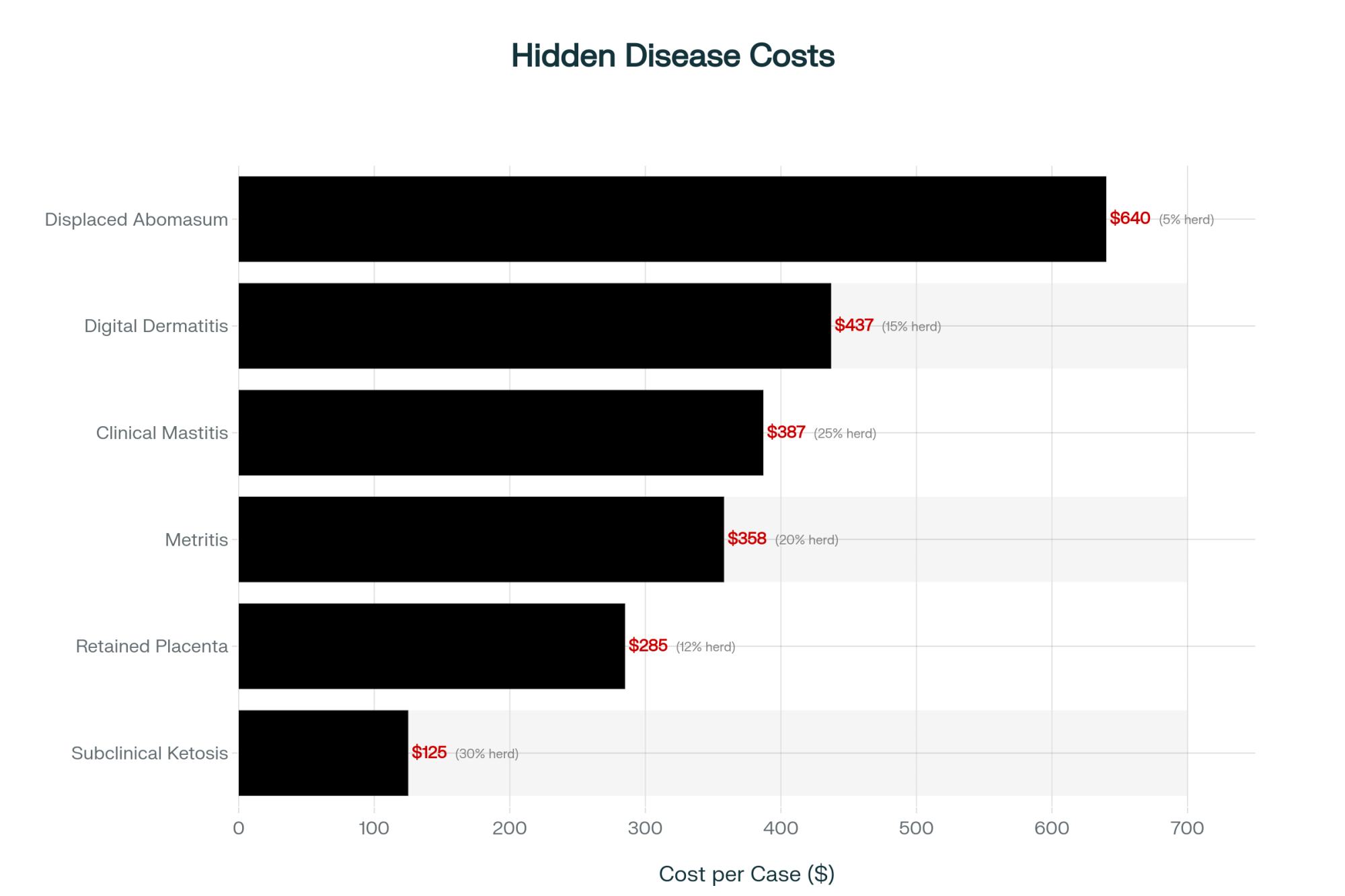
The Disease Tax Nobody Talks About: Every transition disease carries a price tag, but here’s the killer—they don’t come alone. Half your fresh cows deal with multiple conditions, compounding to $600-900 per affected animal. Subclinical ketosis hitting 30% of your herd at $125/case? That’s just the entry fee. Welfare-integrated systems cut these rates in half. Your call.

Recent research on dairy economics has been eye-opening about costs we usually don’t track properly:

You know transition cow challenges—nearly half of fresh cows deal with some metabolic issue. Subclinical ketosis alone runs about $125 per case based on recent studies. Clinical mastitis? USDA data puts it at $325-450 per case, with 71% of those costs from lost production, not treatment.

Lameness economics are brutal. Penn State’s research shows an average of $337 per case, with each additional week adding about $13. Digital dermatitis typically runs almost $100 more than other lameness causes. And here’s what really gets me—research consistently shows lameness hammering fertility, with reproduction-related costs representing a huge chunk of the total economic hit.

Then there’s culling and replacement. Canadian dairy industry data shows turnover at 35-40%, with replacement costs of $2,500-3,500, depending on where you are. Lose a cow before her third lactation? You never recover that rearing investment.

Add it all up, and conservative estimates suggest we’re looking at $1,000-1,400 in hidden costs per cow annually from stress, disease, and management practices we’ve just accepted as normal. That’s… that’s a lot of milk checks.

MetricConventional SystemWelfare-Integrated SystemNet Difference
Annual Cost Per Cow$1,400 hidden losses$400 reduced losses$1,000 savings/cow
Regrouping Events/Lactation4-6 times0-1 times4-5 fewer events
Lameness Prevalence20-25%12-15% (-40%)-40% cases
Lameness Cost Impact$337/case × 100+ cases$337/case × 60 cases~$13,500 savings
Transition Disease Rate~50% of fresh cows~25% of fresh cows-50% incidence
Calf Daily Gain (lbs)1.25-1.9 lbs3+ lbs+1+ lb improvement
Average Culling Rate35-40%22-25% (-35%)-13-15% points
Replacement Cost$2,500-3,500/cow$2,500-3,500/cowEarlier ROI
Labor Cost (% of revenue)8.4%4.4%-48% labor
Milk Production StabilityHigh variabilityMore consistentImproved flow
Veterinary CostsBaseline-30 to -35%$35K+ savings
Total Herd Cost (500 cows)$700,000 in losses$200,000 in losses$500,000 annual gain

Thinking About Infrastructure Investment

The German team’s estimates for welfare-integrated systems suggest substantially greater capital investment than conventional designs—we’re talking significant money here, potentially thousands of dollars per cow.

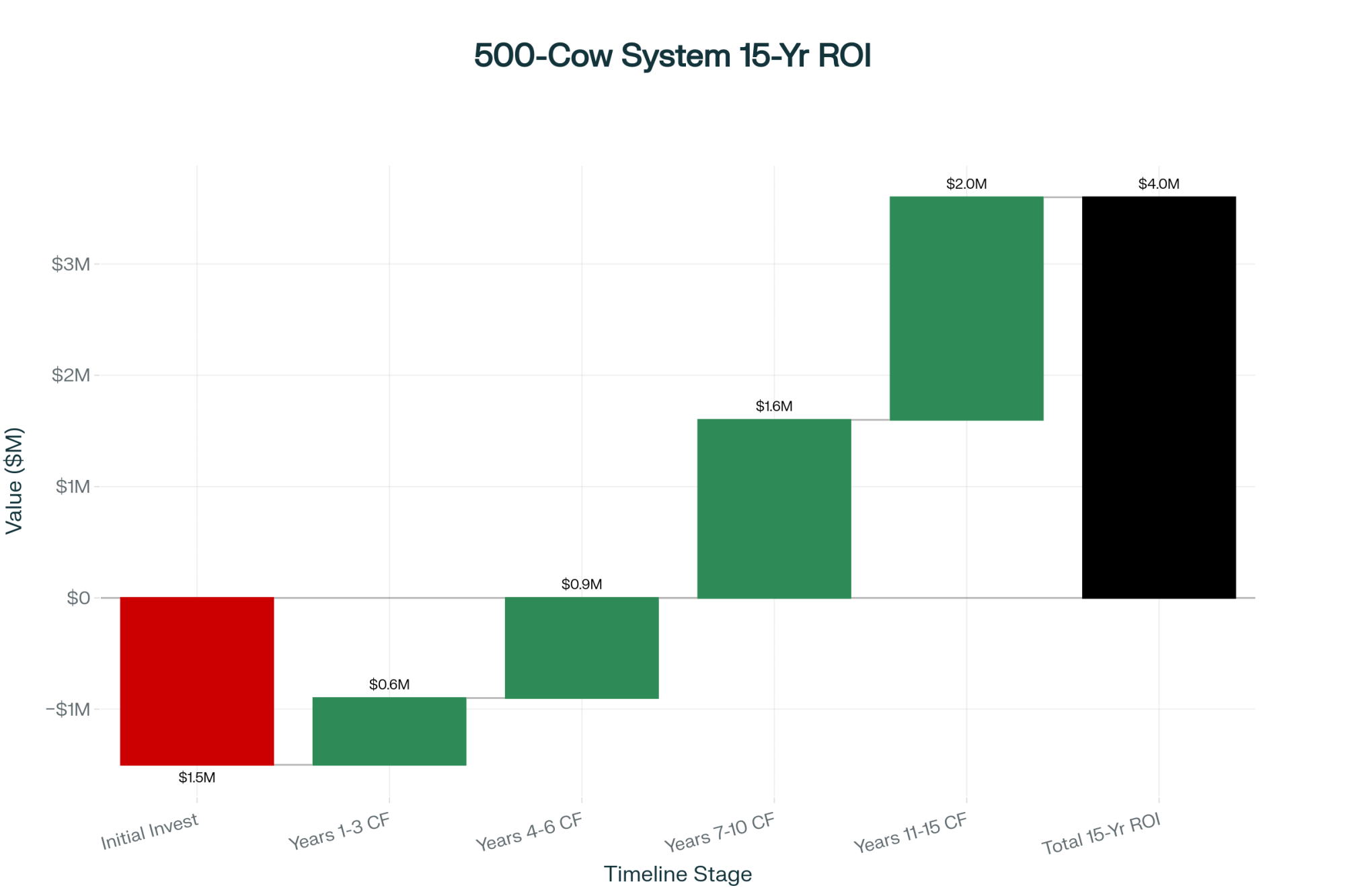
The Math That Changes Everything: Drop $1.5M on a welfare-integrated barn design and conventional wisdom says you’re crazy. But here’s what actually happens—you break even in 4-6 years, then bank $400K+ annually for the next decade. Total 15-year gain? Over $4 million. Meanwhile, “efficient” conventional operations keep bleeding that $1,400/cow every single year. Do the math

But let’s think through the returns. If these systems prevent even $800-1,000 annually in disease, stress, and culling losses, a 500-cow operation could see $400,000-500,000 in annual benefit. Finance that over 15 years at 6%, you’re looking at $200,000-300,000 in debt service, potentially leaving $150,000-250,000 in improved cash flow. That suggests a 4-6 year payback. I’ve seen producers jump on automation for returns that are less attractive than that.

Practical Implementation Thoughts

Based on conversations with producers who’ve made changes, here’s what seems to work:

Start with what you can control. You don’t need to revolutionize everything overnight. Several operations I know in Wisconsin started simple—adding outdoor access areas, reducing regrouping frequency, and trying modified calf management in just one pen.

Really assess your existing setup. Retrofitting current facilities for genuine cow choice is way harder than building it in from the start. If you’re already planning major construction or renovation? That’s your opportunity.

Think carefully about your market position. Nielsen’s 2023 consumer research documented a 57% increase in certified animal welfare products after mainstream retailers began stocking them. There’s a real differentiation opportunity, but you need to know what your milk buyer values.

And budget time for the learning curve. Managing pasture systems, cow-calf contact, stable herds—it’s different than running conventional confinement. Most folks find it takes 18-24 months to really develop the new management skills.

Regional Considerations

One thing the German research doesn’t fully address—and it matters here—is our climate variability. What works in temperate Germany needs adaptation for Arizona heat or Manitoba winters.

I’ve been hearing about different regional approaches. California researchers are testing shade and cooling for outdoor areas in hot climates. Canadian institutions are exploring winter paddock designs that maintain choice even in extreme cold.

In the upper Midwest, some producers are trying hybrid approaches—outdoor access during good weather, modified grouping strategies for winter housing. It’s not the full German model, but they’re seeing meaningful improvements in lameness and culling.

“Lose a cow before her third lactation? You never recover that rearing investment.”

Some producers implementing partial modifications report that eliminating regrouping practices resulted in substantial reductions in veterinary costs, though they acknowledge the learning curve was steep initially. I’ve heard of operations documenting 30-35% drops in vet bills after making these changes, though everyone admits it takes time to figure out the new management approach.

Looking Ahead

The $3.4 Billion Question: While most producers debate whether to adopt welfare practices, the certified animal welfare market is exploding—growing 183% to $3.4 billion by 2033. Early adopters positioning now will capture premium pricing before this becomes table stakes. Wait until mainstream adoption, and you’re just playing catch-up at commodity margins.

The consolidation trend isn’t slowing. Industry projections show substantial portions of milk production shifting to larger operations in the coming years. For mid-sized farms—those 200 to 1,000 cow operations that are the backbone of many regions—the traditional “get big or get out” message feels pretty heavy.

But this research illuminates other paths. The animal welfare certification market reached $1.2 billion in 2024 and is projected to reach $3.4 billion by 2033, according to Grand View Research (https://www.grandviewresearch.com). Major retailers like Walmart and Kroger have made procurement commitments for certified products. That’s creating a genuine market opportunity for differentiated producers.

Plus, emerging climate regulations are going to reshape the economics. Canada’s carbon framework for agriculture and similar U.S. initiatives will likely favor systems with greater efficiency, enhanced pasture management, and lower replacement rates.

What Producers Are Finding

Producers implementing modified approaches report interesting results. After dealing with steep learning curves around cow flow and grazing management, many are seeing veterinary costs drop significantly, labor requirements decrease, and production metrics improve—outcomes that surprise even them.

Others are taking different approaches, like maintaining limited cow-calf contact as a workable compromise between calf health improvements and milk sales. The key seems to be adapting concepts to specific circumstances rather than trying to copy someone else’s system exactly.

There’s no universal template here. Each operation needs to evaluate how these concepts might work with their unique combination of facilities, labor, markets, and management style.

The Bottom Line: Your Hidden Costs

When you factor in:

  • Regrouping losses: $3,400/year for 500 cows
  • Transition diseases: 50% of fresh cows are affected
  • Lameness: $337/case at 15-20% prevalence
  • Premature culling: Never recovering $2,500-3,500 investment

You’re losing $1,000 to $ 1,400 per cow annually in preventable costs.

Quick Takeaways for Action

Looking at all this research, here’s what you can start doing today:

  • Calculate your hidden costs: Track regrouping frequency, transition disease rates, and culling patterns for three months
  • Test small changes: Pick your highest-stress group and eliminate one regrouping event
  • Explore market premiums: Contact your milk buyer about welfare certification opportunities
  • Visit operations making changes: Nothing beats seeing these systems in action
  • Budget for learning: Any system change requires time—plan for it

Making Sense of It All

After really digging into this research, here’s what stands out to me:

The economics are way more complex than simple comparisons suggest. When you account for regrouping losses, disease costs, premature culling, and genetic potential that never gets expressed, conventional systems carry substantial hidden costs. Alternative approaches could meaningfully reduce those expenses.

Consumer expectations keep evolving. When certified products reach mainstream retail with clear differentiation, sales respond. That’s not a trend—it’s market reality.

Technology can enable choices. Current automation typically optimizes confinement, but alternative technical solutions exist. It’s more about design philosophy than technical barriers.

The transformation already underway creates both risk and opportunity. As margins compress and consolidation accelerates, differentiation becomes increasingly valuable. Whether you pursue commodity efficiency or welfare premiums—that’s a fundamental strategic decision.

And here’s the thing—the knowledge exists right now. The research has been published, the designs are documented, and the technical specifications are available. The question isn’t whether these systems work. It’s how they might fit your specific situation.

Looking at where we’re headed, understanding these alternatives becomes crucial for planning. This German research reminds us that innovation sometimes comes from questioning our basic assumptions.

The path forward varies by operation. A 5,000-cow facility in New Mexico operates under different constraints than a 200-cow farm in Vermont. But having genuine options—economically viable alternatives to consider—that’s what gives us flexibility to build operations aligned with our goals, values, and circumstances.

Maybe the question isn’t whether we can afford to implement such changes. Given the hidden costs already embedded in our operations and where markets are heading… maybe we should be asking: What’s the cost of not exploring these possibilities?

That answer will likely shape the next generation of dairy farming. And honestly? When cows get to make choices, it turns out everybody might win—including our bottom line.

Complete references and supporting documentation are available upon request by contacting the editorial team at editor@thebullvine.com.

Learn More:

The Sunday Read Dairy Professionals Don’t Skip.

Every week, thousands of producers, breeders, and industry insiders open Bullvine Weekly for genetics insights, market shifts, and profit strategies they won’t find anywhere else. One email. Five minutes. Smarter decisions all week.

NewsSubscribe
First
Last
Consent
Send this to a friend