










Replacing half a crew costs $268,683 under current Virginia wage floors. But as the June 17 USCIS memo proves, clearing the financial hurdle doesn’t mean you clear the regulatory one.
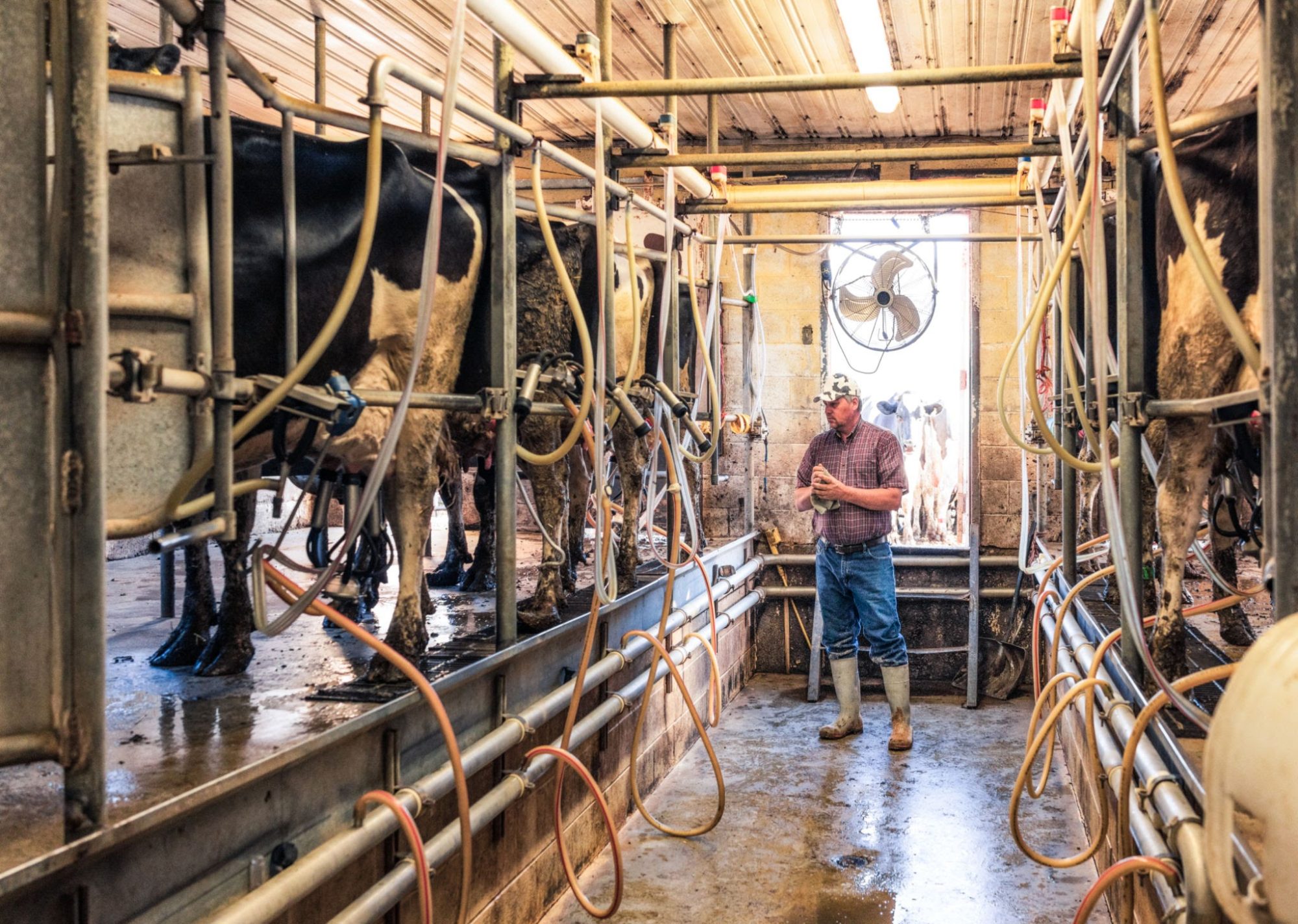
Virginia’s H-2A wage floor didn’t move August 3 with most states — it moved August 17, under the court order in Kansas et al. v. U.S. Dep’t of Labor. Two costs almost nobody budgets: the housing obligation reaches domestic workers in corresponding employment, and the three-fourths guarantee turns the wage line into a floor you owe whether the work is there or not. USCIS opened dairy petitions June 17, but case by case, on proven temporary or seasonal need. The Bullvine ran the four-worker model on a 200-cow Virginia dairy across 12,480 annual hours.
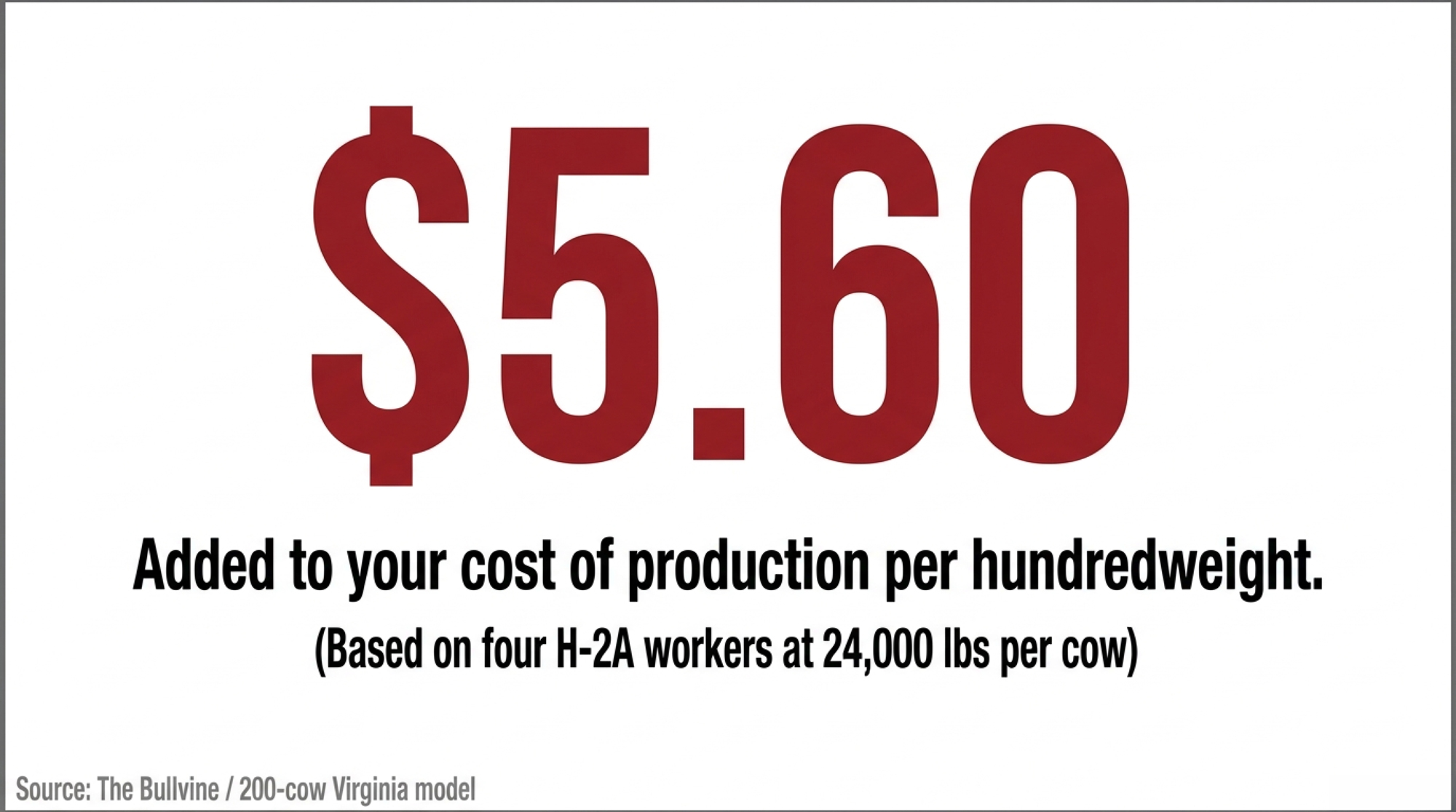
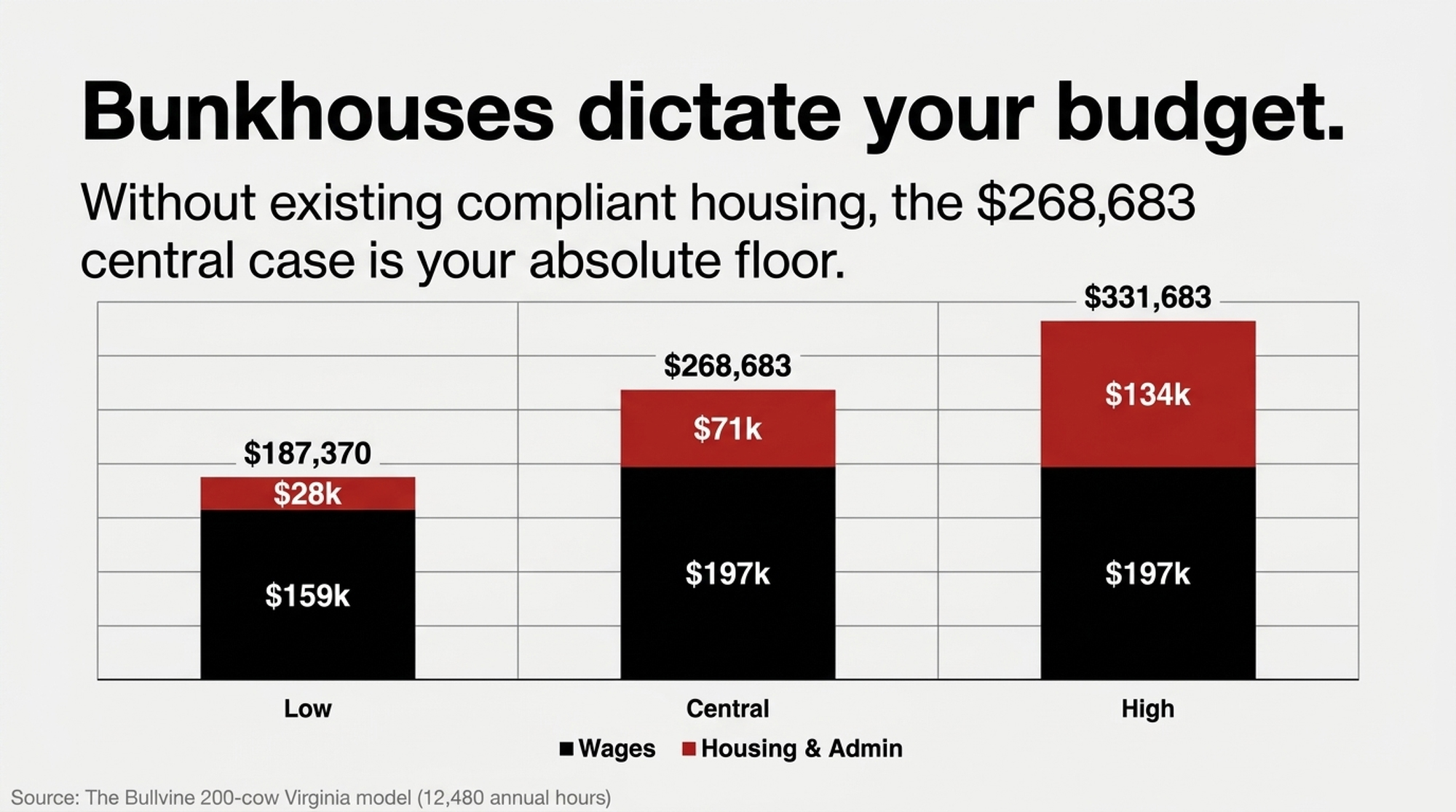
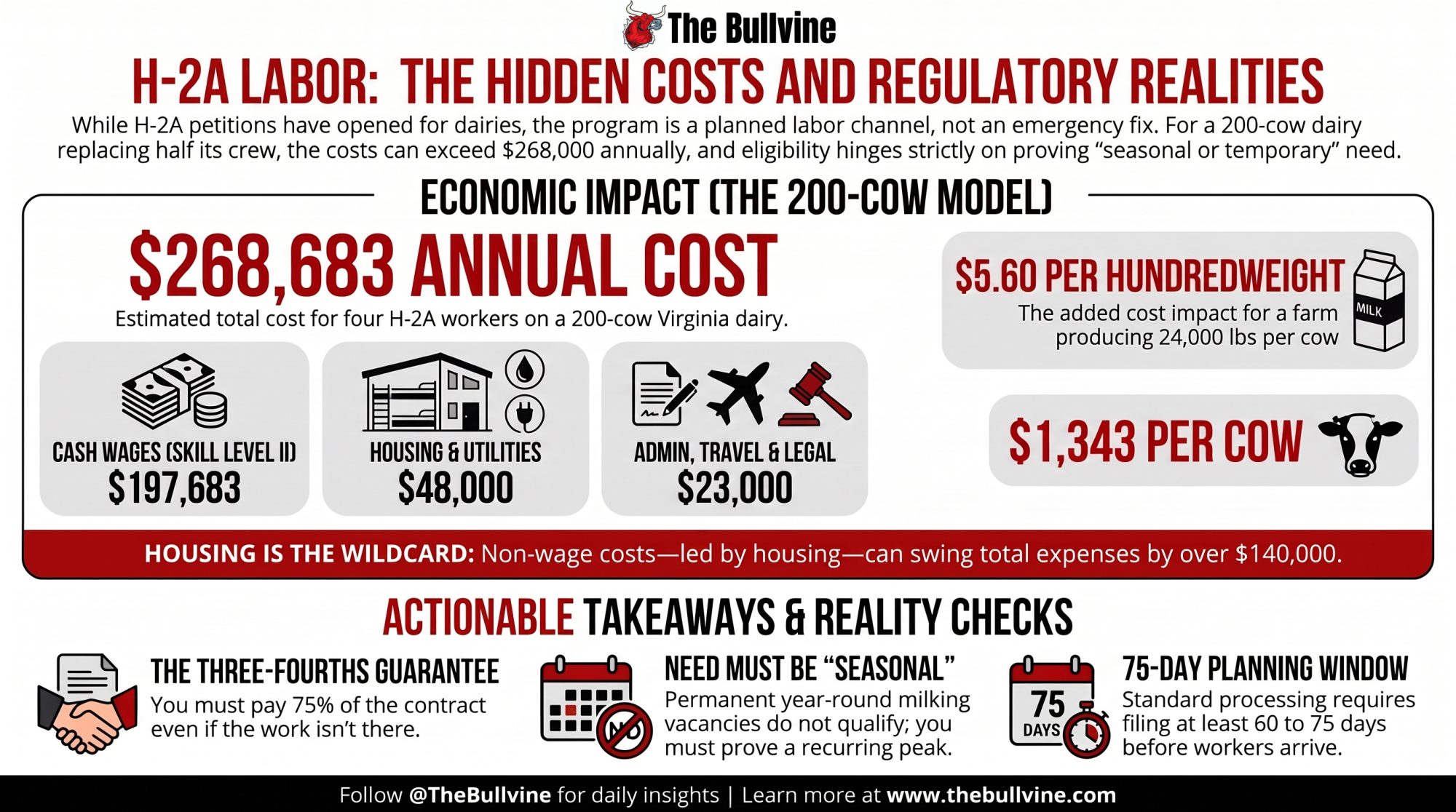
A 200-cow Virginia dairy replacing four of eight employees through H-2A is looking at roughly $268,683 a year — $67,171 per worker, $1,343 per cow, and $5.60 per hundredweight at 24,000 pounds per cow. Low case: $187,370; high case: $331,683; and the spread is almost entirely housing. Two things worth checking before you file: your state’s effective date may not be August 3, and the housing credit that lowers the H-2A wage doesn’t reach your domestic crew. Cost is still the second question. The first is whether those four jobs qualify at all.
What Happened in June
On June 12, 2026, U.S. Immigration and Customs Enforcement conducted a regional operation in Page County, Virginia. ICE confirmed 16 arrests in an action coordinated with the Page County Sheriff’s Office, Greene County Sheriff’s Office, and Gordonsville Police Department.
WMRA reported on August 10 that four of eight employees at a Luray-area dairy were among those detained, and that all four were removed during June. ICE confirmed two removals to Honduras and did not publicly confirm the other two in its response to the station. The Bullvine has not independently verified the farm-level details in this paragraph; all of them are WMRA’s reporting, attributed as such.
Five days later, on June 17, U.S. Citizenship and Immigration Services issued Policy Memorandum PM-602-0200, opening H-2A petitions to dairies that can demonstrate temporary or seasonal need. Nothing connects those two events. The interval is a coincidence of timing and is treated as one here.
The sequence does illustrate something structural: the policy channel that exists runs on a calendar measured in months. A crew loss runs on a calendar measured in hours.
The Dates That Move Your Wage Bill
| Date | Event | Effect |
| May 2026 | BLS publishes OEWS estimates used to set new rates | Floor reflects May 2025 OEWS wage estimates (BLS) |
| June 17, 2026 | USCIS issues PM-602-0200, effective immediately | Dairy petitions adjudicated case by case on temporary or seasonal need (USCIS) |
| August 3, 2026 | DOL publishes 2026–2027 AEWRs at 91 FR 48946 | Two-tier skill-based structure replaces single state rate (Federal Register) |
| August 17, 2026 | New rates take effect in Virginia | Delayed effective date for 17 states under Kansas et al. v. U.S. Dep’t of Labor, 749 F. Supp. 3d 1363 (S.D. Ga. 2024) (Federal Register, DATES) |
| September 2, 2026 | DOL OFLC implementation notice | Current rates stand; future wage adjustments possible (DOL OFLC) |
The other 16 states on the August 17 schedule: Arkansas, Florida, Georgia, Idaho, Indiana, Iowa, Kansas, Louisiana, Missouri, Montana, Nebraska, North Dakota, Oklahoma, South Carolina, Tennessee and Texas.
What June 17 Changed, and What It Didn’t
PM-602-0200 did not create a dairy visa. It told adjudicators that dairying can fall within H-2A where the petitioning employer proves that its need — not the existence of dairy work generally — is temporary or seasonal.
Temporary need generally runs no longer than one year absent extraordinary circumstances. Seasonal need must tie to a recurring time-of-year pattern that pushes labor requirements materially above the farm’s ongoing level.
USCIS gave examples, not blanket approval. A defined calving season could support a petition up to 10 months. A farm without concentrated calving might qualify if herdsman duties and labor demand change materially in identifiable periods. Year-round milking doesn’t automatically kill a petition — but a permanent year-round milking vacancy doesn’t become seasonal because the paperwork says so.
Adjudicators can pull payroll, schedules, staffing levels, contracts, workload records, prior petitions, and the gaps between requested employment periods. Back-to-back petitions covering substantially identical work without a meaningful break support a finding that the need is permanent.
USCIS also caps the stay: classification runs up to the certification period, extends in increments of up to one year, and maxes at three years — after which the worker must leave for at least 60 uninterrupted days (USCIS, H-2A Temporary Agricultural Workers).
Urgency is not eligibility. Losing four permanent employees creates the first and does nothing for the second.
The Lead Time You Don’t Have
USDA’s Farmers.gov guidance puts the standard process at 60 to 75 days — state job order 60 to 75 days ahead of the requested start, federal temporary labor certification filed at least 45 days out (USDA, Farmers.gov).
Emergency filing can waive parts of the 45-day schedule. It does not erase DOL review, USCIS adjudication, consular processing, or worker travel. H-2A is a planned labor channel. It is not four people waiting outside the milkhouse.
The Four-Worker Model
Four positions at 60 hours a week across 52 weeks: 3,120 hours per worker, 12,480 hours across four.
The 52-week frame is a costing device, not a petition. A genuine 52-week need is precisely what fails the USCIS temporary-or-seasonal test. This annualizes exposure so it can be compared against a current wage bill. It is not a claim that USCIS would certify a full-year dairy petition.
Which wage floor applies
Dairy work sits in SOC 45-2093, Farmworkers, Farm, Ranch, and Aquacultural Animals — one of the occupation codes in the field-and-livestock (combined) category (BLS, SOC 45-2093; occupational coverage at 91 FR 48946).
DOL now sets rates at two skill levels from BLS OEWS data: Level I for entry positions requiring no formal credential, Level II for experienced or fully proficient workers (91 FR 48946, methodology).
Virginia’s listed field-and-livestock figures for H-2A workers receiving free housing are $11.76 at Skill Level I and $15.84 at Skill Level II (DOL OFLC, H-2A Adverse Effect Wage Rates). Three qualifications attach:
The lower figure is conditional. It reflects a downward “H-2A Adverse Compensation Adjustment,” calculated from HUD Fair Market Rents for a four-bedroom unit, and applies only where the employer provides compliant housing at no cost (20 CFR 655.120(b)(3); adjustment methodology at 91 FR 48946).
The “highest of” rule overrides it. Employers pay the highest of the adjusted AEWR, the prevailing wage, any collective bargaining rate, the federal minimum, or the state minimum (20 CFR 655.120(a)). Virginia’s 2026 minimum wage is $12.77, so no Virginia H-2A dairy job can be budgeted at $11.76 (Virginia Department of Labor and Industry). Planning floors: $12.77 (Level I) and $15.84 (Level II).
| Worker / planning category | Listed or assumed wage floor | What actually controls the budget | Compliance and cost implication |
| H-2A Skill Level I with compliant free housing | $11.76/hr | Virginia’s 2026 minimum wage of $12.77/hr overrides the adjusted AEWR | Do not budget a Virginia Level I dairy job at $11.76/hr |
| H-2A Skill Level II with compliant free housing | $15.84/hr | The applicable “highest of” wage test | Central four-worker model uses $15.84/hr across 12,480 annual hours |
| Domestic corresponding employment | Full unadjusted AEWR applies | Same-job domestic workers must receive no less than the H-2A offer | Mixed crews can require a higher domestic wage code than the H-2A Level I rate |
| Corresponding worker unable to return home daily | Wage plus housing exposure | Housing obligation extends beyond visa headcount | Housing capacity may exceed the four-worker petition count |
| Four-worker central H-2A model | $197,683 cash wages | Level II wage assumption at 12,480 hours | Three-fourths guarantee puts roughly $148,262 of that wage line at risk regardless of workload |
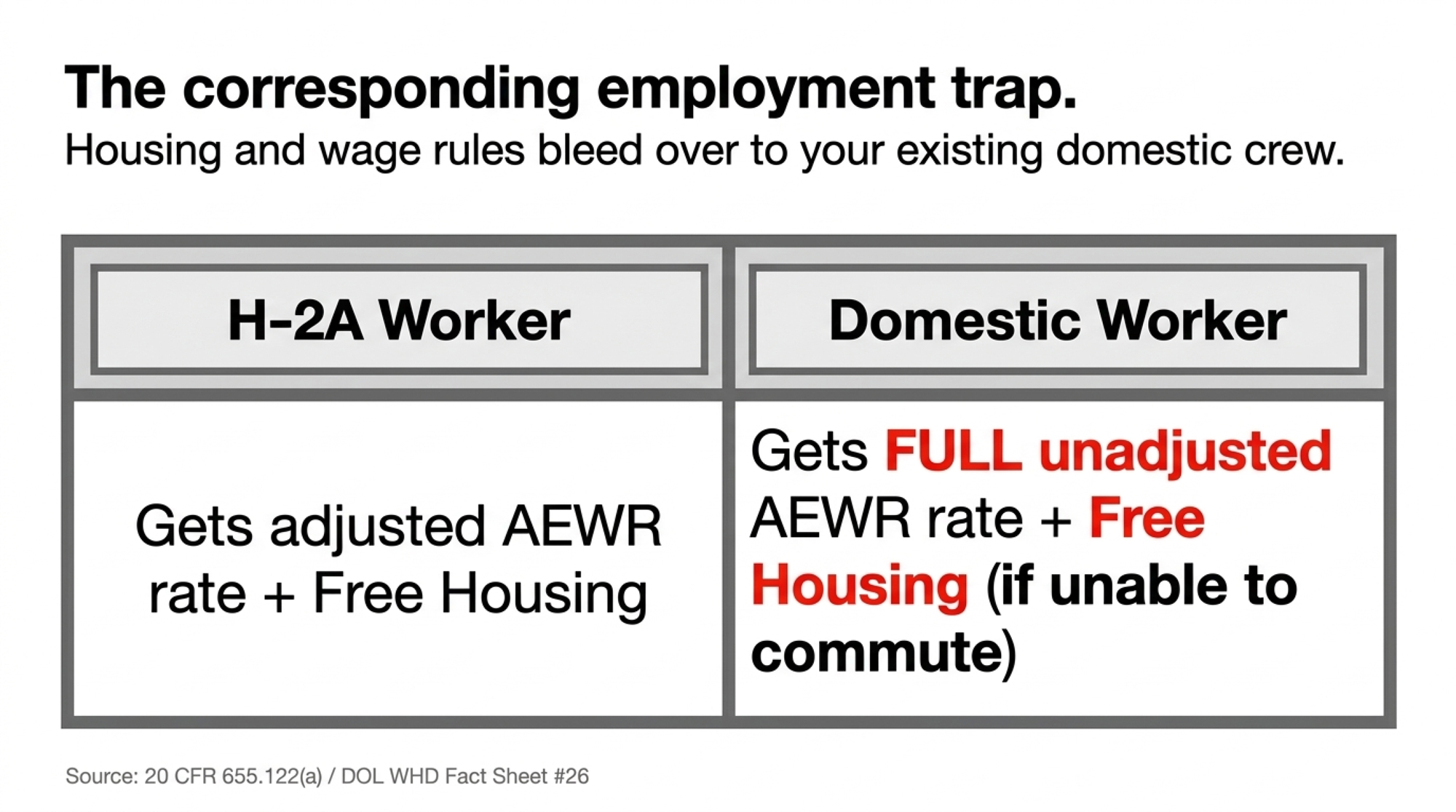
Then the corresponding-employment trap, which runs two ways. The job offer must give U.S. workers in corresponding employment no less than the H-2A workers receive, and the housing adjustment applies to H-2A workers only — so a domestic worker on the same job takes the full, unadjusted AEWR (20 CFR 655.122(a)). And the housing obligation itself extends past your H-2A crew: employers must provide housing at no cost to H-2A workers and to corresponding-employment workers who aren’t reasonably able to return to their residence the same day (DOL Wage and Hour Division, Fact Sheet #26).
Run a mixed crew, and you are running two wage codes; the domestic one is higher, and your housing headcount may be larger than your visa headcount.
The guarantee that makes the wage line a floor
Under 20 CFR 655.122(i), the employer guarantees work equal to at least three-fourths of the workdays in the contract period. The ETA-790A clearance order carries the same commitment (DOL ETA-790A).
That changes the character of the number, not just its size. The $197,683 central wage line is not a dial you turn down in a slow month — roughly three-quarters of it is an obligation you owe whether the work materializes or not. A domestic crew you can send home early. An H-2A contract you largely cannot.
Non-wage inputs, benchmarked
Two government figures anchor this. The Congressional Research Service, citing USDA, puts H-2A housing at $9,000 to $13,000 per worker and transportation at $400 to $650 per worker, and identifies housing as the major non-wage cost in the program (Congressional Research Service, R48614, July 31, 2025). Working from the same USDA 2024 estimates, Choices magazine puts minimum total non-wage cost near $10,000 per worker (Choices, Agricultural and Applied Economics Association).
Those are national seasonal-contract benchmarks, not Virginia dairy figures. They do not cover a farm building or substantially retrofitting housing.
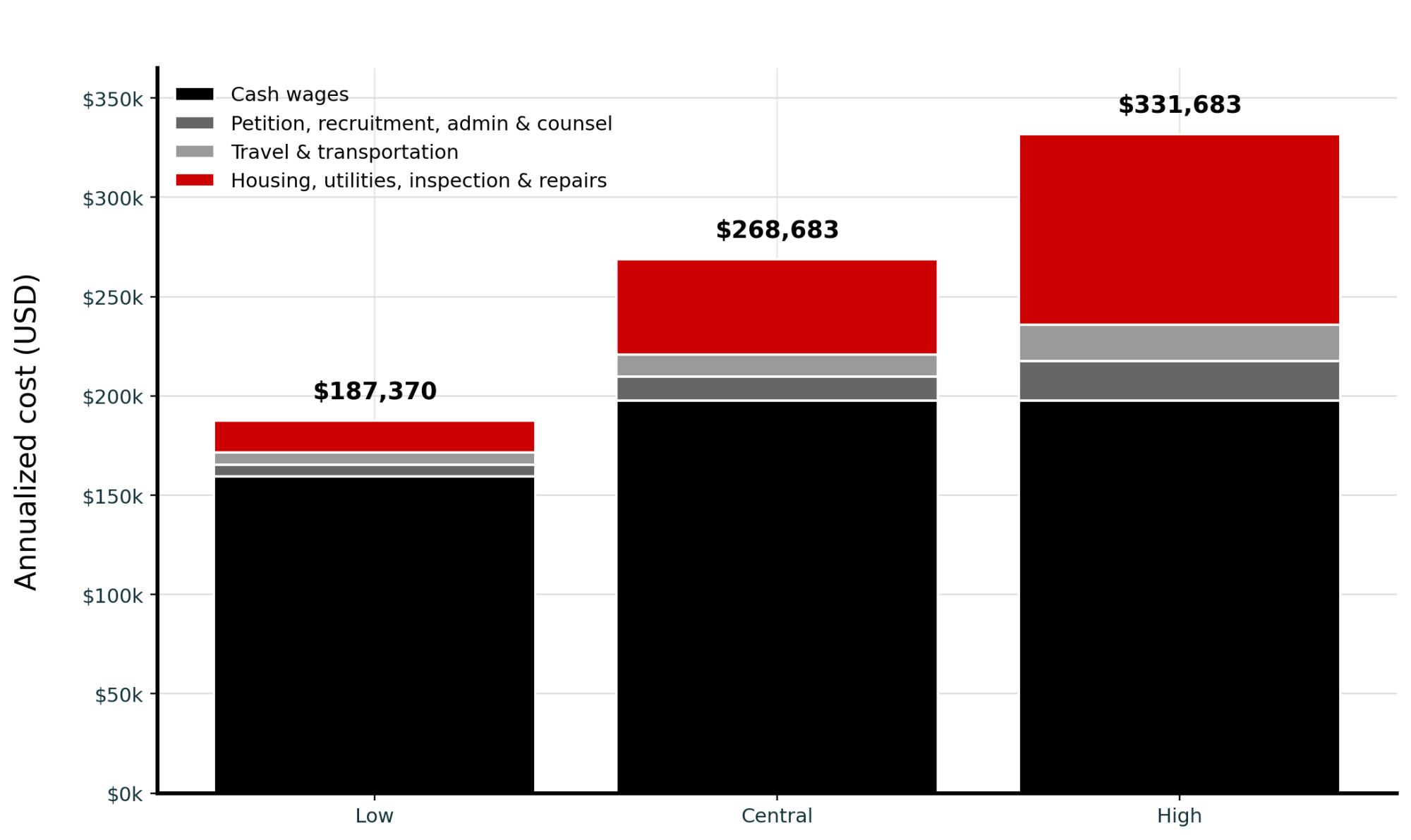
| Input, four workers | Low | Central | High |
| Annual labor hours | 12,480 | 12,480 | 12,480 |
| Wage assumption | $12.77 (Level I, VA min.) | $15.84 (Level II) | $15.84 (Level II) |
| Cash wages | $159,370 | $197,683 | $197,683 |
| Petition, recruitment, admin, counsel | $6,000 | $12,000 | $20,000 |
| Travel and transportation | $6,000 | $11,000 | $18,000 |
| Housing, utilities, inspection, repairs | $16,000 | $48,000 | $96,000 |
| Non-wage subtotal | $28,000 | $71,000 | $134,000 |
| Total annualized | $187,370 | $268,683 | $331,683 |
| Per worker | $46,843 | $67,171 | $82,921 |
| Per cow at 200 cows | $937 | $1,343 | $1,658 |
Per-worker non-wage cost runs $7,000 / $17,750 / $33,500. Read the low case carefully — at $7,000 it sits below the roughly $10,000 minimum in the USDA data. It is only reachable with compliant housing already built and paid for. If you’re planning from zero, the central case is your floor, not your midpoint.
Transportation is built from the CRS $400–$650 travel benchmark plus daily work transport — vehicle, fuel, insurance, maintenance — which is an employer obligation for workers in employer-provided housing. Timing matters as much as the amount: inbound transportation and subsistence are reimbursed once the worker completes 50% of the contract period, and return transportation is owed on completion (DOL Wage and Hour Division, Fact Sheet #26).
Subsistence has its own caps. USDA’s guidance lists a maximum daily meal charge of $16.78, with higher reimbursement available against receipts (USDA, Farmers.gov). DOL updates these rates annually by Federal Register notice — confirm the current figures before you file, not from this table.
Excluded from all three cases: payroll taxes, workers’ compensation, benefits, overtime exposure, emergency relief labor, meals or cooking-facility costs, and the production cost of running short-handed.
Per hundredweight
These figures cover the four replacement positions only — not your total farm labor bill. Production levels are reader inputs; substitute your own shipped hundredweight.
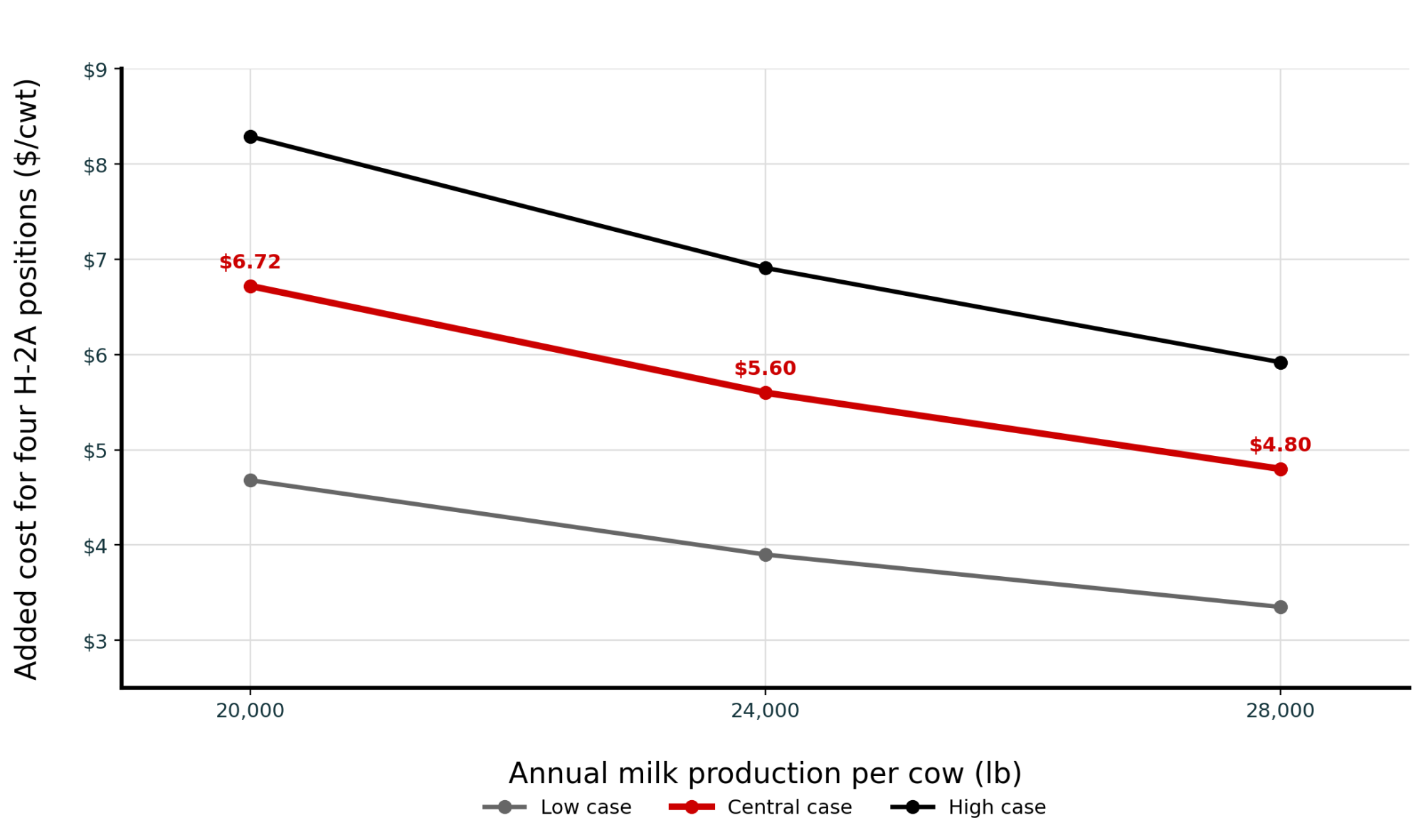
| Annual milk per cow | Total cwt (200 cows) | Low | Central | High |
| 20,000 lb | 40,000 | $4.68 | $6.72 | $8.29 |
| 24,000 lb | 48,000 | $3.90 | $5.60 | $6.91 |
| 28,000 lb | 56,000 | $3.35 | $4.80 | $5.92 |
For scale — and this is a different unit — USDA ERS puts total labor at $13.18 per cwt on herds under 50 cows and $1.85 per cwt above 2,000 cows (USDA Economic Research Service, Milk Cost of Production Estimates). Four H-2A positions at 200 cows consuming $5.60 of that is not a like-for-like comparison, but it tells you the program doesn’t fix a scale disadvantage. It prices one.
Against a domestic crew
The comparison farm’s actual wage bill isn’t public. Labeled planning rates:
| Case | Assumed local bill | H-2A model | Difference |
| Low | $187,200 at $15/hr | $187,370 | +$170 |
| Central | $212,160 at $17/hr | $268,683 | +$56,523 |
| High | $249,600 at $20/hr | $331,683 | +$82,083 |
Central runs about $56,500 above a $17-per-hour domestic cash-wage bill, and $48,000 of that gap is housing. On a 200-cow dairy, the bunkhouse decision matters nearly as much as the wage rate.
The low case reaching near-parity is not a finding that H-2A is cheap. It’s a finding that H-2A is cheap for a farm that already owns compliant housing — which is the farm least likely to need this analysis. And even at parity, the three-fourths guarantee means the two columns don’t carry the same risk.
Dairy’s Exposure, Correctly Dated
The National Milk Producers Federation — which represents dairy cooperatives and advocates for agricultural labor reform — reports immigrant employees at 51% of U.S. dairy labor and farms employing immigrant workers producing 79% of the nation’s milk (NMPF, Labor and Immigration Reform). Both figures come from an NMPF-sponsored Texas A&M study published in 2015, built on a producer survey and economic model (NMPF, The Economic Impacts of Immigrant Labor on U.S. Dairy Farms, 2015). Not a current federal workforce count. Any piece citing them without that date and sponsor is overstating their authority.
What This Means for Your Operation
Map a 50% crew loss this week. Who covers milking, feeding, calves, treatments, and manure handling if 25% or 50% of the crew is gone tomorrow? One name in three essential jobs is not a plan.
Run the per-cwt number today. Annual payroll divided by hundredweight shipped, then compare against the ERS bracket for your herd size. You’re looking for the gap between what you pay now and the $4.80–$6.72 range four H-2A positions would add at 200 cows.
Start 75 days early or don’t start. A June 1 need belongs on the calendar by mid-March.
Build a month-by-month labor curve. Hours by duty and month — milking, maternity, calves, breeding, fieldwork, maintenance. Twelve months of payroll and schedules is how you demonstrate a seasonal increase exists, or admit it doesn’t.
Cost housing before you cost counsel. Benchmark against $9,000–$13,000 per worker, then get your actual structures evaluated. A farmhouse or camper already occupied by employees is not automatically compliant. Sleeping rooms require at least 50 square feet per person, and 100 square feet per person where workers cook, live, and sleep in the same room (DOL WHD, Fact Sheet #26G).
Count your housing headcount, not your visa headcount. Corresponding employment domestic workers who can’t get home the same day are owed housing too. Budget it before you file, not after an audit.
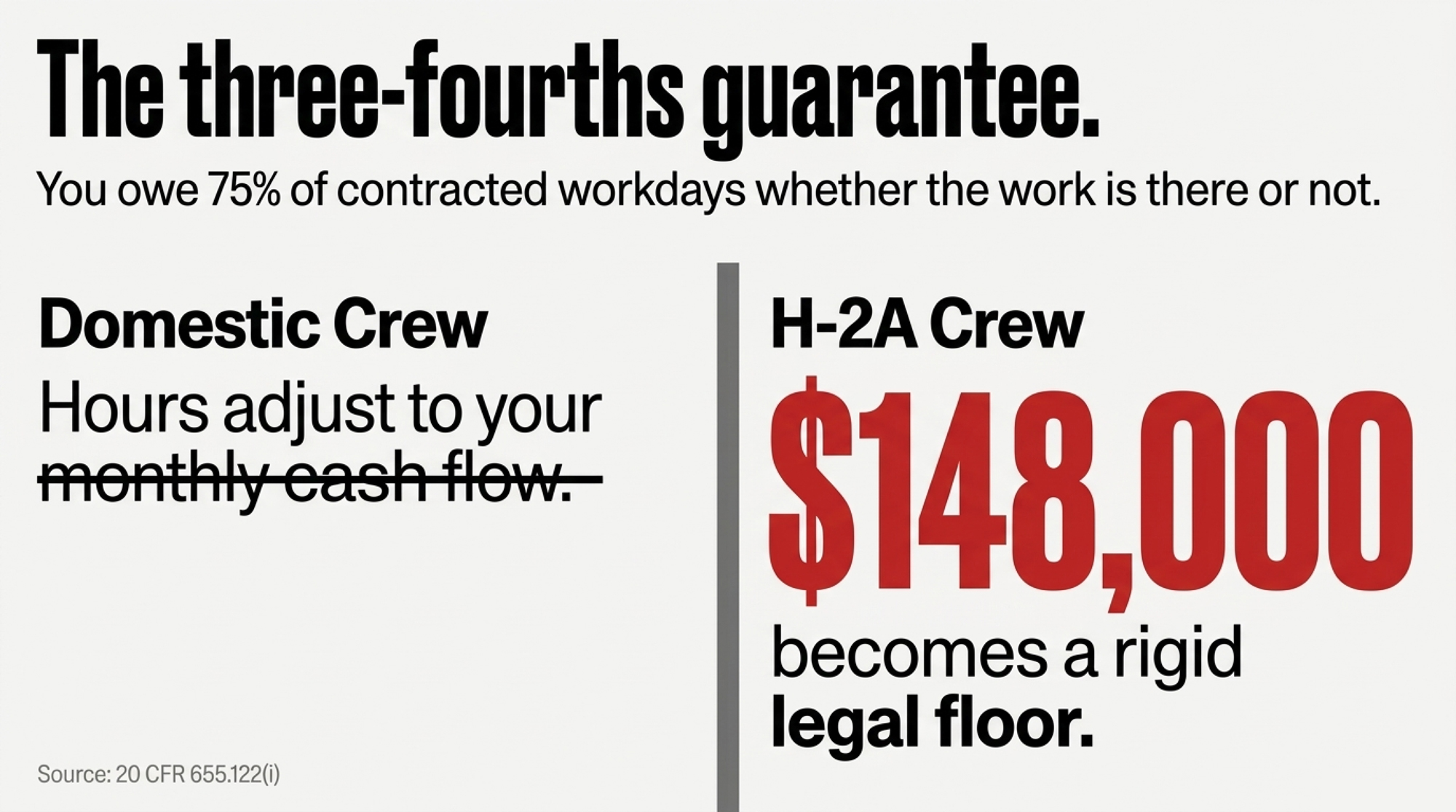
Model the three-fourths guarantee, not just the hourly rate. Under 20 CFR 655.122(i), you owe roughly 75% of contracted workdays regardless of workload, on the central case that’s roughly $148,000 of the $197,683 wage line owed whether the work is there or not. Run your slowest quarter against the contract and see what you’d be paying for.
Price both skill levels and check your state’s effective date. Virginia after August 17: $12.77 and $15.84 before housing and travel. Sixteen other states share that date; the rest moved August 3 (Federal Register, FR Doc. 2026-15673).
Set up three pay codes now. H-2A Level I, H-2A Level II, and domestic corresponding employment at the full unadjusted rate — the structure 20 CFR 655.122(a) requires once you run a mixed crew. A blended average hides a mid-season duty shift, and that is exactly what a DOL reclassification dispute looks for.
Keep wage records tight after September 2. Workers employed during the court-identified period may later qualify for adjustments. Nothing is owed yet. That is not the same as nothing being owed.
Run a privileged I-9 review while the crew is intact. Through qualified immigration counsel, not a DIY audit. Reverifying foreign-born employees on your own creates discrimination exposure of its own.
The Next 30 to 90 Days
DOL’s replacement wage methodology. The September 2 notice signals a rule is coming. Until it publishes, every Virginia H-2A wage you pay is provisional.
The Securing Agriculture’s Workforce Act (H.R. 9535), introduced June 30, 2026, would open H-2A to more categories of agricultural work, set entry wages at the 17th percentile and experienced wages at the 50th, eliminate the prevailing wage, fix contract wages for the contract duration, allow multiyear housing certifications and permit capped housing deductions tied to HUD fair market rent (Alston & Bird analysis; bill text at Congress.gov). Introduced, not law.
H.R. 3227 proposes a limited pool of non-temporary H-2A visas with a dairy reservation (Congress.gov). Also introduced, but not law.
None helps a staffing decision this week. All three change a 2027 budget, and the housing provisions in H.R. 9535 would move the largest single line in the model above.
The policy that exists was never built to refill half a permanent crew after the barn is already short. It was built to be planned for. Cost the four-worker case, test whether the work is genuinely seasonal, and inspect the housing while everyone is still showing up.
Key Takeaways
- Four replacement workers on a 200-cow Virginia dairy run $187,370 to $331,683 a year across 12,480 hours — housing swings nearly the whole spread, so price the bunkhouse before you price the petition.
- Check your effective date. Virginia’s new AEWR didn’t start August 3 with most states; it started August 17 under the Kansas v. DOL order, and a wage line filed on the wrong date is a compliance problem, not a rounding error.
- The housing credit that lowers your H-2A wage doesn’t reach domestic workers in corresponding employment — they get the full unadjusted rate, and some of them are owed housing too.
- Under 20 CFR 655.122(i), you owe three-fourths of contracted workdays whether the work is there or not. Clearing $268,683 doesn’t clear eligibility either, so build the labor curve while the crew’s intact.

The Bullvine H-2A Replacement Cost Calculator
Run the math on wages, housing, and regulatory liabilities before you file a petition.
1. Labor Needs
2. Annual Cost Inputs
3. Farm Scale & Comparison
Complete references and supporting documentation are available upon request by contacting the editorial team at editor@thebullvine.com.
Learn More
- How to Attract and Retain Exceptional Labor for Your Dairy Farm — Arms you with concrete retention strategies that cut turnover expenses and protect your parlor’s efficiency. Dismantles the idea that wages alone keep teams intact, showing how structured communication and performance tracking reduce labor flight by up to 25 percent.
- Dairy Farm Economics 2026: Milk Pricing, Margins & Risk Playbook — Exposes the structural margin squeeze hitting your 2026 milk check, delivering a playbook for navigating a projected $23.66/cwt economic cost. Breaks down how formula modernizations and risk management caps dictate whether you optimize, expand, or exit.
- Robotic Milking Labor Math: Fix the Problem or Grow Debt? — Follows the money on automation, pitting a $48,000 variable wage hike against fixed $150,000 debt payments. Reveals why eight percent of early adopters save zero labor hours and forces you to stress-test dealer proposals against $18 milk.
 The Sunday Read Dairy Professionals Don’t Skip.
 The Sunday Read Dairy Professionals Don’t Skip.
Every week, thousands of producers, breeders, and industry insiders open Bullvine Weekly for genetics insights, market shifts, and profit strategies they won’t find anywhere else. One email. Five minutes. Smarter decisions all week.




