


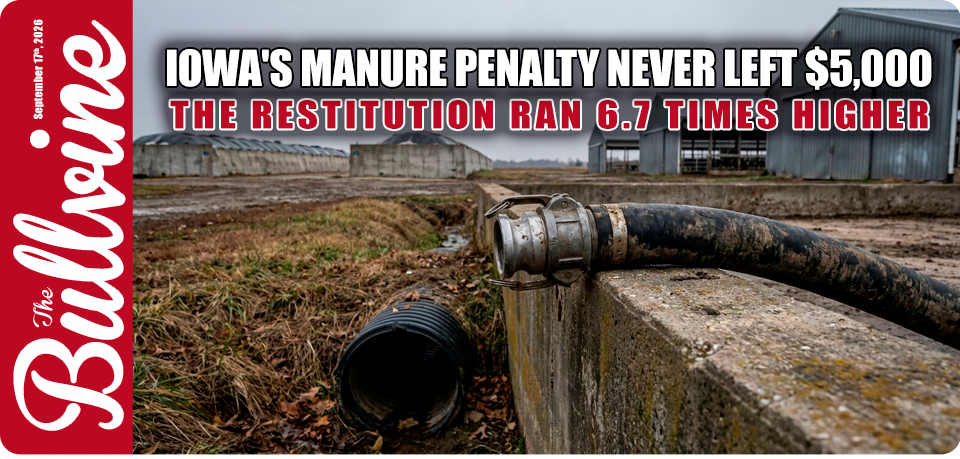





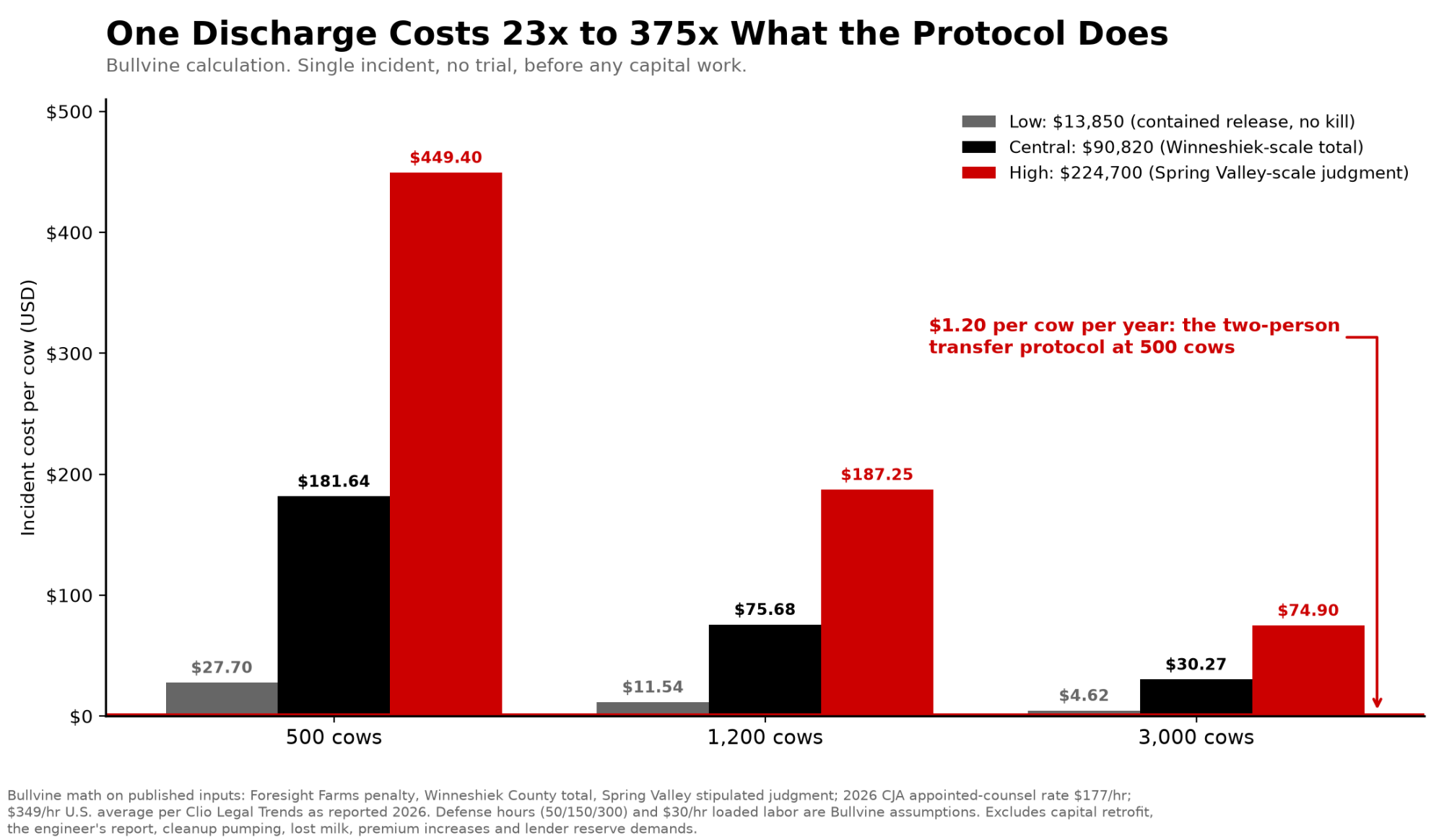
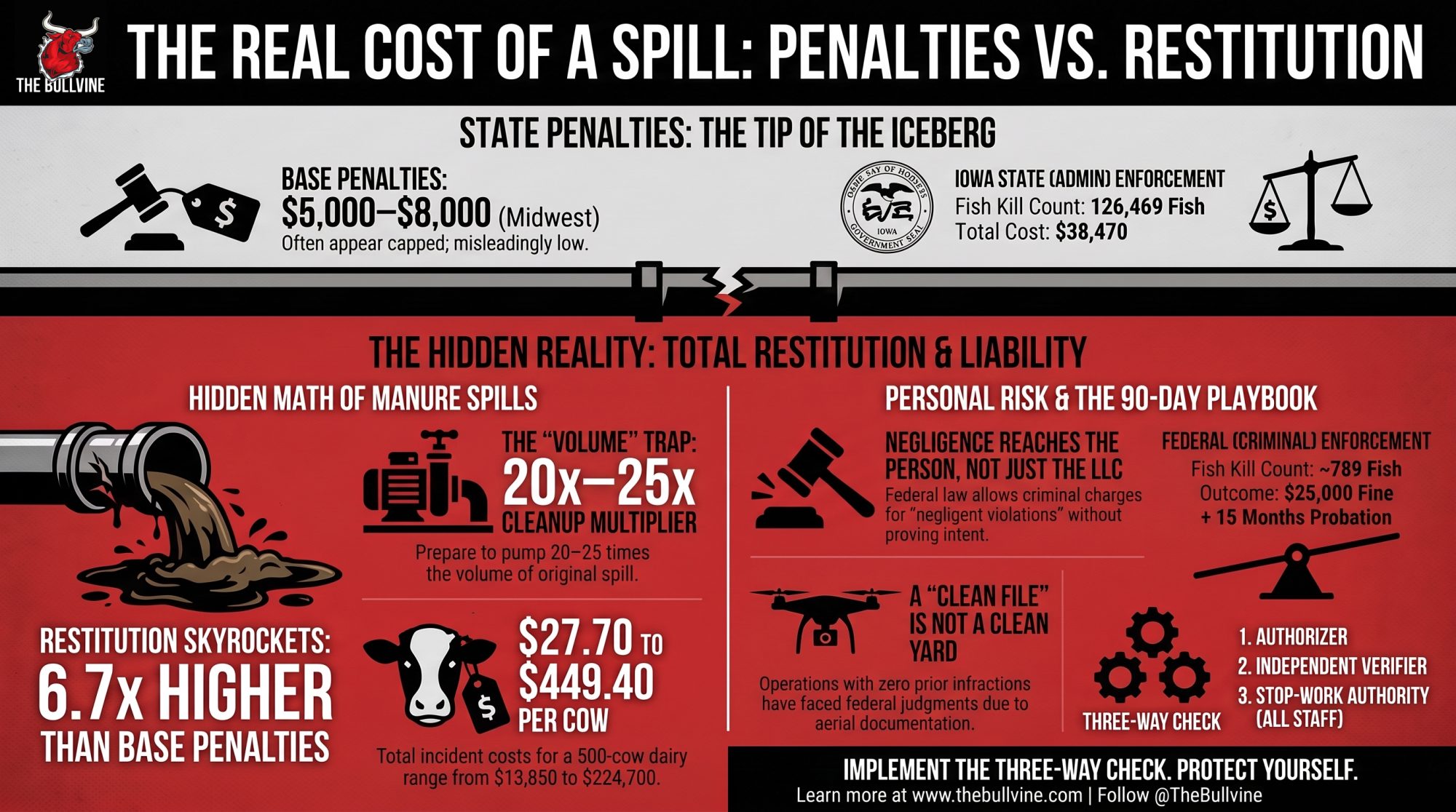
Four Iowa consent orders held the penalty between $5,000 and $8,000, whether the kill was zero fish or 126,469, on herds from 330 cows to about 4,200. Restitution ran 6.7 times higher. In Ohio, roughly 789 dead fish produced a federal conviction, 15 months of probation and a $25,000 fine for one man.
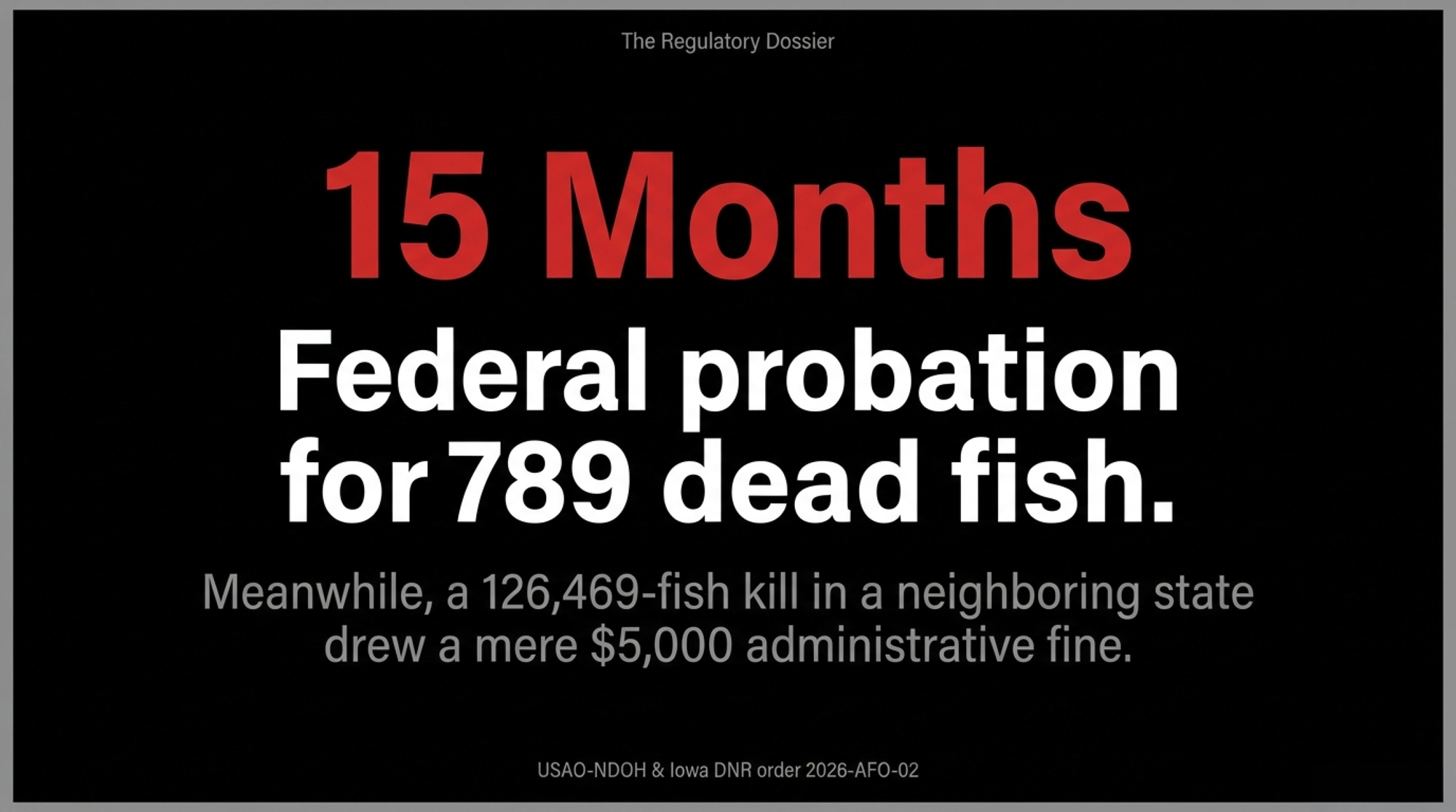
A creek in Mercer County tested between 120 and 150 parts per million of ammonia on December 12, 2022. Thirteen ppm is considered chronic toxicity to aquatic life and 1 ppm is normal, according to Mercer Soil and Water Conservation District officials. Daily Standard Three years and nine months later, in a dairy Clean Water Act sentencing that named one man, U.S. Magistrate Judge Darrell A. Clay handed down 15 months of probation, a $25,000 fine and 100 hours of community service.
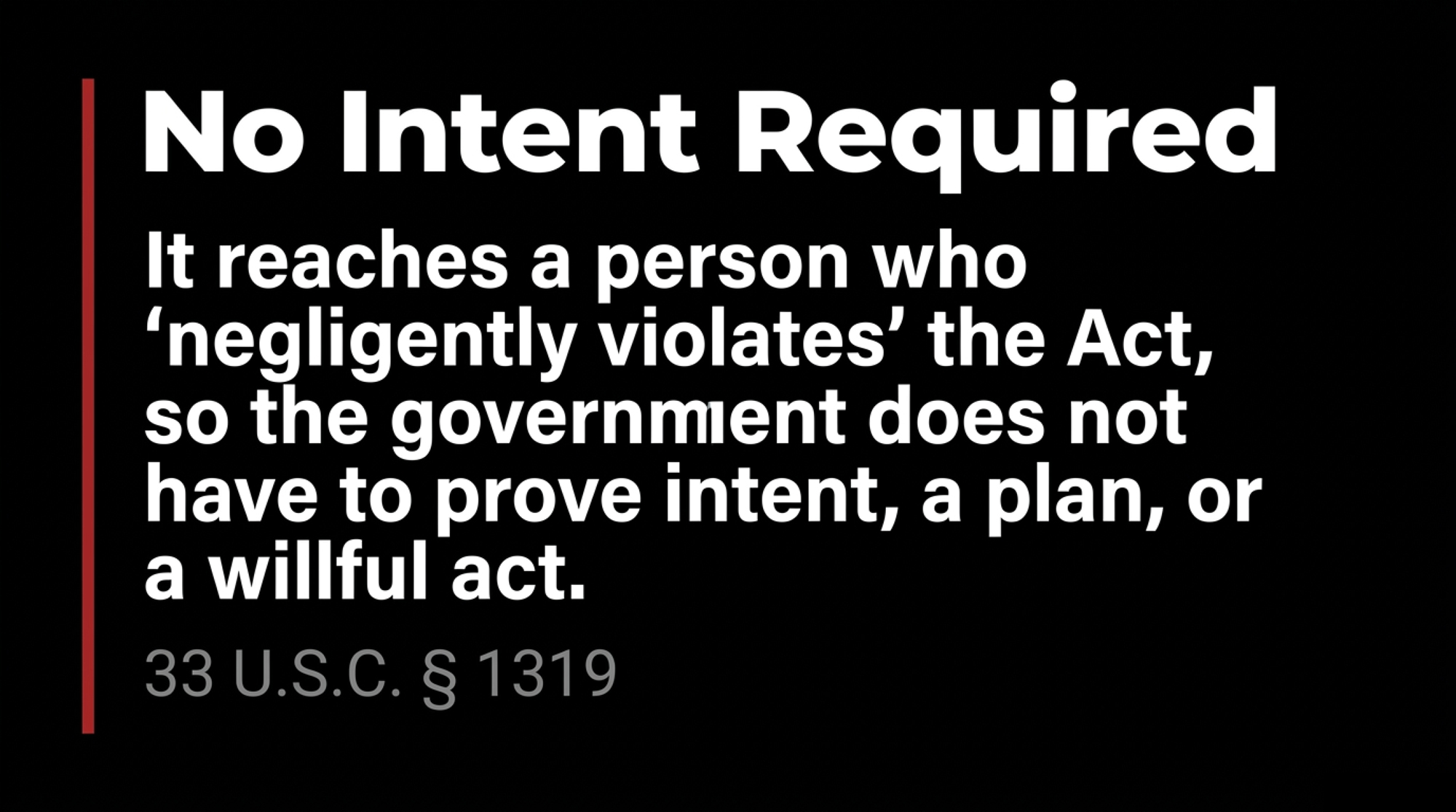
The judgment names Teunis Jan Willemsen, 54, who was serving as manager of Heartland Dairy in December 2022. USAO-NDOH The operation at 3101 Tama Road southwest of Rockford, formed in 2010 and formerly known as Rockford Dairy, is run by Heartland Dairy Holdings, LLC. Daily Standard, 2017 Lima News He pleaded guilty on May 8, 2026, to negligently discharging a pollutant under 33 U.S.C. §§ 1311(a) and 1319(c)(1)(A). DOJ Environmental Crimes Bulletin Read that provision closely, because it is the part most operators get wrong: it reaches a person who “negligently violates” the Act, so the government does not have to prove intent, a plan, or a willful act. It carries $2,500 to $25,000 per day of violation, up to a year in prison, or both.
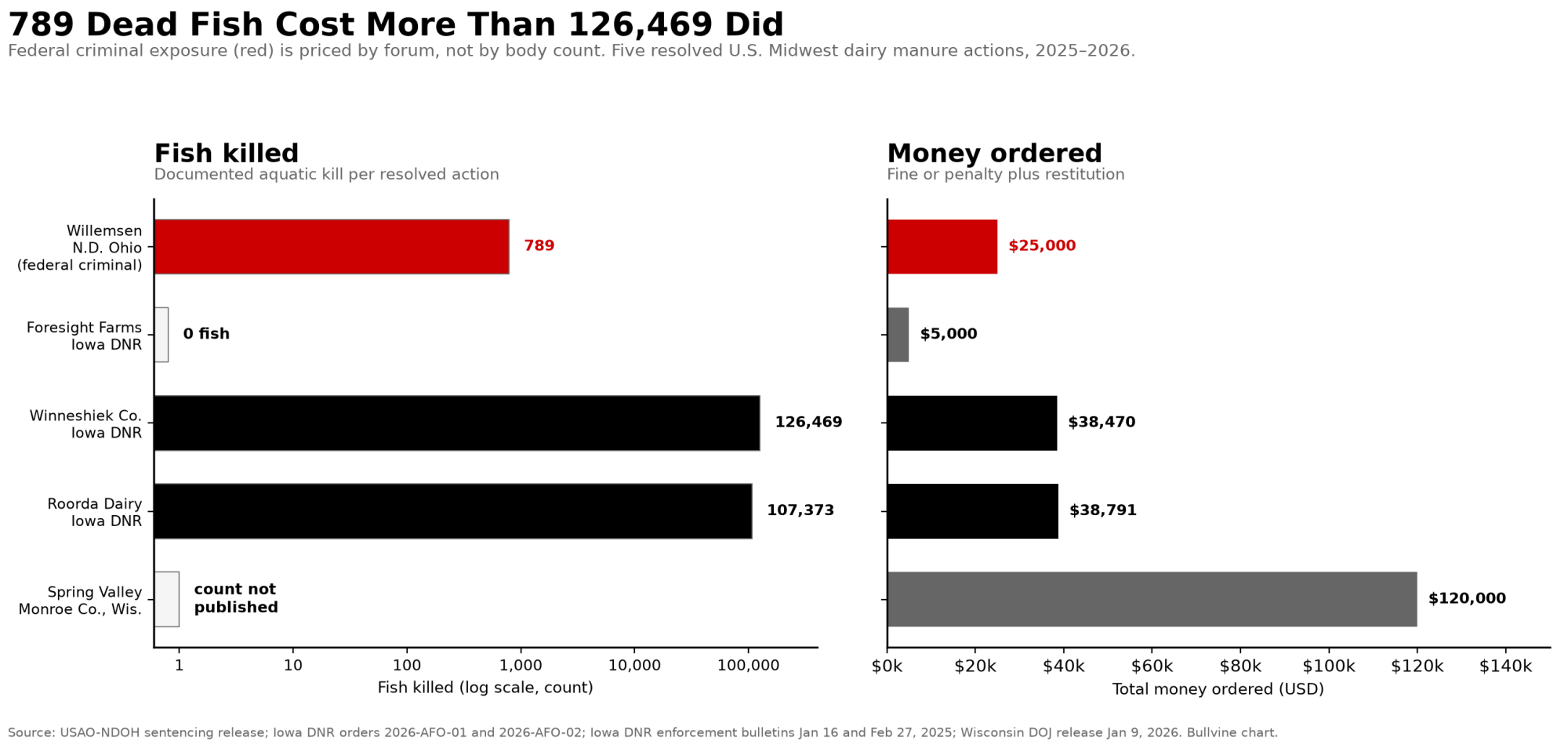
Now put that beside Iowa. A January 2026 consent order in Winneshiek County carried a $5,000 penalty and $33,470.39 in restitution and investigative costs, $38,470.39 in total, for 126,469 dead fish over 10.2 miles. Iowa DNR order 2026-AFO-02 Ohio’s federal case produced a $25,000 criminal fine and 15 months of probation on a kill of roughly 789 fish. USAO-NDOH The operations most exposed are in delegated-permit states, with a leachate or manure structure within hose reach of a swale, tile inlet, or culvert.
What the records establish, and where they disagree
DOJ’s two publications give the outcome. The mechanism comes from the Mercer district’s own field investigation, presented at its January board meeting and reported January 6, 2023, by Leslie Gartrell in The Daily Standard. Bullvine requested the district’s minutes and complaint file on September 17 and had not received them before publication, so the account that follows is that newspaper’s report of a public meeting.
The account runs on a clock. Then-Ohio DNR Mercer County wildlife officer Brad Buening called then-district technician Matt Heckler at 8:25 a.m. on December 12, 2022, reporting discolored water and dead fish where Little Black Creek crosses Erastus Durbin Road. Heckler notified Dave Schilt, then at Ohio EPA’s Division of Environmental Response and Revitalization, and Frances Springer, then at ODA’s Division of Soil and Water. Crews walking the creek found a 10- to 12-inch tile discharging foaming water above 10 ppm ammonia. At the facility, they found a pump in the silage leachate collection system with a hose running over the collection wall and discharging into the clean water swale on the north side of the operation.
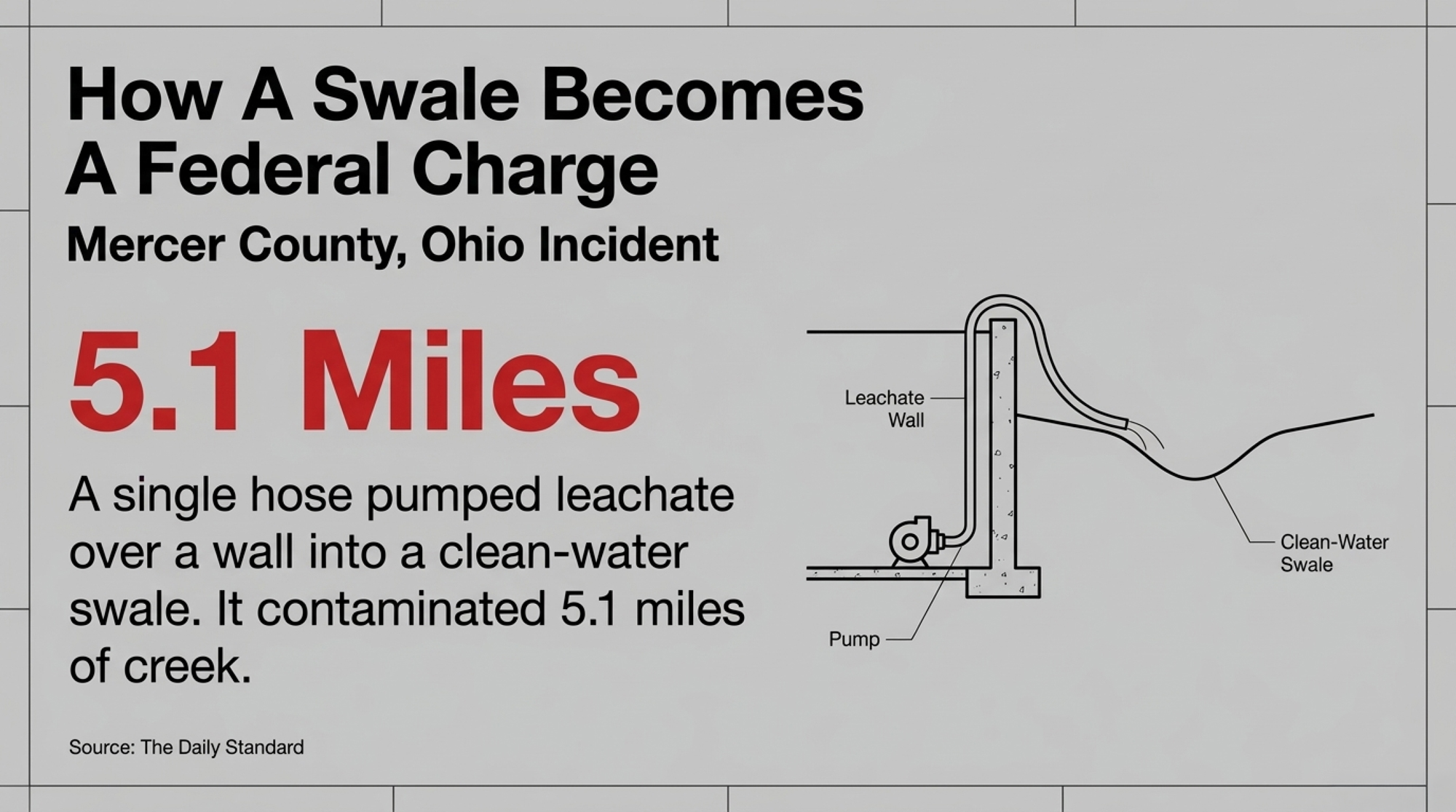
Heckler described silage leachate as a corn byproduct, high in nutrients and land-applicable, and called it one of the worst potential pollutants. By 12:35 p.m., a manure applicator working for the dairy told officials he had plugged the tile in the catch basin and closed the inline water control structure. Total contamination: 5.1 miles of creek. The district found a valid pollution complaint and referred it to ODA-DLEP and Ohio EPA for enforcement. Daily Standard No state enforcement outcome has been verified, and the district had not responded before publication to a September 17 request for comment.
Three places where the records do not line up, stated rather than smoothed. DOJ’s May bulletin locates the dairy in “Rockland, Ohio,” while the county-level record puts it at Rockford in Mercer County. DOJ Daily Standard DOJ describes wastewater pumped from a settling basin into a nearby ditch, consisting of manure and silage leachate, while the district found a pump in the leachate collection system feeding a clean water swale. And the May bulletin puts the non-fish toll at 1,370 animals, attributed to the Ohio Department of Agriculture, while the September release says 1,371. DOJ USAO-NDOH Neither DOJ publication states the discharge volume.
Nor does either explain how they counted the roughly 789 dead fish. Iowa publishes its method: in the Winneshiek County matter, DNR Fisheries staff Theresa Shay, Josh Hefflefinger, Caleb Schnitzler and Steve Pecinovsky surveyed 10.2 miles between March 11 and 14, 2025, using the “Narrow Stream, Incompletely Accessible” method from American Fisheries Society Special Publication 35, and the order names the method on its face. Iowa DNR order 2026-AFO-02 Iowa also runs a public fish-kill database that logs each event’s mechanism and the surveyed distance in yards, with GPS coordinates for the endpoints. Iowa DNR Fish Kill Database Ohio’s count arrives without a method.
The federal record establishes the bridge to the defendant. The bulletin says Willemsen “stated he was responsible for employees pumping the contents from the settling basin into a nearby drainage ditch.” DOJ Special Agent in Charge Allison Landsman of EPA’s criminal enforcement program in Ohio said in the sentencing release: “The defendant oversaw a discharge of ammonia-laden wastewater to Little Black Creek in the Maumee River, Ohio watershed that poisoned the water for miles and killed thousands of fish and other aquatic animals.” “Reckless and careless business practices that threaten Ohio’s environment and wildlife will not be tolerated,” U.S. Attorney David M. Toepfer said.
Employees ran the pump. The manager carried the charge. Assistant U.S. Attorney Matthew D. Simko prosecuted with EPA Regional Criminal Enforcement Counsel Sasha Reyes assisting. USAO-NDOH The reviewed federal materials identify no corporate co-defendant, which is not the same as DOJ clearing the company: Bullvine has not read the judgment, the charging document, the plea agreement, or the full docket in No. 3:26-mj-08002, and no public document explains the charging decision between entity and individual.
How does a clean water swale become a Clean Water Act charge?
Your state permit did not keep federal investigators out of this barn. Ohio EPA has held authority over the base NPDES permit program since March 11, 1974. EPA EPA’s Criminal Investigation Division, the Ohio Attorney General’s Bureau of Criminal Investigation, and Ohio EPA’s Special Investigations Unit still worked this file with support from Ohio DNR.
The pathway had three links and no independent check on any of them. A pump sat in a leachate collection system. A hose crossed a wall into a swale built for clean water. That swale fed an outlet tile connected to Little Black Creek. Daily Standard The statute reaches negligence, and the tile worked exactly as designed.
Two details raise the stakes for anyone whose permit file looks clean. Springer sent Heckler a Mercer County auditor aerial image from March 2021 showing a pump and hose already present in the leachate collection system, and the district said it cannot verify whether contamination had been continuous since then. Daily Standard No document reviewed establishes when that pump was placed, how often it was used, or whether it discharged before December 2022. Worth sitting with: that image came from the county auditor’s aerial photography, so the yard was documented years before anyone walked it. Ohio county auditors publish aerial imagery, and many county assessors elsewhere do the same. Check what your county publishes, then look at what a hose, a pump, or a stained swale would show from above.
Separately, then-ODA-DLEP program administrator Nancy Cunningham said in December, during a five-year permit-to-operate renewal, that the facility had no infractions since its permit was first granted. Daily Standard Heartland Dairy Holdings, LLC was asked on September 17 to respond to each of those findings, including the aerial image and the referral, and to say whether the company was ever charged or resolved any civil or administrative matter. It had not responded before publication. ODA-DLEP was asked the same day for the outcome of the December 2022 referral, the facility’s current permit status, and whether the no-infractions characterization was accurate. It had not responded.
Ohio already requires you to name the people who will execute your plan. Administrative Code 901:10-2-17 requires an emergency response plan identifying those responsible for implementing it, and 901:10-2-14 requires manure management procedures that minimize loss or spillage in transport with prompt cleanup.
What Bullvine got wrong in 2024, and the exact correction
On August 27, 2024, this publication told operators to designate an incident leader and split shutdown, containment, and communication duties. Bullvine, 2024 The instinct was right, and the four-hour gap between Buening’s 8:25 a.m. call and the 12:35 p.m. containment report shows why somebody has to own the response.
The wording was not right. That piece framed the assignment as settling “who is liable for what,” and internal assignments do not decide who a regulator or prosecutor may charge. Section 1319(c)(1)(A) does not read your org chart, and the Alternative Fines Act at 18 U.S.C. § 3571 means the $25,000 daily figure should not be treated as a universal individual ceiling. That page requires correction before this article links to it.
The replacement rule has four roles instead of one: an authorizer, a second trained verifier who is not the pump operator, anyone on the crew with authority to stop the pump, and a named incident leader for the response. Cornell Cooperative Extension recommends that every employee, including those not running waste equipment, know the system and how to shut valves. Cornell CCE Purdue’s response order starts with controlling the source by stopping pumps, closing valves, and breaking the siphon.
Iowa’s orders show what regulators ask for after the fact, and it is close to the same list. Foresight Farms was ordered to develop a standard operating procedure for employee training and equipment inspection. Iowa DNR order 2026-AFO-01 Jochum Agri-Services was ordered to produce five years of manure-application training records and to write mandatory release reporting into its updated procedure. Iowa DNR, Feb 27, 2025 The Winneshiek County operator was ordered to submit a professional engineer’s report on manure storage capacity, rework the grass waterway feeding the tile intake, and write a feedlot maintenance plan.
Does an LLC keep your manager’s name off the caption?
Across one federal case and five resolved state actions read from the orders, consent-order bulletins, and releases themselves, all of them Midwestern, the actor named changes with the conduct and the forum, not with the corporate form.
| Action | Who was named | Documented event | Money | Legal form |
|---|---|---|---|---|
| Willemsen, N.D. Ohio, sentenced Sept 8, 2026 | Individual dairy manager | Discharge reached Little Black Creek; roughly 789 fish and 1,371 other aquatic animals | $25,000 fine, 15 months probation, 100 hours service | Criminal conviction on guilty plea |
| Jochum Agri-Services, Inc., Iowa DNR, penalty due Feb 18, 2025 | Sioux County respondent, ordered to produce five years of manure-application training records | Manure release | $5,000 administrative penalty | Consent order |
| Foresight Farms, L.C., Iowa DNR order 2026-AFO-01, signed Jan 7, 2026 | Dairy LLC, 1,098 animal units at signing, Garnavillo | Umbilical hose coupler separated Oct 4, 2025; manure reached an unnamed tributary of Buck Creek; four dams and two pumps kept it out of Buck Creek, which showed no ammonia | $5,000 administrative penalty, no restitution | Consent order, appeal rights waived |
| Iowa DNR order 2026-AFO-02, signed Jan 30, 2026 | An individual dairy operator, Winneshiek County, 330 mature dairy cattle at signing | Open-feedlot runoff entered a tile intake and an unnamed tributary of Dry Run Creek, March 2025; 126,469 fish killed over 10.2 miles; earthen basin below two-foot freeboard | $5,000 penalty plus $33,470.39 restitution and investigative costs, $38,470.39 total on a four-payment plan | Consent order |
| Roorda Dairy LLC, Iowa DNR, incident July 2024, enforcement Jan 16, 2025 | Dairy LLC, roughly 4,200 dairy cattle per Iowa Capital Dispatch reporting on DNR records, Paullina | Blown tile during land application sent manure to Mud Creek; 107,373 fish killed, with dead fish logged along 16,900 yards, or 9.6 miles, to the Mill Creek confluence src | $8,000 penalty plus $30,791.07 fish restitution, $38,791.07 total | Consent order |
| Spring Valley Holsteins, Inc. and its operator, Monroe County Circuit Court, approved Dec 23, 2025 | Norwalk, Wisconsin dairy corporation and its operator at the time of the judgment | Complaint alleged a faulty manure transfer system let manure escape into an unnamed tributary and Moore Creek; dead brown trout, white suckers, and dace reported May 13, 2024 | $120,000, including $90,000 to Wisconsin DNR to remedy fish-kill effects | Stipulated judgment resolving alleged violations |
Read the Iowa column down, and the pattern is hard to miss. The administrative penalty sits at $5,000 for a manure release in Sioux County, $5,000 for a contained release with no fish kill at Foresight Farms, $5,000 for a kill of 126,469 fish in Winneshiek County, and $8,000 for a kill of 107,373 at Roorda. Iowa DNR Foresight order Winneshiek order Roorda The penalty barely moves, and it does not track herd size either: $5,000 on a 330-cow operation, $8,000 on one running about 4,200. What moves is restitution, which ran 6.7 times the penalty in Winneshiek County and 3.8 times at Roorda.
Iowa priced that kill at $30,923.54 for 126,469 fish, about 24 cents a fish, and added $1,750.63 in Fisheries costs and $796.22 in field office costs. Winneshiek order Apply that rate to Ohio’s 789 fish, and the natural-resource value is roughly $190. On a kill Iowa’s own rate would value near $190, Ohio’s outcome was a $25,000 criminal fine.
| Metric | Winneshiek Co., Iowa | Roorda Dairy, Iowa | Willemsen, N.D. Ohio |
|---|---|---|---|
| Fish killed | 126,469 over 10.2 miles | 107,373 over 9.6 miles | roughly 789 |
| Count method published | Yes — AFS Special Pub. 35, “Narrow Stream, Incompletely Accessible,” four named DNR staff | Yes — DNR fish-kill database, 16,900 yards logged with GPS endpoints | No method stated |
| Natural-resource value | $30,923.54 (~$0.24/fish) | $30,791.07 fish restitution | ~$190 at Iowa’s rate |
| Money ordered | $38,470.39 | $38,791.07 | $25,000 fine |
| Ordered money ÷ Iowa-rate fish value | 1.2x | 1.3x | ~132x |
The Winneshiek County operator and Spring Valley Holsteins were both asked on September 17 to comment on the figures reported here, including Bullvine’s calculation that restitution ran 6.7 times the penalty. Neither had responded before publication.
Different statutes, different forums, different standards of conduct. That is the point. A negligent discharge charged criminally under federal law produced a personal judgment on a small kill, while administrative water-quality violations on kills more than 130 times larger produced payment plans against two operations and one operator.
Running the Numbers
Bullvine calculation: one resolved manure discharge on a 500-cow dairy. USD, U.S. Midwest, single incident, before any capital work.
Published evidence, two inputs. Enforcement and environmental payment, from resolved dairy outcomes: $5,000, the Foresight Farms penalty for a release with no fish kill. $38,470.39, the Winneshiek County total. $120,000, the Spring Valley stipulated judgment. Defense rates: the 2026 federal appointed-counsel rate of $177 per hour, and a $349 U.S. average lawyer hourly rate from Clio’s Legal Trends data as reported in 2026.
Stated assumptions, kept separate. Fifty, 150, and 300 defense hours are Bullvine assumptions, not case figures. Every scenario assumes a single incident and no trial.
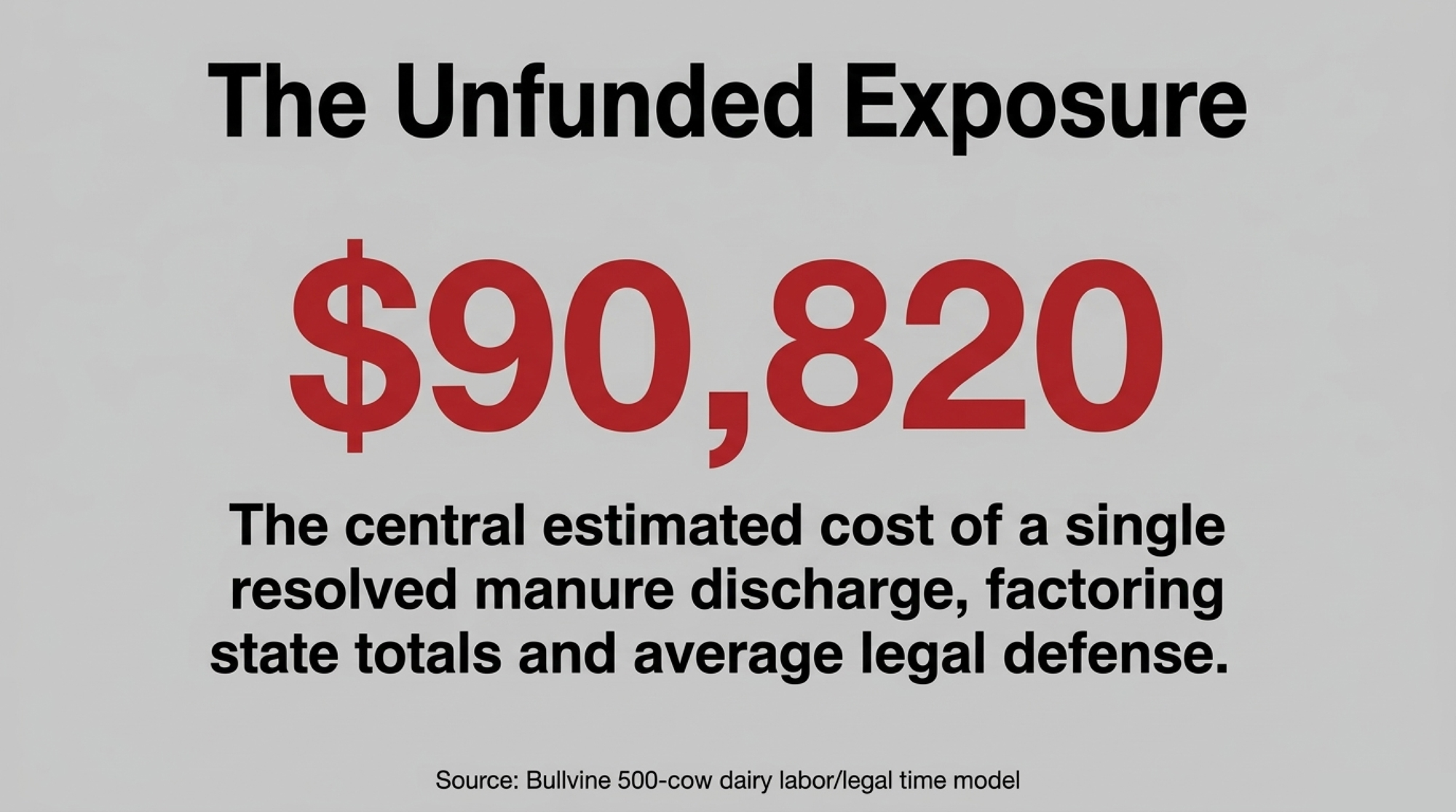
Bullvine math. Low: $5,000 plus 50 × $177, or $8,850, giving $13,850. Central: $38,470 plus 150 × $349, or $52,350, giving $90,820. High: $120,000 plus 300 × $349, or $104,700, giving $224,700.
| Scenario | Incident total | 500 cows | 1,200 cows | 3,000 cows |
|---|---|---|---|---|
| Low | $13,850 | $27.70/cow | $11.54/cow | $4.62/cow |
| Central | $90,820 | $181.64/cow | $75.68/cow | $30.27/cow |
| High | $224,700 | $449.40/cow | $187.25/cow | $74.90/cow |
Excluded, deliberately. Capital retrofit, the professional engineer’s report Iowa ordered in the Winneshiek County matter, the grass-waterway rework, permit and consulting response, lost milk, business interruption, premium increases, and lender reserve demands.
The cleanup line nobody has priced. Ohio State University Extension advises being prepared to pump 20 to 25 times the volume of manure that entered a stream. OSU Extension Heartland pumped water from Little Black Creek from December 12 until December 30, 18 days elapsed. Daily Standard Neither DOJ publication states the discharge volume, and no agency published the pumping cost, so this one stays an equation rather than a number: recovered volume equals released volume times 20 to 25, and cash cost equals that volume times your contractor’s per-gallon transfer rate. Both inputs are yours to obtain. Call your vacuum or dragline contractor for the per-gallon figure before you need it, because it is the only line in this article you can price today, and nobody has priced it for you.
Carry the conservative figure: $13,850, or $27.70 per cow at 500 cows. That case assumes a contained release, no fish kill, no restitution, and no trial. The moment fish die, Iowa’s own arithmetic says the bill multiplies by four to seven.
Against that, the control. Assume 100 transfers a year and 12 minutes for authorization, independent route verification, and first-flow confirmation. That is 20 labor hours, and at an assumed loaded $30 per hour, it is $600 a year, or $1.20 per cow on 500 cows. The $25,000 Ohio fine alone equals 41.7 years of that figure. To be exact: $600 is a Bullvine labor-time model on the two assumptions just named, not a Heartland cost and not evidence that any protocol would have changed this case.
A $600 protocol is not immunity, and nothing in these records says it would have stopped this discharge. What it buys is the ability to prove who authorized a transfer, who independently checked it, and who could stop it, on a day when a regulator is standing in your swale. Here is how to audit your transfer line over the next quarter.
The 90-Day Playbook for Herds Moving Manure in a Delegated-Permit State
30 days
- Walk every clean water swale, catch basin, and outlet tile and write down where each discharges. Requires two hours and a map. Threshold: any swale within hose reach of a leachate or manure structure, the configuration documented at Rockford. Backfire: a map filed and forgotten, so post it at the pump.
- Split the transfer decision. One authorizer, one independent verifier who is not the pump operator, logged with a time. Threshold: any transfer within sight of a tile inlet, ditch, or culvert. Backfire: an unfilled log is worse evidence than none, so audit five entries monthly.
- Put stop-work authority in writing for every worker on the place, in every language your crew reads. Write the non-retaliation clause so the person holding the valve does not have to weigh his job against a shutdown, and name who guarantees it. Cornell Extension recommends that every employee, including those not running waste equipment, know the system and how to shut valves. Cornell CCE Threshold: new hire, new hose route, night pumping. Backfire: a policy the day shift can read and the night crew cannot is not a policy.
- Pull five years of manure-application training records and see whether they exist. Iowa ordered exactly that from Jochum Agri-Services. Iowa DNR Red-flag trigger: if you cannot produce three of the last five years, this moves to the top of today’s list.
- Find your own reporting window in your permit to operate and ODA’s published discharge procedure, and post the number by the pump.
90 days
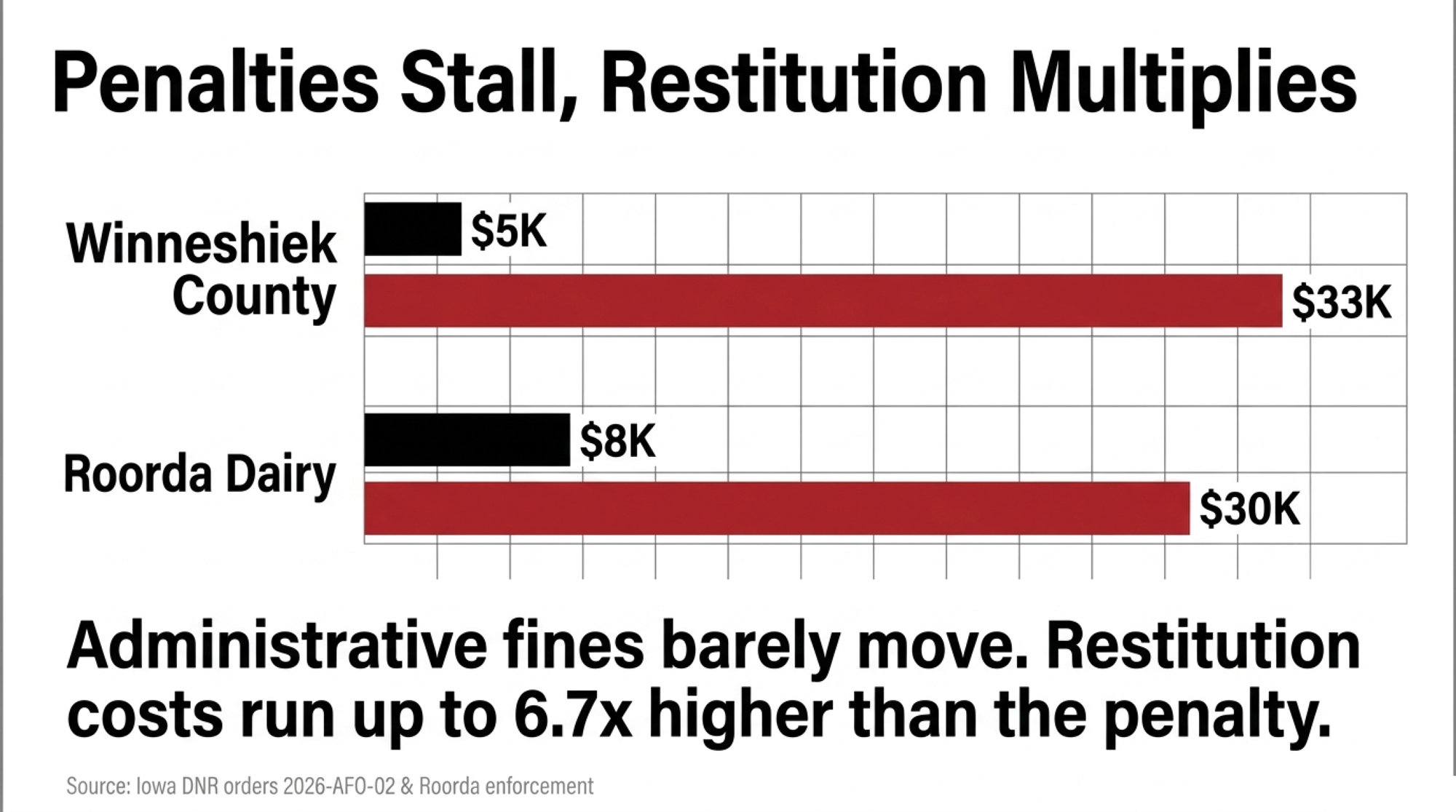
- Get two answers from your insurer in writing: whether the pollution exclusion reaches manure and silage leachate, and whether a named manager’s criminal defense is funded. Requires the policy, your broker, and one hour. Threshold: renewal date. Decision rule: if either answer is no, you are self-insuring that exposure, and the figure to reserve is the $90,820 central case rather than the $13,850 low one. Backfire: an oral assurance a claims file will not honor.
- Ask your lender which environmental events trigger notice, default, a borrowing-base cut, or an added reserve. USDA’s Farm Service Agency treats environmental risk screening as due diligence before taking a security interest in real estate, and FDIC agricultural-lending procedures cover identifying environmental concerns and on-farm inspections. FSA FDIC If your loan documents carry an environmental covenant, the notice clause fires before the penalty is even assessed; if they carry none, the same event lands as a straight liquidity draw. Threshold: if your DSCR has been under 1.25 for three consecutive months on your lender’s calculation, a $90,820 central case is a covenant conversation, not a check.
- Get a per-gallon transfer quote from your vacuum or dragline contractor and put it in the emergency file next to the storage volumes. Requires one phone call. Threshold: before the wet season. Backfire: a quote with no volume beside it, so record both.
365 days
- Commission a professional engineer’s report on manure storage capacity before a regulator orders one. Iowa ordered one within 30 days of signature in the Winneshiek County matter. Iowa DNR order 2026-AFO-02 Opportunity signal: an operation that arrives at a permit conversation with drawings and a price negotiates timing; one that arrives empty negotiates nothing.
- Build a five-record incident standard: structure levels, pump logs, employee assignments, weather, notifications. Threshold: any transfer season where staffing turns over. Backfire: records that contradict each other, so assign one owner per file.
The number check
Pull your permit to operate, your last three transfer records, and your liability policy onto one desk tonight, then walk the swale on the north side of your own facility and find out what its tile is connected to. Heartland Dairy Holdings, LLC held a permit that ODA-DLEP described in December as carrying no infractions since it was first granted, and a hose over a collection wall still put 5.1 miles of Little Black Creek above 100 ppm ammonia and one man’s name on a federal judgment. Daily Standard USAO-NDOH What does your own emergency response plan actually say about who can stop the pump without asking permission?
Two Bullvine files worth pulling alongside this one: whether a permit that promises no discharge survives contact with a watershed, and the same contractor-control question inside a manure-gas enforcement file.
Footnote on scope. This comparison is limited to U.S. Midwestern actions, where federal Clean Water Act authority and delegated state administrative programs operate on the same facility. For a non-U.S. reference point outside that framework: Lacpatrick Dairies (NI) Ltd, a Lakeland-owned processor, was fined £115,000 at Strabane Magistrates’ Court on August 13, 2026, after guilty pleas to 16 offenses affecting the Glenmornan River, £70,000 on seven permit offenses and £45,000 on nine water-pollution offenses.
This article is based on court and agency records available as of September 17, 2026. Comment was sought from every party named critically on September 17, with a stated deadline.
Key Takeaways
- The Clean Water Act’s negligent-discharge provision reaches any person, not just the permit holder. Intent isn’t an element, which is how Willemsen drew a $25,000 fine and 15 months’ probation on a guilty plea.
- Across four Iowa consent orders the penalty never left $5,000 to $8,000, whether the kill was zero fish or 126,469, on herds from 330 cows to about 4,200. Restitution is what moved, running 6.7 times the penalty.
- Roughly 789 dead fish in a federal criminal case cost more in fine than 126,469 did in Iowa state penalty. The forum you land in prices the harm more than the body count does.
- ODA-DLEP described Heartland’s permit as carrying no infractions since it was first granted, yet a March 2021 county aerial already showed a pump and hose in the leachate system. A clean file isn’t a clean yard.
Run Your Numbers
Farm Benchmark Snap Check — The DVI Risk Check reads your hedge position, debt load, feed share, and working capital, then bands you Strong, Watch, or Risk. Run it before you decide whether a $90,820 incident is a covenant conversation or a cash crunch.
 The Sunday Read Dairy Professionals Don’t Skip.
 The Sunday Read Dairy Professionals Don’t Skip.
Every week, thousands of producers, breeders, and industry insiders open Bullvine Weekly for genetics insights, market shifts, and profit strategies they won’t find anywhere else. One email. Five minutes. Smarter decisions all week.




