





25,000 cows are going up a mile and a half from the Red River — the drinking water for four cities. The state says “no discharge.” A judge just took the fight under advisement.
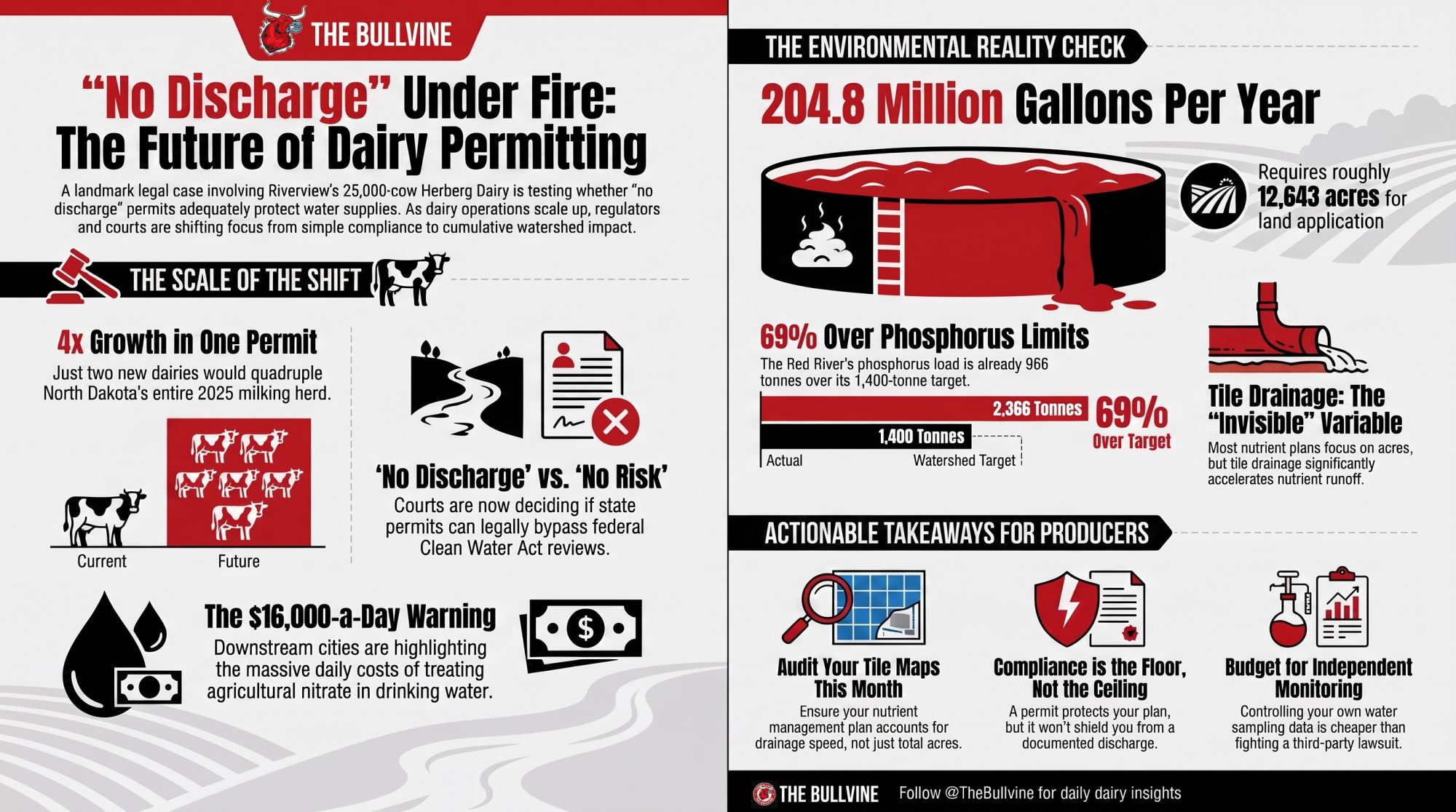
Executive Summary: A courtroom in Traill County is now deciding whether “no discharge” on a permit actually means “no risk” — and the answer could reshape how every expanding operation gets permitted near water. The Dakota Resource Council is asking a judge to rescind Riverview’s state permit for its 25,000-cow Herberg Dairy and force a federal Clean Water Act review DEQ chose to skip. The numbers behind the fight are big: 204.8 million gallons of manure and wastewater a year spread across roughly 12,643 acres — about 16,200 gallons per acre — into a basin whose phosphorus load already runs 69% over target, 2,366 tonnes against a 1,400-tonne limit. Add Riverview’s 12,500-cow Abercrombie Dairy and the two barns would more than quadruple North Dakota’s entire milking herd, which sat near 8,700 cows in 2025. If the court rules DEQ needed a federal NPDES permit, the “no discharge” shortcut gets harder for anyone expanding near surface water — and your own nutrient plan becomes the next thing under the microscope. Judge Bailey took it under advisement without ruling, so nothing’s settled yet.
Based on court filings, agency records, and reporting available as of July 21, 2026, the appeal remains under advisement.
Scott Skokos keeps coming back to one number: $16,000 a day. That’s what Des Moines spends treating upstream farm nitrate out of its drinking water, the Dakota Resource Council’s executive director told the court — “yet in spite of spending an extra $16,000 dollars/day for treatment, water restrictions were in place for much of last summer.” His point lands because the same river system is in play up north. “The Red River is part of the drinking water supply to Fargo, West Fargo, Moorhead and Grand Forks,” Skokos said when his group sued the state. That’s the worst case he wants North Dakota to avoid — and it’s why a permit for one dairy near Hillsboro has turned into a fight over a whole river.
| Metric | Value | Context |
|---|---|---|
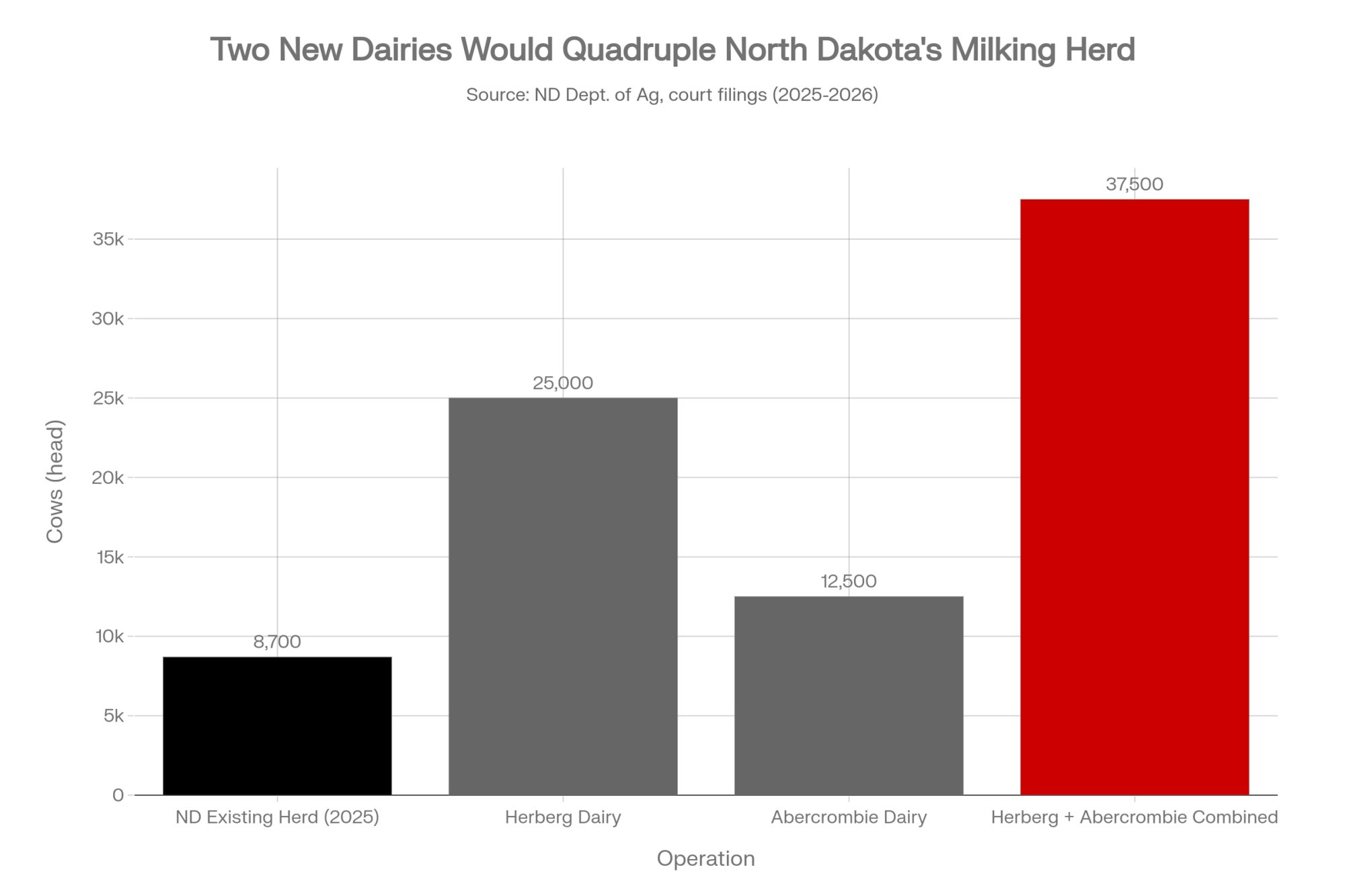
| Herd size | 25,000 cows | Nearly 3x ND’s entire existing herd of 8,700 |
| Annual manure/wastewater volume | 204,800,000 gallons | Spread across ~12,643 acres |
| Average application rate | ~16,200 gal/acre/year | Corridor-wide average, not a spread rate |
| Distance to Red River | 1.5 miles | River supplies drinking water to 4 cities |
| Residential wells within 2 miles | 27 wells | Potable water source unconfirmed for the dairy itself |
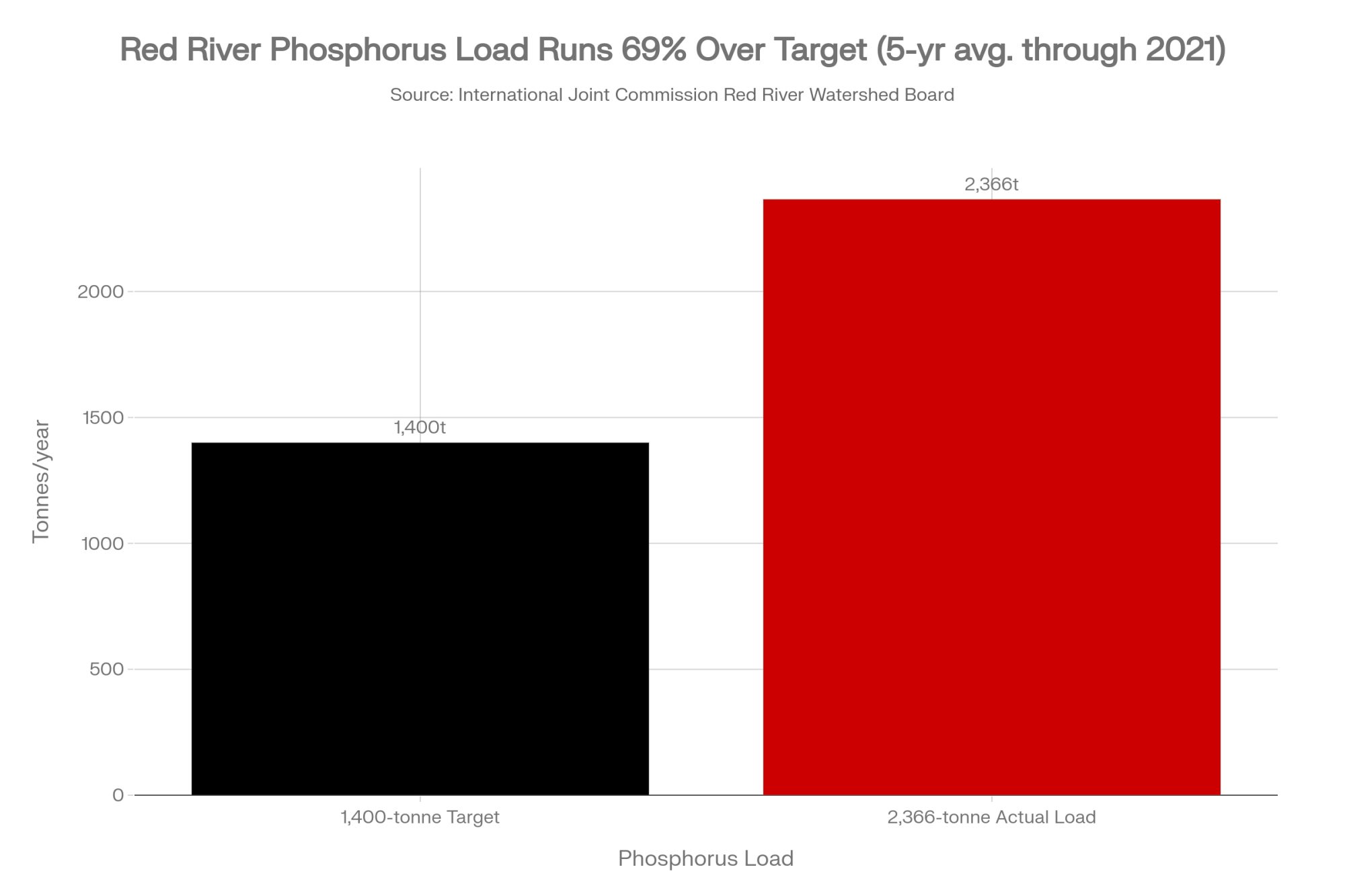
| Basin phosphorus overage | 69% over target | 2,366 tonnes vs. 1,400-tonne limit |
The dairy is Riverview LLP’s Herberg operation — 25,000 cows, going up just a mile and a half west of the Red River, with 27 residential wells inside two miles of the site. On July 13, 2026, Judge Susan Bailey heard the challenge and drew a line: “It’s not for me to judge the science,” she said, then took the case under advisement without ruling. She wasn’t there to referee the manure chemistry. She was there to decide whether the state did its homework before it signed off.
That should matter to you even if you’ll never milk more than 200 cows — because the question underneath this case isn’t really about one Minnesota company building big in North Dakota. It’s whether a permit that promises “no discharge” actually means “no risk” — and who’s watching the whole river when every regulator only ever signs off on one farm at a time.
What’s Actually Being Fought Over
North Dakota’s Department of Environmental Quality issued Herberg’s state feeding-operation permit on September 24, 2025, after a lengthy technical review. The agency’s conclusion: the dairy doesn’t require a federal Clean Water Act discharge permit, because it isn’t a point source that discharges pollutants. That single call is the hinge the entire lawsuit swings on.
Skokos’s group — represented by Food & Water Watch and the Wild & Scenic Law Center — appealed, calling the review “deeply flawed.” Their argument is procedural, not emotional. They say the state skipped a federal permit it was legally required to demand, and that the manure plan doesn’t pin down enough about when, where, and how more than 200 million gallons of manure and wastewater a year get spread across fields within roughly a 15-mile radius of the barn — much of it, the appeal says, stored in clay-lined ponds located partially within a floodplain.
Riverview, for its part, has said its North Dakota dairies were approved after careful, science-based review by state regulators, and its attorney told the court DEQ followed a “rational process.” So this isn’t a case of a company dodging scrutiny — it’s a fight over whether the scrutiny that happened was the right kind.
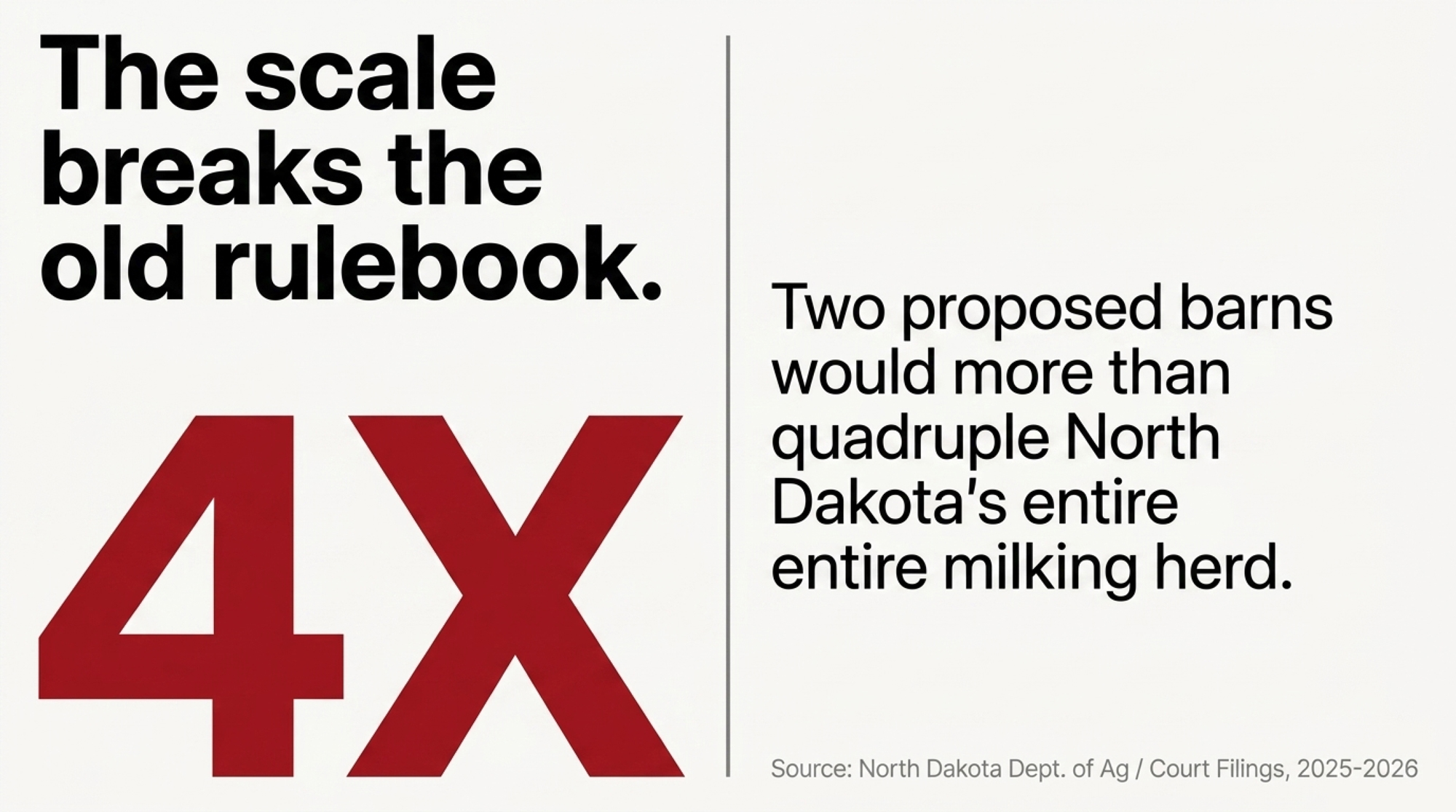
And this isn’t a one-off barn. Herberg’s 25,000 cows plus Riverview’s 12,500-cow Abercrombie Dairy near Wahpeton would together more than quadruple North Dakota’s entire milking herd, which deputy ag commissioner Tom Bodine pegged at roughly 8,700 cows across 23 permitted farms in 2025. The rulebook being stress-tested here wasn’t built for that. As Minnesota Farmers Union vice president Anne Schwagerl put it about Riverview’s separate expansion near Morris — a push toward nearly 19,000 cows — “When we established our current regulatory framework for feedlots in the late 1990s, no one contemplated a nearly 19,000-cow dairy operation. That is more than 60 times the average size dairy herd in our state.”
How This Plays Out on Real Farms
The whole fight hinges on two words: “no discharge.” Under the Clean Water Act, a big dairy dodges a federal NPDES permit only if the runoff from its land-applied manure counts as “agricultural stormwater” — and that only holds if the manure went down according to a proper nutrient management plan. DEQ’s position in court was flat: it has no authority to require a federal permit unless there’s a discharge, and there won’t be one.
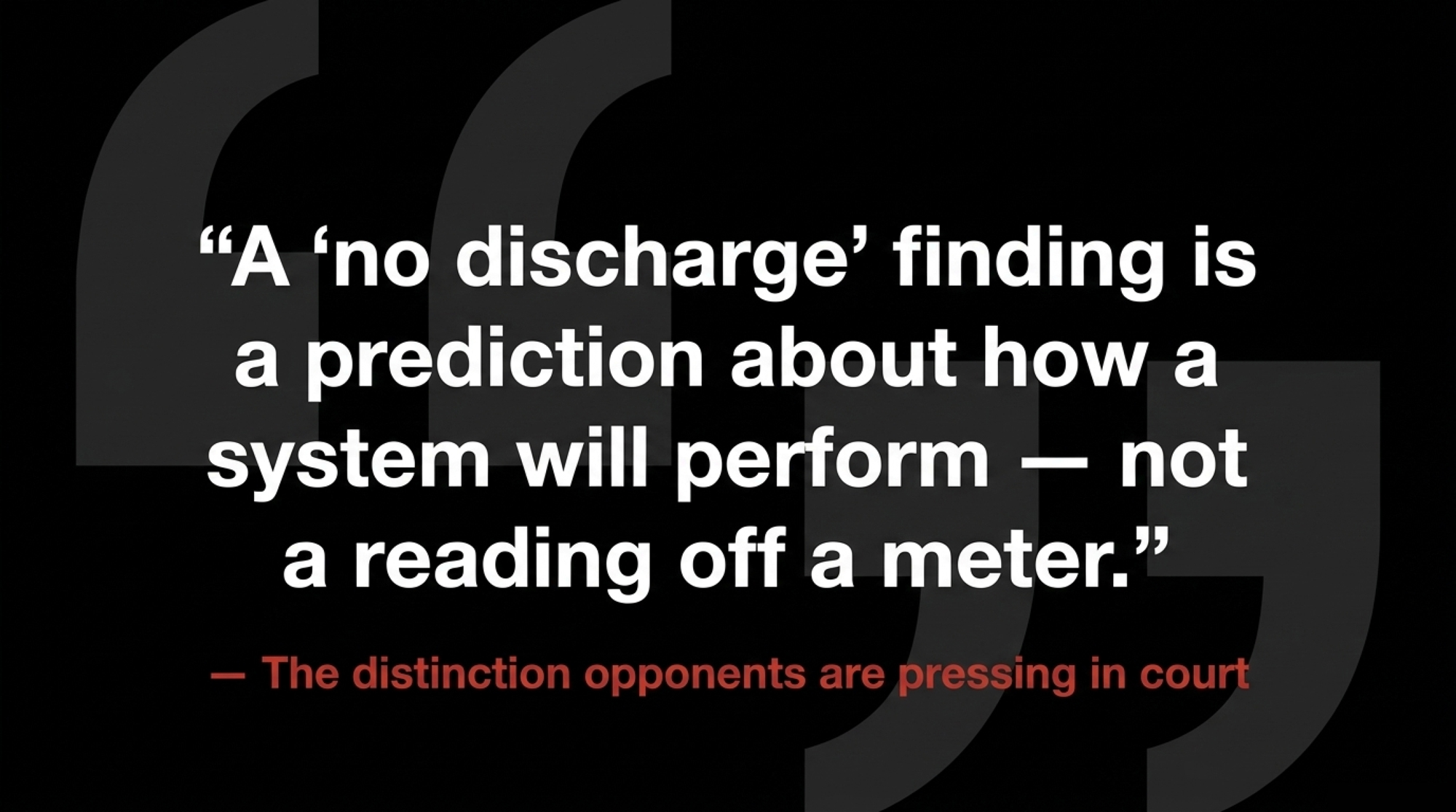
But a “no discharge” finding is a prediction about how a system will perform — not a reading off a meter. That’s the distinction the opponents are pressing. And it’s not just the advocacy groups. Todd Leake, a Grand Forks County farmer who buys his water from the East Central Water District, has pressed since 2024 on whether the state is even equipped to enforce what it permits, and on where a 25,000-cow herd’s potable water will come from in the first place. When a farmer downstream is asking the same question as the lawyers, that’s worth noticing.
Nobody has sampled a tile line at Herberg yet because the cows aren’t there. What we do know is the volume — the appeal filing puts it at 204.8 million gallons of manure and wastewater a year, headed for roughly 12,643 acres of cropland inside that spread radius, much of it tile-drained. Tile moves water off a field fast, and extension work in the region has flagged how sharply it changes where nutrients end up.
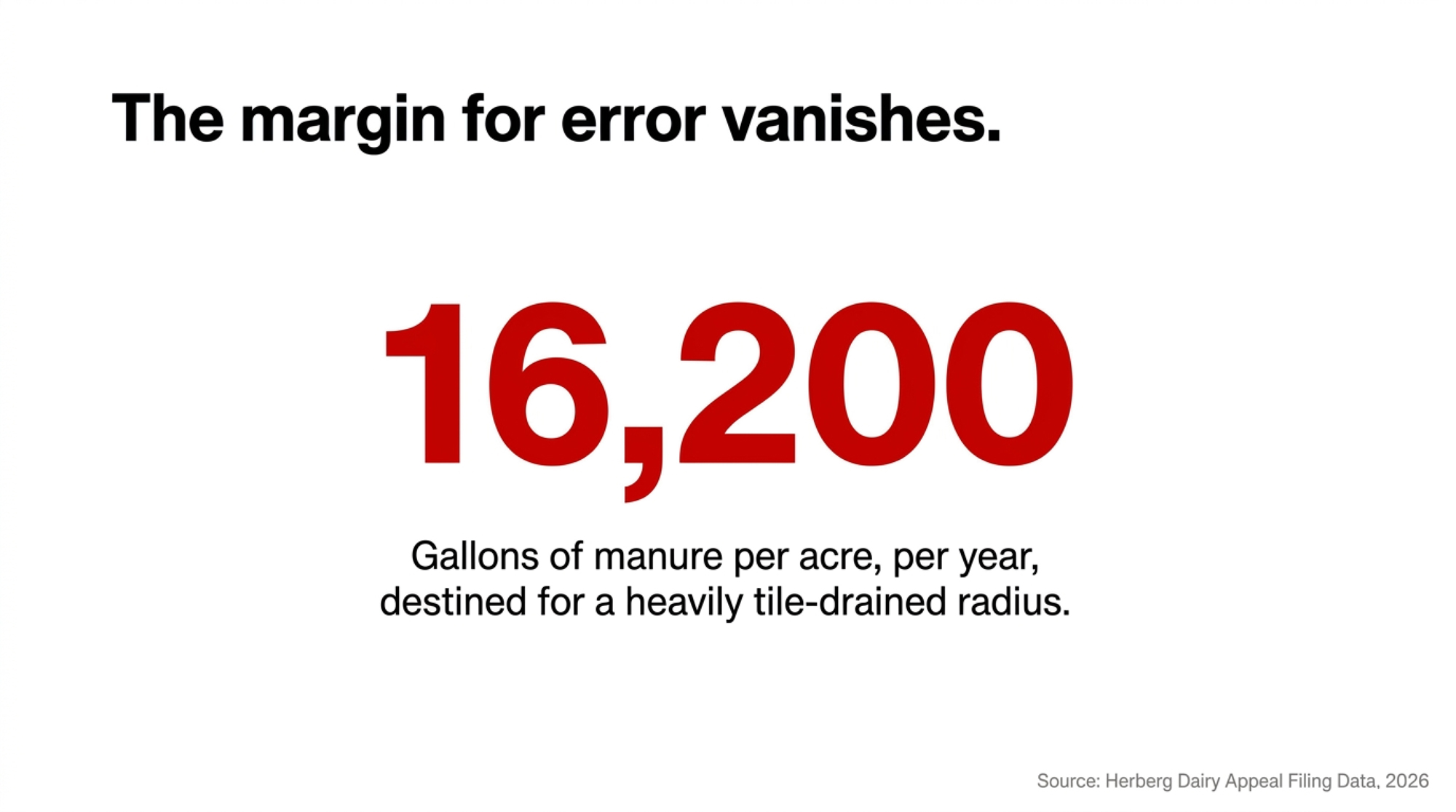
Here’s the barn math, and you can map it to your own ground. Spread 204.8 million gallons across the 12,643 acres cited in the appeal and you land at roughly 16,200 gallons per acre per year on average. That’s a corridor-wide average, not a spread rate — real applications swing hard by field, crop, and season, and you know that better than any permit does. Now shrink it to your scale: on 400 acres, one bad application window before a heavy rain isn’t a headline — it’s a fine, a fish kill, and a neighbor with a phone. The margin for error doesn’t grow with the herd. It just gets more expensive to miss.
The Mechanics Nobody Argues About
Two quiet mechanics drive this, and neither one makes headlines on its own. The first is self-monitoring. Under standard large-dairy permitting, the operator conducts inspections, pulls manure and soil samples, logs application rates and field conditions, and maintains the records — while the regulator reviews the paperwork and retains the right to inspect. That’s not a Riverview quirk. It’s how the system works on every permitted operation in the country. The wrinkle is simple: the party with the most to lose from a discharge finding is also the one mainly responsible for spotting and reporting it.
| Oversight Mechanic | Who Does the Work | Who Reviews It | Risk to Watch |
|---|---|---|---|
| Manure/soil sampling | Operator (Riverview) | State regulator (paperwork only) | Self-reported data, no routine third-party verification |
| Application rate logs | Operator (Riverview) | State regulator (paperwork only) | Records controlled by party with most to lose |
| Discharge inspections | State regulator (right to inspect) | N/A | Inspections are episodic, not continuous |
| Cross-border river accounting | No single regulator | IJC Red River Watershed Board (advisory only) | North Dakota and Minnesota each approve their own piece; no one owns the whole river |
The second mechanic is that no single regulator owns the whole river. North Dakota reviews the North Dakota permit. Minnesota reviews the Minnesota expansion. Each call looks defensible on its own page. But the Red River carries about 68% of the total phosphorus load reaching Lake Winnipeg, according to Manitoba’s own nutrient accounting. And the river is already over the line: the International Joint Commission’s Red River Watershed Board logged a five-year average phosphorus load of 2,366 tonnes a year through 2021 — running roughly 69% above its own 1,400-tonne target. That gap explains the most telling move in this whole story, and it came from the wrong side of the border. On October 8, 2025, Manitoba welcomed the IJC’s decision to direct its Red River Watershed Board to review the North Dakota permits — before any U.S. court had ruled. A downstream government started counting tonnes while the domestic process was still counting pages.
How Much Does “We Got the Permit” Actually Protect You?
Less than the paperwork suggests. A permit certifies your plan meets the rules as written. It does not certify that your watershed can actually absorb the nutrients, and it won’t shield you from a discharge finding if someone’s monitoring later catches one. In a basin already running 69% over its phosphorus target, “compliant” and “safe” have quietly stopped being the same word.
So treat the permit as your starting line, not your finish line. That’s not a knock on anyone who’s followed the rules — it’s a read on where the risk is actually moving. The rules were written for a scale of farming that barely exists in that valley anymore, and they’re now being tested by the scale that does.
Is Your Manure Plan Built for Your Drainage, or Just Your Acres?
This is the operational question Herberg is forcing into the daylight. Most nutrient management plans are built around acres and agronomic rates — pounds of N per acre, setback distances, storage days. Fewer of them wrestle honestly with what tile drainage does to the speed and path of water leaving the field. If you’ve added tile in the last ten years, like a lot of the Red River Valley has, your runoff behavior may not match the assumptions your plan was first written on.
That’s worth a conversation with your agronomist before it’s ever worth one with a regulator. Pull the plan. Find the drainage map. See if they were built to talk to each other.
Options and Trade-Offs for Farmers
You’re probably not building a mega-dairy. But how this case lands shapes the permitting weather for anyone thinking about growth, so it’s worth knowing where the paths lead.
- Treat compliance as the floor. Makes sense if you’re anywhere near surface water, tile drains, or a nutrient-sensitive watershed. Requires knowing your own nutrient plan cold — windows, buffers, drainage layout. The catch: it costs time and some agronomic flexibility, and a clean permit still won’t save your reputation if a neighbor films a runoff event.
- Get ahead of monitoring instead of waiting for it. Makes sense if you’re expanding or already under a microscope. Requires independent record-keeping and ideally some third-party water sampling you control. The catch: you’re paying to prove a negative — but that’s cheaper than becoming the case study an advocacy group builds its next lawsuit around.
- Watch the whole corridor, not just your county. Makes sense anywhere consolidation is stacking cows into one basin. The forward signal here is real: the IJC’s Red River review is advisory, not binding under the Boundary Waters Treaty, but it points toward basin-level nutrient accounting becoming a live permitting factor. Requires paying attention to cumulative-load talk before it hardens into rules.
Here’s the one to do this month: pull your nutrient management plan and check whether it actually accounts for your tile drainage, not just your application acres. That’s a 30-day job, not a five-year strategy.
Key Takeaways
- If your operation sits within a mile or two of surface water, pull your nutrient plan this month and confirm it accounts for tile drainage — not just acres.
- If you’re planning to expand, assume “compliant” won’t mean “uncontested,” and budget for independent monitoring you control before anyone asks for it.
- If you farm in a watershed with a published nutrient target — like the Red River’s 1,400-tonne phosphorus goal — find out where current loads actually sit before you assume there’s headroom.
- If a permit says “no discharge,” treat that as the minimum bar, then ask what a downstream regulator or a neighbor with a phone could document.
- If the Herberg ruling ends up requiring a federal NPDES permit, expect the “no discharge” shortcut to get harder for large operations everywhere — watch for the decision.

The two Riverview dairies are still under construction, and as of mid-July 2026, Judge Bailey had taken the appeal under advisement without ruling. So nothing’s settled. Todd Leake will keep drawing his household water from the East Central district while the barns go up a short drive away.
Complete references and supporting documentation are available upon request by contacting the editorial team at editor@thebullvine.com.
Learn More
- Manure Management Mastery: Essential Tips for Dairy Farmers to Prevent Spills and Protect the Environment— Protocol checklists and daily containment audits that prevent costly runoff spills, protecting your local water table before regulators or neighbors with smartphones document a violation.
- The Bullvine Dairy Curve: 15000 U.S. Farms by 2035 and Under 10000 by 2050 – Who’s Still Milking? — Structural consolidation forecasts detailing why processor capital and compliance pressures favor mega-dairies, exposing the exact margin benchmarks mid-size producers must hit to survive the next decade.
- MANURE TO MONEY: How Smart Dairy Farmers Are Turning Waste into Serious Profits — Advanced processing methods that turn regulatory liability into revenue, unlocking $18/acre in fertilizer savings and new market channels while eliminating the runoff threats targeted by clean water litigation.
The Sunday Read Dairy Professionals Don’t Skip.

Every week, thousands of producers, breeders, and industry insiders open Bullvine Weekly for genetics insights, market shifts, and profit strategies they won’t find anywhere else. One email. Five minutes. Smarter decisions all week.