





The screen kills bulls the team genuinely wants. It also produced Canada’s #1 Newly Proven GLPI sire — and a 70-head sale that cleared at €6,729.
His answer: “That’s not the way we were raised.”
Nicolas Lalande answered the question in French, and the translation landed harder than the original.
He’s looking for bulls without holes.
Not the highest bull on Tuesday’s genomic list. A balanced one — and Lalande put a ceiling on how much imbalance he’ll accept: one weakness. That’s it. Stack a sire’s weak trait onto a cow’s weak trait and you’ve bred a daughter with a hard ceiling on production, on herd life, or both.
Logic PP is what survives that screen. Homozygous polled, Conformation 16 at 93% reliability, full classified and milk-recorded maternal line behind him — and in August, Canada’s #1 Newly Proven GLPI sire, #3 overall. Plenty of bulls Dann Brady liked more on paper never made the list because their second dam was a blank.
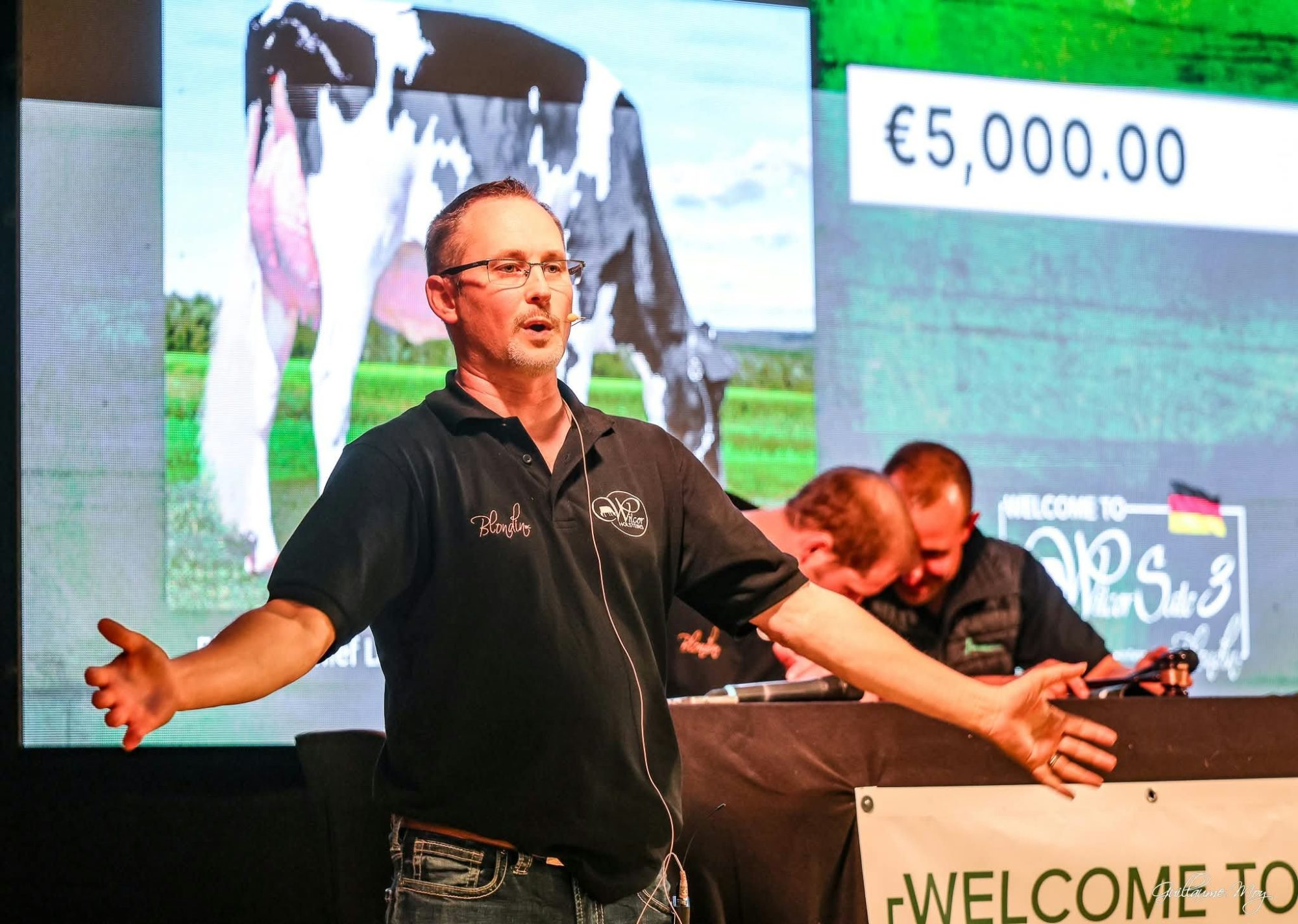
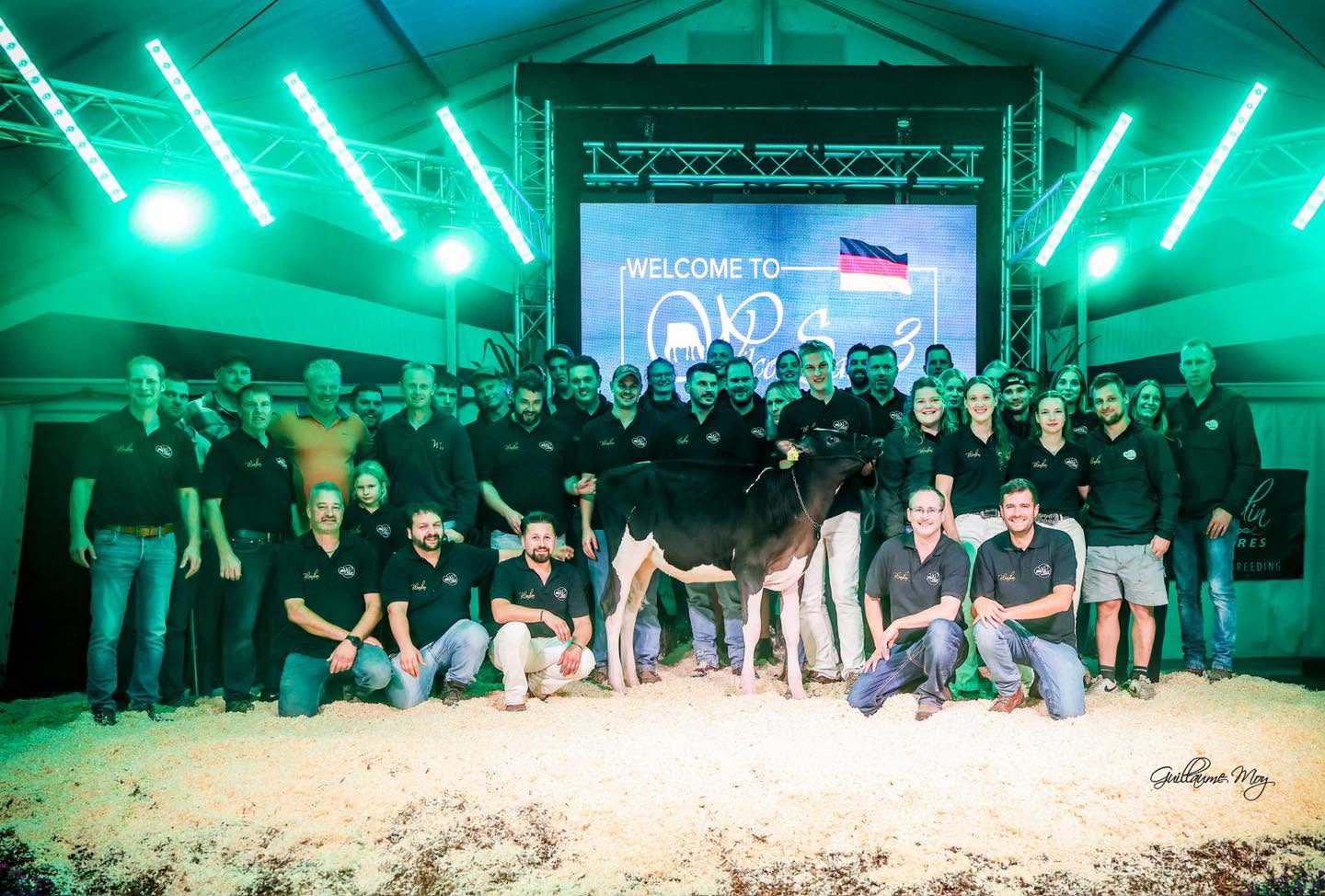
On August 29, 2026, on the eve of the Welcome to Wilcor Sale in Lower Saxony, that screening rule was put under the spotlight. The next day, 70 head averaged €6,729 to buyers across seven countries. The money was in the ring, but the engine was in the semen tank.
Every Tuesday, the Same Disappointment
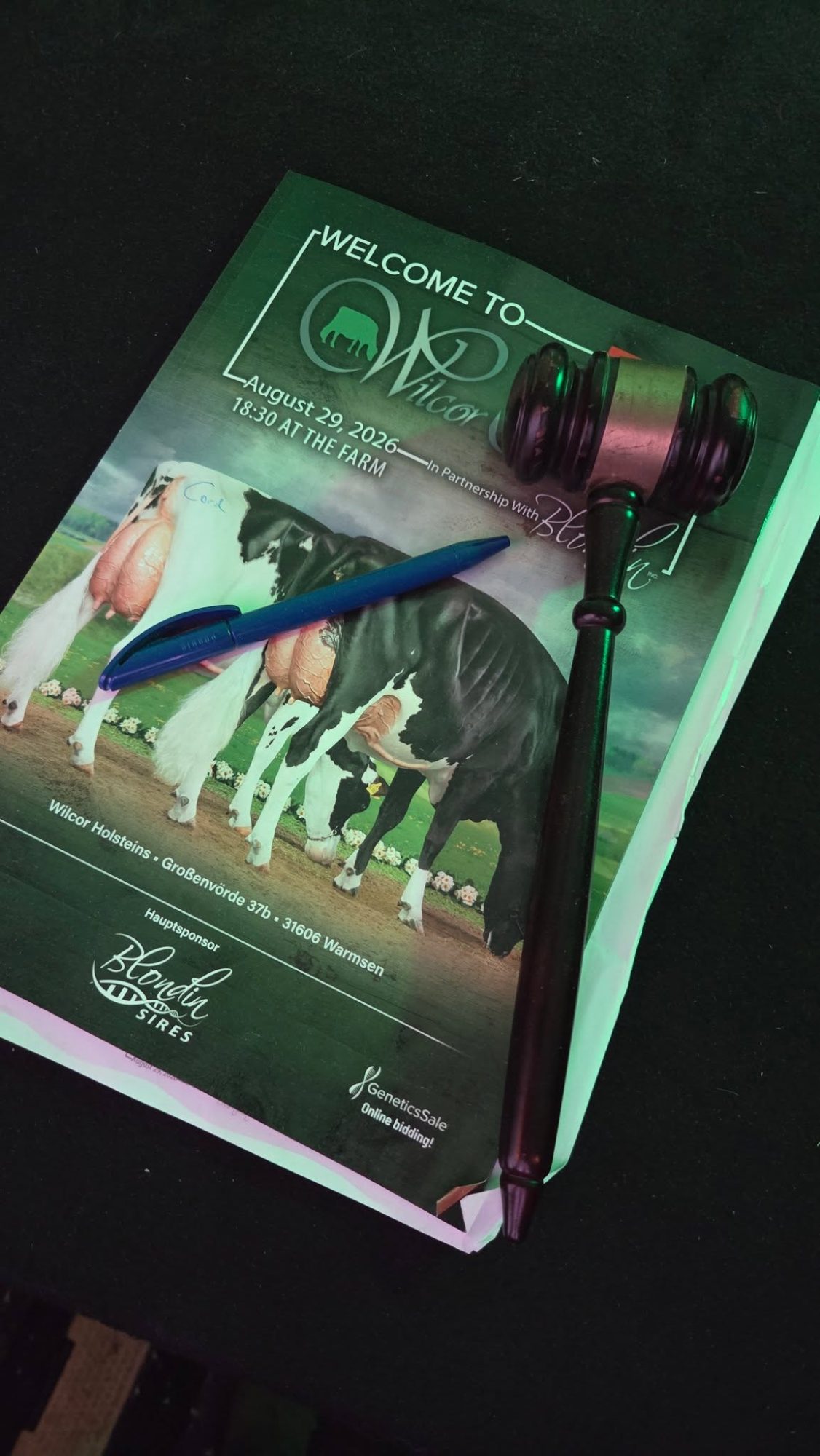
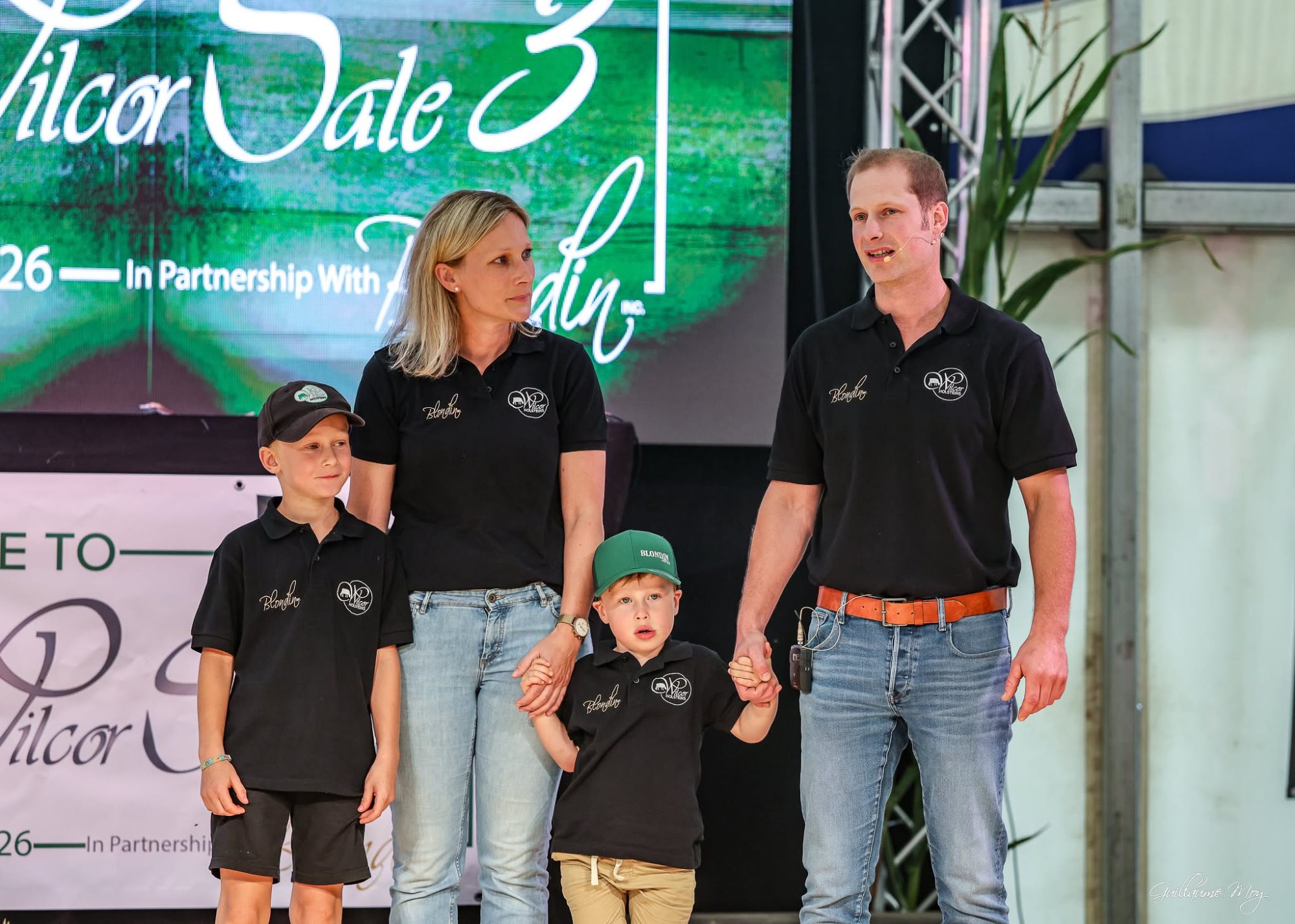
The catalogue and the gavel, minutes before the ring opened. August 29, 2026, 18:30, at Wilcor Holsteins in Warmsen — Blondin Sires listed as Hauptsponsor, online bidding live through GeneticsSale. Cord Hormann’s name is pencilled on the cover in his own hand. Seventy lots. Two operations. One screening rule underneath all of it.
Ferme Blondin milks 250 Holsteins in a sand-bedded freestall at St-Placide, Quebec, farms close to 2,000 acres, and carries roughly 1,000 head all told. They flush five to eight donors every Thursday. Brady does the matings. And roughly ten years ago he kept hitting the same wall.
“We couldn’t find the pedigrees that we wanted to use,” he said. “They didn’t have the full pedigrees, they didn’t have the classification or milk recording.”
Genomics was accelerating at the time, and Blondin was — still is — a believer in it. The technology wasn’t the problem. The problem was that high-genomic young sires kept arriving without classified, milk-recorded dams behind them. So Brady and the Lalandes built their own stud. Health testing, collection, bull housing, the regulatory paperwork. None of which any of them had done before.
“There was a lot to learn,” Brady said.
Tuesday is genomic day at Blondin, and a decade in, it still produces the same frustration on repeat: a bull the team genuinely likes, then a pedigree check that turns up an unclassified dam or an unrecorded second dam.
“That’s actually the hardest thing we do every week,” Brady said. The payoff, in his telling, is more reliability and more structure than studs that accept bulls with incomplete maternal records — a distinction that separates studs building from verified cow families from those buying genomic numbers off the weekly list.
Thirty Cows, Twelve Excellent, and the Same Filter
Cord Hormann of Wilcor Holsteins isn’t running a big program. He milks around thirty cows on 70 hectares at Warmsen — twelve Excellent, fourteen Very Good, nothing below that. (Read more: Rising to Excellence: The Remarkable Journey of Cord Hormann and Wilcor Holsteins)
That’s the whole herd. And it arrived at Brady’s standard independently.
Hormann credits a mentor, Rolf Klöcker, with shaping the approach — deep pedigrees, generations of highly classified dams, serious milk behind them.
“Components are important too, but it’s the families, and it always comes back,” Hormann said.
When he started buying embryos overseas, he bought only out of full pedigrees with no holes, mostly EX-90-and-above dams. Holstein International profiled Wilcor in 2022 as one of the best addresses for conformation in Germany, built on cows like Wiesenfeld Austrias Magic Talent EX-92, Curtat Shottle Benzouka EX-93, and Le Moal Lheros Elaniss EX-94 — a profile that predates the Blondin partnership, which matters when weighing how independently the two operations landed in the same place. Blondin Sires now co-owns Wilcor’s show string.
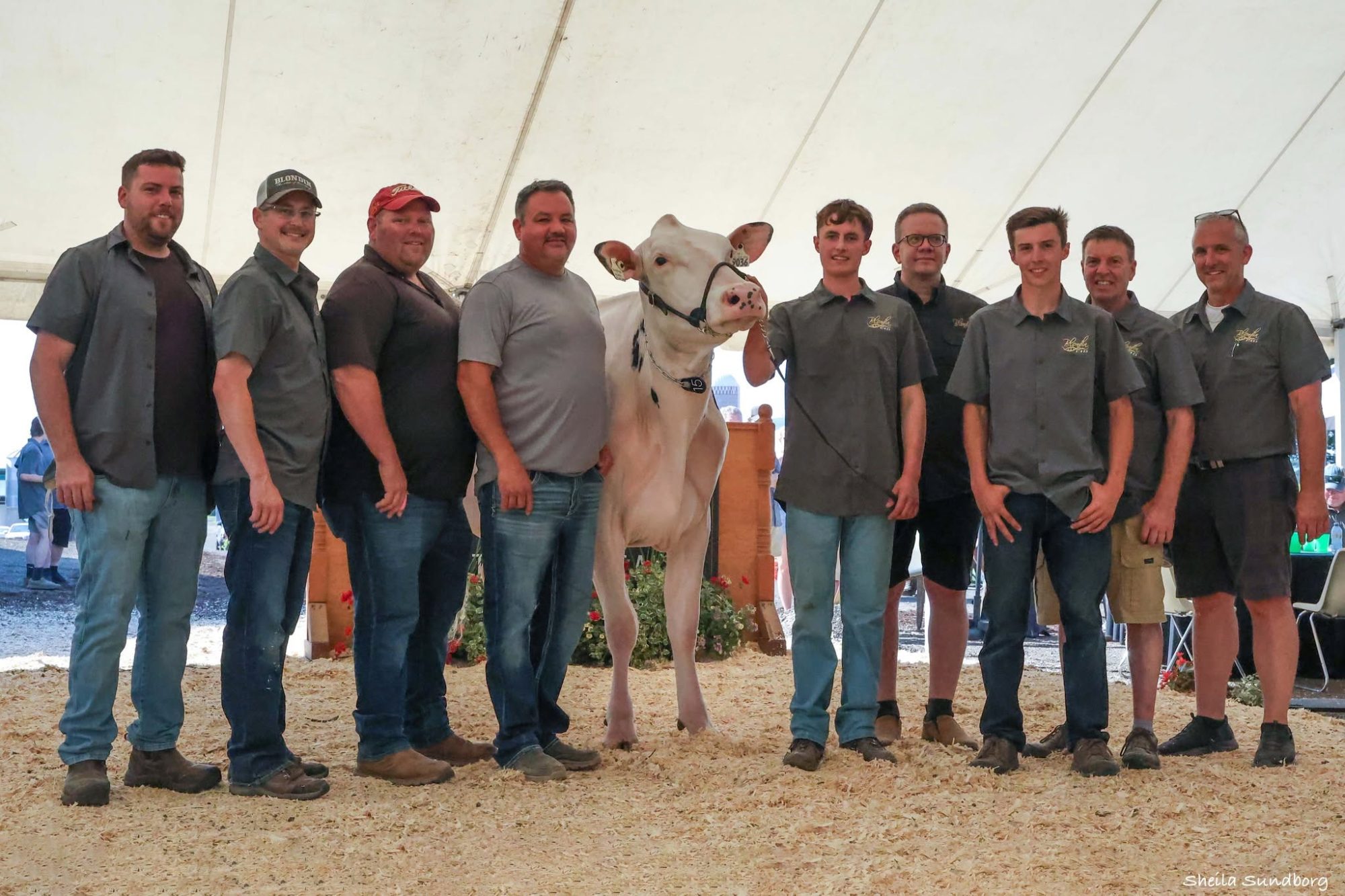
The banners came regardless. Wilcor O’Kaliber Louella took both Grand Champion and Intermediate Champion at the 52nd Schau der Besten in Verden this past February, under the joint Wilcor / Blondin banner. Stablemate Wilcor Chief O’Katy stood Reserve — after winning the whole show the year before, at the 51st, on February 27, 2025.
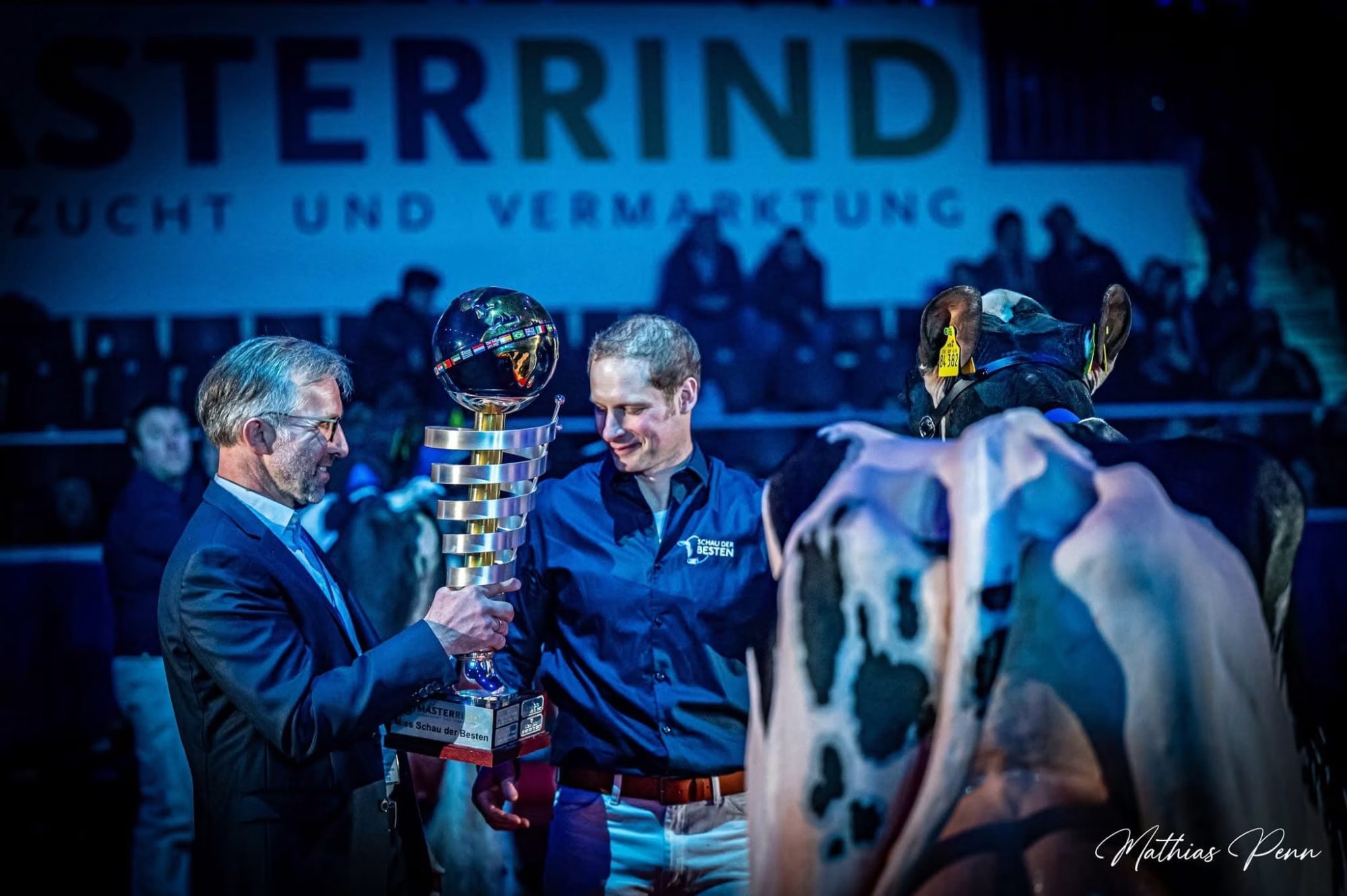
Two Grand Champion banners in two years, out of a 30-cow barn.
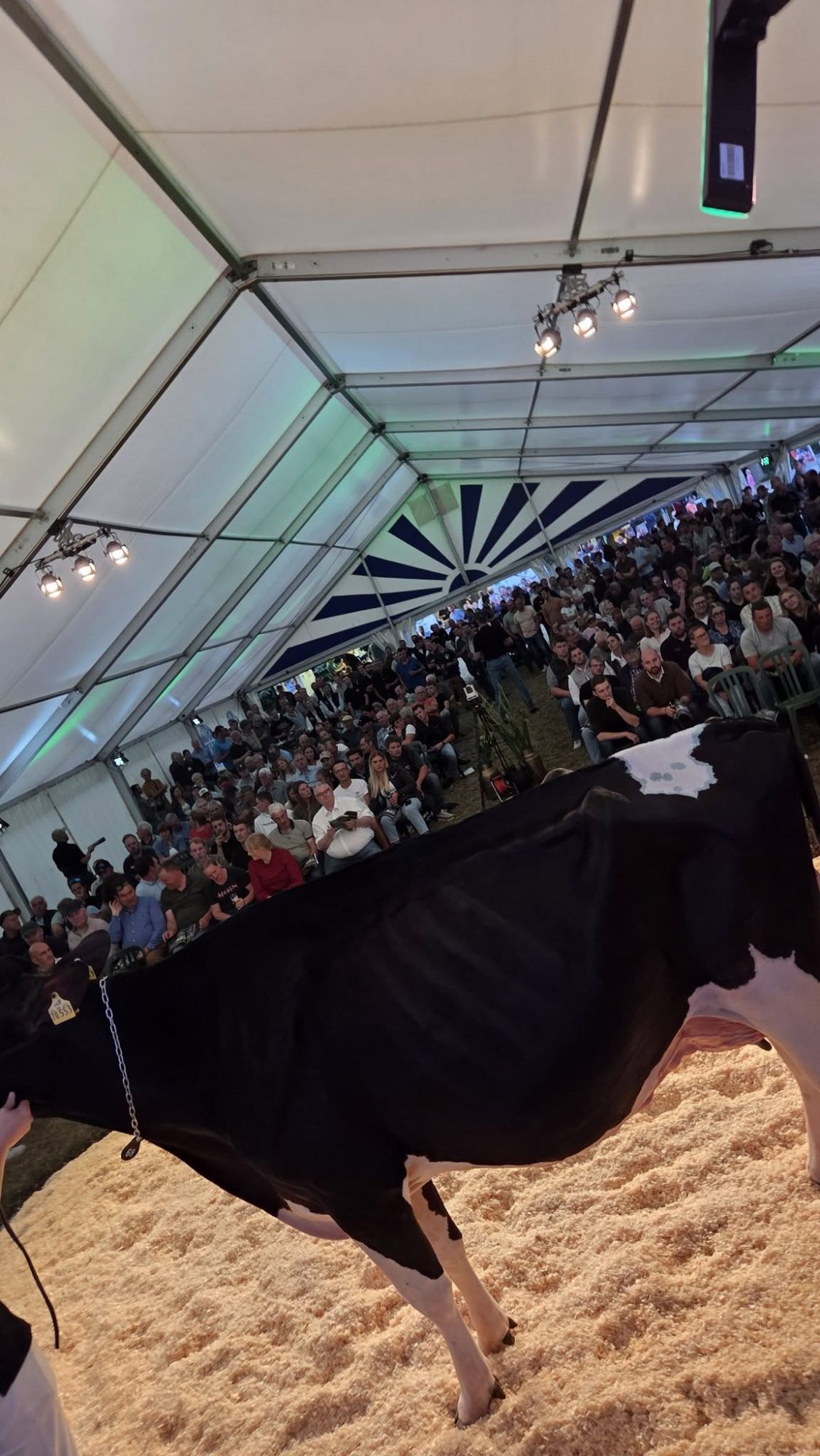
Dann Brady’s view from the block, reading pedigrees at Warmsen the way he did years ago at the After Show Sales. A packed tent, an animal on the shavings, and buyers from seven countries who’d come to look at maternal lines. Seventy lots went through here. Not one went home.
Can You Really Cap a Bull at One Weakness?
Back to Lalande’s rule, because there’s a mechanism underneath it that’s easy to miss.
“The bulls need to have some strengths, and the strengths are really important,” he said. “But the weak points of every cow is what limits her from producing more, from living longer.”
The logic is subtractive, not additive. A cow strong in a given trait can carry a sire who’s merely neutral there. Put his weakness on top of hers in the same trait, though, and the daughter inherits the ceiling. So Lalande caps candidates at one weakness — then places that weakness deliberately, against an area where the cow is already strong.
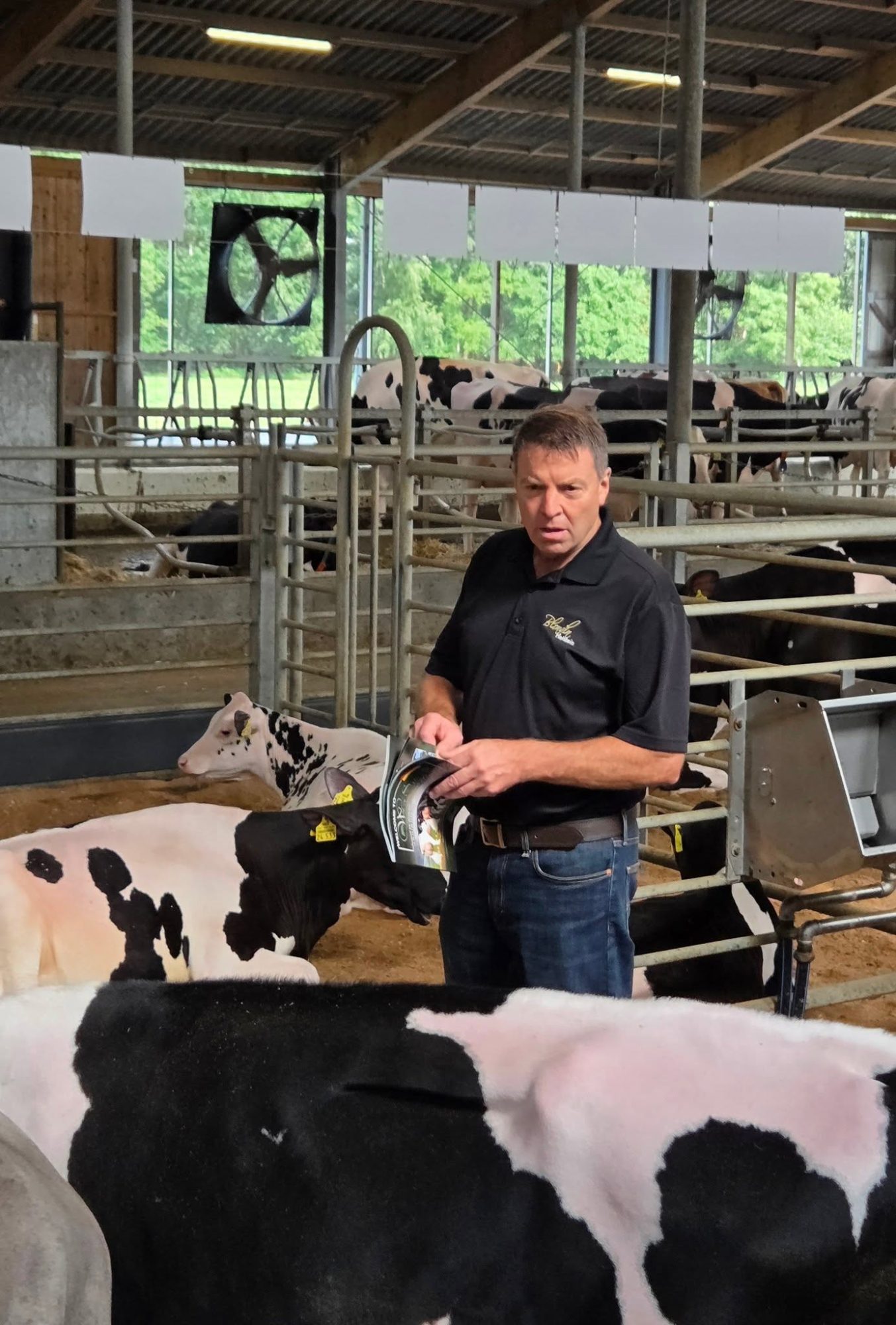
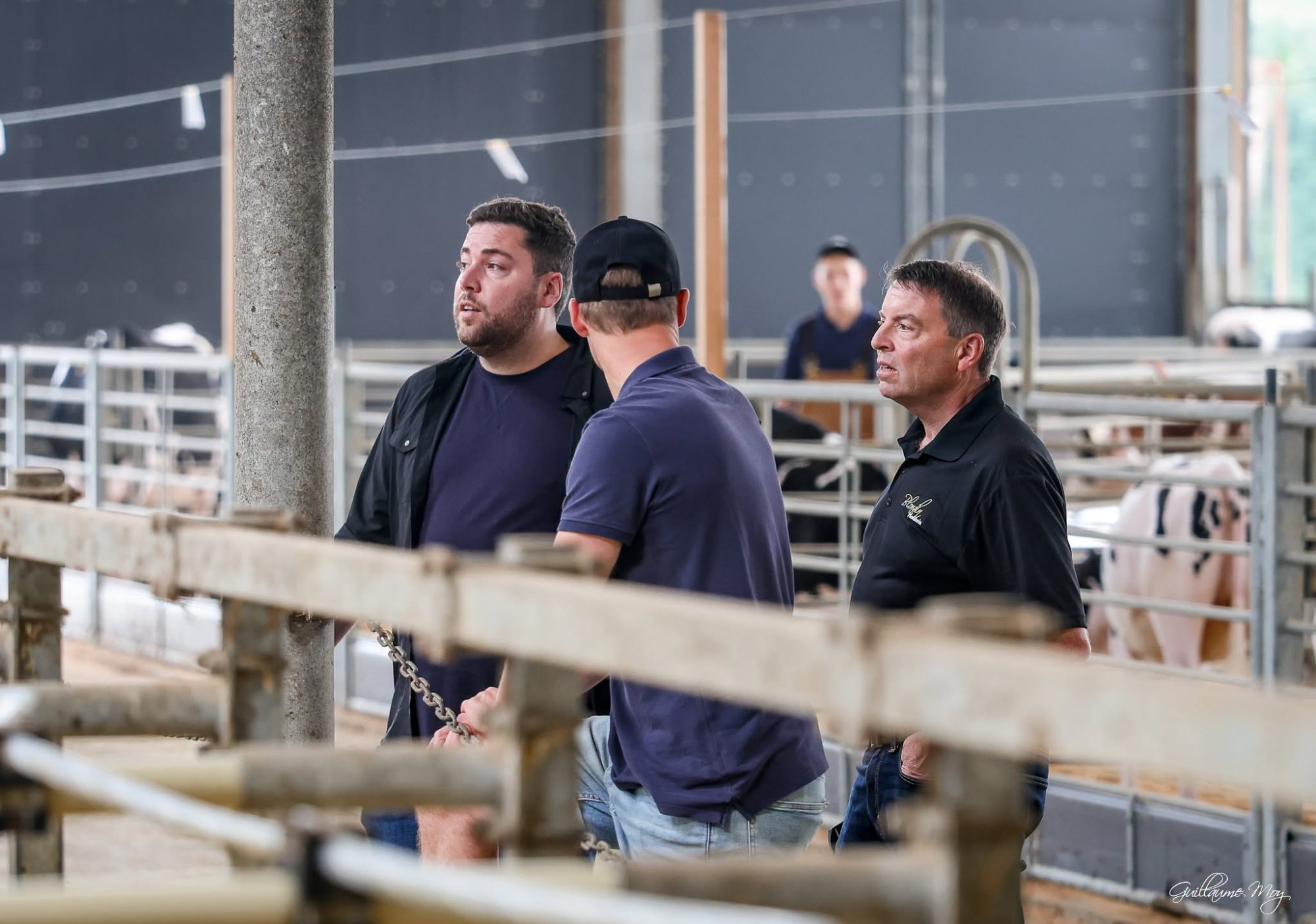
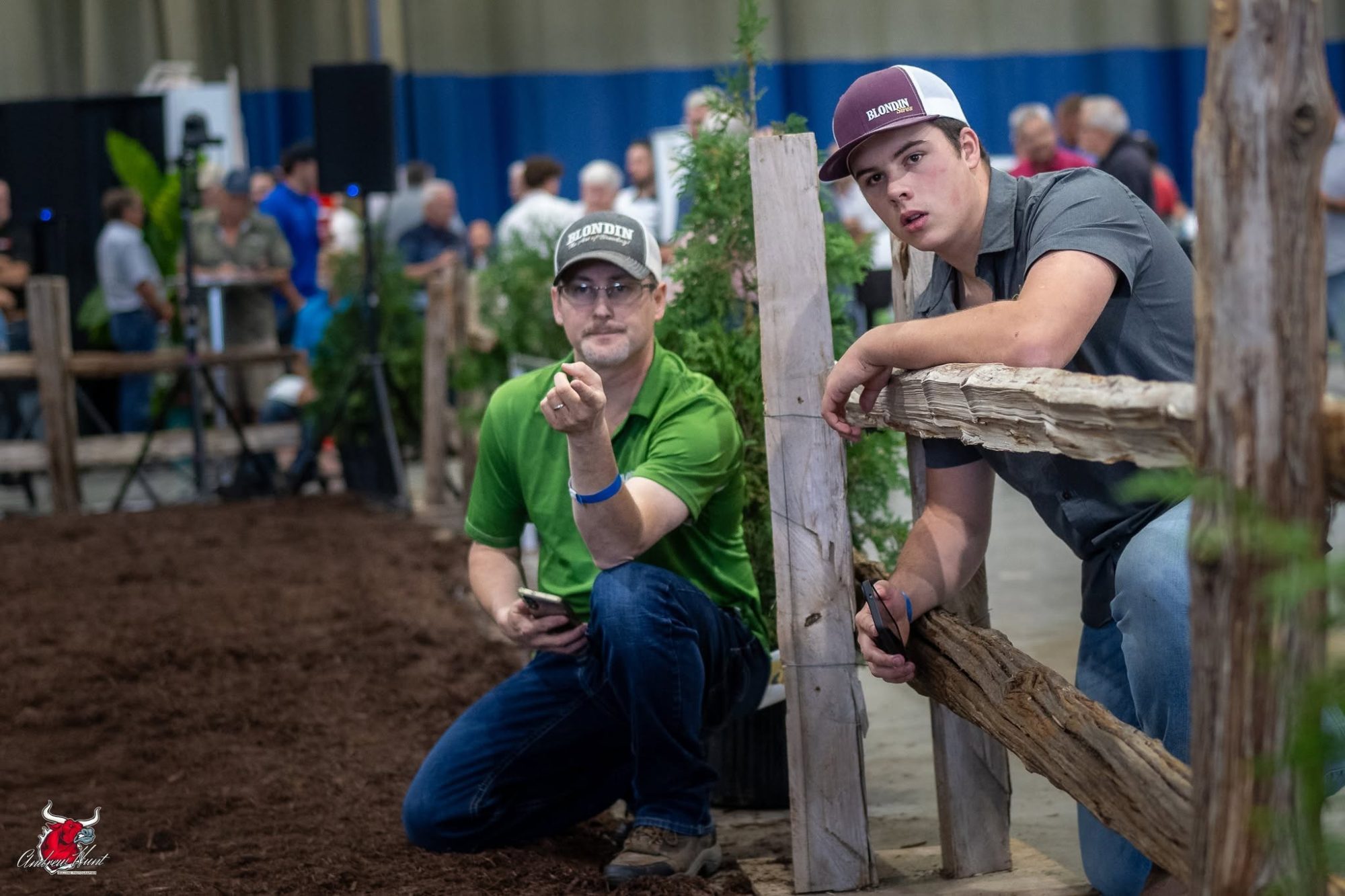
Simon Lalande, working the pens at Wilcor the afternoon before the sale, with the catalog open, gives every animal a careful look and an honest evaluation.
He layers a second filter on top: prioritize highly heritable traits, because those are the ones a sire actually transmits. Chasing a low-heritability trait through sire selection is a slow way to be disappointed.
The clearest example sits in Blondin’s own barn. They breed Salute to Detective and Detective to Salute, because each bull covers what the other lacks. Reciprocal matings, arranged around complementary gaps.
Two or Three Traits. Then Stop.
Arnold Grings, a breeder watching from Luxembourg, asked how show enthusiasm survives as farms consolidate and labour gets thin. Brady’s answer had almost nothing to do with shows.
“It’s not rocket science,” he said. “We try and pick two or three traits we want to improve and that’s it.” No magic formula, in his framing, is going to fix ten things on a cow in a single breeding — the genetics have to come together, and too many small targets never match up.
Then he named what he thinks went wrong across the industry. “People were starting to get confused with all the mating programs and all of the new indexes and this trait and that trait. And for us, we just brought it back to being simple.”
Brady’s characterization of the pitch breeders heard for years: don’t worry about it, we’ll make the mating for you with the computer. In his reading, that convenience cost breeders the habit of looking hard at the bulls they were using. “That’s not the way we were raised.”
It’s an argument that directly challenges the algorithmic, corrective-mating software major studs have sold for the better part of two decades — and Brady co-owns a stud that benefits when breeders pick their own bulls. But whether driven by stud philosophy or commercial pragmatism, the genetic reality holds: selection pressure diluted across ten traits moves none of them.
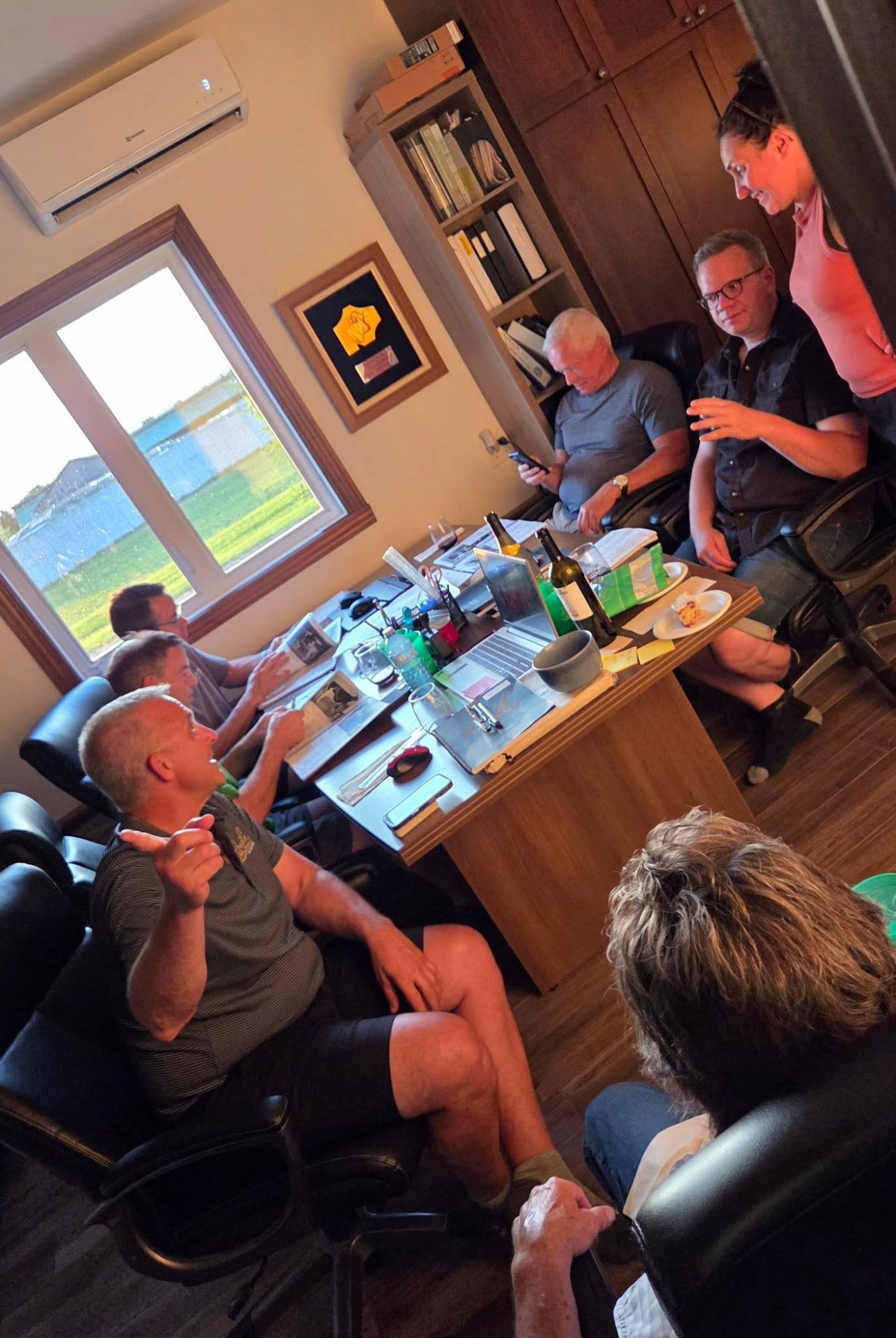
Setting the sale order at Ferme Blondin, done the way Blondin does everything else: in a room, out loud, with the pages spread across the table. Eight people, one laptop, and a lot of pointing at photographs. The Thursday mating calls happen the same way — Brady, Nicolas, Carscadden and whoever else is around, on five to eight donors at a time. “It’s always the biggest decision of the week,” Simon Lalande says. There’s no software in this photo.
They Milk 250. They Show 15.
Brady spent more energy correcting one thing than anything else: the idea that Blondin is a show operation with a semen business attached.
They milk 250 cows. They take 10 or 15 to a show in a given year.
“Shows are just cows that have been washed and clipped up and look good,” he said. “The reason they look good is because we design them that way so they can live a long time and produce a lot of milk. That’s the idea of a show cow.”
Simon Lalande tied it to payroll. “First, we are milking cows every day. We make our living milking cows. We have lots of employees at the farm and we need to be able to pay them.”
Which produces a trait list that reads more like a freestall survival checklist than a show catalogue:
| Trait | Why it’s on the list |
| Correct feet and leg set | Not too straight, not too sickled — a bad leg doesn’t last on concrete |
| Wide chest | Power to push into a full bunk and walk to the parlour twice a day |
| Rump angle | The trait Brady says other studs quietly ignored |
| Udder | Built to milk through several lactations, not one |
On rump angle he didn’t hedge: “There was so many high rump angle bulls at that time. We just didn’t use them.” Go through the Blondin list, he said, and you’ll find very few bulls even a little high in the rump — and none that are really high. Canada’s classification system tracks the trait closely, and Blondin leans on that.
Simon Lalande’s version of the whole philosophy fits in one line: solid frame, good udder, good legs, more lactations, more profit.
What a Half-Lactation Is Actually Worth
Lalande made the longevity-to-profit argument on air but never put a number on it. So here it is as a scenario — not a measured result. Substitute your own herd life and heifer cost and the shape holds.
- Baseline: 250 cows at 2.8 lactations = 89 replacements a year.
- Target: 250 cows at 3.3 lactations = 76 replacements a year.
- Net: 13 fewer heifers needed, roughly $27,000 saved annually at $2,000 a head.
The half-lactation gain is my estimate, not a Blondin claim — nothing in the broadcast ties their trait targets to a specific herd-life figure. And the model leaves something out: fewer replacements also means fewer surplus heifers to sell. If you’re moving heifers into a strong market, net the two against each other before you bank the number.
But it explains why a stud known for type keeps talking about feet, legs, and udders instead of banners.
Robots Are Rewriting the List Right Now
The pressure Blondin watches hardest isn’t the show ring. It’s labour.
“There’s just not enough workers anymore,” Brady said. A large share of Canadian herds have gone to robots — he declined to put a percentage on it, and this article won’t invent one.
The effect on sire selection is concrete. Blondin now watches daughter fertility, milking speed, and teat placement closely. Brady noted that every robot-focused breeder seems to weight a slightly different udder trait — teat placement for some, teat length for others, reverse teat angle for others still. He gave the Canadian evaluation system specific credit for adapting to those traits.
Here’s the version with a deadline attached. If a robot conversion is inside 24 months, pull the milking speed and teat placement values on every sire currently in your tank before your next semen order goes in — call it the next 30 days. Drop anything below breed average on either trait. The cows milking in your box three years from now are the ones you’re breeding this quarter, and no retrofit fixes a teat you bred into the wrong place.
Elite Type Is Wearability in Show Leather
Here’s where the show ring and the milk cheque stop being separate arguments.
Every trait on Blondin’s freestall list is a durability trait. Correct legs, wide chest, an udder built for multiple lactations — those are the same characteristics a judge rewards, described in commercial terms. A cow that scores well is a cow built to still be functional in her fourth lactation, and Nicolas Lalande put the money on that directly.
On a large operation, breeding for type isn’t a hobby line item. It’s a second revenue stream. Cows that last longer produce more sellable calves, and with North American beef-cross calf prices at levels he described as the highest he’s seen, every extra pregnancy out of a functional older cow is margin — a beef-cross calf into a strong market, or an embryo contract on a female whose record is now long enough to sell.
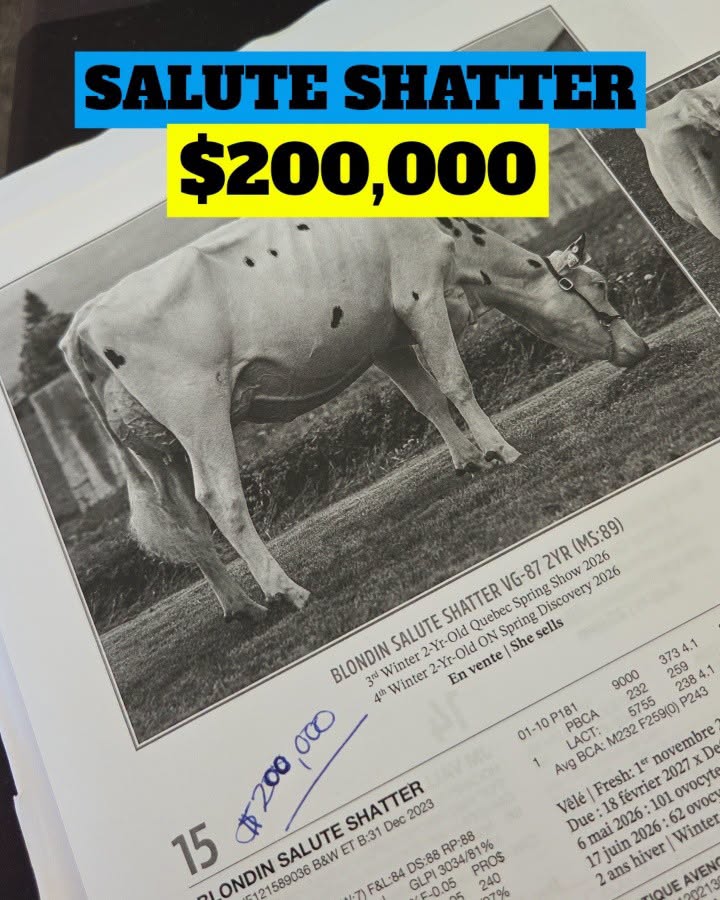
Lot 15, written in ballpoint. Blondin Salute Shatter VG-87 as a two-year-old with an 89-point mammary, third Winter 2-Yr-Old at Quebec Spring Show 2026 and fourth at ON Spring Discovery — and 101 ovocytes with 62 embryos already on her record. Dann Brady marked the price on his own catalogue page: $200,000, the top of Blondin’s own summer sale.
Which is why the cow families come next. They aren’t nostalgia. They’re the accumulated evidence of which lines stay functional long enough to keep paying.
Eight Generations, and One Trip to an Anniversary Show
Both operations argued that families outperform individual animals. Both had receipts, and Simon Lalande’s went personal.
His father was a good farmer and a good milk producer with no purebreds at all. But he took one trip to a Holstein Canada anniversary event and came home with a Warden-sired female from the Supra family. Lalande bred her to Starbuck, kept building on her, and that line has produced for him ever since. It’s the family he’s most attached to — alongside the Barbies, the Jasmines, and the Apples the operation has invested in since.
“Very rare that you’re going to be disappointed when you invest money in a great cow family,” he said. “Sometimes you can fail in one generation, but then the generation after, it comes back.”
There’s a longer arc behind that. Ferme Blondin has been farmed by the Lalande family since 1672 — eight generations — and the herd carried two Master Breeder shields as of 2016. Nicolas is Simon’s son and a co-owner of Blondin Sires alongside his father and Brady, stud code 799. So when Simon describes his own father’s single purchase and Nicolas talks about cow families, that’s four generations of the same decision compounding.
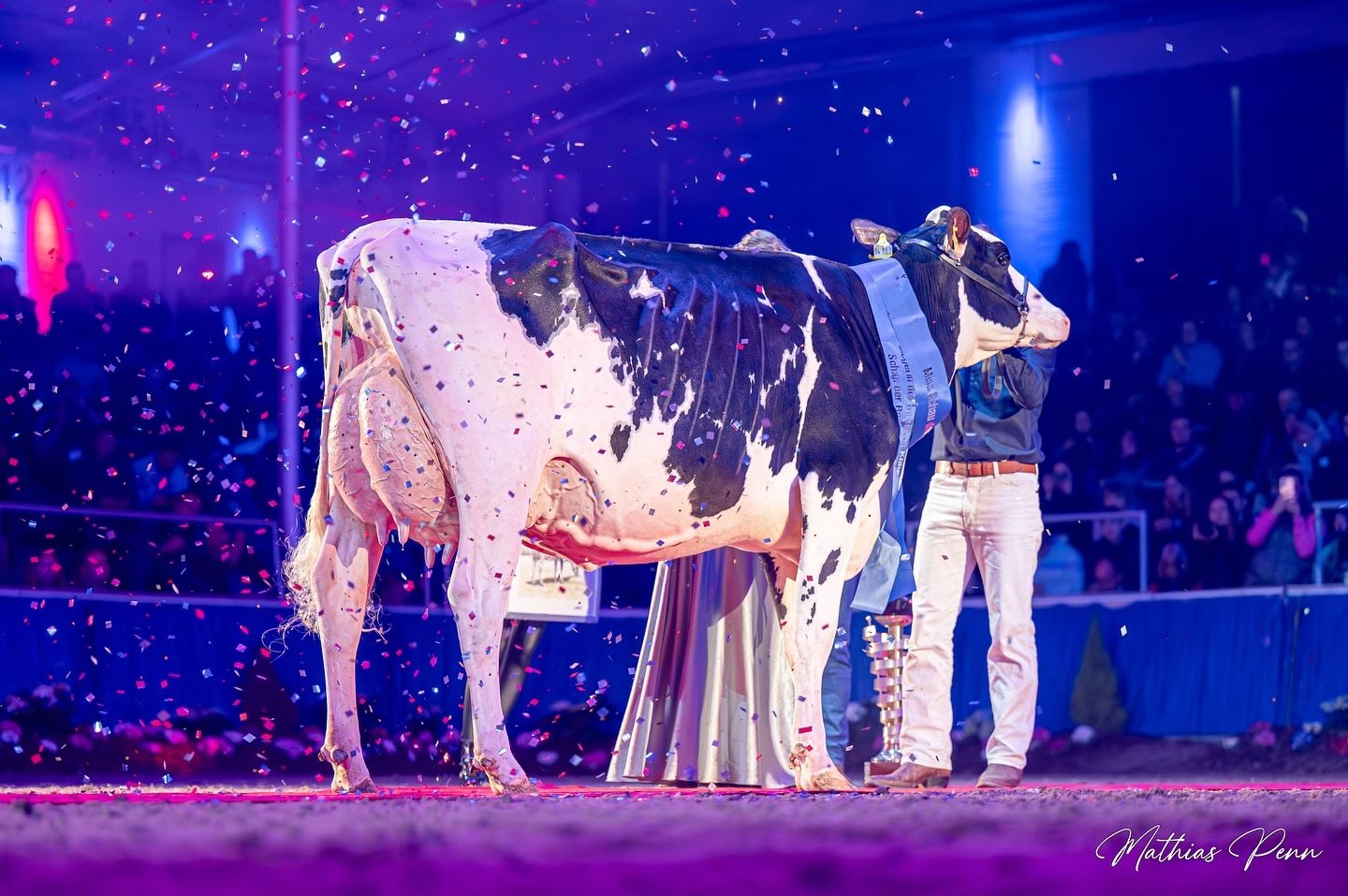
O Katy of Wilcor Holsteins stands triumphantly amid a shower of confetti after being named Grand Champion at the prestigious 51st Schau der Besten in Verden, Germany. Her exceptional dairy strength, balanced frame, and remarkable udder quality caught the judge’s eye, continuing breeder Cord Hormann’s legacy of excellence. This victory marks a remarkable achievement for the German breeding program that emphasizes quality over quantity, proving that with patience, attention to detail, and commitment to deep cow families, championship results are possible regardless of herd size.
Hormann’s version runs on a different clock. O Katy descends from O’Kalibra, the Swiss cow he bought embryos from before her show career took off. That purchase produced exactly one pregnancy: a red-carrier daughter who went on to market a string of high-priced calves. A great-granddaughter of that line became O Katy — a chain Hormann traced himself on air.
Louella traces to a Brittany cow family, and Hormann bought her grand dam in France. Same profile — deep pedigree, strong udders, high production and classification across generations. She was a two-year-old when Simon Lalande first saw her. This past February she took Grand and Intermediate Champion at Verden.
Lalande bought into both cows after seeing them in person, at the show where O Katy took her first Grand Championship. He was there with Brian Carscadden. “I could see in Simone’s [Simon Lalande’s] face when he spotted the cow that he likes her quite a bit,” Hormann said — his read of the moment. Lalande did buy in, on both.
Nicolas Lalande added a wrinkle worth filing away: the less famous pedigrees are often where the value hides. Blondin only ships embryos overseas out of donors they’re confident will produce — so a dam you don’t recognize in a European catalogue frequently signals an outstanding calf rather than a weak one.
That held up on sale night. Four Blondin-prefix lots landed in the top fifteen: Blondin Lambda Lacey at €13,500 to Luxembourg, Blondin Triton Deloria P at €11,000, Blondin Triton Della P at €10,400, and Blondin Armour Sunset at €9,700, the last three all to German buyers.
Why Brady Doesn’t Expect One Red Bull to Lead
The red-and-white question drew the most candid answers of the night, and the verdict was uncomfortable.
There is no proven red bull the industry agrees on. Brady put it flatly: “There’s no proven Red Bull that people want to use.” Earlier in the same answer he’d framed the timeline — the next three years in the red, as he described them, are going to be really difficult, with breeders scattering across several sires instead of converging on one.
Simon Lalande’s solution is to refuse the trade-off entirely. He’ll breed a red cow to a black bull when the black bull offers more of what he wants, accept the red-carrier heifer, and come back to red the following generation.
“We love red, but I’m not ready to sacrifice the quality,” he said. “Every generation, you need to get what you like.”
Over the past 12 to 14 months the operation has put significant money into red and red-carrier females — his words, no figure disclosed — because it sees demand outrunning supply. The market backed the read hard. Wilcor AM Audacious Miracle Red made €15,000 to Great Britain, second-highest of the night, and Jacobs Altitude Shake Hands Red made €13,000, also to a British buyer.
One of the partners made the point that red bulls used to clear a higher bar at home: his father wouldn’t let him use one unless it matched the black and whites, and back then there weren’t many that did.
Brady also named the contradiction keeping the red market stuck. Breeders ask for something new, then refuse it because they don’t recognize the sire. “You’re only gonna get something new if we try to use something outside of our normal everyday bulls.”
Their Own Bull List, Held Against Their Own Rules
The rules are testable, and twelve days before the sale the August 2026 Canadian run tested them.
Blondin posted the results on August 17, 2026: Logic PP became the #1 Newly Proven GLPI sire and #3 overall, and Major jumped for both Conformation and Milk to become the #1 Available bull. Both claims check out against the stud’s own proof-day announcement.
| Bull | Conformation | Ranking | Verified against |
| Logic PP | 16 (93% reliability) | #1 Newly Proven GLPI, #3 overall | Published August 2026 GEBV; Blondin proof-day announcement |
| Major | Increased on both Conformation and Milk | #1 Available bull for Conformation | Blondin proof-day announcement, August 17, 2026 |
Logic’s full published August 2026 GEBV: Conformation 16 at 93% reliability, Mammary System 11, Feet & Legs 12, Dairy Strength 7.
The rest of the lineup came up on the broadcast in functional terms rather than as verified figures, and that’s how they’re presented here:
- Triton — the operation’s next-generation reference sire. A Logic son, described by the partners as combining high type with high index, which is the pairing Blondin has been chasing.
- Detective and Salute — bred reciprocally. Salute goes to Detective, Detective goes to Salute, because each bull covers what the other lacks. This is the one-weakness rule executed in the barn rather than explained on a whiteboard.
- Jacob Spear — a Triton son tracing back to Shakira. Brady flagged him twice, unprompted, as not available. Young, unreleased, and worth watching rather than ordering.
Figures and descriptions for these three come from the August 28, 2026 broadcast and have not been checked against a published evaluation.
Here’s the context the partners didn’t mention, and it works in their favour. Logic didn’t just climb the August list — the mountain moved underneath him. Lactanet adjusted the Holstein LPI Production subindex from 60% Fat / 40% Protein to 40% Fat / 60% Protein for the April 2026 release, a change the organization said would rerank top bulls toward higher-protein sires. That rewarded balanced, component-focused bulls over raw liquid volume, which validates exactly what Blondin had been breeding for. Read the ranking accordingly: it’s a real result under the current formula, and any comparison against a pre-April number is a comparison across two different formulas.
Logic remains the clearest proof of concept for the components argument. Lower milk volume, strong combined fat and protein, homozygous polled, Conformation 16 — a bull built for a component-based milk cheque, as Nicolas Lalande framed it. Brady called it “a unicorn kind of package.” He traces to Drewholme Lambda Leysure P VG-88 out of the Drewholme herd at Gowanstown, Ontario.
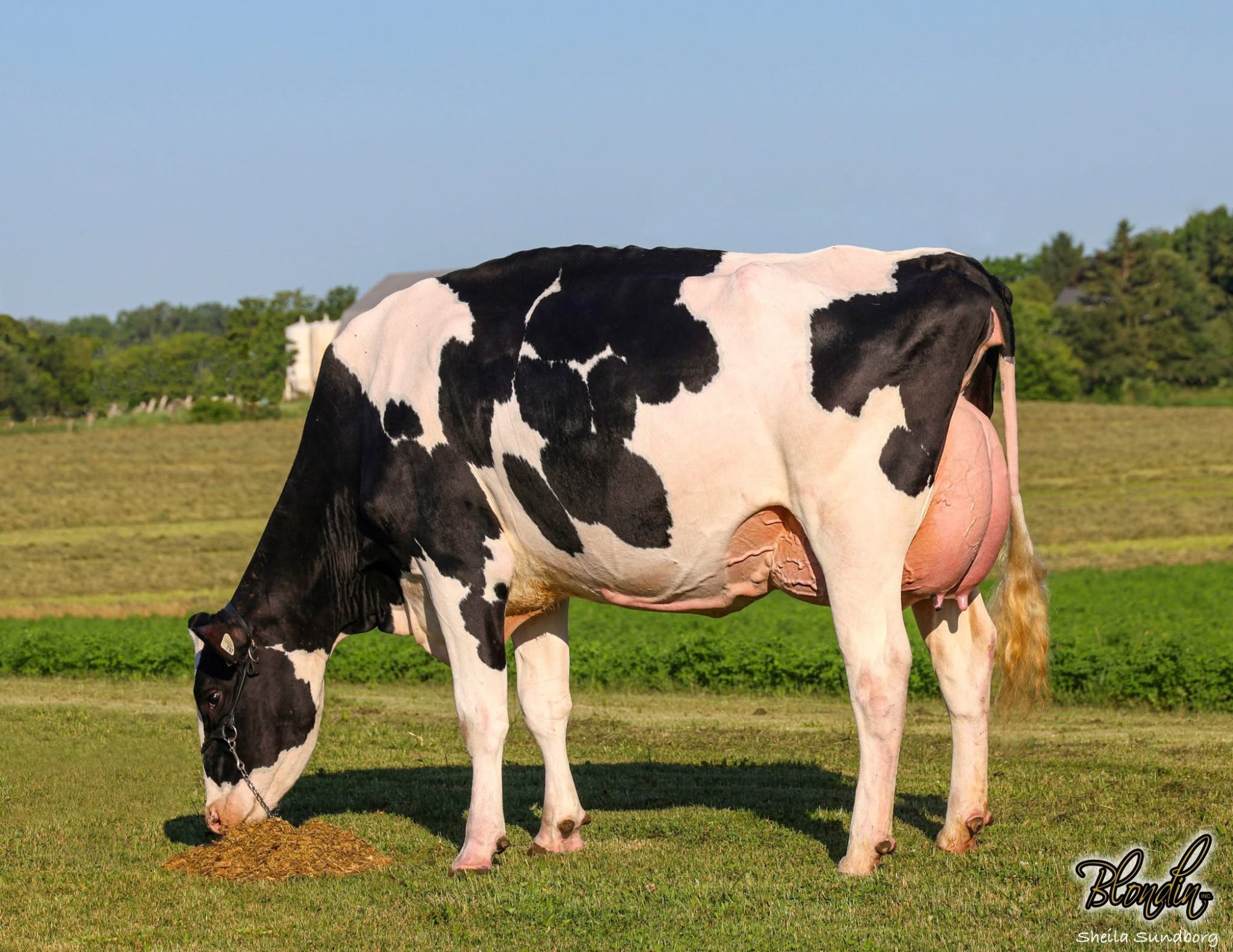
Triton’s record at the sale makes the point about balance. Both Blondin Triton lots in the top fifteen carried the P — polled cattle sitting comfortably inside the top eleven of an international type sale, which is not where polled genetics sat five years ago.
Genomics is doing something else Blondin didn’t expect: surfacing genuinely new pedigrees. A California-bred Parfect daughter the team calls Silver Elite has produced what Brady described as the #15 heifer in the world on LPI, well over 4,100, plus bulls at +16, +17, and +18 type. “She’s a complete package, but she’s a totally new pedigree,” he said. “Something that we’ve been trying to find, and we found her.”
For scale on that number: Canada’s August 2026 GPA LPI run put Stantons Overhaul-P at #1 with +4140, and nine of the top ten were new to the list since April. A heifer over +4,100 sits genuinely near the top of a list that turns over hard every run.
How Much Is a Classified Dam Actually Worth?
The filter produced a #1 GLPI sire and a sold-out sale. It’s still worth knowing exactly what part of that is statistics and what part is marketability.
Lactanet ran the numbers on the question. Across 275 Canadian-born bulls, those with a classified dam received a Conformation evaluation with a reliability 1.3 percentage points higher than bulls whose dams weren’t classified. Seventy-seven percent against seventy-six. Both groups picked up the same roughly 34.5-point gain from genomics.
One-point-three points. That’s the measured statistical premium on a classified dam, for Conformation, in that dataset.
So the filter isn’t buying Brady the reliability gulf the pitch might imply. Holstein Canada is clear that a genotype gets added to whatever information already exists rather than replacing it — parents, performance, progeny, DNA, four sources stacking up — and reliability climbs as information accumulates. Genomics did the heavy lifting: Lactanet reports average LPI reliability in young Holstein animals jumping 37 points, from 41% to 78%, once genomic evaluation arrived. A classified dam adds a rounding error on top of that.
What the full pedigree really buys is different, and Brady’s own behaviour shows it. He’s flushing five to eight donors a week and selling embryos into Europe. In that business, a dam with classification and milk records is verifiable to a buyer — a heifer in a German catalogue whose grandam is EX and milk-recorded sells differently than one whose second dam is a blank. The filter is about marketability and confidence as much as it’s about statistics.
That’s not a knock on the rule. It’s the reason to apply it where it pays instead of treating it as an article of faith.
Thirty Cows and Twenty Snapchats
One more piece of advice, aimed at breeders rather than herds.
Brady’s read is that plenty of breeders have good cattle at home and talk themselves out of it. “A lot of people have really good cows at home and they see the top ones and they think, ‘Oh, they’re not good enough.’ But part of breeding is being excited for what you have and then trying to improve on that.”
Hormann is the argument for that position. Thirty cows, 70 hectares, two Grand Champion banners at Verden in two years.
The channel rebuilding that enthusiasm isn’t the ring, in Brady’s telling. It’s the phone. He wakes up to 20 or 30 Snapchat and Facebook messages from breeders sending photos of daughters by Blondin bulls.
“Farming is a very lonely occupation,” he said. His read on why social media matters: everybody loves cows regardless of country, there are fewer farmers every year, and at least the ones still going can share the experience.
Nicolas Lalande pointed at his own father — Simon, sitting beside him — as the counterexample to the too-busy excuse. Roughly 90 employees across the group, and the man still walks the barn to look at cows.
The Thursday mating calls aren’t one man’s either. Brady, Nicolas, Carscadden and others all weigh in on five to eight donors. “It’s always the biggest decision of the week,” Simon said. Then, deadpan: “If the calf turns out, he made the decision. If it’s a really bad calf, then I made the decision.”
What This Means for Your Operation
- Screen the pedigree before the index — but know what you’re buying. Lactanet’s figure is 1.3 percentage points of Conformation reliability for a classified dam. What you’re really paying for is verifiability to a buyer and confidence in the maternal line, so apply the filter hardest where you’re selling animals or embryos rather than treating it as an article of faith everywhere.
- Cap candidates at one weakness, then decide where it lands. Below breed average on more than one of your herd’s problem traits, he’s out. His single weakness should sit where your cows are already strong — that’s Detective-to-Salute logic applied to your own barn.
- Pull the current LPI rank, not the one you remember. April 2026 moved the Production subindex from 60F:40P to 40F:60P and reranked the top of the list toward higher-protein sires. Comparing a bull’s rank today against a pre-April number means comparing two different formulas.
- Name two or three priority traits in writing before your next order. Everything else becomes a tiebreaker instead of a criterion. Ten priorities is the same as none — selection pressure spread that thin moves nothing.
- If robots are inside 24 months, screen milking speed and teat placement this month. Drop anything below breed average on either. Three-year lag between the semen decision and the animal standing in the box, and no retrofit fixes a teat you bred into the wrong place.
- Count the fourth and fifth lactation as revenue, not sentiment. Every extra pregnancy out of a functional older cow is a beef-cross calf into a strong market or an embryo contract on a female with a long enough record to sell.
- On reds, plan a three-year scatter rather than waiting for consensus. There’s no proven red bull the industry agrees on and Brady doesn’t expect one soon. Budget for multiple red-carrier sires, and take the black-bull generation when the black bull is genuinely better. The sale ring says the premium is real — a Red went second-highest at €15,000.
- Judge a cow family across generations, not on one disappointing daughter. And price a family purchase as a five-to-ten-year position, because that’s what Hormann’s O’Kalibra embryos turned out to be: one pregnancy, then a great-granddaughter with a Verden banner.
- Stop treating herd size as the constraint. Hormann runs 30 cows and sold 70 head into seven countries. The filter doesn’t scale with the barn.
Simon Lalande’s father wasn’t a purebred breeder. He took one trip, bought one Warden daughter out of the Supra family, and four generations later the family still farms ground their name has worked since 1672. Cord Hormann milks thirty cows in a Lower Saxony farmyard and has put two Grand Champions on the coloured shavings at Verden in two years.
Neither of those required scale. Both required deciding what you’re actually selecting for, then holding the line when a flashier number shows up on genomic day.
So what’s the one weakness you’ve been breeding into your herd without meaning to?
Learn More
- Cull cow replacement cost: $2,340 vs $3,500 in 2026 — Exposes the real cash trap in trading sound cows for record-high heifers, arming you with the exact breakeven math needed to stop habit-based culling from bleeding $1,160 or more per stall.
- The New Math of Dairy Genetics: Why This Balanced Breeding Thing is Finally Clicking — Breaks down the “five-of-six rule” using Lactanet’s modernized subindexes, showing how hedging against recessive traits and single-trait extremes protects long-term margins and captures $200–$250 per cow annually in feed efficiency.
- Robot Revolution: Why Smart Dairy Farmers Are Winning with Automated Milking — Delivers field-tested box-milking metrics that separate profitable setups from break-even barns, proving how breeding square udders and faster milkout times doubles box throughput without buying an extra unit.
The Sunday Read Dairy Professionals Don’t Skip.

Every week, thousands of producers, breeders, and industry insiders open Bullvine Weekly for genetics insights, market shifts, and profit strategies they won’t find anywhere else. One email. Five minutes. Smarter decisions all week.