





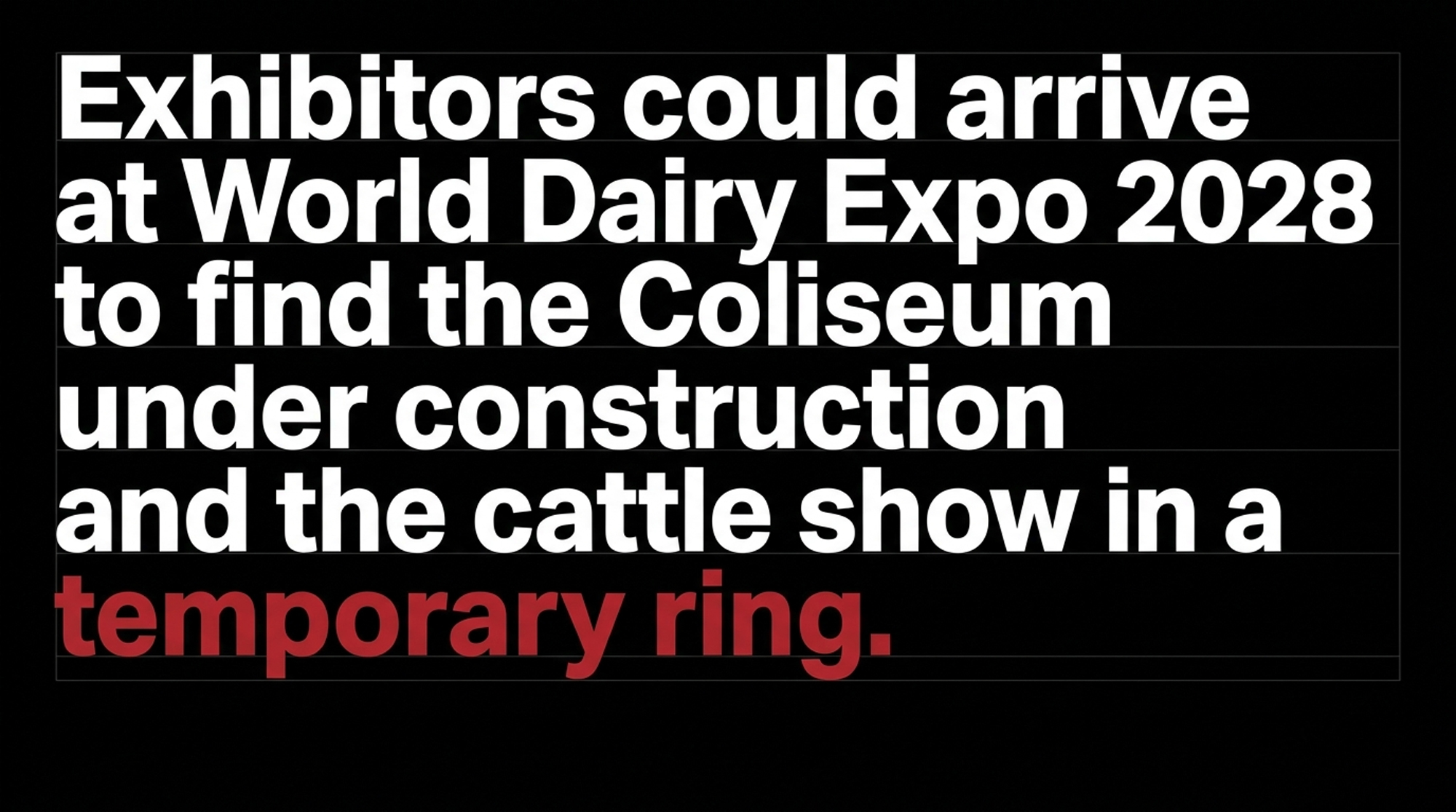
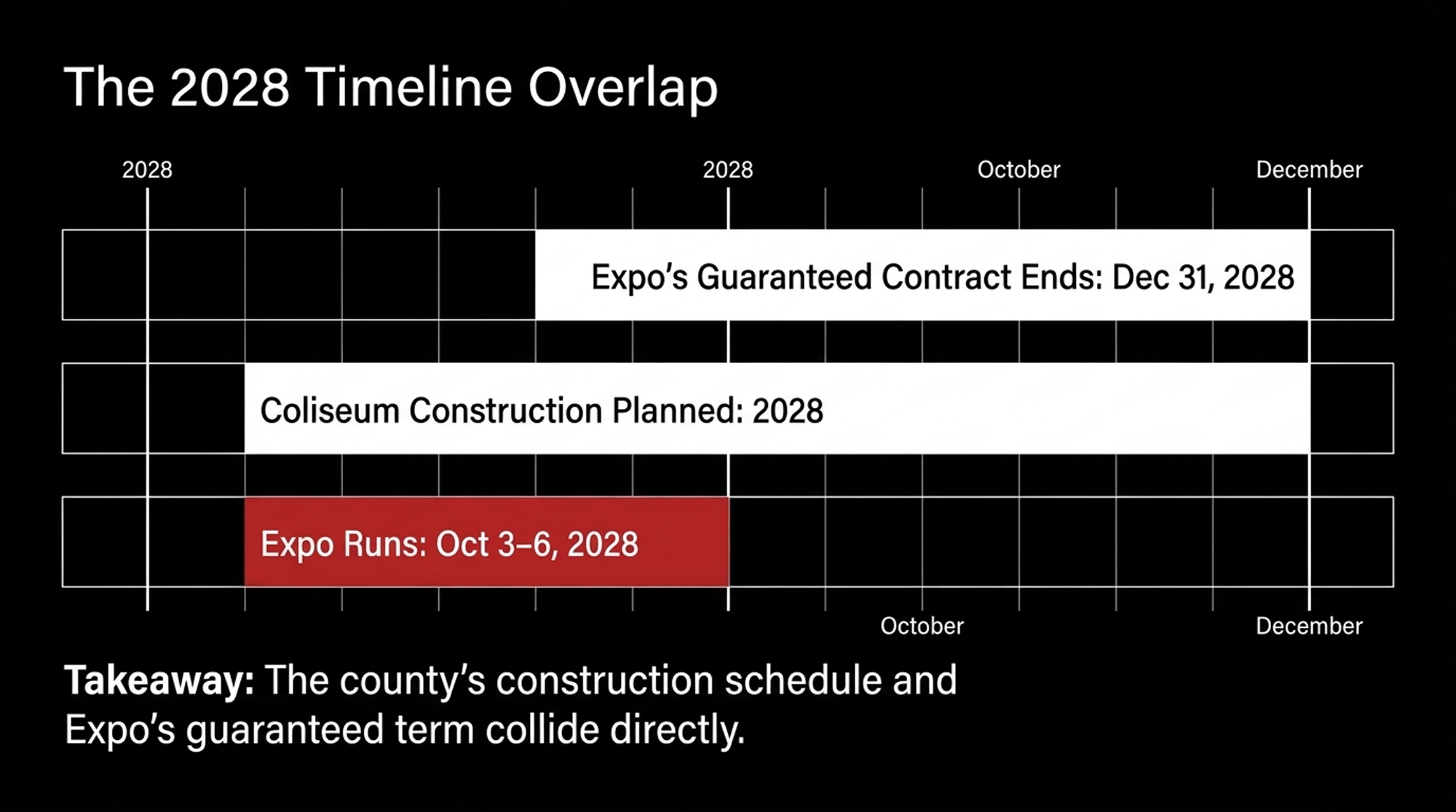
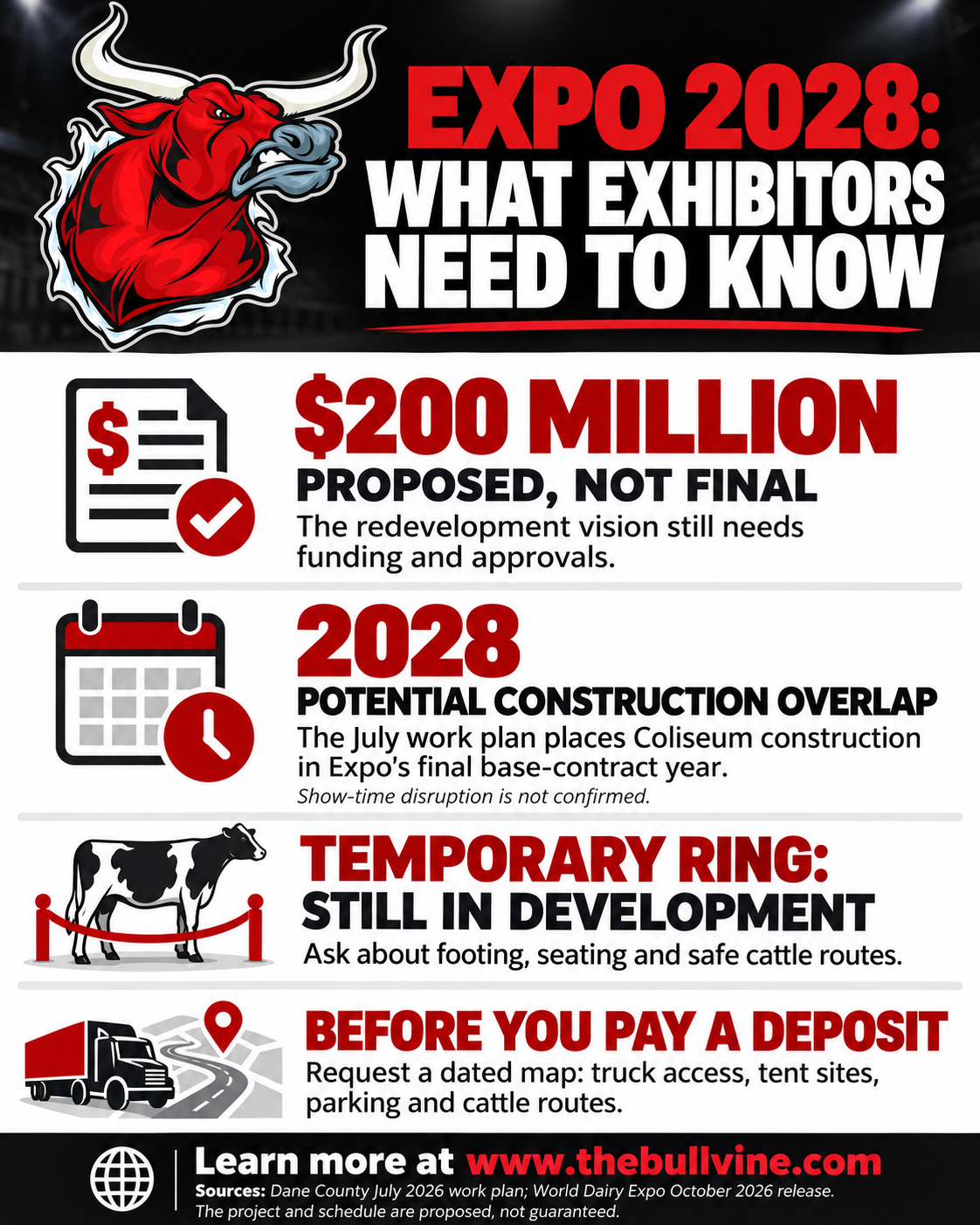
Dane County’s current work plan places Coliseum construction in 2028, the last guaranteed year in World Dairy Expo’s venue agreement. The temporary show ring meant to carry Expo through that work was still being developed when the plan went public. That puts one Expo year squarely inside the county’s timeline.
Dane County’s potential $200 million Alliant Energy Center redevelopment starts with the building World Dairy Expo can least afford to lose: Veterans Memorial Coliseum. The county’s July 20, 2026 work plan put Coliseum design in 2027, construction in 2028 and a goal of reopening in 2029.
Expo’s guaranteed venue agreement runs through December 31, 2028. Three one-year options could keep the show in Madison through 2031. Those options sit outside the guaranteed five-year term approved under Resolution 2023 RES-113 and Contract 15171.
That makes 2028 the exposure year.
Expo is scheduled for October 3–6 that year. On the county’s current calendar, exhibitors could arrive while the Coliseum is being rebuilt and the cattle show runs from a temporary structure. Nobody had designed that structure yet when the plan was presented.
What Dane County has approved
Dane County has not approved a $200 million construction package. The county and World Dairy Expo both describe the redevelopment as a potential project. Each phase still needs financing, agreements and government sign-off.
What the county has approved is Expo’s occupancy agreement. RES-113 authorized Expo to use the Alliant Energy Center from 2024 through 2028, with options through 2031. The County Board adopted it on August 17, 2023.
Contract 15171 runs from January 1, 2024 through December 31, 2028. Its five-year base-space value is about $2.398 million, before parking, catering, goods and services billed at Alliant Energy Center rates.
The redevelopment itself is still a sequence of proposals. The plan presented at Expo in October starts with the Coliseum, then mixed-use development, then the Exhibition Hall expansion. County Executive Melissa Agard’s office said Exhibition Hall capital still needs County Board approval and that the county is working with the Governor’s office on financial backing.
Neither that release nor the July 20 work plan puts a dollar figure on Wisconsin’s share. The only budget item filed so far, 2026 ACT-158, is the Personnel & Finance Committee’s amendments file for the proposed 2027 capital budget. As of October 13 it was still in committee, with no text and no recorded action.
So read “$200 million” as a plan. None of that money is in hand yet.
Which Expo year takes the hit?
Bullvine laid the county’s July 20 work plan over Expo’s occupancy agreement. The result shows one year where the two collide directly, and several years where the risk depends on decisions not yet made.
| Expo year | Proposed redevelopment milestone | Expo contract position described in draft | What exhibitors still need to know |
|---|---|---|---|
| 2026 | Coliseum developer selection and negotiations | Base term: year 3 of 5 | Who sets the temporary-ring requirements? |
| 2027 | Coliseum design | Base term: year 4 of 5 | When will ring specifications and campus-access plans be available? |
| 2028 | Coliseum construction | Final year of base term | Will construction affect the October show, and which facilities would replace the Coliseum? |
| 2029 | Targeted Coliseum reopening; desired start of Exhibition Hall work | First extension-option year | Will the Coliseum be operational before Expo, and has the option been exercised? |
| 2030–2031 | Desired Exhibition Hall construction period, progressing toward 2032 | Second and third extension-option years | Which exhibit, meeting and freight areas would remain available? |
Reading note: A construction target in the same calendar year establishes potential exposure; it does not establish that work will interrupt Expo. The county’s 2023 announcement confirms a five-year agreement plus three option years.
The strongest verb anywhere in that table is planned. The work plan sets targets, not commitments. It lists no construction start date and no completed financing package. It still tells exhibitors where they need answers first: the ring, in 2028.
The Coliseum goes first
Alliant Energy Center Executive Director Kevin Scheibler said the Coliseum historically hosted about 110 events a year and was planning for about 40 in 2026. That figure covers the Coliseum only, not the whole campus.
Scheibler also said a temporary structure to replace the Coliseum show ring during construction is still under development. The July 20 committee presentations include no design, seating count or cattle-movement plan for it.
For Expo, that temporary ring carries the whole show. It has to handle breed-show schedules, cattle marshalling, footing, seating, production crews, broadcast gear, sponsor inventory and safe movement between barns and ring.
The Alliant Energy Center’s July presentation counted World Dairy Expo as one of 18 agricultural events using the campus. It also showed Expo using every major facility during its late September–early October run.
The July 20 minutes list World Dairy Expo General Manager Laura Herschleb as a committee member. Expo’s October release goes further, calling her committee vice-chair and the only representative of those 18 agricultural events.
That seat gives Expo earlier access to design decisions than any other agricultural show on the grounds. It pays off only if the answers reach exhibitors before contracts, freight orders and travel bookings stop being refundable.
Why the campus needs space
The county’s Exhibition Hall concept adds 50,000 square feet of flexible event space, 19 meeting rooms and a 30,000-square-foot ballroom. The broader proposal also includes a 200-room hotel.
| Proposed component | Announced quantity | Intended use or benefit | Question for Expo |
|---|---|---|---|
| Exhibition Hall expansion | 50,000 sq. ft. | Additional exhibition and event capacity | How much existing exhibit space would remain usable during construction? |
| Meeting rooms | 19 rooms | More capacity for meetings and associated events | What meeting space would be available during the transition? |
| Ballroom | 30,000 sq. ft. | Additional gathering and event space | Which Expo functions could use it, and when? |
| New hotel | 200 rooms | More lodging on the campus | When would rooms become available for Expo bookings? |
| Overall redevelopment | Potential $200 million project | Broader campus improvements | Which phases have approved funding and confirmed delivery dates? |
Source: World Dairy Expo’s redevelopment announcement, published by DairyBusiness October 7, 2026. The release lists the Exhibition Hall expansion and ballroom separately but does not establish whether their areas should be added together.
Scheibler said 15 of the Alliant Energy Center’s top 20 events have outgrown the available space. Expo already rents three temporary tents, two for cattle and one for commercial exhibits, to stretch the permanent campus.
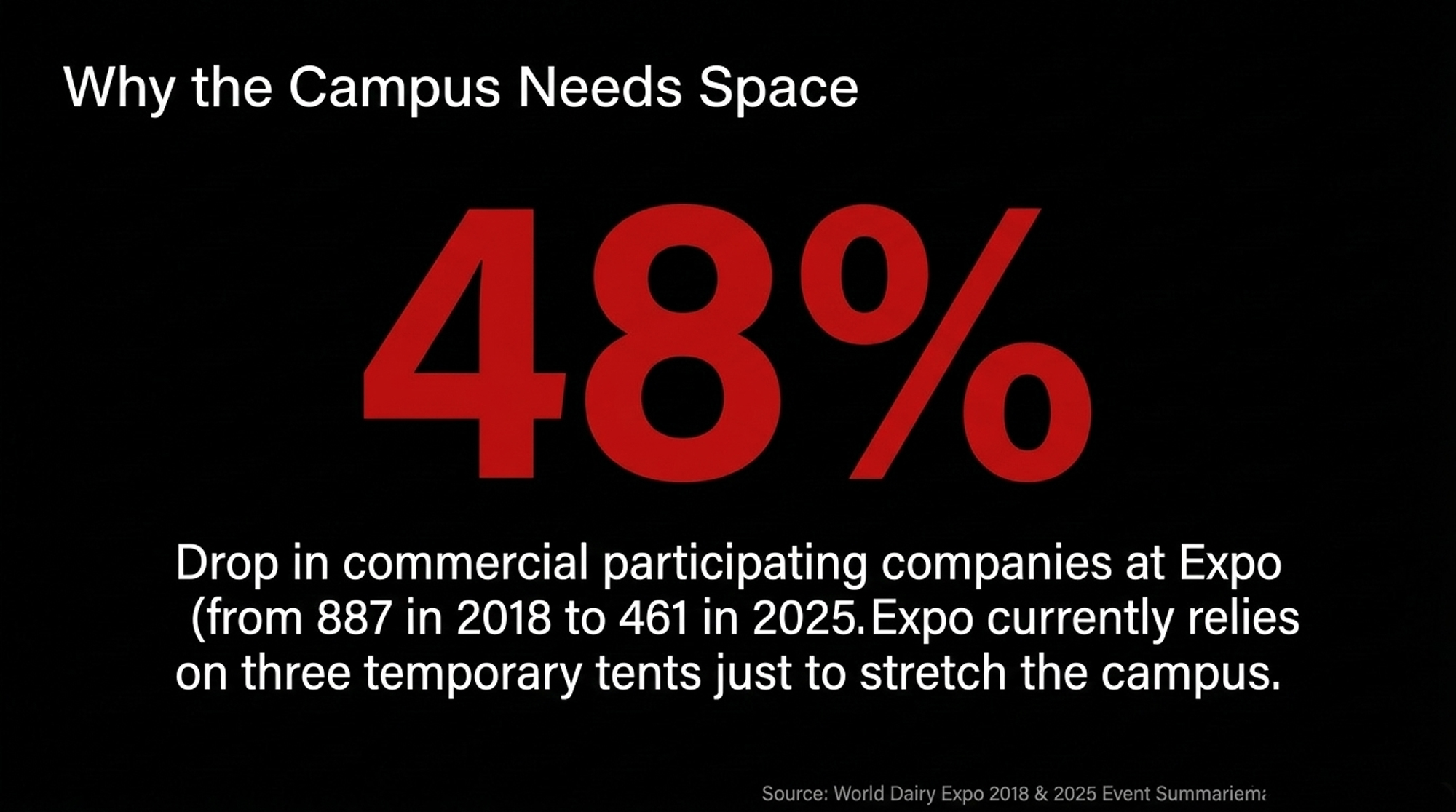
Space hasn’t been the trade floor’s only problem. Expo’s 2018 Show Summary counted 887 participating companies. Its 2025 Event Summary counted just 461. By The Bullvine’s math, that’s 426 fewer companies—a 48.0% drop in seven years.
The July presentation also called for a new agricultural arena, an outdoor exhibition plaza, better vehicle circulation and more than 300 extra hotel rooms across the campus. All of those are still planned improvements, not approved construction.
Trade exhibitors will care about the Exhibition Hall expansion eventually. The 2028 question comes first: does Coliseum construction eat into parking, outdoor exhibit space, freight routes or the ground Expo’s tents sit on now?
What Waterloo already taught
Bullvine’s Waterloo coverage traced how the National Dairy Cattle Congress held dairy’s October slot from 1910 to 1965 and then drifted from the exhibitors who’d built it. Two years later, Expo opened in Madison.
Madison starts this from a stronger position. Expo holds a guaranteed contract through 2028 and a seat on the county’s redevelopment committee. Both only count if they produce an operating plan before exhibitors commit money to the 2028 show.
The 2023 agreement kept Expo at the Alliant Energy Center, its home since the first show in 1967, through at least 2028.
| Issue | What the accessible announcements establish | What they do not establish | Information needed next |
|---|---|---|---|
| Redevelopment funding | The project is described as potentially costing $200 million; Exhibition Hall funding needs County Board approval | That the entire project is financed—or that no funding exists for any component | Funding status and approval requirements by phase |
| Temporary cattle ring | Officials are working with developers on a temporary structure; timing and plans remain under development | A completed design, seating capacity, footing specification or cattle route | Temporary-ring specifications and delivery deadline |
| Continued occupancy | The announced agreement includes a five-year term and three option years | Option notice deadlines, current exercise status or detailed construction protections | Relevant contract clauses and current option status |
| Existing temporary facilities | Expo reports using three tents: two for cattle and one for the trade center | Whether construction would affect their sites or access routes | A dated construction and event-layout map |
| Agricultural representation | Expo’s general manager is identified as redevelopment committee vice-chair and the sole representative of 18 agricultural shows | Exclusive access to information or an approved exhibitor operating plan | A schedule for communicating decisions to affected exhibitors |
Sources: Dane County’s July 2023 agreement announcement and World Dairy Expo’s October 2026 redevelopment release. These announcements support the distinctions above; detailed contractual protections require review of the agreement itself.
What this means for your operation
Nobody needs to change their 2027 Expo bookings today. The county’s plan does set three decision points before the 2028 show.
Before 2027 design closes
Cattle exhibitors and breed associations should ask Expo for the temporary ring’s proposed dimensions, footing, warm-up area, marshalling space, seating capacity and covered route from the barns.
The test is simple. If the temporary ring can’t handle the Coliseum’s class volume, crowd and production schedule, breed schedules and stalling plans need to change before 2028 entries open.
Commercial exhibitors should ask whether the 2028 construction footprint reaches outdoor displays, freight staging, parking or the three temporary-tent sites. Your booth can be inside Exhibition Hall and still get hurt by a blocked loading route outside it.
Before signing 2028 contracts
Trade-show companies should ask for a dated campus map showing construction fencing, truck access, unloading windows, temporary power, parking and pedestrian routes.
If that map doesn’t exist before freight, tent, hotel or equipment deposits go non-refundable, build in a contingency. Don’t assume the 2027 layout carries into 2028.
Breed associations should also pin down who pays if temporary facilities need different seating, audiovisual gear, flooring or hospitality setups. Expo’s venue agreement locks in the dates. It doesn’t say who absorbs each association’s construction-related costs.
Before exercising 2029 options
Expo’s 2029–2031 dates are options, not guaranteed years. Any decision to exercise them should be checked against the actual Coliseum delivery date and the Exhibition Hall schedule in force at the time.
If the Coliseum really opens in 2029, the biggest cattle-show risk goes away. But Exhibition Hall construction starting that same year would shift the pressure onto commercial exhibitors, meetings, food service and freight.
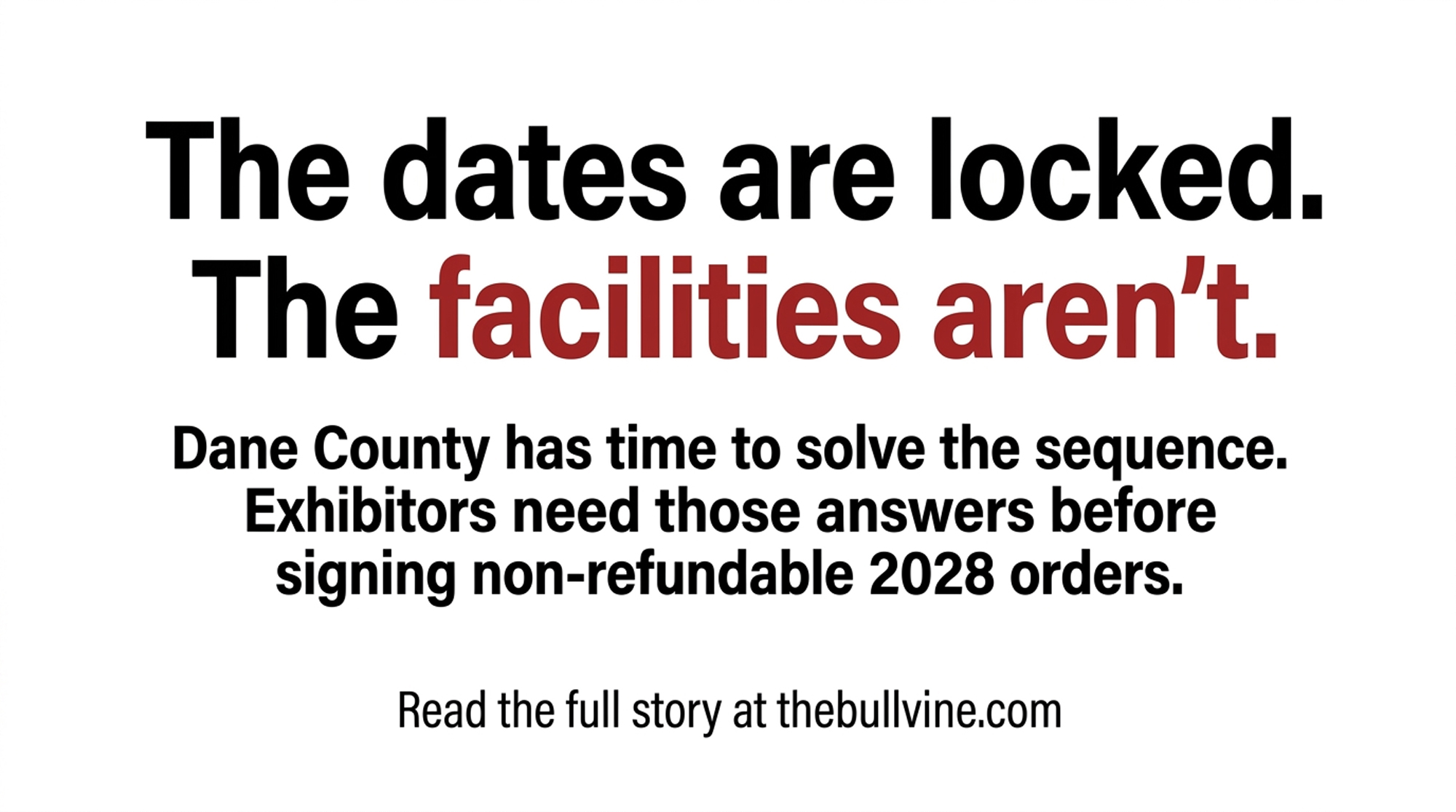
Dane County has time to solve the sequence. Exhibitors need that answer before they sign non-refundable 2028 orders.
Complete references and supporting documentation are available upon request by contacting the editorial team at editor@thebullvine.com.
Learn More
- The Real Price of World Dairy Expo: $3800 a Cow — Your blueprint for surviving October’s hidden costs. Breaks down the $3,800 per-head reality of hauling a five-cow string to Madison, exposing how fixed fees and skilled fitters dictate your actual show ring margins before the trailer ever leaves.
- World Dairy Expo’s Home Base Clears Its First Hurdle for a Major Expansion — Map out your next commercial booth footprint using this timeline of the Alliant Energy Center’s incoming overhaul. Reveals exactly how the Exhibition Hall expansion threatens to choke trade show logistics and force vendors to rewrite their multi-year contracts.
- The Kids Aren’t Coming – They Already Own Dairy’s Future (World Dairy Expo Proves It) — Think the next generation is just watching the colored shavings? Think again. Shows how aggressive young breeders are already commanding elite genetics and navigating an 800,000-head heifer shortage to capitalize on $10 billion in new processing capacity.
The Sunday Read Dairy Professionals Don’t Skip.

Every week, thousands of producers, breeders, and industry insiders open Bullvine Weekly for genetics insights, market shifts, and profit strategies they won’t find anywhere else. One email. Five minutes. Smarter decisions all week.