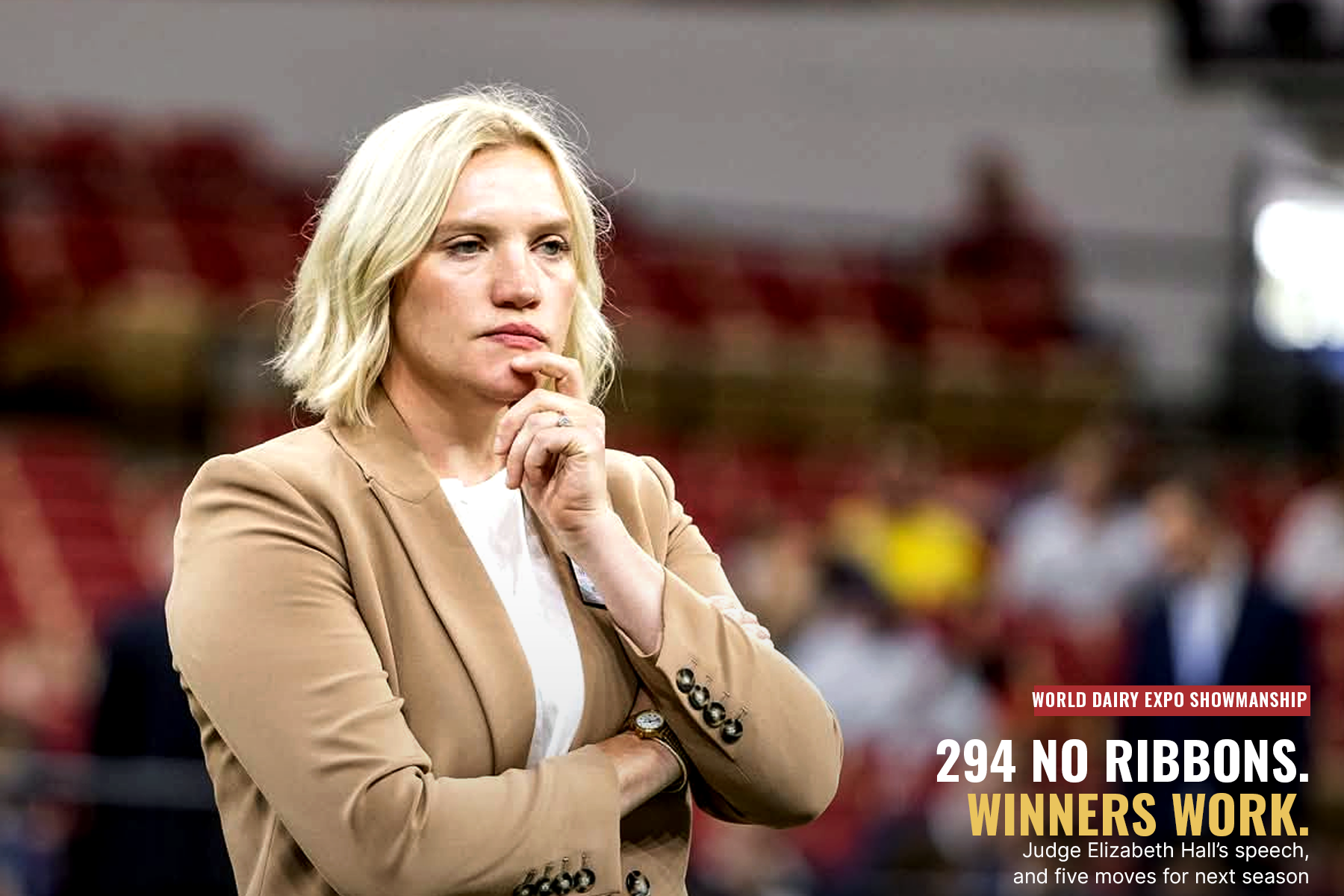





At World Dairy Expo, 294 of the 339 kids in the showmanship ring went home without a ribbon. The senior judge’s closing message explains why that isn’t the same as losing.
You know the walk.
Your heifer is set up square. Your whites are still spotless after hours of waiting. The judge has looked your way twice, maybe three times. Then the pulls work their way down the line and stop one kid short of you.
You smile. You shake a hand. You lead her out past the family who drove you there. You keep it together all the way back to the barn, and then, sitting on a tack box where nobody can see, you don’t.
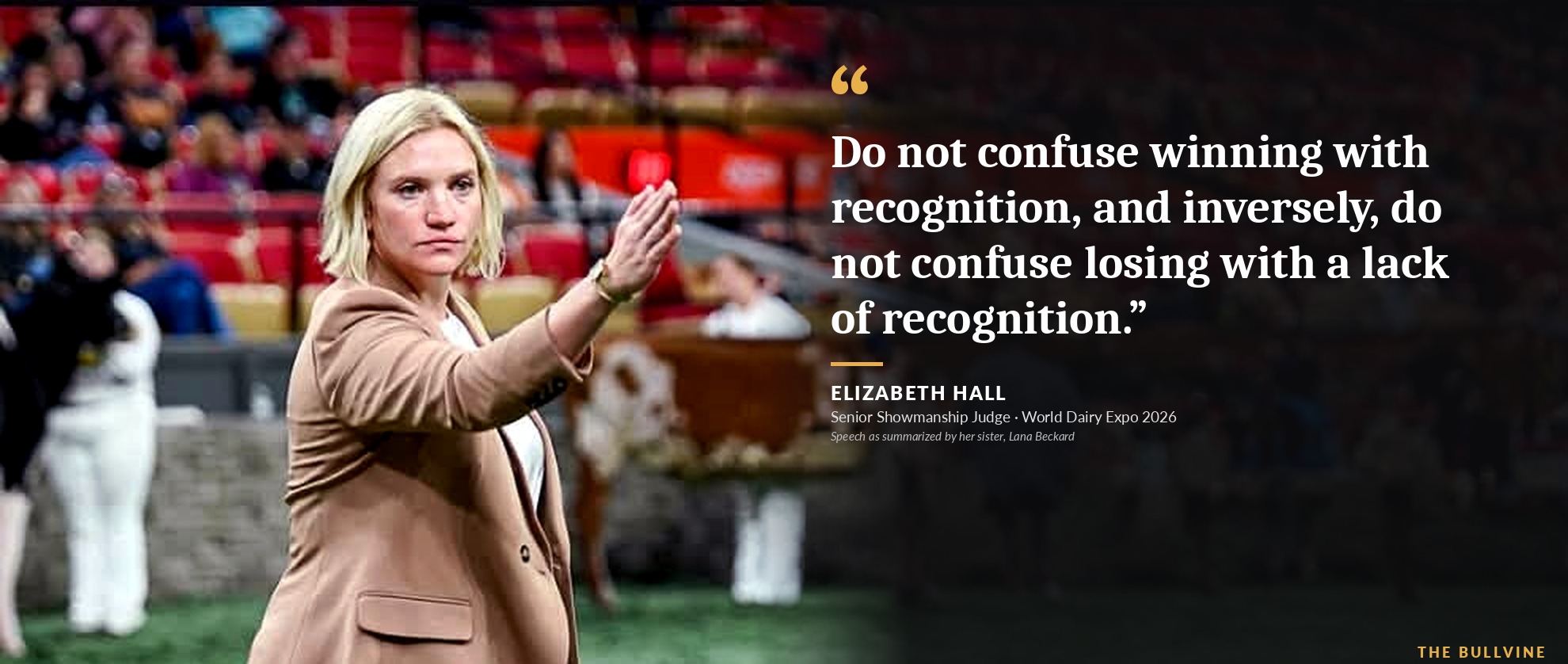
On Saturday, September 26, 294 young people left the colored shavings at World Dairy Expo without a neck ribbon. When the contest closed, the senior showmanship judge, Elizabeth Hall, took the microphone and said the line that has since traveled far beyond the Coliseum:
Her sister, Lana Beckard, wrote the speech down, called it “Winners Work,” and posted it. By September 29, it had been reshared hundreds of times.
If you’ve ever sat on that tack box, it was written for you.
339 Kids Did the Work. 45 Got a Ribbon.
Expo drew 339 competitors to the Youth Showmanship Contest: 101 juniors, 112 intermediates and 126 seniors. Hall’s seniors came through in seven heats, about 18 kids per heat.
Most kids reach those shavings after months of halter-breaking, washing, clipping and walking, plus the long drive to Madison. The math of a national show is unforgiving. Here is how the recognition split.
87% of the ring went home without a ribbon.
| Division | Judge | Contestants | Top-15 neck ribbons | Went home without one |
| Junior (9–13) | Crystal Sinn | 101 | 15 | 86 (85%) |
| Intermediate (14–16) | Josh Karn | 112 | 15 | 97 (87%) |
| Senior (17–21) | Elizabeth Hall | 126 | 15 | 111 (88%) |
| Total | 339 | 45 | 294 (87%) |
Bullvine calculation from the official World Dairy Expo results release.
Six kids shared the $11,750 in cash, or 1.8% of the ring. Justin Brandel of Lake Mills, Wis., won the intermediate division and then Supreme Showman. Logan Harbaugh of Marion, Wis., won Hall’s senior division and then Reserve Supreme. Raegan Bossard of Fabius, N.Y., topped 101 juniors. They earned every bit of it, and you can read the full rundown in our World Dairy Expo 2026 champions report.
If banners are the only scoreboard, nearly nine out of 10 kids in that Coliseum failed on Saturday. Hall’s speech hands you a different scoreboard, one where all 339 had a chance.
Before She Was the Judge, She Was the Kid
Expo’s youth contest judges are nominated and selected by the contest participants. Young people like you asked for Elizabeth Hall.
She grew up as Elizabeth Olson on Raylore Farm, a registered Holstein farm in Hutchinson, Minn., that showed at county and state fairs, the same kind of rings where most of you started.
Then she kept going. According to her 2024 Minnesota State Fair judge biography, she made the collegiate judging team at the University of Minnesota and earned degrees in animal science and applied economics. Next came a move halfway across the country to Vermont, where the biography lists her as a senior sales representative for Elanco Animal Health and a marketing specialist at Fairmont Farm, an East Montpelier operation of roughly 1,500 Holsteins. By 2024, she had judged in 12 states.
Every one of those steps was work.
Fairmont was named Vermont Dairy Farm of the Year in 2017. Hall and her husband, Ricky, coach Vermont’s 4-H dairy judging team. So when she tells kids to ask for coaching, she’s one of the people they can ask.
Beckard also grew up on the family’s registered Holstein farm in Minnesota and now works in agricultural communications. Two sisters from one Minnesota dairy family made this moment. One said the words, and the other made sure they outlasted the day.
Winners Work on Themselves
Hall opened by admitting the obvious: “Of course, we all like to win.” Then she named the medals, banners, checks, and applause, called them nice, and put work above all of it. “The real win in life is to work. Winners work.”
The first kind of work happens in the mirror:
“They say, ‘How can I get better for next year? How can I get better tomorrow?’
“They ask for feedback, for coaching. They look inward at how they can get better. Losers will point outward.”
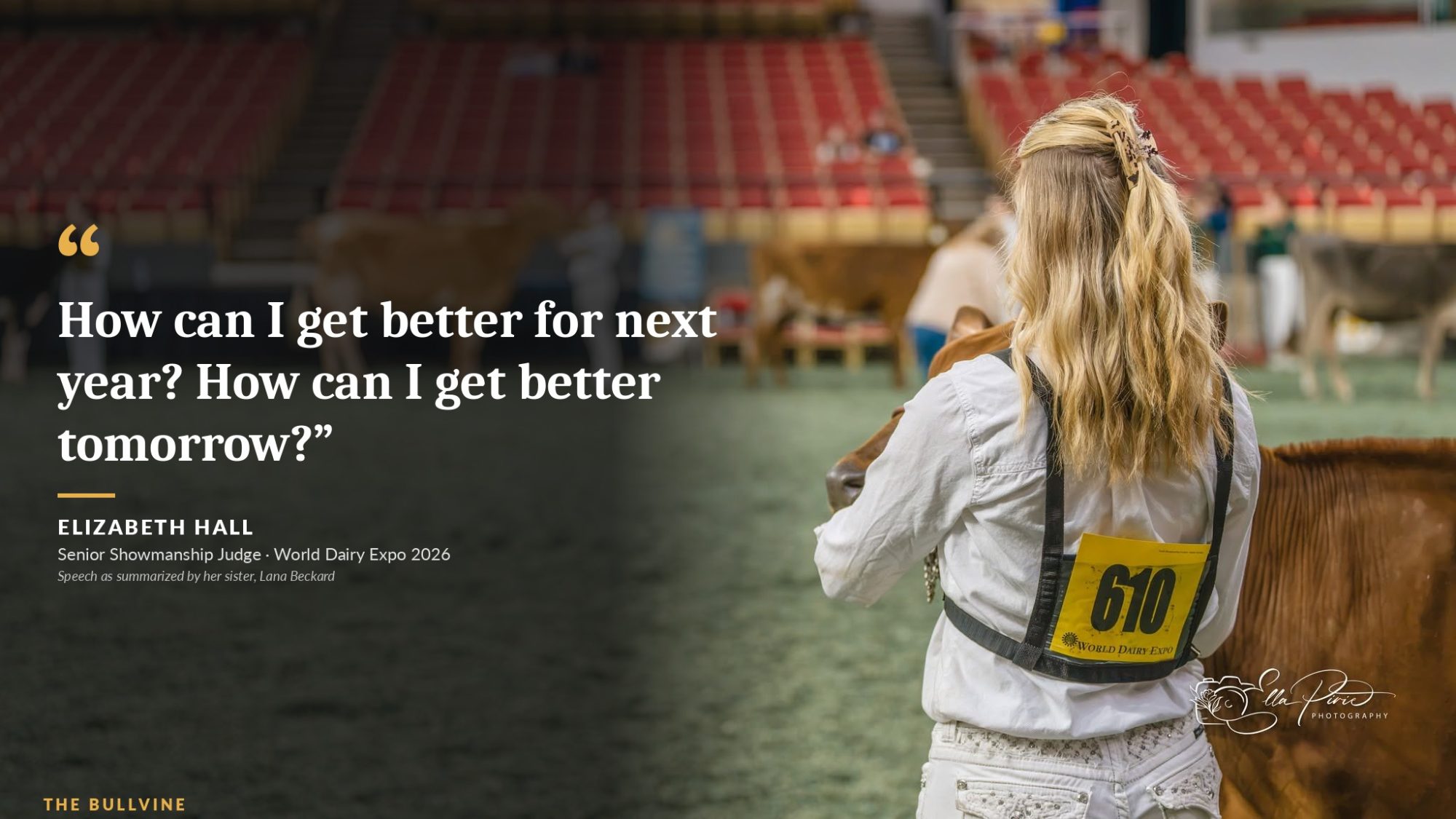
That’s the hardest walk at any show. It’s harder than the walk out of the ring. It’s the walk back across the barn to the judge, a fitter, or the herdsman two stalls down, eyes still red, to ask: “What would you have done differently with her?”
Winners Work No Matter What
“They work after a good show, a bad show, in the dead of winter, in the heat of summer.
“They show up and make it happen. Losers will wait for it to happen.”
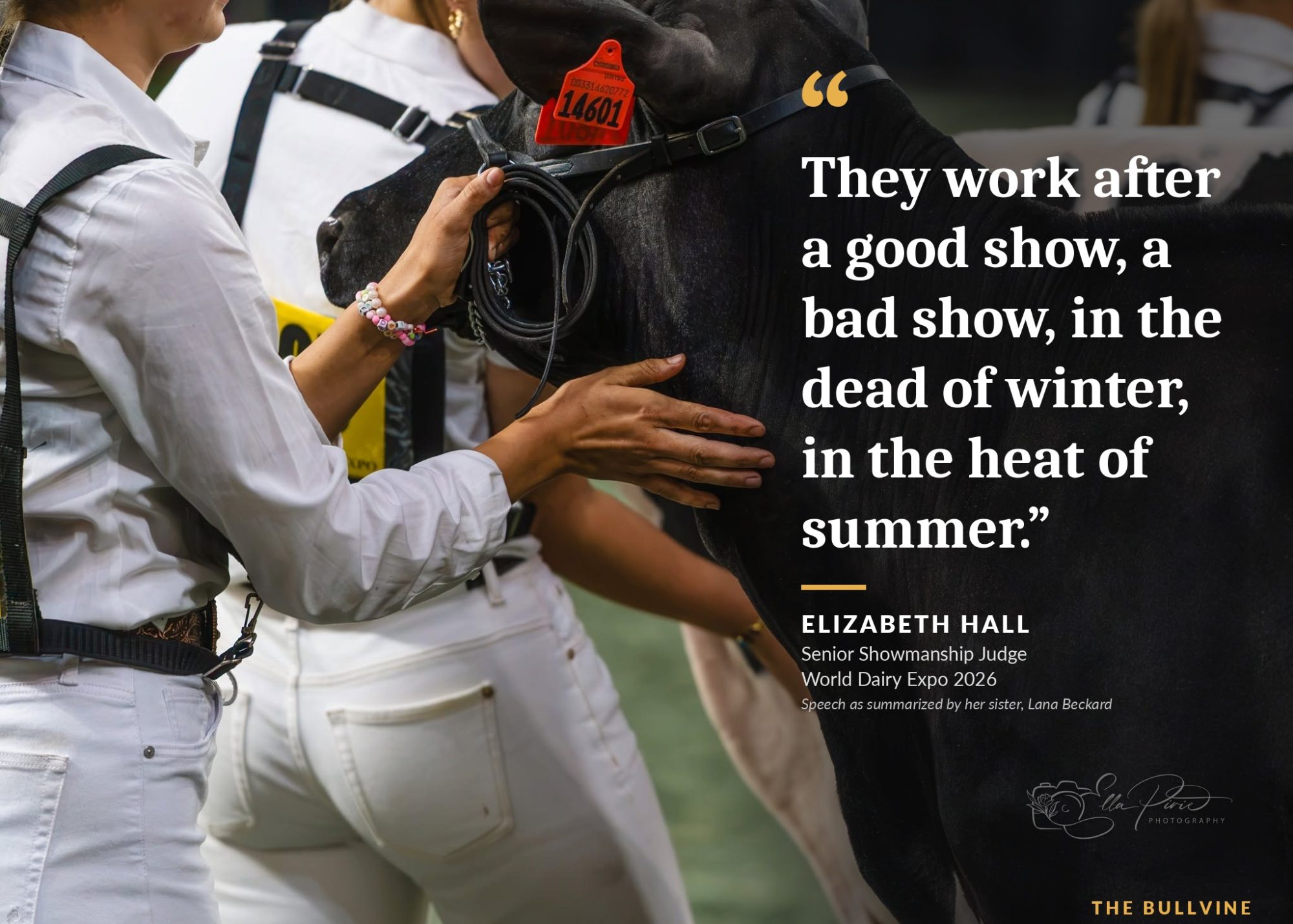
Nobody sees most of it. You halter-break in February, rinse in July, and walk a calf on frozen gravel while your friends are inside. Those few minutes in the ring are built on months of unseen work.
The work never checks the results first. Whether your heifer was pulled first or last, the calves still need feeding Monday morning. The breeders, herd managers, vets, classifiers, and techs this industry will lean on in 20 years are sitting in that 294 right now. They’re the ones who’ll show up on every kind of Monday.
Winners Work When Things Don’t Feel Right
This is where the speech grew bigger than the youth ring, and you can hear the farmer in it:
“We all know our heifers sometimes don’t fill right, or cows don’t fill with milk right, or a cow drops in milk, or heifers don’t look right, or milk prices aren’t good. The list goes on.
“But winners stay neutral to things they can’t control, and losers will dwell on negativity.”
Look at that list. It runs from your show heifer to your fresh cow to your family’s milk check. Read it at 17 and here’s what it says: the sinking feeling of a bad fill on show day is the same feeling your parents carry through a bad price. Learning to stay steady through the first one is how you survive the second.
Staying neutral means deciding where your heart goes: away from what you can’t change and into what you can.
Winners Work at Being a Good Person
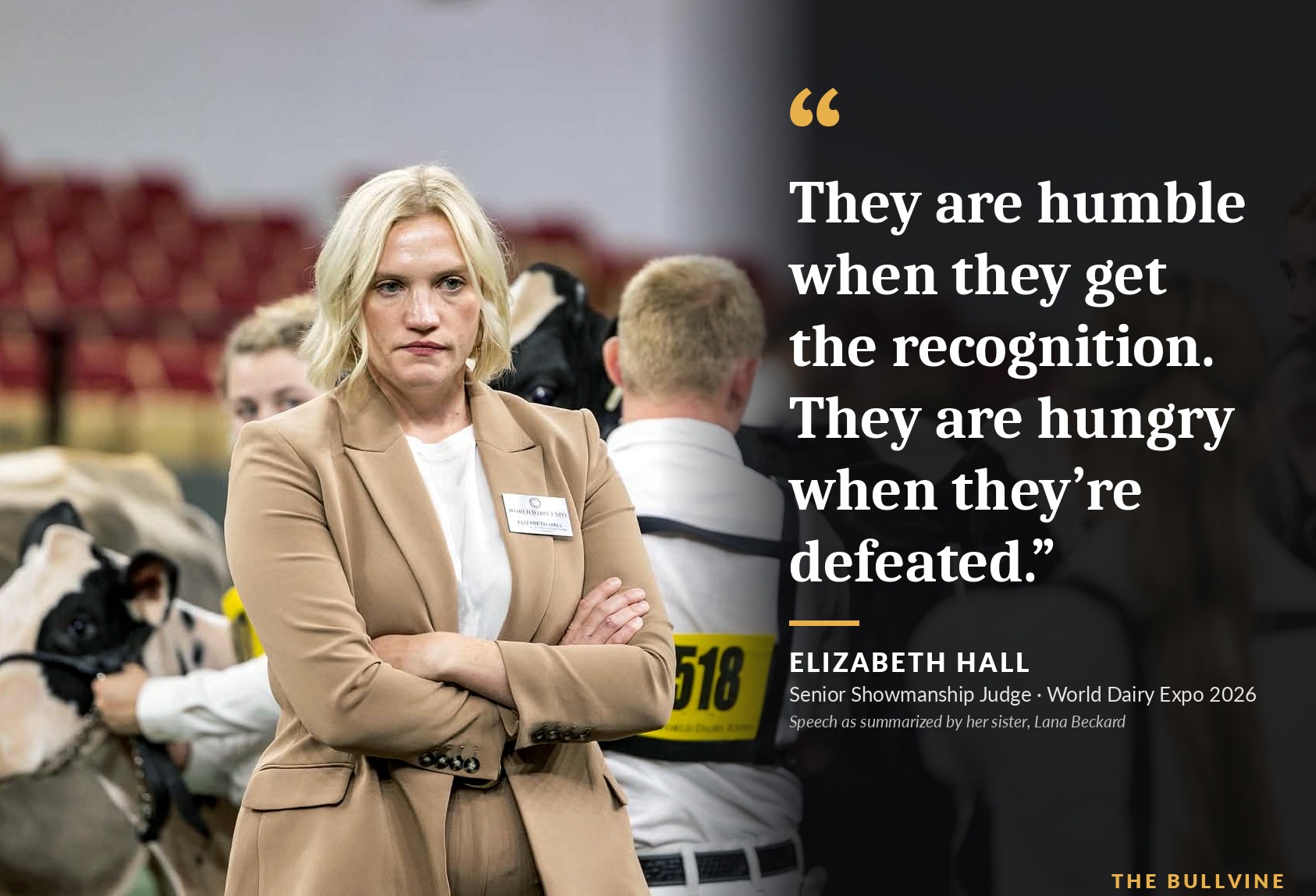
“They are humble when they get the recognition. They are hungry when they’re defeated.
“They’re team players. They’re happy when they see someone else win.
“And they give back. They serve others, and losers wait to be served.”
Humble when they win, hungry when they lose. Those two phrases cover both ends of that table. They give the six kids with checks a job, and they give the 294 kids without ribbons one too.
“Happy when they see someone else win” is the hardest one on the list. It means walking over to the kid who got pulled ahead of you and meaning the handshake. It means kneeling beside a nervous 9-year-old to help set her calf’s feet before her first big class.
Somebody did that for you once. Maybe a neighbor, a 4-H leader, an older kid from the next county. You probably still remember their name. Hall is asking you to be that name for somebody else.
Redefining the ‘L’ Word
In the version Beckard posted, the word shows up four times. It can sting, especially in a ring where most kids had just come up short.
Listen again, though. In her speech, losers point outward, wait for it to happen, dwell on negativity, and wait to be served. Every one of those is a choice a kid makes after the class, whatever the placing. By Hall’s definition, the kid sent out in the first cut of the seventh senior heat can walk out a winner. A champion who stops working loses, banner or no banner.
Karen Hunt made part of this case in these pages a decade ago, in “Learning how to handle failure builds character.” Hall went one step further. She gave a definition of winning any kid can meet on their worst day.
What to Do With It Before Next Season
A speech that gets reshared hundreds of times can be forgotten just as fast. Here’s how to keep this one:
- Ask one question before you load out. Find a judge, a fitter, or a breeder you respect and ask what they’d change. Write the answer down that night.
- Pick your February job. Choose one piece of work you’ll do every week this winter whether or not anyone sees it, like walking calves, clipping practice, or learning to read a pedigree.
- Make the two-column list. On one side, the things you can’t control: the judge, the fill, the milk price. On the other, the things you can: your preparation, your attitude, your next ask for help. Spend your energy on the second column.
- Shake the hand that beat you. Mean it.
- Find your 9-year-old. At your next show, help one younger kid in the barn.
Ready to do the work? Start with our Showmanship Tips Archive.
Your Job on the Drive Home
If you’re the parent, 4-H leader, or coach behind the wheel after a tough class, this part is yours.
Change one question. Swap “Where’d you place?” for Hall’s: “Did you work?” Then tell them you saw it. Name the early mornings, the extra rinse, the walk back across the barn to ask the judge a question.
Karen Hunt wrote to parents in her 2016 Bullvine piece: “When our children lose, as they inevitably will, they will learn to accept encouragement for the next time. The goal is to take the emphasis off winning and put it on mastery.” The ride home is where that encouragement starts.
And remember how this speech survived the day. Hall’s sister, Lana Beckard, wrote it down and shared it. You can do the same for the kid in your passenger seat by noticing the moment worth keeping and saying it out loud.
The Next Season of Life
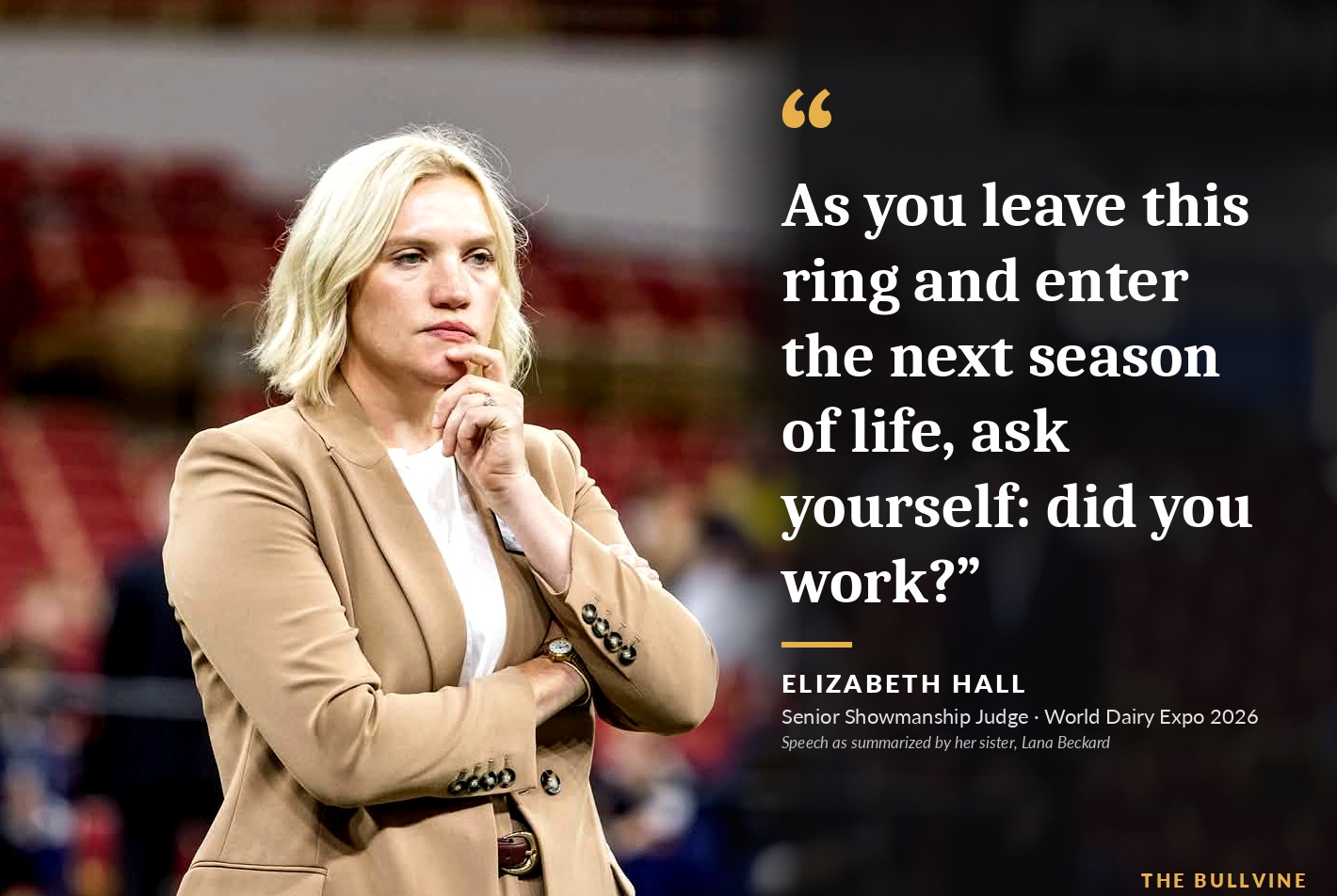
Hall ended on what comes after the ring:
“So with that, as you leave this ring and enter the next season of life, ask yourself: did you work?
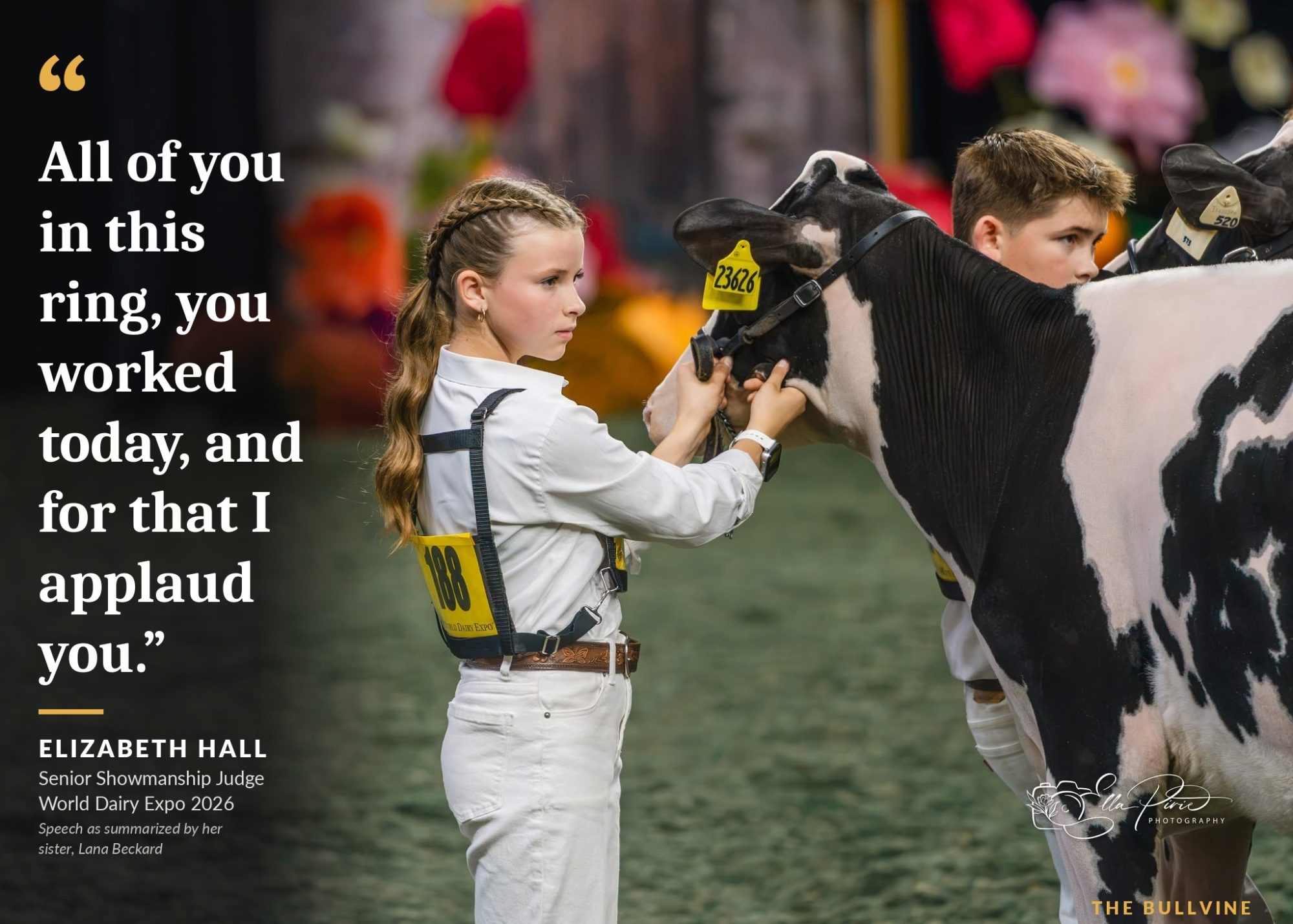
“All of you in this ring, you worked today, and for that I applaud you.”
Think about who said that: a woman who grew up on a Minnesota farm that showed at county fairs, standing in the middle of the Coliseum because young people like the ones in front of her asked her to be there.
Not all of you will stay in the show ring, and you don’t have to. Some of you will run the family herd. Some of you will breed cattle, or treat them, or classify them, or sell to the people who milk them. The ring is where you practice being the kind of person this industry needs, wherever you end up.
One of this year’s 294 could be holding that microphone someday. It could be the one who walked back to ask the judge a question, or the one who knelt down to help a 9-year-old. Maybe it’s you.
Whether you got pulled first, last, or not at all on September 26, the 2026 placings are written. Your next season isn’t.
So, did you work?
Learn More
- 2026 Dairy Show Guide: Judging, Type and Ring Craft — Arms you with updated PDCA scorecards and transition protocols to keep your projects competitive on the shavings. Breaks down how specific feed adjustments and modern ringcraft choices dictate whether an animal thrives or washes out.
- The Quiet Revolution: Two Young Dairy People Who Refused to Choose Between Love and Survival — Exposes the structural shifts making farm ownership economically impossible for the next generation. Follows two youth program graduates creating alternative careers, proving how a decade of show ring commitment translates into lifelong industry influence without inheriting a herd.
- DOC Just Made History: The First Showcase Bull to Hit a Million Units — Dismantles the decades-old myth that breeders must choose between the milk tank and the show ring. Delivers the hard numbers behind King Doc’s millionaire status, showing how elite type genetics are now driving profitability in progressive commercial operations.
 The Sunday Read Dairy Professionals Don’t Skip.
 The Sunday Read Dairy Professionals Don’t Skip.
Every week, thousands of producers, breeders, and industry insiders open Bullvine Weekly for genetics insights, market shifts, and profit strategies they won’t find anywhere else. One email. Five minutes. Smarter decisions all week.