







If you want to win in the modern dairy show ring, you need to understand the 2026 PDCA scorecard changes, how linear classification really works, and how those judging decisions feed straight back into your herd’s profitability.
Here’s the thing. The ring isn’t just theatre any more. It’s a live valuation engine for seedstock and a stress test for whether our idea of the “perfect cow” still works in robotic parlours and high-density housing. At The Bullvine, we’ve spent years analysing show results, classification data, and the economics behind type so you don’t have to sift through ten PDFs and three rulebooks every time the standards move.
In this dairy show guide, you’ll get a plain‑language breakdown of the 2026 PDCA Unified Scorecard, US and Canadian classification systems, the major 2026 shows and judges, 60‑day pre‑show prep, judging philosophies, youth pipelines, and the ethics debates you can’t ignore if you care about your social licence to operate.
PDCA Unified Scorecard 2026: What Changed and Why It Matters
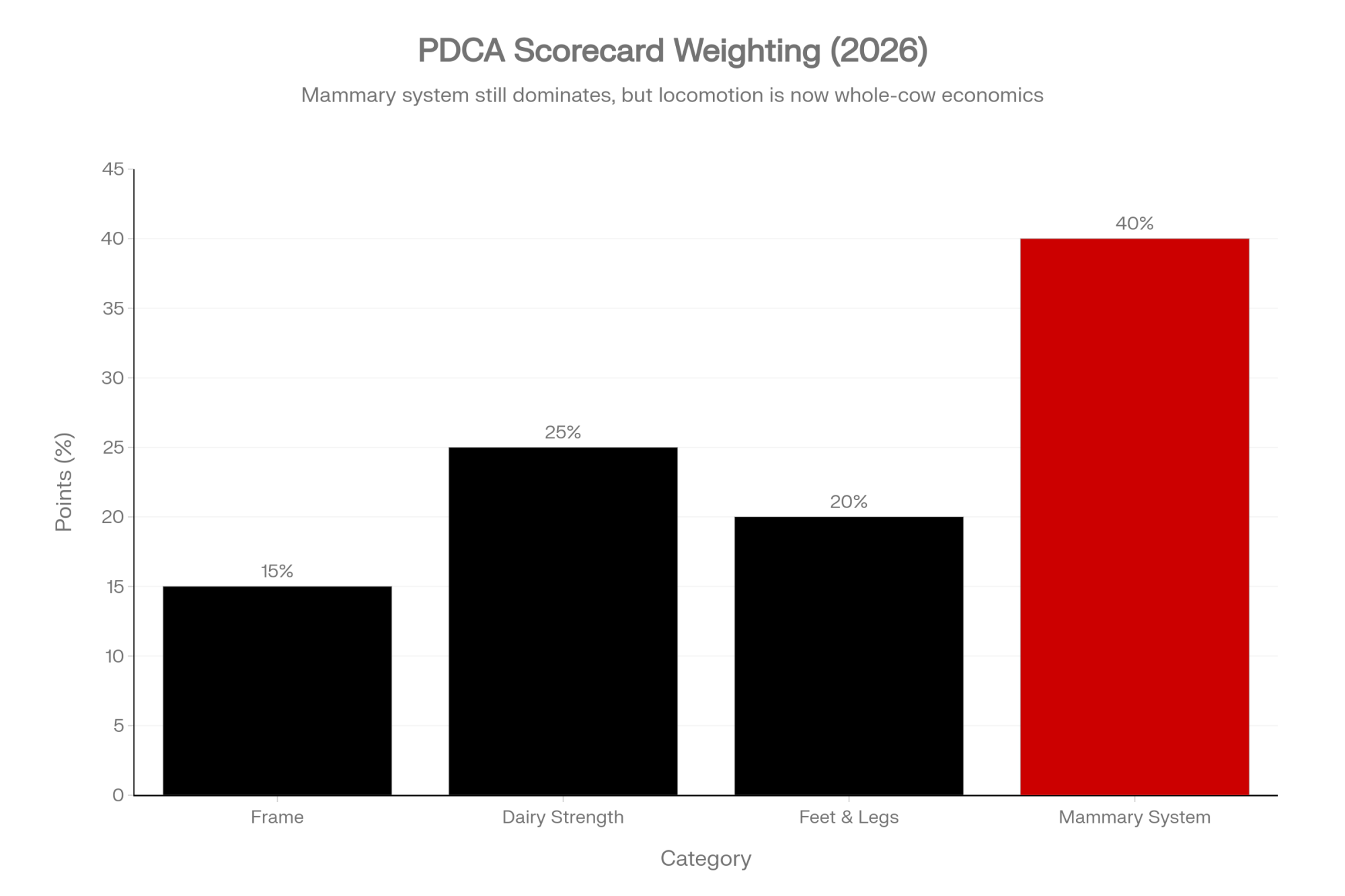
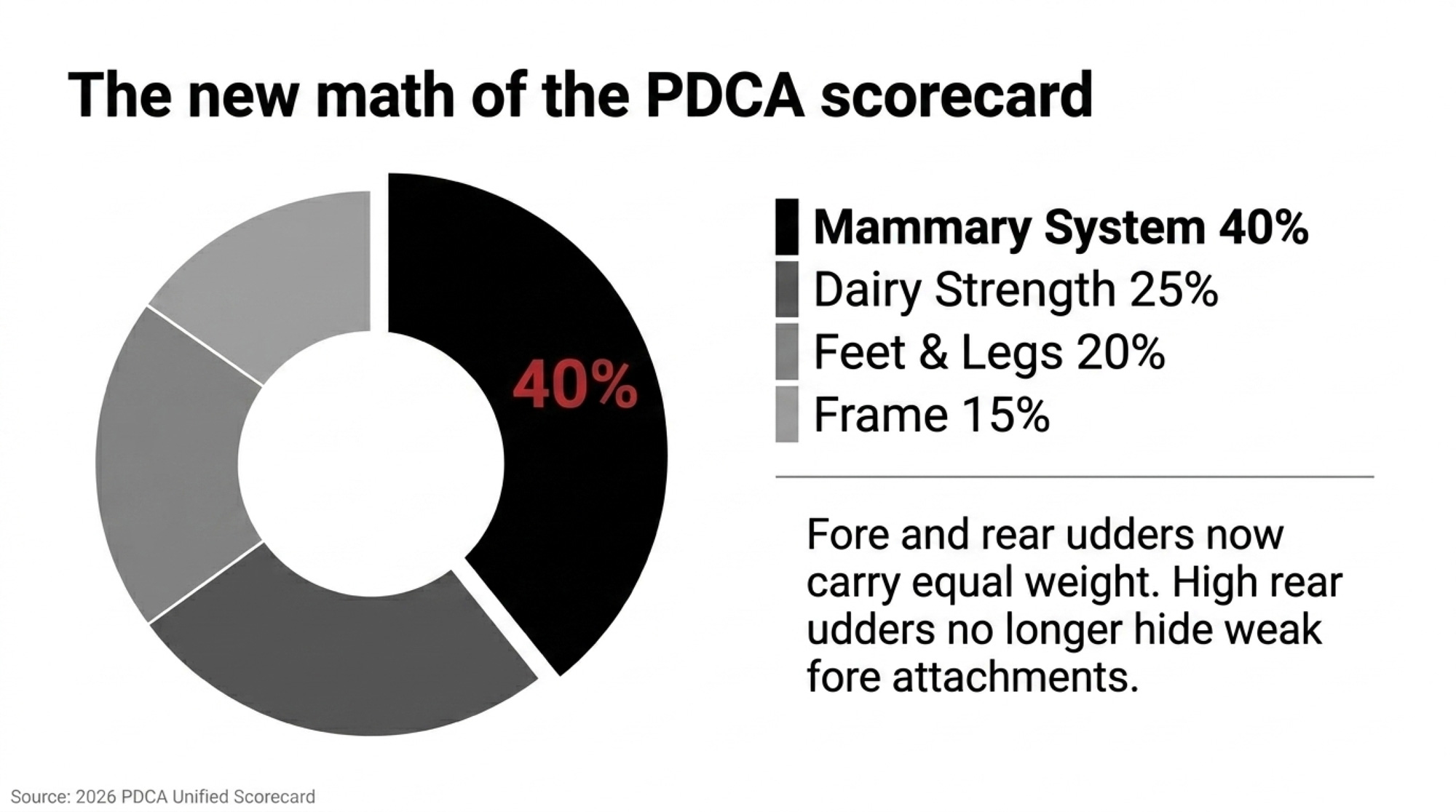
If you’re trying to read a judge’s mind, start with the PDCA Unified Scorecard. Everything they do in the ring hangs off those four buckets: Frame, Dairy Strength, Feet and Legs, and Mammary System.
Effective March 1, 2025 and carrying into the 2026 season, PDCA pushed through the biggest reset in a decade. The goal was simple but gutsy: bring show standards back in line with commercial reality and robotic milking instead of rewarding extremes that look great on shavings but cost money in the parlour.
The updated scorecard still totals 100 points, but a few details now matter a lot more than they did even two years ago.
The four dimensions of excellence
- Frame – 15%
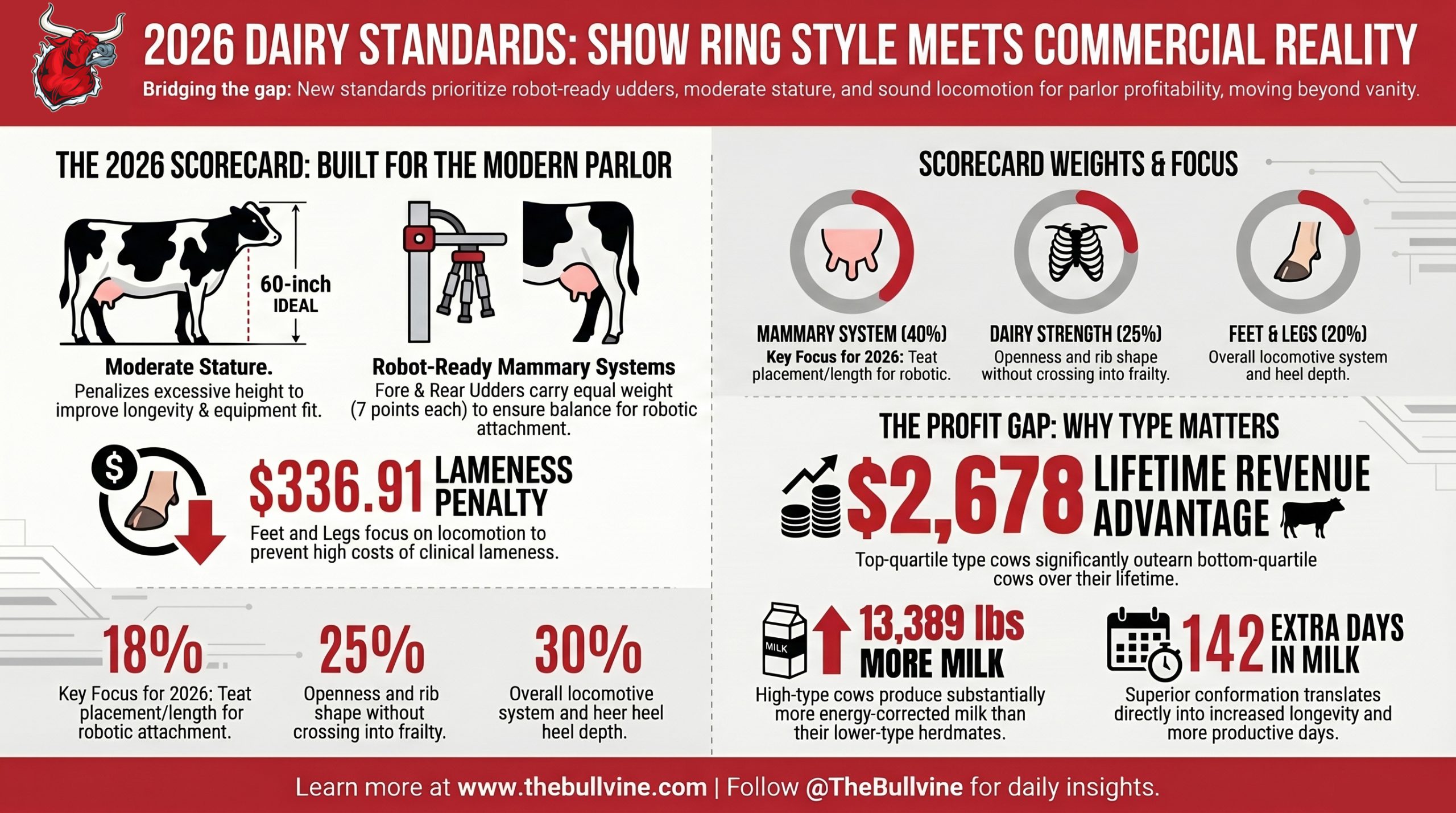
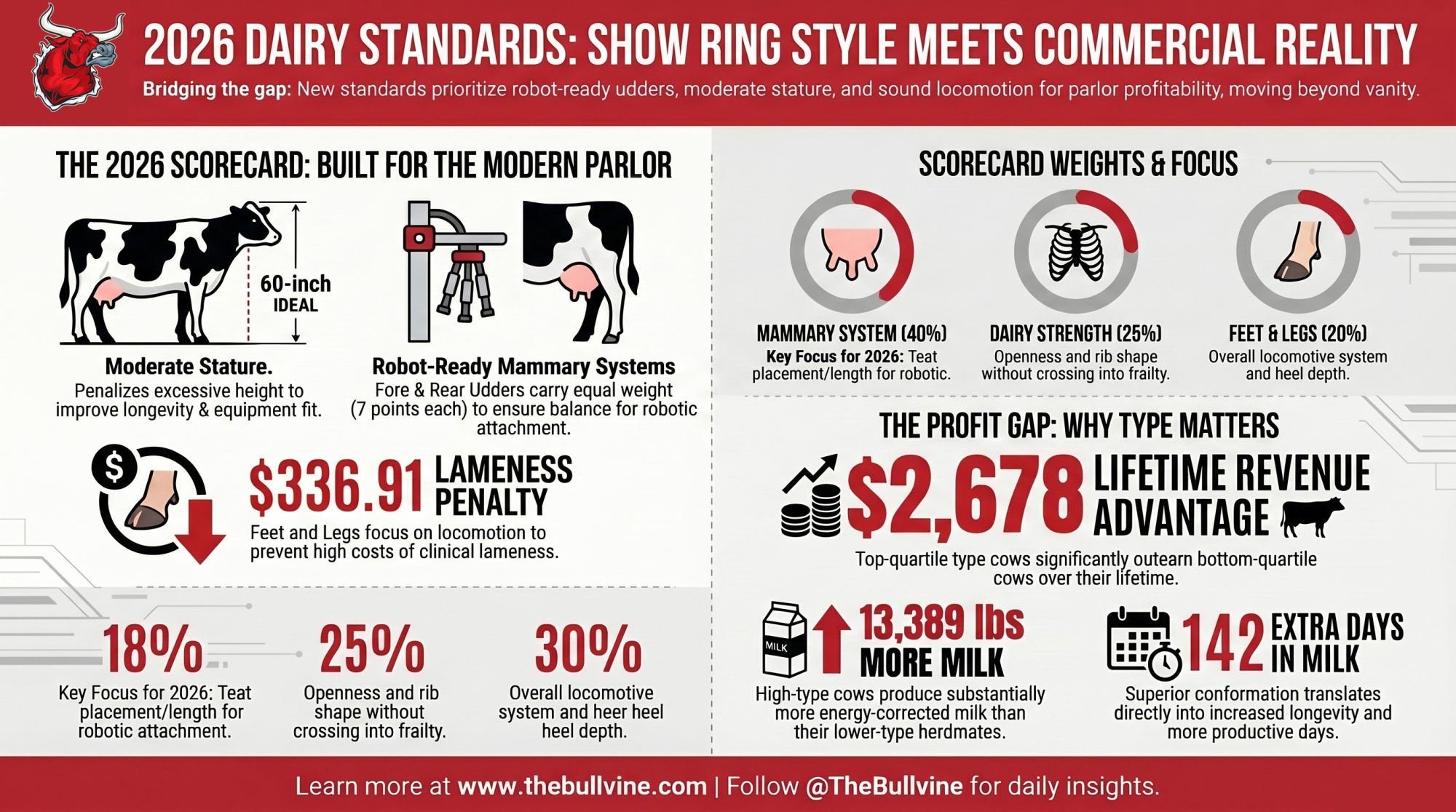
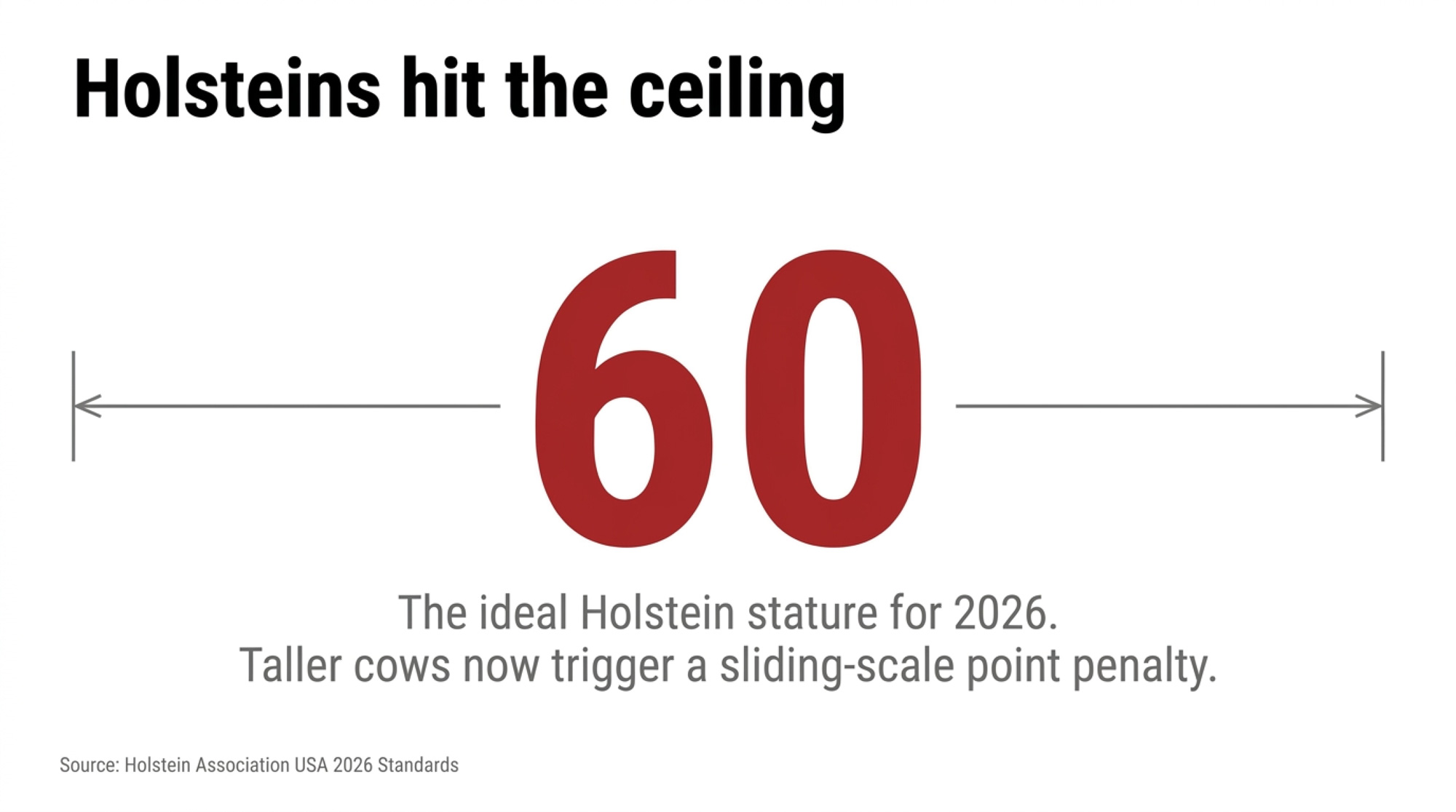
Frame is your skeletal foundation. Judges are looking for a long, wide rump that gives calving ease and a powerful rear udder platform, plus a wide chest floor and straight front legs. For 2026, Holstein specifically adopted an ideal stature standard of 60 inches and a sliding‑scale penalty for going taller, reacting to the very real longevity and equipment‑fit issues with giant cows.
- Dairy Strength – 25%
Dairy Strength is the truce between “open and angular” and “strong enough to stay out of the hospital pen.” The 2026 language explicitly rewards openness, wide‑apart ribs, and a long lean neck that blends smoothly into the shoulders without crossing into frailty. Too coarse and you lose efficiency; too frail and you lose metabolic capacity. - Feet and Legs – 20%
Renamed from “Rear Feet and Legs” to “Feet and Legs,” this category shifts the spotlight to the whole locomotive system. The judge is watching tracking from behind, rear leg set from the side, foot angle, heel depth, and overall ease of movement. With lameness cases easily costing $336.91 per incident, a steep foot angle and deep heel are now viewed as economic traits, not just cosmetic preferences. - Mammary System – 40%
Still the heavyweight. The big 2026 change is equal points for fore udder and rear udder: seven points each. Historically, rear udder height carried outsized influence; now, weak fore udders no longer get a free ride on a high rear. Teat placement and length are treated as “guardrail” traits because robots need centrally placed, adequately long teats to attach consistently.
Breed-by-breed PDCA scorecard comparison (2026)
| Breed | Frame | Dairy Strength | Feet & Legs | Mammary System | Mature Weight (lbs) |
| Holstein | 15% | 25% | 20% | 40% | 1,400+ |
| Jersey | 15% | 25% | 20% | 40% | 1,000 |
| Ayrshire | 15% | 25% | 20% | 40% | 1,200 |
| Brown Swiss | 15% | 25% | 20% | 40% | 1,400 |
| Guernsey | 15% | 25% | 20% | 40% | 1,200–1,300 |
| Milking Shorthorn | 15% | 25% | 20% | 40% | 1,250–1,500 |
Specific breed character – dished face on Jerseys, mahogany red Ayrshire markings – is still read inside the Frame/Breed Characteristics bucket.
“A cow that wins on shavings but loses your milking robot is a luxury most commercial herds can’t afford.”
Dairy Cow Classification Systems: Linear Type as a Profit Tool
Honestly, this is where most people under‑utilise the system. Final scores hang on the office wall. Linear codes drive your herd economics.
Linear classification turns what the judge sees into data points that geneticists and AI studs can analyse across millions of cows. The show ring is one day. Classification, especially under WHFF harmonisation, is your long‑game.
WHFF 1–9 scale: one language, many countries
The World Holstein‑Friesian Federation standardised 18 primary linear traits on a 1–9 scale. A 1 and a 9 aren’t “bad” and “good.” They’re extremes.
- 1 for stature = extremely short
- 5–6 = intermediate, where “slight slope” or “moderate set” live
- 9 = extremely tall, or extremely sloped, or extremely sickled – depending on the trait
| Trait | 1 Point (Low) | 5 Points (Intermediate) | 9 Points (High) |
| Stature | Extremely short | Intermediate | Extremely tall |
| Chest width | Narrow | Intermediate | Wide |
| Body depth | Shallow | Intermediate | Deep |
| Angularity | Coarse/tight | Intermediate | Open/sharp |
| Rump angle | High pins | Level/slight slope | Extremely sloped |
| Rear leg set | Posty/straight | Moderate angle | Extremely sickled |
| Foot angle | Low/flat | Intermediate | Extremely steep |
| Fore udder | Extremely loose | Intermediate | Extremely strong |
| Udder depth | Below hock | Level with hock | High above hock |
| Teat length | Short (<1.25″) | Intermediate (~2.25″) | Long (>3.25″) |
Scores are taken on biological two‑year‑old “anchors” so a 7 for foot angle in Wisconsin means the same as a 7 in Ontario or Verona.
URL: WHFF linear traits manual
Holstein USA vs Holstein Canada: same cow, different lenses
Holstein USA
Holstein USA uses linear traits that roll up into five breakdowns – Frame, Dairy Strength, Rump, Feet & Legs, Mammary System – and then into a final score banded as EX (90–97), VG (85–89), GP, G, F, P.
A 2026 tweak that matters for anyone chasing BAA: cows now need to have calved within the previous 24 months to count toward a herd’s Breed Age Average. This keeps BAAs anchored in cows that are actually working, not just hanging around the dry pen looking nice.
Holstein Canada
Holstein Canada runs a multi‑breed classification program built on the same trait set, but the math behind the scenes leans on the Animal Model. It factors the cow’s own score, her ancestors, and her progeny into her genetic index, rather than just taking her card at face value.
The Canadian breeding goal puts high protein yield plus durable conformation front and centre. The whole system is built to reward cows that can crank out high components and stay in the herd for a lot of lactations, not just win one banner.
URL: Holstein Canada Classification
Classification and lifetime profit: the $2,678 gap
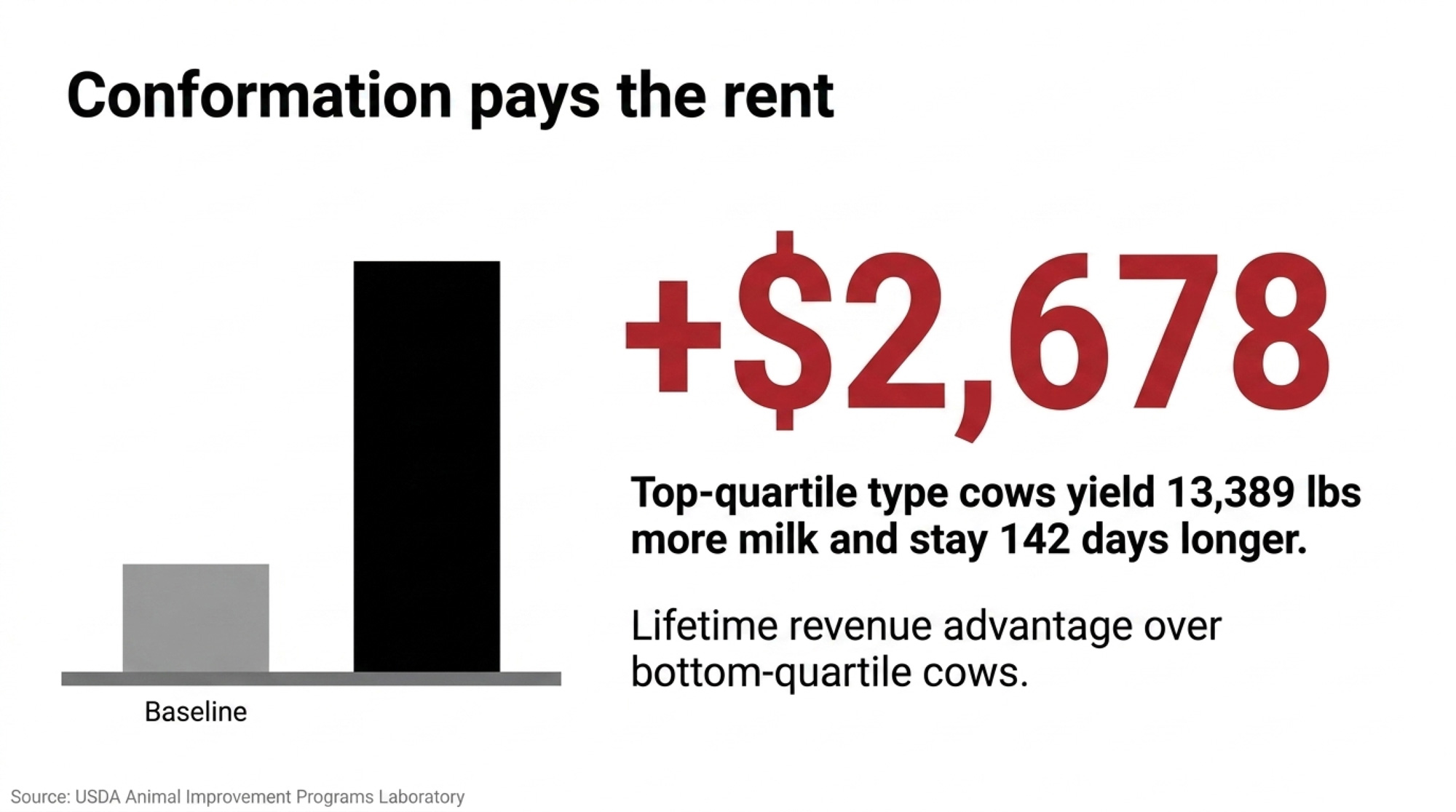
A 2025 study tracking one million Holsteins showed a ,678 lifetime revenue gap between cows in the top quartile for type and those in the bottom quartile. Top‑quartile cows produced 13,389 lb more energy‑corrected milk and stayed in milk an average of 142 more days over their lifetimes.
That’s not show‑ring vanity. That’s rent, feed, and loan payments.
| Type Quartile | Lifetime ECM (lb) | Extra days in milk | Lifetime revenue advantage |
| Top 25% | +13,389 | +142 | +$2,678 |
| Bottom 25% | Baseline | Baseline | Baseline |
URL: USDA Animal Improvement Programs Laboratory type and longevity papers
The 2026 Major Dairy Show Circuit: Dates, Judges, Context
The 2026 show year is basically five anchor events with a lot of important regionals orbiting around them. If you’re chasing banners or marketing embryos, these dates belong on your office wall.
World Dairy Expo – Madison, Wisconsin
- Dates: September 27 – October 2, 2026
- Entry timing: Premium book and online entries open July 1, 2026; standard entries due August 31, 2026 at 11:59 p.m. Central.
- Judge selection: Judges are nominated by past exhibitors and vetted by a committee to protect credibility.
The 2025 Supreme Champion, Golden‑Oaks Temptres‑Red‑ET (EX‑95 Red & White Holstein), underlined just how strong Red Holstein genetics are right now in inter‑breed competition.
| Show | Dates | 2026 Holstein Judge | Standard Entry Deadline |
| IDW (Australia) | Jan 18–22, 2026 | TBD | Dec 1, 2025 |
| European Open | Feb 5–6, 2026 | Brian Carscadden (CA) | Jan 16, 2026 |
| All-American | Sept 12–16, 2026 | TBD | Sept 1, 2026 |
| World Dairy Expo | Sept 27–Oct 2, 2026 | Ryan Krohlow (WI) | Aug 31, 2026 |
| Royal Winter Fair | Mid-November 2026 | TBD | Oct 17, 2026 |
Royal Agricultural Winter Fair – Toronto, Ontario
“The Royal” is still the top Canadian genetics showcase. In 2025, Altona Lea Unix Herminie took Holstein Grand Champion, cementing how deep the Unix line has cut into the Canadian show scene.
- 2026 timing: Mid‑November (National Holstein typically mid‑show)
- Entry deadlines: Typically mid‑October; 2025 used an October 17 regular deadline.
All-American Dairy Show – Harrisburg, Pennsylvania
- Dates: September 12–16, 2026
- Known for its deep youth component and the Premier National Junior Events. It’s a great read‑through on which strings will be dangerous at Madison a few weeks later.
European Open – Verona, Italy
- Dates: February 5–6, 2026 at Fieragricola, Verona
- Holstein Judge: Brian Carscadden (Canada), bringing a very North American eye to European cattle.
This show’s value for North American breeders is calibration. Watching how European judges handle udder depth, teat placement, and stature against robot barns and grazing systems gives you a mirror for your own herd goals.
International Dairy Week – Tatura, Australia
- Dates: January 18–22, 2026
- Southern Hemisphere’s largest dairy event and an early-year look at daughters from sires that will later land in North American strings.
Show-Day Mechanics: Fitting, Clipping, Feeding and Freshening
Here’s where the art meets the rulebook. You can’t “fit your way out of” structural faults, but you can absolutely lose a class with bad prep.
The 60‑day pre‑show feed protocol
The show really starts two months out. You’re managing rumen capacity, bloom, and body condition with more intention than most “everyday” cows ever get.
- Transition management for fresh cows: The three weeks before and after calving are where you either set up a show cow or fight problems all season. Glucogenic diets rich in starch (maize) after calving increase glucose availability for mammary cell regeneration and reduce the risk of subclinical ketosis that drains performance.
- Calf and heifer growth: Show heifers run on high‑quality hay (~50% NDF) plus a 16% protein grain mix fed at 1.5–2% of bodyweight. You’re chasing muscle tone and skeletal growth, not fat heifers.
- Transition milk: Feeding transition milk (second to fourth milkings) can add 6.6 lb to weaning weight and cut disease incidence by 50%. That’s genuinely transformational for future show prospects.
On show week itself, the “fill” strategy is simple, not mystical:
- Soaked beet pulp 4 hours before the class, fed to appetite
- Multiple water opportunities
- Grain cut back so you don’t over-condition or trigger acidosis on pack
- Constant small hay offers to keep rumen working and rib sprung
Fitting and clipping: breed-specific nuances
Fitting is basically sculpting the cow you already have. The 2026 PDCA rules give you a clear line: you can enhance, you can’t fabricate.
- Clipping patterns:
- Holsteins are clipped to emphasise angularity and flow – neck blended into shoulder, shoulder into rib, tailhead blending into rump.
- Brown Swiss and Ayrshires are clipped to show strength and bone, not razor‑sharp dairy character. You’re highlighting ruggedness.
- Topline creation:
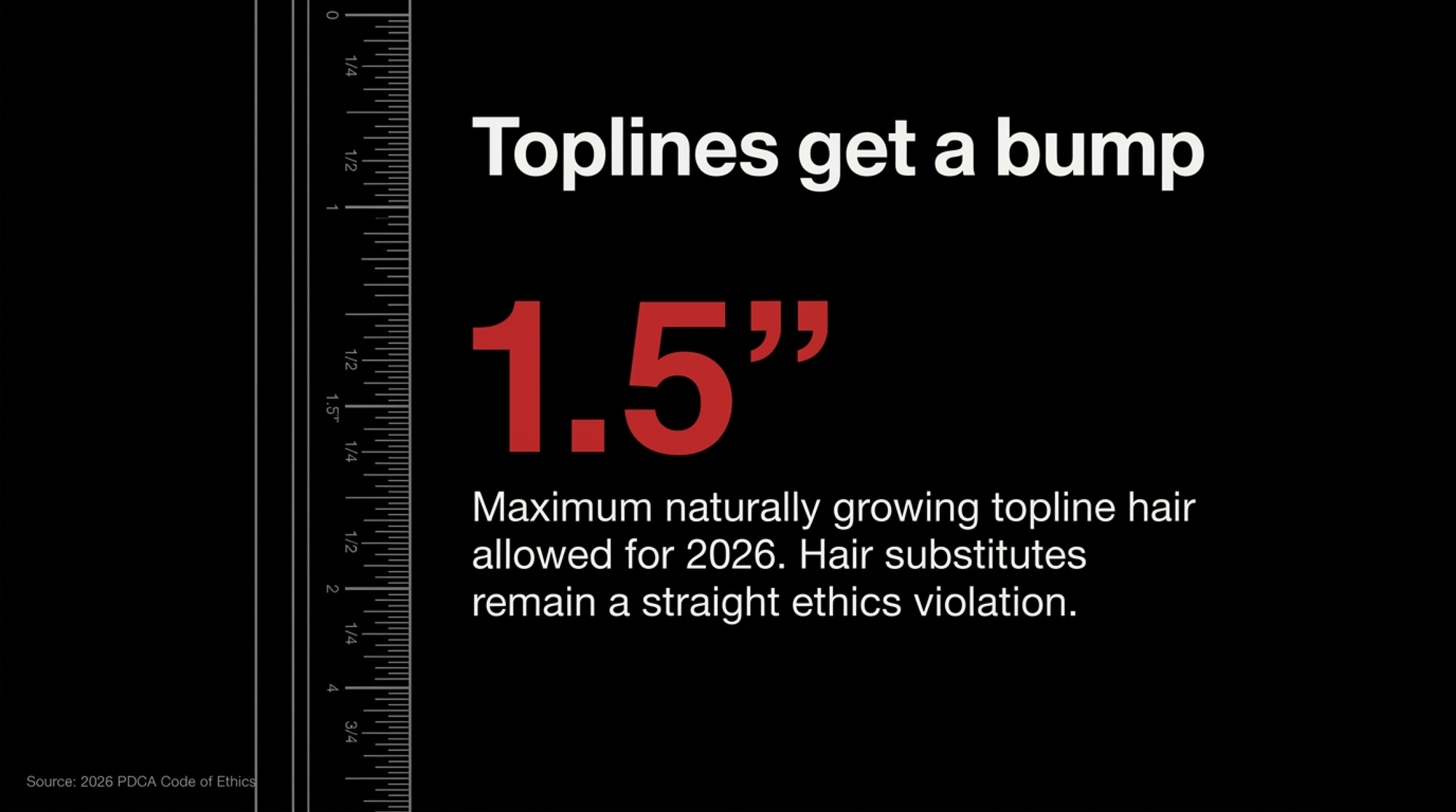
The big change here is legal hair length. Maximum naturally growing topline hair is now 1.5 inches for 2026 (up from 1 inch). Hair is blown up, set with clear adhesive, then trimmed into a straight, wide line from withers to tailhead.
- Leg prep:
Legs are clipped to show flat bone and clean joints. Any swelling or coarseness is minimised by how you leave or remove hair, but you still can’t hide a bad hock. - Products:
The toolbox has moved toward clear adhesives, white foams for “boning” legs, and subtle shine for pliable skin. Hair substitutes or foreign fibres are a straight ethics violation.
Freshening strategy and the “bagging” line
Over‑bagging – letting the udder blow up uncomfortably full before a class – is now taken seriously. The 2026 Code of Ethics demands animals be shown in their natural conformation, and ethics officials can call for a milk‑out of the top five in a class.
The sweet spot most strings use is a controlled milk‑out a few hours before the class, leaving enough fill to show attachment and capacity without putting ligaments or welfare at risk.
Judging Philosophy: How 2026’s Elite Officials See Your Cattle
You can’t read the placings without understanding the people behind them. The 2026 elite judge slate is a good cross‑section of how the industry wants cows to look and work.
David Hanson – Ayrshire purity and utility
An eighth‑generation breeder from Minnesota’s Red River Valley, Hanson’s eye is tuned to “constitution and vigour” plus the udder shape that defines top Ayrshires. His family’s 100% pure Ayrshire focus means he’ll always reward breed character and cows that look like they’ll last.
Richard “RT” Thompson – Brown Swiss bull‑mother mindset
At Random Luck Farm, Thompson learned early that “show winners were also the bull mothers of the breed.” That’s his whole philosophy. Type isn’t wall art; it’s the filter for which cows get to transmit. He won’t reward fragility in a breed built for long productive lives.
Chris Lang – Guernsey eye from calf to cow
Springhill Farm’s Lang has a reputation for spotting elite Guernseys from calfhood through maturity. He brings an American focus on udder attachment and skeletal balance into international rings, and he’s known for rewarding an “eye for quality” even in very young heifers.
Ryan Krohlow – Holstein scale, power, and robot-ready udders
As a former professional fitter, Krohlow is hyper‑sensitive to mammary detail and skin quality. His International Holstein Show at WDE 2026 will lean toward cows that “command the ring” with scale, power, and high, wide, robot‑friendly udders.
Ben Wallace – The junior-ring complete package
In the junior ring, Wallace looks for the complete package: functionally correct animals, professionally presented. He rewards heifers that clearly grew under a structured rearing program, especially in frame development and balance.
“Judge today’s cow, not her reputation. Reputation fills barns; it doesn’t place classes.” – common philosophy across the 2026 panel
Youth Programs and the Dairy Show Talent Pipeline
If you want to know what WDE looks like in 10 years, walk through the 4‑H and FFA dairy showmanship classes today.
4‑H, FFA and junior breed associations
4‑H and FFA programs give kids a staircase from junior calf classes to pro‑level strings. Along the way they learn showmanship, husbandry, and the biology behind what judges are really rewarding.
The 2026 PDCA Showmanship Guidelines raise the bar:
- “Sidestepping when leading” is now a moderate discrimination, not a slight one.
- “Failure to stop and set up the animal quickly” is also bumped to moderate.
That shift says a lot. Technical execution in the ring matters more than ever.
Junior breed associations – like the Junior Holstein Association – add structural classes like “Junior Best Three Females”, where all three animals must be bred by the junior and shown individually. It quietly trains the next generation of breeders, not just showmen.
Why the pipeline matters for the industry
These youth programs keep talent in dairy instead of losing it to other sectors. They also shape how the public sees our industry, especially in a world where welfare and sustainability narratives are under constant scrutiny.
URL: USDA 4‑H youth development dairy resources
Controversies in the Dairy Show Ring: Ethics, Photos and Welfare
Let’s be blunt: 2026 is not a “business as usual” year for show ethics. Three fronts are driving hard discussion.
Photo manipulation and marketing honesty
Digital editing in sale catalogues and social feeds has become sophisticated enough that you can quietly “fix” teat placement, deepen ribs, or tweak udder texture. That might sell some embryos today, but it’s torching trust tomorrow.
Because PDCA’s Code of Ethics stops at the ring gate, the marketing side is still a bit wild west. The debate now is whether associations need parallel rules for how show cattle can be represented visually in commerce.
Cosmetic enhancement and teat setting
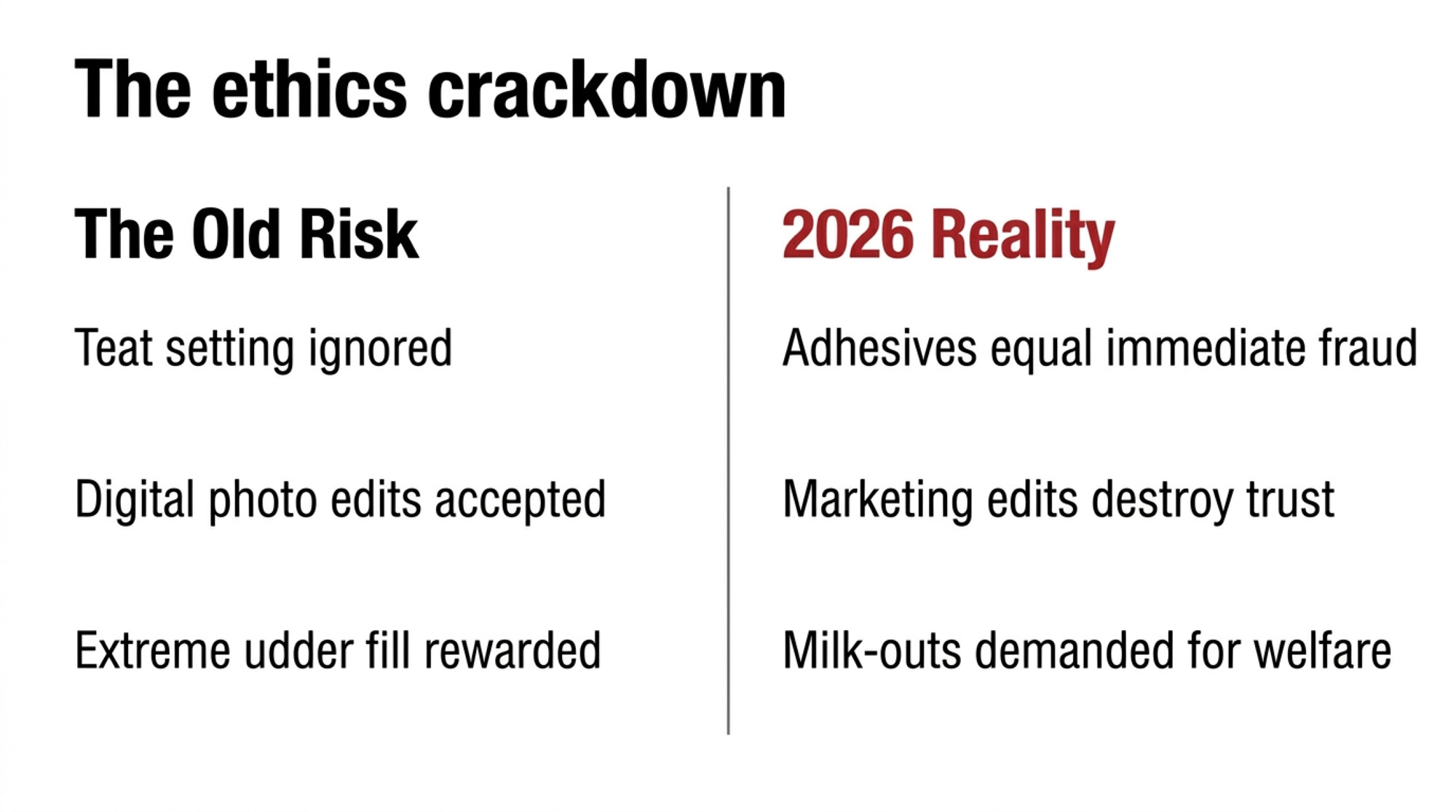
PDCA has made its position crystal clear: teat setting – using adhesives or devices to reposition teats – violates the Code of Ethics. Same story for using irritants to fake an udder crease.
Anything that alters natural conformation crosses the line from “fitting” into “fraud.”
| Practice | 2026 Status | Why It Matters | Risk Level |
| Natural topline hair up to 1.5 inches | Allowed within limit | Lets fitters create a clean line without foreign hair or fibres | Moderate |
| Hair substitutes or foreign fibres | Prohibited | Changes the animal’s natural contour and crosses the PDCA ethics line | High |
| Teat setting with adhesives or devices | Prohibited | Artificially repositions teats and misrepresents natural conformation | High |
| Over-bagging before class | Serious welfare concern | Creates udder pressure and can trigger milk-out checks in top placings | High |
| Controlled milk-out before class | Accepted practice | Balances udder fill, attachment display, and animal comfort | Low–Moderate |
Animal welfare and over-bagging
Over‑bagging, or worse, inserting foreign material under the skin to change contour, is treated as a serious welfare breach. Show management knows the industry’s social licence depends on visible, verifiable good care.
You’ll see stricter enforcement, more vet involvement, and more milk‑out checks on top‑placings. That’s not politics – it’s survival in a world where one viral video can undo a lot of good work.
Frequently Asked Questions
What is the maximum allowed topline hair length for 2026?
The maximum allowed naturally growing topline hair length in 2026 is 1.5 inches, increased from the previous 1‑inch standard to match modern fitting practices while still banning foreign hair or fibres.
Does the new stature penalty apply to all dairy breeds?
No. The specific 60‑inch ideal and sliding‑scale stature penalty is a Holstein Association USA initiative. Other breeds still use the PDCA Frame weightings without the same formalised stature penalty scale.
How has showmanship judging changed for youth in 2026?
The 2026 PDCA Showmanship Guidelines now treat “sidestepping when leading” and “failure to set up the animal quickly” as moderate discriminations instead of slight ones. That raises expectations for technical precision in every youth class.
Can I legally use hair substitutes to fix a weak loin?
No. The PDCA Code of Ethics prohibits adding hair, hair substitutes, fibres, or any foreign material to change the animal’s natural contour. Topline work must use only the animal’s own hair within the 1.5‑inch limit.
What are the dates for the 2026 World Dairy Expo?
World Dairy Expo 2026 runs from September 27 through October 2, 2026 in Madison, Wisconsin. Online entries open July 1, with standard entries due August 31 at 11:59 p.m. Central.
Who is judging the International Holstein Show at WDE 2026?
The official Holstein judge for the International Holstein Show at WDE 2026 is Ryan Krohlow of Wisconsin, known for prioritising scale, power and high, well‑attached udders suited to modern Holstein herds.
What is the 2026 BAA rule change?
For the 2026 season, cows must have calved within the previous 24 months to be included in a herd’s Breed Age Average (BAA) calculation. This keeps BAA aligned with cows that are actively contributing to production.
How do I qualify for “Junior Best Three Females” classes?
All three animals in a “Junior Best Three Females” class must be bred by the junior exhibitor and shown in their individual classes. The class is designed to reward junior breeding programs, not just showmanship.
What does “Animal Model” classification mean in Canada?
“Animal Model” refers to the Canadian genetic evaluation method that combines a cow’s own classification score with data from her ancestors and progeny. It helps identify genetics that consistently transmit desirable conformation across generations.
Is teat setting ever legal if done with professional products?
No. Teat setting – any artificial repositioning of teats using adhesives or devices – is explicitly prohibited under the PDCA Code of Ethics, regardless of the product used or how subtle the change appears.
Key Takeaways
- PDCA’s 2026 scorecard updates push the ring toward cows that can actually thrive in robotic parlours and high‑output systems, not just pose for photos.
- Linear classification, especially under WHFF, is a profit tool – top‑quartile type cows generated $2,678 more lifetime revenue and 13,389 lb more ECM.
- The 2026 circuit (IDW, European Open, All-American, WDE, The Royal) has clear entry deadlines and judge slates that should shape your breeding and marketing calendar.
- Fitting rules now allow 1.5‑inch topline hair but crack down harder on hair substitutes, teat setting, and over‑bagging to protect welfare and credibility.
- Youth programs and updated showmanship rules are quietly raising the technical bar for the next generation of judges, fitters and breeders.
- Photo manipulation and cosmetic enhancement are moving from “everybody does it” to high‑risk behaviours that could cost you reputation and buyers.
 The Sunday Read Dairy Professionals Don’t Skip.
 The Sunday Read Dairy Professionals Don’t Skip.
Every week, thousands of producers, breeders, and industry insiders open Bullvine Weekly for genetics insights, market shifts, and profit strategies they won’t find anywhere else. One email. Five minutes. Smarter decisions all week.




