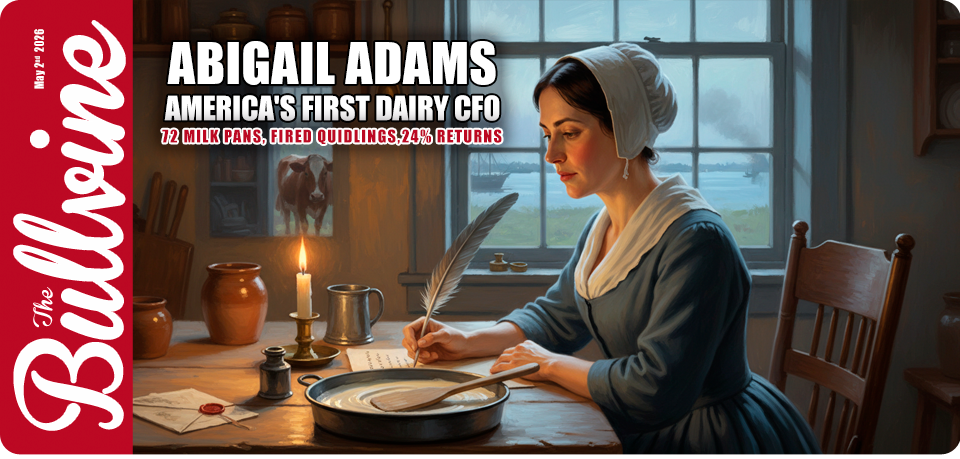






Braintree, 1794. Her land paid 2%. Her bonds paid up to 24%. She ordered 72 milk pans, fired the quidlings, and out‑managed half the Founding Fathers from a farmhouse desk.
Act I — Cannons, Cream Pans, and a Woman with a Quill
The cannons had barely cooled.
It was April 11, 1776. Boston Harbor still carried the faint bite of gunpowder from months of siege. British warships had rattled windows from Roxbury to Braintree, and every farmhouse along that stretch of coast had learned to flinch at the sound of distant artillery.
A few miles south of town, in a plain wooden farmhouse in Braintree, Massachusetts, the air was different. Woodsmoke. Damp wool drying by the hearth. The sour‑sweet tang of yesterday’s milk resting in shallow tin pans in the buttery, throwing off a bit of chill as the cream lifted. Somewhere beyond the kitchen wall, a cow bawled for her calf, and a team of horses clinked past with harness and chain.

At the kitchen table, a woman dipped her quill in ink instead of cream.
Her husband was in Philadelphia, arguing over phrases that would soon cut an empire in half. She’d heard the cannon fire. She’d watched neighbor boys drill on stony pastures and disappear down the road toward armies that might never send them back. She could have written about fear. Loneliness. The price of salt.
She wrote about ambition.
“I hope in time to have the Reputation of being as good a Farmeress as my partner has of being a good Statesmen.”
That’s the voice that opens this story. Abigail Adams, thirty‑one years old, the wife of a lawyer‑turned‑revolutionary, sitting in a working farmhouse with milk cooling in the pantry and a war rumbling just beyond her door. In one sentence, she planted a flag most of her contemporaries couldn’t even see. Inside twenty years, that same quill hand would be buying discounted government notes through a trusted middleman while John was off in Paris — returns her husband would sneer at and her household would quietly live on.
Here’s what most folks miss about that line.
When Abigail wrote “Farmeress,” she wasn’t being cute. She wasn’t reaching for a romantic title to tuck into a letter. In an era when a married woman legally couldn’t own so much as her own butter churn under the doctrine of coverture, she was staking out a professional identity. She was telling her absent husband — and, quietly, the future — that while he built a country, she intended to build a farm worth remembering.
Most people know Abigail as the one who told the Founders to “Remember the Ladies.” That quote wins posters and school projects. But if you actually sit with the 2,100‑plus letters she and John traded over forty years, a different Abigail steps forward. One who talked hay yields, cheese hundredweights, laborer contracts, and discounted government notes with the same cool attention most Revolutionary leaders reserved for treaties.
She wasn’t alone in her era, though she was rare. Down in South Carolina, another woman about her age — Eliza Lucas Pinckney — was quietly perfecting indigo cultivation on her father’s plantations and reshaping a whole colony’s export economy. Different crop, different geography, darker moral footprint given Pinckney’s reliance on enslaved labor, but the same unmistakable pattern: the Revolution‑era colonies had a handful of brilliant women managing serious agricultural operations while the men were off tending to war, politics, or empire. Abigail was New England’s entry in that short, extraordinary list.
What nobody sitting at that kitchen table could have seen, that spring morning in 1776, was this: the woman writing about being a “Farmeress” would one day become the reason a founding family kept its farm when other, more famous Founders lost theirs.
Every dairy farmer reading this knows her type, whether they know her name or not.
Born to Books, Married to the Land
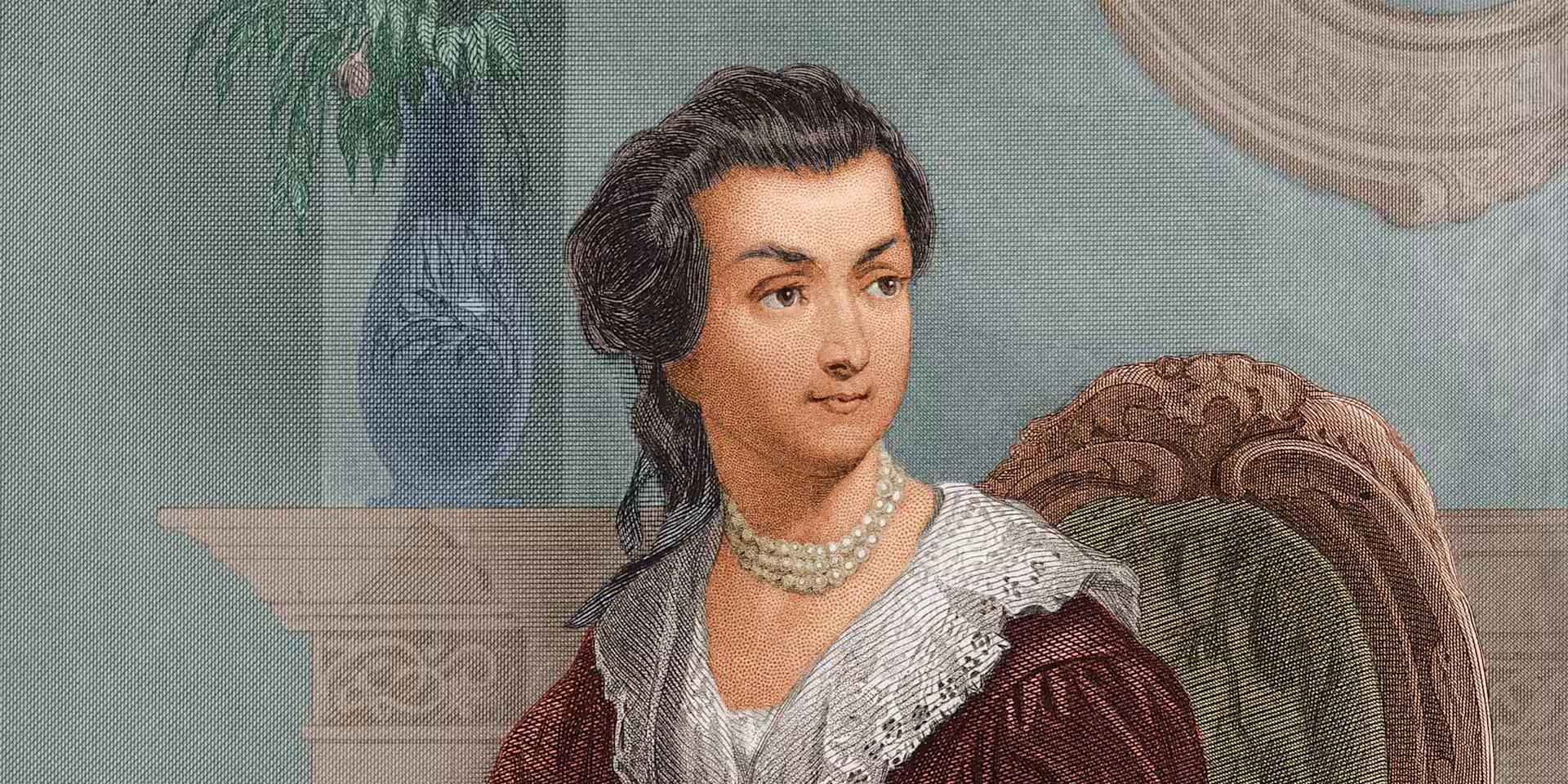
Abigail Smith came into the world on November 11, 1744, in Weymouth, Massachusetts. Her father, William Smith, preached from a Congregational pulpit. Her mother, Elizabeth Quincy, carried a family name already woven into colonial politics and property.
No schoolroom ever held her. Girls of that time simply didn’t get that luxury. But the parsonage was effectively a library with a kitchen attached, and young Abby grazed those shelves the way a good heifer grazes first‑cut alfalfa — thorough, selective, and hungry. Theology. Law. History. Poetry. Richard Cranch, a young tutor who would later marry her sister Mary, helped shape her reading. It showed.
Historian John Kaminski sums her up in eight words worth pinning above a herd manager’s desk: “a very demanding person that people live up to.”
You know the type. You’ve met her at breakfast on a show morning. Quiet in the corner, coffee in hand. Knows every pedigree at the table and doesn’t need to prove it. Standards as high as a first‑lactation Excellent score — and no patience for shortcuts.
She married John Adams in 1764 and stepped onto the Braintree farm that would define the next fifty years of her life. This was no sprawling Virginia plantation. It was a rocky New England operation: patches of stony upland, strips of salt hay cut from the tidal marshes, an orchard, a garden, a few fields in rotation, a small herd of dairy cows, some sheep, and a house that by modern standards would have leaked heat faster than it held it.
Put that in period context. A typical New England farm in the late 18th century ran somewhere around 50 to 100 acres of cleared and uncleared ground, produced most of what the family needed, and kept “a cow” the way we think of “a truck” — one, maybe two, for household milk, butter, and cheese. The Adams place wasn’t enormous by those standards, but in ambition, in dairy scale, and in the way it was run, it was about to leave the neighbors in the dust.
John, at that point, was a lawyer. Lawyers travel. Then he became a revolutionary. Then a diplomat. Then vice president. Then president. Every promotion translated into one reality back home: longer absences, and farther. From 1774 to 1777 he was in Philadelphia at the Continental Congress. From 1778 to 1788 — a full ten years — he was in Europe, bouncing between Paris, Amsterdam, and London. After that came New York, Philadelphia, and the raw new capital on the Potomac.
Someone had to keep the cows fed, the hay in, the cider sound, the taxes current, and the hired help from walking off mid‑season. Someone had to make sure there was still a farm to come home to when the speeches ended.
That someone was Abigail.
At first because she had to. Then — and you can feel this shift in the letters — because she was very, very good at it.
The Farm You’d Recognize, and the One You Wouldn’t
Most Braintree neighbors worked subsistence‑scale places: a yoke of oxen, a couple of house cows, a few sheep, maybe a pig out back. The wider New England dairy economy of the 1770s and 1780s was built around exactly that kind of small, diversified operation — no commercial herds in the modern sense, no milk buyers, no bulk tanks.
The Adams farm was different. Horses, sheep, and dairy cows. Salt hay cut from the coastal marshes for winter feed. Orchards feeding a serious cider operation — John liked to credit a morning “jill of cyder” with his digestion and longevity. A garden. Fish from the coast to stretch rations for family and laborers. Tenant families on outlying acreage, including land they called Thayers place.
Sitting inside all of it, like the bulk tank humming at the center of a modern parlor, was the dairy. No cold chain. No stainless. No pipeline. Milk was a race against spoilage won with cool cellars, clean pans, fast hands, and people who understood what “clean” really meant in a world of wooden churns, tin, and open flame. Cheese and butter weren’t luxuries — they were the storage strategies that turned perishable cream into marketable surplus. That was the world Abigail stepped into as manager, and later, as architect.
The Year the Hay Fell Short
If this all sounds like tidy success, 1777 is the year that tests the story.
By midsummer, John was deep in the Continental Congress’s committee work, writing home to Braintree with both affection and advice. In a July 1777 letter, he gently pressed her on what he already suspected: the farm wanted manure, the hay crop was short, and the cattle needed a plan. “The true Maxim of profitable Husbandry is to contrive every Means for the Maintenance of Stock,” he wrote. “Increase your Cattle and inrich your Farm.”
Easy counsel from Philadelphia. Much harder in Braintree.
Abigail was the one actually staring at the hay mow as it came up lighter than last year. “Northern storms,” British warships strangling coastal trade, labor shortages because young men were off with the militia, currency so unreliable that farmers sometimes barely knew what their hay was worth in any given week. Every manager knows that knot in the stomach when you climb the ladder to the loft and realize the stacks don’t quite reach where they should.
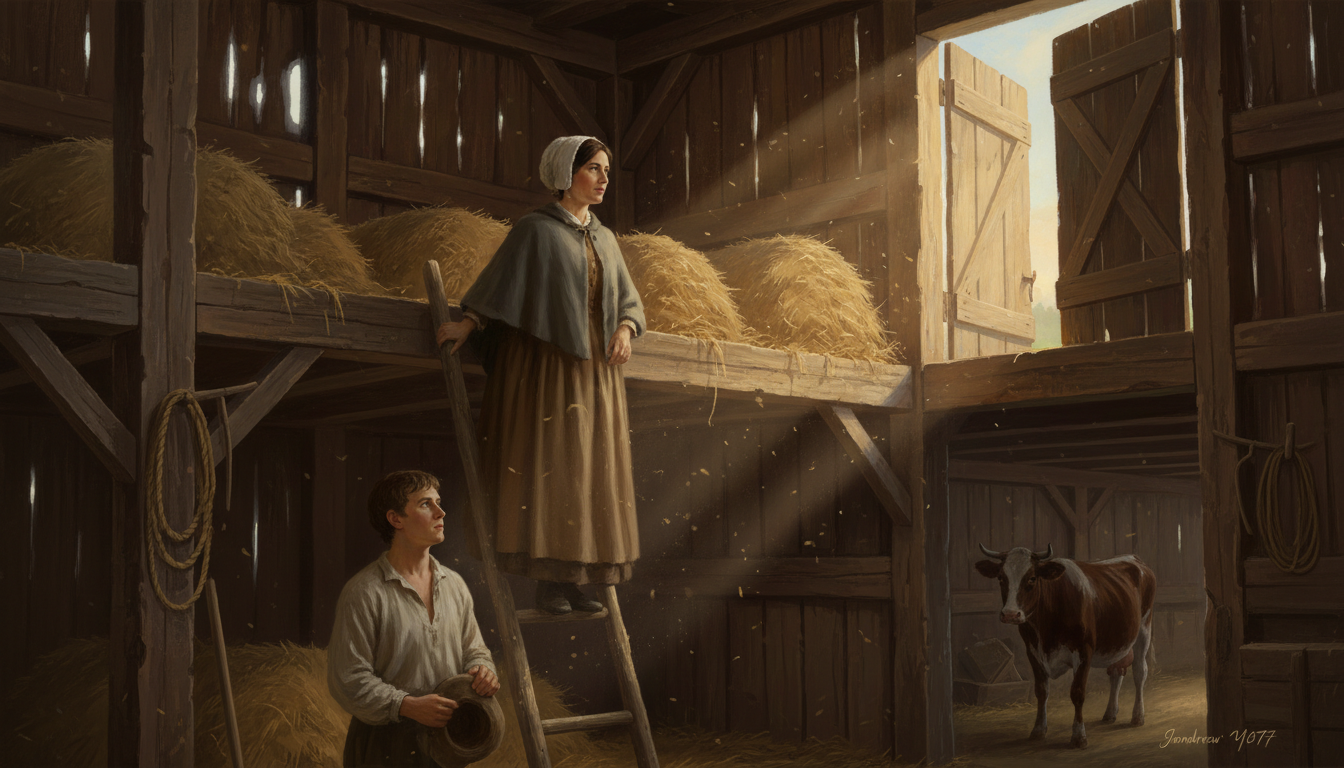
She didn’t write back fussing. She wrote back managing.
The record suggests she tightened stocking numbers where she could, negotiated for hay and feed at prices that were anything but friendly, and pushed hard to recycle every pound of fertility back onto the fields — doing, in practice, exactly what John was preaching in theory. She translated his “true Maxim” into messy, real‑world decisions in a war economy.
Here’s the piece that tends to get missed. A short hay year isn’t just a budget problem. It’s a welfare problem. If you don’t stretch your feed carefully — if you don’t cull the right animals, protect the deepest milkers, keep condition on your stock — cows pay the price first. Abigail’s whole approach, from the manure plan to the way she watched salt hay and orchard yields, reads as someone who understood that her cattle weren’t line items. They were the engine. Starve the engine, and the whole farm grinds to a halt.
You can picture her at the edge of the field late in the day. Light slanting through the last of the timothy. A laborer waiting for a decision about which cows stay, which go, which piece of ground gets more manure before snow. The war is somewhere else. The winter is only weeks off. The cows don’t care about the Continental Congress.
That’s the first obstacle. Hay, weather, war. And she didn’t just survive it. She came out the other side ready to expand.
Managing People Like a Pro Herdsman
Every dairy operator knows the hard truth: cows are the easy part. People are the real job.
Abigail’s letters from the 1790s read like a modern dairy’s HR file, except everything’s in ink and there’s nothing remotely politically correct about the assessments.
In February 1794, with John serving as vice president in Philadelphia, she sat down with the Richards family — son and daughters of a household known in the area for handling dairies “upon a large scale.” She didn’t just shake hands. She set her terms. Then she ran them past her uncle, Dr. Cotton Tufts, for a character check before committing. That’s a vetting process any modern herd manager would respect.
She rotated two hands, Arnold and Copland, on alternating schedules to keep their rivalry from poisoning the crew. She offered Mr. Shaw and Alice terms “not quite as liberal” as other candidates, partly to see if they were serious about the work or shopping for the easiest paycheck.
Porter, a tenant whose wife she judged too weak for the pace of the operation, got dismissed with a biting word that still stings across the centuries — “quidling.” She refused to renew his terms. Faxon, known for a “contrary” nature, proved unreliable for teaming animals when the season demanded it.
If you’ve ever had a hired hand who can fix any piece of iron on the place but sinks morale every time he opens his mouth at breakfast, you recognize what she was up against.
She understood output, too. When she heard that a woman known only as Joy’s wife had made “nine hundred weight of Cheese last year from six cows,” she filed it away. In today’s terms, that’s hearing a neighbor turn out a level of per‑cow performance that makes the rest of the county look tired. Abigail wanted that kind of capability on her payroll.
You could feel the difference between farms under her eye and farms where nobody was counting.
By Letter and by Ledger
One of the gifts Abigail left us is that she didn’t just run the farm. She documented it, week after week, in letters that still exist.
In March 1794, her order sheet reached John’s hands. Six dozen milk pans. Six cream pots. Eight milk pails. Two cheese tubs. Plus assorted odds and ends to outfit an expansion of the dairy.
Stop and think about that for a second.
Seventy‑two milk pans. In a community where most families were making do with a handful. This wasn’t a house cow and a couple of pans for Sunday company. This was capital investment in volume‑scale dairying at a time when the average New England farm considered two or three milk cows a serious herd.

No dabbler orders that much tin and wood in a single request.
She was also weighing logistics in a way that would sound perfectly modern to any multi‑site operator today: should the dairy stay centralized at Thayers place, or split across multiple properties? Each option carried labor, hygiene, and quality tradeoffs, and she was the one running the math.
Meanwhile, from Philadelphia and from Europe, John sent down homilies on husbandry and maxims on soil he’d never apply with his own hands. The affection between them is real, but so is the gap. He gave her theory. She sent back crops, cheese, cider, and a working enterprise.
One can imagine her reading a particularly self‑satisfied paragraph of his by candlelight, smiling a thin smile, setting the letter aside, and going right back to solving problems he’d only ever see in summary.
Act II — The Farm Widow Who Became a Merchant
Running a working farm while your husband’s at court in Boston is one level of hard. Running it while he’s across an ocean, the British navy is choking your coastline, and everyone’s guessing whether the new “United States” will survive another fiscal year — that’s a different animal entirely.
From 1778 to 1788, John was abroad, chasing loans and treaties and legitimacy for the young country.
Abigail stayed home with children, hired help, tenants, debts, and weather.
And she did something almost no woman of her station even considered.
She went into business for herself.
She realized, early, that scarcity was opportunity. Pins, needles, ribbons, tea, fine fabrics — small, high‑margin goods Americans still wanted but couldn’t easily get during wartime — were gold. “The cry for pins is so great,” she wrote in 1775, that prices had tripled. So she asked John to buy a bundle of six thousand in Europe and ship them home.
By 1780, she’d gotten more surgical. She told him exactly which linens and handkerchiefs to send — items that would “turn to good account sold for hard Money.” She noted that “small articles have the best profit,” and specifically requested gauze, ribbons, feathers, and flowers “to make the Ladies Gay.”
That’s a market analyst.

She wasn’t keeping a little novelty shop. She was running a transatlantic supply chain powered by her husband’s diplomatic access and her own ground‑level knowledge of what New England would pay for.
For a woman of her class and time, this was deeply unusual, even faintly scandalous. For Abigail, it was practical math. The farm needed cash flow. Her children needed schooling. John’s public salary wouldn’t stretch. So she built a second income stream — the cushion she’d need for her next move.
And this is where it gets interesting.
The Stock‑Jobber in the Sitting Room — The Turning Point
Like most men of his generation, John Adams trusted land. You could walk it, fence it, mortgage it, leave it to your children. In his world, land meant dignity, stability, and status.
Abigail looked at the ledger and saw something else entirely.
The Adams holdings in Braintree and later at Peacefield brought in, by her accounting, something like two percent a year in real returns once you stripped out taxes, labor, and upkeep. Those acres were necessary. They fed the family, fed the cows, fed the cider. But as profit centers, they weren’t exactly pulling freight.
Meanwhile, after the Revolution, the new federal government was broke and nobody was sure it would honor its paper. State and federal notes — pieces of debt paper issued during and after the war — traded at deep discounts because public confidence was low, as the correspondence preserved by the Massachusetts Historical Society makes clear.
Abigail saw those notes for what they were: undervalued assets in a temporarily spooked market. A lot like a good heifer calf out of a cow that just hasn’t caught anyone’s eye yet.
The catch? Coverture law said anything she owned legally belonged to John. She couldn’t march into a broker’s office under her own name.
So she worked the edges. She quietly set aside “pin money” and proceeds from her retail operation. She asked Cotton Tufts to act as her trustee. Through him, she began buying government State Notes while they were still trading cheap.
The numbers are almost hard to believe.
Land, around two percent. Her bond portfolio, at its peak, up to twenty‑four percent a year as federal credit recovered and the notes rose back toward face value.
Twenty‑four percent.
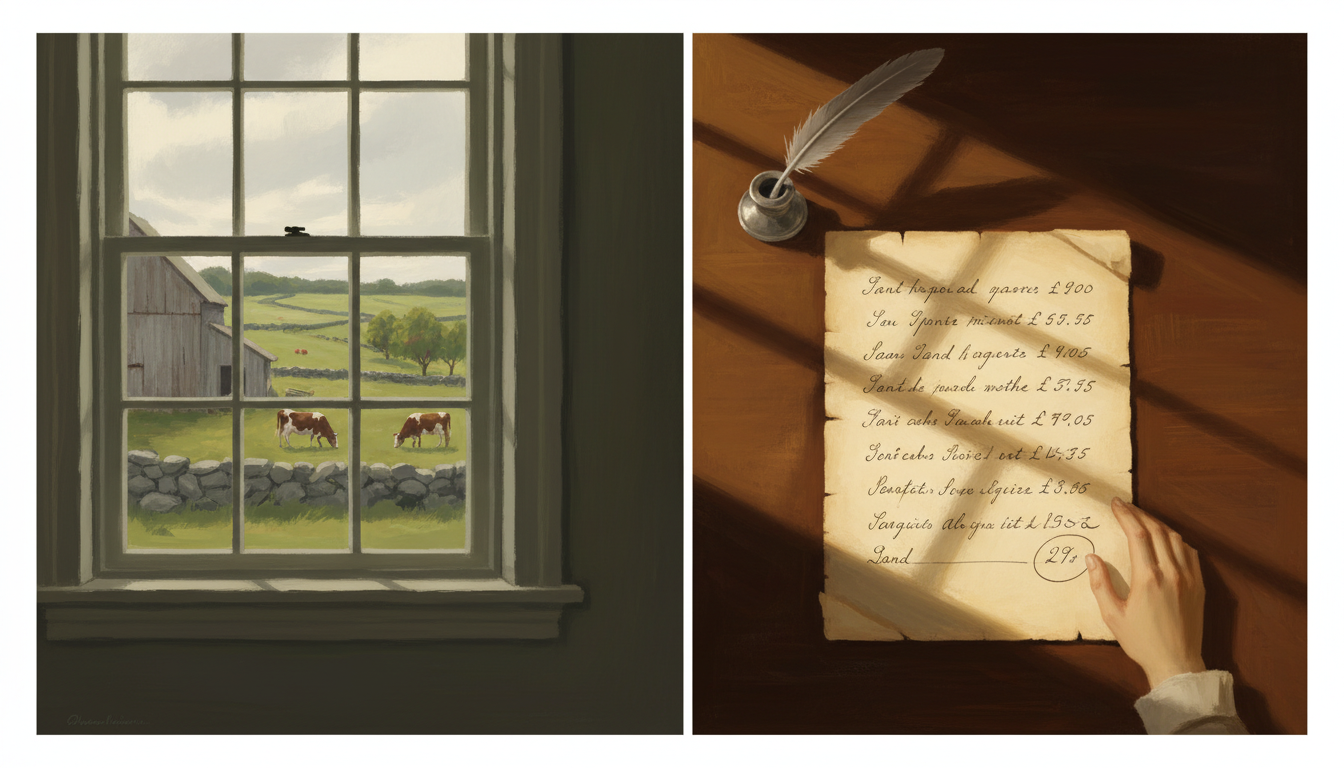
Think about that in today’s dairy terms. You work a 600‑cow herd, fight for every basis point of margin, sweat milk price and feed cost and interest rates, and you know what another point or two on operating return would mean. Now imagine a side investment returning ten or twelve times what the ground under your feet is paying.
One can imagine the moment a statement came back from Tufts in Boston, ink still drying on figures that made her breath catch. The fields she’d fought through storms, labor drama, short hay, and war to keep productive had finally thrown off enough surplus to invest. And that surplus, in her hands, was doing what no acre of Braintree ever could.
John hated this “stock‑jobbing.” He warned her off Vermont land speculation in a famously sharp line — “Don’t meddle anymore with Vermont” — and clung to the comfort of real property.
But the truth was stubbornly the truth. His instinct led toward land‑heavy, illiquid, debt‑prone futures. Hers led toward a modest but steady stream of interest that could cushion public‑service shortfalls and buffer the farm against bad years.
That, right there, is the climax of her story.
Before the bonds, the Adams household was one bad harvest or one political setback from genuine trouble. After the bonds, they had margin. Not riches. Margin. And in a world of volatile currency, endless political stress, and a founding class routinely living beyond its means, margin was oxygen.
Fast‑forward a few decades and look at the scoreboard.
Thomas Jefferson — brilliant, charming, land‑obsessed, debt‑soaked — died so deeply in the red that his heirs were forced to auction off Monticello and the enslaved people who’d built and sustained it to settle creditors.
The Adamses? Peacefield stayed in the family. The farm, the herd, the orchard, the house — still standing, still theirs, still working.
Strip away the quills and frock coats and you’re looking at a farm manager’s dream playbook. Take the surplus from a carefully run mixed farm and dairy. Put a portion into high‑yield, relatively low‑maintenance assets that nobody else trusts yet. Balance land, livestock, and securities. Diversify.
Today we call it risk management. Back then, John called it “stock‑jobbing,” and Abigail Adams became one of the first women in American history to do it at that level.
What It Cost Her
It would be tidy to end there and skip the price she paid. The letters won’t let us.
Abigail wasn’t superhuman. She was a woman living alone on a farm far more than she ever wanted to, carrying weight meant to be shared. In December 1783, after years of separation while John negotiated in Europe, she wrote him bone‑tired and blunt:
“If my dear Friend you will promise to come home, take the Farm into your own hands and improve it, let me turn dairy woman. And assist you in getting our living this way; instead of running away to foreign courts and leaving me half my Life to mourn in widowhood.”
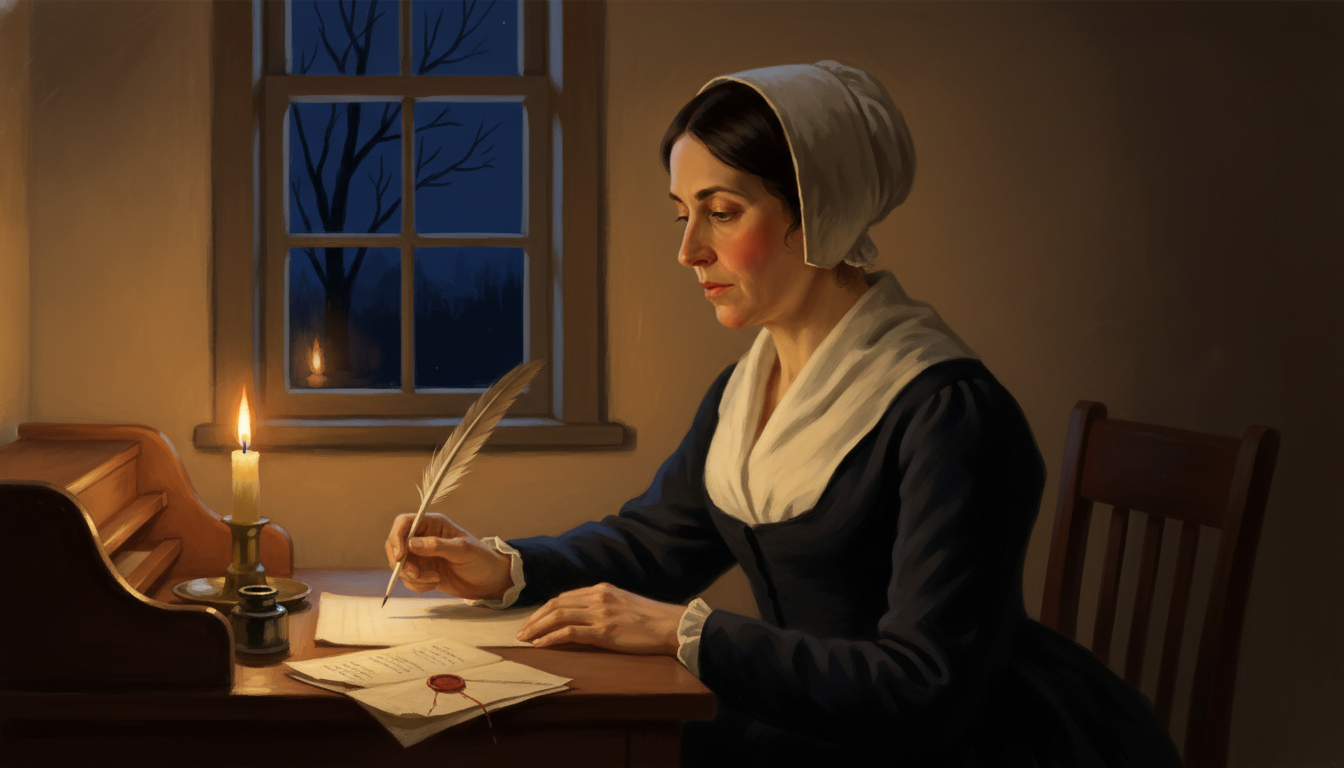
Read that aloud. That’s a line any farm spouse in 2026 can feel in their teeth. She wasn’t asking him to quit the public work. She was asking to share it. Trade the courts for the cows. Trade distant glory for a life pulled in the same direction.
When John finally spent real time at home, he wrote — half joking, half confessing — that he was “jealous” the neighbors might think “Affairs more discreetly conducted” in his absence than at any other time. It’s his way of admitting what we can now see clearly. She’d been running things better than he would have.
Later, when she joined him in Europe from 1784 to 1788, she wrote Tufts from London and Paris about taxes, repairs, plantings, tenants, orchard health, cider barrels. Any producer who’s ever left a good herdsman in charge for a week at World Dairy Expo or the Royal Winter Fair knows exactly where her attention sat. You can be physically anywhere in the world. Your mind stays in the tie‑stall with the fresh cow who looked off this morning.
Act III — Peacefield, Politics, and Her Last Years
Eventually, the politics ran their course. At least for John.
He lost the election of 1800 to Thomas Jefferson. After a bitter campaign, the Adamses packed up Washington and went home to the farm in Quincy they’d come to call Peacefield.
John embraced the role of “Farmer John,” pruning trees, walking fences, writing letters about the weather. And he did put in the hours. But he was moving through systems Abigail had shaped for decades: tenant arrangements, investment income, dairy infrastructure, orchard cycles.
What most people don’t realize is that during his presidency she hadn’t exactly been soft‑pedaling either. She was his political partner as much as his farm partner. She pushed hard for the Alien and Sedition Acts of 1798, seeing them as a shield for her husband and her son, John Quincy, against opposition editors she considered dangerous and “licentious.” She supported the Judiciary Act of 1801 and the “midnight judges,” eager to see Federalists secure the federal courts before Jefferson could reshape them.
Those choices don’t always flatter her by modern standards, and this story doesn’t pretend they do. But they show her seeing herself — correctly — as a co‑executive of the Adams enterprise, political and agricultural both.
On other issues, her moral compass pointed further ahead of her peers than history sometimes remembers. In her March 31, 1776, letter, she told John to “Remember the Ladies” in the new code of laws and warned against putting “such unlimited power into the hands of the Husbands,” adding that “all Men would be tyrants if they could.” On slavery, she asked how colonists could “fight ourselves for what we are robbing the Negroes of” and backed that up by supporting the education of a Black youth named James despite neighborhood opposition.
Back at Peacefield after 1801, her body slowly started to cash checks her years of work had written. Age. Typhoid. The slow erosion of strength. Through it, she kept insisting on plain living: “neither my habits, or My Education or inclinations, have led Me to an expensive stile of living.”
She died at Peacefield on October 28, 1818. She was seventy‑three.
Her passing hit John hard. Later accounts preserve his private wish — to lie down beside her and die too. For a man who’d leaned on her strength, her judgment, and her farm for half a century, that grief was as honest as it gets.
Seven years later, their son John Quincy Adams took the oath of office as the sixth president of the United States. Abigail didn’t live to see it. But follow her letters — her insistence on his reading, his manners, his duty, his moral seriousness — and you can see her fingerprints all over that moment. She and Barbara Bush remain the only two women in American history who’ve been both the wife of a U.S. president and the mother of one.
The monuments can tell that part of the story.
The fields and the cows and the ledgers tell the rest.

What the Farmeress Still Teaches Every Dairy Today
So why should a producer standing in a robot barn in 2026 — worrying about milk price volatility, feed costs, interest rates, and the quota or base rules in your region — care about a woman who ran a farm with no electricity, no refrigeration, and no milk truck ever backing into her yard?
Because a dairy isn’t just cows and milk. It’s systems. Labor. Infrastructure. Cash flow. Land. Markets. She hired families like the Richards because they could handle scale. She rotated rivals like Arnold and Copland to keep the crew workable. She fired the quidlings without flinching. Every time you sit at the kitchen table and debate whether to keep a marginal employee one more season, you’re walking a fence line she already walked.
She treated hardware as investment, not indulgence. Six dozen milk pans, six cream pots, eight milk pails, two cheese tubs. That was capacity planning in tin. Today it might be a robot upgrade, a new freestall pack, a pack barn expansion, or finally buying a decent feed wagon that doesn’t break down every third load. Same instinct. Build the infrastructure before the cows are standing in it waiting.
She refused to bet the family on land alone. The Adams acres fed them. They also ate cash in taxes and labor. Her bonds — the ones John sneered at as “stock‑jobbing” — paid out at roughly twelve times the rate of the ground in a good year. When you weigh whether to put every last dollar into another quarter section versus saving for a robot retrofit, new housing, a feed‑price cushion, or an honest‑to‑goodness rainy‑day fund, you’re running her math. Today’s weather is different. The volatility isn’t. Milk markets, feed spikes, rising interest rates, a wet fall that destroys a corn silage plan — every one of these is a 21st‑century version of her 1777 short‑hay year. The families that come through them are, almost without exception, the ones with some margin tucked somewhere that isn’t soil.
And she knew the hardest work in a dairy isn’t always done in rubber boots. Sometimes it’s done at the desk, before sunrise, staring at numbers, deciding which bill can wait and which can’t. Signing the loan or walking away from it. Every farm woman today who signs the financing, chairs the board meeting, runs the books, negotiates with the lender, or quietly keeps three generations of dairy history alive under one roof is working in space Abigail Adams carved out of a much narrower legal world.
She never milked a cow, as far as we know. She also never stopped managing the ones that did.
A Legacy Worthy of a Hall of Fame
Strip the politics off the story and tell it the way breeders tell each other stories at the rail at World Dairy Expo or over late coffee at the Royal, and here’s what you’ve got.
A farm kid who educated herself out of her father’s library, married into a modest New England place, and ended up running it on her own for years at a stretch while her partner chased history at someone else’s table. A manager who stared down short hay years, stubborn workers, wild markets, wartime blockades, and decades of loneliness — and refused to let the operation slip. A woman who took the hard‑earned surplus from a stony Braintree farm and a wartime side hustle and quietly put it into the one asset class that would outpace everything her neighbors were doing.
You won’t find her name in Holstein pedigrees. She didn’t walk a heifer into the colored shavings at Madison or the Royal, because those rings didn’t yet exist. There’s no bull stud with her initials, no modern bloodline that traces directly to her barn.
But you see her anyway.
You see her in every operation where the person doing the hiring and the books and the long‑range thinking isn’t the one with their name on the banner. You see her in the multi‑generation outfits where Mom or Grandma never sat in the judge’s chair but made sure there was still a farm for the next set of 4‑H calves. You see her in the farm women who sign the financing, work through the cash flow spreadsheets at midnight, and make sure the family doesn’t bet the whole place on a single idea that feels good at the moment. You see her every time a dairy couple divides the labor between the public face and the quiet, relentless work of management — and the quiet one keeps them standing.
Looking back, the signs were always there. From that April morning in 1776 when she wrote about wanting to be as good a Farmeress as her husband was a statesman, to the quiet line of state notes bought on her behalf by a country doctor in Boston, to the farm that was still in the family long after more famous founding estates had gone under the auctioneer’s hammer.
Read her story out loud at a breeders’ banquet tonight and watch heads nod around the room. They’ll know the type. The one who doesn’t need the spotlight but won’t let things slide. The one who refuses to let the numbers lie. The one who, without ever setting foot in the pit, makes sure every cow on the place has what she needs — and makes sure the farm is still there in the morning.
Abigail Adams was America’s first farmeress in more than just name.
For anyone who has ever carried a dairy on their back so someone else could stand in a different light, she isn’t a distant First Lady in a history book.
She’s family.
Key Takeaways
- Abigail ran the Adams farm like a modern dairy CFO — labor, infrastructure, and off‑farm capital all on one ledger. If your operation only tracks cows and crops, you’re leaving her 24% on the table.
- Land fed the family at 2%. Bonds protected it at up to 24%. The families that survive short‑hay years and feed spikes today are still the ones with margin tucked somewhere that isn’t soil.
- Seventy‑two milk pans wasn’t vanity — it was capacity planning before the cows needed it. Whether it’s a robot retrofit or a better feed wagon, build the infrastructure before you’re standing in the problem.
- Fire the quidlings. Vet the Richards. The person signing the financing and running the books at midnight is doing Abigail’s job — and deserves to be named like it on the operation.
Continue the Story
- They Kept the Barn Lights On – History banners usually bear one name, but the operation relies on the partner staying behind. This retrospective on the wives of Dairy Shrine Pioneers honors the same quiet, relentless management Abigail practiced, proving the foundation held because they ran it.
- Diane Hendricks: She Wasn’t Allowed to Milk Cows. Now She’s Worth Over $20 Billion. – While Abigail carved out her management role by necessity, what happens when a brilliant mind is denied the reins? This story shows the staggering legacy that walks away when dairies fail to develop daughters as true business leaders.
- Who Really Owns Your Dairy? Three Ways to Stop Divorce and Succession Turning Unpaid Spousal Work into a Land Sale – Abigail had to hide her off-farm returns because of coverture laws, but the struggle to recognize female farm management didn’t end in 1818. This piece proves why legally formalizing the “invisible work” of today’s dairywomen carries forward what she started.
 The Sunday Read Dairy Professionals Don’t Skip.
 The Sunday Read Dairy Professionals Don’t Skip.
Every week, thousands of producers, breeders, and industry insiders open Bullvine Weekly for genetics insights, market shifts, and profit strategies they won’t find anywhere else. One email. Five minutes. Smarter decisions all week.