








FDA cleared SLICK Holsteins in 2022. Health Canada cleared gene-edited pork in January. No processor has agreed to pay base price for gene-edited milk in 2029 — and you’d own the cows.
The opening scene reflects composite conditions and conversations common across Arizona and Brazilian heat-belt dairies in summer 2025–2026. No specific farm or individual is portrayed. Forward-looking dollar scenarios in this article are scenarios, not predictions.
Casa Grande, Arizona. July. THI past 80, parlor crew soaked through. The herd manager on a 5,000-cow open-lot operation is weighing the same SLICK Holstein heat-stress pitch dozens of hot-belt dairies heard this spring. First-service conception sits well below 20%, squarely inside the 20–35% summer drop documented in the heat-stress literature. Two weeks earlier, a 5,000-cow dairy outside Goiânia sat through the same slide deck in Portuguese, with the same numbers, and the same silent partner nobody in the room talked about: the milk buyer.
Published work from the University of Arizona — including shade-management research from Dairy Extension Specialist Dr. Duarte Diaz (“Shade Management Systems to Reduce Heat Stress for Dairy Cows in Hot, Humid Climates,” UA Experts) — has long documented the productivity and welfare returns of cooling infrastructure in hot-humid systems. The comparison to gene-editing economics in this article is Bullvine’s own, not Dr. Diaz’s, and Dr. Diaz was not interviewed for this piece.
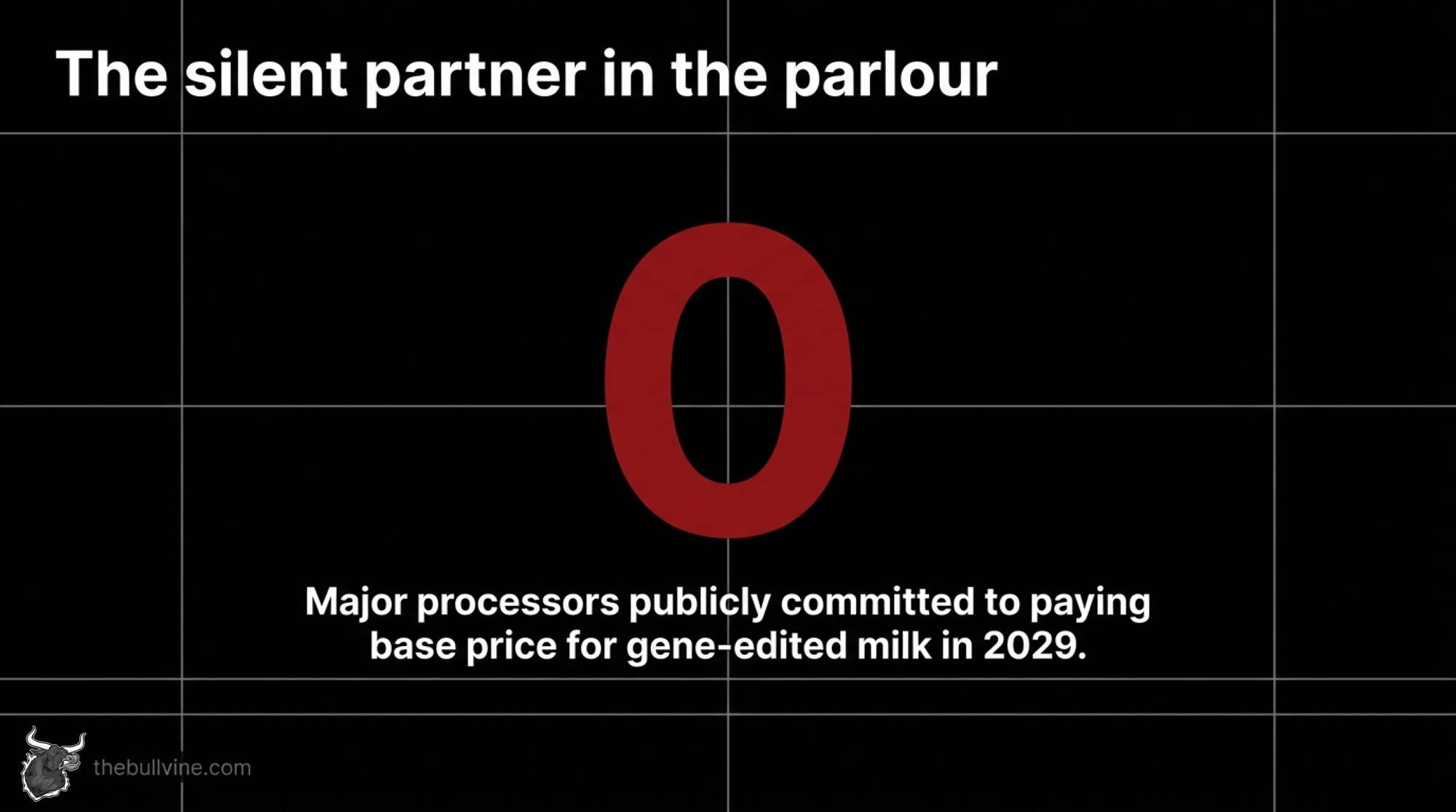
That silent partner is the whole story. FDA, CTNBio, Health Canada, and the UK’s new precision-breeding regime have all cleared a regulatory path for gene-edited livestock. Not one major processor has publicly committed to accepting gene-edited milk in a branded supply chain. For a hot-belt herd bleeding –4 million a year on heat stress, the SLICK pitch sounds like rescue. The math says write a different cheque first — and it’s not a gene-editing one.
What’s Actually Changed in the Last 18 Months
The regulatory ladder moved faster than most producers noticed. FDA issued a low-risk determination for Acceligen’s two PRLR-SLICK cattle and their progeny on March 7, 2022, covering meat, milk, semen, and embryos from those lines (FDA V-006378 Risk Assessment Summary). Brazil’s CTNBio has approved SLICK as non-GMO, and Embrapa — working with the Brazilian Angus Association — announced the country’s first gene-edited calves in May 2025: five Angus calves born between late March and early April 2025, with at least two confirmed carrying the edited slick-coat trait. The Holstein phase is still in the pipeline.
Health Canada’s January 23, 2026 statement approved PRRS-resistant gene-edited pigs for use in food and feed without mandatory labeling — the first animal approved under the new framework — concluding the pork is “as safe and nutritious” as conventional Canadian pork (Health Canada, January 23 2026; duBreton, January 28 2026; CBAN, January 25 2026). The UK’s Precision Breeding Act — enacted in 2023, with secondary regulations phased through 2024–2025 — opens a clear path for precision-bred organisms.
What hasn’t moved: the part of the chain that actually signs your milk cheque. As of April 2026, no processor has issued a blanket acceptance for gene-edited dairy in a branded product line. Bullvine reviewed public disclosures from the ten largest North American and European dairy processors through April 2026 and found none. If your processor has issued such a commitment and we missed it, we want to see it.
Dairy-ingredient procurement has also run cautiously through early 2026 against a background of several high-profile food-safety events in adjacent categories, keeping buyers risk-averse on novel-genetics adoption. Nobody in procurement is feeling bold about novel genetics right now.
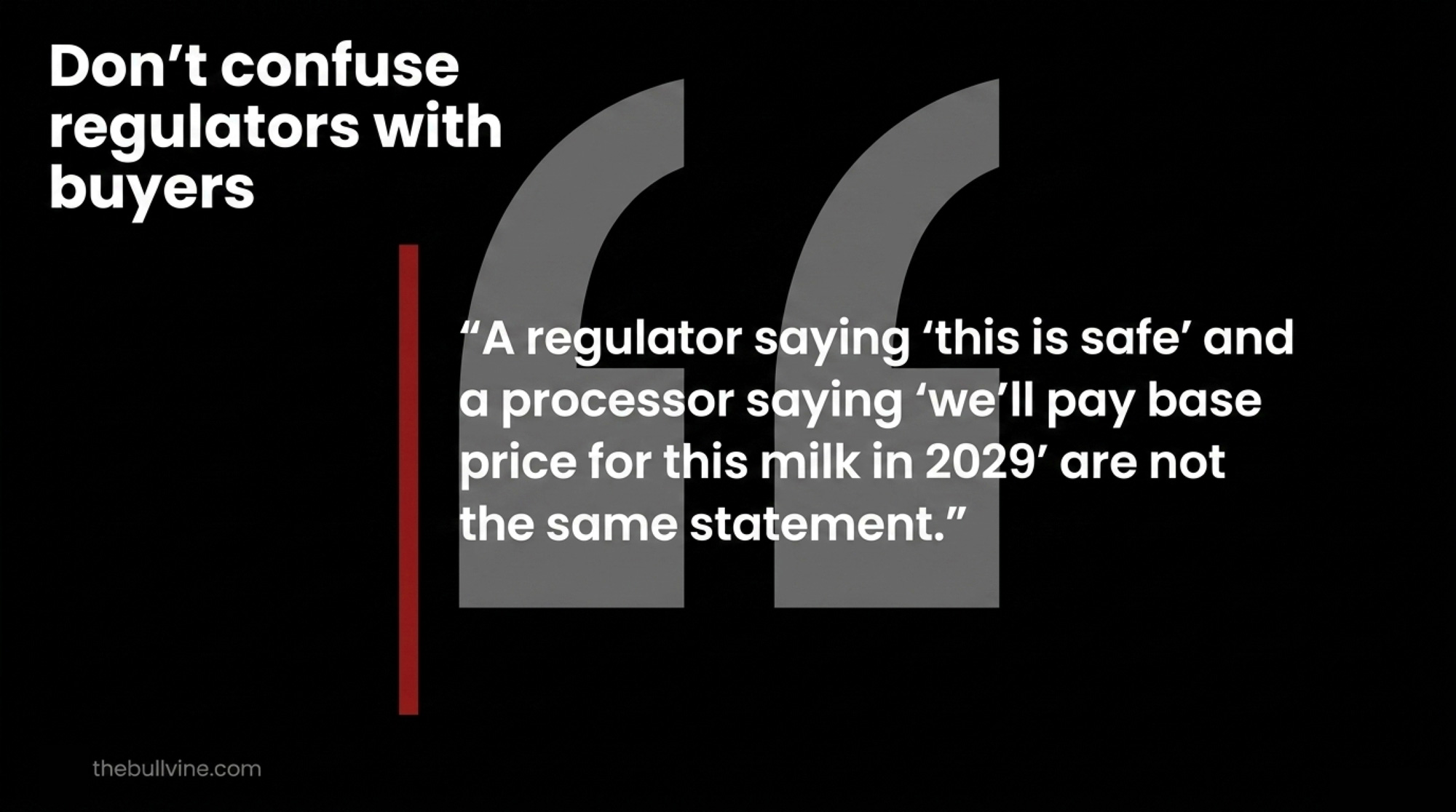
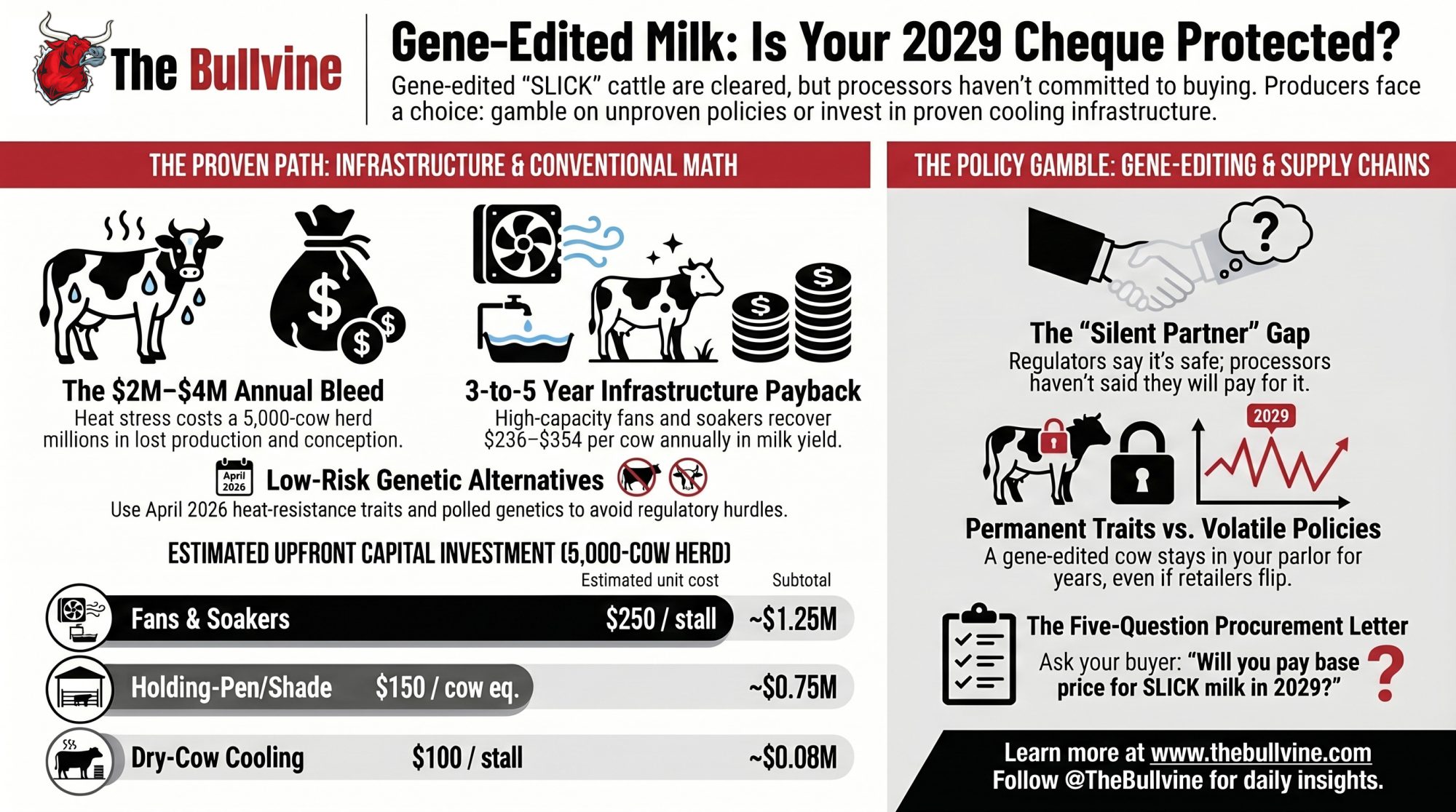
That’s the gap producers keep missing. A regulator saying “this is safe” and a processor saying “we’ll pay base price for this milk in 2029” are not the same statement, by the same people, on the same timeline. Treat them as one and you’ve bought permanent genetics riding on a policy that hasn’t been written.
| Milestone | Status (April 2026) | What It Means for Your Milk |
| FDA low-risk determination (SLICK) | ✅ Cleared March 2022 | Meat, milk, semen, embryos covered |
| Brazil CTNBio non-GMO ruling | ✅ Approved | First gene-edited calves born May 2025 |
| Health Canada gene-edited pork | ✅ Approved January 2026 | No mandatory labeling required |
| UK Precision Breeding Act | ✅ Enacted 2023, regs phased 2024–25 | Clear path for precision-bred organisms |
| Major processor accepting GE milk at base price | ❌ NONE (0 of top 10) | No commitment through 2029 |
| Retailer “no gene-edited dairy” policy | ⚠️ Not yet issued | Could force processor reversal overnight |
How This Plays Out on a Real Farm — The Arizona Math
Put real numbers on that 5,000-cow heat-belt operation. Summer conception drops of 20–35% are well-documented in heat-stressed Holsteins across the U.S. Southwest and tropical production regions. St-Pierre et al. (2003, J. Dairy Sci.) pegged U.S. dairy heat-stress losses at roughly $897 million a year under minimum abatement, and Key, Sneeringer & Marquardt (USDA-ERS ERR-175, September 2014) projected U.S. milk production declines of 0.6–1.3% by 2030under climate change, with the dairy sector bearing over half of current livestock heat-stress costs. Hoard’s Dairyman’s June 2025 coverage of the financial consequences of heat stress on U.S. dairy farms confirms the magnitude of the hit is trending up, not down.
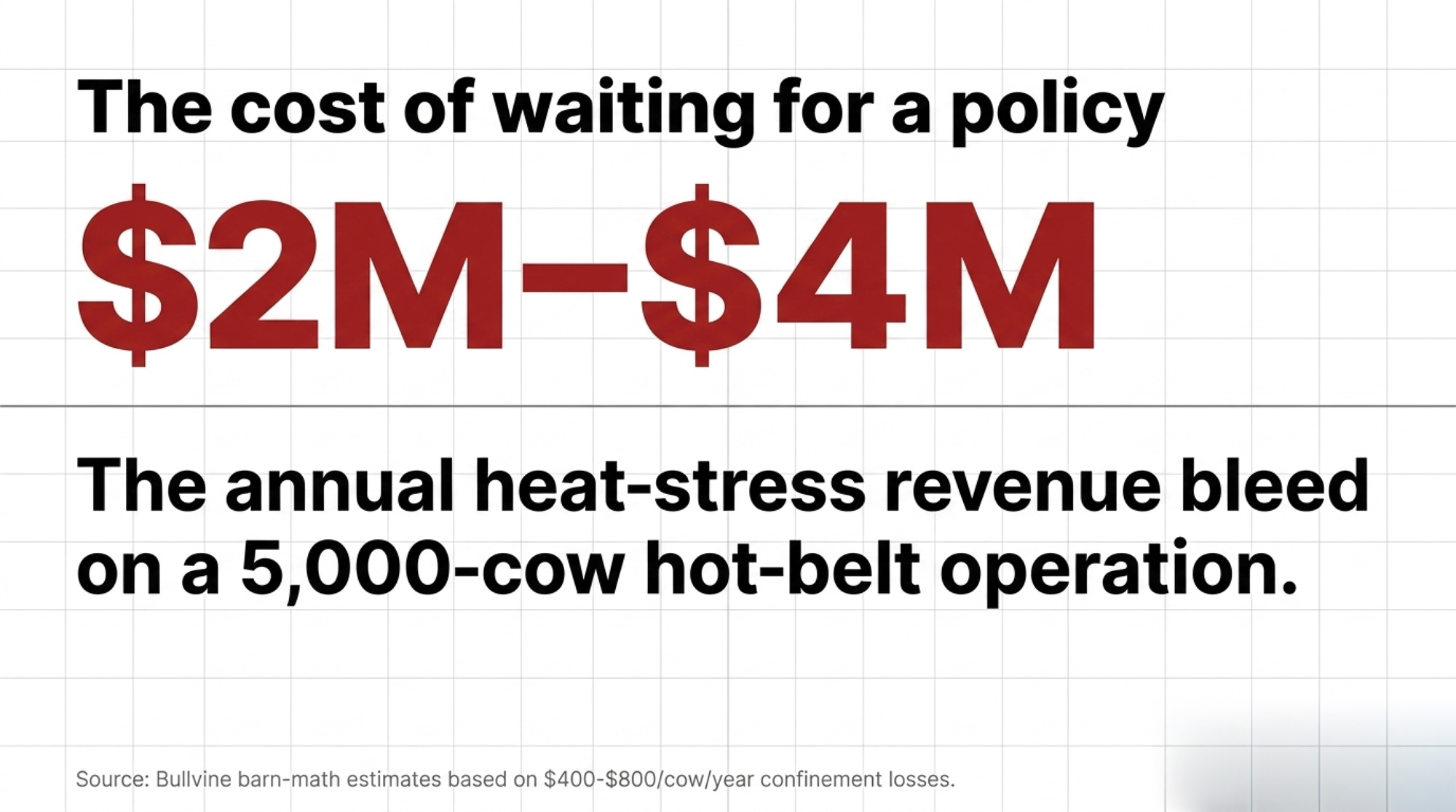
Chen et al.’s Iowa State work — “Extreme Heat and Livestock Production: Cost and Adaptation in the US Dairy Industry,” now published as “Vulnerability of US dairy farms to extreme heat” in Food Policy (ScienceDirect S0306919225000259) — quantifies 4 million in lost Midwestern dairy revenue over five years (2012–2016)using animal-level production data, with yield loss per cow on an extreme-stress day nearly triple that of a medium-stress day. In hot-climate confinement, published per-cow losses fall between $400 and $800/cow/year, depending on THI load and abatement already in place. On 5,000 cows, that’s a $2–4 million annual bleed — real money, every year, compounding with every degree of climate drift.
Here’s the micro barn-math moment. Take that 5,000-cow hot-belt herd averaging 90 lb/day at a placeholder $18/cwt mailbox price — swap in your current Federal Order or processor schedule if you’re running a different component mix. That’s 32,850 lb/cow/year and $5,913/cow of gross milk revenue. If better cooling recovers even 4–6% of lost summer milk (consistent with Mauger et al., “Projected heat stress challenges and abatement opportunities for U.S. milk production,” PMC6438606, which models Minimal/Moderate/High/Intense abatement across nine U.S. climatic regions), you’re looking at 1,314–1,971 lb/cow/year back in the tank. Multiply by $18/cwt and you get $236–$354/cow/year. On 5,000 cows that’s .2–.8 million/year in recovered yield alone. Scale it down: at 500 cows the same math runs $118,000–$177,000/year — before reproduction gains or the next-generation tail from dry-cow cooling.
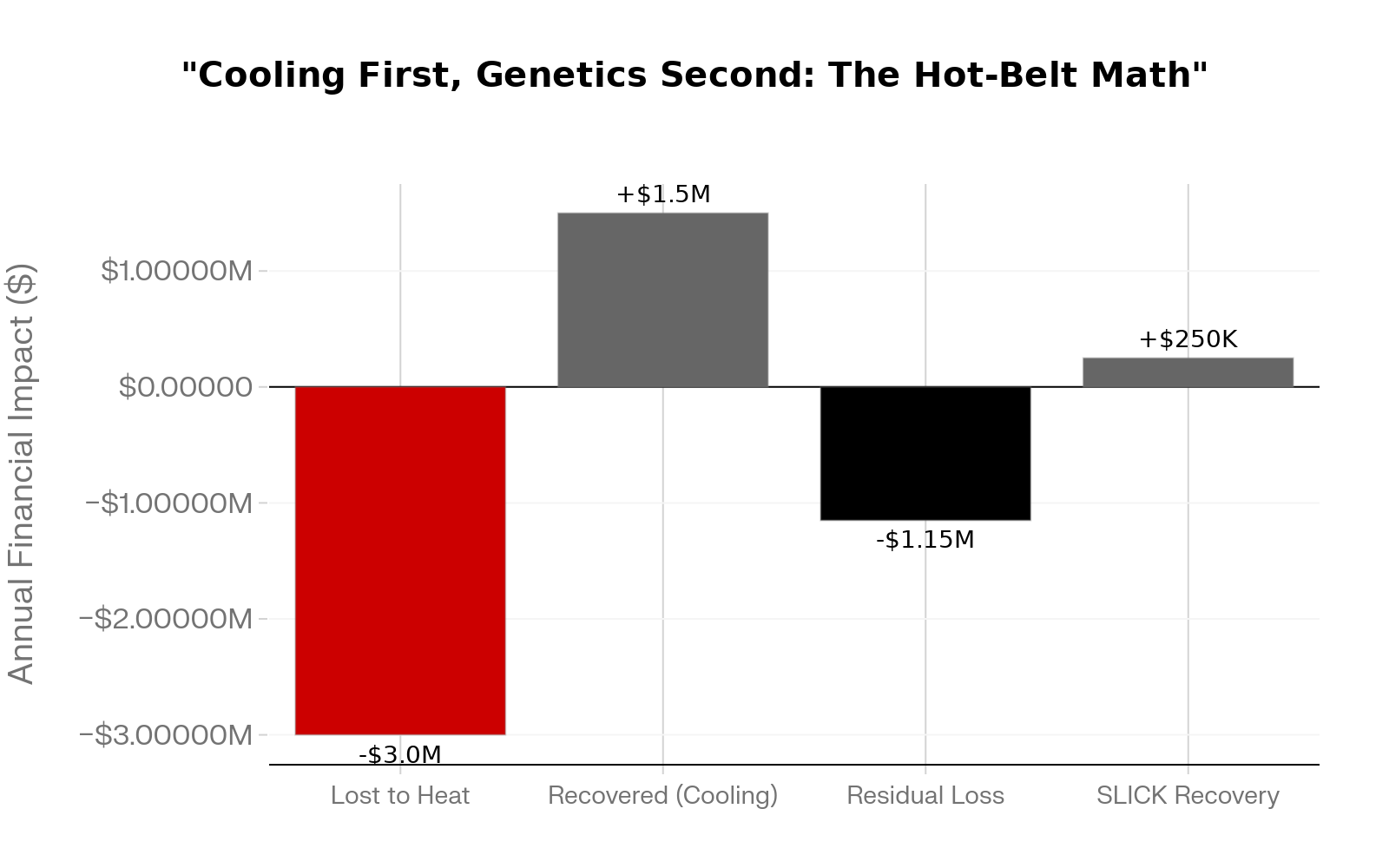
The capital to do it right? Not cheap, but bounded. High-capacity fans (36″–48″, sized at roughly 800–900 cfm per stall per Kansas State University guidance) plus soakers run $250–$400 per stall, consistent with Ontario OMAFRA’s (2020) soaker-cycle design of 21–27°C every 15 min, 27–32°C every 10 min, >32°C every 5 min. Dry-cow and close-up cooling runs about $100–$200 per stall, with benefit-cost ratios near 1.45 and payback around 5.7 years in USDA-region modeling (Ferreira et al., 2016, J. Dairy Sci.; University of Florida IFAS AN342 spreadsheet on economic feasibility of cooling dry cows). Holding-pen cooling and shade add $150–$250 per cow equivalent when spread across the herd. Partial-budget work puts payback in the 3–5 year range at current milk prices. Scale the framework down — a 1,000-cow operation in West Texas or a 500-cow family dairy in Mato Grosso do Sul is looking at roughly a tenth to a fifth of that capex, with similar payback arithmetic per cow.
Infrastructure Capex (5,000 Cows, Low-End Build)
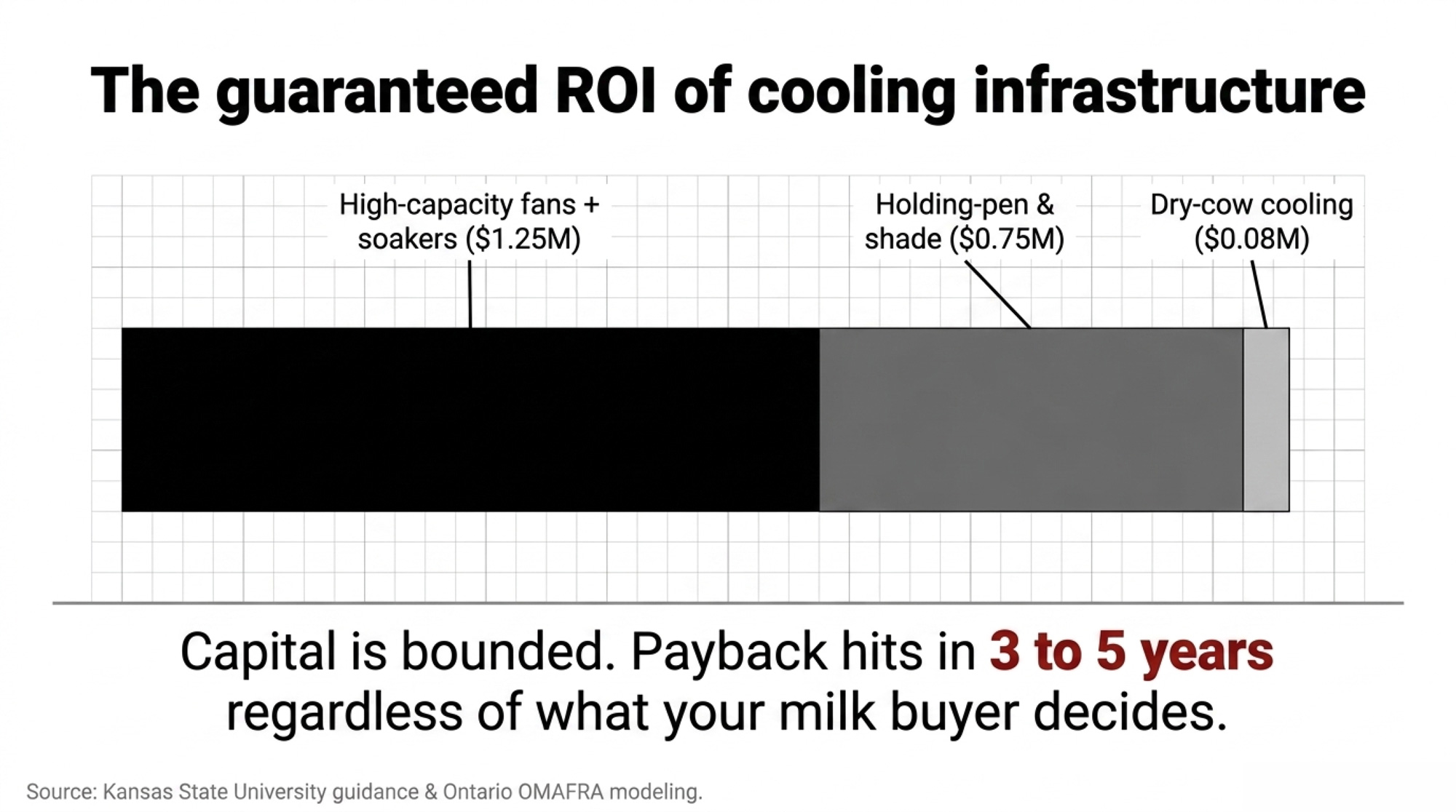
| Strategy | Capex (5,000-Cow Herd) | Annual Recovery | Payback Period | Processor Risk |
| High-capacity fans + soakers | ~$1.25M | $1.2–$1.8M/yr | 3–5 years | None |
| Dry-cow & close-up cooling | ~$80K | BCR ~1.45 | ~5.7 years | None |
| Conventional polled genetics | $0 incremental | Labor + welfare savings | Immediate | None |
| CLARIFIDE Plus heat traits (Apr 2026) | $0 incremental | Improved sire selection accuracy | Immediate | None |
| SLICK gene-editing pilot (5% cohort) | $37.5K–$75K/yr semen | $200K–$300K/yr (est.) | Unknown — no processor commitment | HIGH |
Genetic & Operational Ramp (over 2–4 years)
| Component | Estimated spend | Notes |
| Tunnel retrofit | ~$0.45M | Open-lot to cross-vent conversion, partial |
| 3-year genotyping ramp | ~$0.27M | CLARIFIDE Plus across replacement heifers |
| Operational subtotal | ~$0.72M | |
| Total low-end build | ~$2.80M | Full range runs to $4.8M |
Tunnel-retrofit and three-year genotyping ramp figures are Bullvine internal estimates; operators should replace with quotes from their preferred ventilation contractor and genetic-testing provider before committing capital.
The Mechanics: Why SLICK Works, and Why That’s Only Half the Problem
SLICK is an edit to the prolactin receptor (PRLR) gene — exon 10 in the Bos taurus genome — that truncates the receptor and mimics a coat mutation found naturally in Senepol and Criollo cattle. What you see in the barn: shorter, sparser coats, measurably more sweat, and vaginal temps that stop climbing when THI crosses 68. Puerto Rican SLICK Holsteins maintain lower vaginal temperatures, greater mammary blood supply, and higher milk yield than wild-type Holsteins under tropical heat stress (Dikmen et al., 2023–2024, J. Dairy Sci.; Ortiz-Colón et al., “Thermotolerance capabilities, blood metabolomics, and mammary gland transcriptomics of slick-haired Holstein cattle”). Tropical datasets from Puerto Rico and Florida have consistently shown lower heat-related mortality and better sustained production in SLICK cattle versus wild-type Holsteins in extreme heat.
The catch isn’t biology. It’s supply chain power. And the power sits two or three links upstream of your milk tanker.
The Danone–Zoetis CLARIFIDE partnership is the template. Zoetis and Danone publicly characterize their September 25, 2024 agreement as a “strategic partnership,” building on Zoetis’s role as preferred genetic-testing provider under Danone’s global “Partner for Growth” program since 2023, with CLARIFIDE Plus and DWP$ leveraged across Danone’s supplier base to drive sustainability and cow longevity outcomes. When a buyer that size rolls specific genomic-testing expectations into its supplier programs, processors tend to align quickly — often inside a year — rather than waiting multiple proof runs to see how it plays out. In Bullvine’s view, gene-edited dairy procurement is likely to follow a similar supplier-programs-first pattern — but with more brand risk and more consumer and NGO scrutiny than a genomic-testing rollout carries. Neither Danone nor Zoetis has publicly stated any such plan.
When major North American and European retailers have moved on supply-chain standards in the past — BST-free milk, cage-free eggs, no-antibiotics-ever poultry — processors have tended to follow within roughly a year to 18 months of a first-mover retailer commitment (Bullvine analysis of past retailer-driven pivots). Expect a similar, though not identical, pivot window on gene-edited dairy once a retailer breaks cover.
The Canadian Protein Trap: Why Lactanet’s 40/60 Flip Hits SLICK Harder Than You Think
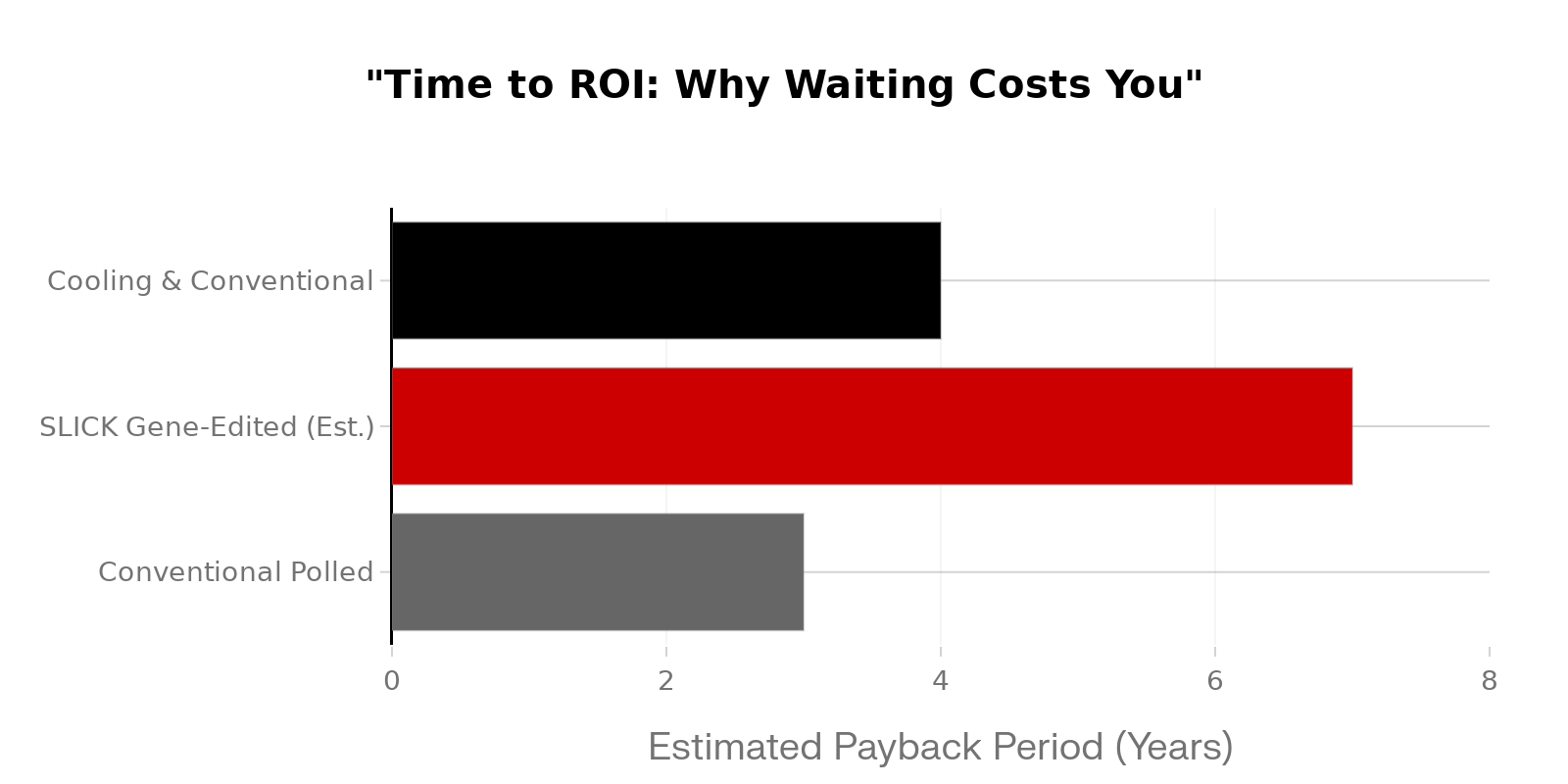
The April 2026 index changes just reshaped the genetic chassis under any edit you make. Holstein Association USA reweighted TPI’s production slice from a 19:19 Fat:Protein ratio to 14:24 Fat:Protein (Holstein USA, TPI Formula — April 2026). Canada’s Lactanet flipped LPI Holstein production weighting from 60% Fat / 40% Protein to 40% Fat / 60% Protein (Lactanet, March 24 2026). This TPI formula update does put NM$ and TPI at opposite ends of the Fat to Protein ratio spectrum, meaning the two indexes are moving farther apart.”
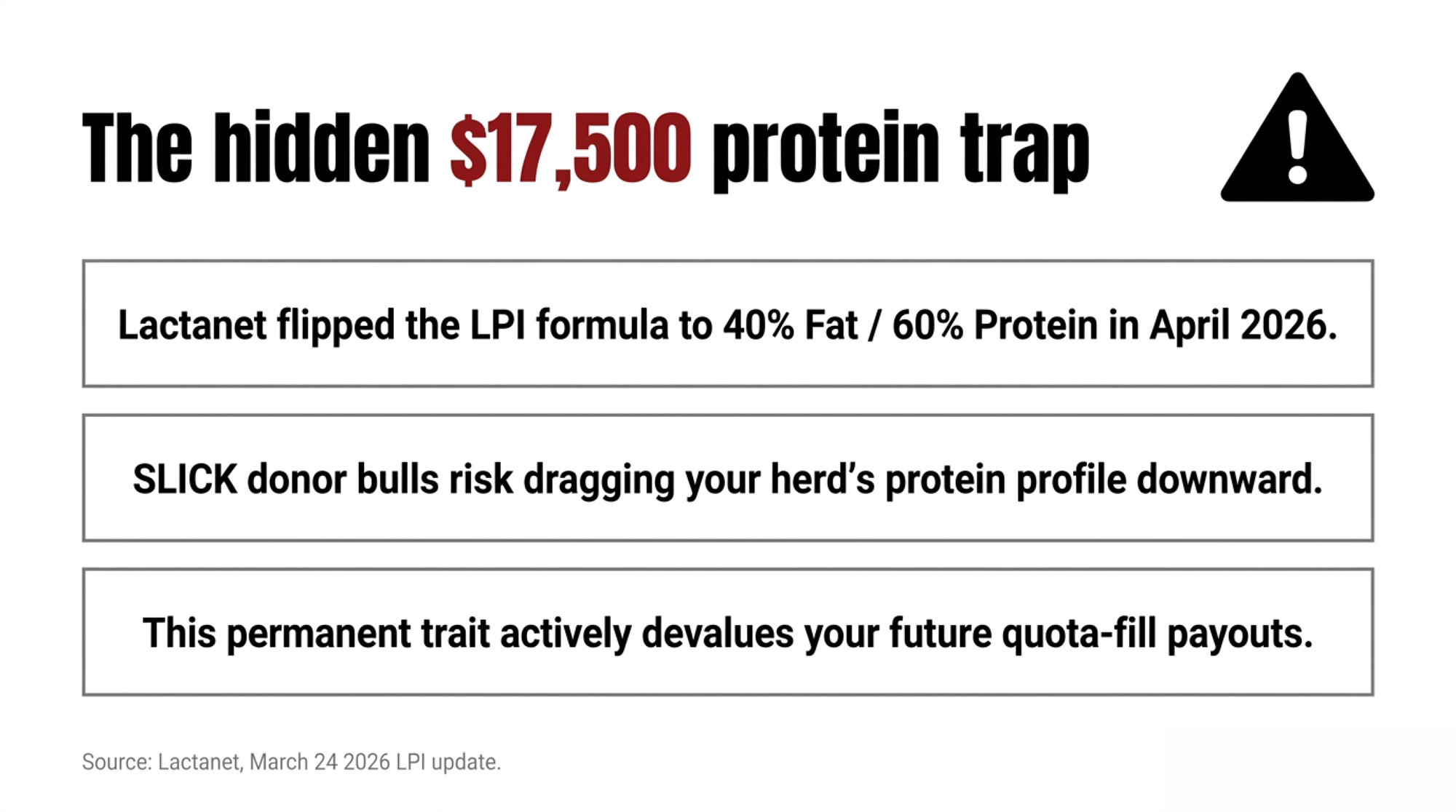
Here’s what that means if you’re Canadian and thinking about SLICK. LPI just moved 20 points of production weighting from Fat to Protein in a single formula release. If your proposed SLICK donor bull is elite on heat tolerance but sits in the bottom third of his proof for Protein, you’re not “waiting to see” on gene editing — you’re actively locking in a genetic base that devalues your future quota-filling under Canada’s protein-weighted component pricing. The trait is permanent. The 60/40 Protein weight is the new LPI reality through at least the next formula review. Bullvine’s own reporting already flagged this as a potential $17,500/year protein trap on a 500-cow herd in U.S. Class III component grids; the Canadian quota-fill math is arguably worse because protein carries the weight and the cheque.
How Much Does Waiting for Processor Sign-Off Actually Cost?
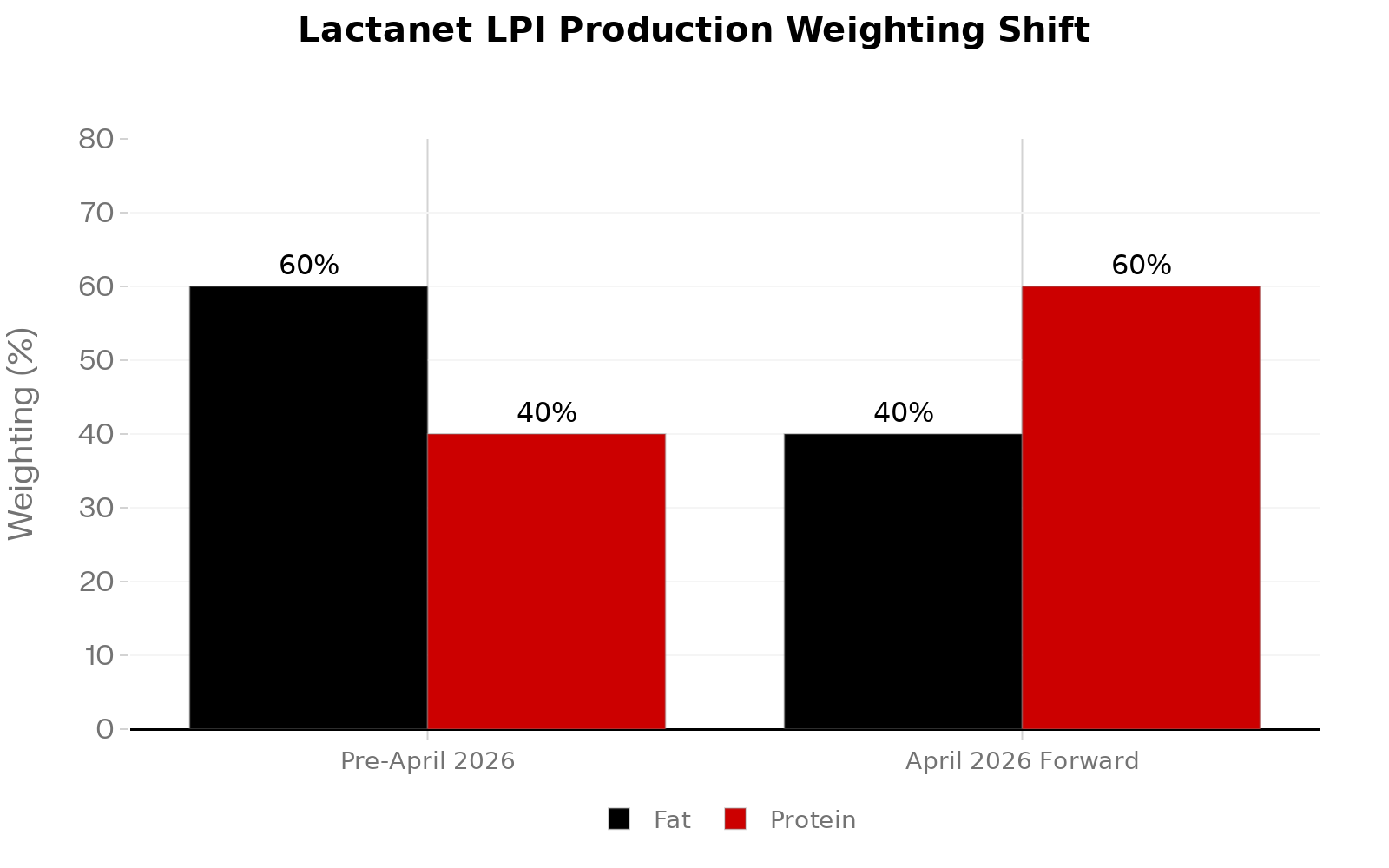
This is the question that separates strategy from wishful thinking. If heat stress is costing your operation $2–4 million a year today, “waiting” feels reckless. But the cooling-and-conventional-genetics playbook doesn’t make you wait. It attacks the loss immediately, with payback inside five years, and it doesn’t depend on any retailer, any processor, or any regulator picking your side.
Run it out to 2029. A herd that spent $3–4 million on serious cooling and pushed Zoetis’s new heat-resistance traits — added to CLARIFIDE Plus and DWP$ in the April 2026 update, alongside environmental stewardship — has probably cut its residual heat-stress loss from $2–4 million down to roughly $0.8–$1.5 million a year under our scenario assumptions. SLICK layered on top of that might recover another $200,000–$300,000/year once a meaningful share of the herd carries the allele. Real money. But not rescue money. (These residual-loss and SLICK-recovery figures are scenario estimates derived in this article, not published findings.)
At an estimated SLICK semen premium of roughly $15–$30 per straw — a Bullvine working estimate, since PRLR-SLICK dairy sire pricing isn’t publicly listed by Acceligen, Select Sires, ABS Global, or ST Genetics as of April 2026 — on about 2,500 SLICK doses a year, roughly half of breedings in a 5,000-cow program once a pilot has ramped up, you’re spending $37,500–$75,000 to capture $200,000–$300,000 in residual savings. A modest uplift — single-digit percent against the pre-abatement loss — on a problem you’ve already mostly solved with cooling. Direct confirmation of that premium range from a stud rep or Acceligen licensing desk is the single most useful number a producer can put into this math before signing anything.
Is Your Herd’s Genetic Strategy Already Behind on the Wrong Thing?
Here’s the shift that matters most and often gets buried in the index debates: indexes are volatile, traits are permanent. You’re used to sire lists moving when TPI or LPI formulas change. You pivot next proof run. Fine.
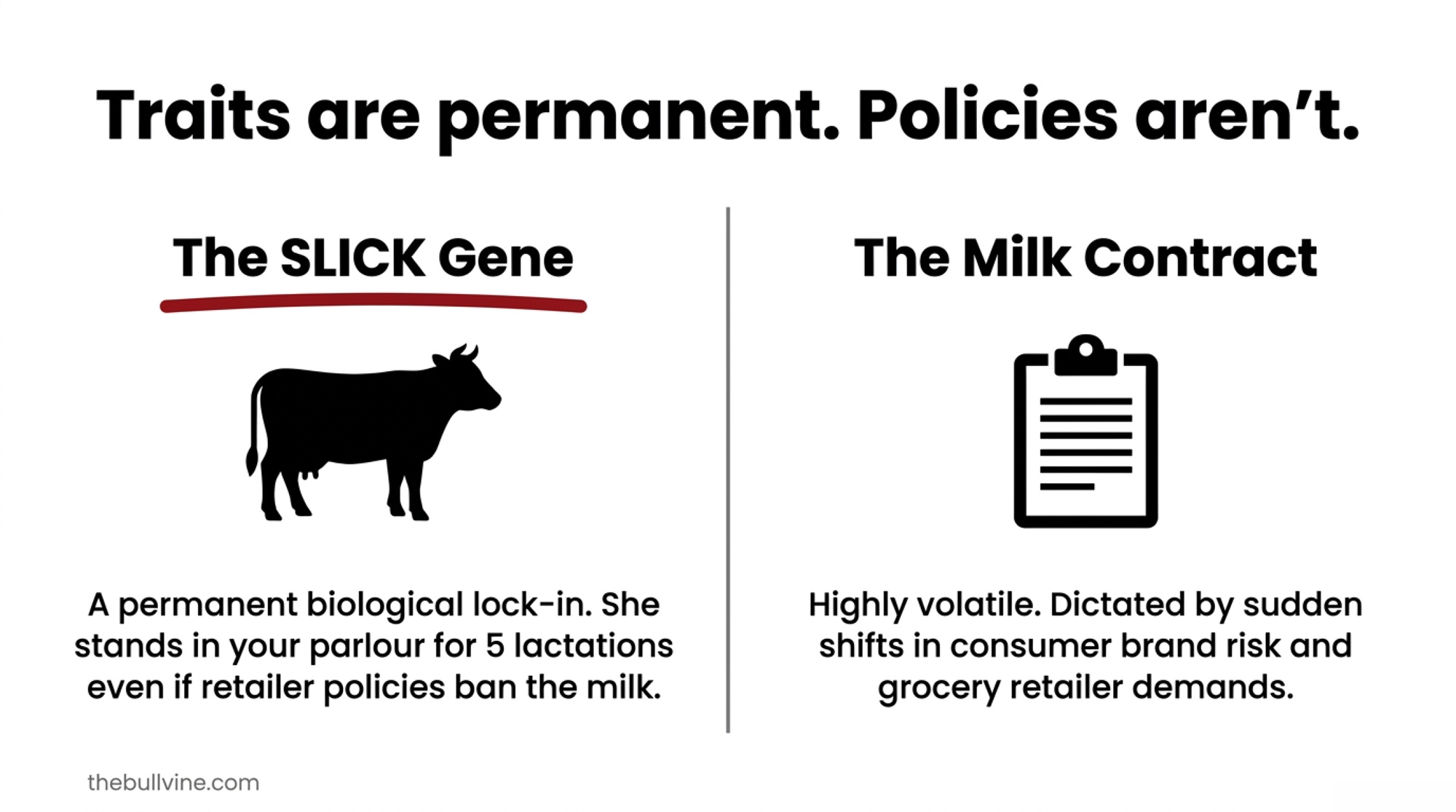
Gene editing breaks that symmetry. Once PRLR-SLICK is in your herd, it’s there for decades — even if the index you used to pick the donor bull gets rewritten three times, even if a major North American or European retailer were to publish a “no gene-edited dairy” procurement policy in 2029 that your processor had to honour or lose the account. rBST was a management decision you could stop making. SLICK is a cow standing in your parlor for five more lactations whether anyone wants her milk or not. Assume the index will change. Assume the trait won’t. Only commit to edits where that asymmetry still looks good under multiple scenarios.
Options and Trade-Offs for Farmers
Four paths producers are actually running, and where each one wins and loses.
| Path | Best For | Capital Required (5,000 Cows) | Processor Risk | Reversible? | Decision Trigger |
| 1. Infrastructure-first, SLICK-later | Most heat-belt herds, 2026–2028 | $2.8–$4.8M over 2–4 yrs | None | Yes (equipment) | THI >72 for 60+ days; fan/soaker below KSU recs |
| 2. Conventional polled | Herds with dehorning pain points | $0 incremental (sire selection) | None | Yes (breeding pivots) | Single-digit NM$ gap vs. elite horned bulls |
| 3. Bounded SLICK pilot (≤5%) | 5,000+ cow optimized herds | $37.5K–$75K/yr semen | HIGH | No — permanent | Written processor acceptance + mid-merit females only |
| 4. Five-question letter | Every producer, right now | $0 (stamp + envelope) | None | N/A | Before any GE dollar moves |
Path 1: Infrastructure-first, SLICK-later (most heat-belt herds, 2026–2028) When it works: you’re bleeding real money on heat stress and haven’t maxed cooling and conventional heat-resilience genetics. What it requires: $2.8–$4.8M in cooling and genotyping capital over 2–4 years on a 5,000-cow herd — the kind of capex large Pinal County and Maricopa County operations already started running in 2022–2023. Named case studies of retrofits at this scale, with year-one recovered-production figures attached, would sharpen this path further and Bullvine is actively sourcing them for follow-up coverage. Decision trigger: if your summer THI exceeds 72 for more than 60 days and current fan/soaker coverage is below published Kansas State or Florida IFAS recommendations, Path 1 is the first cheque. Scale proportionally for 500- or 2,000-cow herds. Layer the April 2026 Zoetis heat-resistance traits into sire selection at zero incremental cost. Risks/limits: slower to swing than bolting SLICK onto the existing system. But every dollar pays back regardless of what any retailer or your processor eventually decide.
Path 2: Conventional polled now, skip gene-edited polled entirely When it works: dehorning labor, welfare, and staff safety are real pain points. What it requires: shifting to homozygous polled (PP) bulls from the VikingGenetics polled lineup, ABS Global’s expanded polled offering, and proven polled options ranked in Australian and European systems. Specific sire codes and current homozygous status should be pulled from the April 2026 catalogues by your breeding advisor before committing. Polled is a dominant trait; a herd can go effectively polled in 3–4 generations. Risks/limits: a single-digit-to-low-double-digit Net Merit gap versus absolute elite horned bulls — shrinking every proof run, and far cheaper than the combined regulatory and processor risk of gene-edited polled.
Path 3: Bounded SLICK pilot on a ≤5% cohort (5,000+ cow heat-zone herds) When it works: documented summer conception losses above 20%, infrastructure already optimized, and your processor is at least willing to have the conversation in writing. What it requires: written processor acceptance with duration language, a defined cohort of mid-merit females (never top-genomic replacements), and the financial ability to absorb the downside if retailer policy hardens by 2029. Risks/limits: SLICK is permanent. Your milk buyer isn’t. If your processor’s biggest retail customer moves against you, you still own the cows.
Path 4: Do-this-in-30-days — the five-question procurement letter The cheapest, fastest action on this list. Before any gene-editing dollar moves, send this to your milk buyer’s procurement contact, in writing, with a response date.
📋 THE FIVE QUESTIONS — PRINT THIS AND HAND IT TO YOUR FIELD REP
Send to your milk buyer’s procurement contact. In writing. With a response date.
- Does our contract currently prohibit, allow, or not address milk from gene-edited animals?
- If we breed SLICK daughters in 2027, will their milk be accepted at base price when they freshen in 2029?
- What’s your written position on labeling, traceability, and auditability of gene-edited milk?
- Do your downstream retail or branded customers have commitments that would force a no-GE policy?
- If a competing processor accepts gene-edited supply first, are existing producers grandfathered?
Bullvine decision rule: If they can’t or won’t answer questions 1 and 2 in writing, you aren’t pioneering. You’re gambling with a 2029 freshening date.
Key Takeaways
- If your processor hasn’t returned written acceptance of gene-edited milk with duration language through at least 2033, SLICK isn’t a genetics bet. It’s a policy bet — and you’re holding the cows if the policy moves. Send the five-question letter this month.
- When summer conception sits below 80% of your seasonal benchmark for two or more seasons — a Bullvine rule of thumb, not an industry standard — the first $2.8–$4.8 million of heat-stress capital belongs in cooling, shade, dry-cow and holding-pen upgrades before a single SLICK straw enters the tank. Payback is 3–5 years. That’s math, not opinion.
- Still treating polled as a “compromise” bull list? Pull the current VikingGenetics and ABS polled lineups before your next sire-selection meeting. A single-digit-to-low-double-digit Net Merit gap is a rounding error compared to betting your herd on a retailer that hasn’t written the policy yet.
- Rerun your CLARIFIDE Plus reports with the April 2026 heat-resistance and environmental stewardship traits before your next sire-selection meeting. Both are free to layer in. Both carry zero processor risk. There’s no reason not to.
- Check your top SLICK candidate bull’s Protein-to-Fat ratio before you commit. Below 0.50, re-sort on NM$ or Cheese Merit — and if you’re Canadian, re-sort on the April 2026 LPI before you even think about it. The 49th parallel just split your catalog in two.
- Cap any SLICK pilot at 5% of replacements on mid-merit females. Never top-genomic animals. Pioneering is fine. Betting your best genetics on a procurement policy nobody’s written yet is not.
- Watching for the signal that the market is actually moving? Watch the first retailer move. Not the first processor press release. Retailers write the cheques processors cash.
The Question Worth Taking to Your Next Sire-Selection Meeting
When you sit down with your breeding advisor this month, the real question isn’t whether gene editing is coming. It’s whether your operation is positioned to move within 90 days when a retailer finally greenlights it — or whether you’ll be 24 months behind because you either waited entirely or bet too early. Where does your cooling capital budget actually sit for the 2026–2027 fiscal year? And have you asked your processor the five questions, in writing, with a response date?
The full per-cow cooling capital model by herd size, and the contract language producers should be drafting for their processors right now, are what we’re breaking down in next week’s Bullvine Weekly. That’s where the deeper numbers live — and where the conversation with your nutritionist, your genetics advisor, and your lender actually starts.
Complete references and supporting documentation are available upon request by contacting the editorial team at editor@thebullvine.com.
Learn More
- Heat Stress Isn’t Coming – It’s Already Robbing Your Milk Check. Here’s How Elite Dairies Are Fighting Back— Arms you with a 3-to-1 ROI blueprint for precision cooling, proving that reaching the 200 feet-per-minute airspeed threshold at cow level recovers lost components and prevents dry-cow heat damage from torching the next generation’s potential.
- TPI 2026’s $17500 Protein Trap: Breeding Holsteins for a Protein Market That Doesn’t Exist — Reveals the massive margin gap created by the April 2026 TPI reweights, helping you avoid locking your herd into a high-volume, low-casein genetic profile that ignores the actual component grids driving your milk cheque.
- Slick Genetics Revolution: How One Gene Could Save Dairy Farmers $5,000 Per Cow Lifetime — Dismantles the infrastructure-only mindset by detailing how the PRLR-SLICK mutation recovers 1.2 pounds of daily milk yield through heritable thermal regulation, potentially saving $5,000 per cow in lifetime value without the recurring energy bills.
 The Sunday Read Dairy Professionals Don’t Skip.
 The Sunday Read Dairy Professionals Don’t Skip.
Every week, thousands of producers, breeders, and industry insiders open Bullvine Weekly for genetics insights, market shifts, and profit strategies they won’t find anywhere else. One email. Five minutes. Smarter decisions all week.




