



In a British Columbia ballroom on a Saturday morning, sixty-five Canadians signed away a century of member-governed dairy democracy. The herd book will outlive the organization. And almost nobody noticed.
Editor's note — April 19, 2026: Former Holstein Journal editor Bonnie Cooper, has pointed out that the language "Resolutions are not binding upon the Board" in the new §4.15 is not new to the 2026 by-laws — the identical sentence appears in §10.5.1 of the prior by-laws and has been operative for years. The Bullvine has updated the relevant passages below to reflect that §4.15 carries forward, rather than introduces, that language. The article's broader argument — that the April 18 rewrite expanded board authority through §2.05 (unlimited borrowing), §2.09 (sole discretion over operating policies), and §5.05 (appointed directors), and that the 2025 member accountability resolutions received no formal progress report — stands unchanged. Our thanks to Bonnie for the correction.
The Slido screen at the front of the room showed a number. It was not a big number.
Sixty-five in favour. Some abstentions. A handful against. The chair — outgoing, warm, measured — announced that the motion had carried. The by-law section was adopted. The meeting moved on. Somewhere in the ballroom, a scrutineer named Pascal Lemire logged the result.
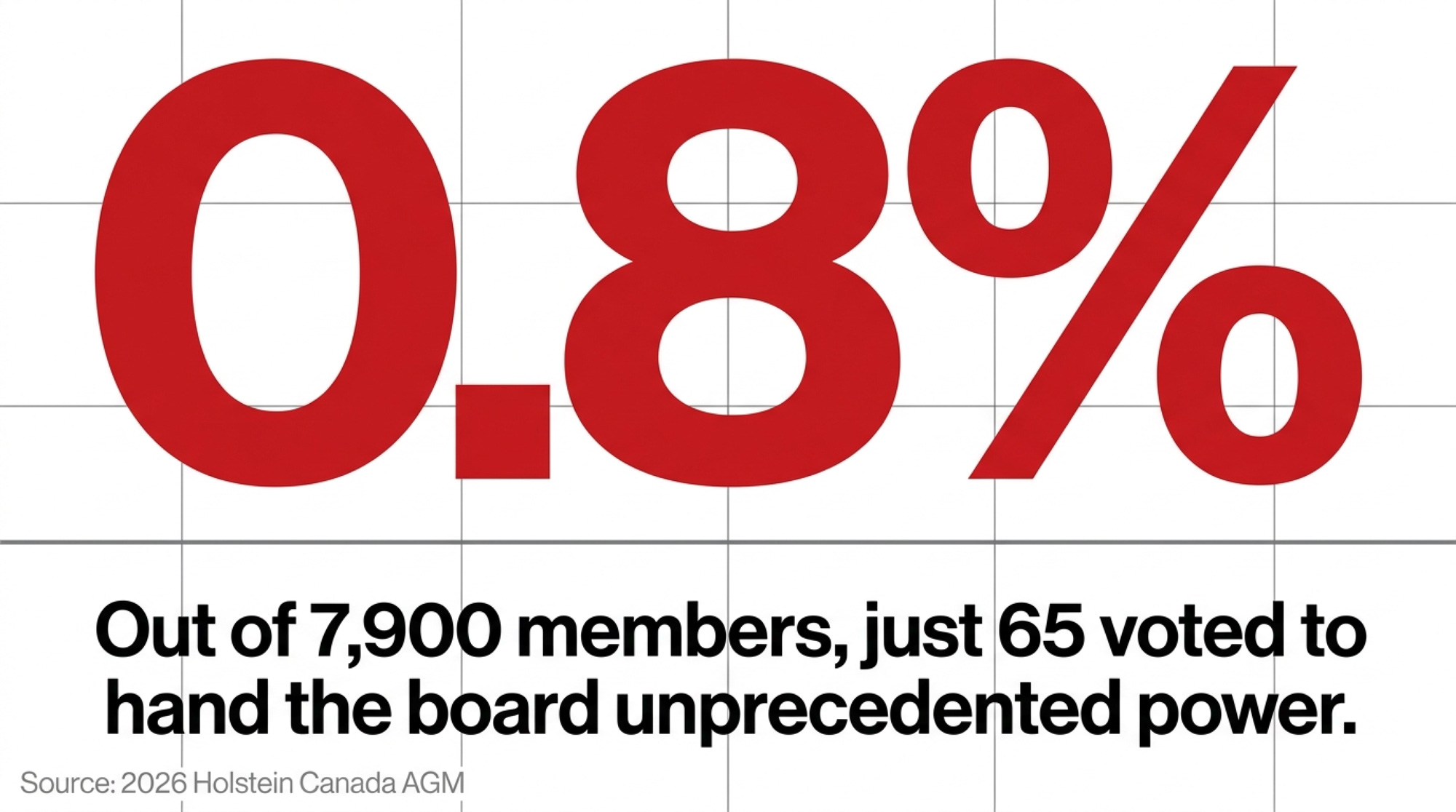
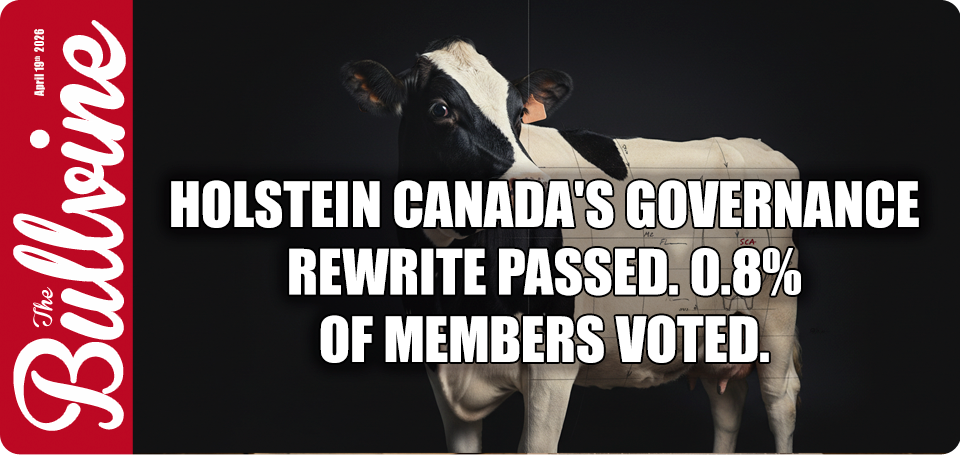
There are 7,900 members of Holstein Canada. Sixty-five of them voted. That is 0.8%.
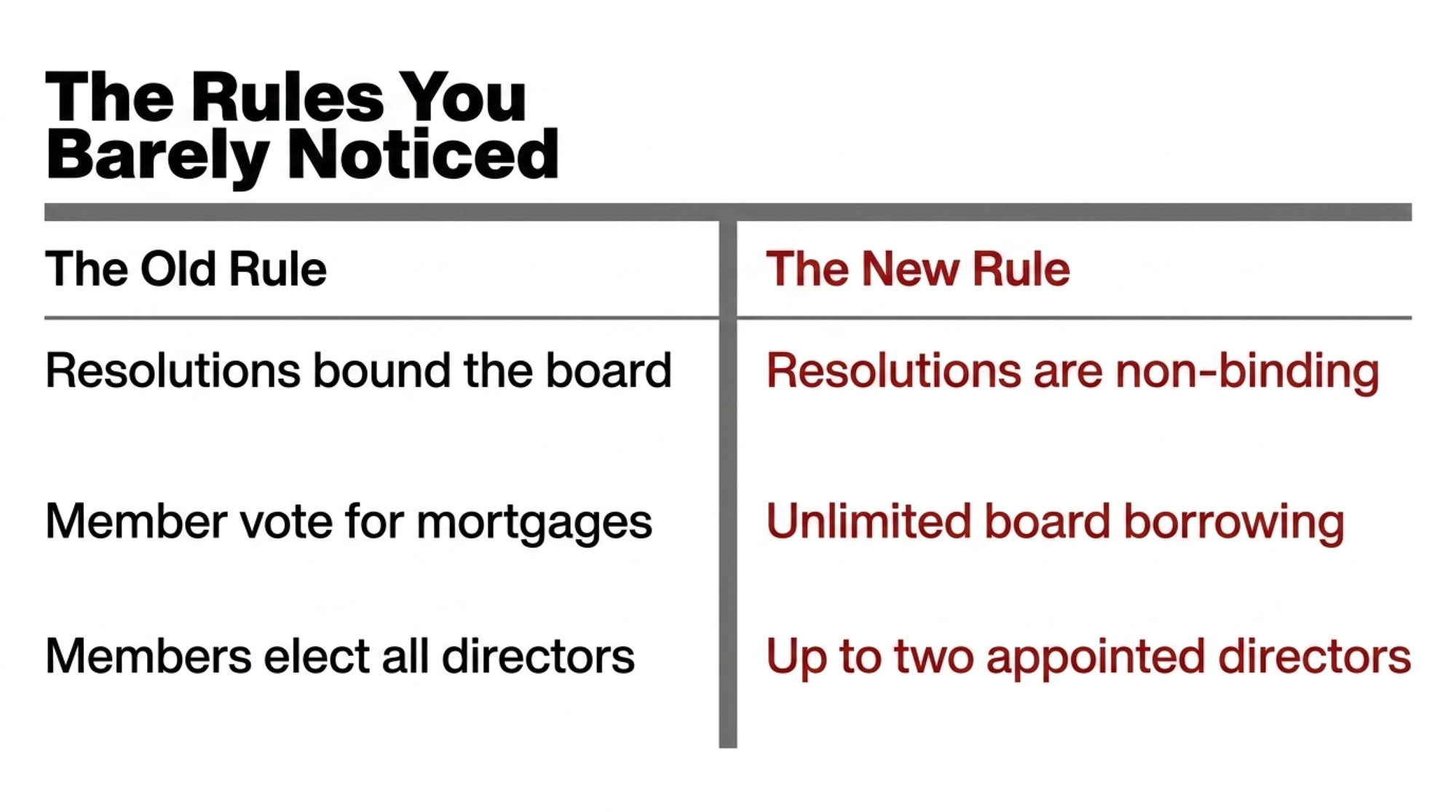
By the end of that Saturday morning, those sixty-five people had adopted a wholesale governance rewrite of the 141-year-old association that governs the Canadian Holstein breed. The by-law rewrite carried forward existing language stating future member resolutions would not bind the board. The board would have “sole discretion” to write the operating policies governing elections, director conduct, and member discipline. The board could borrow against and mortgage any Association property without a member vote, with no stated cap. Two voting directors could, going forward, be appointed by the board itself rather than elected.
None of those four clauses drew a single challenge from the floor.
We read every speaker. We matched every quote. We cross-referenced every vote. And the conclusion we have arrived at is not the one the board would like us to reach. It is not a conclusion about bad actors or institutional conspiracy. It is something quieter and, in its way, more damaging.
Holstein Canada is not being taken over. It is being left.
That is a harder problem than takeover. Takeover can be fought. Abandonment has no opposing side.
And if the trend lines set at this AGM hold for another five to ten years, the specific legal institution that holds the Canadian Holstein herd book, administers the Master Breeder program, and represents Canadian breeders internationally may not survive in any form that a 2020s breeder would recognise. The breed will continue. Holstein genetics are too globally entrenched to care whether any single national association endures. But the member-governed, branch-based, bilingual democratic Association of Canadian Holstein breeders is not a law of nature. It is an institution. Institutions die when their members stop showing up.
On April 18, 2026, in British Columbia, sixty-five (of 7,900) members showed up and changed an association … for ever?
The Million-Dollar Surplus That Wasn’t
The most honest moment of the AGM came from a man who had been in the CEO’s chair for less than five months.
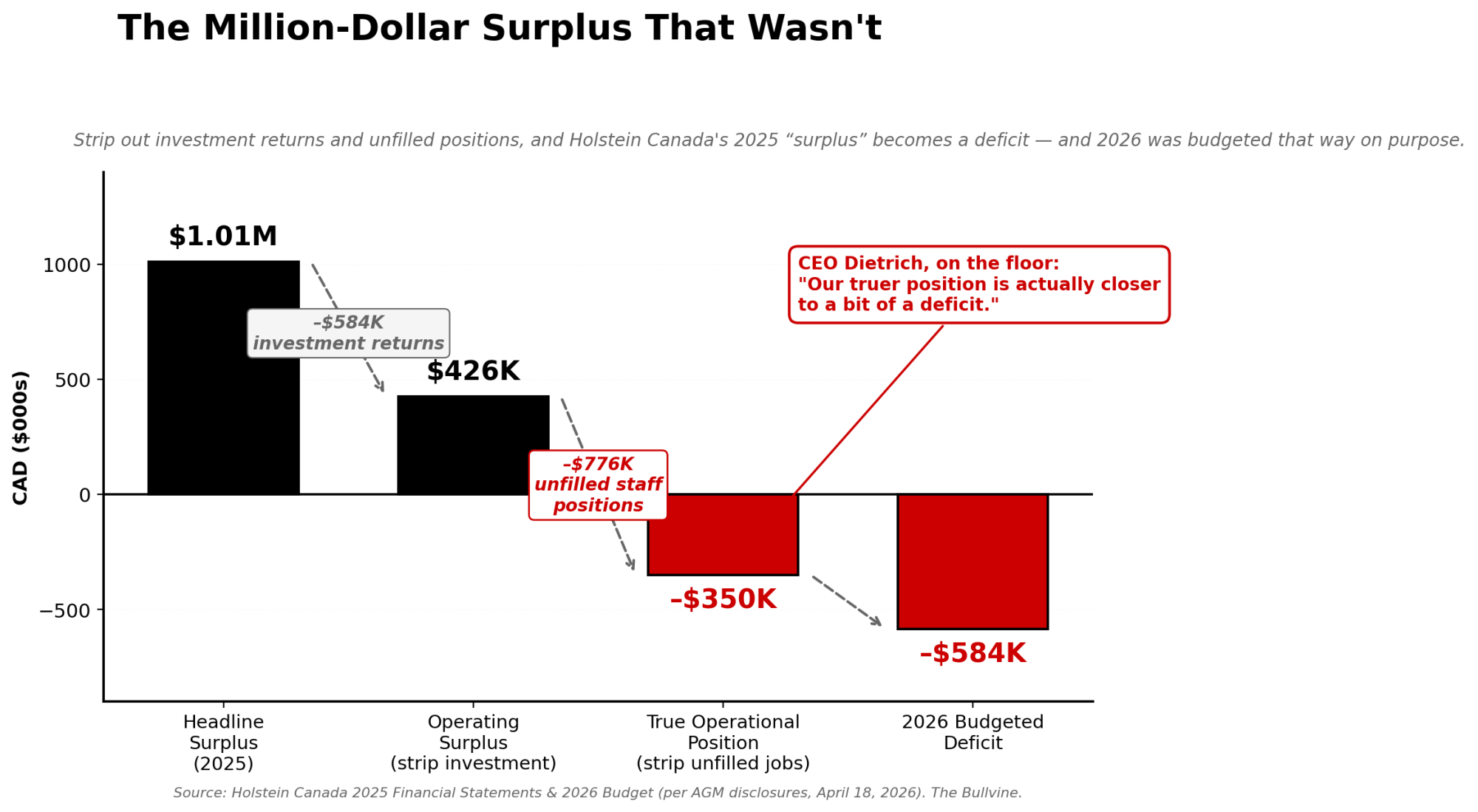
Greg Dietrich, new to the role, new to the podium, walked the room through the 2025 financial statements. On paper: $16.78 million in revenue, $16.35 million in expenses, an operating surplus of $426,000. Add investment returns from the reserve fund and the headline jumped to $1.01 million.
One million. Surplus. A good year.
Then Dietrich did something his predecessors had not done.
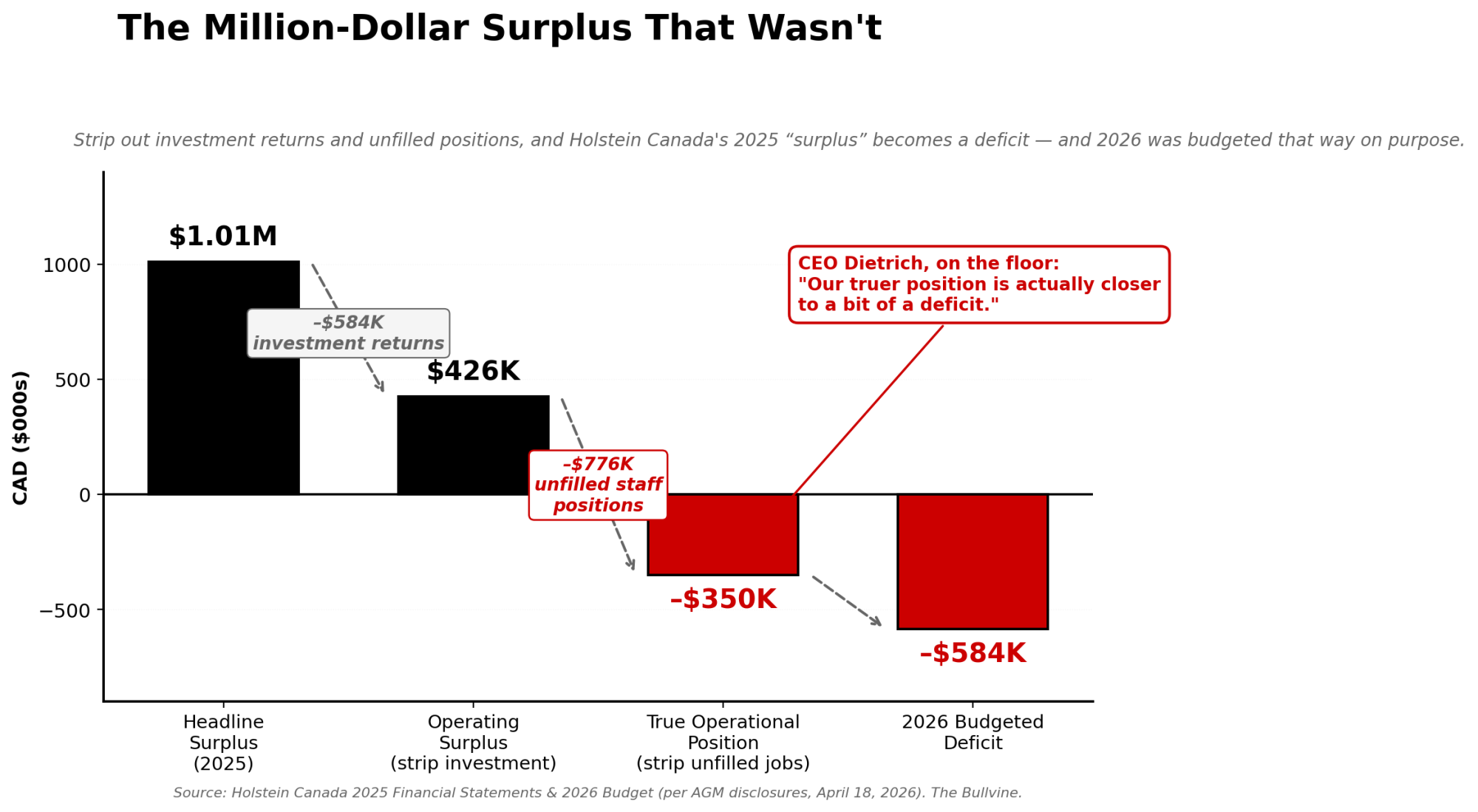
“We had about $780,000 that we did not pay for staffing or labor resources,” he told members. “If we consider that into the full staffing, then our operational position could be more about a $350,000 deficit. So as we look at 2025, it may appear at the beginning that we had a fantastic year. Our truer position is actually closer to a bit of a deficit, if we’re being… looking at it with a close eye. We achieved that, not necessarily in the right way.”
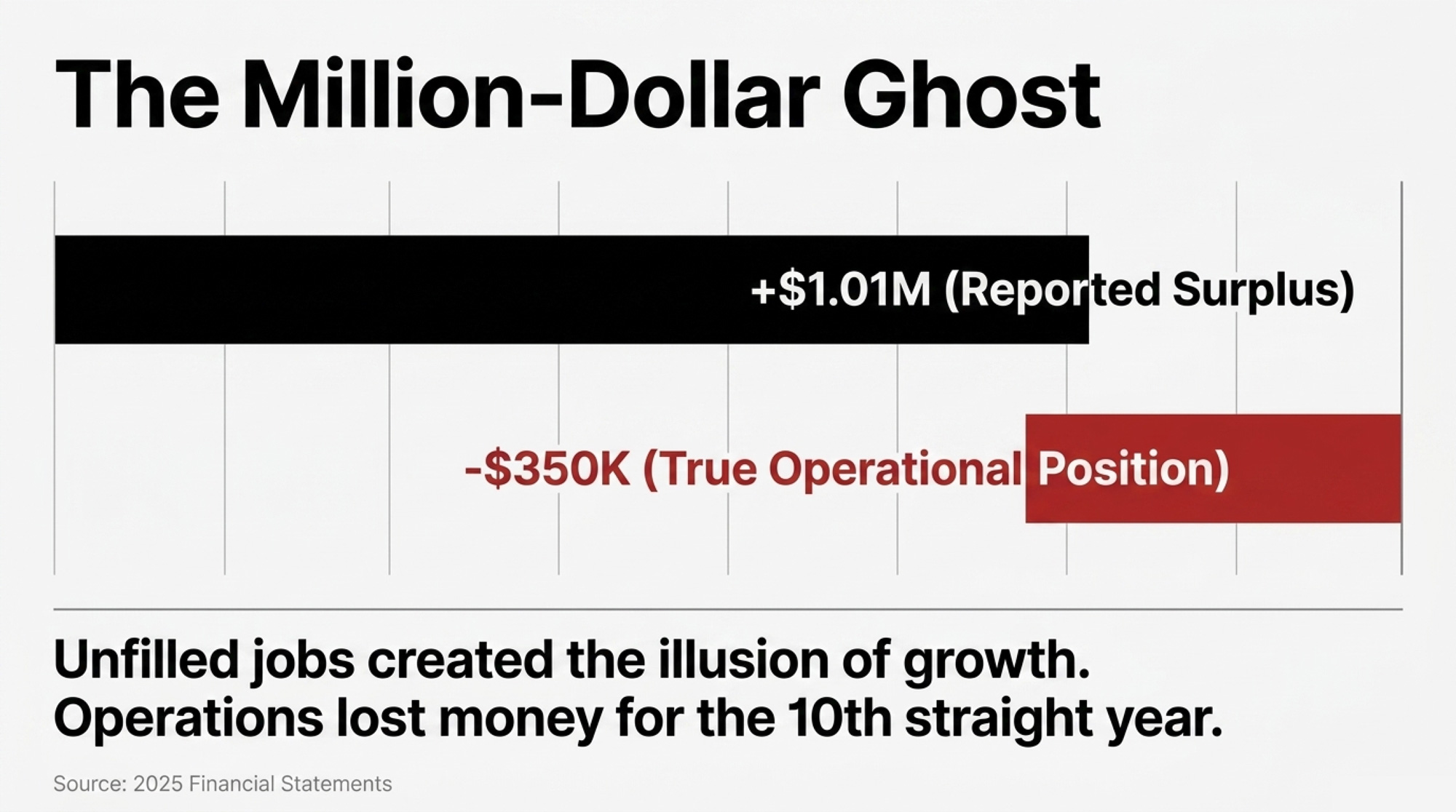
The new CEO stood up in front of the members and told them the million-dollar surplus was a ghost. Jobs they couldn’t fill had produced the illusion of growth.
Finance chair Benoît Turmel of Ferme Beauçoise, Quebec then walked members through a ten-year chart. Expenses above revenues for an entire decade, with one COVID-era exception. “For the past five years,” Turmel said, “our operational deficit has been negative for an average of $147,000. We’ll have to be proactive and use our imagination.”
Five consecutive years of operational losses. A decade of expenses running ahead of income. The books are only held up by investment income from a reserve fund — $6.89 million at year-end, returning 9.28% in 2025, according to the Finance Committee report — that Holstein Canada is now, at management instruction, being moved from RBC to Burgundy Asset Management in an explicit attempt to grow the reserve toward one full year of operating expenses. At present, it covers about six months.
And the 2026 budget members approved without a single challenge? A projected $584,000 deficit, deliberately. Severances are baked in. Consulting fees are baked in. Legal fees for the governance rewrite are baked in. Dietrich framed it as “investment in rebuilding.” It is also a draw on the reserve, and a bet on two specific operational turnarounds that the financials do not yet support.
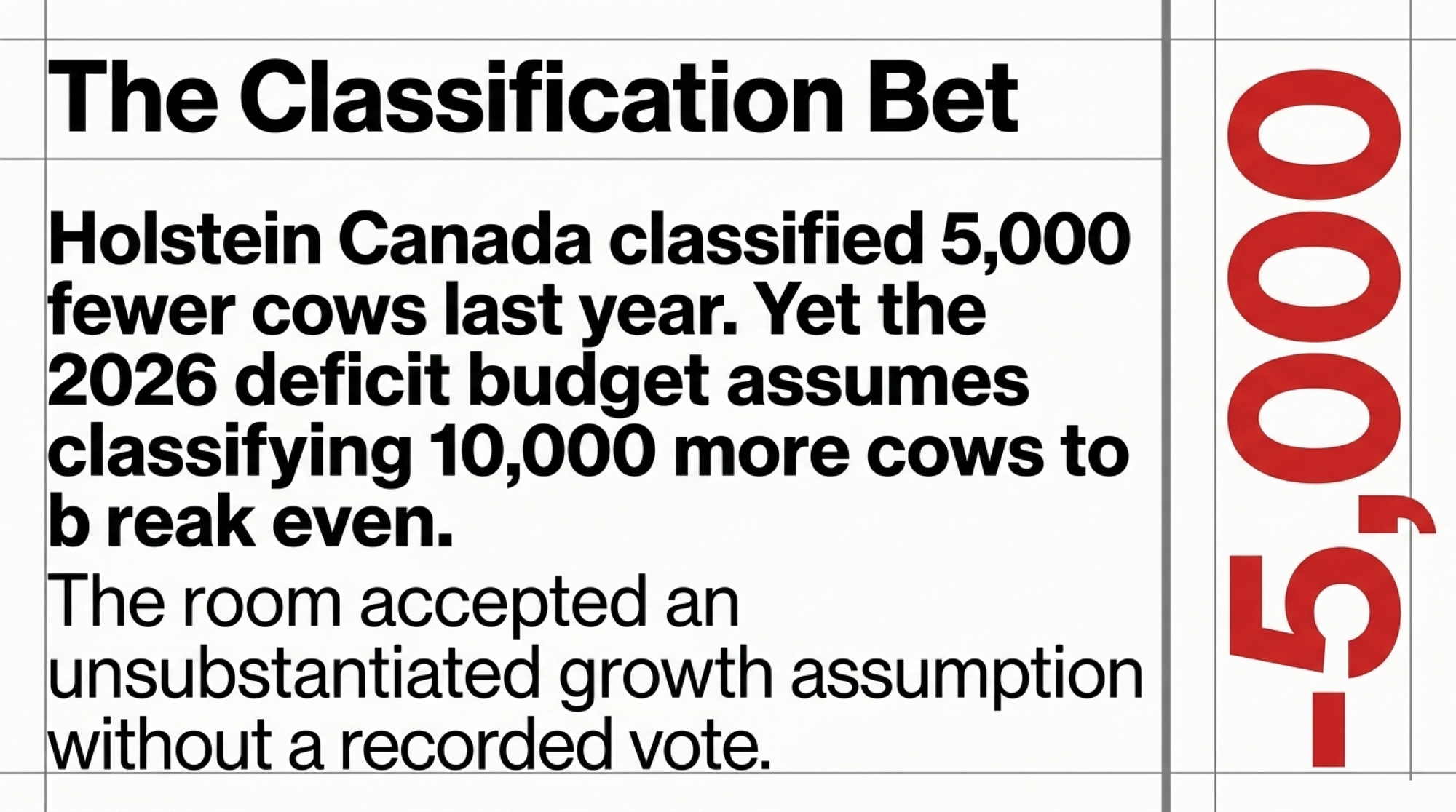
The bet: Holstein Canada will classify 10,000 more cows in 2026 than in 2025. That is the assumption underpinning the budget.
The reality: Holstein Canada classified 5,000 fewer cows in 2025 than in 2024.
Pascal Martin of Quebec, one of the sharpest members in the room, called the contradiction from the floor. The board did not rebut the substance. They explained the plan — new four-month classification rounds, a two-month interval service for large herds, a new business development hire — and moved on.
There is a word in financial reporting for budgeting aggressive growth into a business line that has been contracting. The polite word is “ambitious.” The less polite word is “unsubstantiated.”
The room accepted it without a recorded vote.
Fred Hofstra Stood Up
The only by-law section that drew real opposition was Section 5.05, which creates up to two appointed voting directors — board members chosen by the board rather than elected by the membership.
Fred Hofstra runs Corlane Holsteins in Alberta. He is president of the Alberta Holstein Branch. He is not a perennial critic; later in the same meeting he delivered one of the warmest tributes to the board’s recent progress. He is the kind of member the board wants in the room.
He walked to the microphone. He gave his name, his prefix, his province — the ritual of the AGM floor — and he said this:
“You’re taking a pretty big swing at switching to external members, which are not voted members. They’re going to be appointed. And you’re saying they’re going to be a two-year appointment, but yet they’re going to be making decisions and voting on behalf of your membership. We have to trust the board, but we also have to question the board, because without questions, we don’t get answers. So we can’t just trust you blindly. I really believe that this needs to be thought out at a longer term so that we can bring this back to our membership.”
Stefan Allery of Quebec echoed him. So did Dennis Weary and Rob Bumstead of Ontario. Amanda Jeffrey of Ontario pointed out that the regional boundary maps referenced in the new Section 5.02 did not exist yet — members were being asked to approve a framework and let the board draw the lines after.
The sharpest procedural observation came from Bumstead. Minutes earlier, the meeting had adopted Section 4.11, granting members the right to vote electronically in future meetings. Bumstead said it plainly:
“Those people do not have a chance to vote here today. And I think this is a pretty significant change to your bylaws. And also, we just passed a motion under section four giving them the right to vote.”
In other words: you have just told the membership they have a right to vote remotely. Now you are refusing to defer a major governance decision until you can actually give them that right. Use it, or the provision you just passed is decorative.
Section 5.05 passed anyway.
What did not happen — what no speaker raised, what no member flagged, what no branch president asked the board to defend — was the rest of the rewrite. Section 2.05, giving the board unlimited borrowing and mortgage authority without a member vote and without a cap. Section 2.09, giving the board sole discretion to write the operating policies governing elections, discipline, and director conduct. And Section 4.15, one of the quietest clauses, carried forward from the prior by-laws and again unchallenged:
“Resolutions are not binding upon the Board.”
Nobody raised it. Nobody asked about it. It passed in a bundled section vote in under five minutes. The most important governance sentence in the rewrite received zero seconds of floor debate.
There is a Bullvine question worth asking plainly. How does a clause that explicitly strips the binding authority from every future member resolution pass, in a single meeting, unchallenged, at an association whose members passed seven member resolutions that same morning?
The only coherent answer is that the members in the room did not read the document carefully enough. Or they read it, and they did not feel empowered to challenge it. Or they read it, they understood it, and they accepted it.
None of those three answers is good news.
The Accountability Ghost
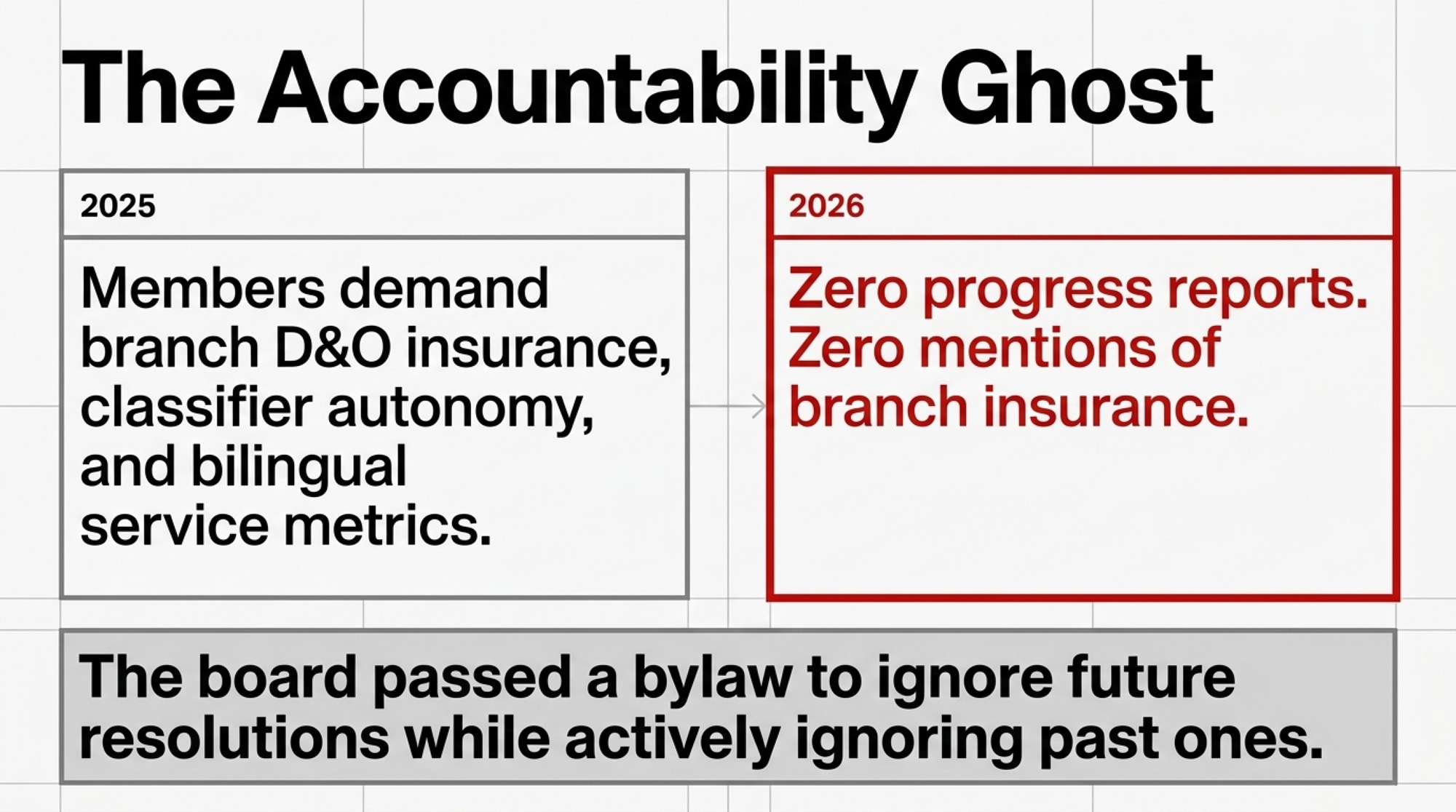
August 2024. Somewhere in Canada, a branch treasurer opened an email from Holstein Canada’s head office and learned that Directors and Officers liability insurance for branches had been cancelled. No consultation. No transition. No replacement coverage. Volunteer branch boards — retirees, working farmers, young leaders doing the unpaid work that holds the federation together — were personally exposed to liability on the decisions they had already been making for years.
The 2025 AGM in Halifax responded with a direct resolution: reinstate it. Alongside that, members passed a set of equally blunt directives. Reinstate the in-person National Joint Branch Meeting. Require HC leadership to attend provincial AGMs. Commit to detailed financial statements. Restore classifier autonomy after reports that breeders had been pressuring classifiers to skip low-scoring cows. Fix bilingual service delivery for a membership that is 43% francophone. Drive progress on crampy bull identification.
Now go to the 2026 transcript. Search for “D and O.” Search for “directors and officers insurance.” Search for “branch insurance.”
Not a single mention. A year after the resolution, the issue that exposed volunteer branch boards to personal liability did not rate a sentence of follow-up. Not from the chair. Not from the CEO. Not from the finance chair. Not in a committee report. Not from a member asking at the microphone. The single sharpest accountability demand of the 2025 AGM — the one that came from branch volunteers who learned they were suddenly personally exposed to liability — appears nowhere in the 2026 AGM transcript.
Classifier autonomy? The outgoing chair said this, precisely: “Given the importance of strengthening the management team for this key department, we have no conclusions to share with you this morning.” A new classification manager, Valerie Trembley, has been hired. Members were told to wait.
Bilingualism? The meeting itself was fully bilingual with simultaneous translation. Dietrich made a personal effort in French. But there was no systemic update, no metrics, no service delivery audit.
Crampy bulls? The 2025 resolution evidently did not produce the change breeders wanted, because a 2026 resolution was required to mandate the same lobbying. Roberto Dufour of Sandrian brought it back. It passed at 69%.
This is the context in which Section 4.15 — resolutions are not binding on the board — was adopted without debate.
Put it together. A membership, a year ago, handed the board a specific accountability list. The board addressed some items, ignored others, made partial progress on the rest, and declined to report back on progress in any organised way. And in the same meeting, that board asked the membership to re-adopt governing language stating future resolutions of this kind would not bind them — and the membership did, without debate.
The members said yes.
If Section 4.15 is the formal codification of how the 2025 resolutions were already being handled in practice, then what members accepted on April 18 is not a change in the relationship between the membership and the board. It is a written acknowledgment of a relationship that had already changed years ago.
The 0.8% of members who voted on April 18 were the ones who showed up to ratify that relationship.
The Resolutions That Landed — and the Test They Now Face
It would be unfair to skip what the membership did pass.
Holstein Québec brought a resolution demanding full transparency on the All-Canadian voting system — complete results for every nominee, named judges, published vote proportions. It passed at 89%. This is a direct win that breeders can measure. If the next All-Canadian results appear in Info Holstein without the breakdowns and the judges, members will know Section 4.15 has teeth.
The review of Cow of the Year weightings — greater weight to daughters’ results, a lowered minimum classification threshold so influential cows below 92 points can still be nominated — passed at 71%. This is overdue. Many of the breed’s most influential modern matriarchs would not clear a 92-point bar. The weighting should reflect what the breed is actually using these cows for.
Saskatchewan’s resolution requiring lactation numbers and fresh dates on show cards passed at 88%. Hofstra again from the floor: “On the ethics side of it, I think this is just common sense.”
Roberto Dufour’s crampy bull resolution passed at 69%. “Crampiness is a big breed issue. If they get crampy at third lactation, we have to cull them, and that damages the entire cow family.”
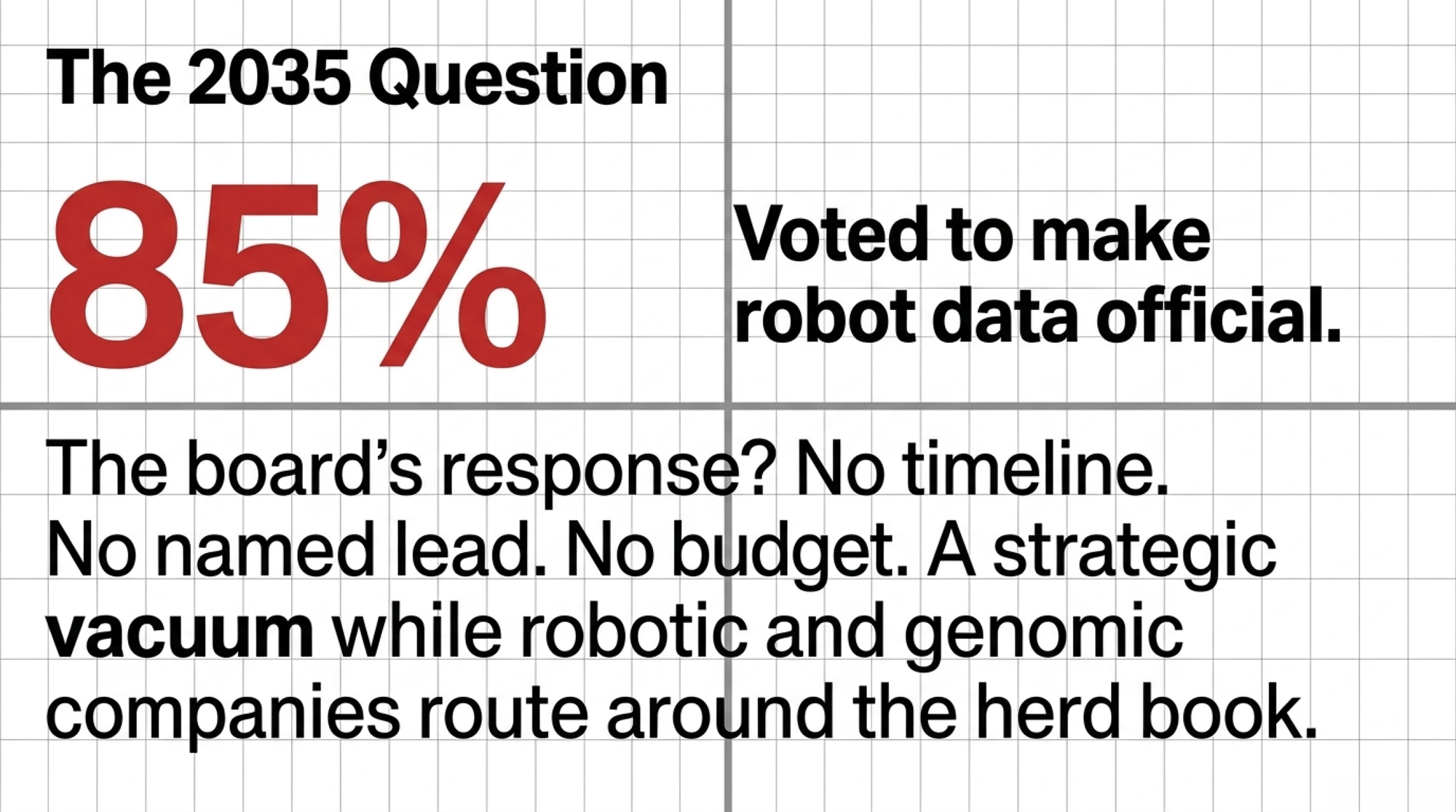
And the most strategically important resolution of the day — joint Holstein Ontario and Manitoba Holstein Branch — passed at 85%. More on that in a moment.
Two resolutions were defeated. Quebec’s move to mandate bull classification at AI centres went down 61% against, primarily because Alberta’s Doug Blair delivered a surgical floor speech on how weakly bull conformation correlates with daughter proof — Gold Chip at 82 as a three-year-old, Cinema, Starbuck — and members listened. Quebec’s motion to allow breeders to enter group show classes based on the “breeders” tab rather than the registration prefix was defeated 60% against, killed in one sentence from Ontario’s Dean Karen: “I’m old school — the prefix on the animal, that should be the group you represent.”
Seven passed, two defeated. In a functional association, this is a productive AGM on member business.
But under the by-laws adopted at this same meeting, the board is now explicitly not bound by any of the seven. Whether these resolutions are implemented, ignored, or partially delivered will be the test of whether Section 4.15 is a safety valve the board uses sparingly or a license it uses casually.
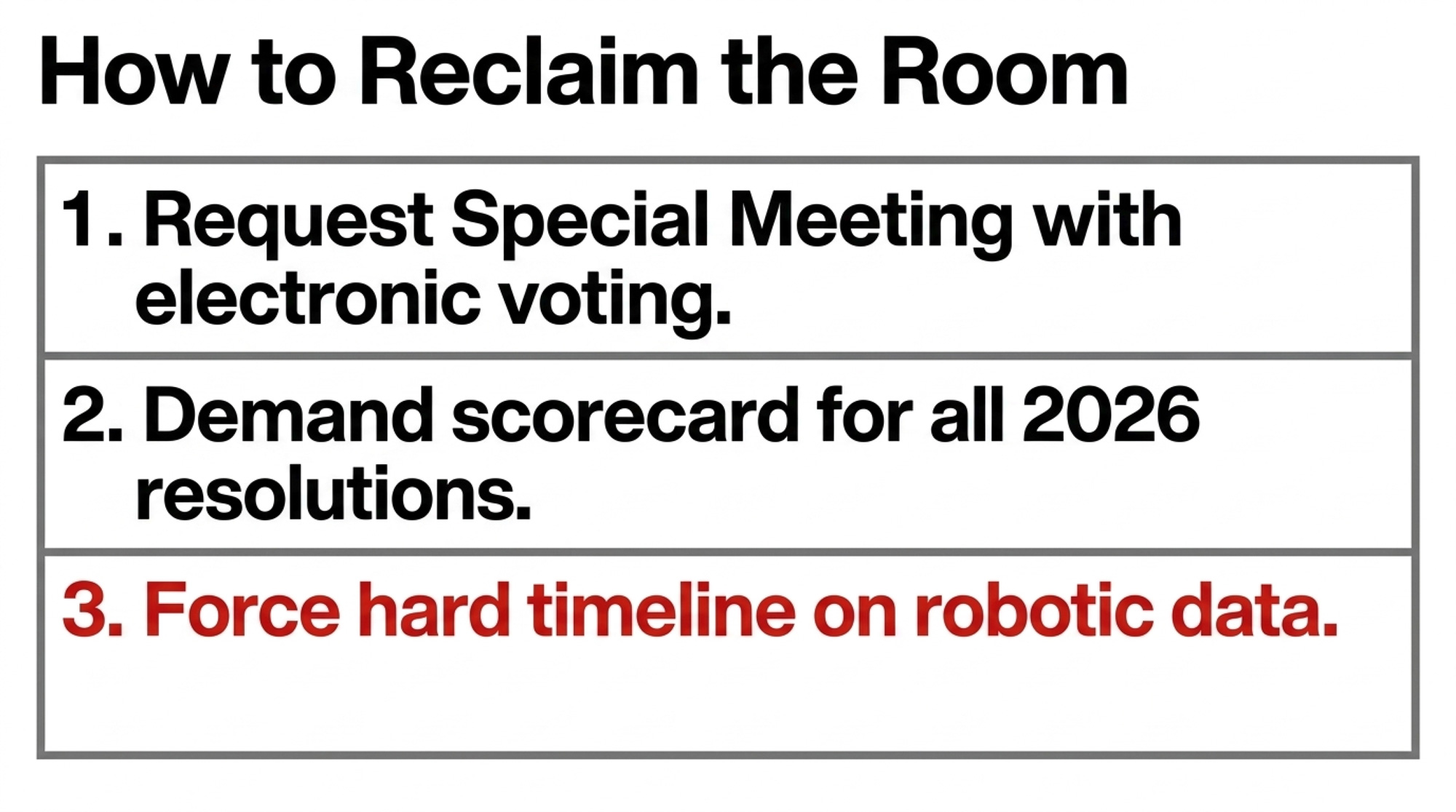
We will be watching. The 2027 AGM should publish, as a standing agenda item, a full implementation scorecard for every 2026 resolution. If that scorecard does not appear, members will have their answer.
The Robotic Milking Question — Where 2035 Actually Gets Decided
If the Canadian Holstein breed is still relevant in 2035, it will be because the people and the institutions around it solved a single technical-political problem in time. Not breeding strategy. Not show ring fashion. Not Master Breeder point weightings. Data.
Roughly 20% of Ontario dairy barns now run robotic milking systems. In Manitoba, it’s well beyond 50%, and across Canada new operations and rebuilds are overwhelmingly free-stall designs built for the robot era. Every milking generates real-time component data — fat, protein, and somatic cell count. The robots know. The herd management software knows. The farm owner knows.
But official milk recording — the foundation of the Canadian dairy genetic evaluation system, and the prerequisite for staying in the Master Breeder program — does not accept that data as official. A farm running Lely or DeLaval robots is asked to also run separate DHI sampling on top, duplicating labour and cost, or to walk away from the program.
An increasing number of farms are choosing door number two.
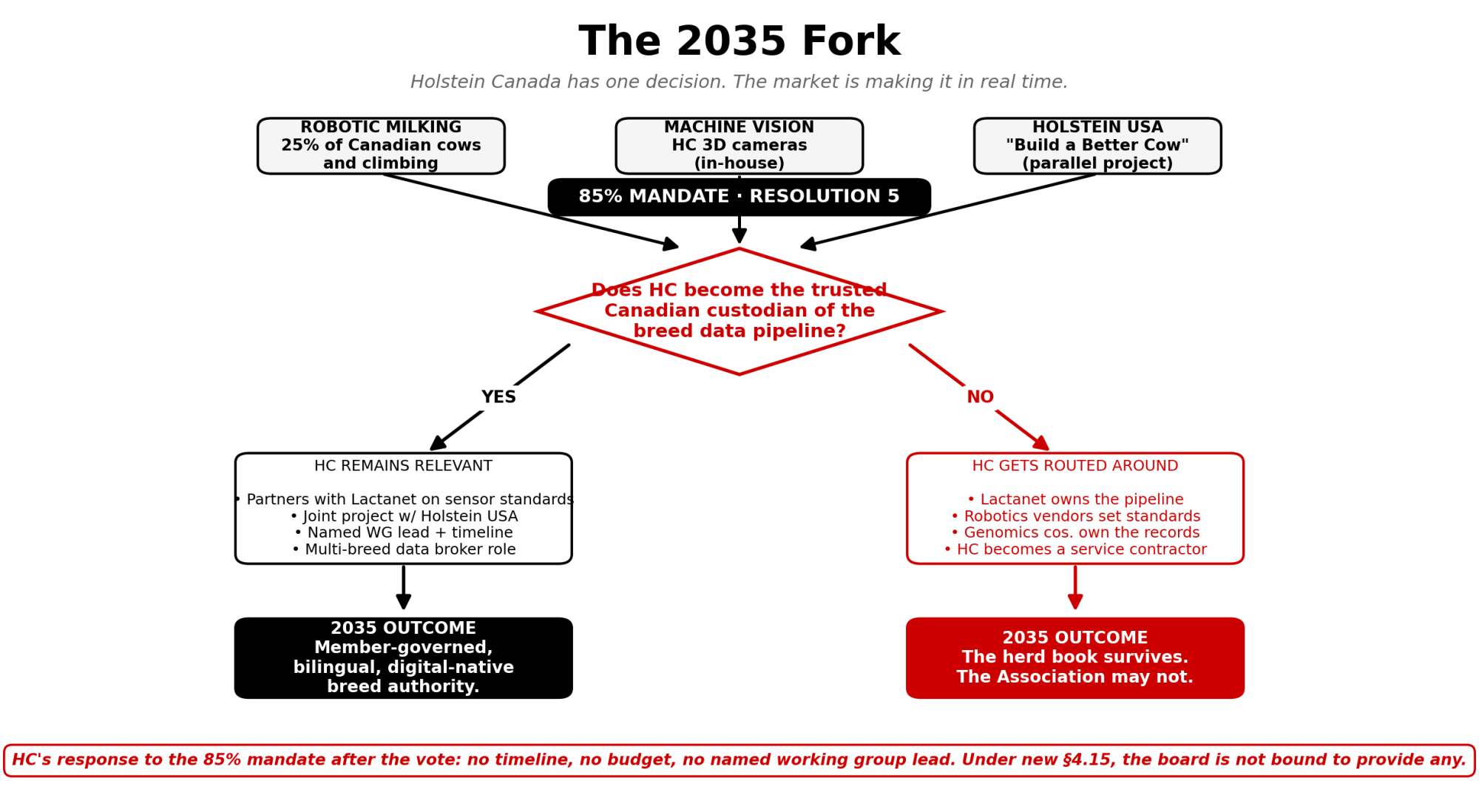
Resolution 5 at the 2026 AGM — moved by Alan Hawthorne of Bobmar Farms, Ontario, vice-president of Holstein Ontario, and seconded by Monica Kagi of Red Lodge, Ontario — calls on Holstein Canada to “fully support development of a working group with all relevant stakeholders” to get robotic sensor data accepted as official test data, keeping members engaged in milk recording and the Master Breeder program.
It passed at 85%. The strongest mandate of the day.
Holstein Canada’s formal response to that 85% mandate after the vote? Silence. No timeline. No named working group lead. No budget allocation. No visible dialogue with Lactanet on the floor. The resolution is on the books.
Overlay that silence with two other things Greg Dietrich said almost in passing during his CEO address. First, Holstein Canada is “researching 3D cameras for AI and animal measurements” — machine-vision evaluation of conformation, an in-house project. Second, the Association is preparing a plan for the board on “multi-breed opportunities” — an expansion of the herd book beyond pure Holsteins.
Then overlay that with what Lindsay Warden, CEO of Holstein Association USA, told the same room when she took the mic. Holstein USA is running a parallel machine-vision project called “Build a Better Cow,” still in development, explicitly aimed at using cameras to support conformation evaluation. An Alberta member stood up and asked the obvious question: should Holstein Canada and Holstein USA be building one system together, or two systems apart?
Dietrich’s response was warm and non-committal: “We’ve already started some similar discussions. We’re already excited to have some of those discussions as a group.”
Here is the decade-defining fork.
In 2035, the Canadian Holstein breed will be evaluated primarily by machines. Robots will capture production. Cameras will capture conformation. Genomic predictions will overlay both. The question that decides whether Holstein Canada — the institution — still has a reason to exist is whether it becomes the trusted Canadian custodian of the breed data pipeline, or whether Lactanet, the robotics companies, the genomic companies, and the AI vendors simply route around it.
On this exact question, the 2026 AGM delivered an 85% mandate and no plan. It disclosed an in-house 3D camera project and no partnership. It hosted the CEO of the American counterpart organisation and produced no joint announcement.
This is a strategic vacuum. It is the exact kind of vacuum the market fills on its own terms, on its own timeline, without waiting for the national breed association to catch up.
And it is, not coincidentally, the exact kind of file on which Section 4.15 matters most. The board is not bound by the resolution. The board is not bound to publish a timeline. The board is not bound to name a lead. The board is not bound to report back.
If Holstein Canada is still relevant in 2035, this is the file that will have proven it.
The Generational Gap Nobody Talked About
There is a line item in the 2026 reports that deserves more attention than it received.
The Young Leader program age range has been changed from 19–30 to 21–35.
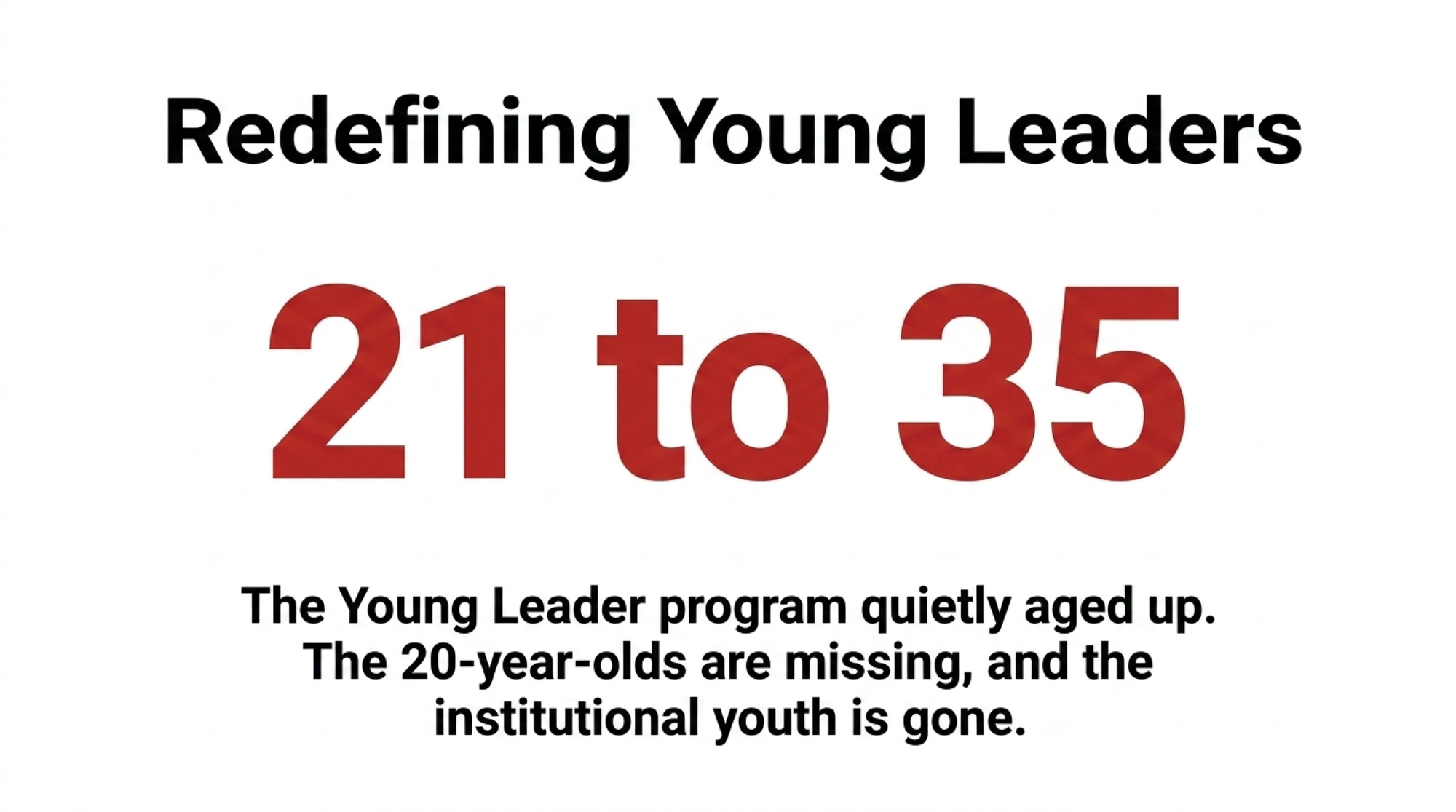
Read that again. The organisation’s flagship pipeline program for the next generation of Canadian Holstein breeders has quietly moved its upper limit up five years. The lower limit moved up two. This is not a cosmetic adjustment. It is an admission that the 19-year-olds and 20-year-olds the program was designed for are not engaging in meaningful numbers, and that the Association’s “young leaders” are now in their thirties.
Look at the floor of the 2026 AGM. Look at the names The Bullvine has quoted in this piece: Hofstra, Blair, Dufour, Martin, Allery, Weary, Bumstead, Jeffrey, Karen, and Hawthorne. These are names that have been on microphones at Holstein Canada meetings for decades. The institutional memory in the room is extraordinary. The institutional youth is not.
There is no single voice in the transcript under 35 making a sustained governance argument. There is no generational cohort standing up and saying: this by-law is what I’ll inherit, and I’m not sure I want it. The silence on Section 4.15, on Section 2.05, on Section 2.09 is not only a silence about the document. It is a silence about the future users of the document.
A Holstein herd book is a 141-year-old asset. It is worth, in the loosest accounting sense, an enormous amount. But it is worth nothing at all if the next generation does not file registrations against it, does not classify animals into it, does not trust the body that holds it. If the under-35 generation is watching this AGM — and a growing number of them are, on the live stream that the new §4.11 will eventually make more accessible — what did they see?
They saw their parents’ generation pass a by-law making their resolutions non-binding. They saw the Young Leader age range creep upward to accommodate the fact that they are not there in sufficient numbers. They saw a CEO they have never met deliver a deficit disclosure that was, in its honesty, the most reassuring thing in the meeting.
Whether they come to the 2027 AGM in a number greater than sixty-five will determine more about the next decade than anything the board in that ballroom voted on.
The Dietrich Variable
No piece about the April 18 meeting is complete without sitting honestly with Greg Dietrich.
The Bullvine has been sharp in this article. It has to be equally honest about what Dietrich did right.
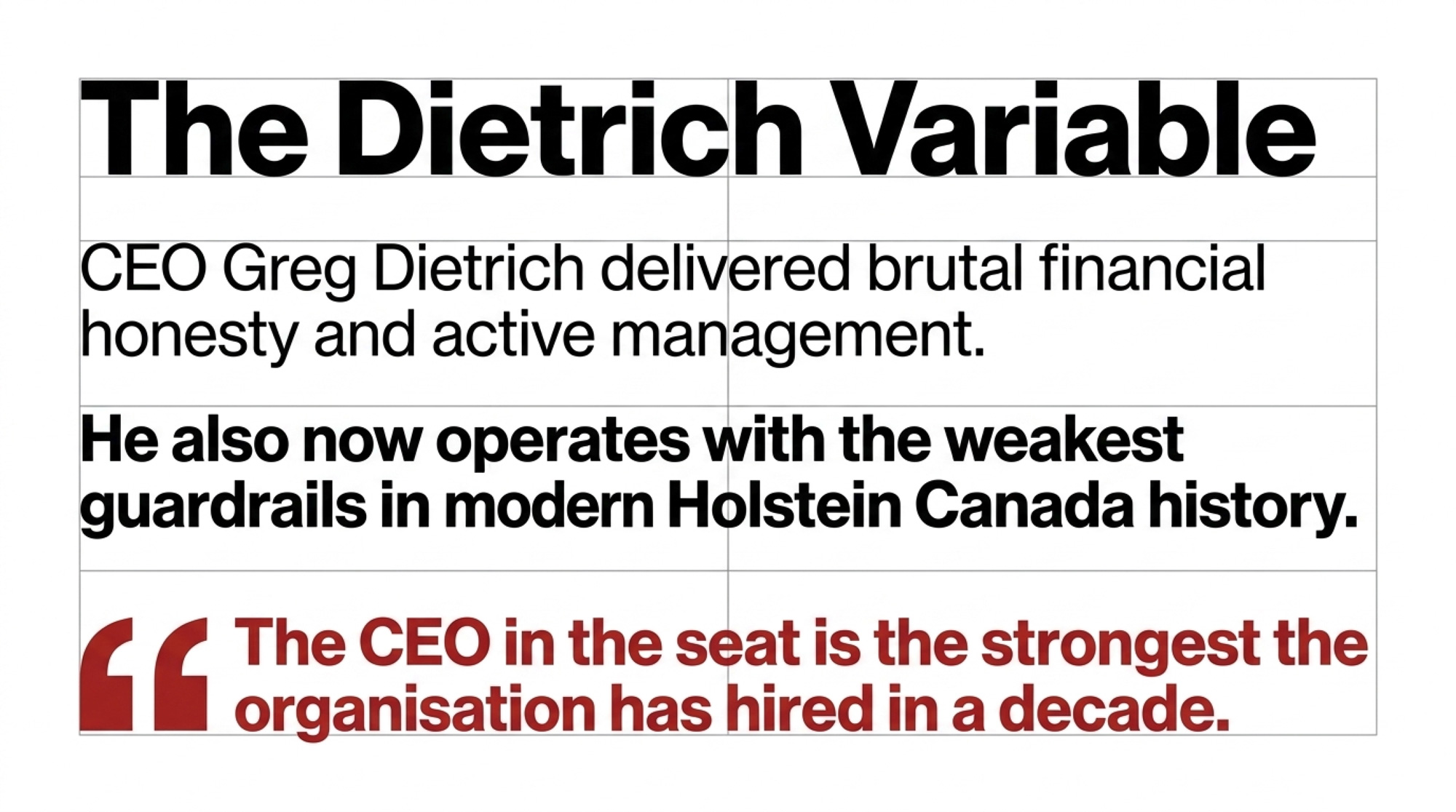
His financial candour was without recent precedent at Holstein Canada. He walked members into an unpleasant truth they could have been allowed to miss. His repeated line — “Talking is one thing, but what are the deliverables? We can talk here this year, and if we come up here next year and talk the exact same thing, then that’s a fail” — is the language of a leader who intends to move an organisation. His decision to move the investment portfolio to Burgundy, his preparation of a multi-breed herd book plan, his willingness to budget severances explicitly, his hiring of a new business development role, his extension of the Young Leader range, his visible attempt to speak French to a 43% francophone membership — these are active management decisions. Several are overdue.
Dietrich is also the person who used the projected $584,000 deficit as the justification for the appointed-director clause, from the floor, while the vote was live. He is the person who defended each contested by-law section as it came up. He is the person who will now operate, with sole board discretion under Section 2.09 and without binding member resolutions under Section 4.15, the governance architecture that just passed.
The guardrails on the CEO role at Holstein Canada are now the weakest they have been in the modern era, and the CEO in the seat is the strongest the organisation has hired in a decade. That is either the best news in this story or the most dangerous sentence in it, depending on who Dietrich decides to be.
His own framing, offered to members in his own voice on the morning of April 18: “The pyramid is reversed. The members are in charge of the board, who is in charge of the Association.”
There is now nothing structural in the by-laws preventing him from changing his mind about that.
He has probably earned the benefit of the doubt in 2026. The 2027 AGM will be the proof.
Does Anyone Care?
Return to the question at the top.
Look at the evidence. 0.8% of members voted on a governance rewrite that reassigned the relationship between the board and the membership. The most consequential clauses were never challenged on the floor. The organisation has lost money on operations for ten straight years. It lost 5,000 classifications in a single year. It budgeted a $584,000 deficit for 2026 on an assumption — doubled classifications — that the trend does not support. It received an 85% mandate on robotic milking and announced no plan. It did not report back on the accountability resolutions of its last AGM. It abolished the binding nature of future member resolutions at the same meeting in which the previous year’s resolutions were, visibly, partially unimplemented. Its Young Leader program has quietly aged upward to cope with generational disengagement. Its financial stability depends on a reserve fund it is now actively drawing down.
And in the face of all of that, Ontario and Quebec — the two provinces representing the overwhelming majority of Canadian Holstein members — did not appear in British Columbia in sufficient numbers to influence a by-law rewrite that will govern them for a decade.
They were not silenced. They were not barred. They simply were not there.
A healthy membership would have filled the ballroom. A healthy branch federation would have insisted on electronic voting before a governance rewrite of this magnitude was scheduled. A healthy board would have treated a 65-vote bar as embarrassing rather than sufficient. A healthy CEO — and Dietrich may yet prove to be exactly that — would have privately urged deferral rather than publicly defending passage.
None of that happened. What happened was a small, earnest, loyalist group in a hotel in British Columbia handed the keys to the new leadership and went home, and the national herd was asked to trust that the new leadership will steward the institution well enough that the guardrails will not be needed.
The Canadian Holstein breed will survive the 2030s. Holstein genetics are globally distributed, privately owned, and commercially valuable in ways that do not depend on any single national association. The cows will be fine. The farms will be fine. The semen market will be fine.
What may not survive the 2030s is Holstein Canada itself — the specific legal institution, member-governed, branch-based, bilingual, democratic, headquartered in Brantford. It may end the next decade smaller. It may end it as a service contractor to Lactanet. It may end it as a subsidiary of a combined North American registry. It may end it as a multi-breed data broker. All of these are consistent with what was approved on April 18. The outcome inconsistent with what was approved on April 18 is the one where the Association grows: rising membership, binding resolutions, branch autonomy, financial surplus from its own services.
That door was open going into the meeting. Sixty-five people closed it.
The Bullvine is not here to mourn. There is still time. The branch federation can request a Special General Meeting, with electronic voting, specifically to revisit Sections 2.05, 2.09, 4.15, and 5.05. Members can demand an implementation scorecard for the 2025 and 2026 resolutions. Resolution 5 already entitles them to a timeline, a budget, and a named lead on the robotic milking working group. A direct public answer on branch D&O insurance is years overdue. An annual reconciliation between board slide decks and KPMG-audited figures — the reconciliation Harry Vanderlinde asked for from the floor years ago — is a thing the board can simply choose to provide.
None of it happens without members who show up. There is no governance fix for 0.8%.
The real question the 2026 AGM raised is not whether Holstein Canada will legally exist in 2035.
The real question is whether enough of its members will care, in time, to make sure that when it exists, it still means something.
On April 18, 2026, out of 7,900 of them, sixty-five voted.
We will see how many show up next April.
Key Takeaways
- Sixty-five members — 0.8% of Holstein Canada’s 7,900 — passed a wholesale by-law rewrite that makes future member resolutions non-binding, gives the board unlimited borrowing authority, and allows up to two voting directors to be appointed rather than elected.
- Financials are worse than the headline suggests: the reported $1M surplus normalizes to a $350K operational deficit once unfilled-position savings are stripped out, extending a ten-year trend of expenses exceeding revenues, with another $584K deficit budgeted for 2026.
- Resolution 5 — robotic milking sensor data as official test data — earned the day’s strongest mandate at 85%, but HC announced no working group lead, no timeline, and no budget, leaving the single most important strategic file for the breed’s 2035 relevance without a plan.
- The 2025 accountability resolutions (branch D&O insurance, classifier autonomy, bilingual service, crampy bull identification) received no formal progress report at the 2026 AGM — the same meeting that codified §4.15, which now lets the board ignore future resolutions by default.
- Branches should coordinate a Special General Meeting request with electronic voting specifically to revisit Sections 2.05, 2.09, 4.15, and 5.05; without that pressure, the governance centralization passed on April 18 becomes permanent and the 2027 AGM becomes a ratification meeting, not a deliberative one.
The Bullvine will continue reporting on Holstein Canada’s governance, financials, classification strategy, and data partnerships through 2026 and beyond. Tips, source documents, and branch communications are welcomed at the usual address. If you were in the room on April 18 and your voice has not been captured here, we want to hear from you.
Complete references and supporting documentation are available upon request by contacting the editorial team at editor@thebullvine.com.
Learn More
- New Genomic Option for Canadian Dairy Breeders to Bypass Herdbook Requirements — Reclaim management control by leveraging new rules that allow genomic testing without mandatory registration fees. This protocol shift arms you with critical DNA data while cutting through bureaucratic red tape and avoiding unnecessary association costs.
- Are Dairy Cattle Breed Associations Nearing Extinction? — Exposes the structural rot threatening legacy organizations and delivers a survival blueprint through modernized leadership. Evaluate whether your membership dollars still purchase a seat at the table or simply fund a failing, apathetic institution.
- The Future of Dairy Breed Societies: Will Innovation or Irrelevance Prevail? — Master the industry’s digital shift by studying Holstein Canada’s pivot toward high-tech service provision over simple record-keeping. Learn how emerging genetic tools replace traditional registries, ensuring your herd stays competitive in an increasingly automated marketplace.
The Sunday Read Dairy Professionals Don’t Skip.

Every week, thousands of producers, breeders, and industry insiders open Bullvine Weekly for genetics insights, market shifts, and profit strategies they won’t find anywhere else. One email. Five minutes. Smarter decisions all week.