







On a 300‑cow Wisconsin dairy, the milk‑replacer invoice said: “smart.” The heifer ledger quietly said the opposite.
Dave runs 300 Holsteins in central Wisconsin. For nearly a decade, he weaned every calf at 42 days and figured he was saving about $55 per head on milk replacer compared with an 8‑week program — roughly $6,600 a year across 120 heifers.
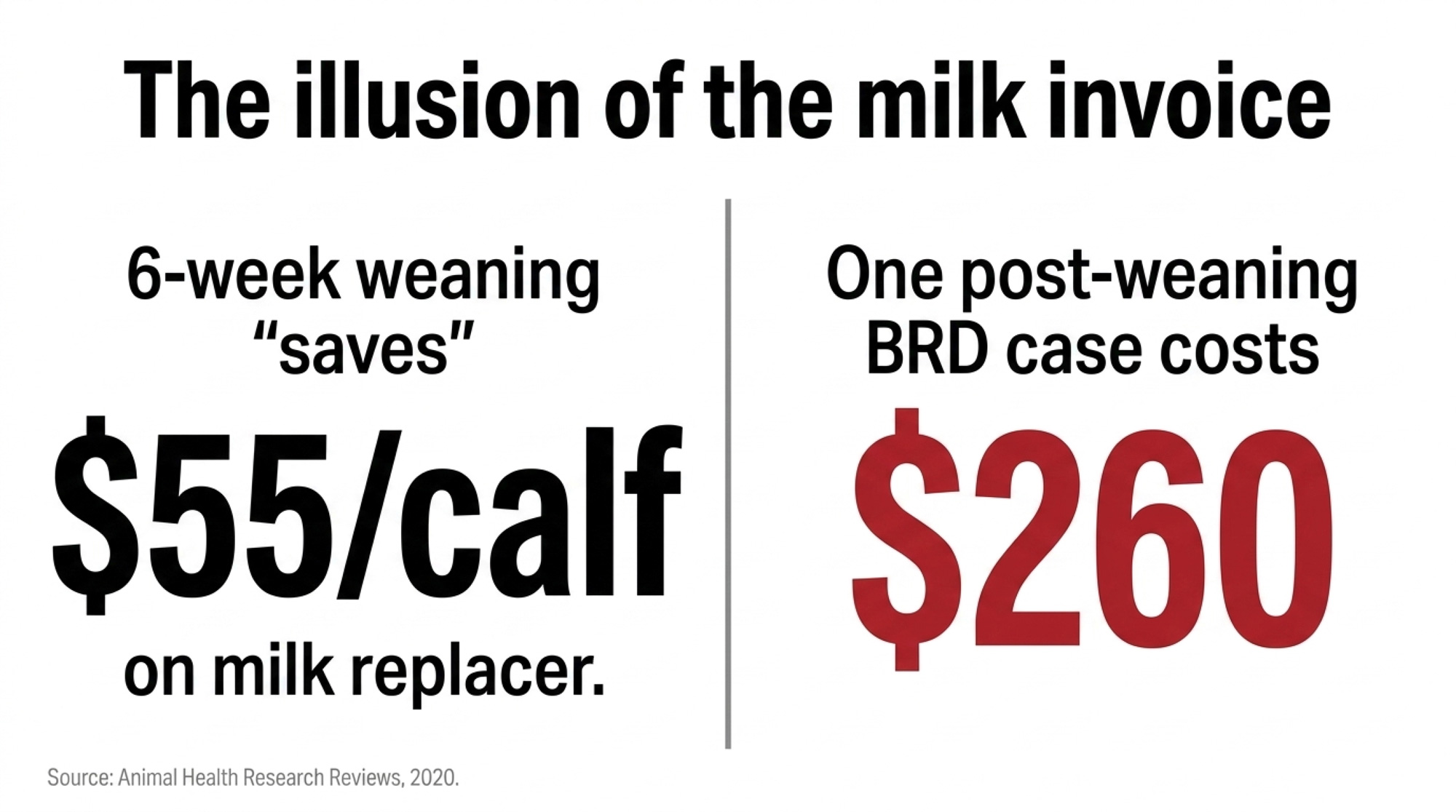
On the milk‑replacer invoice, that math looked good. When his vet put a $260 price tag on each pneumonia case, and they walked through what that did to age at first calving, the ledger flipped. The “cheap” 6‑week program looked a lot more like an $11,000 drag on the heifer enterprise.
Where Dave’s $6,600 Weaning “Savings” Actually Came From
Start with what Dave was paying for liquid feed.
He was on a 20/20 all‑milk replacer. His contracted price sat around $1.80 per pound — right in the middle of what many dairies are seeing, with 50‑lb bags often running from the mid‑$60s to the $120 range depending on formulation and brand.
His 6‑week program looked like this:
- 1.25 lb/day of milk replacer powder
- 42 days on milk
- 1.25 × 42 = 52.5 lb of powder per calf
At $1.80/lb:
- 52.5 lb × $1.80 = $94.50, call it $94 per calf
An 8‑week scenario at a slightly higher feeding rate:
- 1.5 lb/day of powder
- 56 days on milk
- 1.5 × 56 = 84 lb of powder
At the same $1.80/lb:
- 84 lb × $1.80 = $151.20, call it $151 per calf
On paper:
- 6‑week: ≈ $94/head
- 8‑week: ≈ $151/head
That’s a $55/head difference. Across 120 heifers a year:
- 120 × $55 ≈ $6,600 per year
If you stop the spreadsheet at day 42 or 56 and never look past the bottle, you’d call that a win.
The trouble is, the costs don’t stop at the day you pull the nipple.
The BRD Ledger, the Milk Invoice, Never Shows
Dave’s vet didn’t start with rumen theory. He started with the sick sheet.
“How many calves are you actually treating for pneumonia after weaning?” he asked.
Over the previous couple of years, Dave’s records showed roughly 20% of his heifers — about one in five — were treated for BRD in the 30 days after weaning. Not every respiratory case hits right after the last bottle, but that’s where the spike was.
Like most producers, Dave guessed those cases cost him forty or fifty bucks each. A couple of drugs, a vet call, and some extra labor.
A 2020 paper in Animal Health Research Reviews priced it differently. Overton and colleagues looked at 104,100 U.S. dairy replacement heifers and compared animals with and without a BRD history in the first 120 days of life. They reported:
- 36.6% of heifers had at least one BRD case in that early‑life window.
- The estimated cost per incident BRD case was about $252 or $282 per heifer, depending on whether anticipated future milk differences were included.
That cost rolled in:
- Treatment drugs and vet time
- Lost growth and delayed breeding
- Higher culling risk as heifer and cow
- Lower first‑lactation milk in affected animals
So the drugs are the cheapest part of the bill.
To keep the math grounded, Dave and his vet agreed on $260 per BRD case as a working number — basically the midpoint of the $252–282 range.
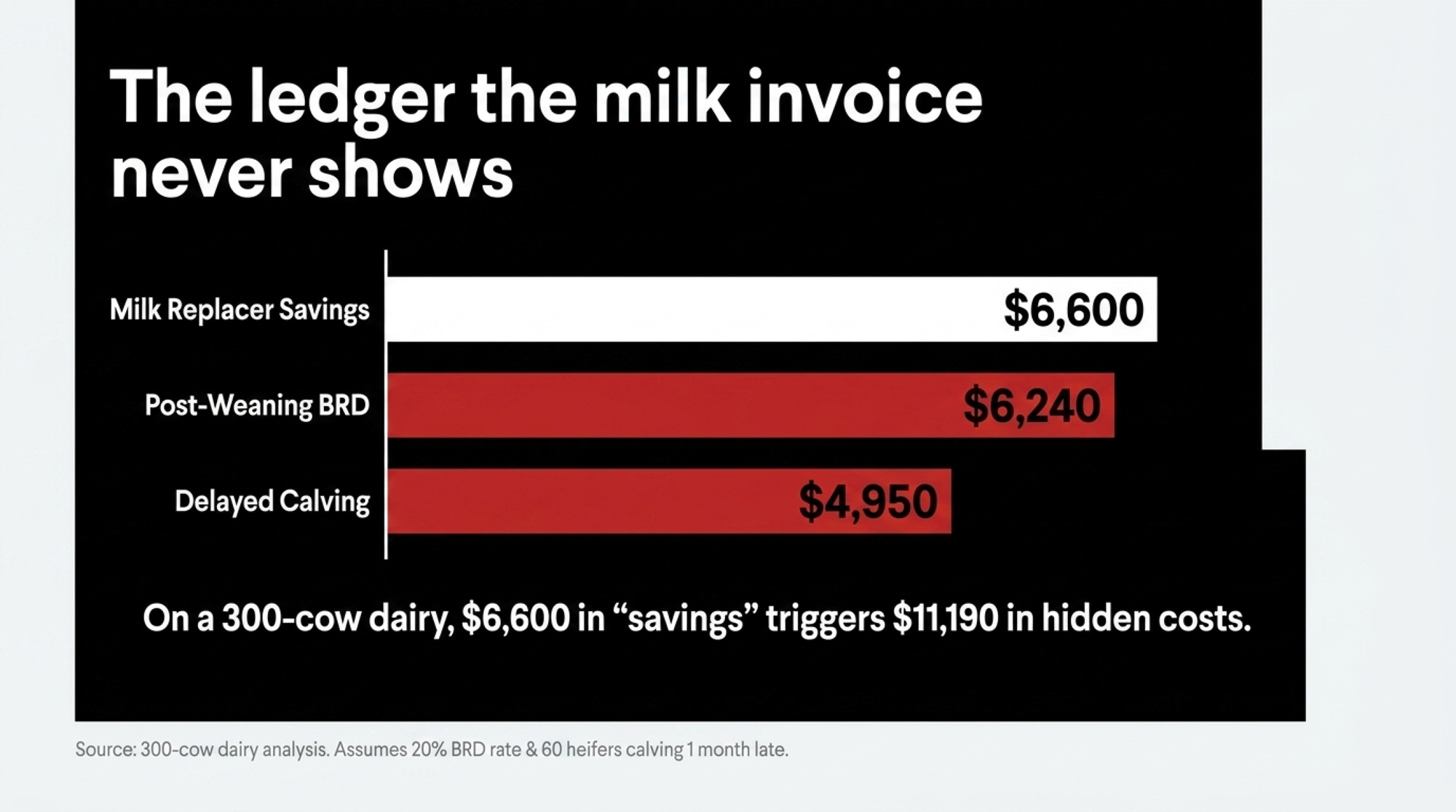
On 120 heifers a year, with a 20% post‑weaning BRD rate:
- 20% of 120 = 24 cases
- 24 × $260 = $6,240 per year in BRD cost
Compare that to the milk line:
- Milk‑replacer “savings”: $6,600/year
- BRD cost: $6,240/year
On Dave’s books, the money he “saved” on milk replacer was almost entirely eaten by pneumonia, before they even put a number on delayed calving.
Rumen Biology Doesn’t Care About Your Calendar
The next question was simple: “Why are so many calves getting sick after weaning?”
Dave’s nutritionist pulled out rumen‑development work from Jim Quigley and the latest weaning review from Aarhus University.
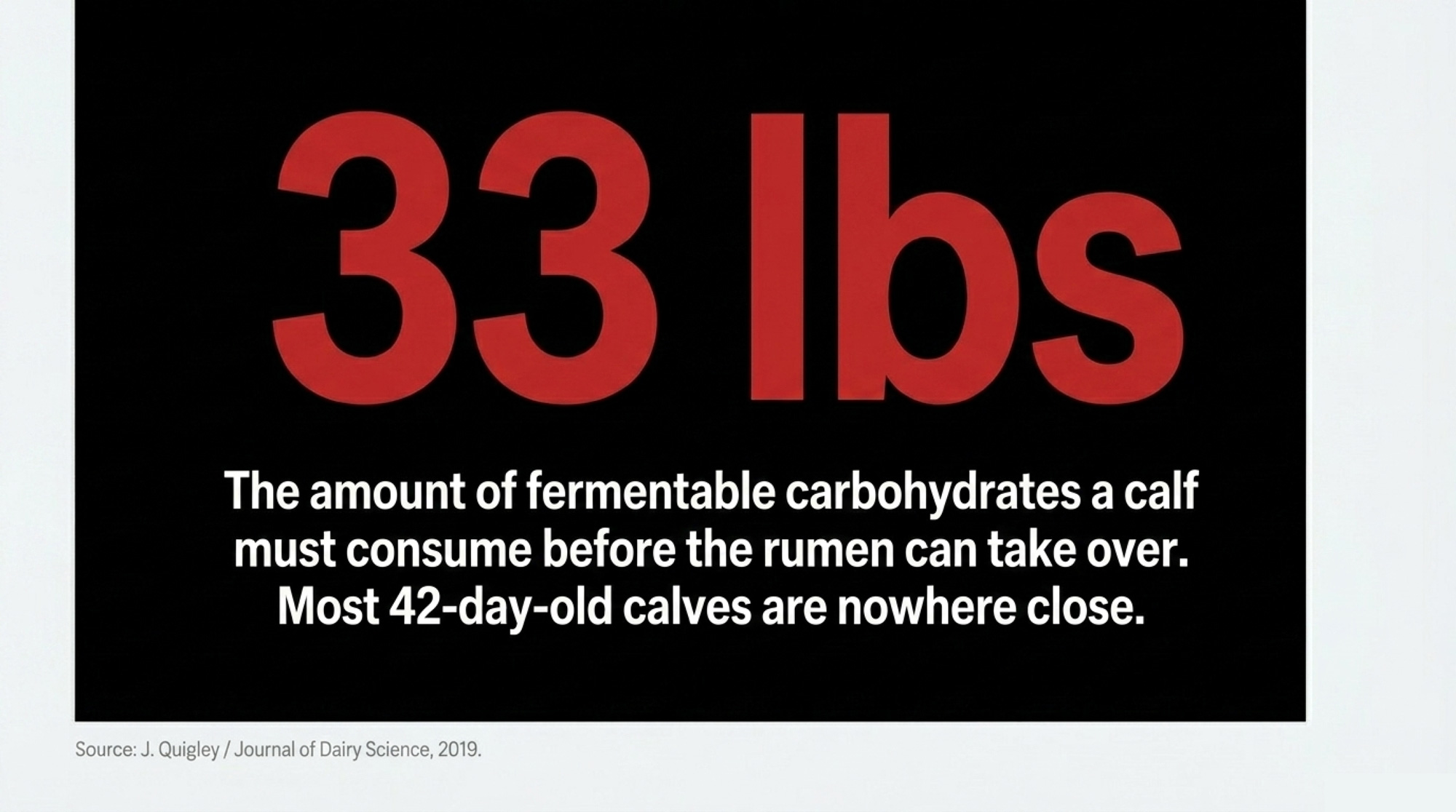
Quigley, through Calf Notes and a 2019 Journal of Dairy Science review, has pushed a specific biological threshold: a calf needs roughly 15 kg of cumulative non‑fiber carbohydrates (NFC) from starter — about 33 lb of fermentable carbohydrate — before the rumen is truly ready to take over.
The Bullvine walked through his math earlier this year:
- On a typical 8‑week program with 6 L of milk per day, many calves only get to around 11.5–13 kg of cumulative NFC from the starter by day 56 — 1.5–3.5 kg short of the 15 kg target.
- On higher‑milk programs, calves often don’t hit that 15 kg NFC mark until week 9 or 10, because liquid keeps them full and slows grain intake.
That tracks with what you see in real barns: big, shiny 6‑week‑old calves that still hardly touch the starter bucket.
A 2024 systematic review in the Journal of Dairy Science by Welk, Neave, and Jensen compiled 44 studies on weaning practices. Their conclusions matched the barn experience:
- Calves weaned later, over longer durations, based on starter intake, or using step‑down milk removal, were more likely to show positive growth and intake responses.
- Weaning based on starter intake produced superior growth and feed intake compared with fixed‑age, earlier weaning.
- When pre‑weaning milk allowances were adequate (over about 6 L/day), weaning after 8 weeks supported superior weight gain.
At 42 days, when Dave pulled the last bottle, most of his calves were barely at a pound of starter a day. Some less. Nowhere near the 2+ lb/day that corresponds to Quigley’s 15 kg NFC target over time.
The milk disappeared anyway.
Extension recommendations from Penn State, Cornell, and the Canadian Dairy Code of Practice all push in the same direction: don’t fully wean Holstein‑size calves until they’re consistently eating roughly 2–3 lb of starter per day for several consecutive days. That’s just a practical way of making sure biology has caught up.
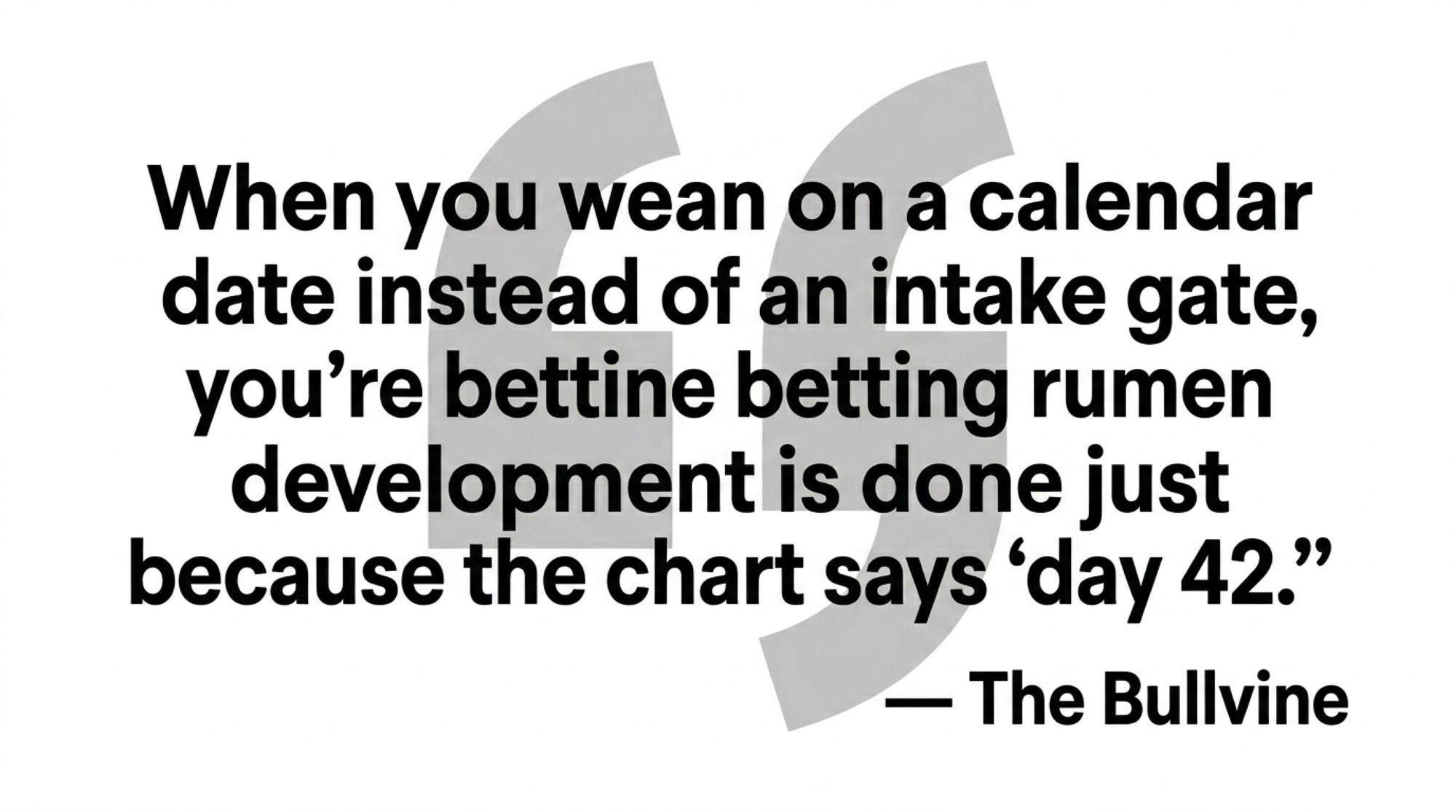
When you wean on a calendar date instead of an intake gate, you’re betting that rumen development is done just because the chart says “day 42.”
How a Rough Weaning Turns Into a 25‑Month Calving Problem
The pneumonia cases were obvious. The weaning slump was there too: calves coughing, sulking, backing off the starter for a week or ten days, then slowly coming around.
What wasn’t obvious was how those ten days of weaning showed up in the heifer yard.
The Welk review and several individual trials report that calves weaned later and more gradually not only eat more starter but also gain more weight per day around weaning and carry a bodyweight advantage through the post‑weaning period, especially when milk is generous pre‑weaning. Those gaps don’t magically close.
Now put heifer economics on top of that biology.
Iowa State University’s 2024 “What’s it Cost to Raise Your Dairy Best Heifer?” budget for a conventional 26,000‑lb herd shows:
- Total cost to raise a heifer to 24 months: about $2,651
- Daily heifer cost: roughly $2.65/head/day when you underload labor, up to about $3.15/head/day when labor is fully charged
The same ISU sheet runs the economics of tightening that up:
- Cutting the heifer‑raising period from 24 to 23 months saves about $93 per heifer.
Work it the other way:
- Take a midpoint of $2.75 per day
- One extra month ≈ 30 × $2.75 = $82.50 per heifer
When Dave’s team pulled his calving records, plenty of heifers were freshening closer to 25 months than 24. Many of those files carried simple notes like “small, waited.”
If half of his 120 heifers — 60 head — were calving just one month later than they needed to because they never quite caught up post‑weaning, that’s:
- 60 × $82.50 ≈ $4,950 per year in extra heifer costs
Stack that on top of the BRD bill:
- BRD: $6,240/year
- Extra heifer month: $4,950/year
- Total downstream cost: $11,190/year
Compare that to the weaning savings:
- Milk‑replacer “savings”: $6,600/year
- BRD + AFC cost: $11,190/year
On Dave’s farm, the 6‑week calendar program wasn’t saving money. It was quietly burning about ,600 a year once the heifer and health costs were on the same page.
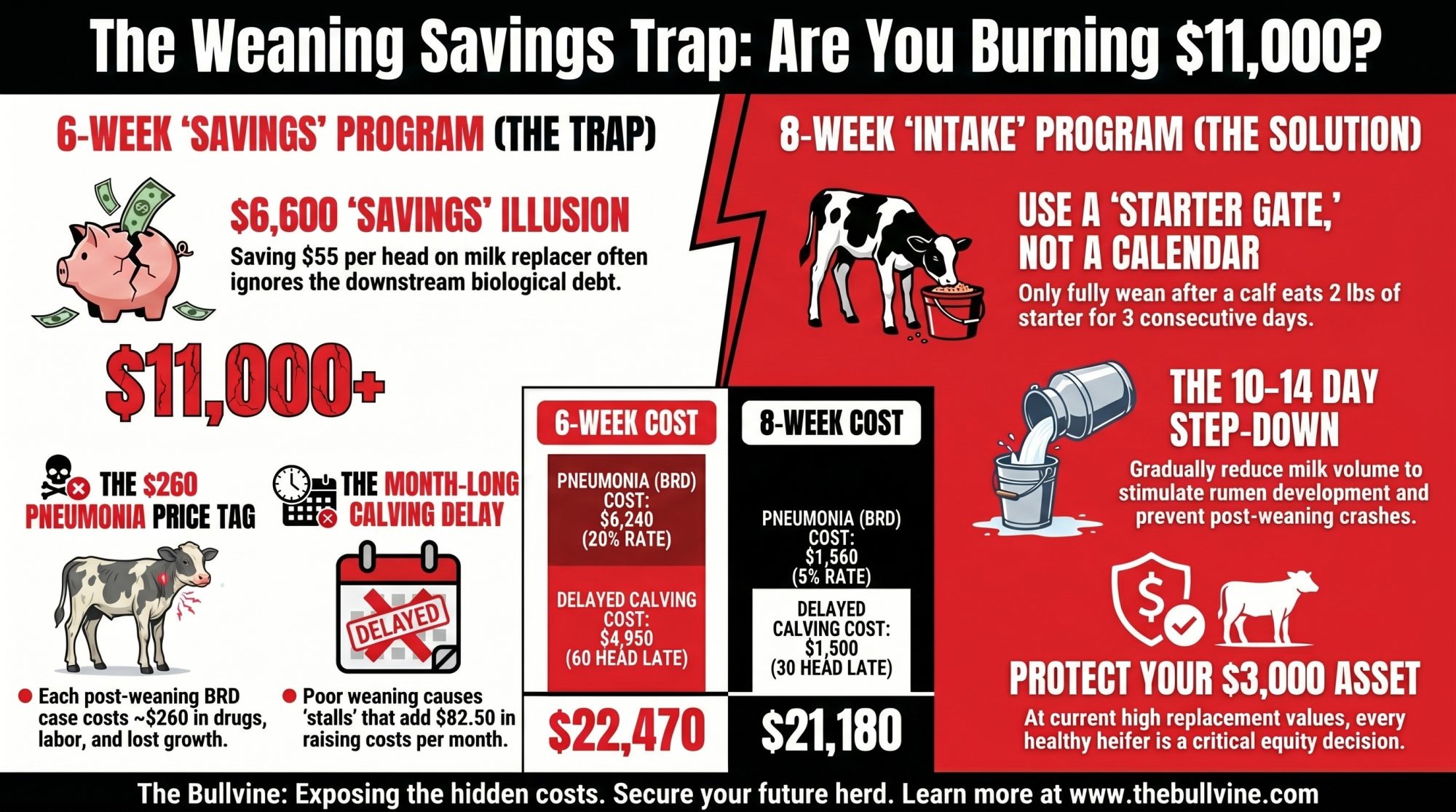
| Cost Line | 6‑Week ‘Savings’ Program | 7–8 Week Intake‑Based Program |
| Milk replacer per year | $11,280 | $18,120 |
| BRD cost per year | $6,240 | $1,560 |
| Extra AFC/heifer‑day cost | $4,950 | $1,500 |
| Total annual heifer program cost | $22,470 | $21,180 |
The Before‑and‑After Ledger on a 300‑Cow Herd
Once all three lines — milk replacer, BRD, and age at first calving — were in front of him, Dave could finally see what the weaning program was really doing.
Here’s how his example pencils out.
Assumptions (Dave’s Numbers)
- Herd: 300 Holstein cows
- Heifers raised/year: 120
- Milk replacer price: $1.80/lb (contract)
- BRD cost per case: $260, midpoint of the published $252–282 per case range.
- Post‑weaning BRD incidence (first 30 days):
- Old 6‑week program: 20% (24 heifers)
- New intake‑based program: 5% (6 heifers)
- AFC drift:
- Old: 60 heifers calving ~1 month late
- New: 30 heifers calving ~10 days late on average
Old 6‑Week Calendar Program
Milk replacer:
- 52.5 lb/calf × $1.80 ≈ $94.50 → $94 per calf
- 120 × $94 ≈ $11,280 per year
BRD cost:
- 20% of 120 = 24 BRD cases
- 24 × $260 = $6,240 per year
AFC drift cost:
- 60 heifers × $82.50 ≈ $4,950 per year
Total:
- $11,280 + $6,240 + $4,950 ≈ $22,470 per year
New Intake‑Based 7–8‑Week Program
Milk replacer:
- 84 lb/calf × $1.80 ≈ $151.20 → $151 per calf
- 120 × $151 ≈ $18,120 per year
BRD cost:
- 5% of 120 = 6 BRD cases
- 6 × $260 = $1,560 per year
AFC drift cost:
- 30 heifers drifting ~10 days: 10 × $2.75 ≈ $27.50/hd
- 30 × $27.50 ≈ $825 per year
- For simplicity, Dave’s team rounded this up to about $1,500 per year to stay close to ISU’s $93 per heifer‑month and acknowledge some extra variation.
Total:
- $18,120 + $1,560 + ~$1,500 ≈ $21,180 per year
Even with conservative rounding, the intake‑based 7–8‑week program came out roughly $1,300/year cheaper than the old 6‑week system on Dave’s farm.
Change the incidence rates or costs, and the gap will move. In some herds with very low BRD and tight AFC, 6‑week weaning might still hold its own on a full ledger.
The point is: until you put your own numbers into a similar layout, you’re guessing.
Why Those Dollars Matter More at $3,000 Heifer Values
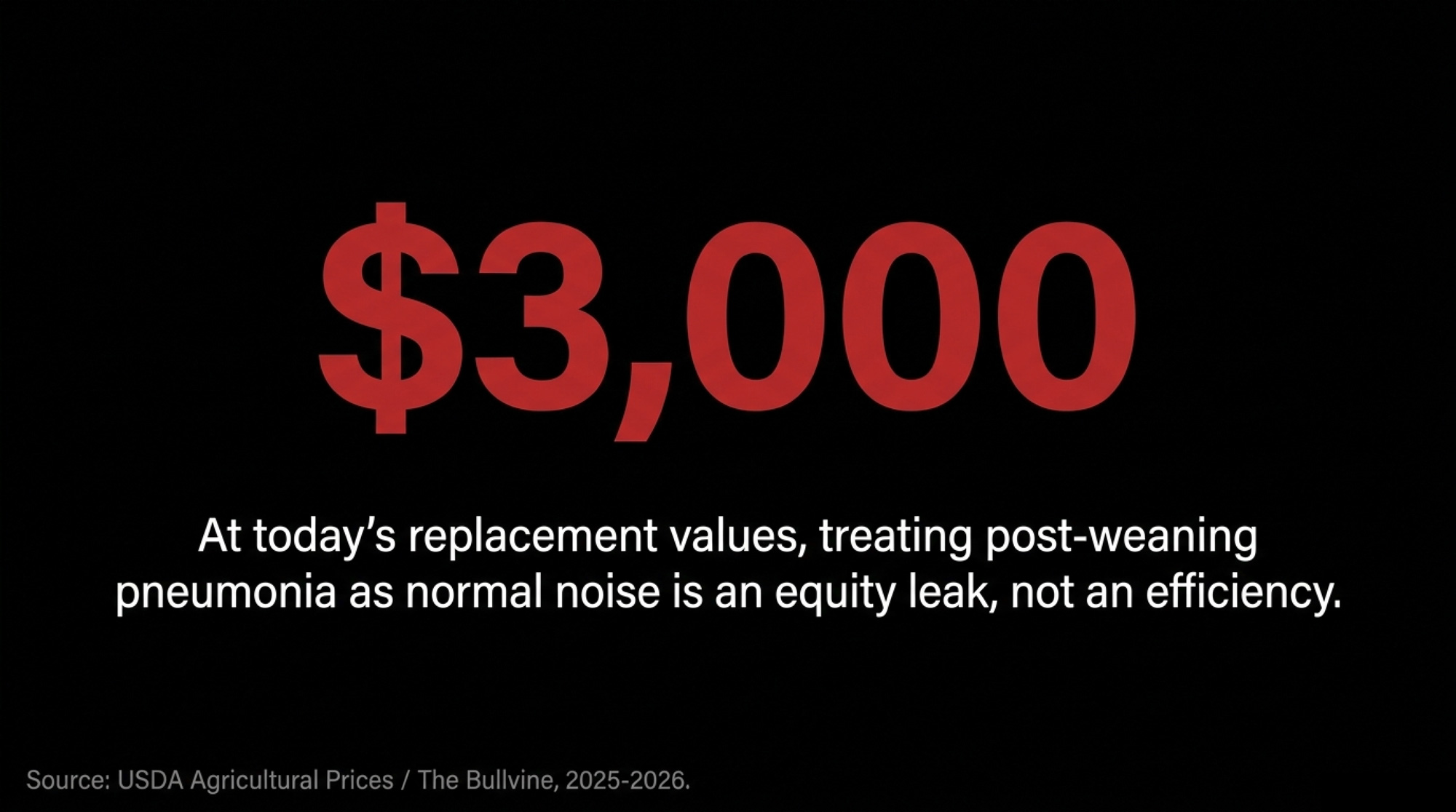
If replacements were cheap and plentiful, you might treat this like a nice‑to‑have improvement.
That’s not the market you’re in.
USDA’s Agricultural Prices reports and Ag Proud coverage show U.S. replacement cow prices averaging about $3,110 per head in October 2025, up roughly 3% from July and 16% from October 2024. By early 2026, averages had eased to around $2,860, but they were still high compared with prior years.
| BRD Impact Line Item | Conservative Cost per Case | Capital Context at ,000 Heifers |
| Drugs + vet time | – | Small part of total loss |
| Lost early growth + delayed heat | –0 | Pushes AFC toward 24.5–25+ months |
| Higher culling/poor first lact. | 0–0 | Lost future milk and genetics |
| Total economic hit per case | ≈2–2 | 8–9% of a ,000 heifer’s value |
A Bullvine analysis across multiple datasets pegged average replacement heifers at about $3,010 per head in early 2026, with U.S. heifer inventories likely to tighten further before any meaningful rebuild around 2027.
At those values, every replacement in your place quietly carries a $2,800–$3,100 asset tag.
A BRD case that knocks a heifer out of your pipeline or drags down her first‑lactation performance is not just a sick‑calf problem. It’s an equity decision.
The same goes for age at first calving. If your heifers are freshening closer to 25 months than 22–24, you’re not just feeding a little extra grain. You’re tying up capital in animals that aren’t milking yet.
So the real question stops being, “How can I save $55 per calf on milk replacer?”
It becomes:
“At $3,000 per heifer, how much BRD and delayed calving am I willing to buy for a milk‑replacer ‘savings’ that only shows up if I ignore biology and time?”
What Changed in Dave’s Barn: From Calendar to Intake
Dave didn’t flip his program because somebody told him 6‑week weaning was “wrong.” He changed because his own numbers — and a few published ones — said the calendar was costing him.
The decision they made was simple:
- The calendar no longer decides when a calf is weaned.
- The calf’s starter intake does.
Three practical changes were made that are real.
1. Intake Became a Gate, Not a Guess
They added one line to the calf card:
“3 days at ~2 lb starter before full wean? Y/N”
Then they did a five‑minute exercise:
- Weighed a full scoop of their calf starter and wrote on the wall: “1 scoop ≈ X lb.”
From that point forward:
- No calf was fully weaned until she had eaten roughly 2 lb of starter per day for three consecutive days — verified with the scoop.
- If she wasn’t there at day 42, she kept her last feeding until she hit that gate.
This lines up with Quigley’s 15 kg NFC concept — calves need to accumulate around 31–34 kg of starter at typical NFC levels to reach that threshold — and with Drackley’s extension‑level recommendation of ≥1.5 kg/day (3.3 lb) of starter dry matter for several days before full weaning.
It also mirrors what Penn State, Cornell, and the Canadian Code of Practice have been saying in plainer language: use starter intake as your weaning trigger, not age alone.
2. They Stretched Weaning Into a Planned 10–14‑Day Step‑Down
Under the old program, the milk schedule went from “full” to “none” at 6 weeks. No ramp.
| Expense Category | 6-Week “Savings” Program | 8-Week “Intake” Program | Impact of Change |
| Milk Replacer | $11,280 | $18,120 | +$6,840 (Cost) |
| BRD/Pneumonia | $6,240 (20% rate) | $1,560 (5% rate) | -$4,680 (Saving) |
| Delayed Calving (AFC) | $4,950 (60 head late) | $1,500 (30 head late) | -$3,450 (Saving) |
| TOTAL ANNUAL COST | $22,470 | $21,180 | -$1,290 (Net Gain) |
Under the revised program, they:
- Cut milk volume by about 50%, roughly two weeks before the earliest possible weaning window.
- Held that reduced feeding while watching starter intake.
- Pulled the last feeding only after the intake gate was met.
In practice, that meant:
- Step‑down starting somewhere in week 6
- Full weaning happens in week 7 or 8 for most calves, depending on their starter intake
That’s exactly the pattern the 2024 Welk review found supported smoother growth: calves weaned later, over longer durations, and based on intake had better performance through the transition, particularly when pre‑weaning milk allowances were higher.
For Dave, the visible payoff was fewer calves crashing when milk disappeared and fewer heifers falling behind by the time they hit breeding pens.
3. They Changed the Starter to Pay for the Program
The last piece was feed, not philosophy.
Dave and his nutritionist swapped out a fine, dusty pellet for a textured starter with visible grain and enough fermentable starch to actually drive rumen development. If you want calves to hit 2 lb/day before weaning, the starter has to be something they want to eat.
They also moved to a starter that included a Saccharomyces cerevisiae fermentation product (SCFP). A 2022 Journal of Dairy Science trial found that calves fed SCFP had better post‑weaning growth and feed efficiency and required fewer respiratory treatments through four months of age, even though pre‑weaning gains were similar between groups. A 2024 review on SCFP as a postbiotic outlined how these products may support immune and rumen function in calves and cows.
| Weaning Feature | 6‑Week Calendar Program | Intake‑Based 7–8 Week Program |
| Weaning trigger | Fixed age (42 days) | Starter intake (~2 lb/day × 3 days) |
| Weaning duration | Abrupt, <3 days step‑down | Planned 10–14 day step‑down |
| Post‑weaning BRD in first 30 days | 20% of heifers (24/120) | 5% of heifers (6/120) |
| Typical starter intake at full wean | Often <1 lb/day | 2–3 lb/day |
| Heifers calving ≥1 month late (per yr) | 60 head | 30 head (about 10 days late) |
| Annual extra AFC + BRD cost | ≈$11,190 | ≈$3,060 |
You can waste a lot of money on additives that don’t pay. In this case, the economics looked reasonable:
- If better palatability and SCFP‑supported gut health pull starter intake forward and trim just a handful of $252–282 BRD cases per year.
- The extra cost of a higher‑end starter becomes cheap insurance relative to $3,000 heifers.
Three Economic Paths for Your Weaning Program
Not every herd is Dave’s herd. Your BRD rates, milk replacer price, labor, and heifer inventory pressure will look different.
But the decision paths are similar.
Path 1: Defend 6‑Week Weaning With Your Own Data
Early weaning can still make economic sense in some herds.
When this path works:
- Your post‑weaning BRD incidence in the first 30 days is consistently in the single digits.
- Calves are reliably eating 2+ lb of starter per day by day 40–42.
- Your heifers are calving around 22–24 months without a pattern of “small, waited” notes.
What it demands:
- At least 12–24 months of calf treatment and AFC records you actually trust.
- A simple intake check to avoid assuming calves are at 2+ lb when they aren’t.
If those numbers look good, your 6‑week program may genuinely be a savings strategy rather than a hidden cost.
If you don’t have the records, you’re not defending 6‑week weaning. You’re just hoping it’s fine.
Path 2: Triage High‑Risk Calves Into 7–8‑Week Intake‑Based Weaning
You don’t have to flip the whole calf barn at once.
Triage play:
- Keep the 6‑week target as your default on paper.
- Any calf that hasn’t hit your 2 lb/day intake gate by day 40–42 gets pushed into a 10–14‑day step‑down and weaned later, once she meets the gate.
- Track BRD and 90‑day weights for this group separately.
Economics:
- You spend more milk replacer only on calves that are biologically behind the curve.
- These are often the same calves driving your post‑weaning BRD and extra heifer months, so improvements here have outsized ROI.
This path works well for herds that have:
- Reasonable calf labor and discipline.
- Chronic trouble with a specific band of high‑risk calves.
Path 3: Redesign Weaning Around Heifer ROI and $3,000 Replacements
If your post‑weaning BRD rate is in the teens or higher and your average AFC is drifting toward 24.5–25+ months, it may be time for a full reset.
What a redesign includes:
- A standard intake gate (for example, “3 days at ~2 lb starter before full wean”).
- A built‑in 10–14‑day step‑down that fits your chore rhythm.
- A starter that calves actually consume, with formulation aimed at hitting Quigley’s 15 kg NFC before milk disappears.
- Routine pricing of BRD and heifer days off your own numbers — not generic assumptions — at least once a year.
When this path pays fastest:
- You’re raising your own replacements in a high heifer‑value environment ($2,800–3,100/head).
- You have a clear pattern of post‑weaning disease and delayed calving.
- You’re thinking about heifers as capital investments, not just “the young stock.”
What This Means for Your Operation
- If your post‑weaning BRD incidence is above roughly 15–20% and you’re weaning at 6 weeks, assume your weaning program is a financial risk, not an efficiency. Once each case is priced around $252–282, and you add the cost of extra heifer days, the milk‑replacer “savings” look a lot like Dave’s — quickly eaten up by disease and delayed calving.
- If your average age at first calving is north of 24 months, treat that as a calf‑program red flag, not just a breeding issue. ISU’s 2024 budget puts the cost of an extra heifer month around $80–100, depending on labor. Until you understand why your heifers are late, your biggest heifer‑cost lever is probably in the calf barn.
- If you don’t have a simple starter‑intake gate built into your weaning protocol, you’re making a capital decision with no biological checkpoint. A weighed scoop and a “3 days at ~2 lb starter? Y/N” checkbox turn that into a gate you can manage and adjust.
- If you’re valuing or buying heifers at $2,800–3,100 and still treating BRD as a $40 problem, you’re underpricing your own risk. Using the $252–282 per‑case economics for heifer BRD puts you in the right ballpark for capital‑level decisions, not just vet‑bill conversations.
- If you want a 30‑day move that doesn’t blow up your chores, start with a BRD + AFC audit. In the next month, pull 12–24 months of calf/heifer records, count your BRD cases in the first 120 days (especially the 30 days post‑weaning), calculate your own BRD cost (cases × ~$260), measure how much later BRD heifers calved, and put that next to your milk‑replacer “savings.” That one piece of paper will tell you whether your current weaning program is defensible or overdue for a redesign.
Key Takeaways
- If your post‑weaning BRD rate is roughly 15–20% and you’re relying on a 6‑week calendar, the odds are high that you’re not actually saving money on milk replacer once you factor in BRD and delayed calving.The $6,600 that looks like savings in the calf‑feed column can be more than offset by $11,000‑plus in disease and extra heifer days on a 300‑cow herd.
- If your average age at first calving is over 24 months, each additional month quietly costs you about $80–100 per heifer. Until that distribution is under control, your fastest heifer‑cost improvement usually sits in intake‑based weaning and grower management, not just semen choice or breeding targets.
- If you’re not using starter intake as a weaning gate, your weaning program is a guess, not a strategy.Adding a simple intake trigger and a 10–14‑day step‑down is one of the cheapest, cleanest risk‑management moves you can make in the heifer enterprise.
- If you’re handling $3,000 heifers in a tight inventory market, treating pneumonia and late calving as “normal noise” is an equity decision. The question isn’t just “Can we live with it?” It’s “Is this the risk position we want to own at today’s heifer values?”

The Bottom Line
Dave didn’t walk away from the 6‑week weaning because someone told him it was outdated. He walked away because, once he stacked his milk‑replacer spend, post‑weaning BRD cases, and ages at first calving on the same ledger, the numbers said the calendar was quietly burning cash.
If you pulled the same reports for your herd and laid them out side by side, would your weaning program look like a savings strategy — or like a risk position you haven’t really priced yet?
The numbers above are built on a 300-cow Wisconsin example with one contractor milk-replacer price and two BRD incidence scenarios. Your herd runs on different inputs — and the answer changes fast when you swap in your own BRD rate, your own replacer cost, and your own AFC. Use the calculator below to run the same ledger with your numbers.
Learn More
- Dairy Calf Nutrition for Healthier, Higher-Producing Cows — Arm your calf crew with a biological timeline of rumen development. This phased implementation protocol maps out the exact milk and starter combinations required to transition calves smoothly, preventing the post-weaning growth crashes that trigger costly respiratory treatments.
- $3,010 Per Heifer. 800,000 Short. Your Beef-on-Dairy Bill Is Due. — Follow the money on the national replacement shortage reshaping farm equity. With heifer inventories at historic lows, the math proves why accepting a high post-weaning sickness rate on $3,000 animals is a direct threat to your 2028 milking string.
- Dr. Bray’s $5 Sodium Bisulfate Gamble: Zero Lung Lesions and the Real Cost of Calf Barn Ammonia — Dismantle traditional ventilation assumptions using a $5 bedding chemistry protocol. By neutralizing ammonia directly at the calf’s nose level, this unconventional trial delivered zero lung lesions and measurable downstream milk advantages, proving proactive prevention beats any antibiotic.
 The Sunday Read Dairy Professionals Don’t Skip.
 The Sunday Read Dairy Professionals Don’t Skip.
Every week, thousands of producers, breeders, and industry insiders open Bullvine Weekly for genetics insights, market shifts, and profit strategies they won’t find anywhere else. One email. Five minutes. Smarter decisions all week.