


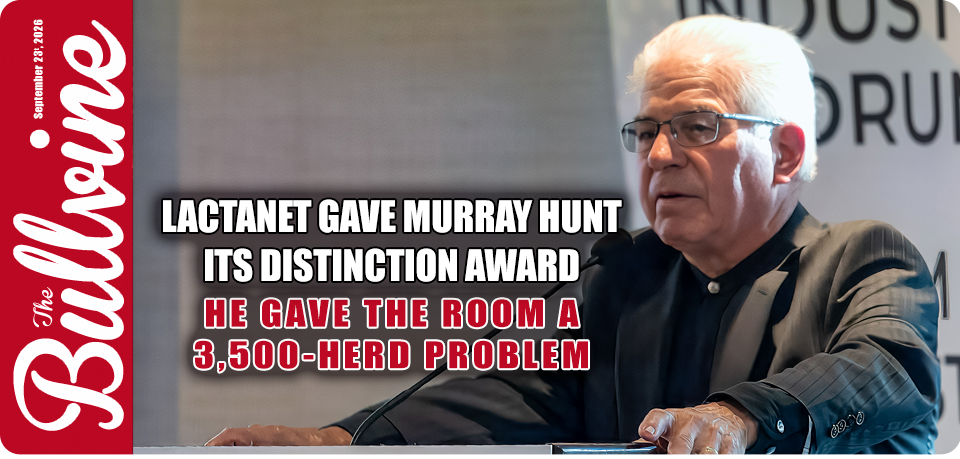






In 1970, Canada had 90,000 dairy herds. By August 2025, there were 9,048. By 2035, there may be just 3,500. Upon receiving Lactanet’s Distinction Award, Murray Hunt challenged the industry: the milk tank can’t pay for the structure we have now.

Murray Hunt thanked Neil Petreny and Paul Larmer for helping him up to the podium. “Age is catching up,” he said, “but I still love the industry.” Then the 81-year-old spent the rest of his time at the podium proving it, first by thanking the people who built his career and then by telling the people who run Canada’s dairy cattle improvement organizations that the structure he spent that career building has outgrown the milk cheque.
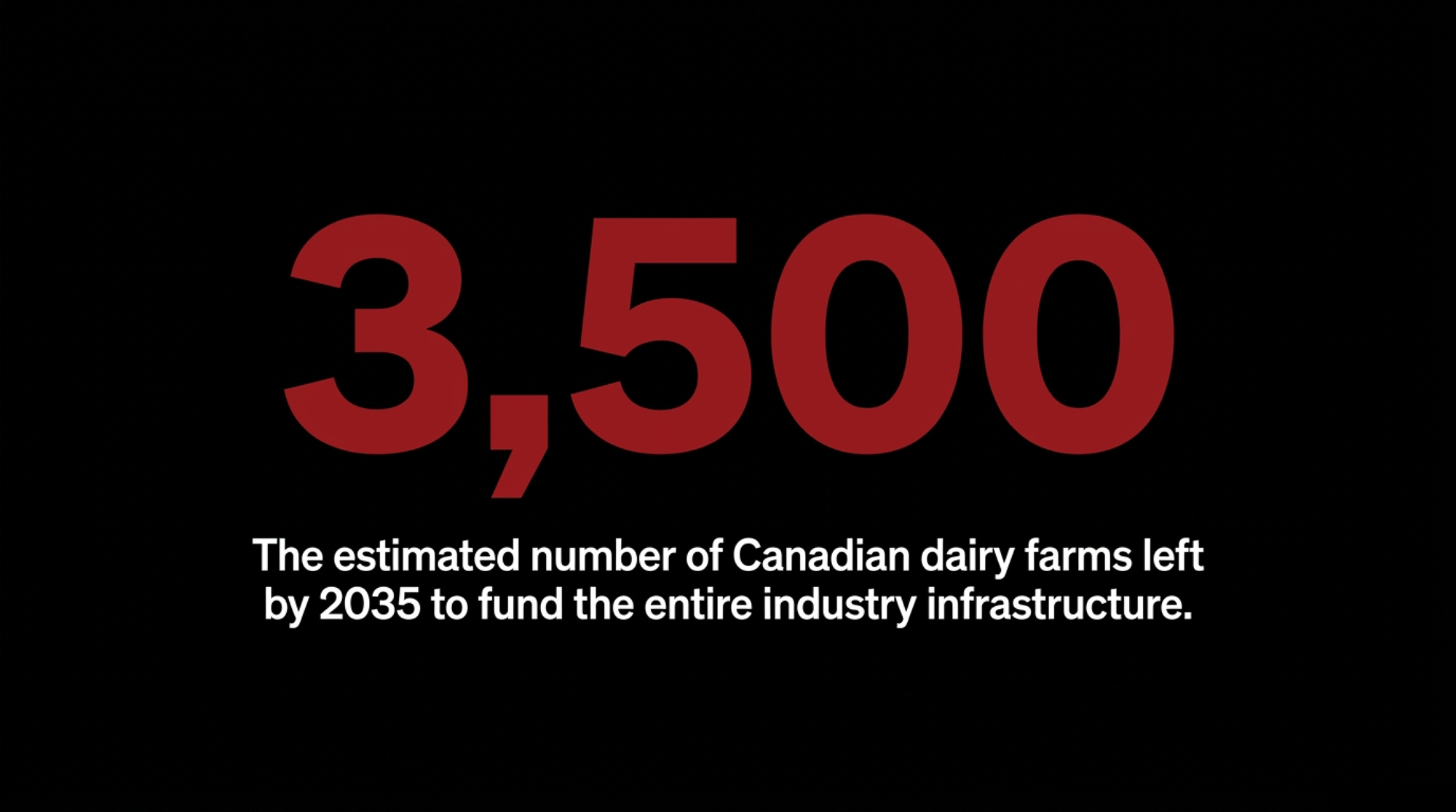
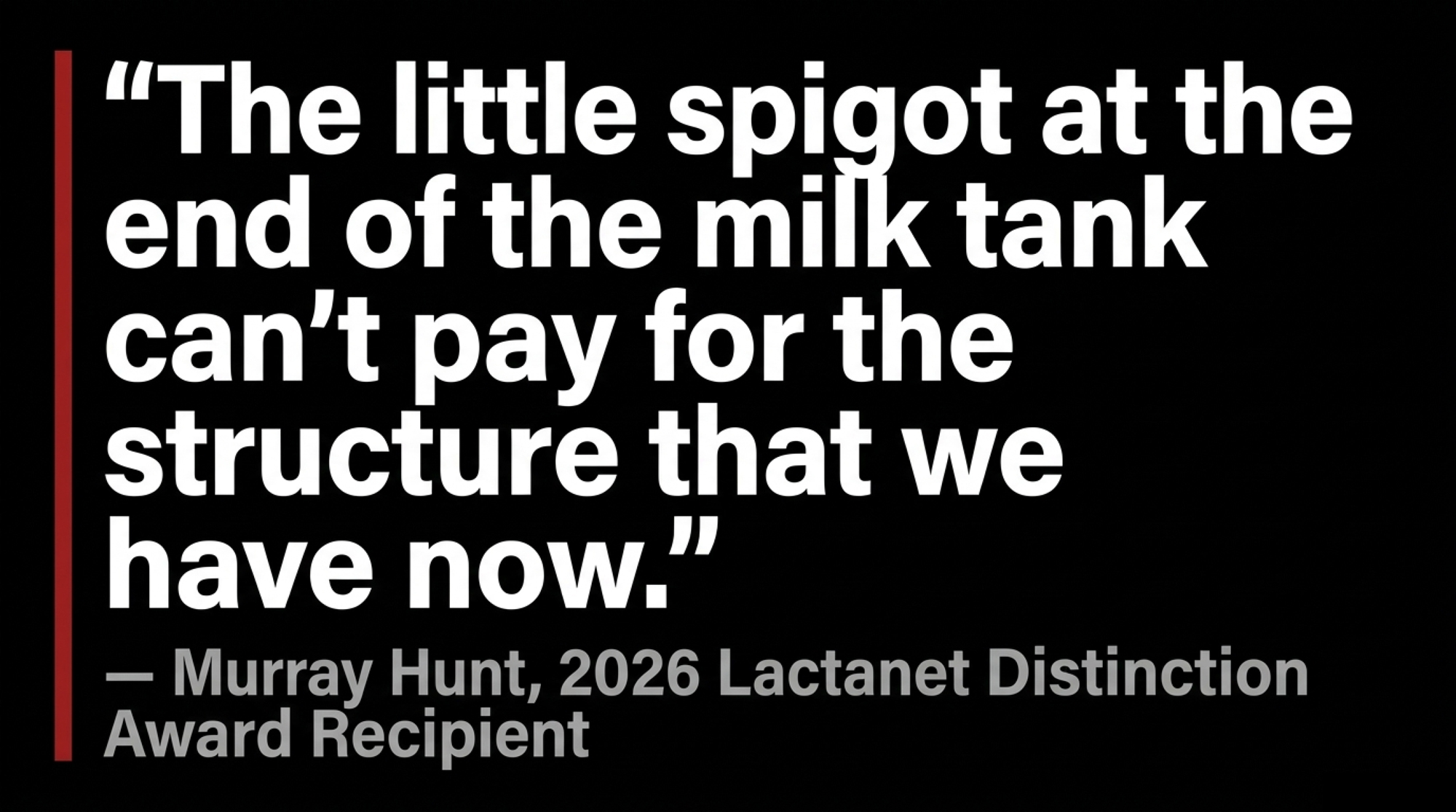
“In 1970 we had 90,000 herds in Canada, 25 cows each, and every farmer organization had its own silo, its own goals, its own area, and you didn’t dare get outside them,” he told the Dairy Cattle Industry Forum at the Sheraton Gateway Hotel in Toronto on September 22, minutes after Lactanet presented him with its 2026 Dairy Cattle Improvement Industry Distinction Award. Canada had 9,048 farms shipping milk on August 1, 2025, according to the latest available Canadian Dairy Information Centre data. The estimate Hunt had read for 2035 is 3,500. “The milk tank, that little spigot at the end of the milk tank, can’t pay for the structure that we have now,” he said.
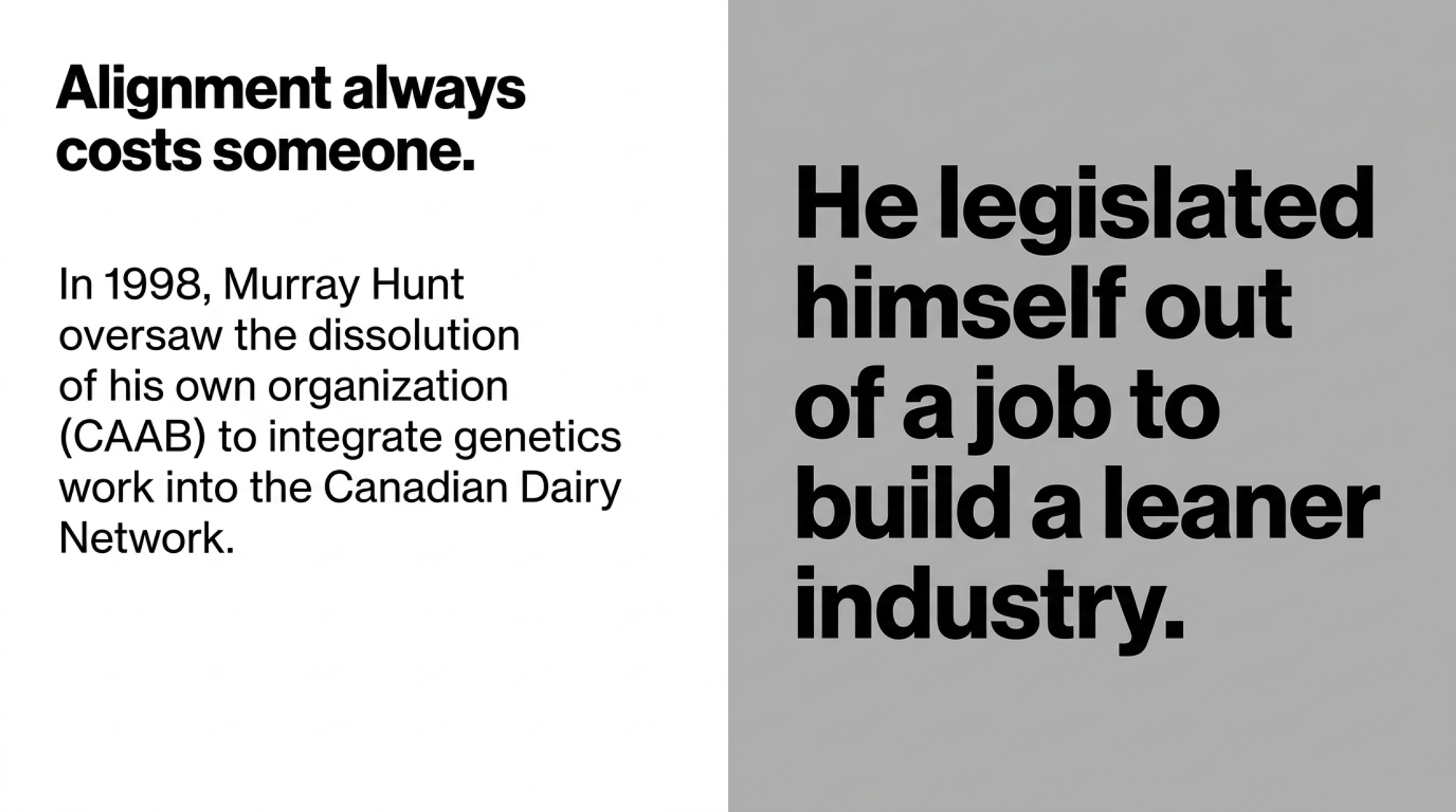
Few people in that room had more standing to say it. In 1998, as executive director of the Canadian Association of Animal Breeders, he saw CAAB dissolved once its genetics work had moved to the new Canadian Dairy Network. Four years earlier, Larmer’s citation noted, he “navigated a successful streamlining and integration of research dollars, people resources, and effort” across industry organizations to create the Cattle Breeding Research Council. On Tuesday, he asked the room to do it again. “Alignment for me and Karen personally was that we were out of a job,” he said.
His 2035 number sounds extreme until you look at who actually buys dairy improvement services. Herds enrolled in milk recording fell 17.3% in five years, against 10.4% for all farms. Hold that pace, and Lactanet records roughly 3,650 herds in 2035, within 150 of Hunt’s figure. That’s a Bullvine calculation, and the math is below.
The Names Read Before His
Larmer read the roll of previous recipients before he read the résumé. Doug Blair and Robert Chicoine shared the first award in 2008. Bonnie Cooper became the first woman honoured in 2019. The 2023 forum made up for three pandemic years with Pierre Laliberté, Dr. David Kelton and a special award to Brian Van Doormaal, according to Lactanet. Gary Bowers followed in 2024, and the late Dr. Gerrit Kistemaker was honoured posthumously in 2025.
Lactanet’s announcement calls Hunt the sixteenth recipient since the award’s creation in 2008. Semex announced Chicoine’s death on September 15, so the name that opened the list was read a week later.
Jack Britt had come up from the United States for the evening. The North Carolina State dean emeritus co-wrote the 2018 Journal of Dairy Science review imagining dairy farms in 2067, a fitting guest for a speech about 2035. Hunt also thanked Van Doormaal for starting the forum at CDN and Lactanet for carrying it on.
Larmer called it “a lengthy résumé, but one of contribution, foundation building, and success that has touched on almost every aspect of our dairy improvement industry.” We covered it in full when Lactanet announced the award in August. The short version: a 1970 University of Guelph master’s thesis under Dr. Ted Burnside arguing for the maximum number of young sires in structured sampling, which at its peak meant more than 500 young bulls sampled in Canada a year. The Production Dollar Difference, Canada’s first sire ranking index built on profit and a forerunner of the Pro$ index that arrived in 2015. Eighteen years at Holstein Canada. Inaugural chair of the Genetic Evaluation Board. A seat in the Futures Group that led to Canadian Dairy Network on May 29, 1995.
→ The full career story: 500 Young Bulls a Year: The 1970 Thesis Behind Murray Hunt’s Lactanet Distinction Award
A Farm Accident, a Centennial Dance and the Hardest Lesson
He was 15 when his parents, Sterling and Irene Hunt, bought Huntsdale Farm: 22 cows and a 25-acre market garden. The herd went on Record of Performance, started using AI in 1962, and was type classified in 1963. Huntsdale earned Holstein Canada’s Master Breeder shield in 1984.
University wasn’t the plan. “I had a farm accident, and she said, ‘You may not be able to farm,'” he said of his mother. “I wanted to farm. As always, mothers are right.”
He called August 5, 1967 “my greatest blessing.” It was a community centennial dance. “I’m not a very good dancer, mostly a wallflower. She did let me drive her home. We went out on a date the next day, and the rest is history.” Karen was entering her first year at McMaster; he was partway through Guelph. They married two years later. “If I have any communication skills, I learned from Karen. She’s my rock, my support, my everything.”
His first job, running Ontario’s Dairy Herd Improvement Program for the provincial agriculture ministry at 25, taught him business and human resources the hard way. “Firing people. That was the toughest thing I ever had to learn,” he said. “I had to learn to part with people in a good way.”
Larmer’s citation filled in the life around the work: more than 15 years as a 4-H leader coaching teams at what’s now the TD Canadian 4-H Dairy Classic, two decades producing the six-night Rockton Dinner Theatre with Karen to raise money for the Rockton Fair, and service as an elder at West Flamborough Presbyterian and Troy United churches. They have three children and eight grandchildren. None of the grandchildren is in dairy. He listed their careers with obvious pride, from data systems to medicine, in the same speech where he cited a 3,500-herd estimate.
How Did Milk Recording Go From 10% of Cows to 58%?
When Hunt joined Holstein Canada in 1973, he said, 10% of Canada’s dairy cows were milk recorded and 6% were type classified. “We’ve heard here today that we don’t need every animal recorded, but at one time we thought we did, so we pushed hard.”
Pushing meant travelling the country to combine the federal ROP program with the provincial DHI programs. It meant writing the first constitution of the Ontario Dairy Herd Improvement Corporation with a lawyer the Ontario Milk Marketing Board paid for. And it meant spending three hours one day explaining to Lorne Hurd, the board’s general manager, why DHI needed a checkoff. “Now whether it’s being well used or not,” he said, “Neil Petreny will have to explain that.”
It worked. In 2025, 563,492 cows in 5,333 herds were on milk recording, according to Lactanet data published by the Canadian Dairy Information Centre. That’s 58% of Canada’s 971,600 dairy cows.
Classification was the harder fix. “The type classification program may not now be meeting everyone’s needs,” he conceded, but in 1973, 47% of first-lactation cows were classified Good Plus, and there were more Goods than Good Pluses. The scores weren’t separating cows, and the recording needed to be standardized.
The answer turned up at a grounded Ottawa airport. It was February, about minus 20, and planes weren’t leaving because Ottawa didn’t have de-icing yet. Hunt got talking to a man in snow boots working on a portable device. He measured trees for a living, he said. He could only work outside for an hour and a half at a time, then went back inside and worked the data. Hunt wondered whether classifiers could use the same thing.
Dalton Hodgins, the Shawville classifier who later led Holstein Canada’s classification staff, according to Holstein Québec, took the project on with him. He’d drive out from his Brantford hotel to the Hunt home at night, where a young Andrew Hunt would pepper him with questions and then start punching keys. Hodgins would warn the boy, “Oh, don’t do that. You might break it,” Murray told the room. “Andrew’s never been afraid of computers.” Larmer’s citation credits that work as the first handheld device used to standardize classifiers’ records, and the Canadian system was adopted by multiple countries. Hunt trained classifiers in Australia, Japan, Brazil, France, Italy, Cuba, Germany and Spain.
He didn’t oversell the result. “I’m not sure we were successful in getting the right feet and legs on the cow,” he said, “but nevertheless, it was a lot of change.”
The Silo Speech
Hunt said he’d cleared it with the organizers first. “I could throw out a little bit of my bias here.” Then he told a room full of cattle people that he wasn’t there to talk about cows. “I want to challenge you on the infrastructure.”
In the 1970s, he said, Canada sampled 500 young bulls a year, and some herds generated 30% of their revenue from breeding sales. The organizations serving them stayed in their own lanes. Some of those walls have come down since. “In my opinion,” he said, “not enough.”
| 1970 (Hunt) | 2025 (official) | 2035 (estimate Hunt cited) | |
| Herds | 90,000 | 9,048 | 3,500 |
| Cows per herd | 25 | 107 | 225–240 |
| Dairy cows | ~2.25 million (implied) | 971,600 | 787,500–840,000 (implied) |
| Fat and protein per cow per day | — | baseline | 20%+ higher |
Sources: 2025 farms and cows, Canadian Dairy Information Centre; 2025 herd average, Dairy Farmers of Canada. The 1970 and 2035 figures are Hunt’s, from the podium. Implied cow counts are Bullvine calculations.
“It’s going to be a business model on every farm,” he said of 2035, and the milk recording service will have to become a business-model service too. “Are you prepared to take down all the silos and get together for the benefit of the dairy farmers?”
He gave three asks.
- Alignment. “Yes, I said alignment, not cooperation, not collaboration, not amalgamation. Alignment.” He held up Lactanet itself, which brought CanWest DHI, Valacta and CDN together in 2019, as the model and said it needs to go further. Then he looked right at the president of Holstein Canada. “It’s going to be a challenge for you, because I think there’s rules for breeds and there’s rules for others.”
- Rationalization. Each organization carries its own HR department and its own computer systems. “We need to destroy more silos.”
- Innovation. “The dairy industry is bigger than Canada, and we need to be finding partners around the world to work on research and development.” Then came an admission from the man who helped shape the type program. “We used to think we had the Canadian kind. It was unique. We’re not any more unique than anything else. We’re finding out now she was too tall in front, and that chest width didn’t mean anything about how much feed she could take in.”
He also asked for modelling. The Futures Group of 1994 led to CDN the following spring. “It sounds kind of stupid now to say 1994. We were looking to the future.” His master’s was a computer model. Now he wants a new model for 2035, 41 years on.
Can 3,500 Herds Pay for Today’s Structure?
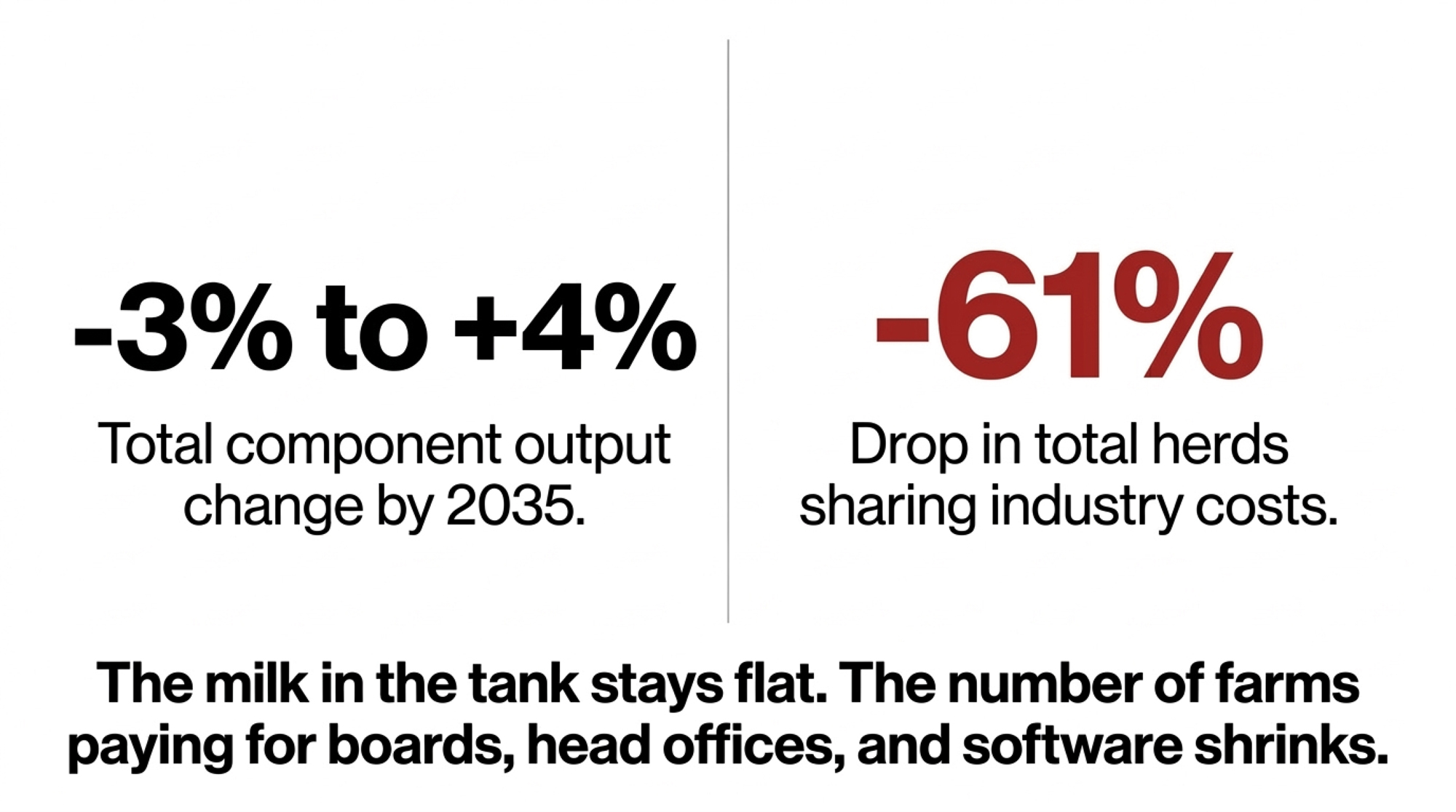
Here’s the surprise in his numbers. The milk in the tank barely moves. At 225 to 240 cows a herd, 3,500 herds is 787,500 to 840,000 cows. Add his 20% more fat and protein per cow, and total component output lands between 3% below and 4% above today’s.
So the spigot pays about what it pays now. What changes is how many farms are left to carry the costs that don’t shrink when a herd sells out: boards, head offices, evaluation runs, software, HR.
“We need to destroy more silos.”
— Murray Hunt, Dairy Cattle Industry Forum, September 22, 2026
Bullvine calculation: how fast does the fixed-cost share per herd rise?
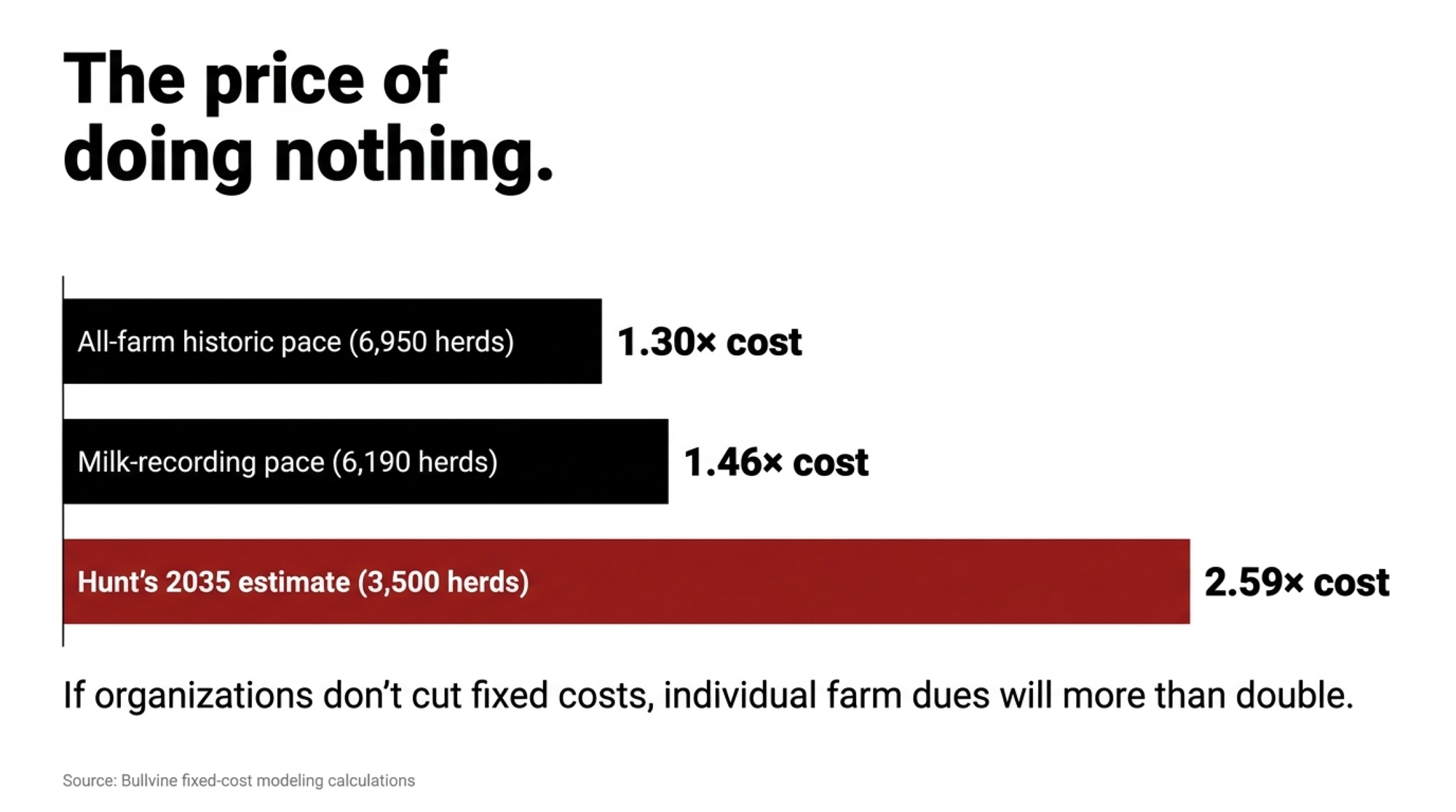
| Path to 2035 | Annual decline in herds | Herds in 2035 | Fixed cost per herd vs. 2025 |
| All-farm pace (2014–2024) | 2.6% | ~6,950 | 1.30× |
| Milk-recording pace (2020–2025)* | 3.7% | ~6,190 | 1.46× |
| Hunt’s 2035 estimate | 9.1% (implied) | 3,500 | 2.59× |
All-farm pace from the AAFC Dairy Sector Profile. *Milk-recording enrolment pace, applied to all farms.
For all farms, 3,500 is aggressive. It needs herds to disappear three and a half times faster than they did over the last decade. For the herds that buy milk recording, it’s close to the current trend line.
| Milk recording | 2020 | 2025 | Change |
| Herds enrolled | 6,446 | 5,333 | −17.3% |
| All dairy farms | 10,095 | 9,048 | −10.4% |
| Share of farms enrolled | 63.9% | 58.9% | −5.0 points |
Enrolled herds fell 3.7% a year from 2020 to 2025. Hold that pace for a decade, and the recorded-herd base is about 3,650 in 2035. Part of that is deliberate. The forum heard the same day that not every animal needs recording anymore, and genomics has made that true for some decisions. But a deliberate exit still leaves fewer herds carrying the same systems.
Put a dollar on it. Say an organization carries $1 million a year in costs that don’t fall when herds leave. Across 9,048 farms, that’s about $111 a herd. At 6,950 farms, it’s $144. At 3,500, it’s $286. Spread only across milk-recording herds, it goes from $188 today to $274 at 3,650. That’s an illustrative model, not any organization’s budget.
What Should Board Members Ask Before 2035?
Hunt aimed the challenge at the directors and delegates in the room, and he’d been on the staff side of that table. “Elected farmer representatives are a great resource,” he said. “Being young and brash, you think you don’t need to be told, but I did.” Here’s what his three asks look like as board work.
- Ask for the fixed-cost split this AGM season. Ask every organization you fund what share of its budget doesn’t fall when herd numbers do, and what that line costs per herd at 6,950 and at 3,500 farms. It’s a 30-day question. A total with no split isn’t an answer.
- Price shared services before governance. Shared HR, IT and field systems attack duplicated costs without anyone surrendering a board, which is the distinction Hunt drew between alignment and amalgamation. The trade-off is control, since breed-specific rules have to survive the sharing.
- Fund research with partners beyond Canada. Bigger research pools spread cost across more cows. The risk is losing Canadian pricing in the selection goal, the same logic that made PDD and Pro$ Canadian tools in the first place.
Hunt closed with John F. Kennedy, from Frankfurt in June 1963: “Change is the law of life. And those who look only to the past or present are certain to miss the future.”
He’d lived that line once already, in 1998, when the job he’d built was the one that went.
The room gave him a standing ovation. Karen was part of it, as she’s been through every chapter of this story: his biggest supporter and his biggest fan.
If the organization you pay dues to had to run on 6,950 herds tomorrow, what would it cut first, and has anyone on your board asked yet?
We’ll put that question to the organizations Hunt challenged and report their answers in The Bullvine Weekly.

Key Takeaways
- Hunt’s 3,500-herd estimate for 2035 is aggressive for all farms, but milk recording is already on that track: enrolled herds fell 17.3% from 2020 to 2025, which projects to about 3,650.
- On Hunt’s own 2035 figures, the tank ships about the same fat and protein, between 3% less and 4% more. What shrinks is the number of herds splitting the fixed costs.
- Alignment always costs someone. In 1998 it cost Hunt his own job when CAAB dissolved, so any board asking for it should be ready to say who gives up what.
- Hunt’s test for any partnership or shared-service plan: “In the end, the group that need to be profitable are the dairy farms, viable and sustainable.”
 The Sunday Read Dairy Professionals Don’t Skip.
 The Sunday Read Dairy Professionals Don’t Skip.
Every week, thousands of producers, breeders, and industry insiders open Bullvine Weekly for genetics insights, market shifts, and profit strategies they won’t find anywhere else. One email. Five minutes. Smarter decisions all week.
Learn More
- Are You Breeding for the Future or the Past? — Align your genetic strategy directly with tomorrow’s milk cheque. Breaks down the hidden costs of outdated selection traits, arming you with the metrics needed to shift your sire criteria toward strict profit margins over show-ring appeal.
- What Will the Dairy Industry Look Like in 2030? — Prepare your balance sheet for the consolidation wave Murray Hunt predicts. Maps upcoming bottlenecks in processing capacity against consumer demand, delivering concrete herd-size thresholds your operation must clear to survive the next decade.
- Is Crossbreeding the Answer to Dairy’s Problems? — Challenge the purebred status quo with hybrid vigor economics. Follows the money on crossbred herds to reveal exactly how improved conception rates and reduced cull costs offset potential yield drops, fundamentally redefining baseline profitability.




