





At 2,500 paying animals, a hypothetical $250,000 annual funding gap would add $100 a head to Expo’s 2026 standard entry fee. Here’s what that calculation leaves to prove.
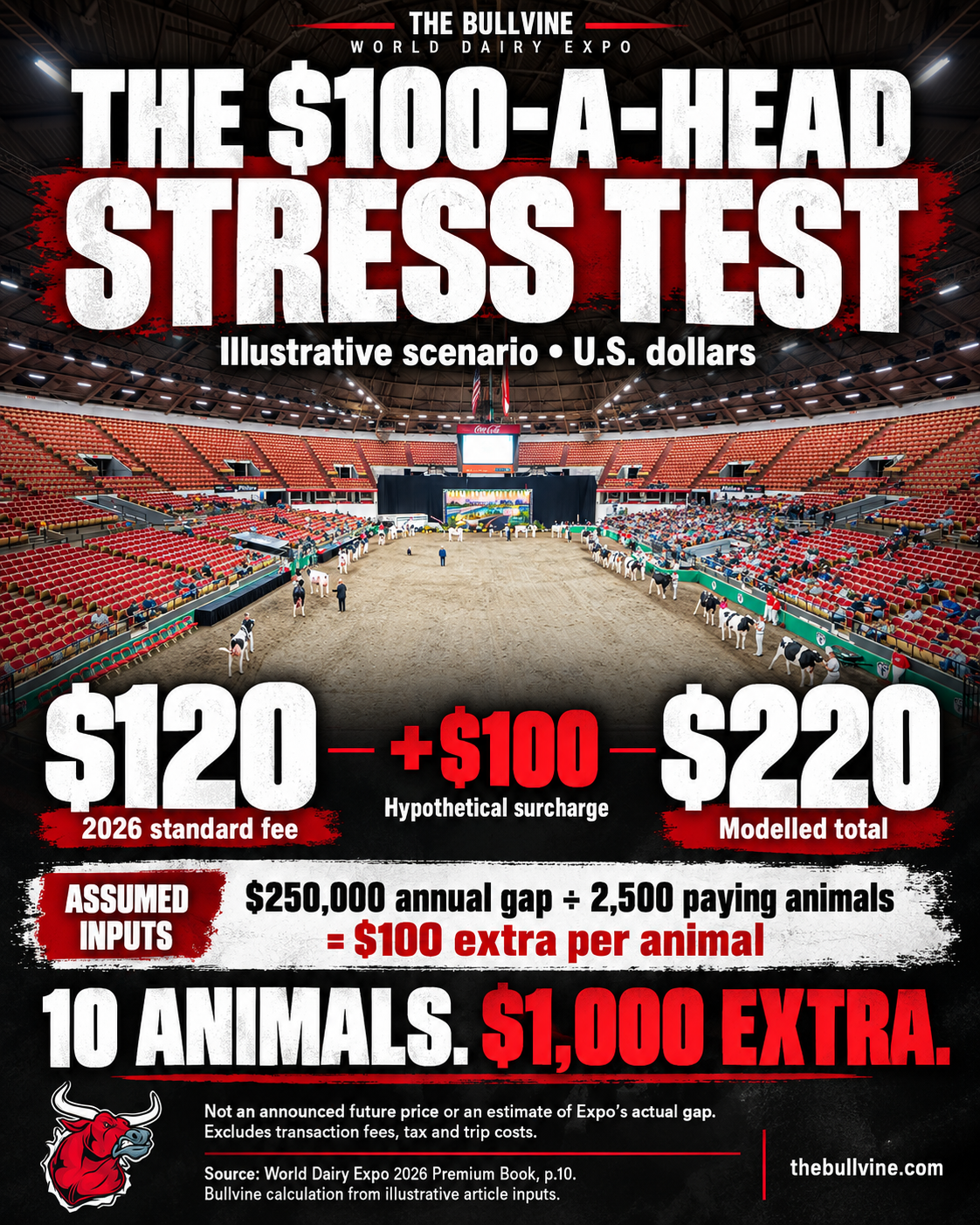
World Dairy Expo’s 2026 trade show closed in Madison on October 2, and dropping it for a cattle-focused event is an easy idea to float. The cattle show would still have bills to pay. In The Bullvine’s stress test, every $250,000 of recurring shortfall a cattle-focused Expo can’t otherwise fund adds $100 a head across 2,500 paying animals. That hypothetical surcharge would take the 2026 standard entry fee from $120 to $220 a head, before transaction fees and tax.
The exercise does not estimate Expo’s actual funding gap. Published 2026 fees provide context; the funding gaps, sponsorship examples, and payroll savings in the stress test are illustrative.
What a $100 surcharge looks like
Expo’s 2026 premium book lists a standard entry fee of $120 per cow or heifer, in U.S. dollars, rising to $250 for entries from September 1 through the show. The table holds the 2026 standard fee unchanged and isn’t an announced future price.
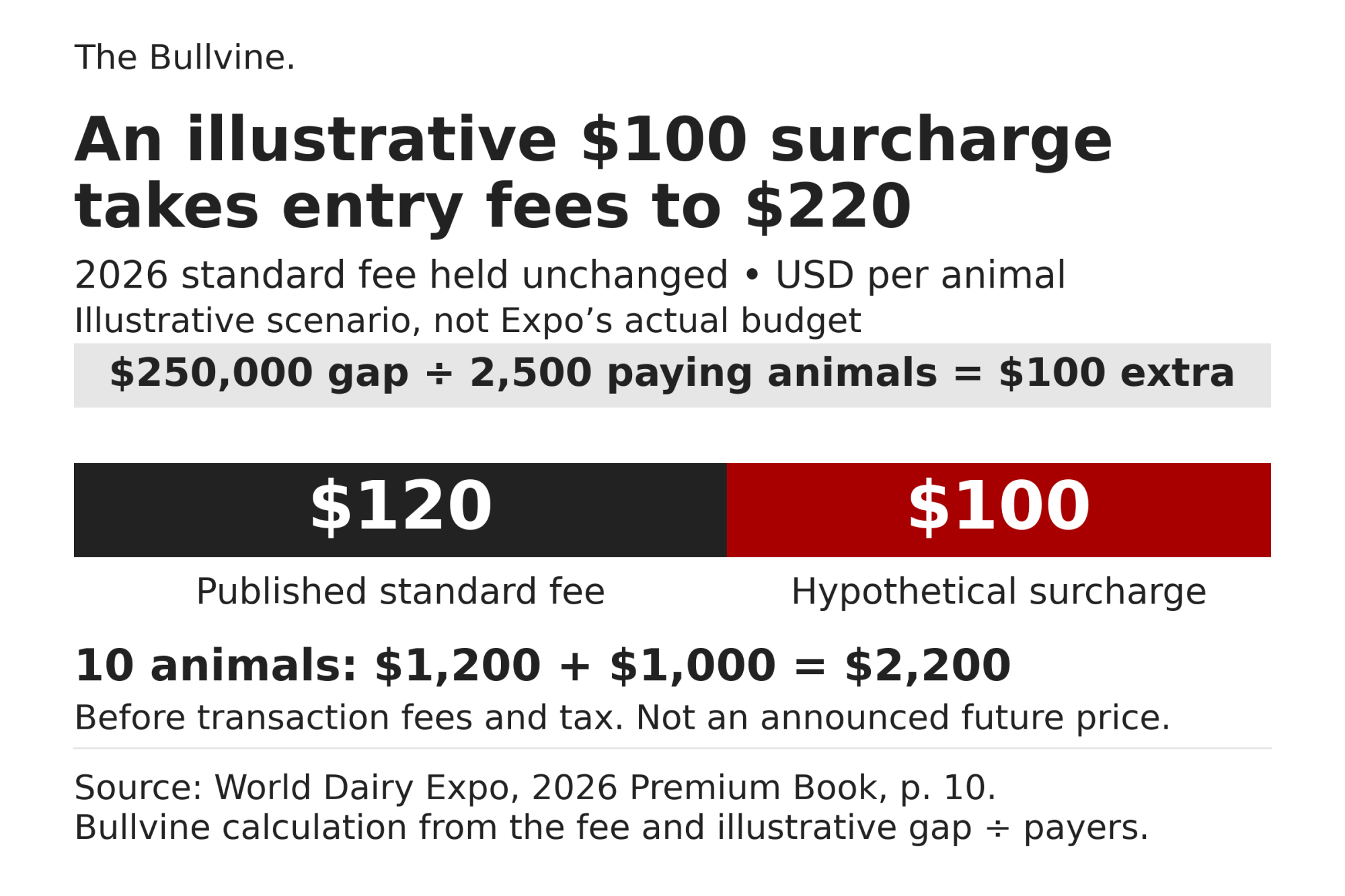
| Illustration, 2026 standard fee held unchanged | Per animal | 10 animals |
| 2026 standard entry fee | $120 | $1,200 |
| Hypothetical additional charge | $100 | $1,000 |
| Combined, before transaction fees and tax | $220 | $2,200 |
On Bullvine’s calculation, the hypothetical $100 is about 83% of the standard fee. It raises the entry charge, not the whole cost of the trip, which our earlier cost analysis walks through using 2025 fees and estimates. For an exhibitor, the test is whether $220 a head changes how many animals get entered. The model doesn’t assume the answer.
Expo’s own history shows that a strong cattle show and a sustainable budget are separate tests. Its published history, We Need a Show, says Madison’s first Expo in 1967 drew 1,182 cattle, but the event’s finances stayed weak through 1970. In 1971, a new corporation funded by industry groups and companies bought the foundation’s Expo assets. Madison’s first show and Madison’s workable business model were not the same achievement, and the account doesn’t isolate what made the difference.
What a World Dairy Expo without the trade show would still include
Commercial promotion already reaches past Expo’s trade floor. Its 2025 Cattle Show Farm Affiliate application allowed qualifying exhibitor-owned businesses to promote themselves in designated stalling areas. The 2026 premium book also provides for farm and affiliate promotion booths. Removing the conventional trade show would still leave a separate decision about barn-side commerce.
Bullvine assumes the Alliant Energy Center and the cattle-related occupancy period described in the 2026 premium book, including approved early arrivals and teardown. The modeled event retains youth contests, breed shows, cattle sales, ExpoTV streaming, and barn-side promotion. Other programming would require its own cost and revenue assumptions.
The calculation does not establish who would attend. Breeders would still need reasons to expect useful buyer contacts; non-exhibiting commercial producers would need reasons to make the trip. Sponsors would need evidence of the audience they could reach. Changes in admissions, sponsorship, and operating costs belong in the budget.
How the stress test works
The recurring gap is the redesigned event’s annual operating cost after verified savings, minus ordinary entry revenue and other continuing revenue. Any sponsorship included in that revenue must also have its delivery costs included in the operating budget.
Two things stay out of it:
- One-time transition costs, such as contract exits or severance if any apply, get their own line.
- Reserve money gets its own line too, because it’s a transition-year financing choice, not income.
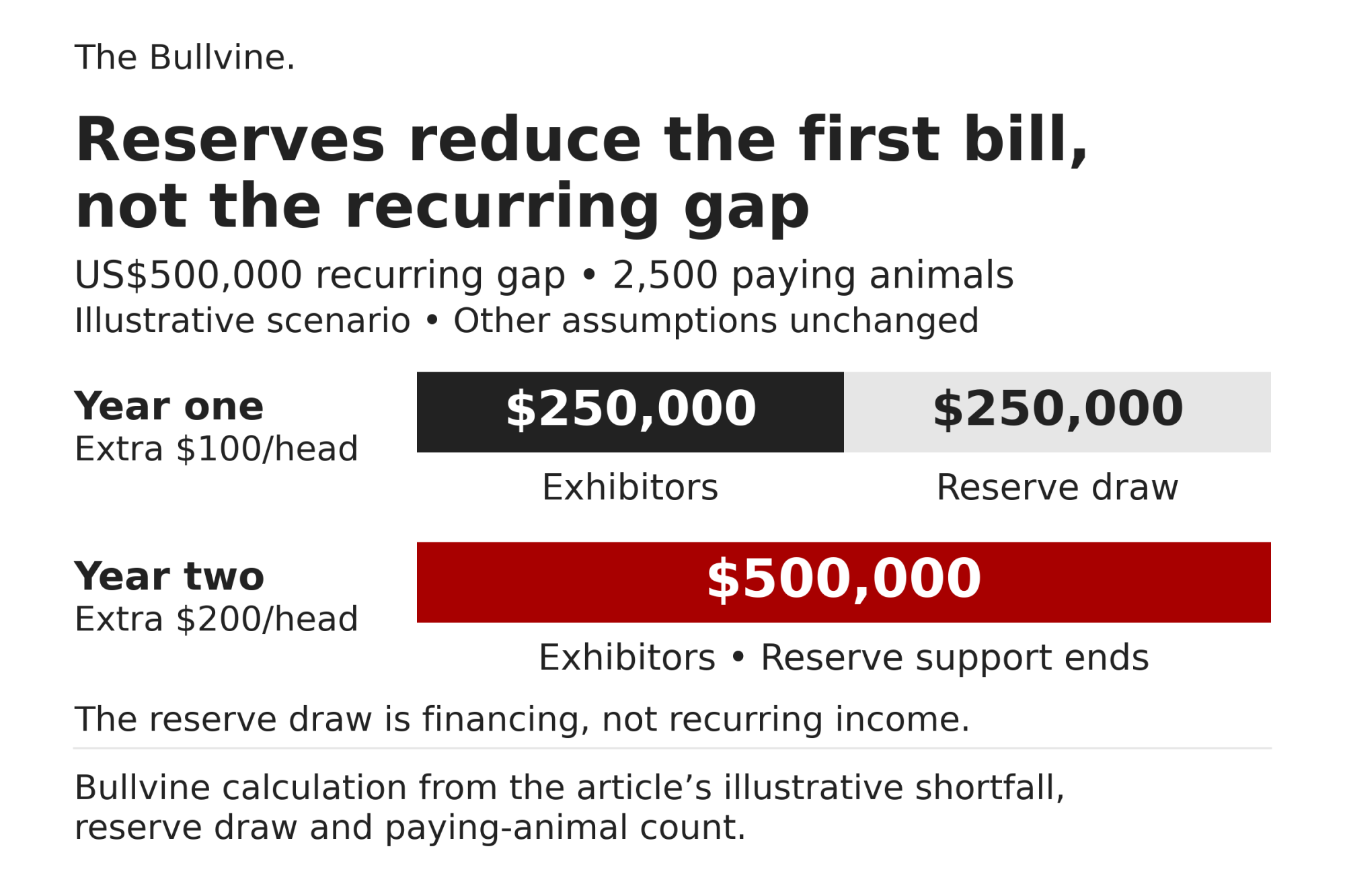
A $500,000 recurring shortfall shows how a reserve draw can mislead:
- Recurring shortfall: $500,000
- Reserve draw in year one: $250,000
- Year-one exhibitor bill: $250,000, or $100 a head at 2,500 paying animals
- Year two, once the reserve support ends: $500,000, or $200 a head, unless something else has changed
Reserve funding can reduce the first-year bill; it does not close a recurring operating gap. Any model has to show the year the reserve support stops.
The model assumes one additional charge per unique animal subject to the surcharge. Dividing the recurring gap by those paying animals gives the extra charge per head.
Running the Numbers: Bullvine’s Cattle-Show Stress Test
- Recurring gap: $250,000, $500,000, or $1,000,000. These are selected scenarios, not an estimated range, and $1 million isn’t a ceiling.
- Paying animals: 3,000, 2,500, or 2,000. The model uses 2,500 as an illustrative paying-animal count.
- Additional per-animal charges cover the remaining gap.
Additional charge per paying animal, U.S. dollars; illustrative scenarios (Bullvine calculation, rounded)
| Recurring gap | 3,000 paying animals | 2,500 paying animals | 2,000 paying animals |
| $250,000 | $83 | $100 | $125 |
| $500,000 | $167 | $200 | $250 |
| $1,000,000 | $333 | $400 | $500 |
At 2,500 paying animals, the three gap scenarios add $1,000, $2,000, or $4,000 to a 10-head string’s entry bill.
Count the animals that would actually pay
Expo reports 2,625 head exhibited by 1,829 owners in 2025. That counts animals shown, and it can’t establish how many animals a future surcharge would reach.
Under the 2026 rules, entry fees aren’t refunded for any reason, including for animals that don’t show, and stalls are assigned for animals on grounds, not animals entered. A real proposal needs paid-entry records. It also has to say whether a surcharge falls on each unique animal, each paid entry, or only the animals that arrive. For the longer attendance picture, see the attendance decline.
Hold the $1 million gap fixed and drop from 2,500 paying animals to 2,000, and the charge rises from $400 to $500 a head. In practice, the gap may also change. Fewer paid entries also mean less ordinary entry revenue, possibly different sponsor value, and some variable costs that disappear. A full downside budget has to recalculate both the remaining gap and the number of paying animals.
Sponsor revenue needs a company-level check
Replacement sponsorship is one of the key assumptions to test. Expo’s 2026 advertising materials sell several commercial products, but separate products don’t prove separate budgets.
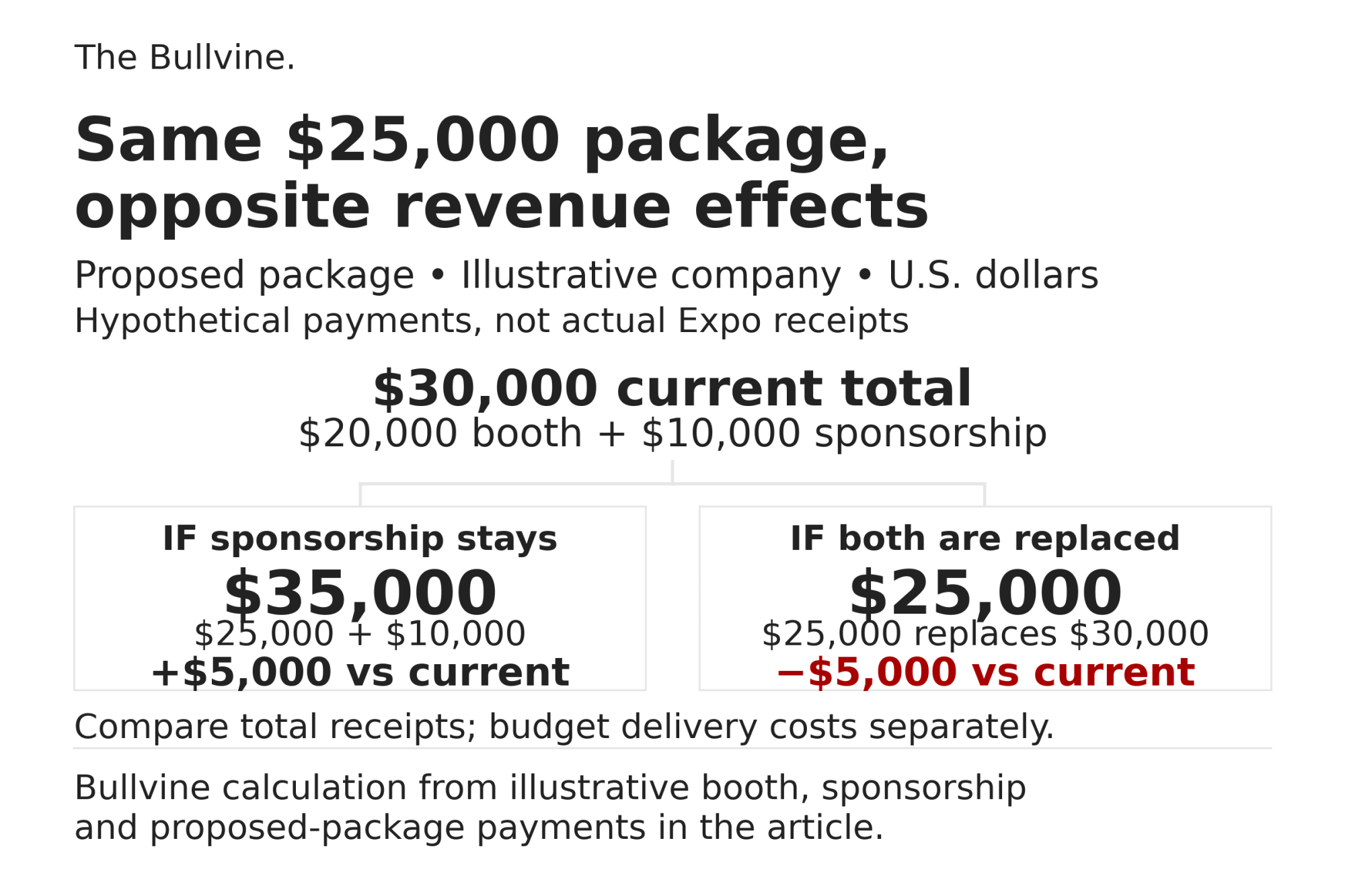
In this illustration, a genetics company currently pays Expo $30,000:
- $20,000 for a trade show booth.
- $10,000 for cattle-show sponsorship.
A proposed $25,000 cattle-focused package produces two possible outcomes:
- The package is additional to the existing $10,000 sponsorship: Expo receives $35,000, an increase of $5,000.
- The package replaces both existing payments: Expo receives $25,000, a decrease of $5,000.
If the second outcome is recorded while the old $10,000 sponsorship remains in the budget, projected receipts are overstated by $10,000. Across 2,500 paying animals, that understates the funding requirement by $4 a head.
The company’s budget holder settles it by stating what the package replaces and what happens to the company’s total Expo bill. Different invoice headings don’t make different dollars.
Two more checks come before any package counts:
- Budget the delivery costs. Any production, hospitality or staffing required by a sponsorship package must appear in the operating budget.
- The term matters too. A one-year agreement leaves the following year’s renewal risk unresolved.
For this stress test, Bullvine would separate signed commitments from conditional support and unconfirmed interest. Each proposed sponsorship needs an amount, payment schedule, conditions, and duration, with delivery costs budgeted separately. The cash schedule must show when receipts are available to meet obligations.
Bullvine proposes conditional commitments to test demand for a defined format, with a funding threshold and decision date. Agreements with unresolved conditions stay identified as conditional.
Deleting the trade-show share of a salary doesn’t delete the salary
Payroll is the first cost category Bullvine would scrutinize. That does not imply Expo is overstaffed; it tests whether the claimed savings actually reduce payroll. If the same salary remains payable after trade-show work disappears, removing its departmental allocation creates no cash saving.
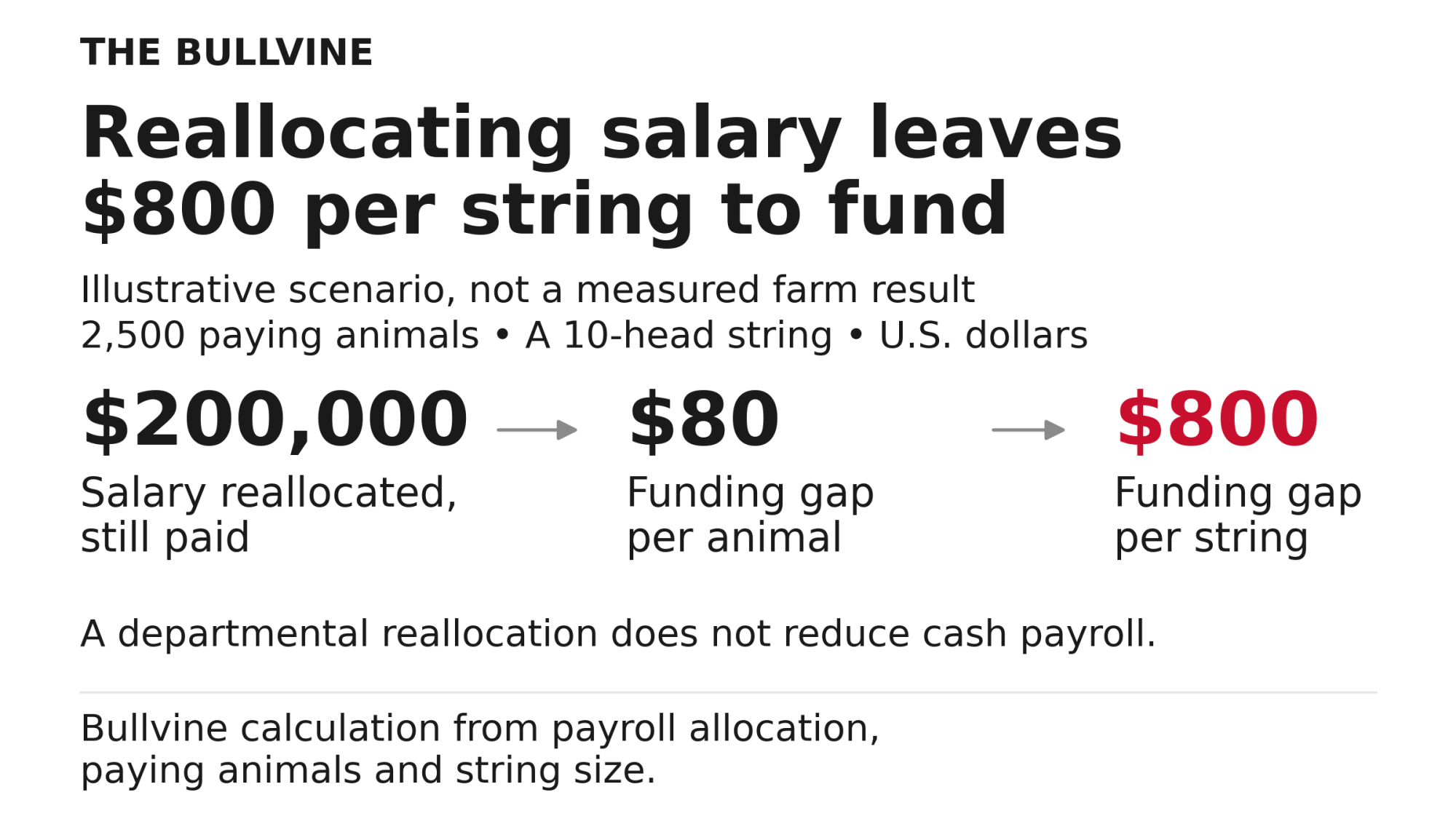
Each claimed saving has to name the payment that stops, the date it stops, and any new cost of stopping it. Staff moved to sponsor sales may add capacity, but the salary is still paid. A $200,000 payroll saving that’s really a reallocated salary understates the gap by $80 a head, or $800 on a 10-head string. The model needs two columns, transition-year and recurring savings, with a staffing plan behind both.
Removing the trade show does not, by itself, establish a shorter cattle schedule. A three-day version needs its own ring schedule and operating budget before savings can be claimed.
| Budget test | Illustrative inputs | Bullvine calculation / interpretation | Limitation |
|---|---|---|---|
| Reserve support ends | $500,000 recurring gap; $250,000 reserve draw in year one; 2,500 paying animals | Year one: ($500,000 − $250,000) ÷ 2,500 = $100/head. Year two: $500,000 ÷ 2,500 = $200/head without further support or other changes. | A reserve draw reduces the first-year bill, not the recurring gap. Hypothetical example. |
| Fewer animals pay | Fixed $1 million gap; paying animals fall from 2,500 to 2,000 | $1 million ÷ 2,500 = $400/head; $1 million ÷ 2,000 = $500/head. | A full downside budget must also recalculate ordinary entry revenue, sponsorship and variable costs. |
| Sponsorship gets counted twice | A hypothetical $25,000 package replaces an existing $20,000 booth payment and $10,000 sponsorship | Receipts fall from $30,000 to $25,000. Retaining the old $10,000 sponsorship in projections overstates revenue by $10,000: $10,000 ÷ 2,500 = $4/head. | Illustrative company—not an actual sponsor agreement. Package delivery costs also belong in the budget. |
| Salary allocation changes, but payroll does not | Hypothetical $200,000 claimed saving; the salary remains payable; 2,500 paying animals | No cash saving occurs. Understated gap: $200,000 ÷ 2,500 = $80/head, or $800 for 10 animals. | Tests a modeling assumption; does not establish Expo’s staffing needs or actual savings. S1 |
What this means for the next show budget
| Reader | Useful action |
| Cattle exhibitor | Before setting the next show budget, calculate the all-in cost per head and the additional charge that would change the string. |
| Sponsor or breed association | Before renewing support, reconcile all Expo spending and identify what a replacement package would replace. |
| Anyone evaluating a format change | Before committing, require recurring and transition budgets, a cash schedule, and a recalculated lower-entry case. |
These figures do not establish Expo’s actual position. Its cost, paid-entry, and commitment records would support Expo-specific scenarios, while future participation would remain uncertain.
A proposed format has to cover recurring costs without depending on a finite reserve draw. Its downside budget must recalculate both revenue and costs with fewer paying animals. The cash schedule must show that enough money is available when obligations fall due.
Test the Math: Your Expo Surcharge Simulator
Adjust the estimated funding gap and animal count below to see how a trade-show shortfall impacts your string’s entry bill.
Methodology Note
The funding gaps ($250,000, $500,000, and $1,000,000), the reserve example, the sponsor bridge, and the $200,000 payroll allocation are hypothetical. Grid results divide each gap by 3,000, 2,500, or 2,000 paying animals and are rounded to the nearest dollar. The grid compares fixed scenarios and doesn’t predict how entries respond to price. The 2026 entry fees ($120 standard, $250 late) come from Expo’s 2026 premium book. The fee comparison excludes transaction fees and tax. The illustrative surcharge does not estimate an exhibitor’s travel or other trip expenses.
Learn More
- Can a Bigger Hall Fix World Dairy Expo’s Trade Floor? — Arms you with a ruthless 30-day audit to measure your trade booth’s actual return on investment. Breaks down why 112 attendees per remaining vendor demands qualified lead-capture over foot-traffic nostalgia before signing your 2028 contract.
- World Dairy Expo: Reversing the 33% Attendance Drop — Seventy companies abandon the Madison trade floor annually while cattle numbers hold steady. Follow the money on Expo’s quiet exodus to see why the audience collapsed long before COVID, dictating where your marketing budget belongs next season.
- What Dairy Shows Must Learn from the Booming Stock Show World — Lowering the financial barrier to the show ring demands importing tactics from the booming stock show world. Dismantles the status quo by applying jackpot circuits and skillathons to dairy, delivering a high-reward blueprint to recruit young breeders.
The Sunday Read Dairy Professionals Don’t Skip.

Every week, thousands of producers, breeders, and industry insiders open Bullvine Weekly for genetics insights, market shifts, and profit strategies they won’t find anywhere else. One email. Five minutes. Smarter decisions all week.