






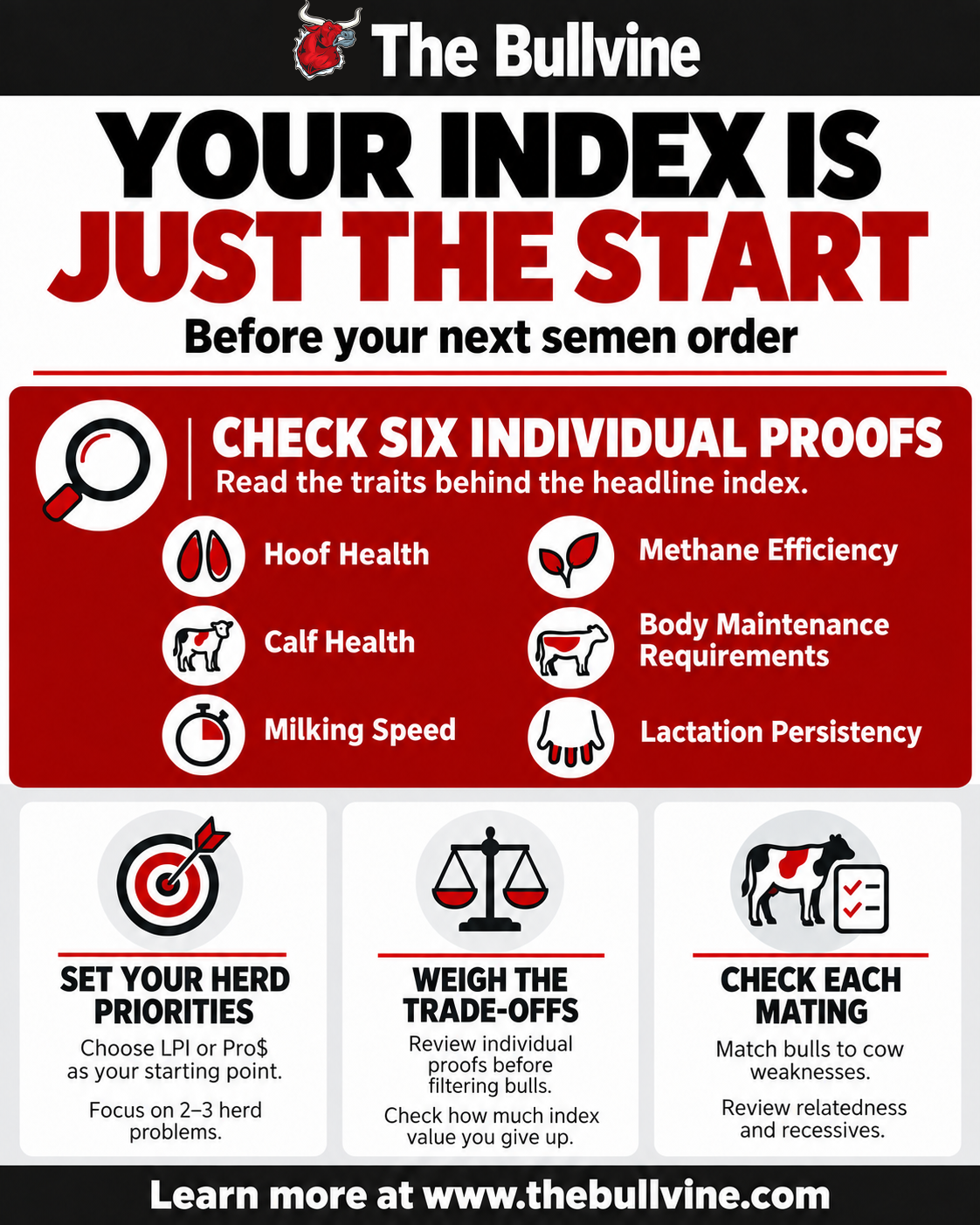
In Lactanet’s April 2026 Canadian Holstein proofs, six traits show little linear association with LPI or Pro$. If these traits matter to your herd, check each bull’s individual proofs.
The cows in your 2035 milking string start with this winter’s semen order. Sort that order on a total merit index alone, and you can breed blind spots into the herd you’ll be milking.
To illustrate, take a heifer conceived in early 2027. She’s born later that year, calves around late 2029, and her daughters reach the milking string around 2032. She may be long gone by 2035. Her genetics can still be in the herd, through the daughters and granddaughters you keep.
Most of those matings will start from a bull list sorted by LPI or Pro$. On six traits, Lactanet’s April 2026 Holstein proof correlation table shows that a total merit index sort tells you little.
Six Traits to Check Individually
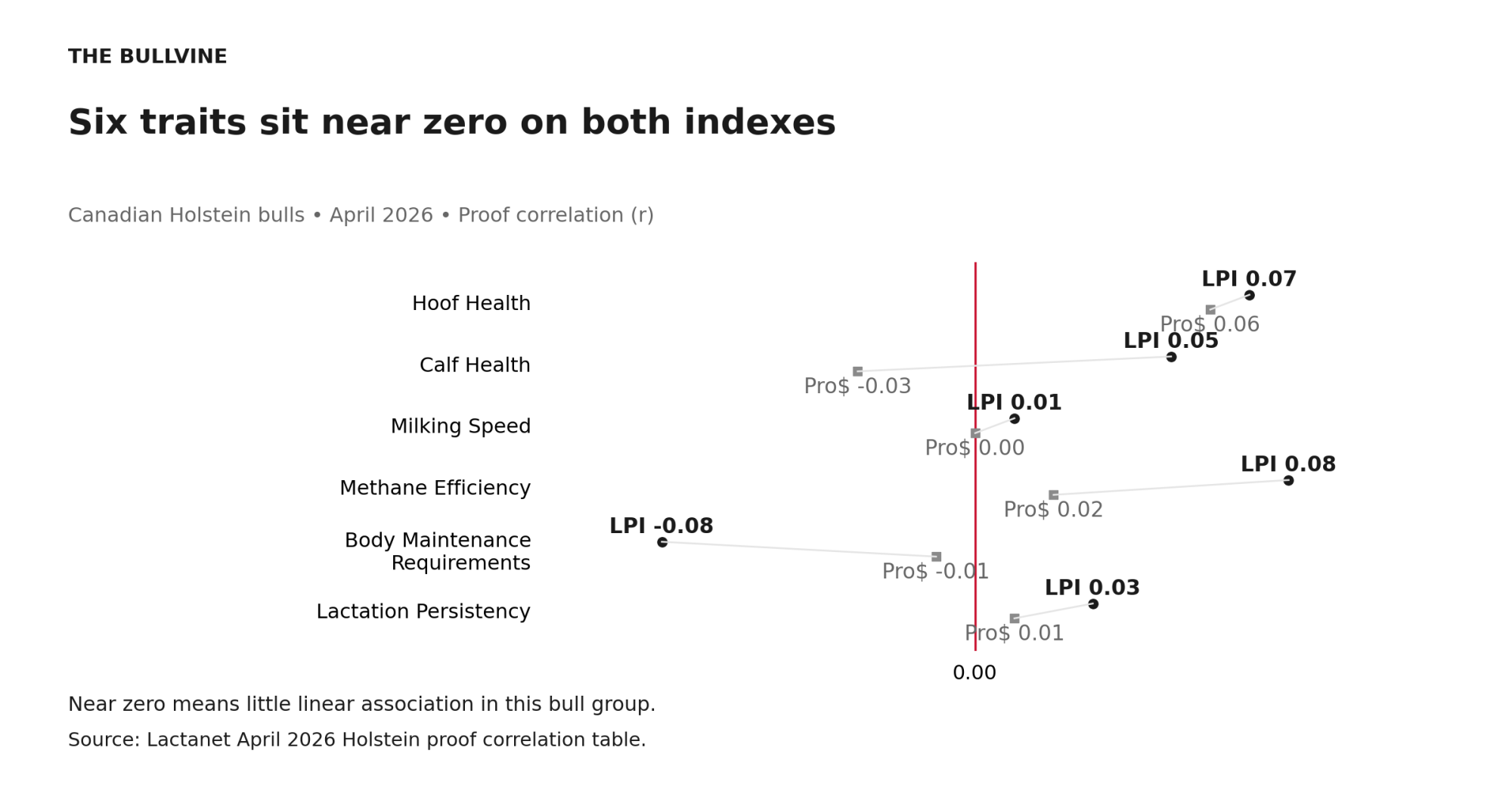
Each of these six traits correlates within 0.10 of zero with both LPI and Pro$.
| Trait | LPI | Pro$ | Why it can matter |
| Hoof Health | 0.07 | 0.06 | Lameness |
| Calf Health | 0.05 | −0.03 | Calf respiratory disease and diarrhea |
| Milking Speed | 0.01 | 0.00 | Robot and parlour throughput |
| Methane Efficiency | 0.08 | 0.02 | Processor or carbon-program requests |
| Body Maintenance Requirements | −0.08 | −0.01 | Maintenance feed needs tied to body size |
| Lactation Persistency | 0.03 | 0.01 | Lactation shape, including extended lactations |
Source: Lactanet, “Proof Correlations for Holstein Bulls with Official Proofs Born Since 2011 and Genomic Young Bulls Used in Canada Born Since 2019,” April 2026.
We picked these six with a statistical screen. They aren’t on every farm’s priority list. A weak correlation doesn’t mean the total merit index never moves a trait. It means a bull’s total merit index rank says little about where he sits on any of the six traits.
Five of the six are direct ingredients in the April 2026 LPI formula, but Persistency isn’t (Lactanet LPI formula, April 2026). Lactanet doesn’t publish Pro$ trait weights (Lactanet, March 18, 2026), so it’s impossible to say which of these traits Pro$ includes directly. A low overall correlation can reflect a small weight, or relationships among other traits in the index that offset each other.
Also read the trait definitions. Calf Health combines the two main calf illnesses, respiratory problems and diarrhea (Lactanet, August 5, 2025). And a good leg score is a poor stand-in for hoof health: in this group, Hoof Health correlates 0.07 with Feet & Legs and 0.11 with locomotion.
What a Proof Correlation Can and Can’t Tell You
These are correlations between bulls with published proofs within one specific bull group: the Holstein bulls with official proofs born since 2011, plus genomic young bulls used in Canada born since 2019. They aren’t genetic correlations. Lactanet puts the genetic correlation between fat and protein yield at 64% (Lactanet, March 25, 2026). The proof correlation for the same pair in this table is 0.81.
Three things limit what any number here can tell you.
- The bulls are already selected. Every bull here survived selection, and selection shapes the associations among the bulls that remain.
- Some links are built in. For young bulls, Lactanet partly predicts Herd Life from other traits. It describes Indirect Herd Life as “calculated based on a formula that combines genetic evaluations for a list of traits known to affect lifetime daughter survival” (Lactanet, November 30, 2021).
- Association isn’t cause. A correlation shows how proofs line up across these bulls, not what one trait does to another inside a cow.
This is Canadian data, and it doesn’t carry over to TPI or Net Merit. Our August look at TPI and the Feet & Legs Composite covers the U.S. side.
Where LPI and Pro$ Differ
LPI and Pro$ correlate at 0.92 in this bull group. Sort a list on either one and most bulls land in a similar place.
| Correlation with… | LPI | Pro$ |
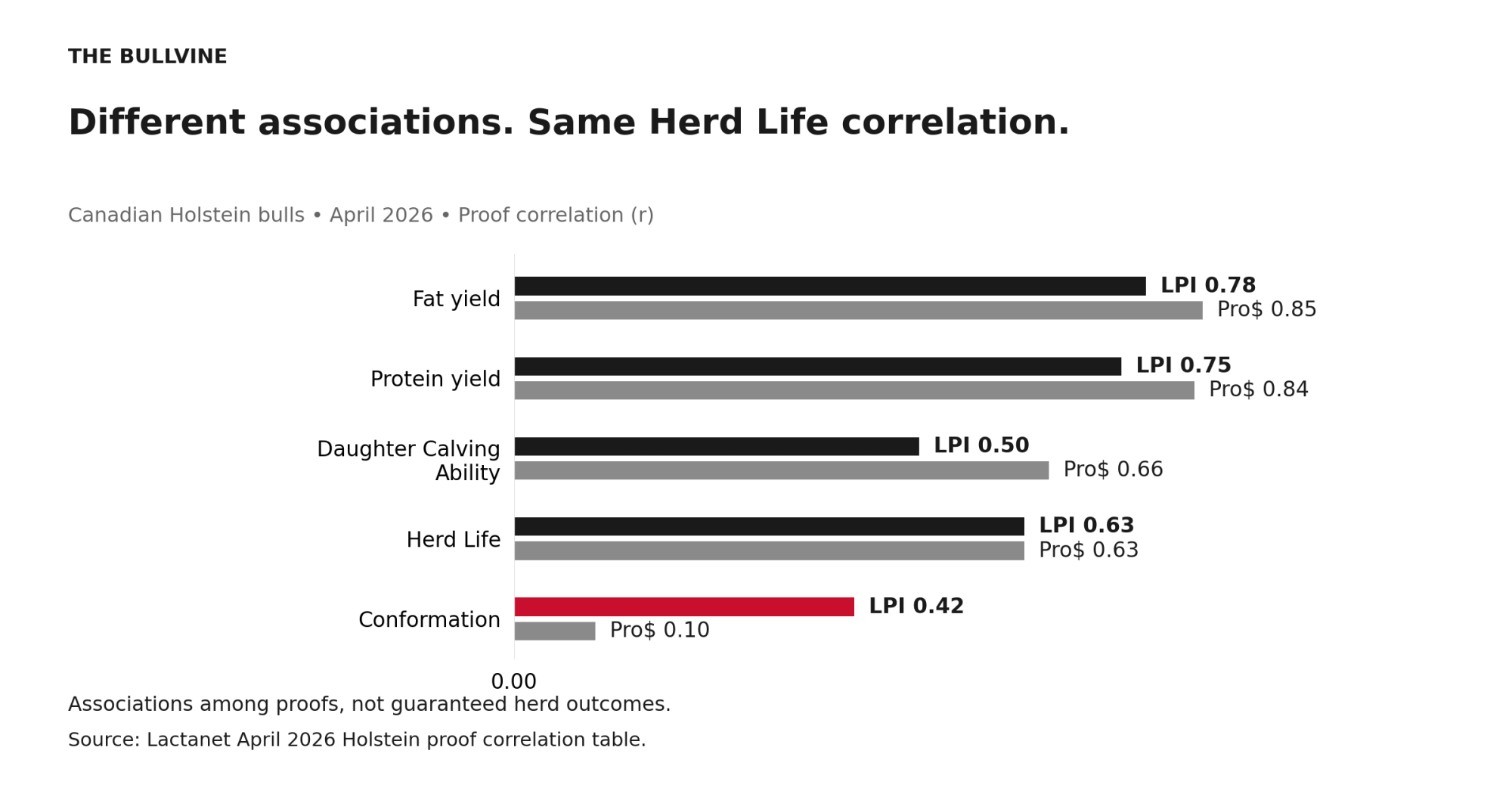
| Fat yield | 0.78 | 0.85 |
| Protein yield | 0.75 | 0.84 |
| Daughter Calving Ability | 0.50 | 0.66 |
| Reproduction Index | 0.31 | 0.39 |
| Herd Life | 0.63 | 0.63 |
| Health & Welfare Index | 0.43 | 0.43 |
| Conformation | 0.42 | 0.10 |
| Mammary System | 0.36 | 0.11 |
| Feet & Legs | 0.44 | 0.17 |
Source: Lactanet April 2026 Holstein proof correlation table.
They part ways on type. LPI correlates 0.42 with Conformation and Pro$ just 0.10, while Pro$ leans harder on fat, protein and Daughter Calving Ability. The two match on Herd Life and Health & Welfare, though matching proof correlations don’t guarantee matching gains in a real herd.
How to Read a Subindex
The April 2026 Holstein LPI weights are Production 40, Longevity & Type 32, Reproduction 10, Health & Welfare 8, Milkability 5 and Environmental Impact 5 (Lactanet LPI formula, April 2026). Our July breakdown of the subindexes made the case for reading them individually, not just the total.
Every subindex is a composite, and combining loosely related traits can be the point. The risk is a good total sitting on top of a weak component your farm can’t afford.
| LPI Subindex | Selected proof associations (r) | What to check alongside it |
| Production | Protein 0.96 · Fat 0.93 · Milk 0.61 | Fat and protein proofs against your payment objectives |
| Reproduction | Daughter Fertility 1.00 · Daughter Calving Ability 0.50 | Daughter Calving Ability separately, when it matters |
| Longevity & Type | Conformation 0.89 · Mammary 0.77 · Feet & Legs 0.76 · Herd Life 0.46 | Herd Life directly, alongside the structural traits |
| Health & Welfare | Mastitis Resistance 0.79 · Calf Health 0.52 · Metabolic 0.44 · Hoof Health 0.28 | The specific disease traits causing losses in your herd |
| Milkability | Teat Length 0.60 · Milking Speed 0.51 · Temperament 0.46 | Speed, temperament and udder traits relevant to your system |
| Environmental Impact | Body Maintenance 0.67 · Methane 0.66 · Feed Efficiency 0.31 | Methane, feed efficiency and maintenance individually |
Source: Lactanet April 2026 Holstein proof correlation table.
The 1.00 proof correlation between Reproduction and Daughter Fertility is rounded. Daughter Fertility makes up 90% of Reproduction Index (RI, and Daughter Calving Ability makes up the other 10% (Lactanet LPI formula, April 2026).
Read Herd Life directly. Herd Life is 20% of the Longevity & Type Index, and the other 80% is structural traits. In this group, Herd Life correlates 0.56 with Mastitis Resistance and 0.52 with Daughter Fertility, but 0.09 with Conformation and 0.15 with Mammary. For young bulls, part of that pattern comes from how Lactanet builds Indirect Herd Life.
HWI now balances calf and adult-cow health. Since April 2026, Holstein HWI has weighted Mastitis Resistance at 40%, Calf Health at 30%, Metabolic Disease at 14%, Hoof Health at 11% and Cystic Ovaries at 5% (Lactanet LPI formula, April 2026).
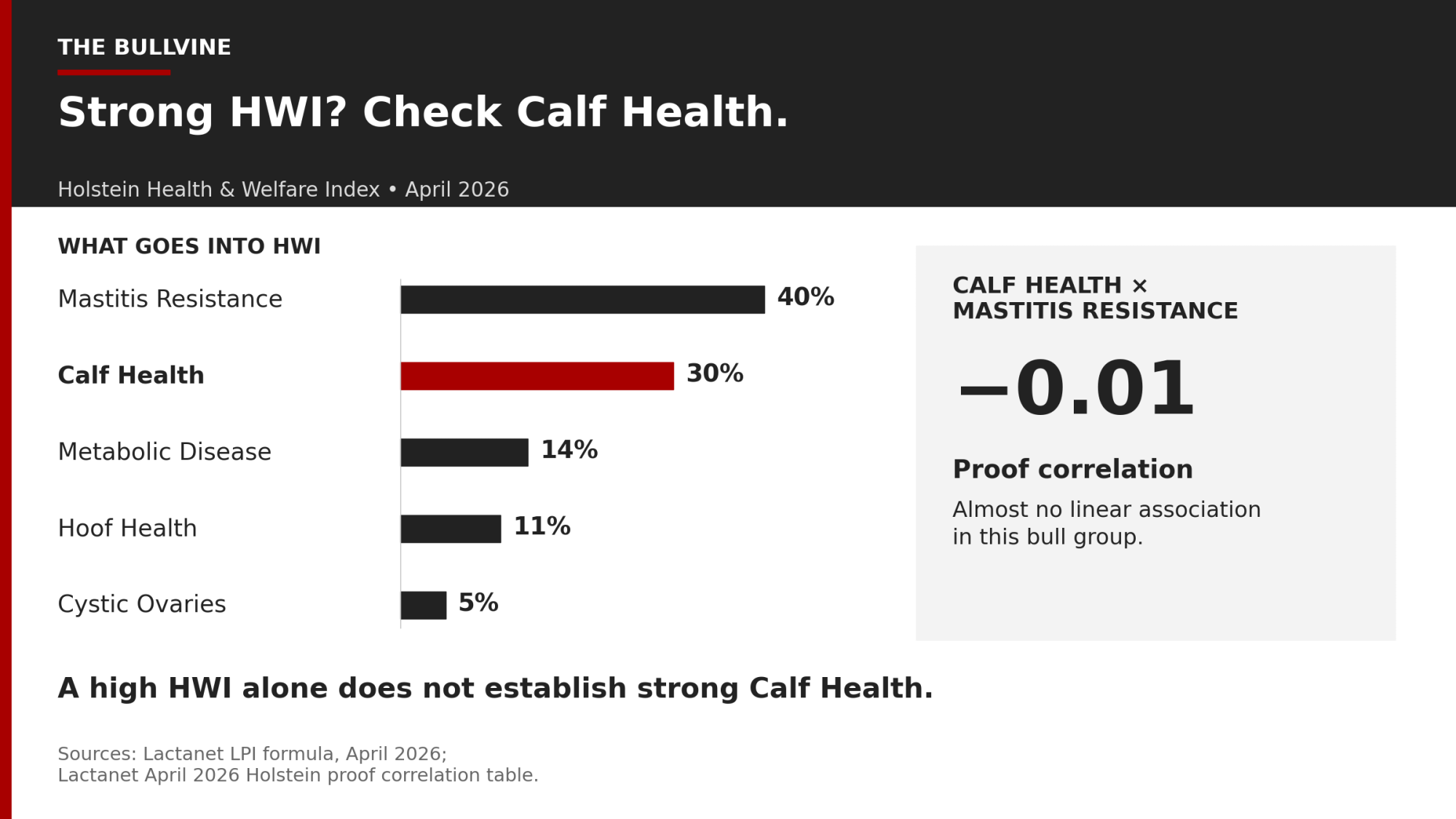
Calf Health and Mastitis Resistance correlate at −0.01, so in this bull group they have almost no linear association. A bull can post a strong HWI largely on udder health. If calves are where you lose money, that HWI may not show it.
Environmental Impact is three checks in one. Methane Efficiency, Feed Efficiency and Body Maintenance correlate with each other at −0.07, −0.04 and 0.03. Methane Efficiency correlates 0.01 with Production, so this bull group shows no strong unfavourable association between the two. Any added requirement on a finite bull list can still shorten the shortlist and mean some loss in top-end index merit. On Body Maintenance, a higher RBV (Relative Breeding Value) means daughters have lower maintenance requirements (Lactanet, March 21, 2023), and here it correlates −0.66 with stature.
More Protein Emphasis Still Requires a Herd-Level Check
For April 2026, Holstein LPI Production weightings moved from 60% fat / 40% protein to 40% fat / 60% protein. That followed the Canadian Dairy Commission’s advice to “stop further improvement of butterfat content relative to protein.” Lactanet said the change will lead to “minor reranking of top bulls, favouring those with higher Protein” (Lactanet, March 25, 2026).
In the 2026 proof correlation table, LPI correlates 0.78 with fat yield and 0.75 with protein yield. Lactanet’s April 2025 table, from a different bull group, showed 0.81 and 0.74 (Lactanet LPI formula, April 2025). Those snapshots don’t measure the effect of the formula change. That would take both formulas run on the same bulls.
Before you read those proofs, pin down which protein goal your milk cheque actually rewards.
- More kilograms of protein: protein yield
- Higher protein concentration: Protein Deviation
- A changed fat-to-protein balance: fat and protein proofs read together
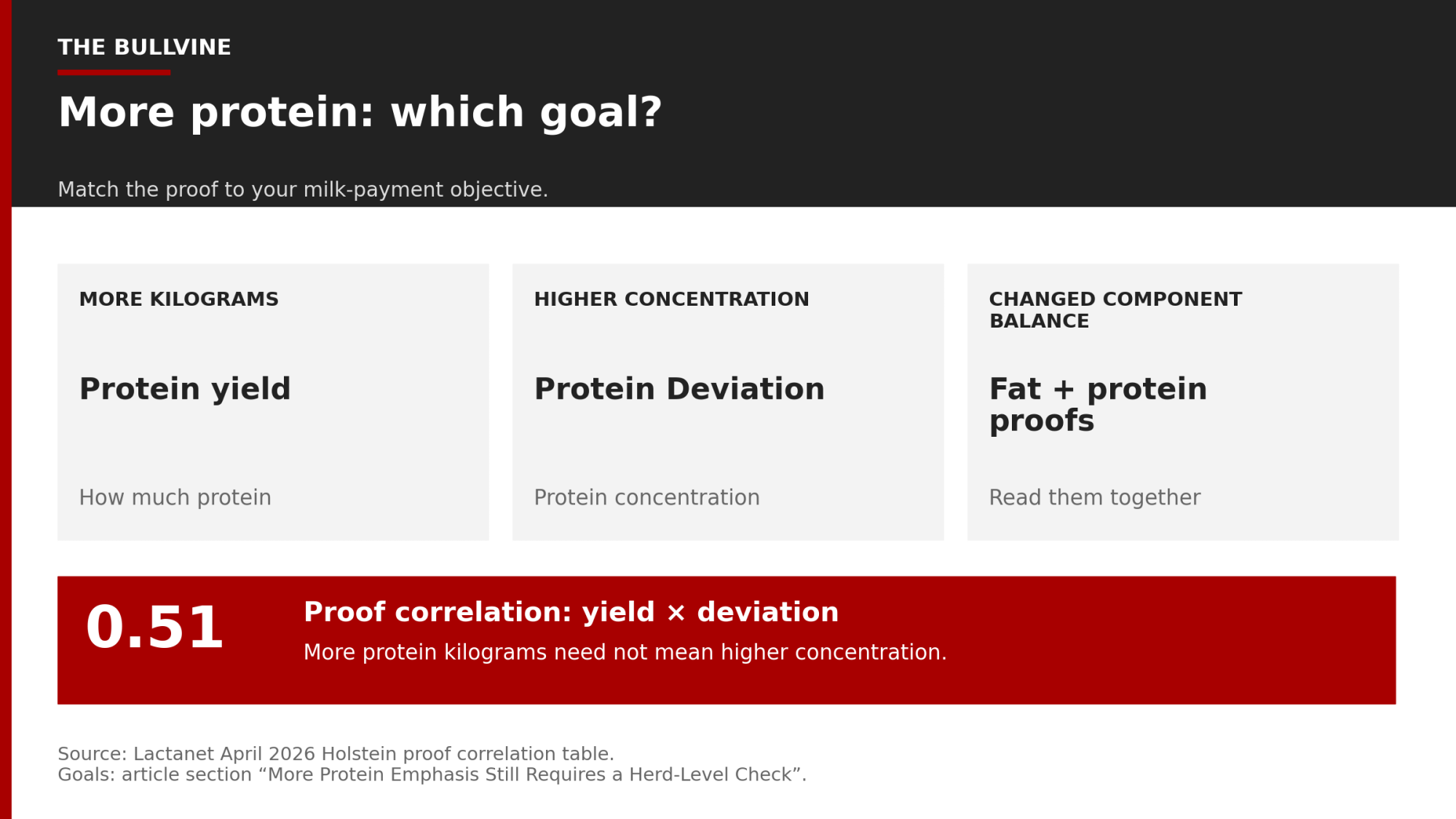
Read the three together. Protein yield and Protein Deviation correlate at just 0.51 in the 2026 table, so a bull can add protein kilograms without lifting concentration.
Where Proofs Still Pull Against Each Other
Some pairs show no strong unfavourable association in the 2026 bull group. The Production Index (PI) correlates 0.00 with Conformation, 0.08 with Daughter Fertility and +0.25 with Mastitis Resistance. These are associations among published proofs, and the table doesn’t show why they exist.
Size, milking speed and udder support still pull against other traits in the 2026 bull group, and body condition sits apart from both total merit indexes.
- Size and fertility. Daughter Fertility correlates −0.40 with dairy strength and −0.40 with body depth. Calving Ability correlates −0.47 with stature.
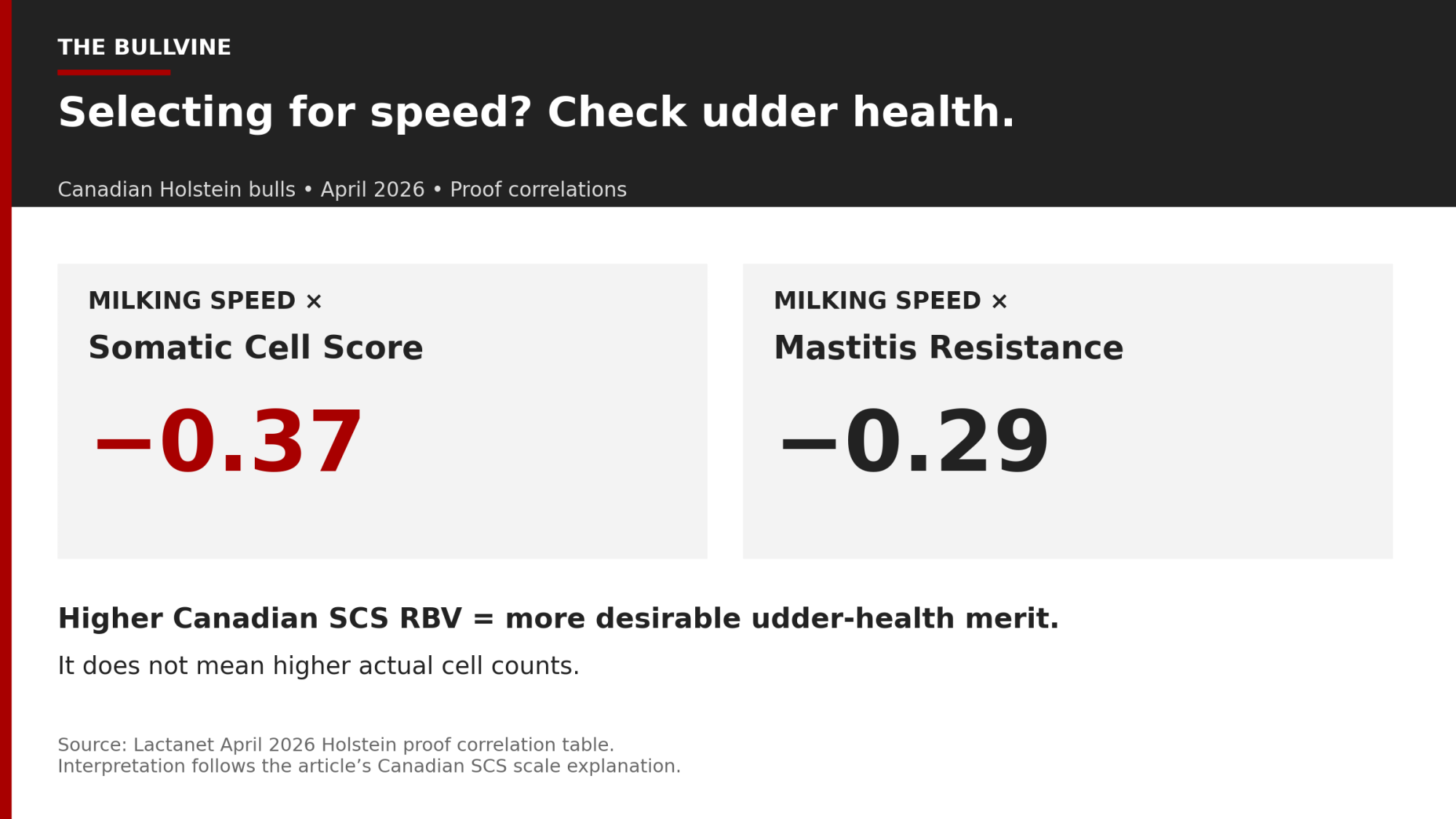
- Speed and udder health. Milking Speed correlates −0.37 with Somatic Cell Score and −0.29 with Mastitis Resistance, both unfavourable. On Lactanet’s RBV scale, a higher SCS proof is more desirable, so it points to lower cell counts, not higher ones.
- Udder support. Median Suspensory correlates −0.27 with Production, −0.14 with LPI and −0.29 with Pro$, so higher-indexed, high-yield bulls in this group tend toward lower Median Suspensory proofs. Weigh udder support mating by mating.
- Body condition. BCS is associated with Daughter Fertility (0.25) and Metabolic Disease Resistance (0.33), and shows little linear association with either total merit index (−0.04 with LPI, 0.03 with Pro$).
A Five-Step Semen-Order Review
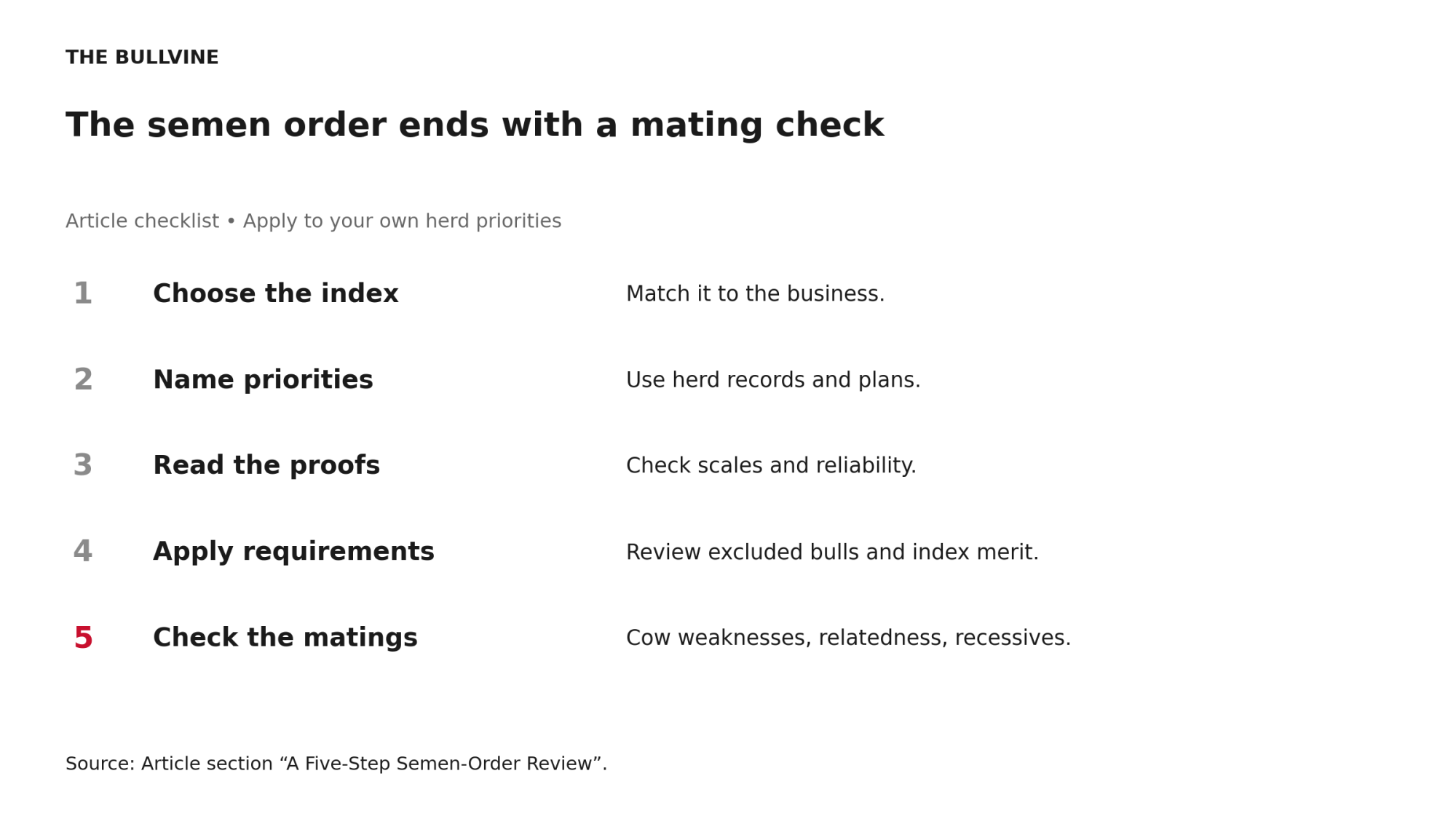
- Choose the total merit index that fits the business. Lactanet’s own guidance says that if a herd “generates essentially all its revenue from the sale of milk and its components, Pro$ is designed to be your primary selection index tool” (Lactanet, March 18, 2026). Keep the functional trait requirements your housing and your cows need. LPI may fit better if your customers pay for extra type merit.
- Name two or three herd problems or planned operating requirements. Draw on your records, such as lameness, calf disease treatments or SCS, and on your plans, such as a robot installation or a processor’s methane requirement.
- Read the relevant proofs within your actual shortlist. Watch the scales. In its 2025 response table, Lactanet expressed production traits in kilograms, type traits in EBV (Estimated Breeding Value) and other traits in RBV (Lactanet LPI formula, April 2025). Lactanet sets an RBV (Relative Breeding Value) of 100 on a reference group of bulls, not on the bulls you can buy today. For Body Maintenance, its 2023 release set 100 on officially proven sires born between 2008 and 2017 (Lactanet, March 21, 2023). Compare the published reliability for that trait on that bull.
- Apply targeted requirements, then see what they cost. Each minimum you add on a trait proof can narrow the pool of qualifying bulls. Note which bulls drop out and how much total merit index value you give up. Extended lactations are one reason to look at Persistency.
- Check the matings, not just the bulls. Look at cow-specific weaknesses, relatedness and compatibility on genetic recessives. Lactanet credits genomic testing with identifying cows and heifers that carry known undesirable genes, to help avoid mating them to carrier sires, and points to AI mating programs and its Compass tool to help manage them (Lactanet, August 13, 2024).
The Bottom Line
In the 2026 bull group, LPI and Pro$ line up with fat, protein and Herd Life. They tell you little about Hoof Health, Calf Health, Milking Speed, Methane Efficiency, Body Maintenance or Persistency. If any of those affects your herd’s performance now, or matters to the system you plan to run by 2035, read it in each bull’s individual proofs before you place this winter’s semen order.
The 2035 Blind Spot Analyzer
Select your farm’s top operational priorities to reveal your hidden exposure when sorting solely by total merit indexes.
Methodology Note: We used Lactanet’s April 2026 table, “Proof Correlations for Holstein Bulls with Official Proofs Born Since 2011 and Genomic Young Bulls Used in Canada Born Since 2019” (file dated April 29, 2026), supplied to The Bullvine. The table covers 61 indexes and traits for that bull group. It doesn’t report sample size, the proven-versus-genomic split, or how Lactanet handled missing or unavailable proofs. It also doesn’t give separate correlations for proven and genomic young bulls, or measure the 2026 LPI formula changes on a fixed bull population. These are proof correlations, not genetic correlations. They describe associations, not causes, and they don’t apply to other national indexes or to any individual herd’s realized response. The 2027–2032 dates in the opening are illustrative. We welcome producer feedback, herd data and corrections through The Bullvine’s contact page.
Complete references and supporting documentation are available upon request by contacting the editorial team at editor@thebullvine.com.
Learn More
- CDCB August 2026 evaluation: don’t panic-cull your bull — Protect your semen inventory from reactionary culling. This breakdown exposes how the recent fertility trait rescale penalizes certain sires on paper without changing their true conception rate, arming you with the exact metrics to trust before locking fall matings.
- Why Your 2021 Dairy Genetic Strategy Is Failing in 2026 — Follow the money on Canada’s April 2026 LPI production weighting shifts. Changing milk pricing models mean outdated fat-heavy sire selections could drain up to $176 per cow annually, demanding a hard pivot toward protein yield to defend your margins.
- The $73-a-Cow Gap Hiding in Your 2027 Bovaer Contract — Dismantle the assumption that feed additives alone will satisfy processor carbon demands. Leveraging genomic methane efficiency traits directly from your DHI reports delivers a zero-cost lever to hit reduction targets and secure future sustainability premiums without shrinking margins.
The Sunday Read Dairy Professionals Don’t Skip.

Every week, thousands of producers, breeders, and industry insiders open Bullvine Weekly for genetics insights, market shifts, and profit strategies they won’t find anywhere else. One email. Five minutes. Smarter decisions all week.
