An April 2026 Science paper mapped why methanogen-targeting additives cap near 30% — and why the zero-cost lever is already sitting on a genomic report you paid for.
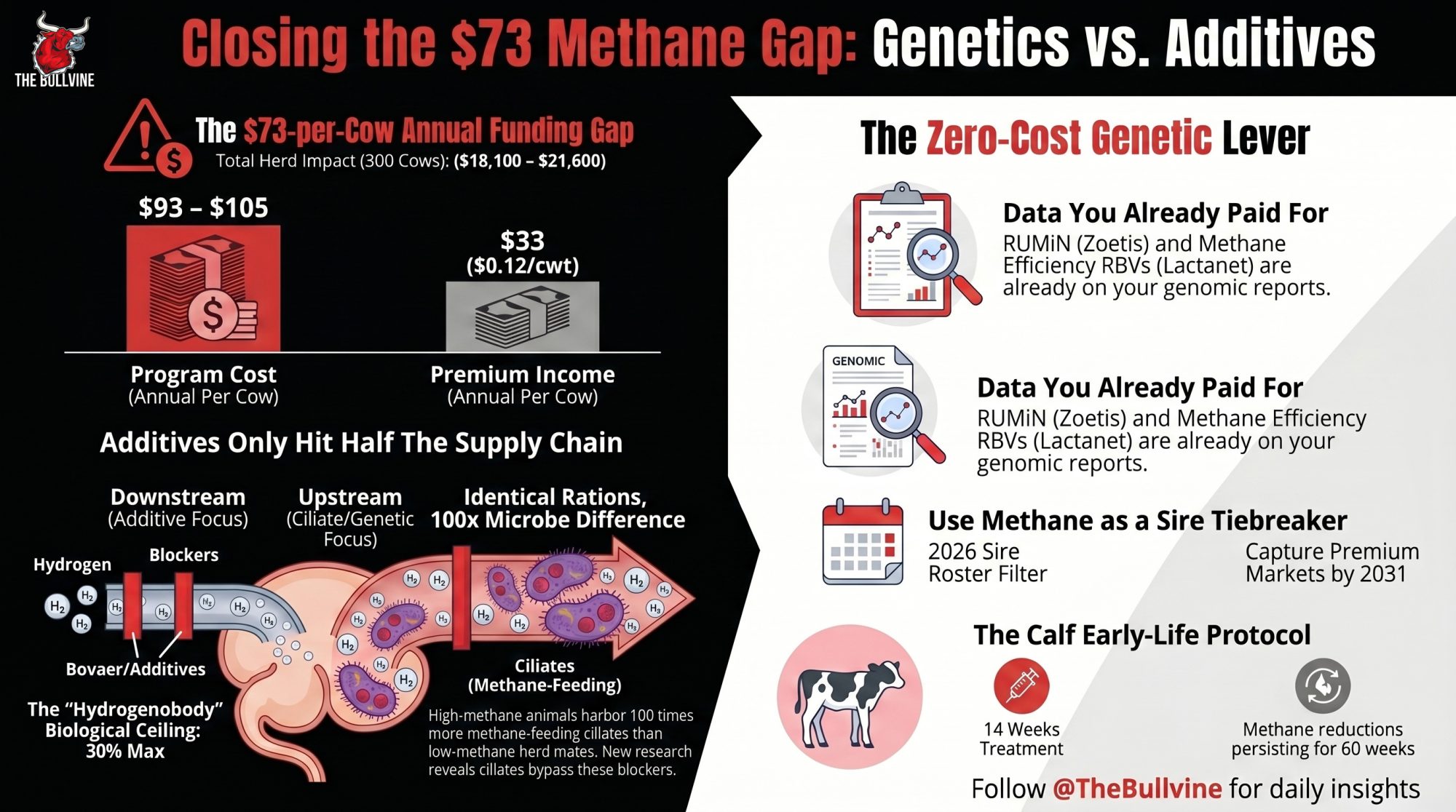
Executive Summary: Bovaer caps near 28–30% methane reduction because the April 30, 2026 Science paper just mapped a second hydrogen supply — the ciliate hydrogenobody — that 3-NOP can’t reach. On a 300-cow herd at 75 lbs/day, Bovaer runs $93–$105 per cow per year while a $0.12/cwt sustainability premium pays back only about $33, leaving a $40–$73 per cow per year gap that carbon credits or insetting have to fill. Sheep on identical rations produced 100 times more Dasytricha ciliates in high-methane animals than low-methane ones — same bunk, same feed, two orders of magnitude apart — which is why adding more additive won’t close the ceiling. The zero-cost lever is already sitting on the genomic reports you paid for: Zoetis dropped RUMiN into the April 2026 DWP$ update, and Lactanet has published Methane Efficiency RBVs on every Holstein female in eDHI since April 2023. Two 30-day moves earn their place before Monday — pull a recent CLARIFIDE Plus or Lactanet report and check whether methane traits ever broke a sire-selection tie, and if Bovaer’s already on farm, talk to your calf manager about adding it to the milk replacer for next-born heifers. Producers who filter sires on methane genetics in 2026 will be selling that genetic trajectory into a premium market by 2031–2032; producers who wait will be buying it back at markup. The full herd-size-tiered math and the two contract questions worth asking before 2027 renewal live in the next Bullvine Weekly.
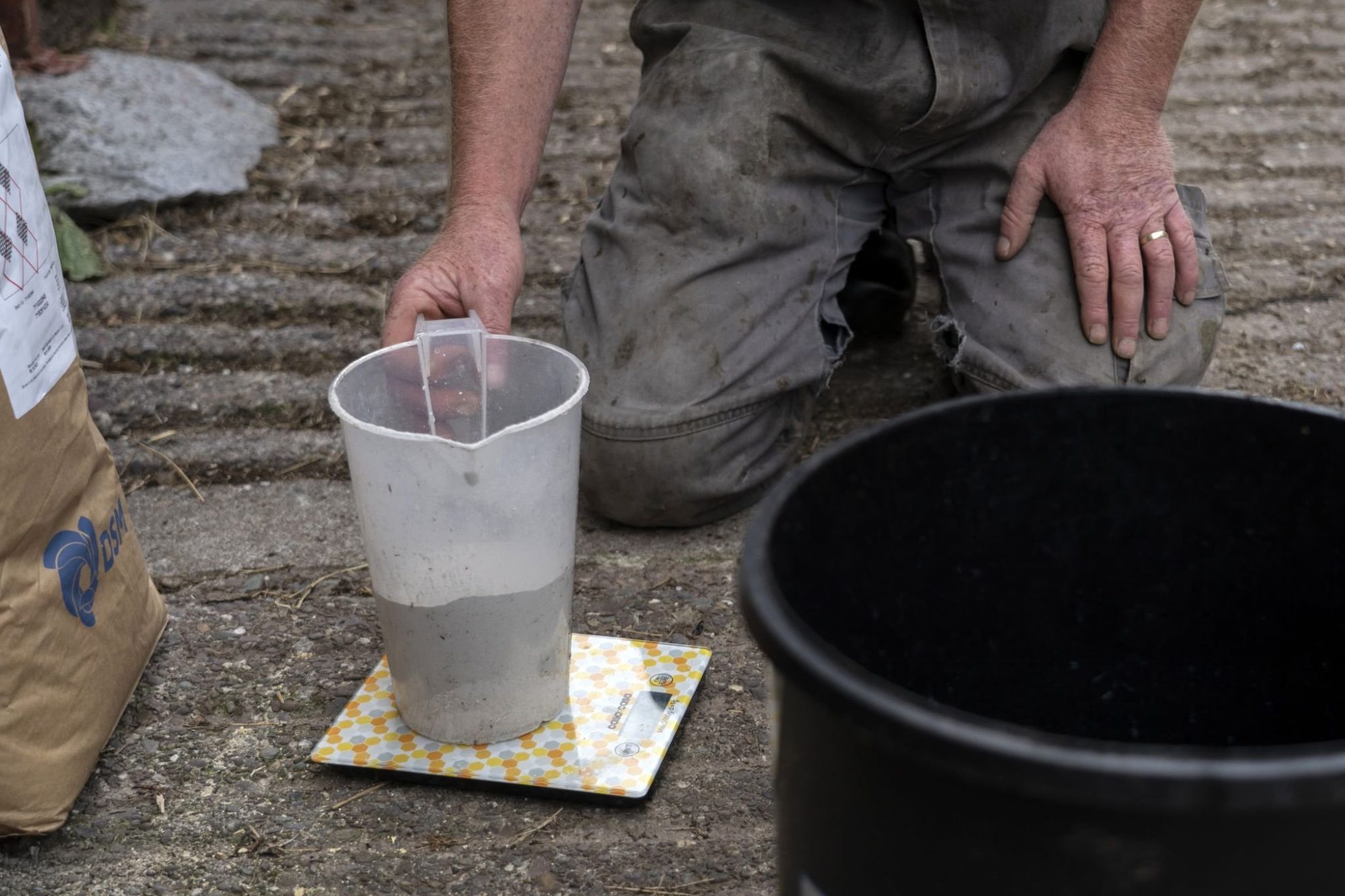
Run the numbers on a typical 300-cow herd shipping to a DFA-member plant at 75 lbs/day, on a contract up for renewal in 2027, collecting a $0.12/cwt sustainability premium. Eighteen months into a Bovaer (3-NOP) program, the methane reduction holds steady at 28%. The additive is doing what the label promised. But Bovaer has been reported in trade coverage at roughly $93–$105 per cow per year, while that $0.12/cwt premium on 75 lbs/day works out to only about $33 per cow per year — and Elanco has publicly projected carbon market returns in the range of $20 per cow per year on top of the premium, which still leaves a gap of $40–$73 per cow per year. The April 30, 2026 paper in Science just explained why closing that gap with more additive isn’t the play.
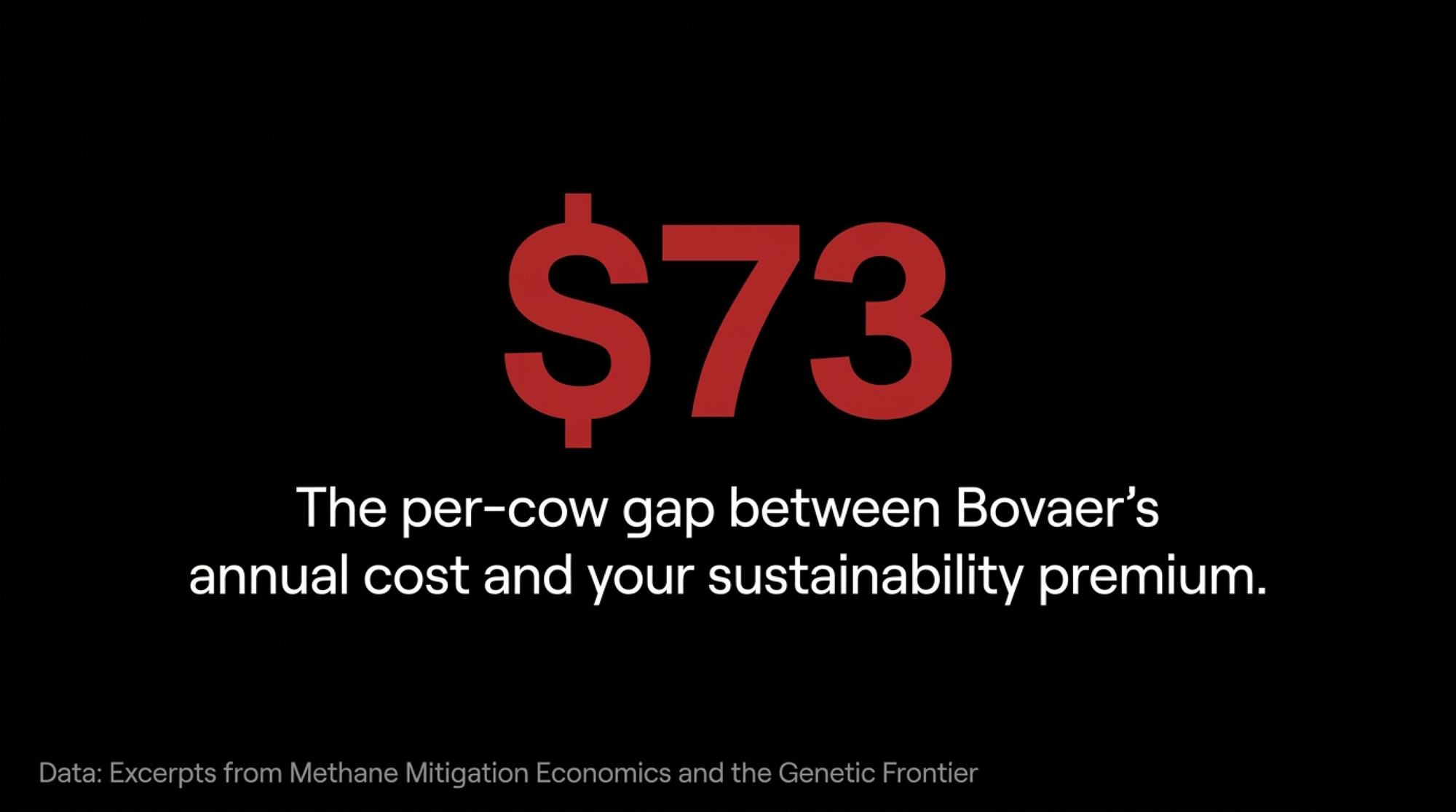
The gap closes fastest where a producer holds insetting access (defined below) or OFCAF cost-share. It widens fastest if carbon market revenue doesn’t materialize at renewal. That’s the variance band every 2027 conversation is running through right now.
The 30% Ceiling: Why the Rumen Resists Methanogen-Only Additives
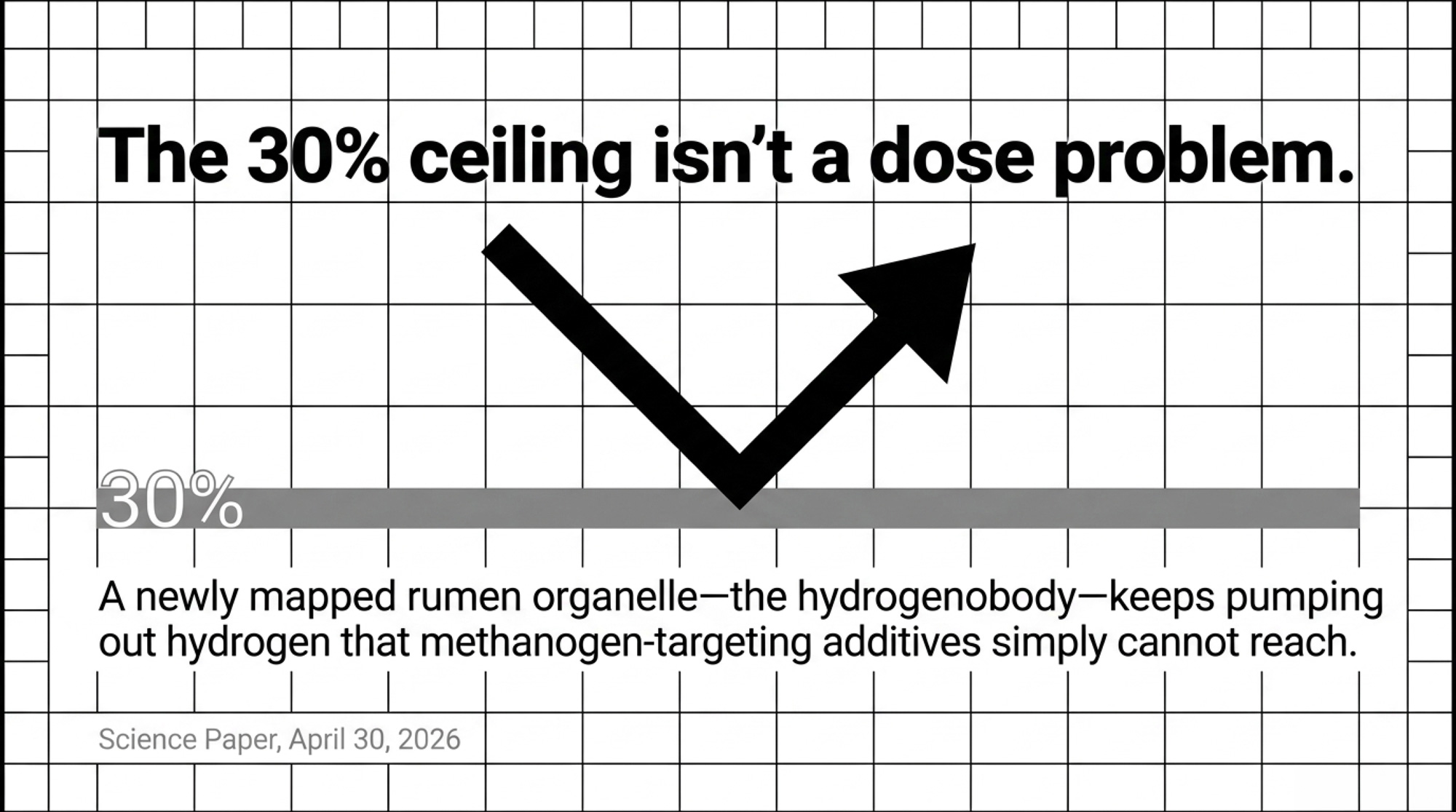
Researchers at the Chinese Academy of Sciences assembled the most comprehensive rumen ciliate genome catalog ever produced — 450 genomes across cattle, sheep, goats, and deer. Inside those single-celled microbes, they found a tiny organelle nobody had described before. They named it the hydrogenobody. It does two jobs: produces hydrogen,
and scrubs oxygen from its immediate environment.
Those two jobs together build a near-perfect environment for the methanogens that convert hydrogen into methane. That’s the causal link the April paper nailed down. Bovaer blocks the downstream methanogens — but the hydrogenobody sitting one step upstream keeps pumping hydrogen the additive can’t reach. Your 28–30% reduction isn’t a dose problem. It’s the practical ceiling of a mechanism targeting only the downstream half of a two-part hydrogen supply chain.
The sheep data is where this lands hard. Animals fed identical rations — same feed, same management — but producing high methane had nearly 100 times more Dasytricha ciliates (a high-hydrogenobody genus) than low-methane sheep. Two animals. Same bunk. Same ration. Two orders of magnitude difference in the microbes most responsible for feeding the methane machine.
How This Shows Up in Real Herds
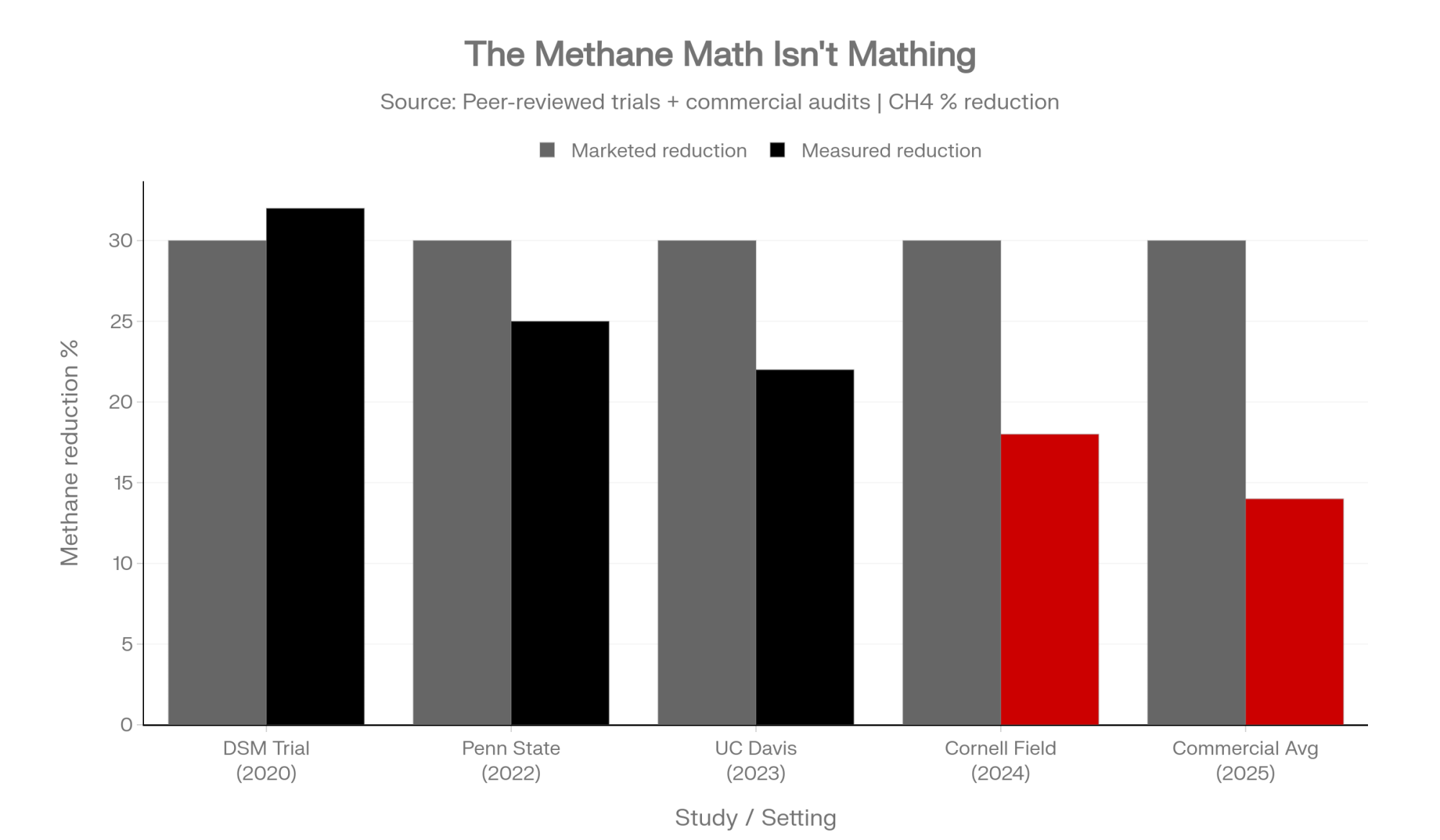
A Canadian producer 18 months into Bovaer watches the methane number hold steady near 28%. A US producer running the same program notices the reduction shrinks when forage composition shifts — consistent with the Dutch year-long trial’s finding that ration changes produced the biggest swings in the number. Both are experiencing the same biology: elevated rumen hydrogen partial pressure from methanogens being partially suppressed, while ciliates keep producing H₂ at the cell surface. Elanco has publicly maintained that Bovaer delivers consistent reductions under commercial conditions across validated trials, and within-mechanism that record is real. What the April paper raises is about the mechanism’s scope, not its integrity.
Penn State measured 3-NOP cutting methane 31% while simultaneously raising free rumen hydrogen from undetectable to 1.33 g/day. The Dutch year-long dairy trial found efficacy of 21–27% across a full lactation. Different herds. Different seasons. Same shape of result.
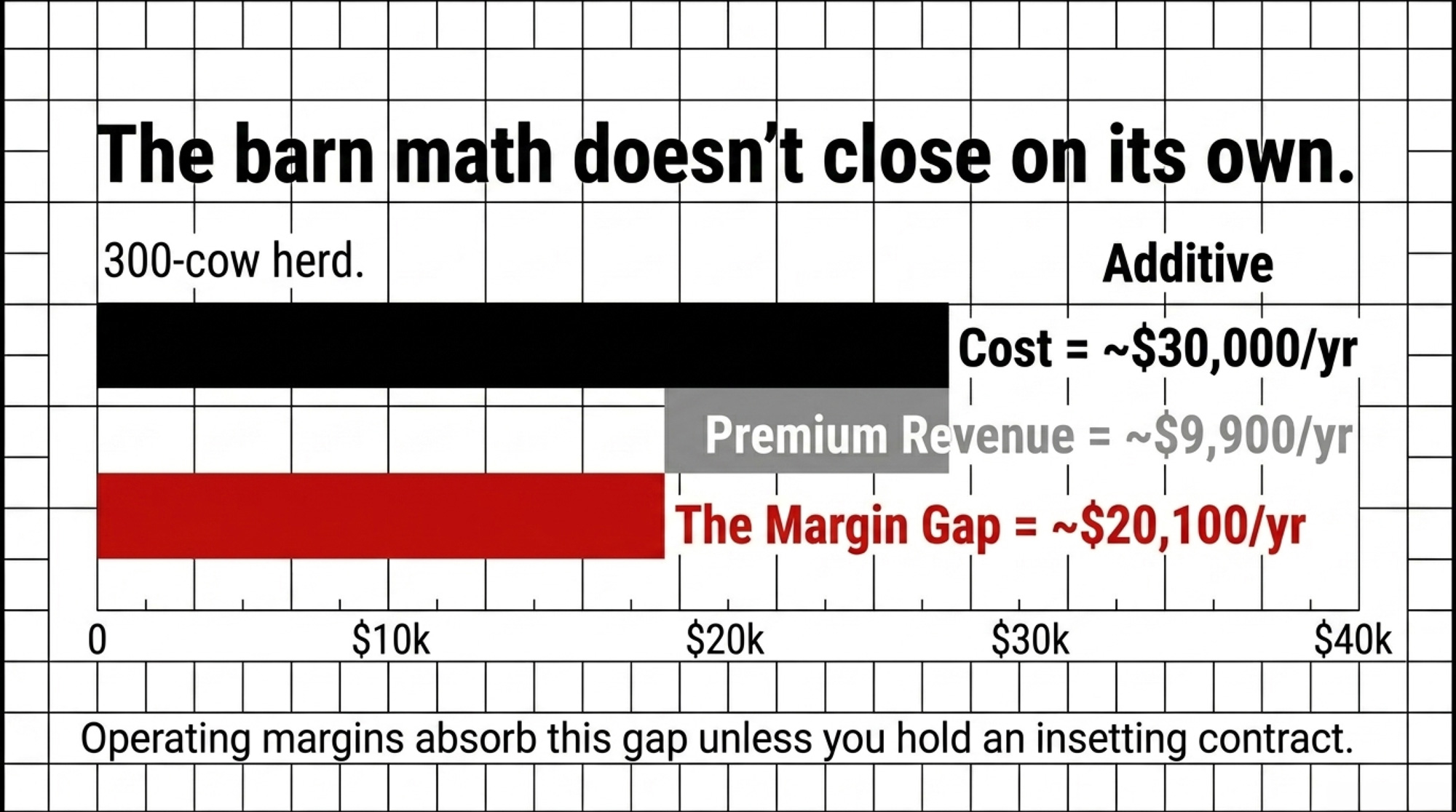
The barn math. On a 300-cow herd, Bovaer costs roughly $28,000–$31,500 per year in additive bills. That same herd earns about $9,900 per year from a $0.12/cwt premium on 75 lbs/day. The gap between cost and current premium revenue lands at $18,000–$21,500 per year that has to come from somewhere. Carbon credits. Cost-share. An insetting arrangement. Or your operating margin absorbing it as audit insurance.
| Contract Line Item | Marketed Value | Realized Value (Yr 1) | Gap |
| Sustainability premium | $1.25/cwt | $0.92/cwt | –$0.33 |
| Bovaer feed cost (DSM pricing) | “offset by premium” | $0.18/cow/day | +$65.70/yr |
| Methane verification fee | Not disclosed | $12/cow/yr | +$12.00 |
| Labor/TMR mixing compliance | “minimal” | 0.4 hr/day/100 cows | +$18/cow/yr |
| Exit penalty (early termination) | “standard” | 24-month clawback | Locked in |
| Net margin impact | +$47/cow | –$26/cow | –$73/cow |
Plug your own numbers in. Your herd size times about per cow per year lands you inside the variance band — closer to the low end if you hold an insetting contract, closer to the high end if you don’t. If that number is larger than you’re comfortable carrying into 2027 renegotiation, the four-lever choice below starts to matter.
| Contract Clause | Typical Language | Hidden Risk | Negotiation Ask |
| Premium duration | “for the term of agreement” | Reviewable annually by processor | Lock floor at $0.75/cwt for 36 months |
| Dosing compliance | “per manufacturer protocol” | Audit failure = full clawback | Cap clawback at 6 months |
| Data ownership | “processor retains herd data” | Sold to CPG brands without share | 25% royalty on secondary data use |
| Methane floor | “minimum 25% reduction” | Below-threshold = unpaid | Tiered payment, no zero-out |
| Termination | “24-month notice required” | Blocks competing contracts | 90-day exit with cause |
What’s Actually Happening in the Rumen
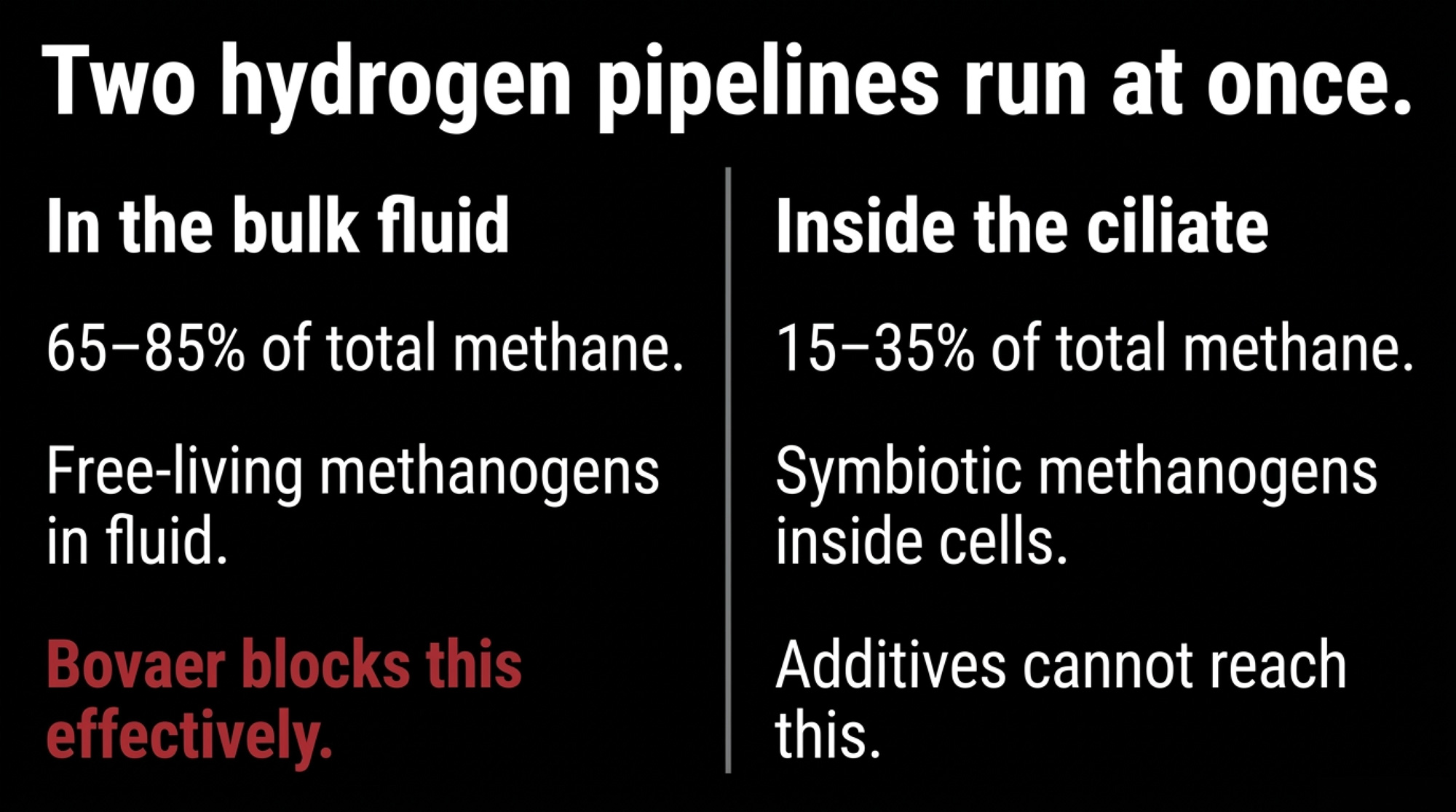
Two hydrogen pipelines run at the same time. Free-living methanogens in the bulk rumen fluid consume roughly 65–85% of total methane production. That’s where Bovaer operates — circulating in fluid, reaching those free-living archaea, blocking the enzyme that makes methane. That’s the real reduction you’re paying for.
But the other 15–35% of methane comes from methanogens that live directly on and inside ciliate cells as symbiotic partners, fed hydrogen at cell-surface proximity by the hydrogenobody organelles. That exchange happens in nanometres, not metres. An additive moving through rumen fluid has a much harder time reaching those methanogens at meaningful concentration — the hydrogen never enters the bulk fluid in the first place.
That upstream gap is why Asparagopsis seaweed routinely hits 80–99% in controlled trials, and why compounds that suppress ciliates directly — certain tannins, saponins, lingonberry-derived extracts — tend to produce more durable results than their mechanism descriptions suggest. They’re hitting the supply, not just the consumer. Worth noting: ambient dietary tannins from alfalfa-heavy rations or byproduct loads don’t reach the therapeutic threshold, so “I already feed high-tannin forage” doesn’t substitute for a targeted blend.
The concerning part for producers 18 months in: recent metagenomics work has documented measurable shifts in the rumen protozoal community under sustained Bovaer dosing, with incomplete reversal after withdrawal. What that work doesn’t answer — and what you should be asking — is whether those community changes affect the size or stability of the methane reduction over time. The long-term efficacy question stays open.
How Much Does Waiting 30 Days Actually Cost?
For the tannin-saponin layer, waiting 30 days costs effectively nothing. The protocols and contract structures aren’t ready to pay for it yet. Verra’s VM0041 methodology — the dominant global protocol for enteric methane feed additive credits — currently covers methanogen inhibition. The ciliate module Viresco Solutions submitted in 2024 was placed on hold December 19, 2024, and the public registry entry does not specify criteria required for it to advance. Stacking a ciliate mechanism onto your current credit path isn’t an option today.
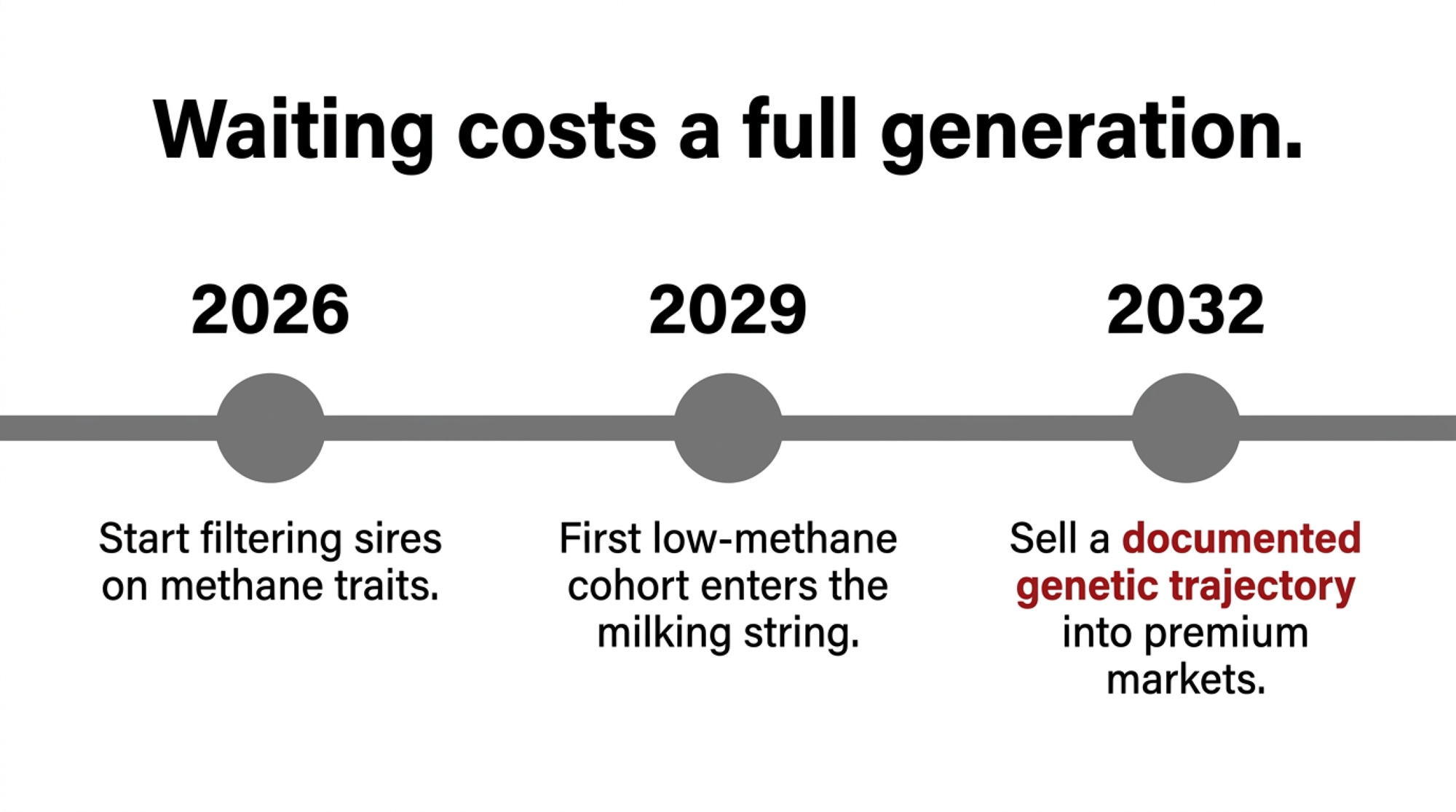
Waiting on the genetic lever costs you a heifer cohort and a breeding cycle. Those compound. Every breeding season you delay adding RUMiN or Methane Efficiency RBV to your sire filter is a generation interval you hand to a competitor who moved first. Danone has publicly stated that genomic testing plays an important role in its global methane reduction strategy. That signals where methane traits may factor into supplier programs over time. Zoetis integrated RUMiN into the April 2026 Dairy Wellness Profit Index update, with company materials indicating that RUMiN-informed sire selection is expected to reduce lifetime methane intensity in daughter cohorts. When methane EBVs get priced into semen premiums — and the trajectory suggests that’s where 2029–2030 is heading — producers who started filtering in 2026 will be the ones selling genetics the late movers pay premium to access.
| Value Chain Player | Revenue/Cow/Yr | Cost/Risk Borne | Net Margin/Cow |
| Dairy farmer | $95 | $88 (feed + labor + risk) | $7 |
| Milk processor | $142 | $38 (logistics + admin) | $104 |
| CPG brand (Danone, Nestlé) | $210 | $45 (marketing + audit) | $165 |
| Carbon credit aggregator | $68 | $14 (verification) | $54 |
| Value capture ratio | — | — | Farmer = 2.4% |
Is Your Herd’s Genetic Strategy Already Behind?
Pull a recent Zoetis CLARIFIDE Plus report or a Lactanet genomic summary on any heifer tested in the last six months. If you can’t immediately find the RUMiN value (Zoetis) or the Methane Efficiency RBV (Lactanet, published on every Holstein female in eDHI herds since April 2023), you’re not using data already in your mailbox.
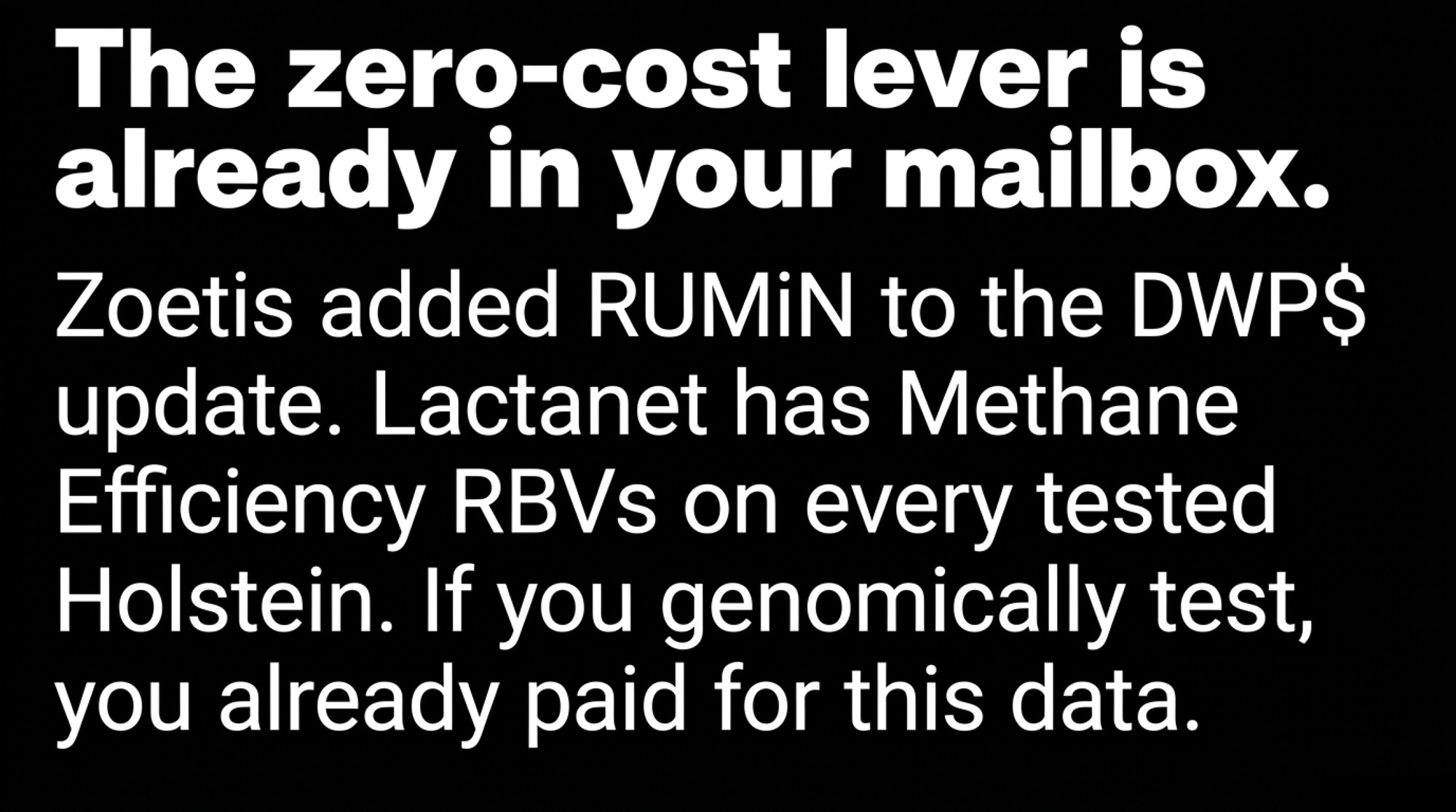
Most selection indexes already weight methane traits implicitly through composites like Feed Efficiency or the Environmental Index inside LPI. That’s a reasonable starting point. When your processor or export buyer shifts toward outcome-based carbon verification in 2028–2030, the herds with a documented genetic trajectory — methane-filtered sires used consistently since 2026, with the genomic records to prove it — walk into that conversation with a structural story competitors can’t replicate on short notice.
Reliability on Lactanet’s methane genomic EBV for young genotyped bulls now exceeds 70%. The genetic correlation between MIR-predicted methane (the kind your eDHI milk sample is already generating) and directly measured methane is 0.85. You’re not selecting on noise. You’re selecting on data flowing through a pipeline that’s already running.
Options and Trade-Offs: The Four-Lever Comparison
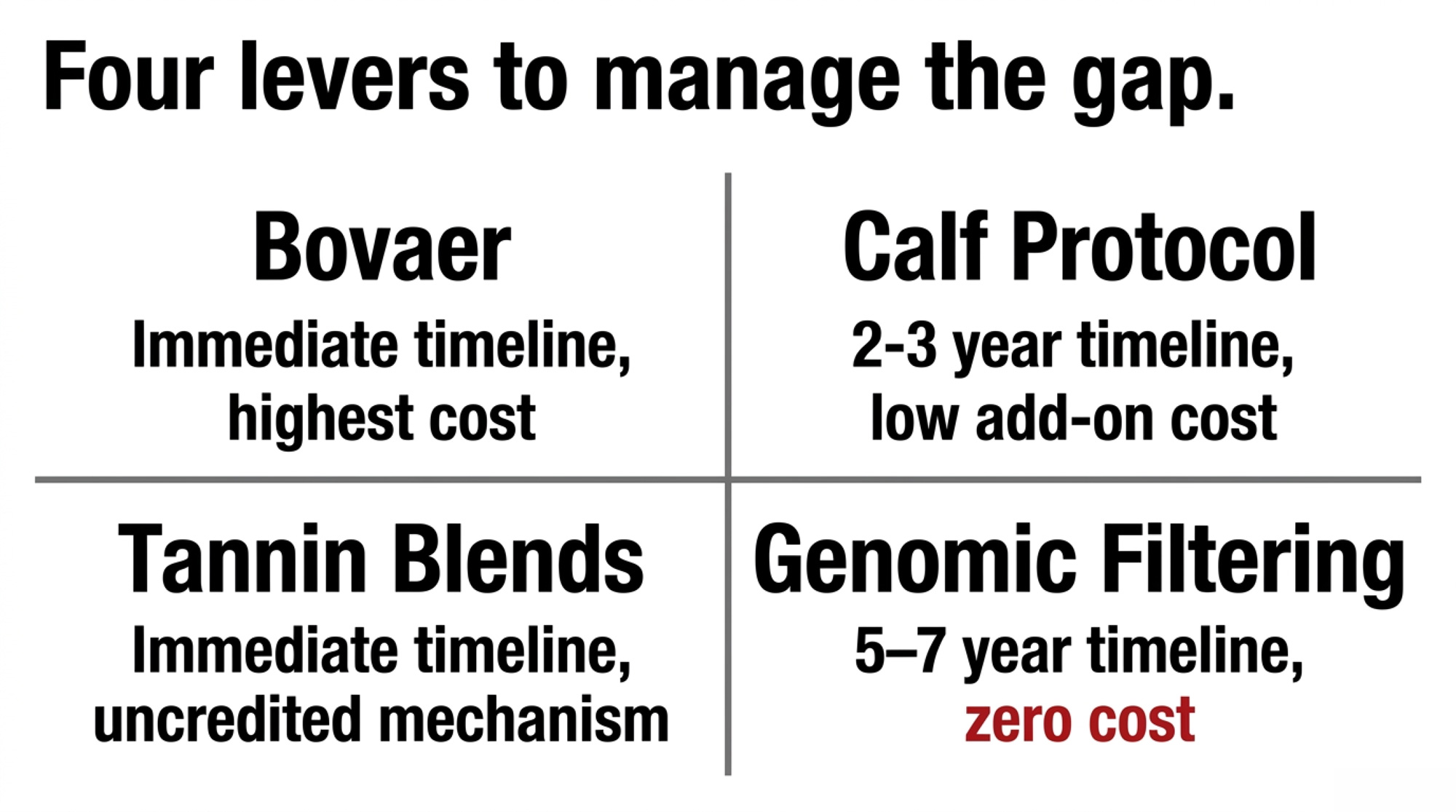
Four levers address different parts of the methane puzzle at different time horizons and cost points. Most producers shouldn’t run all four right now. Pick the combination that matches where your contract and your breeding program sit today.
A quick note on “insetting.” Unlike open-market carbon credits, an insetting arrangement keeps the reduction inside the processor’s own supply chain — it counts toward their Scope 3 footprint rather than being sold to an outside buyer. In an insetting model, your methane numbers feed your processor’s sustainability report. In an open-market model, you can sell the credit independently. The economics of your 2027 contract hinge on which model your processor runs.
| Strategy | Cost (Est.) | Methane Impact | Timeline | Key Trigger |
| Bovaer (3-NOP) | $93–$105/cow/year | 21–31% (practical ceiling) | Immediate | 2027 contract renewal |
| Calf Early-Life Protocol | Low marginal add if Bovaer already on farm | Persistent reduction to 60 weeks of age from 14-week treatment | 2–3 years to milking string | Next calving season |
| Tannin/Saponin Blend | $0.10–$0.18/cow/day | Supplemental (ciliate-targeting, no DMI penalty) | Immediate | $0.18/cwt dual-mechanism tier, OFCAF access, or VM0041 ciliate module restart |
| Genomic Sire Filtering | $0 incremental if testing | Cumulative, heritable | 5–7 years to herd-level expression | This breeding season |
Continue Bovaer. Protocol-compliant under VM0041, registry-creditable today, defensible in a 2027 renegotiation. The net margin is thin at current premium levels, but it isn’t negative if you already hold a sustainability contract. Risk: the 28–30% reduction is the mechanism’s practical ceiling on this lever alone.
Add a tannin-saponin blend — but not yet. The 2025 J. Dairy Science trial on Silvafeed BX confirmed methane reduction without penalty to ECM, fat yield, protein yield, or DMI. The mechanism is real. But the economics don’t close in 2026 — commercial blends scaled from published beef cattle trial pricing land roughly $0.10–$0.18/cow/day on dairy DMI, and current protocols don’t credit the ciliate mechanism separately. Hold this layer until one of three triggers fires.
Start a calf early-life protocol within 30 days. Pre-weaning rumen microbiome colonisation shapes a substantial share of the adult animal’s rumen community, with published estimates clustering in the 60–70% range depending on methodology. A 2021 trial found 3-NOP given to calves in the first 14 weeks produced methane reductions persisting to 60 weeks of age — long after treatment ended. If Bovaer is already on farm, the marginal cost of adding it to the milk replacer program for next-born calves is low. Those calves enter the milking string in 2028–2029, right when outcome-based verification standards are projected to tighten.
Filter your sire roster on methane genetics — zero incremental cost. You’re not buying a new test. Lactanet publishes Methane Efficiency RBVs on every Holstein female in eDHI. Zoetis added RUMiN and Milk Methane Intensity (Z_MI) to every CLARIFIDE Plus report in April 2026. The trade-off: herd-level expression takes 5–7 years. A 2026 sire selection change shows up meaningfully in your herd’s methane number around 2031–2032.
The combination that closes both the near-term audit need and the long-term biological asset without absorbing an extra – per cow per year in negative margin: Bovaer + calf protocol + RUMiN sire filtering. Hold the tannin-saponin layer for the 2028 trigger.
Key Takeaways
- If your net return on Bovaer is under $20/cow/year after premium, check whether your processor runs an insetting program (DFA, Danone, select others) or whether OFCAF cost-share applies in your region. Ask both questions before the 2027 renewal conversation — that’s where the economics turn positive or don’t.
- If your Bovaer program has held at 28–30% for 18 months, monitor rumination time and component tests as leading indicators of rumen ecology shifting under sustained dosing. Neither shows up on a methane reduction number until the shift has already compounded.
- If you’re genomically testing replacement heifers, the RUMiN and Methane Efficiency RBV data is already on the report you paid for. Start using it as a sire tiebreaker within your current economic index this breeding season.
- If Bovaer is already on farm, talk to your veterinarian and calf manager this month about adding it to the milk replacer protocol for next-born calves. The 2029 heifer cohort is the one that carries this forward.
Where Does Your Operation Actually Sit?
The producers who’ll be selling low-methane genetics into a premium market in 2032 aren’t the ones currently spending the most on additives. They’re the ones who recognized in 2026 that the biology had changed category — from a compliance cost to a heritable asset — and adjusted their sire roster while everyone else was still optimizing additive spend. The April 2026 hydrogenobody paper made that shift explicit. The response window is now, not when methane EBVs get priced into semen premiums.
So where does your operation actually sit on that line? Pull your last genomic report before Monday. Check whether your methane trait values were ever used in a selection decision. If the answer is no, you’ve just identified the highest-leverage, lowest-cost change you can make this month. The full herd-size-tiered math — including the two contract questions worth asking your processor rep before 2027 renewal — runs in the next Bullvine Weekly.

Complete references and supporting documentation are available upon request by contacting the editorial team at editor@thebullvine.com.
Learn More
- 400 of 1,600 Danish Farms Report Bovaer‑Linked Health Issues: EFSA’s 2026 Review and the 3 Methane‑Contract Clauses to Read Twice — Arms you with critical contract safeguards and health-monitoring protocols after 25% of early adopters reported crashed milk yields and intake issues, ensuring your sustainability transition doesn’t sacrifice cow welfare or your bottom line.
- THE METHANE MISDIRECTION: Why The Industry’s Obsession with Feed Additives Is Costing You Money While Genetics Offers the Real Solution — Reveals why chasing additive-only compliance is a $100/cow mistake and dismantles the “quick fix” narrative by proving that long-term genetic selection delivers a permanent 20% reduction without the recurring annual subscription fee.
- Stop Throwing Away $48,000 Per Year: How Smart Dairy Operators Are Turning Cow Burps into Cold Hard Cash — Delivers the hard math on the Athian marketplace, following the money for progressive 1,000-cow operations that are already liquidating methane reductions into five-figure revenue streams before any processor premiums even land.
 The Sunday Read Dairy Professionals Don’t Skip.
 The Sunday Read Dairy Professionals Don’t Skip.
Every week, thousands of producers, breeders, and industry insiders open Bullvine Weekly for genetics insights, market shifts, and profit strategies they won’t find anywhere else. One email. Five minutes. Smarter decisions all week.