






The judge’s first glance in September is shaped by decisions you made eight months earlier at 2 a.m. — and the research on why that’s true keeps getting harder to argue with.
Picture the walk-in at your county show next September. The judge takes three seconds per heifer on that first pass — silhouette, topline, the way she moves off the halter. By the time the ribbons get handed out, the class was basically decided long before anyone touched a clipper. It was decided in a maternity pen at 2 a.m. the previous January, when somebody either got up to catch that calf or didn’t.
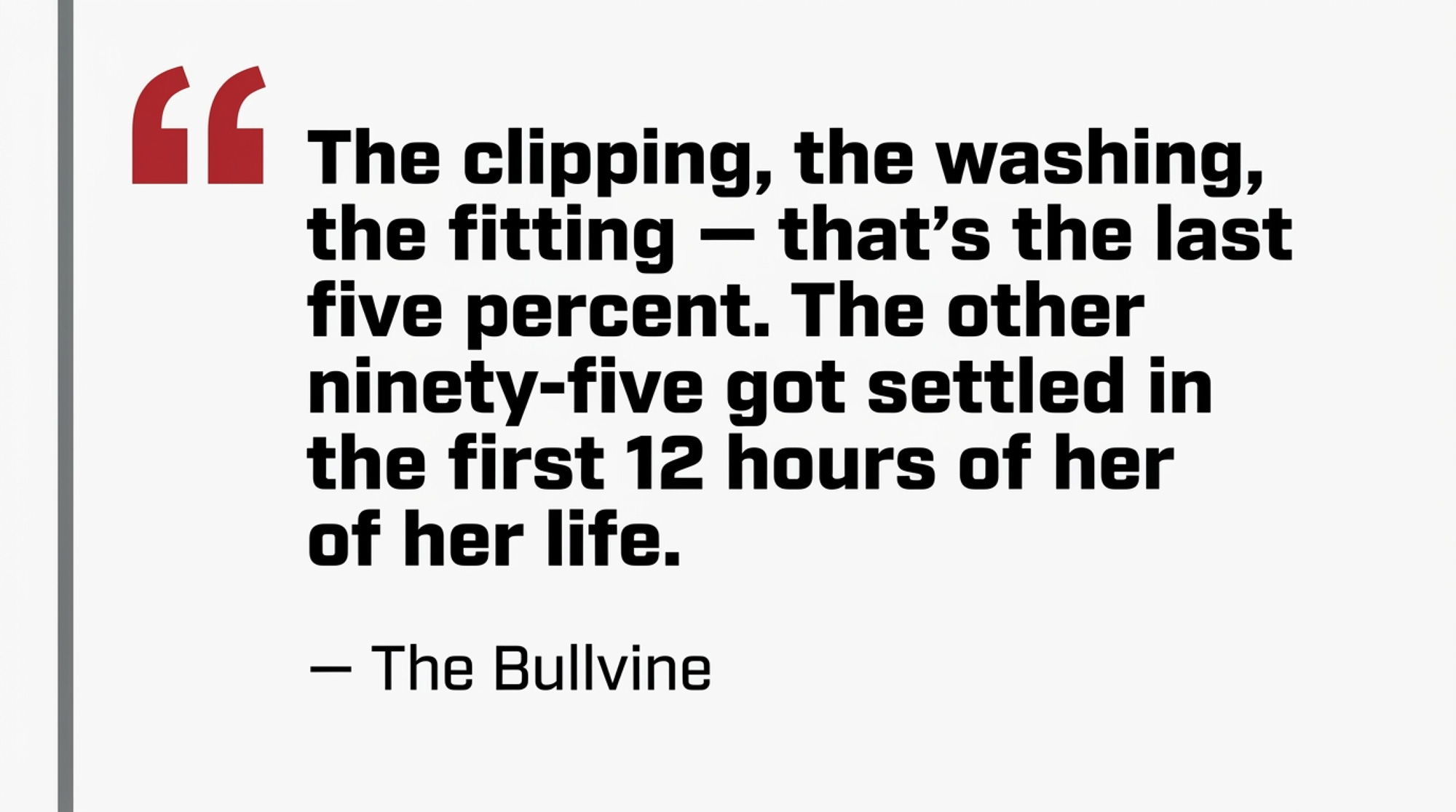
That’s the part nobody puts on a show poster. The clipping, the washing, the fitting — that’s the last five percent. The other ninety-five got settled in the first 12 hours of her life. Most show people know this is true. Running a real show heifer development program like you actually believe it is a whole different thing.
What’s Really at Stake Here
A show heifer is an athlete. Like any athlete, her ceiling gets set early. Miss a step in the first few weeks and you don’t just fall a little behind — you cap how good she can ever be. By the time she walks into the ring as a yearling, the work you did before she was a week old is what the judge is actually grading.
The people winning consistently on the 2026 circuit aren’t doing anything magical. They’re running a Brix refractometer on their colostrum. They’re weighing and measuring their heifers every month against a written target. They’re paying attention to what genomic tests say about how much feed each calf actually needs. They treat the whole thing — maternity pen through show day — as one connected system. Not a string of tricks they pull out the week before fair.
One simple trick before we go further: walk your heifers in the morning before they’ve eaten, then walk them again that evening after full feed. That silhouette should change. If it doesn’t, something’s off. We’ll come back to why.
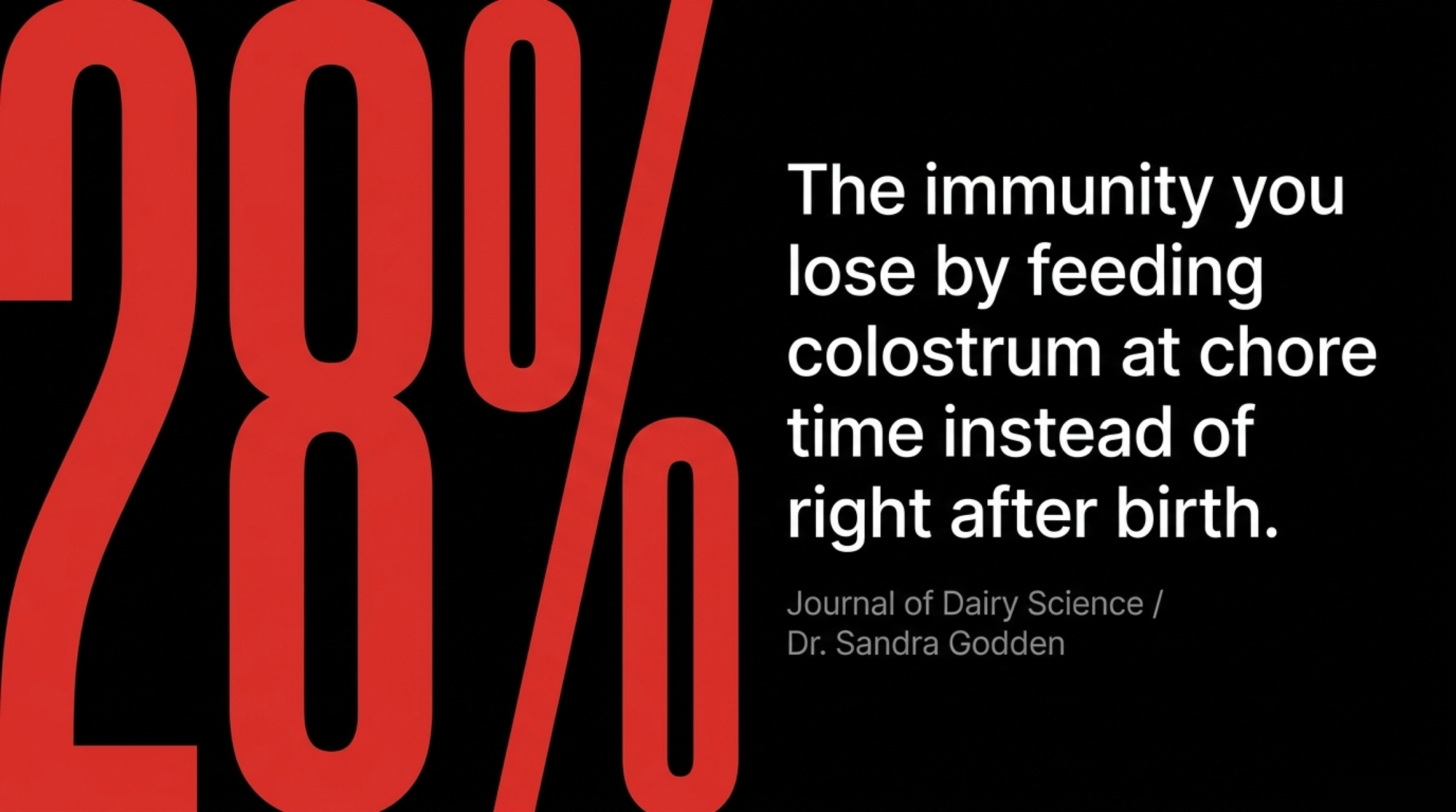
Why Does Waiting Six Hours Cost You 28% of Her Immunity?
Here’s the single most important thing a young showman can learn about calf care. Colostrum isn’t just “the first milk.” It’s a time-sensitive protection package — and the decay clock isn’t about the colostrum itself going bad in the bottle. The colostrum in the pitcher stays full of antibodies all morning. What collapses is her ability to absorb them.
That’s worth reading twice. The 28% loss is an absorption efficiency loss, not a quality loss. The calf is born with specialized cells in her small intestine that pull whole IgG antibodies out of colostrum and ship them into her bloodstream intact. Those cells close — gradually at first, then fast — over the first 24 hours of life. Feed her at two hours and those gates are wide open. Feed her at six hours and they’re already partly shut. Same colostrum, same volume, different destination. The antibodies that don’t make it into her blood don’t protect her.
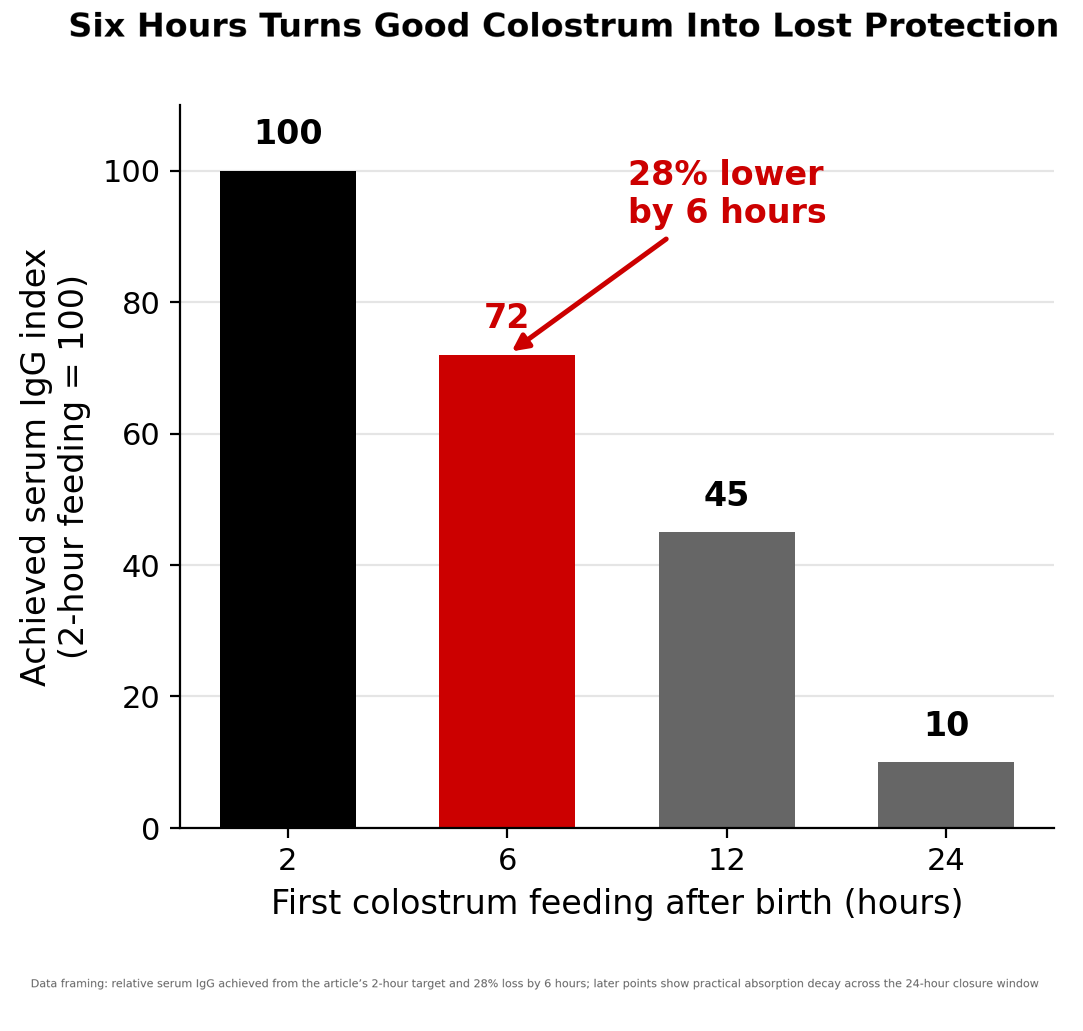
Research from Dr. Sandra Godden at the University of Minnesota and colleagues, synthesized in the Journal of Dairy Science colostrum management literature and echoed in Morrill’s published calf nutrition work, shows that missing the early window cuts achieved serum IgG by roughly a quarter to a third. Not cuts colostrum quality. Cuts what ends up in her blood, which is the only thing that actually matters for protecting her.
Think about that. A quarter of her disease protection — gone. Not because you fed bad colostrum. Because you fed it at chore time instead of right after she calved.
The target has moved, too. The old benchmark was 10 mg/mL of IgG in her blood — the minimum to keep her from getting sick. The current standard, set by the 2020 Lombard consensus paper in Journal of Dairy Science and adopted by the Dairy Calf and Heifer Association, pushes way higher: you want at least 40% of your calves hitting 25 g/L or better, and fewer than 10% coming in below 10 g/L. Calves in that top “excellent” range get sick less and die less than calves in the merely “okay” range. For a show heifer, getting sick as a baby means growth stalls you can never get back. You build frame once, or you don’t.
The Colostrum Decision Table
| Metric | “Excellent” Target | “Fair / Poor” — Action Required |
| Colostrum quality (Brix) | > 22% (roughly ≥ 50 g/L IgG) | < 22% — pull from freezer bank or use replacer |
| Serum IgG (calf blood, 24–48 hrs old) | > 25 g/L | < 10 g/L — failure of passive transfer |
| Feeding window from birth | Within 2 hours | After 6 hours — roughly 28% lower serum IgG achieved |
| Volume at first feeding | 4 L (or 10% of body weight) | Less than 3 L — under-dosed |
| Second feeding | 2 L by 12 hours | Skipped — missed top-up absorption |
Pro tip — Tube vs. bottle, and why it’s not close. A slow bottle feeder can burn an hour of your peak absorption window. Research summarized by the DCHA and university extension guidance consistently shows that tubing 4 liters immediately is often superior to waiting for a “slow starter” to nurse it, because tubing guarantees the volume hits the gut during the 0–2 hour peak absorption window. You can always bottle-feed her the next meal once she’s built protection. You can’t re-open the absorption gates once they’ve closed.
Want the full protocol? The Bullvine’s 4 golden rules of colostrum feeding goes deeper on the full protocol if you want to nerd out on it.
The Hay Belly Problem Nobody Explains Right
If you’ve ever heard a judge or a fitter complain that a heifer has “hay belly,” you’ve heard about a problem that starts with feed, not with looks. And it’s more interesting than most people realize.
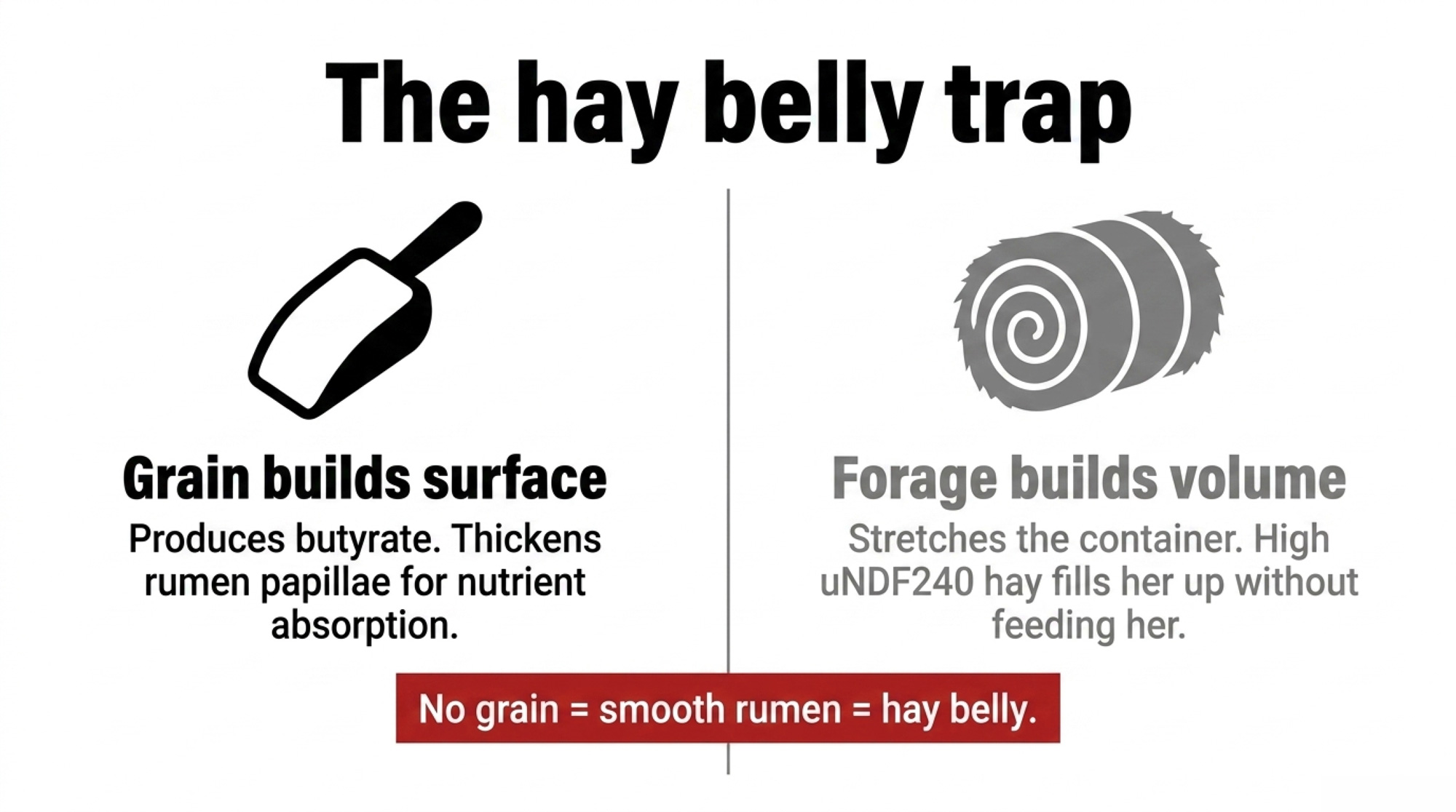
Her rumen — that big first stomach — has to grow in two ways at once. Picture the inside wall covered in thousands of tiny fingers called papillae, each one reaching into the rumen fluid to grab volatile fatty acids and pull them into her bloodstream. Grain fermentation produces butyrate, and butyrate is what makes those fingers grow longer and thicker. Think of it as building shag carpet on the inside of the rumen — more surface area, more nutrient uptake. On a calf fed almost no grain, that wall stays smooth and pale, like bathroom tile. Lots of room for feed. Almost no ability to absorb it.
Meanwhile, the rumen also needs muscular wall and volume, and that comes from forage stretching it out. So grain builds the absorption surface. Forage builds the container. Neither one alone gets you there.
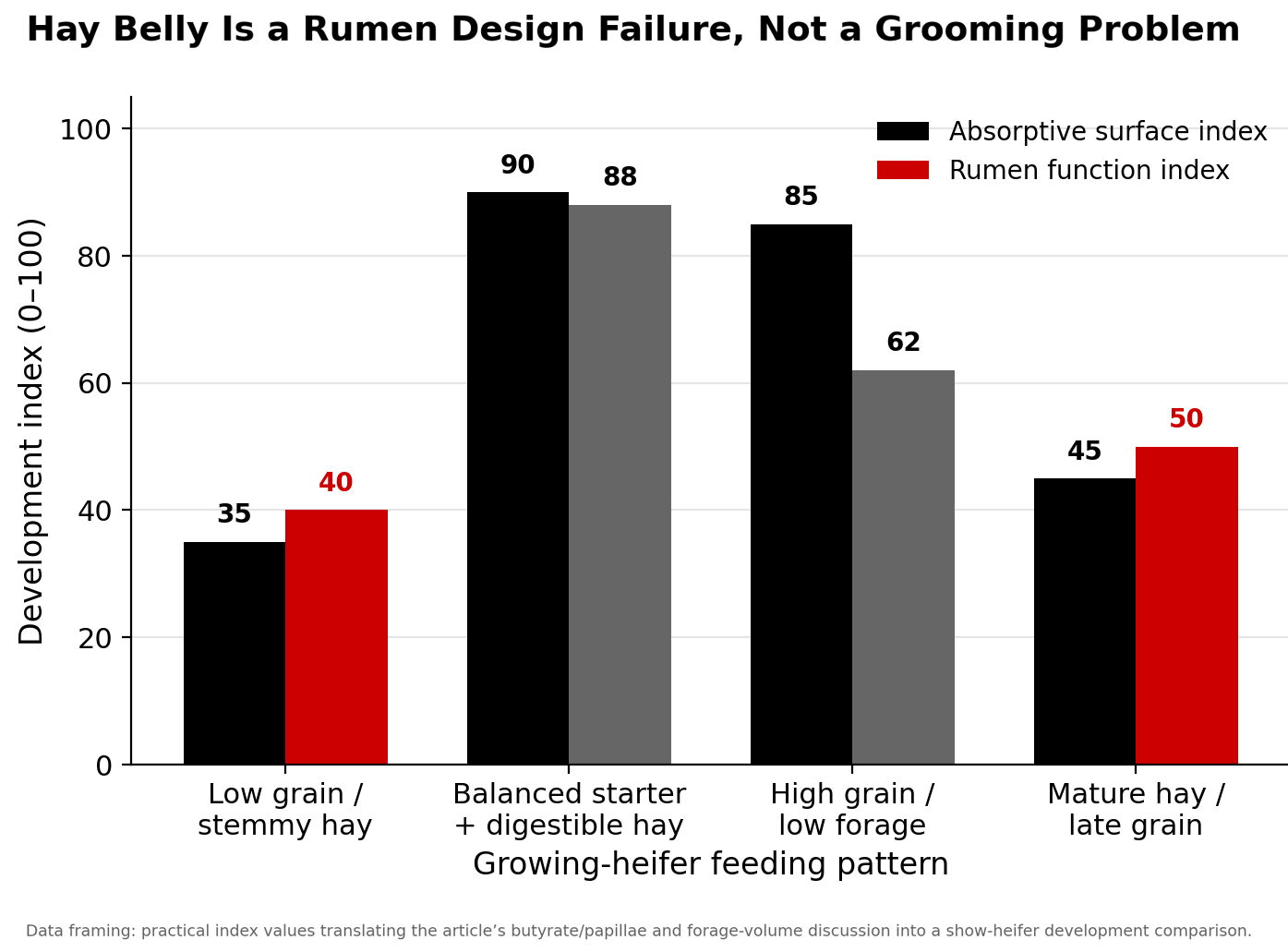
Here’s the trap. Cheap, mature, stemmy hay has a lot of what we call uNDF240 — indigestible fiber that just sits in the rumen for up to ten days without breaking down. It fills her up without feeding her. She stops eating grain because she’s already full. No grain means no butyrate means no papillae. Now you’ve got a heifer with a smooth-walled, oversized container hanging forward off her barrel instead of tucking up like a dairy cow should.
The Silhouette Test: Chronic Fill vs. Real Growth
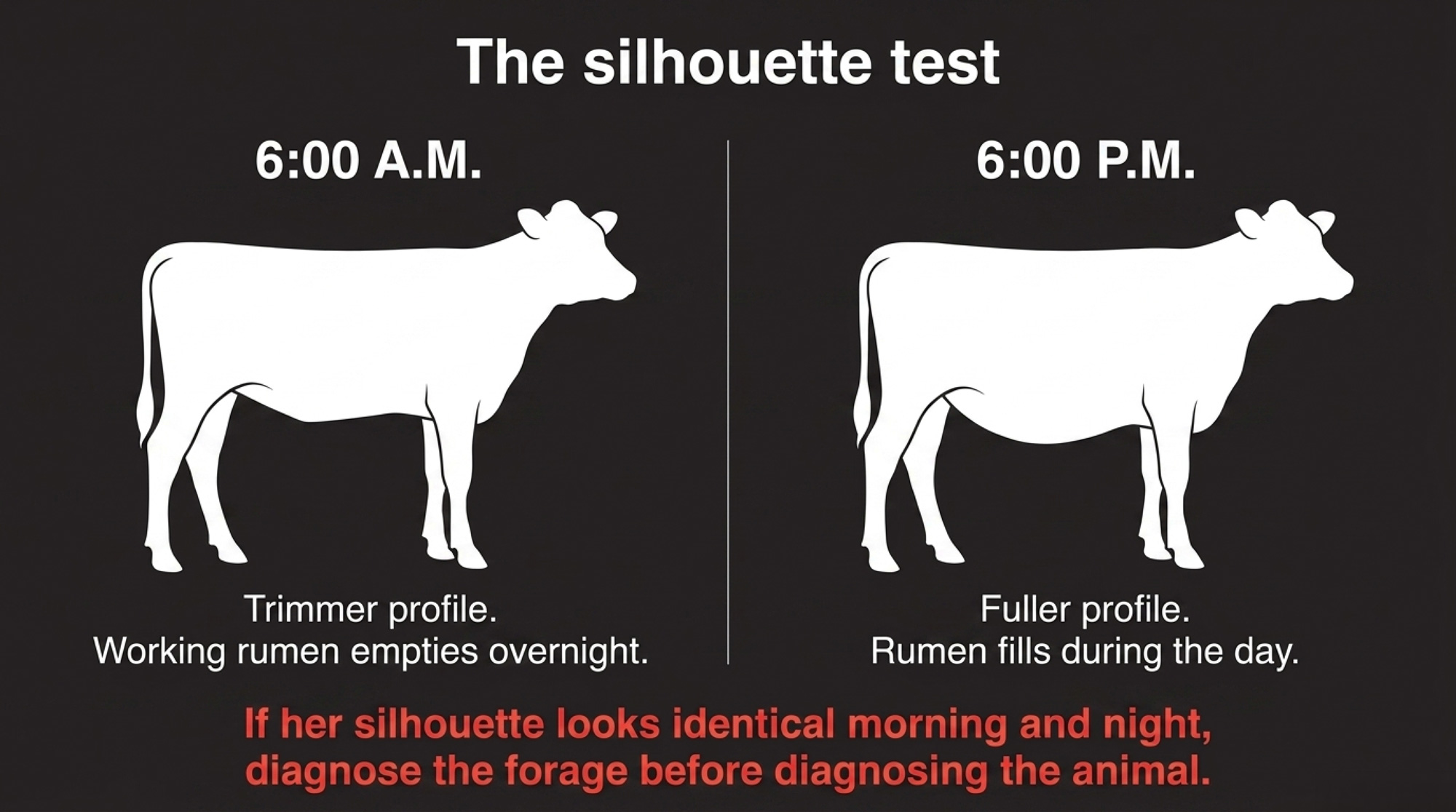
A real working rumen fills during the day and empties overnight. Morning: trimmer. Evening: fuller. Same animal, different silhouette. If your 6-month-old looks identical at 6 a.m. and 6 p.m., she’s got chronic fill, and the forage is the suspect.
Get a forage test, look at NDFD30 and uNDF240, and if the uNDF is high, find better hay. The silhouette test costs nothing and runs itself — if it’s failing, your grain program doesn’t stand a chance until you fix the forage. The Bullvine’s NASEM 2021 dairy nutrition guide has the full breakdown.
Why Do Jerseys Get Fat on Holstein Rations?
If you run both breeds, you already know Jerseys are easier keepers. The why goes deeper than most people think, and it changes how you feed them.
Holsteins hit early lactation with a much deeper tissue energy deficit than Jerseys — roughly double at nadir on a body-reserve-mobilization basis, per the Journal of Dairy Science comparative metabolism literature — because they’re pulling milk out of their body reserves. So a Holstein heifer needs to come into calving with some condition to draw on. A Jersey at the same body condition score is already over-conditioned for what she’s actually going to need. She got there on less feed, because she converts feed to milk solids more efficiently than a Holstein does on an ECM/DMI basis.
In a commercial herd, that efficiency is a win. In a show heifer program, it’s a trap. Feed your Jersey yearling the same ration as your Holstein yearling of the same age, and your Jersey gets fat while your Holstein stays right. Fat Jerseys mean mushy udders at freshening. Mushy udders at freshening mean a mammary score that kills her in the ring at two years old.
Breed-Specific Management Cheat Sheet
| Factor | Holstein | Jersey |
| Feed conversion efficiency (ECM/DMI) | Lower | Higher — gets same job done on less |
| Early-lactation tissue energy deficit | Deeper (roughly 2× at nadir) | Shallower |
| Over-conditioning risk on a shared ration | Lower | Higher — gets fat first |
| Clinical hypocalcemia rate | Lower | Measurably higher per JDS breed comparisons |
| Pre-calving anionic salt strategy | Standard DCAD | More aggressive DCAD, per Penn State / Wisconsin extension |
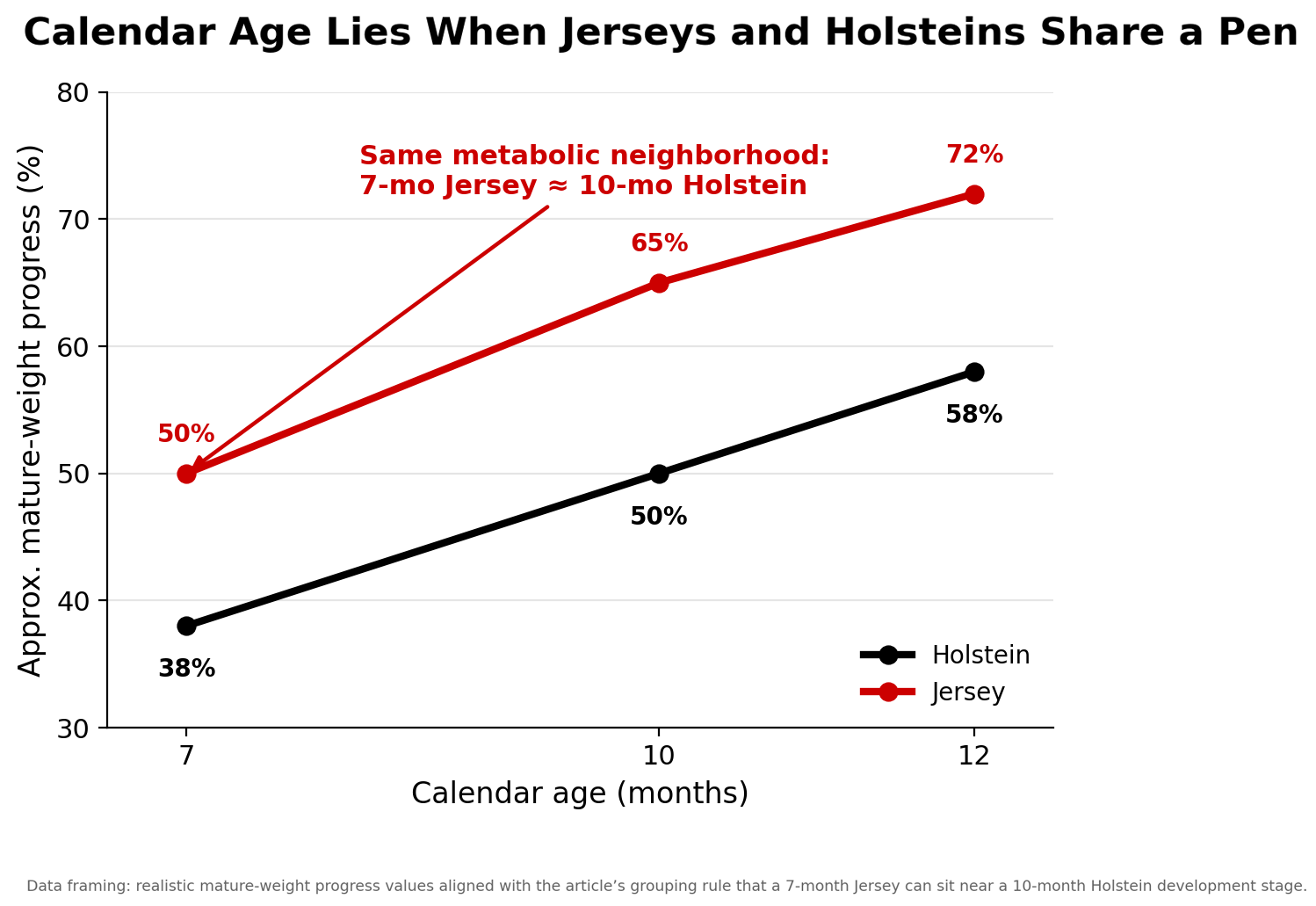
| Grouping rule | By metabolic age, not calendar age | By metabolic age — a 7-mo Jersey ≈ a 10-mo Holstein |
Jerseys also handle calcium differently at calving. They show measurably higher clinical hypocalcemia rates than Holsteins across multiple Journal of Dairy Science breed-comparison studies — a pattern attributed in part to differences in intestinal vitamin D receptor density — and you have to be more aggressive with anionic salts pre-calving than you would for a Holstein, per current Penn State and University of Wisconsin extension guidance.
The fix is simple once you see it. Don’t group Jerseys and Holsteins by calendar age. Group them by where they are in their growth. A 7-month-old Jersey and a 10-month-old Holstein sit at about the same spot on their growth curve. Put those two in the same pen on the same ration and you’re actually feeding them right. Calendar age is a trap with mixed breeds.
Why the Yearling Stretch Is Where Most Programs Leak
The ration that was right at 6 months is wrong at 12 months if nothing changes. NASEM 2021’s protein math shifts as she approaches mature size, because crude protein requirements for lean tissue accretion drop relative to her body weight as her growth curve flattens.
In plain English: the same ration that was building frame and muscle at 8 months starts laying down fat at 12 months. You didn’t change anything. She did.
Fat at 12 months means a yearling whose fore udder is getting laid down wrong, before she’s ever seen a milker. And the mammary system still carries the biggest single weighting on the PDCA unified scorecard. That one weighting is why an over-conditioned yearling costs you more ring points than any other single management miss.
The Ferrari Problem: What Feed Efficiency Actually Means in Your Barn
Lactanet’s Canadian Holstein evaluation publishes Feed Efficiency as a relative breeding value, and this is where genomic testing starts paying dividends beyond sire selection.
Here’s the practical framing. A heifer with a high Feed Efficiency breeding value is a Ferrari that runs on regular gas. Give her premium volume and she’s going to store it as fat faster than her pen mates — she’s literally bred to make more out of less. That’s a gift in the tank. It’s a liability in the show ring, where a BCS over 3.5 means she’s over-conditioned and her udder is getting laid down wrong.
The low-FE heifer in the same pen has the opposite problem. She needs the calories to hold condition. Feed them both the same ration and one ends up fat while the other ends up thin.
This is why genomic data shouldn’t end at sire selection. Pull Feed Efficiency RBVs on your replacement heifers. The high-FE tier needs less volume, lower energy density, or both. The low-FE tier needs what you’d consider a “normal” ration. Segmenting pays off fastest on bigger operations — small groups can’t justify the separate pens — but even a two-pen split on FE tier will save feed and protect udder development on your show prospects.
Lactanet Feed Efficiency RBV explainer breaks down how the index is built and how to read it.
Write It Down or You’re Guessing
Here’s the part nobody tells 4-H kids often enough: if you don’t write it down, you don’t actually know.
Monthly weights. Monthly BCS. Monthly height measurements against the breed standard. Forage tests. Dates of every health event and every treatment. Not because the fair committee asked for it — because you literally cannot improve a program you aren’t measuring. Which heifers hit their target weights? Which ones drifted and when? Which batch of hay lined up with the hay belly problem in that pen? Which bull’s daughters are growing differently than the others?
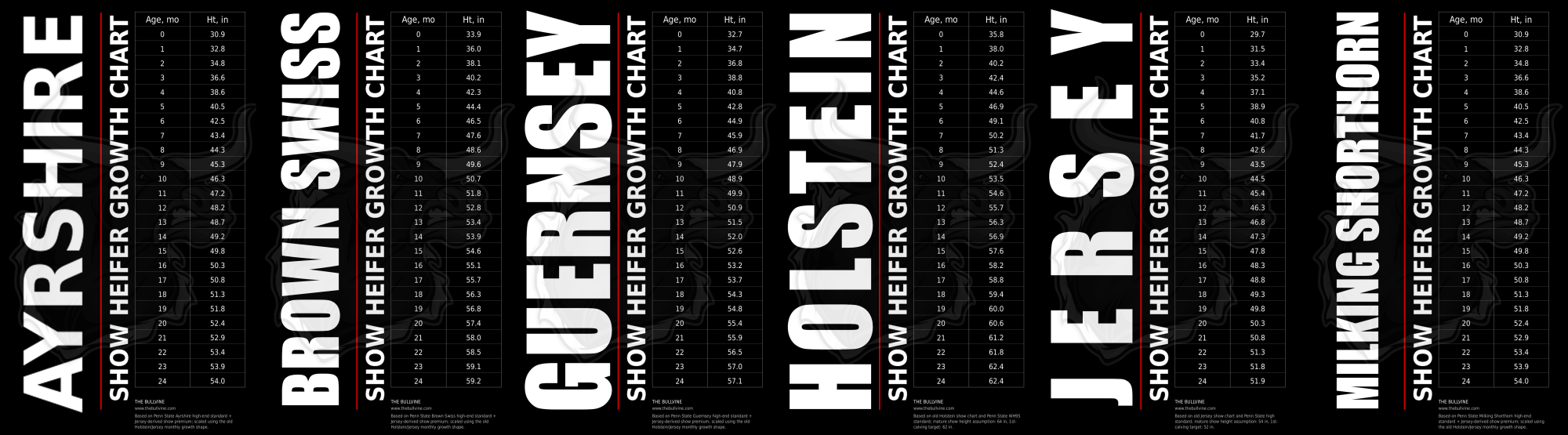
Every season without records starts from zero. Every season with records builds on the last one. The compounding that matters most isn’t just about the cow — it’s about you getting smarter every year.
What You Can Actually Do
Run the maternity pen like a hospital. Refractometer on every batch. Four liters in the first two hours, tubed if she won’t nurse it. Two more liters at 12 hours. About $200 in gear and fifteen minutes of labor per calf gets you most of the way there. The one thing that can blow it all up: dirty equipment. Bacterial contamination undoes the whole protocol in one feeding, so wash and dry your gear every single time.
Use the genomic data you already paid for. If you’re genomic-testing, pull the Feed Efficiency values and segment your rations where group size supports it. Feed the Ferraris less. Feed the work trucks normal.
BCS your heifers every month. Same person. Same target: 3.0 to 3.5. Pre-commit to what you’ll do if she’s over — usually pull grain or switch pens. Here’s the part that’s hard: don’t break the rule because she’s your favorite or because the fair is in three weeks. Get somebody outside your family to eye her, too. Phones and photos help you see what you can’t see when you’re in the barn with her every day.
Have a written re-entry plan for show animals. Isolate returning animals for 7 to 14 days and watch them, consistent with AABP and university extension biosecurity guidance. A September show heifer who came home with a respiratory bug can set back your whole yearling pen through October if you don’t catch it.
What This Means for Your Operation
- Are you actually testing your colostrum, or just hoping it’s good? If you’re not Brix-testing at harvest, you don’t actually know what you’re feeding.
- Pull a forage test on your growing-heifer hay and check NDFD30 and uNDF240. High uNDF240 creates hay belly even when intake looks reasonable.
- When did you last BCS your yearlings against a written target, with a non-family reviewer’s input? If the answer is “never” or “I don’t remember,” the emotional filter is running your program.
- Are your Jerseys in the same pen as Holsteins of the same calendar age? If yes, your Jerseys are getting fat. Match them by metabolic age instead.
- Walk them at 6 a.m. and again at 6 p.m. Does the silhouette change? If not, diagnose the forage before diagnosing the animal.
- Do you know your heifers’ Feed Efficiency values? A high-FE daughter on the same ration as a low-FE pen mate is going to get fat first.
- What’s your plan when a show animal comes home? If it’s informal, it’s a disease event waiting to happen.
Key Takeaways
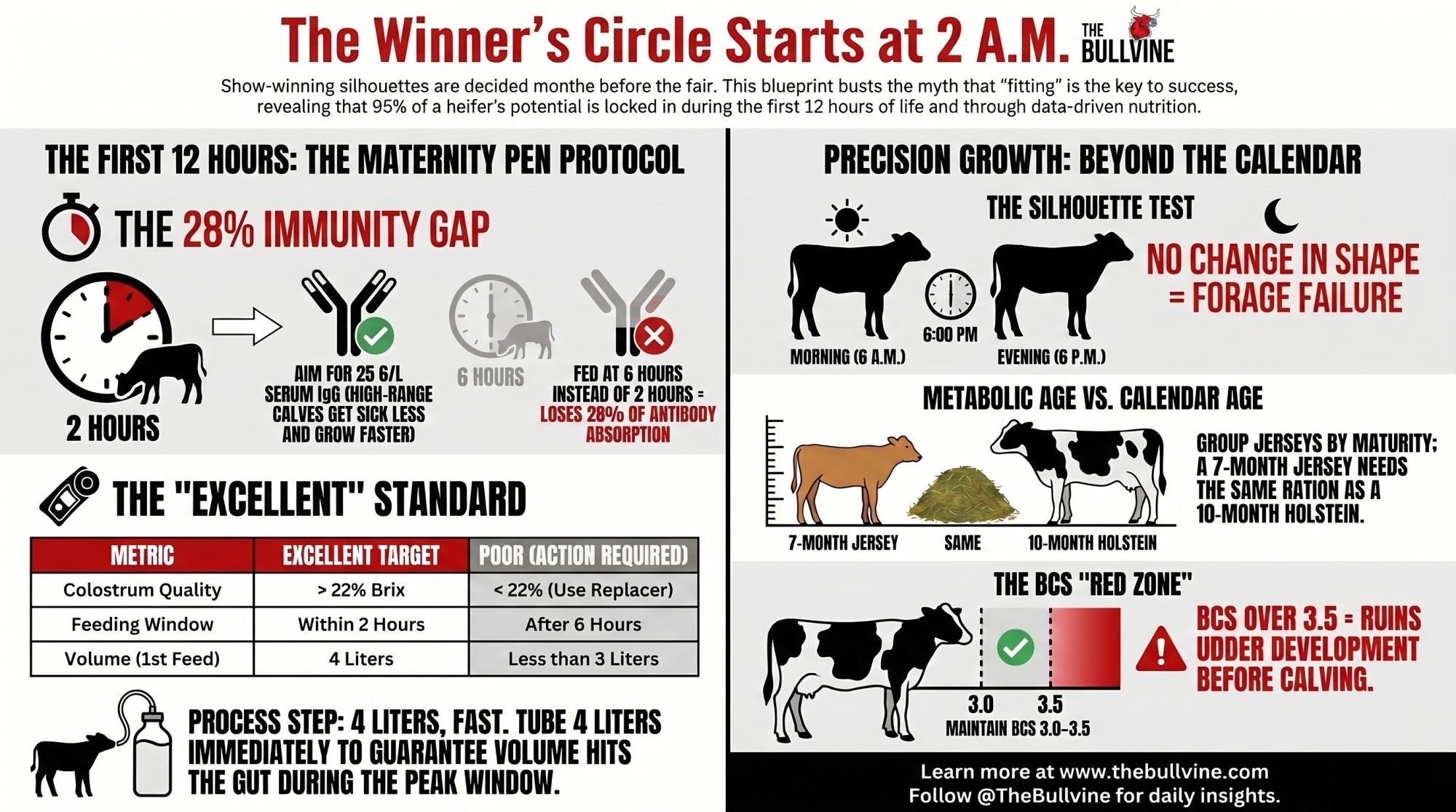
- If a calf isn’t fed colostrum within 2 hours of birth, her achieved serum IgG is already roughly 28% lower than it should be — and the rest of the program is working uphill from there.
- If your heifers show the same silhouette at 6 a.m. and 6 p.m., your forage is failing before your grain program has a chance to succeed.
- If you’re running one ration across Holsteins and Jerseys of the same calendar age, you’re over-conditioning one breed and under-fueling the other.
- If your genomic data ends at sire selection and doesn’t inform ration design, your high-FE heifers are quietly getting fat on the ration that’s keeping your low-FE heifers right.
- If BCS scores over 3.5 don’t trigger a pre-committed, automatic ration change, emotional bias is deciding your program — not the data.
📌 Your 30-Day Move
In the next month, sit down with your herd vet and set up a serum total protein check on the next 30 calves born on your place. That number tells you exactly how well your colostrum program is actually working — not how well you hope it’s working. You can’t fix what you aren’t measuring, and this is the highest-leverage window in the whole show heifer program. Full stop.
The 90-Day and 365-Day Plays
Next 90 days: Get a forage test on your growing-heifer hay and pull a BCS on every animal in the yearling pen. Put the numbers in writing. Buy the $200 refractometer if you don’t own one. Walk the morning-versus-evening silhouette check once a week.
Next 365 days: Pull your heifers’ genomic Feed Efficiency values if you’re testing. Start segmenting rations by FE tier if your group size supports it. Build a written post-show re-entry protocol, sign-off and all. And by the time this cycle closes, you should have month-over-month growth and BCS data on every single replacement — not a feeling, not a memory, a spreadsheet.
The Question That Decides the Class
The walk doesn’t lie. You can fit a mediocre heifer to look impressive standing still. You can’t fit her to move like a champion. That effortless, ground-covering stride is what comes out when everything was done right from day one. You either earn that walk in the maternity pen, or you don’t get it at all.
So here’s the one worth sitting with tonight. Of the calls you’re making this month — whether to get up for that 2 a.m. calving, whether to switch hay loads, whether to pull the grain on that heifer who’s looking a little thick — which one will you see in the ring next September? And which one are you going to wish you’d made differently?
The class gets decided a long time before the shavings go down. The only real question is whether your program runs like you know that.
Is She Big Enough?
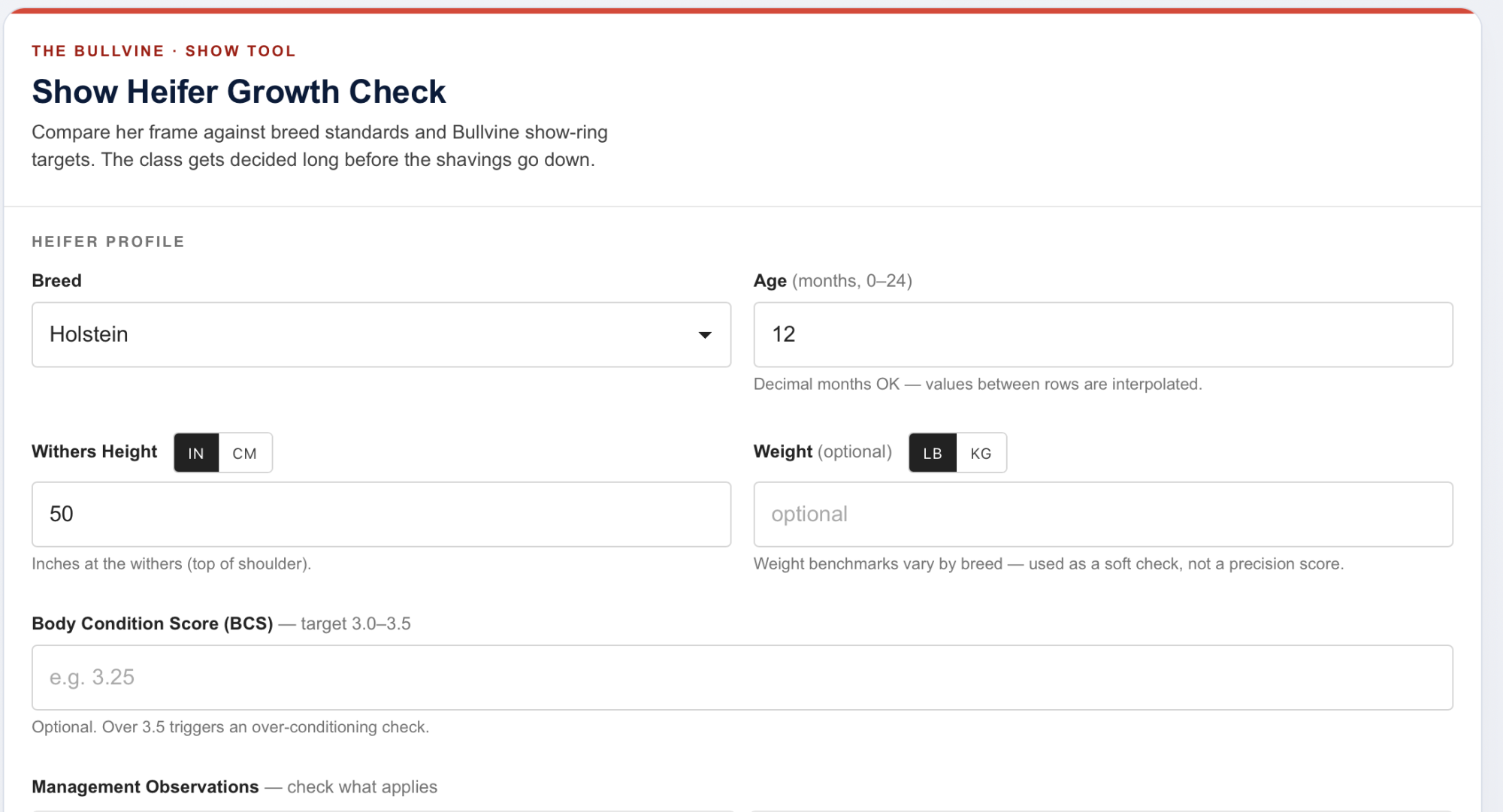
Monitor whether your show heifers are on track to hit critical weight and height targets at each development stage using industry-validated benchmarks. This tool compares your heifer’s current measurements against breed-specific growth curves and mature body weight percentages, flagging whether she’s running ahead, on pace, or falling behind where she needs to be for optimal development and show ring readiness. Access the Show Heifer Growth Check
Learn More
- Feed to Win: How to Maximize Your Dairy Show Heifers Potential — Secure your heifer’s growth trajectory with specific grain-to-forage ratios and monthly monitoring schedules that bridge the gap between baby calf health and yearling ring readiness. High-protein protocols prevent the growth stalls that cap ultimate frame.
- The Ultimate Dairy Show Guide for 2026: Judging, Classification & Ring Craft — Align your breeding program with the massive 2026 PDCA scorecard overhaul, revealing why judges now penalize extreme stature and prioritize robot-ready teat placement over traditional height. Knowing these shifts secures your herd’s future classification rank.
- Unlock Hidden Dairy Profits Through Lifetime Efficiency: How Modern Genetics and Strategic Nutrition Can Cut Feed Costs by $251 Per Cow — Slash annual feed costs by $251 per cow by leveraging genomic Residual Feed Intake data to identify metabolic ‘Ferraris’ in the heifer pen. This shift transforms genetic testing from a sire-selection tool into a precision-ration profit driver.
The Sunday Read Dairy Professionals Don’t Skip.

Every week, thousands of producers, breeders, and industry insiders open Bullvine Weekly for genetics insights, market shifts, and profit strategies they won’t find anywhere else. One email. Five minutes. Smarter decisions all week.