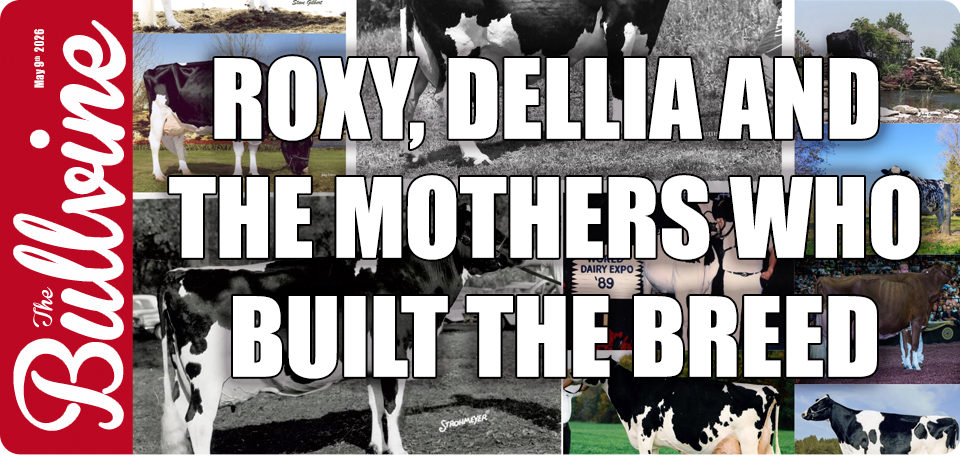



Roxy, Dellia, Blackrose and seven more didn’t just make famous pedigrees. They built the cow families still showing up in bull books, embryos and your best heifers.
Mother’s Day in the dairy business doesn’t look much like the card aisle.
It looks like a cow family that just keeps paying rent.
You know the kind. Pull up a pedigree in a good Holstein barn, go back four generations, then six, then eight, and suddenly there she is. Maybe it’s Roxy. Maybe Dellia. Maybe Blackrose, Laurie Sheik, Altitude, Missy, or Barbie.
And you catch yourself thinking: “There she is again.”
That’s the thing about great donor cows. They don’t really leave. They just stop standing in the barn and start showing up everywhere else.
This isn’t a show-cow ranking. It isn’t a prettiest-picture contest either, though some of these cows could stop you cold in a photograph. This is a Mother’s Day history piece about the cows that kept giving the breed daughters, sons, granddaughters, embryos, sale-ring moments, AI sires, and cow families breeders are still building around.
So pour the coffee. Let’s talk about ten mothers who helped build the Holstein breed.
Glenridge Citation Roxy: The Queen Who Made the Picture Famous
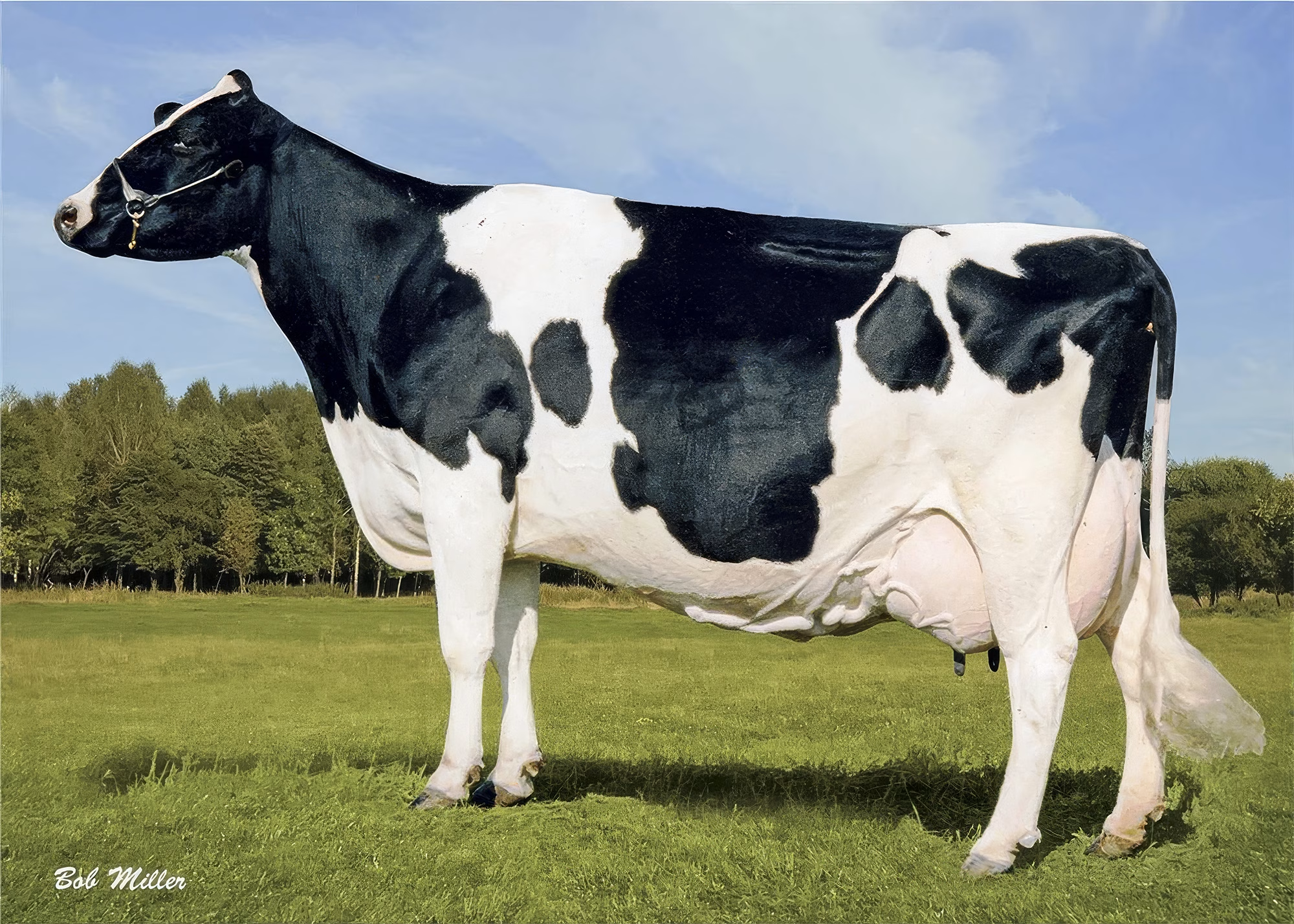
There’s a famous story about Glenridge Citation Roxy getting photographed at Mil-R-Mor in Dundee, Illinois. Bob Miller took one shot. Just one. Roxy was clipped, filled, and standing like she knew exactly who she was.
But honestly, the photo didn’t make Roxy great.
Roxy made the photo great.
Born April 15, 1968, at Lorne Loveridge’s Glenridge herd in Saskatchewan, Roxy became one of those rare cows whose name moved from pedigree line to breed language. The Bullvine profile records her as EX-97-4E-GMD, a third-generation 200,000-pound milk producer, and the first Holstein cow reported to have ten Excellent daughters. She eventually had 16 Excellent daughters . A Holstein Plaza family report also lists Roxy as the dam of 16 Excellent daughters, seven of them Gold Medal daughters.
That’s not a cow family. That’s a franchise.
Her daughter Mil-R-Mor Roxette became Canada’s first 30-star brood cow. Branches through Roxette, Lana Rae, Tony Rae, Debutante Rae, and others kept sending the Roxy influence into type, production, red-carrier lines, sale-ring value, and modern pedigrees.
Roxy sits at the top because she wasn’t just a great individual. She became a structure the breed kept building on.
That’s what great mothers do. They don’t just have a moment. They create a direction.
Snow-N Denises Dellia: The Cow Who Ended the Either-Or Argument
Before Dellia, breeders loved to argue like type and production had to live on opposite sides of the barn.
Then Snow-N Denises Dellia walked in and made the argument feel a little tired.
Born in 1986 on Bob Snow’s Wisconsin farm, Dellia was a Walkway Chief Mark daughter from Snow-N Dorys Denise, a Bell-family cow with the kind of maternal depth breeders spend lifetimes trying to stack. ALH Genetics describes Dellia as the breeder of Regancrest Elton Durham and the source of influential cattle including Die-Hard, Million, and Altiota.
And then there was Durham.
Regancrest Elton Durham became one of those sires who connected eras. He had enough cow sense for breeders who still trusted their eyes, and enough transmitting power for the modern proof-sheet crowd. Through Durham, Die-Hard, Million, and the wider Dellia family, her influence spread through elite type, commercial usefulness, and genomic-era pedigrees.
The reason Dellia ranks this high is simple. She changed what breeders believed could come in one package.
She wasn’t just pretty. She wasn’t just productive. She wasn’t just useful.
She was all three, and she passed enough of it on that people had to stop treating balance like a compromise.
Stookey Elm Park Blackrose: The Bankruptcy Calf Who Became Genetic Gold
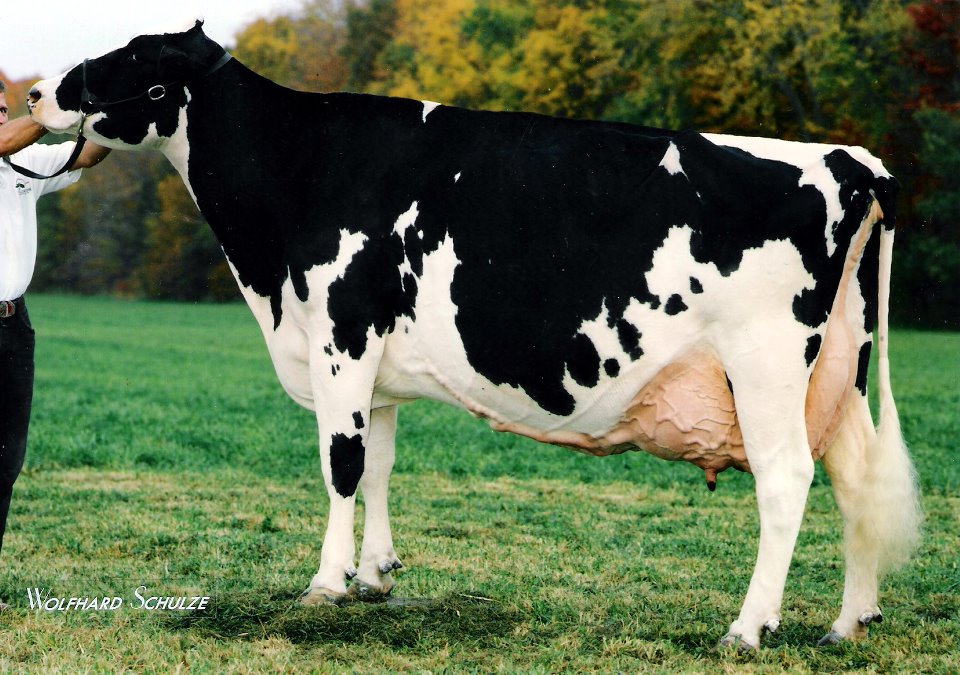
Some cow families start with perfect timing, polished facilities, and everyone already paying attention.
Blackrose didn’t get that kind of entrance.
The Bullvine’s Blackrose story starts in the middle of financial wreckage: Jack Stookey’s collapse, Curt Prange’s rescue work, and a calf that could easily have been scattered into history before anyone understood what she was . That calf was Stookey Elm Park Blackrose, a To-Mar Blackstar daughter from Nandette TT Speckle-Red.
And what a cow she became.
The Bullvine profile records Blackrose as EX-96, a 42,229-pound producer at five years old, All-American as a junior two-year-old and junior three-year-old, and Grand Champion at the 1995 Royal Winter Fair . Holstein Plaza also identifies her as EX-96-3E-GMD-DOM .
But Blackrose’s real Mother’s Day case isn’t one banner. It’s what came after.
Her family helped shape Red and White breeding through cattle like Indianhead Red-Marker and Lavender Ruby Redrose-Red, the Red and White cow who went on to become Supreme Champion at World Dairy Expo , .
That’s why Blackrose belongs here. She’s the reminder that breed history isn’t always tidy. Sometimes the cow that changes everything comes out of a mess, lands with people who can see past the noise, and spends the rest of her life proving them right.
Comestar Laurie Sheik: The Cow That Built an Empire
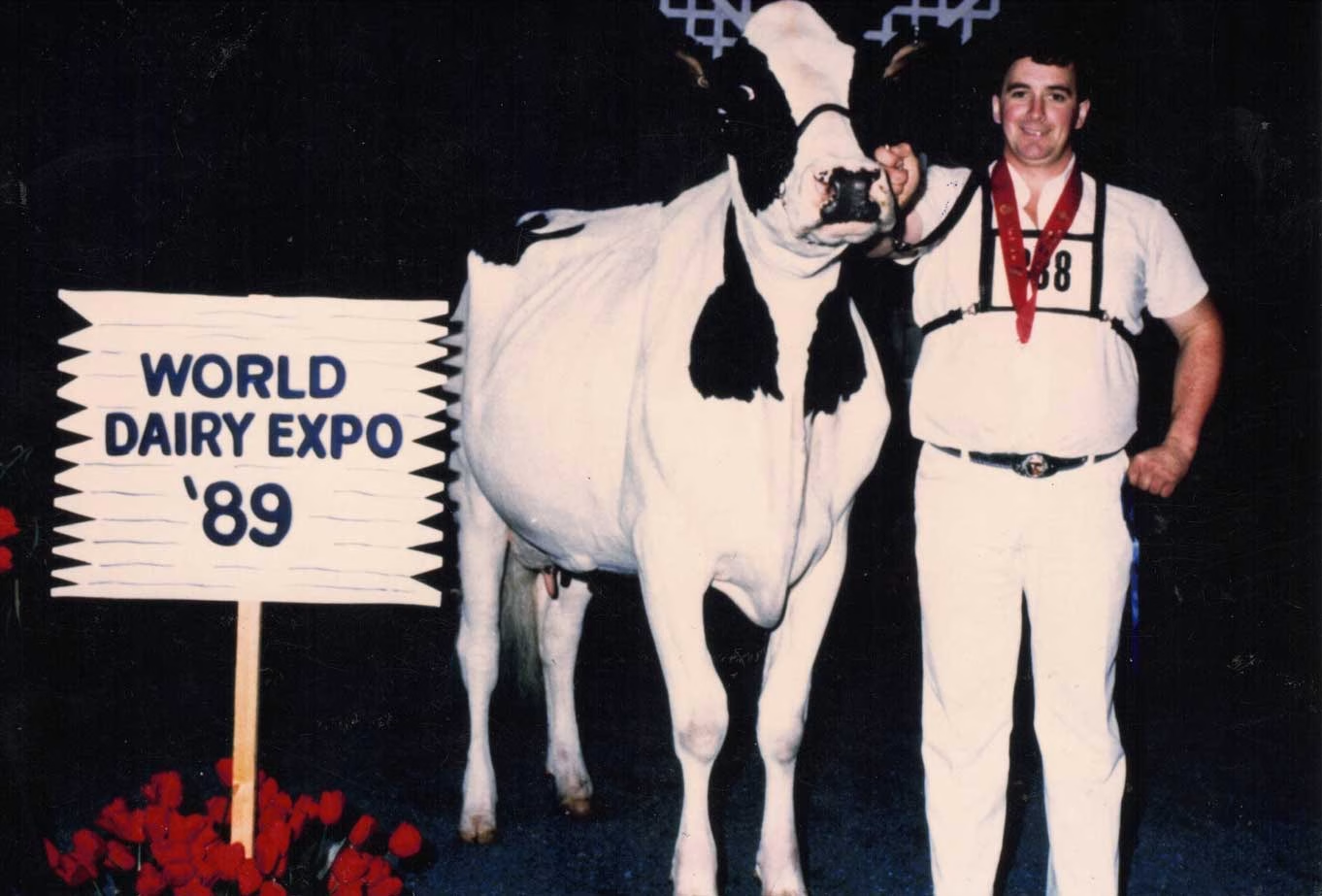
Comestar Laurie Sheik didn’t begin as the obvious global answer.
That’s part of why her story is so good.
Marc Comtois bred Elysa Anthony Lea to Puget-Sound Sheik, and in December 1986, Comestar Laurie Sheik arrived . She would become VG-88-23*, the foundation of one of the most recognizable cow families in the world, and the cow behind a Comestar line that travelled far beyond Quebec .
Holstein International describes Laurie Sheik as the inaugural Canadian Cow of the Year in 1995. That same article notes that family member Comestar Lamadona Doorman EX-94 won Canadian Cow of the Year in 2022, which tells you something important: this wasn’t a one-generation firework .
Laurie Sheik’s family runs through cattle like Lylehaven Lila Z and Comestar Goldwyn Lilac, and through a wider maternal line that helped make the Comestar name feel almost like shorthand for balanced breeding , .
You don’t build that by accident.
Laurie Sheik belongs near the top because she did what only the best brood cows do. She made a prefix mean something. When breeders saw the name, they didn’t just see ancestry. They saw expectation.
Kamps-Hollow Altitude-ET RC: The Red Gene That Became a Revolution
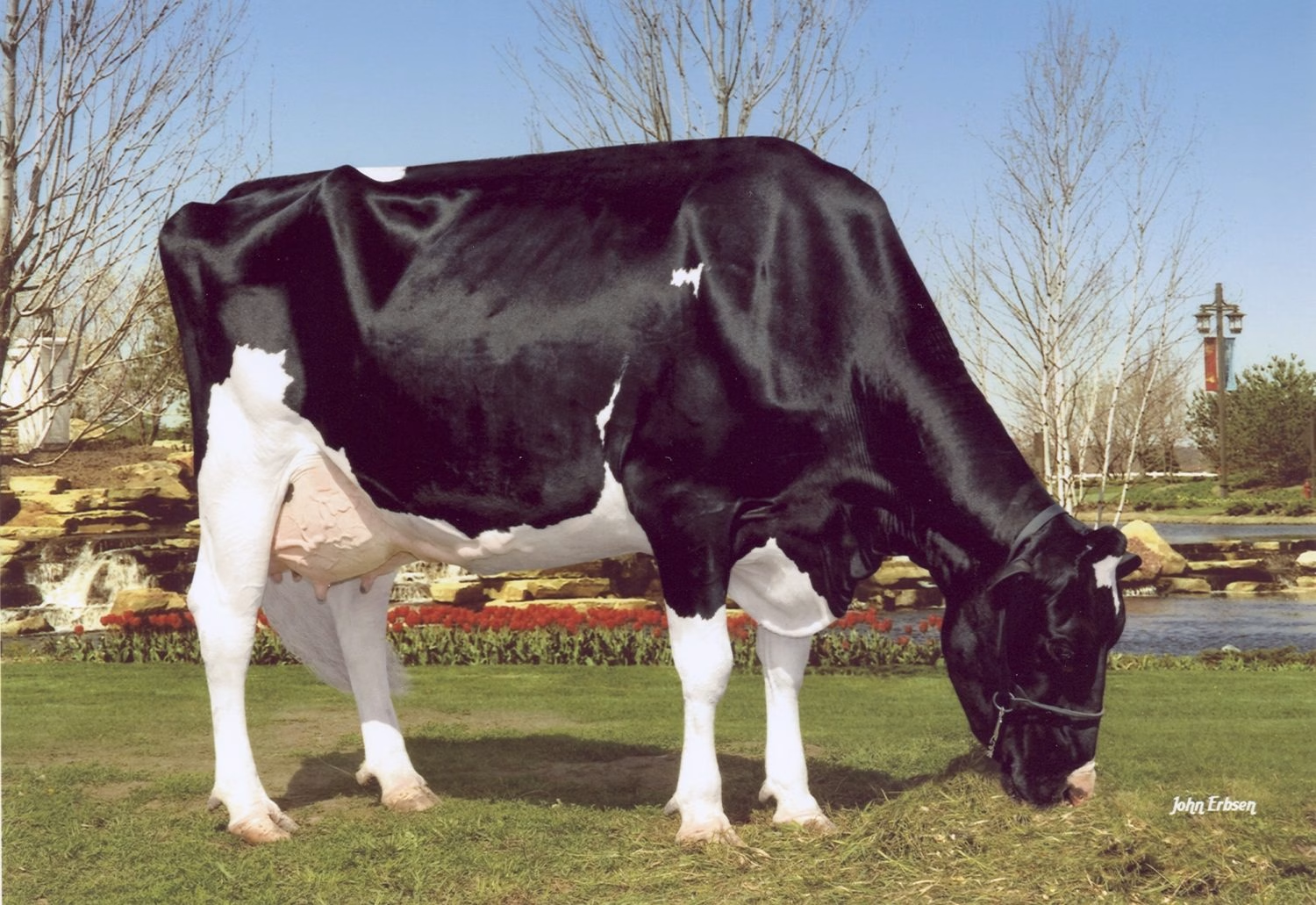
Kamps-Hollow Altitude carried red quietly.
Her descendants did not.
Altitude was a Durham daughter born January 11, 2000, later classified EX-95, and remembered as one of the defining brood cows in modern Red Holstein breeding . ALH Genetics reported that Kamps Hollow Durham Altitude RC EX-95 died at 15 years old and identified her as the mother of Advent, Acme, and Jotan, the grandmother of Amor Red, Absolute Red, Big Apple, and Armani, and the great-grandmother of Aikman and Addiction P Red .
And of course, there was Apple.
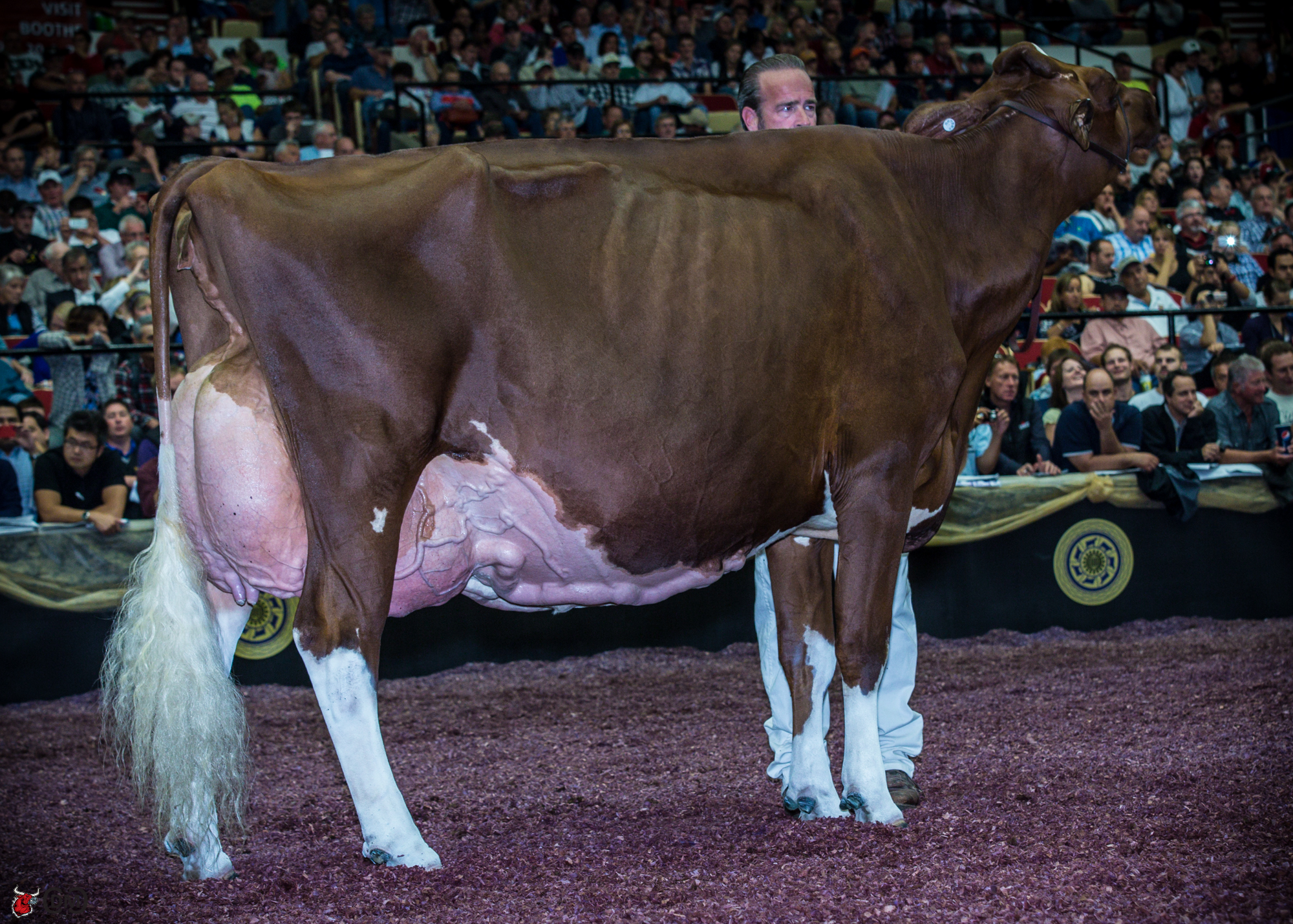
ALH names KHW Regiment Apple Red EX-96 as Altitude’s best-known daughter . That alone would put Altitude in the conversation. But when you add Advent-Red, Acme, Jotan, Aiko, Absolute, Armani, Addiction P, and the later Apple branches, you get something bigger than one popular cow family , .
You get a turning point.
Altitude made the red factor feel less like a novelty and more like a serious breeding lane. She gave Red and White breeders style, marketability, type, and sons people actually wanted to use.
That’s why she’s here. In the right cow, behind the right udder, with the right people paying attention, a recessive trait stops being a footnote.
It becomes history.
Wesswood-HC Rudy Missy: The Phone Call That Rewired the Genomic Era
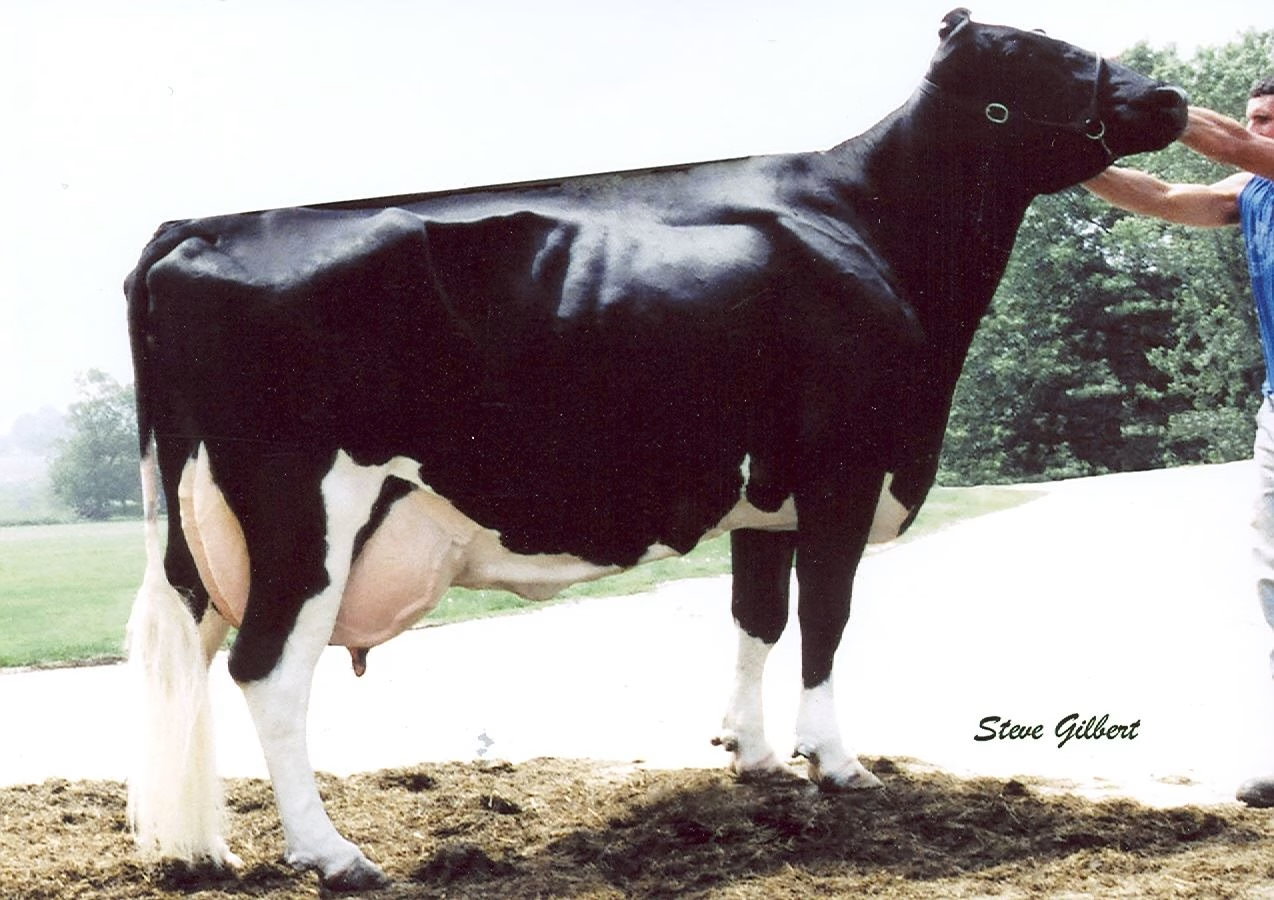
The Rudy Missy story has one of those scenes you can almost hear.
A sale. Buyers drifting. Interest softening. A cow that should have been getting more attention than she was.
Then a phone call.
The Bullvine profile tells the story of Matt Steiner buying Wesswood-HC Rudy Missy by phone and follows the family into Pine-Tree, Ammon-Peachey Shauna, Supersire, Mogul, Silver, and Balisto . Holstein International reports that Rudy Missy was selected as its Global Cow in 2014 after finishing second in 2012 and 2013 . The same article points to Mogul, Supersire, Silver, and Balisto as examples of her influence .
Missy’s power was not sentimental. It was practical. She hit the genomic era where it mattered: influential sires, high-use pedigrees, elite females, and commercial relevance.
That’s why she ranks ahead of some cows with more glamorous stories. Missy’s family didn’t just look good in a feature. It moved through breeding programs at scale.
The lesson is pretty simple, and a little uncomfortable.
The next great mother may not be the cow everyone is clapping for in the sale ring. She may be the one one person quietly refuses to let go cheap.
Larcrest Cosmopolitan: The Spotted Heifer From Minnesota
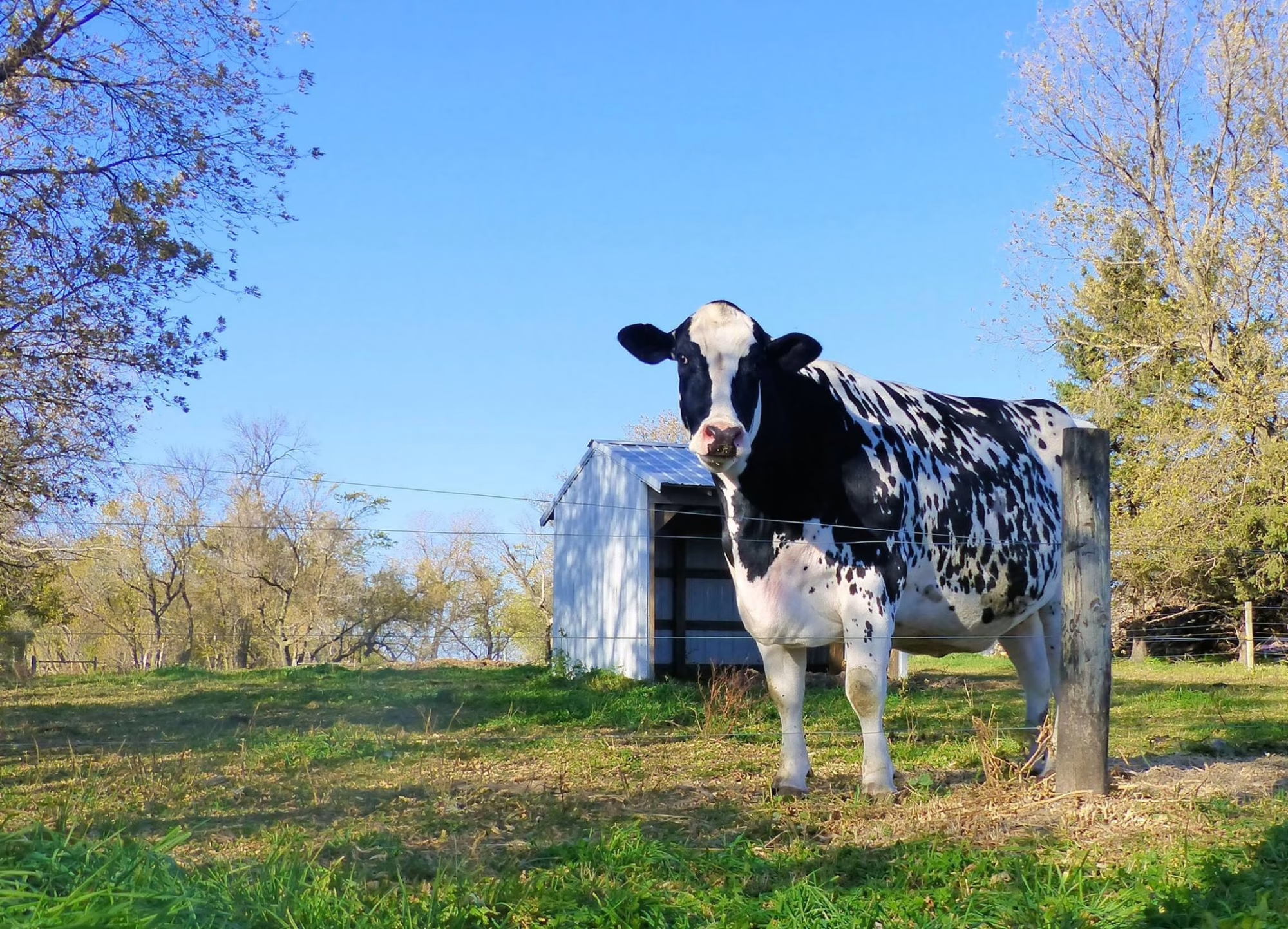
Larcrest Cosmopolitan’s story doesn’t come at you with fireworks.
It sneaks up on you.
She was a Picston Shottle daughter born in September 2005 at Jon and Ann Larson’s Larcrest herd in Albert Lea, Minnesota . The Bullvine traces the family back through Larcrest Juror Chanel and the registered heifers Raymona Larson bought with her teacher’s retirement savings , .
That detail always gets me.
A teacher’s savings. A few heifers. A cow family that eventually becomes one of the most recognizable maternal lines of the genomic era.
Cosmopolitan turned that family into a brand. The Bullvine identifies Larcrest Crimson as her daughter and describes Crimson’s sons Calibrate, Camelot, Chavez, Conquest, Casual, and Cyclone as AI-stud staples . The same profile points to Larcrest Commander as another later family example with cross-border relevance in U.S. TPI and Canadian LPI conversations .
Cosmopolitan wasn’t loud. She didn’t need to be.
She made Larcrest mean repeatability. That’s a different kind of fame, and in many barns, a more useful one.
Harborcrest Rose Milly: The Cow Who Came Over the Hill
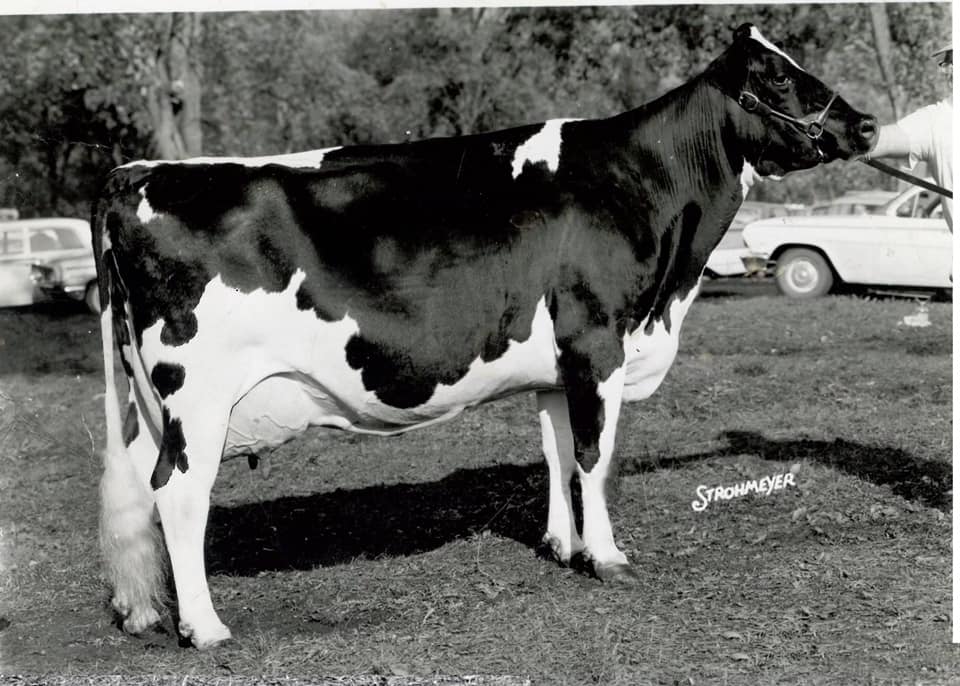
Some cattle stories need a whole crowd.
Milly just needs one hill.
The Bullvine profile tells the scene from June 1961 in West Salem, Ohio: Dick Brooks visiting John Snoddy, cows coming over the rise, and Harborcrest Rose Milly walking at the head of the line . You can almost see it. The kind of cow that makes the conversation stop for a second.
Milly was later recorded as EX-97-GMD, a three-time All-American Aged Cow, and the dam of Paclamar Astronaut . The King Barn Dairy MOOseum also identifies Astronaut as born in early 1964 to Harborcrest Rose Milly and describes Milly as a widely known All-American cow with a strong dairy record .
Her legacy runs through Astronaut.
The Bullvine profile credits Astronaut with 59,949 tested daughters and connects his daughters to later breed-shaping lines including Hanoverhill Starbuck and Startmore Rudolph . ABS Global’s bull database identifies Paclamar Astronaut as a proven Holstein bull born January 19, 1964 .
We don’t need to overstate it. The verified story is strong enough.
Milly produced Astronaut. Astronaut carried her influence into thousands of daughters. Those daughters helped open pathways into some of the most important bloodlines that followed.
That is maternal influence at breed scale.
One son. Thousands of daughters. Decades of echo.
Plushanski Chief Faith: The Cow Her Owner Would Not Sell
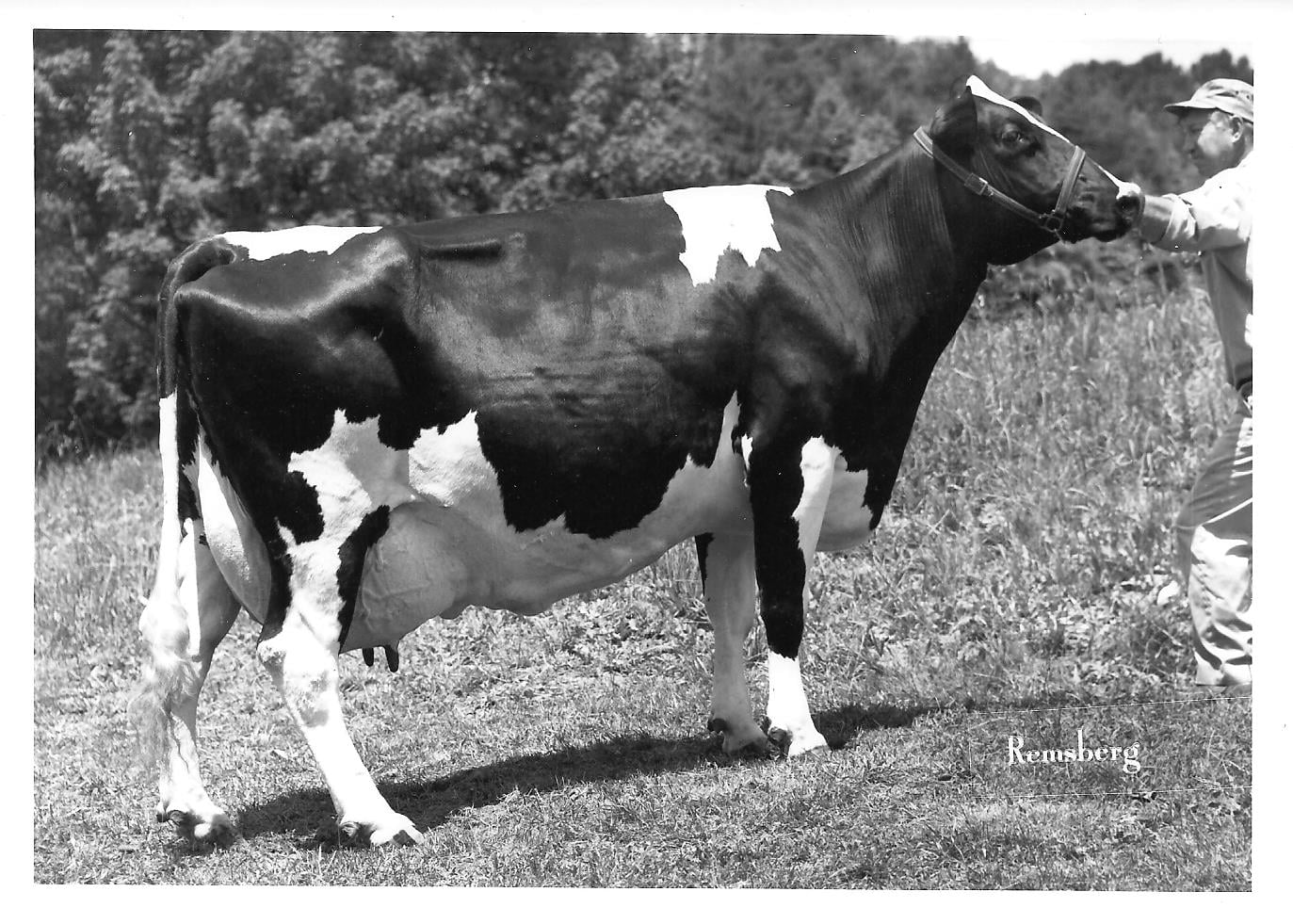
In 1973, Charlie Plushanski said no.
That’s the whole hinge of the story.
The Bullvine profile frames Plushanski Chief Faith around Charlie refusing to sell her before mating her to Pawnee Farm Arlinda Chief . Faith was born in November 1968, classified EX-94-4E-GMD, and credited in the profile with lifetime production of 242,863 pounds of milk and 11,353 pounds of fat . Holstein Plaza also identifies Plushanski Chief Faith EX-94-4E-GMD as a foundation cow in the Quality Gibson Finsco pedigree .
Faith’s strength came through daughters.
The Bullvine identifies Plushanski Valiant Fran, Plushanski Job Fancy, Plushanski Dawn Fayne, and Plushanski Star Faith as daughters that carried different parts of the family forward . The profile also connects the Faith line to Quality BC Frantisco, the EX-96 cow who became a two-time Royal Winter Fair Grand Champion through the Fran branch , .
This one feels less like a glossy genetics story and more like something every breeder understands.
Sometimes the whole future turns on a cow you decide not to sell.
Charlie Plushanski didn’t know he was protecting history. He just knew enough to trust the cow in front of him.
That’s not luck. That’s stockmanship.
Regancrest-PR Barbie: The Brood Cow Who Made Type Personal
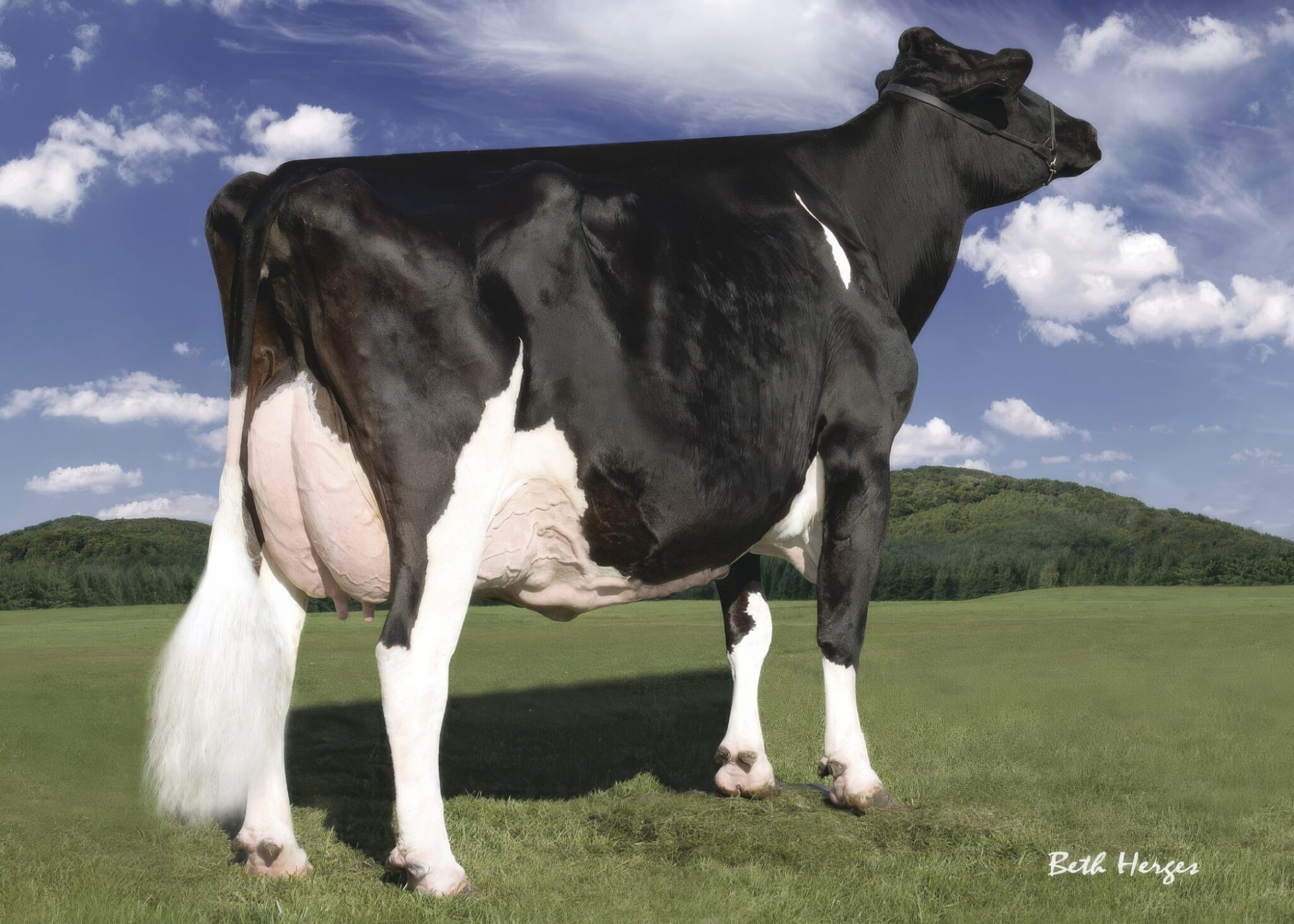
Regancrest-PR Barbie looked good enough to get attention.
Then her daughters made her impossible to ignore.
The Bullvine profile places Barbie at the 2004 Minnesota State Fair as Reserve Grand Champion and follows her into one of the most concentrated type-transmitting stories of the modern era . By 2010, the profile says Barbie had produced eight Excellent and 19 Very Good daughters, with all but one of her 27-plus daughters classified VG or better on first lactation . The Bullvine’s earlier Golden Dam finalist profile also treated Barbie as one of the defining donor females of her era .
And then came the names.
Bedazzle. Breya. Brocade. Gold Chip. Bradnick. Cashcoin. Brokaw.
That’s the kind of family where even people who don’t follow every branch still recognize the landmarks . Eurogenes has also continued to identify top PTAT animals tracing back to Regancrest-PR Barbie, which shows the family remained visible in modern type rankings .
Barbie ranks tenth here only because the first nine cows have longer historical arcs or wider breed-building records. In almost any other feature, she could be the headline.
That says more about this list than it does about Barbie.
What These Mothers Knew
There’s a funny habit in dairy history. We talk about the bulls.
The bull got the stud code. The bull got the proof sheet. The bull got the semen tank, the ad, the argument, the daughters counted in tidy rows.
But behind the bull was usually a cow someone believed in first.
Roxy gave the breed a family that reproduced excellence. Dellia made type and production feel less like enemies. Blackrose turned a financial wreck into Red and White power. Laurie Sheik made Comestar a global name. Altitude made red serious. Rudy Missy helped wire the genomic era. Cosmopolitan made Larcrest repeatable. Milly gave Astronaut the maternal base to move through the breed. Faith rewarded one farmer’s refusal to sell. Barbie reminded everyone that type still needed mothers.
That’s the real Mother’s Day story.
Not the soft-focus version. Not the greeting-card version.
The real story is quieter and better. It’s a breeder standing in a barn, looking at a cow, and thinking, “There’s something here.”
Sometimes they’re right.
And when they’re really right, the rest of us are still seeing that cow generations later. In the heifer pen. In the bull book. In the embryo catalog. In the sale ring. In the pedigree of the cow that just freshened better than expected.
So walk the barn a little slower this Mother’s Day.
Find the cow that always breeds back. The one whose daughters freshen right. The one nobody makes much noise about because she simply works.
Pull her pedigree. Go back far enough.
Odds are, one of these mothers is waiting there.
Key Takeaways
- Don’t give the bull all the credit. The cow family behind him often tells you more about repeatability, risk, and long-term value.
- Pull the pedigrees on your best heifers and look for the mothers that keep showing up. That’s where the next breeding decision starts.
- Great cow families aren’t built from one perfect mating. They come from breeders who notice the right cow early and keep stacking the right daughters.
- Legacy still has barn value. If a family keeps breeding back, classifying well, and making useful daughters, don’t let fashion talk you out of it.
Continue the Story
- From Laurie Sheik to Robotic Milking: Bois Seigneur Holstein’s Journey of Innovation – While Laurie Sheik provided the maternal spark, Marc Comtois built the engine. Step into the Quebec barns where this exact historical timeline played out, proving what happens when visionary stockmanship meets the right foundation cow at the perfect moment.
- Edward Young Morwick – Country Roads to Law Office – Every legendary sire in a stud book traces back to a mother someone refused to cull. Explore the bull side of this history through the eyes of a Master Breeder, where names like Astronaut and Durham pushed maternal foundations into millions of modern pedigrees.
- KHW Regiment Apple-Red-ET – Everything and more – When Altitude made the red factor a serious breeding lane, she laid the groundwork for an absolute dynasty. Trace how her most recognizable daughter took that exact foundation and relentlessly dominated both the shavings and the global genomic era.
 The Sunday Read Dairy Professionals Don’t Skip.
 The Sunday Read Dairy Professionals Don’t Skip.
Every week, thousands of producers, breeders, and industry insiders open Bullvine Weekly for genetics insights, market shifts, and profit strategies they won’t find anywhere else. One email. Five minutes. Smarter decisions all week.