



A camera can measure a cow consistently and still be wrong. In a hypothetical Bullvine example, three readings agree within one-tenth of an inch but miss the cow’s actual rump width by about an inch. That’s the difference Holstein USA must test before its 26-trait system goes on sale.
Three cameras, 26 targeted traits.
Holstein Association USA’s Build a Better Cow system places three time-of-flight cameras in the exit alley from the milking parlor and measures cows as they leave, AgriNews reported. “At the current time, we are measuring 26 traits, including body condition score, a few locomotion indicators and all of our linear traits,” Jeffrey Bewley said. The stationary system is aimed mainly at large dairies and is meant “to supplement, but not replace classifications.” Holstein USA hopes to sell it in 2027 or 2028.
Classification gives one expert assessment at a single visit, while automated imaging could collect repeated measurements across lactations. The public material reviewed here doesn’t yet show whether those measurements are accurate, repeatable and useful for selection, or whether getting them requires specialized depth cameras. Before the system goes on sale, it has five tests to pass, and Holstein USA should publish the results. We also correct several claims from our own earlier coverage.
Even if the cameras measure every targeted linear trait accurately, that wouldn’t show the system can reproduce a classifier’s overall judgment. Holstein USA describes Build a Better Cow as a supplement to classification, and commercial validation should be judged against that stated purpose.
From Hand-Identified Points to Automation
Bewley’s image work goes back to a 2008 study at Scottish Agricultural College’s Crichton Royal Farm (Bewley et al., Journal of Dairy Science (2008)). A camera captured images automatically as cows passed through a weigh station, and researchers identified up to 23 anatomical points on each image by hand.
Predictions came within 0.25 points of observed body condition score 92.79% of the time under the US system and 89.95% under the UK system. The authors wrote that future efforts should “explore ways to automate this process.” Nearly two decades later, Build a Better Cow pursues the broader goal of automating anatomical measurement at commercial scale.
Measurement Work Already Done
On December 1, 2024, Holstein USA revised its stature scale from 51–61 inches to 55–65 inches, based on a 2023 cow-measurement project led by Bewley. (See our analysis of what the new stature scale and the HCC mean for selection.) On August 11, 2026, it released the Holstein Conformation Composite with its genetic evaluations. The composite is designed to help breeders identify animals that combine conformation traits associated with balance, functionality and longevity, and it targets intermediate optimums for many characteristics.
The composite shows Holstein USA rethinking how existing conformation information supports selection. It doesn’t validate the measurements the new camera system is meant to generate.
Why Build a Better Cow Uses Three Views
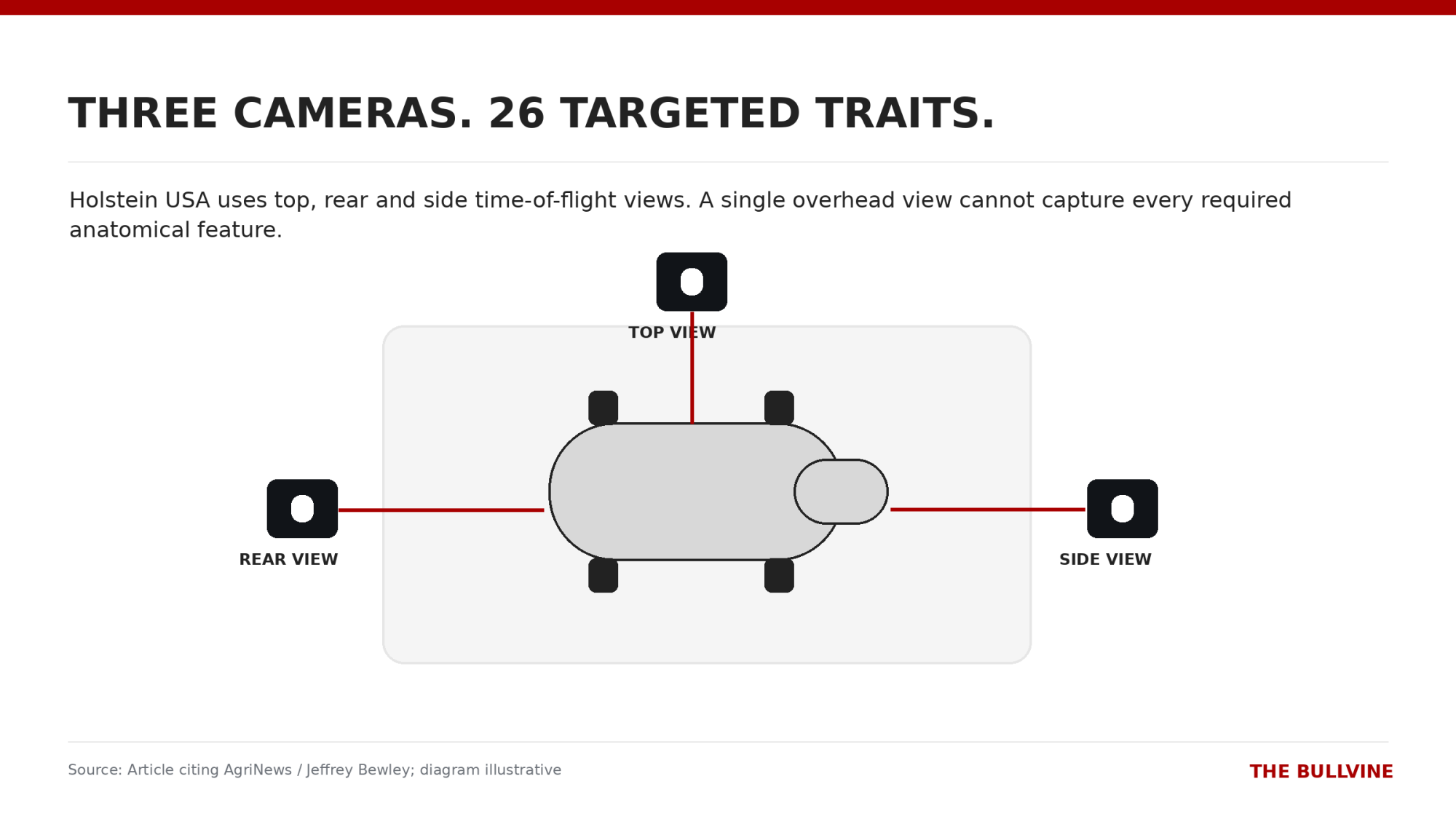
A single overhead camera can’t see the udder, the feet and legs, or much of the rear. One Build a Better Cow camera sits above the cow, one behind her for udder traits and one at her side. The system calculates traits “using basic principles of geometry” and delivers them in spreadsheet format for herd management software, Bewley said.
Summerfield et al. (2023) mounted three depth cameras on a frame over a crush and recorded 462 Holsteins at one dairy in Rayton, near Pretoria. Combining a separate model for each camera scored body condition better than any single camera did. That supports combining depth views, but the study measured body condition rather than the full trait set, and it doesn’t validate Holstein USA’s walk-through installation.
Consistent Isn’t the Same as Accurate
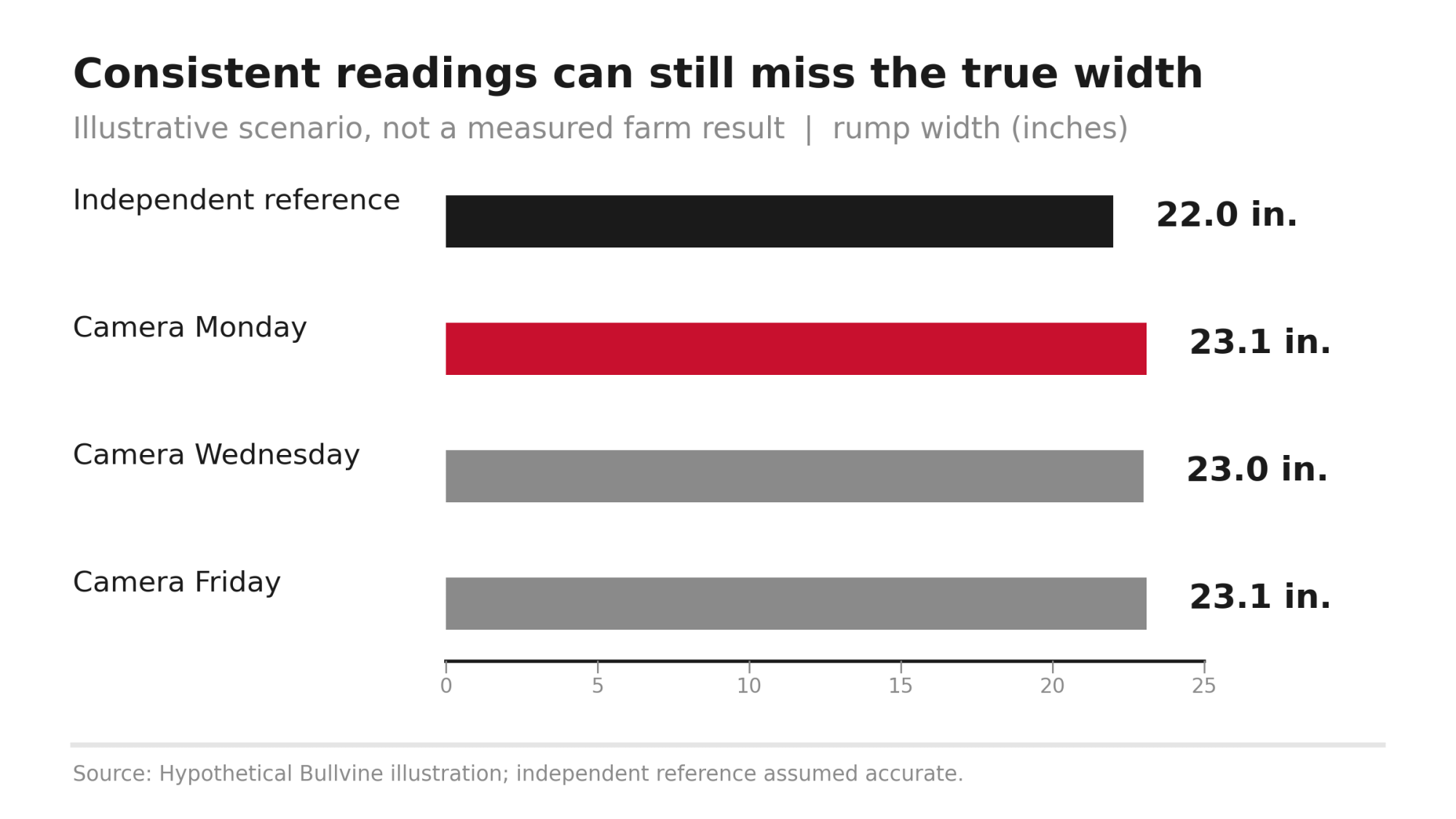
In the hypothetical below, a camera reads 23.0 to 23.1 inches on a cow whose rump measures 22.0 inches.
Hypothetical Bullvine illustration, not Holstein USA test results; assumes the reference measurement is accurate.
| Rump width | |
| Independent reference measurement | 22.0 in. |
| Camera, Monday | 23.1 in. |
| Camera, Wednesday | 23.0 in. |
| Camera, Friday | 23.1 in. |
That camera is precise but biased by about an inch. Accuracy against a reference is only one part of validation, and the reference measurement carries error too. A 2026 systematic review of vision-based body measurement in beef cattle lists uncertainty about ground truth and insufficient cross-ranch validation among the field’s open challenges. It doesn’t assess dairy conformation classification, but it strengthens the case for independent validation.
Rump width can be checked against a defined physical measurement. Locomotion indicators may need comparison with independent expert assessments or validated movement measurements. A 2025 Journal of Dairy Science invited review on sensor data in breeding notes that some variables, such as milk yield, are easier to validate than more complex ones like animal activity (Brito et al., 2025). Holstein USA should name the reference method for each trait, with its measurement uncertainty, rather than report one accuracy figure for the whole system.
Our recommendation is to validate on cows and farms kept out of model development, not on random video frames that may include animals used in training.
Udder traits are hardest because an udder looks different full than after milking. Placement in the exit alley should help standardize the timing of measurements relative to milking. The published results reviewed here don’t show how much that reduces biological variation, or whether stage of lactation produces systematic differences.
Five Tests Holstein USA Should Report Before 2027–28
Holstein USA plans to install the system on additional farms in 2026. “We hope to be ready to sell this system in 2027 or 2028,” Bewley said. That’s a target, not an announced launch.
The public material reviewed for this article does not provide the trait-by-trait accuracy, repeatability, rejection rates and independent across-farm validation needed to assess commercial performance. That does not establish that Holstein USA lacks the data internally. It means prospective buyers cannot yet evaluate those results independently from the evidence available here.
What This Means If You’re Weighing the System
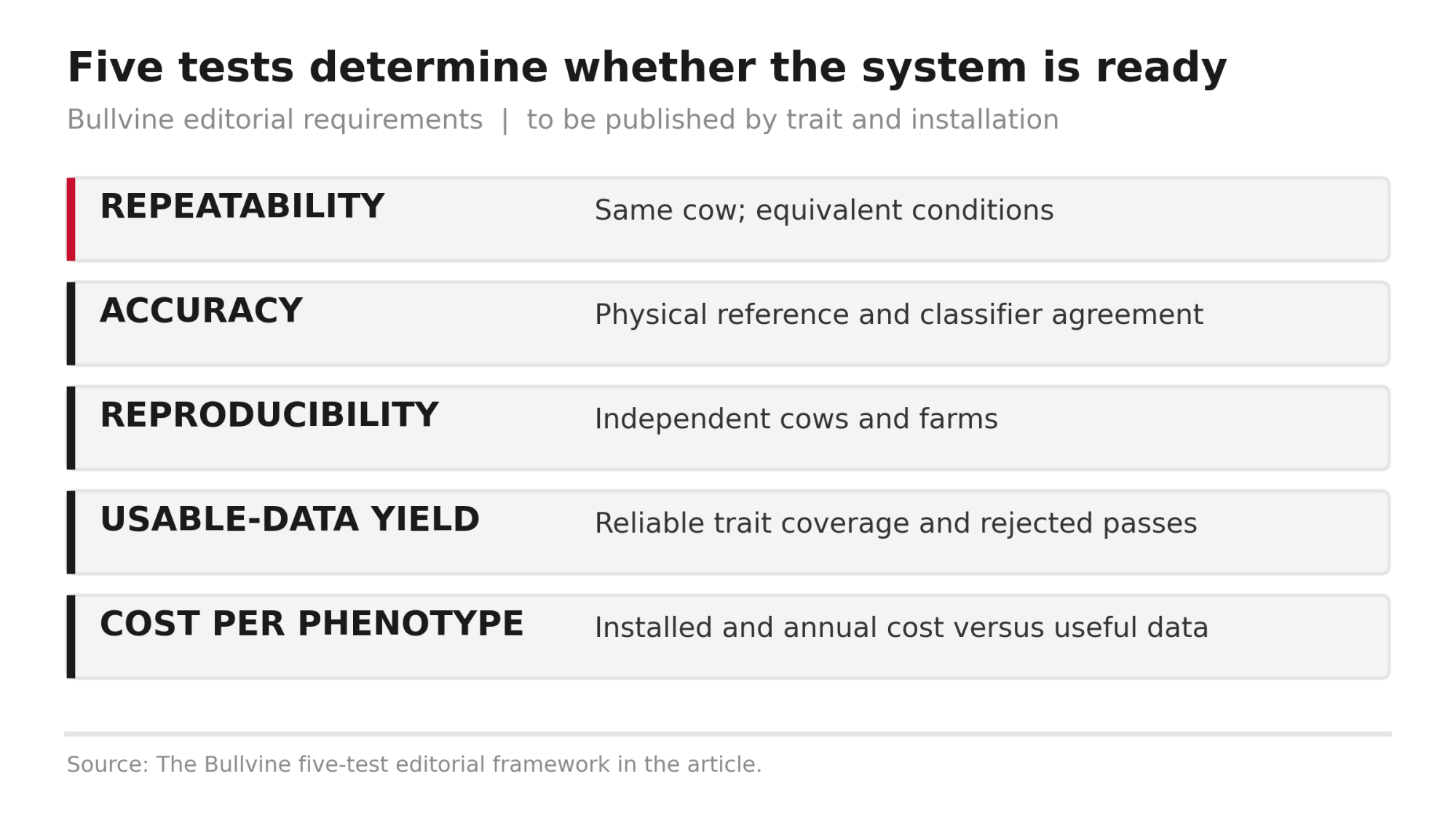
Before signing, ask Holstein USA for evidence on all five tests, broken out for your herd size and barn type. Each test covers several statistics across the 26 traits, not one number. Ask, too, who controls the data the system generates (see “Data Ownership: Who Controls the Phenotypes?” below).
| Test | What Holstein USA should report | Why farmers should care |
| 1. Repeatability | Within-cow standard deviations and repeatability coefficients by trait; usable passes needed per trait | Can I trust changes in a cow’s measurements? |
| 2. Accuracy | Error against a stated reference method for each trait, with its uncertainty; agreement and bias against classifiers on the same cows | Is the system measuring what it claims? |
| 3. Reproducibility | Bias between installations and software versions; results from cows and farms excluded from model development | Will it work in my barn? |
| 4. Usable-data yield | Valid traits per cow, rejected passes, reasons for rejection | How many cows actually produce useful information? |
| 5. Cost per useful phenotype | Installed and annual costs; reliable cow-level coverage; share of previously unclassified animals that become available for genetic analysis | Is the extra information worth paying for? |
Holstein USA should set acceptable performance for each trait and intended use before commercial validation, then report results against those targets. A system that performs well on some traits but not others may still have value, provided buyers know exactly which measurements are dependable and which remain experimental.
Udders, condition and locomotion change over a lactation, so a repeatability figure has to show how much of an observed change exceeds expected measurement variation.
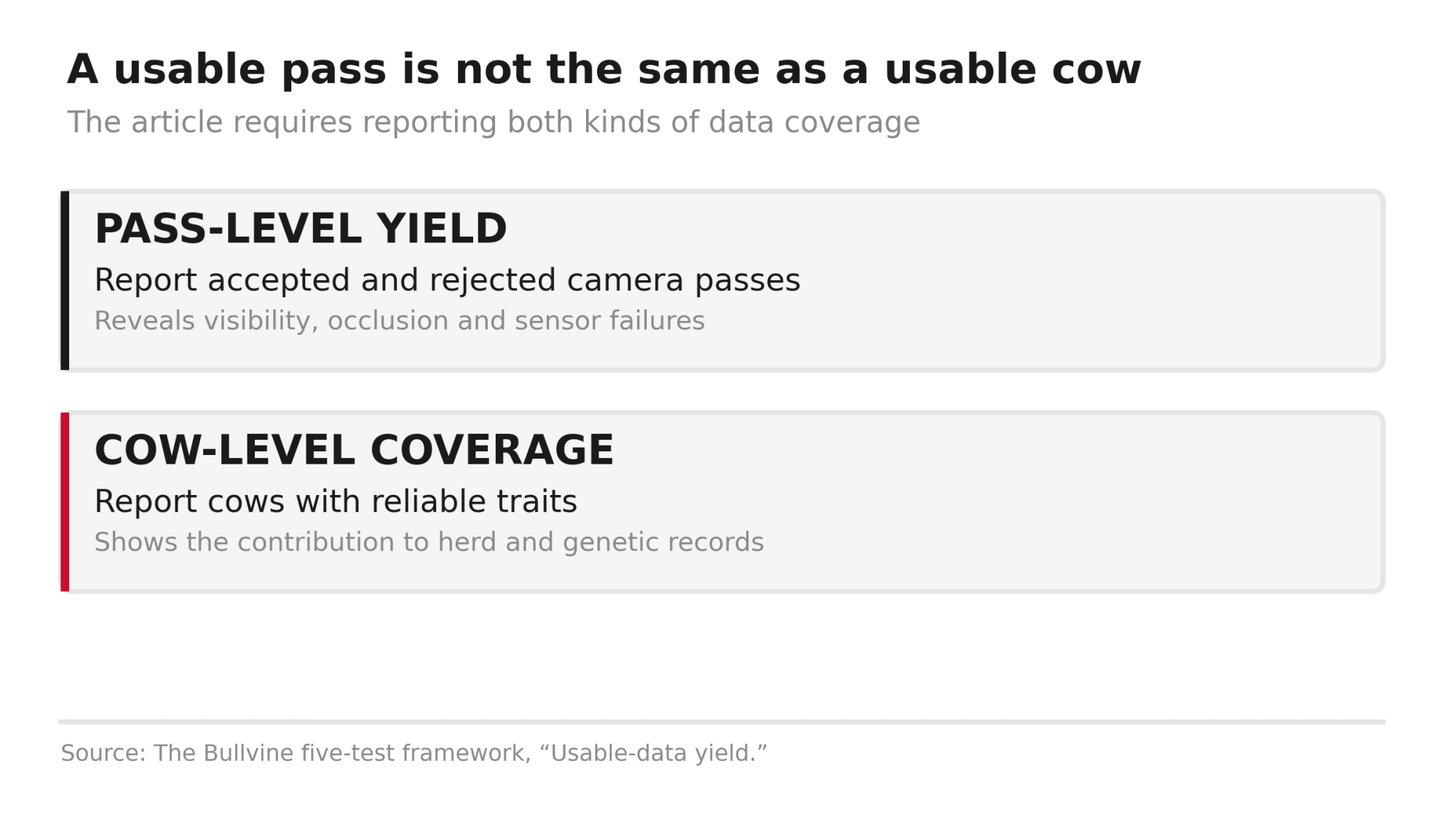
Report both usable passes and the proportion of cows achieving reliable trait profiles. Pass-level rejection rates show how often the system fails. Cow-level coverage shows its eventual value to the farm and to genetic evaluation.
A Farm System Has to Know When It’s Wrong
Holstein USA hasn’t said whether recalibration can compensate for mounting differences, or how often it would be needed.
A fogged lens, manure on the housing, a second cow in the frame or a bumped mount can each produce a misleading reading, and even depth sensing struggles with occlusion. The system that earns trust is the one that rejects a poor image instead of reporting a confident number anyway. Buyers should ask three questions:
- Can a technician recalibrate a moved camera without rebuilding the model?
- Does the system detect misalignment on its own?
- How does it reject unreliable observations and alert the farm?
Can Ordinary Cameras Do the Same Job for Less?
Bewley has argued the depth cameras earn their place: “Unlike conventional cameras, these provide us with more accurate information about the object we’re looking at.” A properly designed head-to-head validation study could test that claim.
Demonstrated: 3D tracking with ordinary cameras in a working barn
In a 2024 study, seven RGB cameras recorded 183 cows in a Swedish freestall barn between December 2021 and April 2022 (Kroese et al., Journal of Dairy Science (2024)). Sony Nordic’s software matched 2D poses across synchronized views to output 3D coordinates of anatomical landmarks. The authors report 88.2% sensitivity and 99.5% precision for detecting lying-to-standing transitions, figures that describe behavior detection, not conformation accuracy. They also flag limited external validity: a single cubicle design, a limited period and manually selected video sequences. Seven cameras watching freestalls is not three cameras in a walk-through alley.
Under investigation: RGB reconstruction for a body measurement
In an October 21, 2026 announcement, Charles Sturt University described using ordinary RGB cameras from multiple viewpoints and AI-based 3D reconstruction to estimate cattle weight without a conventional scale. The university says one of the researchers’ key goals is to provide “a potentially lower-cost and less intrusive alternative to methods that rely on more expensive sensors.” The team hopes to validate the project in more real-world settings. This is weight estimation, not classification-grade conformation, and it doesn’t show RGB can replace Holstein USA’s depth sensors.
Unproven: RGB reproducing the full classification trait set
The beef review lists the trade-offs:
- 2D images are low-cost but have limited expressiveness for 3D body parameters.
- RGB-D and LiDAR are affected by point-cloud noise, occlusion and equipment cost.
- Multi-view fusion “places high demands on calibration, registration, and system integration.”
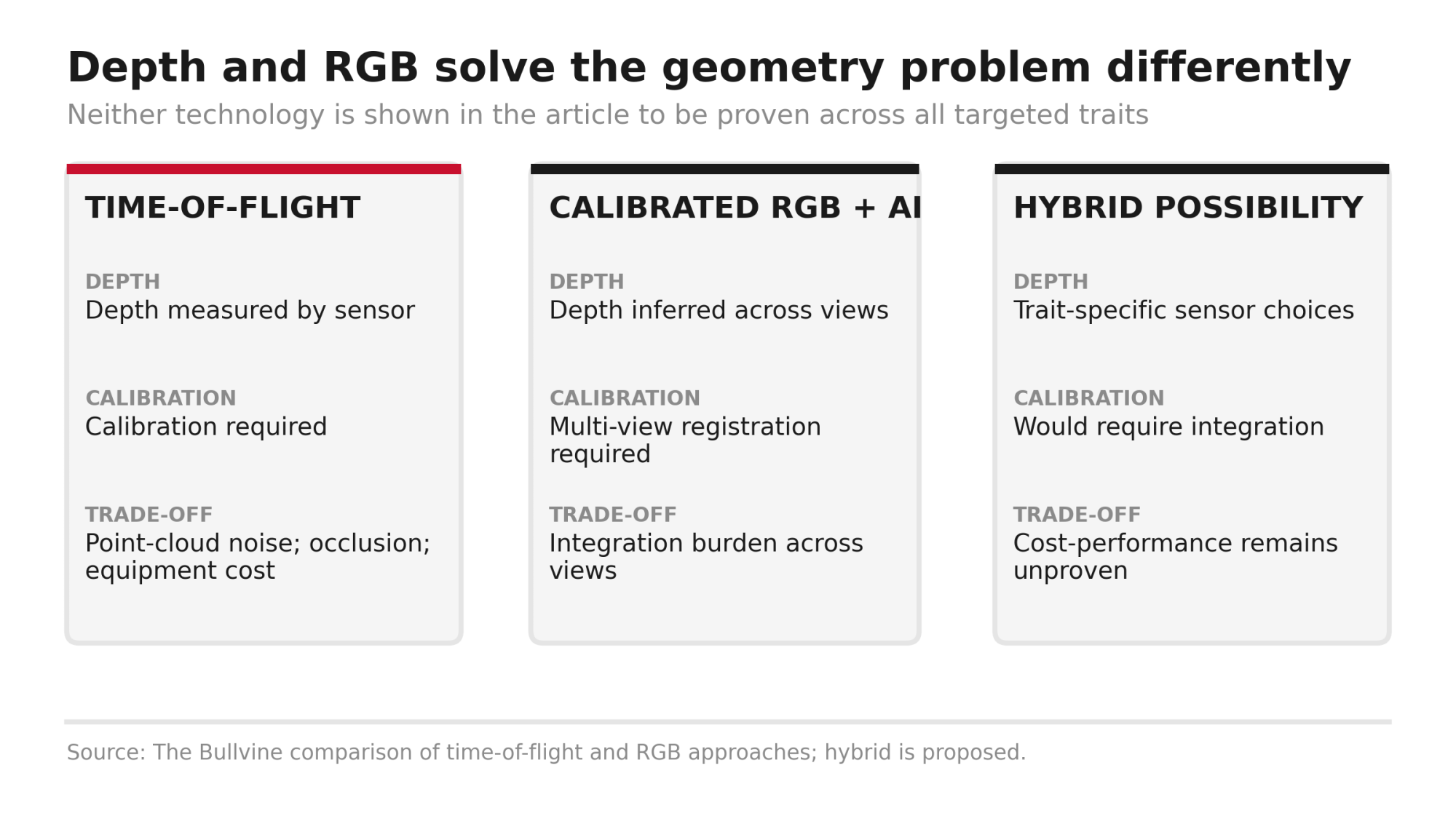
| Time-of-flight cameras | Calibrated RGB cameras + AI | |
| Source of depth | Measured directly by sensor | Inferred by matching views |
| Calibration | Required | Required, with heavy registration demands |
| Weaknesses the review lists | Point-cloud noise, occlusion, equipment cost | Integration burden across views |
| Proven for 26 traits | Not shown in public evidence reviewed here | Not shown |
Table note: How severe point-cloud noise is depends on the sensor, scene geometry and processing pipeline.
The decisive comparison would evaluate calibrated RGB cameras and time-of-flight sensors on the same cows during synchronized passages, using independent reference measurements. Trials would need to include cows and farms excluded from model development, different lighting and housing conditions, and repeated measurements across time. Results should be reported by trait, covering physical measurement error, usable-data yield, calibration demands and total operating cost.
Holstein USA need not run that experiment itself; a university or another developer could. Until a rigorous comparison exists, claims that ordinary cameras are either adequate replacements or inherently insufficient remain unproven.
The answer may be neither all depth cameras nor all conventional cameras. RGB imaging may eventually measure some traits adequately while others justify dedicated depth sensing, and a hybrid system could cost less than either extreme. That turns on trait-specific accuracy and the total cost of producing reliable information, not the price of individual cameras.
Do Automated Traits Actually Improve Breeding Value?
Holstein Association USA staff analyzed a dataset of more than 1 million cows, matching official linear classification records with DHIA production records. In an April 2023 release promoting a webinar on the study, titled “A Million Reasons Why Conformation Matters,” Bewley said “cows with more functionally correct physical conformation produced more lifetime energy correct milk and stayed in the herd longer.” These are associations: the analysis doesn’t establish that conformation itself caused the production differences.
| Level | What must be established | Why it matters |
| Measurement | Trait measured consistently and accurately | A phenotype you can trust |
| Genetics | Useful genetic variation, reliably evaluated | Potentially better breeding values |
| Economics | Selection improves lifetime profit or another goal | A reason to collect the data |
The biggest value may lie in how a cow’s structure changes over time rather than in reproducing today’s classification sheet. If one cow’s udder holds through three lactations while another’s declines, repeated measurements could show whether that difference is genetic.
Three milkings a day don’t create three independent cows for genetic evaluation. Repeated observations can still add information, especially about how traits change with age and lactation. Their value depends on how genetic models account for correlations between measurements and separate permanent cow effects from real change over time. Researchers also need to show that the automated traits add information beyond existing classification records, and that they make genetic evaluations more reliable in independent populations.
Data Ownership: Who Controls the Phenotypes?
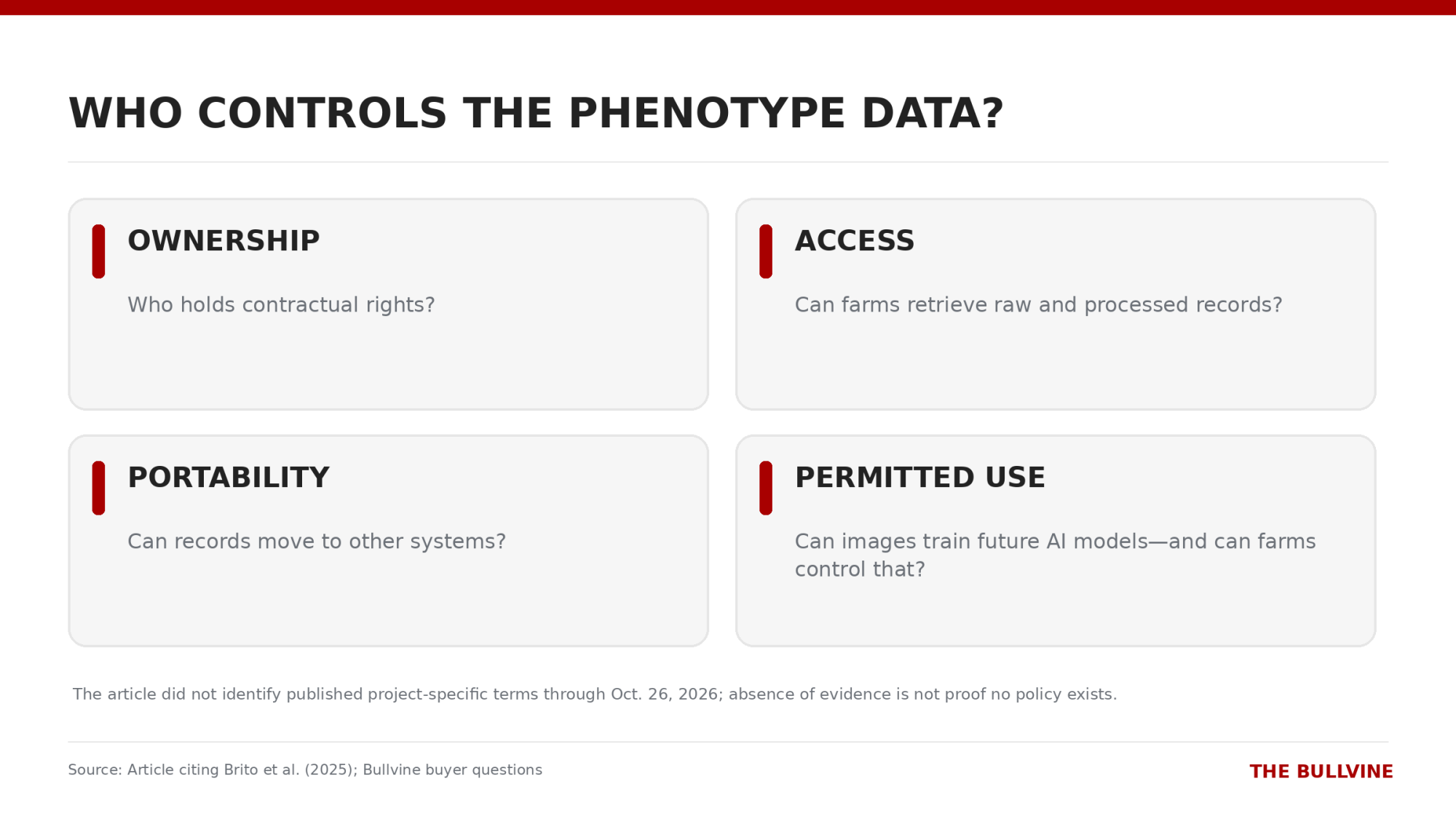
The 2025 Journal of Dairy Science invited review by Brito and colleagues found that integrating sensor data into breeding programs “remains limited due to fragmentation across sensor brands, lack of standardization, and challenges related to data accessibility, data access and portability rights, business interests, and governance.” It calls for “transparent data-sharing agreements” (Brito et al., 2025). Bewley is a co-author, listed with a Holstein Association USA affiliation, so Build a Better Cow is a direct test of whether the barriers his own review identifies can be solved in a commercial system. A 2021 review by Cole and colleagues adds the genetics context: phenotypes for some newer traits “are difficult or expensive to measure,” which “is driving interest in sensor-based systems.”
The same camera could serve an individual herd and the wider genetics industry, and those aren’t necessarily the same business case. Farmers may benefit from monitoring udder structure, locomotion or body condition. Breed associations and genetic evaluation organizations could gain observations on cows that might never be formally classified.
Ownership, access, portability and permitted use are related, but they aren’t the same thing:
| Concept | What farmers need to establish |
| Ownership | Who holds contractual rights in the generated data? |
| Access | Can the farmer obtain both the original and processed records? |
| Portability | Can the data move into other management or genetic evaluation systems? |
| Permitted use | Can measurements be shared, commercialized or used to train future AI models? |
Permitted use matters for an imaging system. Bewley told AgriNews the system uses “artificial intelligence through techniques of machine learning to process the information from that image.” Before commercial rollout, Holstein USA should answer five questions:
- Who controls the measurements?
- Can they be used in genetic evaluations?
- Can farmers export them to other systems?
- What happens to historical records if a farm stops using the service?
- Can a farm’s images or measurements be used to train future commercial models, and can the farm control that use?
Our search of public material through October 26, 2026, did not identify Build a Better Cow terms resolving these questions. That does not establish whether Holstein USA has developed policies or contractual provisions that have not yet been published.
Sidebar: What Does a Reliable Cow-Level Phenotype Actually Cost?
This is a Bullvine illustration in US dollars, not a Holstein USA price or performance result. Holstein USA hasn’t published pricing. The $20,000 total annual ownership cost (capital recovery plus ongoing costs) is a scenario we chose for illustration. It isn’t derived from Holstein USA equipment or support quotations.
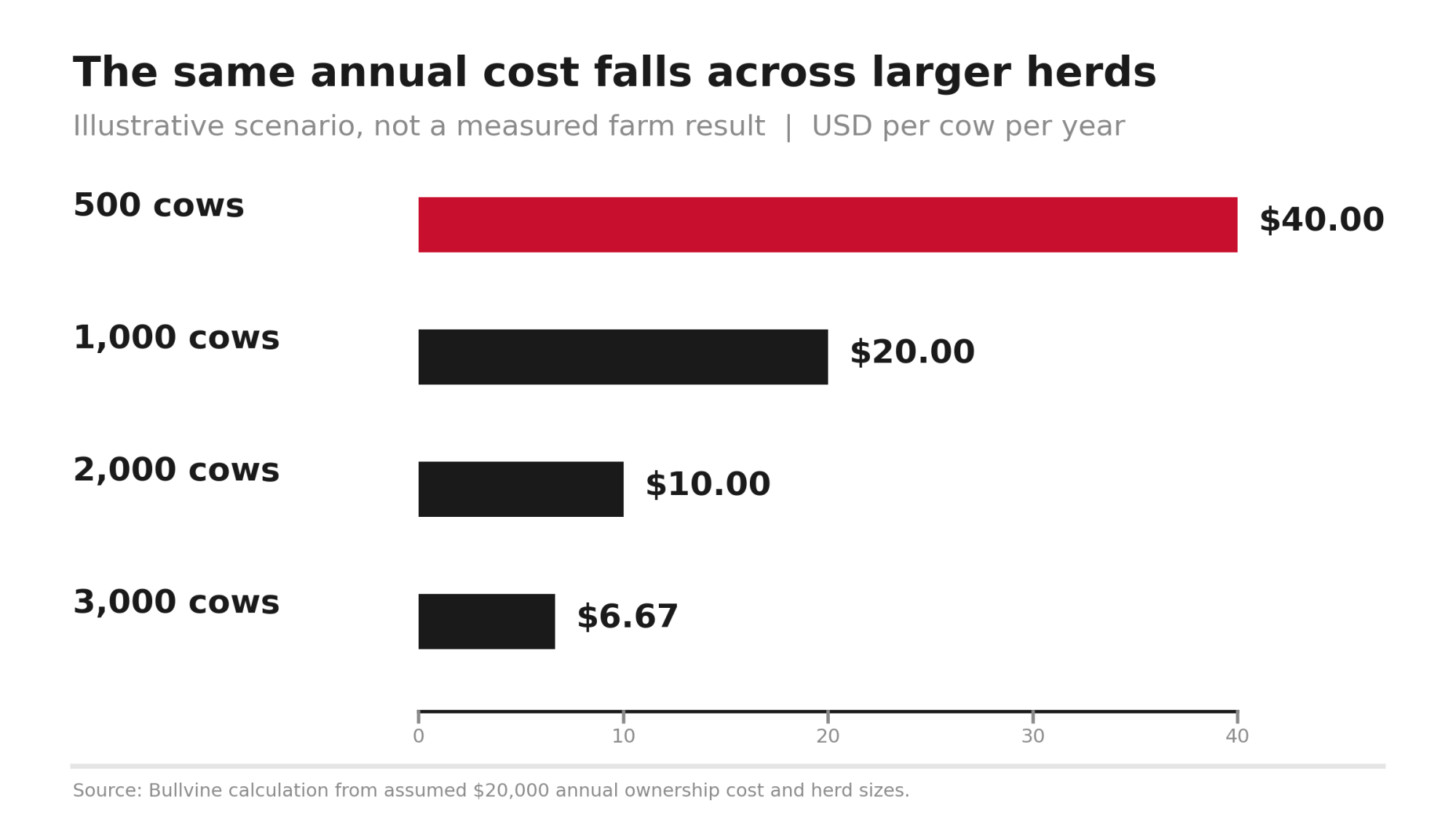
| Herd size | Cost per cow per year (our math) |
| 500 | $40.00 |
| 1,000 | $20.00 |
| 2,000 | $10.00 |
| 3,000 | $6.67 |
This illustration holds annual system cost constant across herd sizes. Actual costs could increase if larger operations require additional camera lanes, computing capacity, software licenses or maintenance. The falling cost per cow shows fixed costs being spread over more animals, not a demonstrated economy of scale for this system.
Here we count a cow only when she has a complete annual trait profile meeting a defined reliability threshold. That’s an assumed standard for the calculation, not a Holstein USA requirement. In practice, partial profiles could also have breeding value, and usable coverage should be reported for each trait.
If only 75% of cows qualify for a reliable profile, the fixed cost is spread over fewer animals. For a 1,000-cow herd, that pushes the cost from $20.00 up to $26.67 per usable cow (750 cows; our math). That isn’t the cost per camera reading. The economic test is how much independent genetic information the system adds, by recording more cows and by revealing change over time, and whether that information improves breeding decisions.
Correction to Earlier Bullvine Reporting
On May 22, 2026, The Bullvine reported that “the estimated installed cost is around $150,000 per farm” and that “heat shutdowns occur above 105°F.” The same article described “Twenty-six linear traits measured automatically” and said camera condensation in winter milkings “shows up” across northern states and Canada. We have not established any of those as verified specifications or operating results of Build a Better Cow. Holstein USA describes the 26 traits as including body condition score and locomotion indicators as well as linear traits.
The $150,000 figure originated in our October 2025 analysis. That piece offered it as a Bullvine projection: “If system costs align with current precision agriculture pricing—potentially around $150,000.” It raised heat and condensation as general concerns for camera systems, not as documented limits of Holstein USA’s system. It also described a 2027–2028 commercial timeline as industry speculation. Holstein USA later gave that timeline as its own sales target, and it describes the system as a supplement to classification.
Readers should not treat the cost, the temperature threshold or the condensation claim as Holstein USA claims. This article corrects those statements.
Where the Value Would Come From
If Build a Better Cow succeeds commercially, it could generate repeated, objective measurements from thousands of cows across multiple lactations, covering body condition and locomotion indicators as well as linear conformation traits. Those records could help researchers identify structural characteristics associated with productive life and evaluate whether additional phenotypes improve genetic predictions.
CDCB says reliable genomic evaluations depend on a continuous flow of accurate genotypic and phenotypic data to establish and refresh the reference population. On that standard, the case for Build a Better Cow rests on its cost per reliable, genetically useful phenotype, and whether conventional video cameras and AI can lower that cost stays open until someone runs the same-cow comparison.
In Brief
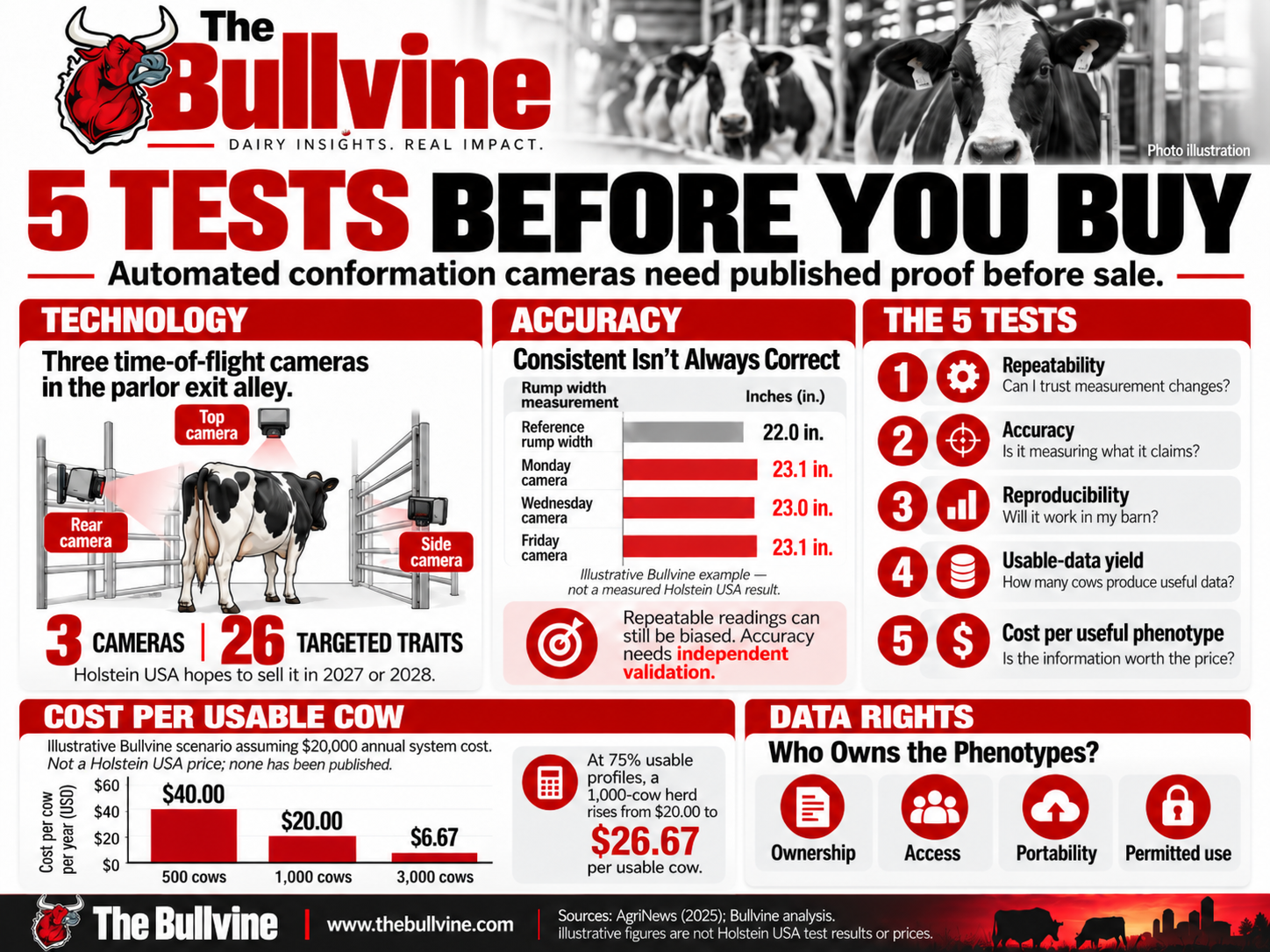
- A consistent camera can still be wrong. The accuracy figure that matters is each trait’s error against a stated reference method, with its uncertainty, not one number for the whole system.
- Depth cameras versus ordinary video isn’t settled. A same-cow comparison, run by Holstein USA, a university or another developer, would answer it trait by trait.
- Our October 26, 2026 search found no published Holstein USA terms on data ownership, access, portability or AI-training use, with the system targeted for sale in 2027 or 2028.
Automated Phenotype Cost Estimator
Adjust the variables below to calculate the true financial investment required to extract reliable, genetic-grade phenotypic data from an automated camera classification system.
Learn More
- Robotic milking ROI: 13 hours freed, 12.9 must leave payroll — Dismantles the massive gap between glossy automation brochures and actual barn-floor returns. This calculation exposes exactly how many paid hours must leave your payroll to justify a million-dollar precision upgrade.
- Holstein stature penalty: why 60 inches now costs you — Follows the money on the latest structural change to type evaluation. This analysis details the exact point deductions for oversized cows and arms you with the genetic metrics needed to protect future herd value.
- McCarty’s $40 Genomic Test Exposed a 28% Error – and a $104,750 Leak on a 500-Cow Dairy — Reveals the hidden drain of raising the wrong replacements. By proving how pedigree mistakes sabotage profit margins, this case study delivers a hard number on what a simple DNA panel is actually worth.
The Sunday Read Dairy Professionals Don’t Skip.

Every week, thousands of producers, breeders, and industry insiders open Bullvine Weekly for genetics insights, market shifts, and profit strategies they won’t find anywhere else. One email. Five minutes. Smarter decisions all week.