



You’re rearing every heifer. McCarty isn’t. His $40 genomic test caught a 28% error and freed up $104,750 a year on a 500–cow dairy.
Executive Summary: McCarty Family Farms runs a $40 genomic test on every heifer and discovered a 28% parentage error across its 19,000‑cow Holstein herd. That shock turned genomics into a core profit center, feeding embryo work, a Danone supply partnership, and a disciplined sort where the top half of the heifers make replacements, and the bottom half go to beef. When you run the same logic on a 500‑cow dairy, the barn math points to roughly $104,750/year in cash‑flow swing from tighter heifer rearing and beef‑cross premiums, before you even count long‑term genetic gain. Independent data from AHDB, CDCB, and Holstein Canada back the principle: genomic testing roughly doubles reliability over pedigree and widens the profit gap between herds that test most heifers and those that don’t. The biggest thing holding mid‑size herds back isn’t the $40 test cost — it’s the identity hit of culling daughters from cow families that built the prefix, as Kelly and Luke Donkers openly admit. This feature unpacks McCarty’s system, the supporting research, and four realistic strategies — from tightening margins to selling into a hot heifer market — that get sharper once you stop treating genomics as optional.
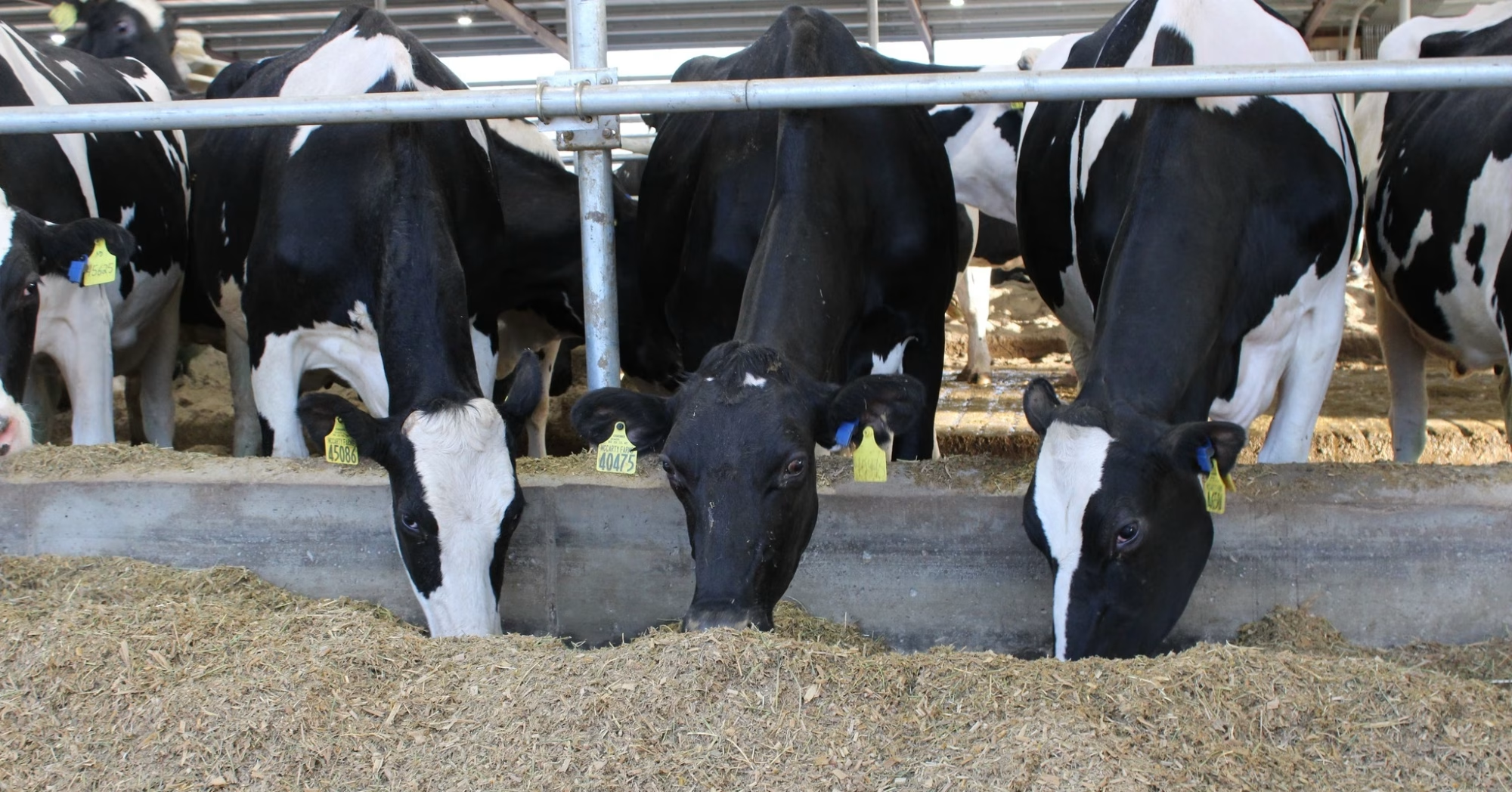
Ken McCarty doesn’t agonize over which heifers to keep. At McCarty Family Farms — a fourth-generation, B Corp-certified operation running the world’s largest registered herd of Holsteins across five dairy farms in Kansas, Nebraska, and Ohio — every heifer calf gets a genomic test before anyone decides her future. A Zoetis Clarifide Plus panel. About $40–$50 per head. Top half by index: sexed dairy semen. Bottom half: beef. The protocol is the same whether the calf traces back to the herd’s best flush family or walked in on a transfer truck last Tuesday. (Read more: The McCarty Magic: How a Family Farm Became the Dairy Industry’s Brightest Star)
At 19,000 cows, that discipline is table stakes. At 400 cows — where you know every heifer by name and her grandmother’s show record — it’s something else entirely. The genomic testing technology is available to any freestall in Wisconsin, Pennsylvania, or anywhere else with a FedEx drop, for less than the cost of a bag of milk replacer. So why are most mid-size herds still breeding blind, rearing every heifer, hoping the bottom end sorts itself out in the milking string? The answer has less to do with money than most people think. It has everything to do with identity.
$18.95 Milk, $20.85 Costs: Where the Squeeze Lands Hardest
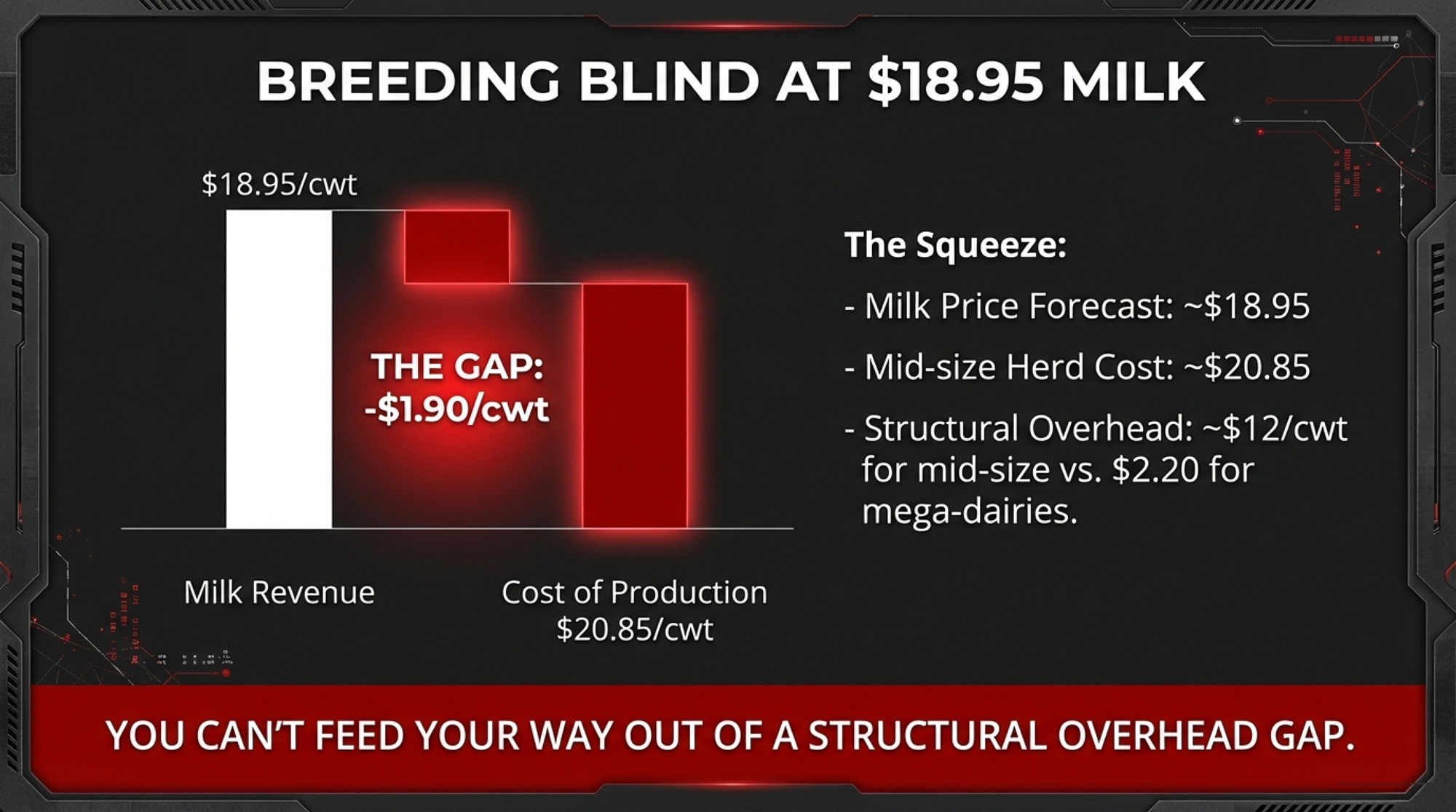
USDA’s February 2026 WASDE pegged the all-milk forecast at $18.95/cwt — up 70 cents from January’s $18.25 projection, but still $2.22/cwt below the revised 2025 average of $21.17. For a 500-cow herd at 23,000 lbs/cow — about 115,000 cwt shipped per year — that drop means roughly $255,000 less gross milk revenue compared to last year.
Now lay that price against USDA’s Economic Research Service cost-of-production estimates, updated in 2024 using the 2021 ARMS dairy survey:
| Herd Size | Feed Cost ($/cwt) | Labor Cost ($/cwt) | Total COP ($/cwt) | Margin vs. $18.95 Milk |
|---|---|---|---|---|
| 2,000+ cows | $8.00 – $12.00 | $2.20 | $19.14 | -$0.19/cwt |
| 200–499 cows | $8.50 – $12.50 | $12.00 | $20.85 | -$1.90/cwt |
| 100–199 cows | $9.00 – $13.00 | $14.00+ | $24.00 – $26.00 | -$5.05 to -$7.05/cwt |
- $19.14/cwt for 2,000+ cow herds
- About $20.85/cwt for 200–499-cow herds
- $24–$26/cwt for the average 100–199-cow operation
The biggest herds are scraping breakeven. The average mid-size dairy? Roughly $1.70–$2.00/cwt in the red on a full economic basis — and that’s before debt service.
Feed usually gets the blame. But ERS data show feed costs range from $8–$12/cwt across all herd sizes, and the difference between mid-size and the largest herds is often less than $1.50/cwt. The real gap sits in labor and overhead: smaller herds carry roughly $12/cwt in labor, counting unpaid family hours, versus about $2.20/cwt for mega-dairies, and fixed costs per cwt balloon when you’re spreading a parlor and freestall across 300 cows instead of 5,000.
You can tighten the feed. But you won’t feed your way past a structural overhead gap. Something else has to give. And if you look at where the biggest on-farm processing investments are landing — and the economics driving those decisions — the mid-size herd’s margin problem isn’t going away on its own.
How McCarty’s Genomic Program Works — And Why He Leaned In So Hard
McCarty’s genetics page lays out the priorities: high type, elite health, high components, positive production, feed efficiency, and longevity. The herd averages more than 94 lbs/day, with 4.2% butterfat and 3.33% protein, according to the farm’s website. Holstein USA classifiers visit the farms three times a year, typically scoring more than 2,000 cowsper round.
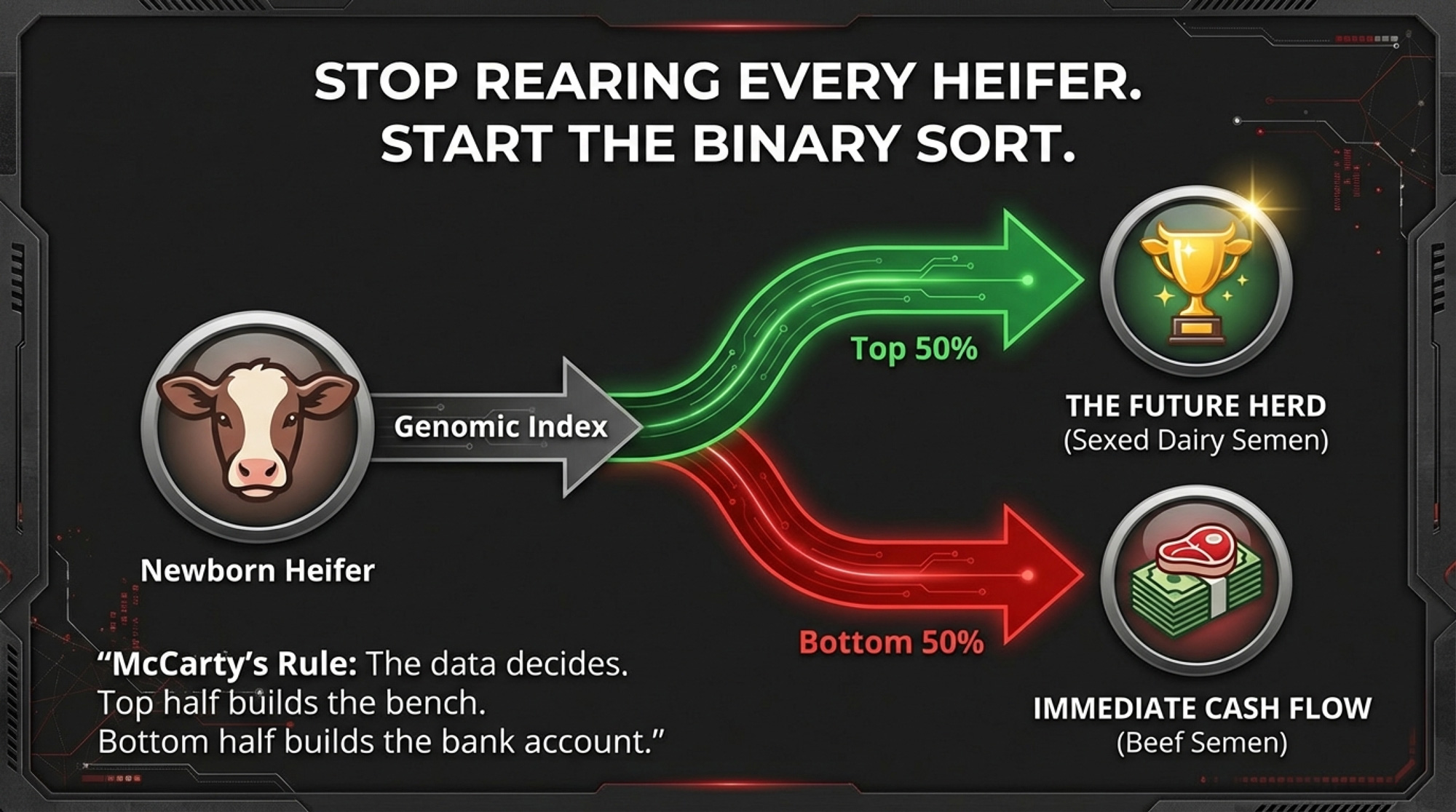
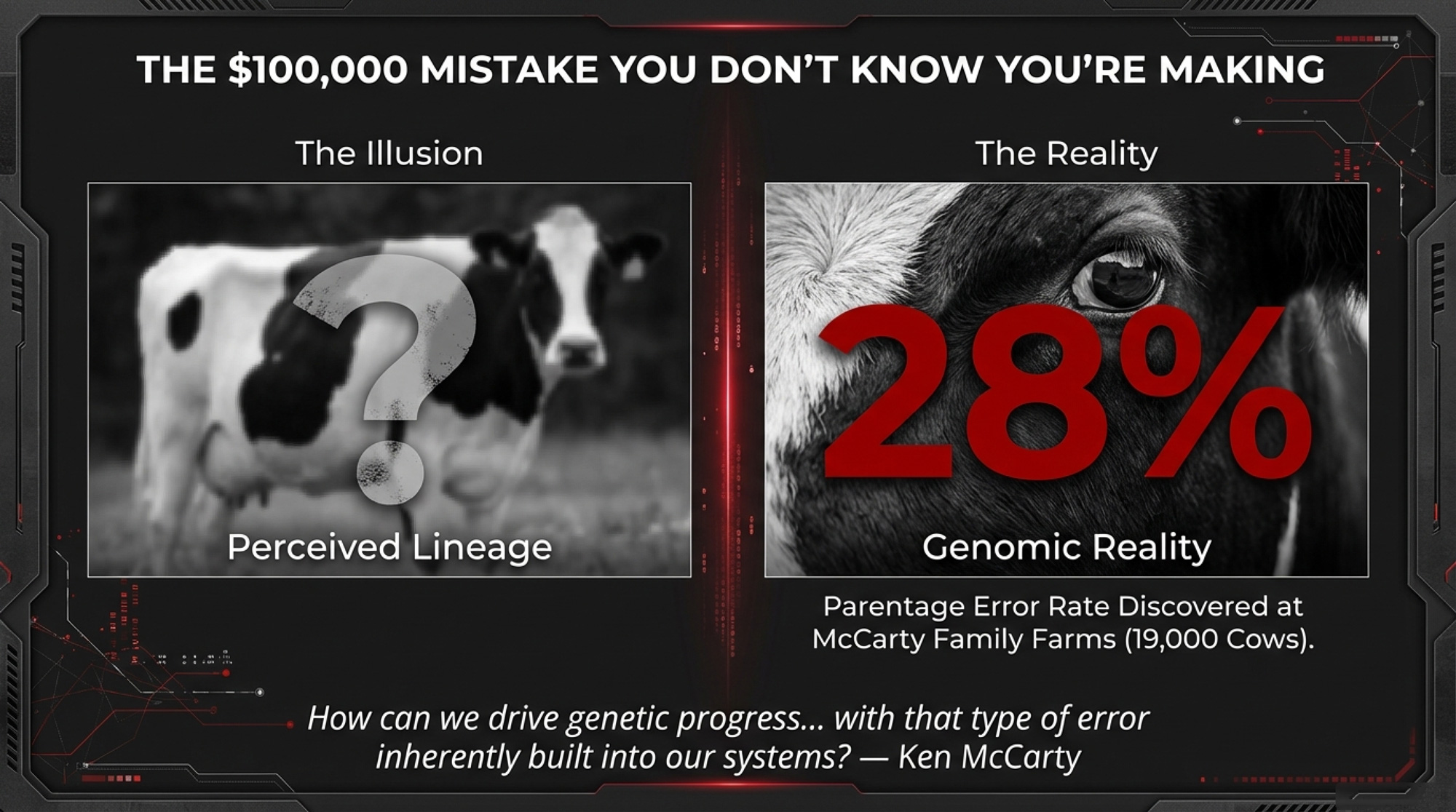
The rule is brutally simple: the top half of the breeding herd creates the next generation, the bottom half goes to beef — regardless of age or stage. And there’s a reason McCarty leaned into genomics so hard. Speaking on the Zoetis-sponsored Uplevel Dairy Podcast in December 2024, Ken admitted — with characteristic bluntness — that when the farm first ran genomic evaluations, they discovered a 28% parentage error across the herd.
Twenty-eight percent. More than one record in four was wrong.
“How can we ever drive the appropriate rate of genetic progress, reduce inbreeding to levels where we want them to be, make the types of breeding decisions that will propel our business and our farms forward with that type of error inherently built into our systems?” — Ken McCarty, Uplevel Dairy Podcast, December 2024
Genomic testing fixed that overnight — and once parentage was right, the data unlocked everything else. McCarty described the shift from treating genetics as “just a piece of what we do every day” to something much bigger:
“As we’ve tried to take genetics and move it from just a piece of what we do every day and transition it into an actual business center — or hopefully a profit center of our business — having that genomic information and being able to isolate those animals that have a unique set of traits or are very high-end animals in terms of various indices, that unlocks the capability and the potential for us to create an entire new avenue for our business and our farms.” — Ken McCarty, Uplevel Dairy Podcast, December 2024
The $40 test isn’t just parentage correction and heifer ranking. For McCarty, it became the entry point for embryo production, genetic sales, and a direct relationship with Danone — an entirely new revenue stream built on data he didn’t have before genotyping.
Parentage Errors: Not Just a McCarty Problem
That parentage problem isn’t unique to McCarty’s scale. AHDB’s Marco Winters, head of animal genetics, flagged the same issue in UK herds: 17% of calves had their sire records updated once genotypes were analysed — 7% had the wrong sire recorded, another 10% had no sire recorded at all.
“It’s surprising how many animals have been misidentified, often assigned the wrong sire, and sometimes even the wrong dam.” — Marco Winters, AHDB, June 2024
If you’ve never genotyped your herd, you don’t know how deep your own parentage error runs. That’s not a comfortable thought when you’re spending $1,850 per head to rear replacements based on those records.
| Source | Herd/Sample Size | Parentage Error Rate | What That Means |
|---|---|---|---|
| McCarty Family Farms (US) | 19,000-cow Holstein herd across 5 farms | 28% error | More than 1 in 4 breeding records wrong — sire, dam, or both misidentified before genomic testing |
| AHDB (UK) | National Holstein data, 2024 genotyping analysis | 17% total correction rate (7% wrong sire, 10% no sire recorded) | Nearly 1 in 5 calves had parentage corrected after genotyping — systematic misidentification across UK herds |
| Implied Industry Baseline (CDCB/Holstein Canada) | Not directly quantified, but reliability data suggests 20–30% pedigree uncertainty | Estimated 15–25% error in herds without systematic verification | Breeding decisions, genetic evaluations, and culling choices built on unreliable foundation |
The operation earned World Dairy Expo’s 2025 Dairy Producer of the Year award on October 1 — a recognition not just of scale, but of on-farm milk processing, a direct supply partnership with Danone North America, and a genomic discipline applied consistently across all five farms. The fifth generation is beginning to join the operation.
What Does a $40 Genomic Test Actually Change About Your Breeding Decisions?
Here’s what matters for a 400-cow herd: the technology is the same. And the reliability jump tells the whole story.
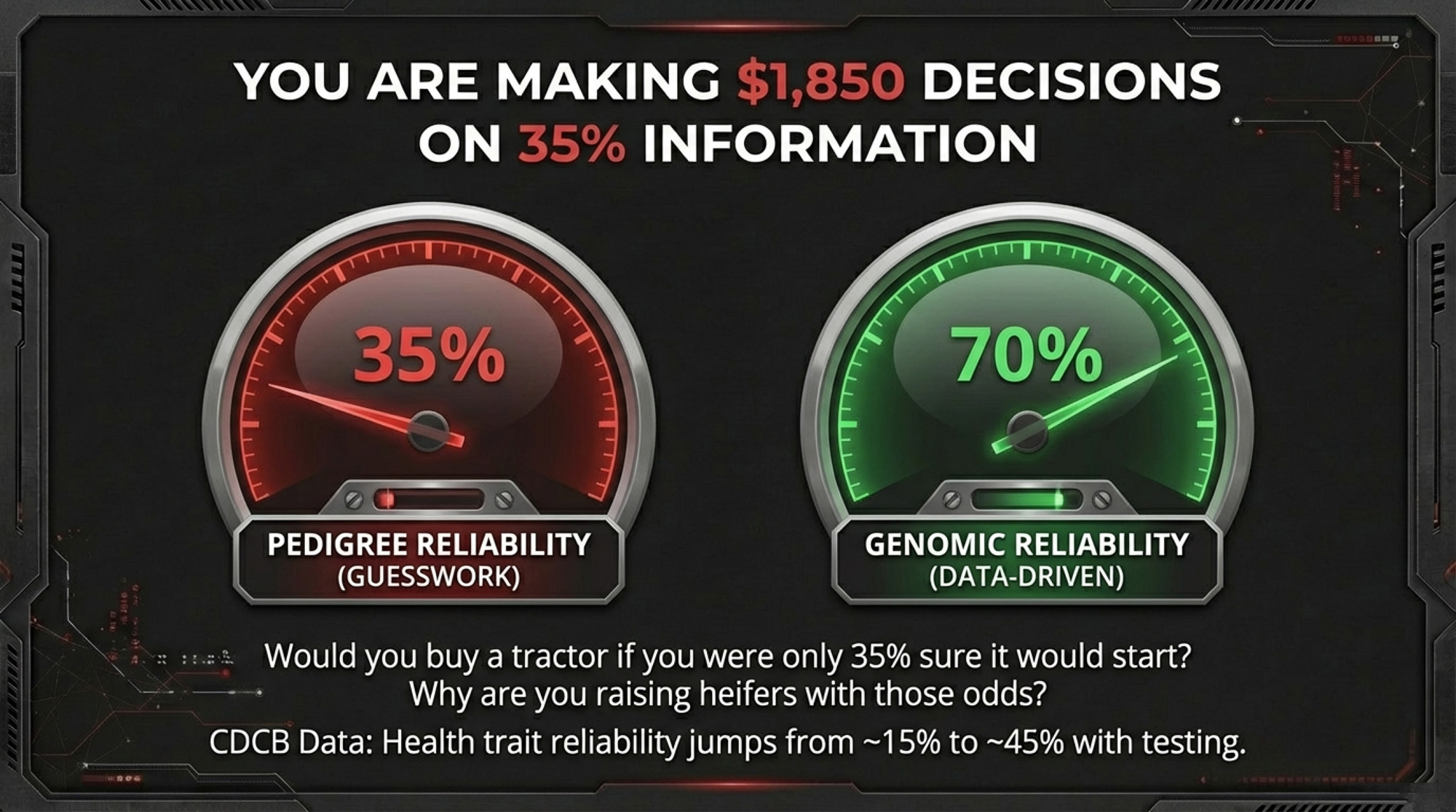
According to Holstein Canada, the parent average prediction has about 35% reliability for a young animal. A genomic test bumps that to roughly 70%. That’s a doubling of certainty for $40 a head. VanRaden’s foundational 2009 study in the Journal of Dairy Science documented realized reliabilities of 50% for genomic predictions versus 27% for parent averages when averaged across all 27 traits in North American Holsteins. The CDCB’s own data on health traits shows genomic reliability of 40–49% in young animals versus just 11–18% from pedigree alone.
Put differently: you’re making $1,850-per-head rearing decisions on 35% information. Or you’re spending $40 to make the same decision with 70% of the information. The math isn’t subtle. And that’s the same principle that turned a handful of bold sire bets into the modern Holstein breed — except now any producer can run the numbers on their own herd instead of waiting a decade for progeny proof.
AHDB’s June 2024 analysis found that UK producers genotyping 75–100% of their heifers averaged a £430 PLI for their 2023 calves, versus £237 for those testing under 25% — a £193 gap. Winters called it “a massive difference in profit potential between the best and worst herds.” The theoretical value runs about £19,300 on a typical 175-head herd, but AHDB’s analysis of actual margins from farm business accounts pegged the advantage at over £50,000. UK adoption backs the trend: a record 112,507 new females were genomically evaluated in 2024, up 19% from the year before. The index names differ across borders, but the genotyping-gap pattern holds wherever it’s been measured.
A fair caveat: Winters himself notes that “the genetic benefits seen in the top herds are not necessarily only a consequence of heifer genomic testing” — producers who test are also more likely to be genetically engaged across the board. But that’s the point. The $40 test isn’t just a parentage check or a ranking tool. It’s the entry point to a different way of managing your breeding program. The herds that start testing tend to make better decisions everywhere else, too. That’s the gap Kelly Donkers was staring at when she decided the grey-haired cows might need a harder look.
Why Aren’t More Herds Genotyping? The Barrier Nobody Talks About at Extension Meetings
If the math works this cleanly, why isn’t every mid-size herd running these panels?
It’s not the $40. And it’s not access — Zoetis, Neogen, and others will ship kits to any address in the country. When EastGen surveyed producers at Canada’s Outdoor Farm Show who weren’t genomic testing, the answers ranged from “we don’t have time” to “it’s a waste of money.” But those are the polite answers. The real friction runs deeper.
At Rose Vega Farm in Branchton, Ontario — a 100-cow registered Holstein herd — Kelly Donkers put it plainly during an EastGen genomics workshop at Canada’s Outdoor Farm Show in 2023:
“There are probably more grey-haired cows on our farm than just about anybody else.” — Kelly Donkers, Rose Vega Farm
Her husband, Luke, conceded that he regularly keeps cows in the milking herd for sentimental rather than profitability reasons. But he also outlined the potential benefits of analyzing genomic evaluations — from building on the positive traits of cow families to avoiding genetic defects. Genetics can’t be overlooked, he agreed.
The Donkers aren’t the cautionary tale here — they’re the honest ones. Most farms that keep low-genomic animals don’t talk about it publicly. Kelly and Luke did so at an industry event in front of their peers. That candor is exactly what makes the identity barrier visible — and it’s the same tension every mid-size herd eventually has to confront.
That tension — I know what the data says, but she’s earned her place here — scales differently depending on herd size. At McCarty’s operation, no individual animal carries emotional weight. The sort is automatic. But at 100 cows, or 400, or 700, some of your worst genomic heifers are also the ones whose families built your prefix, won your first banner, and convinced your daughter she wanted to stay on the farm.
EastGen’s Jamie Howard framed the shift bluntly: “At all dairy farms these days, no matter if they’re milking 1,000 cows or 40 cows, there needs to be a genetic strategy that feeds into keeping the farm profitable.” The workshop exercise — asking producers to visually assess four genomic-tested heifers and decide which two to keep — revealed how often gut instinct and genomic data pointed in different directions.
A $40 test doesn’t just rank your calves. It directly challenges the way you’ve always picked bulls, evaluated cows, and told your herd’s story. That’s not a technology barrier. It’s an identity cost. And the pattern plays out repeatedly at workshops across the industry — the hardest part isn’t the first round of results. It’s the second round: you’ve already seen the math work, and now you have to decide whether the data or the pedigree wins every single time. That’s why the adoption curve for female genotyping looks nothing like the adoption curves for activity monitors or feed software.
Can a $40 Test Really Swing Six Figures on 500 Cows?
Here’s the math. Walk through it with your own numbers after.
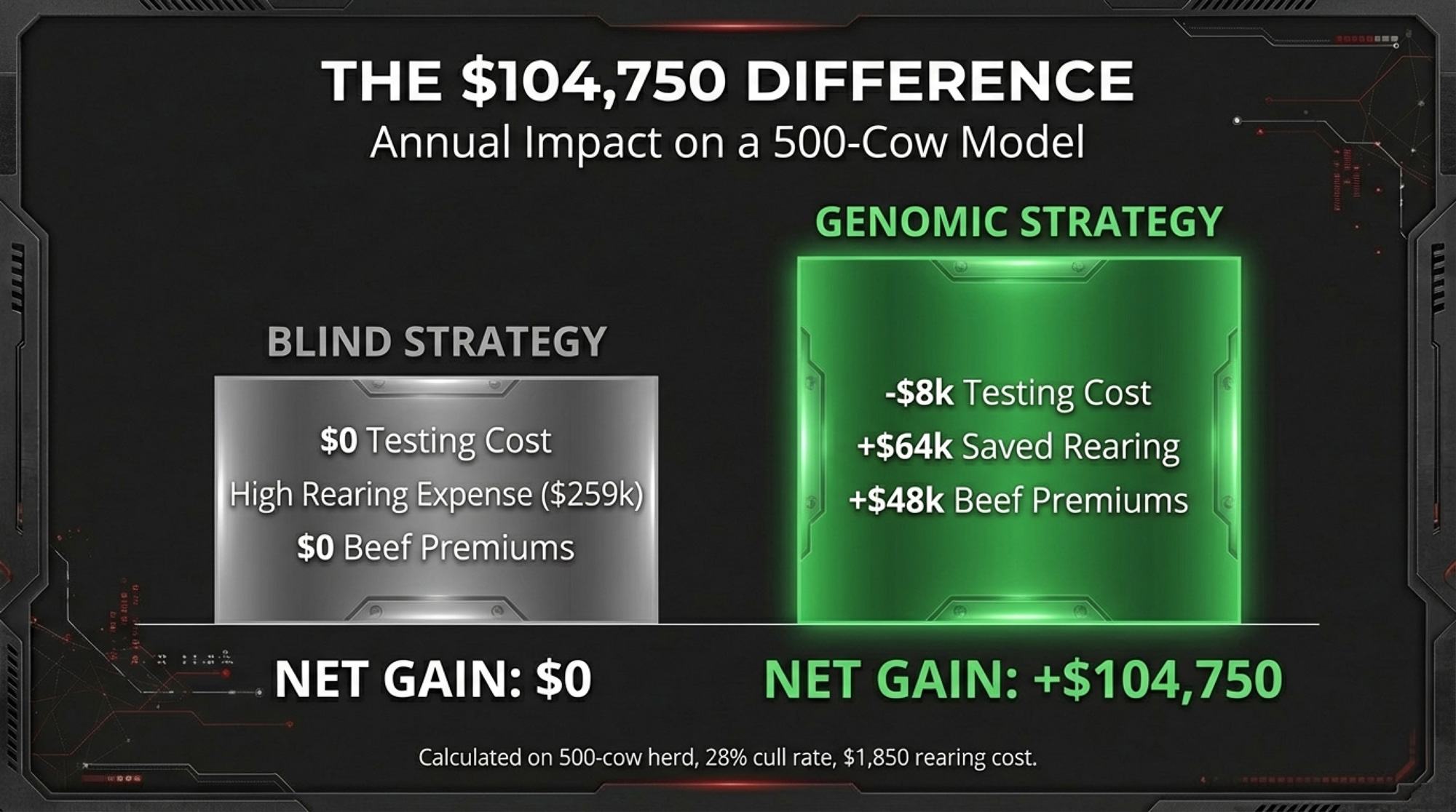
Assumptions: 500 milking cows, 23,000 lbs/cow/year, 28% annual replacement rate = 140 replacements needed. Heifer rearing cost: $1,700–$2,000/head based on FINBIN and Penn State Extension data from 2016–2021 ($1,709 Upper Midwest average, $2,034 Pennsylvania average). Iowa State Extension calculated 2024 rearing costs at just over $2,600 for 24 months. Midpoint for this example: $1,850/head — a conservative figure that understates the current swing.
The Cost of Breeding Blind: Side-by-Side Comparison (500-Cow Herd)
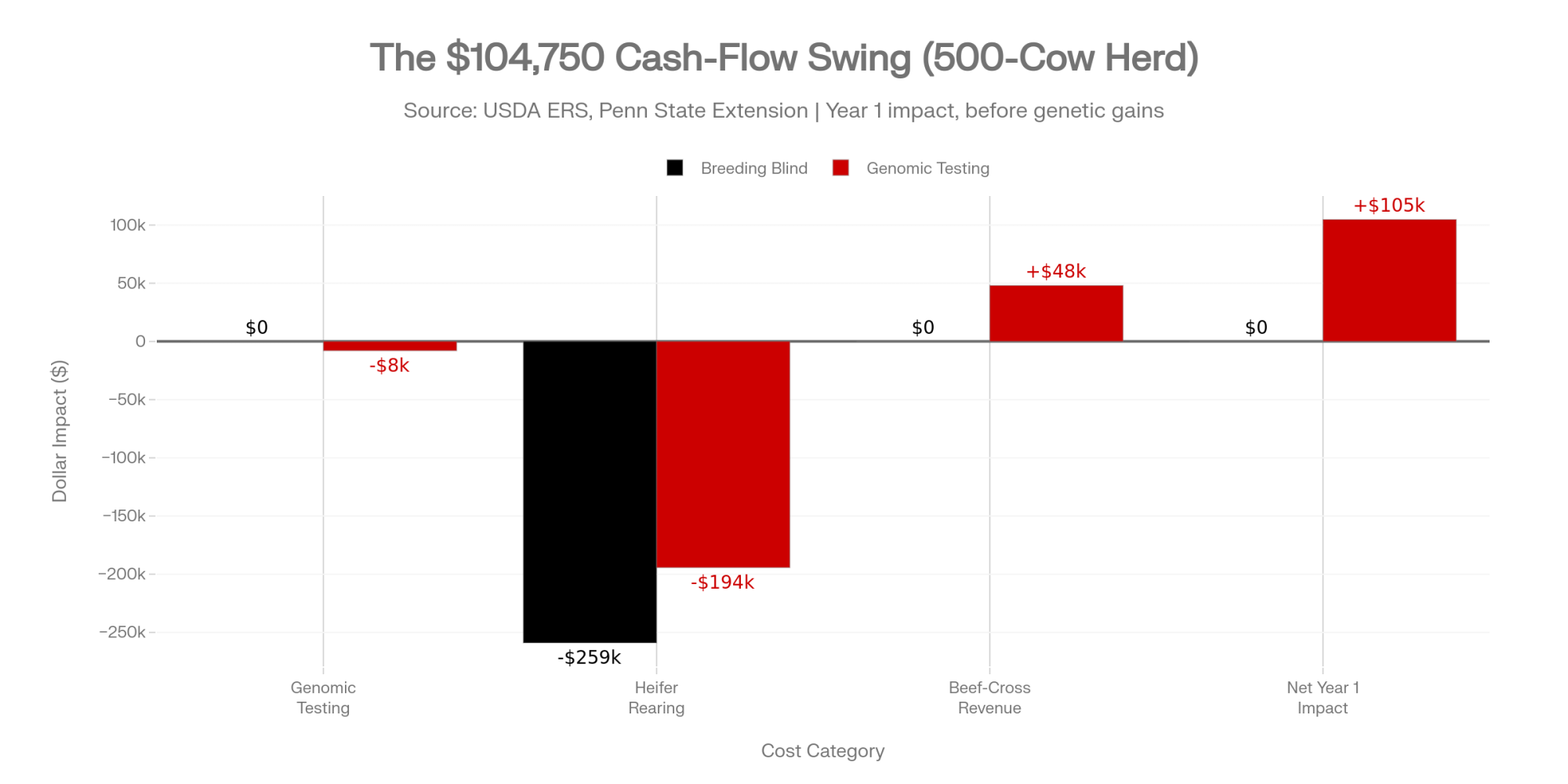
| Expense / Income | Blind Strategy | Genomic Strategy | Difference |
| Genomic testing | $0 | −$8,000 (200 calves × $40) | −$8,000 |
| Heifer rearing | $259,000 (140 head × $1,850) | $194,250 (105 head × $1,850) | +$64,750 saved |
| Beef-on-dairy calf premium | $0 (all Holstein) | +$48,000 (60 beef-cross × $800 avg premium) | +$48,000 |
| Net Year 1 cash-flow impact | $0 (baseline) | +$104,750 | +$104,750/yr |
Genetic merit lift not included in Year 1 total. CDCB genetic trend data and VanRaden’s 2025 NM$ revision (USDA AGIL, ARR-NM9) show national NM$ gains of approximately $80–$120 per year over the past decade. That compounding advantage materializes in the milking string starting in Year 3 and accelerates from there — it’s the portion of the math that doesn’t show up in a first-year cash-flow table but is the reason Kline’s genomic-selected cows outlasted his purchased animals over 14 years.
At Iowa State’s updated $2,600/head rearing cost, the rearing savings alone jump to $91,000 — and with Premier Livestock’s January 2026 auction data showing beef-dairy cross calves at $1,000–$2,000 and most Holstein bulls at $900–$1,425, the premium spread per calf may run well above the $800 midpoint used here. The realistic swing for many herds in early 2026 pushes into the $130,000–$160,000+ range. And that’s before the compounding genetic lift from keeping only your best replacements in the pipeline — a lift that AHDB’s farm business account data suggests is worth over £50,000 once the genetic gap materializes in actual production and fertility.
The exact number is yours to calculate. The direction isn’t debatable.
What Does Genomic Testing Unlock? Four Paths at $18.95 Milk
| Path | What It Is | You Gain | You Give Up |
|---|---|---|---|
| 1. Fix the Margins | Genotype heifers, tighten replacement selection, shift 50–60% matings to beef on bottom end, extend lactations on high-persistency cows | Lower rearing load, higher average cow, beef-cross revenue, ,750+ savings | Comfort of doing what you’ve always done; 12–18 months for pipeline to reflect change |
| 2. Go Bigger | Expand to spread fixed costs, but stress-test at $16.65 milk; secure processor contracts early; lock in 70–80% of supply long-term | Per-cwt overhead closer to $19.14 (mega-dairy level); access to premium contracts | Flexibility — multi-year contracts lock volume, plant, quality spec; hard to exit |
| 3. Differentiate | Organic ($33–$50/cwt) or A2 conversion; requires consumer proximity and marketing capacity | 50–130% premium over conventional; different pricing power | 3-year organic transition costs; ability to pivot if niche cools; not viable for most rural ops |
| 4. Sell Into Strength | Strategic exit during 2026 heifer shortage (springers at $3,200–$4,400); planned dispersal vs. forced liquidation | $400,000–$680,000 preserved family equity vs. $100,000–$200,000 forced sale; control over timing | Chance to ride next upcycle; farm identity |
Once you accept both the math and the identity shift, the question becomes which version of “change” fits your operation. Genomic testing doesn’t just save money on rearing — it fundamentally changes what each of these strategies can deliver. None is universally right. All are better than standing still at $18.95 milk and $20+ costs.
Path 1: Fix the margins — use genomics to ensure every stall earns its keep. Genotype your heifer crop. Tighten replacement selection. Shift 50–60% of matings to dairy on your best animals by index, and a controlled share to beef on the bottom. Extend lactations selectively on high-persistency cows instead of chasing a 40% replacement rate — and consider tightening your heifer breeding window to match your tighter selection criteria. Glenn Kline at Y Run Farms LLC in Troy, Pennsylvania, started genomic testing his roughly 500-cow herd back in 2011 — one of the earlier mid-size adopters — and has used the data to sharpen breeding and culling decisions over more than a decade. If your feed-cost basis is already locked and your component test is trending right, this path is halfway done — genomics sharpens the blade. You gain: lower rearing load, higher average cow, beef-cross revenue. You give up: the comfort of doing what you’ve always done. It takes 12–18 months for the replacement pipeline to reflect the change fully.
Path 2: Go bigger — but stress-test it at $16 milk. Run your expansion pro forma at USDA’s $16.65/cwt Class IIIforecast, not the price you hope to see. If the plan only survives at $20 milk, it’s a bet, not a budget. IDFA confirmed on October 2, 2025, that more than $11 billion in new and expanded dairy processing capacity is under construction or planned across 19 U.S. states, with over 50 projects coming online through early 2028. CoBank’s analysis found processors have already pre-secured 70–80% of their required milk supply through long-term contracts, predominantly with operations milking 2,000+ cows. One central Pennsylvania producer was recently offered a premium for exclusive supply but required a commitment to all production through the decade’s end — no spot sales, no price shopping during market spikes. If you’re already at 500 cows and your facility can handle 750 without a new barn, the per-cwt math on your existing overhead flips fast. But if expansion means $3 million in concrete and steel, pressure-test that debt at the price floor, not the price hope. You gain: fixed-cost spread closer to the mega-dairy’s $19.14/cwt COP. You give up: flexibility — multi-year contracts lock you to a plant, a volume, and a quality spec that’s hard to exit.
Path 3: Differentiate. Organic pay prices in early 2025 ranged from $33–$45/cwt for grain- and pasture-fed, with grass-fed certified operations seeing $36–$50/cwt — a 50–130% premium over conventional, per the Northeast Organic Dairy Producers Alliance. A2 is gaining traction too — AURI’s 2024 market assessment documented increased interest in A2 genetics among Minnesota dairy farmers, with some actively converting their herds. The question is whether you have the consumer proximity and marketing stomach for it — most rural operations don’t, and a three-year organic transition is expensive when milk is already below cost. You gain: a different kind of pricing power. You give up: three years of organic transition costs and the ability to pivot quickly if the niche cools.
Path 4: Sell into strength. CoBank’s August 2025 outlook flagged 438,844 fewer dairy heifers projected for 2026 — driven by 398,925 more beef-on-dairy calves born and 198,925 fewer dairy calves reaching the completion rate threshold, only partially offset by 170,181 additional heifers from sexed semen. Top-quality Holstein springers at Pipestone Livestock in Minnesota brought $3,200–$4,000 per head in February 2026, with Premier Livestock in Pennsylvania reporting $2,800–$4,400 the same week, and CoBank projects the deficit won’t recover until 2027. A planned dispersal can preserve $400,000–$680,000 in family equity versus $100,000–$200,000 in forced liquidations. If you’ve been thinking about this for more than a year and the next generation isn’t coming back, the math for selling has never been better — and waiting rarely improves it. You gain control over timing and what comes next for your family’s equity. You give up: the chance to ride the next upcycle.

| Year | Heifer Inventory (relative to 2024 baseline) | Market Price Range for Top Springers |
|---|---|---|
| 2024 | 0 (baseline) | $2,200 – $2,800 |
| 2025 | -150,000 | $2,800 – $3,400 |
| 2026 | -438,844 (CoBank projection) | $3,200 – $4,400 |
| 2027 (projected recovery start) | -300,000 (recovering) | $2,800 – $3,600 |
| 2028 (projected) | -100,000 (continued recovery) | $2,400 – $3,200 |
What to Do Before Your Next Calf Crop Hits the Ground
- This month: Pull a full-cost breakeven — family labor at a realistic wage, depreciation, return to management, all of it. Compare it to $18.95. If you’re more than $1.50/cwt over, structure determines your 2026, not luck.
- Within 30 days: Order genomic panels on your next calf crop. Start with one round of heifer calves. The cost is $8,000 on 200 head. The information value could reshape your breeding program for the next decade.
- 90 days after results arrive: Review the NM$ spread within your own herd. If the gap between your top and bottom calves exceeds $200, that’s your starting point for restructuring your breeding plan. If the spread is tighter than expected, your past sire selection has been better than you thought — and genomics just confirmed it for less than the cost of one heifer’s feed bill.
- Check your parentage before you trust your matings. McCarty found 28% error. AHDB found 17%. You don’t know your own number until you test.
- Watch DMC margins. The Center for Dairy Excellence projected January 2026’s margin at roughly $7.52/cwt— nearly $2/cwt below the $9.50 Tier I trigger. DMC Tier I coverage expanded to 6 million pounds for 2026.
- 365 days from now: Compare your first genomic cohort’s actual first-lactation data against your pre-genomic replacements. That’s your real ROI — not the model, the milk check.
Key Takeaways
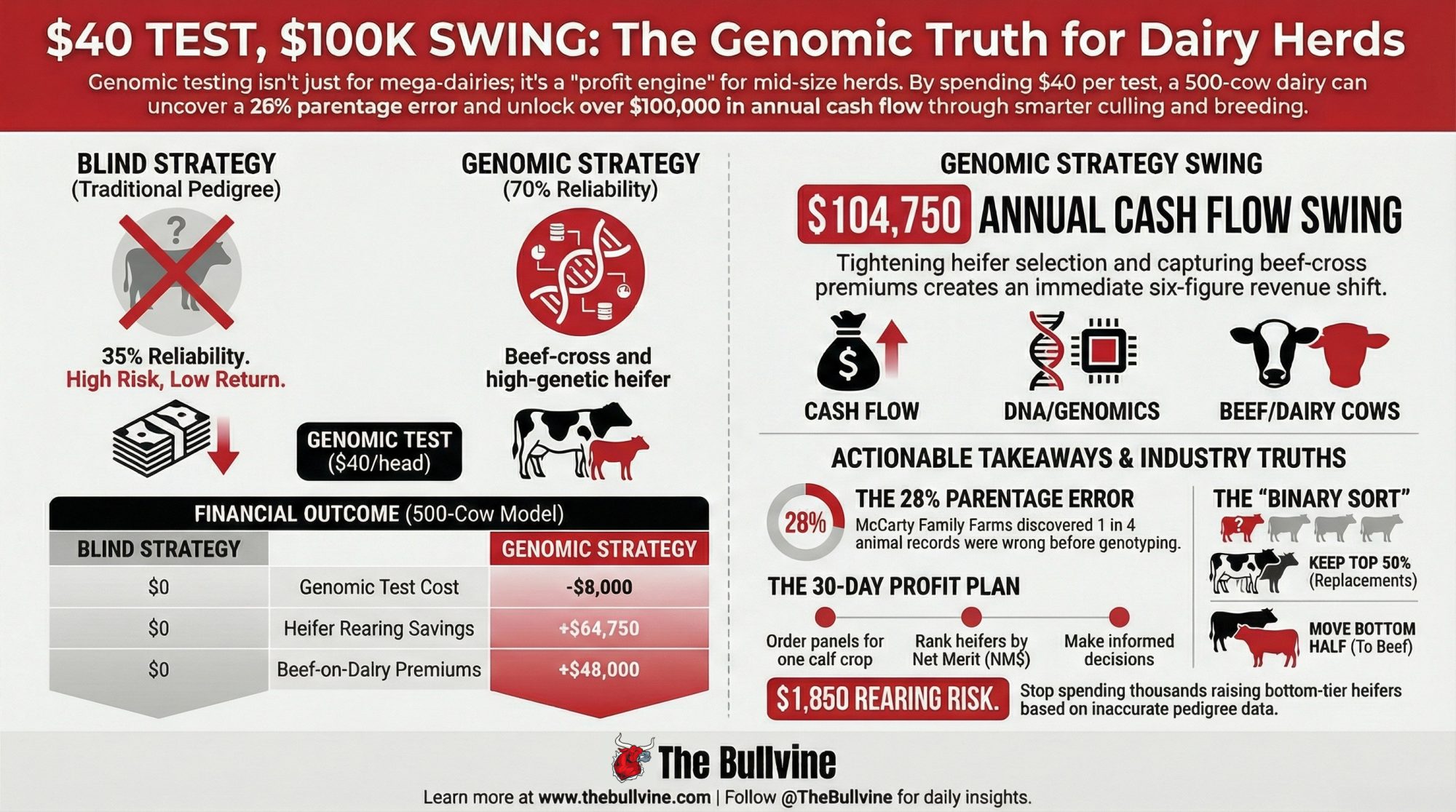
- McCarty’s first whole‑herd genomic run found a 28% parentage error across 19,000 cows, making a ~$40 heifer test a baseline requirement, not a luxury.
- On a modeled 500‑cow herd, using genomics to tighten replacement selection and push the bottom end to beef unlocks about $104,750/year in cash flow before long‑term genetic gains.
- Independent data from AHDB, CDCB, and Holstein Canada confirm the engine behind that math: genomic testing roughly doubles reliability over pedigree and consistently widens the profit gap for herds that test most heifers.
- The real barrier for mid‑size dairies isn’t the test cost — it’s the identity friction of cutting daughters from cow families you’re emotionally attached to, even when the numbers say they’re dragging the herd.
- In the next 30 days, you can test one calf crop, rank heifers by NM$, and draw a hard line (for example, bottom 25% to beef, top 50–60% for sexed dairy) so every replacement you raise fits one of four clearer paths: fix the margin, grow, differentiate, or sell into strength.
The Bottom Line
McCarty’s operation didn’t grow from a Pennsylvania dairy started near Sugar Run in 1914 — through Tom and Judy’s 150-cow barn, to 250 cows loaded onto trucks bound for Rexford, Kansas, on April 1, 2000 — to the world’s largest registered Holstein herd by accident. But the lesson for a 400-cow herd isn’t “get bigger.” It’s the same $40 panel, the same NM$ index, and the same binary sort that could be running in your barn next month – just like the Donkers began weighing at their own kitchen table after that EastGen workshop.
Pull your last 12 months of calf sales. Add up what you spent rearing every heifer that freshened below herd average last year. That’s your number. Is it worth $40 a head to know it in advance?
Complete references and supporting documentation are available upon request by contacting the editorial team at editor@thebullvine.com.
Learn More
- $3,010 Per Heifer. 800,000 Short. Your Beef-on-Dairy Bill Is Due. – This analysis exposes the 800,000-head replacement gap locked into the 2026 market. It delivers the strategic intelligence needed to survive dairy’s structural reset, revealing why beef-on-dairy premiums are no longer a no-brainer for every herd.
- Stop Breeding by Color: Genomics, Heat Stress and Beef-on-Dairy Math That Can Add Over $4/cwt to Holstein Margins – This guide breaks down a 12-month “learn from your own data” trial to fix execution leaks. It arms you with concrete genomic sorting tactics to protect your margin and identifies heifers dragging down your herd’s true profitability.
- The Next Frontier: What’s Really Coming for Dairy Cattle Breeding (2025-2030) – This outlook reveals how AI and precision genetics will drive $3,000–$5,000 in additional annual revenue per cow. It delivers an implementation roadmap for robotic systems and health-trait selection to slash labor costs while boosting milk yields.
The Sunday Read Dairy Professionals Don’t Skip.

Every week, thousands of producers, breeders, and industry insiders open Bullvine Weekly for genetics insights, market shifts, and profit strategies they won’t find anywhere else. One email. Five minutes. Smarter decisions all week.