





It’s August. Entry deadline’s next week, the good heifer’s coming along nice — and you’re doing the math you never write down. $3,800 a cow. Ten days gone. Only $280 of it is Expo’s. Go — but go knowing what you’re trading.
A longtime exhibitor who’s been showing since the 1970s ran the numbers out loud for us. About $3,000 to exhibit one animal, another $2,000 for travel, meals, and a hotel. Call it $5,000. Then he figured that matched a Hawaii trip for two, and said one word.
“Aloha.”
He wasn’t complaining. He was doing something most of us avoid: pricing the thing honestly and saying the number out loud.
Here’s the number we built. A family hauling their own five-cow string to Madison spends roughly $3,800 per cow, all in. Not five cows for $3,800 — $3,800 each. And that’s the efficient version, where you’re spreading a tack fee, one vet call, one fuel bill, and one hotel room across five head.
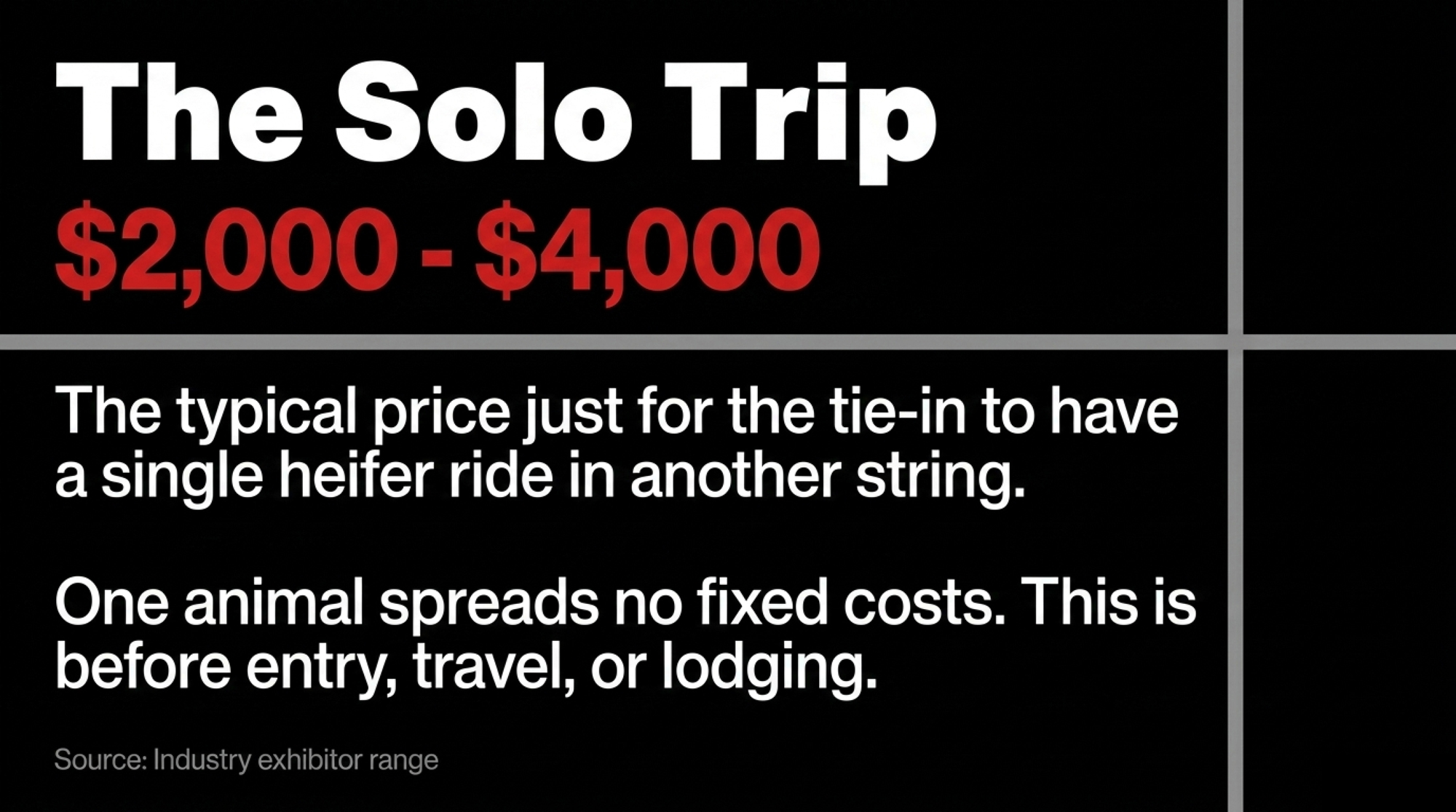
Want the benchmark that makes it real? An exhibitor who sends a single animal to ride along with someone else’s string — no truck, no tent, no crew of their own — typically pays $2,000 to $4,000 just for the tie-in, depending on age, because cows are more work than heifers. That’s before entry. Before their own travel. Before lodging. Before the days away. That’s the industry range from exhibitor conversations, not a published rate.
Sit with that for a second. Somebody pays up to four thousand dollars for the privilege of having their heifer ride in another man’s trailer.
So when you haul your own five head, and it lands near $3,800 a cow, you’re not saving money. You’re paying the same freight in a different currency — your labor, your ten days, your hired milker, your week that didn’t go to anything else.
This is not an argument against going. Read that twice. Madison is still where the dairy cattle world does business, and the education, the people, and the market that exist in that building don’t exist anywhere else. The argument is that you should go knowing precisely what you’re trading — and that “we go every year” is a decision you should make on purpose instead of by habit.
Editor’s note: This is opinion and analysis. The cost breakdowns and recommendations are The Bullvine’s alone, not World Dairy Expo’s position. The Bullvine shared this analysis with World Dairy Expo before publication. Expo responded but did not provide a statement for publication. The $5,000 exhibitor estimate and the $2,000–$4,000 tie-in range reflect composite exhibitor testimony gathered by The Bullvine — not published rates, and not one named source. Fixed fees come from WDE’s published 2025 entry materials. Hotel figures are a dated third-party booking snapshot pulled in July 2026, not a quoted Expo housing-bureau rate. Anything not a published fee is tagged [ESTIMATE]. An earlier version of this analysis modeled a single-cow entry at about $4,142; WDE’s display and tack-space fee applies to strings of 5 to 14 head, so that model overstated one line and has been rebuilt.
What Does Expo Actually Charge? Less Than You Think
Start here, because it’s the part that surprises people and it matters for where you point your frustration.
WDE 2025 ran September 30 through October 3 at the Alliant Energy Center in Madison. Per WDE’s 2025 entry materials, entry was $100 per head by the online deadline, $250 late. A substitution after the first free change ran $150. Display and tack space for a 5-to-14-head string was $450 for one booth or tent — about $90 per cow across five. Exhibitor season tickets ran a discounted $30, up to four per entry. Youth showmanship and fitting contests: $10 on time.
Entry, prorated tack, and three exhibitor tickets: about $280 per cow.
For access to the deepest concentration of elite dairy cattle, buyers, classifiers, and genetics decision-makers on the planet, $280 is not the problem. WDE’s own materials say plainly that entry fees don’t cover what goes into a walk on the colored shavings, and they’re right.
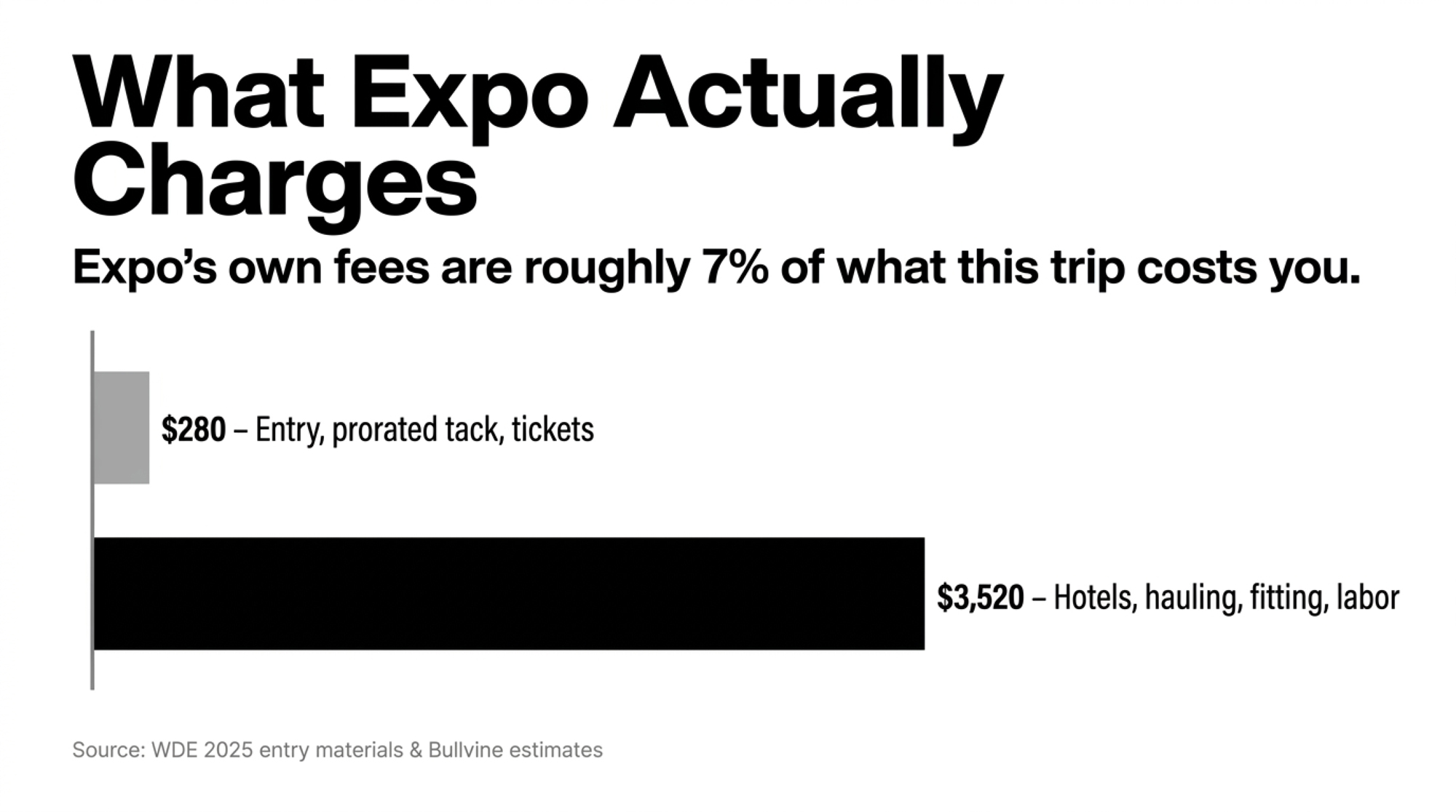
Expo’s charges are roughly 7% of what this trip costs you. The other 93% is hotels, hauling, fitting, feed, health paperwork, meals, and somebody covering your barn. That’s the part nobody itemizes, and it’s the part that’s been quietly climbing.
Where the Money Actually Goes
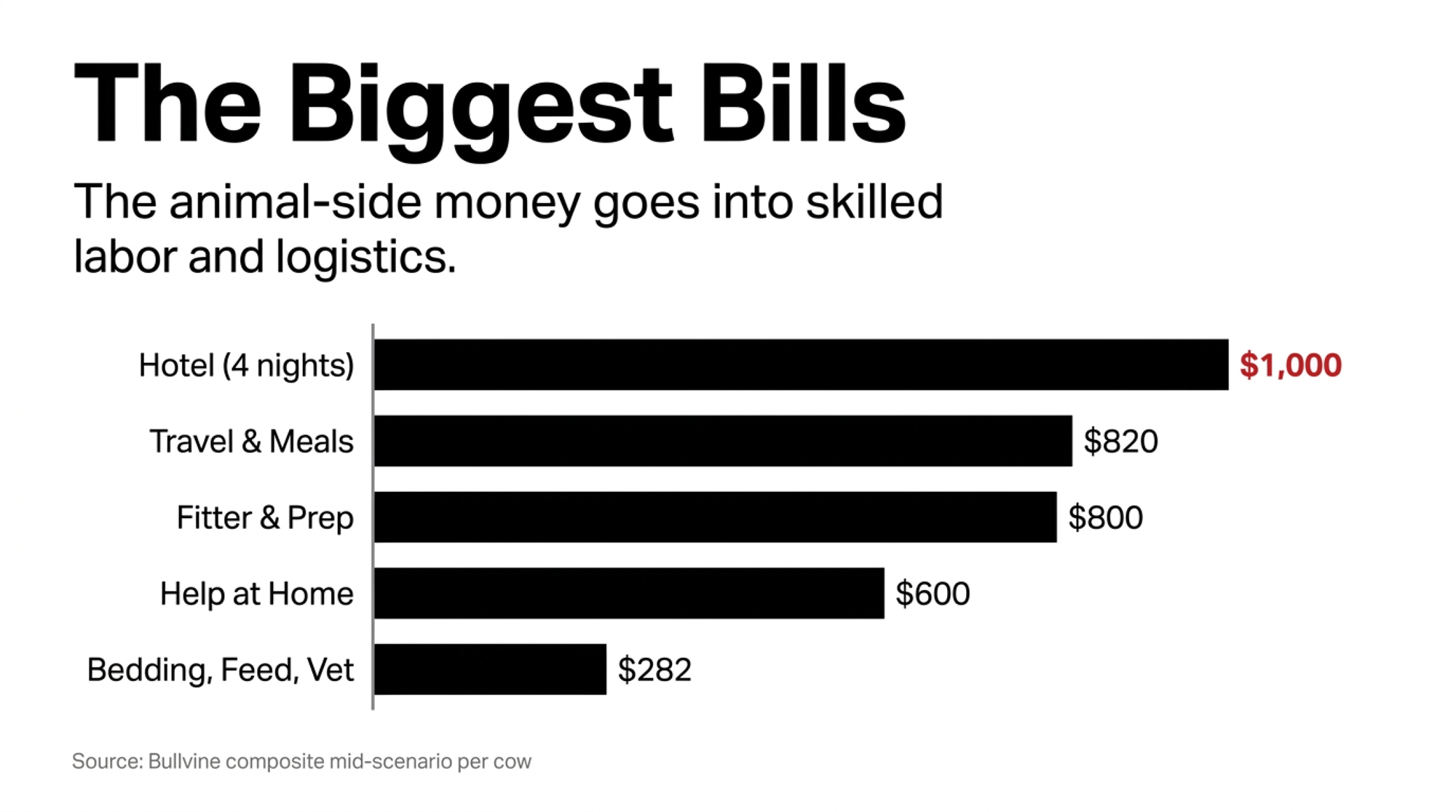
Fitting and prep. The animal-side money goes into fitters and full-service crews. It rarely appears in a premium book, but it’s real — and WDE’s entry agreement makes exhibitors responsible for anyone, fitters included, who preps or shows the animal. For a sense of what skilled show-barn labor commands: Chandler Barber, the first-ever Night Man of the Year at the Royal Agricultural Winter Fair, earns premium overnight rates reported at $900 a night for the cattle in his care. That’s overnight watch at another show, not a Madison clipping rate — but it tells you this work is priced like a trade, not a favor. We budget $800 per cow for the entire week [ESTIMATE, $600–$1,000 range] covering clipping, daily washing, topline work, and ring prep. Given what the market pays for skilled hands, treat $800 as a floor and substitute your own crew’s real rate.
Hotels — the largest single line and the softest sourcing here. A July 2026 booking snapshot near the Alliant Energy Center showed quiet-period rooms far cheaper and event-heavy stretches climbing into the low $300s a night. That’s a consumer aggregator checked once, months early, for a September event — not an Expo housing quote. The model uses $220–$280 a night for a shared room. If you have a real quote, use yours.
Hauling. At 11 mpg and $3.75 diesel, a 300-mile round trip burns about $102 in fuel; call it $150–$200 with wear. A 600-mile haul: $250–$350. Eight hundred-plus miles off the East Coast, $400–$500. All [ESTIMATE].
Health paperwork. APHIS updated its guidance on interstate movement of lactating dairy cattle, easing federal HPAI testing requirements for cattle moving from Unaffected states. Confirm WDE’s own current health requirements before you enter — a show’s rules can be stricter than the federal baseline, and they have changed year to year. Expect at minimum a current CVI and official RFID identification, and budget for milk testing if your state’s status calls for it. Your vet sets that price, not Expo — roughly $100–$150 for the call and CVI [ESTIMATE], and it’s the same bill whether you haul one head or ten.
Coverage at home. USDA’s Farm Labor report put hired-worker wages in the Lake Region — Michigan, Minnesota, and Wisconsin — at $19.17 an hour in the April 2024 reference week and $19.46 in October 2024. Call it about $19. Six to eight hours of daily coverage across four days runs $450–$610 in cash [ESTIMATE] — before your own unpaid time.
What Does One Cow Cost in a Five-Cow String?
Four nights, hired fitter, shared room, three exhibitor tickets, 600-mile round trip. Every figure below is per cow — string-level costs have already been divided across five head.
| Line item | Per-cow amount | Type | Basis |
| Entry fee, on time | $100 | FIXED, per head | WDE 2025 entry materials |
| Display/tack space | $90 | FIXED, prorated | $450 string fee ÷ 5 head; WDE 2025 entry materials |
| Exhibitor tickets | $90 | FIXED, per entry | 3 × $30; WDE 2025 entry materials |
| Vet call + CVI | $120 | ESTIMATE, prorated | One farm call, split across the string; vet-set, not a WDE fee |
| Milk testing, where required | $30 | ESTIMATE, per head | State status and show rules dependent |
| Bedding | $60 | ESTIMATE, per head | 3–5 bags |
| Feed increment | $72 | ESTIMATE, per head | Four-day increment |
| Fitter/show preparation | $800 | ESTIMATE, per head | Conservative floor; $600–$1,000 range |
| Travel, fuel and tolls | $300 | ESTIMATE, prorated | One 600-mile round trip ÷ 5 head |
| Hotel, four Expo-week nights | $1,000 | ESTIMATE, prorated | Shared rooms for the crew ÷ 5 head |
| Meals, two people × four days | $520 | ESTIMATE, prorated | $65/person/day ÷ 5 head |
| Help at home | $600 | ESTIMATE, prorated | Relief milking at ~$19/hour ÷ 5 head |
| Total per cow | ≈ $3,800 | Mid scenario | 9 of 12 lines estimated |
How to read this table: every number is what one cow costs you. Shared expenses — the truck, the rooms, the vet call, the relief milker, the food — are string-level bills already divided across five head, so a bigger string spreads them further and a single animal absorbs them alone. Bring one cow instead of five, and the prorated lines don’t shrink; they land on her by herself. That’s why a lone entry can cost more per animal than a full string.
Nine of twelve lines are estimates. This is a scenario, not a fact — and change four assumptions and it swings hard:
| Scenario | Assumptions | Per cow |
| Lean | Own clipping, 300-mi haul, shared room off-peak, one traveler, family covers home | ≈ $1,800–$2,200 |
| Mid | Table above | ≈ $3,800 |
| Heavy | Full-service crew, 800+ mi, five nights, three travelers, full hired coverage | ≈ $5,500–$6,500 |
Anyone quoting one number for “the cost of Expo,” us included, is quoting a scenario. Build yours before you enter, not after you get home.
The Bill That Never Gets Written
Now the part the table can’t hold, and the part that actually drives people out.
It isn’t four days. It’s closer to ten. Clipping starts the week before. Then loading, hauling, setup, four days on your feet, teardown, the drive home, unloading — and the day afterward when you’re useless. Ten days out of a farm year, gone.
Somebody else is milking your cows. You’re paying them, you’re worried about them, and you’re checking your phone at 6 am from a hotel room in Madison, wondering whether the parlor’s running. Every experienced exhibitor knows that feeling, and nobody puts it on the invoice.
The week didn’t go anywhere else. Same days, same money. For most operations, this is genuinely the family trip that didn’t happen — and that’s where the Hawaii comparison stops being a joke. It’s not that Maui is better. It’s that you only get one week, and you spent it in a barn.
The farm work that waited. The field, the repair, the breeding decision, the fence. It’s all still there when you get back, and now you’re ten days behind.
Four days of being “on.” The ring, the buyers, the small talk, the placings — and the disappointment if it goes sideways in front of people whose opinion genuinely matters to you. That’s real cost, and it lands hardest on the people who care most.
And here’s the honest other side, because a piece that only counts the losses is lying. Those ten days are also the barn at eleven at night. The people you see once a year. The kid who watches a class and decides this is what they want. The conversation by the wash rack that becomes a sale two years later. Nobody who’s been there would trade all of it away.
All of that is real. None of it is a financial return. And that distinction is the whole game.
Can You Actually Name What You’re Getting?
Here’s where we have to be straight about an asymmetry in our own reporting.
We can document the cost to the dollar. We cannot document the return.
The one concrete upside figure available is four decades old. Brookview Tony Charity walked into a 1981 ring with swollen hocks and a cooling crowd; Peter Heffering paid $47,000 anyway. Four years later, Romandale Farms bought a 50% share for a Canadian-record $1.4 million. One animal. Once. During the Reagan administration.
| Scenario | What’s Included | Per-Cow Cost | Financial Return Documented? |
|---|---|---|---|
| Individual Exhibitor | Own clipping, 300-mi haul, off-peak shared room, one traveler | $1,800–$2,200 | No — same asymmetry applies |
| Typical Herd/Exhibitor | Hired fitter, 600-mi haul, 4 nights, 3 tickets | $3,800 | No — no published average resale/added-value figure exists |
| Big Time Exhibitor | Full-service crew, 800+ mi, 5 nights, 3 travelers, full hired coverage | $3,000–$6,000 | Depends, if they have any winners that they can market/sell. |
| Champion / sale animal (top tier) | Any scenario above, plus buyers already in the barn | Same as above | Yes — Brookview Tony Charity sold for $47,000 in 1981, then $1.4M for a 50% share in 1985 |
Beyond that, published data doesn’t give a reliable average resale or added-value figure for a typical mid-class Expo cow. We’re not inventing one, and we’re not claiming we’ve proven there isn’t one.
And the sale ring isn’t the only ledger. A twelfth-place heifer won’t pay for the trip on hammer price, but the barn aisle is a marketplace of its own — international buyers walking stalls, embryo interest, semen conversations, a cow family getting seen by people who make mating decisions for a living. That return is real, and it’s why plenty of serious breeders keep going. It also only exists if you work the aisles: standing up, talking to strangers, having your pedigrees and your story ready. Sit on the showbox for four days, and it doesn’t happen.
But the asymmetry itself is the finding. No one has produced evidence that a mid-pack Madison placing generates a measurable financial return. Absence of proven return isn’t proof of absence — for a family deciding in August, though, it functions the same way. If a benefit can’t be documented, measured, or predicted, you cannot finance a decision on it. You can still choose it. You just can’t call it a return.
At the top, the math genuinely works. A champion, a real sale animal, a flush prospect with buyers already in the barn — those trips pay, and Madison is where that ceiling exists. That’s a thin slice of the stalls, and most of us know before we load which slice we’re in.
So Should You Send Her This Year?
Here’s our position, and it’s a judgment call rather than a proven fact: for most of us, going every single year no longer pencils — and that’s fine, because it was never supposed to be an obligation.
Go when you have the animal. Sit out when you don’t. That’s not retreat; it’s how people stay in this long enough to have the year that matters.
Three questions before you enter:
- Name the commercial vehicle. Is there a specific embryo contract, consignment, semen deal, buyer conversation, or classification goal this trip is meant to serve? If yes — go, and work the aisles. If no, that’s not disqualifying, but stop calling it an investment.
- Make the honest ring call. Not her genomic number. Can she stand at the top of her class on that day, against that competition, under that judge? You usually know before you load.
- Run the farm resilience audit. Can the herd at home absorb ten days on relief labor without something breaking? Not the money — the days. That’s the answer that usually decides it and the one people examine last.
If you’d go with zero dollars coming back, go. You’ve priced it correctly, and family, tradition, the next generation, and the love of good cattle are legitimate reasons to spend $3,800 and ten days. They’re the same reasons people spend it on Hawaii — and nobody apologizes for that.
If you’d only go if it pays, be honest about whether this is that cow and that year.
The trouble was never the cost. It’s telling yourself it’s an investment, then feeling like a failure when the ledger won’t cooperate.
Key Takeaways
- Roughly $3,800 a cow in a five-cow string. Expo’s own fees are about $280 of it — the other 93% is everything around the show.
- Tying in one animal runs $2,000–$4,000 before entry and travel. One animal spreads no fixed costs; five spread them all.
- It’s ten days, not four. Price the whole commitment, including whoever milks and what waits when you get back.
- The sale ring isn’t the only return — but barn-aisle marketing only pays if you’re up working it.
- Go when you have the animal, not because it’s October. Sitting out a year isn’t quitting.
Related reading: We made the case that the cattle were never the problem, and neither was the ring, when we looked at why Expo’s crowds thinned while the show ring stayed magnificent.
What actually happens is quieter than a decision. One August a family sits at the kitchen table, runs the numbers, looks at the ten days, thinks about the few minutes in the ring — and it doesn’t add up. Nobody announces it. They don’t enter, and then they don’t enter again, and the hardest part is that they still love it.
Going deliberately is what prevents that — the right cow, the right year, priced honestly, with your eyes open about the ten days and the milker and the week you didn’t spend somewhere else.
Madison is still worth it. It’s just worth it on purpose.
Estimate Your Costs to Show at World Dairy Expo
World Dairy Expo: Calculate Your True Cost Per Cow
Adjust your origin, string size, and labor options to model your farm’s bottom line.
Complete references and supporting documentation are available upon request by contacting the editorial team at editor@thebullvine.com.
Learn More
- World Dairy Expo Attendance: The Trend Nobody Wants to Talk About — Uncovers the decade-long slide from 77,000 to 51,000 gates, exposing why commercial crowd attrition threatens the ringside marketing power that exhibitors spend thousands to access.
- Dairy's Ultimate Power Play: Your Insider's Guide to Conquering World Dairy Expo 2025 — Arms exhibitors with practical stalling, scheduling, and biosecurity tactics to maximize ringside commercial exposure and squeeze every dollar of value from their show budget.
- The Night Shift Revolution: How Chandler Barber, a Beekeeper from North Carolina, Became the Tanbark Trail’s Most Dedicated Guardian — Breaks down the specialized overnight labor economy behind modern show strings, revealing why elite fitting and care command premium professional rates on major show circuits.
The Sunday Read Dairy Professionals Don't Skip.

Every week, thousands of producers, breeders, and industry insiders open Bullvine Weekly for genetics insights, market shifts, and profit strategies they won't find anywhere else. One email. Five minutes. Smarter decisions all week.