






Select Sires calls Luster-P the highest-selling polled sire in Holstein history. His grandson Logic-PP debuted third on Canada’s proven LPI list at 3909, and two of Logic’s PP sons come from a maternal half-sibling mating.
Nearly one million units. That’s the semen-sales total Select Sires put on Cherry-Lily Zip Luster-P when it announced his death on October 27, 2025, weeks short of his ninth birthday. The stud calls him the highest-selling polled sire in the history of the Holstein breed. Rick VerBeek, Select’s senior Holstein sire analyst, said the mating was meant to produce a breed-leading homozygous polled bull: “While we were not lucky enough to get a homozygous Polled bull, we succeeded in creating one of the breed’s most influential, all-around sires of recent times.”
Luster-P doesn’t prove that every polled bull is elite. He proves the best polled options now compete near the top of the rankings.
The more interesting story is what came after. Drewholme Logic-PP, a Luster-P grandson in Ontario, came out at 3909 LPI on his first daughter proof in August 2026, with 173 daughters in 87 herds behind it. That put him third on Lactanet’s August 2026 domestic proven LPI list. He already has 10 homozygous polled sons in AI. Two of them come from a mating between maternal half-siblings, out of a daughter of Logic’s own dam.
A Bull With a Thin Paper Trail
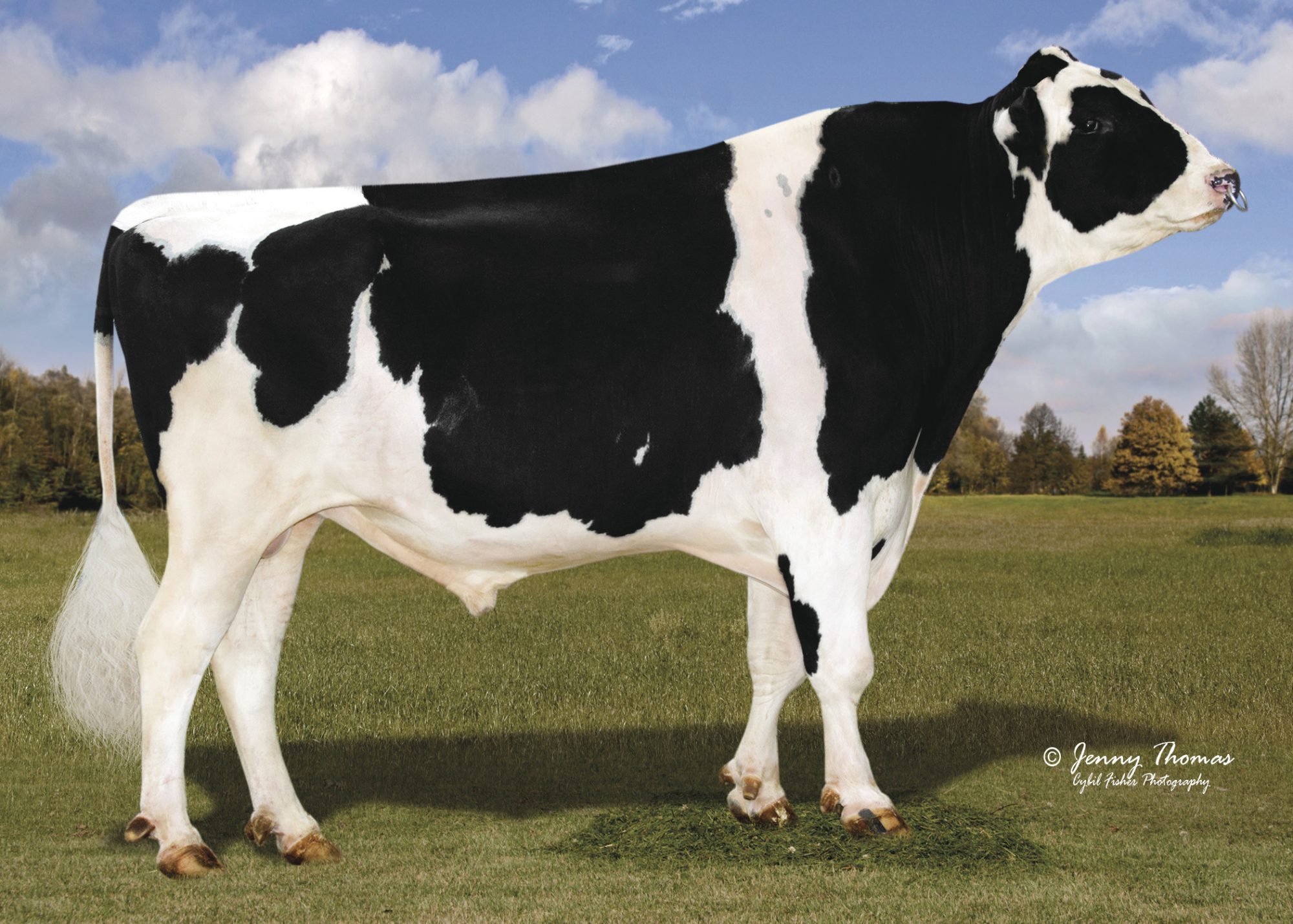
Luster-P was born in November 2016, bred by Hembury Farms and Marshman Farms of Muncy, Pennsylvania. He spent his career at Select Sires in Ohio.
His pedigree came with limited information. His sire, OCD Eraser Zipit-P, saw very little use because he was a poor semen producer. His dam, Cherry-Lor KBoy Loma-ET, was a VG-85 Kingboy. His second dam, a Supersire, was flushed as a heifer, never got pregnant and was never scored. That’s a gap in the record, not evidence she was weak. The proven depth sat one generation further back, in Tiger-Lily Lawnboy Lulu-Red, dam of Tiger-Lily Ladd-P-Red.
On farms, he dominated his matings. Across very different dams, his daughters kept showing balance, strong mammary systems and a habit of standing out in heifer pens. He could add teat length, put more set in the leg and lower the pins. That helps the cows that need it, and only those cows. Breeder Jorden Siemers described him as a balancer: use him on production cows to add type, or on type cows to add production.
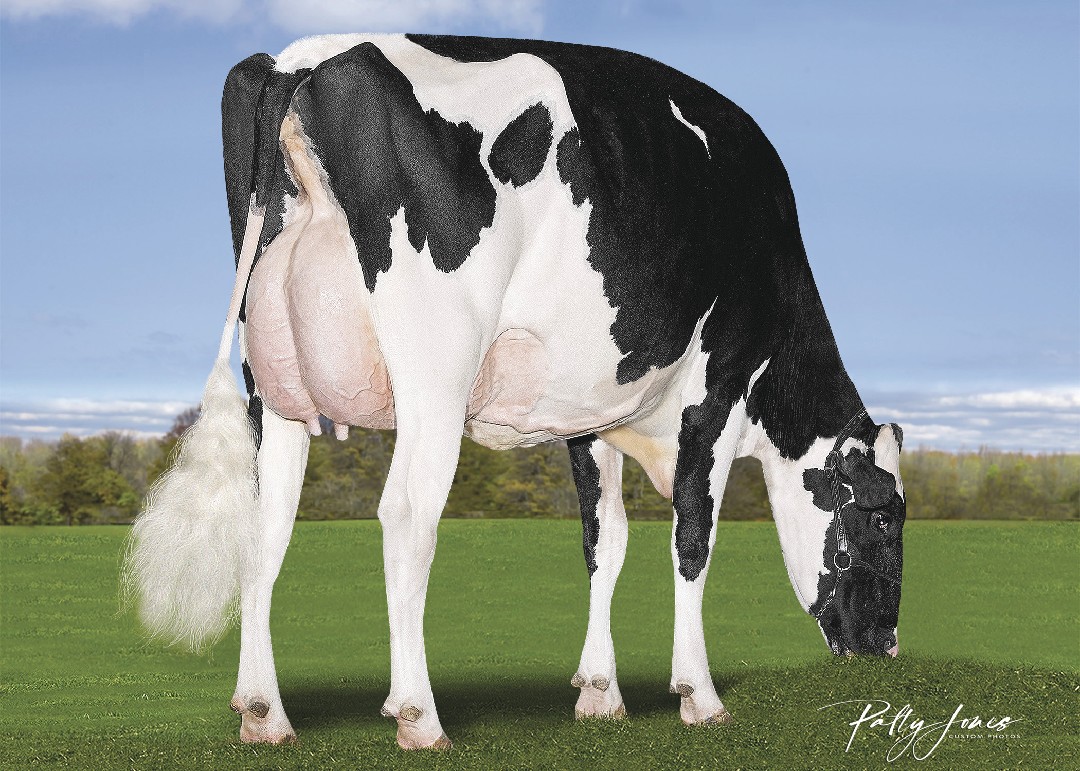
Daughters and Sons Who Carried It Forward
His best-known daughter, Siemers Lstr Hanan 33317-ET EX-91, was the 2024 Global Cow of the Year. She’s the dam of Hanx-P, Holy-P and Hulu-RC. Another daughter, Penn-England Candy 15944-P VG-87, is the dam of Penn-England Chew-P.
Two Canadian sons took the line further. Stantons Remover-PP is now #1 on Lactanet’s August 2026 proven LPI list at 3945. Vogue A2P2-PP EX-97 is Logic’s sire and the link to the next generation.
The Lambda Cow at Drewholme
Brian Carscadden of Blondin Sires was on the road in western Ontario when he saw a young Lambda cow at Andrew Martin’s Drewholme herd near Listowel. Her dam and granddam were both Excellent. Carscadden asked a price, and Blondin bought her in partnership with Quality Farms as a genetic cow. That fall, in 2021, she placed second in the summer two-year-old class at the National Holstein Show.
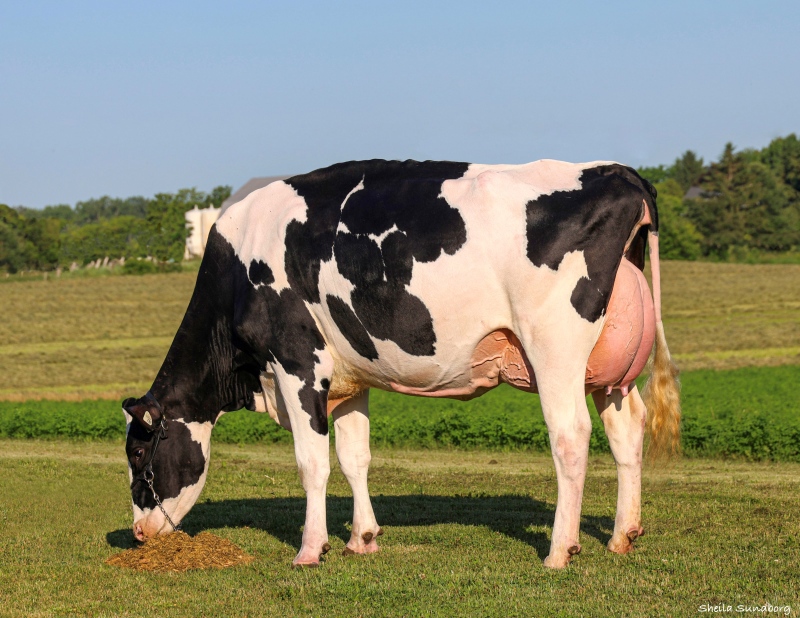
She was Drewholme Lambda Leysure P, a Delta-Lambda daughter of Drewholme Zipit Leysure P EX-90. She comes from the Ravenswell Lydia family behind Idee Lustre EX-95, the same family that produced Rockymountain Talent Licorice EX-95 and Winterbay Goldwyn Lotto EX-95. She’s now EX-92-5YR. She had two A2P2-PP bull calves. The first, Leyhigh, went to Semex. The second tested slightly higher. That was Logic.
Logic-PP’s August 2026 Canadian proof
| Measure | Logic-PP (CDN, August 2026) |
| LPI | 3909, 91% reliability |
| Milk | −18 kg |
| Fat | +124 kg, +1.05% |
| Protein | +43 kg, +0.34% |
| Conformation | +16 |
| Production daughters / herds | 173 / 87 |
| Herd life | 105 (92% rel.) |
| Daughter fertility | 95 (GPA, 83% rel.) |
| Hoof health | 96 (GPA, 77% rel.) |
| Rear legs side view | −11 (toward straight) |
| Bone quality | 0 |
| Milking speed | 103 (92% rel.) |
Source: Blondin Sires, CDN-202608, accessed October 12, 2026. Canadian scale; don’t compare directly with U.S. values. GPA = genomic parent average, which Lactanet describes as a blend of parent average and the animal’s direct genomic value.
| Canadian measure | August 2026 value | What the value establishes | Selection consideration |
|---|---|---|---|
| Milk | −18 kg | Near-neutral yield relative to the Canadian base | Limited predicted volume improvement |
| Fat | +124 kg; +1.05 percentage points | Positive yield and concentration breeding values | Assess against the milk-payment system |
| Protein | +43 kg; +0.34 percentage points | Positive yield and concentration breeding values | Assess alongside fertility and health |
| Conformation | +16 | Positive overall type evaluation | Overall type does not eliminate individual weaknesses |
Source: Blondin Sires, CDN-202608. Production evaluation: 173 daughters in 87 herds; LPI 3909 at 91% reliability.
With Remover-PP at #1 and Logic-PP at #3 on Lactanet’s August list, two of Canada’s top three proven bulls are homozygous polled. The bull between them, Siemers Rengd Parfect-ET at 3932, isn’t polled.
The numbers explain what “extreme components” means here. At −18 kg, Logic offers little predicted milk-volume improvement over the Canadian genetic base. His strengths are fat, protein and conformation at +16.
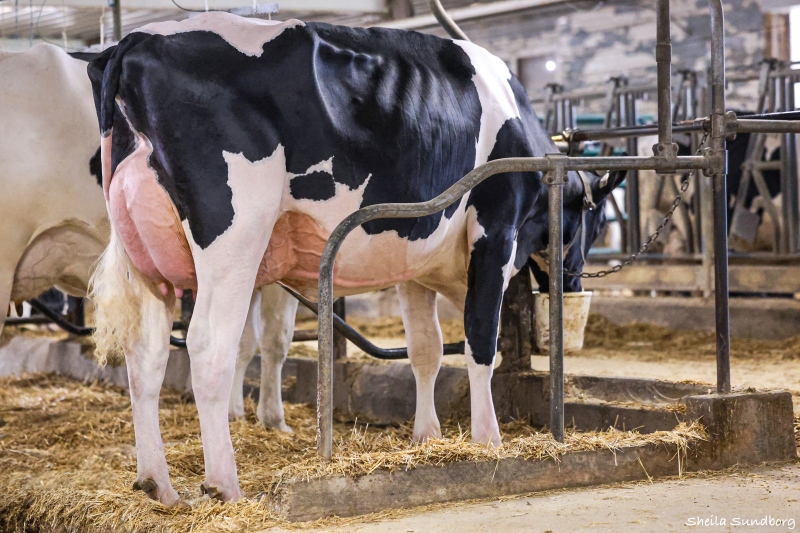
Carscadden says he’d protect Logic for slightly straight legs, bone quality and milk yield. The −11 for rear legs side view supports the straight-leg caution. Bone quality at 0 is a neutral value on that scale, so the bone caution is his assessment rather than something the number proves.
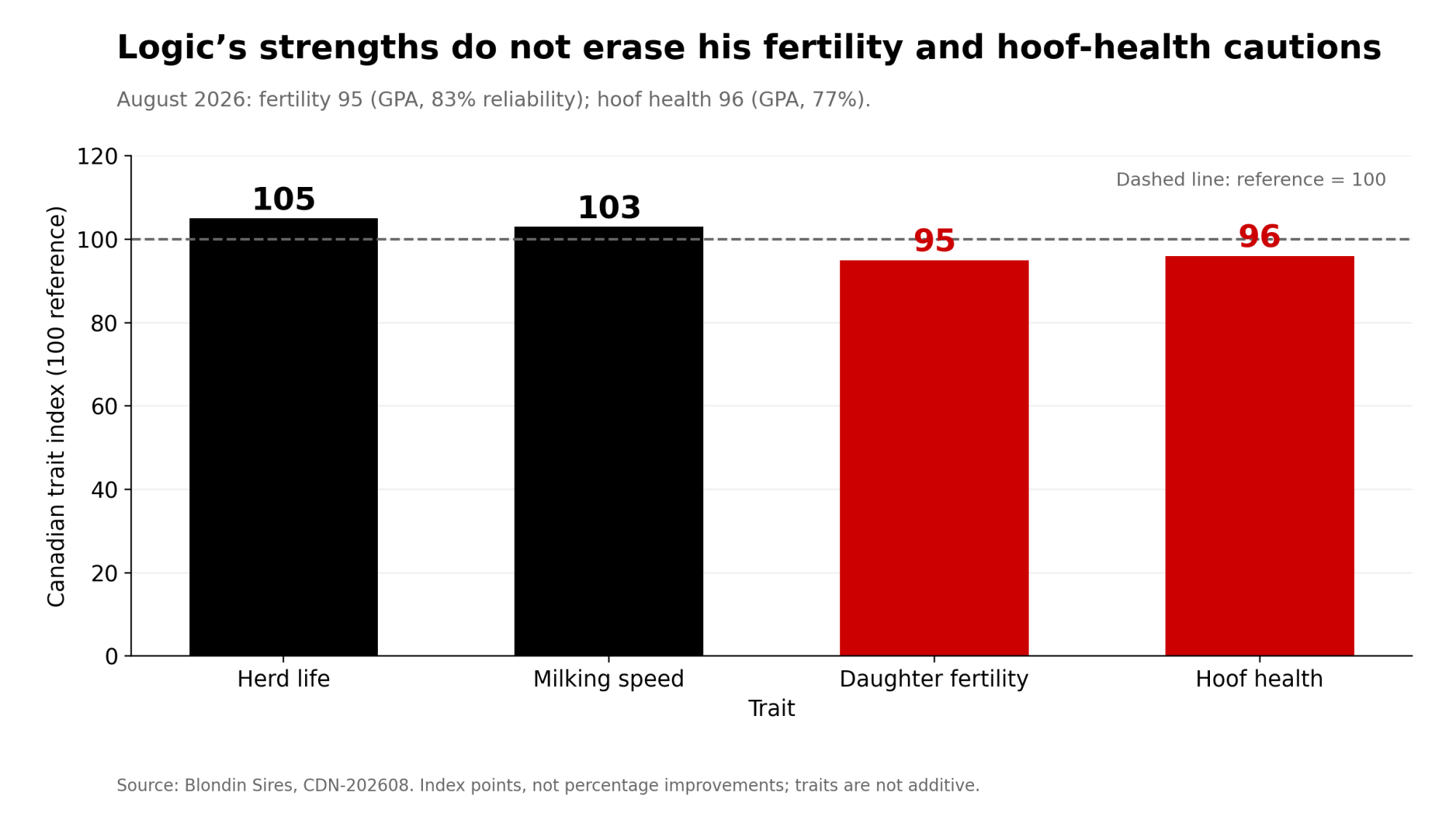
Daughter fertility (95) and hoof health (96) are below 100 and still reported as GPA, so they may move as more information enters the evaluation. His 103 for milking speed fits Carscadden’s view that daughters milk out faster than average.
None of that makes Logic an automatic choice for every herd paid on components. Fertility, feet, legs, relationship to your cows, semen price and the alternatives all still count.
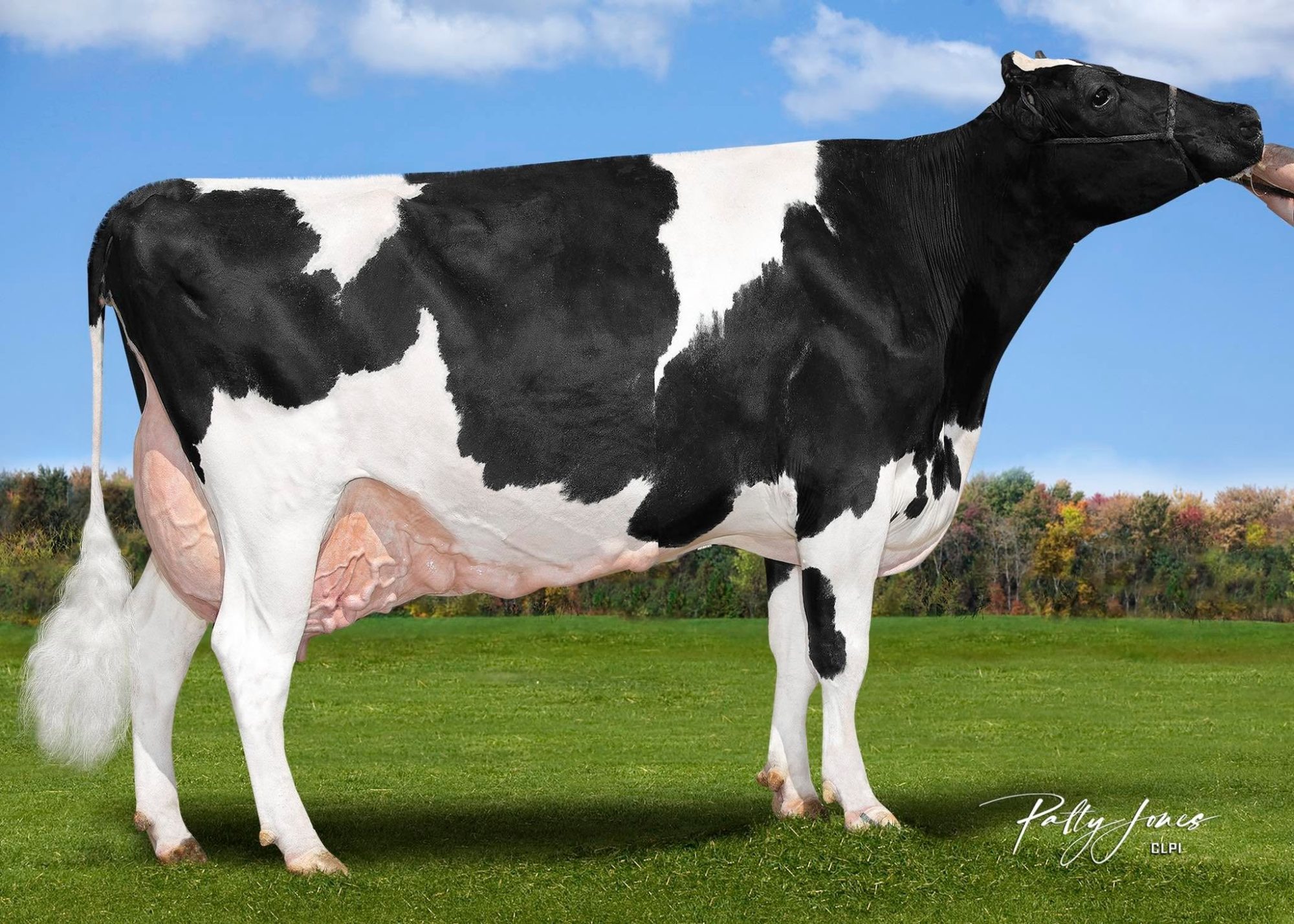
His pedigree adds one more detail: Logic is already line-bred. OCD Eraser Zipit-P, Luster’s sire, also sired Logic’s maternal granddam, Drewholme Zipit Leysure P. That puts Zipit-P on both sides of Logic’s pedigree (Bullvine analysis of the Blondin, Select Sires and Holstein Canada records).
The Half-Sibling Mating
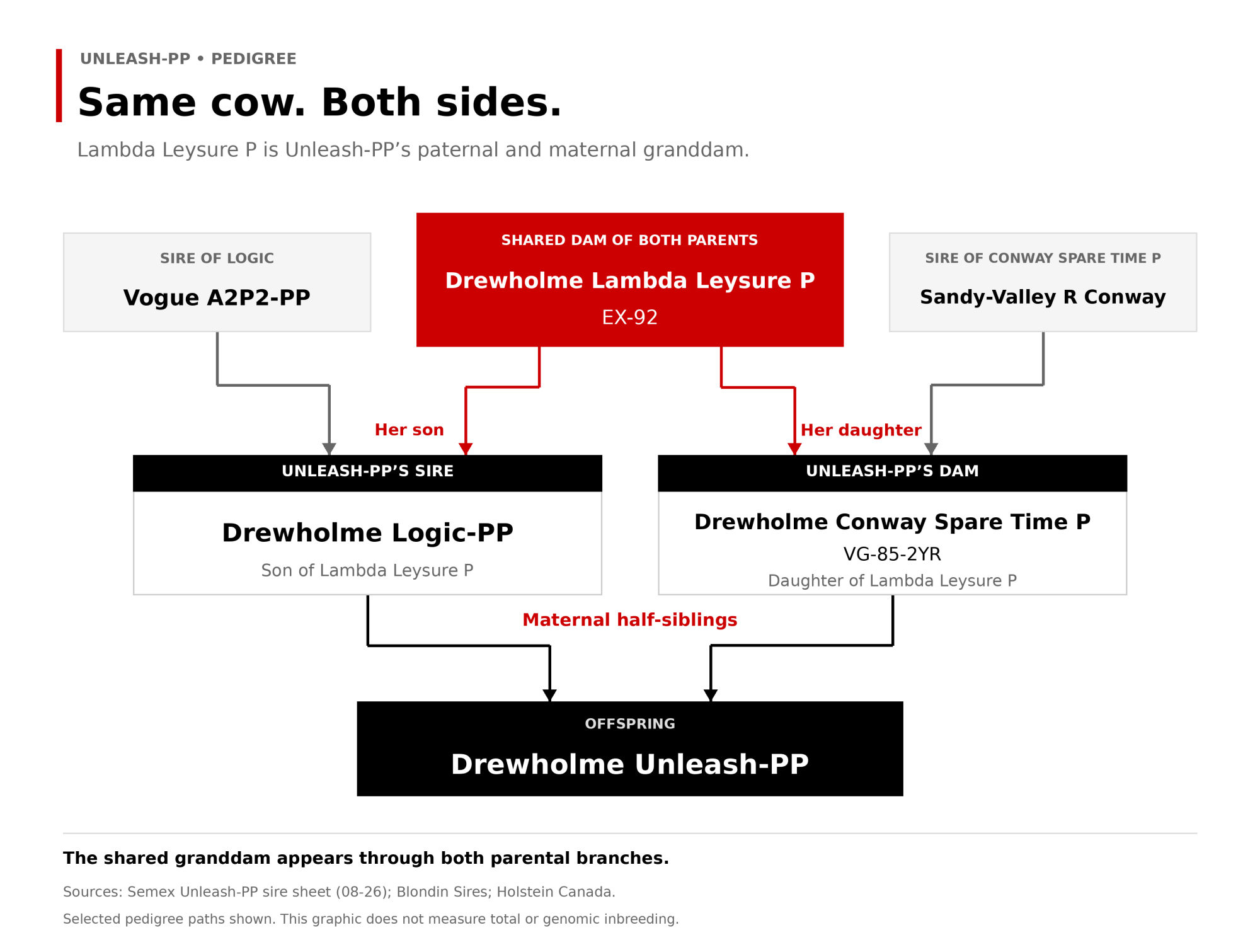
Unleash-PP and Spare Time-PP were bred under the Drewholme prefix and are marketed by Semex. Semex’s sire sheet for Drewholme Unleash-PP, with evaluations dated August 2026, lists his parents:
- Sire: Logic-PP.
- Dam: Drewholme Conway Spare Time P VG-85-2YR, a Sandy-Valley R Conway daughter.
- Maternal granddam: Drewholme Lambda Leysure P EX-92.
Lambda Leysure P is also Logic’s dam, so Unleash’s parents are maternal half-siblings. Herd records published in October 2026 list a second son from the same mating, Drewholme Spare Time-PP, also at Semex. Semex’s April 2026 Holstein Highlights describes him the same way: a Logic son out of a VG-2YR Conway maternal sister to Leyhigh-PP.
That puts Lambda Leysure P two generations back on both sides of Unleash-PP. She’s his paternal granddam through Logic and his maternal granddam through Conway Spare Time P.
Pedigree loops: what 12.5% does and doesn’t mean
This is an illustration, not a measurement (Bullvine calculation from the published pedigree). A mating between maternal half-siblings creates one shared-dam loop. If the shared dam isn’t inbred herself, that loop alone contributes 12.5% to the offspring’s pedigree inbreeding coefficient. That isn’t a measured genomic coefficient, and it isn’t a complete pedigree calculation. Other shared ancestors further back can raise the total, and a full calculation has to count each valid path once without double-counting overlapping ancestry.
Close matings concentrate whatever a family carries, desirable and undesirable alike. The published pedigree establishes the relationship. It doesn’t tell us the breeder’s reasoning, or whether this mating’s gains outweighed its tradeoffs.
U.S. sire data put Unleash-PP’s expected future inbreeding at 12.1% and Spare Time-PP’s at 12.0%, against 9.9% for Luster-P. That’s the predicted inbreeding of their daughters across the breed, not the 12.5% loop in their own pedigree.
The breeding decision downstream is a separate question. A bull’s own inbreeding doesn’t tell you the predicted inbreeding of his calves out of a particular cow. That depends on how related he is to her.
Logic’s Sons and the Ancestors They Share
Logic has 10 PP sons in AI, all with extreme components and double-digit conformation. Here’s what the best-known of them carry, and what to look for in your own cows before you use them.
| Son(s) | Dam side | Shared ancestors to check in your cows |
| Unleash-PP, Spare Time-PP (Semex) | Conway Spare Time P, Logic’s maternal half-sister | Lambda Leysure P (on both sides), Zipit-P, Luster-P, Vogue |
| Loaded-PP, Leverage-PP (Stantons full brothers) | A Remover-PP daughter | Luster-P twice (through Vogue and Remover), Zipit-P, Lambda Leysure P |
| Vector Fra Apollo-PP (Validity), Fraholme Vec Triton-PP (Blondin), Fraholme Vec Gideon-PP (Semex) | Fraholme Allday Arielle-P | Luster-P, Vogue, Zipit-P and Lambda Leysure P through Logic; dam side not traced here |
Bullvine analysis of the Semex, Blondin and Holstein Canada pedigree records and the published herd history credited below.
This is one family’s route through North American polled breeding, and it isn’t the only one. In the Netherlands, CRV’s Delta Launch-PP-Red spread his influence mostly through daughters: about 16,000 milking by mid-2026, and a growing list of CRV bulls with him as maternal grandsire. In Germany, RUW’s Simon-P spread his through sons. He has 18 progeny-proven sons, 11 of them homozygous polled, plus descendants in France, Italy and Scandinavia. Some of those descendants, such as Rise Up, aren’t even polled. Launch and Simon deserve their own breakdown, and we’re working on one. For this mating decision the point is simpler. Polled progress isn’t running through a single sire, so the alternatives to a Logic son are real.
The question breeders need to ask has changed. “Is there a polled bull good enough?” now has an answer at the top of the rankings. The breed-wide question is genetic diversity, and this piece doesn’t measure the available pool. For a given herd, the decision is narrower: do you have enough suitable polled alternatives with low relationships to your own females?
What the Hot Iron Is Worth
A 2017 Journal of Dairy Science paper by Thompson and colleagues at Purdue, USDA-ARS and Michigan State put a price on dehorning. Under the study’s assumptions, producers could pay up to US$11.90 a head more for homozygous polled genetics, or US$4.17 a straw at a 35% conception rate. That’s measured against hot-iron disbudding without pain relief, the cheapest conventional method in the study. Heterozygous genetics came out at about half that, US$2.08 a straw, because half a heterozygous sire’s calves out of horned dams are expected to grow horns. Pain relief barely moved the math: the study priced it at US$11.90 a head.
Those are 2017 dollars. USDA NASS put U.S. livestock workers at US$18.15 an hour for the April 2025 reference week, up 4% from a year earlier. Our read: where disbudding labor is a real expense, the avoided cost is likely higher now. We haven’t re-run the model, though, so we won’t put a 2026 number on it.
As an illustration only (Bullvine math): 500 straws × US$4.17 = US$2,085, in 2017 dollars. Your farm’s number will differ. Beyond the avoided cost, a premium buys some mix of the bull’s genetic merit and the welfare and management value of not disbudding. Know which one you’re paying for. Our break-even analysis walks through the full method.
What This Means for Your Breeding Program
- Check the genotype before you pay for it. P and PP aren’t the same product. Only PP sires guarantee every calf is polled. With horned dams, a heterozygous bull’s break-even in the 2017 study was about half as large.
- Use Logic where he fits. He suits herds that need fat, protein and udders more than milk volume. Watch rear legs side view, the bone caution, fertility and hoof health, and expect the GPA traits to move.
- Run the relationship check son by son. If your cows carry Luster, Vogue, Zipit-P or the Leysure family, pull predicted offspring inbreeding for each Logic son before you pick one. Use the table above as your list.
- Judge descendants on their own proofs. Ancestry points you to candidates; the proof decides. That goes for Launch and Simon descendants too.
- Keep proof systems separate. Canadian LPI, Dutch NVI and German RZG use different bases, so compare bulls within one system.
- Price the premium against your own costs. Use your conception rate, straw count, wage rates and disbudding protocol, not the study’s 2017 assumptions.
Back to Nearly a Million
Nearly a million units is the number Select Sires put on Luster-P’s career. It was never the full measure of him.
A better measure is the Lambda cow Carscadden saw in the Drewholme barn. Blondin asked a price and bought her with Quality Farms as a genetic cow, and she finished second at the 2021 National that fall. Her son Logic now sits third on Canada’s proven LPI list, and his PP sons out of her Conway daughter are already at Semex.
At the top of the rankings, polled has caught up. What matters for the next mating is narrower: the bull’s own proof, and the predicted inbreeding of his calves out of the cow you’re breeding. For more on how polled sires reached the top, see Polled Just Hit 3371 TPI and our polled dairy cattle archive.
Key Takeaways
- Logic-PP debuted #3 on Lactanet’s August 2026 proven LPI list at 3909 on his first daughter proof. That’s +124 kg fat and +43 kg protein against −18 kg milk, with fertility and hoof health still GPA.
- Lambda Leysure P EX-92 is both paternal and maternal granddam of Unleash-PP. By our math, that one shared-dam loop alone adds 12.5% to his pedigree inbreeding before any older shared ancestors are counted.
- With Remover-PP #1 and Logic-PP #3 in August 2026, polled isn’t the limit at the top of Canada’s proven list anymore. The thing to manage now is how closely a polled bull is related to your cows.
 The Sunday Read Dairy Professionals Don’t Skip.
 The Sunday Read Dairy Professionals Don’t Skip.
Every week, thousands of producers, breeders, and industry insiders open Bullvine Weekly for genetics insights, market shifts, and profit strategies they won’t find anywhere else. One email. Five minutes. Smarter decisions all week.
Learn More
- The Hot Iron’s Last Stand: Why Canada’s #1 Proven Bull Just Changed Everything — Calculate the true $22–$35 per-head cost of dehorning using a realistic three-year transition plan. By bypassing standard genetic proofs, this operational breakdown shows exactly when flipping your herd to 100% polled stops draining cash and starts generating immediate returns.
- Gene Editing in Dairy: When the Revolution Makes Sense-And When It’s Just Expensive Hype — Separating guaranteed single-gene wins from complex traits that struggle to perform, this analysis exposes the financial reality behind the CRISPR buzz. Navigate regulatory hurdles and hidden costs to find exactly where edited genetics justify their hefty premium.
- From Saving a Baby’s Life to Transforming Your Dairy Herd: The Gene Editing Revolution Is Here — The commercial pipeline for tomorrow’s engineered traits moves rapidly, projecting a three-year horizon on the POLLED locus and imminent mastitis resistance breakthroughs. Concrete projections detail how these targeted genetic shifts aim to eliminate a $2 billion industry problem.