






A homozygous polled bull just sat at #1 on Canada’s August 2025 proven LPI list — ahead of every horned sire. The 15-year horn tax is gone. Is your iron still earning its keep?
At Embro, Ontario, breeder Mark Fraser keeps an 85-cow herd built around one VG-86 cow doing outsized work for the polled story. Her name is Fraholme Allday Arielle-P — a finalist for Holstein International’s 2025 Global Cow of the Year — and her homozygous polled sons Triton-PP, Apollo-PP, and Gideon-PP now sire some of the highest-ranked polled animals in Canada. A decade ago, a cow like Arielle-P would’ve been a curiosity. A novelty in a corner of the barn. Today she’s a blueprint.
And because of cows like her, the question on your operation has flipped. It used to be simple: can I afford the production hit that comes with polled? Now it’s sharper. Is the dehorning iron still earning its place in your calf protocol, or are you just heating it up out of habit?
Why did polled stop being a compromise?
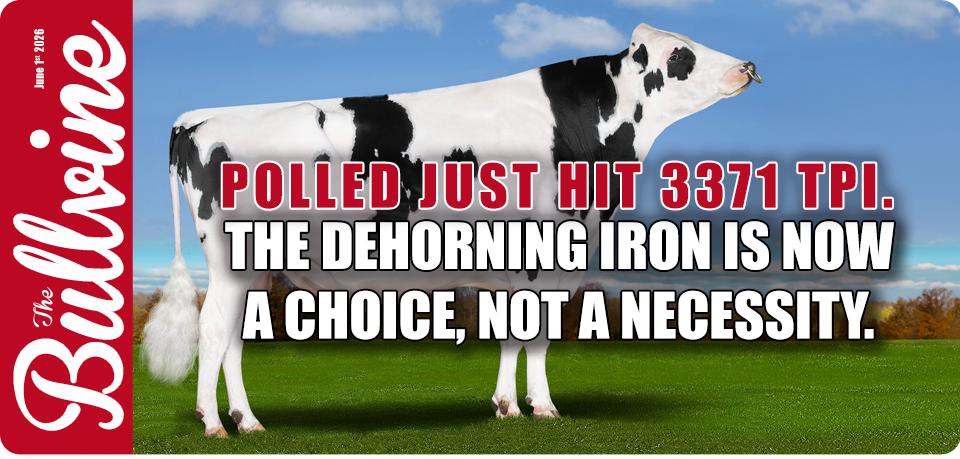
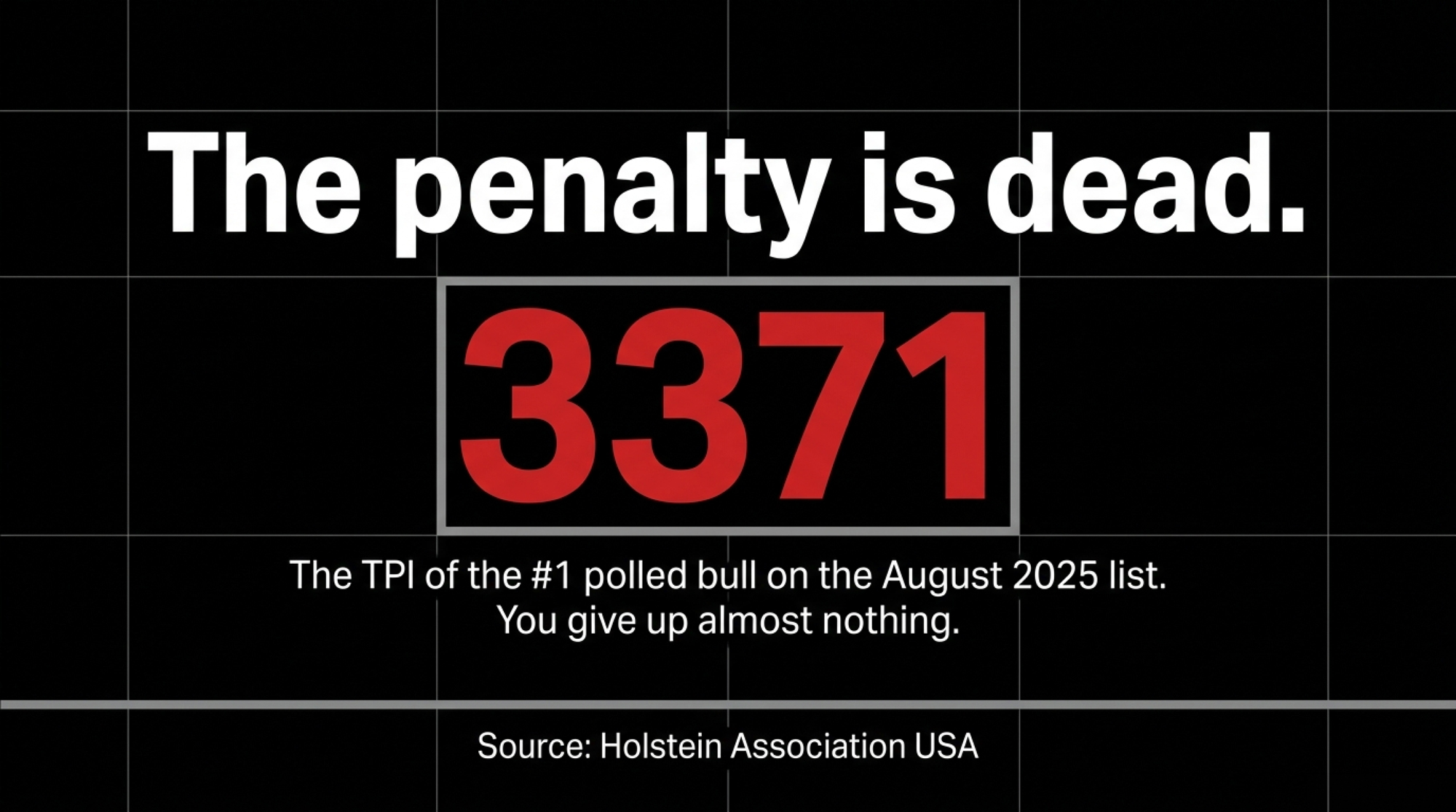
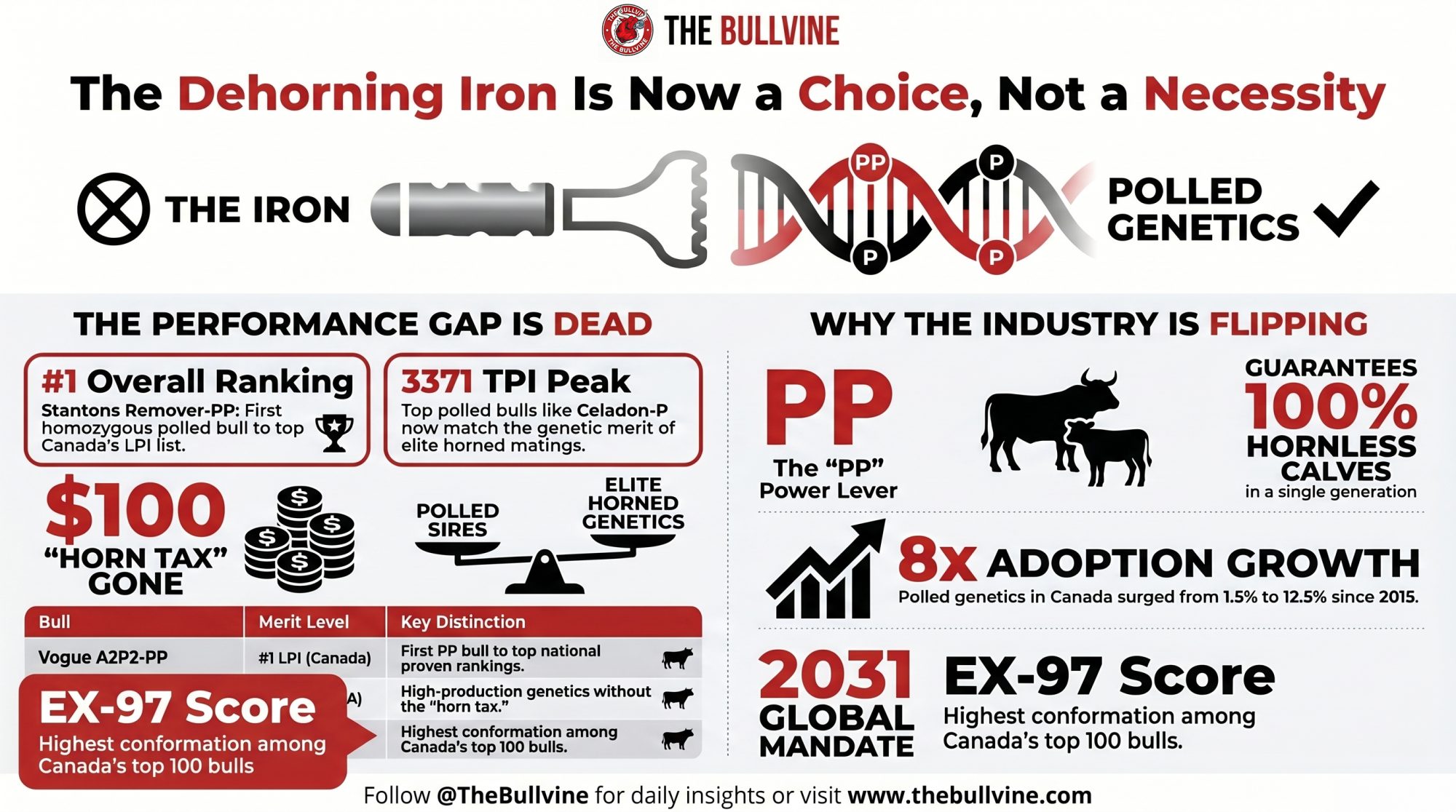
For years, breeding hornless meant paying a tax — in milk, in components, or in type. Pick your loss. That trade is gone. The top polled bull on Holstein USA’s August 2025 list, DeNovo 23201 Celadon-P, sits at 3371 TPI — close enough to your best horned matings that you give up almost nothing.
The genetics behind the shift aren’t complicated, which is exactly why polled moved through herds so fast. Polled is dominant; horned is recessive. One copy of the polled allele — that’s the “P,” a heterozygous bull — and you get a hornless calf. Breed that P sire to your horned cows and the next calf crop splits roughly 50/50 polled to horned.
Two copies — “PP,” homozygous — and the math changes entirely. A PP sire bred to anything, horned cows included, throws polled calves every single time. That’s the lever every serious polled breeder is pulling. PP is how you flip a herd to hornless in one generation instead of grinding through three.
The 15-year climb out of the bargain bin
It’s worth remembering how bad the trade used to be, because that’s what makes the current numbers land. Back when genomic testing went mainstream around 2009, the polled bulls on offer were a study in compromise — pick one and you were trading away production, type, or both to get the hornless trait. Breeders who wanted polled weren’t chasing genetic merit. They were paying a horn tax and hoping the rest of the proof didn’t sink the mating.
The most-cited cautionary name was Aggravation Lawn Boy P-Red. He spread the polled trait widely through red-and-white pedigrees in the early 2010s, but breeders openly talked about working around him to avoid dragging down their other numbers — The Bullvine said as much in its own polled coverage back in 2013 and 2014. That’s the era in a sentence: polled was available, but using it cost you something real.
Later names like Mission-P — a daughter-proven polled sire that reached the +3000 LPI range in Canada — showed the gap starting to close. Polled was climbing the lists. It just wasn’t at the top yet, and almost all the progress was on the heterozygous side, where the trait is easier to carry without piling up the weaknesses that dogged the early homozygous bulls.
What changed was the math underneath. Each generation of polled-to-elite matings narrowed the gap, because breeders stopped treating polled as a separate, lesser pool and started crossing the best polled animals onto the best horned cows in the barn. Genomic selection sped that up — you could identify a high-merit polled calf at birth instead of waiting years for a proof. The trait rode along on animals that were getting genuinely good, not just hornless. By the early 2020s the homozygous bulls finally caught up, and once PP got competitive, the whole equation changed — because PP is the only version that flips a herd in one shot.
The bull who erased the penalty
If you want to know why the compromise finally died, start with one bull: Cherry-Lily Zip Luster-P. He was bred by Ron Hembury of Cherry-Lor in Pennsylvania and John Marshman of Tiger-Lily in New York, and stationed at Select Sires in Ohio. And he did something no polled bull had pulled off before — he sired daughters that could win in a heifer pen on type and still fill the bulk tank.
Holstein International reported that Select Sires sire analyst Jordan Siemers credited Luster-P with combining type and production rather than forcing a trade between them. That framing matters more than it sounds. For most of polled’s history, a breeder picked a polled bull despite his proof — to fix horns, you accepted a hole somewhere else on the sheet. Luster-P flipped that logic. You could use him on production cows to fix type, or on type cows to add production. He stopped being a compromise and started being a tool.
That’s why he sold. Select Sires says he is the highest-selling polled bull in its history, with lifetime semen sales of roughly 964,000 units — a figure the company reports and that we haven’t independently audited. His daughter base now runs north of 39,000 head. Luster-P himself is gone. But the genetics he turned loose are why the rest of this story exists.
His sons did what no polled bull had done
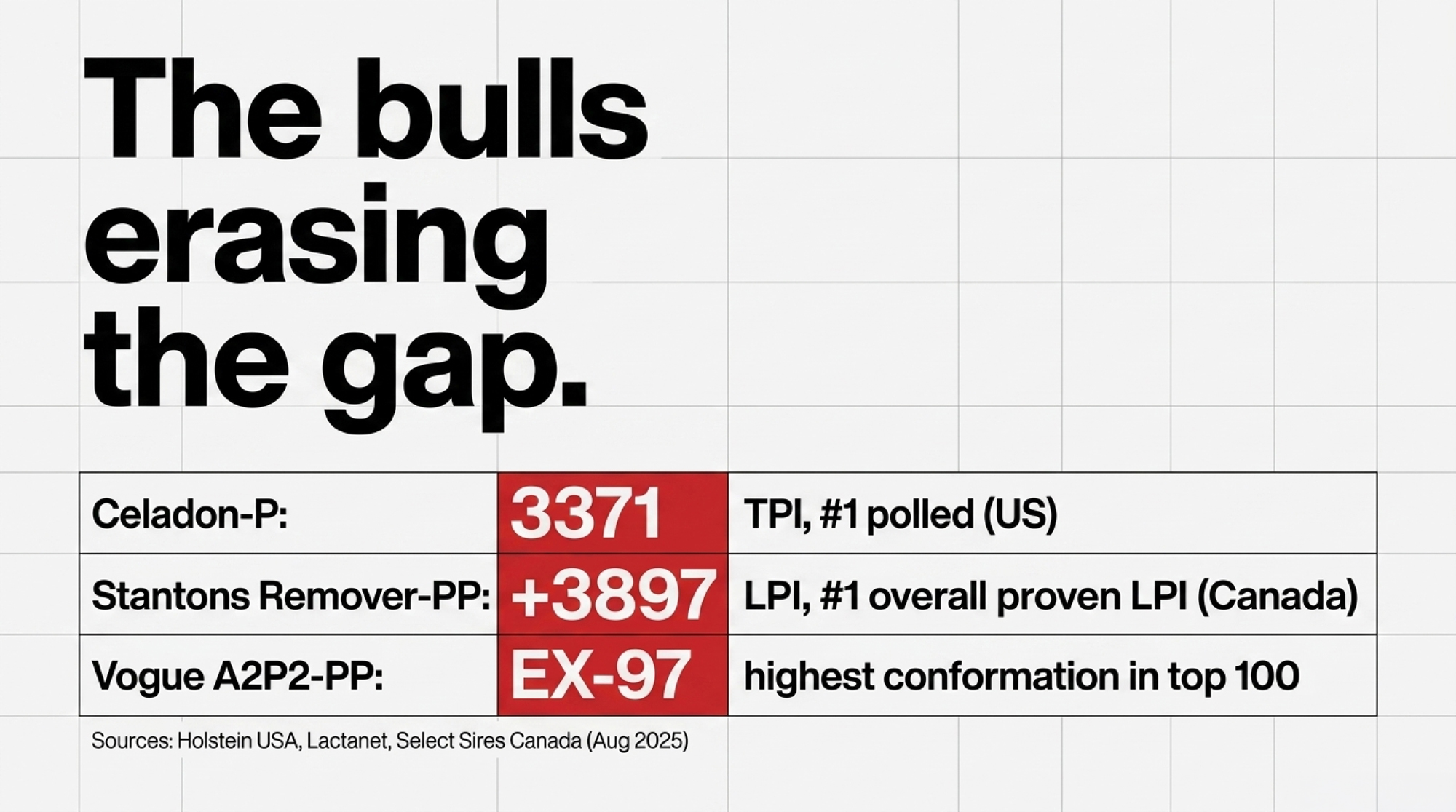
Here’s the part that should change how you read a proof sheet. Luster-P’s son Stantons Remover-PP went from #7 in April to #1 on Canada’s August 2025 Holstein LPI list — a homozygous polled bull topping a national proven ranking outright, ahead of every horned sire in the country. Read that again. Not a genomic prediction. Not a young-sire flier dressed up in a pedigree. A daughter-proven, homozygous polled bull sitting at the top of the list.
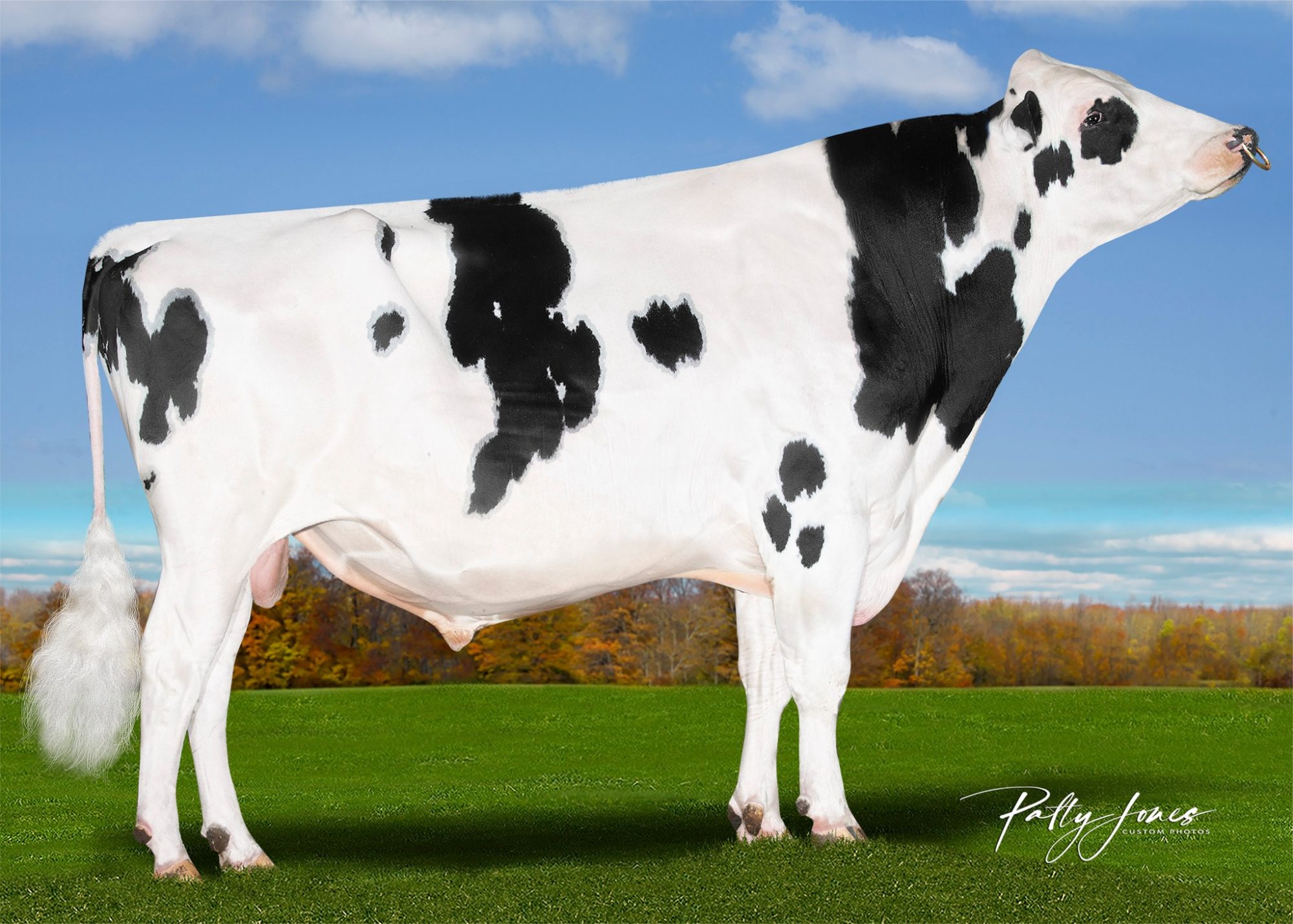
His other standout son, Vogue A2P2-PP, is the only polled Holstein sire on record to be classified EX-97, according to Select Sires Canada — scored EX-97-5YR-CAN with +15 conformation at 99% reliability, which makes him the highest-conformation bull among Canada’s top 100 proven LPI sires. Five years ago, a homozygous polled bull at that score would’ve been a typo. Now he’s a building block other breeders mate toward on purpose.
The numbers behind those two bulls — and the bull who sired them — read more cleanly side by side than buried in a paragraph:
| Bull | Region / Index | Status | Daughters |
| Celadon-P (P) | 🇺🇸 US — TPI | 3371 TPI, #1 polled (Aug 2025 formula) | Genomic |
| Winstar Kvell-PP (PP) | 🇺🇸 US — TPI | 3224 TPI, top PP (Aug 2025 formula) | — |
| Stantons Remover-PP (PP) | 🇨🇦 Canada — LPI | +3897 LPI, #1 Aug 2025; +3873, #2 Apr 2026 | 234 |
| Vogue A2P2-PP (PP) | 🇨🇦 Canada — type | EX-97-5YR-CAN, +15 conformation, 99% rel. | Highest conf. in top 100 proven LPI |
| Cherry-Lily Zip Luster-P(P, sire) | 🇺🇸 US — Select Sires | ~964,000 units sold (co-op-reported) | 39,000+ |
Sources: Holstein Association USA Top 100 TPI Polled Bulls, Aug 2025; Eurogenes/Lactanet/Holstein International, Aug 2025 & Apr 2026; Select Sires Canada; Holstein Canada registry. US TPI figures are on the August 2025 formula — Holstein USA reweighted TPI in April 2026, so don’t line these up against post-April-2026 numbers. Indexes are not directly comparable across borders — see note below.
That’s the difference between “polled is improving” and “polled has arrived.” The improvement story has run for fifteen years. The arrival showed up on the male proven list in Canada — with daughters standing in real barns getting scored, not just genomic numbers on a screen. And Remover-PP’s slip from #1 to #2 between August and April isn’t a knock; a homozygous bull holding the top tier across multiple proof rounds is the signal that matters, not the single peak.
How fast is polled actually moving?
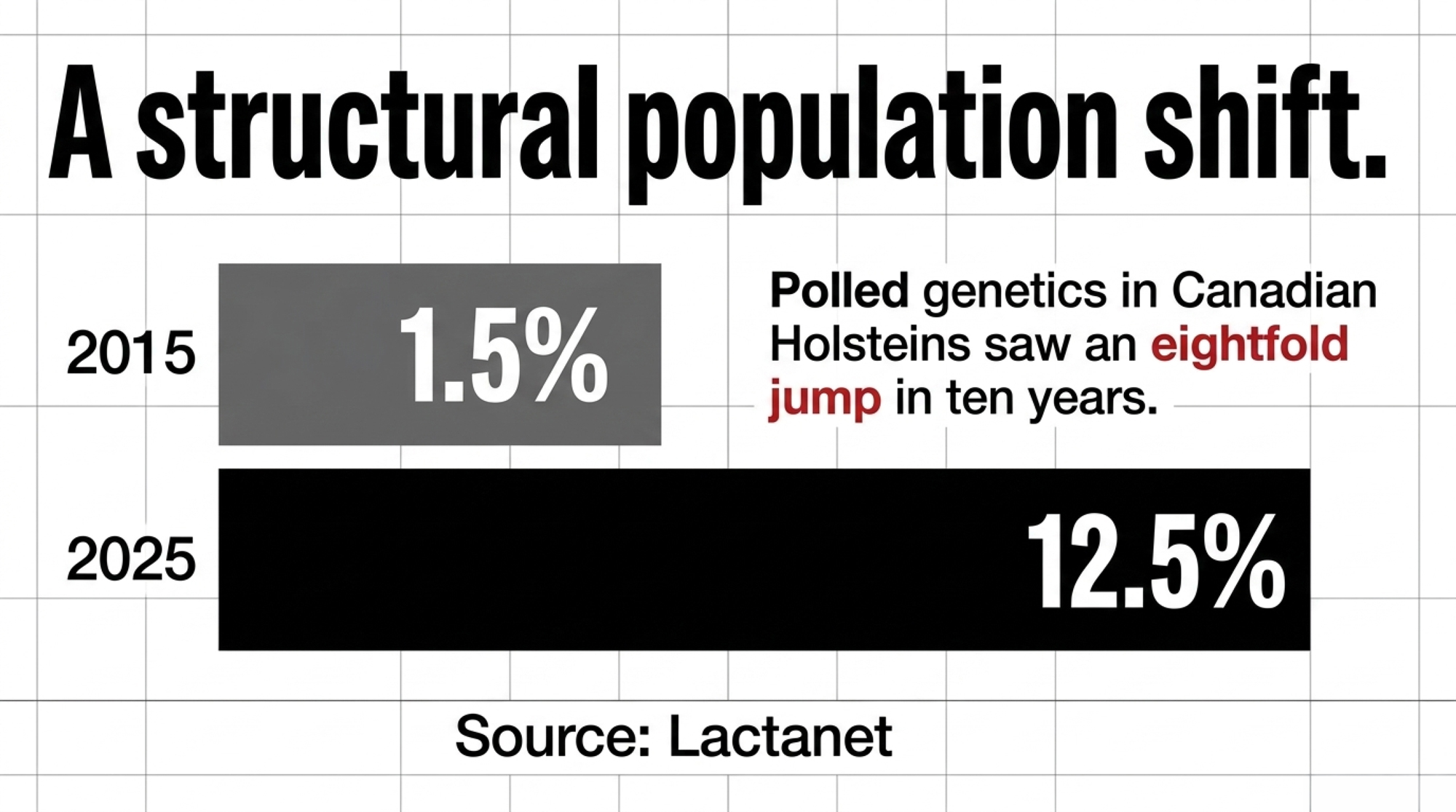
Look north for the clearest read. In Canada, polled genetics showed up in about 1.5% of Holsteins in 2015. By 2025 that figure hit 12.5%, according to Lactanet — better than an eightfold jump in a decade. That’s not a fad curve. That’s a structural shift in how an entire population is being bred. Nine polled bulls now rank inside Canada’s top 100 LPI.
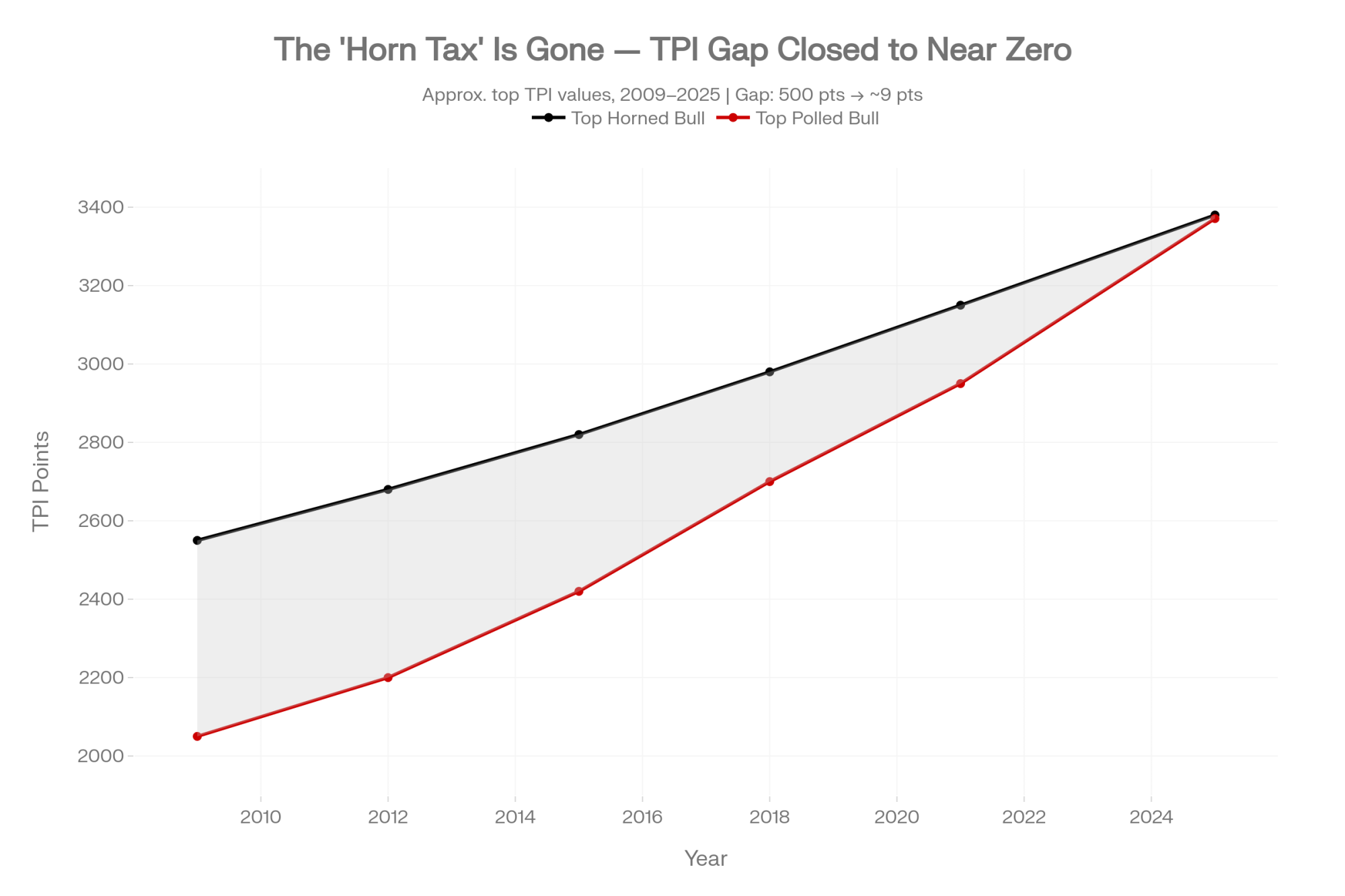
The genetic gap that used to justify steering clear has nearly closed too. Top polled sires now average $1,108 Net Merit, and on Herd Health Profit Dollars — HHP$, Semex’s health-and-fertility measure — they sit less than $100 behind comparable horned NxGEN sires (per The Bullvine’s Semex NxGEN comparison; NxGEN is Semex’s elite proven sire program). A hundred dollars of HHP$ on a high-end mating is real, but it’s not the canyon polled breeders used to stare across.
Then there’s the data point that punctures the last emotional argument. In one Western Canadian herd, the polled cows out-milked their horned herdmates — 66.5 kg versus 65.9 kg per day, roughly 147 versus 145 lbs, per The Bullvine. One herd isn’t a population trend, and we’ll say that plainly. The sample’s too small to bank on. But it quietly kills the fear that hornless somehow means lesser — and that fear, more than any proof, is what kept the iron in the fire this long.
And that brings us back to Embro. The reason a short list of cow families now does so much of the breed’s polled heavy lifting is that bulls like Arielle-P’s son Fraholme Vec Triton-PP keep showing up at the top — Triton debuted at #30 on Canada’s genomic list at +3952 GLPI in the April 2025 run, billed by his marketers as the #1 homozygous polled bull in the breed (The Bullvine, April 2025 evaluations; Blondin Sires). That concentration is exactly the risk worth flagging now — hold the thought, because it lands in the action section.
Europe isn’t watching. It’s mandating.
Now cross the Atlantic — and watch the logic flip from choice to rule. North American breeders pick polled because the numbers finally pencil out. Parts of Europe are about to breed it because the law will require it. Follow the thread country by country, and you can see the same deadline pulling each market in the same direction.
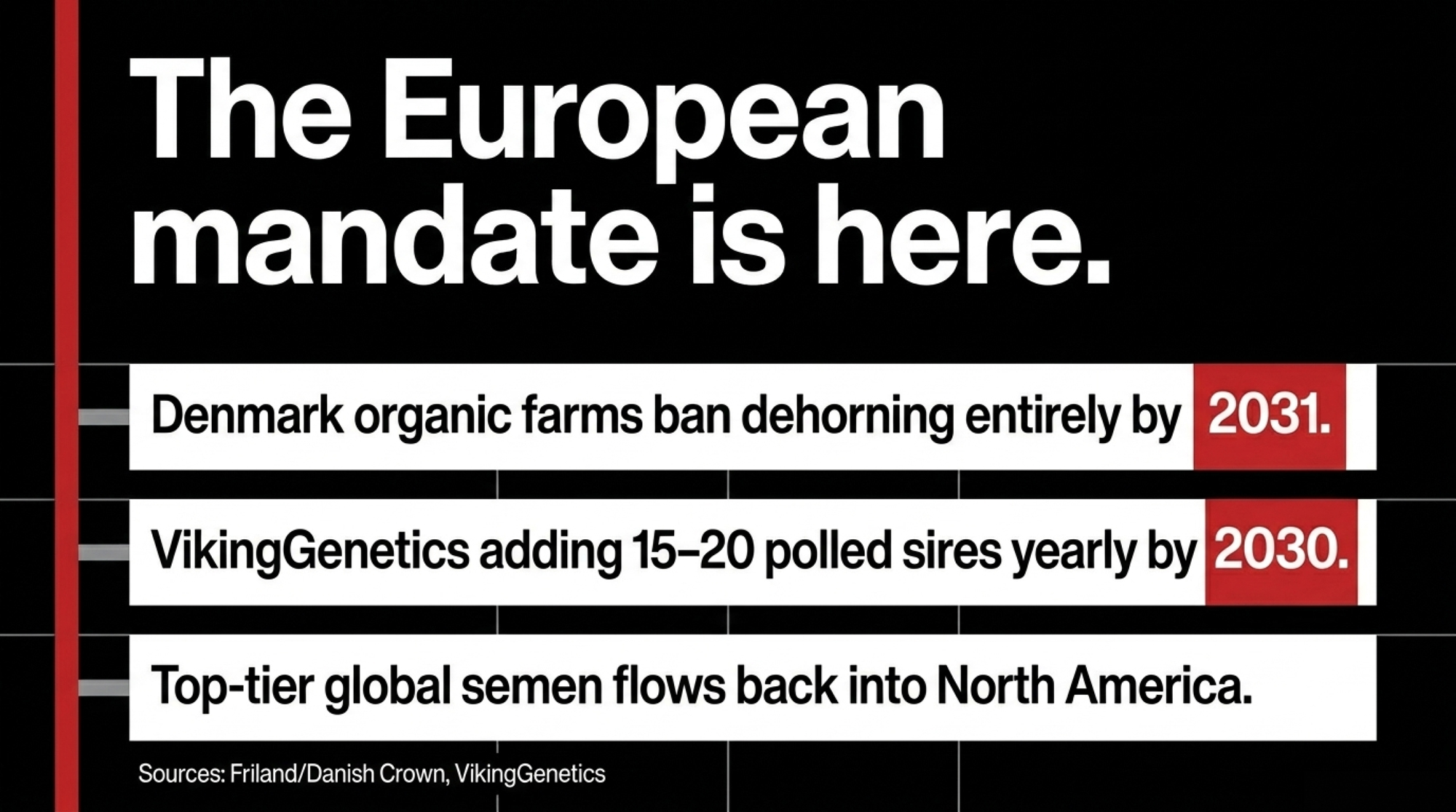
🇩🇰 Denmark — the deadline that started it. Denmark already runs organic standards stricter than the EU baseline: routine disbudding is restricted, permitted only as a vet-performed last resort, under anesthesia, with mandatory long-term pain treatment (Friland/Danish Crown welfare standards). Holstein International reports Danish organic farms will be barred from dehorning entirely as of January 1, 2031 — the regulatory direction is independently documented via Friland and INRAE. That single date is what every other move on this list is reacting to.
🇪🇺 EU-wide — the baseline it sits on. Only about 1% of dairy farms across the EU keep polled cattle today, but the Demeter organic standard already bans dehorning and disbudding outright (INRAE EU dehorning survey, 2020). The mandate edge is organic-first, then widening — which is why a 2031 organic deadline doesn’t stay confined to organic herds for long.
🌍 VikingGenetics (Nordic) — the supply response. That 2031 wall is already reshaping a major AI cooperative’s playbook. VikingGenetics says it intends to bring 15 to 20 new high-testing polled Holstein sires online each year from 2030, aiming for a standing lineup of 20 to 25. The pipeline’s already visible: as of the May 2026 proof run, VikingGenetics lists nine polled VikingHolstein bulls, three of them homozygous — and the new #1 bull on its own gNTM list, VH Mads-P, is itself polled (heterozygous) at +47 gNTM. When the top bull on a major program’s list happens to be hornless, that’s the tell.
🇩🇪 Germany — the head start that fed the pool. Germany has run its own polled engine for years, and it predates the North American surge. The Simon-P line in particular is a backbone of German polled breeding, with homozygous sons like Sampler-PP and transmitters like Signal-P anchoring the rankings (Holstein International). German breeders leaned in earlier and harder, partly because welfare pressure on the Continent arrived earlier — so when the rest of Europe started scrambling, Germany already had genetics to export.
🇳🇱 Netherlands — the red-and-white channel. CRV’s Delta Launch-PP-Red — among the world’s first and bestselling homozygous polled red sires — now counts roughly 16,000 milking daughters across several continents (Holstein International). The red-and-white channel matters because the polled trait has historically run strong through red genetics, giving breeders of red-and-whites an even deeper hornless bench.
Why should any of this land on your radar if you ship milk in Wisconsin or Ontario? Because the genetics don’t stop at the border. When a co-op of VikingGenetics’ size builds 20-plus elite polled bulls into its standing lineup to beat a 2031 deadline, that semen flows into the North American market too. Europe forcing the issue makes your sire list deeper — whether you ever sell a drop of organic milk or not.
One caution on every number above: TPI, LPI, GLPI, NM$, NTM, and RZG aren’t directly comparable across borders without an Interbull MACE conversion. Each figure lives inside its own system. The trend is real and global; the point totals don’t translate one-to-one.
Does the dehorning iron still pay its way?
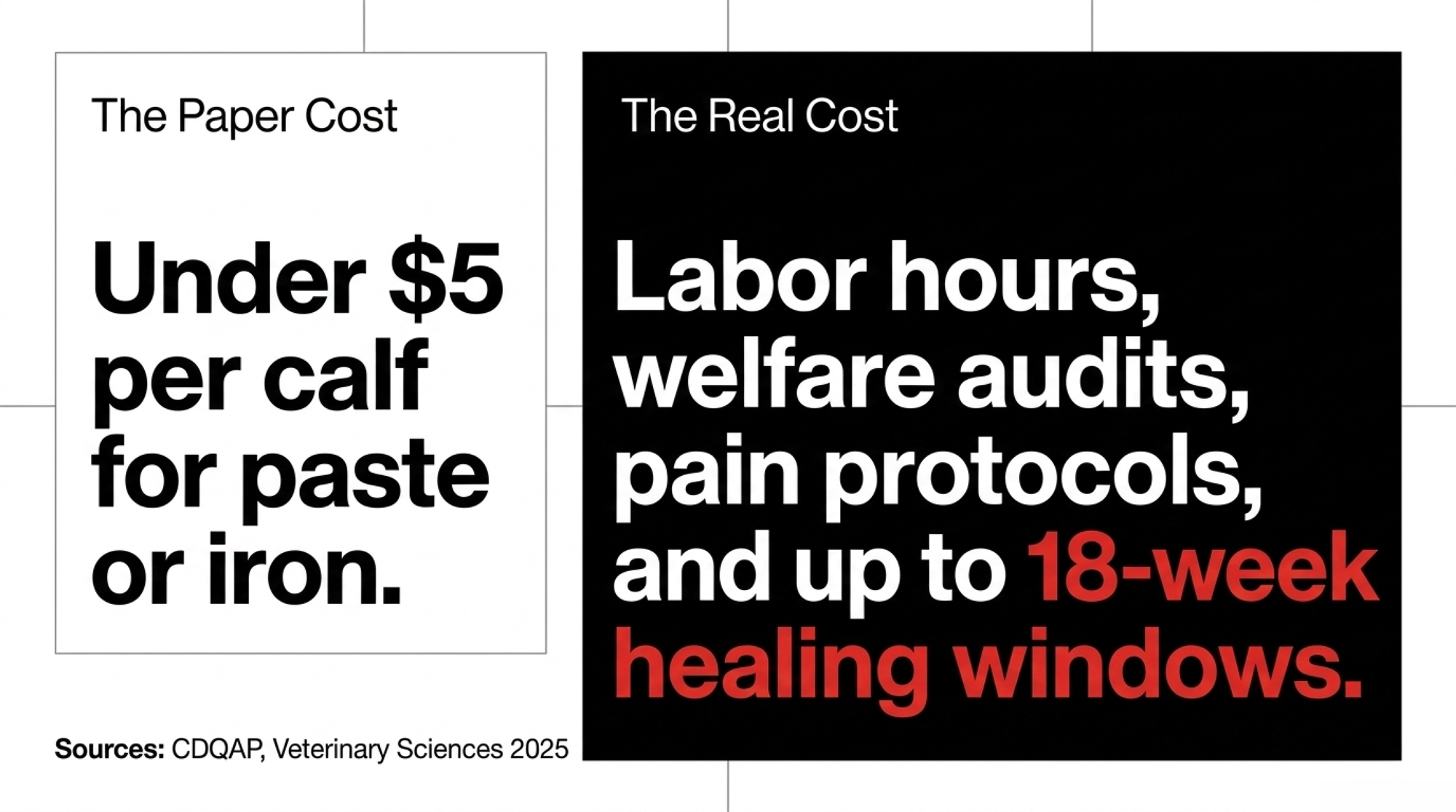
Strip away the proof sheets and here’s the on-the-ground case. Disbudding a calf, done early and well, is cheap on paper — extension estimates put hot-iron or caustic-paste disbudding at well under $5 per calf when farm staff do it, plus cents for pain control (CDQAP). Per calf, the materials aren’t what hurts.
What hurts is everything around it. The labor scheduling. The pain-management protocol your buyers increasingly expect you to document. The welfare scrutiny. The job nobody on the crew volunteers for. And the recovery window — healing from caustic paste alone can stretch up to 18 weeks in some calves (Veterinary Sciences, 2025). Research consistently flags polled genetics as the one approach that eliminates the procedure entirely: no pain, no healing window, no labor, no treatment cost.
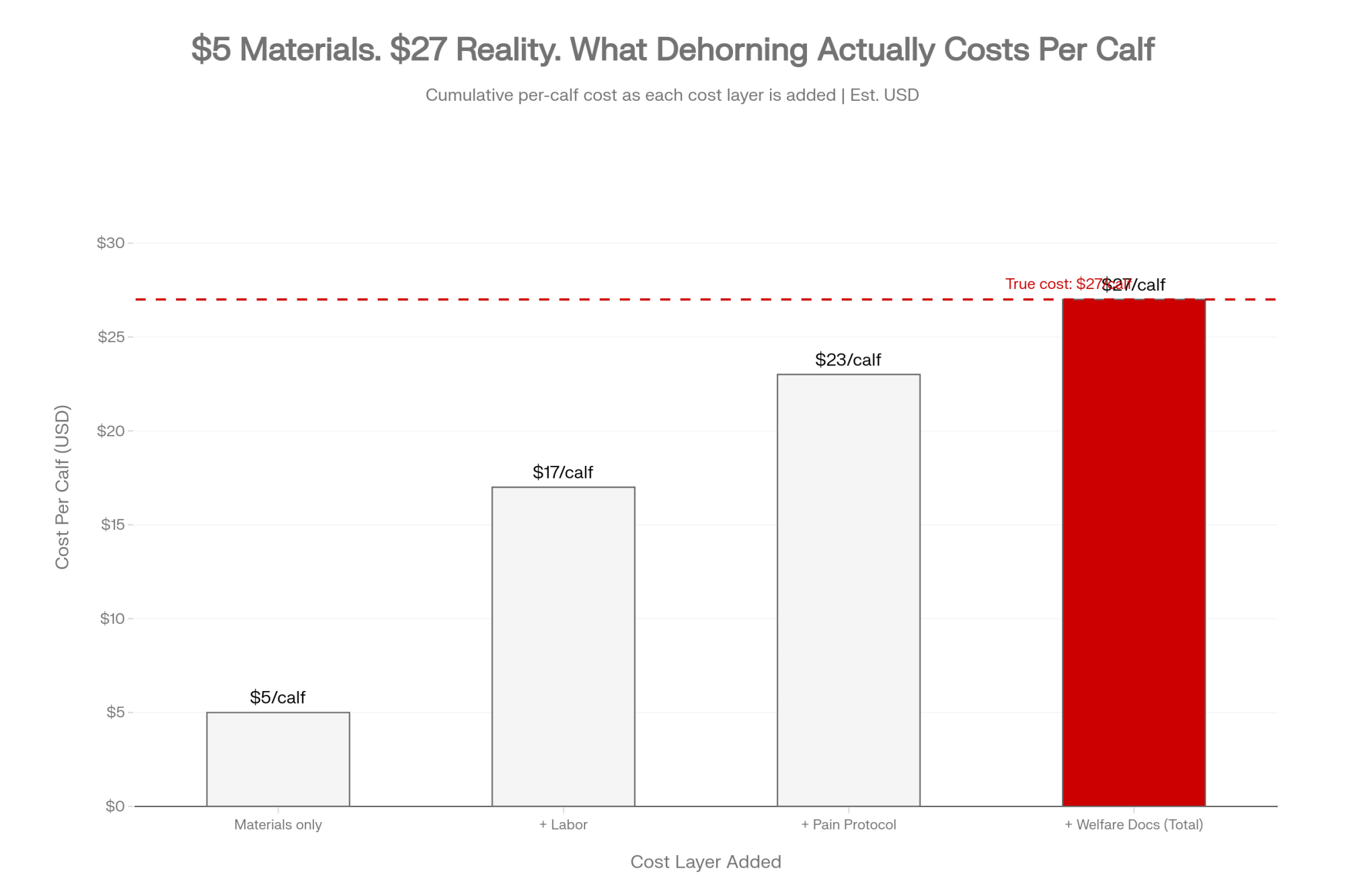
So run it on your own scale, because the math reads differently depending on your barn. Say you raise 250 heifer calves a year. At $5 a head that’s only $1,250 in materials — but layer in the labor hours, the pain protocol, the recovery time, and a buyer audit you now have to log, and that line item stops being about $5. Now picture a 60-cow tie-stall raising maybe 30 replacements: the dollar total is smaller, but it’s likely one person doing every calf by hand, on top of milking, fieldwork, and everything else. For that operator the cost isn’t really money — it’s the morning they have to carve out for a job they dislike, on a calf that’s healing for weeks.
There’s a semen-cost angle too, and it’s worth doing on your own gun. A PP straw might run you a few dollars more than your usual horned pick — call it the price of skipping the index gap. But you’re buying out every disbudding that calf and her future daughters would have required, plus the labor and welfare paperwork attached to each one. On a heifer that stays in the herd and breeds replacements, that one-time premium amortizes across years of calves you never have to touch with an iron.
Either way, breed a PP sire and the whole job goes to zero. One mating decision, made once at the gun, against a recurring headache and a growing welfare liability. When the genetic penalty was real, the headache won every time. Now that the penalty’s gone, the headache has no defense left.
What This Means for Your Operation
You don’t need to convert the whole herd this fall. You need a deliberate position. Pick the row that matches where you are, then run the move next to it.
| Your situation | The move | The trade-off |
| Testing the water(start this month) | Book a heterozygous (P) sire that ranks where you already breed onto a defined group of horned cows. The US Aug 2025 list runs from Celadon-P at 3371 down through dozens above 3200 TPI. | Half the calf crop is hornless; you’re still dehorning the other half. A toe in the water, not the finish line. |
| Moving fast (one-generation flip) | Use a homozygous (PP) sire like Remover-PP or A2P2-PP on a defined group. Every calf is polled, guaranteed, regardless of the dam. | Give up a little top-end index — 147 TPI points between the top P (3371) and top PP (3224) on the US Aug 2025 list. In Canada, the proven gap is now under |
| Selling genetics / exporting | Build PP into the matings you’d market into the EU. VikingGenetics is stacking its lineup around the 2031 shift; PP animals are positioned to carry a premium where dehorning is banned. | Those are organic- and EU-specific signals — not a promise your local sale ring pays up tomorrow. |
| Any of the above | Spread your polled pedigrees. VikingGenetics is screening barely-used cow families on purpose to keep diversity. Do the same at home. | A short list of source families — Arielle-P’s among them — is doing most of the work, so stacking the same pedigree on every heifer imports inbreeding risk. |
Your 30-day step, whatever row you’re in: pull your last three sire selections and check where the best polled bull ranked against what you actually used. That single comparison tells you how much — or how little — going polled would have cost you.
| Factor | Heterozygous P Sire | Homozygous PP Sire |
|---|---|---|
| Polled calves guaranteed? | No — 50/50 split on horned cows | Yes — 100% polled, every calf |
| Top US TPI (Aug 2025) | 3,371 (Celadon-P) | 3,224 (Kvell-PP) |
| Top CA LPI (Aug 2025) | — | +3,897 (Remover-PP, #1 proven) |
| Index gap vs. top horned | ~9 TPI points | ~147 TPI points |
| Dehorning eliminated? | Partial (50% of calves still need iron) | Fully eliminated |
| Herd conversion speed | 2–3 breeding cycles | One generation |
| Best use case | Testing adoption; maintaining top index | Flipping herd; exporting PP genetics |
| EU/export market value | Moderate | High — meets 2031 Danish organic standard |
| Pedigree diversity risk | Lower | Higher — monitor source families |
| Typical semen premium | Minimal | $3–8/straw above comparable horned |
Key Takeaways
- If your best polled option ranks within roughly 100 points of your best horned sire — and on the current Canadian lists it does — the old “production penalty” reason to skip polled no longer holds. Re-run that comparison before you book your next round.
- If you want hornless calves guaranteed in one generation, breed PP and accept a modest index trade — 147 TPI points between the top P and top PP bull on the US Aug 2025 list. If you’re fine flipping the herd gradually, a high-ranking P sire on horned cows gets you halfway each cycle.
- If you export or sell genetics into the EU, treat PP as a market-access decision, not just a welfare one — Denmark’s organic dehorning rules are tightening toward a reported January 1, 2031 deadline, and the German and Dutch polled pools are deep enough to compete with on merit.
- If you’re moving toward polled, check the pedigrees before you commit. A short list of source families is doing most of the work, so spread your matings or you’ll stack inbreeding risk into your own herd.
So where does your iron stand?
Polled isn’t the future of the Holstein breed anymore. It’s the present — sitting at 3371 TPI on the US list, topping Canada’s August 2025 proven ranking, and getting written into European law. The iron didn’t become illegal. It became optional. The genetics that made it optional are on the sire list right now, and a cow named Arielle-P in an 85-cow barn at Embro is part of the reason why.
So here’s the real question for your next mating sheet: is the dehorning iron still earning its place in your calf protocol, or are you just heating it up out of habit? If the gap between your best polled option and what you actually bred last round surprises you — and it might — that’s your answer.
Run Your Numbers
Genomic Testing ROI Calculator — Before you build PP into your matings, run the calculator to see whether testing pays on your replacement costs and culling pressure. It flags the families where inbreeding risk needs tighter control — the exact trap when a short list of polled pedigrees does most of the work.
Complete references and supporting documentation are available upon request by contacting the editorial team at editor@thebullvine.com.
Learn More
- Polled genetics – examine the pros and cons — Arms you with a line-by-line cost framework to calculate the direct milk volume and component fat sacrifices historically incurred when prioritizing hornless genetics over elite horned herdmates.
- How Albert Cormier Rewrote the Rules of Global Holstein Business – and Made the Whole Industry Catch Up— Exposes how early commercial investments in elite polled families like Miranda-P transformed from a niche show-ring curiosity into the structural blueprint required to survive modern European retail welfare audits.
- Gene-Edited Cows Are Legal. Your 2029 Milk Cheque Isn’t Safe. — Delivers a critical market warning about how emerging genetic modifications like SLICK technology disrupt conventional breeding paths while facing immediate processing bottlenecks and volatile corporate buyer compliance deadlines.
 The Sunday Read Dairy Professionals Don’t Skip.
 The Sunday Read Dairy Professionals Don’t Skip.
Every week, thousands of producers, breeders, and industry insiders open Bullvine Weekly for genetics insights, market shifts, and profit strategies they won’t find anywhere else. One email. Five minutes. Smarter decisions all week.




