





A New England co-op started mailing crisis lines with the pay stub in 2018. The data says the real lever isn’t tougher farmers — it’s a workload almost nobody redesigns.
⚠️ Need help right now? Canada: National Farmer Crisis Line — 1-866-FARMS01 (1-866-327-6701), 24/7 · Talk Suicide Canada — 1-833-456-4566 · Ontario Farmer Wellness Initiative — 1-866-267-6255 United States: Call or text 988 · AgriStress Helpline — 833-897-2474 · Farm Aid — 1-800-FARM-AID In an emergency, call 911.
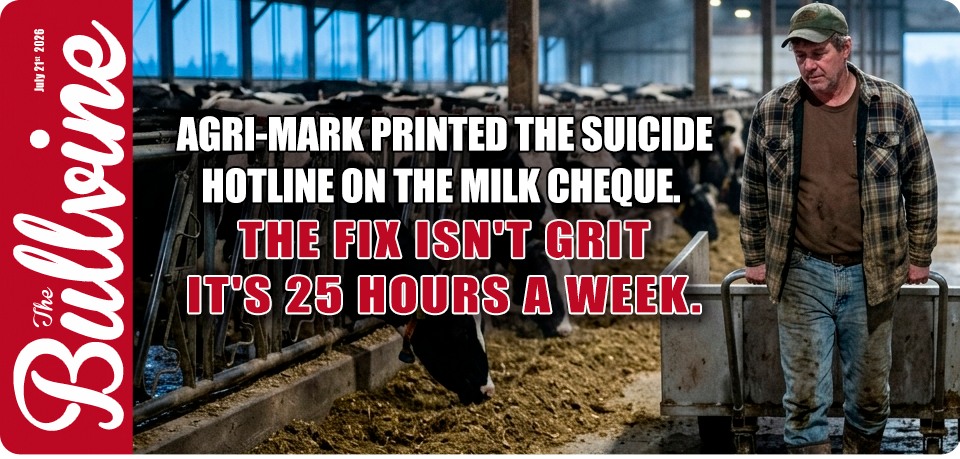
In February 2018, a New England dairy farmer opened his twice-monthly cheque from Agri-Mark and found something new tucked inside. Not a premium notice. Not a hauling change. A list of suicide-prevention hotlines, mailed to all of the co-op’s roughly 1,000 members alongside a price forecast sitting near $17 per hundredweight, well under break-even. Spokesman Doug DiMento told Vermont Public the idea came from the co-op’s own board, which is made up of farmers, after they lost a member to suicide.
Sit with that for a second. The crisis number didn’t go on a poster in the milk house or a slide at a winter meeting. It went on the cheque. The one piece of paper every farmer opens. When a board of farmers decides that’s where the number belongs, they’re saying the quiet part out loud: the way this business is built is dangerous to the people running it.
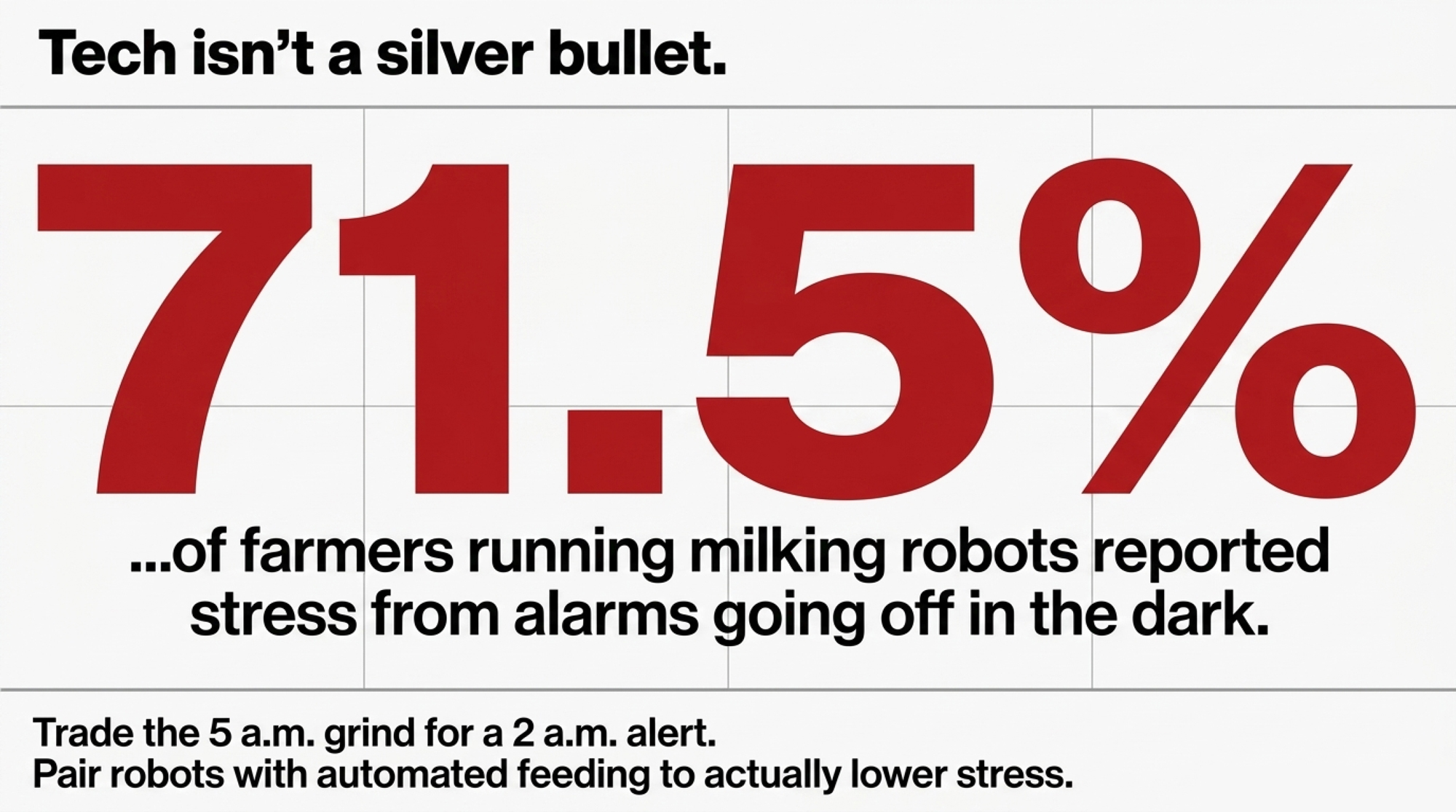
And here’s the part that should stop you. The fixes we reach for don’t always help. Robots get sold as the great labor saver, yet in one Finnish study, 71.5% of the farmers running them reported stress from alarms going off in the dark. Trade the 5 a.m. grind for a 2 a.m. alert. This is a workload story before it’s a feelings story, and that’s exactly why it’s fixable.
What’s Actually Driving the Distress
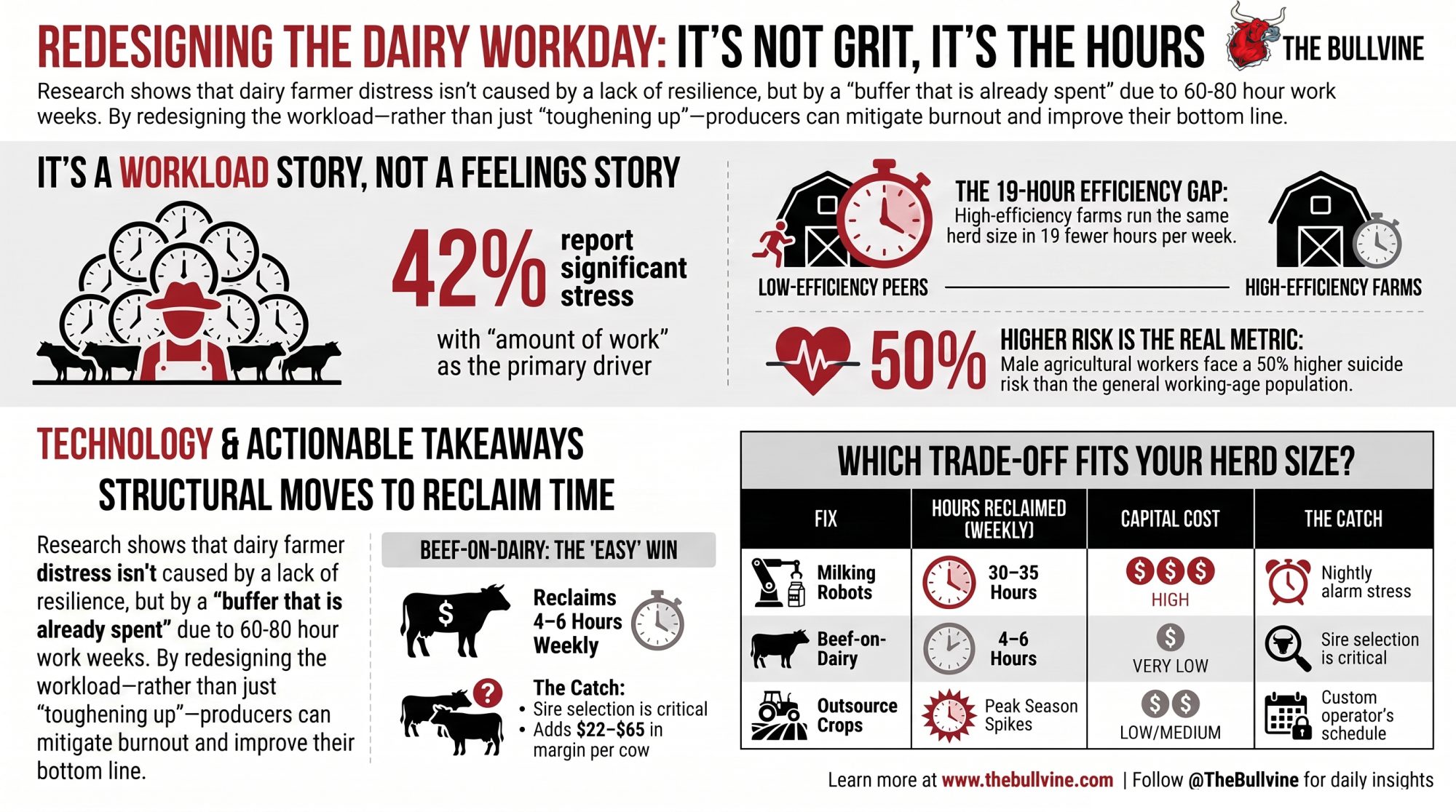
For a decade, farmer mental health got treated as an awareness problem. Talk more, stigma less, hang up the helpline poster. But the research keeps landing somewhere harder to fix. A 2016 Finnish study of dairy farmers found 42% under significant stress and 9% in severe burnout, with “amount of work” among the strongest drivers. A follow-up using the Job Demands-Resources model went further — workload and loneliness tracked straight to ill health, even after the researchers accounted for burnout itself.
The Canadian numbers sharpen the point. University of Guelph surveys led by Dr. Andria Jones-Bitton found 76% of farmers reporting moderate or high stress, and roughly one in four saying they’d recently felt life wasn’t worth living. Across her team’s 1,132-farmer study, stress, anxiety, and depression all ran higher than normative data — and resilience ran lower, not higher. These aren’t people short on grit. They’re people running on a buffer that’s already spent.
Now the twist. When researchers isolated dairy on its own — a 2026 Journal of Dairy Science survey of 115 dairy farmers in Western Canada and Ontario — producers reported lower stress and anxiety and higher resilience than the broader Canadian farming population. But the same study found workload and financial pressures were the stressors most strongly tied to increased stress, anxiety, and depressive symptoms. Even the tougher, more resilient group points straight at the hours.
Is the “3.5x Farmer Suicide Rate” Even Real?
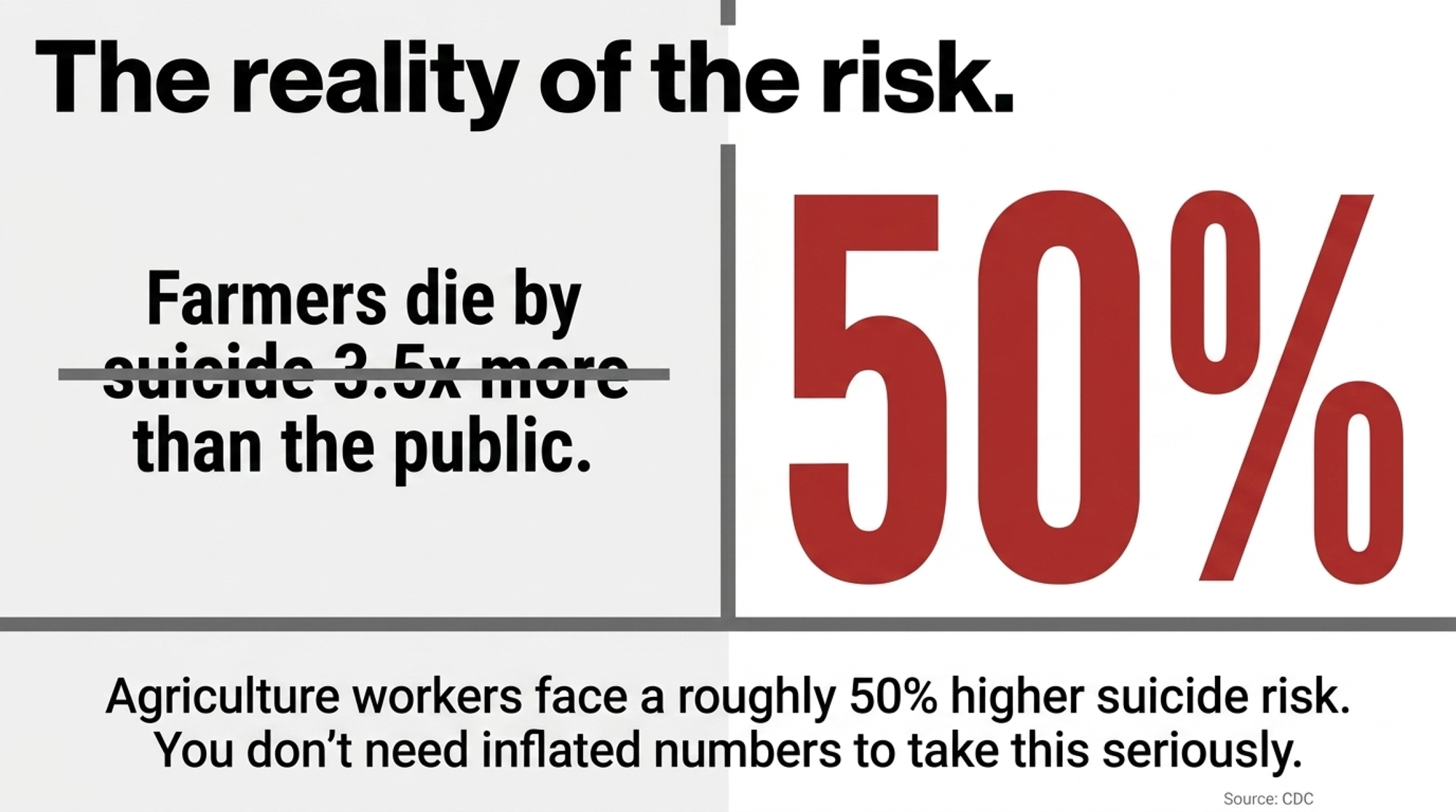
You’ve heard the stat. Farmers die by suicide “3.5 times more than the general population” — it shows up in co-op newsletters, keynotes, awareness campaigns. But pull the thread and it frays. That figure descends from an older 2016 CDC occupational study that reported a startling 84.5 per 100,000 for “farming, fishing, and forestry,” a number CDC corrected in 2018 after admitting it had misclassified farmers into the wrong occupational group. As The Counter put it, the claim “that farmers have the highest suicide rate in the country — is not supported by the study’s underlying data.” Even the National Rural Health Association’s own brief lands at 43.2 per 100,000 for male farmers, not a clean 3.5-times multiple.
So what’s real? The most recent CDC data — published in MMWR in December 2023, using 2021 death records from 49 states — put male workers in agriculture, forestry, fishing, and hunting at 47.9 suicides per 100,000, against 32.0 for all working-age men. That’s roughly 50% higher, not 3.5x. The honest version: farmers face meaningfully elevated risk, and a clean dairy-specific multiple doesn’t exist yet. You don’t need the inflated number to take this seriously.
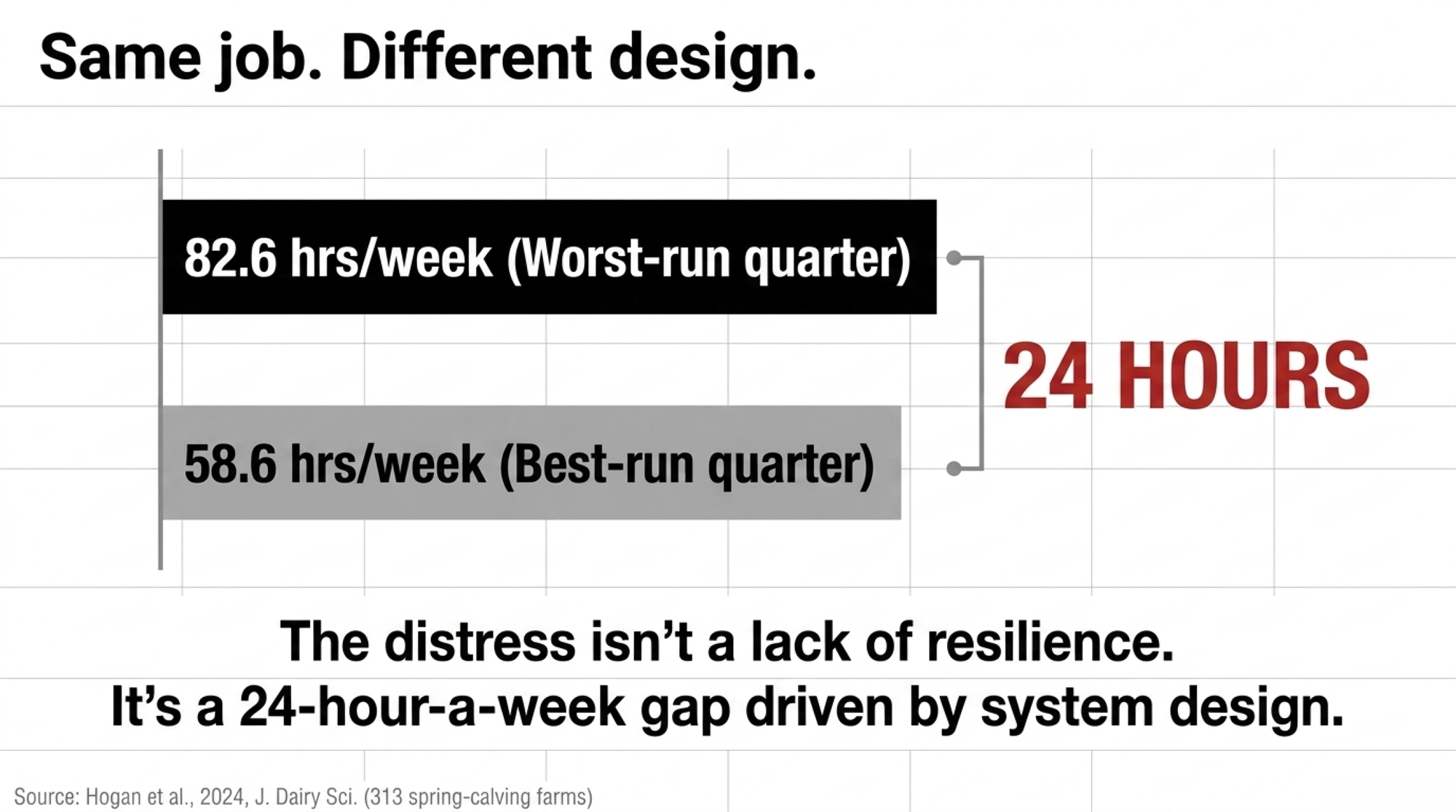
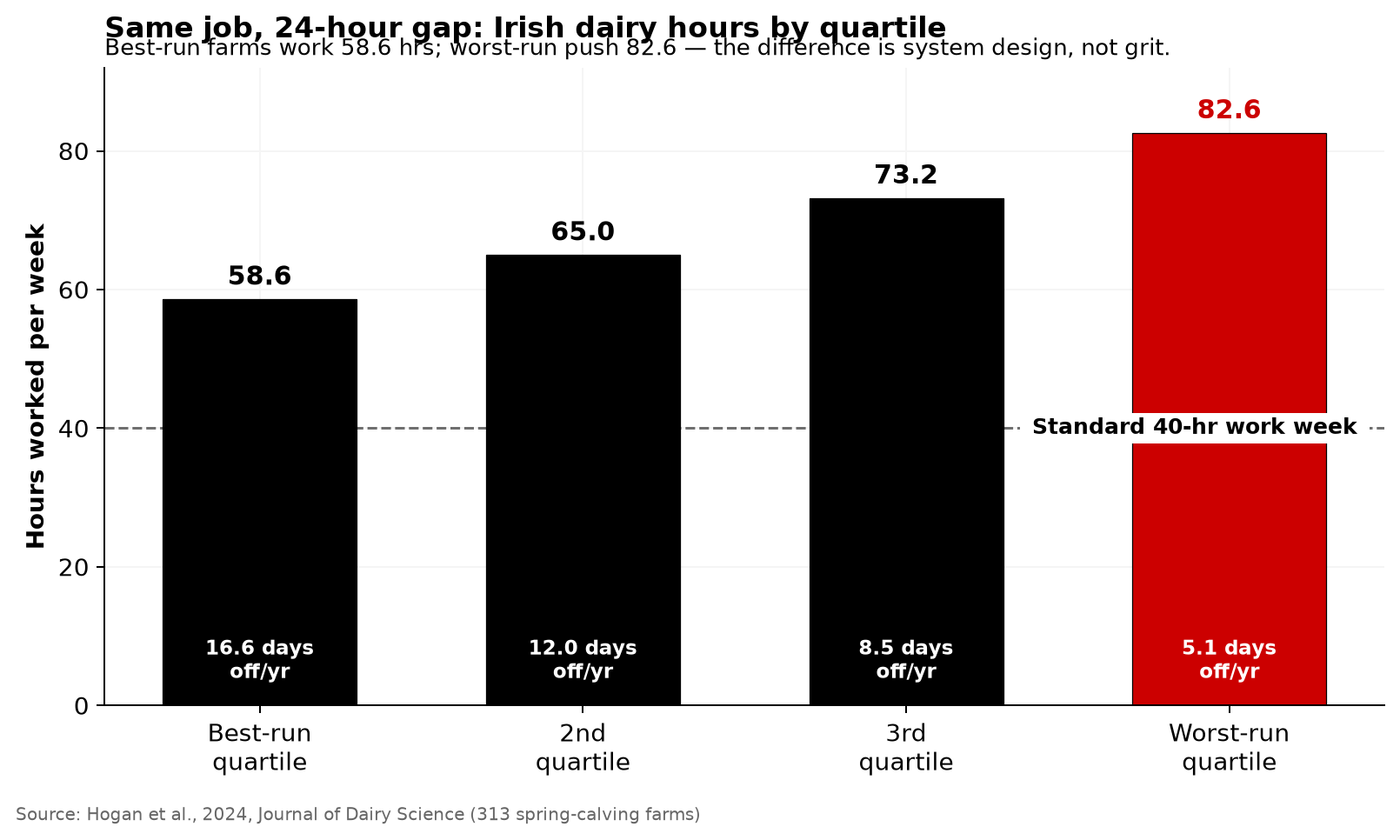
Why does the messier stat actually make the case stronger? Because if resilience already runs below average and dairy farmers are still more distressed than the general public, resilience isn’t a tank you keep topping up. It’s mostly gone. Look at the hours alone: an Irish study of 313 spring-calving farms found the best-run quarter averaged 58.6 hours a week with 16.6 days off, while the worst-run quarter ran 82.6 hours on just 5.1 days off. Same job. A 24-hour-a-week gap, driven by how the work is built, not by how tough the farmer is.
The Mechanics: Where the Hours Actually Hide
Milking is the anchor tenant. UK CAFRE benchmarking found it eats 30–50% of total working time on dairy farms. Total labor demand runs anywhere from about 22 to 80 hours per cow per year depending on the system — a 3.5x spread for what’s essentially the same job. That range is where wellbeing lives or dies.
And the spread isn’t about herd size. It’s about how the work is built. Bullvine’s own labor analysis found the most efficient operators worked 51.2 hours a week running 112 cows, while the least efficient put in 70 hours on a virtually identical herd. Same cows, same milk, nearly 19 hours a week apart. That’s a full extra work day, every week — one farm spends it, the other reclaims it, purely on system design. The difference between a Sunday off and a Sunday in the parlor.
Then there’s the input nobody costs: unpaid family labor. Wisconsin and Minnesota organic dairy data pegged it at 25–31 hours per cow per year, and the better-run farms sometimes leaned on it more, not less. Meanwhile USDA’s Dairy Margin Coverage protects feed and milk margins but largely ignores labor and replacement-heifer costs — quietly treating a small farm’s 70-hour week as a free input. It’s the same math that makes a cash-basis farm look fine right up until the day you try to pay yourself.
So here’s the uncomfortable core. In a system where nobody wants to absorb the cost, someone already is. It shows up as long weeks, worn-out backs, and grief that lands in farmhouses — never on anyone’s balance sheet.
How Much Is a 70-Hour Week Really Costing You?
Start with what money is supposed to buy: your time and your health. If you’re logging 60–70 hours a week across milking, calves, cropping, and paperwork, the research drops you square in the zone where workload predicts ill health directly. So run it in dollars. One full-time hire at roughly $18–$20/hour CAD/USD over a 2,500-hour year lands near $45,000–$50,000 in wages alone — before benefits, housing, or payroll costs, which typically add another 15–30%.
Here’s the barn-math version, so you can map it to your own place. Say that hire takes 20 hours a week off your back — a conservative number for one good employee. Over a year that’s about 1,040 hours you’re not doing. Put your own time at that same $18–$20 CAD/USD, and you’ve effectively bought back $18,700–$20,800 worth of your own labor while the wage bill runs $45–50K. The gap is what the extra cows, fewer mistakes, and a full night’s sleep have to cover. Where does that pencil out on your herd? That’s the real question — and it moves with scale.
Which Fix Fits Your Operation?
Four structural moves keep surfacing in the research. Each one shifts the stress somewhere. None of them erases it — so pick the trade you can actually live with. Here’s how each one moves a 150-cow solo operator’s week before you stack them.
📊 Hours reclaimed per week — 150-cow solo operator Baseline: 55–65 hrs/week (70+ in peak season).
- Robots → ~30–35 hrs off the pit → week toward 35–45 hrs
- Beef-on-dairy → ~4–6 hrs off calf chores → 50–58 hrs
- Outsource cropping → kills the 70–80 hr peaks → 45–52 hrs
- Add one FTE / share-milk → down toward 35–40 hrs Stacked, not additive. Full week-by-week schedule in the deep dive below.
The paths pull different levers. Robots are capital-heavy and buy back the most raw hours, but they hand you a new kind of stress. Beef-on-dairy costs almost nothing and quietly shrinks the chore list. Outsourcing cropping kills the peak-season spikes fast. Adding labor hits the hours hardest — but only if the arrangement itself is built right. Here’s the side-by-side.
| Fix | Primary Lever | Capital / Cost | What it Buys Back | The Catch |
| Milking Robots | Capital-for-labor | High: 7-yr negative cash flow | ~75% of milking labor (6.5 → 1.5 hrs/day); +13% net returns (USDA ERR-356) | 71.5% of robot farmers report stress from nightly alarms |
| Beef-on-Dairy | Fewer replacement animals | Very Low: incremental semen cost | 18–24 months of daily chores per heifer not raised; +$22–$65/cow margin | Beef-sired stillbirths run 5% vs 2% — sire selection is critical |
| Outsource Cropping | Shed peak-season spikes | Low–Medium: per-acre custom rate (operating cost, not capital) | The 70–80 hr peak weeks tied hardest to burnout | Weather turns, and you’re on the custom operator’s schedule, not yours |
| Add Labor / Share-Milk | More hands | Medium/High: ~$45K–$50K CAD/USD per FTE/yr | Owner’s week from 60-plus down toward 40 hrs | Poor contract design just relocates the burnout onto whoever signs it |
One bright spot worth pulling out of the robot row. Guelph found farmers who added automated feeding alongside robots reported lower stress, anxiety, and depression. The tech isn’t the enemy. Selling it as a standalone fix is.
The share-milking line deserves a plain warning, because it’s the one people get wrong. A New Zealand survey found 73% of contract milkers hit financial or mental-health strain and 43% reported abusive behavior on the job. Hand off the tasks the wrong way and you reproduce the same burnout on someone else’s back. The contract terms — hours, holidays, downside protection — decide whether it’s healthy for anyone.
Where does your break-even sit? Rule of thumb, not gospel: a solo operator north of about 120 cows usually hits the added-labor tipping point first, because the hours already run past what one person can safely carry. Under 80 cows milking alone, beef-on-dairy and outsourced cropping tend to move the needle faster and cheaper than a full wage. Run your own numbers before you treat either line as settled.
The 30-day move: don’t buy anything yet. Price one outsourced task. Call two custom operators this month, get a real per-acre number, and stack it against your own hours in planting or harvest. That’s a decision you can make before next calving, with no capital and no contract.
Is This Your Problem to Fix — Or the Industry’s?
Both, and it’s worth being straight about the split. You own the hours you tolerate and the fixes you install. But co-ops, processors, and policymakers own the structures that make a 70-hour week feel normal. The EU’s 2025 SafeHabitus policy brief named “excessive working hours” as a target for actual policy — not just individual coping. Agri-Mark’s own letter said it plainly: “Farm families are incredibly resilient, but…” people still need help. That “but” is the whole argument. The resilience is maxed. The design is the next lever.
Key Takeaways
- If you’re logging more than 60 hours a week across milking, calves, and cropping, treat that as an operational risk metric — not a badge. The data ties that range straight to burnout.
- If you’re quoting the “3.5x” number, stop. It was corrected down — say “meaningfully higher risk” instead. It’s the honest and defensible version.
- If you’re solo past roughly 120 cows, run the added-labor numbers first. If you’re under 80 and milking alone, start with beef-on-dairy and custom cropping — they usually pay back faster.
- If you’re eyeing robots, budget for the alarm stress and the seven-year cash-flow valley — and pair them with automated feeding, which the data links to better wellbeing.
- If you’re breeding your bottom third to dairy out of habit, switch to beef. Fewer replacements means fewer 10 p.m. February chores and $22–$65 CAD/USD more margin per cow.
- If share-milking is on the table, cap the hours in the contract — or you’ll just move the burnout to whoever signs it.
So here’s the number worth running this week: which single task on your place eats the most hours for the least joy — and what would it actually cost to hand it off before next calving? Do that math with your accountant at the table, not in your head at 2 a.m. And tell us in the comments which of the four fixes you’d pull first, and why — we read every reply, and the sharpest ones shape what we dig into next.
⚠️ You don’t have to run these numbers alone. Canada: National Farmer Crisis Line — 1-866-FARMS01 (1-866-327-6701), 24/7 · Talk Suicide Canada — 1-833-456-4566 · Ontario Farmer Wellness Initiative — 1-866-267-6255United States: Call or text 988 · AgriStress Helpline — 833-897-2474 · Farm Aid — 1-800-FARM-AID In an emergency, call 911.
Run Your Numbers
Farm Benchmark Snap Check — This piece names four levers; the Snap Check pressure-tests three of them in under a minute. Plug in 3–5 numbers and see, in dollars per cow, whether your margin exposure, heifer pipeline, and robot payback land in the Strong, Watch, or Risk band — then decide which hour to buy back first.
Complete references and supporting documentation are available upon request by contacting the editorial team at editor@thebullvine.com.
Learn More
- Why 70‑Hour Weeks Are Killing Your Dairy Profits — Reveals how top operators run 112 cows in 51 hours while less efficient herds waste 70 hours on identical workloads, and arms you with a practical challenge to reclaim 19 profit-draining hours weekly.
- $18.95 Milk, 8% Money: Nathan Kauffman’s 18‑Month Warning for the 10–15% of Dairies in Significant Stress — Exposes how lenders now stress-test operations against a forward $17 milk line, delivering a 30-day strategy to protect working capital and debt-service coverage before financial pressure forces structural decisions.
- Robotic Milking Labor Math: Fix the Problem or Grow Debt? — Breaks down the sharp trade-off between variable labor wages and $150,000+ in annual fixed robot debt, dismantling trade-show promises with a stress-test playbook to evaluate automation against your actual debt-coverage capacity.
The Sunday Read Dairy Professionals Don’t Skip.

Every week, thousands of producers, breeders, and industry insiders open Bullvine Weekly for genetics insights, market shifts, and profit strategies they won’t find anywhere else. One email. Five minutes. Smarter decisions all week.