



At the 1989 World Dairy Expo, three Senior Two-Year-Olds came back into the Madison ring after milking. The ribbons settled one afternoon. The consequences are still turning up in pedigrees around the world.
The 1989 Class at a Glance
- The class: Senior Two-Year-Old, 1989 World Dairy Expo, Madison, Wisconsin. Judge: Howard Binder. Associate judge: Paul R. King.
- The result: Dupasquier Starb Winnie 1st, Comestar Laurie Sheik-ET 2nd, Aitkenbrae Starbuck Ada 3rd — reportedly re-sorted after milk-out.
- Why it matters: All three founded major maternal lines still active in global pedigrees.
- Winnie: GP-83 → EX-3E-CAN. WDE Grand Champion at eight (1994). 97,371 kg lifetime.
- Laurie Sheik: $45,000 sale topper; four millionaire AI sires; inaugural Holstein Canada Cow of the Year, 1995.
- Ada: Dam of Shoremar S Alicia EX-97-3E and Ms Kingstead Chief Adeen EX-94-2E; grandam of the Atlee/Atwood type dynasty.
The milk had come down, the udders had changed, and Howard Binder had one more decision to make.
It was October 1989 at World Dairy Expo in Madison, back when cattle people still packed the Coliseum rail to study a cow after milking — because that was when the bloom was gone, and the udder had to speak for itself. Dupasquier Starb Winnie had the class. Behind her, the tension was between Comestar Laurie Sheik-ET and Aitkenbrae Starbuck Ada.
Breed-history accounts say Ada stood second before milk-out. When the three heifers came back, Laurie Sheik moved ahead on the strength of her udder texture, cleft and vein definition, taking second and the Best Udder nod of the class; Ada went third. The documentary trail for that switch is thinner than anyone would like — it runs through breed commentary rather than a recovered official World Dairy Expo results sheet — but the final order is clear.
That would have been enough for a good Expo story. It became something much bigger, because in those few minutes Madison had placed three young cows who’d each become the head of a major maternal line. Winnie would grow into an eight-year-old World Dairy Expo Grand Champion. Laurie Sheik would turn an unfashionable mating into four millionaire AI sires and a family spread across more than 50 countries. Ada would leave Alicia, Adeen, Atlee and Atwood — a line that carried show-ring power straight into the genomic-type era.
The ribbons named a winner, a second, and a third. Time sorted them differently.
Act I: Before the Numbers Won
Now, the thing about 1989 is that Holstein breeding was already in the middle of an argument.
For decades, show breeders had built programs around the cow standing in front of them: balance, openness, feet and legs, mammary systems, strength where strength had to be. Meanwhile, the genetic evaluations were gaining force, and commercial dairymen were reading milk, fat, protein, and reliability numbers with growing seriousness. One side trusted the eye. The other trusted the index. Most barns, if we’re honest, were trying to figure out how to have both — and World Dairy Expo sat right in the middle of that argument.
This was a different dairy world. Embryo transfer worked, but international work still meant hand-signed health papers, ownership transfers, customs forms, phone calls, and fax machines. You’ll see “-ET” after a cow’s name in this story; that’s the marker for an animal produced by embryo transfer, and in 1989 it still signaled something faintly futuristic.
Classification reads differently through a modern lens, too. A GP-83 two-year-old might look ordinary on paper, but in the late 1980s classifiers didn’t hand lofty scores to first-lactation heifers. A young cow could be Good Plus and still have every bit of the raw material to become a great one.
That year, Madison was already thick with history. Norm Nabholz took the Klussendorf Trophy. Roy Ormiston of Roybrook became the first Canadian honored with the Dairy Shrine Award. The Coliseum held the usual mix: cattlemen comparing notes, breeders quietly calculating what a good young cow might be worth, kids pressed along the rail trying to decide which animal they’d remember forever.
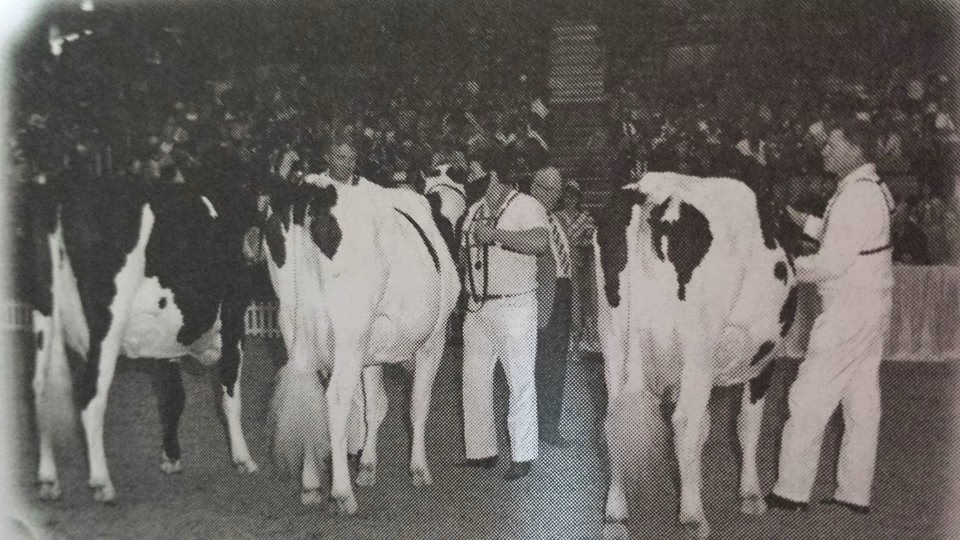
Then Winnie, Laurie Sheik, and Ada walked in.
| 1989 WDE Senior Two-Year-Old | Cow | 1989 Owner / Exhibitor | Sire |
| 1st · 1st BU (pre-milkout) | Dupasquier Starb Winnie | Oscar Dupasquier, Guelph, ON | Hanoverhill Starbuck |
| 2nd · Best Udder of Class | Comestar Laurie Sheik-ET | Marc Comtois / Belgistar Syndicate, QC | Puget-Sound Sheik |
| 3rd | Aitkenbrae Starbuck Ada | Lawson Bennett / Hygerian Associates, OH | Hanoverhill Starbuck |
Best Udder credit reflects the post-milk-out re-sort described in breed-history accounts rather than a recovered official WDE results sheet.
Winnie and Ada were Hanoverhill Starbuck daughters. Laurie Sheik — contrary to a claim that keeps slipping into retellings — was not. She was by Puget-Sound Sheik. That distinction matters, because this wasn’t three Starbuck daughters in a sweep. It was two Starbuck daughters and a Sheik daughter, representing three sharply different breeding decisions.
Starbuck was still the giant in the background. Bred at Peter Heffering’s Hanover Hill Holsteins in Port Perry, Ontario, he was born April 26, 1979, by Round Oak Rag Apple Elevation and out of Anacres Astronaut Ivanhoe VG-88. CIAQ bought him as a 45-day-old calf for $2,500 — a figure that reads almost absurdly small now. He grew into a 2,580-pound bull, 73.5 inches at the shoulder, and he stamped daughters with the kind of open rib, chest, udder, and consistency that made a breeder stop walking and take a second look. The record credits him with 10 milking-age All-American daughters, more than any bull in Holstein history, plus 82 All-American nominations and 130 All-Canadian honors among his daughters. His reach eventually became so wide that the industry had to take inbreeding and mating management seriously.
But Starbuck didn’t make this class historic on his own. The story lives in what the three cows did with their chance.
Act II: Three Roads Out of Madison
Winnie and the patience to let a cow become one
Oscar Dupasquier’s kind of breeding didn’t reward impatience.
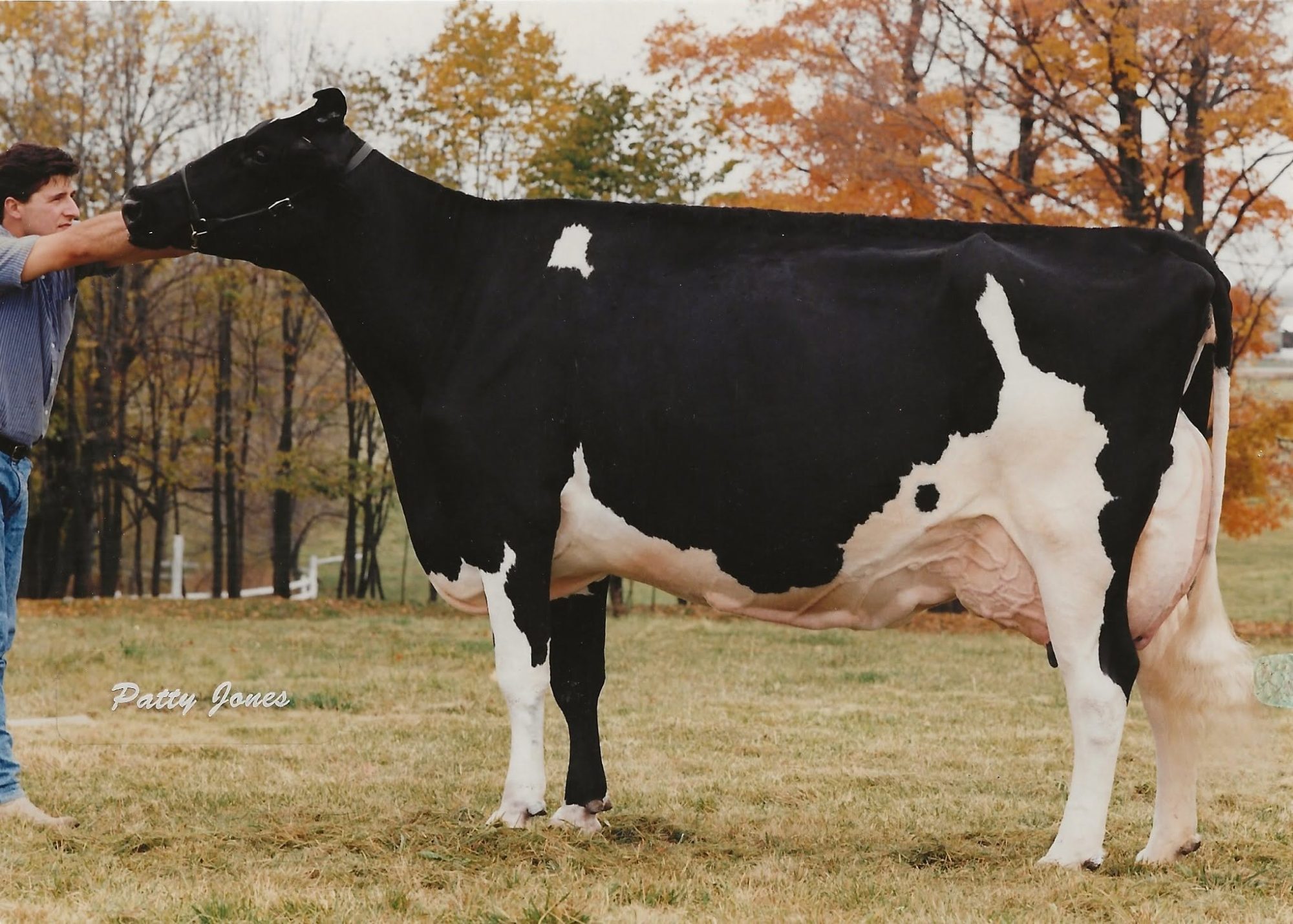
Winnie was born October 13, 1986, by Starbuck and out of Allangrove AA Winnie VG-85 4* — those stars being Holstein Canada’s way of recognizing a cow whose progeny keep proving her worth. When Winnie won at Madison as a two-year-old, she was GP-83. Not a score to make a sale catalog shout, but one that asked a breeder to see past the first lactation and picture the mature cow waiting underneath. Dupasquier did exactly that. The old cattleman’s rule explains why: a cow had to be built to keep working, feet and legs had to carry the frame, the frame had to hold the capacity, and somebody had to be patient enough to let her prove whether the promise was real.
Winnie became a case study in that patience. She climbed from GP-83 all the way to EX-3E-CAN — Excellent, reclassified upward three separate times as she matured — and earned eight Brood Cow Stars along the way. Her show record built slowly, then piled up: All-Canadian and All-American Senior Two-Year-Old in 1989, All-Canadian Three-Year-Old in 1990, All-Canadian Four-Year-Old in 1991, Reserve Grand Champion at World Dairy Expo in 1993, All-American Aged Cow in 1993.
And here’s where it gets interesting.
At the 1991 Royal Agricultural Winter Fair — a 277-head show — Winnie stood Grand Champion. Her daughter, Dupasquier Black Winnie VG-88, was named Junior Champion in the same ring on the same day. Holstein Canada identifies the pair as the only dam and daughter to take those two major titles at the Royal in the same year.
Think about what that actually requires. Not one great cow — a great cow who can hand the banner forward while she’s still winning it herself. One is memorable. Two is a dynasty.
Three years later came the summit. Winnie was eight years old when she stood Grand Champion at World Dairy Expo in 1994, the third straight Starbuck daughter to win Madison. Holstein International later treated the photograph of Winnie posed with Eric Dupasquier outside the Coliseum as one of those images that carries an entire era inside it: an aged cow, a young handler, the building behind them, and proof that maturity still counted for something in a breed sprinting toward numbers.
Then she went home and worked — and this is the part that should stop a modern reader cold. Across six lactations, Winnie put 97,371 kilograms of milk in the tank. That’s 214,664 pounds, at 4.1 percent fat and 3.3 percent protein. Her 6-07 record ran 15,229 kilograms in 365 days, with 612 kilograms of fat and 477 of protein. Nobody could ever file Winnie away as a show-ring specialist. She could stand under the lights, then go home and fill the bulk tank for another year.
Laurie Sheik and the bet nobody could see yet
Laurie Sheik came from a different kind of gamble.
Marc Comtois left school at fifteen to work with cattle. By eighteen he’d bought a farm in Princeville with 44 grade cows. He married France Lemieux on April 23, 1977, and the two of them started swapping grades for registered Holsteins, one practical decision at a time. Comestar didn’t begin as an empire. It began as a young couple putting their confidence into cattle.
In 1985, Comtois bought Elysa Anthony Lea EX-15, a deep-ribbed daughter of Willowholme Mark Anthony. Then he bred her to Puget-Sound Sheik — a 1972-born VG-85 bull nobody was chasing anymore. In a business that runs on fashion as much as data, that takes some spine. The mating produced Laurie Sheik on December 1, 1986, and she came into the world wearing a broad white starburst on her forehead. A little too perfect, really.
She won the Senior Two-Year-Old class at Victoriaville in 1989, then came to Madison and finished second with the class Best Udder nod. Picture her walking back in after milking — the Coliseum lights catching that white star, her udder collapsed clean and correct the way only the good ones do. That’s the moment the whole class turned on.
“Flash gets attention; the empty udder gets respect.”
She’d go on to VG-88-CAN and 23 Brood Cow Stars. That distinction is worth making carefully: the 23 stars measure the strength of her transmitting record — they aren’t a claim that she had 23 Excellent daughters. The source record lists 18 Very Good daughters behind that total.

A pivotal moment in Holstein history as a young Comestar Laurie Sheik VG-88 23* claims second place in the Senior 2-Year-Old class at World Dairy Expo. What makes this moment especially significant is that this unassuming cow would go on to become one of the most influential matriarchs in Holstein history, producing four millionaire bulls and establishing a genetic dynasty that continues to influence dairy breeding worldwide today. This early show ring success hinted at the extraordinary genetic potential that would eventually extend to 51 countries and span multiple generations of elite Holstein breeding.
The real turn came at that first Comestar Sale in 1989, where Laurie Sheik topped the day at $45,000, and Eddy and Annie Pussemier of Bois Seigneur Holstein in Belgium bought a 50 percent interest, creating the Belgistar Syndicate. The price was a statement. Getting her genetics home was the hard part. Live-animal import restrictions meant the Pussemiers couldn’t simply load her on a plane, so the two families went the embryo route instead — a cross-border process run on the analog machinery of the day: paperwork, phone calls, faxes, health certificates, customs documents.
Consider what that decision looked like from the Belgian side. The Pussemiers were converting a beef operation into an elite dairy herd, and they’d just committed serious money to half of a young Quebec cow they had no legal way to bring home. One can only imagine the conversation on the drive back. Everything depended on embryos surviving a paper trail nobody had built yet.
It worked better than anyone had a right to expect. Laurie Sheik’s three To-Mar Blackstar daughters — Comestar Laura Black VG-87-CAN 24*, Comestar L Or Black VG-87-CAN 16*, and Comestar Lausan Black VG-87-CAN 23* — became the family’s multiplying point. Through Laurie Sheik and those branches came Comestar Leader, Comestar Lee, Comestar Lheros, and Comestar Outside: four millionaire AI sires. Lee alone was credited with 1.5 million doses and more than 183,000 daughters. The family reached 51 countries in the dossier record, and at Bois Seigneur roughly 70 percent of the herd traces to her — including Blacklaure de Bois Seigneur, credited with more than 100,000 kilograms of lifetime milk.
A mating half the breed had written off ended up rewriting AI lineups on two continents.
Laurie Sheik became Holstein Canada’s first Cow of the Year in 1995. Twenty-seven years later, in 2022, Comestar Lamadona Doorman EX-94-2E — from that same family — took the identical honor. That’s the sort of bookend most breeders only dream about.
She died April 30, 2004. But the bet Marc and France Comtois made on an out-of-fashion sire didn’t die with her. It became one of the breed’s most profitable arguments for looking past the fashionable page.
Read more: The Cow That Built an Empire: Comestar Laurie Sheik’s Unstoppable Genetic Legacy
Ada and the lesson of third place
Ada’s the reminder not to turn a class placing into a permanent verdict.
Aitkenbrae Starbuck Ada was born September 13, 1986, at Aitkenbrae Farm in Holstein, Ontario. Her sire was Starbuck; her dam, Aitkenbrae Sheik Arlene, was a GP-80 daughter of Puget-Sound Sheik. Before the 1989 Expo, Lawson Bennett and Hygerian Associates — the Ohio group led by Robert Binger and William Atkins — bought Ada after cattleman Ken Empey saw her two months fresh and recognized her dairy strength. And there was plenty to see: the record describes a massive, clean-boned cow with exceptional width of chest and a highly functional mammary system — the kind of animal that looks like she was built to milk hard for years, not just for a season.
Think about the nerve that purchase took. An Ohio investment group, buying an Ontario heifer barely two months into her first lactation, largely on a cattleman’s word about what she’d become. The record doesn’t preserve what Binger and Atkins said to each other before they wrote that check, but anyone who’s ever syndicated a young cow knows the feeling — you’re not buying what’s standing there, you’re buying what you think is coming.
That’s the kind of call that separates good cattlemen from the rest of us. Some people look at cows. Others see them. But it was still a decision made on a young cow, and those can go either way.
Ada won the Michigan State Fair in 1989, then finished third in Madison. That December she sold again, this time to Gayridge and Kingstead Farms in Maryland — a move that dropped her into a donor-cow setting where a strong young show heifer could be given the chance to become something more.
She took it.
By 1990, Ada was Grand Champion at the Eastern National Show and Unanimous All-American Senior Three-Year-Old. She eventually classified EX-94-2E-USA DOM at fourteen years and two months — the 2E marking two upward reclassifications, and DOM standing, the designation for a cow whose type and production transmit reliably to her offspring. She earned four Brood Cow Stars in Canada and produced 137,732 pounds of milk across six lactations. At 2-05, she made 25,000 pounds in 362 days.
But the daughters are where Ada’s story starts to feel almost unfair.
Flushed to Donnandale Skychief, she produced two full sisters: Shoremar S Alicia EX-97-3E and Ms Kingstead Chief Adeen-ET EX-94-2E DOM. Alicia reached Excellent-97 — one of roughly 35 Holsteins in North American history to get there, by the count in the breed record. Sit with that number a second. Ninety-seven, in a system where cracking the mid-90s makes a barn go quiet. She was nominated All-American five times in milking form and stood Supreme Champion at the 2000 Royal. And Howard Binder — the same judge who’d placed Ada third at Madison in 1989 — later became a part-owner of Alicia. Eleven years after he set the original order, he ended up connected to the daughter who made that order feel wonderfully incomplete.
You couldn’t script that.
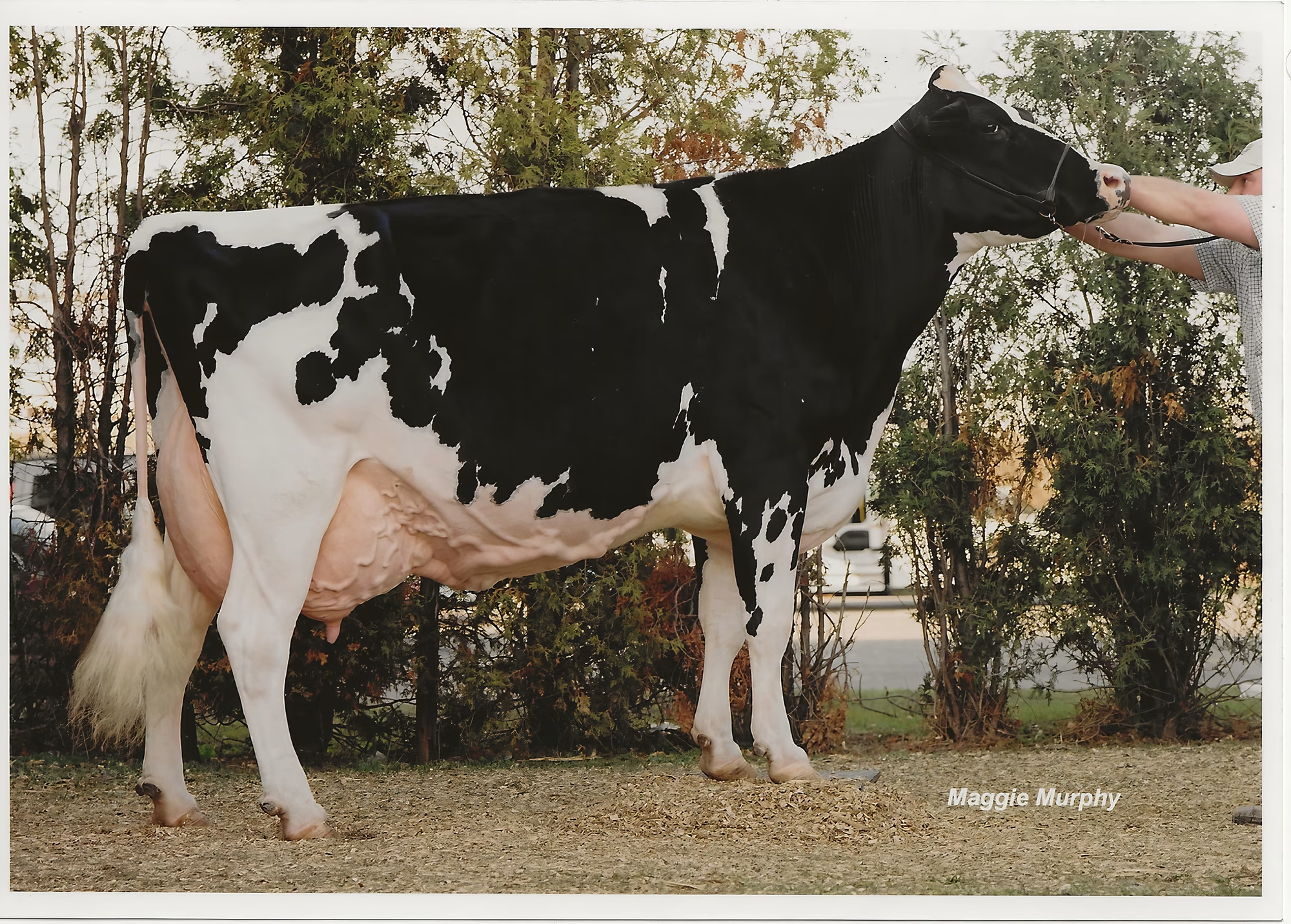
Adeen anchored the foundation at Butlerview Farms from 1999 until she died in 2011 at fourteen. The sources credit her with somewhere between 24 and more than 30 Excellent daughters — the exact count varies by record, which tells you something in itself about how many good cows she left behind. But it was Adeen’s daughter, MD-Delight Durham Atlee EX-92 GMD DOM — the GMD marking her a Gold Medal Dam for the production her progeny delivered — who turned show-ring type into an international commercial force. Atlee gave the breed Maple-Downs-I G W Atwood, the number-one proven type sire in the United States in August 2012 at +4.16 PTAT. And she didn’t stop at one. Ms Atlees Sht Aftershock came out of the same dam at +3.12 PTAT, alongside Mr Atlees AltaAmazing, Allyndale-I Atticus, Maple-Downs-I G.W. Atlantic and Ridgefield Delete.
Two sire brothers over +3.00 PTAT out of one cow. That’s the number that tells you what actually happened here. Atlee didn’t just produce a good type bull — she produced a bench of them, and that bench is what carried Ada’s branch into the genomic era as the definitive source of global high-type sire stacks for the better part of two decades. So when Ms Atlees Goldwyn Ariel EX-92 sold as part of a $1.5 million package at the 2010 Parade of Perfection Sale, it only confirmed what breeders already knew: the third-place heifer from 1989 had laid the foundation for the most dominant high-type maternal line of the genomic era.
Here’s what Ada really did, though. She made the jump from show cow to donor matriarch without giving up either side of the equation. Her family turned up in the United Kingdom, France, the Netherlands, Spain, and Japan — including Tanaka Farm’s TMR Adeen Dundee Chief-ET, grand champion at the Hokkaido Black and White Show. It also produced cattle that could compete in a world increasingly run on genomic information and type proofs.
Third in Madison. Everywhere later.
Sidebar: Three Families, One Afternoon
- Winnie’s family. Dupasquier Starb Winnie EX-3E-CAN 8*, whose daughter Dupasquier Black Winnie VG-88 took Junior Champion at the 1991 Royal on the same day her dam took Grand. Other Dupasquier-prefix animals in the line include Starb Whitey and Starb Winda, with Windstar Wanity EX-90-2E-CAN, Rudlph Winnie EX-90-CAN, Rose-Vue Astro Whoosh EX-93-2E-USA and Rose-Vue Damion Wooki EX-91-2E-USA appearing in the family’s later records.
- Laurie Sheik’s family. From Elysa Anthony Lea EX-15 came Comestar Laurie Sheik-ET VG-88 23*, then the three To-Mar Blackstar sisters — Laura Black VG-87 24*, L Or Black VG-87 16*, Lausan Black VG-87 23*. Out of those branches: the millionaire sires Comestar Leader, Lee, Lheros and Outside. Further down the line sit Comestar Lautamie Titanic VG-89 33*, Comestar Lautama Goldwyn VG-88 22*, and Comestar Lamadona Doorman EX-94-2E, the 2022 Cow of the Year.
- Ada’s family. Aitkenbrae Starbuck Ada EX-94-2E DOM, dam of full sisters Shoremar S Alicia EX-97-3E and Ms Kingstead Chief Adeen-ET EX-94-2E DOM. Adeen’s daughter MD-Delight Durham Atlee EX-92 GMD DOM produced the type-sire bench: Maple-Downs-I G W Atwood (+4.16 PTAT, #1 US proven type sire, August 2012), Ms Atlees Sht Aftershock (+3.12 PTAT), Mr Atlees AltaAmazing, Allyndale-I Atticus, Maple-Downs-I G.W. Atlantic and Ridgefield Delete — plus Ms Atlees Goldwyn Ariel EX-92, sold in a $1.5 million package in 2010.
Act III: What the Breed Saw — and What It Missed
Looking back, that class wasn’t historic because the cows photographed well or because Binder happened to find a memorable top three. It was historic because three breeding arguments walked into the same ring on the same afternoon.
Winnie was the argument for structure, patience, and the mature cow. GP-83 to EX-3E, major shows won as an aged cow, serious milk in the tank, quality passed to the next generation. Laurie Sheik was the argument for conviction — a young couple picked an unfashionable sire, sold half of their best young cow, moved embryos across an ocean and built a global AI family out of it. Ada was the argument for the long view: a third-place heifer became the dam of Alicia and Adeen, then the grandam of the animals that shaped type breeding in the genomic era.
And Starbuck? He was the current running under the whole floor, but he wasn’t the whole story.
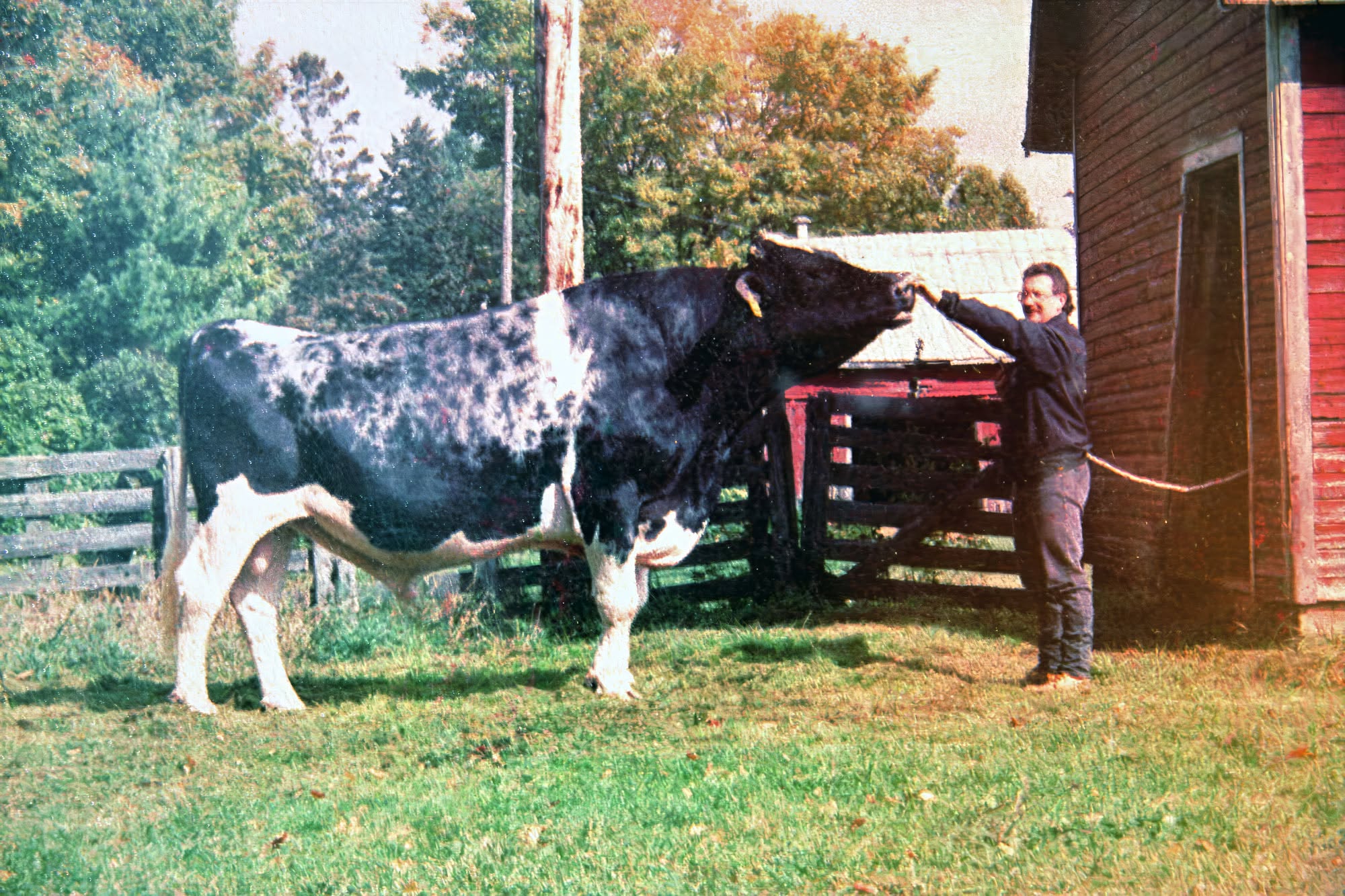
The record credits him with more than 200,000 daughters across 45 countries, roughly $25 million in semen sales, and 27 Premier Sire honors between 1986 and 1995. By 2000, about 95 percent of registered Holsteins in Quebec carried his genetics, and the research dossier estimates his DNA persists in roughly 83 percent of sequenced North American Holsteins today. That reach brought enormous progress — and a hard lesson in stewardship. When one bull gets that dominant, mating plans have to get smarter.
“Genetic concentration isn’t a trophy if it quietly narrows the next generation’s options.”
Which brings us to the practical inheritance of that class, the part worth pinning to a barn wall.
Don’t confuse a first-lactation score with the finished cow. Fashion is not a breeding plan — let it make your decisions and eventually it’ll make a bad one for you. Never assume the cow standing third has finished writing her story. And when a sire gets that common? Manage the success instead of just celebrating it.
The best cattle people have always worked that way — looking at the cow, the pedigree, the numbers and the next two generations all at once.
The Tracks They Left
The banners are long folded away now.
Laurie Sheik died in 2004. Winnie lived to twelve, leaving three Excellent and four Very Good daughters behind her. Ada’s own show career gave way to Alicia, Adeen, Atlee, Atwood, and every branch still spreading from them. Starbuck died September 17, 1998, in Saint-Hyacinthe, Quebec, and the clone that followed him, Starbuck II, never entered commercial breeding after mitochondrial DNA discrepancies surfaced — a strangely fitting end to the whole idea of copying a great animal instead of breeding forward from him.
There’s sadness in that, sure. But no emptiness, because good cows don’t disappear when the halter comes off.
Open a modern type pedigree and find Atwood or Aftershock sitting in it, and Ada’s third-place afternoon is right there in the background. Watch Comestar Lamadona Doorman get named Cow of the Year, and Laurie Sheik’s white-starred gamble is still paying. Stand at the rail while a mature cow comes back after milk-out with a better udder, more strength through her middle, sound feet and legs, and that look of an animal built to last — and Winnie’s standard is still part of the conversation, whether anybody says her name or not.
That’s why the 1989 Senior Two-Year-Old class matters. For a few minutes in Madison, three young cows stood on colored shavings while a judge sorted a class, and a few hundred people thought they were watching good young cattle. What they were really watching was inheritance itself — strength, udder, family, and faith in the cow. Nobody in that ring could have known how far those daughters and granddaughters and sons would travel, across provinces and oceans, through AI studs and donor programs and genomic pedigrees. But the evidence was standing right there the whole time: in the udder after milking, in the frame still growing, in the breeder willing to trust a bull nobody wanted, and in three cow families waiting patiently to become history.
Key Takeaways
- Winnie won Madison as a GP-83 two-year-old and finished EX-3E. If you’re culling on a first-lactation score, you’re culling cows before they’ve shown you what they are.
- Comtois bred Elysa Anthony Lea to a 1972 bull nobody was using and got Laurie Sheik out of it. Pull one mating a year off the popular list and breed to what your cow actually needs.
- Atlee threw two type sires over +3.00 PTAT. Real brood cows are rare — when one shows up in your barn, flush her while you’ve got her and give the family two generations to prove out.
- Starbuck’s DNA is in roughly 83 percent of sequenced North American Holsteins. Run your matings for how deep that stacks before the safe, popular bull turns into your inbreeding problem.
Learn More
- Hanoverhill Starbuck: The Bull That Changed Everything — Arms breeders with the genetic blueprint behind Starbuck’s global dominance, dissecting how his massive bloodline concentration shaped modern inbreeding levels and why managing pedigree depth determines long-term commercial longevity.
- Marc Comtois: Master Breeder of Comestar Holsteins — Breaks down the high-conviction mating strategies and cross-border syndication models behind Laurie Sheik, delivering proven management tactics for turning out-of-fashion donor genetics into multi-million-dollar AI lineages.
- MD-Delight Durham Atlee: The Type Queen That Built an Empire — Reveals how Adeen’s greatest daughter transformed third-place show-ring power into commercial dominance, tracing the genomic type stacks that generated six elite sire brothers and multi-million-dollar sale packages.
The Sunday Read Dairy Professionals Don’t Skip.

Every week, thousands of producers, breeders, and industry insiders open Bullvine Weekly for genetics insights, market shifts, and profit strategies they won’t find anywhere else. One email. Five minutes. Smarter decisions all week.