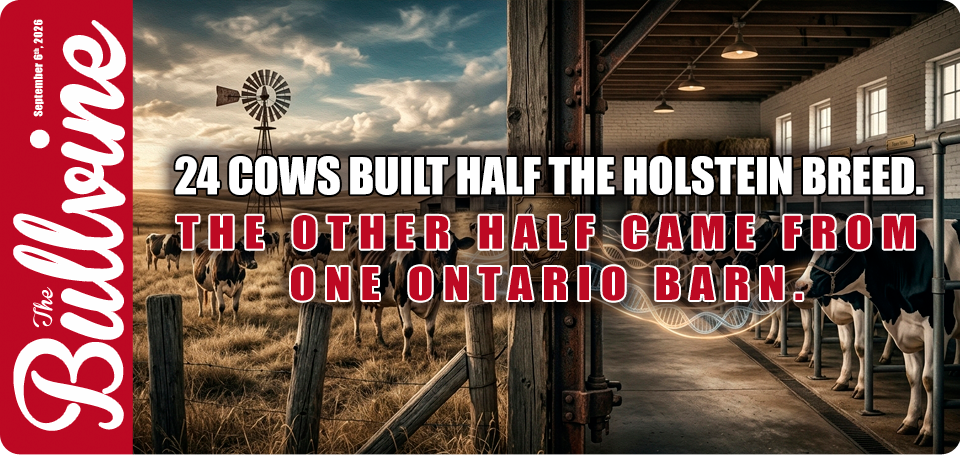




Twenty-four cows nobody else wanted from Kansas. One stubborn Ontario dairyman who used an outcross bull exactly once. Between them: 99.84% of every A.I. sire in your barn tonight.
In 1947, at the Wisconsin State Reformatory in Green Bay, a bull calf was loaded onto a truck bound for Kansas, and not one dollar changed hands.
The Reformatory ran the best Holstein herd of all the Wisconsin state institutions — and yes, that’s exactly what it sounds like. A prison. With a bull barn that half the Midwest wanted access to. Their blood went into serious herds, the kind of operations that produced bulls like Osborndale Ivanhoe, and a breeder who got access to it got it because somebody there thought well of him.
Elmer Dawdy had no money to speak of.
What he had was a young bull sired by Dunloggin Golden Cross — and he’d gotten that mating almost by accident. Golden Cross spent fourteen days at Dawdy’s place while en route to Colorado, and Dawdy bred one cow to him during the stopover. One cow. That was the whole opportunity, and he took it.
So he offered that son to the Reformatory, straight across, for a five-week-old calf named Wis Burke Ideal, born May 20, 1947.
They took the deal.
A five-week-old calf. Understand what that means — Dawdy wasn’t buying proven genetics; he was buying a guess. Nobody knew what that calf would become. He could have grown into nothing at all and cost Dawdy the only good bull he’d ever bred by accident.
Instead, Wis Burke Ideal sired Tidy Burke Elevation. Tidy Burke Elevation sired Round Oak Rag Apple Elevation. And Elevation — the bull Holstein International crowned Bull of the Century in 1999 — sits behind roughly half of every active Holstein A.I. sire in North America today.
The other half traces to a man in Brampton, Ontario, whose Glenvue prefix Dawdy had probably never bothered to learn, whose favorite bloodline Dawdy would have thrown him out of the barn for mentioning, and who was building the identical monument from the opposite end.
ACT I: BREEDING BLIND
Understand what these men were working with, because it changes how you read everything that follows.
When Doug Dunton bought his first Holstein in 1920, formal classification didn’t exist in Canada yet. Holstein Canada wouldn’t launch its program until 1925. And even once inspectors were coming through with clipboards and scorecards, what they left behind was a letter on a card — nothing more.
No sire summaries. No daughter averages published in a booklet you could carry to a sale. No reliability figures, no indexes, no way to compare one bull’s daughters against another’s except by driving to see them.
So that’s what you did. If you wanted to know whether a bull’s daughters had udders worth having, you got in a car — or a wagon — and you went and looked. You asked the neighbors. You trusted your eye.
Doug Dunton put it plainly years later: if you couldn’t see an animal’s ancestors to judge how good the type was, and whether it passed along, “you were working blind.”
Compare that to what’s sitting in your pocket. Genomic proofs. Reliability percentages. Haplotype screens on animals that haven’t been born yet. These two men laid the foundation of the modern Holstein cow with less usable information than you’d bring to buying a used truck.
The one cow that ended the Shorthorn experiment
Doug Dunton came to Holsteins sideways, and late.
In 1920 he signed up for a dairy short course run by the Ontario Department of Agriculture. Up to then he and his father had been crossing Dual Purpose Shorthorns — an experiment the record describes, with what I read as considerable mercy, as having “little apparent success.”
During the course, Doug got into some good Holstein barns for the first time. He came home and bought one cow. One. Not a conversion — a test.
She milked 80 pounds in a day.
Twice what any Shorthorn on the place had ever given. Picture her standing in that tie-stall row, a big black-and-white stranger among the roans, filling a pail while the home-bred cows on either side of her filled half of one.
You don’t need a scorecard to read that. Doug and his father went out and bought four more Holsteins, and the Shorthorns were finished.
Three of the four came from Lorne Davidson’s farm at Meadowvale. Two of those three built everything.
Bruach Noelle hit the ground on Christmas Day, 1928 — a daughter of King Segis Vale Spofford. She’d become the maternal great-granddam of two All-Canadian winners.
Her maternal sister, Bruach Luella Acme, was a daughter of King Toitilla Acme, the Davidson herd sire. She started the line that ran down to Glenvue Jean Inka B.
Hold onto Jean Inka B. She comes back at the end, and when she does, it’s going to land.
Dunton had no college degree. What he had instead was a conviction so fixed it worked like faith. He believed in close breeding — “breeding warm,” he called it, which is honestly the most farmer description of inbreeding ever committed to print — and he believed the King Toitilla Acme line was better than whatever anyone else was using.
In roughly four decades of breeding, Doug Dunton used an outcross bull exactly once.
The verdict on that experiment is the driest sentence in the whole record: he “didn’t do much harm,” but “neither did he do much good.”
No more outcross bulls were used. Ever.
The Kansas boy who sold his herd to buy an education
Elmer Alfred Dawdy was born in 1915 on his father’s place in Washington County, north-central Kansas. He came to dairy cattle through 4-H — with a Guernsey calf, which ought to make every Holstein person reading this smile. By the time college came around, he’d built a small herd of his own.
Then he sold it. All of it. For tuition.
He sold the herd. That’s Elmer Dawdy. He’d spend his whole life treating cattle as instruments rather than ornaments, and he opened by liquidating his own to buy an animal husbandry degree from Kansas State.
He graduated in 1938 into extension work — assistant county ag rep for Saline County, then head county agent six months later. That got him named Southwestern fieldman for the Holstein Association, seven states: Texas, New Mexico, Oklahoma, Nebraska, Colorado, Wyoming, Kansas.
And at that point Elmer Dawdy had never owned a Holstein cow in his life.
Think about the strangeness of that. The Association’s man across a seven-state territory, and he didn’t own one of the animals he was paid to promote.
But the job gave him something no amount of money could buy — he now knew where every bargain, every overlooked cow, and every seller in trouble was located across a quarter of the country.
So he bought a hundred acres in Saline County and started collecting.
Crooked cows from institutions
The Tidy Burke herd never exceeded twenty-four head of milking age.
Twenty-four. Smaller than most modern hospital pens. Smaller than the string a lot of you would cull in a bad year. That’s the operation we’re talking about.
And the cows in it were, to put it charitably, crooked. Bought for a song, many carrying some physical defect — the kind of fault that makes a breeder’s eye slide right past an animal at a sale. Dawdy fixed what he could and lived with the rest.
Two came out of Clyde Hill Farm in Clyde, Missouri. One of them, Clyde Hill Jewel Carine Mercedes, was classified Good the day he bought her.
She was never raised. Not once, the entire time he owned her.
Good. In an era when Good meant middling — the score you didn’t mention at the feed store, the cow you apologized for. Year after year the classifier came through, ran his eye over her, and left the card exactly where it was.
That cow founded the family that produced Tidy Burke Elevation.
Sit with that if you’ve ever culled a heifer on her score alone. The maternal foundation behind half the breed’s paternal lineage was a permanently Good cow from a Missouri farm, bought cheap by a man who couldn’t afford better.
The rest of the foundation reads like a list of places nobody shops for cattle.
The other Clyde Hill cow became the dam of Raven Burke Elsie — three Gold Medal sons. And at the Colorado State Home for Dependent Children, Dawdy found Posch Ormsby Johanna Bess. She’d produce Ormsby Burke Pontiac Mose, sire of Paclamar Astronaut.
An orphanage. A children’s home. A prison herd. A Missouri dispersal.
Even his first herd sire came through persuasion. Dawdy talked Sister Xavier of St. Joseph’s Orphanage into buying Sir Bess Tidy from Fred Eiten of Waterloo, Iowa — Eiten proved the bull, the orphanage owned him, and Dawdy used him artificially.
A nun financed the first sire in a program that would reshape the global Holstein population, and there’s nothing in the record suggesting Dawdy ever found that arrangement remarkable.
They would not have gotten along
Doug Dunton was pleasant. Accommodating. The kind of man neighbors dropped in on without calling first. He worked as an official classifier for the Canadian association — not a job they hand to men who can’t be diplomatic in somebody else’s barn. And when his sons Ralph and Earl came of age, they became his partners.
Elmer Dawdy could be abrasive and abrupt, inclined to speak his mind regardless of consequences. His own biographer noted that his normal ways of doing business were at times “very much at odds with accepted methods and behaviours.”
His two sons left home after high school. The record’s phrasing is nine words long and quietly devastating: they couldn’t, it seemed, get away fast enough.
There’s a whole story in those nine words, and I’m not going to pretend I know it. But anyone who’s worked a farm alongside family understands what a kitchen can feel like when the man running things is certain about everything.
Then there’s the bloodline schism, which was absolute. Dunton was a King Toitilla Acme man who braided in the Rag Apple line and spent decades weaving the two together.
Dawdy was a Burke man. Tried and true.
Mention “Rag Apple” in Elmer Dawdy’s barn, and he’d throw you out.
Not argue. Throw you out.
ACT II: THE TRADE AND THE TWELVE-LACTATION COW
A row of matched half-sisters
By the mid-1950s, Glenvue Farm at Brampton was producing cows people drove to see.
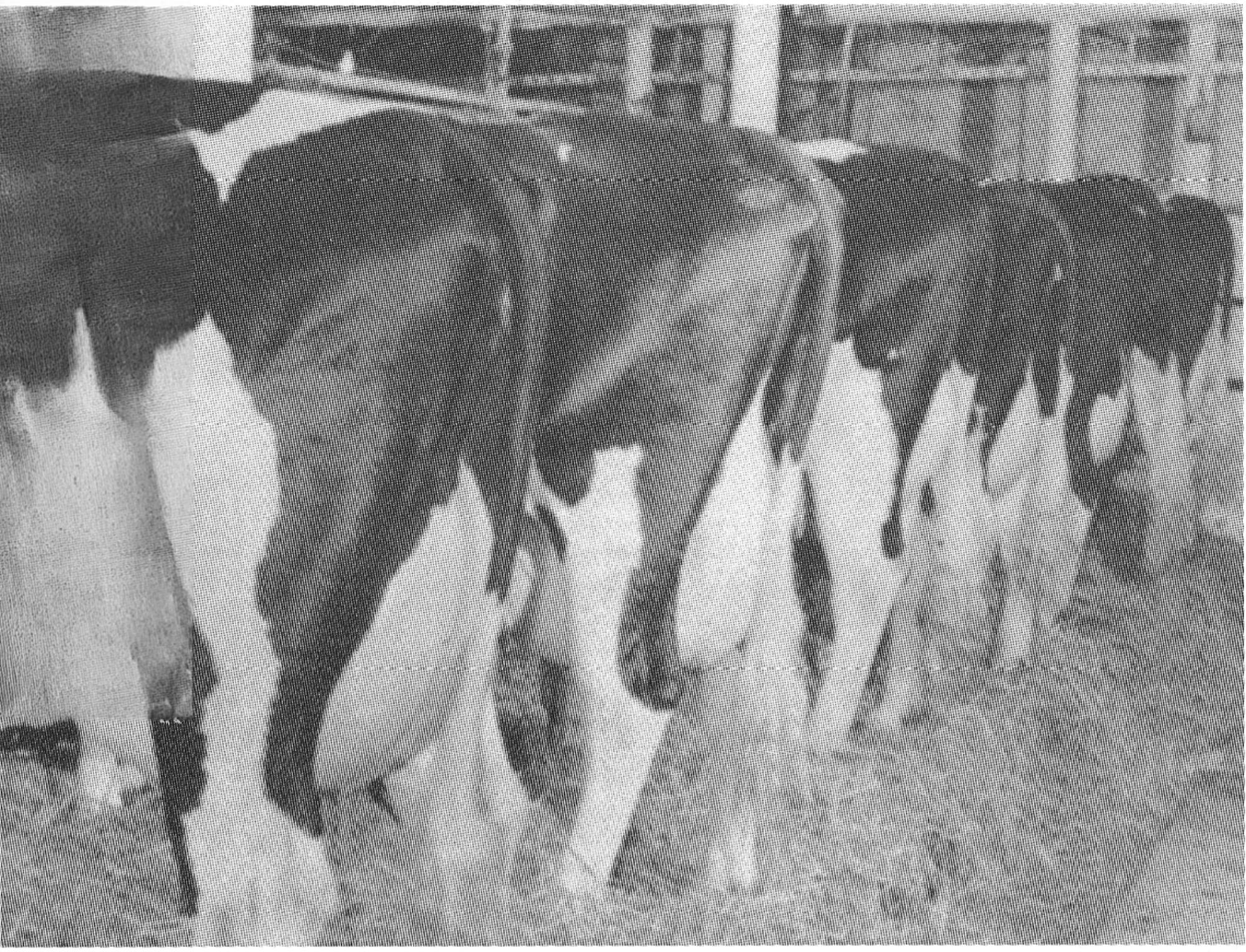
There’s a photograph from those years that captures it better than any production string could — a row of A.B.C. Midnight Joe daughters standing in Dunton’s stable, and the record notes they “made an impressive sight.”
Picture what that actually means. Half-sisters, tied side by side, matched enough in their toplines and udder attachments that a visitor walking the alley could tell before anyone said a word which bull had sired the lot of them.
That’s what breeders came for. Not one great cow — anybody gets lucky once. A row of them, predictable enough to look like they’d been stamped.
The individuals were extraordinary too.
A.B.C. Inka May (EX), All-Canadian 4-year-old in 1947, made 24,142 pounds of milk at 4.67% with 1,128 pounds of fat over 365 days, milked three times a day — that’s what “3X” means on an old record, and it was the going method for pushing a cow to her limit before anyone had heard of a robot.
In 1947. When the good cow in your neighbor’s barn made 12,000, and he talked about her all winter.
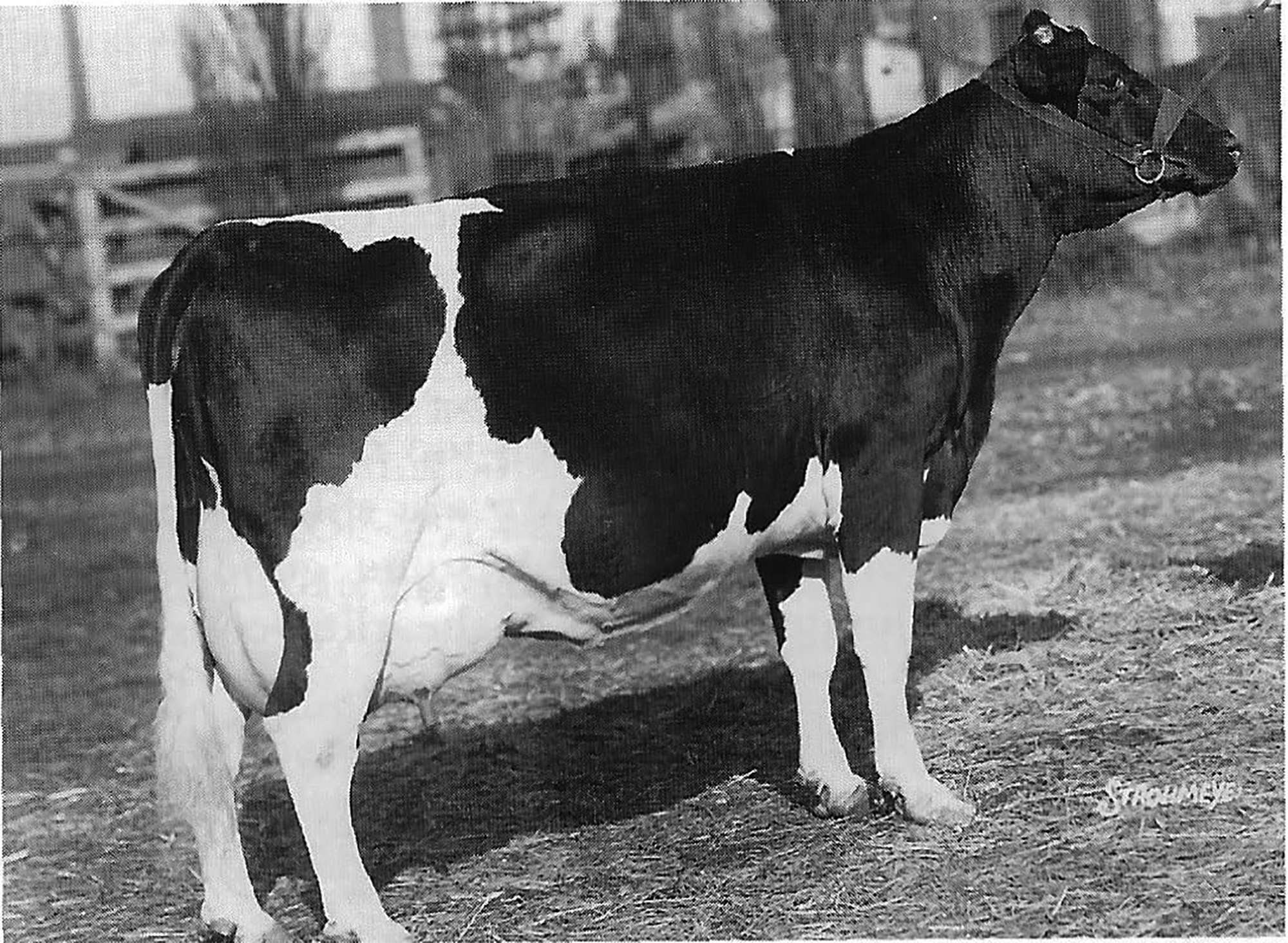
Glenvue Noelle Inka (EX-4*) took All-American and All-Canadian aged cow in 1947 — both sides of the border in one season. Glenvue Rilla Top Grade (EX) was Reserve All-Canadian aged cow in 1951.
And Glenvue Rosalie Fond Hope (VG), out of Rilla Top Grade by Spring Farm Fond Hope, stood grand champion at the Royal Winter Fair in 1955 and took All-Canadian 4-year-old the same year — on the tanbark at Toronto, in front of a crowd that considered the Royal the only show in Canada that truly counted.
Nine Glenvue matrons made Dave Morrow’s list when he asked “Who Breeds the Brood Cows?” in the June 10, 1962 Holstein World. Nine, from one farm.
And standing above all of them, an old cow named Glenvue Nettie Jemima (EX-13*).
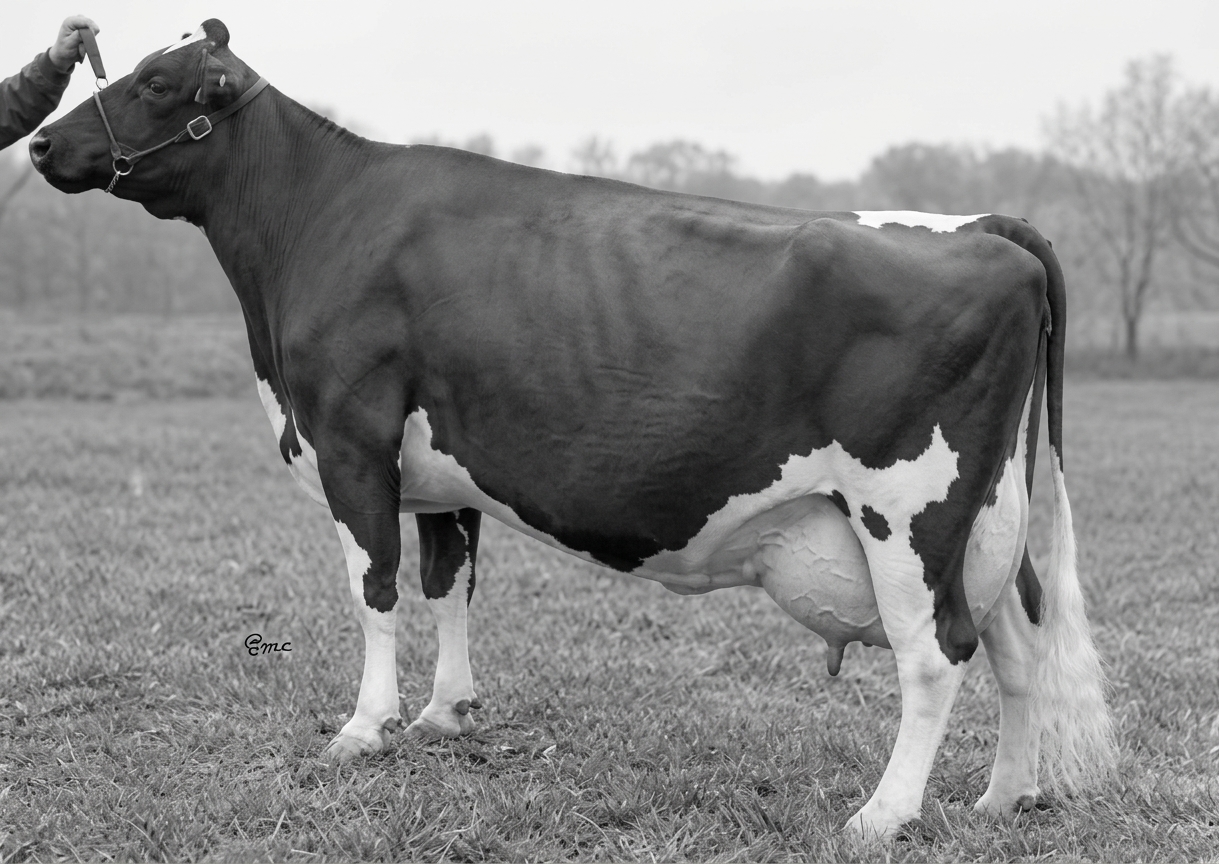
Twelve lactations. 218,215 pounds of milk. 8,193 pounds of fat.
All-Canadian aged cow, 1954 — in a herd where a cow graded Good Plus or she went down the road.
The number that matters there isn’t the milk. It’s the twelve.
Because Dunton ran the hardest cull rule in the country: to stay at Glenvue, a cow had to grade Good Plus or better. One exception, only one — a two-year-old who classified Good but carried a Good Plus udder got another year, because Dunton had seen too many good udders show up late.
Everything else went down the road. No sentiment, no second thoughts.
So twelve lactations in that herd means Doug Dunton stood in front of that cow twelve separate times, in an operation where merely good wasn’t good enough, and chose her. Through her prime and well past it.
A pleasant, accommodating man who culled without mercy kept looking at Nettie Jemima and deciding, again, that she stayed.
Picture her in her later years — a big, well-worn old cow with the hips and the hollows a twelve-lactation record leaves behind, still carrying an Excellent card, standing in a barn full of animals young enough to be her great-granddaughters. Anyone who’s kept an old favorite past the point where the spreadsheet says to knows exactly what that looks like.
She paid him for every one of those decisions. She’s the dam of Rosafe Centurion, and of Magician, Signet, and Citation R.
That “13*” on her card, for anyone under fifty: the star system marked qualifying superior offspring. Thirteen of them, in an era of hand-kept records and postal reporting, was a maternal record that bordered on absurd.
The cruel part of Doug Dunton’s career
Here’s what I find genuinely hard about his story.
Those cows — and type-wise they were far beyond anything Dawdy ever bred, a man who never once placed a cow on the All-American calendar — made other men famous.
A.B.C. Inka May was sold in dam — sold while carrying the calf. A.B.C. Farms bought her mother, Temple Farm May, and under the rules of the day the buyer registered the resulting offspring under his own prefix.
So the cow Doug Dunton bred carried somebody else’s name. And her son by Montvic Rag Apple Sovereign — A.B.C. Reflection Sovereign, called by some the greatest bull the breed has produced — carried it too.
Dunton bred the brood cows. Other men banked the bulls.
In his entire career, exactly one bull carrying the Glenvue prefix achieved major impact. His name was Glenvue Clipper, and he’ll matter shortly.
What he was actually selecting for
Before the trade, sit with Dunton’s philosophy a minute, because it’s the most useful thing in this story for anybody building a mating list in 2026.
“It takes longer to breed type than production,” he told a reporter, “but once you get type, it is not so difficult to get higher production.”
Type first. Always. Forced to choose, type won.
And he selected for three things that appeared nowhere on a pedigree in his day — no index, no proof, no number attached to any of them: temperament. How a cow milks out. Longevity.
Read that list again and tell me it isn’t the conversation this industry is finally having, seventy years late, about functional traits, productive life, and whether we bred ourselves into a corner chasing yield.
Dunton was selecting for traits that wouldn’t get formal evaluations for another half-century. He did it because he’d decided they mattered more than the things he could measure.
His four stated reasons for Glenvue’s consistency, from a 1963 Farmers Advocate interview: strict culling. Slow-maturing animals — his two-year-olds were never pushed, and a thousand pounds of milk in a month satisfied him. Line breeding. The Good Plus rule.
Never pushed. In a business that has spent eighty years pushing.
1947, and the fortnight bull
Down in Kansas, Dawdy had been watching Wisconsin Admiral Burke Lad tear through the breed in the early 1940s — “witnessing the havoc,” the record says — and he jumped in with both feet.
He bought Weber Burke Hazelwooder, a Burke Lad son. Then he borrowed Weber Hazelwood Burke Raven from Jake Zarnowski.
Borrowed. Neighbor to neighbor, on a handshake, the way things actually got done before contracts.
Raven was out of an inbred Burke Lad daughter, and he sired Raven Burke Elsie plus Raven Burke Carine Mercedes — the maternal granddam of Tidy Burke Elevation.
Then came the trade.
Wis Burke Ideal, born May 20, 1947, was sired by Wis Ideal (EX-GM) out of Wis Juanita — and both of them were sired by Weber Burke Cyclone, the great inbred Burke son standing at Green Bay.
A son of Cyclone bred to a daughter of Cyclone. That’s the calf Dawdy got for a bull out of a fourteen-day stopover.
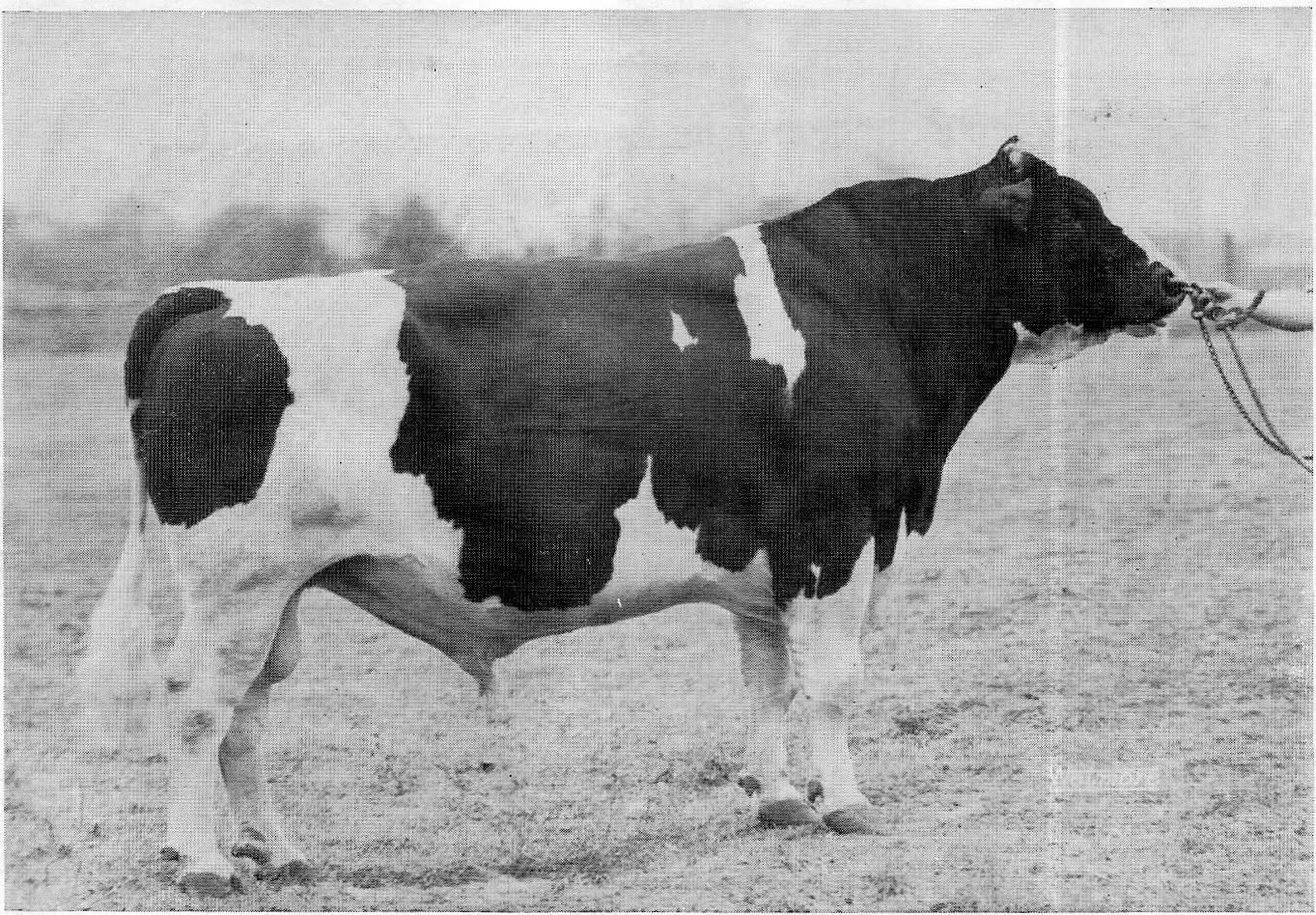
And then he doubled down. Dawdy bred Wis Burke Ideal to a daughter of Wisconsin Admiral Burke Lad — inbreeding stacked on inbreeding, on purpose, by a man whose entire philosophy on the subject ran five words long:
“You can never get too much of a good thing.”
He meant it literally. He was spectacularly right, and — as the breed would learn expensively, decades later — he was also wrong.
The calf was Tidy Burke Elevation.
August 30, 1965
On Round Oak Farm in Virginia, out of a cow named Round Oak Ivanhoe Eve by Osborndale Ivanhoe, Tidy Burke Elevation’s son hit the ground.
Round Oak Rag Apple Elevation.
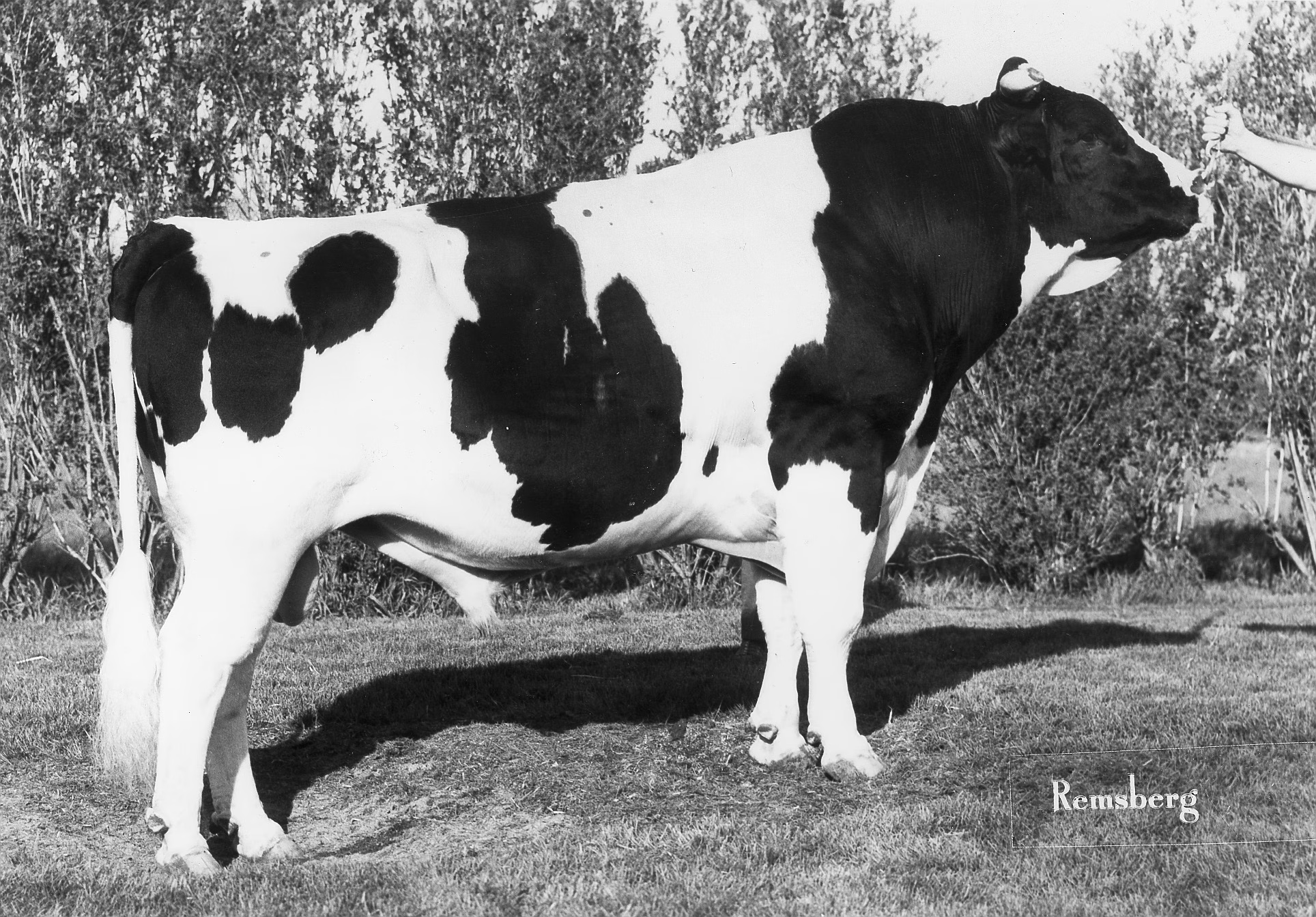
And here’s the collision that makes these two men inseparable rather than rivals.
Elevation’s sire came from Dawdy. But run up the maternal line: Elevation’s maternal granddam was Round Oak Nettie Emaline, born January 7, 1959, sired by Glenafton Gaiety — and Gaiety was sired by Rosafe Centurion, the son of Dunton’s Inka Supreme Reflection out of Glenvue Nettie Jemima.
The old twelve-lactation cow. The one Doug Dunton kept choosing.
The bull named for the Rag Apple line that Elmer Dawdy would have thrown a man out of his barn for mentioning carried Doug Dunton’s brood cow on his dam’s side.
Neither man had any say in it. Neither, so far as anyone can tell, ever met the other.
May 9, 1962 — and three years earlier, Chief
May 9, 1962 — and three years earlier, Chief
Three years before Elevation, the other half of the breed was born — and not where you’d expect. Lester Fishler’s Pawnee Farm sat on the south edge of Central City, Nebraska, and when he dispersed the herd on April 14, 1962, a pregnant cow named Pawnee Farm Glenvue Beauty sold for $4,300 to Wally Lindskoog of Arlinda Farms. She rode a train to Turlock, California, and calved twenty-five days later.
The dam was Pawnee Farm Glenvue Beauty (EX) — sired by Glenvue Clipper. Dunton’s one great bull.
The sire was Pawnee Farm Reflection Admiral (born February 16, 1960, EX, Gold Medal Sire). Admiral’s sire was Rosafe Pearl Hannibal — bred on Hector Astengo’s Rosafe farm in Ontario by mating Rosafe Shamrock Rosamond to Rosafe Sovereign Supreme, which made Hannibal a double grandson of A.B.C. Reflection Sovereign.
And Rosafe Shamrock Rosamond’s maternal granddam?
Glenvue Jean Inka B.
The cow descending from Bruach Luella Acme — one of the five Holsteins a young Doug Dunton bought in 1920, after a single cow gave him 80 pounds of milk and ended his father’s Shorthorn experiment.
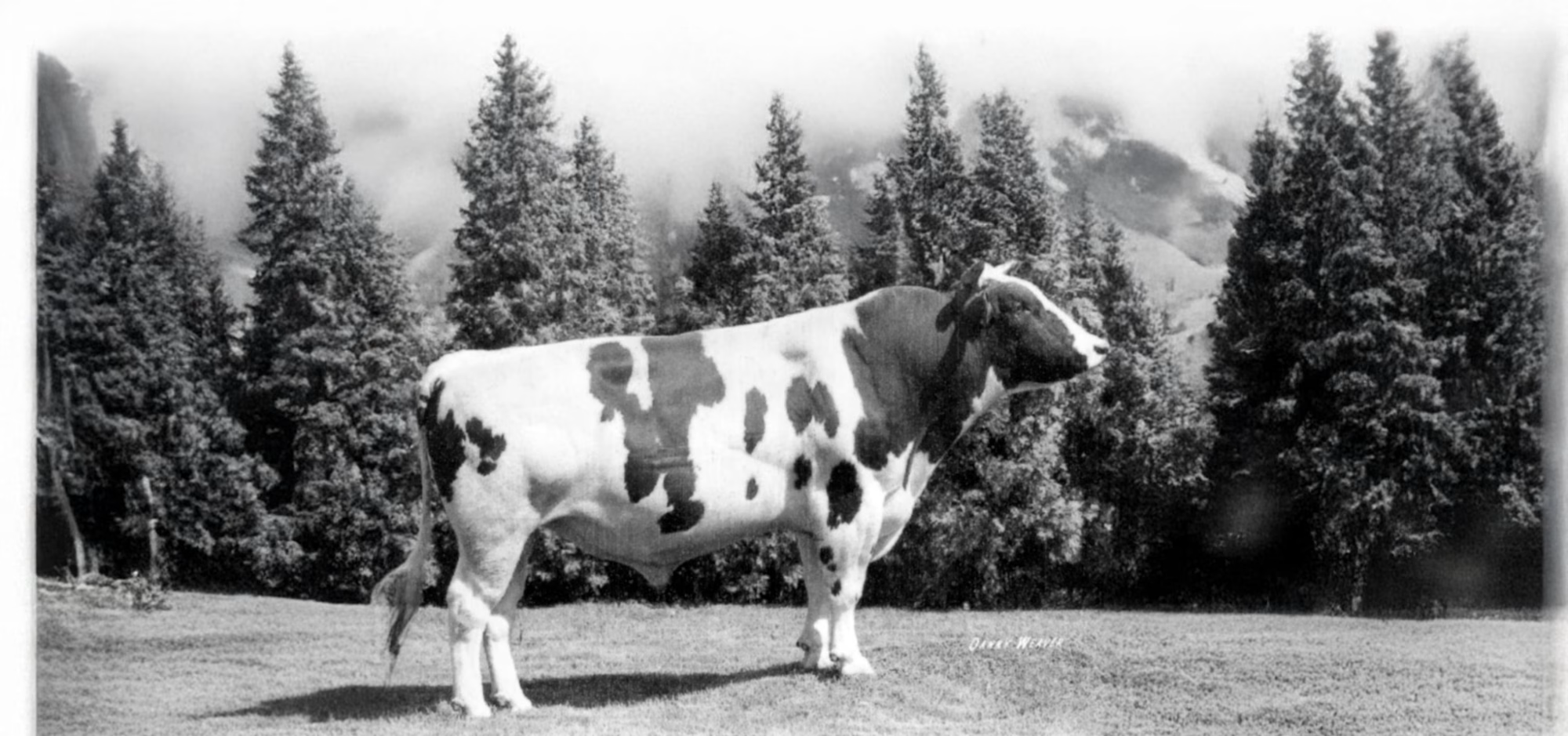
Pawnee Farm Arlinda Chief. Dunton’s breeding on both sides of the pedigree. Sire’s side and dam’s side. (Read more: The $4,300 Gamble That Reshaped Global Dairy Industry: The Pawnee Farm Arlinda Chief Story)
Elmer Dawdy contributed nothing to Chief — not one gene he was responsible for placing there.
Two bulls, born three years apart. Elevation, built on Dawdy’s paternal line with Dunton’s Nettie Jemima standing in the maternal background. Chief, built on Dunton at both ends.
That’s the climax of this story, and it took two stubborn men roughly forty-five years of refusing to compromise to arrive at it.
Two men, two halves — the ledger
| The Dawdy Side (paternal power) | The Dunton Side (brood cow power) | |
| Foundation animal | Wis Burke Ideal (b. May 20, 1947) | Glenvue Nettie Jemima (EX-13*) |
| Scale / signature | Never above 24 head milking | Nine great matrons on one 1962 list |
| Key anchor bull | Round Oak Rag Apple Elevation (1965) | Pawnee Farm Arlinda Chief (1962) |
| Paternal share, 2010s bulls | 51.06% of active lines | 48.78% of active lines |
| Breed contribution | 10,000+ A.I. sons; Bull of the Century, 1999 | ~14% of the modern U.S. Holstein genome |
| The bill that came due | Inbreeding velocity — “never too much of a good thing” | Carried HH1, the APAF1 lethal recessive |
Paternal-share figures from the Journal of Dairy Science Y-chromosome study of 62,897 North American bulls born 1950–2013. Note the irony in the bottom row: each man’s signature strength produced the other’s kind of problem.
ACT III: WHAT THEY LEFT
Neither man took a victory lap
This is the part that gets me.
In the late 1960s — right as Elevation was beginning to make his name — Elmer Dawdy got rid of his cattle. And he didn’t hold a dispersal.
Understand what that means. On July 15th and 16th, 1985, the Hanover Hill dispersal at Port Perry drew more than 2,500 people from around the world. Auctioneer Bob Shore opened the bidding on Brookview Tony Charity at $50,000. When it stopped, a half-interest in that one cow had brought $1,450,000 — a Canadian record, Stephen B. Roman bidding for Romandale Farms.
That’s what a dispersal was: the moment a breeder’s life’s work got appraised in public, with buyers from three continents leaning on the rail.
Dawdy had bred the sire of Round Oak Rag Apple Elevation. He’d bred Ormsby Burke Pontiac Mose, paternal grandsire of Paclamar Astronaut. His last herd sire was Tidy Burke Cornerstone, a Mose son born in 1957. Any auctioneer in America would have fought for that sale.
He farmed his cows out to a couple of young Kansas breeders he had confidence in, and walked off.
No trumpets. Twenty-four cows quietly handed to two young men he trusted.
Doug Dunton’s ending was quieter still, and to a breeder’s eye it’s the sadder of the two.
He’d built the finest brood cow herd in Canada — and one by one the bulls carrying his blood left. Voyageur. Midnight Joe. Prefect. Radar, Sky Chief, Crown Royal. They finished their careers standing in A.I. studs, working for other people’s catalogs and other people’s prefixes, the same way A.B.C. Inka May’s son had.
Picture Glenvue after they’d gone. The tie-stall rows still full of those matched, deliberate, warm-bred cows. The row of Midnight Joe daughters aging in place. The best young bulls gone to studs whose names would go on the semen straws while the Glenvue prefix quietly stopped appearing at the top of pedigrees.
His best customers — Dawdy’s too — were farmer-breeders who lived no more than twenty miles from the farmgate. That was the distribution network. Neighbors, driving over to look at a young bull.
Twenty miles. For genetics that now circle the planet.
Where they live today — and this part isn’t sentiment; it’s arithmetic
If you breed Holsteins, both of these men are standing in your barn tonight. Not metaphorically.
A Y-chromosome study published in the Journal of Dairy Science traced the paternal pedigrees of 62,897 North American Holstein bulls born between 1950 and 2013 and found the male line had collapsed to essentially two branches.
Among bulls born in the 2010s: Chief’s line at 48.78%. Elevation’s at 51.06%. A third lineage, Penstate Ivanhoe Star, hung on at 0.16% — a whole paternal family down to a rounding error.
Split almost exactly down the middle. Dunton’s bull and Dawdy’s bull, dividing a breed between them.
The Bullvine’s own analysis puts today’s figure at 99.84% of active A.I. sires tracing to those two. Penn State’s Dr. Chad Dechow doesn’t soften it: “When people say 99 percent of Holstein sires in the U.S. today can be traced to only two bulls, both born in the 1960s, it’s absolutely true.”
Chief’s chromosomes account for roughly 14 percent of the entire U.S. Holstein genome. He left about 16,000 daughters, 500,000 granddaughters, and more than two million great-granddaughters.
Elevation sired over 10,000 A.I. sons across 45 countries, with an estimated nine million descendants — and by The Bullvine’s analysis, his DNA still makes up something close to a tenth of the CDCB genomic reference population, the dataset your genomic predictions are trained on.
The pathways run where you’d expect. Chief’s best sons were S-W-D Valiant (June 28, 1973) and Walkway Chief Mark (June 13, 1978, out of Walkway Matt Mamie, a No-Na-Me Fond Matt daughter).
On Elevation’s side: Sweet-Haven Tradition (August 18, 1974) and Hanoverhill Starbuck — born April 26, 1979, out of Anacres Astronaut Ivanhoe, an Astronaut daughter. Which means Dawdy’s Mose line shows up on both sides of Starbuck’s pedigree.
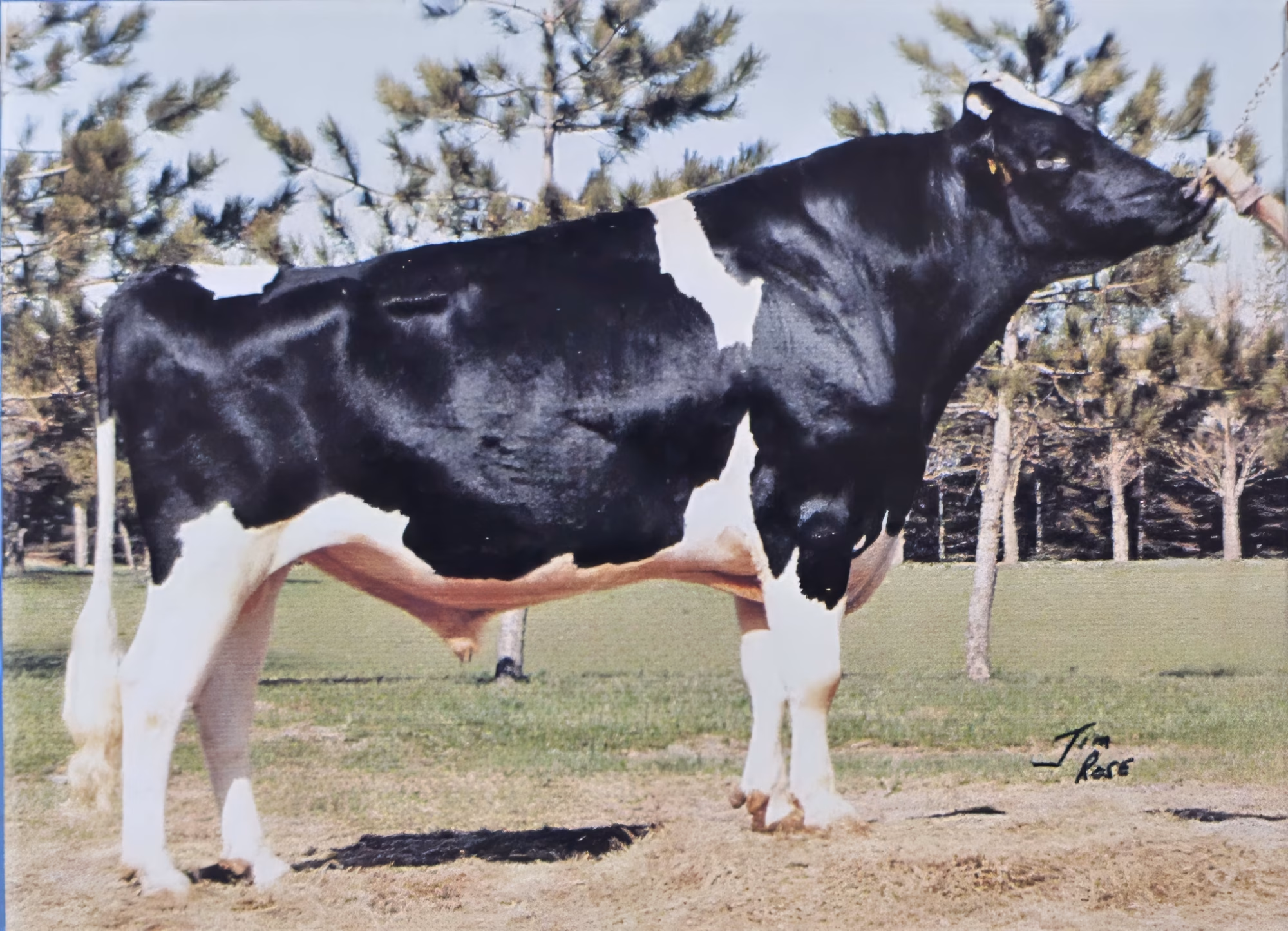
And Starbuck is where you can watch the whole thing come full circle.
He left more than 200,000 daughters across 45 countries and 209 proven sons, which led to 406 proven grandsons. In Canada alone, 36,976 of his daughters were classified — and 70% of them scored Good Plus or better.
Read that number again, because it’s the quiet miracle in this entire story.
Good Plus or better was Doug Dunton’s cull rule. The line he drew in a Brampton tie-stall barn, the standard that decided which cows stayed and which ones went down the road. Seventy percent of thirty-seven thousand daughters of a bull descended from Elmer Dawdy’s overlooked, bought-for-a-song foundation cows would have cleared Doug Dunton’s bar.
The two men never agreed on a bloodline in their lives. Their genetics still met Dunton’s standard anyway.
Ninety-five percent.
One province, one bull, one bloodline.
And in Quebec, 95% of Holsteins carried Starbuck’s genetics. Ninety-five percent — traceable straight back to a five-week-old calf that left Green Bay on a truck in 1947.
Dunton’s Glenvue Noelle Inka threw one more long shadow: her grandson Spring Farm Fond Hope was grandsire of No-Na-Me Fond Matt, and paternal great-grandsire of Hanover-Hill Triple Threat, whose daughter Tora Triple Threat Lulu produced Hanover-Hill Inspiration.
The bill that came due
If this were only a monument, I’d stop there. But these were farmer-breeders, and farmers get the whole ledger.
“You can never get too much of a good thing,” Dawdy said.
He was wrong, and the breed has been paying that invoice ever since.
Chief carried a lethal recessive nobody knew existed — a mutation in the APAF1 gene, now called HH1. One copy makes a carrier. Two copies and there is no calf at all, just a cow that comes back around.
Before it was identified in 2016, that single inherited flaw is estimated to have caused roughly 500,000 spontaneous abortions worldwide and about $420 million in losses across 35 years. Once geneticists found it, carrier frequency fell from 8% to 2% within a few years.
And the concentration those two bulls created is still tightening. Lactanet’s August 2025 figures put average pedigree inbreeding for Canadian Holstein heifers born in 2024 at 9.99%.
Here’s the practical piece, and I think both men would want you to hear it.
That “outcross” bull on your mating list probably isn’t one. When 99.84% of active A.I. sires descend from the same two bulls, a clean-looking four-generation pedigree tells you almost nothing — two animals can show no shared ancestors in three or four generations and still carry a substantial genomic relationship, because the common ancestry sits further back in Chief and Elevation, in both pedigrees, many times over.
That’s what pedigree-based screening can’t see and genomic evaluation can. Run your matings through the CDCB or Lactanet genomic tools rather than reading a paper pedigree and calling it an outcross. The number you want is the genomic inbreeding of the resulting calf, not the count of repeated names on a page.
That’s not a knock on either man. Neither had a sire summary, a daughter proof, or a haplotype screen. They were breeding by eye and by memory. They bred so well, and so consistently, that A.I. took their two best products and made them universal before anybody understood what universal would cost.
The last word
They never met. They’d have argued if they had.
One was a pleasant Ontario dairyman with no degree, two sons who stayed, and a stubborn faith in one bloodline he refused to abandon even once in forty years.
The other was a blunt, degree-holding Kansan who bought crooked cows out of orphanage herds, milked twenty-four of them, traded a fortnight houseguest’s son for a five-week-old calf that became the sire of the century, and had two boys who left and didn’t look back.
Doug Dunton bred the cows. Elmer Dawdy bred the bulls.
E.Y. Morwick spent six pages trying to settle which of them mattered more. He laid out his propositions, ran the pedigrees both directions, weighed Elevation against Chief and Astronaut against Fond Matt, and reached the only honest conclusion available to him: “So far as I can see, they come out pretty well equal.”
Sixty years of genetics have proved him right to two decimal places. 48.78 and 51.06.
And that’s the thing worth carrying out of this story. Some legacies are too large for one man, so history hands them to two — one chasing type when nobody could measure it, one chasing intensity when everybody told him to stop — and lets them build the same thing from opposite ends, in different countries, in barns eleven hundred miles apart, neither one ever knowing the other man was working.
Walk your barn tonight. Look at the udders. Watch how they milk out. Notice which old cow you keep deciding to keep, one more lactation, past what the spreadsheet advises.
Doug Dunton’s three unmeasurable traits are still the ones you’re chasing. Elmer Dawdy’s twenty-four crooked cows are standing in every animal you own.
Two barns. Eleven hundred miles. One breed.
Key Takeaways
- Neither man had a sire summary, a daughter proof, or a bank account worth mentioning. Dunton had one bloodline he refused to leave; Dawdy had 24 cows nobody wanted and a trade nobody else would make. Scale was never the moat.
- The cow that founded half the breed’s sire line was classified Good and never raised off it. Before you cull a heifer on her card alone, look at her udder, her mother, and what she throws.
- Dunton selected for temperament, milk-out, and longevity when none of the three appeared on a pedigree. Seventy years later, that’s the functional-traits conversation the industry finally caught up to.
- At 99.84% of A.I. sires tracing to Chief and Elevation, a clean four-generation pedigree isn’t proof of an outcross. Run the mating through CDCB or Lactanet and read the calf’s genomic inbreeding instead.
Continue the Story
- Round Oak Rag Apple Elevation: The Bull of the Century – Step inside the world where Elmer Dawdy’s prison-calf gamble took physical form, tracing how Virginia farmer Ronald Hope guided Elevation from an unheralded young sire into the monumental sire line that conquered modern A.I. studs.
- Hanoverhill Starbuck – A Legendary Sire – Walk the show barns and test herds where Doug Dunton’s strict type gospel and Dawdy’s linebred genetics finally merged, revealing how one black bull redefined Canadian breeding and proved that the foundation held across generations.
- Inbreeding in the Dairy Cattle Industry: Is It Time to Panic? – Confront the modern ledger of Chief and Elevation’s absolute reign, unpacking the mounting genetic bottleneck, lethal recessives, and why today’s commercial breeders are navigating the costly consequences of two men who bred too well.
The Sunday Read Dairy Professionals Don’t Skip.

Every week, thousands of producers, breeders, and industry insiders open Bullvine Weekly for genetics insights, market shifts, and profit strategies they won’t find anywhere else. One email. Five minutes. Smarter decisions all week.