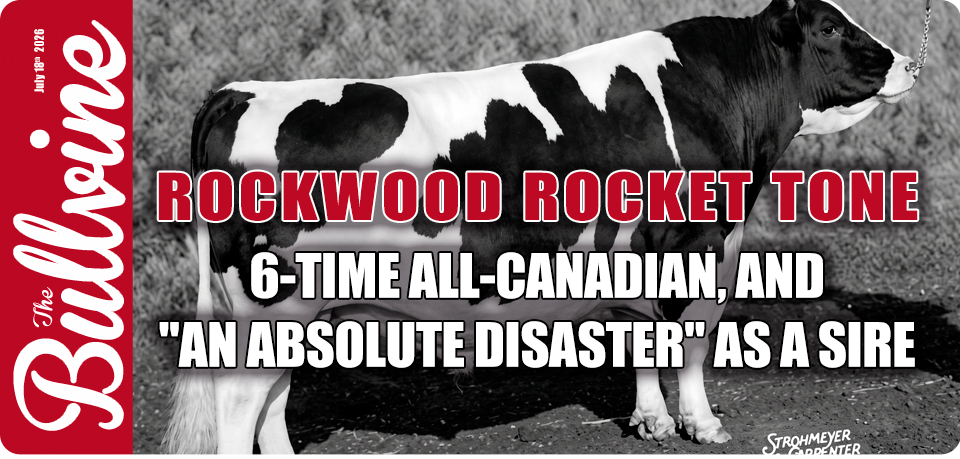




Six times All-Canadian. One of the most formidable bulls ever shown. Then his daughters freshened—and Rocket Tone couldn’t breed. Only 1 in 6 champions ever could.
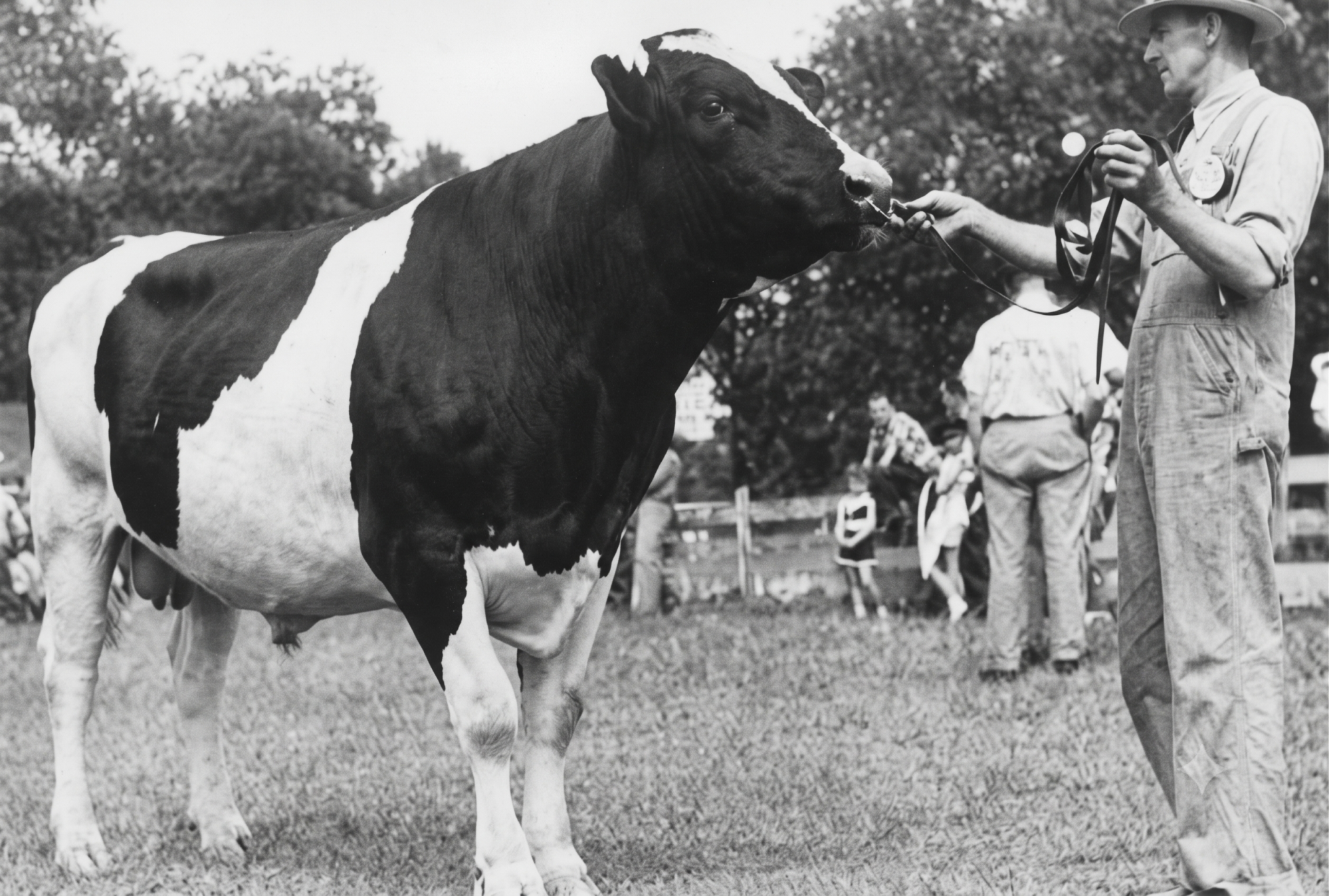
The crowd could see Rockwood Rocket Tone before he ever truly entered the ring.
That was the thing about the great show bulls of that vanished era. They didn’t just walk onto the tanbark—that soft brown bark-dust footing spread across the show floor. They arrived. Big necks, hard toplines, sweeping ribs, hides rubbed to a shine, handlers leaning into the halter just enough to make the whole performance look effortless. In those days—before bull classes disappeared from the major fairs and left the males to the semen catalogs—a champion male could still stop traffic at the Royal Winter Fair or the Canadian National Exhibition. And Rocket Tone was one of the most formidable ever to set foot on that floor.
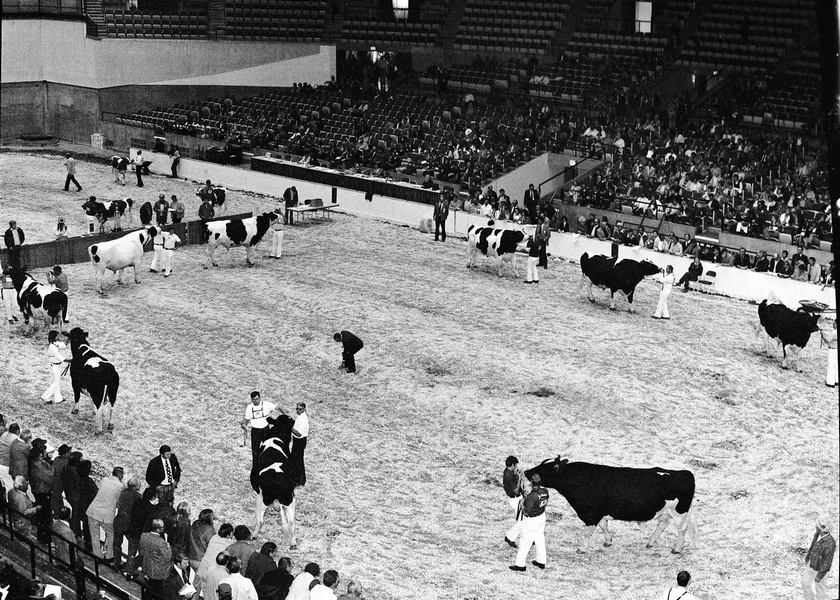
He was a son of Houckholme Sovereign Sky Rocket, bred at Rockwood Holsteins in St. Norbert, Manitoba, later proven at the Quinte District stud in Belleville, Ontario. Junior champion at the Toronto Royal Winter Fair in 1949. Then All-Canadian six times running—senior yearling, two-year-old, three-year-old, aged bull—a record beaten only by Montvic Rag Apple Marksman and Spring Farm Juliette.
Six times. Let that sink in. This was back when hauling cattle was real work, fitting was closer to art than science, and a bull had to whip other great bulls face-to-face—not win a photograph contest.
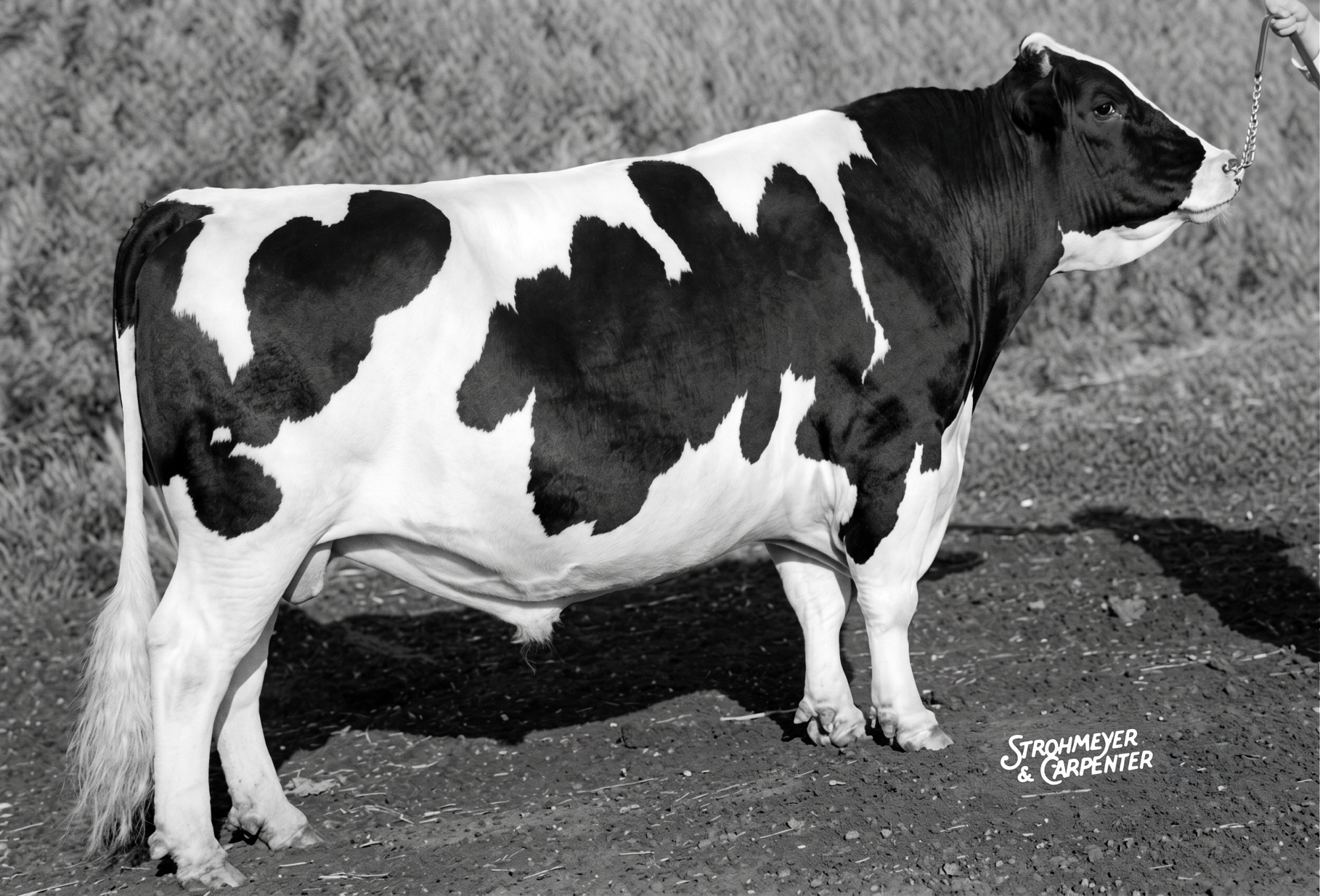
And then, when the ribbons were boxed up, and his daughters began to freshen, the truth came in quiet.
Rocket Tone couldn’t breed.
Not the way breeders needed him to. Not the way that magnificent body promised he would.
“A dud, just an absolute disaster.” — E.Y. Morwick, on Rockwood Rocket Tone as a transmitter of desirable qualities
E.Y. Morwick—one of the sharpest students of Holstein history this continent ever produced—didn’t soften it. That line still lands like a cold pail of water down the back of the neck. The old bull had fooled the eye. Or maybe, more honestly, the eye had fooled the men who trusted it too far.
Now set him beside Smithcroft Snowball Rocket.
Snowball Rocket didn’t carry quite the same thunder. Gordon Smith of Milverton, Ontario bred him, a paternal grandson of Rockwood Rag Apple Remus, and Morwick described him as long, stylish, and beautifully balanced. He won All-Canadian as a two-year-old in 1956, then Reserve All-American and Reserve All-Canadian aged bull the year after. A lovely bull, sure. But not the mythic beast Rocket Tone appeared to be.
Then his daughters started winning. And they didn’t stop.
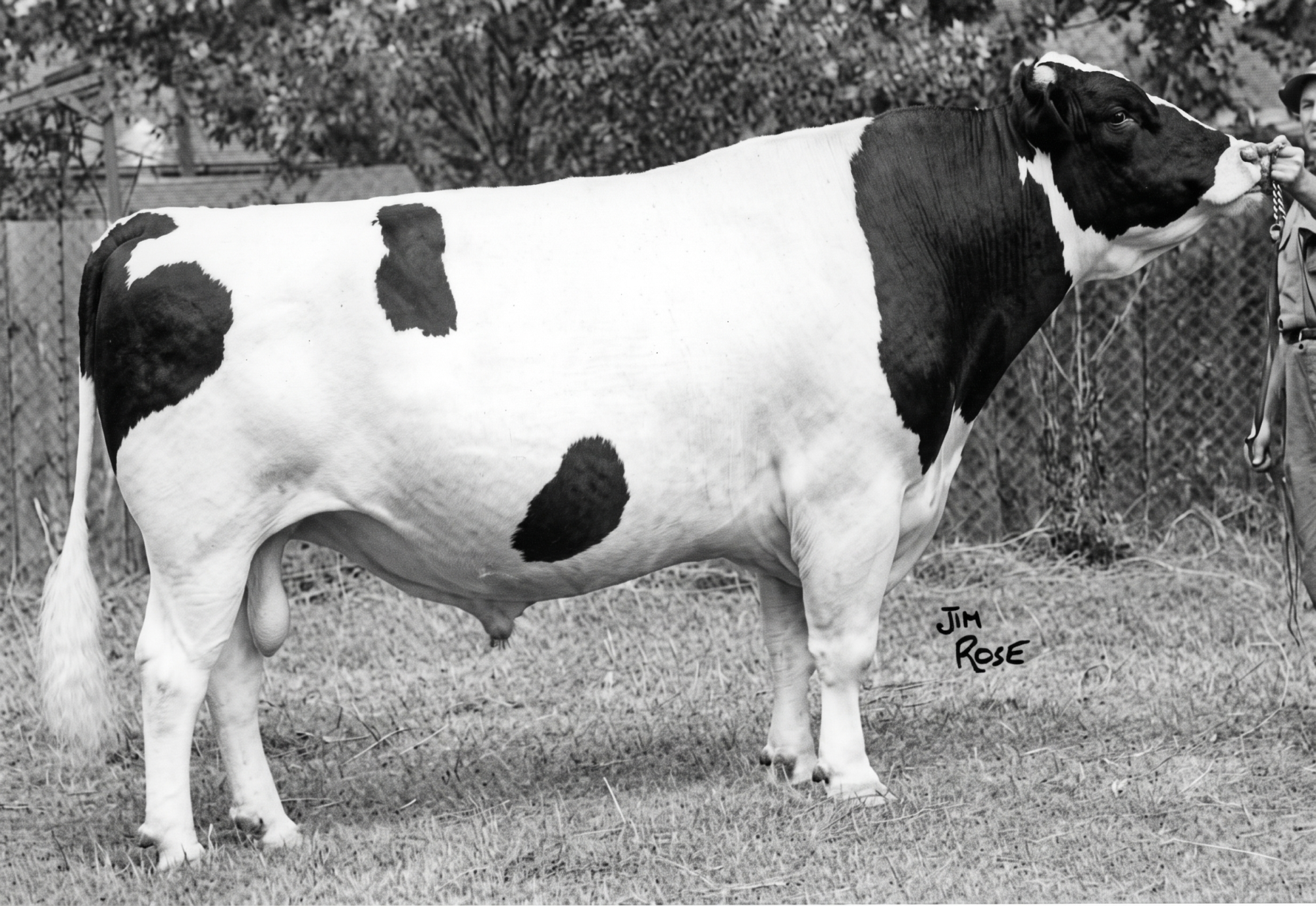
Greenden Rocket, All-American two-year-old in 1958. Delightful Rocket, grand champion at Chicago and Reserve All-American four-year-old in 1960. His gets of sire—that’s a group of a bull’s offspring shown together as proof of what he stamps into them—were nominated for All-Canadian honors in 1960, 1961, 1962, 1963, and 1966, and he pulled off the rare trick of nominating two separate gets in a single year, 1963. Four times his gets were nominated All-American, headlined by that intimidating string Green Meadow Farms of Elsie, Michigan brought out in 1960.
So there it is, laid out plain as a fresh classification card. Two related, structurally similar bulls from the same broad Canadian tradition. One a legend of the ring who left almost nothing. One a quieter champion who helped remake the breed.
That’s where this story really begins. Not in a straw-bedded calf pen—but in a warning. Admire the phenotype. Then interrogate the pedigree.
Act I: When the Ring Ruled
Most modern breeders can’t quite picture how much authority the show ring carried back then.
Today, a breeder studies genomic predictions, linear type breakdowns, daughter fertility, health traits, and production data that pours in faster than a barn cat at feeding time. Back then? A great bull standing under the lights at the Royal or the Waterloo Dairy Cattle Congress could become a breeding proposition almost entirely on the strength of looking the part.
And the part mattered enormously.
A show bull was supposed to project power without coarseness, breed character without weakness, enough scale to promise a next generation of big, durable, profitable cows. The tanbark was theatre. But it was also the marketplace. A championship raised semen demand, lifted sale prices, and earned bragging rights that traveled from the county line clear across national borders.
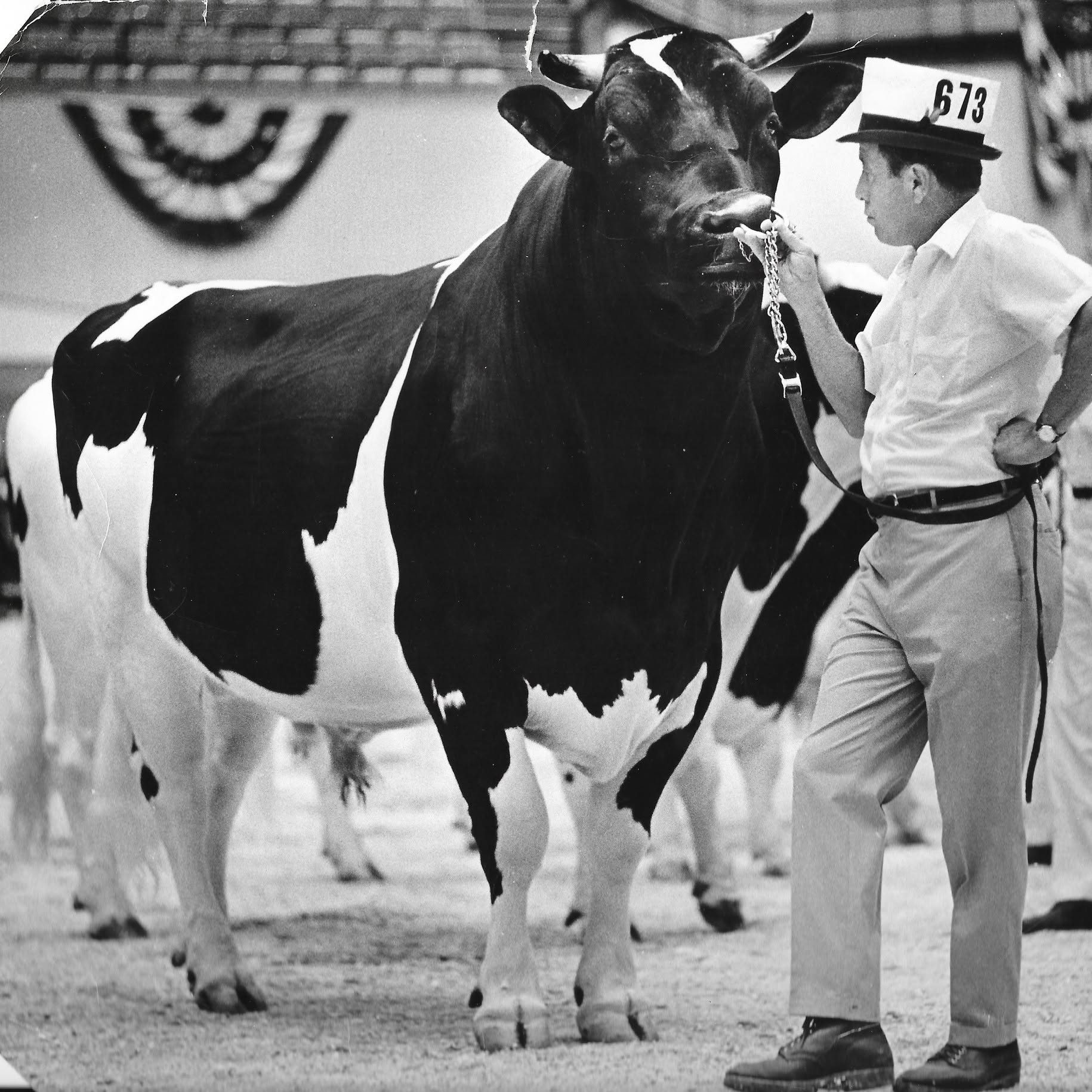
Artificial insemination was beginning to change everything. The Oxford District Cattle Breeders Association, under herdsman Paul Jensen, did something almost no other Ontario stud bothered with—it actually campaigned its bulls at the shows. Snowball Rocket was one of those Oxford bulls, keeping company in the record with Baker Reflection Jerry, the All-Canadian two-year-old of 1960, and Clearcreek Model, Reserve All-Canadian bull calf in 1956. That mattered, because A.I. was becoming the bridge between a bull admired by a few thousand people at ringside and a bull whose daughters milked in barns from Ontario to Oregon.
But the old question wouldn’t lie down.
Did the glamour bulls breed?
Morwick chewed on that through eleven of the most prominent Holstein breeding establishments in North America—six Canadian, five American—and his verdict was blunt. Most didn’t. By his own reckoning, only about half of the famous show bulls proved reliable transmitters, and only about a third of that half—call it one in six overall—ever reached the exceptional class. A follow-up analysis put numbers to the whole roster, scoring each institution’s show bulls from five, for a superior transmitter of type and production, down to zero, for a bull who as a breeder did next to nothing.
So yes. The tanbark could crown a champion.
But the breeding shed kept its own book, and it balanced to the penny.
Here’s how the eleven houses finished, best to worst:
| Breeding establishment | Principal breeder | Score | Daughter Verdict & Key Sires |
| Rosafe Farms | Dr. Hector I. Astengo | 17 | Citation R. scored a perfect 5; Preceptor, Signet, and Shamrock Perseus each earned 4 off the A.B.C. Reflection Sovereign blood. |
| Mount Victoria | T.B. Macaulay | 16 | Marksman a 5, Sovereign and Monogram 4s, Hartog a 3—the Rag Apple dynasty at full power. |
| Carnation Milk Farms | E.A. Stuart | 16 | Governor Imperial and Royal Master perfect 5s, Homestead Revelation a 4, Matador Masterpiece a 2. |
| Pabst Farms | Fred Pabst | 15 | Sir Roburke Rag Apple and Roamer Dean Walker Lad 5s—yet four-time All-American Fobes Burke managed a 1. |
| Elmwood Farm | Robert V. Rasmussen | 14 | King Bessie Korndyke Ormsby a 5; Progressor, Senator, Gypsie each a 3. |
| Spring Farm | J.M. Fraser | 14 | Inka Jewel and Fond Hope 5s, Reflection a 4—and Sovereign Supreme, for all his ribbons, a 0. |
| Romandale Farm | Stephen B. Roman | 9 | Marquis a 5, Dividend a 4, while Governor and Argus both scored 0. |
| Franlo Farm | F.W. Griswold | 8 | Roebuck Regent and Gen Treasure Model 4s; Chip Douglas King and Chip Montvic Royal, 0s. |
| Cash-Mar | C.M. Bottema Jr. | 8 | Ormsby Jerry and Jerry Darky Lassie 4s; Jerry Delight and TM Pell City, 0s. |
| Sheffield | John Malcolm | 8 | Crown Prince, Dusty, Monarch, Chico—four pretty bulls, four scores of 2. |
| Glenafton Farm | J.J.E. McCague | 5 | Rag Apple Alert a 5; eight other campaign sires, all 0. |
Rosafe seventeen. Glenafton five. Sit with that gap a moment, because the whole story lives inside it.
The best sires all shared something the failures didn’t. Deep maternal families. Linebred strength that held up. Daughters and sons who proved the body wasn’t just a lucky roll of the genetic dice. The great ones stood behind cows like Montvic Rag Apple Colantha Abbekerk, Lakefield Fobes Delight, Bonnie Lonelm Texal High, Soo Rag Apple Princess. The duds? Often glamorous enough to win—but without the additive power to stamp a daughter.
That’s the whole difference between a great photograph and a great sire.
Act II: The Bulls Who Kept Faith—and the Ones Who Broke It
Mount Victoria: The Cathedral of the Rag Apples
If this story has a cathedral, it stands at Mount Victoria.
T.B. Macaulay’s herd at Hudson Heights, Quebec became the home of the Rag Apple blood that shaped North American Holstein breeding for decades, concentrating the line of Johanna Rag Apple Pabst into cattle that looked important before the records even confirmed it. And then came the brothers.
Big, black, and beautiful. That’s exactly the feeling Morwick reached for when he wrote about Montvic Rag Apple Marksman and Montvic Rag Apple Sovereign, both sons of the great cow Montvic Rag Apple Colantha Abbekerk. They formed the All-Canadian produce of dam—the top-placed pair of offspring from one cow—in 1945, 1946, and 1947. Other famous male pairs had come before: Hays Taxpayer and Hays Alamoda, Hays Sensation and Hays Supreme, Man-O-War Progressor and Sir Man-O-War Heilo. Put them side by side and photographed against Marksman and Sovereign? Morwick said no contest.
But the brothers had something those pairs didn’t. They bred.
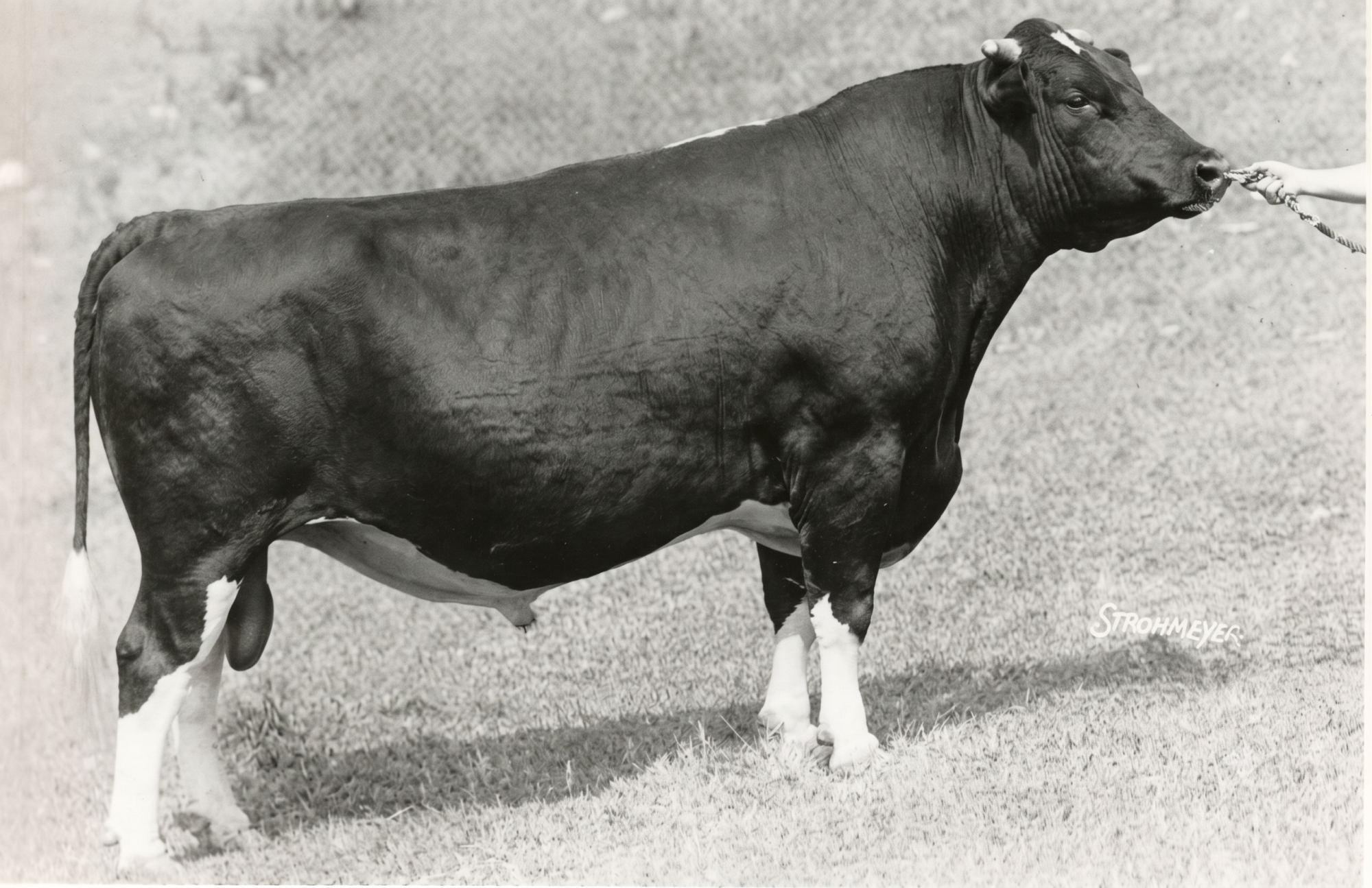
Marksman went All-Canadian seven times as an individual and then sired the All-Canadian gets of 1946, 1947, 1949, 1950, and 1951. Sovereign sired A.B.C. Reflection Sovereign and Houckholme Sovereign Sky Rocket—two of the most prolific sources of show-winning stock the breed had. And there’s a twist worth savoring: Sky Rocket was Rocket Tone’s own sire. The same family that produced the breed’s great disappointment also produced its engine. Blood is like that. Generous and cruel in the same breath.
Now, the sad one.
Montvic Rag Apple Hartog spent too many of his best days on the show circuit and not enough at Hays Farms doing bull’s work. He wasn’t used nearly as hard as he should’ve been. And yet even from that neglect he threw Hays Supreme—the best bull, Morwick said, the Hays boys ever bred. Hays Supreme sired Supreme Ruby Echo, Canada’s first 200,000-pound milk cow, and anchored a line running down through Inka Supreme Reflection, A.B.C. Reflection Sovereign, Glenvue Nettie Jemima, and Spring Farm Fond Hope. A half-wasted bull. A river still deep enough to cut through generations.
Carnation: Stacking the Production Deck
Swing south and west now, to Carnation Milk Farms in Washington.
E.A. Stuart wasn’t only chasing ribbons—he was building production and scale into cattle that had to hold up in real, commercial dairying. And at Carnation, the proof didn’t come from the show string. It came stacked three generations deep. Carnation Governor Imperial won All-American three times and sired seven Gold Medal sons—Gold Medal being the old honor for a bull whose daughters proved themselves in both the show ring and the milk pail. His son carried it forward, and his grandson, Carnation Homestead Revelation, topped the Honor List—the annual roll of the top proven sires by daughter records—in 1958, completing the breed’s first three-generation string of Honor List-leading sires. Grandfather, father, son, each ranked first in the nation. Nobody had ever stacked three like that, and the men in the Carnation barn knew exactly what they were standing on.
Then came Royal Master, and this time the proof arrived in a sale ring.
Carnation Royal Master sired two world-record sellers at once—Don Augur Mothermarthas Pride at $108,000 in 1966, and Oak Ridges Royal Linda at $62,000 in 1968. Picture the Don Augur ring that day: the bidding cracking past every previous mark, the crowd going still, an auctioneer’s voice climbing into territory nobody in the barn had ever heard for a female. That wasn’t showring smoke. That was hard cash betting on a bloodline that had already proven it delivered.
The Wisconsin Invasion and the Illusion of Fobes Burke
Pabst Farms taught maybe the sharpest lesson of all—and it cut the opposite way.
Fred Pabst’s herd at Oconomowoc, Wisconsin, bred cattle of tremendous uniformity, and Pabst quietly produced non-show sires like Pabst Regal and Pabst Roamer who each threw two All-American gets. But the bull everyone came to see was Pabst Fobes Burke, classified EX-96—an outstanding score for a bull in that day.
What a sight he must’ve been. He was All-American four times between 1953 and 1957, and he headed the Wisconsin invasion of the 1956 Royal Winter Fair, the year Pabst walked into Toronto and presented both grand champions—Fobes Burke and Plain View Inga. One can only imagine the mood at ringside for the Ontario men that afternoon. Wisconsin hadn’t come to compete. Wisconsin had come to take the flags home, and did.
Then the daughters freshened.
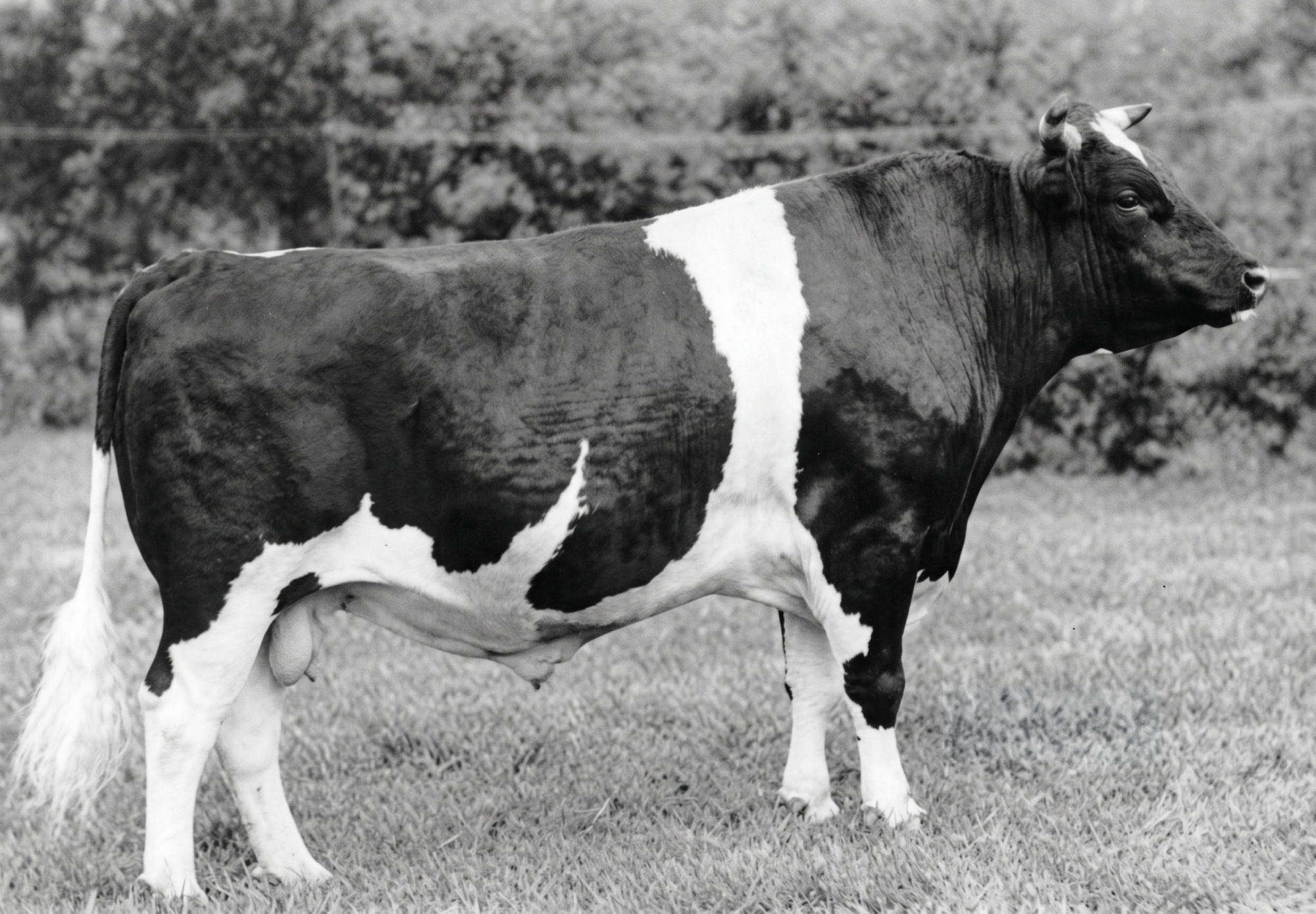
And Fobes Burke—by the good sire Sir Regal Fobes, out of a Wisconsin Admiral Burke Lad daughter—did next to nothing. What stung most was where the real breeding power sat: not in the champion, but in the father who’d never drawn half the crowds. Sir Regal Fobes left thirty-four classified daughters averaging 82.7 points, six of them Excellent. Walk that number back to what it meant. In an era when a solid working cow scored in the high seventies, a bull who could pull a whole barn of daughters up past eighty-two—with a half-dozen going Excellent—was a genuine type-builder. Pabst Sir Roburke Rag Apple was better still: three All-Americans, fifteen Gold Medal daughters, 230 daughters over 100,000 pounds lifetime, and leading Honor List sire in 1961, 1962, and 1964. Roamer Dean Walker Lad ranked second on the Honor List in 1954 with nine Excellent offspring and Class Extra sons—Class Extra being the Canadian rating reserved for sires whose progeny stood out most sharply. The glamour bull in the middle of all that? A footnote.
Maybe there’s nothing mysterious there. Maybe some bulls are simply great without being able to hand it down. That’s the uncomfortable part every breeder eventually swallows: an animal can be excellent without being prepotent.
Spring Farm: The Costliest Decision Jack Fraser Ever Made
Spring Farm made that same point—and it must have cost Jack Fraser some sleep.
Fraser, of Streetsville, Ontario, bred cattle that became part of the breed’s foundation memory. His Spring Farm Inka Jewel was an All-American bull calf in 1935, then opened in 1937, winning grand at Ottawa and reserve grand at the C.N.E. And then, at the Lindsay Fair, the bull got hung up in his halter, wrenched his back, and had to be destroyed.
Read that again. One tangled halter, one bad wrench, and a young sire of enormous promise was gone.
Except he wasn’t, really. In just three herds and a short life, Inka Jewel sired Inka Supreme Reflection and Inka Supreme Lillian for Jim Henderson, plus lines feeding into A.B.C. Reflection Sovereign, Spring Farm Juliette, and Spring Farm Fond Hope. Short life. Long shadow. That’s how it goes with the real ones.
But the harder story—the one that stings—was Sovereign Supreme.
Spring Farm Sovereign Supreme, a son of Montvic Rag Apple Sovereign, went All-Canadian four times and All-American three. Fraser believed in him. The Herd Book from the late 1940s shows more than 100 Sovereign Supreme calves registered by Fraser—against just five he registered by Elmcroft Voyageur M, the other bull sharing his herd-sire duties.
Picture Fraser years later, thumbing back through those pages. A hundred-plus by the bull who couldn’t transmit. Five by the bull who could.
“Using Sovereign Supreme to the near-exclusion of Voyageur M was probably the biggest mistake Jack Fraser ever made.” — E.Y. Morwick
Sovereign Supreme was a write-off in the breeding shed. Voyageur M sired Spring Farm Fond Hope.
And Fond Hope changed the arc of everything. All-Canadian as calf, senior yearling, and two-year-old, he and his full sister Spring Farm Juliette formed the All-Canadian produce of dam four years running, 1950 through 1953. His influence ran so deep that Senator Harry Hays drew on his sons as foundation stock for a whole new beef breed, the Hays Converter. When a Holstein bull leaves his mark outside the Holstein breed entirely, you know the ground moved under everyone’s feet.
The Same Tune, Four More Times: Romandale, Franlo, Cash-Mar, Sheffield & Glenafton
The other houses kept singing verses of the same tune, so let’s take them together, because by now the pattern needs no introduction.
Stephen Roman—the mining magnate who poured a fortune into building Romandale at Unionville, Ontario—bred eight bulls that won twelve All-Canadian awards, and only two, Reflection Marquis and Dividend, truly cut through as sires. Marquis was the crown jewel, siring Agro Acres Marquis Ned and a string of sons, plus a daughter, Agro Acres Marquis Patsy, who went All-Canadian two years running. But Romandale Reflection Governor, three-time All-Canadian himself, left thirty-nine classified daughters averaging a dismal 51 percent Good Plus and better. Same prefix. Same glamour. And when the classifier worked down those Governor daughters, the cards came back with the kind of scores that make a breeder go quiet, set down his coffee, and rethink a whole mating plan. Argus, another All-Canadian, contributed nothing worth remembering.
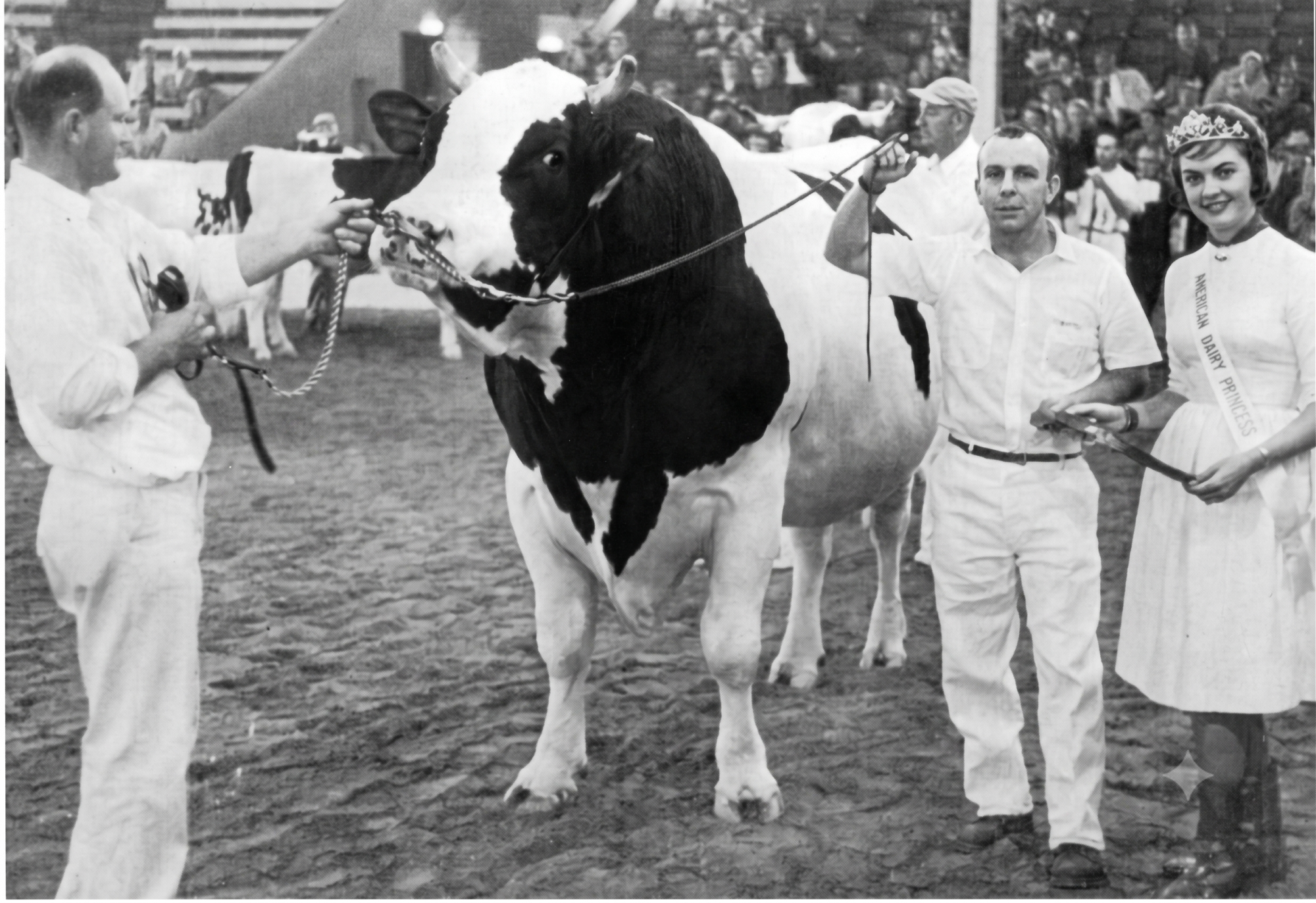
Griswold’s Franlo, in Hopkins, Minnesota, ran under manager Henry Bartel Sr.—a fitter’s fitter—who turned out show-winning males with cookie-cutter consistency, and most were write-offs in the shed. They mirrored their ancestor, Chip of Nettie Aaggie, the bull who whipped both Marksman and Sovereign at the 1946 Royal yet failed as a breeder. Franlo Chip Douglas King and Chip Montvic Royal looked unbeatable and bred like fence posts. The two exceptions, Roebuck Regent and Gen Treasure Model, both traced their strength to one good cow, Browns Mistress Corrine—the maternal line steadying what the glamour line couldn’t.
Cash Bottema could fit and lead a bull with anybody who ever gripped a lead strap—”his bulls, not his own,” as Morwick dryly put it, needling the man who won on cattle he hadn’t bred. His Cash-Mar Ormsby Jerry and Jerry Darky Lassie proved solid, the latter posting a daughter-dam gain of 3,259 pounds of milk in a Montana herd. But Jerry Delight, three-time All-American, and TM Pell City left nothing behind.
John Malcolm’s Sheffield gave us the prettiest cautionary tale of the lot—and it came with the biggest cheque. The 1960 Sheffield Dispersal averaged $3,154 on 75 head—the highest North American auction average to that time—but that money rode on the magnificent females, not the bulls. Crown Prince, Dusty, Monarch, Chico—four handsome sons of Rosafe Sovereign Supreme who caught every eye and changed nothing.
And Glenafton. J.J.E. McCague bred nine bulls that won ten All-Canadian awards, and exactly one—Glenafton Rag Apple Alert—became an exceptional sire. Alert, a Marksman son, topped the 1944 All-Canadian Sale as a three-month calf at $5,100, then topped it again in 1947 selling to Chile for $11,500; he stayed under McCague–McIlquham ownership right through that fall’s Royal Winter Fair, where he placed first in the two-year-old class and stood reserve grand champion. His gift to the breed was Maplenix Rag Apple Mercury, a key sire of show type across Eastern Ontario in the 1960s.
The other eight Glenafton show bulls won their banners and left the barn silent behind them.
That contrast, all by itself, might be the whole article in miniature.
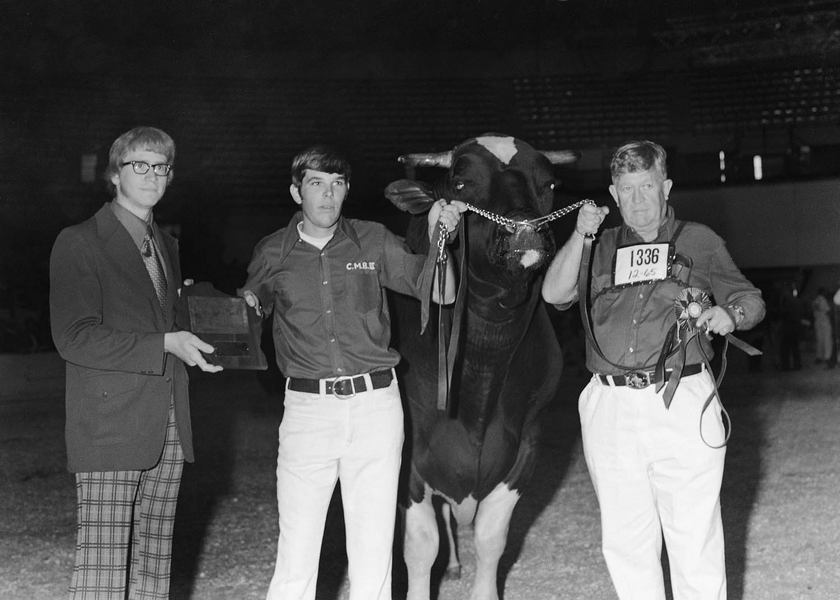
Act III: What the Daughters Always Knew
So the ledger closes on eleven great houses—and every one of them keeps circling back to a single, stubborn truth. A daughter doesn’t care about ribbons.
She either freshens with the udder, the feet and legs, the strength and production and staying power to make a breeder nod—or she doesn’t. A son either breeds beyond himself or he fades into yellowed photographs and old catalogs. The bull classes could honor a magnificent body, and sometimes the body told the truth. But the daughters spoke a language no judge could overrule.
Rosafe: When Beauty and Blood Finally Agreed
Rosafe Farms showed the dairy world what happened when beauty and breeding power finally lined up.
Dr. Hector Astengo, of Brampton, Ontario, bred bulls Morwick called scintillating and unequaled as breeders—most of them sons of A.B.C. Reflection Sovereign. Rosafe Signet was grand champion at the Royal in 1958 and 1959, and then his daughter Bond Haven Signet Sally took the Royal grand championship as a four-year-old in 1961. And this is the detail that ought to raise the hair on any breeder’s arm: that was the first time in history a Royal grand champion male had sired a Royal grand champion female. The photograph proved itself. The blood backed the beauty.
Rosafe Citation R., Signet’s full brother, sired All-Canadian gets across four different years and led Canada’s Honour List in 1966, 1967, and 1969. And that’s exactly where the past reaches out and lays a hand on the present—because Citation R.’s blood didn’t stay in the 1960s.
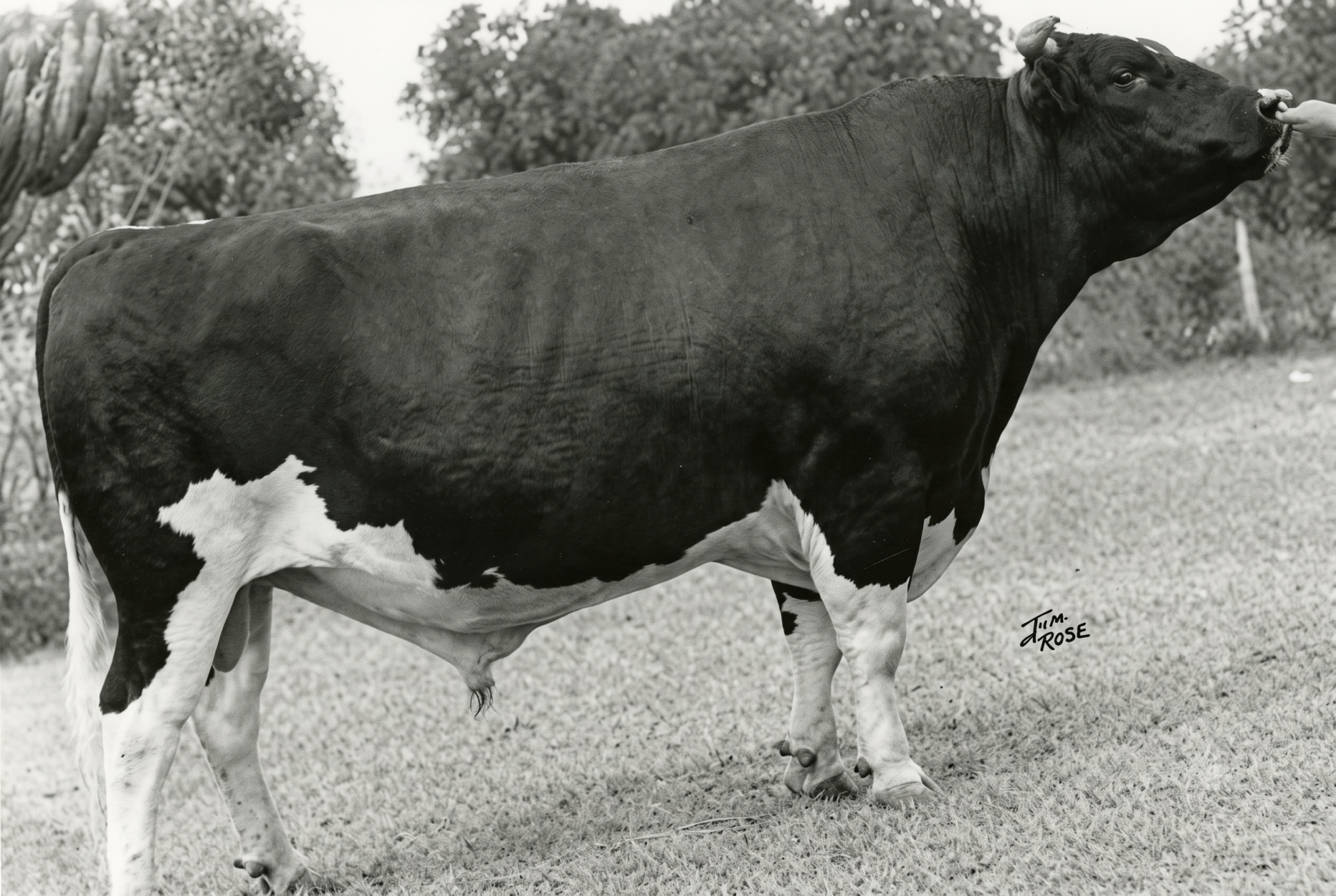
The Genetic Echo: Where They Live Today
Follow Citation R. forward, and you arrive at Glenridge Citation Roxy.
Roxy was a Citation R. daughter out of Norton Court Model Vee. She classified EX-97, produced 209,784 pounds of milk and 9,471 pounds of fat in her lifetime, and became the first cow in the world to have ten daughters classified Excellent. Ten daughters, all Excellent. Mention that in a serious breeder’s barn today and watch the eyebrows climb, because plenty of good cows never leave one. Her maternal grandsire, Springbank Model Fame, traced straight back to that Franlo exception, Gen Treasure Model—the very bull whose good maternal foundation had rescued a risky glamour line a generation earlier.
So the old debate between glamour and transmission didn’t end in some dusty essay. It walked, on four black-and-white legs, right into the pedigrees breeders still chase.
And Roxy wasn’t the only one carrying that blood forward, which is the part that always stops me cold. Trace the maternal line of Walkway Chief Mark—a bull whose name a lot of older breeders can still rattle off from memory, one of the great proven sires of his day—and it runs back through Cash-Mar Reflection Triune to Franlo’s Gen Treasure Model, that same steadying cow family, turning up in the pedigree of a household name where you’d never think to look. Then there’s Round Oak Rag Apple Elevation—the bull who became one of the most influential sires in the history of the breed, a name sitting behind an enormous share of modern North American Holsteins. His maternal granddam? Glenafton Gaiety. An uncampaigned Glenafton cow who never chased a single ribbon in her life. The best animal in the barn, it turns out, isn’t always the one wearing the sash.
And if you think all that belongs safely in the past—that genomics finally settled the argument—look closer.
The Same Bet, Now in a Genomic Suit
The tools changed beyond recognition. The wager didn’t.
Today the glamour comes wrapped in a genomic test instead of a show halter. A chart-topping GTPI number, a headline LPI figure, an IVF-fueled flush program pulling dozens of embryos from a single donor, a six-figure genomic heifer changing hands before she’s ever milked—these are the modern equivalents of that big-necked bull stopping traffic on the tanbark. And the modern show ring still crowns its own royalty: names like Erbacres Snapple Shakira and Blondin Goldwyn Subliminal draw the same crowds, the same awe, the same assumption that a phenotype this good must breed on. Sometimes it does. Sometimes, just like Rocket Tone, it doesn’t.
The mandate hasn’t budged an inch. If the maternal line underneath all that data lacks the additive power to stamp the next generation, you aren’t buying breed improvement—you’re buying a very expensive lottery ticket with a prettier envelope. Genomics narrowed the odds. It never repealed the rule.
The Lesson That Outlived Them All
So what did the glamour bulls finally teach us?
To admire a great phenotype—and then interrogate it. That a bull’s own body is one performance, while his daughters are the encore that actually matters. That deep cow families and repeatable transmission must outweigh one perfect afternoon under perfect lights.
And they taught humility. Because no honest breeder reads about Rocket Tone, Sovereign Supreme, Fobes Burke, Reflection Governor, or those eight silent Glenafton bulls without a chill of recognition. Those weren’t ugly animals. They weren’t nobodies. They were often magnificent. The trouble was never bad eyes. The trouble was trusting the eye, alone, to tell the whole story.
But don’t mistake this for a scolding. It’s a tribute.
Because the bulls that did transmit gave the Holstein breed its backbone. Marksman and Sovereign lit the Rag Apple name for generations. Governor Imperial, Homestead Revelation, and Royal Master carried Carnation production down through record-shattering sales. Sir Roburke Rag Apple and Roamer Dean Walker Lad proved a show bull could be more than a pretty picture. And Citation R. carried Astengo’s genius into daughters and gets, and into one of the most revered cow families the breed has ever known.
Maybe that’s the lesson still standing after all these years. Genomics changed the tools. Classification changed. The bull classes have all but vanished from the great fairs, and semen now travels farther than any show string ever could. But the old question hasn’t aged a day. Every time a breeder squints at a proof, watches a heifer cross the concrete, and wonders whether her beauty will outlast the photograph, that same quiet question is doing its work at the very heart of breed improvement—the one Rocket Tone’s daughters answered the hard way. Does she transmit?
Rockwood Rocket Tone deserves to be remembered—not for failing, but because his failure taught a lesson too expensive ever to forget. Smithcroft Snowball Rocket deserves to stand right beside him, not as the prettier legend, but as the bull who reminded everyone that the true champion is often crowned years after the judge’s hand comes down. Between the two of them lives the great and permanent lesson of Holstein history: the tanbark can crown the body, but only the daughters can crown the blood. The breed we milk today wasn’t built by the bulls who merely looked immortal—it was built by the ones whose daughters made them so.
Key Takeaways
- A show banner tells you what a bull is, not what he’ll leave behind—Rockwood Rocket Tone won All-Canadian six times and still bred like a fence post, while quieter Snowball Rocket remade the breed through his daughters.
- Only about 1 in 6 of history’s most decorated show bulls became exceptional sires. Before you chase a phenotype, dig into the maternal line—deep, proven cow families are what separated Rosafe’s 17 from Glenafton’s 5.
- The rule didn’t change with genomics. A chart-topping GTPI heifer or a six-figure flush donor still has to transmit, or you’ve bought a very expensive lottery ticket with a prettier envelope.
Continue the Story
- The Vision of Mount Victoria: T.B. Macaulay’s Holstein Legacy – Long before Rocket Tone fooled the eye, T.B. Macaulay was using strict mathematical principles to build the foundational Rag Apple dynasty, proving that true breeding power is engineered through rigorous maternal selection rather than show-ring glamour.
- The Bull Who Changed Everything: The Johanna Rag Apple Pabst Story – Walk the old barns of the 1920s Wisconsin circuit to see how a single prepotent sire defied the odds of Morwick’s one-in-six rule, anchoring the entire genetic framework of the modern Holstein breed.
- Rosafe Citation R – Discover how Hector Astengo’s linebred masterpiece carried the ultimate triumph of blood over beauty forward through time, leaving an omnipresent blueprint of excellence that still dominates pedigrees in today’s genomic era.
The Sunday Read Dairy Professionals Don’t Skip.

Every week, thousands of producers, breeders, and industry insiders open Bullvine Weekly for genetics insights, market shifts, and profit strategies they won’t find anywhere else. One email. Five minutes. Smarter decisions all week.