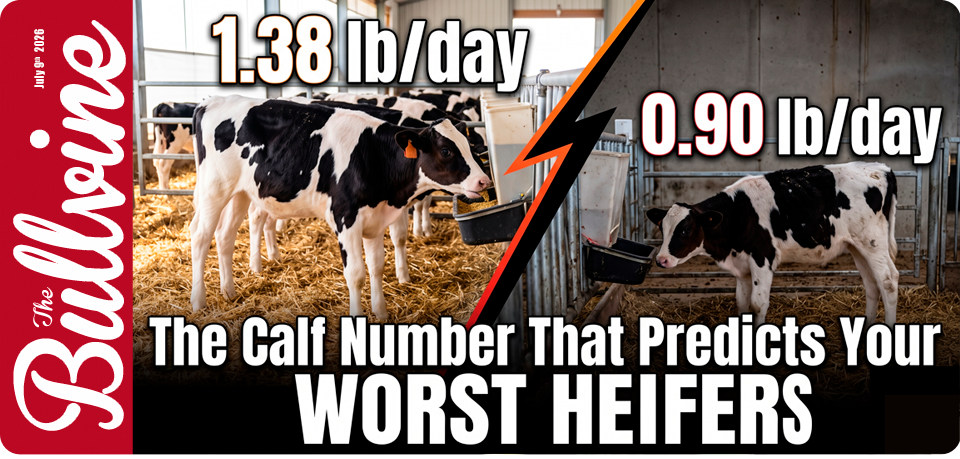






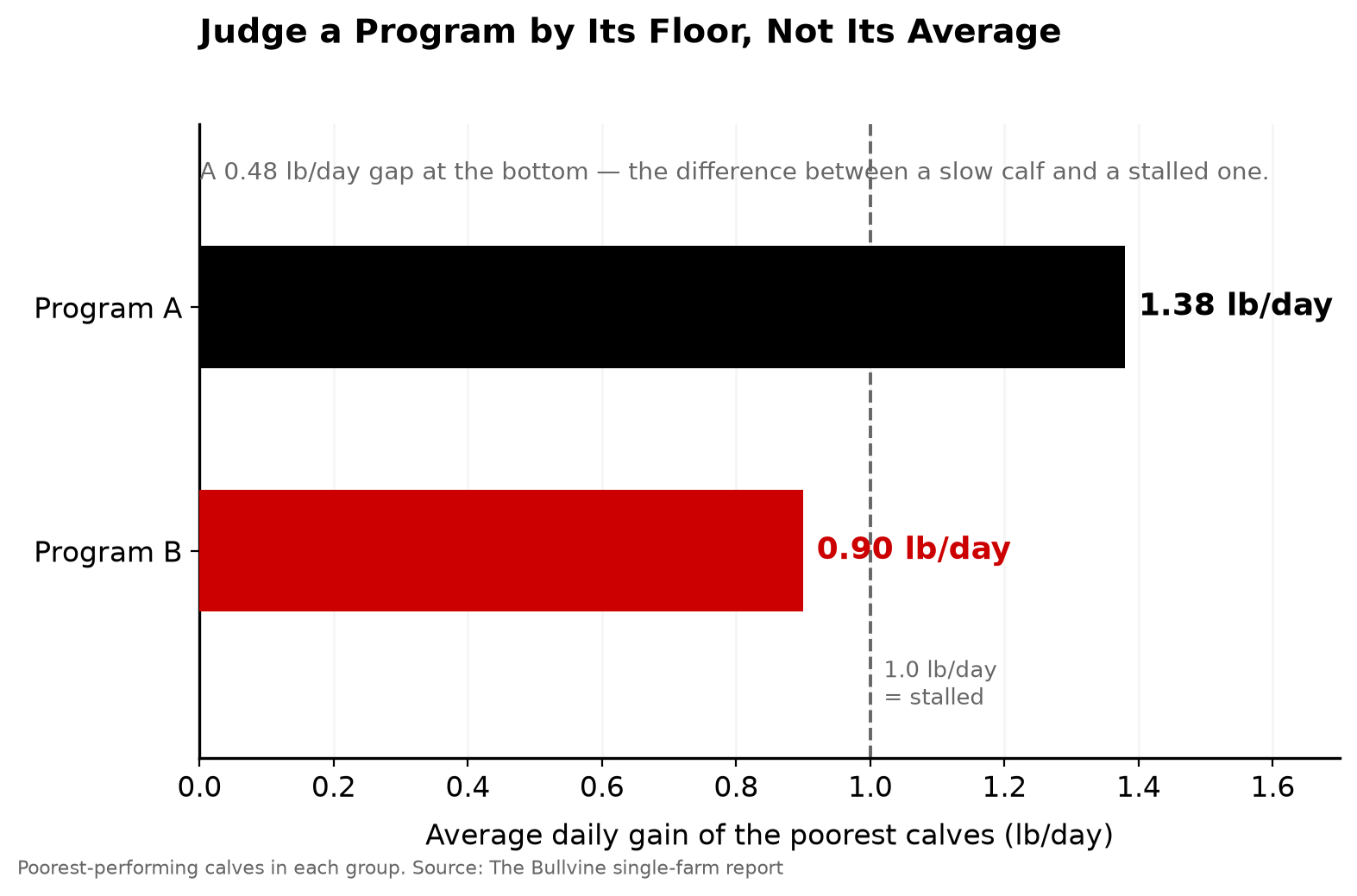
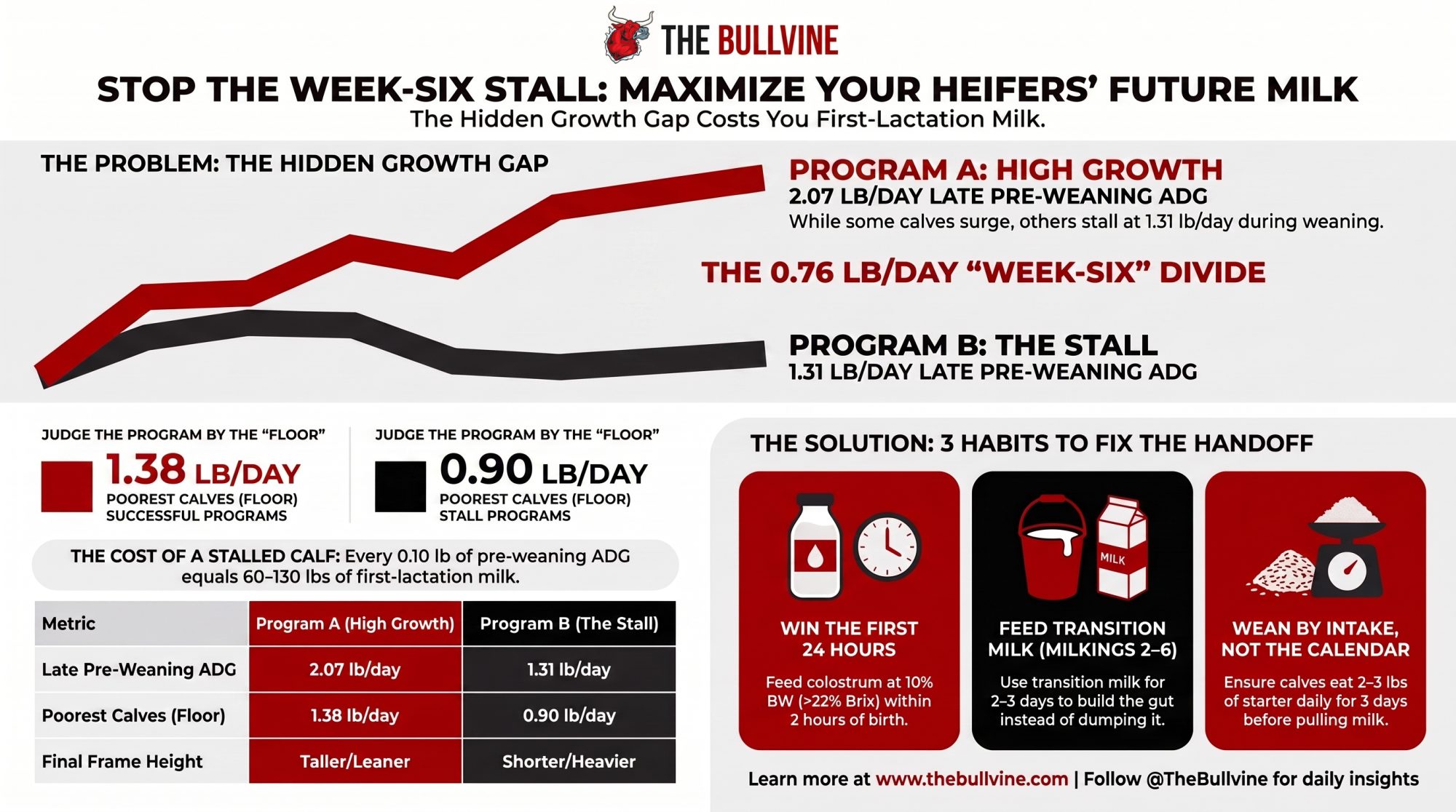
Same barn, same week: the poorest calves on one program held 1.38 lb/day. On the other, 0.90. That floor — not your average — is what shows up in the heifer pen two years later.
Picture the calf every feeder loves. Four weeks old, slick-haired, bright-eyed, draining the bottle and bawling for more. Nobody worries about her. She gets weaned around six weeks, moved to a group pen, and forgotten — because she never got sick and never gave anyone trouble.
Then somebody puts a scale under the group, and the calves split into two stories. That’s the shape of what one Midwestern dairy found when it ran a 39-calf comparison of two commercial calf programs, tracked on average daily gain (ADG). It was one farm’s report, not a controlled multi-herd trial — so read the size of the gap as directional, not gospel. But the point at which calves separate is the part of any calf-weaning program that almost nobody measures: right around week six.
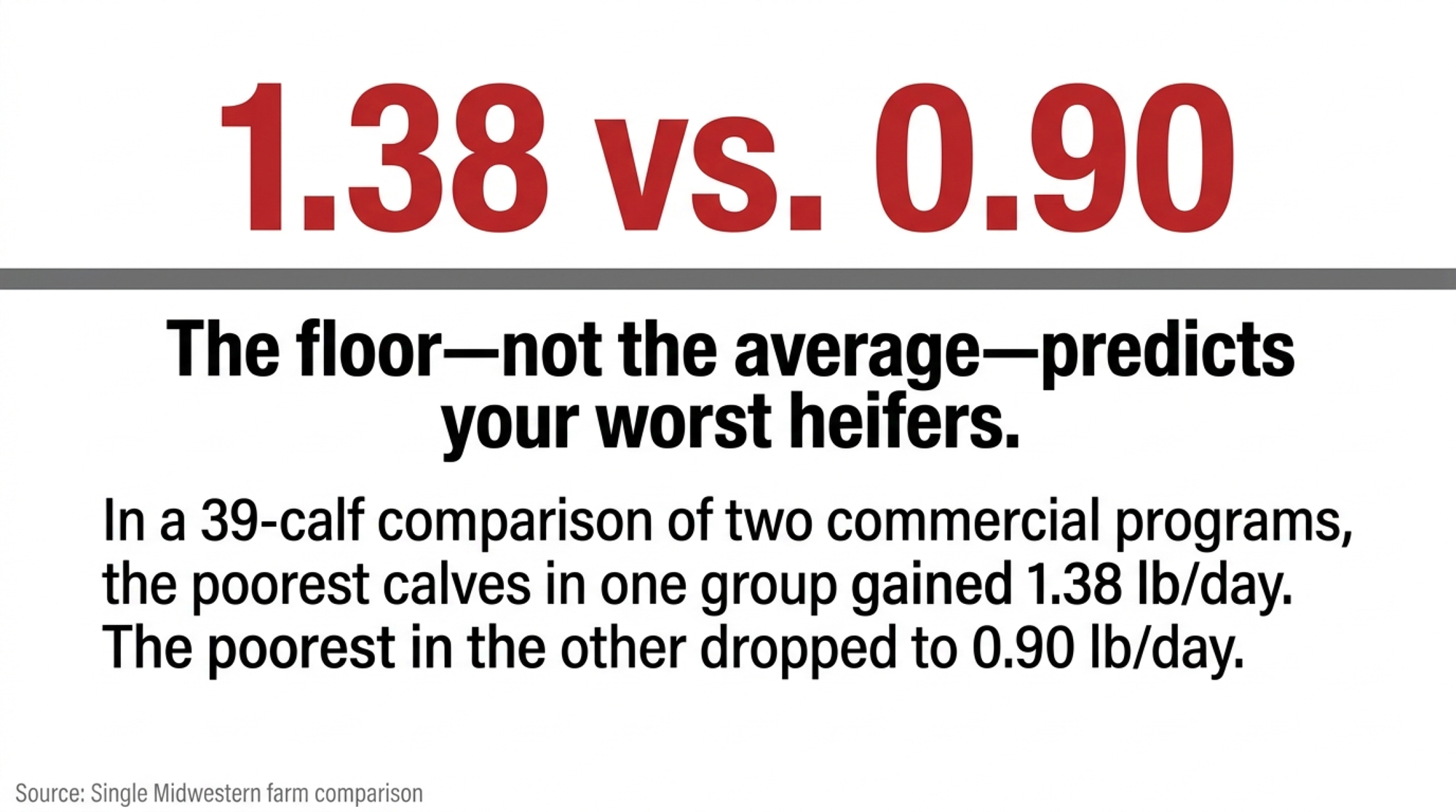
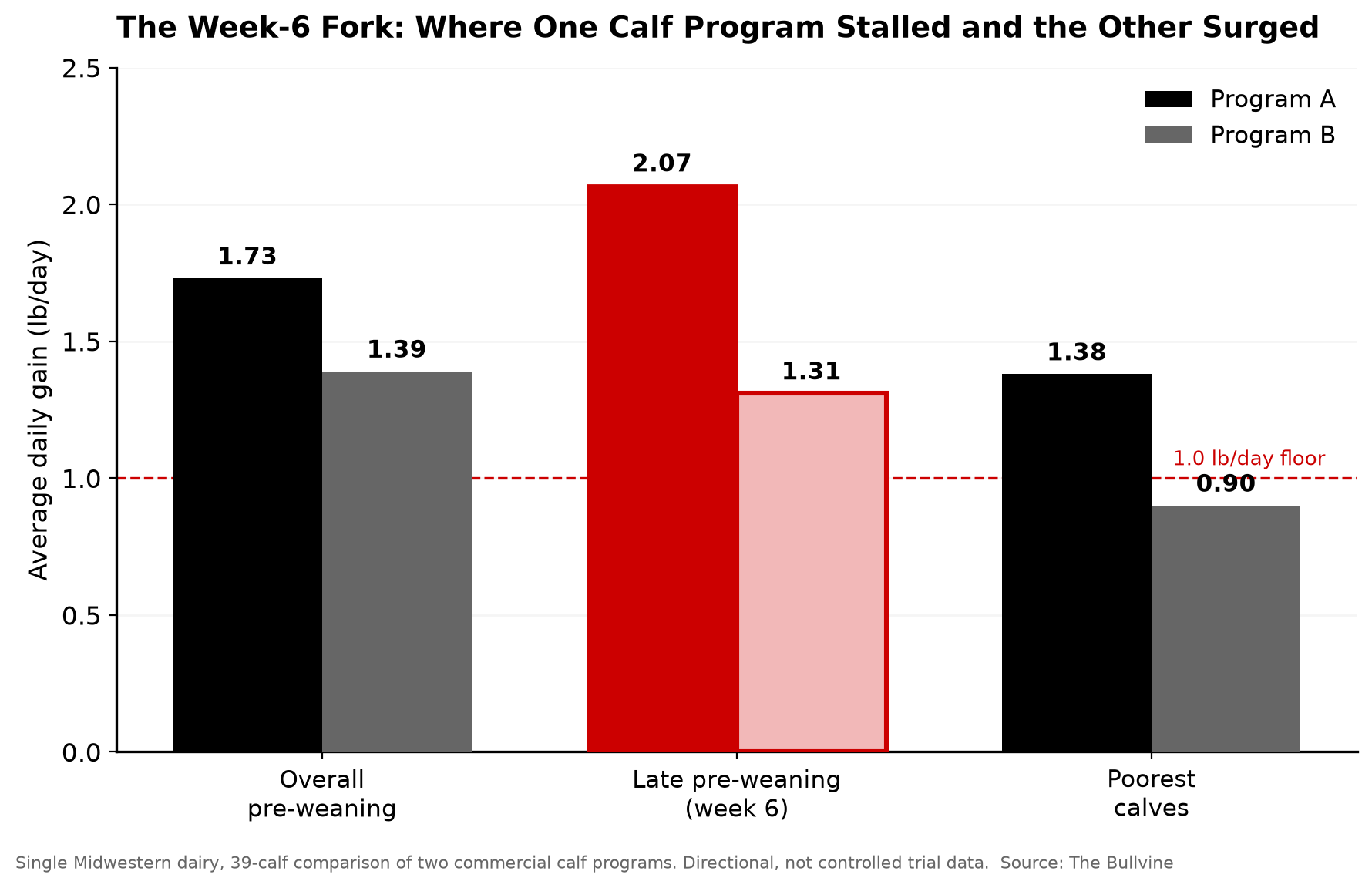
The three numbers that tell the story. Overall ADG: 1.73 vs 1.39 lb/day (+0.34). Late pre-weaning phase: 2.07 vs 1.31 lb/day. Poorest calves in each group: 1.38 vs 0.90 lb/day (Program A vs. Program B; single Midwestern farm, 39 calves).
What the Report Showed — and How to Read It
Across the full pre-weaning period, the calves on Program A gained 1.73 pounds per day, compared with 1.39 pounds per day for Program B — a 0.34-lb/day edge. Over a 56-day pre-weaning window, that’s about 19 extra pounds of calf, built during the weeks that matter most.
The more telling number is when the gap opened. Early on, the groups ran close. In the late pre-weaning phase — the week-six window — the Program A calves surged to 2.07 lb/day, while Program B stalled at 1.31 lb/day. One group accelerated into weaning; the other flattened. Same barn, same week, opposite direction.
And look at the bottom of each group, because that’s where a program is really judged. The poorest-performing calves on Program A still gained 1.38 lb/day. The poorest on Program B dropped to 0.90. Your worst calves tell you whether a program protects the whole group or flatters the average — and a floor of 1.38 versus 0.90 is the difference between a slow calf and a stalled one.
The Program A calves also grew differently in frame — about 0.084 inches a day of height versus 0.061 — finishing taller and leaner rather than just heavier. One caveat worth saying out loud: this was a single farm, 39 calves. It’s a real result, not a guarantee your barn will see the same spread, and it isn’t repeatable trial data.
The Calf That Looks Fine and Still Falls Behind
The trap is that pre-weaning ADG doesn’t announce itself. A dead calf gets noticed. A calf gaining 1.31 pounds a day instead of 2.07 looks completely normal in the pen — she’s just a little smaller, and “small for her age” rarely earns a phone call.
That’s why the week-six stall survives on so many farms. Most herds answered a decade of calf research by feeding more milk; feeding 3 quarts twice a day is common now, where two quarts twice a day used to be the rule. Fewer changed how, or when, they wean. So the front half of the program improved, and the back half didn’t — and the seam between them is exactly where calves stall. The report didn’t just show a winner. It showed where and when the second program lost the calves.
The Stall Starts Before You Think — Day One, Actually
Here’s the part that catches good managers off guard: the week-six stall often gets set in motion in the first 24 hours of a calf’s life. Get colostrum wrong, and you’ve handicapped the calf before she’s ever offered a handful of starter.
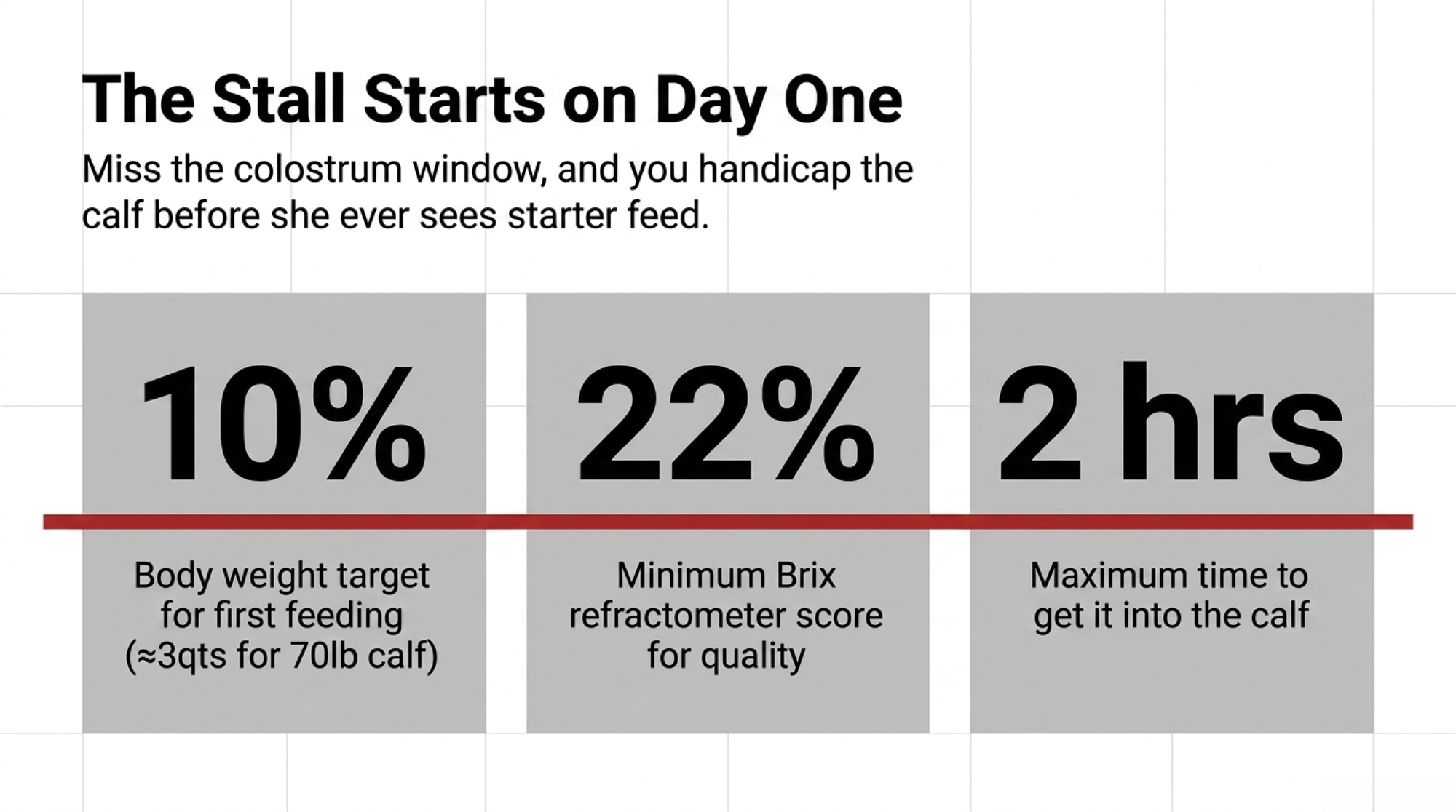
The target is well established, and it scales to the calf. Most extension programs feed colostrum at roughly 10% of body weight in the first feeding — so a 90 lb Holstein calf takes about a gallon, while a 70 lb calf needs closer to 3 quarts, not four. What matters is clean, high-quality colostrum testing above 22% on a Brix refractometer, fed within the first 2 hours, with passive transfer confirmed in the first few days. Calves that miss that window absorb fewer antibodies, get sicker more often, and — critically — eat less starter feed in weeks two and three. Less starter means a slower-developing rumen heading straight into weaning. The first feeding and the week-six gain are the same story, just told 40 days apart.
The day-one rule that shows up at week six: feed colostrum at about 10% of body weight (≈3 quarts for a 70 lb calf, a gallon for a 90 lb calf), testing above 22% Brix, in the first 2 hours. Then feed transition milk (milkings 2–6) for two to three days before switching to milk or replacer.

| Step | Target | Timing | Why it drives week-6 gain |
|---|---|---|---|
| Colostrum volume | ~10% of body weight (≈3 qt for a 70 lb calf; 1 gal for 90 lb) | First feeding, within first 2 hours | Antibody absorption window closes fast; miss it and starter intake drops in weeks 2–3 |
| Colostrum quality | Above 22% Brixrefractometer | First feeding | Below-22% colostrum = weaker passive transfer, more sickness, slower rumen |
| Transition milk (milkings 2–6) | Feed 2–3 days before switching | Days 2–4 of life | Richer in fat, protein, growth factors; most farms dump this down the drain |
| Passive transfer check | Confirmed adequate | First few days | Failed transfer = sicker calf, lower early intake, stalled rumen into weaning |
Transition milk — the second through sixth milkings after calving — is the bridge most farms still pour down the drain. It’s richer in fat, protein, and bioactive growth factors than the milk or replacer that follows, and feeding it for two or three days after colostrum has been associated with improved early gut development and higher early intakes. You’re not buying anything new. You’re just not throwing away something the cow already made.
Why Starter Beats Milk for Building Week-6 Calves
Two things run underneath all of this, and neither cares how your barn is laid out.
First, calves are born with a rumen that barely works. The papillae — the projections that absorb energy from fermented grain — only grow when there’s grain in the rumen producing volatile fatty acids. So starter intake, not milk, is what builds the rumen heading into weaning. Penn State Extension puts it bluntly: no matter how much milk you feed or what age you wean, calves whose rumens aren’t ready will struggle afterward. That’s the mechanism behind a 0.90 lb/day floor.
Second, that same window appears to shape the udder. Reviews from UF/IFAS and others suggest that nutrition and stress during the first six to eight weeks influence mammary development. You’re not just building a bigger calf — you may be shaping how much milk-making machinery she carries as a cow. That’s the working theory behind why early gain tracks with later milk.
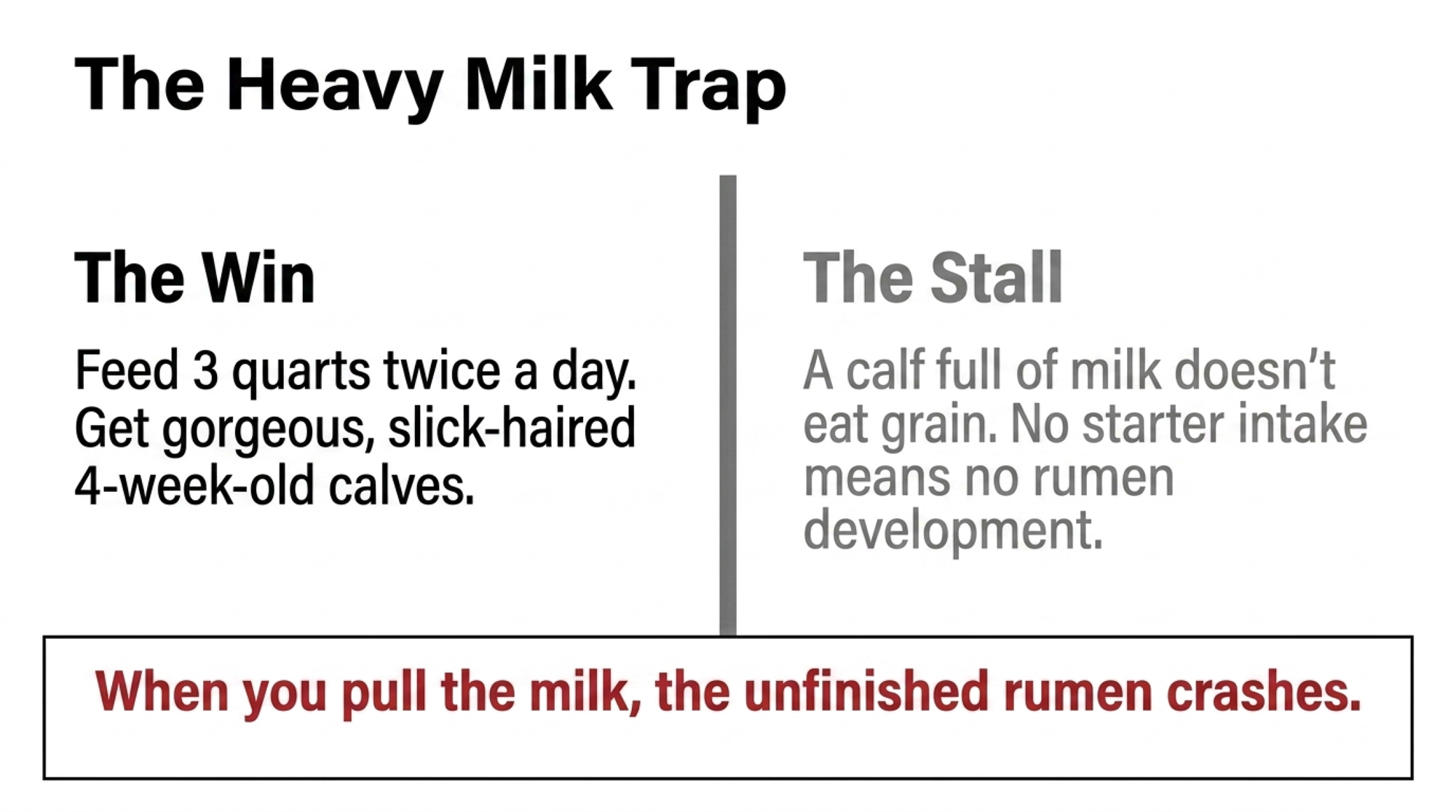
There’s a tension here worth naming, because it bites a lot of well-meaning farms. The same heavy milk feeding that drives those gorgeous four-week calves can suppress starter intake if you’re not careful — a calf full of milk doesn’t go looking for grain. That’s why the step-down matters so much. Pull the milk too fast, and the rumen isn’t ready; leave it high too long, and the calf never learns to eat. The herds that thread that needle are the ones whose calves don’t stall.
Now stack management on top. Wean by age and pen space, not starter intake. Cut milk over two or three days instead of stepping it down. Move, mix, and disbud in the same week. Push calves onto a forage-heavy grower ration before the rumen can handle it. Do enough of that at once, and you get the stall: rumens that never got enough grain, intake dropping just as the milk goes away. The calf survives. The growth curve flattens right when it counts.
Why That 0.34 Pounds Is a Lever You Actually Control
The skeptic’s question is fair: Does a third of a pound a day in the calf barn really show up in the tank two years later? The research says it’s linked — and it’s been quantified.
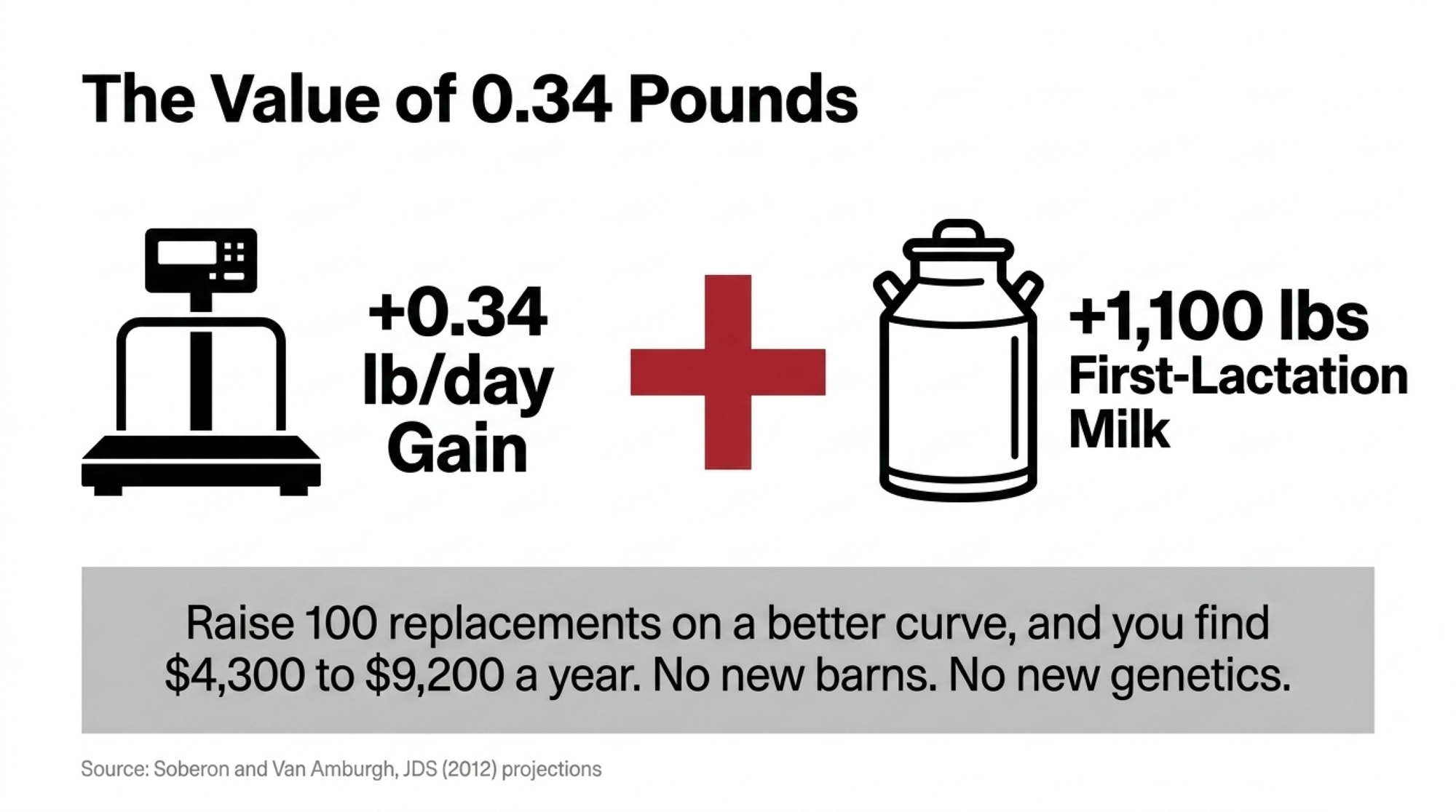
In the foundational Cornell work (Soberon and Van Amburgh, Journal of Dairy Science, 2012), every additional kilogram of pre-weaning ADG was associated with about 1,113 kilograms more milk in first lactation in the commercial herd, and across both herds studied, pre-weaning gain explained 22% of the variation in first-lactation yield. That slope works out to roughly 1,100 pounds of first-lactation milk per additional pound of daily gain at the high end; more conservative pooled analyses land lower, bracketing a working range of about 600 to 1,300 pounds per pound of gain (roughly 60–130 lb for every 0.10 lb/day).
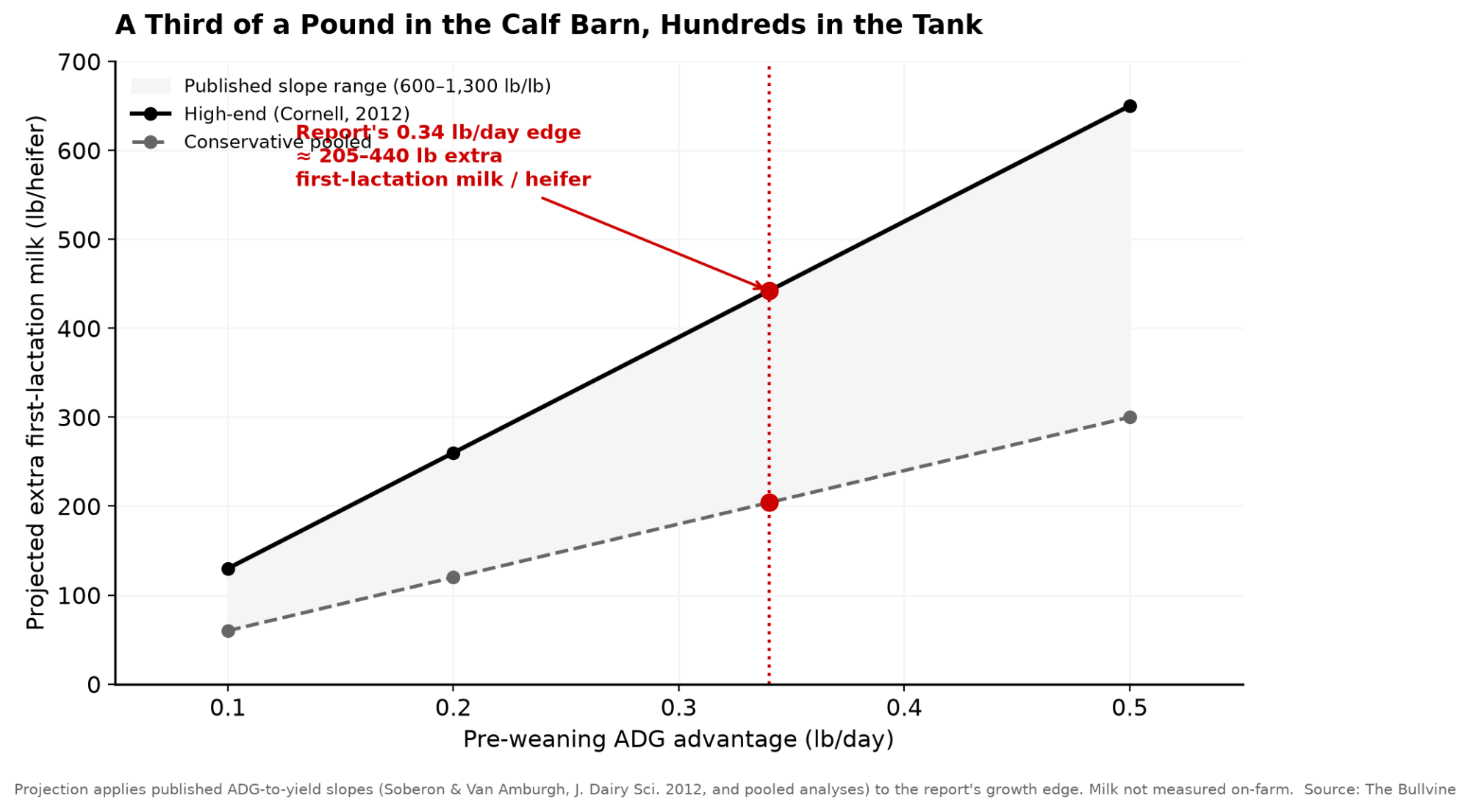
Run the report’s edge through that range. A 0.34 lb/day advantage projects to roughly 205 to 440 pounds of additional first-lactation milk per heifer, depending on which published slope you use. Raise 100 replacements a year on that better curve, and you’re looking at 20,000 to 44,000 pounds of milk — somewhere around $4,300 to $9,200 a year at $21/cwt, with no new barn and no new genetics.
One honest line on that number: the report measured calf growth, not these calves’ actual milk records. The milk figure is a projection from outside research, not something this farm has weighed in the tank. That’s still the right argument — genetics, transition, and breeding decisions all come later and cost more to move. Pre-weaning gain is one of the few levers you can pull before the heifer is even bred.
How Much Does the Week-6 Stall Actually Cost You?
Run the report’s spread through your own herd, and it stops being abstract. A 250-cow dairy raising 60 heifers a year, with a 0.34 lb/day gap, is projecting roughly 12,000 to 26,000 pounds of first-lactation milk left behind per cohort. A 600-cow herd raising 140 heifers? Roughly 29,000 to 64,000 pounds.
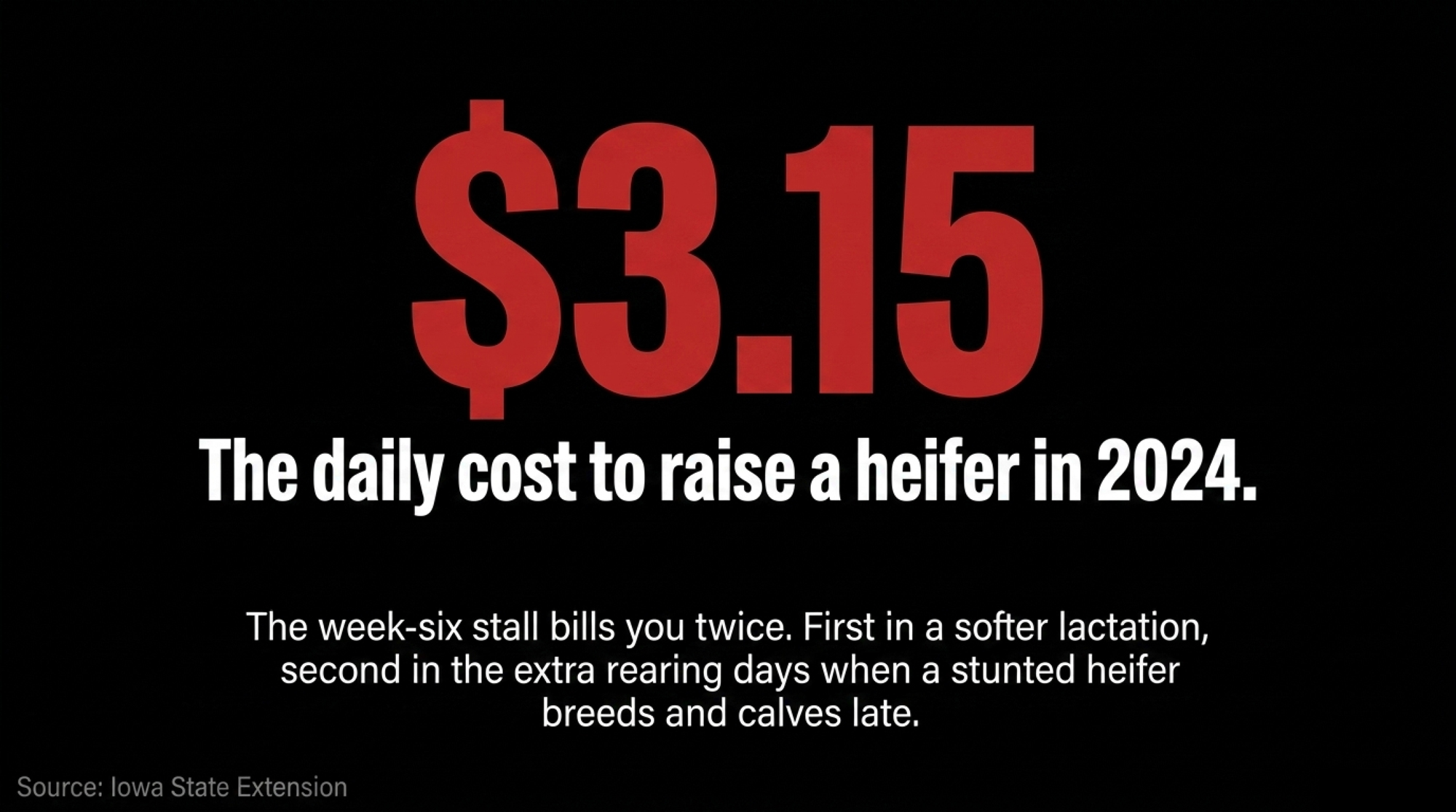
Then there’s the rearing bill. Iowa State Extension pegged the cost of raising a heifer in 2024 at about $2.65 a day for a good genetic heifer, or $3.15 with labor, and heifer raising is the second-largest expense on most U.S. dairies, behind only the milking herd’s feed. A stalled calf doesn’t just milk lighter; she tends to breed and calve late, stacking more of those $2.65-to-$3.15 days onto a heifer that isn’t earning yet. So the week-six stall bills you twice — once in a softer first lactation, once in the extra rearing days before she enters the parlor.
| Herd size | Heifers raised / yr | Projected first-lactation milk left behind / cohort | Rearing cost exposure ($2.65–$3.15/day) |
|---|---|---|---|
| 250 cows | 60 | 12,000 – 26,000 lb | Stalled calves breed & calve late, stacking extra $2.65–$3.15 days |
| 600 cows | 140 | 29,000 – 64,000 lb | Heifer raising = 2nd-largest dairy expense (Iowa State, 2024) |
| 100 replacements | 100 | 20,000 – 44,000 lb (≈ $4,300 – $9,200/yr at $21/cwt) | No new barn, no new genetics — pure management lever |
| Per heifer | 1 | 205 – 440 lb | Late calving adds unearned rearing days on top |
What the Report Doesn’t Tell You — and Why That Matters
Be honest about the limits of a single-farm comparison, because your own numbers will carry the same caveats. This report tracked growth — ADG and frame — not health events, not feed cost per pound of gain, not what these specific calves eventually milked. A program can post a great ADG and still cost more per pound, or run into a scours break the numbers don’t show.
It also can’t separate the feed from everything around it. Same barn, same crew, same season — but we don’t know how the two groups were split, whether one got slightly better hutches, or how the weather hit the trial window. Thirty-nine calves are enough to see a clear pattern and not enough to rule out luck. Treat the size of the gap as directional and the shape of it — a stall versus a surge right at week six — as the part worth trusting.
None of that sinks the story. It sharpens what you should take from it: not “switch feed and gain 0.34 pounds,” but “find out whether your own calves stall at week six, and if they do, fix the handoff.” The report is a prompt to measure your barn, not a promise about it.
Is Your Weaning Plan Ready for the Milk You’re Feeding?
You don’t need to recite papillae biology to answer this. You need four blunt answers about your own barn.
When do calves start eating starter, and are they really eating it before week three? How many days have they been on grain before you pull the milk? Are you weaning on age because that’s when the pen needs to turn — or do starter intake and ADG get a vote? And what else hits those calves that same week: disbudding, regrouping, a move somewhere colder?
Stack all of that around an unfinished rumen, and you’ve built a stall, not a handoff. The herds pulling ahead aren’t the ones with the fanciest sensors. They’re the ones where somebody can tell you, without opening a laptop, what their ADG to weaning is, what happens the week after, and what they changed last time the curve went flat.
How Do You Measure Starter Intake Without Losing Your Mind?
This is where most programs quit, because “measure intake” sounds like a research trial. It doesn’t have to be. You’re chasing a trend and a trigger, not a number to three decimals.
Pick a representative pen or a set of individual calves. Weigh the starter you put out, weigh back what’s left and wasted, and you’ve got daily intake per calf close enough to act on. Watch for the moment a calf reliably eats 2 to 3 pounds a day for three straight days — the practical green light that the rumen is doing real work. Pair that with a weigh tape or scale at a few fixed points, and you see both halves: is she eating, and is she growing? The herds that do this well don’t measure every calf every day. They sample, chart the trend, and let intake and ADG — not the calendar — decide when milk comes off.
Sponsored Post
Three Changes That Help Calves Power Through Week 6
You can close most of this gap without rebuilding the calf barn. But you have to decide what becomes a non-negotiable habit.
Earn the right to wean. Switch the trigger from age alone to starter intake plus age. Don’t fully wean before calves eat 2 to 3 pounds of starter a day for three straight days, and step milk down over 7 to 10 days rather than yanking it. USDA APHIS data on preweaned Holstein heifers show that higher planes of liquid feeding support the kind of gains — pushing toward 1.8 to 2 pounds a day — that Program A landed in. The trade-off is real: intake-based weaning disrupts tight pen-move schedules, and someone actually has to monitor intake.
Unstack the week-six pile-up. Keep dehorning, big group changes, and major pen moves out of the week before and after milk withdrawal. Hold calves on a starter-heavy diet for a week or two post-weaning before loading in forage. Headed to group housing? Move them before the step-down so they’re already eating well in the new pen. The limit is logistics — spreading jobs out feels inefficient until you price in the lost gain and the vet calls.
Make one person the owner of the curve. Name one person to record weights, review ADG by group monthly, and flag the slumps — then give that person a real slot in the herd meeting, next to somatic cell count and repro. The risk: with no backup, the whole system rides on one person and dies fast if leadership never acts on the numbers.
What This Means for Your Operation
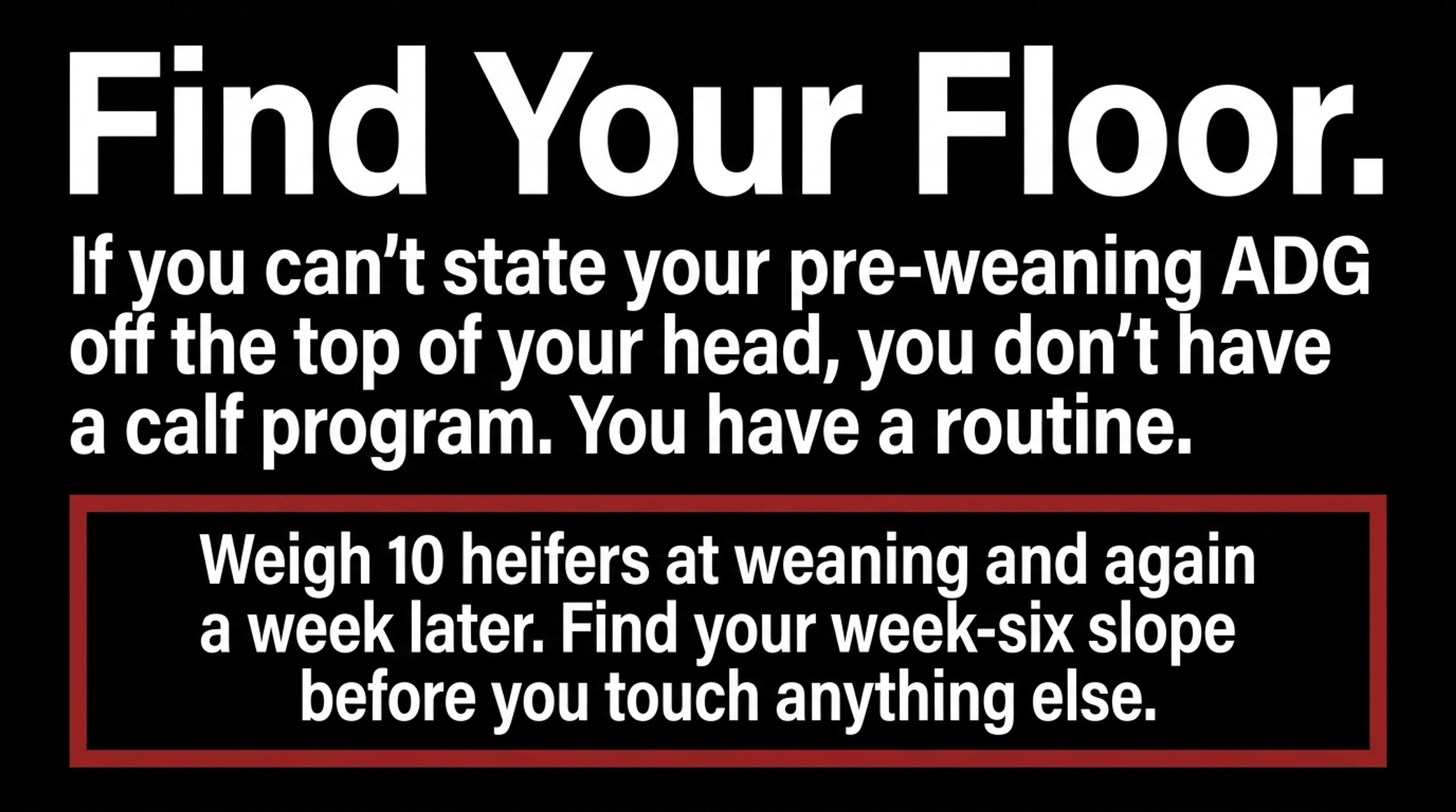
- If you can’t state your herd’s pre-weaning ADG off the top of your head, you don’t have a calf program — you have a calf routine. Measuring is the first decision.
- If your late pre-weaning gain looks more like 1.31 than 2.07, the week-six handoff — not the calf — is probably the problem.
- If you’re weaning strictly by calendar age, check starter intake first: under 2 to 3 pounds per day for three days likely means the rumen isn’t ready.
- If you’re dumping transition milk, you’re throwing away the cheapest gut-development tool you’ve got — feed milkings two through six for a couple of days before you change anything else.
- If you want to know whether a program protects every calf, look at your bottom tier, not your average — 1.38 versus 0.90 is the whole ballgame.
- If a chunk of your heifers calve late, trace them back and ask whether they were the calves that stalled at six weeks — because at $2.65 to $3.15 a day, those extra rearing days aren’t free.
Key Takeaways
- If you only change one thing this month, weigh 10 heifers at weaning and again a week later, calculate ADG, and find your week-six slope before you touch anything else.
- If your colostrum isn’t testing above 22% Brix and going in within two hours — at about 10% of the calf’s body weight — fix the first feeding before you fuss over the weaning end. The stall often starts on day one.
- If your bottom-tier calves gain under 1.0 lb/day, that floor — not the group average — is your real target, and it’s a feed-and-weaning problem before it’s a genetics problem.
- If your weaning is age-triggered, switch to intake-plus-age: 2 to 3 pounds of starter for three straight days before milk comes off.
- If you’re carrying heifers past 24 months at first calving, the calf barn is a likelier culprit than the breeding pen — start there.
The Midwestern dairy in that report didn’t find a magic calf. It found a 0.34-pound-a-day fork in the road, most of it opening in a single week — and it could see the fork only because it put a number on the part of the program everyone else eyeballs. So here’s the question worth chewing on at your next herd meeting: do you actually know what your calves gain between week four and week six, or are you trusting that the slick-haired ones are telling you the truth?
Complete references and supporting documentation are available upon request by contacting the editorial team at editor@thebullvine.com.
Learn More
- Calf Weaning by Starter Intake: Jim Quigley’s 15 kg NFC Threshold — Arms you with the biological threshold needed to eliminate post-weaning growth checks. You will discover why calendar-driven milk pull creates an energy deficit and how tracking fermentable carbohydrate intake protects your heifers from stalling.
- The Beef Check You Banked in 2023 Is the $3010 Heifer You Can’t Afford in 2026 – The Bullvine — Exposes the severe structural heifer shortage driving replacement values past $3,000 per head. This economic analysis forces you to recalculate the capital cost of rearing errors and find hidden pipeline losses.
- Emily Miller-Cushon’s Physics-to-Dairy Pivot: Pair Housing’s 130g/Day Gain Edge and … – The Bullvine — Delivers a behavior-led strategy to boost starter grain consumption through social learning. You will gain a proven method to increase pre-weaning weight gains by 130 grams per day without changing your ration formulation.
The Sunday Read Dairy Professionals Don’t Skip.

Every week, thousands of producers, breeders, and industry insiders open Bullvine Weekly for genetics insights, market shifts, and profit strategies they won’t find anywhere else. One email. Five minutes. Smarter decisions all week.