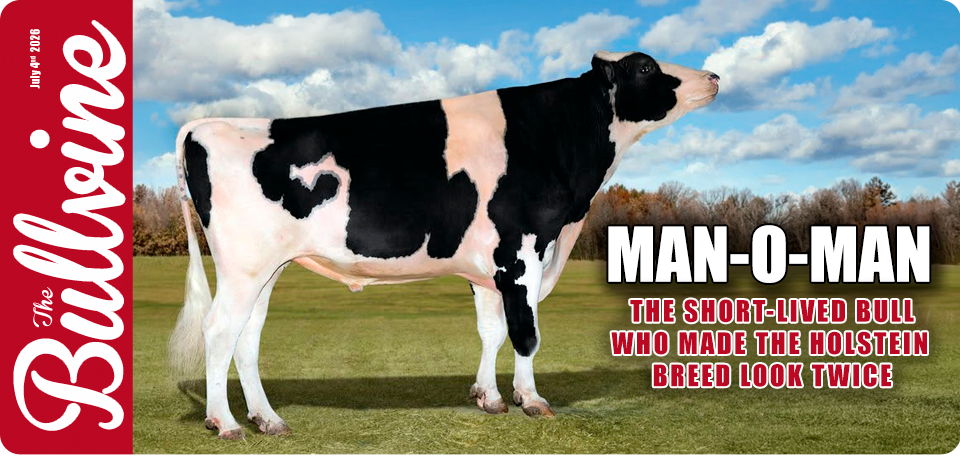





He classified VG-85, fought for every straw of semen, and died at eight. Then his daughters rewrote the sire lists—and quietly built the pedigree of the bull in your tank today.
Nobody writes a bull’s obituary while he’s still delivering daughters.
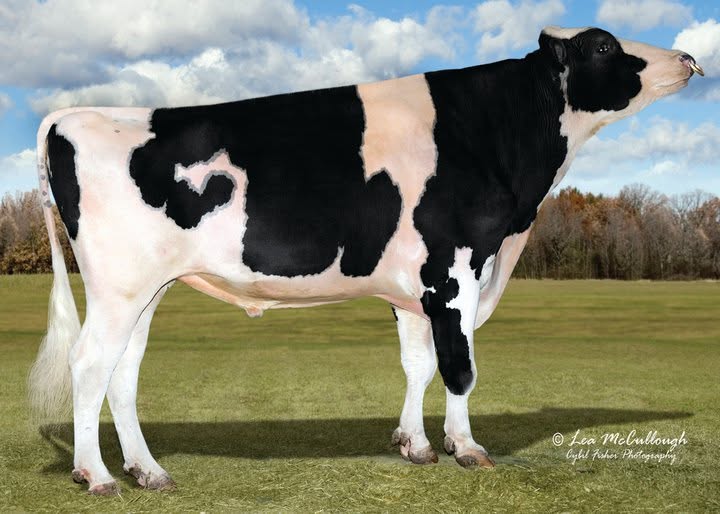
But that’s almost what happened in the spring of 2012. The genomic era had arrived, young sires were being ranked by DNA before their daughters ever freshened, and every serious breeding program was learning a new language of reliability and risk. Then the April sire summaries dropped, and there he was: Long-Langs Oman Oman-ET, VG-85-GM, the bull everyone simply called Man-O-Man—standing as the No. 2 U.S. TPI sire at +2247. He was also the highest proven bull in the breed for TPI on a 100% RHA basis: a fully Registered Holstein pedigree, no grade blood anywhere behind him.
And then he was gone.
Accelerated Genetics announced his death that same spring, before the breed had really finished measuring him. He was only eight years old. Respiratory trouble had dogged him most of his life, making semen production a constant battle and limiting the inventory breeders could actually get their hands on. In a business where one great bull can shape millions of cows, that kind of scarcity changes everything. Every straw mattered. Every mating carried a little more weight.
Here’s the thing—Man-O-Man wasn’t the biggest, flashiest, prettiest bull the Holstein world had ever seen. He classified VG-85, respectable but hardly the stuff of show-ring mythology. His genius was quieter than that. It lived in daughters that milked hard, held together, bred back, and then turned around and became the mothers of the next generation of elite sires. He wasn’t just a bull you used. He was a bull you built from.
Act I — Before Genomics Had a Name
To understand Man-O-Man, you have to go back to the early 2000s, when Holstein breeding was having one of those uncomfortable conversations it seems to have every couple of decades. Production had climbed beautifully. The milk was there. But the cows, too often, weren’t sticking around long enough to pay the bills the way dairymen needed them to.
Fertility was slipping. Productive life mattered more than it had in years. Somatic cell score was no longer a footnote buried at the bottom of the proof sheet. The commercial dairyman—the one milking twice or three times a day, watching the cull list with a pencil in his hand—wanted more than a cow that peaked high. He wanted a cow that came back tomorrow. And the lactation after that. And the one after that.
Into that moment walked O-Bee Manfred Justice-ET. O-Man.
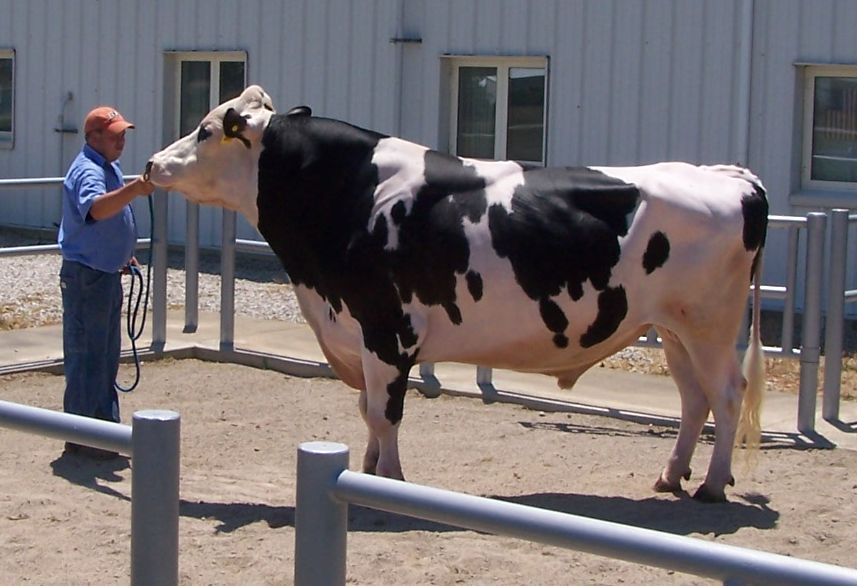
His proof looked different because his daughters were different. They brought production, sure, but they also carried the health traits the breed was starving for: productive life, daughter fertility, somatic cell score, the kind of quiet durability that turns a good cow into a profitable one. One source calls him the “fitness saviour of the breed” when he broke through in 2003, and AI organizations around the world answered by sampling hundreds of his sons. By August 2009, O-Man sons would hold five of the top ten spots in the high-ranking sire reports—and the pull toward shorter, stronger, more functional Holsteins was on in earnest.
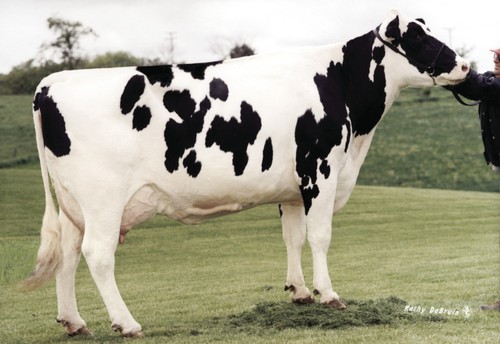
Now, O-Man’s own story had a bit of magic in it. His dam, Meier-Meadows El-Jezebel EX-92-GMD, was the kind of cow people remembered long after they’d left the barn. Sire analyst Charlie Will called her “just an awesome individual,” saying she gave a lot of milk “without even stressing herself at all”. The Obert family of Dakota, Illinois—Gaylon, Gary, and Steve—had bought Jezebel as a three-month-old calf at the Illinois State Sale, and Gaylon put it the way only a cattleman would: any 4-H group would’ve picked her out of the lineup, because “it was that clear-cut”. No spreadsheet poetry there. Just a calf you couldn’t walk past.
Mated to Ha-Ho Cubby Manfred, Jezebel produced O-Man—and O-Man sent his sons to the top of sire lists on four continents.
One of those sons arrived April 30, 2004: Long-Langs Oman Oman-ET, registration HOUSA000135746776, NAAB code 014HO04929, UK AI code FH3100. His sire was O-Man. His dam was Winning-Way Marci-ET (VG-89), bred by Randy Blodgette —a Dixie-Lee Aaron daughter. Look one generation deeper and the cow power keeps coming: Marci traced through PETICOTE BWOOD MOZZETTA a VG Bellwood daughter, then PETICOTE MASCOT MAYDAY an EX Mascot daughter. This wasn’t a lucky outcross. It was stacked, proven female depth behind a fashionable young sire.
Look at that sire stack for a second. O-Man brought health and function. Aaron brought production snap. Bellwood, further back, added structural foundation and production credibility that ran to one of the great fitness-and-yield families of the late twentieth century. And the cow-family depth behind it was something else again. The pedigree traces back through Pond-Oak Elevation Pumpkin VG-87, her Valiant daughter Mandy, Mandy’s Bell daughter Melody, and the famous donor Al-Hart Rotate Martha VG-88.
Picture that last one. A late afternoon in 1990, the light going soft, a visit to Bill Pettit’s Huff’n Puff ET/Peticote Farm in New Jersey—and there stands Rotate Martha, one of America’s most popular donors of her day, chewing her cud in the fading light. Nobody standing in that pen knew they were looking at the sixth dam of a bull who’d shake the breed a generation later. That’s usually how it goes. Tomorrow’s history stands around looking like today’s good cow.
And this is where it gets interesting.
Modern genomics weren’t in the picture yet when Man-O-Man was born. What the AI organizations did have was a precursor—the marker test. Crude next to today’s genomic evaluations, but useful enough to make sire analysts lean in. Man-O-Man had a full brother who showed better on conformation. Accelerated Genetics chose Man-O-Man anyway, because his marker test came back higher.
Think about that for a second. Before the genomic age truly opened, before every calf arrived with a spreadsheet of promises attached, somebody stood between two brothers and trusted the test over the prettier package.
They were right.
Act II — Scarcity, Suspense, and the Number That Changed Everything
Great bulls usually earn their chance through sheer volume. Semen gets collected, shipped, sampled, proven, then used harder and harder. Man-O-Man never had that clean road.
His respiratory issues fought him from the start, and they changed the way his genetics could move through the breed. The waiting period—that long stretch when AI organizations sit on a young bull’s semen while his daughters are born, freshen, and slowly write his proof—was tighter for him than anyone wanted. There was no deep tank waiting for the whole world. Breeders who wanted him often found demand had already run out ahead of supply.
That obstacle could’ve buried him. Plenty of useful bulls have vanished into bad timing, thin inventory, or plain biology. Man-O-Man had all three leaning on him at once.
So Accelerated Genetics had to be surgical about it. The semen that existed went mostly to elite, high-index females, which meant a lot of his daughters came out of some of the deepest cow families available. That wasn’t luck. That was triage. When you don’t have enough of a great bull, you don’t scatter him around—you put him where the odds of breeding the next great one run highest.
Then came August 2009.
Five years after that marker-test gamble, Man-O-Man became the No. 1 TPI sire among all American tested sires. Not a fashionable young genomic bull. A daughter-proven bull, sitting on top of the tested list—and he got there at the precise moment modern DNA technology stepped onto the stage.
That was the turning point. The whole story bends right here.
Picture the breeder at his kitchen table that fall, coffee going cold beside the proof sheets, trying to make sense of a breed that had suddenly changed its own rules. Genomics was starting to whisper what calves might become before the parlor ever confirmed a thing. And there, bridging the old world and the new, stood a bull chosen by a marker test and validated by his daughters—suddenly one of the most wanted sires of sons on earth.
What no one fully saw coming was how well he’d fit that new genomic machinery. As the No. 1 TPI sire, he became one of the most heavily used sires of sons, and genomics let the AI companies sort his highest-testing sons early. In country after country, young Man-O-Man sons climbed the DNA rankings, making him one of the first major sires of sons in the genomic era to throw a whole crop of high-testing sons. Looking back, that plain little marker-test decision from 2004 doesn’t look like a gamble anymore. It looks like a door swinging open.
But daughters still had to speak. They always do. And his did.
Walk into a freestall barn milking his daughters and you’d have seen it before you saw a single number—black-and-white cows filing in on sound feet, filling the parlor without fuss, the kind of herd that doesn’t make a herdsman’s morning harder than it has to be. His UK evaluation, under AHDB and Holstein UK, put figures to that impression: a Milk PTA of +193 kg at 99% reliability, built on 10,446 daughters across 1,617 herds. Read those numbers again. Ten thousand daughters. Sixteen hundred herds. Somewhere in Cheshire there was a herdsman pulling clusters in the gray morning light who’d never once said the bull’s name, who just knew the black-and-white cow in the third stall bred back clean every year and never gave him trouble—and multiply that quiet trust by sixteen hundred barns and you understand what the number really means. That’s not a kitchen-table impression or a lucky first crop; that’s enough cows, in enough barns, under enough different management, that excuses get very hard to find. His Australian proof told the same story from the other side of the world: 363 daughters in 73 herds, 99% production reliability. The bull traveled.
And his daughters weren’t bred for applause first. They were bred for work. The records and the breeder reports describe hard-working, trouble-free cows—functional udders, useful feet and legs, the O-Man family habit of staying useful instead of just looking good on one September afternoon. They weren’t flawless. Breeders learned to watch rump angle, since pin setting could run a touch high, and that became a standard corrective-mating note for any serious Man-O-Man program. No real legend is perfect. The useful ones almost never are.
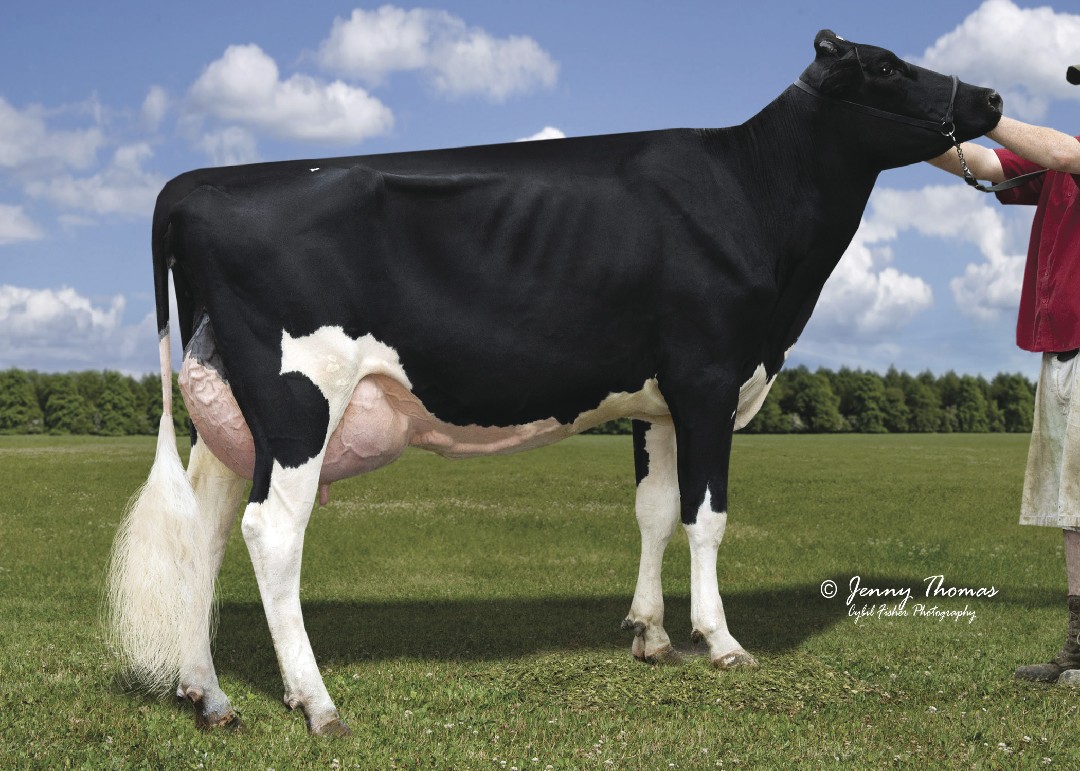
What set him apart was the combination. Some bulls give you health. Some give you milk. Some give you daughters people love to look at but don’t necessarily want a whole barn of. Man-O-Man landed in that narrow, valuable middle—enough production, enough health, enough function, enough pedigree horsepower to be dangerous in the very best sense.
And then his daughters started becoming bull mothers.
By December 2012, The Bullvine had counted six Man-O-Man daughters worldwide carrying genomic LPI numbers higher than his own index: Comestar Lautamai Man O Man, Stantons Manoman Ezra, Seagull-Bay Shauna Saturn, Benner Manoman Janesse, Donnandale Manoman Jakarta, and Ste Odile Manoman Model Saphir. That’s the moment a bull’s whole reputation shifts. He’s not just making daughters anymore. He’s making launchpads.
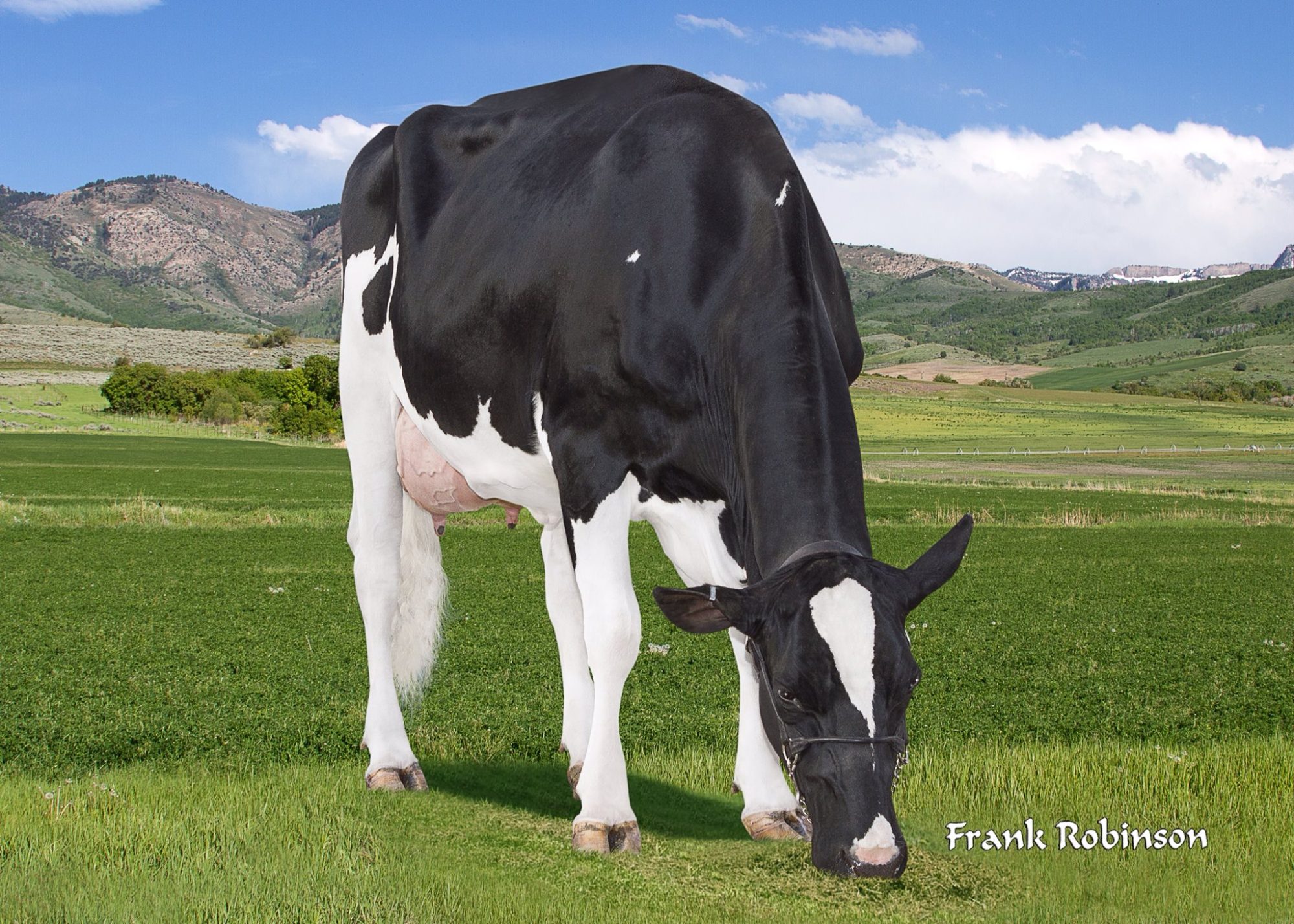
Then came the August 2012 Canadian genomic list. Imagine the analyst running a highlighter down the top 50 that morning and slowly realizing he’d shaded the same sire’s name eighteen times—eighteen of the top 50 bulls were Man-O-Man sons, averaging +3038 gLPI, +1728 kg milk, +94 kg fat, +81 kg protein. One. Two. Five. Ten. Eighteen. One sire, over and over, until you set the paper down and just shake your head.
That kind of repetition gets a breed’s full attention.
Act III — The Clone, the Daughters, and the Long Echo
There’s a cruelty in the timing that still stings. The very year Man-O-Man’s sons were flooding the top of the lists—the year the breed finally understood what it had—the bull himself couldn’t hold on to see it. He died before his second-crop proof ever arrived. The daughters were still coming in, still confirming everything the marker test had promised back in 2004, and the animal who made them was already gone.
Accelerated Genetics had seen it coming, though. Man-O-Man 2, clone code 014HO06429, was already two years old when the original died, offered to breeders as early as 2011. And here’s the quiet irony: the clone was expected to produce so much semen that his lifetime total would soon pass the original’s limited output entirely. Later classified VG-86 at two years and five months, Man-O-Man 2 even scored a point higher than the bull he was copied from. One can only imagine the mixed feelings around the stud that day—pride that the copy had held up, maybe even bettered the model, tangled with something quieter about the original who’d never get the chance to prove what those extra straws might’ve built.
Cloning always makes cattle people argue, and it should. Is the clone really “the same” bull? How do you think about proof, identity, and inbreeding risk when a handful of great sires already dominate global use? Those weren’t idle debates in a breed watching its elite base narrow. Man-O-Man himself carried haplotype considerations that demanded careful mating, a reminder that no great sire gives without asking for discipline in return.
But for the breeder with a string of Man-O-Man daughters milking away without complaint, the clone wasn’t a philosophy seminar. It was access. It meant the genetics he’d bet on weren’t disappearing just because one bull’s lungs had failed him.
The real memorial, though, was never the clone. It was the daughters.
Four of Eastside Lewisdale Gold Missy’s milking daughters in 2013 carried Man-O-Man’s name—and in a cow family as celebrated as Gold Missy’s, nobody uses a bull four times by accident. His top genomic daughters became the cows AI organizations circle in red: high enough to flush, high enough to build sons from, high enough to move a whole family forward. Rivendell Oman Oman Pussy-ET, a New Zealand-bred daughter out of Rivendell Farm Ltd, earned EX classification and was still a Cow of the Year finalist as a 12-year-old in 2024. That last part matters, because longevity was part of the promise from the beginning. These daughters didn’t just come in hot and fade. A lot of them aged right into their usefulness.
Then came the sons and the grandsons, and the story stopped being about one bull at all.
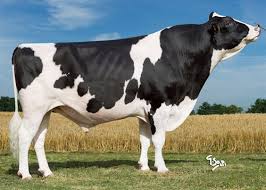
At the time of his death, Man-O-Man’s leading sons by parent average GTPI included Amighetti Numero Uno at +2587 gTPI, Ladys-Manor Man-O-Shan, Texel Beauty Cosmo, and GenerVations Lexor. Numero Uno—a Man-O-Man son from Amighetti Shottle Ave Ty VG-89-ITA—later carried a PLI of +529, a TPI of +2381, and an LPI of +3012 in his December 2017 evaluations. Other sons and descendants spread the influence across borders: Delta G-Force, Marbri Facebook, Gen-I-Beq Lavaman, Famous Man, Firmin Pom, Maserati.
The Marbri Facebook branch deserves a moment of its own. One of Facebook’s notable daughters was Ransom-Rail Paris—dam of JaltaOak, the sire of S-S-I PR Renegade, and third dam behind Global Cow Siemers Lambda Paris EX-91, herself the dam of Parfect. That’s not a footnote in a pedigree book. That’s a bridge straight into today’s active sire stack.
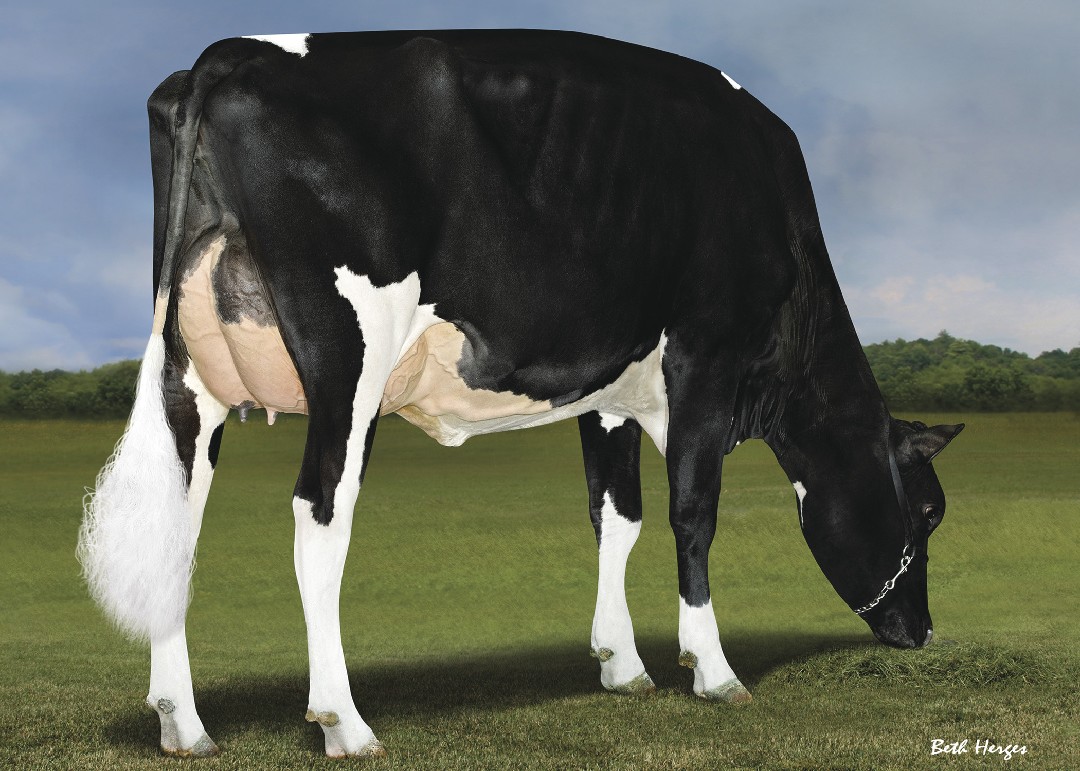
And Renegade walks that bridge right into the barn you’re standing in this morning.
S-S-I PR Renegade, one of the most popular transmitters of the modern era, has already thrown a long line of influential sons—Trooper, Parfect, Rupert, Taos, Conway—and those sons are throwing sons of their own. In Renegade’s first four generations, only two sires show up twice: Man-O-Man and Shottle. The strength conversation around Renegade is where it really comes home. His +1.04 strength linear is rated rare in today’s Holstein market, and it traces back through JaltaOak, AltaOak, Facebook, Millington, Davinci, Snowman, and the O-Man lines behind them.
Here’s what that means in plain barn talk: when breeders today argue about putting strength back into Holsteins—real strength, not just more stature—they’re still circling the same questions O-Man and Man-O-Man forced onto the table twenty years ago. Not every answer runs through them. But a surprising number of the important arguments still do.
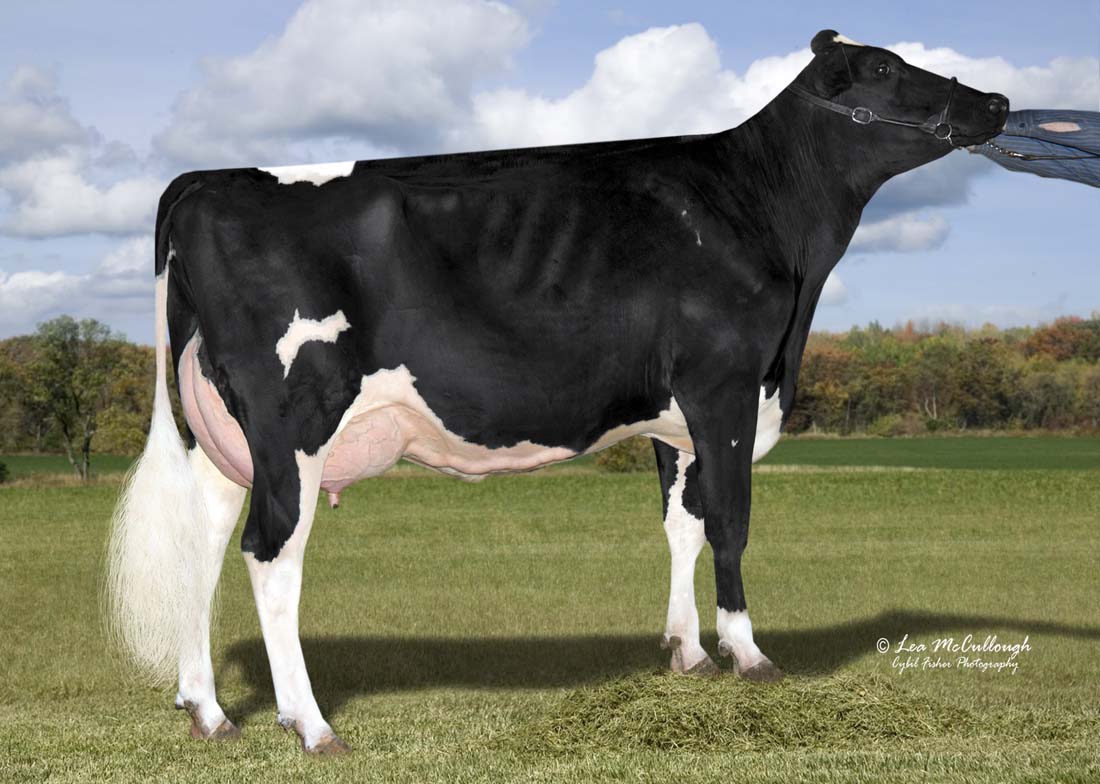
Cookiecutter Mom Halo VG-88 might be the most glamorous proof of Man-O-Man’s maternal power. A direct daughter, Halo earned Global Cow recognition in 2019, landed in the top ten of Holstein International’s 2021 competition for the world’s most influential brood cows, and her great grand daughter S-S-I Doc Have Not 8784-ET EX-94 EX-96-MS topped the 2022 Ducket Holstein Sale at $1,925,000. Read that price again and remember where it started—a short-lived, hard-to-collect bull who fought for every straw. Her half-sister Clear-Echo M-O-M 2150 VG-87, out of the famous Clear-Echo Ramos 1200, became a foundation cow behind a cluster of influential sires; her granddaughter De-Su Delta 4900 placed three sons—Tahiti, Venture, and Ginetta—in the TPI top 20 in 2022. That’s how a maternal sire proves himself. Not with one headline. With layers, stacked generation on generation.
The records tell us one thing—birth date, stud code, proof, score, daughter counts, son lists. But cattle people know the record never tells the whole story. It doesn’t catch the breeder standing over a scarce straw, deciding which donor it’s worth spending on. It doesn’t show the AI staff nursing a limited inventory and hoping the daughters would justify the faith. It doesn’t capture that first fresh Man-O-Man daughter walking into the parlor and making somebody stop and think, “All right. There’s something here.”
One can imagine those moments, because every breeding program has lived some version of them. The calf you almost passed on. The mating you argued over longer than you’d admit. The bull you used carefully because there wasn’t much semen and the invoice wasn’t small. The daughter who freshened and made you wish you’d bred ten more just like her.
That was Man-O-Man’s whole territory.
The Fine Print That Refused to Fade
You won’t find Long-Langs Oman Oman at the top of any active sire directory today. Proof sheets move on—they always do. The breed keeps a short memory the moment the next genomic numbers hit, and dairy farmers have bills due long before nostalgia can pay them.
But pedigrees remember what proof sheets forget.
Follow the maternal side of enough high-ranking Holsteins and Man-O-Man keeps surfacing right where the deepest influence usually hides—not always as the headline sire, but as the daughter-maker, the cow-family amplifier, the bull whose females handed later sires a platform to stand on. He’s there behind Renegade through the Facebook–Ransom-Rail Paris–JaltaOak line, he anchors the maternal side of Cookiecutter Mom Halo and Clear-Echo M-O-M 2150, and he turns up again in Numero Uno and Facebook—right at the heart of the argument breeders are still having about strength, health, and honest production.
That’s his permanent place. Not a flawless bull. Not a show-ring statue. A genetic hinge—the point where the door of the breed swung from one era into the next.
The Holstein world before O-Man and Man-O-Man was learning the hard, expensive way that production without function doesn’t pay. The world after them had real proof that fitness, production, and maternal power could be stacked together—if breeders were disciplined enough to manage the trade-offs. Man-O-Man didn’t solve every problem. What he handed the breed was a better set of tools, and maybe more valuable than that, a better set of questions.
Every mating meeting worth having still wrestles with which cow truly pays her way. Every serious breeder still hunts for the bull whose daughters become mothers. We’re all still trying to build production without draining the strength out of our cows, and still learning how to use greatness without narrowing the breed too far. Those questions belong on the table today just as much as they did in 2009.
Long-Langs Oman Oman-ET came into the world April 30, 2004—an O-Man son from Winning-Way Marci-ET, bred by Darin and Sonya Burnikel of Da-So-Burn Holsteins in Iowa, USA, registered HOUSA000135746776 and marketed as 014HO04929. He left it far too soon, with respiratory trouble strangling the very semen breeders wanted most. On paper, he departed a VG-85-GM bull ranked No. 2 for U.S. TPI at +2247, with a clone already waiting in the wings and daughters just beginning to reshape the breed.
But that’s only the official record.
The truer tribute is simpler. Man-O-Man made the whole breed reconsider what a great sire could be. He carried O-Man’s health revolution into the genomic age, turned a handful of scarce straws into lasting influence, and left behind daughters whose names still anchor the pedigrees of the bulls that matter most. And every time a strong, profitable Holstein walks out of the parlor looking better than she did the day before—every cow that milks, lasts, and raises the next one—you can still hear the quiet echo of the bull they called Man-O-Man.
Key Takeaways
- The best sires aren’t always the prettiest ones—Man-O-Man classified VG-85 but built a dynasty because his daughters milked, lasted, and bred back, then became the mothers of the next great bulls. Chase daughter-proven functionality, not just a flashy proof card.
- If you’re using popular O-Man-line genetics like Renegade for strength, watch your inbreeding and mate carefully around known haplotypes—that’s the discipline this bloodline demands in return for what it gives.
- When you look at a young sire, ask the Man-O-Man question: will his daughters become bull mothers, or just fill your parlor? The families that stack proven cows generation after generation are where lasting value hides.
Continue the Story
- The Golden Age of the Holstein: Farmer‑Bred Sires Who Built the Genomic Era – Long before spreadsheets took over, visionary breeders laid down the durability traits that defined an entire generation of cattle. This profile explores the era’s great master-maters—men who trusted functional conformation over flashy show banners—shaping the exact world that produced O-Man and Man-O-Man.
- MAN-O-MAN will he turn Platinum? – Written in the winter of 2012 as second-crop daughter proofs were arriving, this archival snapshot captures the electric tension, economic frenzy, and staggering international demand that surrounded Man-O-Man’s scarce semen supply just after his untimely death.
- They Called Mogul’s Heifers Fat. Then Came the Million Doses. – Follow the genetic trail forward into the full realization of the genomic age, where the industry applied the precise lessons learned from Man-O-Man. Discover how subsequent legendary sires utilized that stacked maternal power to completely dominate today’s active AI tanks.
 The Sunday Read Dairy Professionals Don’t Skip.
 The Sunday Read Dairy Professionals Don’t Skip.
Every week, thousands of producers, breeders, and industry insiders open Bullvine Weekly for genetics insights, market shifts, and profit strategies they won’t find anywhere else. One email. Five minutes. Smarter decisions all week.