







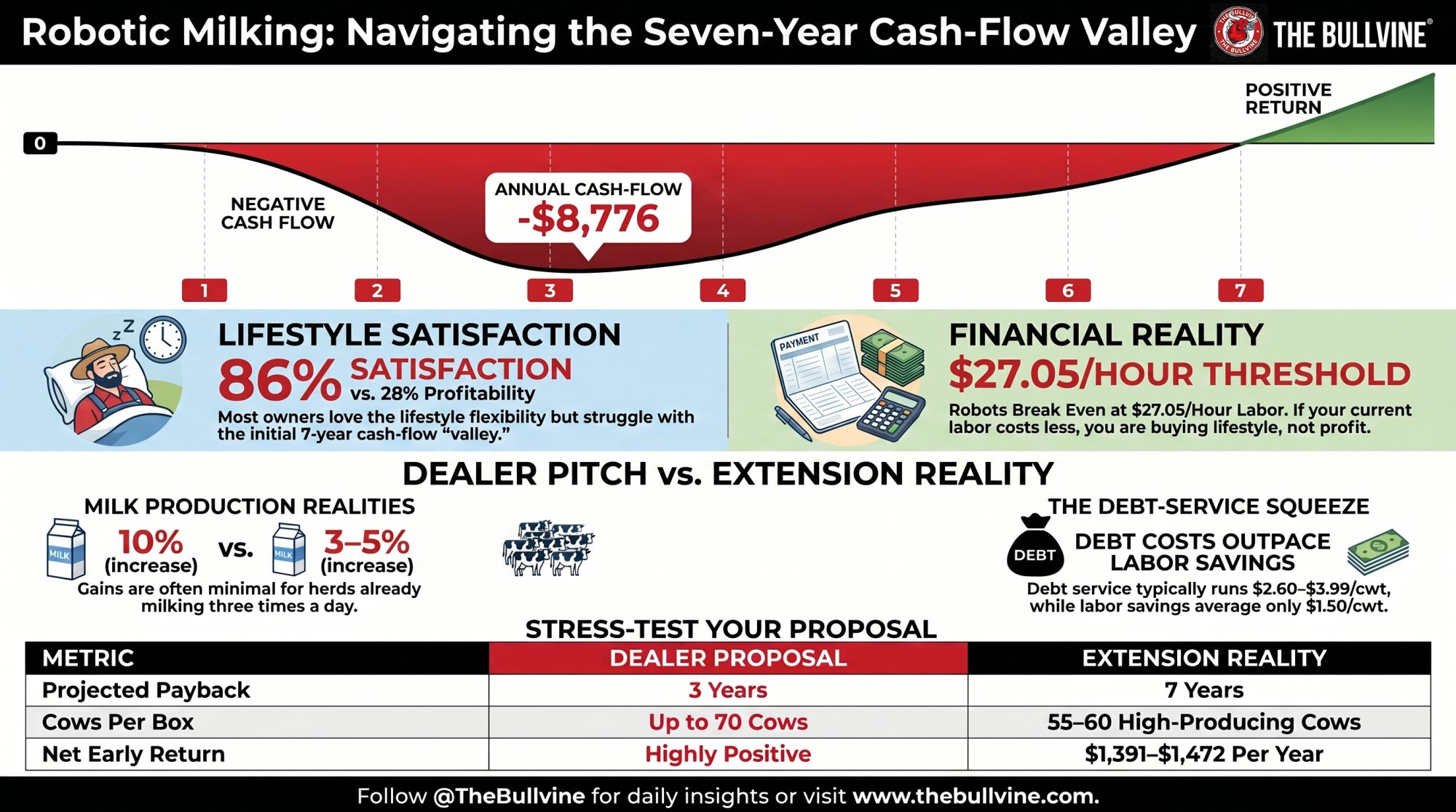
On a 140-cow herd, that −$8,776/year robot valley isn’t theory — it’s seven milk checks’ worth of red ink before the dealer’s “payback” ever shows up.
Editor’s note: The farmer and his daughter described below are a composite scenario modeled from typical 120–160-cow Midwest and Ontario family operations, not a single real individual. All farm cases drawn from named, published sources are identified as such.
Picture a 58-year-old farmer at the kitchen table on a 140-cow operation, a robot dealer’s proposal sitting between the coffee cups. Two boxes, a tidy three-year payback, and that line everybody’s heard: “the labor savings pay the payment.” His daughter’s leaning in the doorway, half-deciding whether there’s a future here worth coming home to. That’s where robotic milking actually gets decided. Not in a spreadsheet — at a table, with a payment book on one side and a balance sheet on the other.
Here’s the number that should be sitting there too. Across Iowa State surveys and Bullvine’s own analysis, 86% of robot owners are satisfied — but only 28% find it profitable. That gap is the reason you can love your robot and still be patching cash-flow with off-farm income.
What’s Changing — and Why the Gap Is So Wide
Robotic milking has gone mainstream fast, and the appeal is real: fewer 4 a.m. shifts, more flexibility, a barn that runs while you sleep. A 2021 University of Guelph study of 28 Ontario robotic-milking farms, published in Animal Welfare, found that farmers who paired robots with automated feeding reported lower stress, anxiety, and depression — and that better farmer well-being tracked with healthier, less-lame cows. That’s the kind of thing the 86% satisfaction number is really capturing. Quality of life. And on that score, robots usually deliver exactly what they promised.
Profitability is a different ledger. In January 2026, USDA’s Economic Research Service published ERR-356 — the first nationally representative study of its kind — and found that box robots increase dairy net returns by 13% — about $3.15 per cwt — relative to nonadopters. But that’s an average built on average assumptions. What your farm actually sees rides on your herd size, your capital cost, and how well you run the barn.
One number is about your life — your sleep schedule and who’s in the barn at 4 a.m. The other is about your loan — the payment book on the fridge. You need to be clear which ledger you’re really buying in before you sign.
How This Plays Out on Real Farms
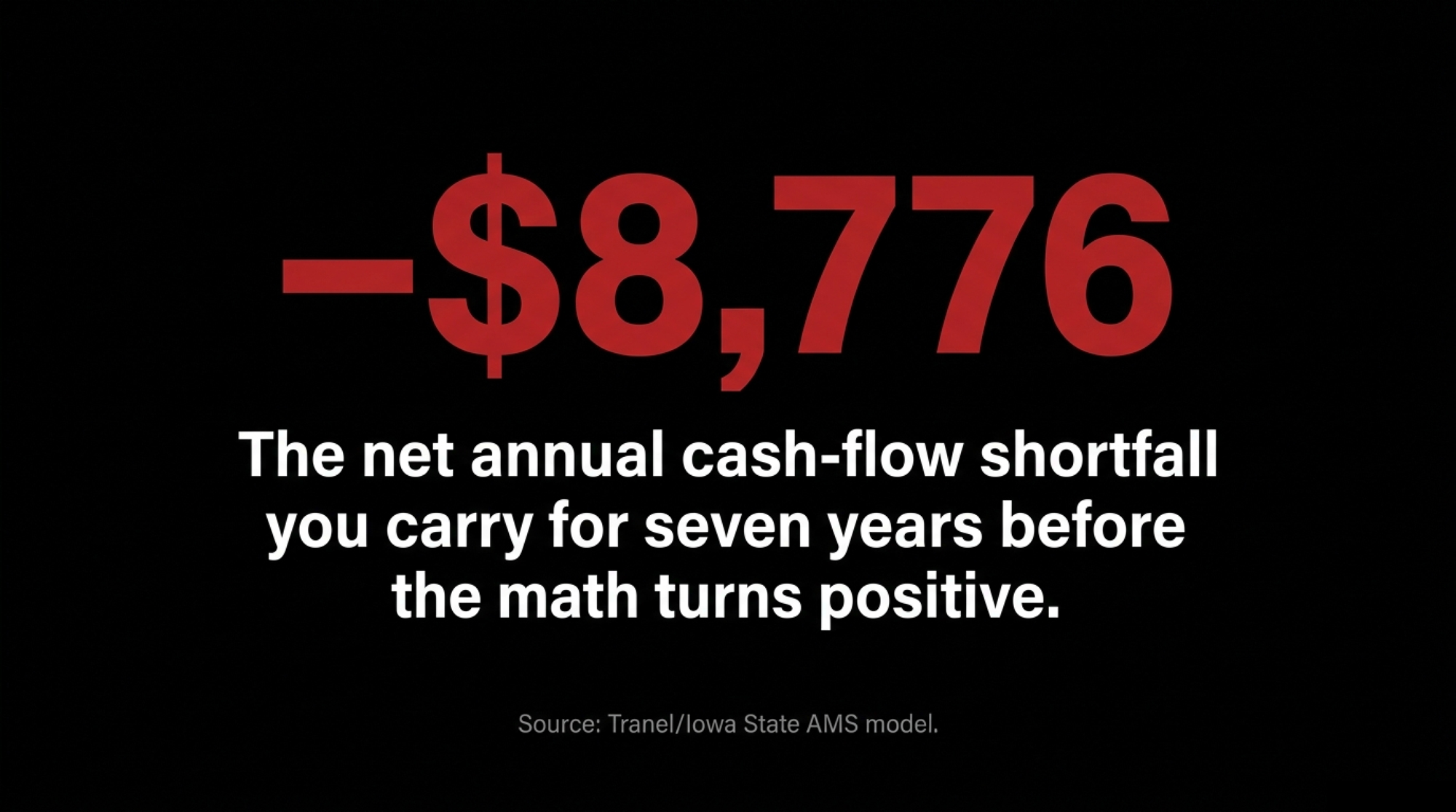
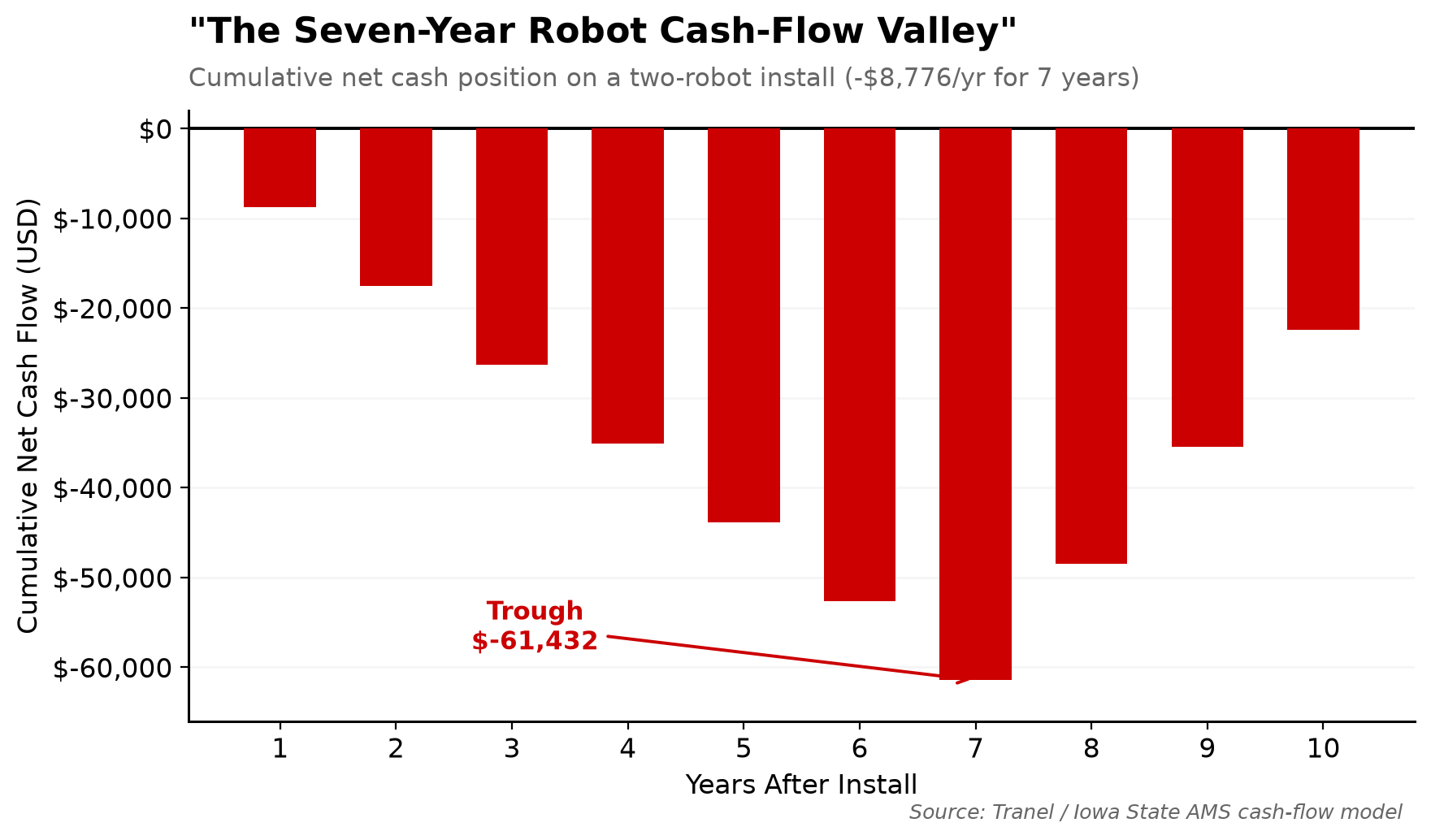
Iowa State dairy economist Larry Tranel has been running AMS economics for years, and his cash-flow model tells the part of the story the payback chart skips. A typical two-robot install — about $400,000 all-in — carries roughly $62,000 a year in ownership costs plus $69,000 in loan payments, against only a slim net financial benefit in those early years: about $1,391 a year in the partial-budget run this article follows, and $1,472 in Iowa State’s published 2018 example, depending on herd size and inputs. Run Tranel’s full model — ownership, payments, labor savings, and production gains all netted together — and you land on a cash-flow gap of about $8,776 a year for seven years before the math turns positive. That $8,776 isn’t payments minus benefit; it’s the net annual shortfall after every offset is counted.
Stack it up and that $8,776 hole runs to roughly $60,000 before the valley ends. You don’t need a consultant to tell you what that would feel like on your own balance sheet. Tranel’s modeling shows robot cash flow running sharply negative for roughly the first seven years before turning positive, and he’s clear that the swing depends heavily on lifetime repair costs across the whole life of the machine.
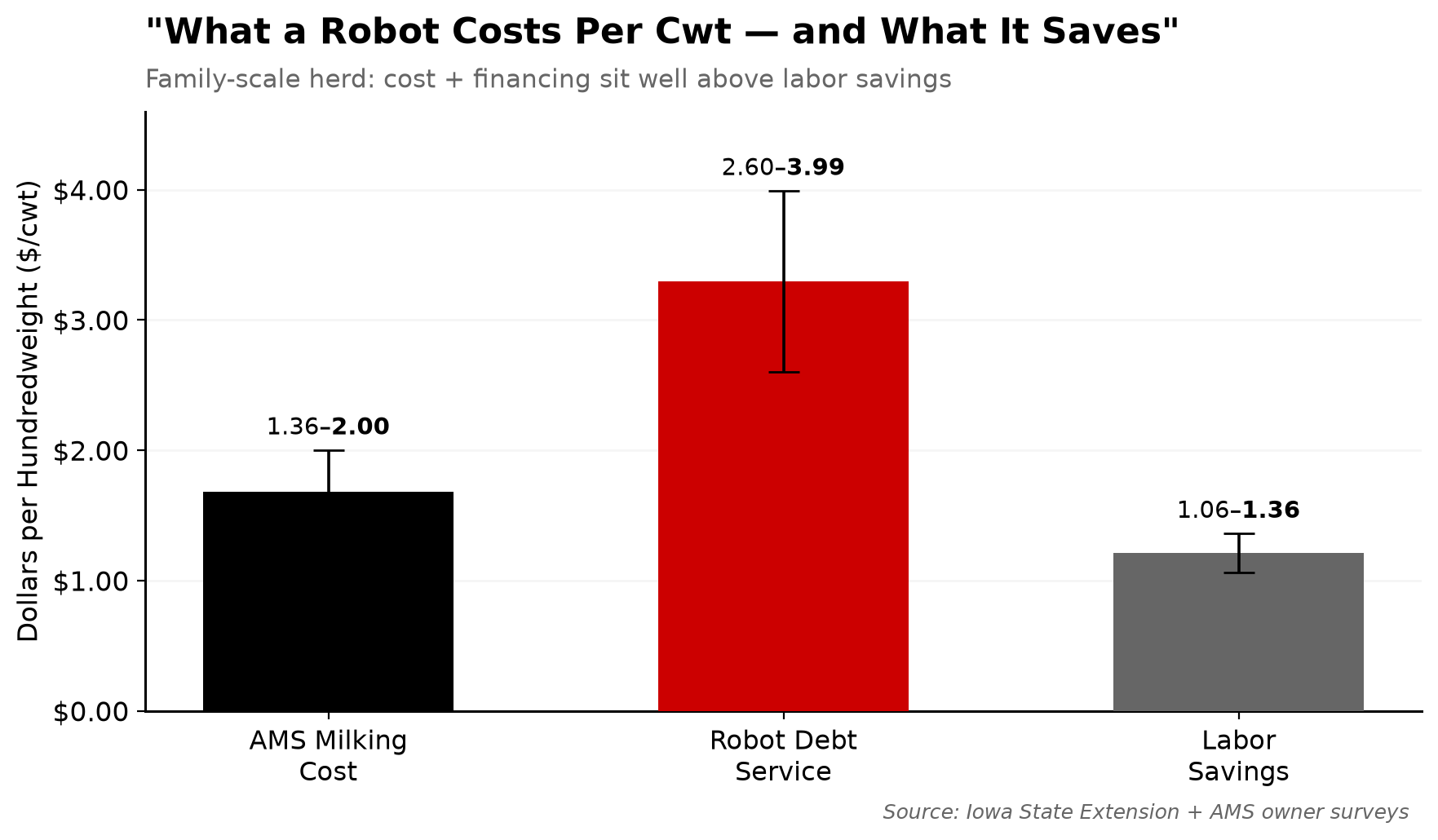
Run it on your own herd. Average AMS labor savings come in around $1.50/cwt across surveyed herds — but debt service on the robots runs $2.60 to $3.99/cwt. On a 140-cow herd shipping roughly 8 million pounds a year, that $1.50/cwt of labor savings is about $120,000. Real money. But if your robot debt service lands at $3.00/cwt, that’s $240,000 going the other way. The production bump and the management value have to cover the difference. Sometimes they do. Often they don’t.
The Dealer Pitch vs. Extension Reality
Put the brochure side by side with the university numbers and the gap stops being abstract. Here’s where the two stories diverge on the figures that actually drive your payment book:
| Financial Metric | Dealer Proposal Pitch | University Extension Reality |
| Projected payback | 3 years | 7 years — the cash-flow valley |
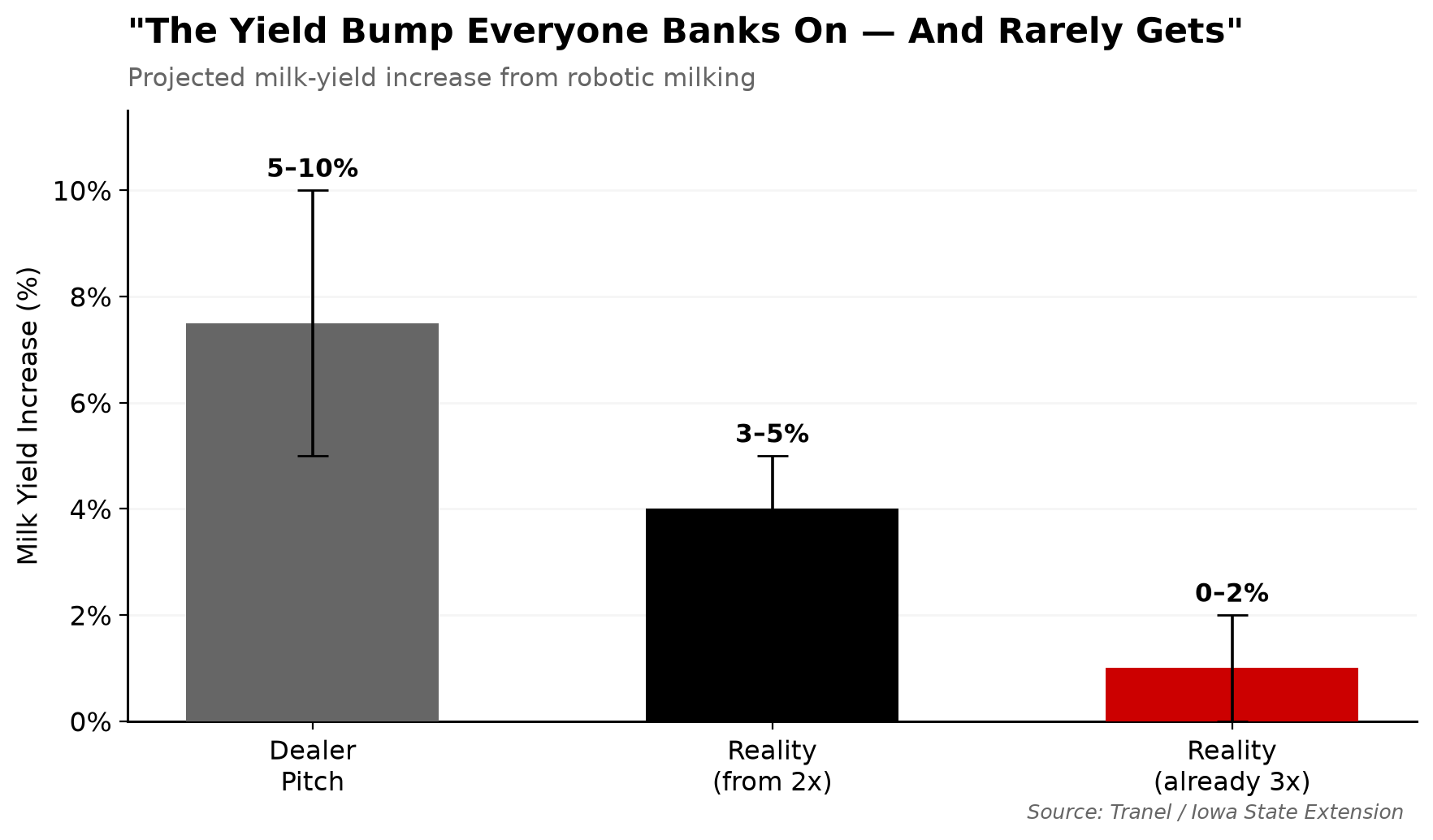
| Milk yield bump | 5% to 10% increase | 3% to 5%; near zero if you’re already milking 3x |
| Cows per robot box | Up to 70 cows | 55 to 60 high-producing cows |
| Break-even labor wage | “Pays for itself” | Only balances if current labor costs $27.05/hr |
| Net early annual return | Highly positive | $1,391 to $1,472/year net cash flow |
None of the dealer’s numbers are lies, exactly. They’re best-case inputs presented as expected ones. The extension column is what the same machine does in an average barn with average cows and an average loan — which is the barn most of us actually farm.
What Does a Robot Actually Cost Per Cwt — and What Does It Really Save?
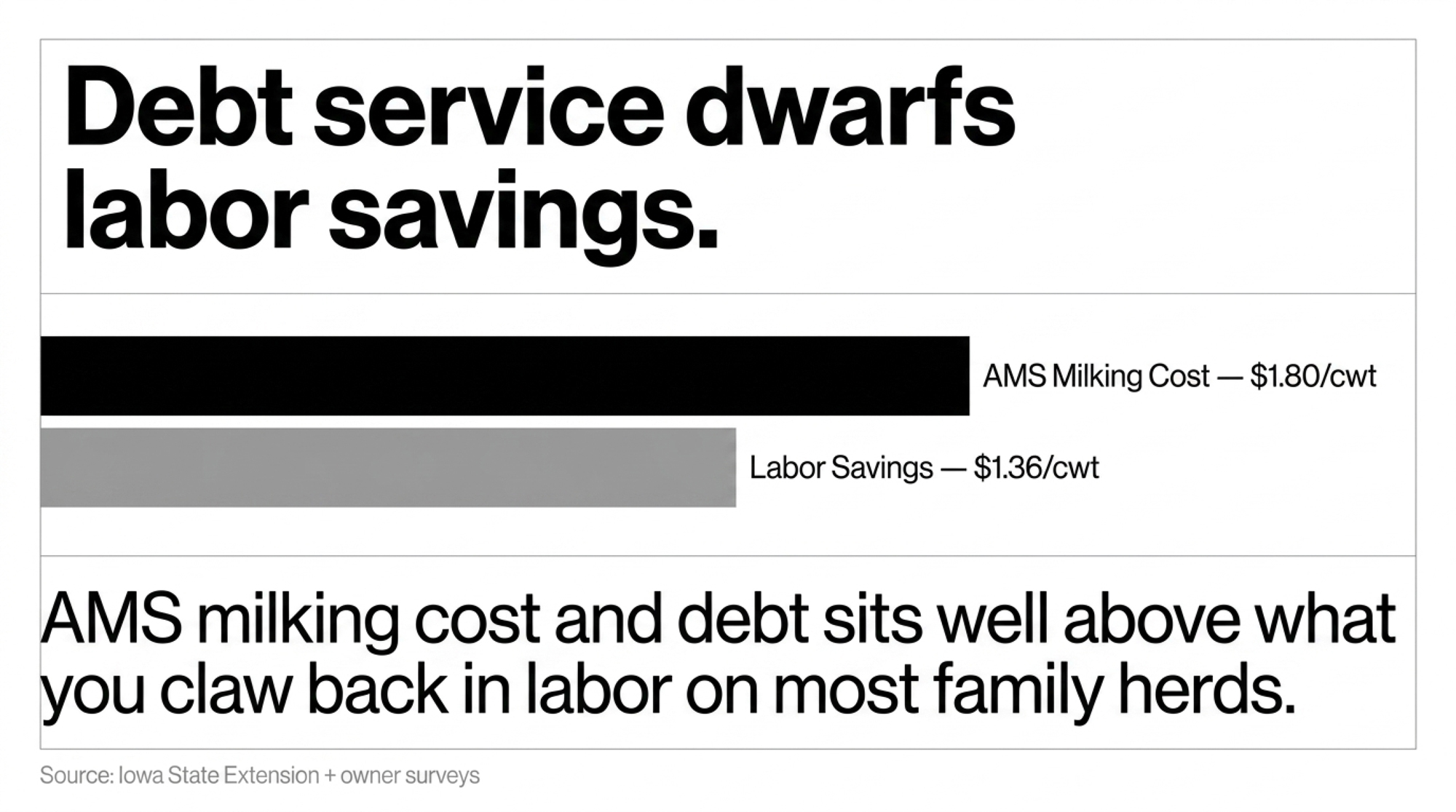
This is where the dealer math and the extension math part ways. Iowa State pegs the AMS milking cost at about $1.80/cwt, with a realistic range of $1.36 to $2.00 once you account for a leased two-robot setup at roughly $32,819 per unit per year. The labor savings that are supposed to offset it? Iowa State puts those at $1.06 to $1.36/cwt on a 120-cow herd — real, but thinner than the pitch implies. Line those bars up against debt service and the early-year squeeze stops being abstract.
Look at the gap and the lesson lands without anybody having to spell it out. The cost of running the robot plus the cost of financing it sits well above what you claw back in labor on most family-scale herds. That’s not an argument against robots. It’s an argument for knowing exactly where your own numbers fall inside those ranges before you treat the dealer’s single tidy figure as gospel. Pull your real labor hours and your real quoted payment, drop them onto this chart, and see whether your bars cross.
📖 Go deeper: Want the cash-flow valley walked through one year at a time? See our companion breakdown, Robotic Milking Pays 13% More — After 7 Years of Red Ink.
The Mechanics Behind the Outcomes
The most fragile number on a typical robot ROI proposal is the assumed milk-yield bump. Proposals routinely pencil in a 5 to 10% production increase. Tranel and the extension data put the realistic gain at 3 to 5% for herds coming off twice-daily milking — and for herds already on 3x, that per-cow response can run lower still. If you’re milking 3x in a good parlor today, that gap can shrink toward zero. And every other line on the spreadsheet is riding on it.
Tranel points to a cleaner predictor anyway: milk per robot box, not milk per cow. He’s blunt that milk per AMS unit is “very highly correlated” with profitability, more so than per-cow yield. Dealers rate the boxes for up to 70 cows. Extension guidance from Iowa State, Wisconsin, and Lactanet pegs the realistic profit sweet spot closer to 55 to 60 high-producing cows per robot. Push past that to make the numbers sing, and box time climbs, fetch lists grow, and the system quietly bleeds.
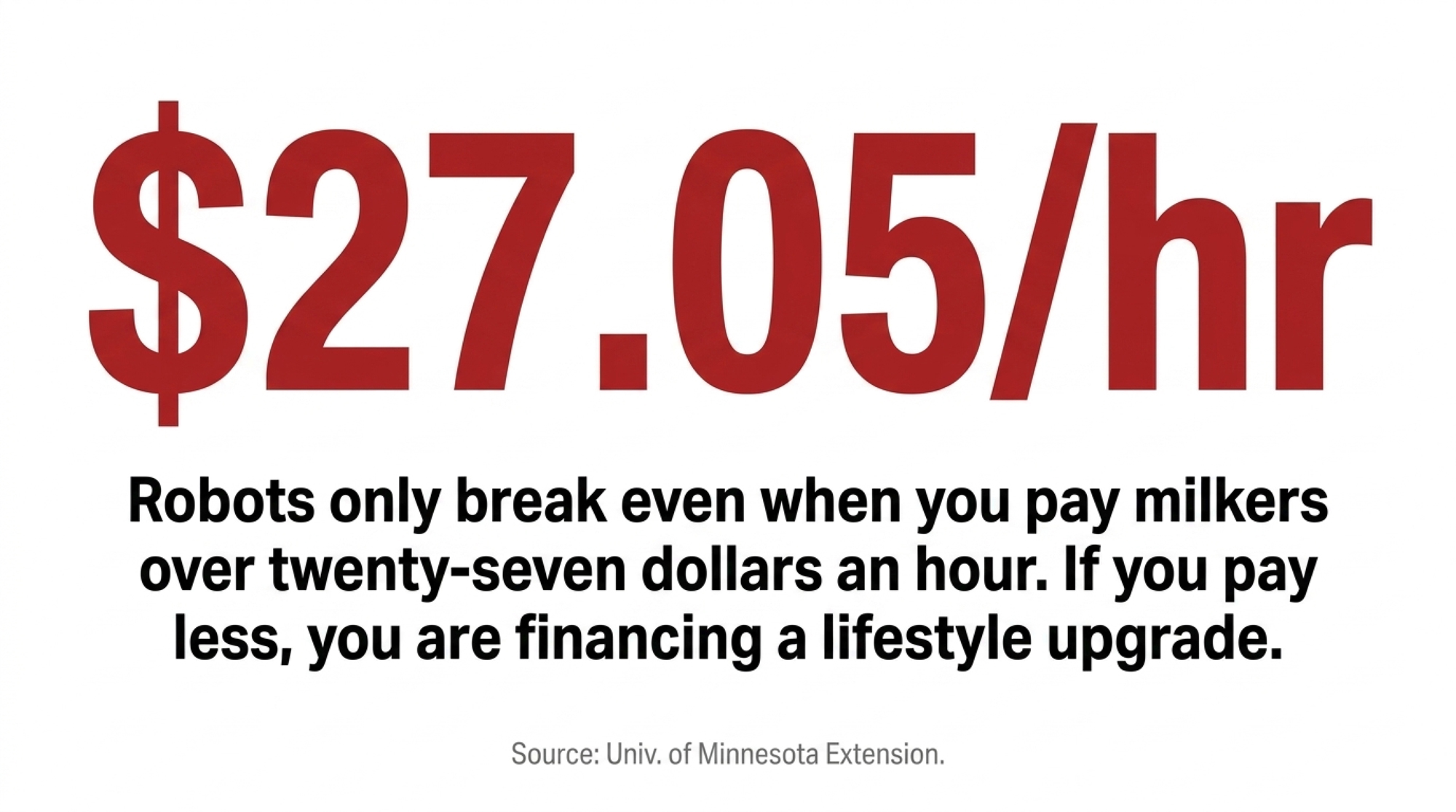
Then there’s the labor assumption holding the whole thing up. University of Minnesota Extension’s Jim Salfer found robots and a well-run parlor only break even when you’re paying milkers $27.05 an hour — or gaining about 3 pounds per cow per day more milk than your current 3x system. For you, if you’re not paying $27 an hour for milking labor, robots are first a lifestyle call. That’s a fair reason to buy one. It’s just not the same as a profit upgrade, and it’s worth being honest with yourself about which one you’re signing for.
Does the Math Change North of the Border?
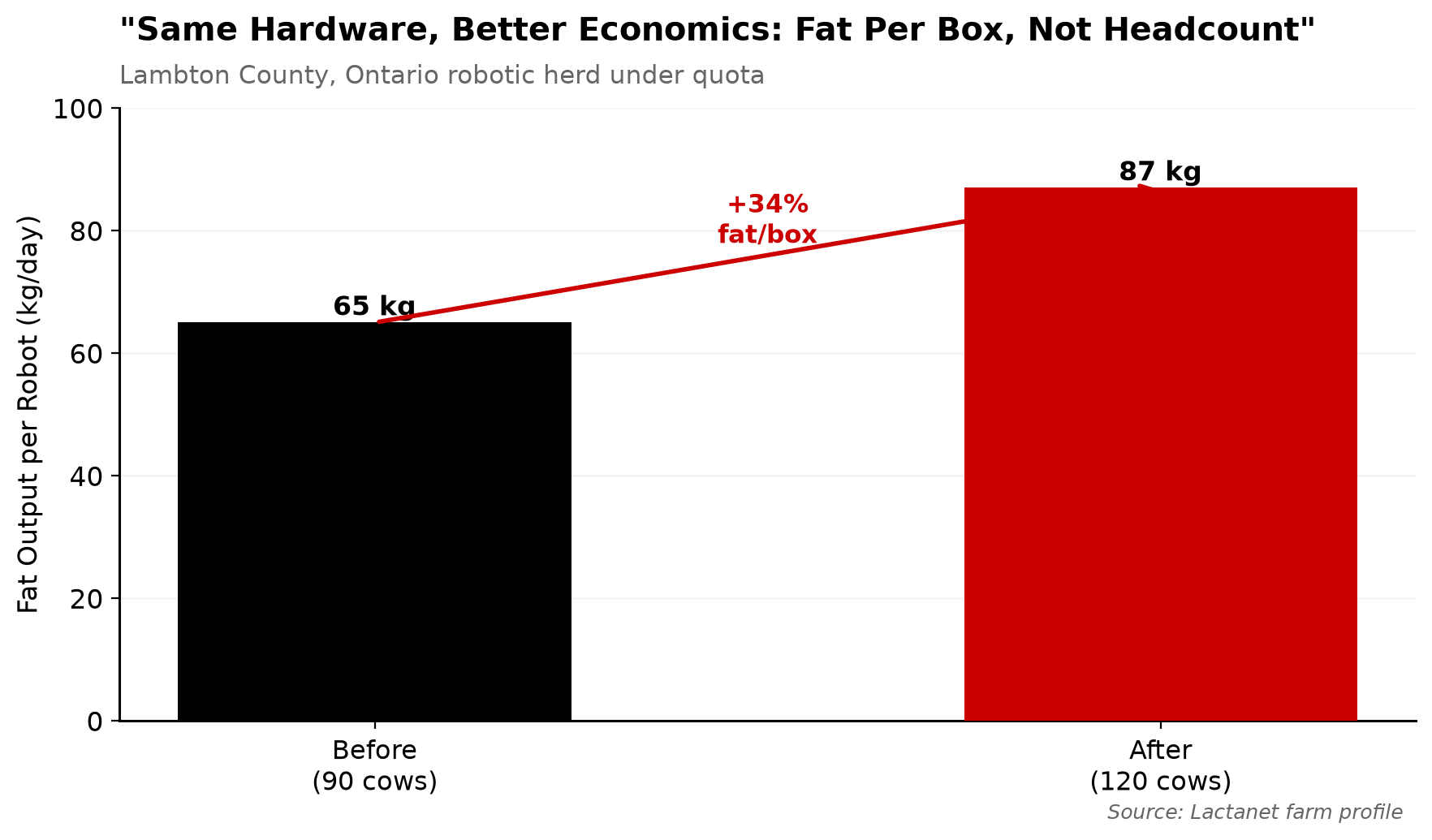
It does, and not in the direction most people assume. Under Canada’s quota system, the constraint isn’t selling more milk — it’s making more fat per kilogram of quota you already own. That flips the robot equation from “milk more cows” to “push more fat through each box.” A Lactanet-profiled farm in Lambton County, Ontario, shows what that looks like in practice: they grew from 90 cows producing 130 kg of fat a day to 120 cows on 175 kg of quota, lifting output per robot from 65 to 87 kg of fat a day. Same hardware, far better economics — because they optimized fat per box, not headcount.
But quota cuts the other way on the debt side. Lactanet has warned that with $20,000 of debt per kilogram of quota, a 2% interest-rate bump can add $225 per kilogram per year, and for a 100-cow farm with 113 kg of quota that’s an extra $2,000 to $3,500 a month before you’ve bought a single robot. Stack a $400,000 AMS loan on top of an already quota-leveraged balance sheet and the seven-year valley gets steeper, not shallower. If you farm under quota, you need to run the robot decision as a fat-per-box question and a debt-stacking question at the same time — not as the volume play the US extension models describe.
Options and Trade-Offs for Your Operation
There’s no single right answer here. There’s a right answer for your barn, your labor market, and your balance sheet. Four paths producers are actually walking:
| Path | When It Fits | Capital / Payback | The Risk (flagged) |
| Buy the robots | Labor scarce, wages mid-$20s, purpose-built barn | ~$400,000, 2 boxes | Retrofit + cheap labor = financing the problem |
| Go hybrid (parlor + tech) | Herds under 180 cows | Monitors: 7–14 mo payback | Manages a shortage; doesn’t solve a true one |
| Fix the herd first | Lameness or poor cow flow | Near-zero (audit only) | Skip it and the 7-yr valley gets deeper, fast |
| Wait & stress-test | Tight finances | Model at $18 milk | $18 milk pushed one pitch from $2.03 to $4.07/cwt |
- Buy the robots — when labor is scarce and expensive. Makes sense when you genuinely can’t hire or keep milkers, wages are pushing into the mid-$20s, and you’ve got a purpose-built barn with good cow flow and low lameness. Needs a strong start: a manager who likes living in the data, sand-bedded freestalls, tight box utilization. The risk — in a retrofit barn with cheap labor, you’re financing your problems, not fixing them.
- Go hybrid — parlor plus targeted tech. For herds under the 180-cow threshold where activity monitors and precision feeding consistently out-return robots, you can capture much of the benefit at a fraction of the capital. The Bullvine’s 2025 tech-ROI analysis puts the automation sweet spot squarely between 180 and 400 cows — below it, monitors with a 7- to 14-month payback usually win. The risk — it manages around a labor shortage; it doesn’t solve a true one.
- Fix the herd first — and start this month. Before you sign anything, run a real milking-routine and lameness check. Tranel’s seven-year valley gets deeper fast if cows won’t walk to the box. This is the cheapest move on the list, and it tells you whether your throughput problem is a robot problem or a management problem.
- Wait and stress-test. If your finances are tight, model the proposal at $18 milk before you commit. A 240-cow Upper Midwest family ran their dealer’s four-robot pitch at $18 instead of the dealer’s $22 and watched the projected milking cost jump from $2.03 to $4.07/cwt. The risk cuts both ways — waiting costs you too if your labor situation is actively falling apart.
📖 Go deeper: If you’re milking under 500 cows and weighing robots against hired help, read Robots Won’t Save Your Dairy If You’re Alone: 5 Hard Truths About Labor and Robotic Milking ROI Under 500 Cows.
How Much Does That Seven-Year Valley Actually Cost a Family?
Year three is where it gets real. The robot has kept its promise on lifestyle — the early mornings are gone, the data’s slick, the barn looks modern enough that the neighbors slow down to look. But the bank’s promise on profitability is still on layaway. The monthly reality is $8,000-plus in annual red ink getting patched with off-farm income, a deferred repair, or a quiet draw on equity that nobody mentions at supper.
Try the debt-service coverage check your lender actually runs. DSCR is just your net farm income available for debt service divided by your total annual payments. Say you’ve got $260,000 available and $200,000 in existing payments — that’s a 1.30x ratio, comfortable. Add, say, an $80,000 robot payment and the same income now covers $280,000 of debt, dropping your DSCR to roughly 0.93x. Below 1.0x means the farm isn’t generating enough to cover its own payments, and that’s when a lender turns cautious. The University of Waterloo’s dairy-robotics case study put it bluntly: adopting AMS “may require a transition period of up to four years to achieve profitability.” That’s a polite description of the same valley.
Is Your Barn Already Telling You the Answer?
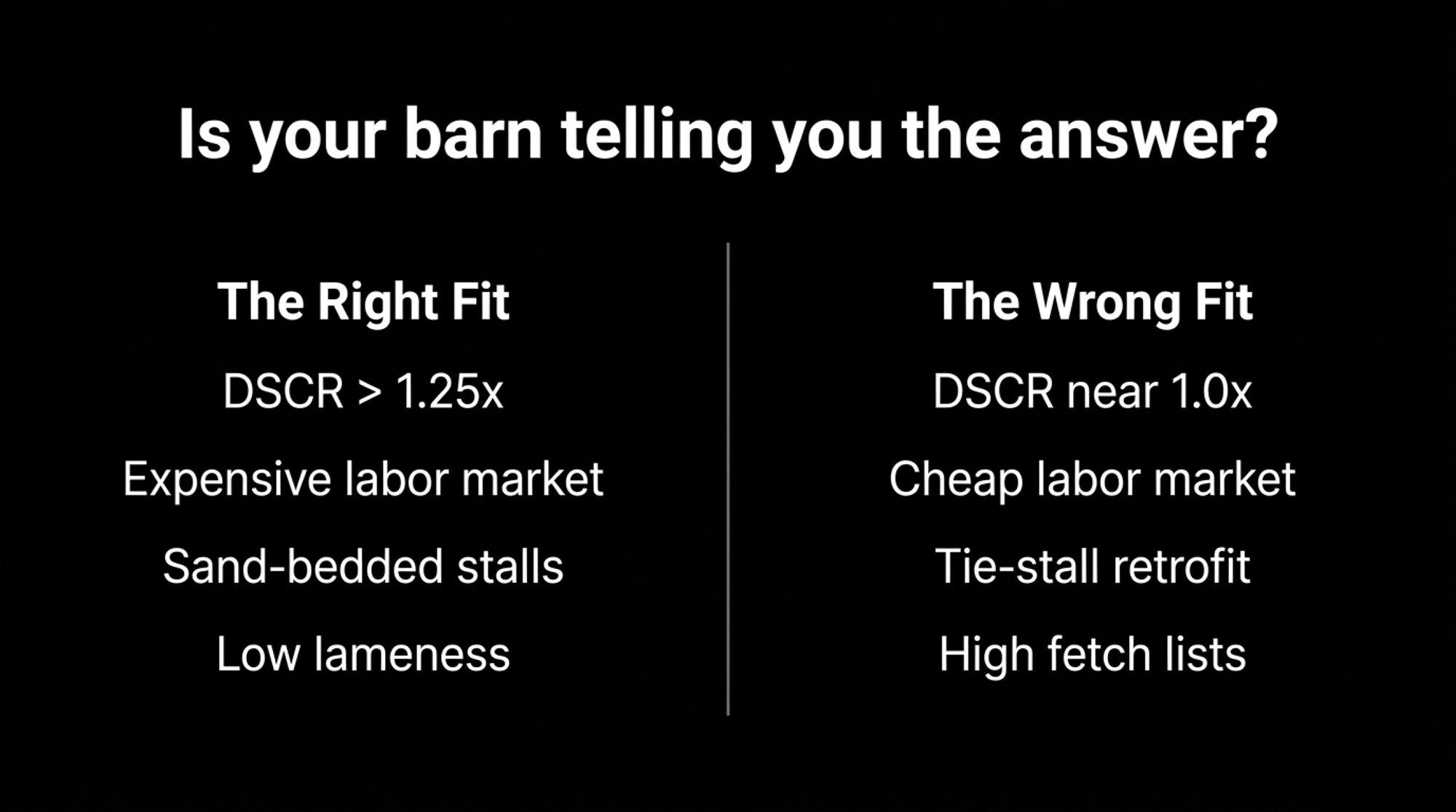
You can spot the fit before the decision’s even made — no hindsight required. The farm that should buy robots has high, hard-to-fill labor, a DSCR comfortably above 1.25x, sand-bedded stalls, clean feet, and cows already hitting strong milk per box. The infrastructure was doing the hard work. Robots just monetize it. Walk that barn and the cows are calm, the alleys flow, the fetch list is short.
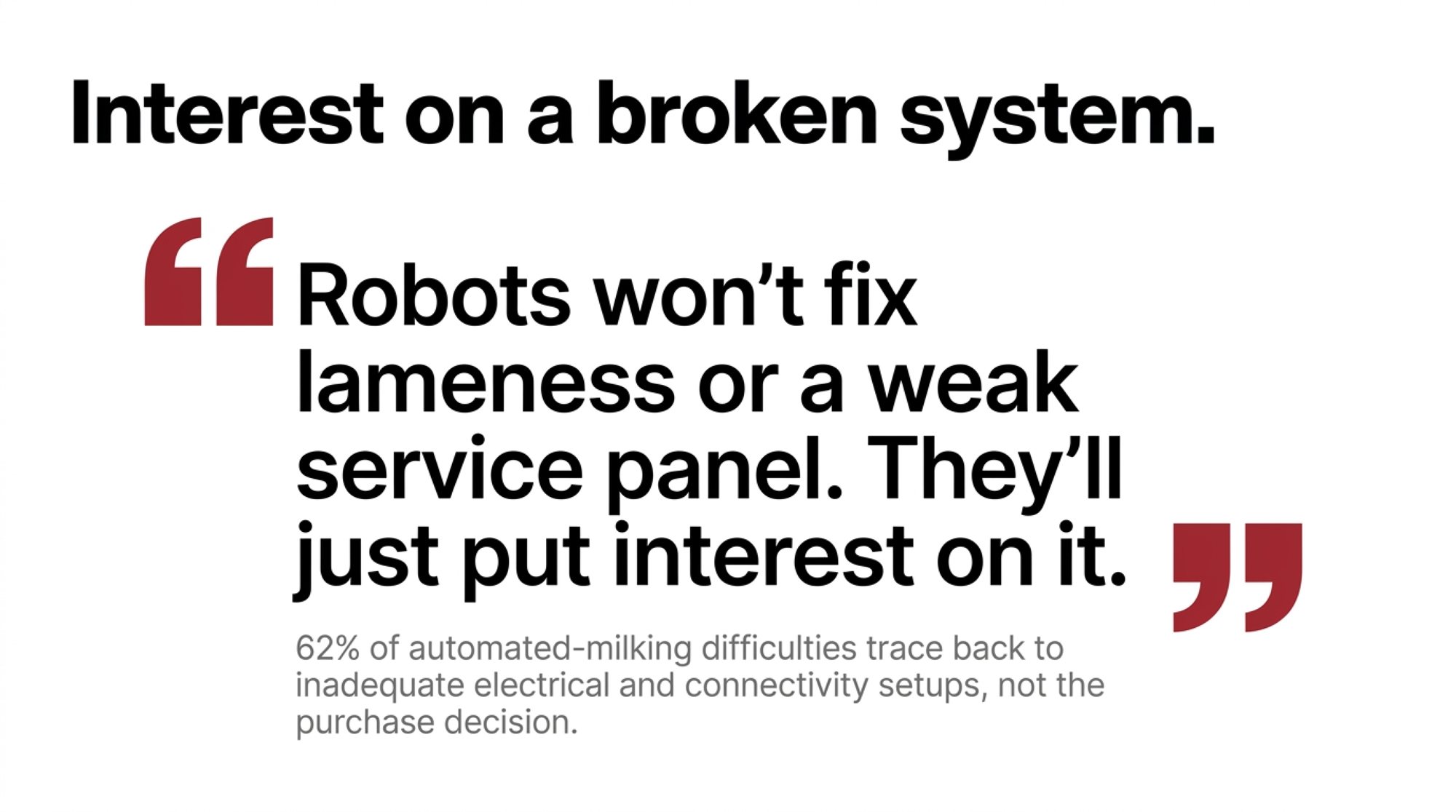
The farm that shouldn’t is the tie-stall retrofit with cheap labor, a debt-service ratio already flirting with 1.0x, lameness in every alley, and a fetch list that’d make a robot tech wince. There’s a hard infrastructure truth underneath this, too: Bullvine’s 2025 tech-ROI work found 62% of automated-milking difficulties trace back to inadequate electrical and connectivity setup, not the purchase decision. Robots won’t fix lameness or a weak service panel. They’ll just put interest on it. Here’s what the glossy proposal tends to underplay: the robot is an amplifier, not a cure. Watch a milking, walk the alleys, look at the feet — your barn usually answers the question before the dealer does.
What About the Next Generation Standing in the Doorway?
Now put the daughter back in the picture. Only about 16.5% of dairy farms make it to the third generation — the other 83.5% don’t, and it’s usually planning and debt structure that sink them, not markets. Lenders generally want debt-to-EBITDA under 4:1 and term-debt coverage of at least 1.25x before they’ll bless new debt. So the question across that table isn’t really “robots or no robots.”
It’s whether you want to hand her a business with room to breathe — or a high-tech barn strapped to a payment schedule she’ll spend her thirties servicing. A clean balance sheet with good cows is a bigger inheritance than a laser arm. Robots can absolutely be part of a strong handoff. But only when they’re turning a real labor crisis into durable margin in a barn that already works — not when they’re bolting cutting-edge debt onto a structure that was already wobbling.
📖 Go deeper: Before you add a dime of debt, walk through Why 83% of Dairy Farms Will Disappear: How to Beat the Succession Odds Before It’s Too Late.
📋 The Kitchen-Table Checklist
Financial Guardrails
- The DSCR target: If your debt-service coverage ratio sits below 1.15x before adding robot debt, treat it as a flashing yellow light — model the new payment against your income before you fall for the technology.
- The stress test: Run the proposal at $18 milk, not $22 — then add one $10,000-to-$15,000 maintenance spike. If it still covers payments and family living, proceed. If it only works at $22, you’ve found your real answer.
- The yield assumption: Make the dealer put the milk bump in writing. If it’s above 3 to 5% and you’re already milking 3x, demand retrofit-specific data before you sign.
Operational Realities
- The break-even wage: Check your actual milking-labor wage. If you’re paying well under $27/hour, you’re buying a lifestyle upgrade, not a profit margin — fine, as long as you decide with that clear.
- Box efficiency: Keep plans capped at 55 to 60 high-producing cows per box. Push past that and your fetch lists spike while box utilization tanks.
- The quota flip (Canada): Judge the system on fat per box, not head count. Follow the Lambton County model — they hit 87 kg of fat per robot per day by optimizing that, not headcount.
Before You Sign
- Infrastructure first: Have an electrician audit your service panel and connectivity. 62% of automated-milking failures trace back to poor electrical/connectivity setup, not the purchase.
- The free option: Book a comprehensive milking-routine and lameness audit this month. If cows won’t walk to the box voluntarily, your cash-flow valley gets deep, fast — and it’s the cheapest check on this list.
The One Question to Put on the Table
So if you could ask just one thing across that kitchen table, make it this: If I plug my own last 12 months of milk checks, my real labor cost, and my actual barn into Tranel’s cash-flow model and Salfer’s breakeven wage, does this robot still make money — or am I just financing a lifestyle upgrade? It’s a fair question. It just forces the dealer’s averages to collide with your numbers — which is exactly the collision a glossy proposal is built to avoid.
So where does your breakeven really sit? Before you sign a $400,000 note, run your own numbers against the ones the brochure left out, and have that conversation with your lender and your kid in the same week. We’ve built the full cost-per-cwt model by herd size — plus the $18-milk stress test and the quota-side fat-per-box math — in this week’s Bullvine Weekly breakdown. That’s where the real numbers live, and it’s worth an evening before the dealer’s truck comes back down the lane.
Key Takeaways
- If your DSCR is under roughly 1.15x before the robot note, treat that as a yellow light and run the $18 milk stress test before you sign.
- Robots make the most sense where labor is truly scarce and expensive, cows are sound, and you can keep box use in the 55–60 high-producing cows range.
- If you’re paying well under $27/hour for milking labor, be honest that you’re mostly financing lifestyle, not margin, and decide with that clear.
- Before any AMS contract, do the cheap work first: a full milking-routine, lameness, and infrastructure audit in the next 30 days to see if you’re fixing management or just buying hardware.
Run Your Numbers
Before you accept any dealer’s three-year payback, drop your own installed cost, labor wage, milk price, interest rate, and downtime into the Robot ROI Reality Check. It turns the dealer’s averages into your breakeven and shows whether the seven-year valley is real on your balance sheet.
Learn More
- Dairy Tech ROI: The Questions That Separate $50K Wins from $200K Mistakes — Arms you with a strict filtering protocol to evaluate alternative automation, showing why lower-capital activity monitors and precision feeding systems frequently out-return automated milking boxes on herds under 180 cows.
- Robotic Milking Labor Math: Fix the Problem or Grow Debt? – The Bullvine — Delivers a brutal comparison table pitting wage hikes against multi-million dollar robot notes, exposing how rigid fixed-debt service spikes your long-term vulnerability to volatile milk price crashes.
- $19.14 Costs vs. $18.95 Milk: Is Your Barn Tech Paying the Difference? | The Bullvine — Exploses the quiet financial leaks of underutilized on-farm data, laying out a 30-day tune-up strategy to capture up to $45,000 annually from herd software features you already own.
 The Sunday Read Dairy Professionals Don’t Skip.
 The Sunday Read Dairy Professionals Don’t Skip.
Every week, thousands of producers, breeders, and industry insiders open Bullvine Weekly for genetics insights, market shifts, and profit strategies they won’t find anywhere else. One email. Five minutes. Smarter decisions all week.