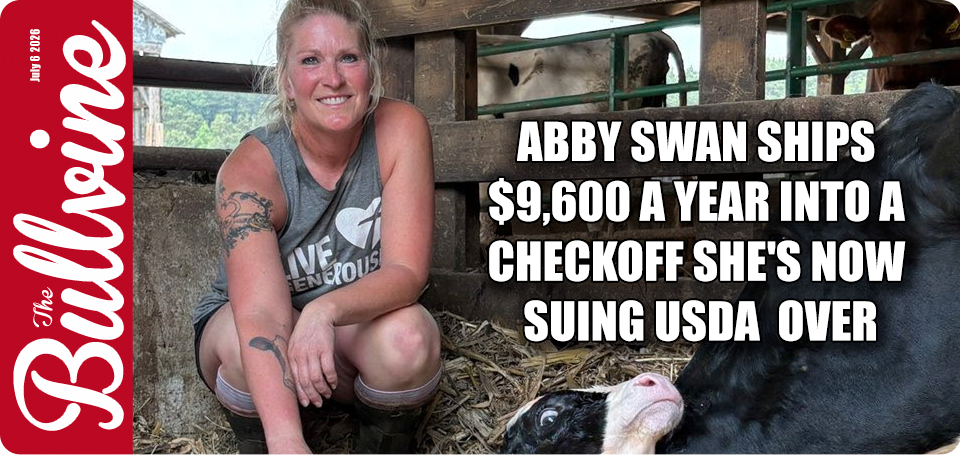





She grew Kemridge from 60 cows to 220 — and pays ~$9,600 a year into the dairy checkoff. In June, Abby Swan sued USDA to stop it from funding ESG. Here’s what her case means for your milk check.
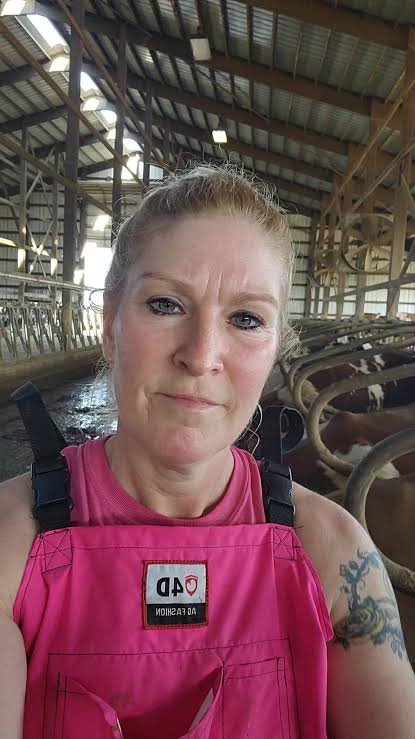
Abby Swan milks 220 cows at Kemridge Farm near Westfield, Wisconsin — up from 60 head two decades ago. She pays about $9,600 a year into the dairy checkoff, and in June she sued USDA to stop it from funding ESG.
Abby Swan milks about 220 cows at Kemridge Farm near Westfield, Wisconsin — a herd her family grew from 60 head in a stanchion barn over the better part of two decades. On June 9, 2026, she put her name on a federal lawsuit that could reshape what every checkoff-paying producer funds. She and two other Wisconsin farmers — Adam Faust of Chilton, a double-amputee who already settled a case against USDA in his favor once, and Christopher Baird of Ferryville — sued USDA Secretary Brooke Rollins and the National Dairy Promotion and Research Board.
Their objection isn’t that cheese ads are bad. According to the complaint, they argue the dairy checkoff has strayed from promoting milk into funding an environmental, social, and governance agenda through the Innovation Center for U.S. Dairy — all on the same mandatory 15 cents. The allegations have not been tested or proven in court.
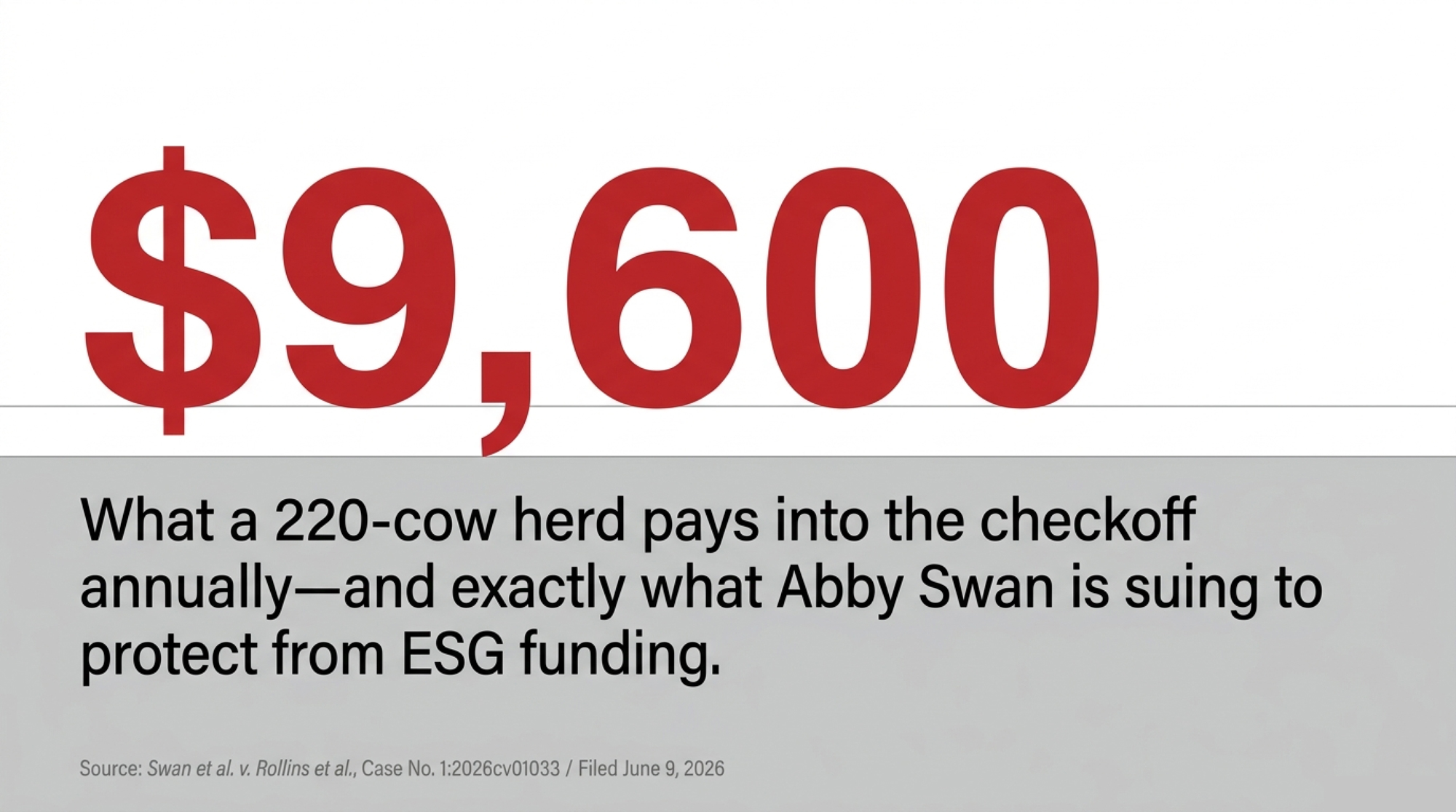
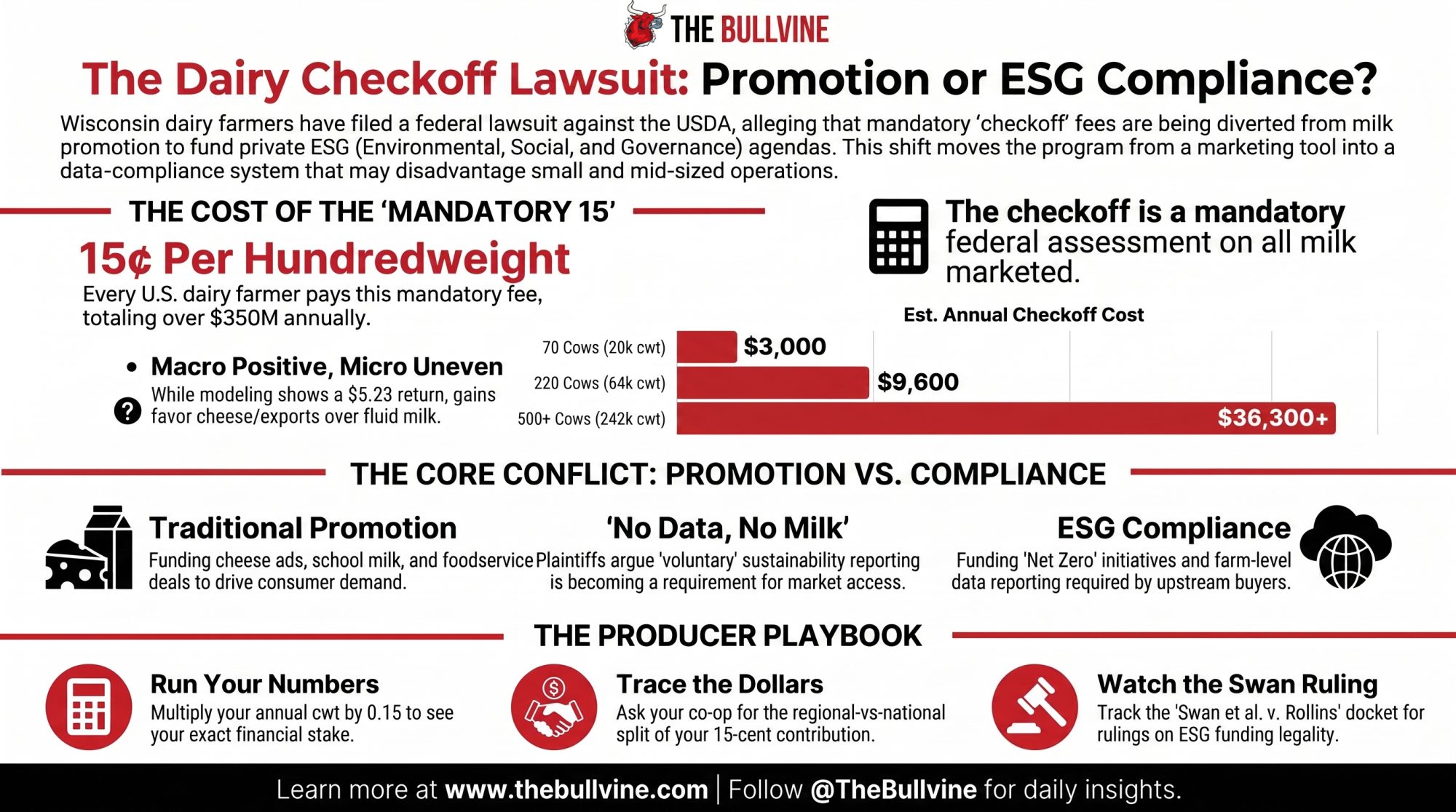
Picture the math on Swan’s herd. At roughly 220 cows shipping about 80 pounds a day, Kemridge moves close to 64,000 cwt a year — call it $9,600 in checkoff annually. Most producers treat that milk-check line like hauling: a cost you don’t love but can’t escape. And you can’t. There’s no opt-out. Whether you milk 70 cows like Faust or 8,000 out West, this case is worth understanding before your co-op sends you the next data request.
What’s Changing and Why
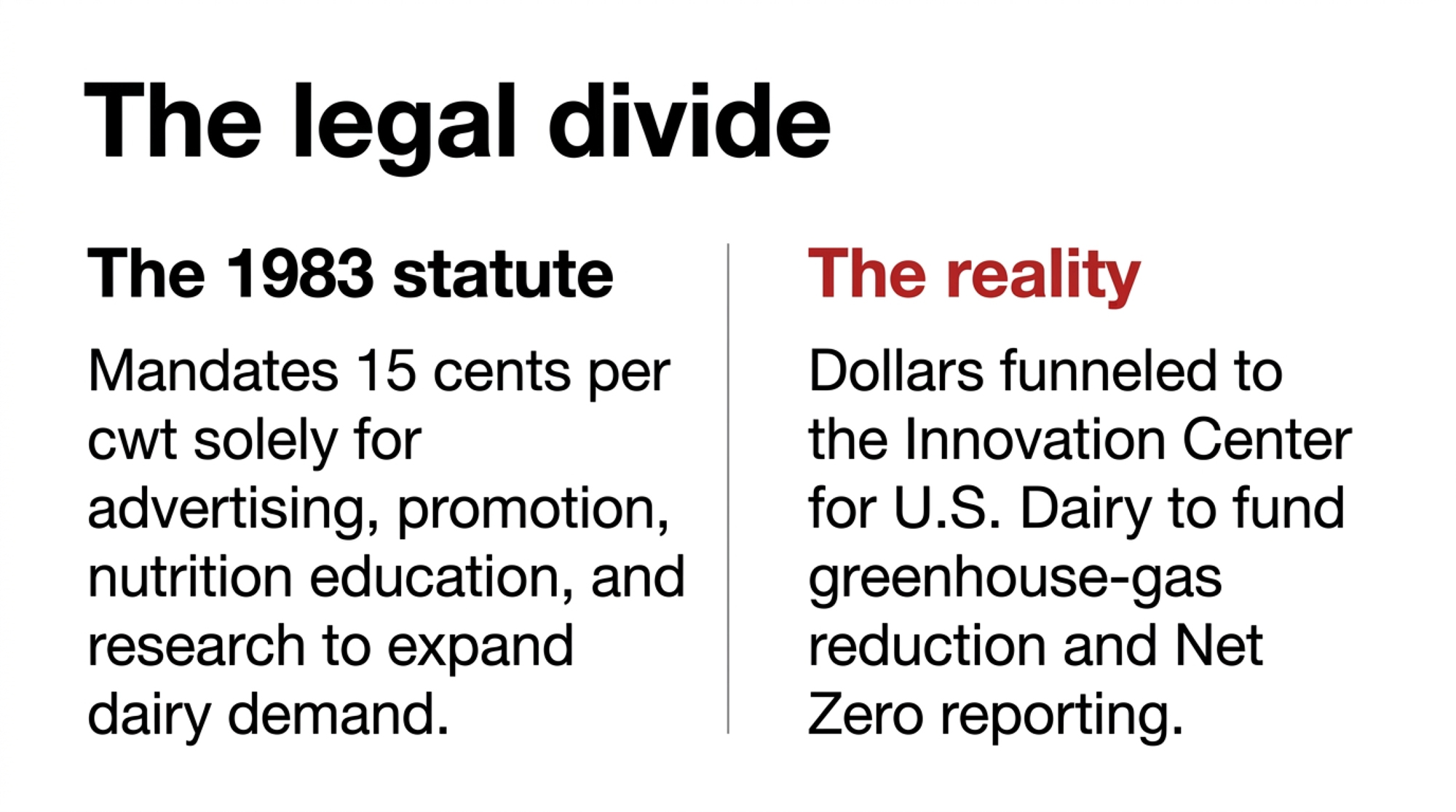
The checkoff started simple. Under the Dairy Production Stabilization Act of 1983, every U.S. farmer who markets milk pays 15 cents per cwt, and importers pay 7.5 cents. The statute is narrow about where that money can go — as WILL Deputy Counsel Rebecca Furdek frames it, the dollars are only supposed to fund plans to “advertise and promote the sale and consumption of dairy products and related research.” That’s the language the plaintiffs are leaning on.
The dollars aren’t small in aggregate. USDA’s September 2024 Report to Congress — its most recent — put the national checkoff system at $431.8 million for 2022, about $352.1 million of it from producers at 15 cents. The lawsuit pegs the combined producer-and-importer take at more than $350 million a year.
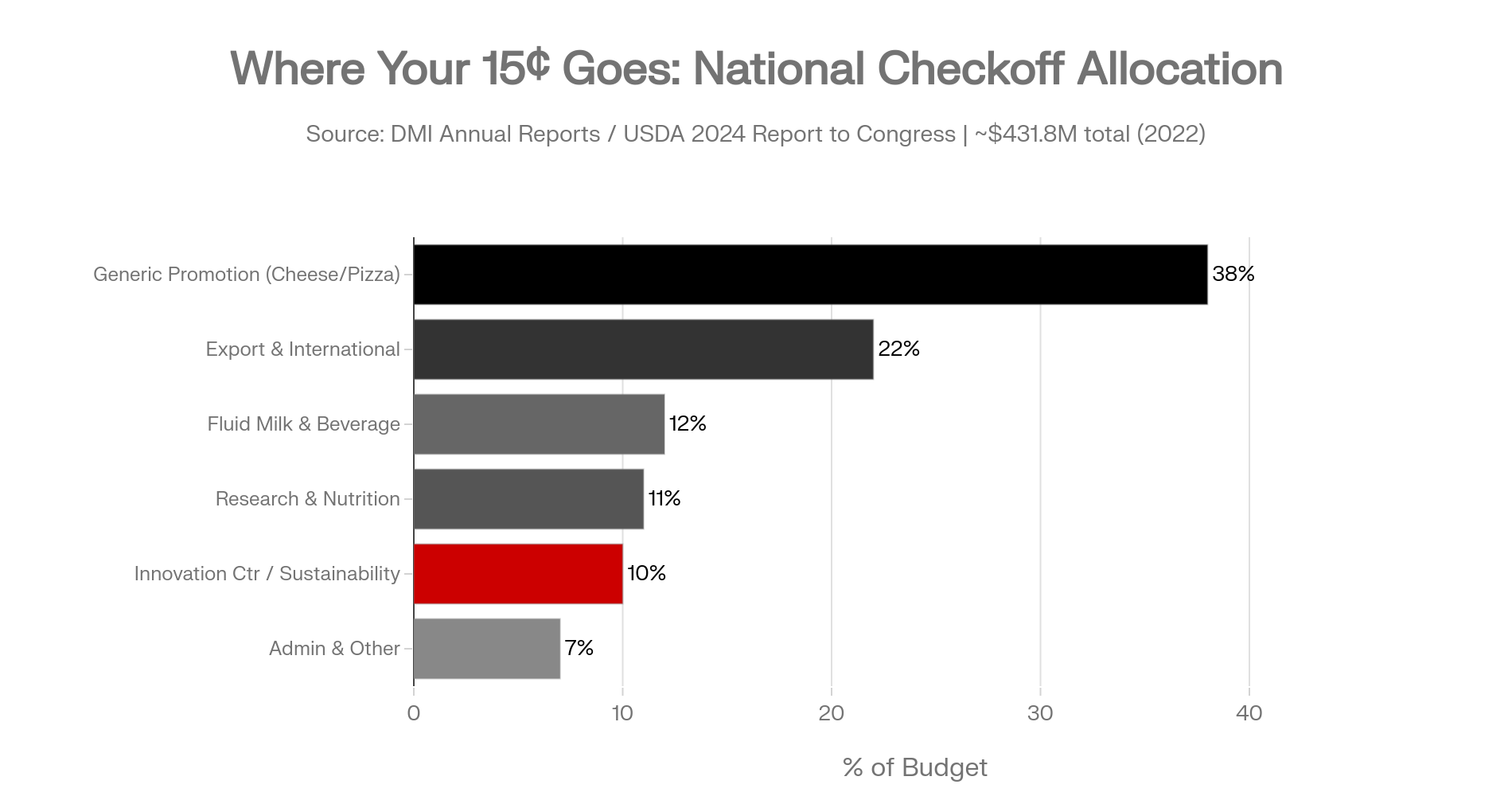
For most of its life, the program did what you’d expect. Generic cheese campaigns. School milk. Foodservice deals to push more cheese onto pizza. Export work no single farm could fund alone. Nobody seriously fights that part.
What’s contested is the move into climate and sustainability work. The Swan complaint alleges producer money is funneled through Dairy Management Inc. to the Innovation Center for U.S. Dairy — a private organization founded in 2008 whose stated priorities include greenhouse-gas reduction and sustainability reporting. The suit specifically asks the court to bar checkoff funding of the Innovation Center and related programs — the U.S. Dairy Net Zero Initiative, Pathways to Dairy Net Zero, and FARM Environmental Stewardship — which the plaintiffs allege fall outside the statute’s promotion-and-research scope. The farms most exposed, by their argument, are the ones with the least leverage — small and mid-size operations in weaker markets, paying the same 15 cents but holding the fewest seats at the table.
How This Plays Out on Real Farms
Here’s what’s making producers uneasy. The plaintiffs allege — and it’s an allegation the court hasn’t ruled on — that the FARM program’s environmental arm collects farm-level data (energy use, herd numbers, management details) that cooperatives and processors can roll into sustainability reports for food-company customers. If they’re right, the same 15 cents that buys a cheese ad also helps fund the data system that feeds those reports. That link between checkoff dollars and FARM ES is exactly what the case is built to test.
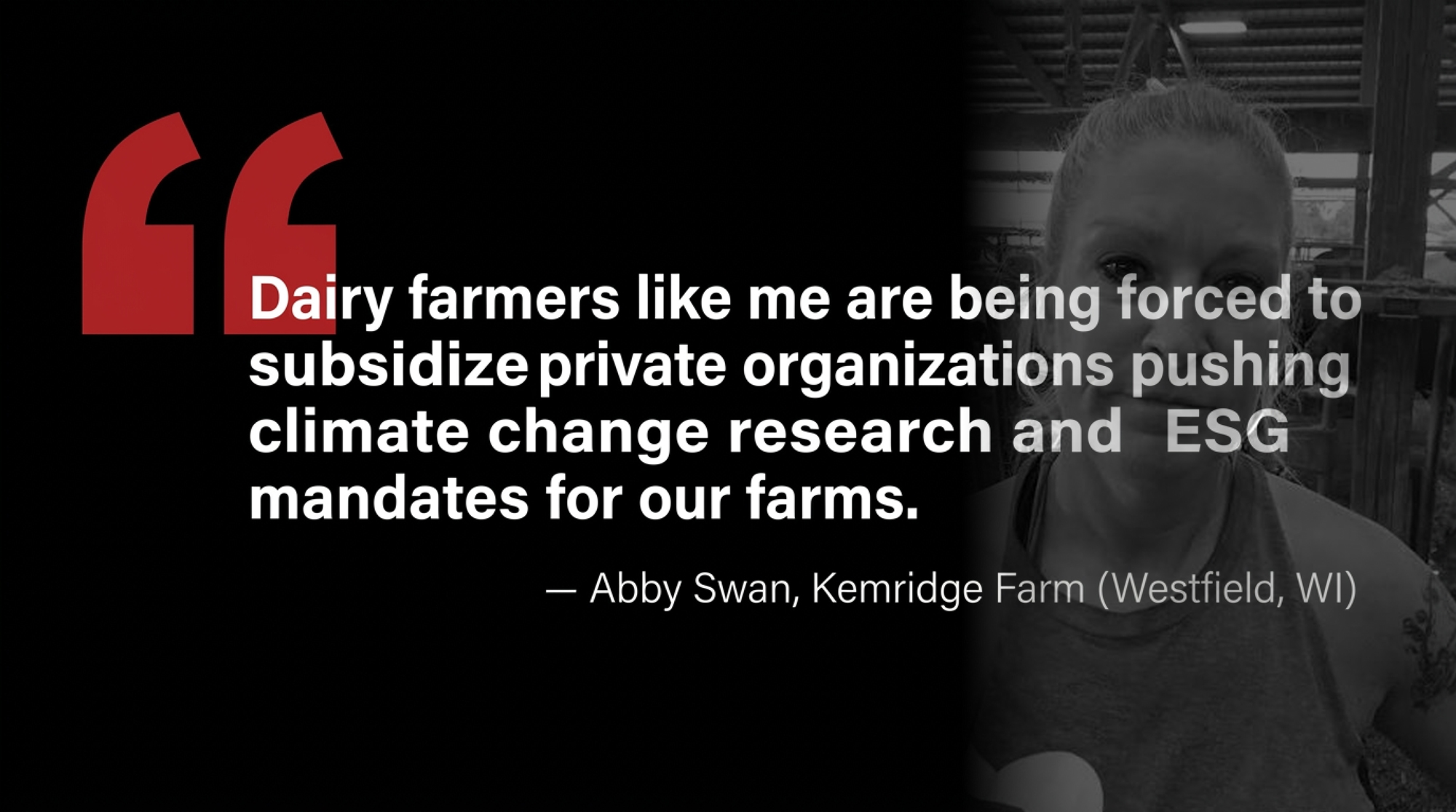
For Swan, this started months before the lawsuit. Back in February 2026, she went public over a request for a full year of farm data — natural gas, diesel, propane, electricity, herd size, and production — tied to sustainability reporting her buyers wanted. The request called itself voluntary. Her read was blunter: skip it, and the processor may not be able to take your milk, because its buyers upstream require the reporting. “Dairy farmers like me are being forced to subsidize private organizations pushing climate change research and ESG mandates for our farms,” Swan said in WILL’s June 9 statement announcing the suit, “even though the dairy checkoff program is just supposed to market and promote our milk.”
WILL’s Furdek put the constitutional stakes more bluntly: “Wisconsin dairy farmers shouldn’t be forced to bend the knee to radical ESG demands pushed by private” organizations. That’s the gap the plaintiffs are driving at — coverage of the suit runs under the blunt phrase “no data, no milk.” When your processor is in the system, “voluntary” starts to feel like a word on paper.
Take two 220-cow dairies side by side, both writing that same $9,600 check.
| Metric | High-Score Dairy | Laggard Dairy |
|---|---|---|
| Herd size | 220 cows | 220 cows |
| Annual checkoff paid | $9,600 | $9,600 |
| Milk destination | Export cheese plant | Regional fluid bottler |
| Sustainability score | High — FARM ES compliant | Low — limited data submission |
| Checkoff ROI estimate | ~$5–6 per dollar invested | ~$1.68 per dollar invested |
| Gross sector-modeled lift (64,000 cwt) | ~$64,000 modeled value | ~$21,500 modeled value |
| Data exposure | Full herd & energy data submitted | Partial / refused data request |
| Processor risk | Low — buyer metrics met | Elevated — “no data, no milk” risk |
| Co-op sustainability marketing advantage | Yes | No |
| Effective net benefit | Strong positive | Near break-even or negative |
One has the capital to build a high sustainability score and a co-op that markets those metrics well. The other runs thinner, gets tagged a “laggard,” and watches the gap widen — in a system it helped pay for. Same assessment. Very different outcome.
The Macro Math vs. Your Mailbox
So is the checkoff a bad deal? Not on average — and that’s what makes this messy. USDA’s congressionally mandated evaluation, authored by Texas A&M economist Oral Capps Jr., pegs the aggregate all-dairy benefit-cost ratio at $5.23 per dollar invested. Other independent modeling lands nearer $2 to $3 per dollar, so treat $5.23 as the high end of a wide band, not a floor.
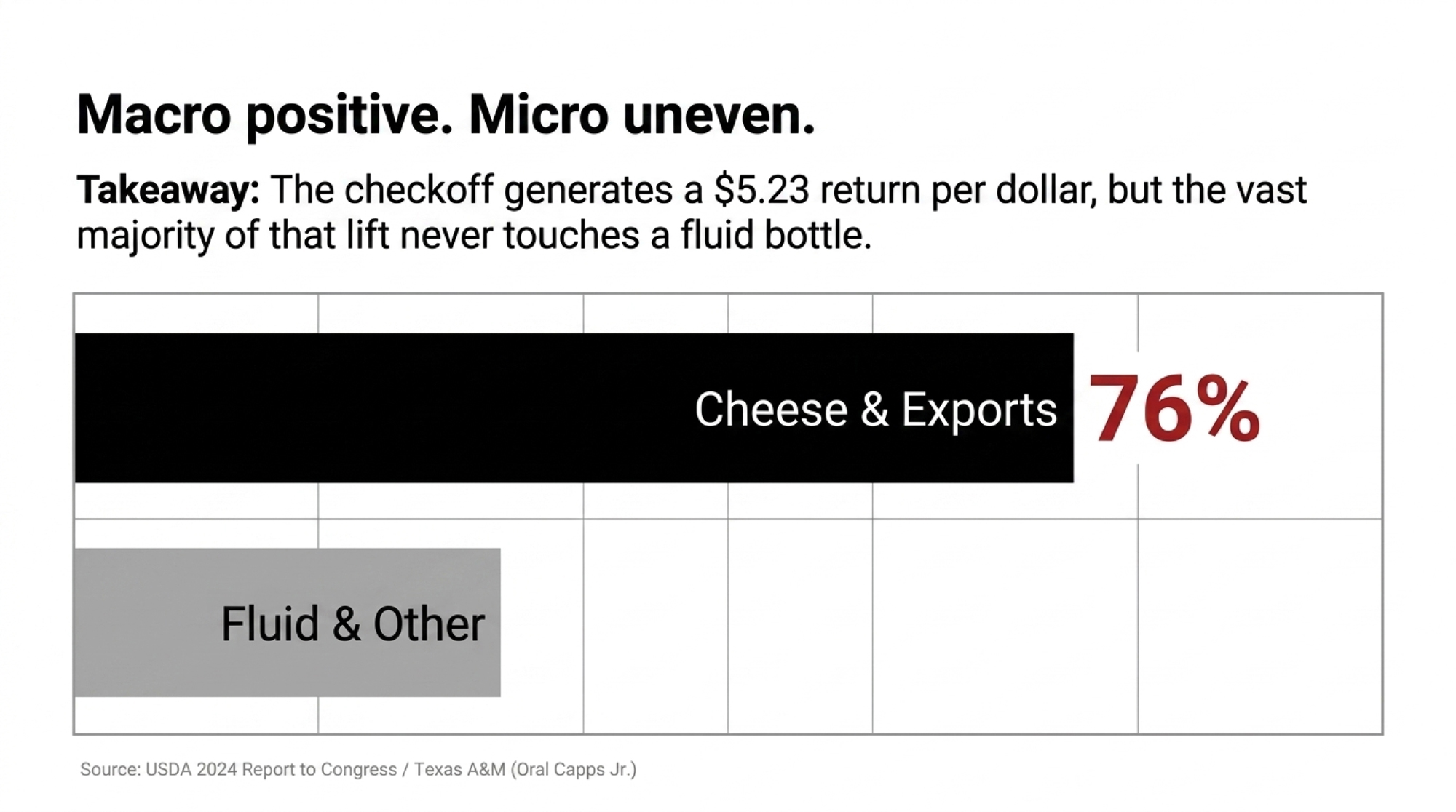
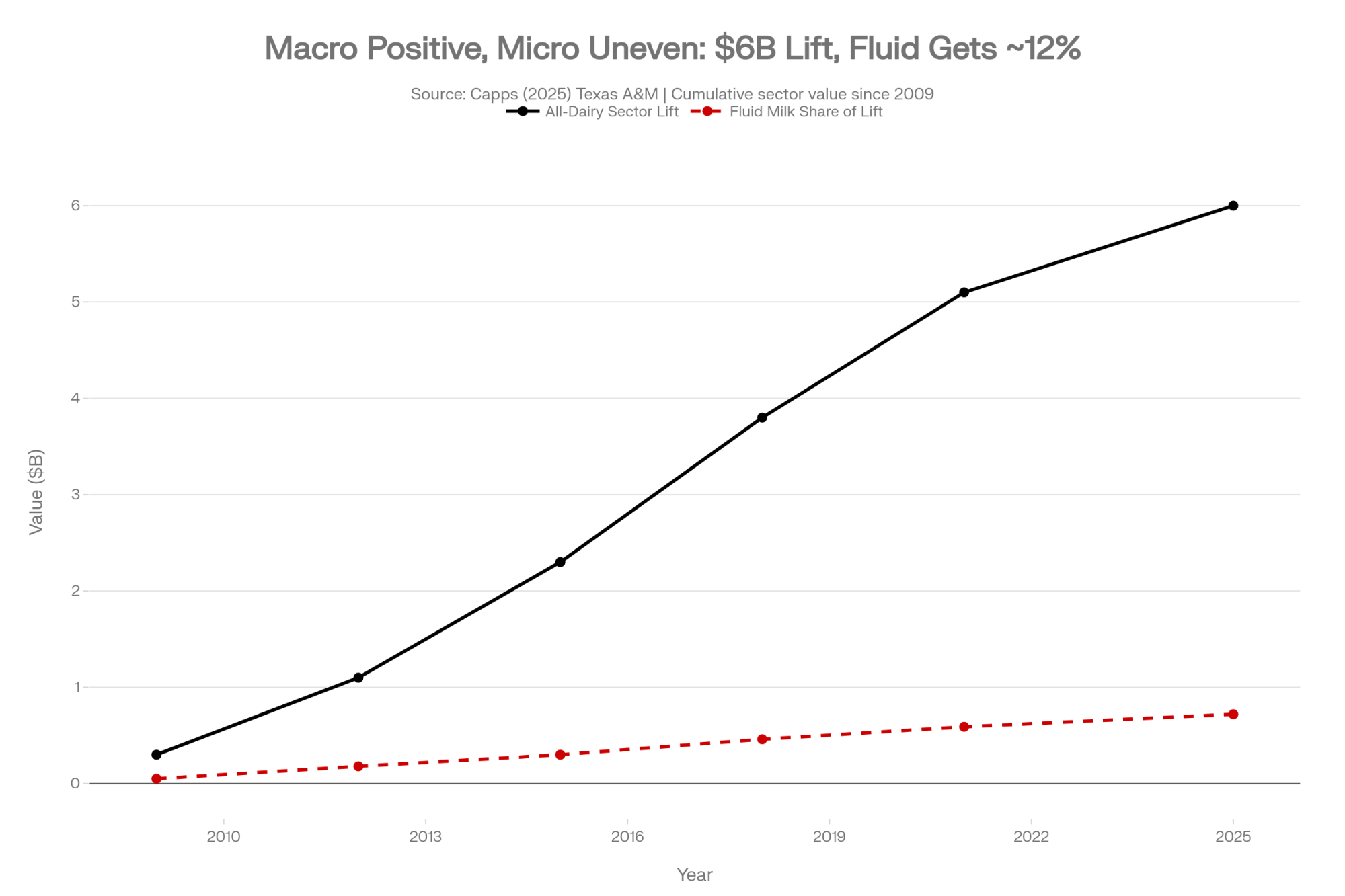
But read the fine print. These are model-based estimates — economists build a “no promotion” version of the market and compare it to reality, measuring what happens across the whole sector, not who pockets the gain. And the returns aren’t even. Capps’ November 2025 economic impact analysis puts cumulative checkoff value at about $6 billion since 2009, and roughly 76% of that traces to cheese, whey, and powder exports rather than fluid. As our breakdown of where checkoff dollars actually flow lays out, most of that lift never touches a fluid bottle — fluid milk innovation returned just $1.68 per dollar over six years.
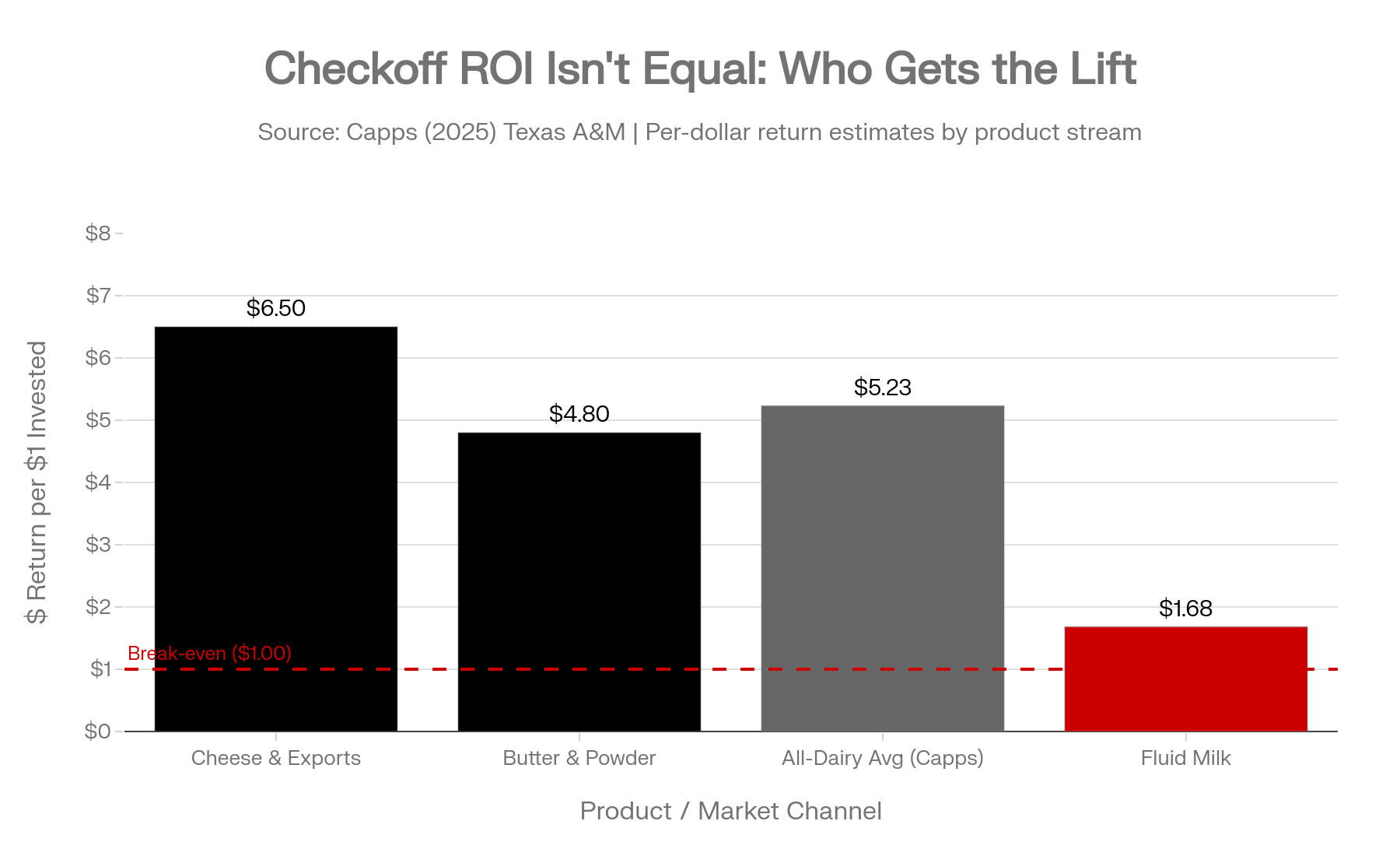
That leaves you with a phrase worth taping to the office wall: macro positive, micro uneven. The sector tide can rise enough to justify the cost while a mid-size fluid operator in a shrinking market sees almost none of it. Ship into cheese, butter, powder, or export channels and you’re close to the spigot. But hand your milk to a stagnant fluid bottler and you may be bankrolling someone else’s growth.
Put a number on it. At the sector level, Capps’ model says promotion adds roughly $1 per cwt to the all-milk price versus a no-promotion world. On a herd shipping 64,000 cwt, that pencils out to roughly $64,000 of sector-modeled gross value — but that’s an average, not a check in anyone’s mailbox. With milk hovering around $16.50/cwt or lower in early 2026 when Swan went public, a buck of modeled lift isn’t trivial, but it lands very differently for a high-component herd feeding an export cheese plant than for a tie-stall shipping into a fading bottler. No conspiracy required. It’s just what generic promotion does when it sits on an industry already tilted toward scale.
The Innovation Center, for its part, has a real answer. It frames its sustainability work as removing barriers so farmers gain recognition and fair compensation for the environmental assets they manage, and pitches the 2050 goals as voluntary and market-driven rather than regulatory. The argument: buyers and consumers increasingly demand this reporting, and ceding that ground would cost producers more than the programs do. USDA, the National Dairy Promotion and Research Board, and Dairy Management Inc. had not publicly responded to the lawsuit as of publication on July 6, 2026.
What Does the Beef-Checkoff Fight Tell Us About Swan’s Odds?
This isn’t the first time a producer has dragged a checkoff into court, and the beef cases are the tell. In R-CALF v. USDA, ranchers argued the beef checkoff forced them to fund private speech they disagreed with. Courts have generally upheld checkoff messaging as “government speech” — but only where USDA exercises real control over what gets said and funded. USDA later signed memoranda of understanding to tighten that oversight, which then triggered more litigation over whether the fix was real. The beef fight is still live: separate 2025 lawsuits pushed USDA to pause checkoff spending pending public audits — the same transparency demand now echoing on the dairy side.
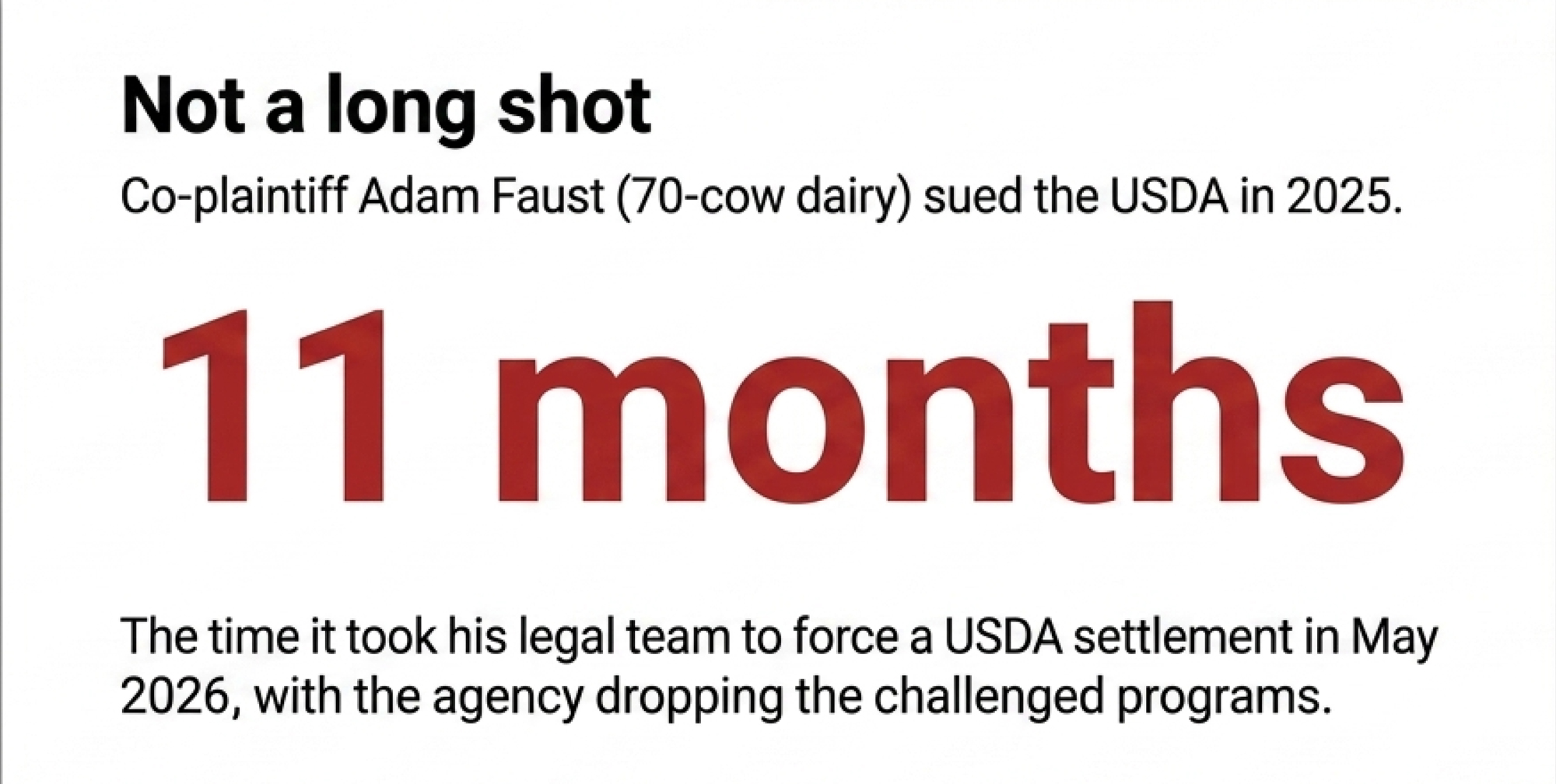
Swan’s case leans on the same nerve. In its court filings, WILL frames the suit around what it calls compelled subsidy — arguing farmers are forced to fund speech and programs they oppose, and that the checkoff’s ESG messaging isn’t protected “government speech.” The plaintiffs aren’t trying to kill the checkoff; the complaint asks the court to declare the Innovation Center funding unlawful and permanently bar future checkoff money from flowing to it. The suit, Swan et al. v. Rollins et al., Case No. 1:2026cv01033, was filed June 9 in the U.S. District Court for the Eastern District of Wisconsin, in Green Bay. And don’t write it off as a long shot: the same WILL legal team filed a separate discrimination suit for Faust in June 2025 and secured a USDA settlement by May 2026 — roughly 11 months, with the agency dropping the challenged programs. Faust isn’t a casual plaintiff, either — he’s a Calumet County Holstein producer who farms with spina bifida as a double-amputee, and he’s already beaten the government once, winning a 2021 case after being blocked from a COVID loan-forgiveness program over race.
Is the Checkoff Still a Promotion Tool — or a Compliance System You’re Forced to Fund?
| Program / Activity | Statutory Basis (1983 Act) | Plaintiffs’ Classification | What Your 15¢ Funds |
|---|---|---|---|
| Generic cheese ads (pizza, foodservice) | ✅ Clearly authorized — “advertise and promote sale” | Promotion ✅ | Mass media, co-op campaigns |
| School milk programs | ✅ Authorized — consumption promotion | Promotion ✅ | USDA partnership programs |
| Export market development | ✅ Authorized — sale/consumption globally | Promotion ✅ | USDEC international trade work |
| Nutrition research (health claims) | ✅ Authorized — “related research” | Promotion ✅ | University grants, dairy health studies |
| Innovation Center for U.S. Dairy | ⚠️ Contested — sustainability mandate | Alleged ESG overreach ❌ | GHG reduction, sustainability reporting |
| U.S. Dairy Net Zero Initiative | ⚠️ Contested — climate goals | Alleged beyond statute ❌ | Carbon accounting, net-zero pathways |
| FARM Environmental Stewardship | ⚠️ Contested — farm data collection | Alleged compliance infrastructure ❌ | Energy use, herd data, processor reports |
| Pathways to Dairy Net Zero | ⚠️ Contested — private org. funding | Alleged beyond statute ❌ | Private sustainability coalition work |
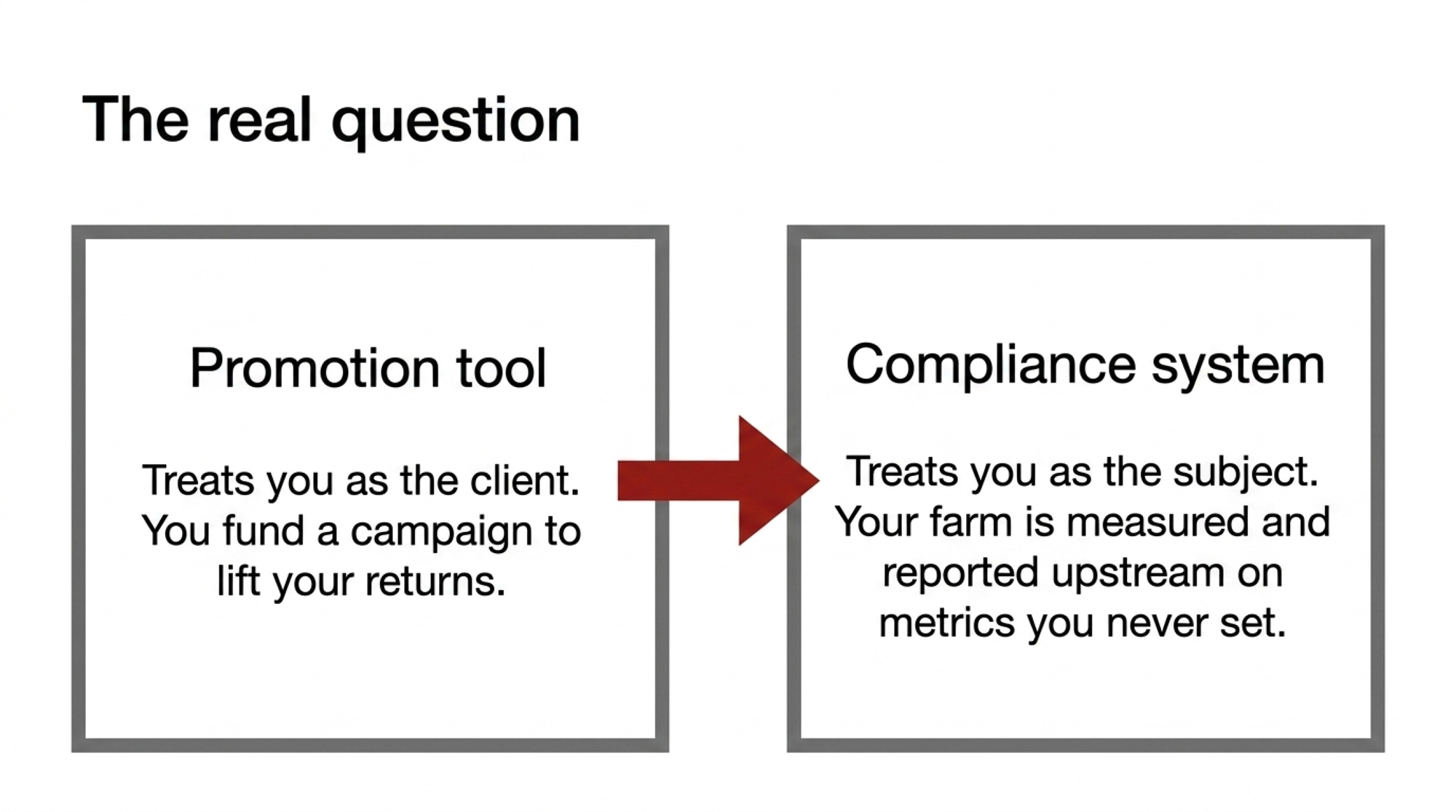
This is the question sitting under the lawsuit. A promotion program treats you as the client: you fund a campaign to lift your returns. A compliance system treats you as the subject: your farm gets measured and reported up the chain on metrics you didn’t set — and that, the plaintiffs argue, is where the program has drifted.
The line most producers would draw is reasonable enough. Defend dairy against plant-based competitors. Fight for school milk. Push cheese into foodservice. Write that check. But once mandatory dollars start funding ESG infrastructure and farm-level reporting, the complaint argues, you’ve crossed into territory Congress never authorized. As we detailed in why one producer’s checkoff bill hit $36,300 a year, the dollars at stake scale fast with herd size — and the court, not either side’s press release, will decide where the line actually sits.
The Producer Playbook: 4 Steps to Take Now
You can’t opt out of the assessment. But you can change how you engage with it.
1. Run your own number first — do this within 30 days. Pull your annual cwt, multiply by 0.15, and put a real dollar figure on what you pay. Faust’s roughly 70-cow operation runs a smaller bill than Swan’s 220-cow Kemridge; a higher-producing 500-cow dairy can ship about $36,300. (Run your own pounds, not ours — per-cow output swings the total a lot.) Knowing the cost doesn’t recover it. It just sharpens every question you ask.
2. Ask where your dollars split and land. Up to 10 of your 15 cents can stay with a qualified regional program; the rest goes national. Pull DMI’s annual budget at dairycheckoff.com and ask which categories got funded and what they returned. If your co-op can’t tell you the regional-vs-national split, treat that as a flag, not a formality.
- Risk: you may get a runaround instead of a number.
3. Read the next sustainability data request before you fill it out. Swan’s whole fight started with exactly that kind of request — a full year of energy and herd data. You don’t have to refuse it, but know what you’re handing over and who sees it.
- Trade-off: pushing back may strain a processor relationship if your buyer ties reporting to supply.
4. Watch the Swan ruling if you’re mid-size — and push for consent. You don’t need to pull court filings; your co-op newsletter and the farm press will carry the two headlines that matter — a preliminary injunction decision and any ruling on the merits. If the court limits checkoff funding of the Innovation Center, that reshapes where your dollars can legally go. The single reform worth demanding, ruling or not, is consent — no new spending category, especially ESG or data infrastructure, without an explicit producer vote.
For the full margin picture behind these decisions, The Bullvine’s Dairy Farm Economics 2026 playbook lays out where breakevens actually sit this year.
The Question to Chew On
So here’s the question worth chewing on at your own kitchen table. If your co-op asked you tomorrow to vote yes or no on using checkoff dollars to fund a sustainability agenda, would you know enough about the program to answer? And when did you last actually check where your 15 cents went?
Abby Swan answered a sustainability data request by suing USDA in federal court. You don’t have to go that far — but you should at least know your own number before someone else uses it. We’re running the full per-farm math in next week’s Bullvine Weekly, broken out by herd size, region, and product stream, including the “macro positive, micro uneven” split the checkoff’s own studies quietly admit. If you want the numbers behind the headline, that’s where they live.
Complete references and supporting documentation are available upon request by contacting the editorial team at editor@thebullvine.com.
Learn More
- $110.5M to ‘Reputation’: Why 3 Farmers Are Suing USDA — Delivers an operational breakdown of Dairy Management Inc.’s audited financial categories, arming you with the raw data to see exactly how much of your mandatory assessment is diverted away from product advertising.
- The USDA Formula Change No Milk Check Explains — Exposes the hidden regulatory mechanics behind recent FMMO milk pricing revisions, revealing how a single back-end formula shift quietly pulled nearly $0.90/cwt out of Class III and IV checks.
- Net Merit: The $100000 Cull Gate Your Index Misses — Dismantles the strategic risk of breeding heifers for an unpriced, voluntary sustainability index, contrasting current domestic genetic trait limitations against real-world cash premiums paid to producers overseas.
 The Sunday Read Dairy Professionals Don’t Skip.
 The Sunday Read Dairy Professionals Don’t Skip.
Every week, thousands of producers, breeders, and industry insiders open Bullvine Weekly for genetics insights, market shifts, and profit strategies they won’t find anywhere else. One email. Five minutes. Smarter decisions all week.