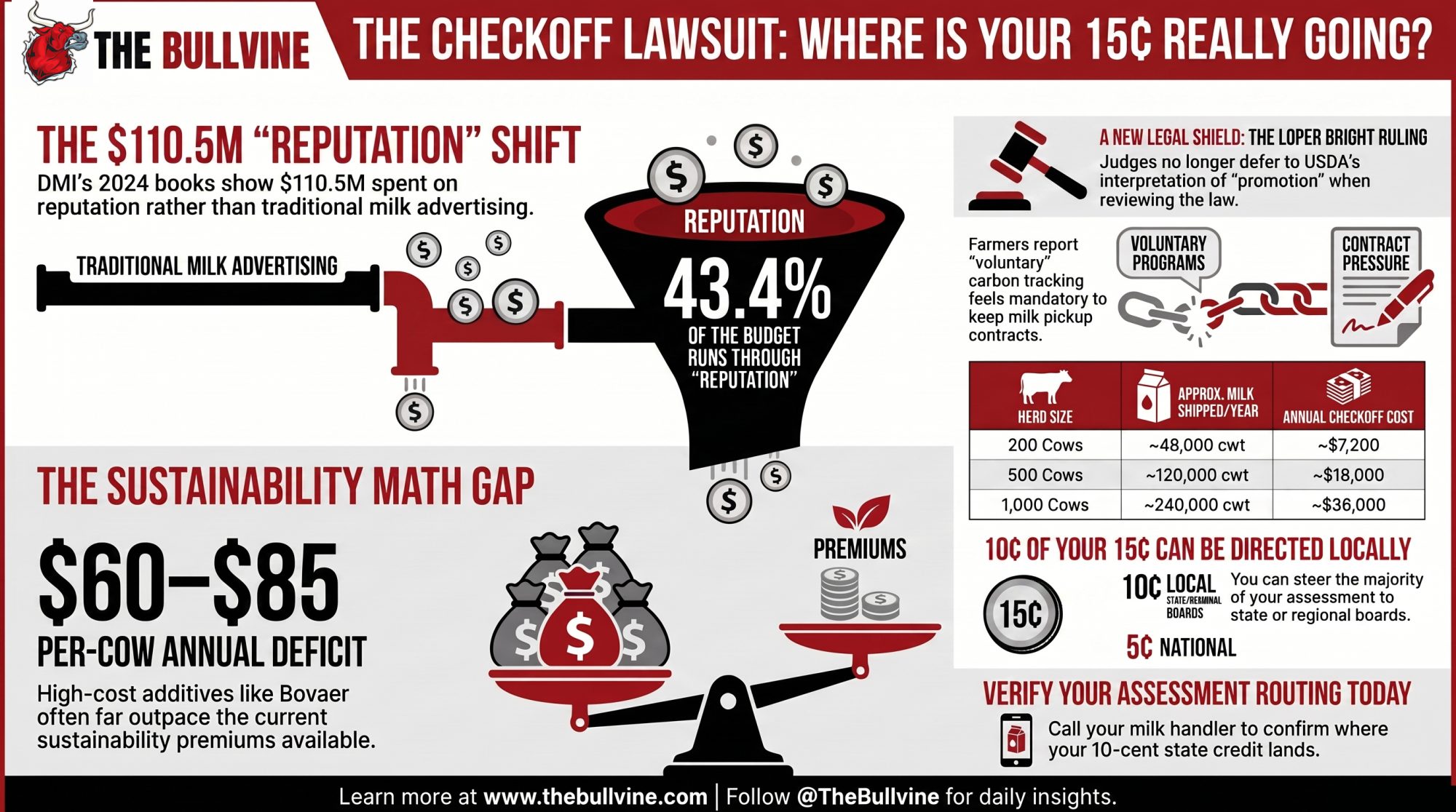
DMI’s own 2024 books show $110.5M — 43.4% of your checkoff — ran through “Reputation,” not milk ads. Three Wisconsin farmers just sued USDA to shut off the tap.
Executive Summary: DMI’s own 2024 audited books show that $110.5 million (43.4% of the checkoff budget) was routed through a category it labels “Reputation,” not ads that move product. A new federal lawsuit by three Wisconsin producers aims to block this pipeline.
Here’s what every dairy farmer needs to know before their next co-op meeting:
- The Lawsuit: Filed June 9, 2026, against USDA, arguing that mandatory checkoff funds are being illegally used to build a “Net Zero” infrastructure the 1983 law never authorized.
- The Real Cost: This isn’t just about the 15¢/cwt deduction (roughly $18,000/year on a 500-cow dairy). The real threat is the commercial squeeze — pressure to adopt sustainability practices like Bovaer, which in most current contracts carries an unfunded $60–$85 per-cow deficit.
- The Legal Shift: Unlike 40 years of failed checkoff challenges, this suit leans on the Supreme Court’s 2024 Loper Bright ruling, meaning judges no longer have to defer to USDA’s interpretation of the law.
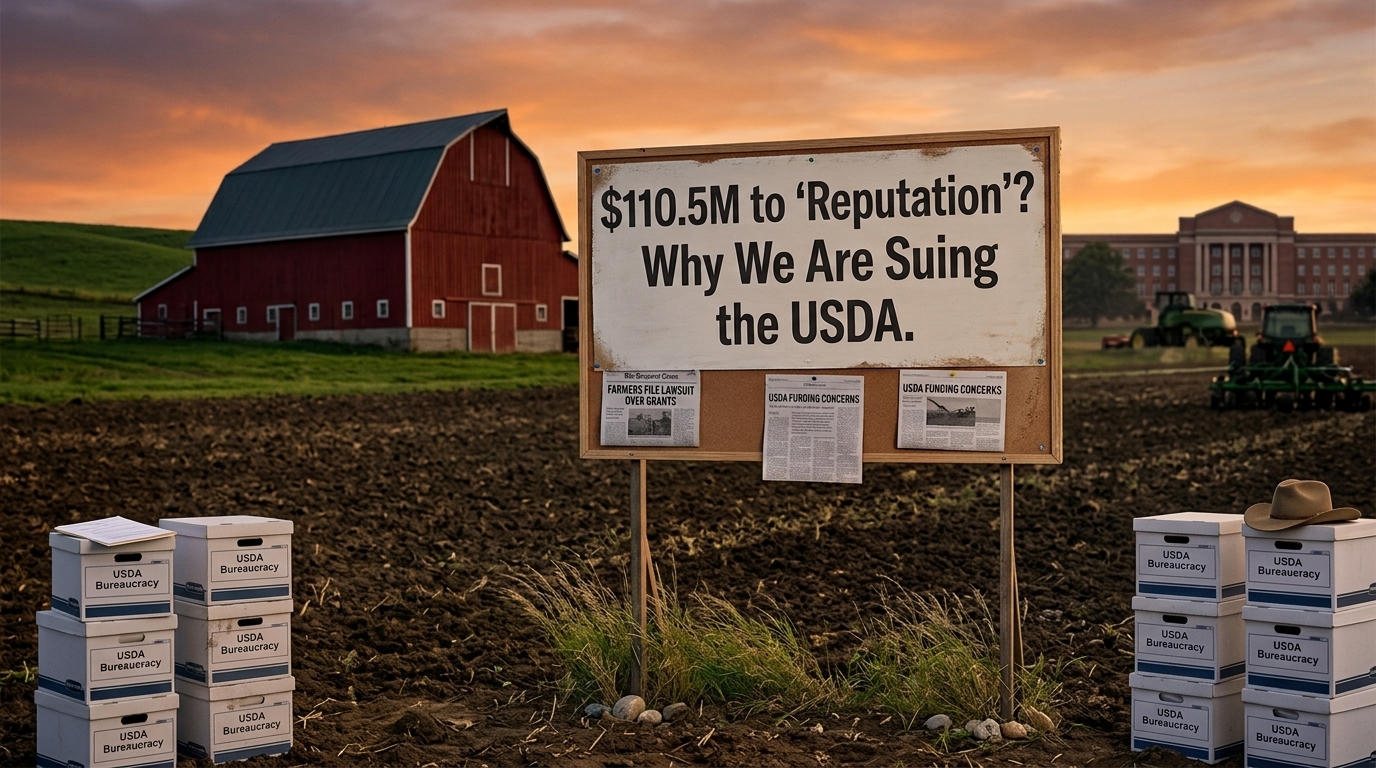
Every farm shipping milk in America pays the same 15 cents per hundredweight. Nobody gets to opt out. And three Wisconsin producers now say a chunk of that mandatory money is being used for purposes they never signed up for — and they’ve taken USDA to federal court to prove it.
In February, Westfield, Wisconsin, dairy farmer Abby Swan told Fox Baltimore that her milk plant had sent a letter asking for a year’s records — natural gas, diesel, propane, electricity — to calculate her farm’s carbon footprint. The program was billed as “voluntary.” But as Swan tells it, participation didn’t feel optional when she believed her milk pickup was on the line. The processor’s side isn’t reflected in that account.
That tension — voluntary on paper, pressured in practice — is the whole fight, folded into one envelope.
On June 9, 2026, Swan put her name on a federal lawsuit against USDA and the National Dairy Promotion and Research Board. So did Adam Faust of Chilton and Christopher Baird of Ferryville. Their claim: the mandatory 15-cent-per-hundredweight dairy checkoff every U.S. producer pays is being used for environmental and sustainability programs the plaintiffs allege fall outside what the 1983 law authorizes (WILL, June 9, 2026).
| Dimension | 1983 Dairy Production Stabilization Act Language | Current DMI Spending | Plaintiffs’ Argument |
|---|---|---|---|
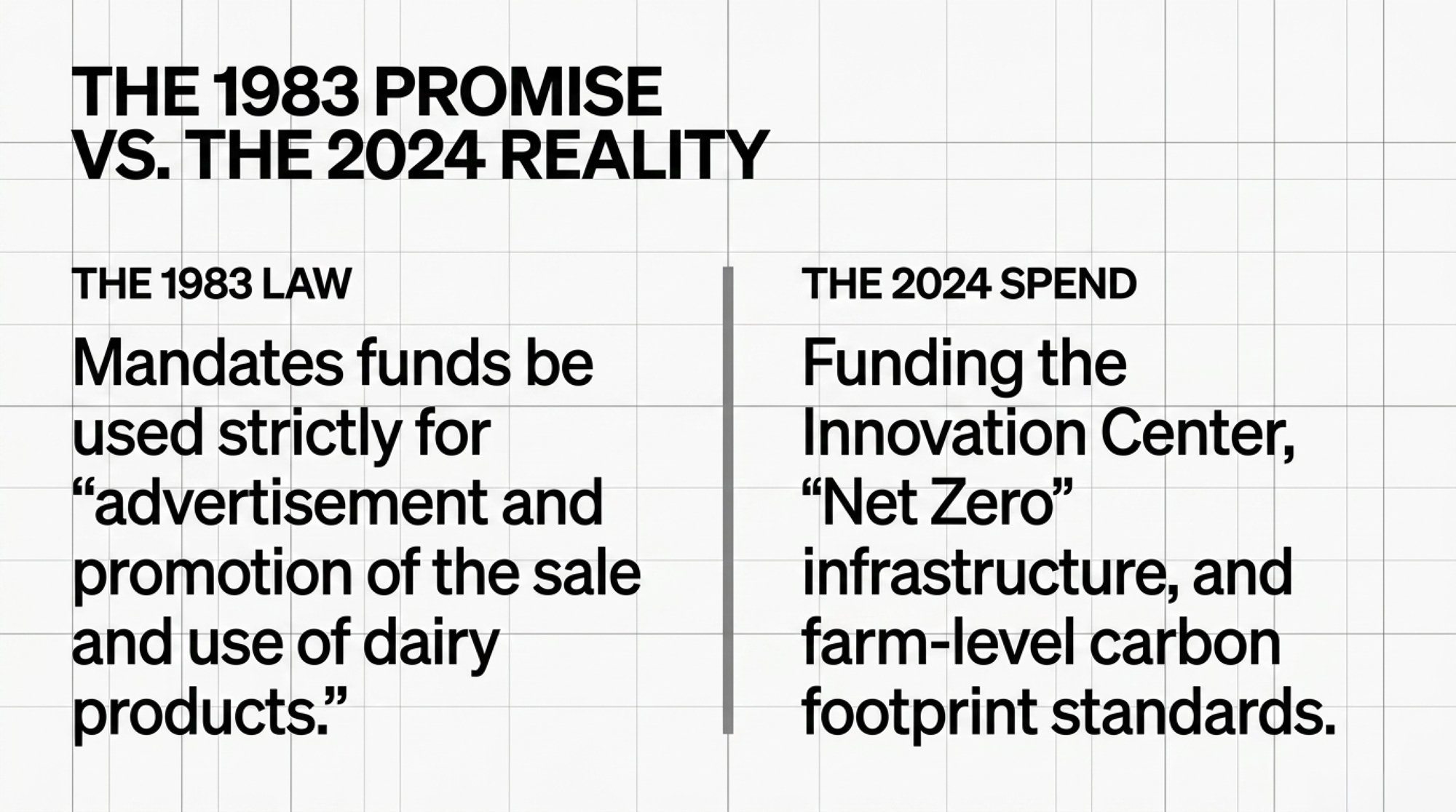
| Authorized purpose | “Promotion of the sale and use of dairy products” | 43.4% ($110.5M) to “Reputation” category | Sustainability story ≠ product promotion |
| Secondary purpose | “Research and nutrition education” | $57.9M to “Innovation” (Net Zero, FARM ES) | Net-zero infrastructure not authorized by law |
| Core promotion | Consumer advertising and market development | ~$53.7M to consumer promo | This is the only spend plaintiffs consider legal |
| Oversight mechanism | USDA oversight under AMS Promotion Order | Farmer-elected board; no mandatory public audit | OFF Act would add USDA Inspector General audits |
| Legal doctrine (pre-2024) | Chevron deference — courts defer to USDA interpretation | USDA defined scope broadly over 40+ years | Challengers consistently lost under deference |
| Legal doctrine (post-2024) | Loper Bright — judges read statute independently | Untested on checkoff programs | Opens statutory challenge courts couldn’t take before |
What’s Changing and Why
The checkoff isn’t new. Congress built it under the Dairy Production Stabilization Act of 1983, which says the funds “shall be used” for “advertisement and promotion of the sale and use of dairy products,” plus related research and nutrition education (7 U.S.C. ch. 76; Public Law 98-180). The 15-cent rate hasn’t moved in over 40 years. What’s moved, the plaintiffs argue, is the mission.
The lawsuit aims at the Innovation Center for U.S. Dairy — a forum initiated in 2008 by dairy farmers and run by Dairy Management Inc. (DMI) — and three programs under it: the U.S. Dairy Net Zero Initiative, Pathways to Dairy Net Zero, and FARM Environmental Stewardship (FARM ES). The funding link isn’t in dispute. The Innovation Center has said dairy farmers and importers have primarily funded its work through DMI and the national checkoff since its inception (Innovation Center for U.S. Dairy). What’s in dispute is whether building a sustainability story counts as “promotion of the sale and use” of dairy. The suit doesn’t try to kill the checkoff — it asks the court to block checkoff funding of the Innovation Center specifically.
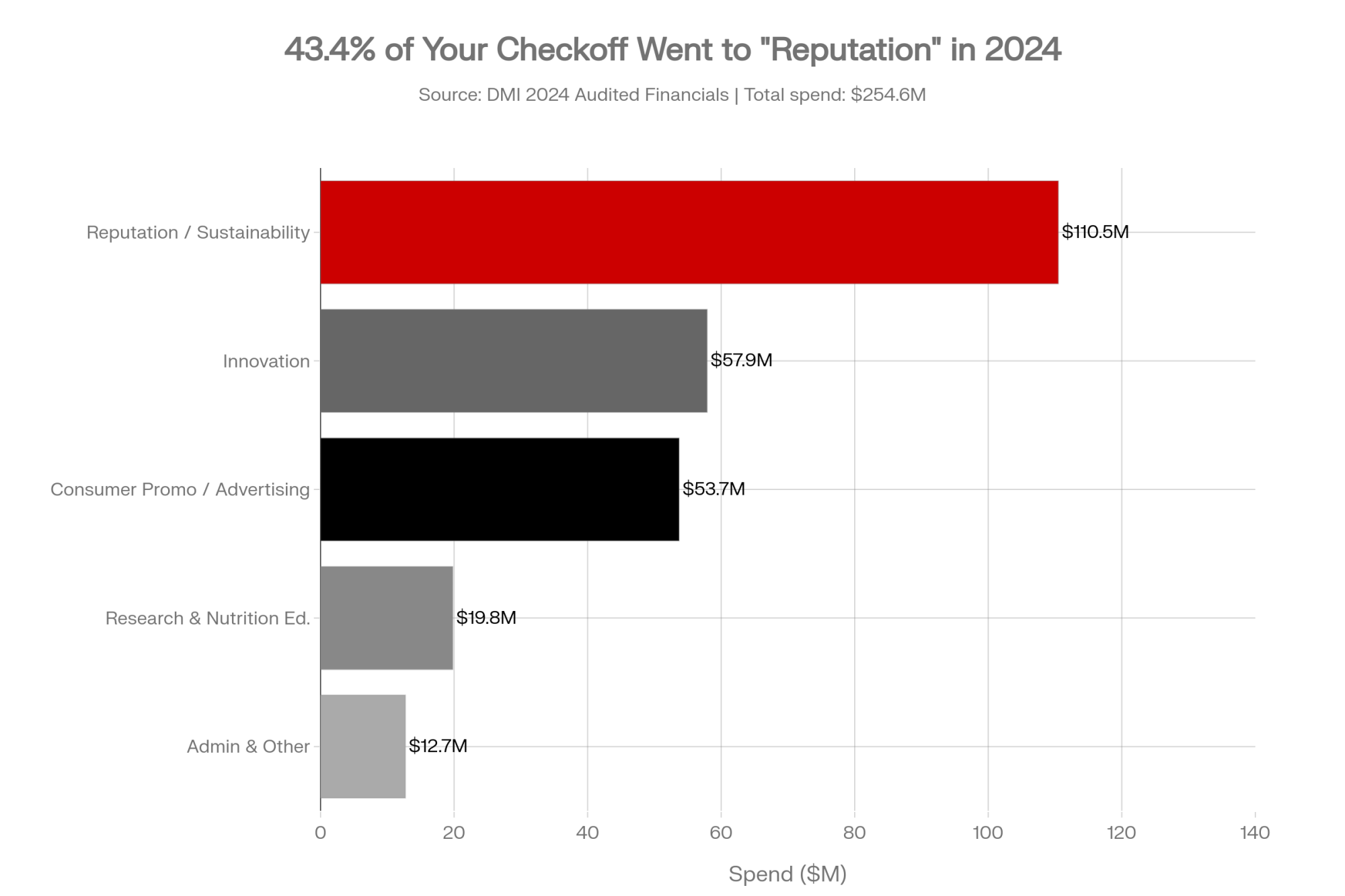
The dollars are real, and they’re big. The checkoff collects more than $350 million annually from producers and importers, per USDA figures cited in the June 2026 complaint. DMI’s 2024 audited financials show $254.6 million in total expenditures once state and regional pass-throughs are counted — and of that, $110.5 million, or 43.4% of the entire budget, ran through a category DMI itself labels “Reputation,” with another $57.9 million booked to “Innovation” (DMI 2024 Annual Report; The Bullvine, May 27, 2026). That’s not advertising milk. That’s work measured partly by whether the public believes dairy farmers are good for the environment.
To be fair to DMI, the organization sees that spending differently. Its position is that reputation and trust work protects long-term demand — that a consumer who trusts dairy’s environmental record keeps buying milk, cheese, and butter for decades. The plaintiffs argue spending in that category drifts from the checkoff’s promotional purpose. That’s the exact disagreement now headed to a federal judge.
How This Plays Out on Real Farms
For Swan, the friction started with that data request. She told Fox Baltimore the letter wanted “herd data, nutrition data, energy data, total terms of natural gas, total gallons of diesel” — “mind you, this is for a whole year,” she said — and that participation didn’t feel optional when she believed her pickup was on the line (Fox Baltimore, Feb. 19, 2026). USDA Secretary Brooke Rollins said publicly she’d investigate the new requirements. As of late June, there’s no public record of what that review turned up — a gap worth watching as the case moves.
Faust isn’t a first-time litigant. He’s the Chilton farmer who, with the Wisconsin Institute for Law & Liberty (WILL), beat the agency in a separate discrimination case in roughly 11 months. Same legal shop. Same farmer. Now pointed at the checkoff. We tracked how that first win came together, and it’s the reason this filing reads differently from the usual coffee-shop grumbling — WILL deputy counsel Daniel Lennington told Brownfield Ag News on May 27, 2026, that the checkoff is “an unconstitutional” use of mandatory funds.
Baird, the third name on the filing, farms near Ferryville in the southwest corner of the state. The complaint describes all three as Wisconsin producers “subject to and harmed by” the mandatory assessment (Cheese Reporter, June 11, 2026) — not activists who went looking for a fight, but farmers who pay the levy every month and want to know what it’s being used for. That’s the thread worth holding onto: this isn’t a fringe case. It’s three working dairies questioning a deduction that automatically hits all of them.
Here’s where it gets concrete. The 15 cents scales straight with volume, so the bigger you milk, the bigger the bill. Run the numbers on a herd averaging about 24,000 lbs per cow per year — adjust up or down for your own rolling herd average — and the assessment lands like this:
| Herd size | Approx. milk shipped/yr | Annual checkoff at 15¢/cwt |
| 200 cows | ~48,000 cwt | ~$7,200 |
| 500 cows | ~120,000 cwt | ~$18,000 |
| 1,000 cows | ~240,000 cwt | ~$36,000 |
(Figures assume a 24,000-lb rolling herd average; recalculate against your own production.)
And that’s before the second layer: the practices these sustainability programs are starting to expect.
The Real Cost Isn’t Just the Deduction
Take Bovaer, the methane-reducing feed additive moving through sustainability channels. Start with the cost. DSM-Firmenich pegs it at roughly $93–$105 per cow per year on a lactating-cow basis — call it about a quarter to thirty cents a head a day (DSM-Firmenich; The Bullvine, June 23, 2026). That’s the bill, and it’s fixed.
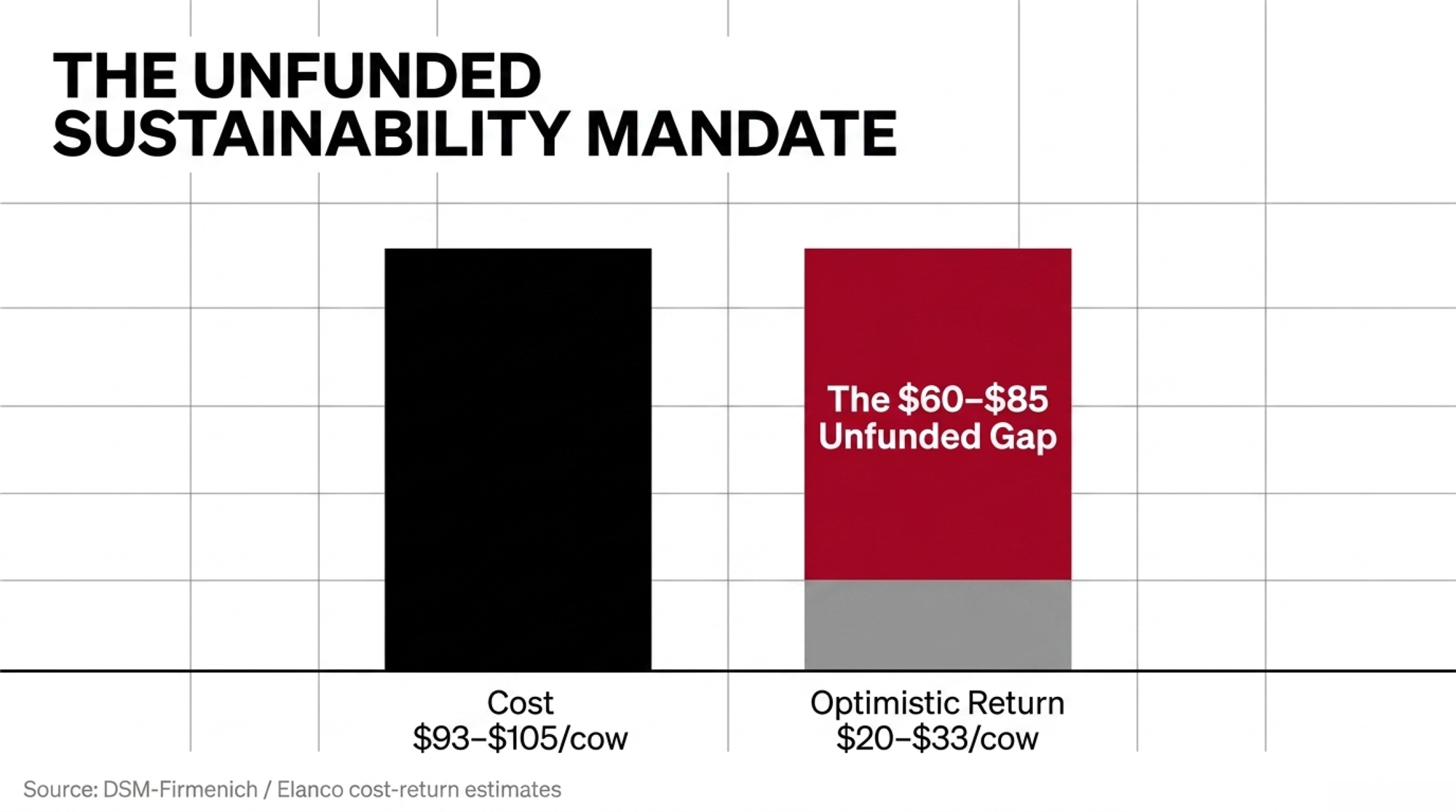
Now the return, run at its most optimistic. Elanco has estimated an annual return of $20 or more per lactating cow from feeding Bovaer, drawn from voluntary carbon markets, conservation-program funds, and processor incentives (Elanco, via Dairy Herd Management, Nov. 2024 — note this estimate is over a year old and may have shifted). Add an assumed 12¢/cwt sustainability premium on a cow milking 75 lbs a day and you’d claw back about $33. Even that’s generous, since most documented sustainability and component premiums today run higher per cwt but rarely attach to methane reduction specifically (The Bullvine, Oct. 2025). Call the total documented return $20–$33 per cow — and that’s the friendly read.
So line them up. Cost of $93–$105 against a return of $20–$33 leaves a $60–$85 per-cow gap the system doesn’t close. On a 300-cow herd, that’s an unfunded $18,000 to $25,500 a year. The climate story and the cash-flow story aren’t the same story. We ran the full methane-efficiency-breeding-versus-Bovaer comparison separately — worth a look before you sign anything.
The Mechanics Behind the Outcomes
Most producers treat the 15 cents and the data letter as two separate headaches. They’re not. They’re two ends of one pipe.
Checkoff dollars fund the Innovation Center and the Net Zero infrastructure. That infrastructure builds the measurement standards — FARM ES uses the Ruminant Farm Systems model to estimate a farm’s greenhouse gas footprint (National Dairy FARM Program, June 2025). Here’s how that turns into a letter in your mailbox:
The Leverage Pipeline — how “voluntary” becomes a condition of the sale
1. Your checkoff funds the Innovation Center and its Net Zero / FARM ES measurement standards. 2. Those standardsbecome the yardstick for a farm’s carbon footprint. 3. Your processor or co-op pools your farm-level data to show buyers the supply chain is cleaning up. 4. A buyer like Nestlé or Danone writes sustainability reporting into its purchase contracts. 5. To keep that account, your processor needs your numbers — so a “voluntary” program quietly becomes a practical condition of getting your milk hauled.
No regulation cited in the letter. No law forcing your hand. Just leverage running down the contract chain.
That reach is already wide, and it’s growing. By 2025, 39 cooperatives and processors representing about 77% of U.S. fluid milk had signed the U.S. Dairy Stewardship Commitment — up from 35 companies and 75% in 2022 (Innovation Center for U.S. Dairy, 2025, via Choices magazine). And the people approving how the checkoff spends? It’s a farmer-led board, funded by more than 23,000 dairy farmers plus importers (DMI 2024 Annual Report; Agri-Marketing, April 2026). As of its 2021 report, the board consisted of 41 dairy farmers, 12 importer representatives, and 2 non-voting cooperative seats, and it’s chaired by Pennsylvania dairy farmer Marilyn Hershey, re-elected to lead the checkoff for 2026 (Dairy Checkoff, April 27, 2026). Farmer-controlled on paper. If you want the full picture of where those dollars actually go, we broke down Hershey’s $121 million checkoff bet — and why 76% of it chases cheese and exports. The plaintiffs argue the spending has drifted beyond what farmers signed up for in 1983.
Why This Lawsuit Is Different From the Last 40 Years of Checkoff Fights
If you’ve tuned out every prior checkoff challenge — and there’s been a parade of them — here’s the one reason to look up this time.
Back in 2004, a federal appeals court struck down the dairy checkoff in Cochran v. Veneman, calling it unconstitutional compelled private speech. The win didn’t hold. In 2005, the Supreme Court upheld the beef checkoff in Johanns v. Livestock Marketing Association, ruling that checkoff advertising is “government speech” and therefore shielded from First Amendment attack (Cornell Law School case summary). That doctrine has protected the dairy program ever since. Every speech-based challenge since has run straight into the same wall.
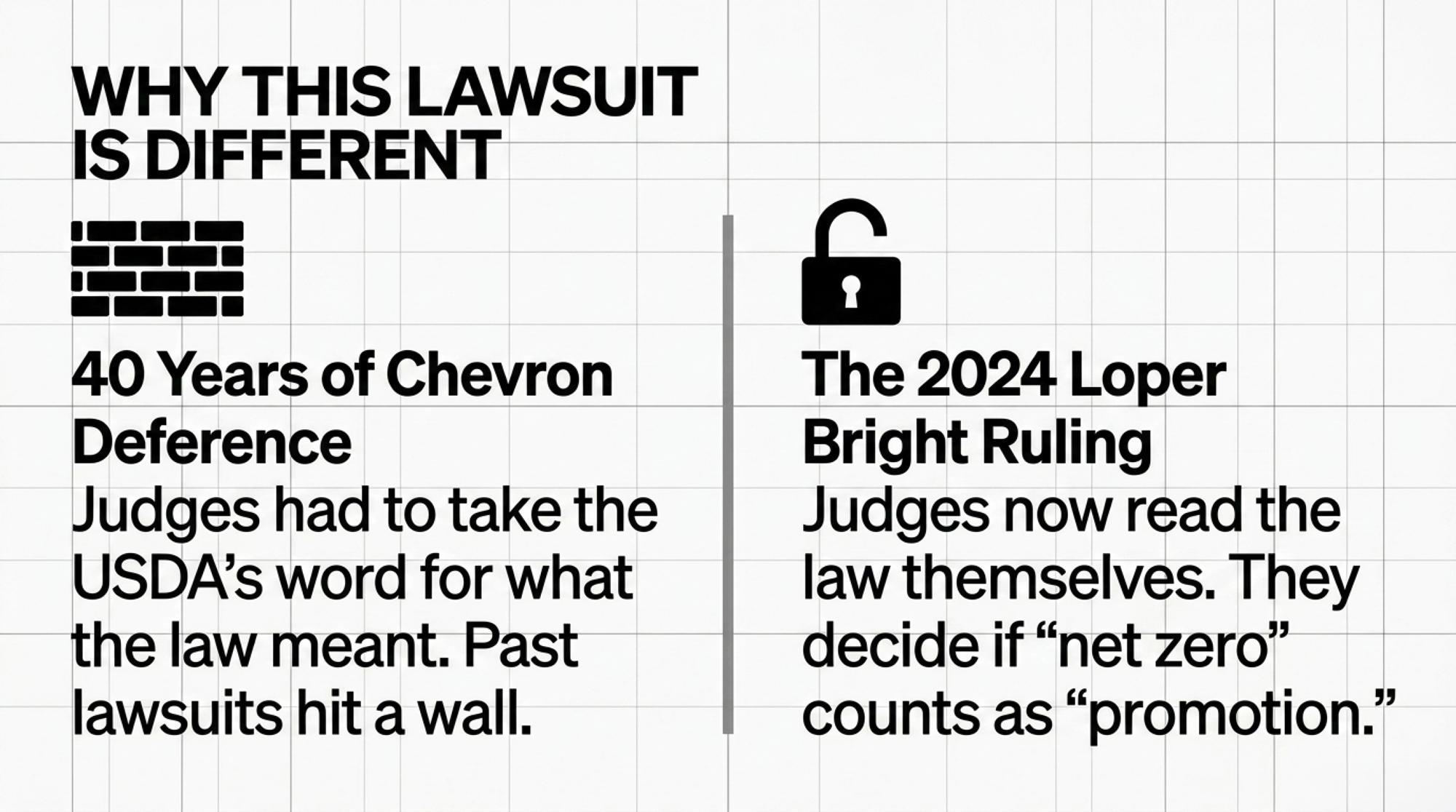
But this case isn’t only a speech case. In June 2024, the Supreme Court decided Loper Bright Enterprises v. Raimondoand overruled the 40-year-old Chevron doctrine (U.S. Supreme Court, 603 U.S. 369, 2024). Here’s the tractor-cab version: judges no longer have to take USDA’s word for what a statute means. They read it themselves. So a court can now look at the 1983 law’s actual language — “promotion of the sale and use of dairy products” — and ask whether funding net-zero infrastructure honestly fits, without deferring to the agency running the program. That’s a statutory question, not a speech question. It sidesteps the wall that stopped everyone before. No court has tested it on a checkoff yet. It’s an opening, not a verdict.
The Global Playbook: What U.S. Farmers Can Learn from Canada and the EU
| Dimension | United States | Canada | European Union |
|---|---|---|---|
| Funding mechanism | Mandatory 15¢/cwt federal checkoff (USDA order) | Provincial levies via supply management marketing boards | EU Common Agricultural Policy (taxpayer-funded co-financing) |
| 2024/25 budget | ~$350M+ collected annually (USDA, per complaint) | DFC-administered; $7.5M+ federal top-up in 2023 | €160M co-financing for 2026 promotion budget |
| Sustainability commitment | Net Zero by 2050 — Innovation Center / FARM ES | Net Zero by 2050 — “We’re In” campaign | Climate-linked CAP payment conditions for farmers |
| Governance | Farmer-elected board; 41 farmers + 12 importers (as of 2021) | Producers hold direct provincial board seats | European Commission approval; NGO/parliamentary pressure |
| Active legal challenge | Swan v. Rollins — June 9, 2026 (Eastern District, Wisconsin) | None equivalent | None equivalent; pressure runs opposite direction |
| Key legal lever | Loper Bright (2024): courts read statute independently | Supply management consent structure differs | Regulatory, not judicial |
| “Voluntary” pressure dynamic | Processor data requests tied to pickup contracts | Less documented at farm level | NGOs and buyers push for more strings on CAP payments |
To see where this “reputation-first” pipeline eventually leads, American producers only have to look across the border and over the Atlantic. Two mature systems, two very different answers on who controls the money — and both are instructive for what’s coming down the U.S. contract chain.
Canadian producers fund promotion too, but the structure is different enough that the same fight hasn’t erupted north of the border. Dairy Farmers of Canada (DFC) runs producer-funded promotion and has committed the Canadian sector to net-zero greenhouse gas emissions by 2050, backed by its “We’re In” sustainability campaign featuring real farmers (Dairy Farmers of Canada, 2023). Ottawa has chipped in too — over $7.5 million to DFC for sustainable dairy development in 2023 (Government of Canada, July 2023). (Canada-specific figures — don’t read these across to U.S. operations.)
The difference is governance. DFC’s levies flow through provincial marketing boards under supply management, where producers hold direct seats and the money is collected at the provincial level rather than through a single federally mandated USDA-style order. That’s why you haven’t seen a Canadian compelled-funds lawsuit mirroring Swan v. Rollins — the consent-and-control mechanics differ, even though the sustainability-spending direction looks strikingly similar.
Europe is almost the mirror image. The EU’s 2026 farm-promotion budget — €160 million in co-financing — isn’t a mandatory producer levy at all; it’s largely Common Agricultural Policy money, meaning taxpayers, not a milk-check deduction (European Commission call for proposals, Jan. 2026). And the pressure there comes from NGOs and parliamentarians who want more climate strings attached to the money, not from farmers suing to keep climate spending out. Mirror image of Wisconsin. Same global sustainability current, three very different fights over who controls the cash (European Commission, 2026; Regulation 1144/2014).
How Much Is This Really Costing Your Balance Sheet?
Start with what you can see. The 15-cent assessment is fixed and printed on every milk statement. What’s harder to see is the second layer — the practices and reporting the sustainability programs increasingly expect, with Bovaer just the most-quoted example. More buyer requirements are coming, and they don’t show up as line items until they’re already conditions of the sale.
The deeper problem is that the accountability runs one direction. The money is mandatory. Transparency is optional — you can request DMI’s budget breakdown, but no one pushes it to you (DMI Budget & Financials page). And there’s no rule anywhere requiring that a checkoff-funded obligation come with a documented, farm-level return that actually covers its cost. That’s the real gap. Not whether sustainability matters — but who’s on the hook when it costs more than your milk check can carry.
Is Your Co-op Routing Your Money Somewhere You Didn’t Choose?
Worth knowing, and most producers haven’t checked: of your 15 cents, you can direct up to 10 to a qualified state or regional program where farmer-elected boards steer the spending. The remaining nickel flows to DMI nationally (per the USDA AMS Dairy Promotion and Research Order). Do you know which path your dime takes — directed by people you can call, or dropped into the national pool by default?
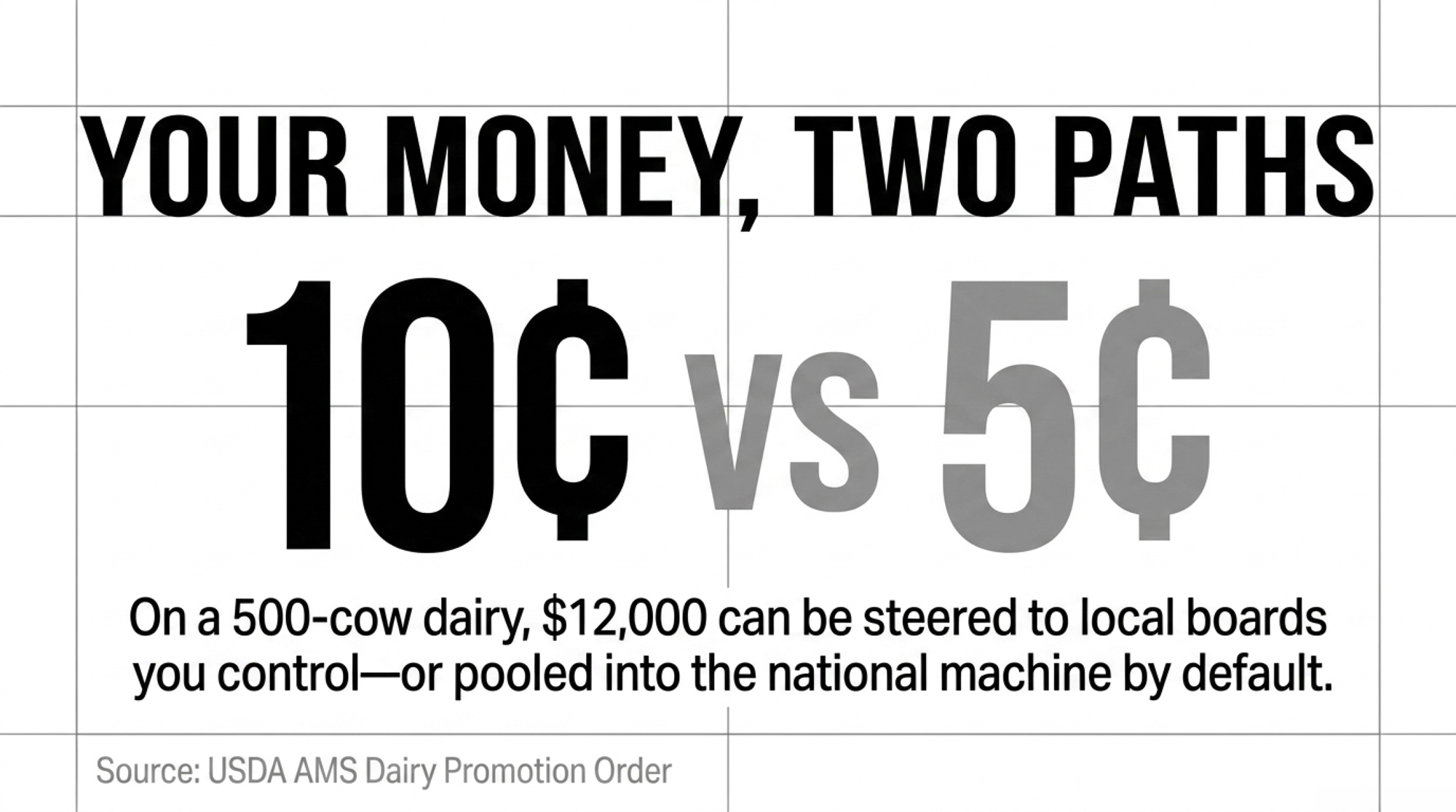
Put numbers on it. On a 500-cow dairy paying about $18,000 a year, the directable 10-cent share is roughly $12,000, with the national nickel running near $6,000. Scale that to 1,000 cows, and you’re looking at about $24,000 you could be steering locally versus $12,000 pooled nationally. One phone call to your milk handler settles where yours actually lands. That’s a this-month job, not a someday one.
Options and Trade-Offs for Farmers
There’s no single right move here. Some of this you can do this month with one phone call. Some of it is a longer game. Sort them that way.
| Practice / Obligation | Annual Cost/Cow | Documented Return/Cow | Net Gap/Cow | Gap on 500-Cow Herd | Return Source Reliability |
|---|---|---|---|---|---|
| Bovaer (methane additive) | $93–$105 | $20–$33 | $60–$85 | $30,000–$42,500 | Low — carbon markets volatile; premiums not broadly attached to methane reduction |
| FARM ES data collection | Staff time + audit cost (~$5–$15 est.) | $0 documented farm-level premium | ~$5–$15 | ~$2,500–$7,500 | None published at farm level |
| Annual checkoff assessment | $18,000 (500 cows, 24k lb RHA) | No direct farm-level return guaranteed | Full amount | $18,000 | Indirect only (market development) |
| Genetics for methane efficiency | $0–$8/cow higher semen cost (est.) | Compounding herd improvement; no direct premium yet | Neutral to slight positive | Neutral | Emerging — no contract premium attached as of 2026 |
| Carbon footprint audit (1-yr records) | ~$500–$2,000 in time/records prep (est.) | $0 guaranteed; possible future credit access | $500–$2,000 | $250,000–$1,000,000 | Speculative; market access not guaranteed |
Do this in the next 30 days:
- Verify your assessment routing. Pull your last three milk statements and ask your handler where your 10-cent state credit lands. Costs nothing, risks no relationship, takes one call. The limit: it tells you where the money goes, not what it buys.
- Request the budget breakdown. Ask your checkoff rep or co-op for the split between consumer promotion, “Reputation”/sustainability, and overhead. Makes sense if you want to judge ROI for your own herd type. The catch: the categories are self-reported, so read them with a skeptical eye.
- Make one policy call. The OFF Act (Opportunities for Fairness in Farming Act) would force USDA Inspector General audits and public budgets for the big checkoffs (Farm Action Fund). A call to your senator’s office costs nothing and spends zero co-op goodwill. The downside: it hasn’t passed, and Washington moves slowly.
Play the longer game:
- Watch the lawsuit — and weigh involvement carefully. Swan et al. v. Rollins is filed in the U.S. District Court for the Eastern District of Wisconsin, and WILL has posted the full complaint publicly. Litigation like this realistically takes 18 to 30 months before any ruling changes how the program runs. Getting publicly involved means a visible disagreement with the organizations tied to your milk check. That’s a real cost, not a small one — and only you know your own relationships.
Key Takeaways
- If you’ve never checked where your 10-cent state credit goes, call your milk handler this month — on a 500-cow herd that’s roughly $12,000 either steered locally or pooled nationally.
- If a sustainability program asks for a year of farm data, ask straight out: is participation tied to whether my milk gets picked up, and who owns the data once I hand it over?
- Before you adopt any checkoff-promoted practice, run the per-cow math first. If the cost (Bovaer’s ~$93–$105/cow) outruns the documented return (~$20–$33/cow), find out who’s covering the $60–$85 gap before you sign.
- If you want the assessment’s spending audited, the OFF Act is the existing vehicle — a constituent call is the cheapest pressure you can apply.
- Track the Swan v. Rollins timeline, but plan to keep paying the 15 cents regardless of how it lands for the next year and a half.
Abby Swan is still shipping milk. Still paying the 15 cents, same as you, while her name sits on a federal docket that won’t see a ruling for a year or more. So here’s the question worth carrying into your next co-op meeting: do you actually know what your mandatory 15 cents is buying — and whether the practices it’s nudging you toward still pencil out at the milk price you’re getting paid right now? Most producers have never run that number. Swan, Faust, and Baird did, didn’t like the answer, and handed it to a judge.
THE BULLVINE INTERACTIVE
Calculate Your Herd’s True Checkoff Cost & Sustainability Deficit
1. Enter Your Herd Metrics
2. Your Farm Financial Impact
Calculations derived from DMI 2024 audited books & processor sustainability contract models.
Complete references and supporting documentation are available upon request by contacting the editorial team at editor@thebullvine.com.
Learn More
- Adam Faust Beat USDA in 11 Months. The Checkoff May Be Next. — Arms you with immediate operational blueprints to audit your handler’s checkoff routing within 30 days, shielding your state-level 10¢ allocation from defaulting into DMI’s national pool.
- Hershey’s $121 Million Checkoff Bet: From TikTok Butter Boards to Your 15¢/cwt Milk Check — Traces why billions in marketing value continuously pool in corporate cheese and export lines while fluid milk returns drop, exposing the stark structural imbalance in national checkoff spending.
- Methane efficiency breeding beats Bovaer’s $73 gap — Delivers a zero-cost genetic counter-strategy using highly heritable sire traits, proving how permanent herd selection outpaces commercial feed additive contracts that strip margins out of your tank.
 The Sunday Read Dairy Professionals Don’t Skip.
 The Sunday Read Dairy Professionals Don’t Skip.
Every week, thousands of producers, breeders, and industry insiders open Bullvine Weekly for genetics insights, market shifts, and profit strategies they won’t find anywhere else. One email. Five minutes. Smarter decisions all week.