








A Wisconsin law firm walked USDA into a settlement in 11 months. Now they’re studying the $18,000-a-year checkoff bill on a 500-cow dairy. No complaint filed yet — but the math already is.
Executive Summary: A Wisconsin law firm just settled a federal case against USDA in eleven months, and on May 27 attorney Daniel Lennington told Brownfield Ag News he’s preparing the next one against the dairy checkoff. No complaint is filed yet — but the legal theory is already clear: the 1983 statute authorizes “promotion of dairy products,” while DMI’s 2024 audited financials show $110.5M of a $254.6M budget flowing into a “Reputation” category measured by environmental-perception shifts in Forbes and the LA Times. Every conventional U.S. dairy pays the 15¢/cwt assessment regardless — about $7,200 a year on 200 cows, $18,000 on 500, $54,000 on 1,500 — and the 5¢ national share is what’s actually at stake. Even if WILL files and wins, plan for an 18- to 30-month window before any operational change, which is roughly $27K–$45K more in assessments on a 500-cow dairy. The realistic remedy is prospective relief, not a refund check, and the under-discussed risk is co-op governance: a named plaintiff is announcing a public conflict with the body that signs the milk settlement check. The 30-day move for any producer reading this is smaller and cheaper — confirm with your handler that the 10¢ state share is being credited to a USDA-certified qualified program, not defaulting into DMI’s national pool.
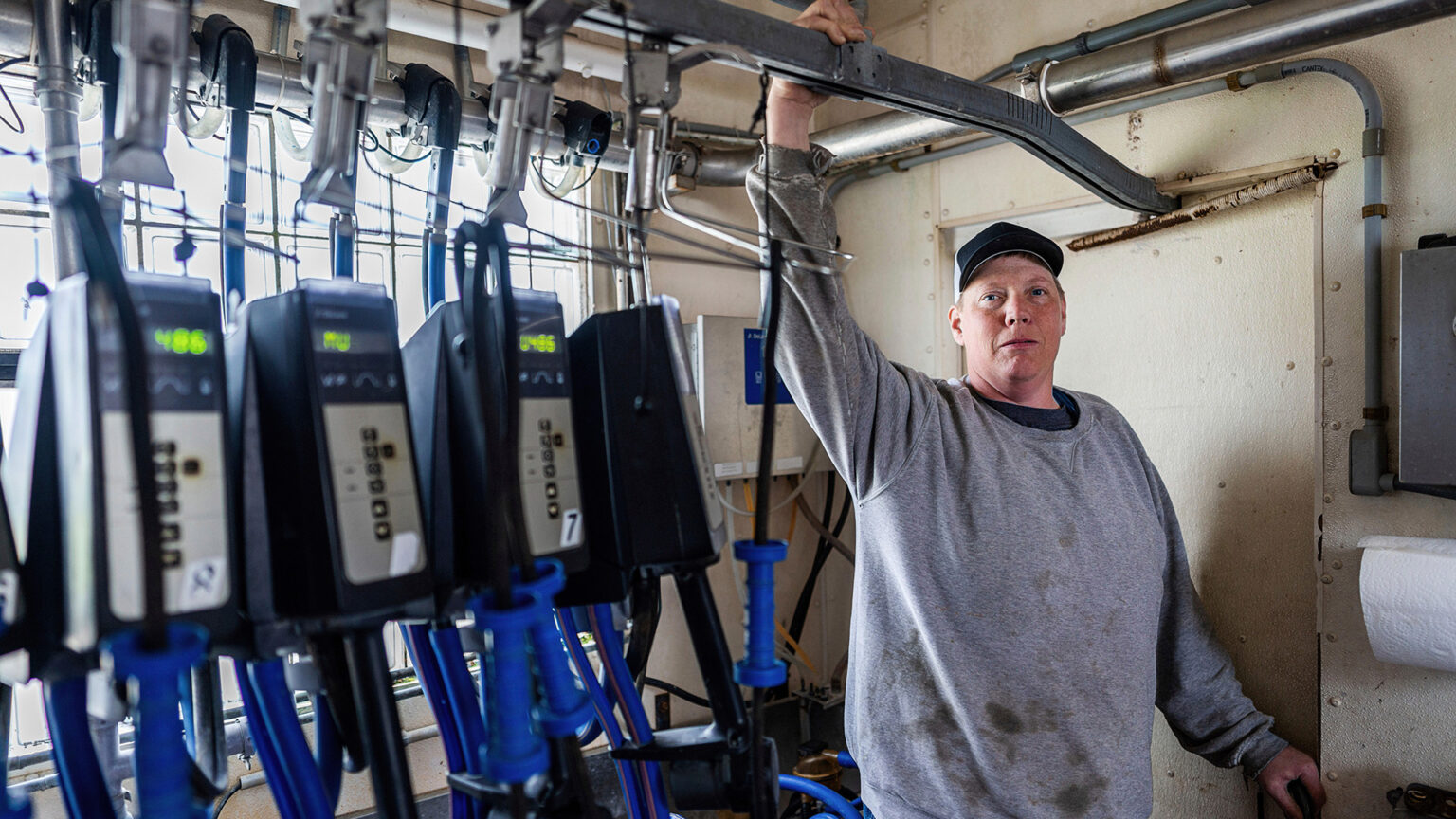
Adam Faust runs a dairy in Chilton, Wisconsin. In June 2025, he became the named plaintiff on a federal lawsuit filed by attorney Daniel Lennington at the Wisconsin Institute for Law & Liberty, challenging USDA program eligibility criteria. Within months, the Department of Justice walked back its defense of the challenged programs. By May 18, 2026, USDA settled — agreeing to remove the contested criteria from a wide range of programs nationwide. Eleven months from filing to settlement.
Then on May 27, 2026 — yesterday, by this article’s publication clock — Lennington told Brownfield Ag News reporter Larry Lee something that should land on every conventional dairy producer’s desk this week: WILL “is preparing another case against the federal government related to the dairy check-off program.” One sentence. No complaint filed. No plaintiff was named publicly. But the same firm that just walked USDA into a settlement in under a year is now studying the 15¢/cwt mandatory assessment that every conventional dairy farm in the country pays — about $18,000 a year on a 500-cow operation, $54,000 on a 1,500-cow operation.
“WILL is preparing another case against the federal government related to the dairy check-off program.” — Daniel Lennington, attorney, Wisconsin Institute for Law & Liberty, to Brownfield Ag News, May 27, 2026
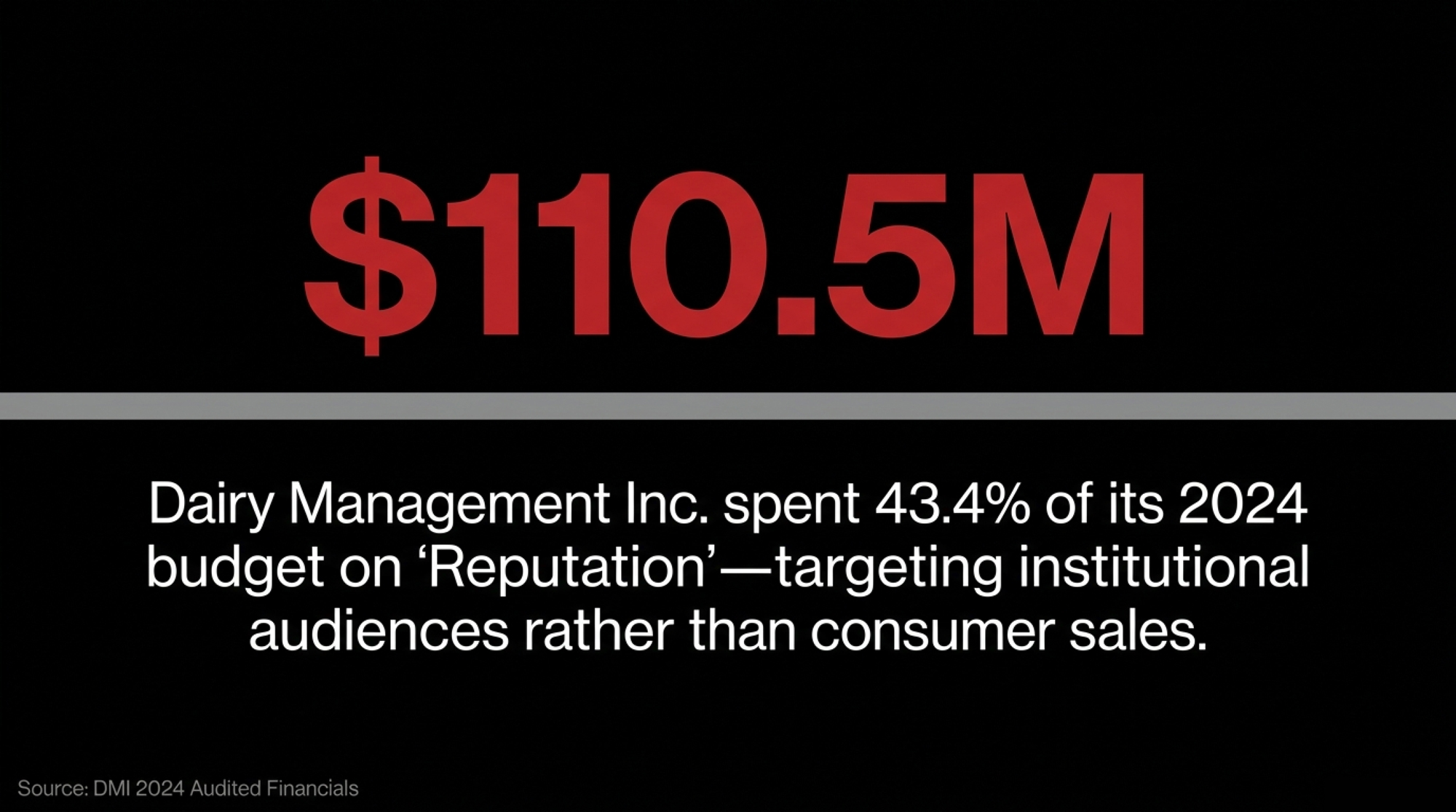
The fight isn’t about whether dairy promotion works. It’s about whether what the checkoff has quietly become — a $254 million program with $110.5 million flowing to “Reputation” work — still fits inside the narrow lane Congress drew in 1983. And whether you, as the farmer writing the check, have any say in it.
This is an analysis grounded in public filings, audited annual reports, and on-the-record statements. No new allegations are being made.
What’s Actually Being Challenged
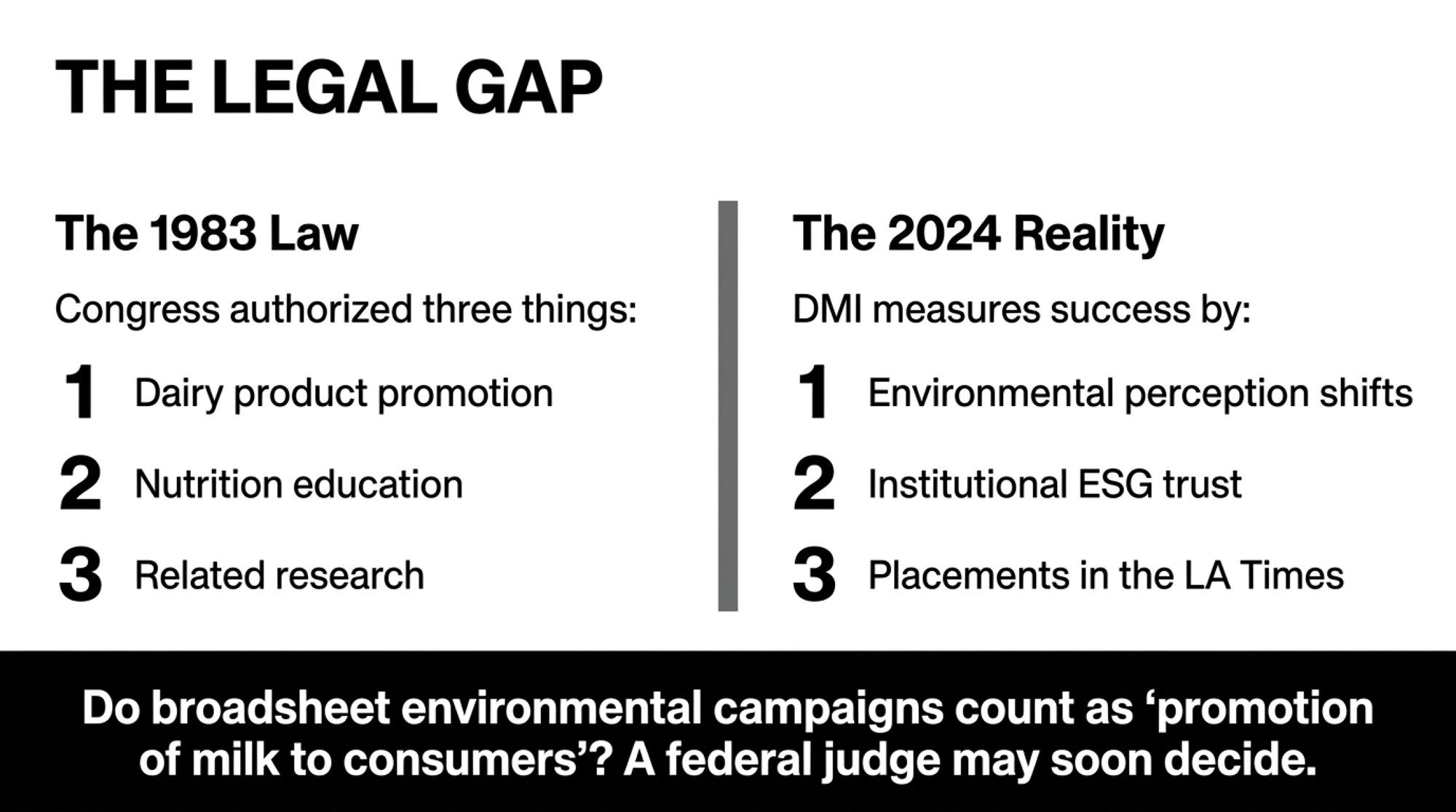
The Dairy Production Stabilization Act of 1983 authorizes three things, and only three. “Advertisement and promotion of the sale and consumption of dairy products.” “Research projects related thereto.” “Nutrition education projects.” That’s the lane. Producers ratified the program in a national referendum after the Act took effect.
The program looks different now. Dairy Management Inc.’s 2024 audited financials show $254.6 million in total expenditures, with $110.5 million — 43.4% of the entire budget — flowing into a category called “Reputation.” That category includes 46.8 million media impressions placed in Forbes, the New York Times, the Los Angeles Times, and USA Today, telling dairy’s “sustainability and nutrition story” to institutional audiences. One LA Times placement, according to DMI’s own annual report, produced an 8.3% lift in the belief that “dairy farmers are taking steps to help the environment.”
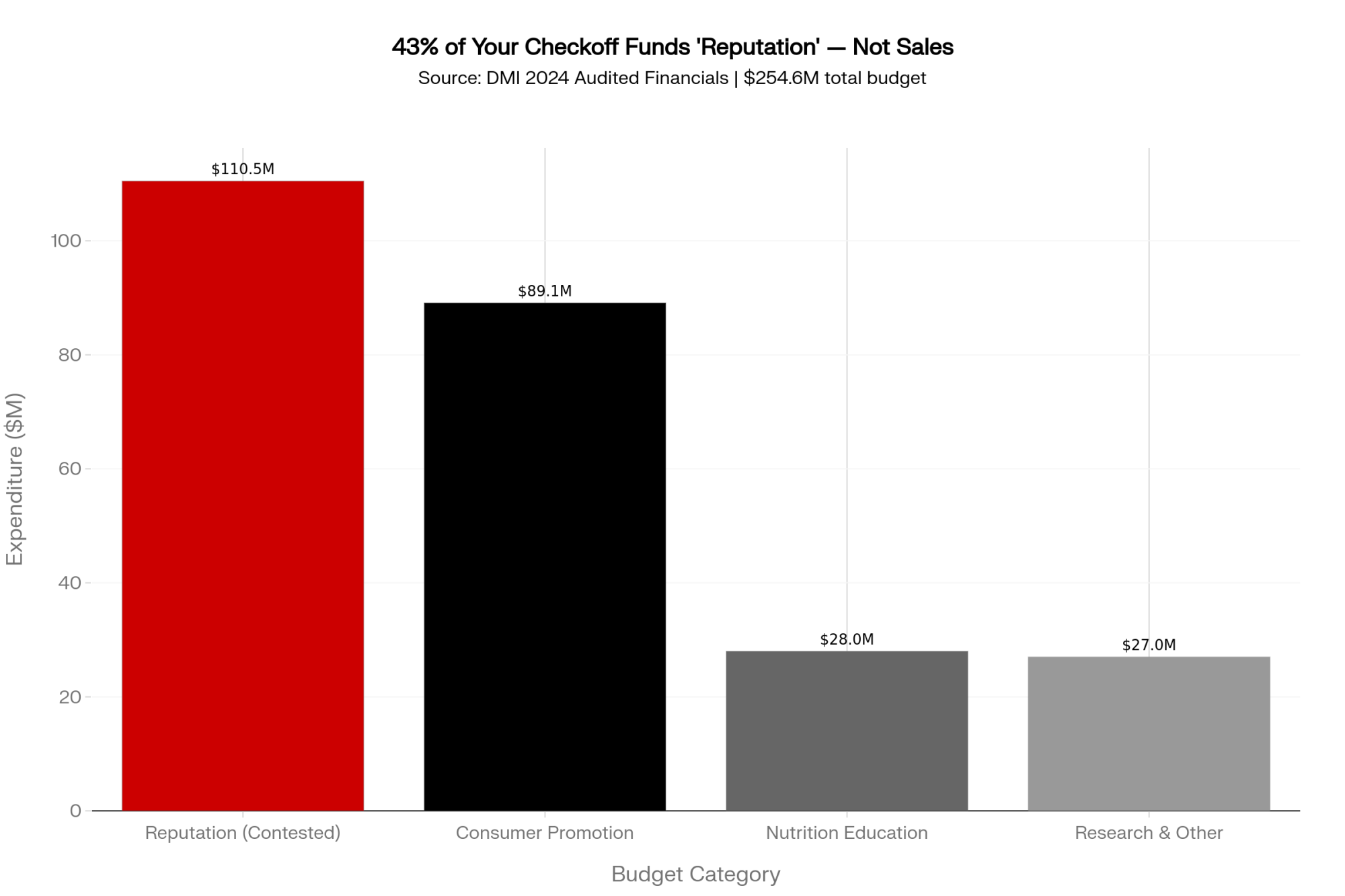
WILL’s likely argument is straightforward: a 1983 statute authorizing promotion of milk and cheese to consumers is now funding work that DMI itself measures by environmental perception shifts among urban readers of national broadsheets. The factual framing comes from DMI’s own reporting. The legal characterization — whether that fits inside “promotion of the sale and consumption of dairy products” — is the question no court has been asked in those exact terms, and the one WILL is preparing to put before one.
| 1983 Statute Authorizes | DMI 2024 Actual Program Activity | Alignment with Statute? |
|---|---|---|
| “Advertisement and promotion of the sale and consumption of dairy products” | $110.5M “Reputation” category — measured by environmental-perception shifts in Forbes and LA Times among institutional readers | 🔴 Disputed — metric is perception, not consumption intent |
| “Research projects related thereto” | Research allocated within overall $254.6M budget | ✅ Clearly within scope |
| “Nutrition education projects” | Nutrition content included in DMI programming | ✅ Clearly within scope |
| (Not authorized) | 8.3% lift in belief “dairy farmers are taking steps to help the environment” — cited as campaign outcome in DMI 2024 annual report | 🔴 No statutory basis — environmental trust ≠ sale/consumption promotion |
| (Not authorized) | 46.8M media impressions in national broadsheets targeting ESG-adjacent institutional audiences | ⚠️ Contested — who is the intended consumer here? |
What the Math Looks Like in Your Barn
The 15¢/cwt assessment is split into two components with very different governance structures. Run it at three common herd sizes, using a 24,000-lb/cow average — conservative relative to the 2024 U.S. national average of approximately 24,178 lb/cow.
| Operation | Annual cwt | Total Checkoff (15¢) | 🔴 National 5¢ Share (disputed) | 🟢 State/Regional 10¢ Share (local control) |
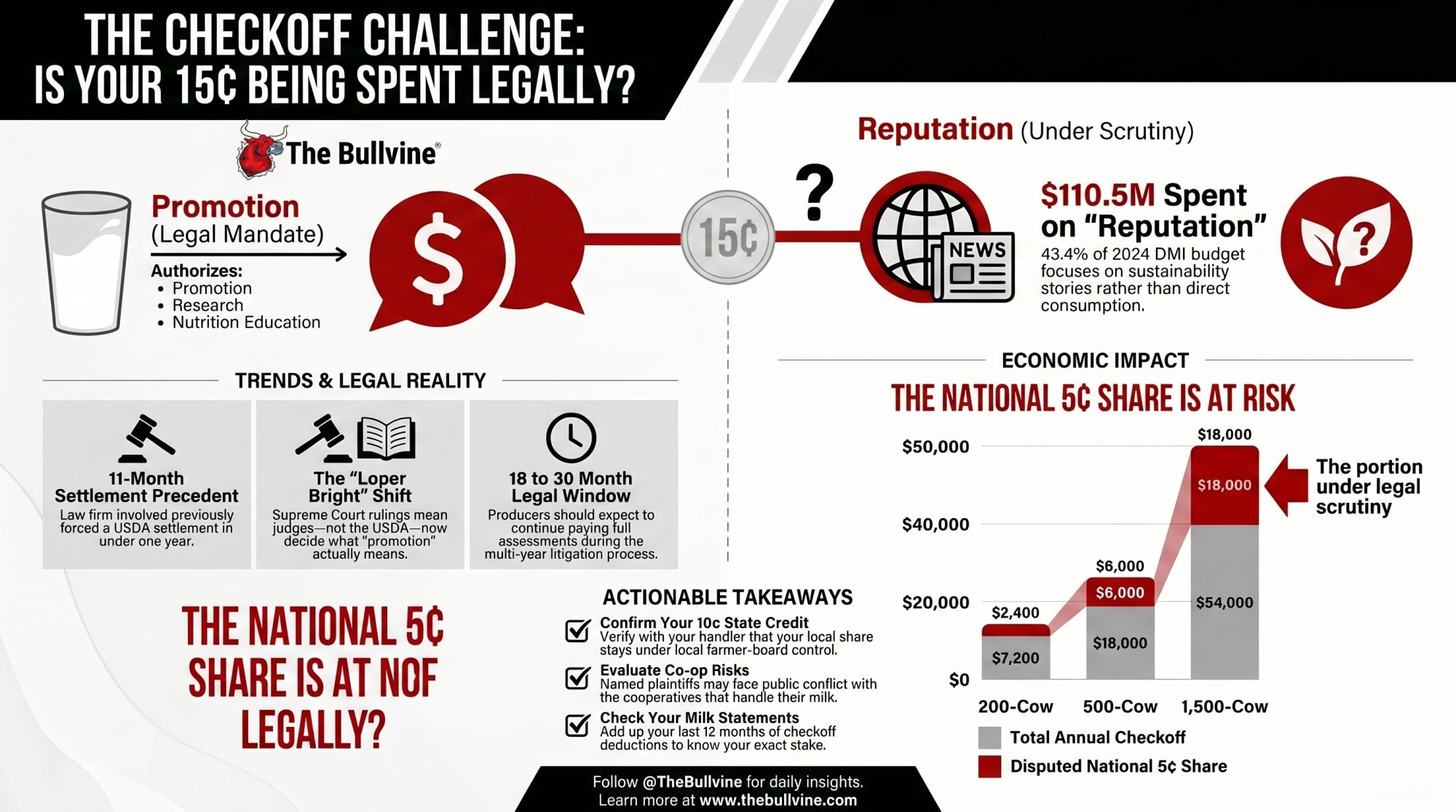
| 200-cow dairy | 48,000 | $7,200/year | $2,400 | $4,800 |
| 500-cow dairy | 120,000 | $18,000/year | $6,000 | $12,000 |
| 1,500-cow dairy | 360,000 | $54,000/year | $18,000 | $36,000 |
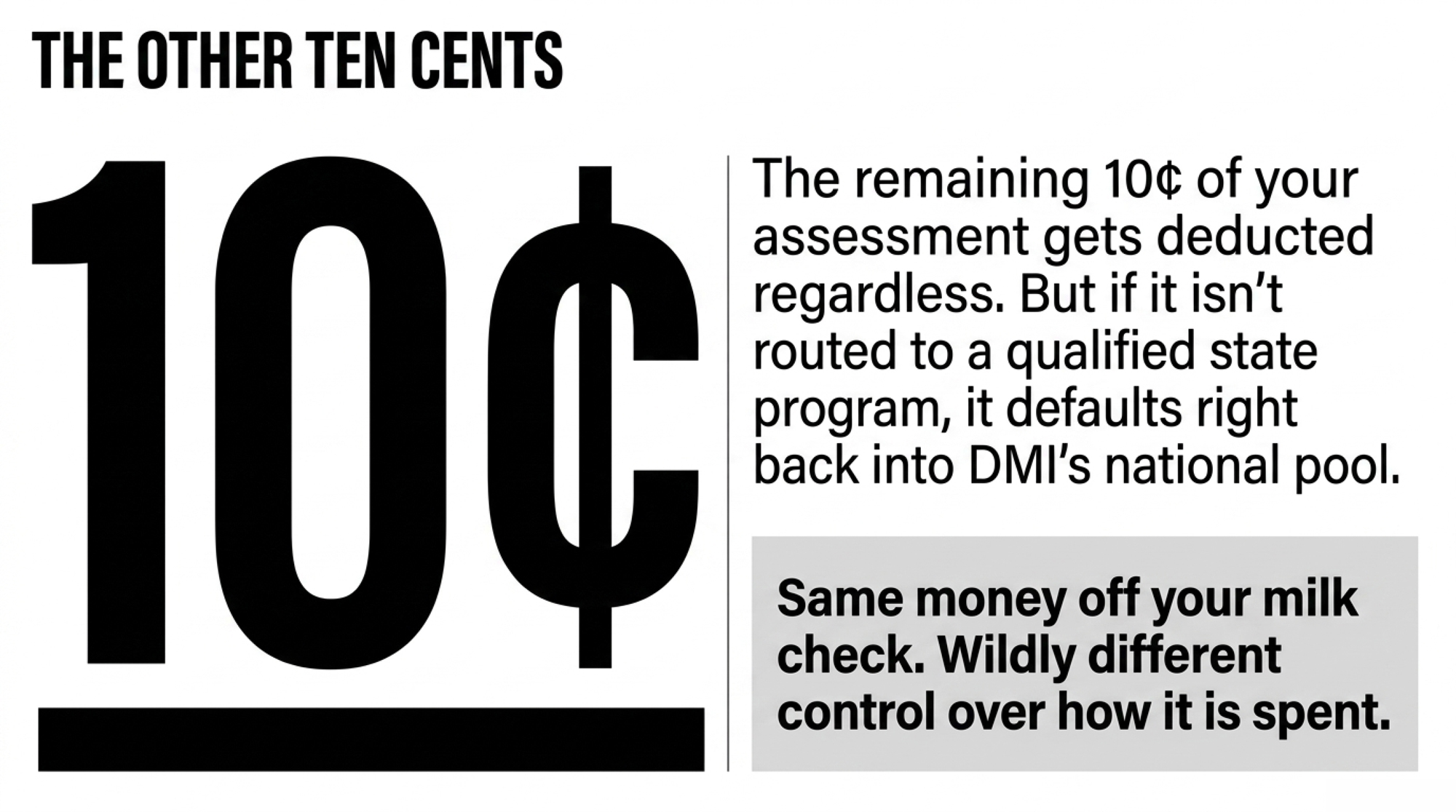
The red column is what’s at stake in any WILL lawsuit. That’s the national 5¢ flowing to DMI for the Reputation, sustainability, and institutional-trust work the legal theory is targeting. The green column gets deducted from your milk check, regardless — that part of the assessment isn’t going anywhere. The question with the 10¢ is governance: is it being credited to a USDA-certified, qualified state program where farmer-elected boards direct the spending, or is it defaulting to DMI’s national pool because no state program is properly receiving it?
That distinction matters. On a 500-cow dairy, $12,000 a year either gets directed by Midwest Dairy, Dairy Farmers of Wisconsin, or another state body whose board you can vote for and call, or it gets absorbed into the same national budget WILL is now scrutinizing. Same dollars off your milk check. Wildly different control over how they’re spent.
That gap is your first decision point this week. Pull your last three milk settlement statements, find the checkoff line, and confirm with your handler that the 10¢ is being routed to a qualified state program. It costs nothing to ask. It can be worth real money to know. For the broader picture of where the remaining 5¢ goes, our 76% of Your Dairy Checkoff Funds Cheese and Exports breakdown lays out the national pool category by category.
Brenda Cochran was the lead plaintiff in the 2004 challenge that briefly succeeded before Johanns reset the doctrine. The legal arguments she advanced then — that the assessment functions as compelled funding of speech farmers don’t choose — track closely with the theory WILL is now preparing. She’s still paying. Our profile, Brenda Cochran has been here before, gives the full timeline of how that 2004 case rose, won, and was vacated.
The Mechanics Behind the Legal Fight
To see why this case is harder to bring than it looks, you need the legal architecture in plain language.
In Johanns v. Livestock Marketing Association (2005), the Supreme Court upheld the beef checkoff under the government speech doctrine. The reasoning ran like this: because the Secretary of Agriculture has ultimate authority over checkoff messaging, the campaigns are government speech, immune from First Amendment challenge by private objectors. That ruling is what protects the dairy checkoff today, and it’s the structure WILL would have to work around.
| Legal Framework | Johnanns v. LMA (2005) — Status Quo | Post-Loper Bright (2024) — New Landscape |
|---|---|---|
| Core Doctrine | Government speech — USDA controls checkoff messaging, so no First Amendment challenge | Courts now read statutes independently; no deference to USDA’s own interpretation of its authority |
| Who Decides What “Promotion” Means | USDA/DMI define scope; courts defer | Federal judge reads the 1983 statute text cold — without agency deference |
| Vulnerability in Current Checkoff | Low — consumer promotion campaigns clearly government speech | Higher — “Reputation” campaigns attributed to “U.S. dairy industry,” not USDA; measured by ESG metrics |
| Best-Case Defense for DMI | Institutional trust → consumer demand → “promotion of sale and consumption” | Same argument, but a judge applying plain textual reading may reject it without Chevron cover |
| Likely Claim Type if WILL Files | First Amendment compelled speech (harder post-Johanns) | Statutory ultra vires — USDA exceeding 1983 Congressional authorization |
| Precedent Needed to Win | Must distinguish or overturn Johanns | Does not need to touch Johanns — textual argument runs independently |
That’s the doctrinal architecture. Here’s the crack in it.
The vulnerability is real. Johanns assumed the government was the genuine author of the speech, not just the administrator of the fund paying for it. That assumption holds cleanly for “Got Milk?”-style consumer promotion. It gets harder to defend when the campaign is attributed to “U.S. dairy” as an industry brand, targets institutional ESG-adjacent audiences, and is measured by shifts in environmental perception rather than consumption intent.
There’s a parallel argument that doesn’t even need to win on First Amendment grounds. Call it the exceeding-authority claim — that USDA is spending checkoff money on activities Congress never authorized in the 1983 statute. After Loper Bright Enterprises v. Raimondo (2024) eliminated Chevron deference, courts now read statutes independently rather than deferring to agency interpretations. A federal judge reading “promotion of the sale and consumption of dairy products” without deference, against a factual record showing institutional sustainability reputation campaigns, has a real textual problem to grapple with. Our prior DMI’s $165M Checkoff Bet coverage walks through the audited 2024 spending breakdown line by line.
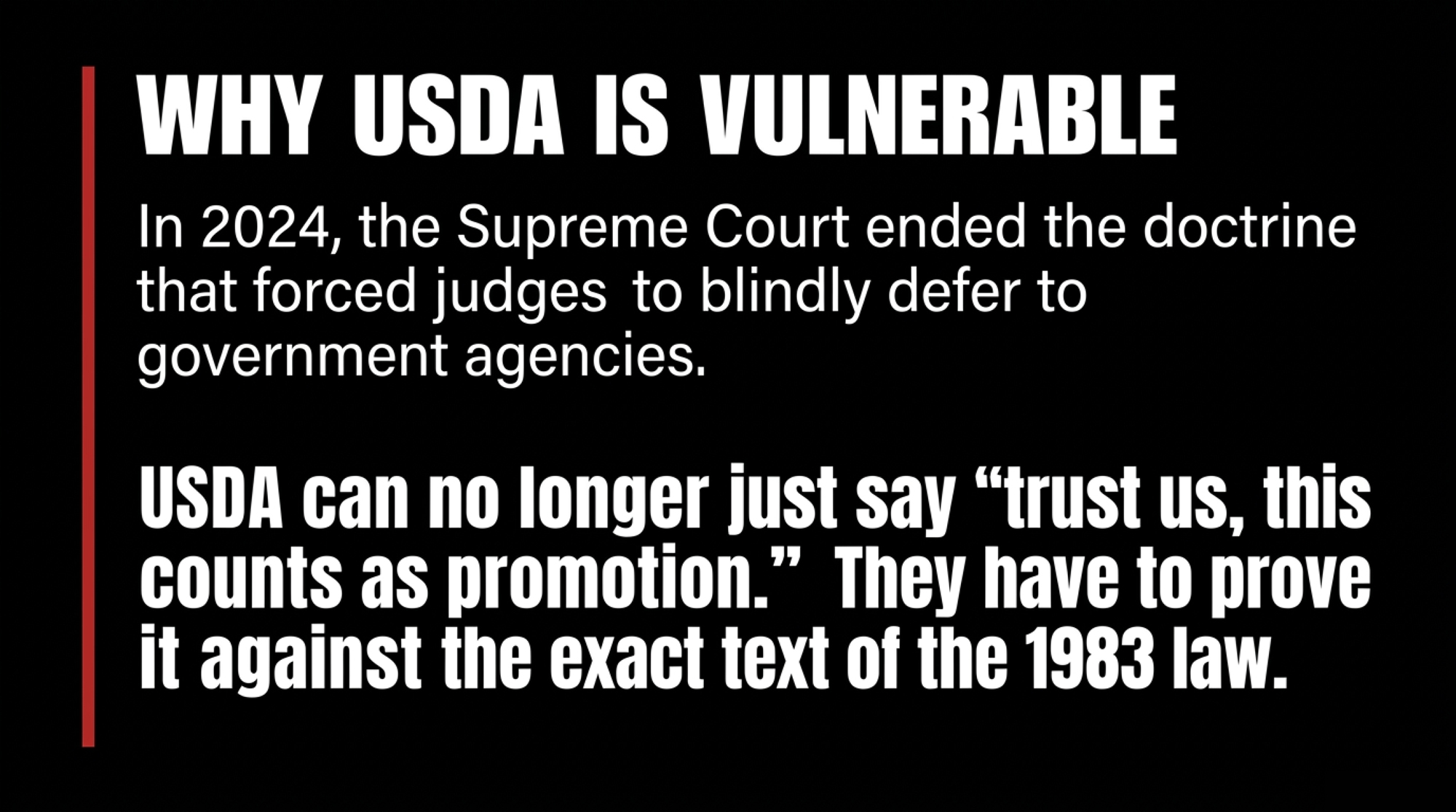
DMI’s defensible position is that institutional trust is instrumental to consumer demand — if processors, retailers, and media gatekeepers trust dairy’s environmental story, they stock more product and resist pressure from plant-based substitutes. That’s a real argument. It’s also a defense that has never been tested in court under Loper Bright. DMI’s 2024 annual report identifies environmental perception shift as the published outcome metric for the LA Times placement; whether a metric of that type satisfies the 1983 statute’s “promotion of the sale and consumption” language is precisely the question WILL would put before a federal judge. Requests for comment sent to Dairy Management Inc., USDA Agricultural Marketing Service, and the National Milk Producers Federation regarding whether the 2024 Reputation campaigns received messaging-level review by USDA or only budget-category approval were not returned by press time. The reporting record in the public domain — DMI’s own 2024 annual report and USDA AMS oversight documents — describes USDA’s authority over checkoff messaging in general terms without specifying the level of review.
How Much Does This Actually Cost a Farmer Who Wants to Push Back?
The short answer: between now and any court-ordered relief, you keep paying the assessment exactly as it stands today. Here’s what the realistic timeline looks like in seasons your operation actually plans around.
| Phase | Timing from Today (May 28, 2026) | What Changes for Your Operation |
| Pre-filing | June 2026 → late 2026 (3–9 months) | Nothing. WILL builds the case and selects a plaintiff. |
| Complaint filed | Late 2026 to Q1 2027 | Nothing operationally. Legal news cycle begins. |
| Preliminary injunction motion | 6–12 months after filing | Possible — but unlikely — first moment the program could pause. |
| Earliest realistic operational shift | Late 2027 to mid-2028 | Roughly two breeding cycles and two crop years from now. |
These phases reflect typical federal civil litigation timelines for agency action cases; the case-specific schedule will only firm up after a complaint is filed. For a 500-cow dairy at $18,000/year, the gap math runs roughly $27,000 to $45,000 in checkoff assessments collected during an 18- to 30-month window, regardless of how the litigation ultimately resolves. That’s the number a lender or financial advisor will ask about if the topic surfaces in a 2027 operating loan conversation.
The honest framing has to include this: the realistic remedy is prospective — an injunction, a structural change, or a forced congressional reauthorization — not a check in the mail for past assessments. Farmers chasing this for retroactive recovery will be disappointed. The litigation value is the injunction that stops future collection for unauthorized purposes. Or, in the strongest scenario, a referendum that puts the question — what should the checkoff fund? — back in front of the people writing the checks.
What Does Joining a Federal Lawsuit Mean for Your Co-Op Relationship?
This is the question most legal coverage skips. And it’s the one that probably matters most.
Most conventional dairy farmers sell through cooperatives. Cooperatives have institutional relationships with DMI and NMPF, and commercial incentives to maintain checkoff funding for programs that benefit their branded product portfolios. A member who becomes a named plaintiff in a federal constitutional challenge to that funding structure isn’t just filing a lawsuit. You’re announcing a public conflict of interest with the organization that processes your milk, signs your settlement check, and may hold your operating credit.
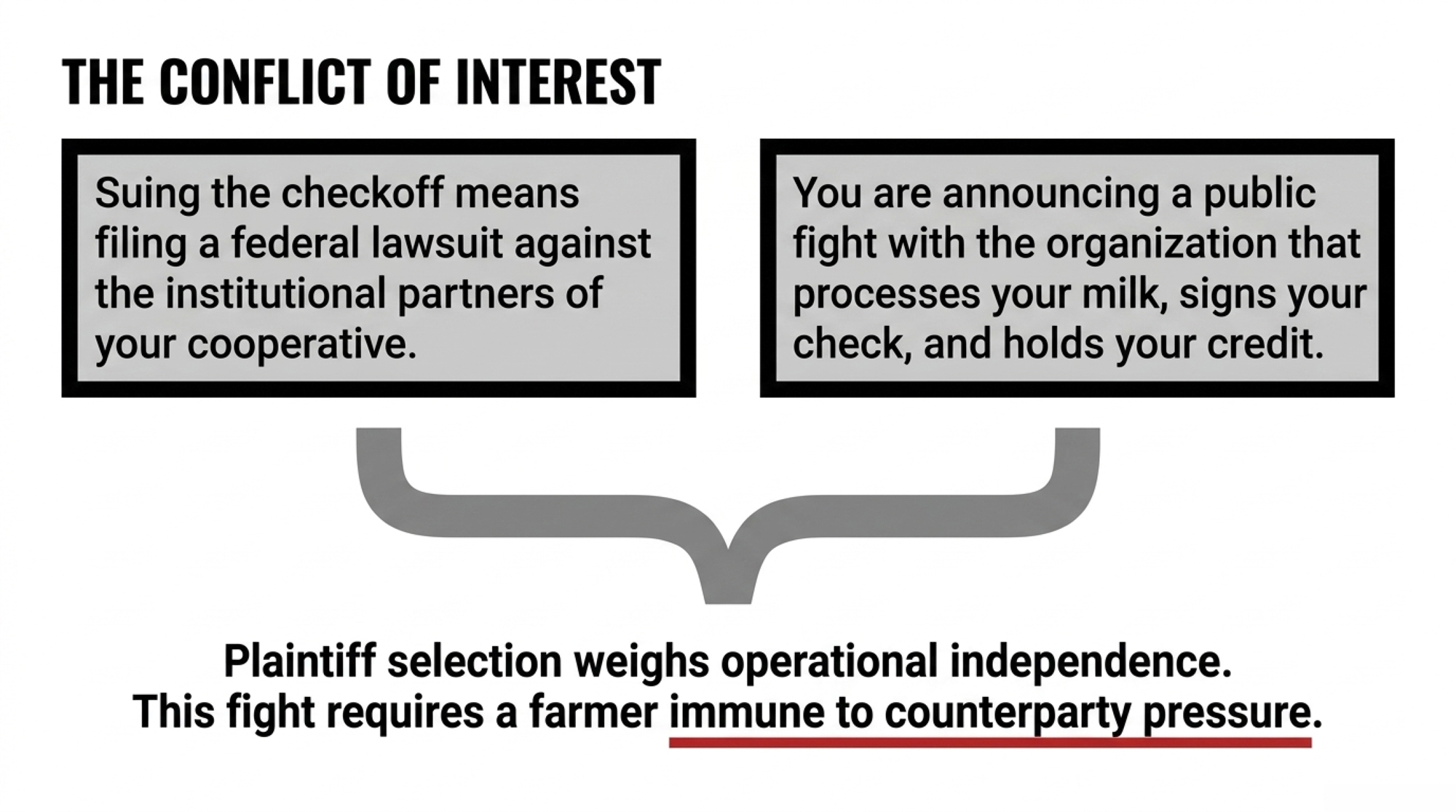
That’s not paranoia. It’s a realistic reading of how cooperative governance works in practice. In any constitutional challenge of this kind, plaintiff selection typically weighs operational independence alongside legal standing — particularly when the named plaintiff faces predictable counterparty pressure from milk handlers or co-op leadership. Cooperative structures, by design, prioritize collective decision-making over individual member dissent — which is why a referendum on current spending may never reach the floor through normal governance channels. Our case study on what happens when co-op governance breaks down traces that dynamic in detail.
Brenda Cochran’s position, twenty-two years after she first sued, is the only producer voice currently on the public record in this fight, and it’s a clarifying one: she paid the assessment in 2004, won at the Third Circuit, watched the doctrine reset under Johanns, and is still paying it today. That’s the practical answer to the “what happens to producers who challenge this” question. The check keeps going out. The argument doesn’t go away.
Options and Trade-Offs
Four practical paths are available to a producer who wants to engage with this issue. None of them is fast. None of them is free.
| Path | Action Required | Annual Cost Impact | Timeline to Result | Co-op Relationship Risk | Who It’s For |
|---|---|---|---|---|---|
| 1. Confirm State Credit | One call to milk handler | $0 — but up to $12,000/yr redirected locally | Immediate (30 days) | None | Every conventional producer |
| 2. Engage Co-op Board | Written request for DMI ROI audit; board access | $0 direct | 6–18 months | ⚠️ Moderate — may be seen as dissent | Producers with board standing |
| 3. Support OFF Act | Call your senator’s office (5 minutes) | $0 | 1–3 years (legislative) | None | Any producer wanting reform without confrontation |
| 4. Signal to WILL as Plaintiff | Self-assess co-op independence; contact WILL | $0 direct — but $27K–$45K kept flowing during litigation | 18–30 months to earliest change | 🔴 High — named public conflict with milk handler | Operationally independent producers only |
Path 1: Confirm your state credit. Do this within 30 days. The 10¢ portion comes off your milk check regardless — the question is whether it’s routed to a USDA-certified, qualified state program where you have governance access, or defaults to DMI’s national pool. Pull three milk settlement statements, find the checkoff line, and call your handler to confirm where the 10¢ is going. When it makes sense: always — this is about local control, not protest. Risk: minimal. What it requires: one phone call.
Path 2: Engage your co-op board on accountability. Most cooperatives bloc-vote member assessments and are institutionally aligned with DMI. A board member or active co-op participant can request audited farm-size ROI breakdowns from DMI and propose resolutions on automatic bloc-voting. When it makes sense: if you have standing on your co-op board or close access to those who do. Risk: you may appear out of step with co-op leadership. What it requires: a working relationship with directors and a willingness to make written requests.
Path 3: Support the OFF Act. The Opportunities for Fairness in Farming Act, reintroduced in the 119th Congress by Senators Mike Lee (R-UT) and Cory Booker (D-NJ), would prohibit checkoff programs collecting more than $20 million in annual assessments from contracting with policy-influencing groups, mandate USDA Inspector General audits, and require public budgets. When it makes sense: if you want reform without confrontation. Risk: legislative paths move slowly, and this bill has been introduced before without passing. What it requires: a phone call to your senator’s office. No litigation list. No co-op exposure.
Path 4: Signal interest to WILL as a potential plaintiff. The case hasn’t been filed. WILL is in the plaintiff selection phase. Adam Faust had the right profile in 2025 — a named, publicly visible producer with the operational independence to take on the lawsuit. WILL will be looking for that profile again. When it makes sense: if you’re a conventional producer with operational independence from co-op governance pressure and a willingness to be publicly named. Risk: the highest-cost path, with cost mostly relational. What it requires: honest self-assessment of your milk-marketing relationships before you make the call.
A forward-looking signal worth anchoring here: if DMI’s 2025 and 2026 program reporting begins narrowing the Reputation category back toward consumer promotion and away from institutional ESG framing, that’s a preemptive restructuring move — and probably the best outcome the industry can produce on its own without a court forcing the question. Watch the next two annual reports closely.
Key Takeaways
- If your 10¢/cwt isn’t being credited to a qualified state program, you’re not losing money — but you are losing local governance over $12,000 a year on a 500-cow dairy. Confirm with your handler this week.
- If you support sustainability work in principle but believe it should be voluntary or congressionally reauthorized, you’re closer to WILL’s likely legal theory than the ideological framing suggests.
- If you’re modeling the financial impact, plan for an 18- to 30-month timeline from filing to any operational change. That’s roughly two breeding cycles. Treat any “this changes everything tomorrow” framing — from either side — with skepticism.
- If you’d vote no on current spending in a farmer referendum but you depend on the co-op to stand behind your milk contract or operating loan, you’re in the position any plaintiff-selection process is built around — and you’re also the producer least able to engage publicly. Acknowledge that tension honestly before you pick up the phone.
- If the OFF Act lands on your senator’s desk with a constituent call attached, that’s the lowest-cost lever you have. It doesn’t require a lawsuit, a co-op confrontation, or a checkbook. It does require five minutes.
- If DMI’s 2025 annual report — due later this year — shows the Reputation category narrowing toward consumer-promotion metrics, that’s the industry signaling it sees legal exposure. If it doesn’t, the litigation pressure stays on.
What Now
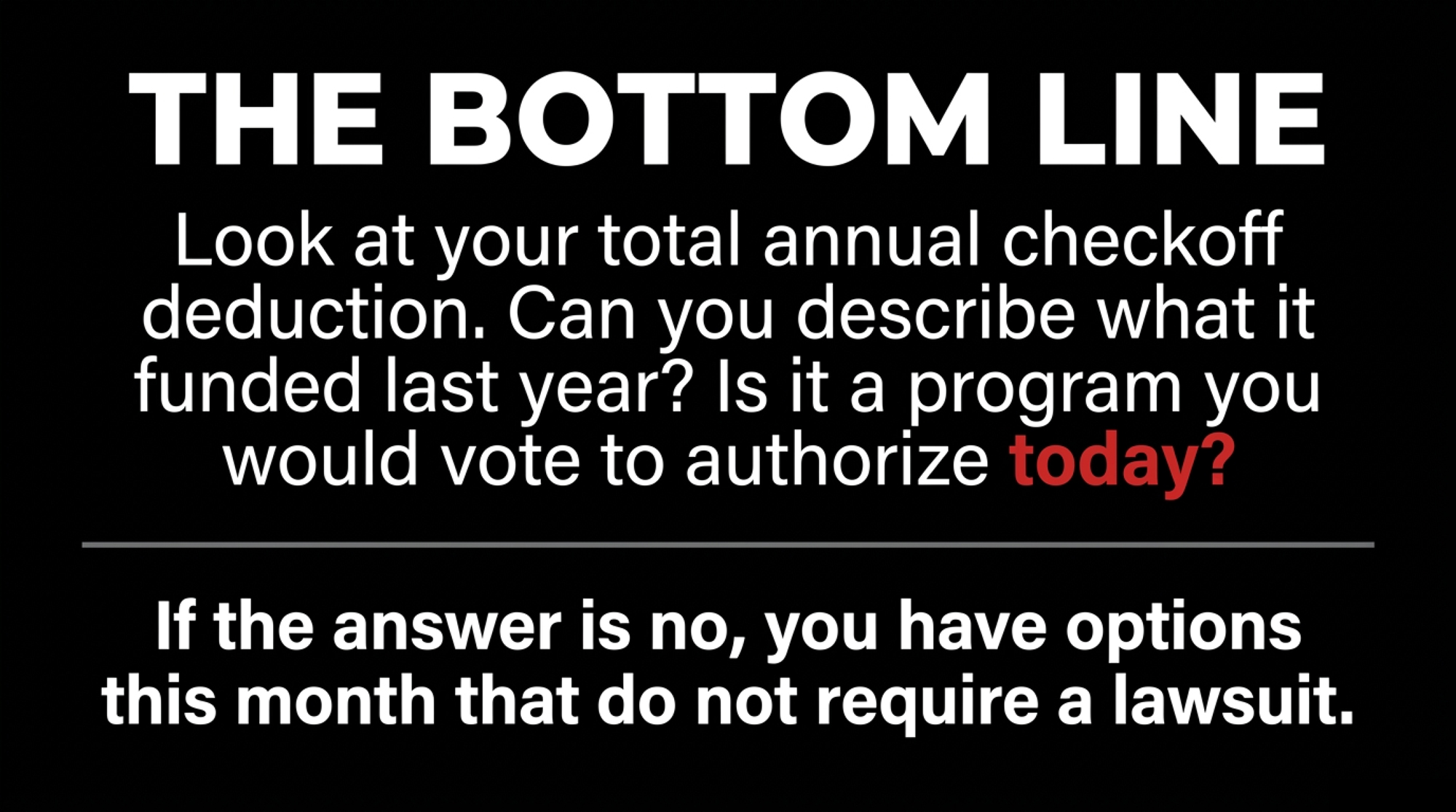
Pull your last twelve milk settlement statements. Add up the checkoff line. Then ask yourself a harder question than “is this legal” — ask whether you can describe, in one sentence, what that money funded, and whether that’s the program you’d vote to authorize today if anyone asked you.
If your answer is yes, this fight isn’t yours, and the cost of joining it is real. If your answer is no, you have more options this month than you probably realized — most of which don’t require a lawsuit. We’re breaking down the full Reputation-category audit, the Loper Bright statutory mechanics, and what each of the four paths actually costs at five different herd sizes in next week’s Bullvine Weekly. That’s where the deeper math lives.
Run Your Numbers
Farm Benchmark Snap Check — Pull your last three milk settlement statements and run the 15¢/cwt assessment against your actual herd size. The tool translates the disputed 5¢ national share and the 10¢ state share into your annual exposure, so you walk into that handler call knowing exactly what’s on the line.
Complete references and supporting documentation are available upon request by contacting the editorial team at editor@thebullvine.com.
Learn More
- Hershey’s $121 Million Checkoff Bet: From TikTok Butter Boards to Your 15¢/cwt Milk Check — Exposes the tension between national marketing campaigns and your individual barn margins, delivering a 5-question audit to track whether promotional influencer dollars actually trickled down into your component pay.
- Dairy Farm Economics 2026: Milk Pricing, Margins & Risk Playbook — Arms you with a defensive strategy for the $18.95 all-milk price squeeze, mapping out capital outlays, margin protection triggers, and concrete cash-flow limits over the next three years.
- 76% of Your Dairy Checkoff Funds Cheese and Exports. How Much ROI Hits Your Fluid Milk Check? — Dismantles the standard econometric return claims by contrasting national checkoff success with regional FMMO make allowance losses that stripped real cash from Class I fluid milk pools.
 The Sunday Read Dairy Professionals Don’t Skip.
 The Sunday Read Dairy Professionals Don’t Skip.
Every week, thousands of producers, breeders, and industry insiders open Bullvine Weekly for genetics insights, market shifts, and profit strategies they won’t find anywhere else. One email. Five minutes. Smarter decisions all week.




