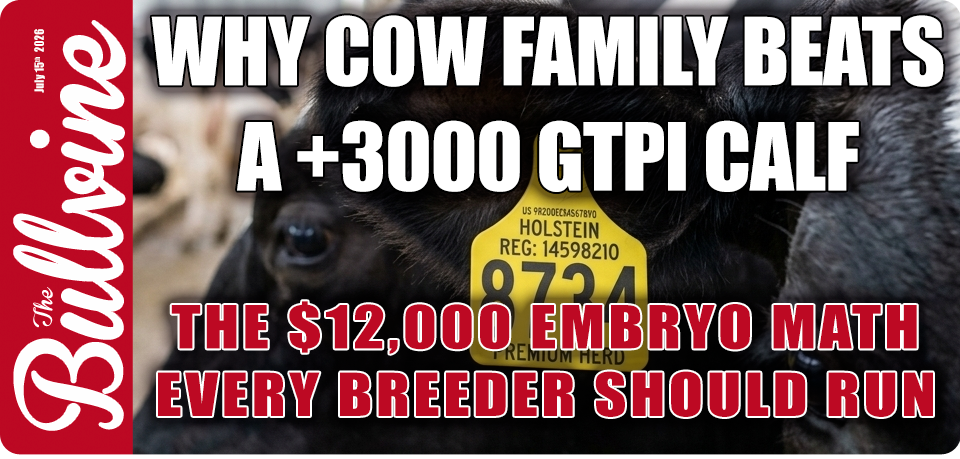




A dynasty-line heifer can out-earn a flashier genomic pick by roughly $950 to $1,600 over five years — here’s the barn math, and why the surname on your best cow’s ear tag matters more than the index on top.
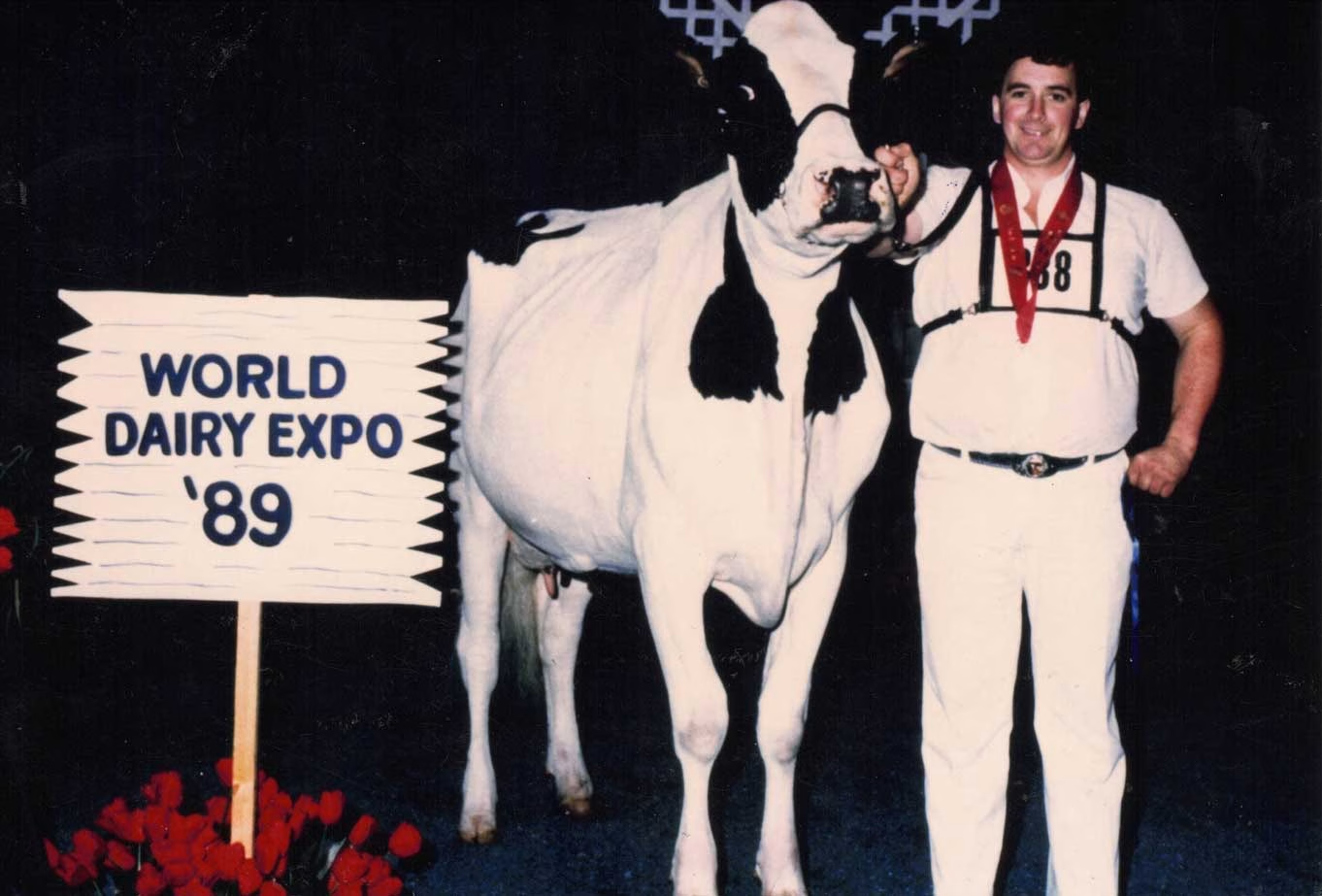
The best argument for cow family over index sheets showed up on Marc Comtois’s trailer in 1985. It was Elysa Anthony Lea EX-15*, one of Willowholme Mark Anthony’s best daughters, and the most important thing he ever bought. Bred to Puget-Sound Sheik, she produced Comestar Laurie Sheik VG-88-23* in December 1986. That one cow went on to anchor 14 Semex Class EXTRA bulls and four millionaire sires — Leader, Lee, Lheros, and Outside. That’s a maternal dynasty, fully cashed in.
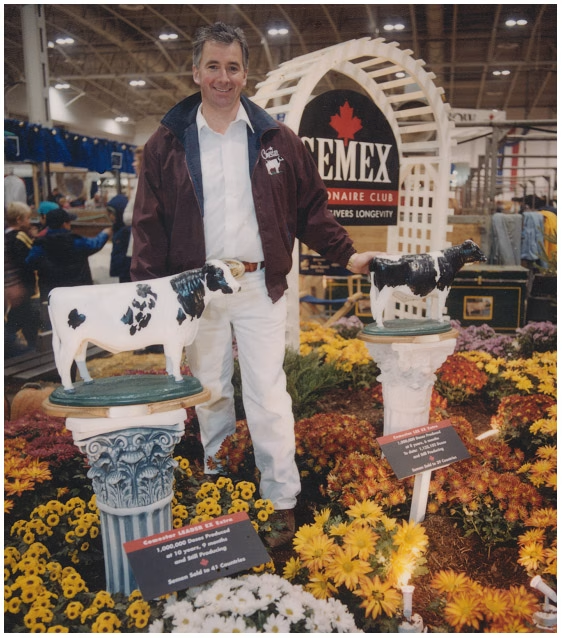
Marc Comtois at the Semex Millionaire Club display, flanked by models of Lee and Leader — two of the four millionaire sires bred off Comestar Laurie Sheik. The placards tell the story in numbers: over a million doses, semen sold in 43 countries. No single index built that. One cow family did — which is exactly the case this article makes
The uncomfortable question is what’s happening in your own barn right now. You’re spending on genomic tests, elite semen, and $3,000-plus embryos without asking whether the cow family underneath those numbers can actually stay in your barn for three or four lactations. That gap between paper merit and staying power is what this piece is about.
From Bull-of-the-Month to Cow Families That Don’t Miss
Genomics promised we could skip generations of slow, patient pedigree-building. But as the index race speeds up, a paper-thin pedigree is turning into a high-maintenance luxury. Let’s look at the real math of what a shallow family costs you once the honeymoon of her first proof wears off.
The industry still runs on a four-month heartbeat — new proofs in April, August, December, fresh catalogs, a fresh list of must-use sires. CDCB’s April 2025 base change reset every TPI value in the system, moving the reference point from cows born in 2015 to those born in 2020, and the April 2026 run reshuffled the rankings again, with STgen alone holding 36% of the proven TPI top 100. By design, you’re pushed to think bulls first.
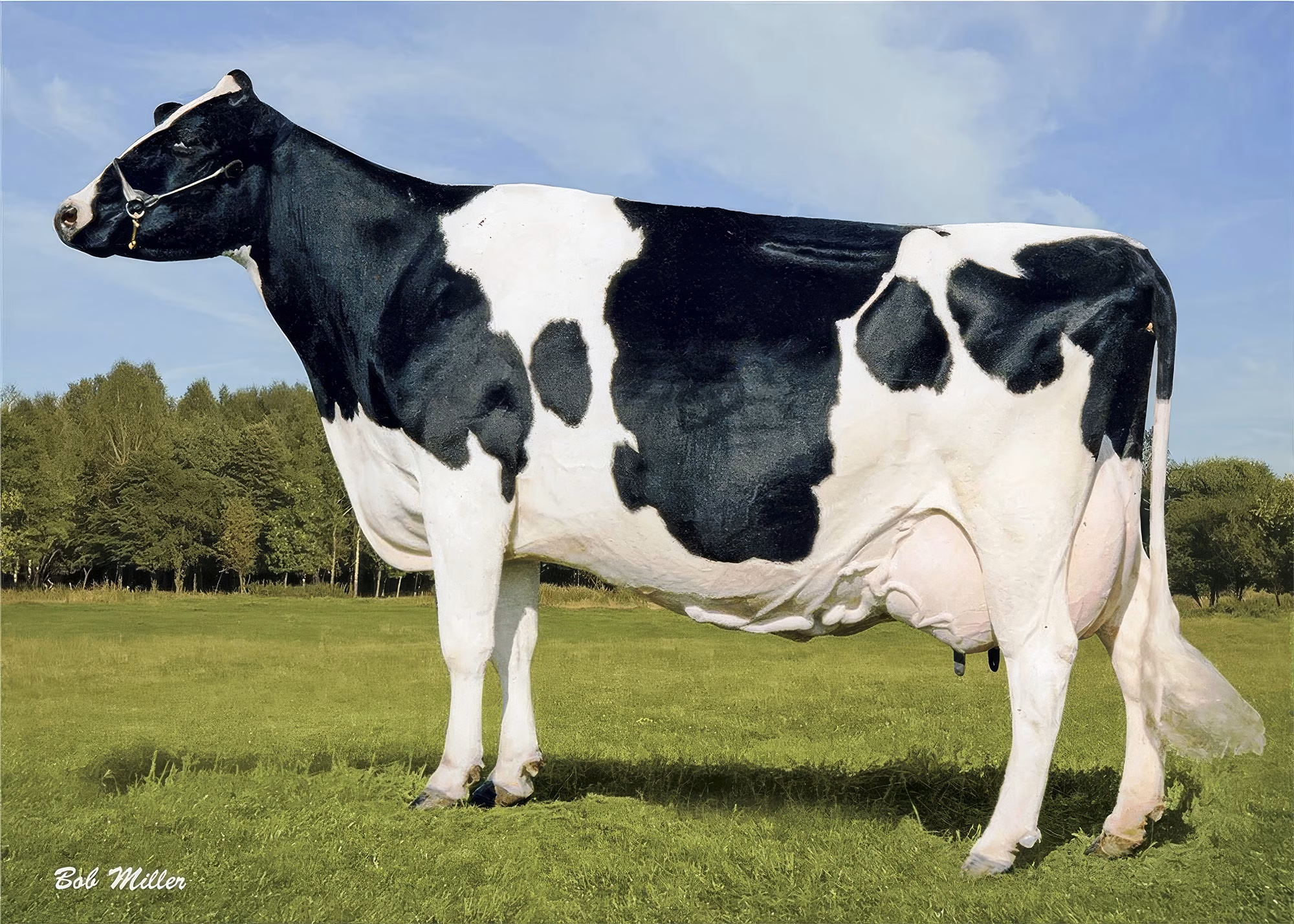
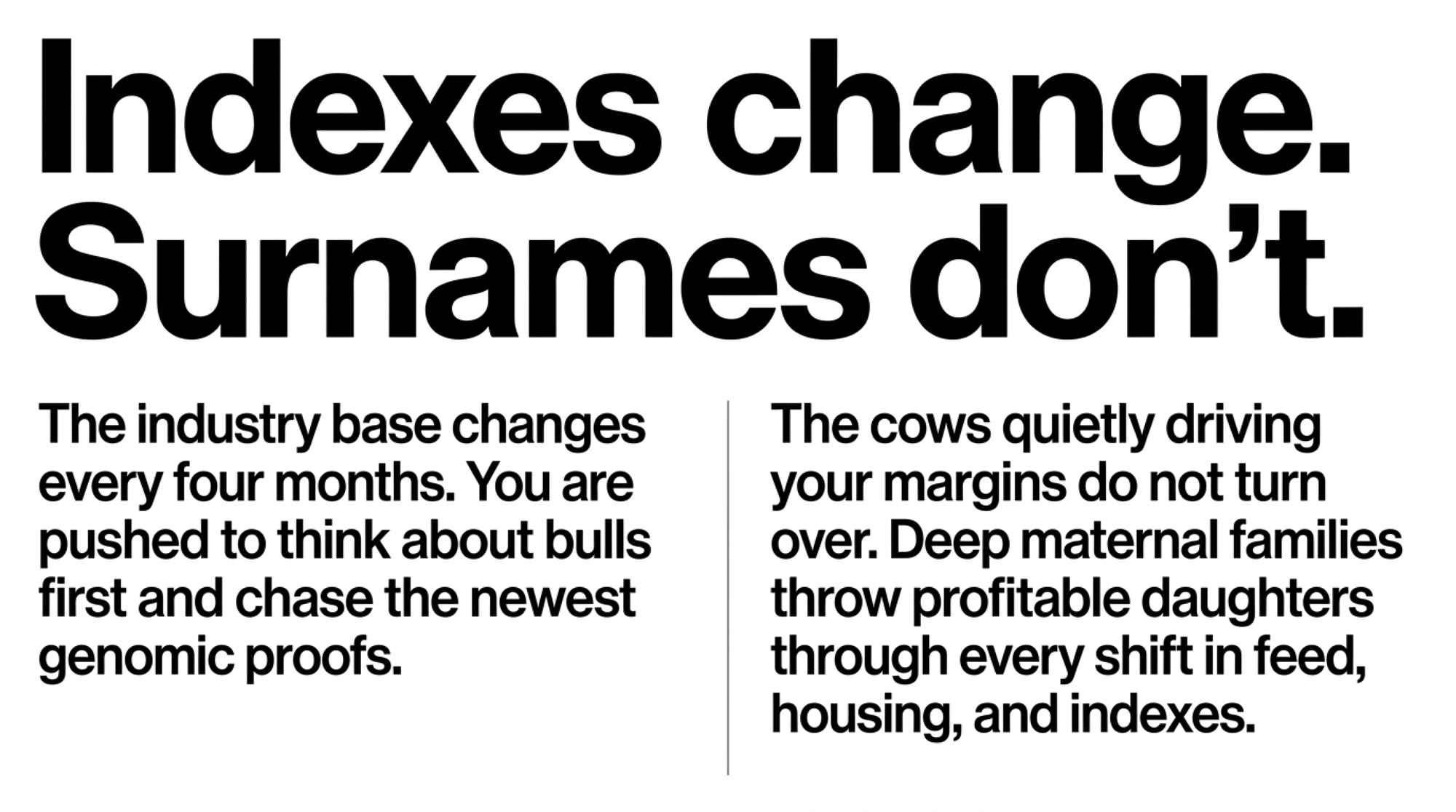
The cows quietly driving your margins don’t turn over every four months. Strip the brand names off the catalogs, follow the cow side, and the same surnames keep surfacing: Comestar Laurie Sheik, Snow-N-Denises Dellia and her granddaughter Regancrest-PR Barbie, Glenridge Citation Roxy. These families do what no single sire can — throw profitable daughters, generation after generation, through changes in feed cost, housing, indexes, and tools. For the wider story of how 16 years of genomics rewrote which bulls get used — and what it didn’t touch on the cow side — see The Great Holstein Shakeup.
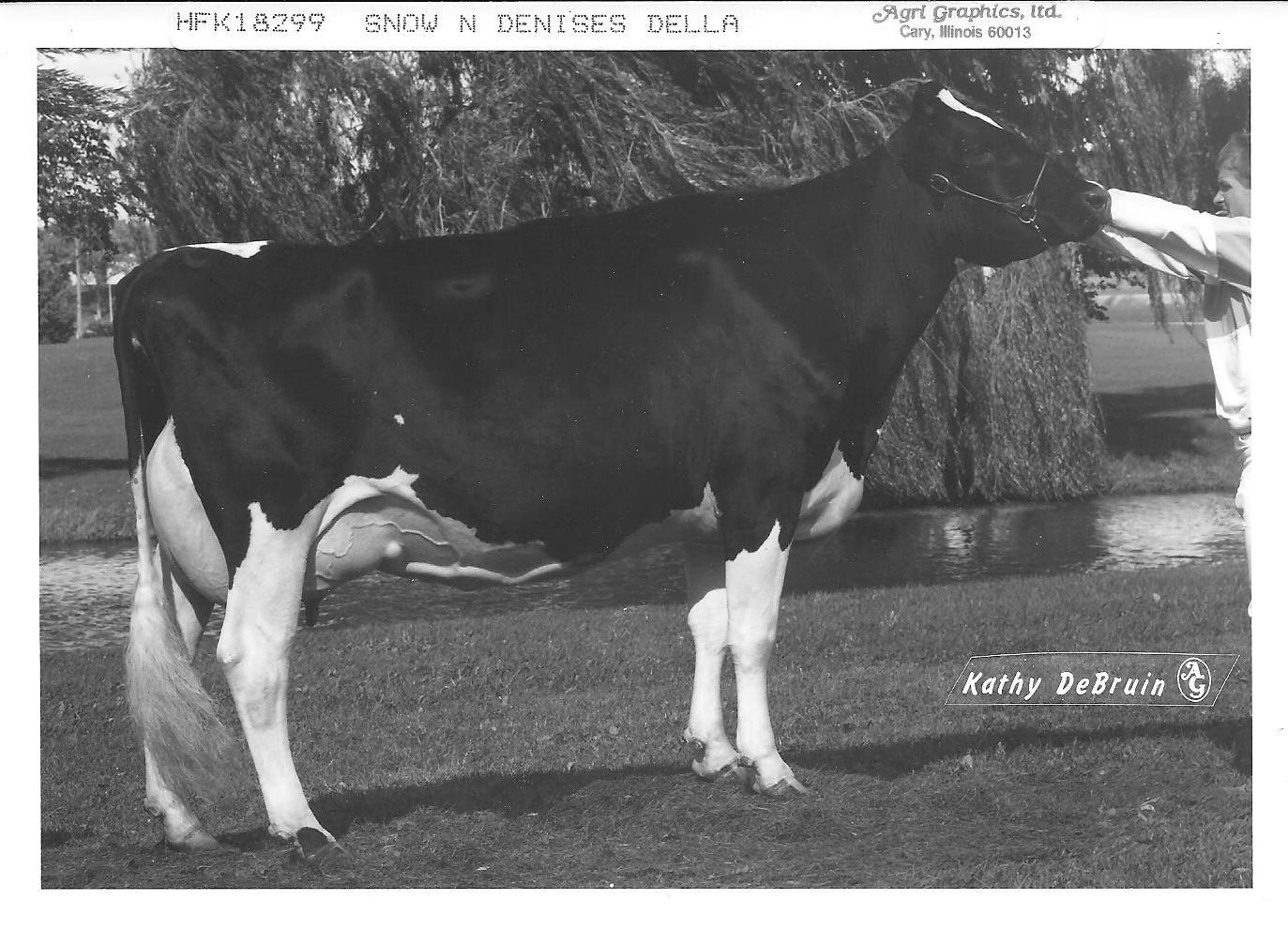
Snow-N Denises Dellia, EX-95-2E-GMD-DOM—Walkway Chief Mark out of Snow-N Dorys Denise, with Carlin-M Ivanhoe Bell as maternal grandsire. “Tall, sharp, clean, beautifully uddered, and trouble-free,” judge Niles Wendorf called her the day she stood grand champion at the 1991 Wisconsin Spring Show. This is the cow Select Sires had passed on. (Read more: Three Gold Medal Sons From One Cow the Studs Didn’t Want)
How Does a Shallow Pedigree Actually Cost You Money?
Bring it down to two heifers walking into your parlor next spring.
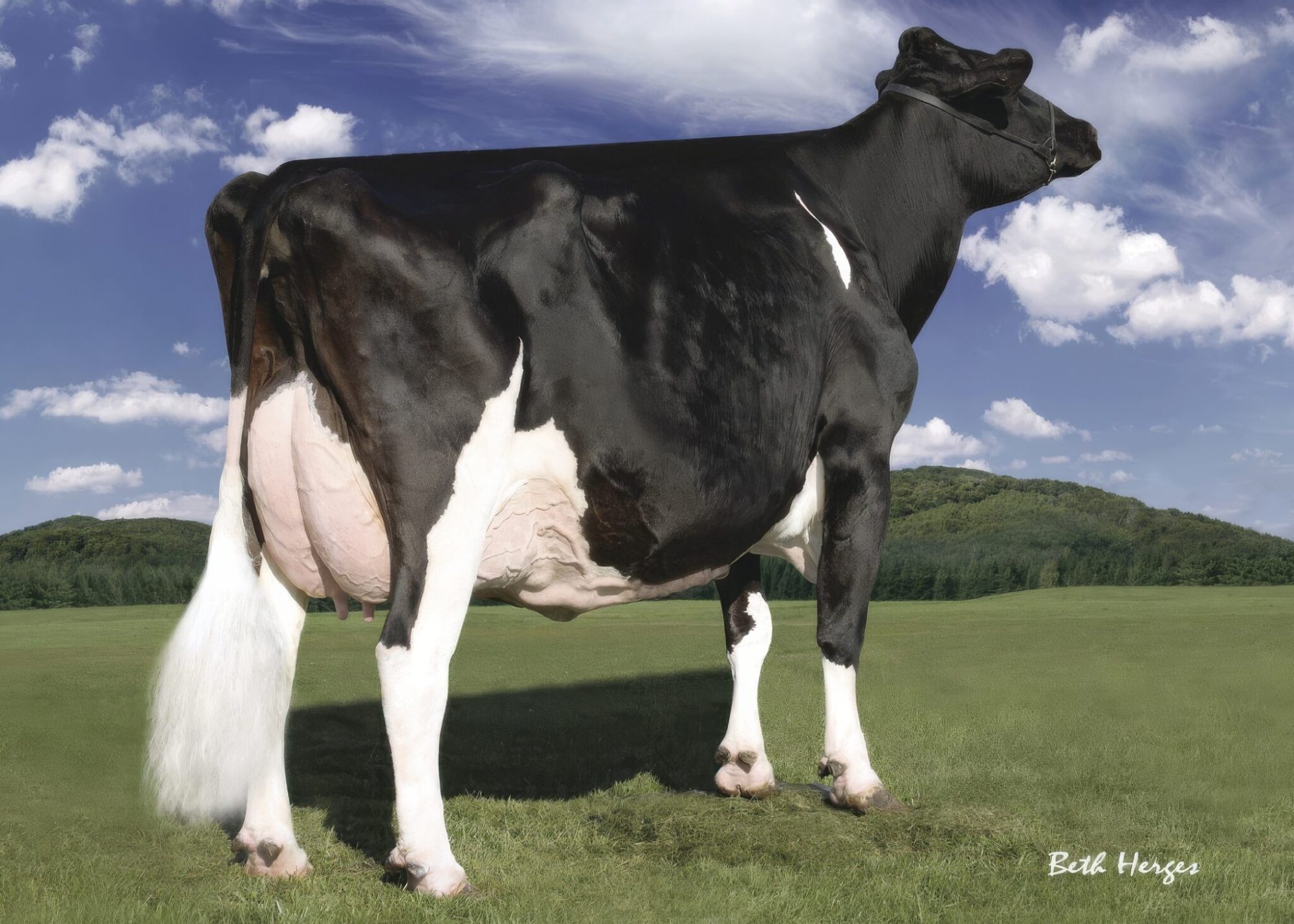
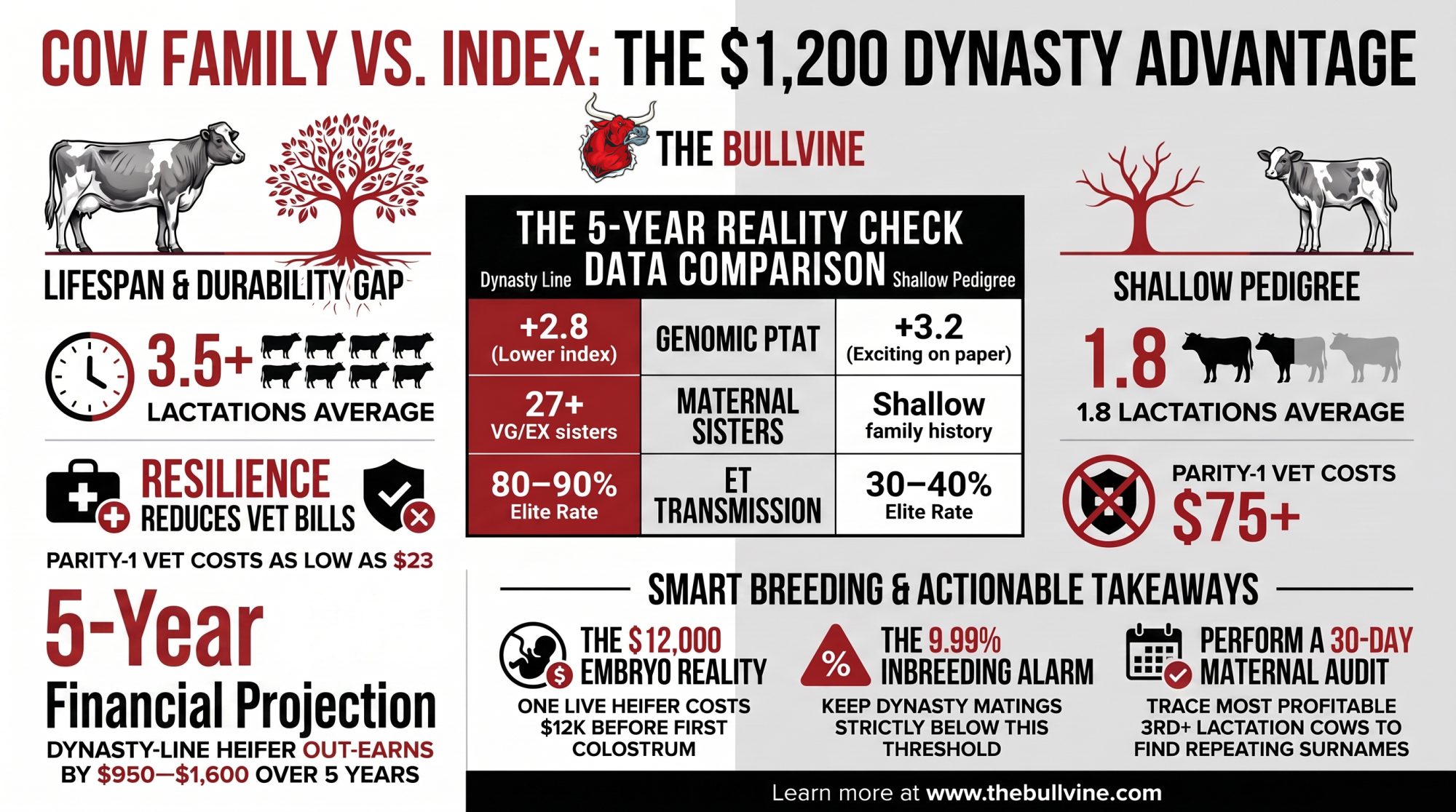
Heifer A is +3.2 PTAT on a genomic-only proof. Her dam’s a GP cow with two quick lactations and not much behind her. On paper, she’s exciting. In reality, you’ve got no idea whether that maternal line survives heat, robot glitches, or your transition pen. Heifer B is +2.8 PTAT — less flashy on the sheet. But she comes from a Barbie-type line where more than 27 daughters have been scored, all but one landing VG or EX on first classification, and where the family now sits behind roughly 36% of top-tier PTAT rankings.
Heifer Comparison: Dynasty vs. Shallow Pedigree
| Attribute | Heifer A (Shallow Pedigree) | Heifer B (Dynasty Line — “Barbie/Roxy”) |
| Genomic PTAT | +3.2 (exciting on paper) | +2.8 (slightly lower index) |
| Maternal backing | GP dam, shallow family | Deep line (27+ VG/EX maternal sisters) |
| Expected lifespan | ~1.8–2 lactations (early cull risk) | 3.5+ lactations (proven durability) |
| Parity-1 vet costs | ~$75+ (higher stress susceptibility) | ~$23–$35 (resilient, low drama) |
| ET/IVF viability | High risk (unproven transmission) | High reward (80–90% elite transmission) |
| 5-year est. margin | Baseline | +$950 to +$1,600 (midpoint +$1,200) |
Note: Parity-1 vet costs (Blom et al., 2023) and maternal backing reflect documented records. Expected lifespan and ET transmission rates are Bullvine illustrative estimates comparing dynasty and shallow lines — not measured population values.
Fast-forward five years. The Barbie-line heifer is far more likely to still be milking in her third or fourth lactation. Published herd-life economics — De Vries (2017, Journal of Dairy Science) on the longevity-versus-genetic-gain trade-off, and Gazzarin et al. (2025, JDS) on optimal productive lifespan — consistently show that spreading rearing cost across more lactations while banking extra peak-milk cycles adds real profit per cow. Our Bullvine analysis, built on those ranges, pegs each additional successful lactation at roughly $400 to $600 per cow, depending on your system.
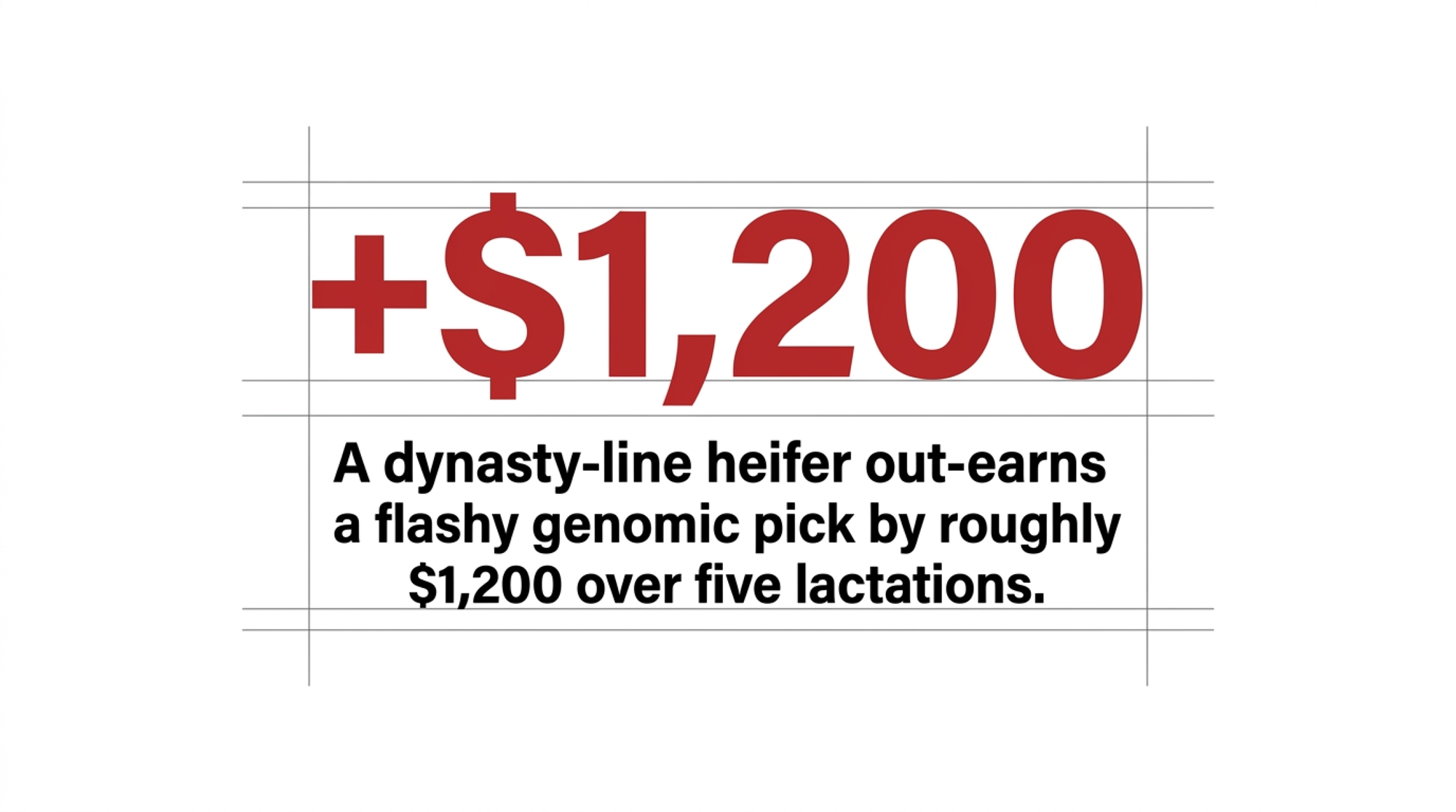
Health stacks on top. A 2023 study of eight high-performance Minnesota Holstein herds (Blom et al., Animals) found parity-1 treatment costs ranging from about $23 to $75 per cow — and that’s direct vet cost only, before lost milk, discard, and breeding delays. Add it up across three or four lactations and the dynasty cow pulls clear. Our model lands the five-year cash gap between a dynasty-line heifer and an equally fancy but shallow-pedigree heifer at roughly $950 to $1,600 per head — call it $1,200 at the midpoint. Hold that in pencil. It moves with your feed cost, your milk price, and how hard you lean on ET.
On a 300-cow herd raising 40 to 50 donor-candidate heifers over a few years, that gap scales into five-figure territory. The genomic test bills you today. The shallow family bills you in year three.
Three Fingerprints a Dynasty Can’t Fake
The Comestar, Regancrest, and Roxy families don’t look alike. One leans functional type, one extreme PTAT, one fertility and herd-life. Lay their histories side by side, though, and the same fingerprints show up.

Depth, not a spike. In the Laurie Sheik family, herdbook stars stack in a way most herds never see once. Laurie Sheik carries 23 brood-cow stars, her Blackstar daughter Laura Black topped her with 24, and L Or Black earned 16. Holstein Canada named Laurie Sheik the inaugural Cow of the Year in 1995; her descendant Comestar Lamadona Doorman took the same title in 2022 — 27 years apart. That one purchase Comtois made in 1985 is still winning national hardware nearly four decades later. Not a one-hit wonder. A conveyor belt. The full story lives in The Cow That Built an Empire.
Barbie’s line runs the same pattern — dams, daughters, granddaughters carrying multiple Excellent daughters and top PTAT slots, not one freak cow surrounded by also-rans. Glenridge Citation Roxy EX-97-4E had 16 Excellent daughters, over 300 Excellent descendants, and a 30-star brood cow in Mil-R-Mor Roxette EX. Families that flat-out refuse to miss.
Volume with the same result. Dynasties don’t get judged on three daughters. Barbie produced more than 27; all but one classified VG or better on first lactation, and by 2010 she’d stacked eight Excellent and nineteen Very Good, with at least eleven daughters in the top-25 PTAT rankings. Give a family 20 to 30 daughters by different bulls and they still hit 80 to 90% of the time — that’s zero-failure transmission in barn terms. No genomic prediction fakes that.
And here’s the real separator: the results hold across different sires and different barns. In the Barbie family, Goldwyn and Shottle daughters both show the same mammary quality. In the Laurie Sheik line, Blackstar, Prelude, and Storm all threw daughters and sons that lifted herds from Quebec to Belgium to modern robot barns — at Bois Seigneur Holstein, roughly 70% of the herd traces back to her. Roxy’s descendants have milked in tie-stalls, free-stalls, and on pasture without losing their reputation for fertility and low SCC. A printout ranks a calf in a population. It can’t tell you how her granddaughters behave across 30 matings and five proof runs. That’s where dynasties live. Read the family trees in Roxy, Dellia and The Mothers Who Built the Breed.
| Dynasty family | Depth (brood-cow stars / EX daughters) | Volume tested | Repeatability signal |
| Comestar Laurie Sheik | 23 brood stars; Laura Black 24, L Or Black 16 | Anchored 14 Class EXTRA bulls | 2 Cow-of-the-Year titles, 27 yrs apart |
| Regancrest-PR Barbie | 8 EX + 19 VG daughters by 2010 | 27+ daughters classified | All but 1 hit VG/EX on 1st lactation |
| Glenridge Citation Roxy | 16 EX daughters; 300+ EX descendants | Mil-R-Mor Roxette = 30-star brood cow | Held type across tie-stall, free-stall, pasture |
| Millionaire sires produced | Leader, Lee, Lheros, Outside (Laurie Sheik) | Comestar Lee: 1.5M doses | Same result across Goldwyn, Shottle, Blackstar |
What Does a $3,000 Embryo Really Buy You?
Here’s the flip side, and it’s the other half of our $93,300-a-year “three cow families” warning. Not the trap of leaning too hard on a handful of dynasties — the opposite mistake, ignoring proven cow families entirely.
Hand over $3,000 for an embryo and you’re not buying a guarantee. You’re playing biological telephone. Here’s how the cash actually drains:
The Cold Math on $3,000 Embryos
- The buy-in: 4 embryos × $3,000 = $12,000 spent
- The reality check: ~50% conception rate = 2 pregnancies
- The coin flip: ~50% heifer rate = 1 live heifer
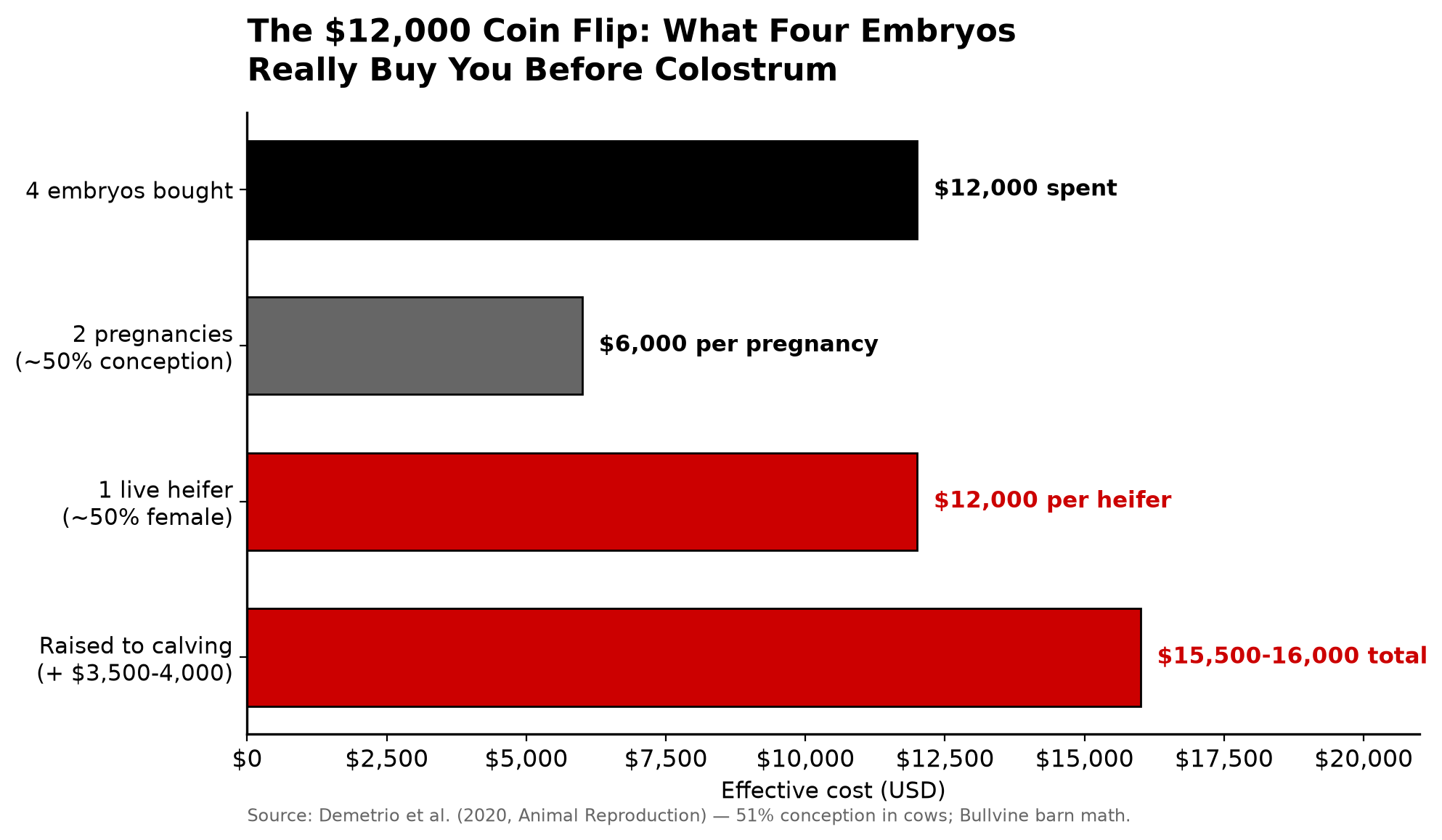
You just paid $12,000 for one live heifer before she drinks her first bag of colostrum — and that’s before the $3,500 to $4,000 to raise her to calving. If her donor’s a one-generation wonder, you’ve got a real shot at that $12,000 washing out early. If she’s a Roxy or a Barbie, she’s got the maternal infrastructure to back the price tag. Those conception rates aren’t guesses, either: Demetrio et al. (2020, Animal Reproduction) put in vivo pregnancy at about 51% in lactating cows and 63% in virgin heifers.
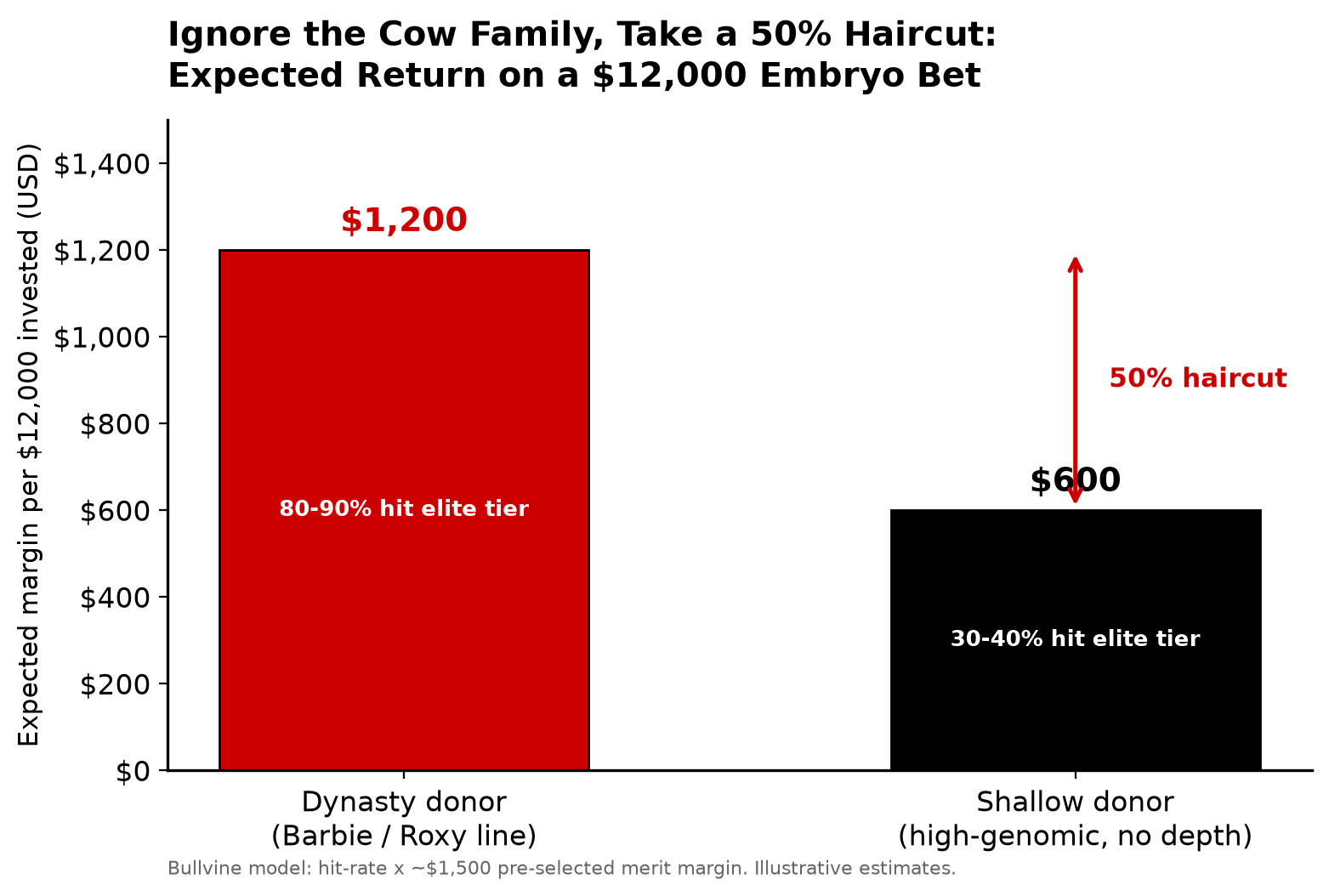
Now overlay the family. From a Barbie/Laurie/Roxy-level dynasty, family data suggests 80 to 90% of those embryo-derived daughters land in your top tier. From a high-genomic young cow with nothing behind her, that “elite” hit rate can realistically slide to 30 to 40% once health, fertility, and cull reasons pile on. Using the upper end of our earlier range — roughly $1,500, since embryo heifers are pre-selected for merit rather than average — the expected margin per $12,000 investment looks like this:
- Dynasty donor: 0.8 × $1,500 ≈ $1,200 expected margin
- Shallow donor: 0.4 × $1,500 ≈ $600 expected margin
Ignore maternal proof and you’ve taken a 50% haircut, purely because you never asked whether the donor’s family had proven anything past three generations of names on paper. Run 20 embryos a year in a 300-cow herd and that’s five-figure lost upside over five years — before you count the drain of watching can’t-miss heifers turn into problem cows.
How Do You Lean on Dynasties Without Breeding Yourself Into an Inbreeding Hole?
There’s a real catch. Double down on a few cow families, ignore the sire mix, and you dig an inbreeding hole fast.
Canadian Holstein heifers born in 2024 now average 9.99% inbreeding, per Lactanet’s August 2025 update — up from 9.61% the year before, and nearly double where it sat 15 years ago. The US doesn’t publish one breed-average figure, but CDCB’s base-change work tells the same story: average Expected Future Inbreeding jumped from 7.5% to 9.4% between the 2015 and 2020 cow bases. Different yardstick. Same direction.
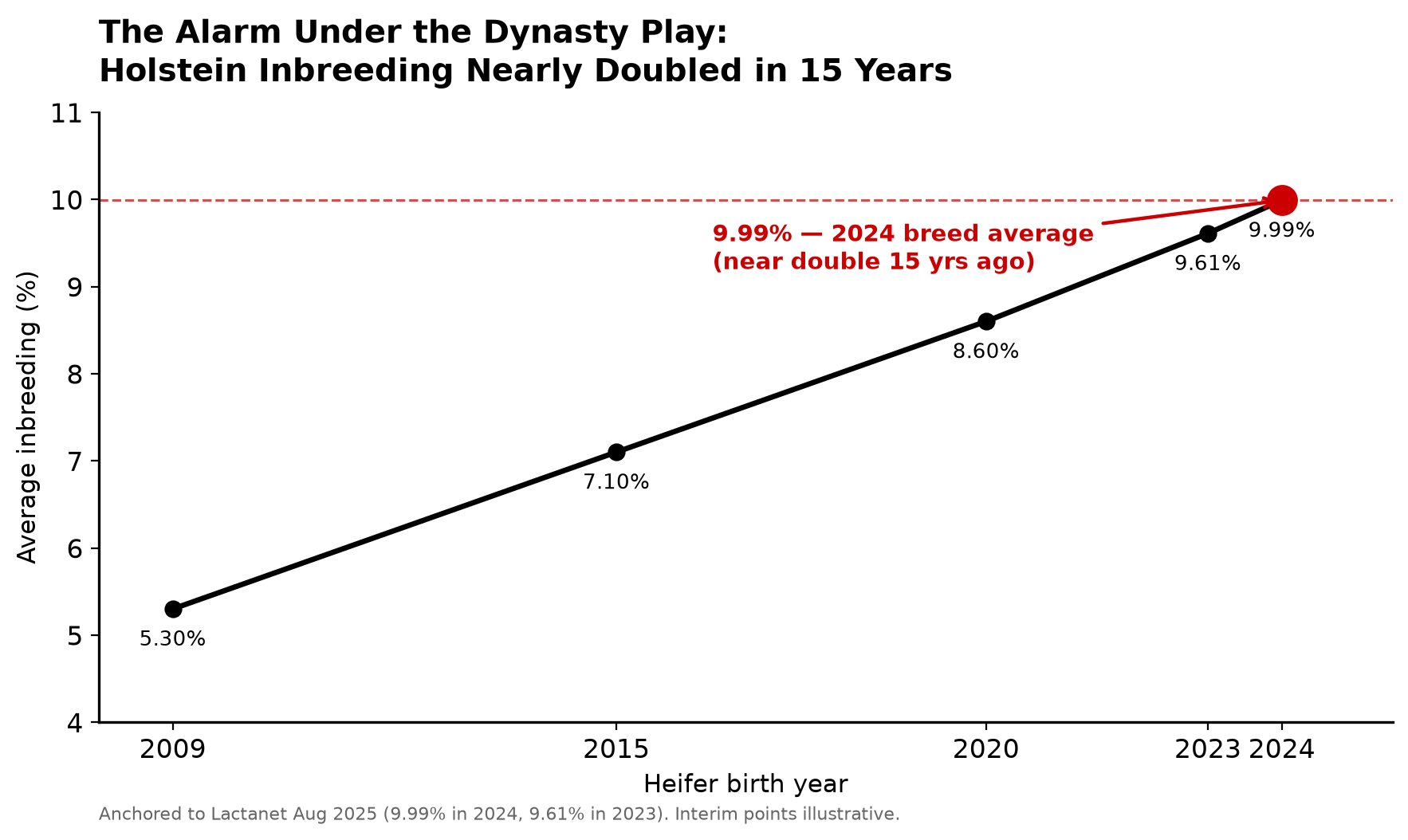
The Inbreeding Alarm: With breed averages sitting at a historic 9.99%, doubling down on “popular” branches of a dynasty without a strict mating guardrail is genetic self-sabotage. Virginia Tech’s benchmark work (Smith et al., 1998, JDS) pegged each 1% rise in inbreeding at roughly $22 to $24 in lost lifetime net income per cow — but that’s in 1999 dollars. Inflation-adjusted and paired with newer genomic milk-loss data, real-world estimates now run about $44 to $100 per cow. And it hits exactly where dynasties are supposed to protect you: fertility, stillbirths, immune-system slack.
So you manage a dynasty like a long-term investment, not a shortcut:
- Track inbreeding animal by animal, not just as a herd average.
- Hold expected heifer-crop inbreeding well below the 9.99% breed average — treat whatever number you pick as a brake pedal, not a target.
- Don’t blackball elite carrier bulls. A +3,200 GTPI carrier mated only to clear (Code 0) cows beats a +2,800 GTPI clean bull — you bank the genetics and dodge the homozygous risk.
- Use genomic relationship data to find less-related bulls that still fit your dynasty’s type and production goals.
The full barn math on what each point of inbreeding costs is in Holstein’s $40,500 Inbreeding Bill, and the outcross-sourcing playbook is in How Blondin Sires Turned a Bottleneck into 75% Growth. You’re not giving up pedigree depth. You’re keeping inbreeding depression from erasing the exact traits that made you love the family.
Options and Trade-Offs for Farmers
Every herd sits in a different spot on the genetics curve. Three paths fit most 200- to 1,500-cow operations staring at this maternal blind spot.
The 30-Day Maternal Audit (start here). Print three to four years of cows sorted by lifetime milk or margin. Highlight the ones in third lactation or better with solid components and no chronic problems. Trace them back three maternal generations and circle the surnames that repeat. When it makes sense: any herd over ~150 cows with a few years of records. What it takes: a couple hours with herd software and a pen — no consulting fee. The limit: if your records don’t track lifetime performance well, you’ll lean on cull notes and memory as a stopgap. Even that beats flying blind. Tag those dynasty animals in your software this month, and you’ve already started changing daily decisions.
The Dynasty-First Semen Plan. Redirect the budget you already spend. Sexed, high-end semen goes to your top 20 to 30 dynasty cows and heifers first; conventional Holstein or beef goes on the rest unless one has a clear role. Cap expected inbreeding well under 9.99% on dynasty matings, and when a sire pushes those animals toward the line, swap him. When it makes sense: herds already spending real money on elite or sexed semen. The trade-off: you give up chasing every new bull and run a tighter sire list longer. As genomic evaluations put more weight on health and fertility, the smartest move won’t be overriding maternal proof — it’ll be sharpening which sires you use inside families that have already earned their spot in your barn.
The “Stop Guessing” Embryo Rule. Write one rule before the next sale catalog hits: if the donor’s family can’t show three generations of daughters with solid production, decent classification, and real herd life, you don’t write a $3,000 check. When it makes sense: any herd using ET/IVF or tempted by purchased embryos. The trade-off: you’ll walk past a hot donor with sizzling numbers and no cow-family proof, and you might miss the rare new family that would’ve panned out. You’ll dodge far more expensive disappointments. As more ET programs chase feed efficiency and sustainability, donors from proven dynasties are the ones that hit under real-world stress.
Key Takeaways
- If you can’t name the maternal lines behind your top 10 cows without opening the herd book, run the 30-day audit before you spend another dollar on semen or embryos.
- If a donor’s family can’t show three generations of daughters that milk, breed back, and stay out of the dead pile, don’t pay brood-cow prices for her embryos.
- If you’re running more than 15 to 20 Holstein sires in a 300-cow herd over two or three years, you’re spreading the budget too thin — tighten the list and aim it at your top three families.
- If your embryo-derived heifers aren’t beating your herd’s average retention to a third lactation, your program’s riding shallow families. Rebuild it around lines that have proven they stay.
- If your herd inbreeding is creeping toward 9.99%, cap dynasty matings below that line, mate elite carriers to Code 0 cows only, and check inbreeding animal by animal — not just as a herd average.
Nobody’s arguing whether Barbie, Laurie Sheik, and Roxy created value. Four millionaire sires — with Comestar Lee alone reaching 1.5 million doses — 16 Excellent daughters in one family, a third of the elite PTAT list: that answer’s already written. The open question is whether your program is built to reward the dynasties quietly carrying your barn, or whether you’re still spending 2026 money like it’s 1998, letting catalogs call the shots instead of the surnames on your best cows’ tags.
So here’s the one to sit with before the next proof run lands in your inbox: print that three-to-four-year cow list tomorrow morning and see which three families are actually holding your barn together. Once you see it, you can’t unsee it. And when you want the full model — exactly how much extra profit per lactation a dynasty cow throws off at 200 cows versus 1,500 — that’s the deeper per-cow math we’re building next, and where Bullvine Weekly readers get it first.

Run Your Numbers
Genomic Testing ROI Calculator — Before you flush a donor or write another $3,000 embryo check, run the numbers on which animals are actually worth testing. It puts a dollar value on the spread between your best and worst genetic quartiles, flags where inbreeding risk needs tighter control, and pressure-tests whether the decision pencils under conservative assumptions — not just the aggressive ones.
Complete references and supporting documentation are available upon request by contacting the editorial team at editor@thebullvine.com.
Learn More
- The 9.99% Holstein Inbreeding Bill: Are You Breeding for Profit or Just Index Points? — Reveals the hidden financial drain of modern genetic selection by detailing how every percentage point of inbreeding above breed targets costs your operation $44 to $100 per cow in lost lifetime net income.
- Roybrook 2026: The $15000 Holstein Cow Family Test — Delivers a strict three-strike diagnostic framework to audit your own herd, helping you cull underperforming maternal lines and construct a highly profitable, self-replacing breeding nucleus.
- The Great Holstein Shakeup: How 16 Years Rewrote Breeding Rules — Breaks down how genetic concentration collapsed since 2008, arming you with long-term strategic insights into how top-tier commercial operators now bypass single super-sires to manage multi-generational genetic risk.
The Sunday Read Dairy Professionals Don’t Skip.

Every week, thousands of producers, breeders, and industry insiders open Bullvine Weekly for genetics insights, market shifts, and profit strategies they won’t find anywhere else. One email. Five minutes. Smarter decisions all week.