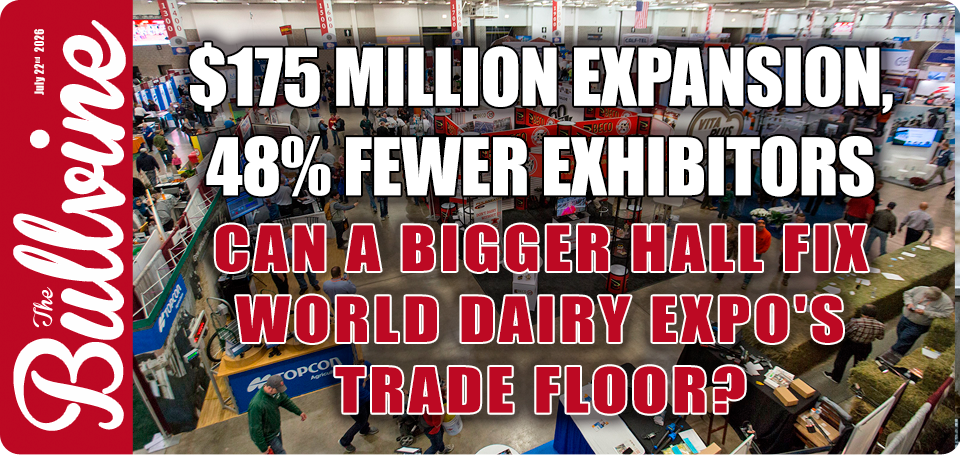




Dane County just cleared the first hurdle on a major Exhibition Hall expansion at the Alliant Energy Center — part of a redevelopment package the county pegs at $175 million. The catch: World Dairy Expo’s trade floor has lost more than 400 companies in eight years, and square footage isn’t the problem.
Big changes are coming to the Alliant Energy Center, and they land right on top of World Dairy Expo. On Wednesday, July 15, the Madison Urban Design Commission voted unanimously to approve plans for a major Exhibition Hall expansion — about 223,000 square feet added across the first two of three construction phases running 2028 to 2031, bringing the hall to a finished footprint of roughly 382,000 square feet, with a hotel connector, new entrances, and reworked pedestrian spaces. It’s the opening move in a broader master plan to modernize the whole campus that’s hosted World Dairy Expo for nearly six decades.
On paper, that sounds like good news for Expo — a bigger, newer building in the place the dairy world gathers every October. But dig into what’s happening on that trade floor and a harder question surfaces: does more space fix Expo’s real problem, or give the problem more room to spread?
What the county actually approved
The plan grows the Exhibition Hall north and south, adds a connector to the neighboring hotel, and updates entrances and gathering areas. Several existing structures would be demolished to make room, including the Dane County Public Works administration and storage buildings and the William H. Ferris Center. This is a Dane County project, not a World Dairy Expo one — but WDE uses the venue, so whatever happens here shapes the show.
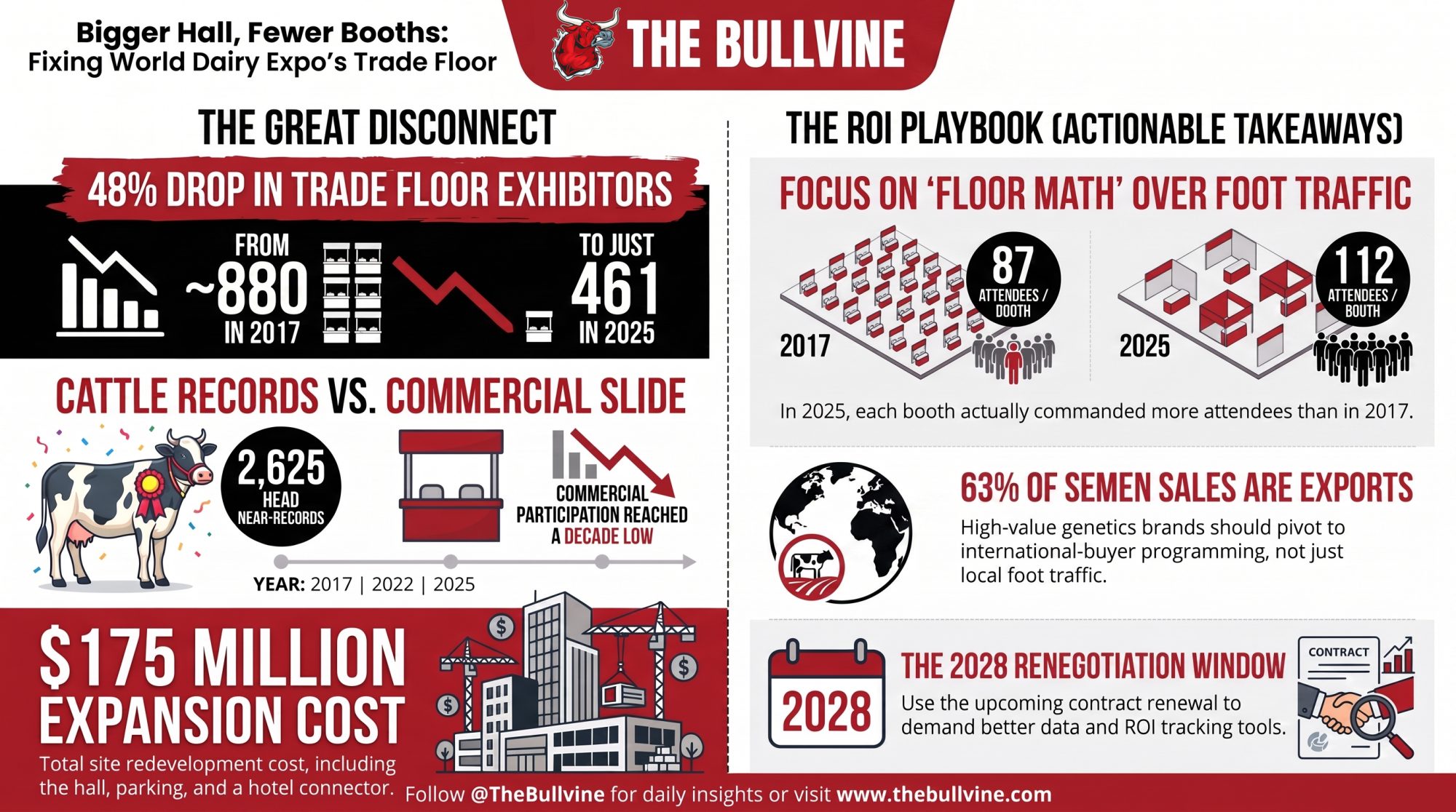
When the state first backed the project in 2019, the Exhibition Hall expansion alone was estimated at $77.4 million, with $30 million committed from Wisconsin’s 2019–2021 capital budget. By the county’s 2024 redevelopment planning, the figure being discussed had grown to $175 million — but that number isn’t the hall by itself. Per Dane County’s own Redevelopment Committee, the $175 million covers “the Expo Hall Expansion and Related Site Improvements,” including revamped and new parking, additional storage, a new ring road, stormwater management, a new grand entrance at Rusk Road, a new sewer force main, the hotel connector, and demolition of the Huber Center. So when you see “$175 million,” read “the hall plus everything around it,” not the building alone. This week’s approval covers design and landscaping, not final funding — the county hasn’t committed the capital, and more sign-offs lie ahead.
The commission liked the architecture, approving the plans with one condition: fix the landscaping. Several proposed tree species — yellow birch, showy mountain ash, red maple — aren’t well-suited to southern Wisconsin’s climate, so the team has to swap in native plantings and diversify the shrubs. Minor stuff. The building itself sailed through.
The number nobody’s talking about
Here’s what gets lost in the ribbon-cutting excitement. In 2017, World Dairy Expo sat near its modern exhibitor peak — roughly 880 participating companies on its trade floor. By 2019, WDE was still touting 859 participating companiesfrom 28 countries, six Canadian provinces, and 41 U.S. states. Last fall, the count was 461. That’s more than 400 companies gone from a floor that used to be packed. (For the full year-by-year breakdown, see The Bullvine’s analysis of Expo’s attendance slide.)
So before anyone celebrates a bigger hall, ask the obvious thing: if the trade floor has shed nearly half its exhibitors, what does more square footage actually solve? This isn’t a space problem. It’s an exhibitor-value problem — and you can build a bigger room and watch the same slide play out in more of it.
There’s a timing wrinkle that makes it sharper. WDE signed a five-year deal in 2023 keeping it at the Alliant Energy Center through 2028, with three option years that could stretch to 2031. So the first real renewal decision lands right as the new hall comes online. Building and contract, hitting the table together. That’s when terms get renegotiated.
Two shows under one roof
The cattle show isn’t just holding — it’s setting records. WDE housed a record 2,663 animals in 2022, topping a mark that had stood since 2008, and drew 2,625 head from 37 U.S. states and 7 Canadian provinces in 2025, up from 2,331 in 2019. The best animals on the continent still load up and fill the Coliseum every October. That part works.
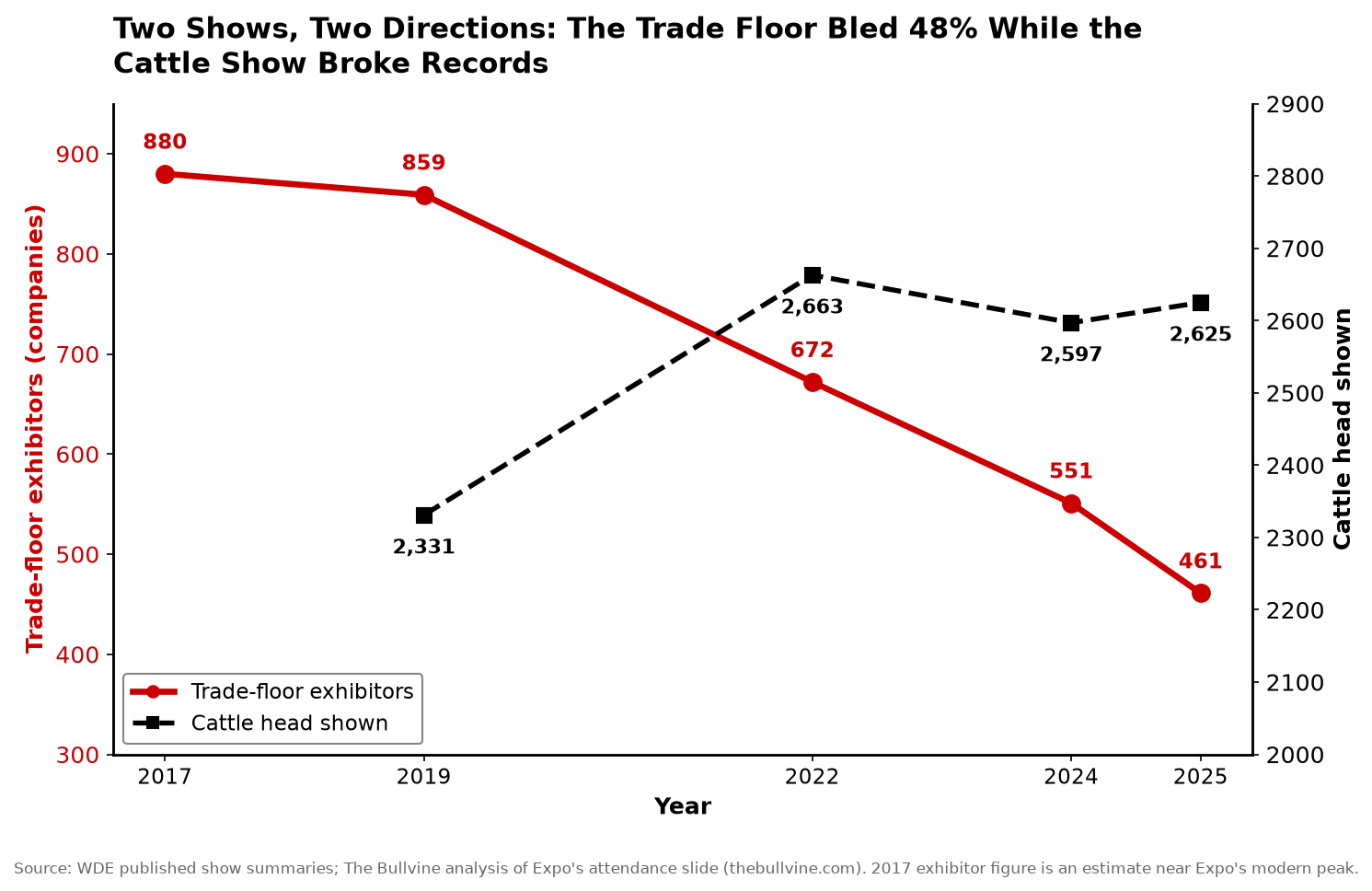
The trade floor is the part that doesn’t. Two different events are happening across the campus, headed in opposite directions.
| Year | Trade-Floor Exhibitors | Cattle Head Shown | What It Signals |
| 2017 | ~880 companies | — | Peak commercial footprint |
| 2019 | 859 companies | 2,331 head | Pre-pandemic exhibitor & cattle baseline |
| 2022 | 672 companies | 2,663 head (record) | Consolidation accelerates as cattle peak |
| 2024 | 551 companies | 2,597 head | Virtual launch tools mature |
| 2025 | 461 companies | 2,625 head | ~48% fewer exhibitors, near-record cattle |
Cattle figures from WDE published show summaries. Trade-floor figures from WDE show summaries and The Bullvine’s analysis of Expo’s attendance slide; the 2017 figure is an estimate near Expo’s modern peak. Dashes mark years where that metric isn’t in the public record we can verify.
The pattern is brutal in its consistency: the trade floor shed exhibitors every single year while the cattle show sat at or near all-time highs the whole time. And the bleed sped up. Roughly 40-plus companies a year walked away between 2017 and 2022, then about 70 a year from 2022 to 2025 — the same three years cattle never dropped below 2,597 head. The commercial side isn’t stabilizing. It’s accelerating downhill, even as the county lines up more space to hold it.
The companies feel it first — genetics outfits, equipment makers, and nutrition suppliers writing five-figure booth checks every fall. Their customer base is thinning fast. U.S. dairy operations are on track to fall to 15,000–16,000 herds by 2035 and under 10,000 by 2050, and the biggest 3% of operations — those over 2,500 cows — already produce about 46% of the U.S. milk supply. Farms under 500 head make up 86% of farms but just 22% of the milk. Fewer, bigger buyers change the math on a big open trade floor.
What a new building can’t buy back
Three forces compounded here. Genomics decentralized sire selection, so breeders no longer needed a trade floor to pick bulls. Consolidation shrank the pool of independent genetics and equipment brands that exist to buy booths in the first place. Then COVID normalized virtual product launches and on-farm demos — and a lot of that behavior stuck.
None of those is a square-footage problem. WDE describes its purpose as a place to learn, share, do business, and showcase competition. The competition half is delivering — record cattle prove it. The commerce half isn’t. A nicer building makes the commerce space prettier. It doesn’t touch the reasons companies stopped buying booths.
The barn math on a booth
For an exhibitor, it comes down to one cold question: is my customer still walking through that door? For many genetics companies, the honest answer is “somewhere else.” NAAB’s 2025 report shows total dairy semen unit sales fell about 6% from 2024, dropping to 45.8 million units, with 28.3 million of those exported — roughly 62–63% of volume heading overseas. (We broke down what that export tilt means for breeding strategy in why 2025’s 6% semen-sales drop is actually good news.) When two-thirds of your product ships to Brazil, Italy, or China, a trade floor in Wisconsin is brand-building, not deal-closing.
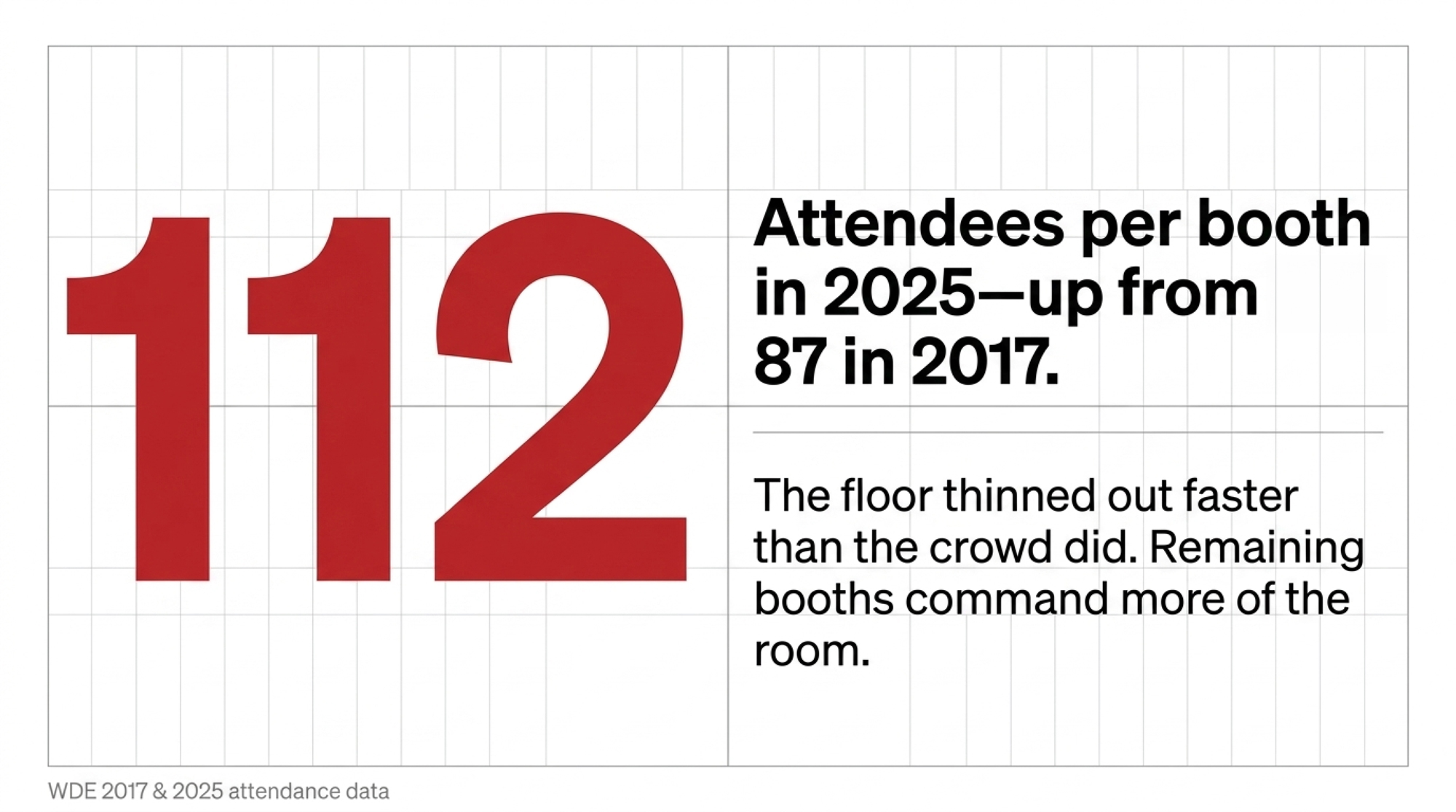
Now run the floor math. In 2017, WDE drew 77,204 attendees against roughly 880 exhibitors — about 87 attendees per booth. In 2025, attendance had fallen to 51,525 while exhibitors dropped to 461, which works out to 112 attendees per booth. Read that twice. Even with attendance down about a third, each remaining exhibitor now has more visitors to itself, not fewer. The floor thinned out faster than the crowd did.
That cuts both ways. Fewer rivals in the aisle can be a reason to stay — more share of a smaller room. Or a reason to leave, if those 112 visitors aren’t the decision-makers you need. And the booth fee is just the entry cost: add design, build, staffing, travel, freight, and marketing, and the real number climbs fast. That whole spend has to earn its keep in qualified leads and real conversations, not badge scans.
What would actually move the needle
It’s easy to stand outside a $175 million project and point at what’s broken. Harder — and more useful — is to say what we’d do if it were our call. The fix doesn’t require a single extra square foot. Four plays Expo could run.
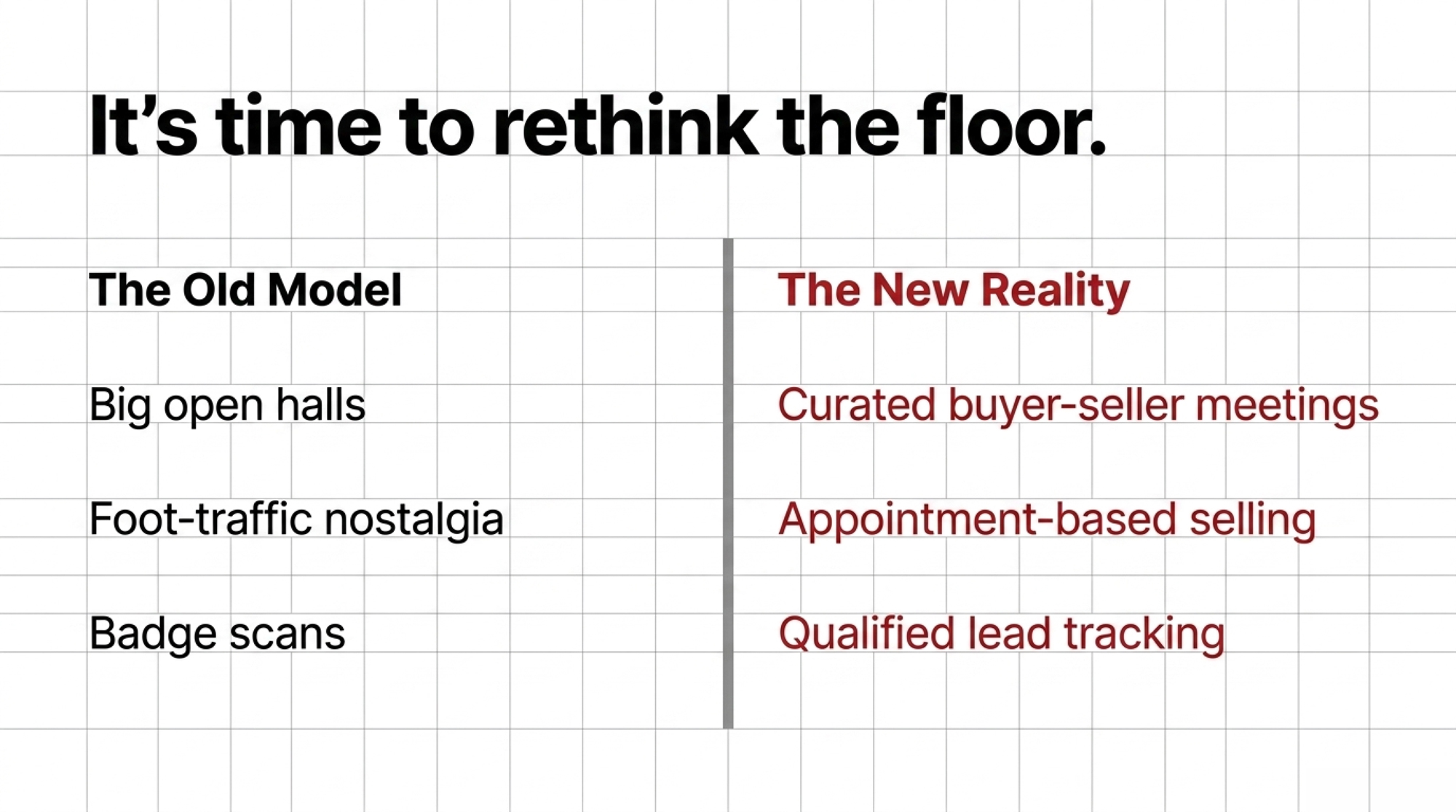
Build and publish an exhibitor-ROI framework. WDE offers exhibitors no public way to measure booth returns. Change that: qualified-lead tracking, badge-to-meeting data, post-show analytics that tell a genetics marketing lead exactly how many real conversations their spend bought. The moment an exhibitor can prove the floor pays, the renewal conversation stops being a leap of faith.
Rethink the floor for the buyers who are left. If 3% of herds make 46% of the milk, and roughly two-thirds of genetics volume ships overseas, the old model — a big open hall and hope the right buyer wanders past — is fighting the math. Design for fewer, higher-value buyers: curated buyer-seller meetings, appointment-based selling, dedicated international-buyer programming that treats the export customer as the center of gravity, not an afterthought. A smaller room built around the people who write the big checks beats a bigger room built on foot-traffic nostalgia.
Bundle the new hall with commerce, not just space. If $175 million is going into the ground, tie it to outcomes an exhibitor can bank. Data tools. Hybrid reach that extends a booth’s audience beyond the four on-site days. A year-round digital presence so the relationship doesn’t go dark for 361 days. Make the building buy commerce — that’s the difference between an investment and a renovation.
Use the 2028 contract window as a redesign moment. The contract and the building landing together is a risk if Expo sleeps on it, an opportunity if it doesn’t. That pressure point is the best chance Expo will get to reset what a booth actually delivers — to walk into the room with a new value proposition instead of the same one at a higher rate. The leverage cuts both directions. The question is who uses it.
None of these need the shovel to hit dirt first. They need someone to decide the trade floor is a product worth rebuilding, not just a space worth expanding.
To be clear: Dane County holds the checkbook, not Expo. But Expo is the anchor tenant with the most at stake in how that space gets built — which gives it real leverage to push for a hall designed around commerce, not just square footage.
Your real competition isn’t another show
For breeders, WDE competes with Cremona, The Royal, and UK Dairy Day on ring prestige and production value. Cremona’s recent edition pulled 800-plus elite cattle from six nations and made the arena the main event — proof a smaller show can win on experience instead of scale, a lesson we dug into in what dairy shows must learn from the booming stock-show world.
But for the companies buying booths, the competition isn’t another cattle show at all. It’s every channel that reaches the same herd for less. A virtual demo. A processor-hosted supplier day. A truck rolling straight to a 2,500-cow operation where the actual buying happens. That’s what WDE is up against, and a shinier hall doesn’t answer it.
The playbook: three ways to work the new floor
If you’re the one signing off on a five-figure autumn budget, here’s how the numbers above turn into a decision you can defend to whoever signs the check. Pick the lane that matches your buyer.
| Play | Best For | The Move | Warning Signal |
| Data-Driven Renewal | North American / mid-size commercial-herd sellers | Stay in Madison; demand qualified lead-capture and track cost-per-real-conversation, not badge scans | Cost per conversation rising while close rate flat |
| Hybrid Pivot | Export-heavy genetics & tech brands | Shrink booth footprint; reinvest savings in year-round virtual tours & international-buyer programs | 62–63% of your volume already ships overseas |
| 30-Day Audit | Every exhibitor | Pull last two shows’ lead logs; calculate real cost per high-value deal before 2028 talks | Renegotiate before the building justifies a price hike |
| Do Nothing | No one | Renew at higher rates on foot-traffic nostalgia | Paying more for a thinner floor |
The Data-Driven Renewal — for North American players. If your buyer is still the mid-sized commercial herd owner walking the aisles, stay in Madison — but stop paying for foot traffic and hoping. Demand qualified lead-capture from Expo, and track your own cost-per-real-conversation instead of badge scans. That one number tells you whether the aisle is earning its keep or just an expensive place to hand out pens. WDE doesn’t offer that framework yet, so build the tracking yourself — before you renew, not after.
The Hybrid Pivot — for export-heavy genetics and tech brands. With 28.3 million of 45.8 million dairy semen units heading overseas in 2025, a booth in Wisconsin is doing a thinner job than your budget assumes. Shrink the physical footprint in the new hall to control travel and build-out costs, then push those five-figure savings into year-round virtual farm tours, localized international-buyer programs, and digital launches that reach the export customer where they actually are. A small booth in a big hall reads as retreat if the design’s sloppy — so make the shrink look deliberate, not defensive.
The 30-Day Audit — for every exhibitor. Before 2028 renewal talks, pull your lead logs from the last two shows and calculate your real cost per high-value deal closed. If that number’s climbing while your close rate sits flat, your own balance sheet is telling you to renegotiate space terms before the concrete dries. The time to set the price of a booth is before the building that justifies the price hike exists.
The bottom line
- The money isn’t committed. This week’s vote covers design and landscaping only. The $175 million is the hall plus parking, roads, and site work — the building alone was pegged at $77.4 million in 2019. Treat 2028–2031 as a target, not a guarantee.
- A bigger room won’t refill an empty floor. Exhibitors fell every year the cattle show broke records. The real fixes — an ROI framework, a floor built for consolidated buyers, a hall that sells commerce, a 2028 redesign — are decisions, not construction.
- Run your own number before you sign. Cost per qualified meeting, last two shows. If it’s rising while your close rate holds flat, that’s your renegotiate-or-reallocate signal.
- A thinner floor isn’t automatically fewer prospects. At 112 attendees per booth in 2025 versus 87 in 2017, each booth commands more of the crowd — the question is whether they’re your buyers.
- 2028 is the leverage point. The contract’s first hard decision and the new building arrive together. That’s the one moment terms are genuinely up for negotiation — for exhibitors and for Expo.
World Dairy Expo acknowledged The Bullvine’s request for comment but did not provide a statement for publication.
The Bullvine — analysis and opinion on the business of the dairy industry.
Complete references and supporting documentation are available upon request by contacting the editorial team at editor@thebullvine.com.
Learn More
- World Dairy Expo: Reversing the 33% Attendance Drop — Arms you with a four-step commercial roadmap to fix trade show ROI, rebuild youth pipelines, and transform live cattle judging into high-production entertainment that draws crowds back to Madison.
- Falling Semen Sales Aren’t Bad News – They’re Proof You Bred Better — Follows the money on the 6% semen volume drop, showing how tighter conception rates and 63% export shares force genetics companies to rethink traditional physical trade show sales strategies.
- World Dairy Expo Is the Benchmark. These 10 Other Shows Are Worth Your Passport. — Delivers a global scouting report on rival dairy arenas from Italy to Brazil, breaking down how international shows win on fan atmosphere and spectacle rather than raw square footage.
The Sunday Read Dairy Professionals Don’t Skip.

Every week, thousands of producers, breeders, and industry insiders open Bullvine Weekly for genetics insights, market shifts, and profit strategies they won’t find anywhere else. One email. Five minutes. Smarter decisions all week.