








Beef-cross calves clear $575 a head over dairy bull calves — but on the cows you’d actually keep a daughter from, that premium nearly cancels out. Here’s the math that should be settling the argument.
Editor’s note: The kitchen-table scene that opens this piece is a composite, modeled from succession-research patterns and multiple multi-generation dairy operations rather than a single named farm. All statistics, dollar figures, and named organizations are sourced.
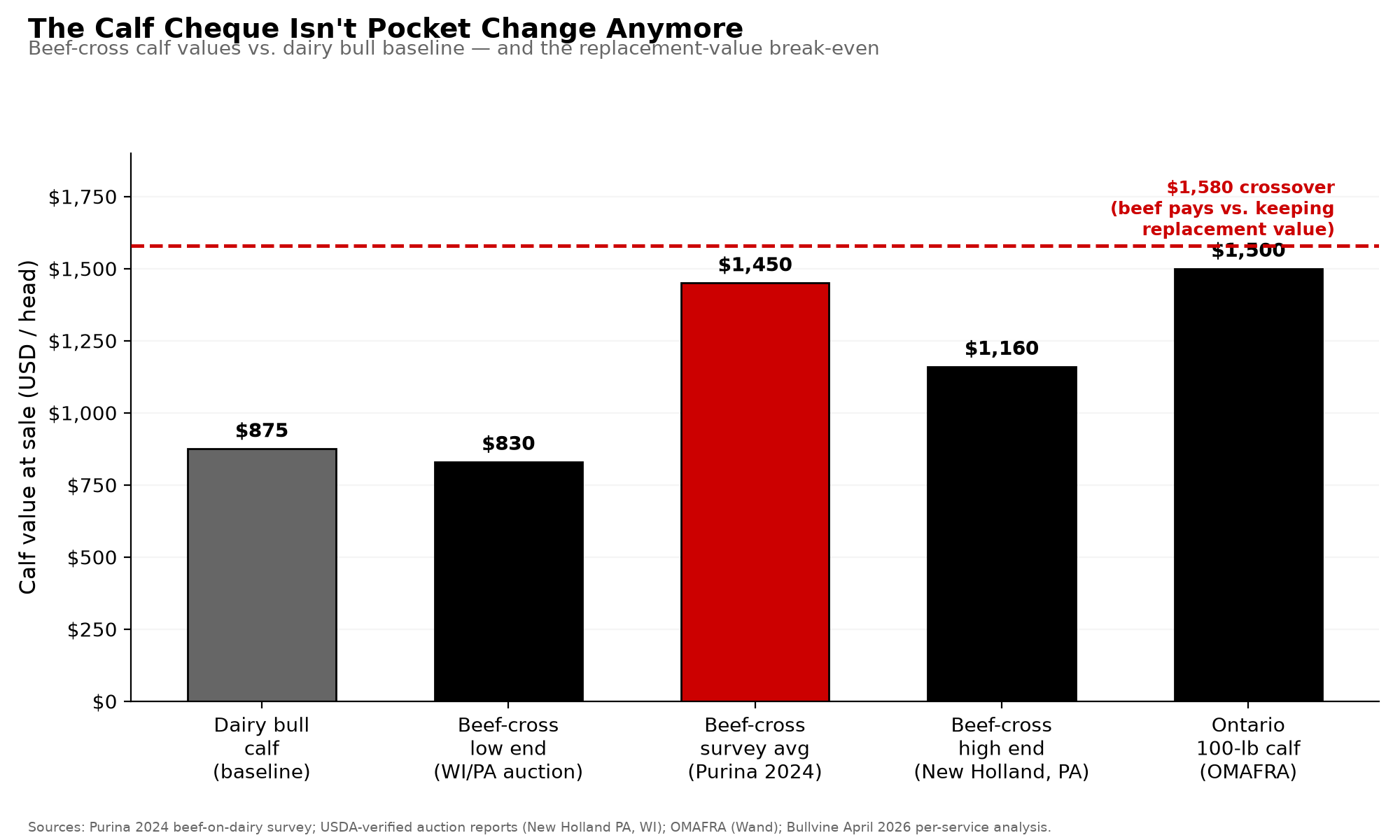
It’s February. The breeding sheets are spread across the kitchen table, and the herd’s best cow is the lightning rod — a high-component Holstein that traces back to a foundation cow your grandfather still talks about like she’s standing in the box stall. Your dad wants to flush her to a hot type bull. Your grandfather wants to know why beef-on-dairy is even in the conversation. And you’re sitting there with a milk cheque that’s tighter every month, running the math on a beef-cross calf worth $1,450 against a straight dairy bull calf worth $875.
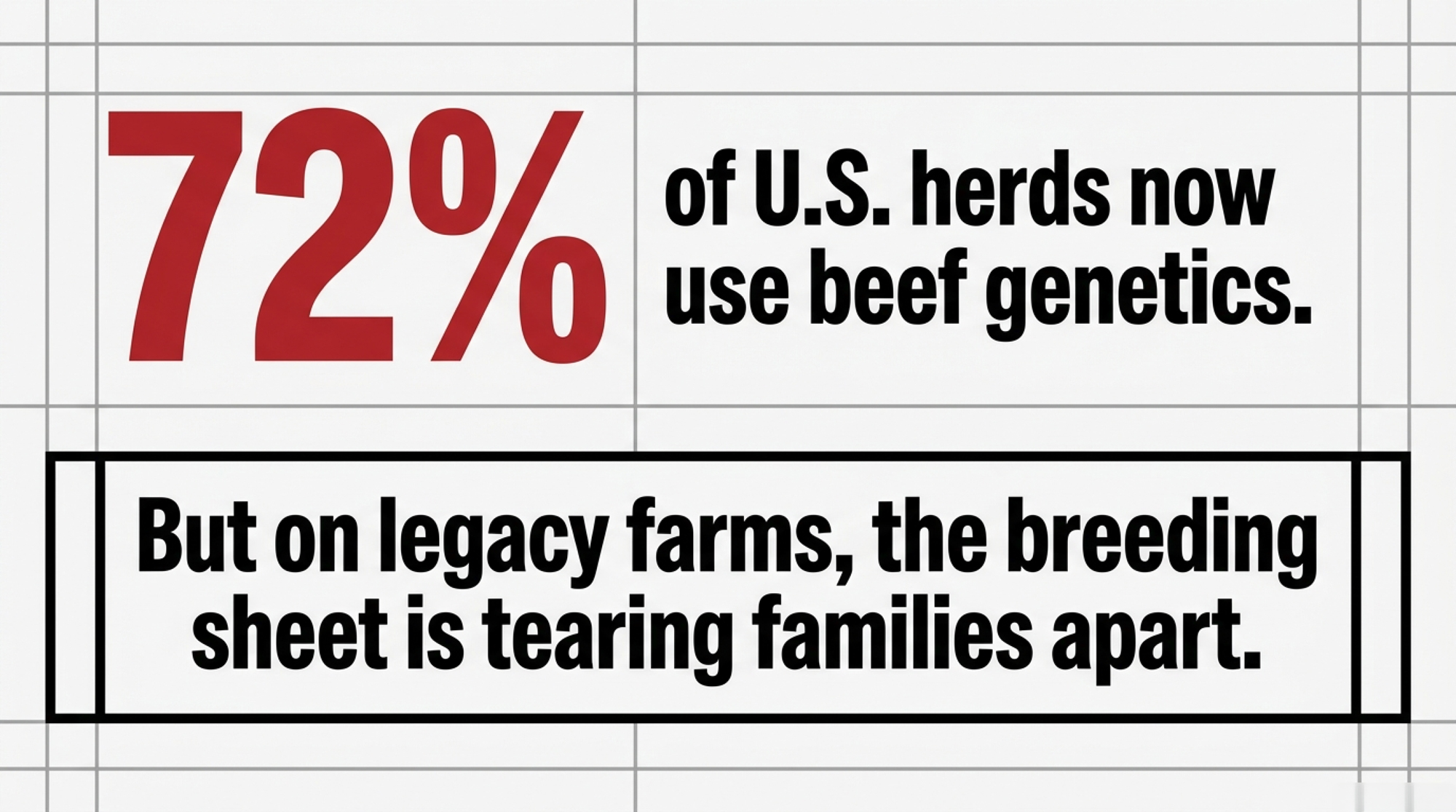
That argument feels like it’s about genetics. It isn’t. It’s about who owns the future of the farm, and breeding is just the thing everyone’s pointing at. With 72% of U.S. herds now using beef genetics on at least part of the herd, this exact fight is playing out at thousands of kitchen tables right now. The cow is the proxy. The real stakes are who decides, who stays, and when control actually changes hands.
The Kitchen Table Math
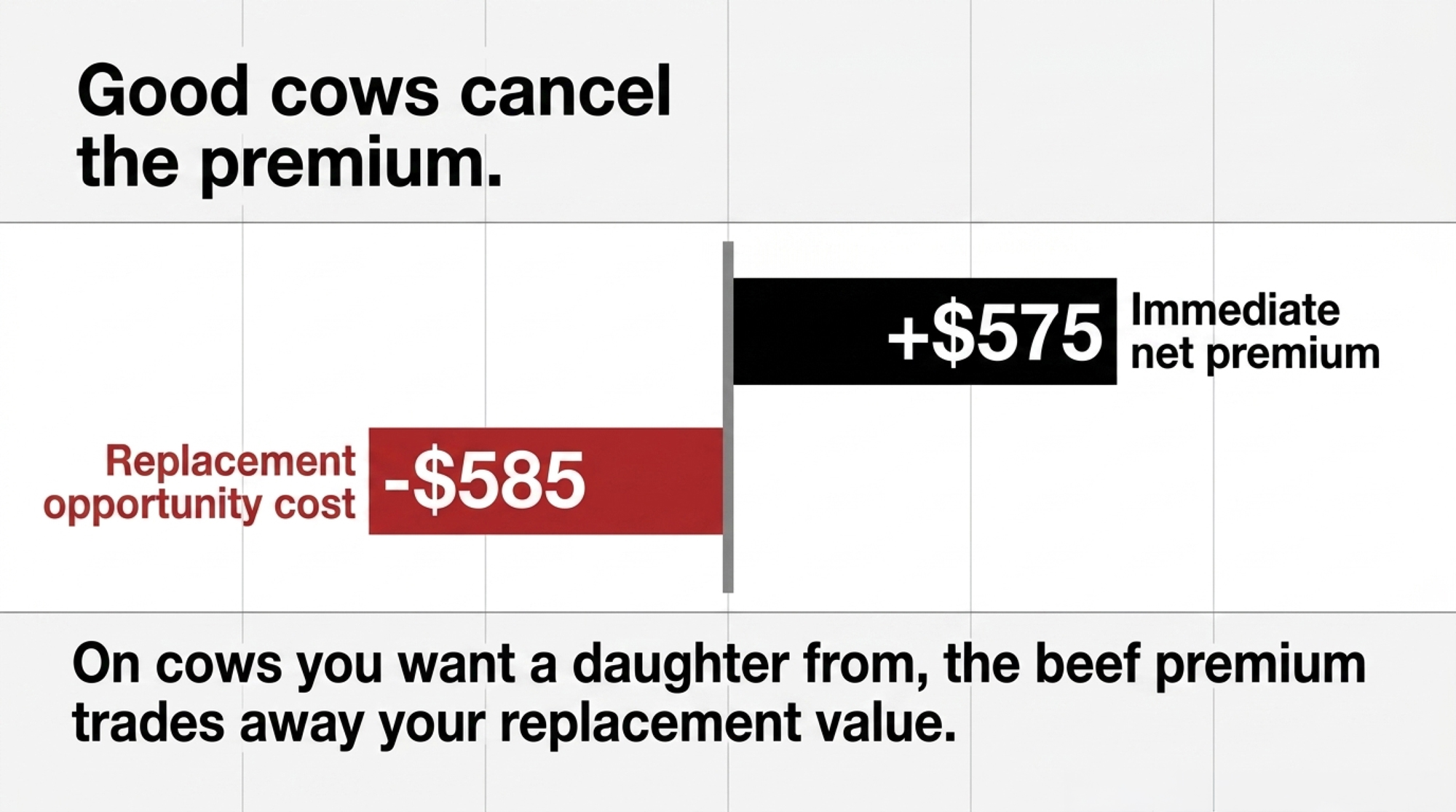
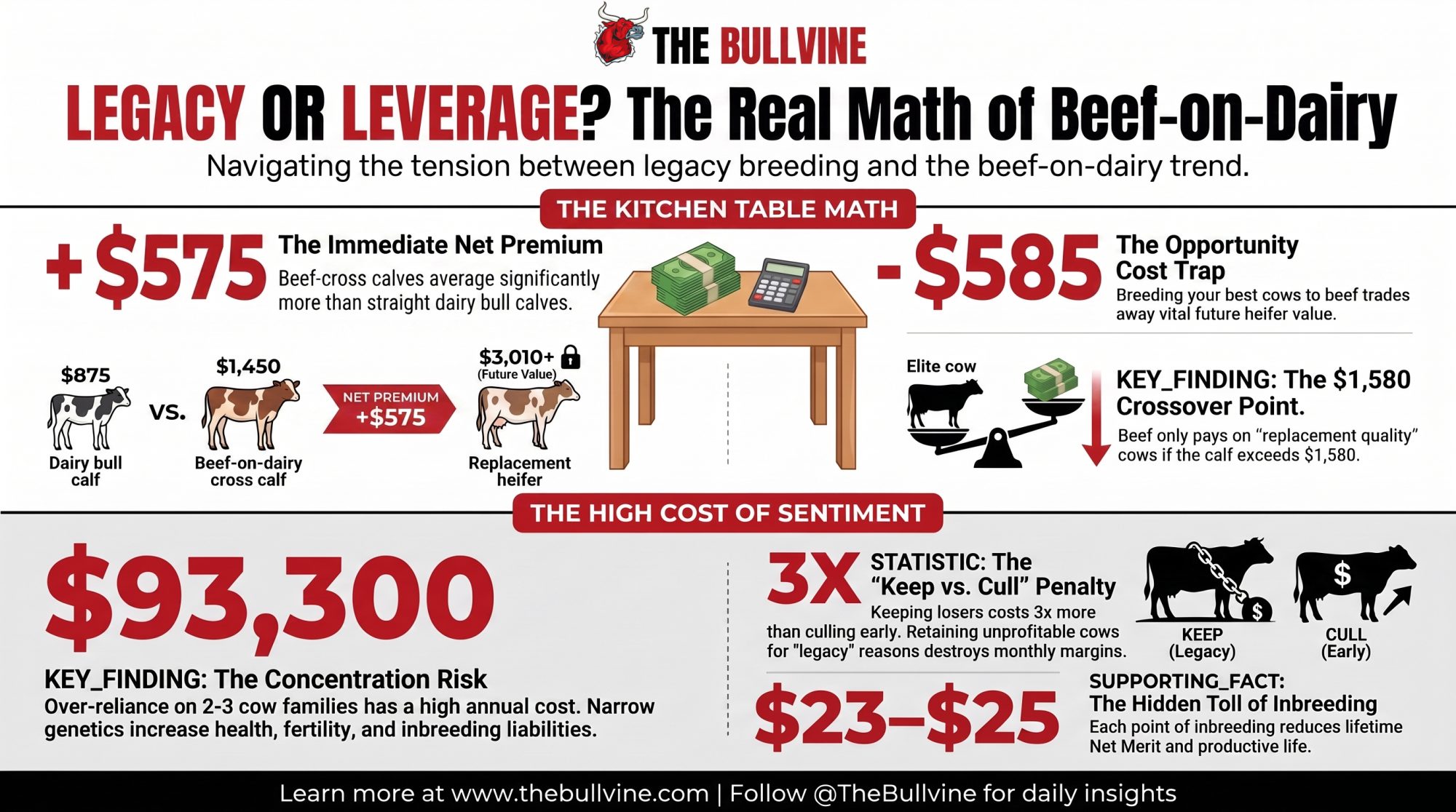
Beef-cross calf value: ~$1,450 Dairy bull calf value: ~$875 Immediate net premium: +$575 / head Replacement opportunity cost on cows worth keeping: −$585 / service
On the cows you’d actually want a daughter from, those two numbers nearly cancel. Which is why which cows you breed beef matters more than how many.
| Cow you’re breeding | Beef-cross calf premium | Replacement value traded away | Net per service | Verdict |
| Bottom-20% genomically verified | +$575 | $0 (you weren’t keeping her daughter anyway) | +$575 | Breed beef |
| Middle-of-herd, sound but average | +$575 | −$585 | −$10 | Coin flip — sexed dairy still safer |
| Top proven family, third-lactation-plus | +$575 | −$585 | −$10 | Sexed dairy or donor work |
| Any cow at beef prices below $1,580 | Below crossover | −$585 | Net negative | Beef stops paying |
What’s Changing and Why
For decades, legacy purebred herds ran on a clean logic. Build deep cow families, protect the prefix, chase classification and the show ring, and let the genetics business help carry the farm. That logic is cracking. Genomics flattened the premium that pedigree depth used to command, the available AI bull pool has thinned sharply, and the calf cheque quietly became one of the biggest levers a commercial herd has.
Here’s how big. A 2024 Purina survey found 80% of dairy farmers now receive a premium on beef-on-dairy calves, reporting $350 to $700 per head above straight dairy calves. The spread runs wider than any single average suggests: USDA-verified auction reports had beef-cross calves at $680–$1,160 per head at New Holland, Pennsylvania, and $680–$1,100 in Wisconsin markets, while Ontario was running near $15 a pound — roughly $1,500 for a 100-pound calf, per OMAFRA’s Christoph Wand.
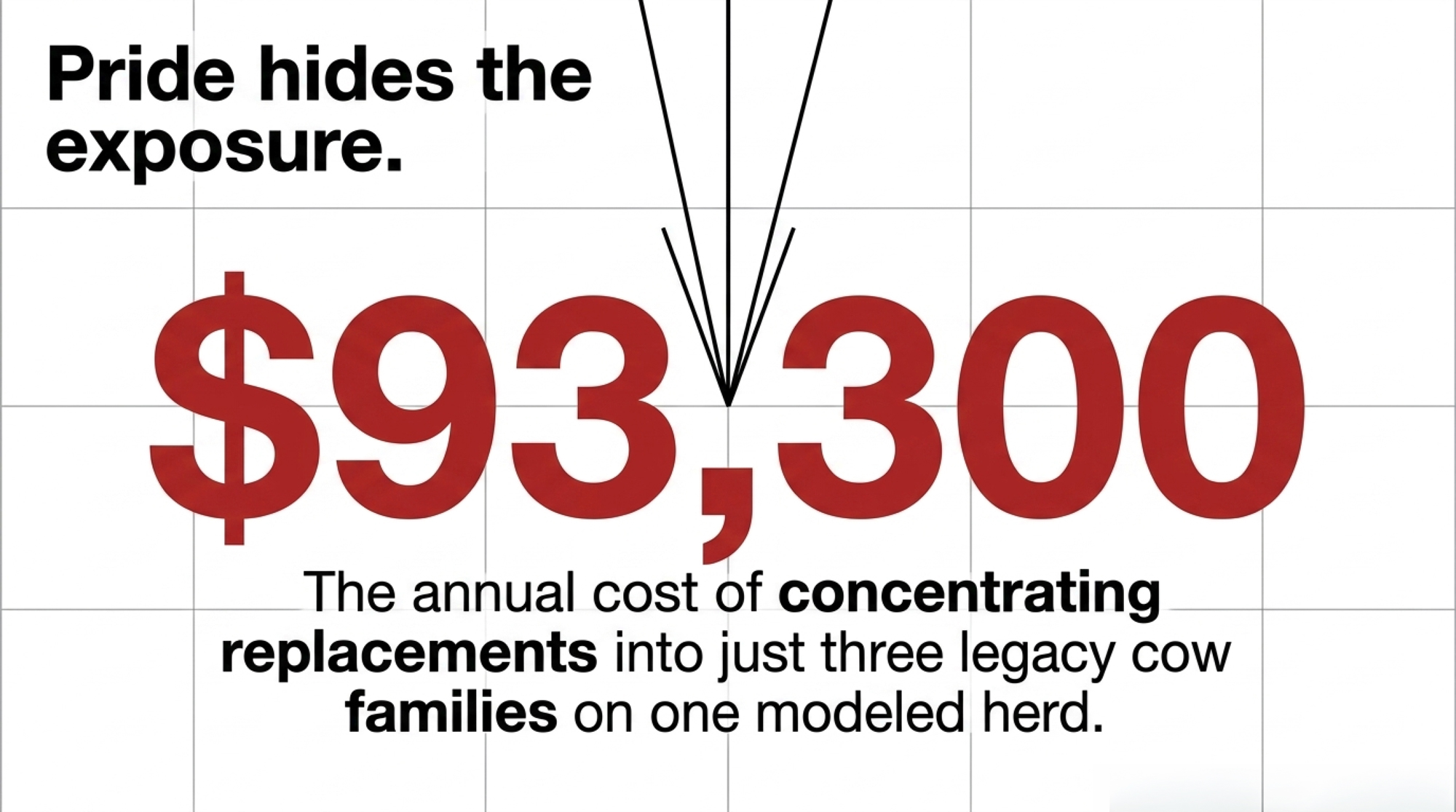
And the calf cheque is only half the story. The same legacy herds most likely to protect a famous cow family are the ones most exposed when that family stumbles. The Bullvine’s March 2026 concentration analysis modeled a herd whose top genomic heifers all traced back to three cow families and put the cost of that concentration at roughly $93,300 a year against a $3,110 replacement value — close to USDA’s $3,010 national average for July 2025. That’s the figure in the headline: one modeled herd, not a universal number, but the kind of exposure that hides in plain sight when pride sets the breeding plan.
Which farms carry the most exposure? The multi-generation purebred operations. The ones with banners on the wall and a parent or grandparent still making the mating calls. For a commercial herd with no show history, the pivot to beef is arithmetic you run once and move on. For a legacy herd, every beef straw on a homebred cow family feels like a vote against who the family is.
Why the timing bites now: milk margins have been thin enough that the calf cheque stopped being pocket change and started being a line item that decides whether the year pencils. When a beef-cross calf clears four figures and the bottom-end dairy bull calf is a coin flip, a sentimental breeding policy isn’t abstract anymore. It shows up at settlement.
How This Plays Out on Real Farms
The pattern repeats across succession research and farm-press profiles, and it usually starts with a spreadsheet. The next generation comes to the table showing what the numbers actually do: one herd’s calf income line more than quadrupled when it shifted from dairy bull calves at $650 a head to beef-crosses at $1,400 — the same number of calves, roughly twice the value each, according to Bullvine 2026 margin modeling. Dad agrees, with one rule written in pen at the top of the sheet. No beef on the legacy family. Grandpa doesn’t want beef semen anywhere near a cow he still considers a bull mother, full stop.
The herds that thread this needle tend to do it structurally, not emotionally. They ring-fence the top 15–20% of proven cow families for sexed dairy semen and donor work, run balanced dairy genetics through the middle, and put beef on the genomically verified bottom 20–30% of performers. Verified — not chosen on type or intuition. One Bullvine podcast laid the gap out plainly: dairy bull calves at $875, beef-cross at $1,450, a $575 premium per head.
Now run it on your own herd. Say you milk 300 cows and you move 150 of them from dairy semen to beef at that $575 premium. That’s roughly $86,000 in additional calf income for a single breeding cycle — before you adjust for calving rate and calf losses, which trim it some. Defer the decision a year because the conversation was too hard to have, and that’s $86,000 the bank quietly notices, even if nobody at the table says it out loud.
But that premium has a mirror image, and it’s the part the enthusiasts skip. At today’s replacement values, every beef service on a viable dairy dam trades away roughly $585 in expected replacement value — putting the crossover point near $1,580 per beef calf before the swap clearly pays on a cow you’d otherwise breed dairy, per our April 2026 per-service analysis. So the premium and the opportunity cost nearly cancel on your good cows.
What Does Keeping the Wrong Cow Actually Cost?
There’s a harder cost layered underneath all of this, and Swiss researchers put a number on it. Schlebusch and colleagues, publishing in Animals in 2025, tracked 3,003 cows across 29 Swiss dairy farms over five years, comparing what farmers actually did against what a bio-economic model said they should have done. Suboptimal replacement decisions cost an average of 161 CHF per farm per month.
| Decision error | Cost per cow per month | Cumulative cost across 29 farms | Direction of the bias |
| Retaining an unprofitable cow | 1.18 CHF | 3,557 CHF | Farmers overestimate cull cost |
| Culling slightly too early | 0.33 CHF | 1,101 CHF | Farmers underestimate keep cost |
| Ratio (keep-too-long : cull-too-early) | ~3.6× | ~3.2× | The pride tax |
| Average replacement heifer benchmark | — | 3,123 CHF (≈ USDA $3,010) | Ratio applies in North America |
The direction of the error is what matters for your breeding sheet. Retaining unprofitable cows cost 1.18 CHF per cow per month, versus 0.33 CHF for culling a bit too early — roughly a three-to-one penalty for hanging on. Across all 29 farms, cows kept despite a negative cow value accounted for 3,557 CHF in cumulative losses against 1,101 CHF from premature culling. Their average replacement heifer ran 3,123 CHF, which isn’t far off North American replacement costs right now, so the ratio travels even if the currency doesn’t.
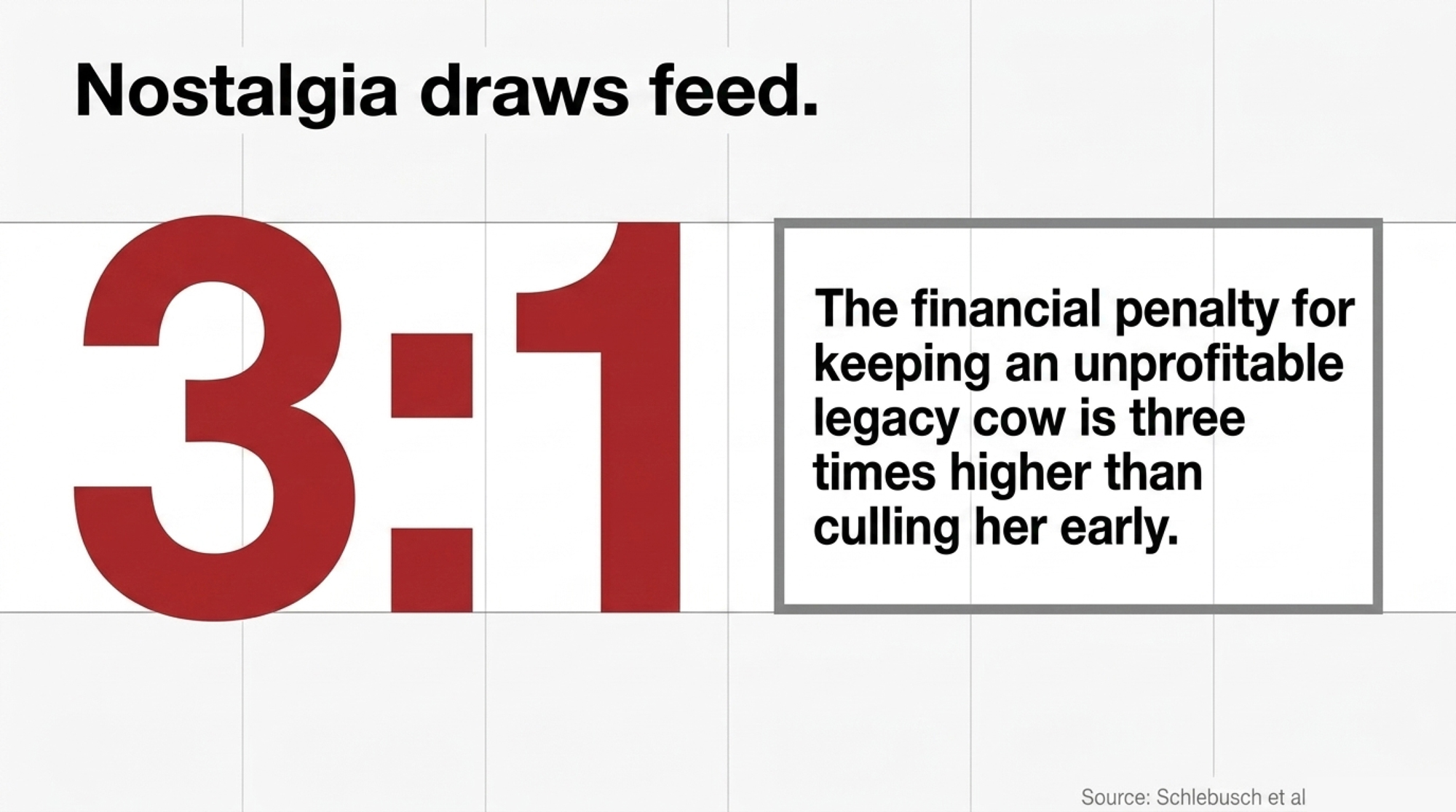
Farmers overestimate the cost of culling early and underestimate the cost of keeping too long. When the protected list is built on pride instead of performance, those losses hide inside the legacy families nobody’s willing to question. And they compound — a late-calving, low-component cow you kept for her pedigree is also a cow you bred dairy when you could’ve bred beef. You paid twice for the same sentiment.
The Mechanics Behind the Outcomes
So why is breeding the lever older generations grip the hardest? Harder than the equipment, the debt, even the herd-size decisions? Because genetics is authorship. You can hand over the tractor keys and still feel like yourself. Hand over the mating plan, and you’re admitting the herd’s story belongs to someone else now. Succession researchers call what’s changing hands here “psychological ownership” — the feeling of being tied to something you built. It’s exactly what gets cut when breeding policy shifts.
The Bullvine’s succession work names herd genetics, reproduction, and milk-quality knowledge as “intellectual capital that must be transferred alongside physical assets.” Wisconsin Extension frames the recurring tensions as fair-versus-equal, business-versus-family, and control-versus-inclusion. Breeding decisions sit right inside that control bucket. Which is why they detonate.
But here’s where the economics stop caring about feelings. A cow family earns its protected spot only if its daughters pay back what they cost to raise. Lactanet’s analysis of Canadian Holsteins found the average cow doesn’t hit breakeven until about 42 months of age — mid-second lactation. U.S. cost structures differ, so treat that as a Canadian benchmark rather than your own number. The direction holds either way: a line that consistently calves late and leaves before that point isn’t a legacy. It’s nostalgia drawing feed.
How the $93,300 Trap Actually Adds Up
Go back to that headline number. In the modeled herd, the top genomic heifers all traced to three cow families — which feels like a strength right up until it isn’t. The cost stacks three ways: inbreeding creeping up as you breed within a narrowing pool, the health and fertility liabilities riding along with it, and the replacement gamble if one of those families has a bad run at $3,110 a head.
The inbreeding piece is no longer a soft worry, though you have to be careful which number you’re reading. Genomic inbreeding in Holstein bulls ran from roughly 5.7% to 15.2% between 2010 and 2020 — a 168% jump in one decade. Pedigree-based inbreeding in Holstein heifers hit 9.99% in 2024, highest of any major breed. Those aren’t the same metric, and genomic measures always read higher than pedigree ones on the same animal: one study found a 7.74% pedigree average against 15–31% when calculated genomically. Compare like with like or you’ll scare yourself with the wrong figure.
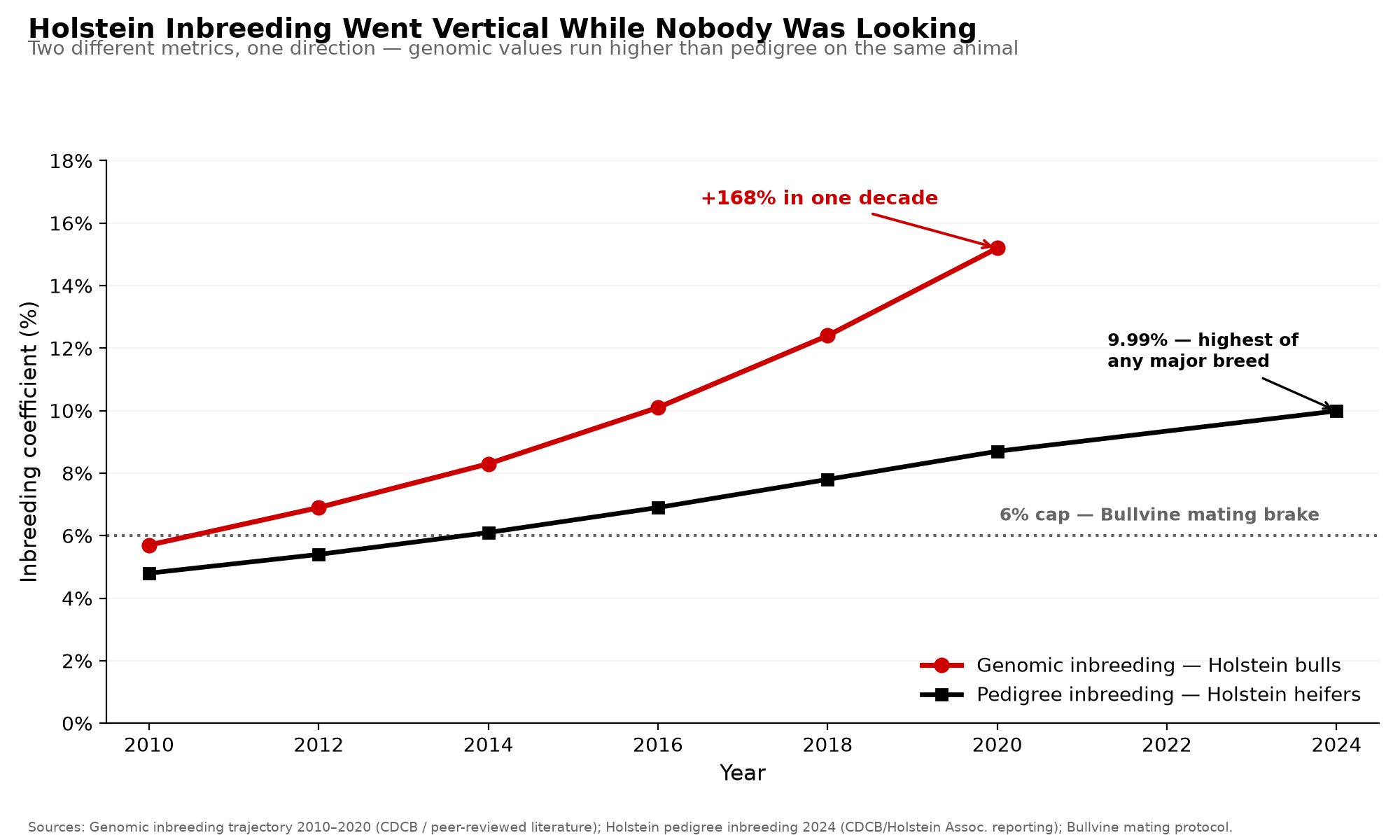
The cost per point is well-established. Each 1% of inbreeding takes $23–$25 off lifetime Net Merit. That tracks closely with older peer-reviewed work — Cassell’s analysis put it at $22 to $24 in lifetime net income per 1%, and Smith’s 1998 lifetime-performance study found registered cows dropped $24.43 in fluid markets. A 10%-inbred cow versus a 5% one also gives up about 92 kg of milk per lactation and 65 days of productive life, per Canadian Dairy Network. On 500-cow herds, cutting inbreeding from 13% to 8% documented $75,000–$94,000 in improved lifetime cow value — $150 to $188 per cow.
That’s the part the show banner hides. Concentration looks like dominance when those families are winning. It turns fragile the moment one of them stops — and on a closed herd, one off year in a foundation line can echo for three lactations before you’ve bought your way out of it.
How Much Does Waiting One More Cycle Actually Cost?
More than most families let themselves admit. Start with the calf premium you skip, layer on the retained-cow losses, and add the fertility ground you don’t gain. A 2024 Journal of Dairy Science simulation — European modeling, so read it directionally — found that improving fertility and productive life from 2.8 to 3.8 years lifted profit by about €98 per cow-year, while enabling more beef semen use, not less. Better cows let you push more beef without gutting your replacement pipeline. Worse fertility traps you in dairy matings you can’t afford to skip.
So the deferral isn’t neutral, and it isn’t free. Picture two herds the same size, same milk price, same feed bill. One sorted its cow families by profit two years ago and has been banking the calf premium since. The other is still arguing about a single cow. By the time the second herd settles the fight, the first has a head start that didn’t come from better cows — just from an earlier decision. The math doesn’t pause for the family meeting.
Is the Cow Even the Real Argument?
Usually not. Strip the breeding fight back and it’s a stand-in for the conversation nobody wants to start: who decides, who stays, who leaves, and when authority actually transfers.
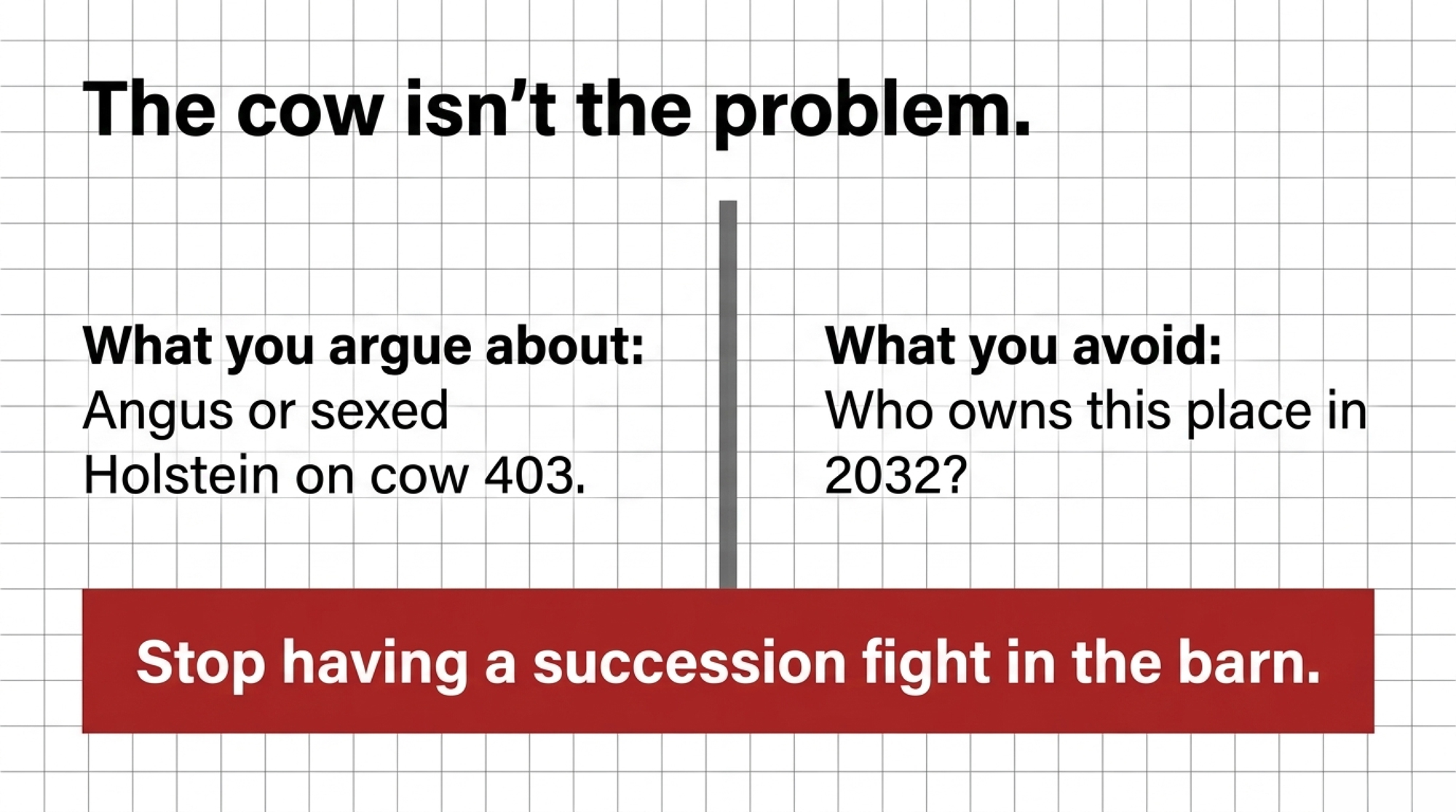
The real conversation isn’t “Angus or sexed Holstein on cow 403.” It’s bigger and harder. Who owns this place in 2032? How much income does the retiring generation actually need to walk away comfortable? Which decisions are being handed over now, not someday? And when does the older generation stop using the breeding sheet as proof they still run the farm? That talk is rare because the moment you put names, dates, and dollars on the table, you’re admitting somebody’s dream might not survive the transition. A mating plan is a far easier thing to argue about.
Here’s the quiet part. When the breeding fight keeps reigniting over the same cow, that cow usually isn’t the problem — she’s the only safe place to have a fight about everything else. Move the real questions to their own table and the genetics argument shrinks back down to what it should be: a technical decision about which straw goes in which cow.
Options and Trade-Offs for Farmers
There’s no single right split. Three paths keep showing up, and each one buys you something while costing you something else.
Option 1: Ring-Fence and Pivot (The Survivor Model)
The Play: Protect the top 15–20% of proven families with sexed dairy semen; put beef on the genomically verified bottom 20–30%.
When It Works: Operations with genuine seedstock or show equity and solid reproductive metrics.
What It Takes: Genomic testing to sort the core honestly — not by who’s got the famous prefix. Cap projected inbreeding at 6% in your sire-search filter and treat it as a brake, not a target.
The Catch: Over-concentrating replacements in too few lines risks the $93,300 exposure that March 2026 model found.
Option 2: Aggressive Beef-on-Dairy
The Play: Shift the majority of your matings to beef, keeping only enough sexed dairy service on your best cows to cover replacement needs. Treat crossbred calves as a primary revenue line, not a byproduct.
When It Works: High 21-day pregnancy rates, where local beef calf prices clear the $1,580 crossover threshold.
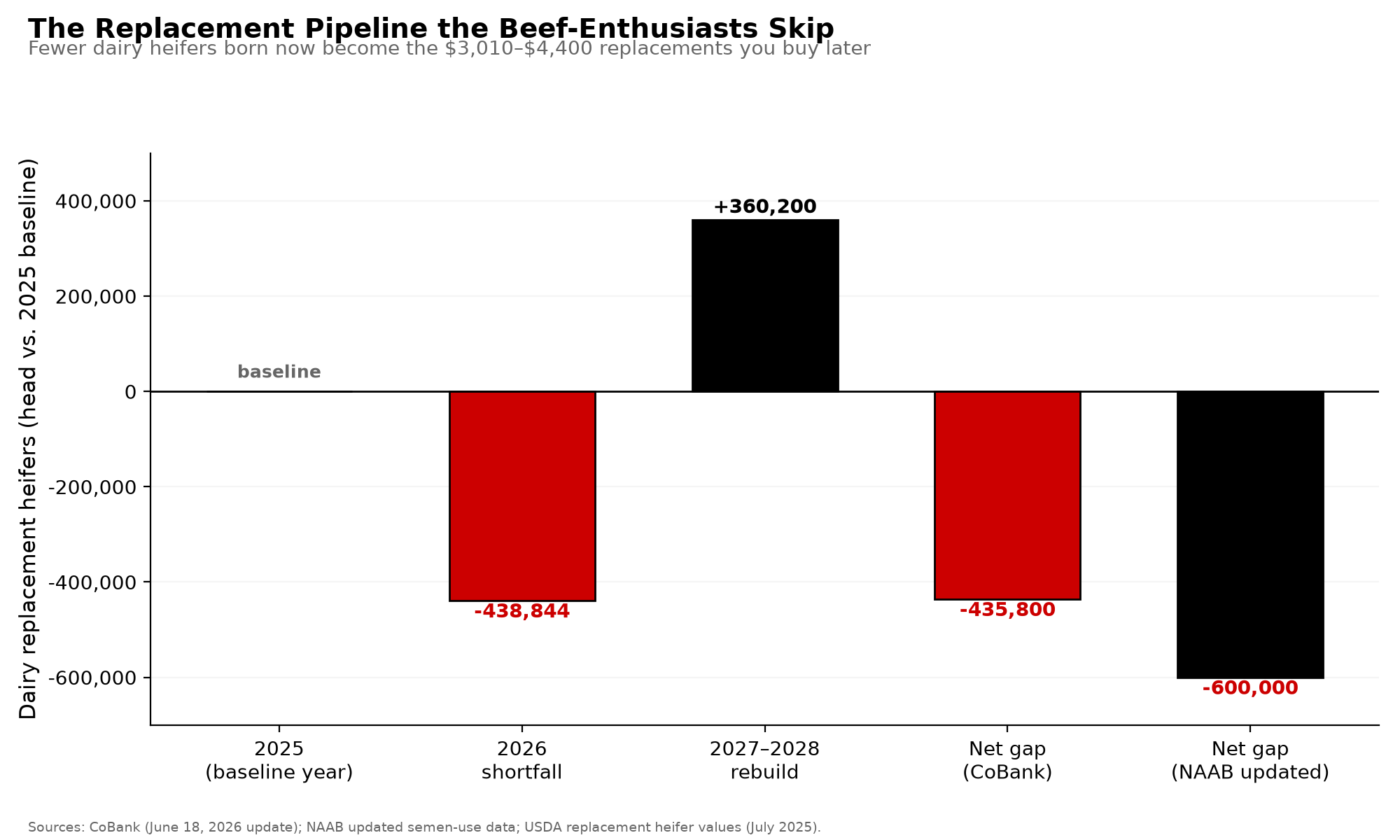
The Catch: Severe exposure to the replacement heifer squeeze. CoBank projected 438,844 fewer dairy heifers in 2026 versus 2025, driven by 398,925 more beef-on-dairy calves born; their June 18, 2026 update puts the combined 2025–2026 shortfall near 796,000 head, with only about 360,200 rebuilt across 2027–2028. Updated NAAB data trims the likely gap closer to 600,000 — but your replacement bill doesn’t care about the difference. Market replacements now run $3,010 average (USDA, July 2025) to $4,400 for top-quality at auction.
Option 3: Hold the Legacy Line
The Play: Maintain traditional dairy breeding, relying on classification, genetics, and replacement sales.
When It Works: Elite, recognized cow families positioned to capitalize on record replacement demand. Jeffrey-Way Holsteins built 384 Excellent cows out of essentially one cow family over forty years — so it can be done.
The Catch: That’s the upside case. The downside shows up elsewhere: shrinking seedstock margins, and line-breeding tight around a single family has run $10,000–$15,000 in voluntary culls in separate Bullvine modeling.
Do This Within the Next 30 Days
Run the maternal audit before your next semen order. Print three to four years of cows sorted by lifetime milk or lifetime margin, highlight the ones in third lactation or better with solid components and no chronic problems, then trace those cows back three maternal generations and circle the surnames that repeat. That’s your real protected core — not the one on the barn wall.
Pull your inbreeding coefficients animal by animal while you’re at it, and note whether your software is reporting pedigree or genomic values. A 6% pedigree herd average can hide replacement heifers sitting at 12%.
Key Takeaways
- If you can’t name the maternal lines behind your top ten cows without opening the herd book, run the 30-day audit before you spend another dollar on semen or embryos.
- If your top genomic heifers all trace to two or three families, price your exposure now — that concentration ran $93,300 a year in one modeled herd at $3,110 heifers.
- If beef calves in your market are selling below roughly $1,580, keep beef off any cow you’d genuinely want a replacement from. At that price the $575 premium doesn’t cover the $585 in replacement value you’re trading away.
- If any mating pushes projected inbreeding above your 6% cap, find a different bull. Every point costs $23–$25 in lifetime Net Merit, and the peer-reviewed work behind that number has been consistent for twenty-five years.
- If you’re holding a cow because culling her feels premature, remember the Swiss ratio: keeping too long cost roughly three times what culling too early did.
- If you’re deferring a breeding shift because the family conversation is hard, put a dollar figure on the delay — calf premium plus retained-cow losses — and bring that number to the table instead of the breeding sheet.
- If breeding keeps triggering the same fight, stop having it in the barn. Schedule a separate succession meeting where the older generation defines the non-negotiable families and the next generation sets the performance bar those families must clear.
The question worth sitting with this week isn’t whether beef-on-dairy belongs in your herd. For most operations, some version of it already does. It’s whether your family has ever actually named, out loud and with the numbers in front of you, which cows carry the legacy and which ones carry the mortgage.
If you haven’t had that conversation, the cow is still standing in for one nobody’s brave enough to start.
Learn More
- The $585-Per-Service Beef-on-Dairy Trap: What a 500-Cow Herd Reveals About Your Replacement Pipeline— Arms your breeding protocol with concrete math on pipeline ratios and 21-day PR thresholds, exposing how breeding viable dairy dams to beef trades away $117,000 in future herd value.
- Your Top Heifers All Trace to Three Cow Families. That’s a $93,300-A-Year Trap. — Breaks down the hidden replacement capital drain when genomic selection over-concentrates maternal lines, delivering a 30-day audit protocol to protect long-term herd durability.
- 384 Excellent Cows and a Royal Grand Champion: Inside Holstein USA’s 2026 Elite Breeder Jeffrey-Way Holsteins — Examines the contrarian case for single-maternal-line concentration, demonstrating how strict culling and sub-family branching built 384 Excellent cows without crashing health or fertility.
 The Sunday Read Dairy Professionals Don’t Skip.
 The Sunday Read Dairy Professionals Don’t Skip.
Every week, thousands of producers, breeders, and industry insiders open Bullvine Weekly for genetics insights, market shifts, and profit strategies they won’t find anywhere else. One email. Five minutes. Smarter decisions all week.




