




The National Dairy Cattle Congress owned October from 1910 to 1965. Then it dropped “Dairy” from its own name and bet the building on a greyhound track. This month its fair closes two days before Expo’s gates open.
The short version, for anyone reading this in the parlor
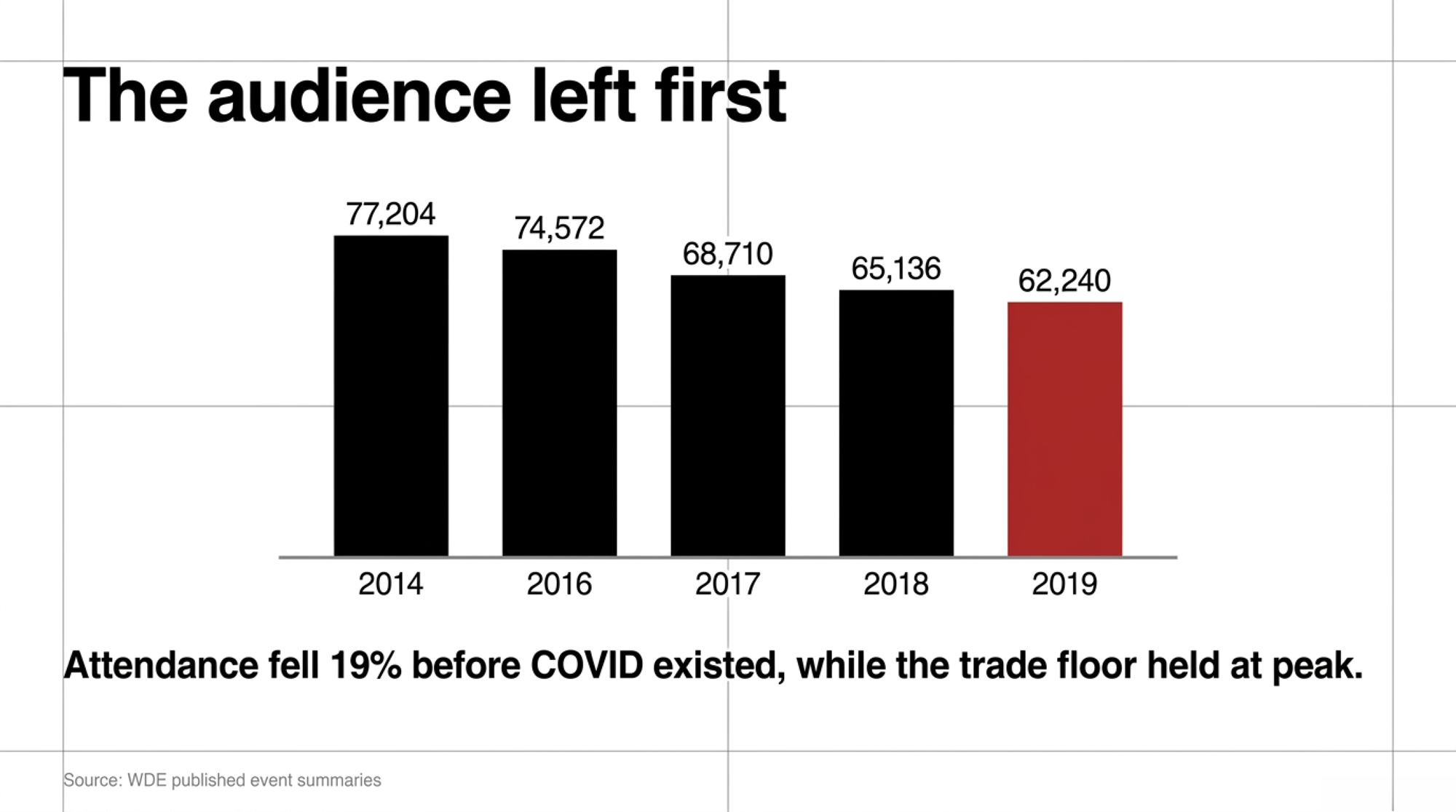
- The audience left first. World Dairy Expo attendance fell every year from 2014 to 2019 — down 19% before COVID existed — while the trade floor held near its peak.
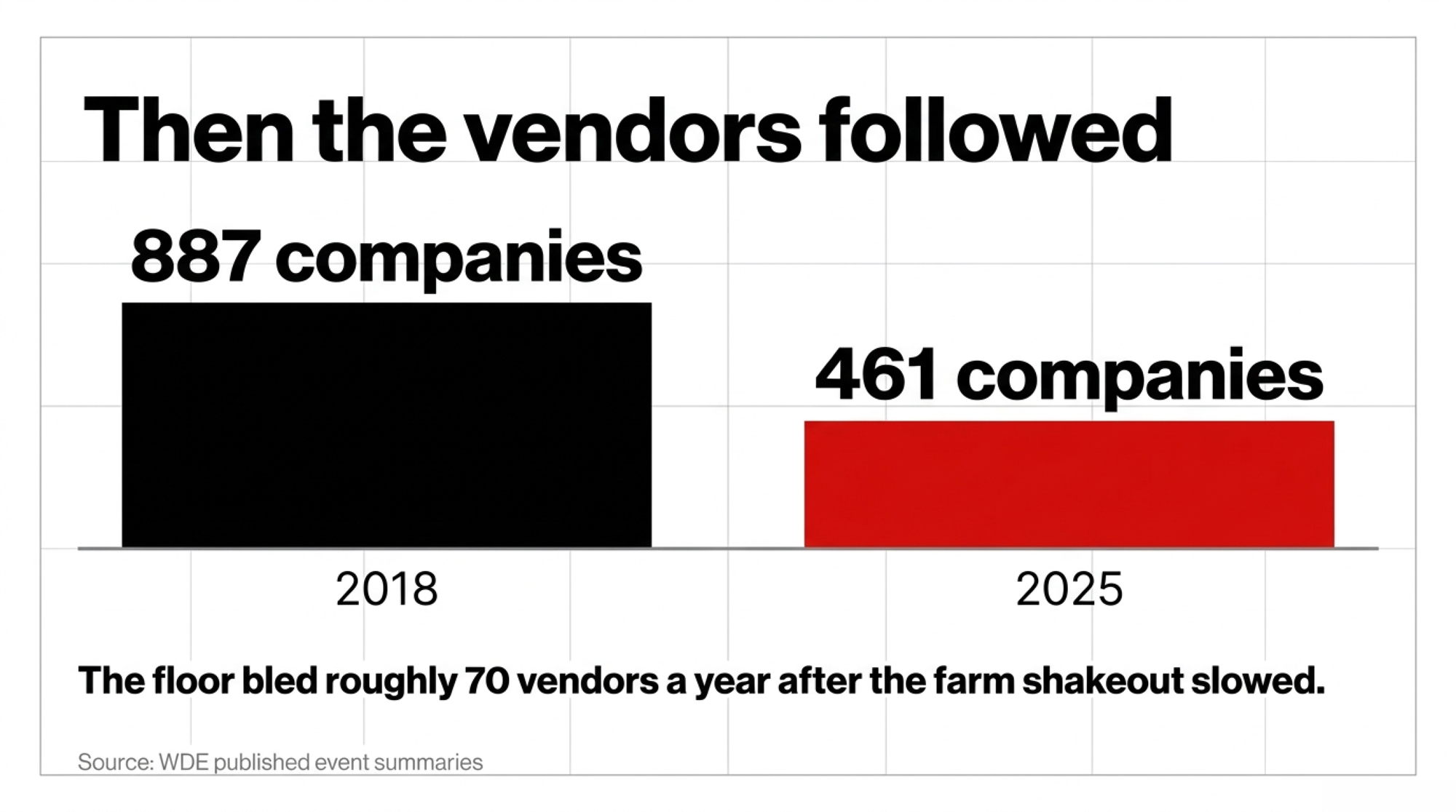
- Then the vendors followed. The floor went from 887 in 2018 to 461 in 2025, a 48% loss, with 211 of it in the three years after the farm shakeout slowed.
- Cattle sit at 108% against 2016. Waterloo died the opposite way and ended up in the same place. Read the inversion below.
Norman Nabholz can still smell it. “I was captivated by it,” he told The Bullvine in 2013, remembering the National Dairy Cattle Congress in Waterloo, Iowa. “I remember everything, from the smells to the sights, sounds, and the people. It’s why I’m in the business that I’m in today.”
That’s not idle nostalgia. Nabholz has been showing since his first champion in 1974, and he wrote the book on Waterloo — literally, Millionaires in the Cornfields: The Glory Days of the National Dairy Cattle Congress. So when he read our reporting on World Dairy Expo’s decline this summer and reached for a warning in the comments, it carried weight. “Sixty-one years ago this October we were heading to Waterloo and thought we would be doing it forever.”
Do that math. Sixty-one years back from this October is 1965, the exact year the dairy establishment walked out of Waterloo. And when the gates open September 29, the 59th World Dairy Expo runs at the Alliant Energy Center in Madison, on a venue contract that extends through 2028, which makes this the moment to ask an uncomfortable question about permanence.
What Waterloo actually was
Don’t picture a county fair. Picture the center of the dairy universe.
The National Dairy Cattle Congress opened October 9–10, 1910, built by the Iowa State Dairy Association as a nonprofit exposition to grow the industry. It swung big from day one: roughly 5,500 people the first day, about 40,000 over the opening weekend, and it still turned a profit. By the accounts compiled in the National Cattle Congress’s own published history, attendance reached 87,000 by 1919, pulled in by a new Hippodrome seating around 7,000 and the growing prestige of the Belgian Horse Show.
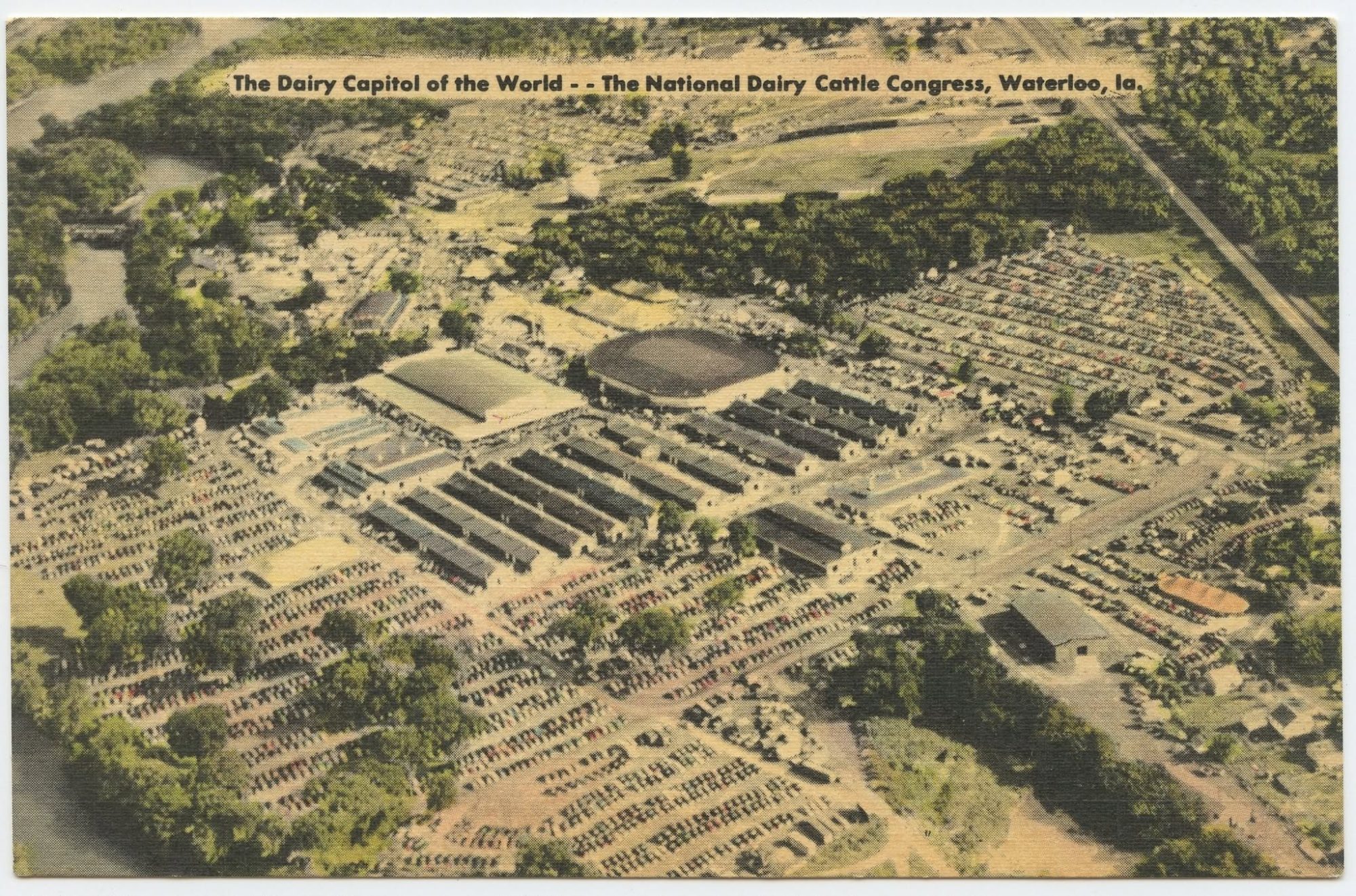
The credibility followed the crowds. In 1948, four national dairy breed organizations made Waterloo their official National Show, and the National FFA dairy contests had already moved there the year before. This was where the breed sorted itself out. Best cattle, best judges, best people, one barn, every October.
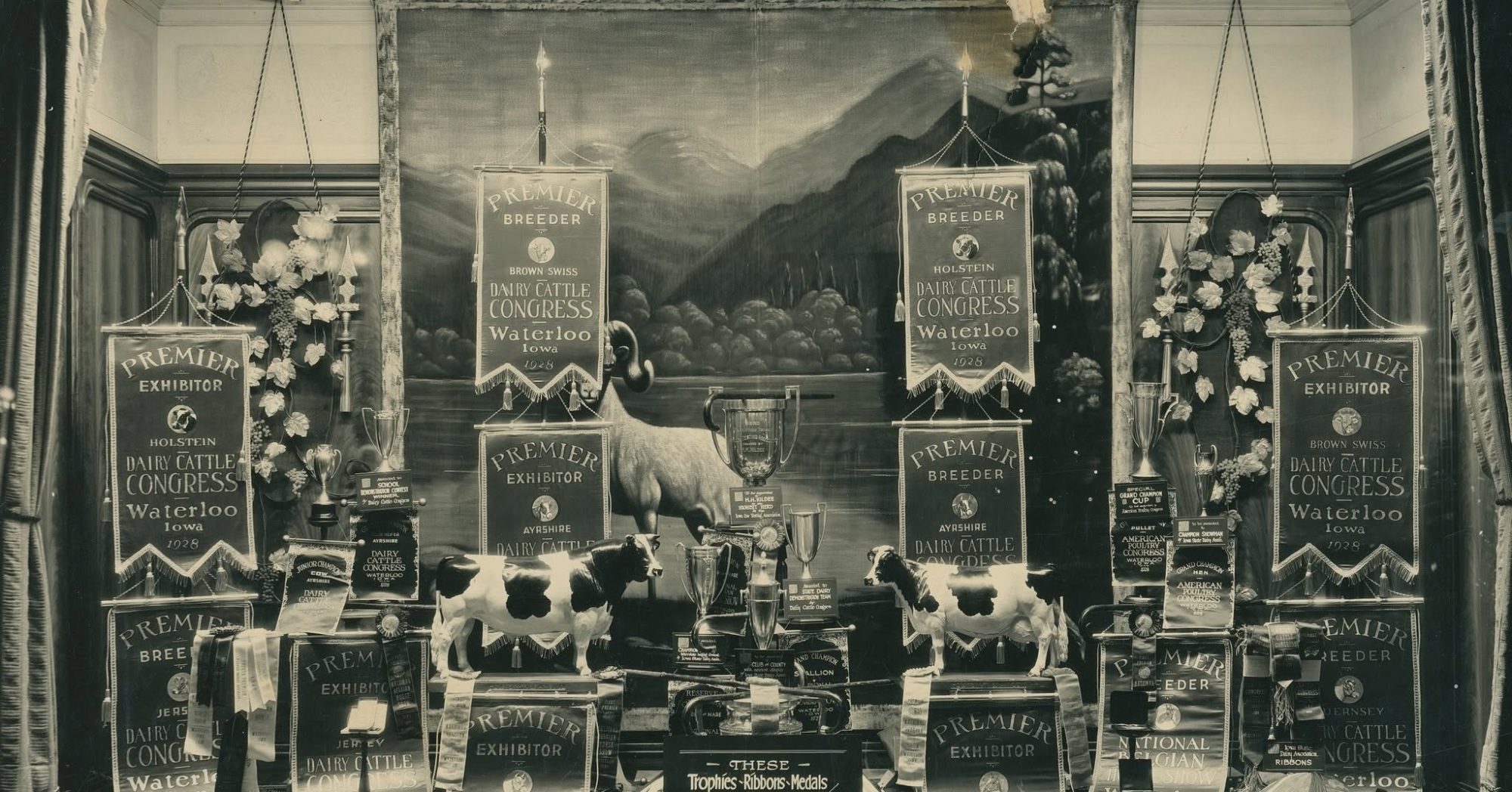
Nabholz doesn’t hedge on what that meant. He’s called it “the world’s greatest dairy cattle show from 1910 to 1965.” Read that end date twice. The man who loves the place most is the one telling you when the clock started running out.
How a legend talks itself into a slow death
Big institutions rarely die in one loud crack. They erode in decisions that each sounded reasonable at the time.
Waterloo’s turn came in the 1960s, when the show started “refocusing.” The University of Northern Iowa’s Black Hawk County history is blunt: the dairy focus was slipping. Farm machinery ate more floor space. Horse shows grabbed more billing. The event stretched to nine days. Every step got sold the same way — the public wants variety, farming’s changing, give people more show. Sounds sensible. It usually does, right up until the mission gets watered down past recognition. You can watch it happen in the show’s own advertising.
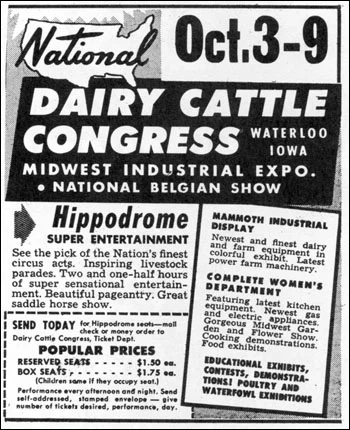
Read what Waterloo was selling. This undated Dairy Cattle Congress advertisement headlines circus acts, a saddle horse show, power farm machinery, kitchen appliances, a flower show and waterfowl. Not one of its three featured attractions is the dairy cattle show. The name still said National. The billing had already moved on.
The problem wasn’t that management adapted. It’s what they adapted toward. The breed associations that had bankrolled Waterloo for decades watched a dairy show trying to be everything to everybody, and they walked. The UNI history says their frustration “came to a head in 1965,” when the National Dairy Association pulled its support and moved its shows to Madison, Wisconsin.
That’s the hinge. Everything before it was a warning. Everything after was a consequence. And here’s the part that should make every breeder wince. With the dairy backing gone, the National Dairy Cattle Congress became simply the National Cattle Congress. They dropped “Dairy” from the name. That’s not rebranding. That’s a coroner’s note.
Maurice Telleen, the secretary-manager who lived through it and later founded the Draft Horse Journal in Waterloo, said the show was no longer national but regional, and pointed to the crumbling economics of shipping cattle long distances by rail as service declined. Real enough. But only half the story. Waterloo also lost its ability to convince the dairy world it was the one show nobody could skip. Lose that, and the trucks stop coming no matter how good your rail spur is.
Madison wasn’t an accident – it was the autopsy
Here’s the twist that should rattle every Expo loyalist. World Dairy Expo exists because Waterloo failed to hold the center.
The Bullvine’s own founders’ history says Gene Nelson saw Waterloo’s “dwindling popularity” firsthand when he and three others launched a new exhibition. The first World Dairy Expo ran in 1967, two years after the dairy establishment abandoned Iowa. The biggest dairy show on earth was born straight out of the moment the old giant stopped being enough.
One detail worth clearing up, because it came up in the same comment. Nabholz pointed readers toward a book called We Need a Show. The book is real, though it tells the other half of the story: We Need a Show: A 50 Year History of World Dairy Expo, published in 2015 by W.D. Hoard & Sons and co-edited by Corey Geiger and Steve Larson. It’s Expo’s history rather than Waterloo’s autopsy. His point survives the correction, though, and the title makes it for him. Expo’s whole reason for existing was a room full of people looking at a drifting institution and saying, flatly, we need a show. That’s the verdict on Waterloo, printed on a cover.
Now the part that cuts the other way. Expo wasn’t born bulletproof either. Dairy Agenda Today’s history shows the early years were shaky, and the trade floor only took off after leadership changes in the late 1980s, when Tom McKittrick and Joe Gilbert rebuilt the commercial engine. When Madison wobbled, people made hard choices and fixed it. Waterloo drifted. Madison fought. Hold onto that difference.
The long fade – from dairy cattle to dog track
After 1965, Waterloo didn’t vanish. That’s exactly what made the decline easy to ignore. The grounds still ran. The fair still opened. The name still carried a century of history. The institution kept moving, which let everybody pretend it was still the same institution. It wasn’t.
The 1970s pushed the same diversification logic into farm implements, more horse shows, and big-name entertainment. The UNI history’s language is brutal: the National Cattle Congress was starting to look like a small-time carnival with sideshow attractions, with people showing up to ride the midway and eat the food while the livestock took a back seat. That reads as a diagnosis of a show that forgot which audience built it.
Then the money ran out. By 1984 the organization was in serious financial trouble, and the rescue plan was pari-mutuel greyhound racing. Waterloo Greyhound Park opened October 15, 1986. For exactly one year it looked like salvation: roughly $600,000 in track profit and a $519,000 gain for the Cattle Congress, figures carried in both the UNI history and the Waterloo Courier’s published NCC timeline. Sit with that. An institution built to crown the world’s best dairy cattle was betting its survival on dog racing.
The bet went bad fast. By 1989, management admitted the track was in trouble and warned that if it failed, the banks would own both the track and the Cattle Congress. In December 1992, the Meskwaki Casino opened in Tama, half an hour away, with gambling the track couldn’t touch. A 1993 bankruptcy auditor concluded the organization would have folded eight years earlier without the track’s yearly cash infusions. The Meskwaki Nation later lent the NCC bailout money and eventually foreclosed on the property. The dogs only stretched out the dying.
Then came the headline that says everything. When the Waterloo Courier ran “Cattle Congress Cuts Cows,” the show once built on elite dairy cattle could no longer afford to hold the livestock shows. That’s the cleanest definition of institutional death you’ll read: the day your institution can no longer afford to do the one thing it was built to do.
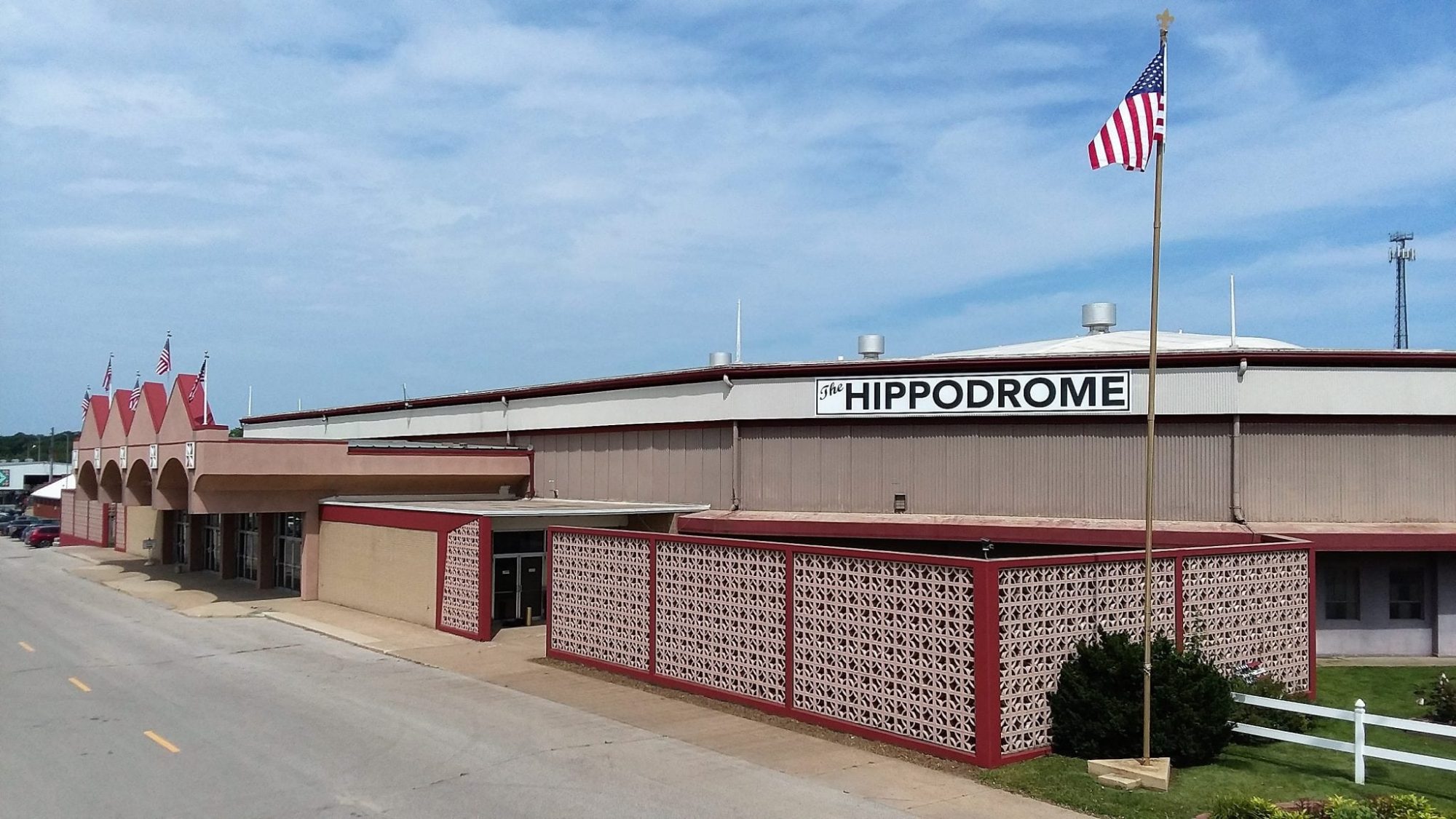
Here’s the part that should stop you cold, and it’s happening this month. The National Cattle Congress is still there. The 116th National Cattle Congress Fair runs September 24 through 27, 2026, on the same Waterloo fairgrounds, with a carnival, ranch bronc and bull riding, general admission at $15, and the tagline “Still Our Story.” The Hippodrome still stands, rented out at 20,000 square feet. The financial difficulties described above belong to that organization’s 1980s and 1990s management, and the National Cattle Congress today operates under different leadership. Their fair closes on a Sunday. Expo’s gates open two days later. The grounds survived. The National Dairy Cattle Congress, as North America’s premier dairy show, did not. The buildings outlived the mission.
Is World Dairy Expo actually turning into Waterloo?
No. But the specific mechanism is worth understanding, because it isn’t the one people watch for — and the full twelve-year record tells a different story than the headline number does.
Start with what was never in doubt at Madison. The Expo cattle show is healthy. The breeders held their end, and every year the families still hitched up and hauled the best genetics on the continent to Wisconsin. If you’re waiting for someone to say the cows have gone soft, this isn’t that article.
Here is the complete record, from Expo’s own published show and event summaries. Index values in brackets: exhibitors against 884 in 2017, cattle against 2,434 in 2016, attendance against 77,204 in 2014.
| Year | Commercial exhibitors | Cattle on grounds | Attendance |
| 2014 | 835 (94) | 2,334 (96) | 77,204 (100) |
| 2015 | 871 (99) | 2,296 (94) | 72,427 (94) |
| 2016 | 881 (100) | 2,434 (100) | 74,572 (97) |
| 2017 | 884 (100) | 2,356 (97) | 68,710 (89) |
| 2018 | 887 (100) | 2,338 (96) | 65,136 (84) |
| 2019 | 859 (97) | 2,331 (96) | 62,240 (81) |
| 2020 | cancelled (COVID-19) | — | — |
| 2021 | 663 (75) | 2,306 (95) | 48,502 (63) |
| 2022 | 672 (76) | 2,663 (109) | 54,525 (71) |
| 2023 | 563 (64) | 2,571 (106) | 56,250 (73) |
| 2024 | 551 (62) | 2,527 (104) | 55,209 (72) |
| 2025 | 461 (52) | 2,625 (108) | 51,525 (67) |
Read the attendance column down before you read anything else. It falls in 2015. It falls again in 2017, 2018, and 2019. By the last show before the pandemic, Expo had lost 14,964 people, down 19% from 2014 — and not one of those years can be blamed on COVID. The crowd was leaving for six years, and the industry talked about it as if it hadn’t started.
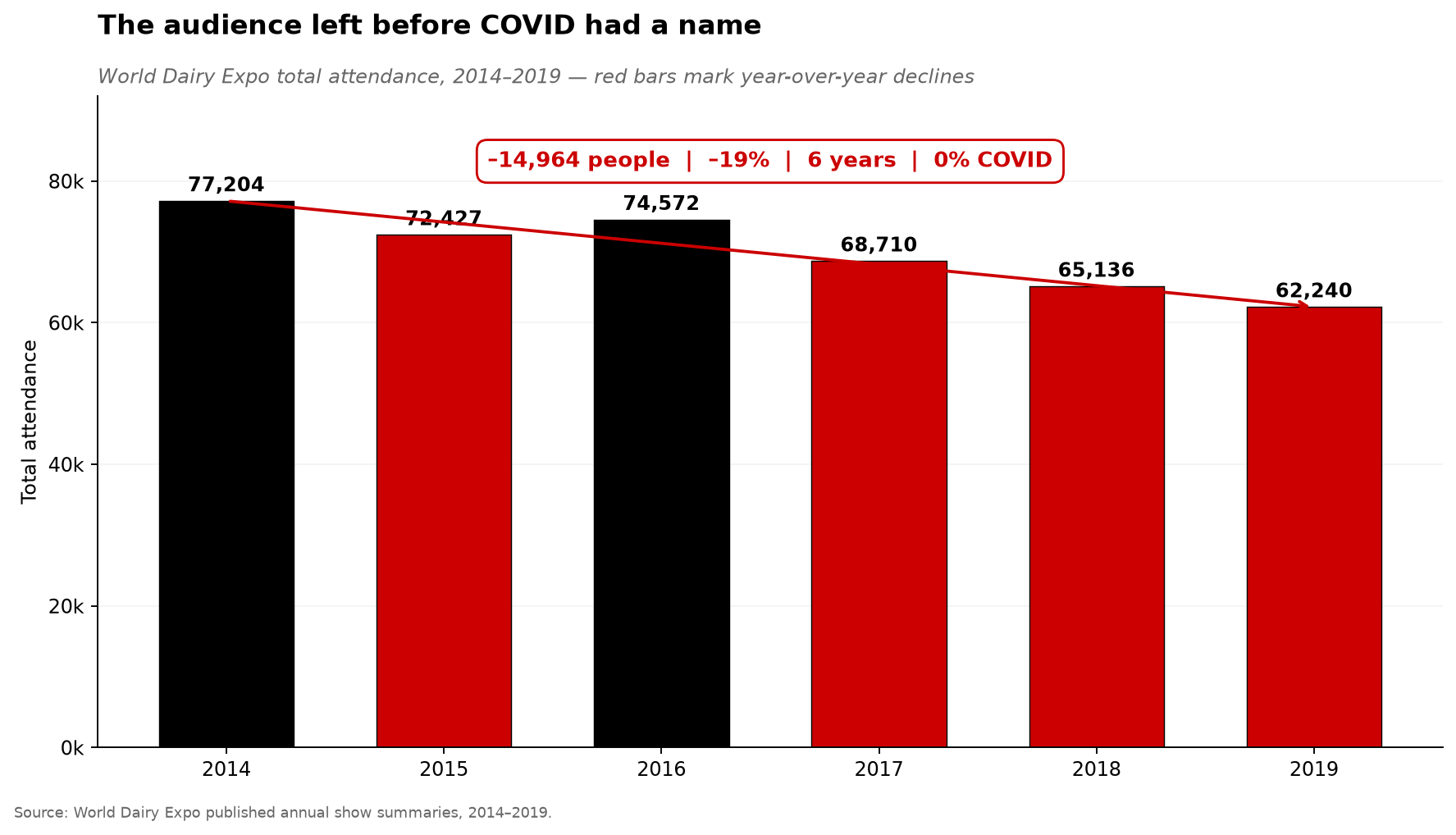
Now read the exhibitor column next to it. Through all of that, the trade floor held. It peaked at 887 companies in 2018, the fifth consecutive year of falling attendance. Vendors were still buying booths at a show whose audience had already shrunk by a sixth.
That’s the finding, and it isn’t the one we expected. The audience left first. The vendors followed. They followed in two waves: 196 companies gone across the shutdown gap between 2019 and 2021, then another 211 in the three years from 2022 to 2025 — about 70 a year, in a stretch when the farm shakeout had largely run its course. The first wave has an obvious explanation. The second doesn’t.
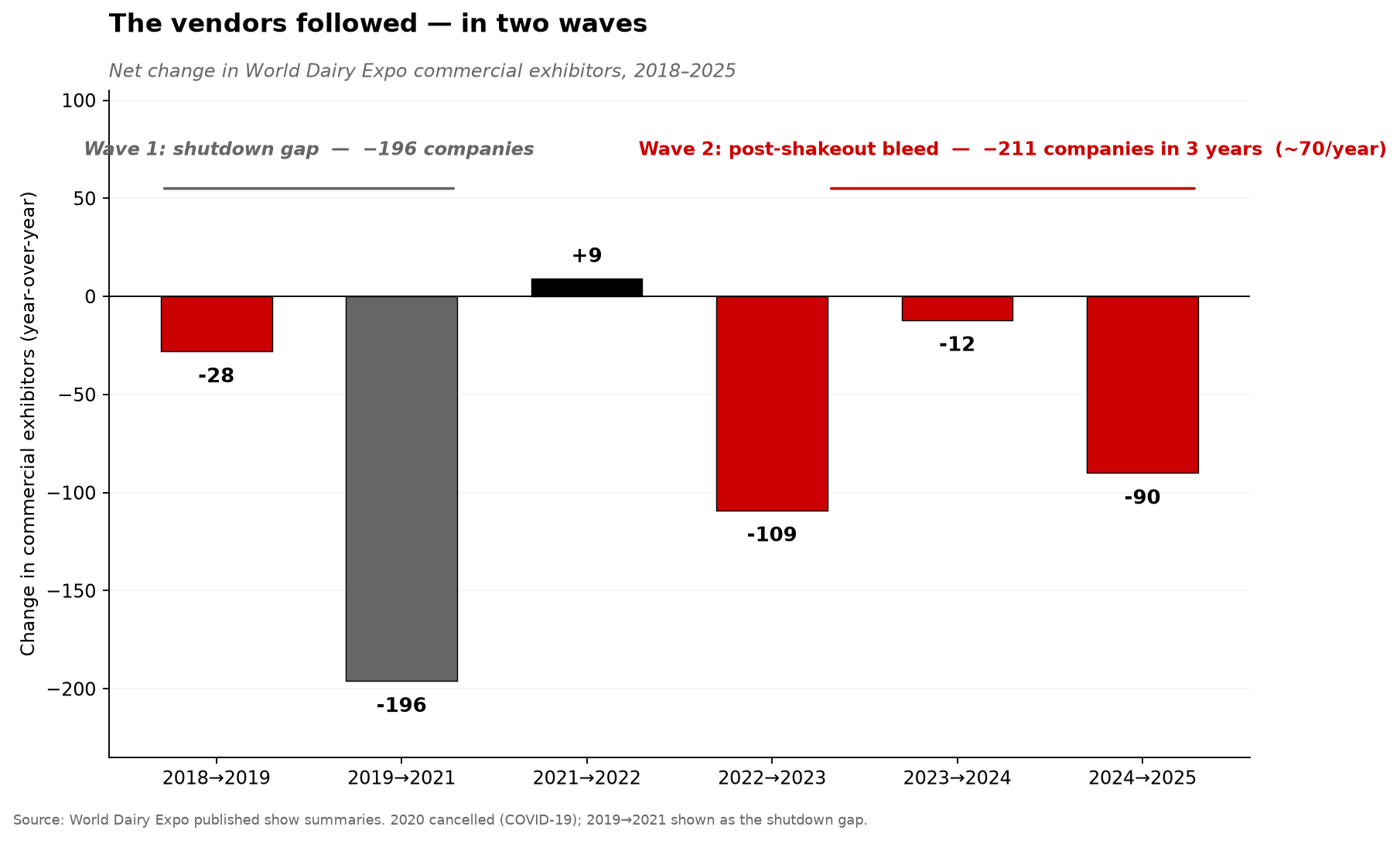
These are not contested numbers, and Expo isn’t hiding them. Its own website currently describes the trade show as “over 450 companies from 15 countries,” which squares with the 461 it published for 2025. The disagreement here is about what the trend means, not what the figures are.
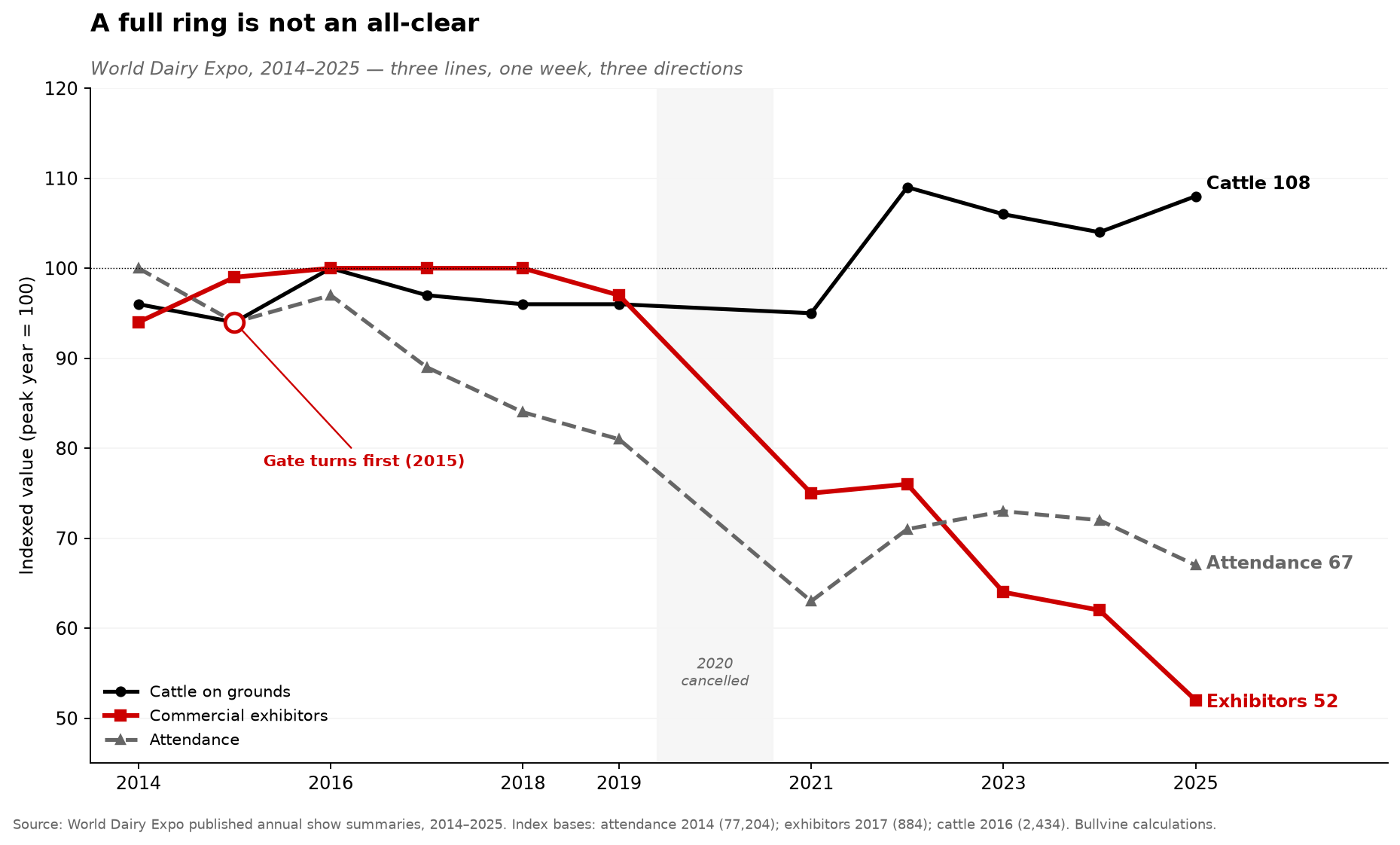
And the cattle held throughout. Head on the grounds peaked at 2,663 in 2022 and sits at 2,625 today, index 108 against 2016 and up 12% on 2014. Set that beside a trade floor at 52 and an audience at 67. Same show, same week, one line up and two lines halved or worse.
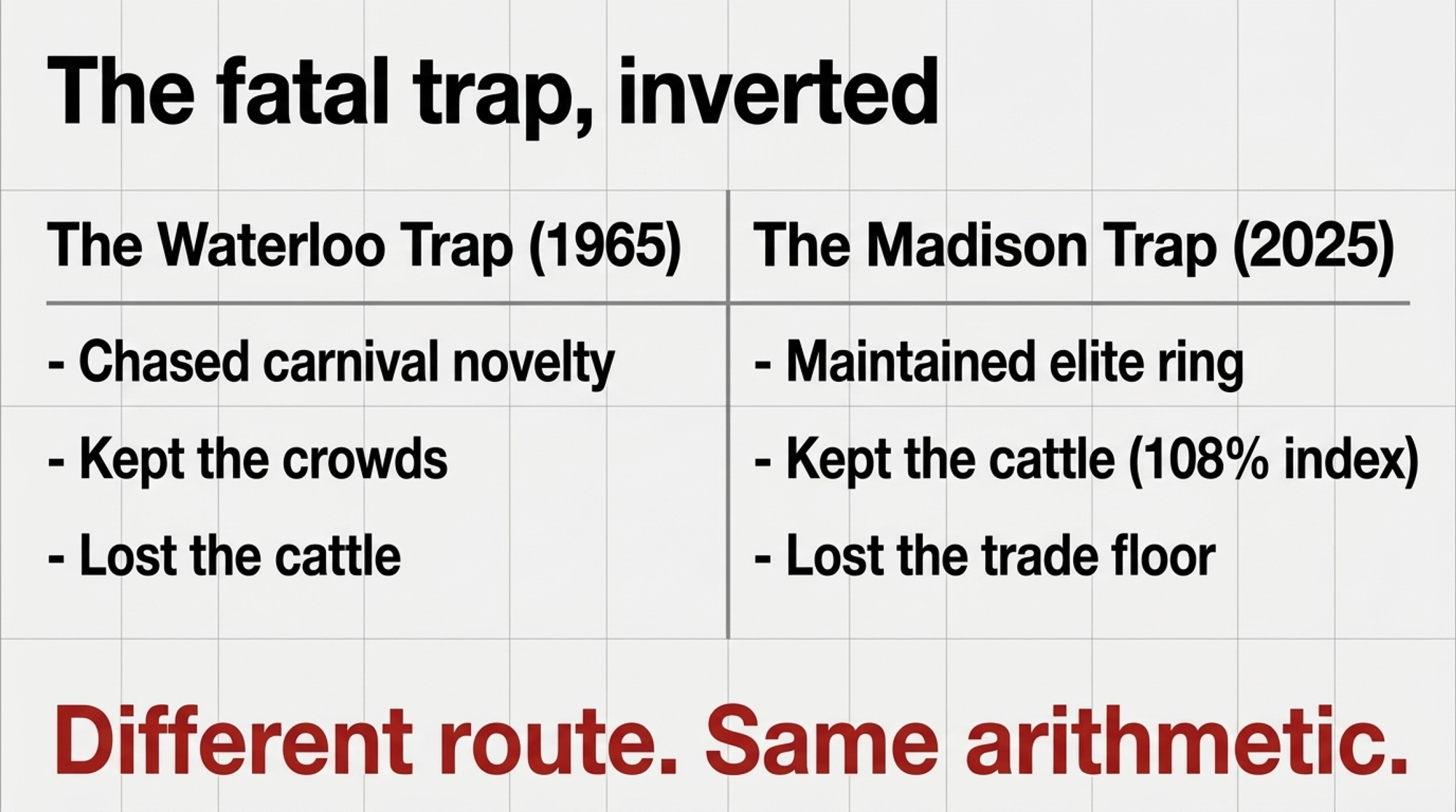
The inversion worth sitting with. Waterloo choked because management chased trade-floor novelty and entertainment at the expense of the cattle, until the breed associations stopped believing it was a dairy show. Madison faces the opposite trap: a ring full of elite cattle whose audience thinned for six years and whose commercial floor then walked. The symptom is inverted. In our view, the fatal outcome is the same: a show whose economics no longer support the thing it exists to do.
| Dimension | Waterloo (National Dairy Cattle Congress) | Madison (World Dairy Expo) |
| Peak era | 1910–1965; 87,000 attendance by 1919 | 2014–2018; 77,204 attendance in 2014 |
| What management protected | Trade floor, horse shows, entertainment | The cattle ring (2,625 head in 2025, index 108) |
| What management lost first | The dairy mission — breed associations walked in 1965 | The audience — down 19% between 2014 and 2019 |
| The visible symptom | Dropped “Dairy” from its own name | Commercial exhibitors down 48% since 2018 (887 → 461) |
| The financial rescue | Greyhound track (1986); Meskwaki loan; foreclosure | Unresolved — sponsorship model not yet restructured |
| Terminal sign | “Cattle Congress Cuts Cows” — could no longer afford its own livestock shows | Trade-floor economics no longer support the ring they exist to fund |
Meanwhile, the herd behind those numbers didn’t shrink. Farm counts fell hard, from 39,303 in 2017 to 24,094 in 2022, yet the U.S. still milks roughly 9.4 million cows, producing more milk than ever, around 226 billion pounds. Same cows. More milk. Emptier building. For the fuller picture of what dairy’s consolidation is doing to the whole show week, the pattern is the one Waterloo lived: a strong core on an eroding base nobody wanted to name.
What does a shrinking trade floor actually cost a show like this?
Run it like your own operation. The floor went from 887 companies in 2018 to 461 in 2025, so 426 gone in seven years, with the current bleed near 70 a year. Now price what one vendor represents: a booth fee, yes, but also sponsorship dollars, hospitality spend, and the reason a share of attendees fire up the truck at all. Organizers expect more than 50,000 guests from nearly 90 countries this year, and the show generated $31.8 million in local economic benefit last year. Strip half the commercial base out of an engine that size and what you lose is gravity.
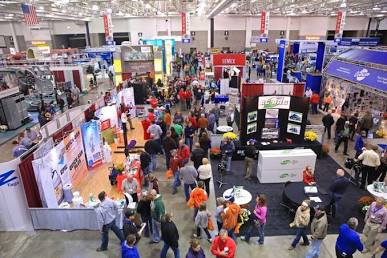
This is what a full floor looks like. Expo’s commercial exhibitor count peaked at 887 in 2018 and stood at 461 in 2025 — 426 booths gone. A booth is never only a booth. It’s a sponsorship line and somebody’s reason to keep coming back.
Expo’s trade show currently runs Tuesday through Friday. Whether four selling days against Madison hotel and facility costs still pencils for a mid-size supplier is a question worth asking out loud — and one only the exhibitors who left can answer. We don’t have that reporting yet. Nobody does, which is part of the problem.
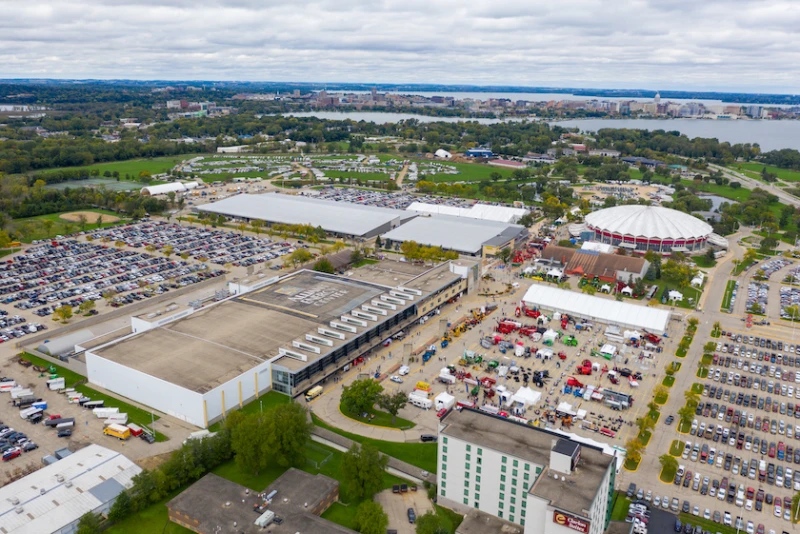
Here’s the piece romantics skip. A great show ring doesn’t finance itself. Prestige doesn’t cover the power bill, and legacy doesn’t make payroll. Every big show needs an economic engine, and at Expo the trade floor has long been a huge part of that engine. Waterloo’s engine shifted away from cattle and ended up at a dog track, and by the time anyone called it a crisis, the identity damage was done. Different route, same arithmetic.
The disanalogies are real, and they matter. The 1965 break came when the National Dairy Association physically walked, and Madison has no equivalent walkout. Waterloo slid from national to regional while Expo still draws from nearly 90 countries. Rail-era transport economics aren’t Madison’s problem. And where Waterloo’s management answered decline by diversifying away from dairy cattle, Madison has done the opposite, and the cattle numbers prove it. This is a complacency warning, not a collapse prophecy. Say it plainly so nobody twists it.
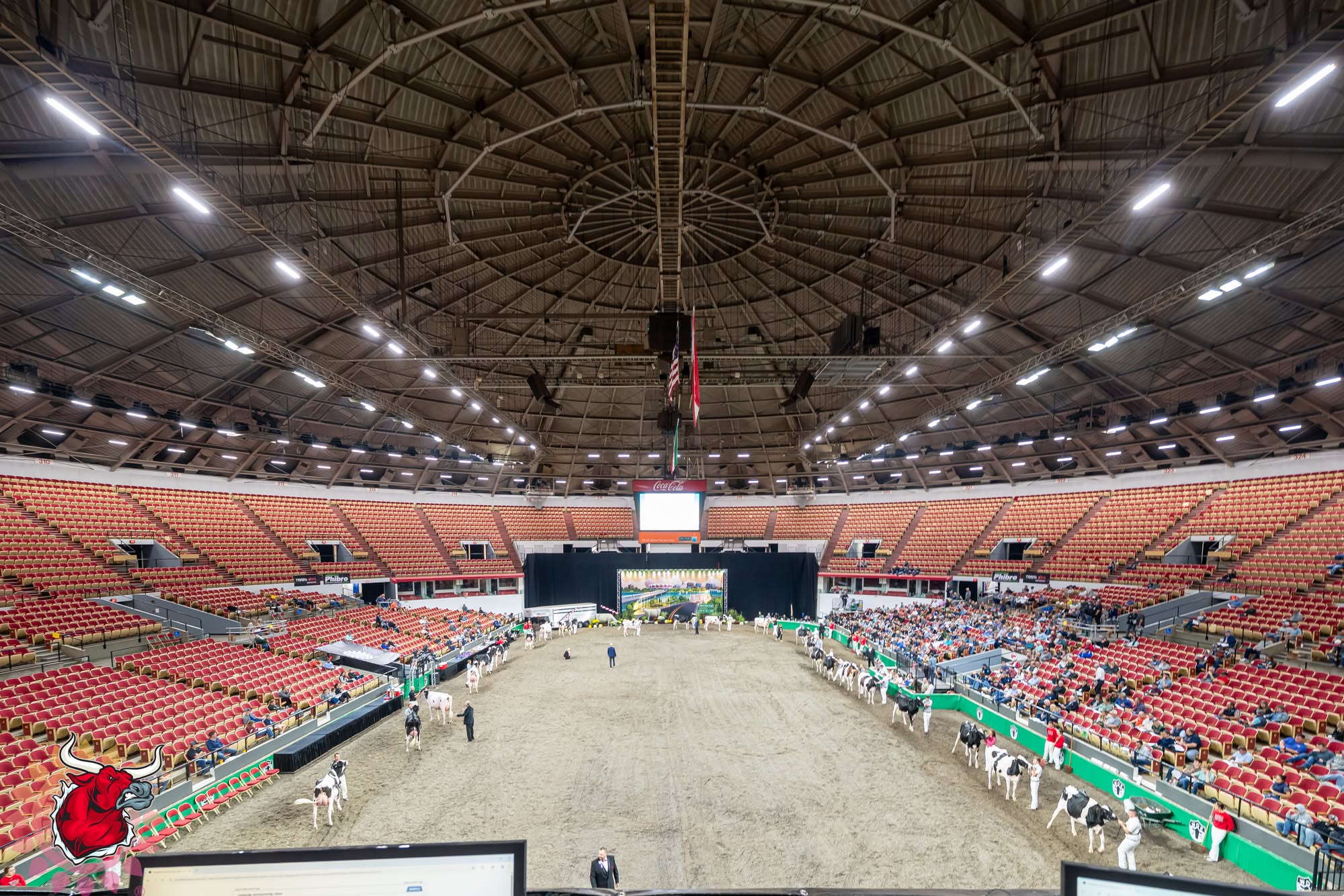
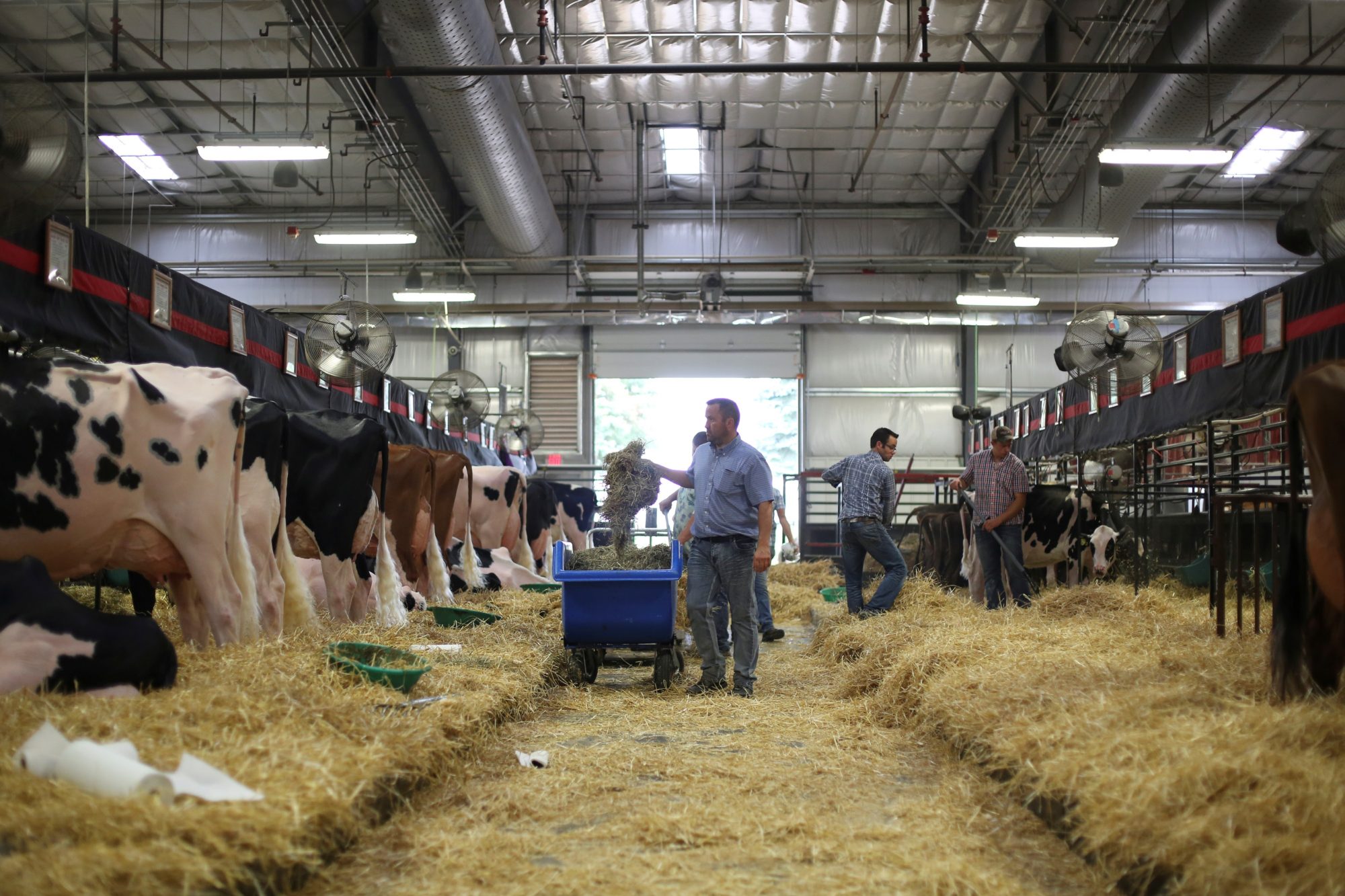
This is the World Dairy Expo Holstein Show — the marquee event of dairy’s premier week. The best cattle on the continent are in the ring. Look at the seats around them.The 2025 International Holstein Show at the Alliant Energy Center Coliseum, Madison. The stands sit barely a quarter full for one of the most prestigious classes in the world. Photo: The Bullvine.
So what do you actually do if it’s your show that’s fading?
Waterloo’s decline wasn’t fate. It was a stack of choices, which makes the fixes choices too, and some shows are already making them. If you sit on a committee, a breed board, or an association that runs an event, these are your live options.
| Fix | What triggers it | What it costs to try | How it fails |
| Watch the gate before the floor | Two consecutive years of falling attendance | An afternoon consolidating existing gate data | One weather-driven year proves nothing; you need three data points before you act |
| Reconcile numbers to marketing copy | Any published claim older than 3 years | One editor, one afternoon | Fixes credibility, not revenue — and a sponsor’s lead data may find the gap first |
| Build year-round sponsorship program | Trade-floor revenue falling faster than attendance | 12-month sales calendar, naming-rights inventory, education programming | Denver’s model leans on capital-campaign scale that dairy suppliers may not match |
| Audit the 93% you don’t invoice | Exhibitors complaining about cost | Block hotel rates, scheduling tie-ins, logistics coordination | $3,800/cow figure is composite, not audited — build policy on your own string first |
Path one: watch your gate before you watch your floor. Expo’s own record shows the audience turning six years before the vendors did. Attendance is the leading indicator and booth count is the lagging one, which means a show reading only its exhibitor revenue is reading the slower number. When it works: you track gate and floor as separate series, year over year, and treat two consecutive attendance drops as a trigger rather than weather. What it requires:publishing your own numbers consistently enough to have a series at all. Risks and limits: gate counts move with weather, calendar, and ticket policy, so one bad year proves nothing. Three do.
Path two: check whether your own numbers still match your own story. Waterloo kept the word “National” in its name and on its letterhead for years after the national shows had left for Madison, right up until “Dairy” came out in 1965. The paperwork described an institution that no longer existed. When it works: you compare ten years of published figures against what your website, venue copy, and sponsor decks currently claim, and fix the gaps yourself. What it requires: one afternoon and a willingness to be embarrassed in private. Risks and limits: it fixes credibility, not revenue. If a sponsor’s own lead data finds the gap first, you lose the renewal and the credibility in the same meeting.
Path three: build a year-round sponsorship program. The National Western Stock Show in Denver paid its debt in full for the first time in decades and reached $120 million toward a $150 million capital campaign. Then it packed 750,039 people through the gates over 16 days this January, an all-time record that broke a mark standing since 2006. In the ring, the first Auction of Junior Livestock Champions in the new CoBank Auction Arena set a record at $822,500 for the top eight champions, up $185,000. Read the venue name again. A lender put its name on the arena. When it works: your commercial base is eroding but the brand is still worth investing in. What it requires: naming rights, hospitality, and scholarship alignment sold on a twelve-month calendar. Risks and limits: Denver leans on a multi-year capital campaign and named-facility partners, while dairy equipment and genetics suppliers run on tighter margins and shorter budget cycles. The operating principle survives the difference. You cannot treat commercial partners like booth-renters for five days in October and expect them to behave like stakeholders the other eleven months. Worth testing: the sponsors most likely to stay are the ones buying year-round category alignment, education programming, and naming rights rather than floor space. That’s a hypothesis about where the money is going, not a claim about what any company has said.
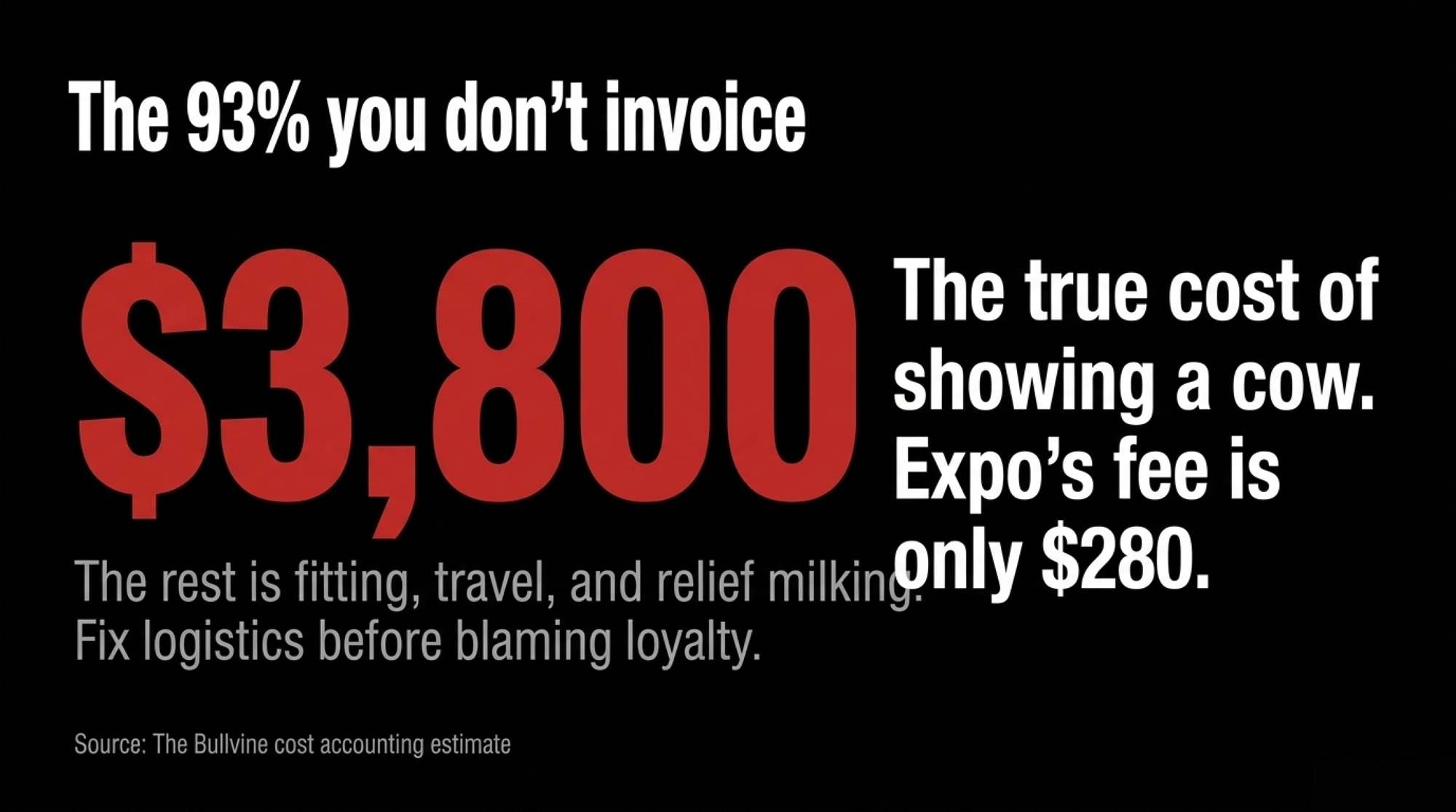
Path four: fix the cost math before you blame loyalty. Bullvine’s accounting puts the true cost of showing at Madison near $3,800 a cow in a five-cow string, with Expo’s own fees only about $280 of it. The other 93% is fitting, hotels, travel, and relief milking. When it works: you attack the costs you don’t invoice for, through block rates, scheduling, and tie-in logistics. What it requires: treating exhibitor cost as your problem rather than theirs. Risks and limits: the $3,800 figure is a composite drawn from exhibitor testimony, not audited accounts, so run your own string before you build policy on it.
The 30-day action. Before your next board meeting, pull ten years of attendance and vendor counts from your own published summaries and put both series on one slide. Not one line. Two, so you can see which turned first. This month, while Expo week is fresh enough to argue about. Waterloo’s fatal habit wasn’t ignorance. Plenty of people saw the slide, and nobody made the room stare at it while there was time.
Key Takeaways
- Two consecutive years of falling gate is a trigger, not weather
Expo’s attendance dropped in 2015, then again in 2017, 2018, and 2019 — 19% gone before COVID. The trade floor was still at peak through 2018. If your gate is sliding while your booth revenue holds, you are reading the lagging number. - If the decline outlasted consolidation, “structural” is an excuse
Madison’s floor lost 211 companies in the three years after the farm shakeout slowed, roughly 70 a year. Herd size held and milk output hit records over the same stretch. - Index your three lines against each other before you call anything healthy
Cattle at 108, attendance at 67, exhibitors at 52. A full ring is not an all-clear, and the ring is the only line that’s up. - Reconcile your published figures with your promotional copy this week
Waterloo kept the word “National” long after the nationals left. Find the gap yourself before a sponsor’s lead data finds it in a renewal meeting. - Ringside banners will not carry a sponsorship program
Denver retired its debt, raised $120M toward $150M, set a 750,039 attendance record, and posted an $822,500 junior auction, all off year-round partnership and named-facility deals. - If exhibitors complain about cost, audit the 93% you don’t invoice
At roughly $3,800 a cow, only about $280 is Expo’s fee. The rest is fitting, hotels, travel, and relief milking, and a show can move more of that than it thinks.
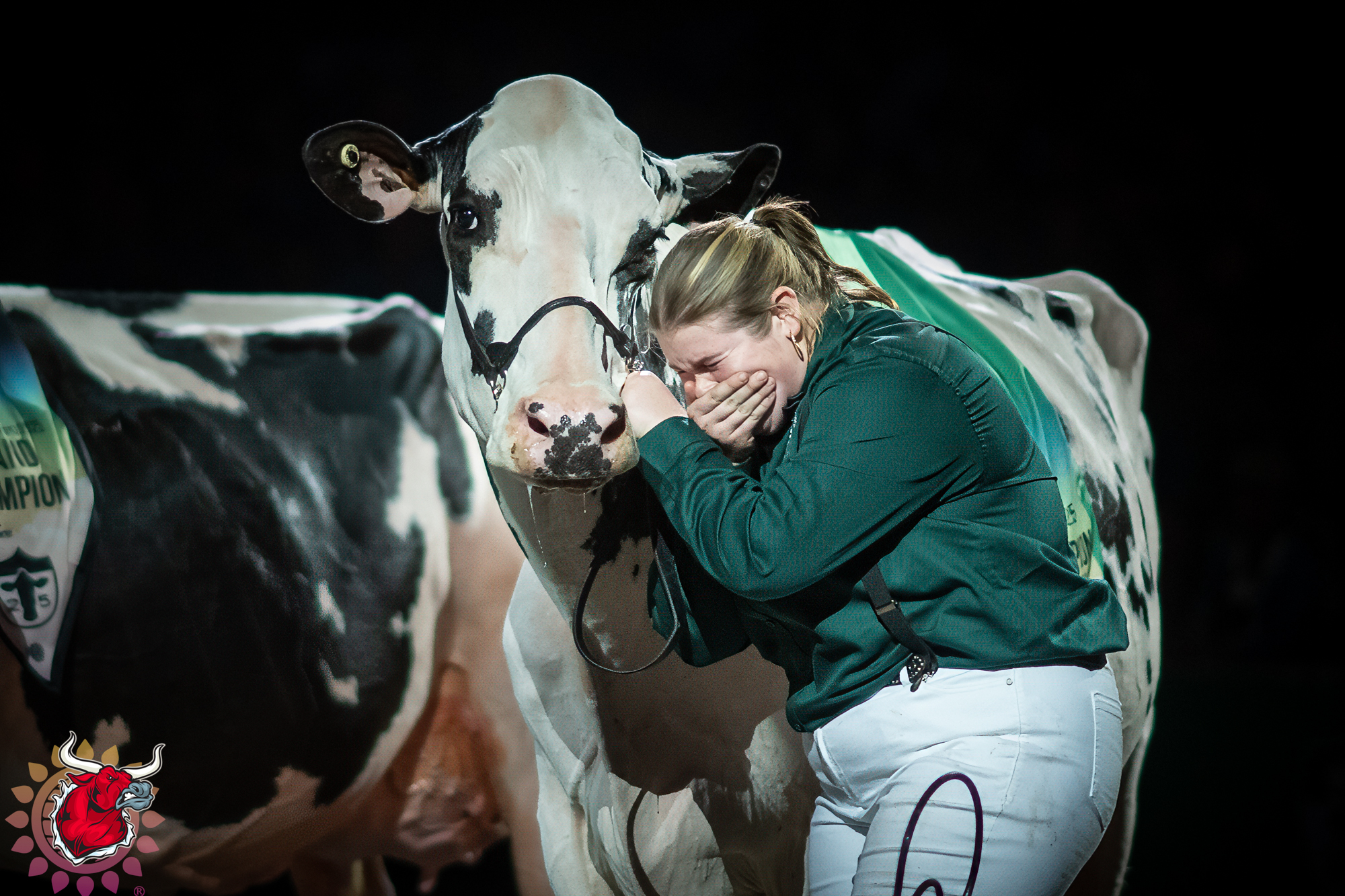
Before you decide it can’t happen here
The 116th National Cattle Congress Fair closes in Waterloo on Sunday, September 27. Two days later, the gates open in Madison for the 59th time. Carry this question through them: which of your show’s two lines turned first, and how many years ago? Pull the series before you answer, and pull it from the published summaries rather than the brochure.
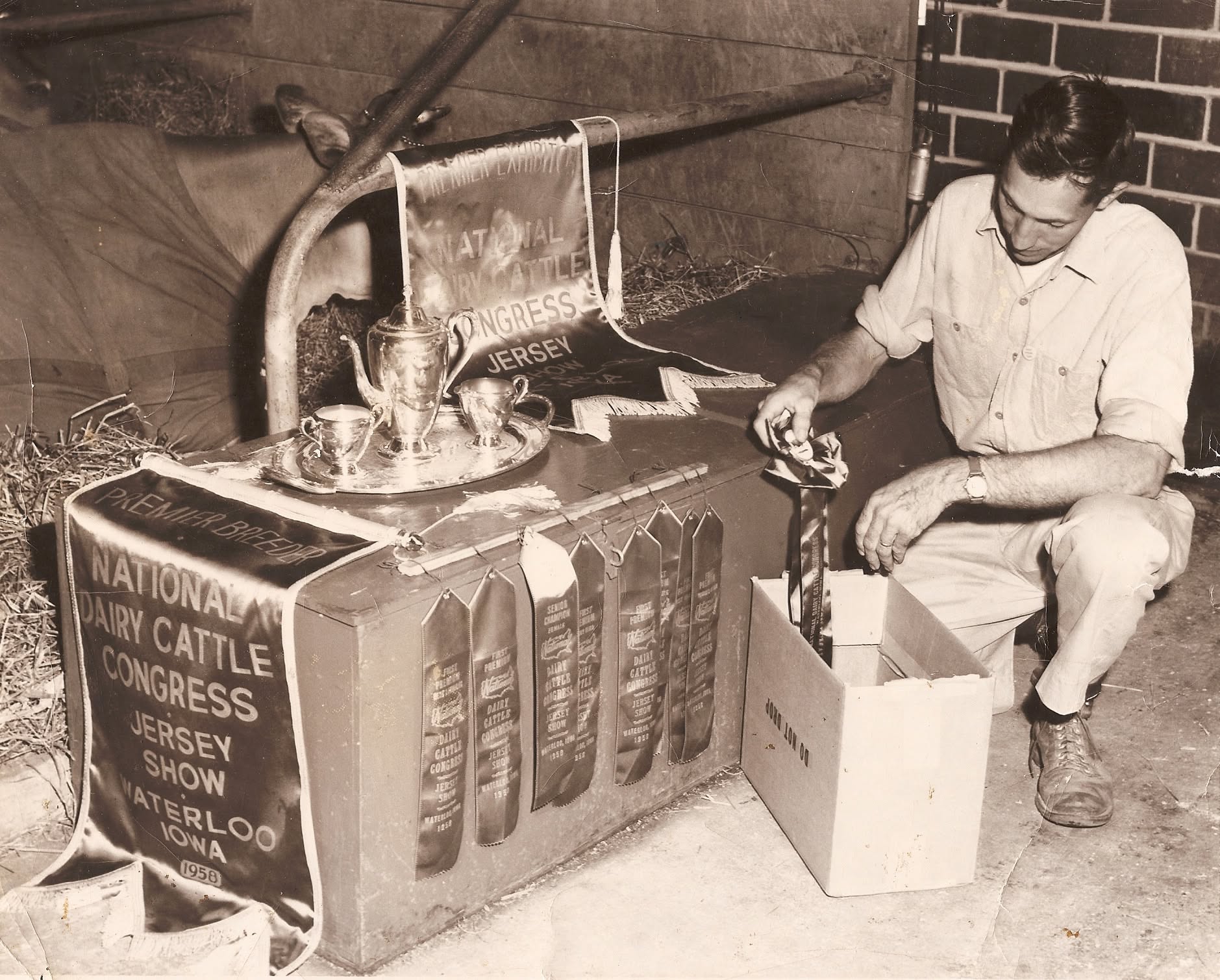
Waterloo wasn’t some weak little fair nobody loved. It was enormous, prestigious, woven into generations of October traditions, and it still lost the plot, then the center, then the cattle. Nabholz wrote his book to preserve what a great show had been before the memory thinned out. The people invoking Waterloo around Madison are trying to make sure nobody has to write the eulogy.
Decline isn’t fate. But complacency is a choice.
The booth-by-booth breakdown behind the slide is in our deeper dive on Expo’s attendance decline, and the sharpest of these signals land first in The Bullvine Weekly.
Editor’s note: This is an opinion piece. The historical record of the National Dairy Cattle Congress is documented and sourced; the comparison drawn to World Dairy Expo, and the recommendations that follow, are solely those of the author and The Bullvine. They are not a position or viewpoint of World Dairy Expo, which did not request, authorize, or contribute to this article. We consider the long-term health of North America’s principal dairy exhibition a matter of legitimate public interest to the exhibitors, breed associations, sponsors, and producers whose time and capital it depends on. Every attendance, trade-show, and cattle-entry figure cited comes from World Dairy Expo’s own published annual show and event summaries, 2014 through 2025; the indexed comparison and loss rates are The Bullvine’s own calculations based on those published figures, and our interpretation is our own.
Learn More
- The True Cost of Showing at World Dairy Expo — Pinpoints the real capital burn of competing in Madison, exposing why overhead outside entry fees drives strings to roughly $3,800 per head and forces exhibitors to audit their marketing budgets.
- Dairy Farm Numbers Drop Below 28,000 as Consolidation Accelerates — Analyzes structural producer attrition to show where the trade show audience vanished, arming breeders with long-term forecasts on herd concentration and shifting B2B buying power.
- Is the Show Ring Still Relevant to Commercial Dairying? — Dismantles the widening divide between purebred aesthetics and commercial parlor profitability, revealing whether modern production herds still source genetics from the colored shavings or look entirely to genomic pipelines.
 The Sunday Read Dairy Professionals Don’t Skip.
 The Sunday Read Dairy Professionals Don’t Skip.
Every week, thousands of producers, breeders, and industry insiders open Bullvine Weekly for genetics insights, market shifts, and profit strategies they won’t find anywhere else. One email. Five minutes. Smarter decisions all week.