






Archive for dairy market consolidation

77,204 to 51,525: The World Dairy Expo Conversation We Need to Have

That’s how many people walked onto the colored shavings in 2014 versus 2025. The cattle are still magnificent — so why is the world quietly walking away, and why has nobody done a thing about it?
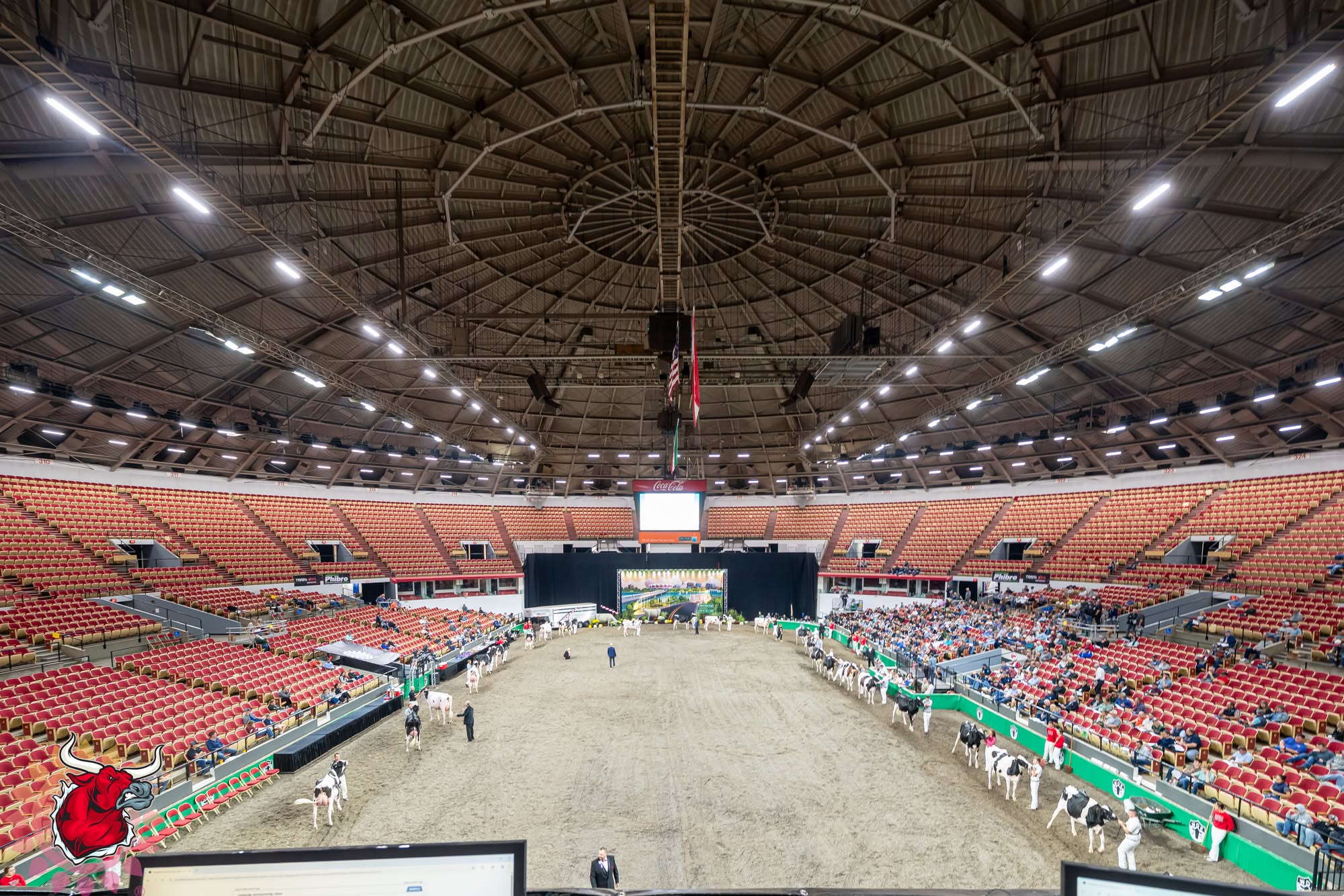
This is the World Dairy Expo Holstein Show — the marquee event of dairy’s premier week. The best cattle on the continent are in the ring. Look at the seats around them. The 2025 International Holstein Show at the Alliant Energy Center Coliseum, Madison. The stands sit barely a quarter full for one of the most prestigious classes in the world. Photo: The Bullvine.

Editor’s note: This is an opinion piece. The observations, arguments, and recommendations here — including the “four fixes” below — are solely those of the author and The Bullvine. They are not a position, statement, or viewpoint of World Dairy Expo, which did not request, authorize, or contribute to this article. In keeping with our standards, we shared the article with World Dairy Expo ahead of publication and invited their comment; they reviewed it and provided feedback, and this piece reflects our independent editorial judgment. World Dairy Expo has not issued a statement for publication. Every attendance, trade-show, and cattle-entry figure cited is drawn from World Dairy Expo’s own publicly published show summaries and anniversary materials; how those numbers are interpreted is our opinion alone.

You know the feeling. The lights come up over the Coliseum. Your heart’s going before your heifer ever hits the gate. The colored shavings stretch out in front of you like the most important stage in the dairy world — because for one week in Madison, that’s exactly what it is.

That part hasn’t changed. The cattle are still the best in North America. The competition is still ferocious. The 4 a.m. trailer-loading, the clipping, the nerves at ringside — all of it is exactly as good as it ever was.

So here’s the question that should stop every one of us cold.

If the cattle are this good, why has World Dairy Expo lost one in three of the people who used to come watch them?
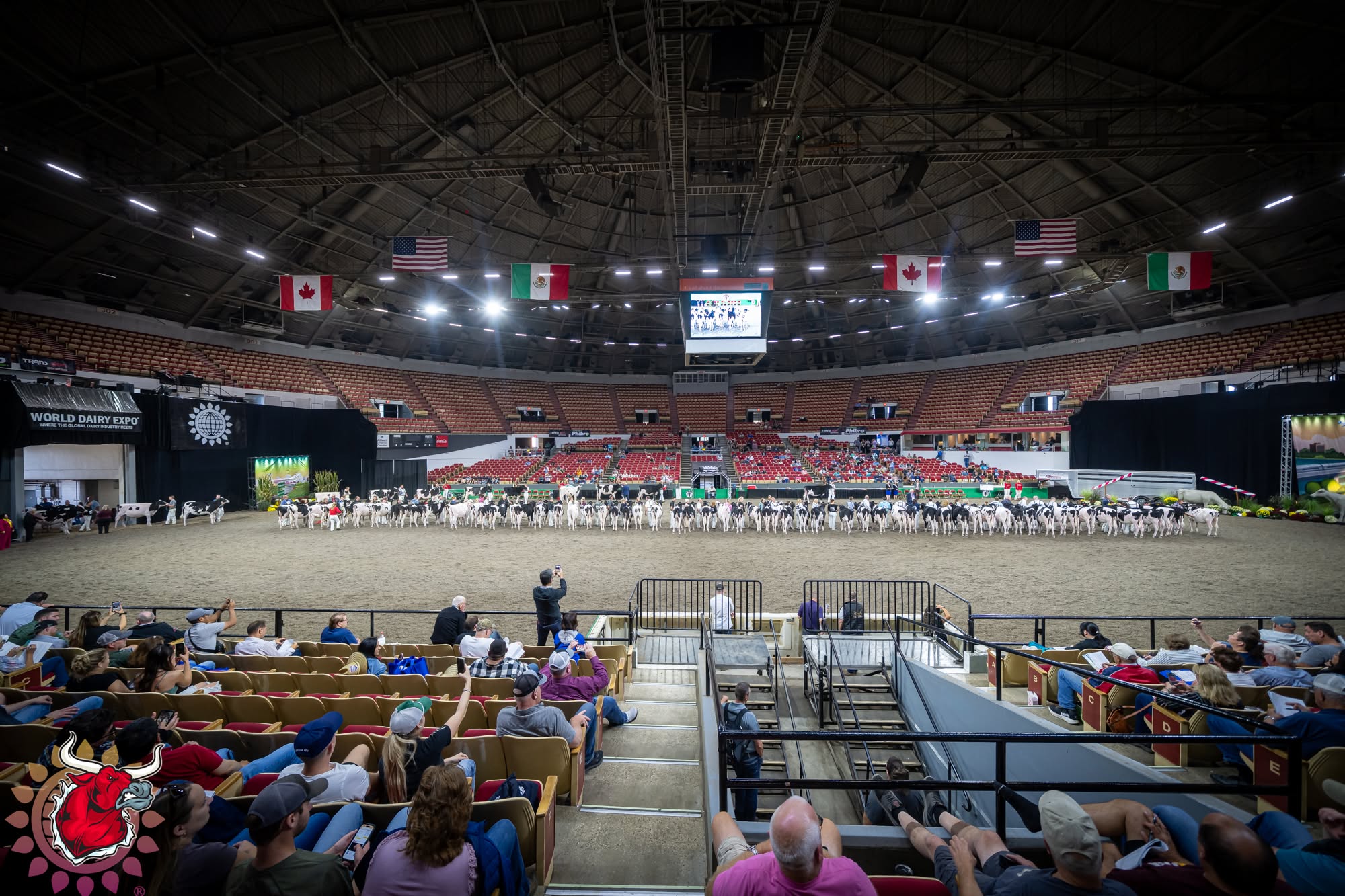
The faithful still fill the front rows. It’s everything behind them that should scare us. A Holstein heifer class at the 2025 World Dairy Expo, Alliant Energy Center Coliseum, Madison. A loyal crowd rings the sand while the rest of the coliseum sits nearly empty. Photo: The Bullvine.

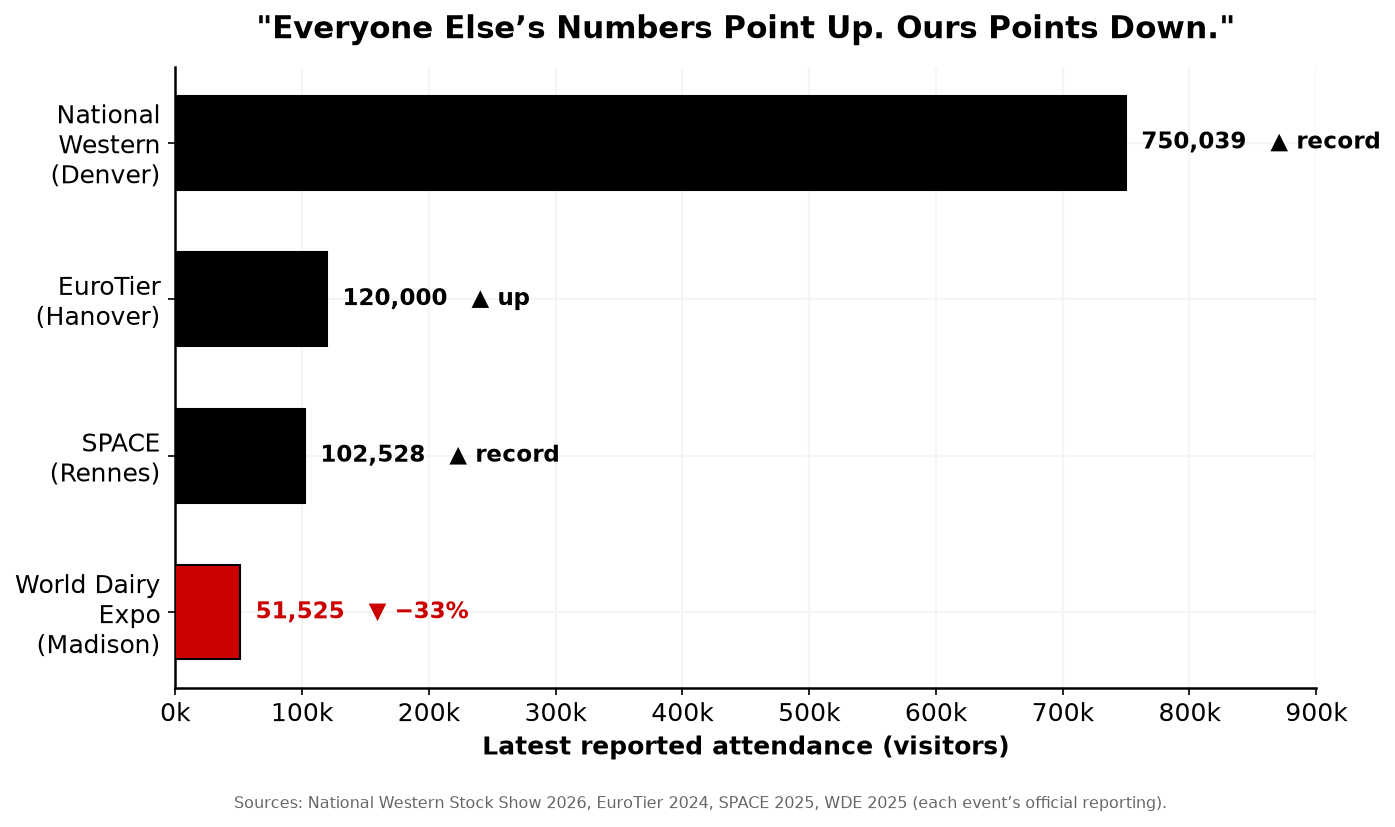
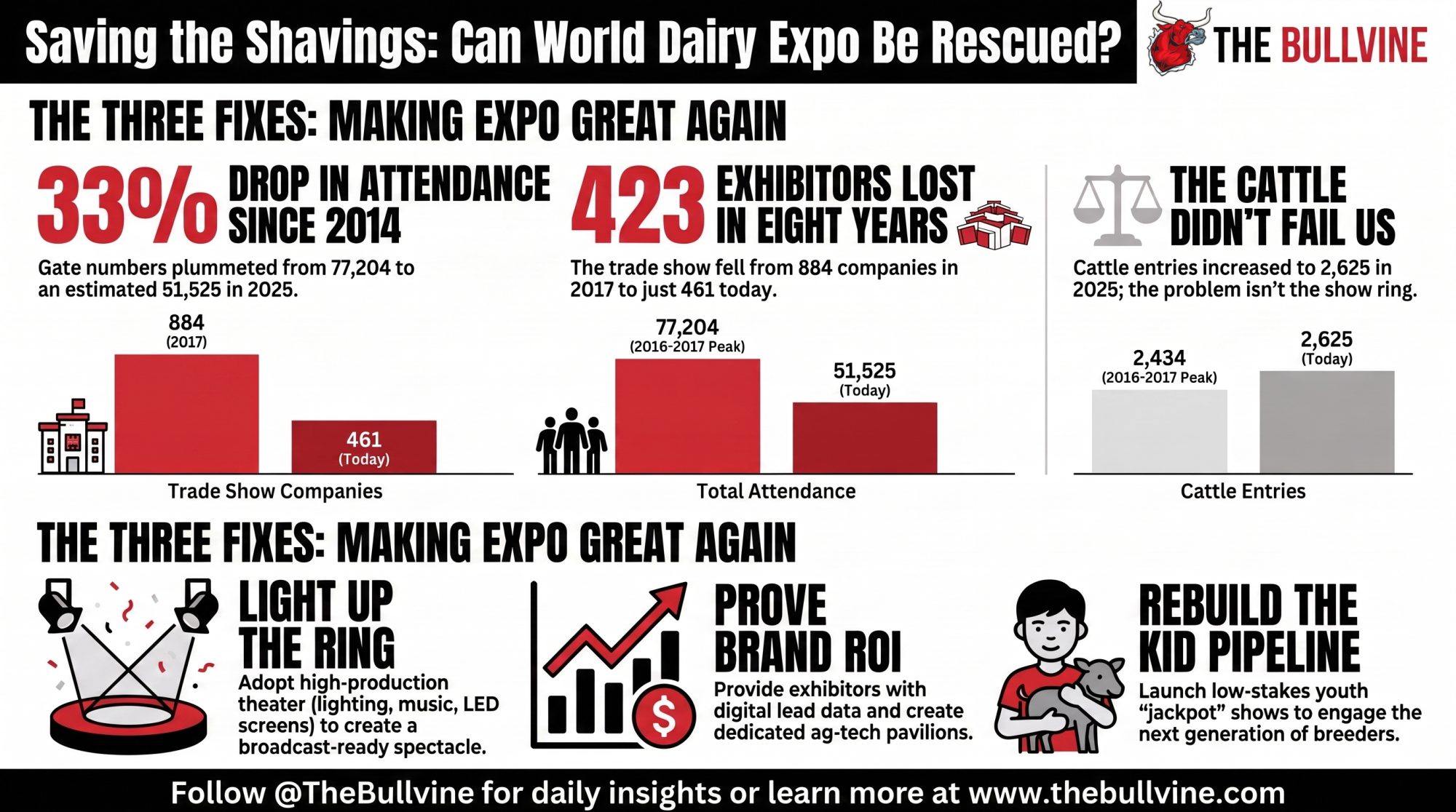
In 2014, Expo pulled 77,204 through the gates. In 2025, an estimated 51,525 (WDE Show Summaries 2014; World Dairy Expo homepage). That’s a 33% collapse in eleven years. And the trade show — the floor that used to have companies on a waiting list begging to get in — has gone from 884 companies in 2017 to 461 in 2025 (WDE 49th anniversary materials; WDE homepage). Nearly half. Gone. In eight years.
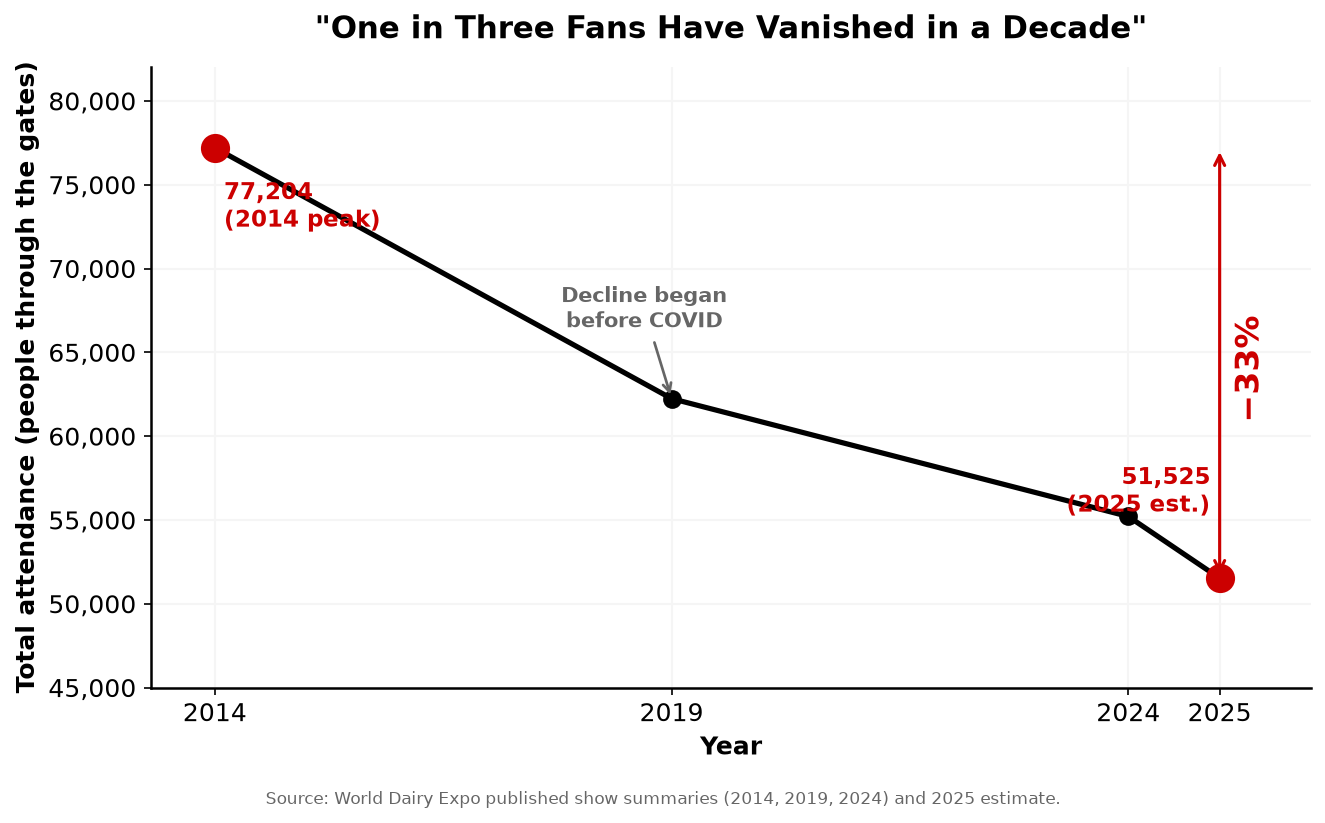
We are quietly letting the greatest show in our world slip away. One empty seat and one dark booth at a time. And the silence about it is the most alarming part of all.

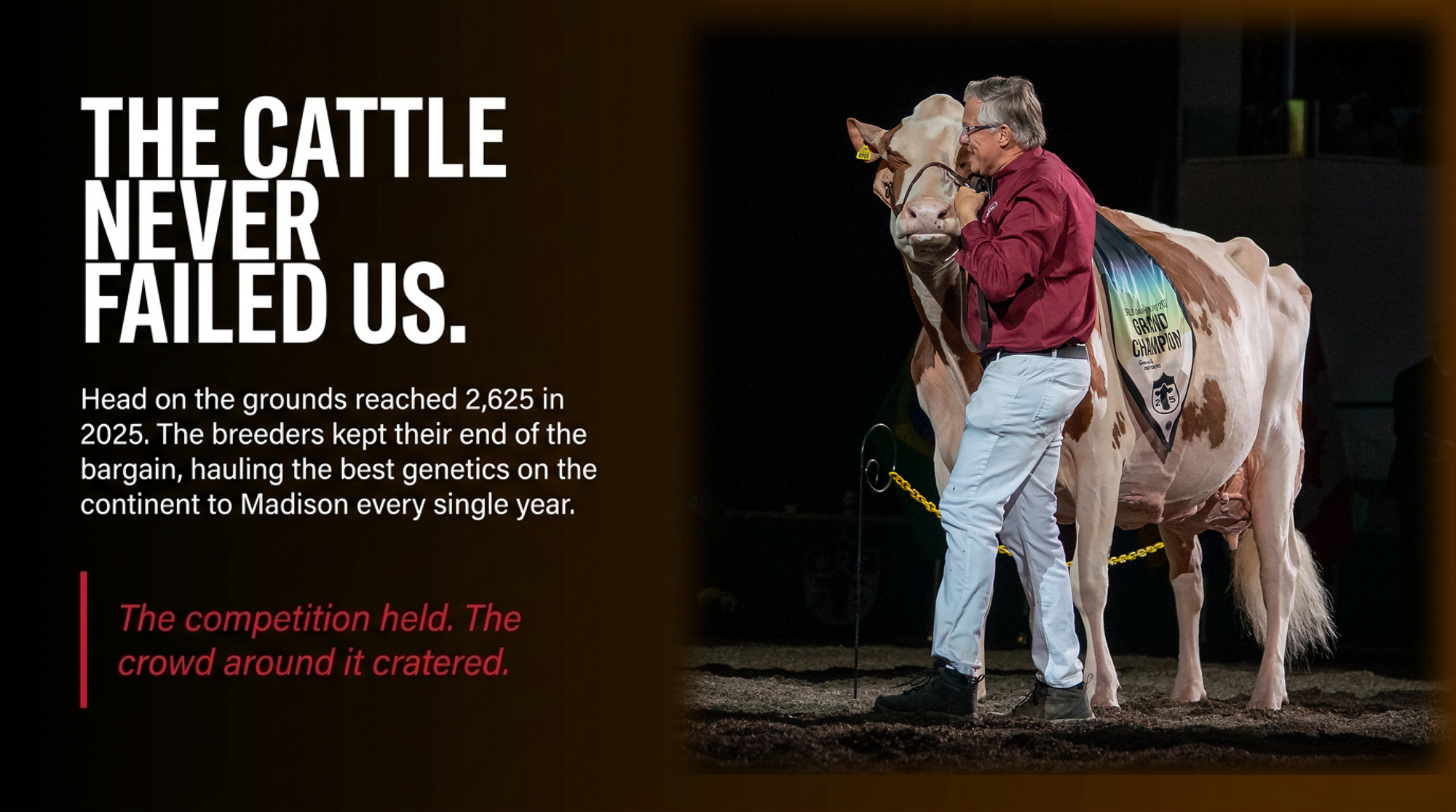
The cattle didn’t fail us. Let’s be clear about that.
Before anybody gets defensive — this is not a knock on the show ring. Read that twice.

The cattle show is thriving. Head on the grounds ran 2,434 in 2016, 2,331 in 2019, and 2,625 in 2025 — flat-to-up across a whole decade (WDE Dairy Cattle Show). The breeders kept their end of the bargain. Every single year, the families still hitched up and hauled the best genetics on the continent to Madison.

So sit with what that actually means. The competition held. The crowd around it cratered. The companies bailed.

That’s not a cattle problem. That’s everyone around the cattle quietly deciding Expo isn’t unmissable anymore — while the people who love it most kept showing up and assuming somebody, somewhere, was minding the store.

Were they? Let’s look.

Two of the sport’s best, working the ring in front of a house that’s mostly empty seats. Judge Adam Hodgins and associate judge Joel Phoenix evaluate the 2025 Red & White Holstein Show at World Dairy Expo, Madison — a red-carpet performance for a Coliseum with more empty chairs than fans.

From “you’re on the waiting list” to “please, take a booth”

Picture 2014. Eight hundred thirty-five companies on the floor (WDE 2014 Show Summary) — and a line of others behind them, because Expo “typically sells out very early in the year” and runs a formal waiting list, in its own words (WDE exhibitor information). That’s how badly the world wanted in.

Now look at 2025. 461 companies — roughly what the floor looked like in the mid-1990s (WDE 1999 Show Summary). Thirty years of growth, erased. The waiting list is a memory. The homepage now advertises the open space.

And here’s what should really light a fire: this started before COVID. The 2019 show was already down to 859 companies and 62,240 people (WDE 2019 Show Summary). The first full show back in 2022 — when pent-up demand should have packed the place — managed just 672 companies, already a quarter below the peak. Then 563. Then 551. Then 461.

Do that arithmetic and it’s chilling. From 672 companies in 2022 to 461 in 2025 is 211 exhibitors gone in three years — the trade floor is losing roughly 70 companies every single year, right now. This isn’t a slow historical fade. It’s an active bleed, accelerating while we watch.
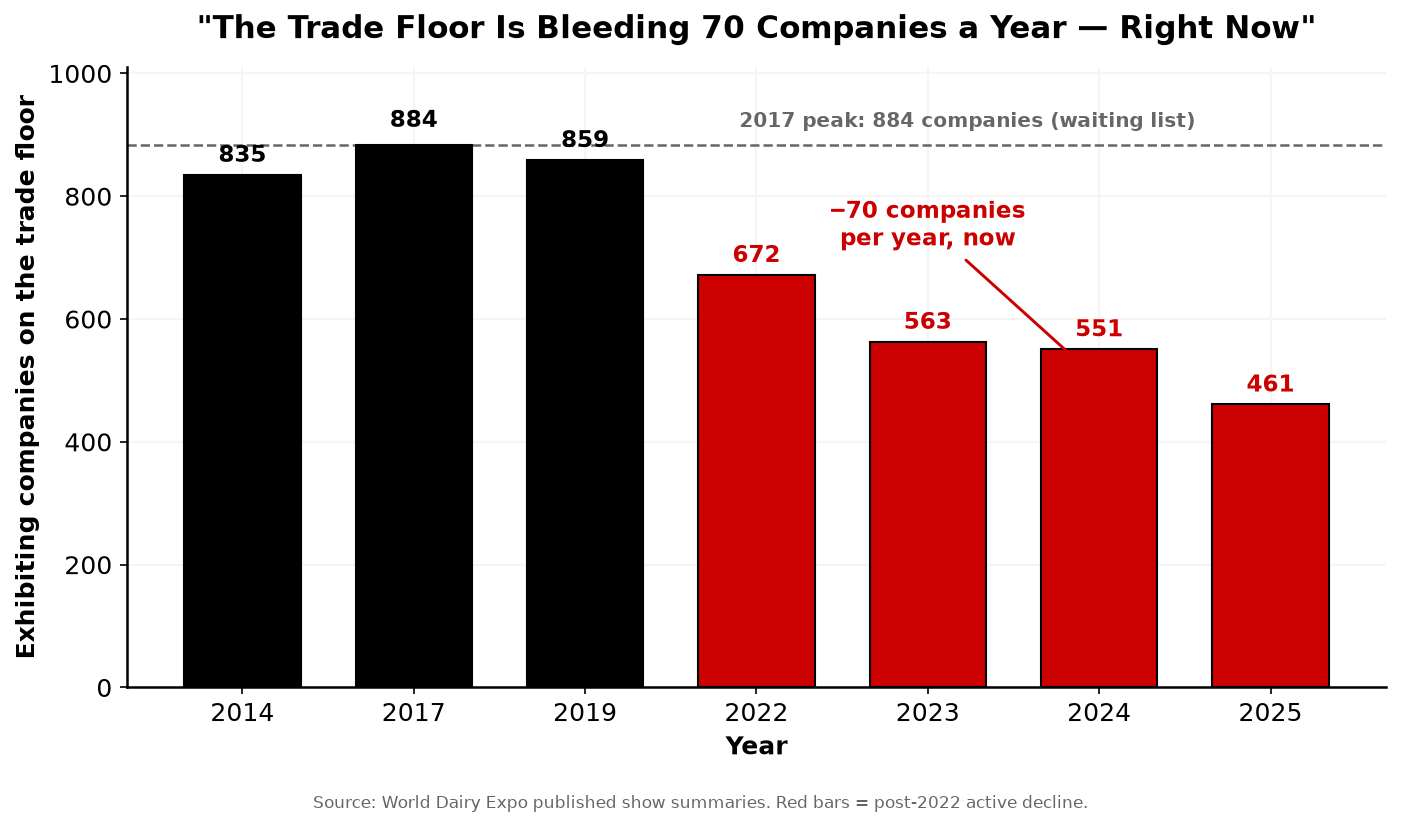
That’s not a pandemic dip anyone can blame and move on from. That’s a slide that’s been running for the better part of a decade in plain sight. The pandemic was just a convenient place to hide it.

“But the industry’s shrinking” — no, it isn’t. And that’s the gut-punch.

Here’s the excuse you’ll hear at every coffee shop and committee table: fewer farms, fewer people, what do you expect.

It does not hold up. Yes, the number of dairy farms fell hard — 39,303 in 2017 to 24,094 in 2022 (USDA via Farmdoc Daily). But the cows didn’t go anywhere. The U.S. still milks about 9.4 million of them — same as before — and produces more milk than ever, around 226 billion pounds (USDA NASS Census Highlights).

Read that again. Same cows. More milk. More work to do than ever.

The customers didn’t disappear — they got bigger. The 40,000 farmers who used to walk the aisles are now a few thousand large operations, and the genetics and equipment companies serving them merged to match: Select Sires swallowed Accelerated, ABS took De Novo, BouMatic bought SAC, DeLaval took milkrite | InterPuls. Every merger turned four booths into one.
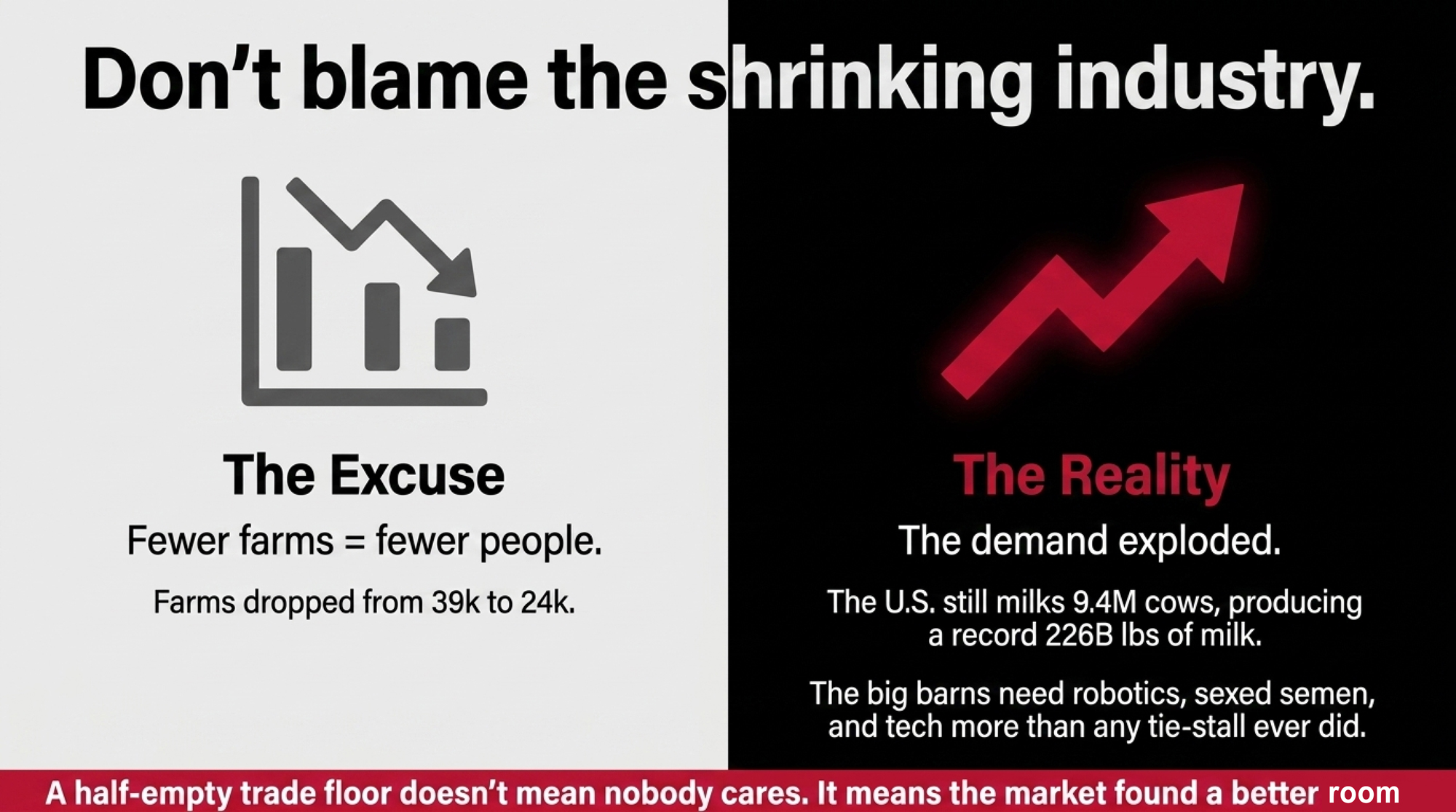
But — and this is the part that should make every enthusiast furious — those big barns need the latest genetics and technology more than any tie-stall ever did. Robots. Sensors. Sexed semen. The TPI and NM\$ proofs everybody’s chasing. The demand for everything Expo exists to showcase didn’t shrink. It exploded. A half-empty trade floor isn’t the market saying nobody cares. It’s the market saying the people who care most found a better room to do it in.

And while we coasted, the rest of the world turned the lights on

This is the part that stings the most, so brace for it.
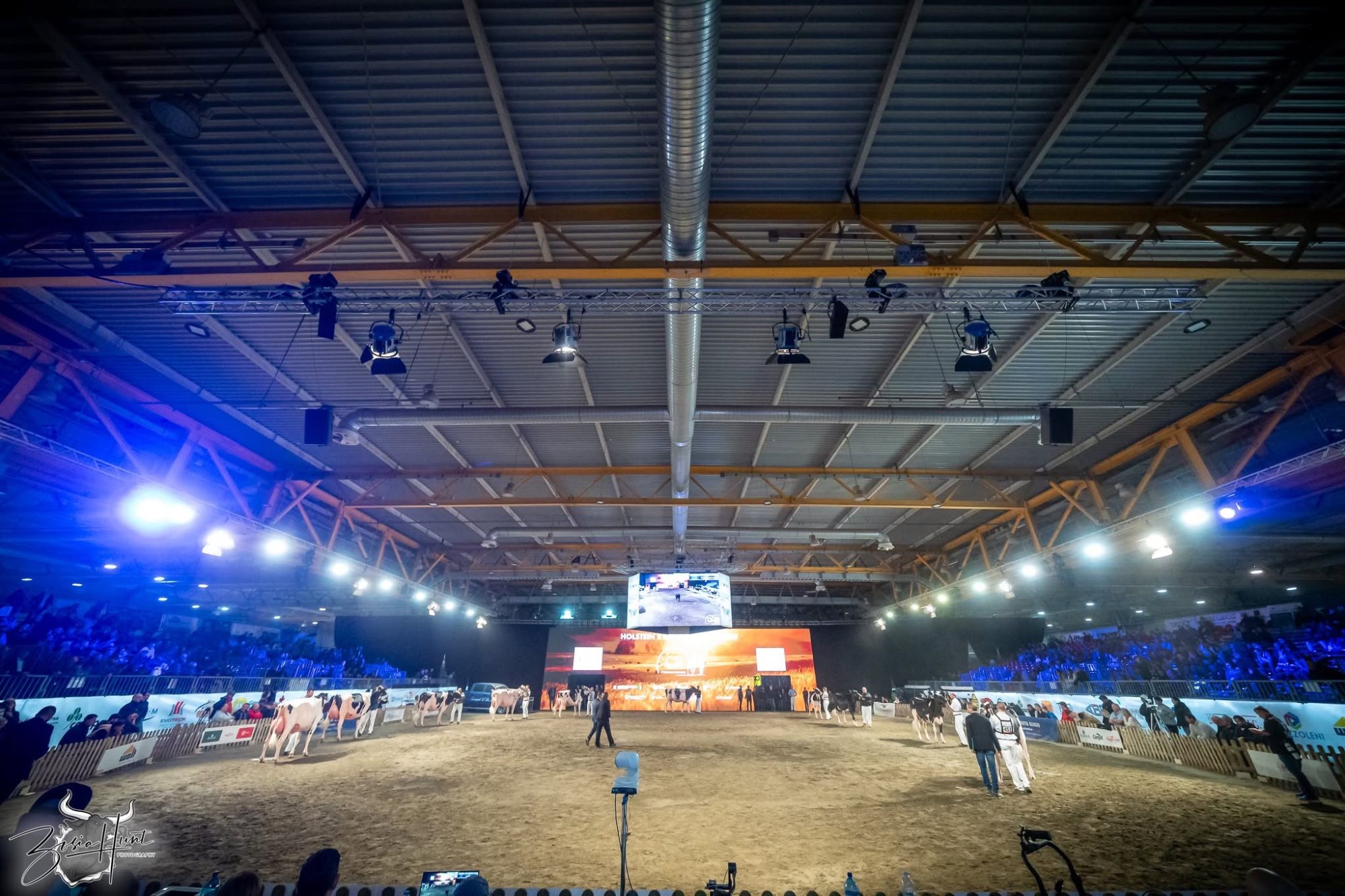
This is a cattle show. Spotlights, a stadium-sized LED screen, a crowd lit like a rock concert — for Holsteins. The 2025 Cremona international show, Italy: a fully produced arena where the ring itself is the main event. It’s the experience North America stopped building.

Go to Cremona, Italy, in late November. They run their show ring like a rock concert — darkened arena, theatrical lighting, music cues, giant LED screens. Fitters who’ve led at the top called the atmosphere “unreal” and “unbelievable.” And here’s the twist of the knife: Judge Nathan Thomas, fresh off a World Dairy Expo championship, said the spectacle is exactly why he took the Cremona assignment (The Bullvine’s Cremona coverage called it “a fashion runway built for Holsteins”).

Cremona is a show a third Madison’s size — about 200 exhibitors. It isn’t beating Expo on scale. It’s beating it on show. On the experience. On making people feel something special walking into the building.
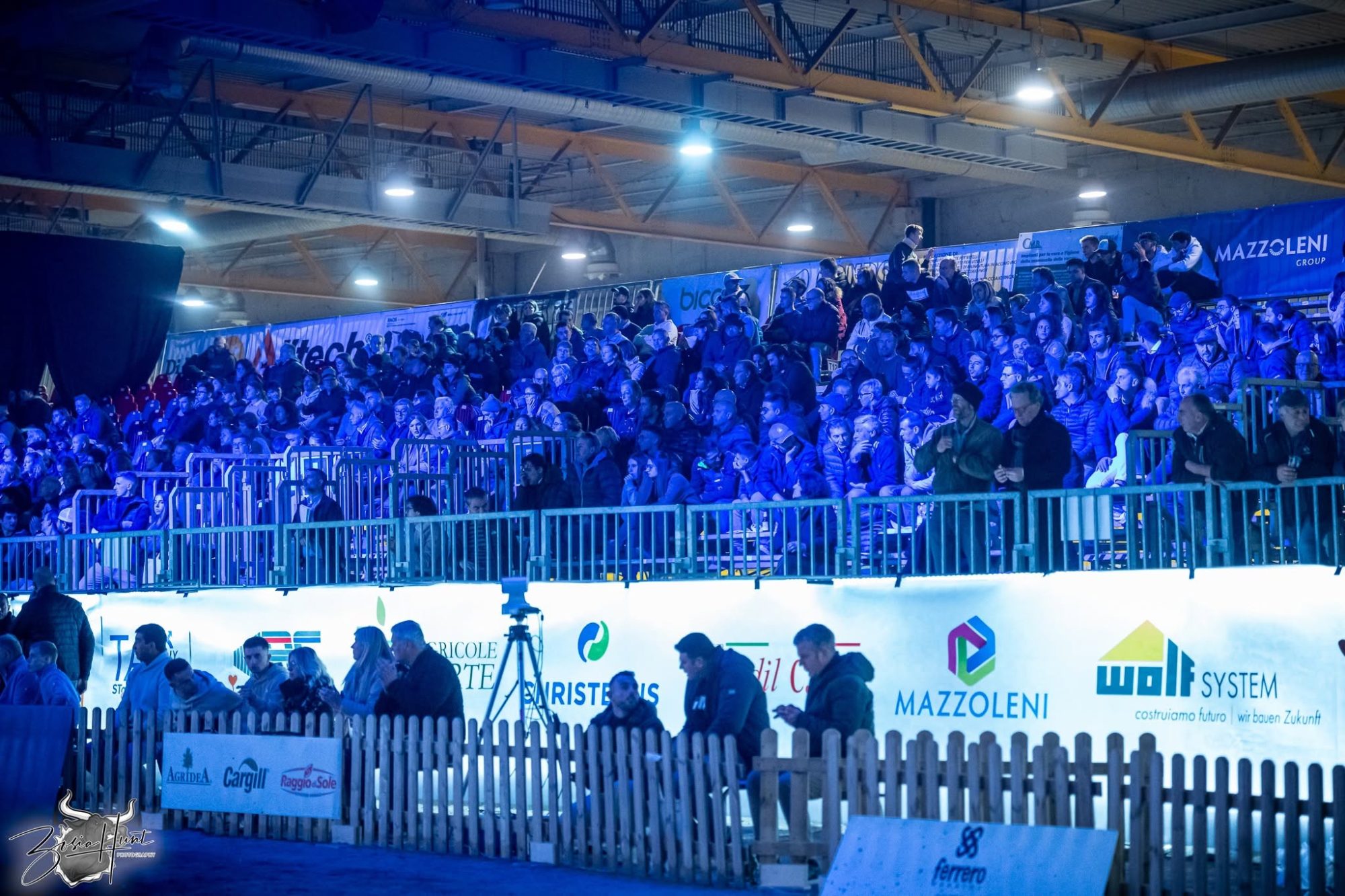
Now look at Cremona. A third of Expo’s size — and the house is packed, lit like a concert, roaring. The 2025 Cremona international show in Italy draws a full, standing-room crowd under theatrical lighting. This is the same sport, the same time of the year, a fraction of the scale.

It’s not just Italy. EuroTier in Hanover pulled roughly 120,000 visitors from 149 countries in 2024 (EuroTier 2024). SPACE in Rennes set a record 102,528 visitors in 2025 (SPACE 2025). Those are broad livestock shows, not pure dairy — fair enough. But the direction of the number lines is the whole point. Theirs go up. Ours goes down.

And don’t tell me it’s a European thing. Drive to Denver. This January, the National Western Stock Show packed 750,039 people through the gates over 16 days — an all-time record that finally broke a mark standing since 2006 (National Western Stock Show; Denver7). Same continent. Same cold January. The difference is that Denver treats its show like a 16-day event the whole city can’t miss — rodeo, horse show, trade floor, the works (NWSS) — while we treat ours like a cattle competition with a trade hall attached. One of those models is setting records. The other is dyeing shavings.
When did our signature become the color of the shavings?

Ask anyone what makes World Dairy Expo special and you’ll hear it: the colored shavings. Stop and really feel how strange that is. The single most iconic thing about the world’s premier dairy event is the color they dye the wood chips — Hoard’s Dairyman literally ran a feature on how they’re made.

And here’s the maddening part: Expo knows how to do spectacle. The one-ton, 20-foot revolving globe has spun over the show since 1967. The themed backdrops have become a simple backdrop where once a full construction-site build for “Excitement is Building” (Hoard’s Dairyman). They do a supreme-champion moment — lights down, single spotlight, the music swelling as she walks in — gives everyone in that Coliseum chills.

So the talent is there. The history is there. The capability has always been there. The question isn’t whether Madison can light up a ring like Cremona. It’s why, year after year, we let more of our identity ride on the shavings and less on everything the rest of the world is now building around them.

That’s not bad luck. That’s a choice nobody’s owned.

So how did this happen on our watch?

Be fair: some of this nobody could stop. Farm consolidation and supplier mergers are real forces, and no show committee could have frozen them.

But “it’s structural” became the comfortable story everyone hid behind — because it lets all of us off the hook. And it doesn’t survive the timeline. The decline started before COVID. It kept rolling for three straight years after the farm shakeout was already over: 563, 551, 461. The cows never left. The milk never left. The hunger for genetics and technology only grew.

So no — this didn’t just happen to Expo. It happened while the people who love it assumed it was somebody else’s job to fix. The breeders kept showing. The enthusiasts kept buying tickets. And the slow leak kept leaking, because outrage requires somebody to first say the number out loud.

Consider it said.
What it would take to make Expo great again — four fixes that already work

To be clear: what follows is our opinion — a set of ideas drawn from what’s working at other shows, not a plan endorsed by or affiliated with World Dairy Expo.

Here’s the hopeful part, and it’s real: almost nothing here is fatal, and almost every fix already exists somewhere in the show world. The decline is a choice. Which means it can be un-chosen — if enough of us push.

LeverThe moveThe impact
1. Light up the ringAdopt Cremona’s high-production theater — lighting, music, LED screens, plain-English commentary.Turns live judging into a broadcast-ready moment worth sharing.
2. Prove value to brandsGive exhibitors modern digital lead data, plus a dedicated ag-tech pavilion.Pulls back the commercial companies chasing real ROI.
3. Rebuild the kid pipelineChampion a dairy version of the beef jackpot circuit — frequent, cheap, low-stakes youth shows.Restores the fading youth crowd that fills the seats in 2045.
4. Capture the afterglowLaunch an official, app-integrated flash sale right after the Supreme selection.Redirects the genetics surge back into the show that created it.

No single lever saves Expo. Together, they turn a show that’s playing defense into an event the commercial world can’t afford to miss. Here’s the evidence under the four moves:

Light up the ring (Lever 1). Expo’s own ExpoTV livestream drew about 56,935 unique viewers and 212,916 views in 2023 — an online audience already rivaling the in-person gate. The reach is sitting there untapped. It also highlights that more people would like to watch from home than live, similar to the challenges the NFL have, something we have made suggestions in the past for: From Football Field to Dairy Show Ring: Translating NFL Marketing Prowess into Tanbark Success

Prove value to brands (Lever 2). 79% of exhibitors say they want attendee buying-cycle data; fewer than half get it (Exhibitor Advocate). And remember the earlier math — the big commercial barns didn’t stop needing genetics and automation, they need more of it than ever. Expo has to prove those buyers are standing in the aisles.

Rebuild the kid pipeline (Lever 3). Expo youth showmanship plateaus near 450 entrants while a single beef event runs 7,000-plus kids (Oklahoma Youth Expo). By 2023, only 1 in 7 Dairy Challenge students came from a dairy background. That’s the crowd that fills the seats in twenty years.

Capture the afterglow (Lever 4). You can’t buy the Grand Champion while she’s standing on the shavings — nor should you. But the moment the judge’s hand hits her hip, the private texts, breeder groups, and third-party sale platforms light up to trade her embryos and offspring. The infrastructure already exists: elite Madison-week sales like the Top of the World Sale have gone all-virtual with online bidding. Expo builds the marketing moment; an official flash sale ties that financial heat back to the entity that built the stage.

This is the part where you stop nodding and do something

If you’ve read this far, you’re not a bystander. You’re the person who actually cares whether your kids get to feel what you felt walking onto those shavings. So don’t just share this and sigh. Find your role below and do the one thing next to it.

If you’re on a board, committee, or breed association: Put the production question on the next agenda. Ask out loud why Cremona outshines us at a third our size — and what a lit-up ring would actually cost. Somebody has to ask. Let it be you.

If you exhibit or sponsor: Renewal contracts for the 2027 show go out this coming winter, with deposits due by early spring. Before you sign the next one, tell Expo exactly what would make the floor worth it again — lead data, a dedicated tech pavilion, a real reason to be there. They have every reason to be listening now, because they have to.

If you’re a breeder or a fan: Say the quiet part loud. Bring it up in the barn aisles, in the online groups, and anywhere breeders gather. The single biggest reason nothing’s been done is that nobody has demanded it as a community. A hundred voices that love this show beat any consultant’s slide deck.

Because the cows were never the problem. They still show up — the same nine and a half million of them, making more milk than ever.

The only question left is whether we show up for the show the way the breeders always have. Whether we make enough noise, soon enough, that Madison remembers it’s supposed to be the place nobody can stay away from.

The clock’s running. And right now, by default, we’re letting it slip.

What are you going to do about it?
Key Takeaways

  • The cattle never left — attendance fell a third since 2014 and the trade floor is bleeding ~70 companies a year, while cow numbers and milk output held. This is a show-experience problem, not a dairy problem.
  • Cremona runs a ring a third of Expo’s size and packs the house with lights, screens, and atmosphere. The capability exists in Madison too; the will to use it hasn’t.
  • The next real window is the 2027 renewal cycle — contracts go out this winter, deposits early spring. If you exhibit or sponsor, that’s when your feedback actually moves the room.
  • Nothing here is fatal, and every fix already works somewhere. Whether it turns around depends on whether the people who love this show start saying so out loud, now.

Want the deeper math behind all this? We’ve gone further on whether Expo is really dairy’s Super Bowl, on what dairy shows must learn from the booming stock-show world, and on where consolidation is taking the whole industry in our deep-dive, The Bullvine Dairy Curve.


Methodology note: Attendance, trade-show company, and cattle-entry figures come from World Dairy Expo’s own published show summaries except where noted. Farm count, cow numbers, and milk output are from the USDA Census of Agriculture and USDA NASS. Show-ring history (the globe, themed backdrops, colored shavings) is drawn from Hoard’s Dairyman and WDE’s published anniversary record. Comparative attendance for other shows comes from each event’s official reporting (EuroTier, SPACE, and the National Western Stock Show). National figures may not reflect your region or operation. Year-by-year gate counts vary by source: the 2024 show reported 55,209 attendees including 2,731 international visitors, WDE has not published a clean public 2022 gate count, and the 2023 figure ranges from “over 54,500” to ~56,250 depending on the source; these are flagged rather than smoothed over. World Dairy Expo was contacted for comment prior to publication.

Learn More

The Sunday Read Dairy Professionals Don’t Skip.

Every week, thousands of producers, breeders, and industry insiders open Bullvine Weekly for genetics insights, market shifts, and profit strategies they won’t find anywhere else. One email. Five minutes. Smarter decisions all week.

NewsSubscribe
First
Last
Consent

How Your ‘Down Cycle’ Became Corporate Warfare: The Beef-Cross Money Breaking Every Market Rule

Why are some producers expanding herds during margin squeezes? The answer reveals a fundamental shift in dairy economics

EXECUTIVE SUMMARY:

Recent research shows U.S. milk production increased 3.4% through July 2025 despite challenging margins, with New Zealand up 8.9% and South America rising 7.7%—a pattern that breaks traditional market correction cycles. What farmers are discovering is that beef-on-dairy crossbred calves now generate revenue streams that can offset monthly feed costs, fundamentally altering culling decisions that historically balanced supply and demand. This shift coincides with processing consolidation, as demonstrated by Lactalis’s $4.22 billion acquisition of Fonterra, creating fewer competitive alternatives for milk marketing. University research indicates that when processing facilities operate above 95% capacity, basis relationships deteriorate for producers—a situation becoming more common as companies optimize throughput over redundancy. The convergence of alternative revenue sources, reduced processing competition, and government programs like Dairy Margin Coverage creates market dynamics in which traditional price signals no longer effectively drive supply adjustments. For progressive producers, this means developing risk management strategies that account for combined milk-plus-calf returns while diversifying processing relationships. Understanding these structural changes—rather than waiting for cyclical recovery—positions operations to navigate an industry where market fundamentals are being permanently rewritten.

dairy market consolidation

So I’m having coffee with this producer last week—big operation, been at it for decades—and he says something that’s been bugging me ever since. “You know what’s weird?” he goes. “My margins are terrible, milk check keeps shrinking, but I’m milking more cows than I ever have.”

And I’m thinking… wait, what?

See, I’ve been covering these markets since Clinton was president (yeah, I’m that old), and this just doesn’t follow the old playbook. You know how it’s supposed to work, right? Prices tank, producers cull hard, supply drops, prices recover. Economics 101 stuff.

Except look at what the USDA put out last month. U.S. milk production up 3.4% through July—during what should be a massive correction period. New Zealand’s running 8.9% ahead of last year, according to Global Dairy Trade reports. South America’s up 7.7%. These numbers keep coming in month after month.

I mean, when’s the last time you saw production climbing during a price crash? Never, right? Because it makes no damn sense economically.

And honestly? That should scare every independent producer reading this.

Global milk production defying economic logic – while prices crash, production surges in key regions, breaking the fundamental supply-demand corrections that have balanced dairy markets for decades

The Beef-Cross Money That’s Breaking All the Rules

You guys all know about these beef-on-dairy calves bringing serious money lately. I’m talking… well, let’s just say crossbred calves are covering expenses that used to come straight out of the milk check.

But here’s where it gets nuts—that calf money is completely screwing up everything we thought we knew about supply and demand responses.

Think back to 2014. I remember writing about operations that culled hard when Class III dropped. Supply tightened up real quick. Prices recovered. Basic market mechanisms are working like they should.

Not anymore.

You’ve got cows bleeding money on every hundredweight of milk, but that same cow’s beef-cross calf might cover months of feed costs. So instead of sending her down the road like you would’ve done back then, you keep her around for the calf revenue.

Makes total sense from a cash flow standpoint, I get it. But multiply that decision across every dairy operation dealing with tight margins… and suddenly you’ve got this bizarre situation where terrible milk prices are actually keeping more cows in production.

What are the feedback loops that are used to correct market imbalances automatically? They’re not just broken—they’re working backwards.

When Your Processor Starts Playing Games

You know what really bothers me? How tightly these processing networks run nowadays. I keep hearing about plant shutdowns that create these massive disruptions—milk backing up at farm tanks, basis going to hell, producers scrambling to find alternative processing.

And the basis? Starts at maybe a small discount and just keeps sliding. Gets ugly real fast.

But what really gets me is how it exposes just how deliberately lean these processors run their operations. Mark Stephenson up at Wisconsin Extension—sharp guy, does good work—he’s mentioned how when processing plants approach capacity limits, basis relationships start deteriorating for producers.

Which makes you wonder… why are so many facilities always running right at that edge?

My theory? Because they figured out that tight capacity gives them leverage. When every processor in your region is maxed out, where else are you gonna haul your milk? They can knock your basis down, and you’ll take it because—what choice do you have?

Talk to producers lately. Basis penalties that used to be seasonal exceptions are becoming… well, more frequent occurrences. Because some genius in corporate figured out that running short on capacity works better than building enough to actually serve their suppliers properly.

The Lactalis Deal That Shows How This Game Really Works

You want to see corporate timing that’d make a Wall Street trader jealous? Watch how Lactalis—try saying that name three times fast—played their Fonterra buyout.

So these guys are already the biggest dairy company on the planet, right? Pulling in over €30 billion annually according to their own financial reports. They could’ve struck this deal anytime they wanted.

But did they move when milk prices were strong and farmers actually had some negotiating power? Hell no.

They waited until this year, right when global oversupply was building and operations were getting squeezed on margins. Those Australian Competition and Consumer Commission documents show the negotiations happening right as market pressure was building. Final deal: $4.22 billion for Fonterra’s consumer and foodservice businesses.

Coincidence? I seriously doubt it.

Want proof this is a pattern? Look at what they did in France after they consolidated operations there. Despite making record money—record money—they cut milk collection by 450 million liters last year. That’s nearly 10% of their French volume, according to European dairy reports. French producers were screaming about it, but by then, competitive alternatives were already gone.

Funny how that timing works out, isn’t it?

Why “Cheaper Feed” Is Mostly Marketing Nonsense

Every trade publication—and I read way too many of them—has some consultant talking about how lower grain costs are gonna save our margins. Corn backing off from highs, soybeans down… sounds encouraging in theory.

Until you actually run the numbers on real operations.

So let’s say feed costs drop significantly—and I mean really drop, more than you’d normally see. When you break that down per cow per day versus what most operations are losing on milk revenue… well, it’s like trying to fill a swimming pool with a garden hose while someone’s got the drain wide open.

I keep hearing from producers who’ve done the math. Feed improvements might save you fifty cents, maybe seventy-five cents per cow daily. But if milk revenue’s down two-fifty, three dollars per cow… you see the problem?

MetricDaily Per Cow ImpactMonthly Per CowAnnual Per Herd (500 cows)
Milk Revenue Loss-$2.50-$75.00-$456,250
Feed Cost Savings+$0.60+$18.00+$109,500
NET IMPACT-$1.90-$57.00-$346,750

But these consultants keep pushing feed procurement strategies because—and I suspect this is part of the game plan—it keeps producers focused on optimizing costs while the real money flows toward corporate consolidation. Keep us busy saving pennies while Rome burns.

The Processing “Emergency” Pattern

What bothers me about these plant shutdowns? Every time one goes down, it requires this massive coordination effort—state agencies getting involved, emergency rerouting across multiple states, even companies that don’t normally handle dairy getting pressed into service.

When one facility failure requires government-level intervention, that tells you everything about how this system’s designed to operate. Zero redundancy is built in. Everything is running right at the breaking point.

If any of us ran our dairy operations with that little backup… hell, we’d never sleep at night. But for processors? Apparently, running lean means every breakdown creates regional pricing opportunities they can use to their advantage.

And that’s becoming the pattern. Processing disruptions that create permanent changes to local basis relationships. Never temporary adjustments that recover—always permanent shifts that favor the processor.

Makes you wonder how accidental some of these emergencies really are…

What the Experienced Guys Are Actually Doing

I’ve been talking to producers who’ve figured out this cycle’s different from anything we’ve seen before. The ones positioning to survive aren’t sitting around waiting for some magical market recovery.

They’re getting serious about risk management for Q4 production. Class III put options for fourth quarter production—locking in price floors when things could get uglier. Some operations regularly rotate milk between multiple processors. Soon as one plant starts offering heavy discounts, they shift volume to keep everyone competitive.

DMC enrollment deadline’s coming up fast—September 30th, that’s next Monday. Coverage costs you maybe fifteen cents per hundredweight but pays out when margins collapse below certain thresholds. Joe Outlaw at Texas A&M’s Agricultural and Food Policy Center ran the numbers after that 2023 squeeze—program paid out $1.27 billion to enrolled producers. With margins running where they are now? Enrolled operations could see substantial government checks.

Strategic culling’s getting weird, too. Some producers I know are scoring every cow on total economic return—milk revenue plus calf value minus feed costs. Some of their best milk producers are getting shipped because their calves don’t bring premium money. Makes sense mathematically, but it feels backwards, you know?

Regional feed coordination with neighbors still makes sense if you can coordinate bulk purchases and negotiate decent freight rates. Every dollar saved per ton adds up when you’re feeding this many animals.

The Government Program Making Everything Worse

This probably won’t make me popular with the bureaucrats in Washington, but I gotta say it: Dairy Margin Coverage isn’t protecting family farms. It’s subsidizing the oversupply that’s letting corporate processors buy cheap milk.

Think about the logic here. DMC literally pays producers to keep milking cows that lose money on every hundredweight. Who benefits from a sustained cheap milk supply? Processing companies are buying raw materials at below-market rates.

It’s corporate welfare disguised as farmer relief, and most of us are too desperate to turn it down.

The program uses national averages that completely ignore regional basis manipulation games. Producers dealing with heavy local discounts see DMC calculations based on milk prices they’ve never actually received in their mailbox. It’s like calculating your gas mileage based on highway speeds when you’re stuck in city traffic all day.

Still, with margins this brutal, you probably need the coverage. Just understand what you’re really signing up for—subsidizing a system that’s working against your long-term interests.

The Reality Nobody Wants to Discuss Publicly

Hell, I’ve been doing this since the late 90s, and I’ve never seen market mechanisms get systematically dismantled like this. What are the automatic balancing systems that are used to correct supply-demand imbalances? They’ve been neutralized.

Beef-cross revenue eliminates price-driven culling incentives. Processing consolidation kills competition for our milk. Global production growth creates sustained oversupply conditions. Government programs subsidize below-cost production.

This isn’t your typical cyclical correction. It’s a managed transition toward corporate control of milk pricing, with independent farmers becoming contract suppliers instead of actual market participants.

Back when we had real competition for our milk—and some of you remember those days—you could play processors against each other. Get a better basis here, threaten to move volume there. Now? Good luck with that strategy.

Industry publications keep using words like “partnership” when they talk about these corporate acquisitions. Lactalis is partnering with farmers after they buys up assets. Partnership. Right. Like David partnering with Goliath—how’d that work out?

When one party controls processing capacity and the other has nowhere else to sell their product… that ain’t partnership. That’s dependency, presented in fancy marketing language.

Bottom Line for Producers Who Understand What’s Happening

Smart farmers are repositioning for an industry where volume might matter more than efficiency per cow, where calf checks could drive more herd decisions than milk production metrics, and where basis management becomes more critical than traditional futures hedging.

Reality check time. Feed cost improvements can’t offset milk revenue losses when prices drop faster than input costs. Government programs provide short-term cash flow but perpetuate the structural problems driving margin compression. Beef-cross returns generate immediate revenue while potentially undermining long-term market stability.

Operations implementing serious risk management strategies—protecting production with options, diversifying processor relationships, culling based on total economic returns instead of just milk numbers—those farms will survive this transition period.

The ones waiting for a traditional cyclical recovery? They’re gonna discover that “normal” doesn’t include the competitive market relationships that made independent dairy farming economically viable.

Corporate consolidation is accelerating rapidly across the industry. Producers who recognize this as a permanent structural change rather than a temporary market weakness have limited time to position defensively before competitive alternatives disappear entirely.

Your operation’s survival depends on understanding that current market conditions aren’t just natural economic forces playing out. They reflect corporate strategies designed to concentrate industry control while systematically reducing the number of independent producers.

The question isn’t whether markets will eventually improve—they might. The question’s whether your farm can adapt to survive in the corporate-controlled industry that’s emerging from this transformation.

Makes me sick to write that last part, but it’s the truth as I see it developing.

KEY TAKEAWAYS:

  • Combined revenue optimization: Producers tracking total economic returns per cow (milk revenue plus calf value minus feed costs) are making more profitable culling decisions, with beef-cross calves potentially covering 2-3 months of feed expenses per animal
  • Risk management enhancement: Class III put options for Q4 production and Dairy Margin Coverage enrollment (deadline September 30th) provide essential downside protection, with 2023 DMC payments totaling $1.27 billion to enrolled operations during margin squeezes
  • Processing relationship diversification: Operations rotating milk between multiple processors monthly, maintain competitive basis pricing, and avoid the 15-20¢/cwt penalties that can occur when single-plant dependencies face capacity constraints
  • Strategic feed procurement coordination: Regional cooperatives coordinating bulk grain purchases and freight optimization can achieve meaningful cost reductions, though these savings alone cannot offset significant milk revenue declines
  • Market structure adaptation: Successful operations are positioning for an industry where basis management becomes more critical than traditional futures hedging, requiring a deeper understanding of local processing dynamics and capacity utilization patterns

Production data sourced from the USDA Economic Research Service monthly dairy reports and Global Dairy Trade auction results that track international supply trends. Corporate financial information from publicly available Lactalis Group reports and Australian Competition and Consumer Commission regulatory filings. Academic analysis from the University of Wisconsin Extension dairy economics research and Texas A&M’s Agricultural and Food Policy Center studies on government program impacts.

Complete references and supporting documentation are available upon request by contacting the editorial team at editor@thebullvine.com.

Learn More:

The Sunday Read Dairy Professionals Don’t Skip.

Every week, thousands of producers, breeders, and industry insiders open Bullvine Weekly for genetics insights, market shifts, and profit strategies they won’t find anywhere else. One email. Five minutes. Smarter decisions all week.

NewsSubscribe
First
Last
Consent
Send this to a friend



