It’s a Tuesday repair. A guard comes off the PTO shaft, the machine goes back to work, and nobody writes it down. Seven years later that missing line item is worth $1,934,000 — and your comp won’t touch it.
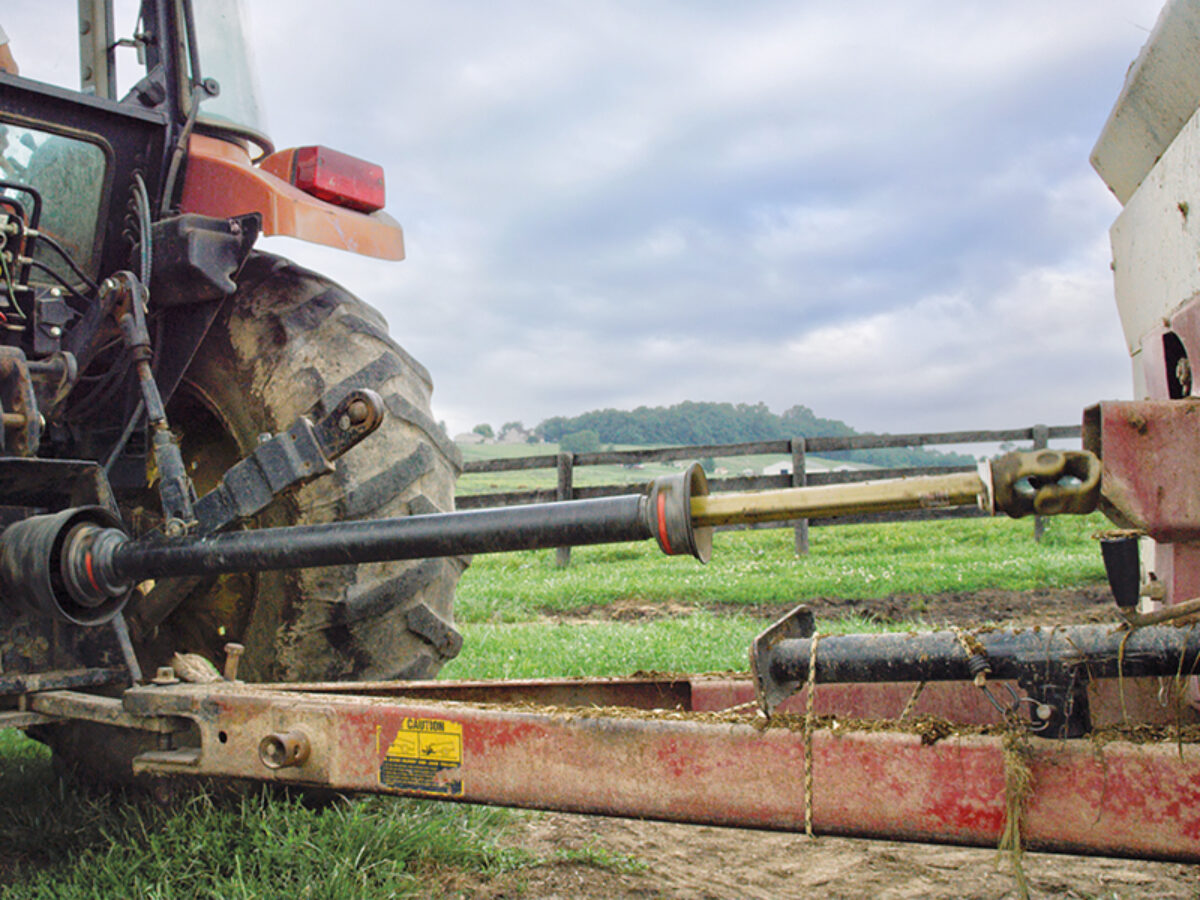
The sand spreader carried the warning on the machine itself. Near the power take-off shaft, the manufacturer had stamped “DANGER, ENTANGLEMENT HAZARD” and “Keep Guards in Place.”
According to the Supreme Court of Ohio’s opinion, Jose Camara was operating that spreader as a farm laborer for Gill Dairy, L.L.C. in Madison County on April 22, 2019. He noticed an oil leak, shut the machine down, couldn’t locate the source, and restarted it to keep looking. Clothing on his left leg caught the unguarded PTO shaft, which pulled him toward the machine and threw him over the shaft — permanent injuries to both legs and his left shoulder, skin grafts, multiple surgeries.
The jury awarded $1,934,000. The award hasn’t been paid out. The Twelfth District Court of Appeals vacated it; the Supreme Court reversed that court on August 12, 2026, and the case now returns to the Twelfth District on two unaddressed assignments of error. But if you employ anyone outside your family, the more consequential ruling here is eleven years older — and it’s about your insurance.
THE SHORT VERSION
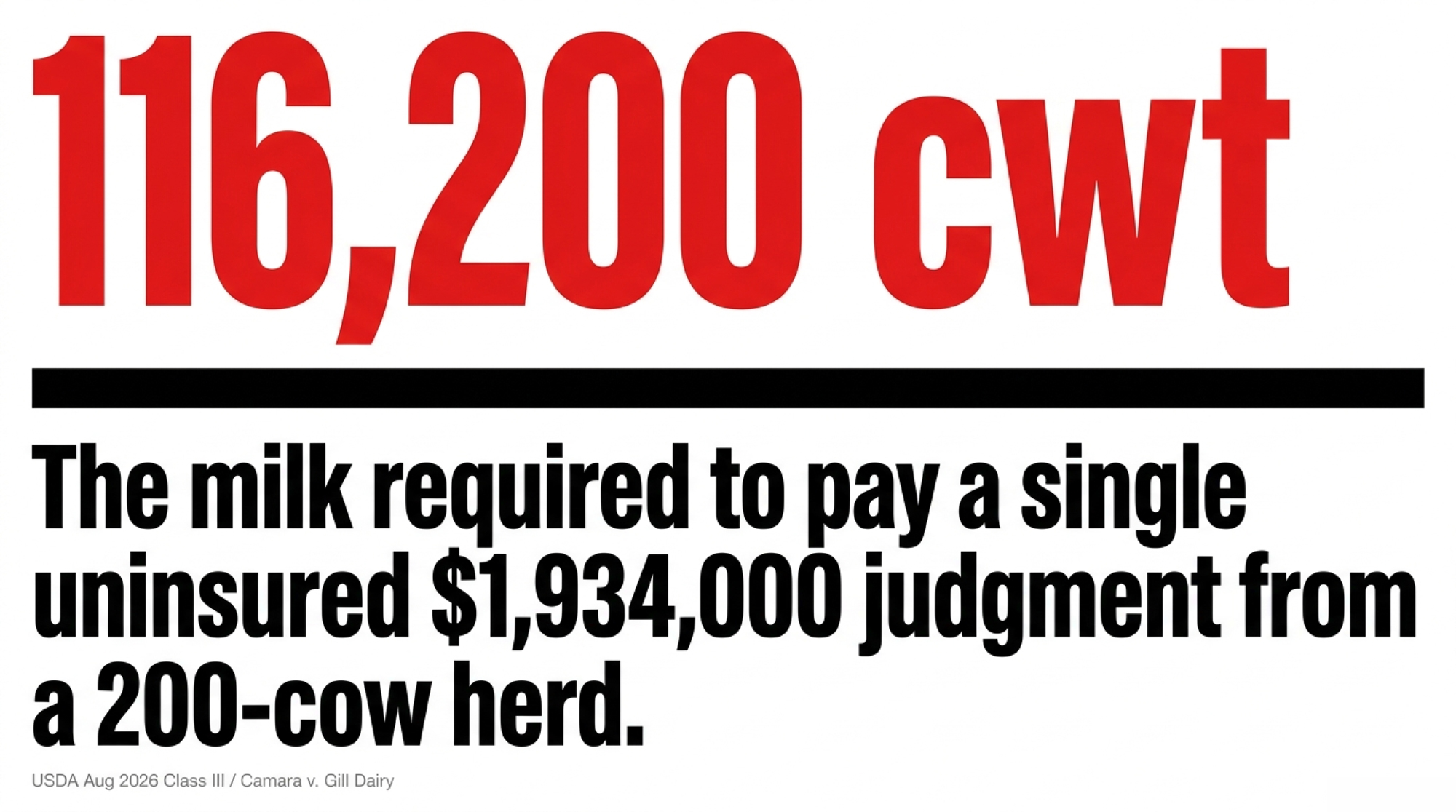
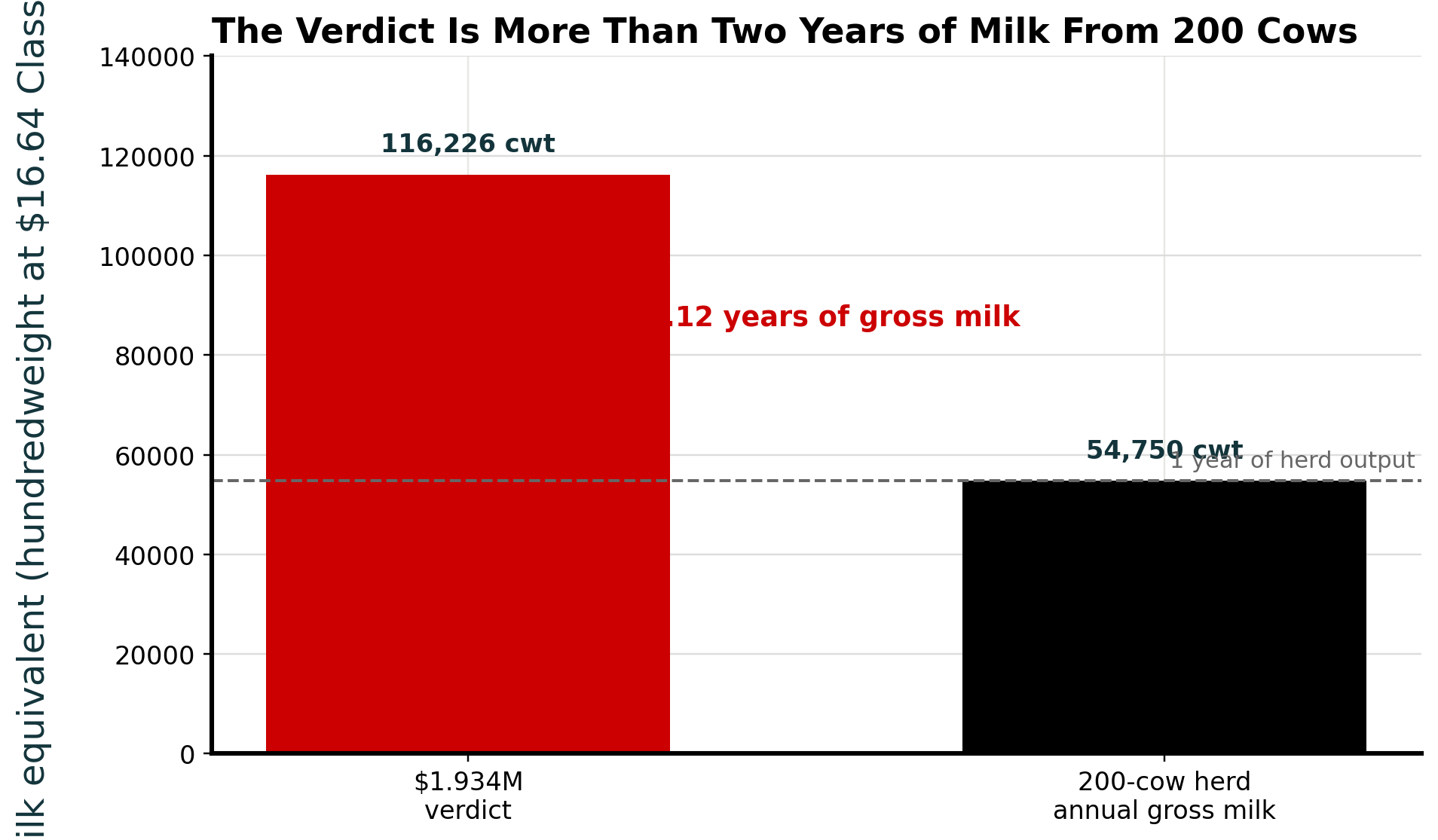
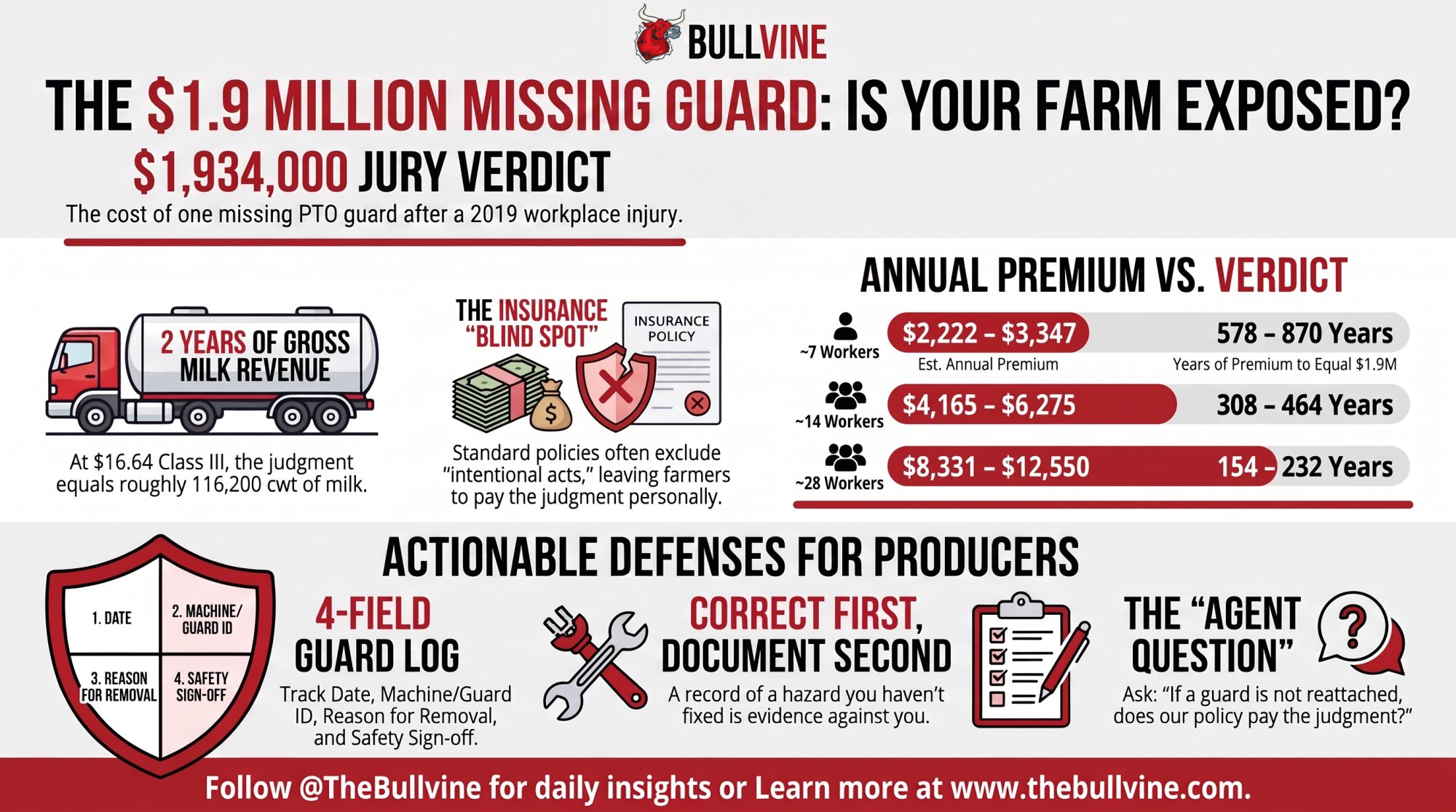
On August 12, 2026, the Supreme Court of Ohio reversed an appellate ruling that had tossed a $1,934,000 jury verdict against Gill Dairy, L.L.C., remanding the case to address remaining appeals — and exposing a seven-figure blind spot in farm liability. At August’s $16.64 Class III, that judgment equals roughly 116,200 cwt, a little over two years of gross milk from a 200-cow herd.
The ruling in Camara v. Gill Dairy held that Ohio’s rebuttable presumption of intent attaches on evidence of deliberate guard removal, reachable through circumstantial proof, without the separate non-reattachment finding the Twelfth District had required. Here’s the part that should reach past Ohio: a 2015 decision, Hoyle v. DTJ Enterprises, already established that standard employer-liability language excludes the exact intent such a claim requires proving, so the judgment lands outside your policy — and one carrier stopped writing that coverage in Ohio altogether after Kaminski.
Against BWC dairy base rates of $0.6171 to $0.9296 per $100 of payroll, a farm running fourteen people pays roughly $4,165 to $6,275 a year in premium, meaning that single verdict runs 308 to 464 years of it. The pivot in the record was a 2016 hydraulic pump job by an outside contractor that required pulling the coupling guard, with nothing on file showing it went back on — so if mobile mechanics or short-line dealers touch your guarded equipment, the paper trail that decides your case is being written by someone who doesn’t work for you.
Standards vary sharply by state: Michigan hands the question to a judge as a matter of law, and Pennsylvania’s § 303(a) has no intentional-tort exception. Keep reading if you employ anyone outside your family — the fix is a four-field guard-removal log that costs nothing, and the question for your agent fits in one sentence.
What Camara v. Gill Dairy Actually Decided
Ohio workers’ compensation is built to be your employee’s exclusive remedy. Under R.C. 4123.74, employers who comply with the premium requirements of R.C. 4123.35 aren’t liable in damages at common law for workplace injuries — an immunity backed by Article II, Section 35 of the Ohio Constitution. Ohio also runs a monopolistic state fund: you buy coverage from the Bureau of Workers’ Compensation, not a private carrier, and it’s mandatory from your first employee. No agricultural exemption.
The crack in that wall is R.C. 2745.01, effective April 7, 2005. An employer isn’t liable “unless the plaintiff proves that the employer committed the tortious act with the intent to injure another or with the belief that the injury was substantially certain to occur.” Subsection (B) then defines “substantially certain” as deliberate intent. Read those together, and the two apparent routes to liability collapse into one — there’s no middle ground. A claim is either ordinary, and comp absorbs it, or it’s deliberate, in which case you’re outside comp and, as you’ll see, outside your policy too.
Subsection (C) is the equipment provision. “Deliberate removal by an employer of an equipment safety guard… creates a rebuttable presumption that the removal… was committed with intent to injure another if an injury or an occupational disease or condition occurs as a direct result.”
Gill Dairy’s position, as the Court’s opinion describes it, was that the evidence showed no deliberate removal at all — only guards that may have worked loose during normal use and weren’t replaced. The dairy argued Camara had to prove it both removed the guard and made a considered decision not to reattach it. The Twelfth District accepted that reading and held the dairy should have won on summary judgment. Worth sitting with: an appellate court agreed with them, which is why this arrived at the Supreme Court as a certified conflict rather than a long shot.
The Supreme Court reversed. Its syllabus holds that subsection (C) “creates a rebuttable presumption that attaches when the plaintiff presents evidence that the employer made a considered decision to remove and not reattach an existing equipment safety guard, and no court may add a substantive requirement that is not contained in the text of the statute.” Justice Jennifer Brunner wrote it, joined by Chief Justice Kennedy and Justices DeWine, Deters, Hawkins, and Shanahan, with Justice Fischer joining all but one section. No dissent.
Two Published Analyses Read It Differently
If you’re working from a summary rather than the opinion, which summary you read matters.
Ohio State’s Agricultural & Resource Law Program put it broadly on August 27, in a piece by Senior Research Associate Ellen Essman: “an injured employee must only prove that an employer has knowledge of missing safety equipment, not that the employer deliberately removed them or decided not to replace them.” Writing for Kegler Brown on August 14, Jacob Dobres read it tighter — “The plaintiff still must prove that the employer affirmatively and deliberately removed the guard” — and added that Camara “does not convert ordinary negligence, poor maintenance, or knowledge of a missing guard into an employer intentional tort.”
The gap traces to how the Twelfth District phrased its certified question, which asked what proof is required “in addition to the employer having mere knowledge of a missing safety guard.” Frame the question around knowledge and the answer starts to sound like knowledge is the test.
What the opinion itself shows: the syllabus keeps deliberate removal at the center, Hewitt v. L.E. Myers Co. still stands with its definition of removal as an affirmative act, and the presumption can now be reached on circumstantial evidence. No eyewitness required. Which reading applies to your operation is a question for your own counsel.
The Contractor Problem Nobody Puts in the Work Order
Here’s the detail most commercial dairies will recognize immediately. According to the Court’s opinion, Gill Dairy hired an outside company in April 2016 to replace the spreader’s hydraulic pump — work that required taking the PTO coupling guard off and putting it back on.
That job became evidence. Not the contractor’s problem. The dairy’s.
Read the statute’s trigger again: deliberate removal by an employer. The published opinion doesn’t address whether a third party’s physical act gets attributed to the farm that hired them — that question wasn’t before the Court. What the record shows is more useful anyway. The jury heard that the repair required guard removal, heard that no record showed reinstallation, and saw a still from a video Camara shot in March 2018 — a year before he was hurt — with the coupling guard gone and half the shaft guard missing. Enough to reach a jury on whether the employer made a considered decision.
If you run mobile mechanics, short-line dealers, or a service truck through your yard, that’s your exposure. You won’t be standing next to the shaft when the shield comes off. You won’t know whether it went back on. And the paper trail proving it did gets generated by somebody who doesn’t work for you and has no reason to note it.
The rest of the record ran the same direction, and none of it came from the dairy’s own safety file. Camara testified the machine looked that way from his October 2017 start date onward, and that he raised it with co-owner Frank Van Genugten in 2017 and was told to keep working. An OSHA investigator’s report followed the injury; as the opinion recites Van Genugten’s statements, he didn’t know when the guard had been removed, hadn’t done the repair himself, and couldn’t recall how long ago it happened. The dairy had also obtained a quote in January 2019 for a new PTO shaft assembly, three months before the injury, and the opinion recites a dispute over documents later given to a BWC investigator — the subject of a separate spoliation claim that wasn’t part of this appeal.
A contractor’s invoice. An employee’s phone. A federal investigator. A state investigator. Your operation generates all four categories right now, whether or not anybody’s keeping a file — and the same documentation gap runs through confined-space incidents.
The 2015 Ruling That Decided Who Pays
Hoyle v. DTJ Enterprises, decided March 12, 2015, wasn’t a farm case — Duane Hoyle was a carpenter who fell roughly 14 feet from a ladder-jack scaffold onto a concrete pad in March 2008. His employers had bought exactly the protection you’d want: an endorsement called the Employers Liability Coverage Form—Ohio, purchased from Cincinnati Insurance Company for an additional premium. It covered “substantially certain” intentional torts, and it excluded “liability for acts committed by or at the direction of an insured with the deliberate intent to injure.”
Justice Judith French, writing the lead opinion, closed the loop. Because Ohio law equates substantial certainty with deliberate intent, “whether Hoyle proves that intent with direct evidence under R.C. 2745.01(A) or with an unrebutted presumption under R.C. 2745.01(C), intent to injure is an essential element of his claim.” Therefore: “there is no set of facts under which DTJ and Cavanaugh could be legally liable to Hoyle that falls within the policy’s coverage.”
Justice Judith Lanzinger concurred in judgment only and put the practical effect plainly: “There is now nothing less than deliberate intent.” Justice William O’Neill dissented.
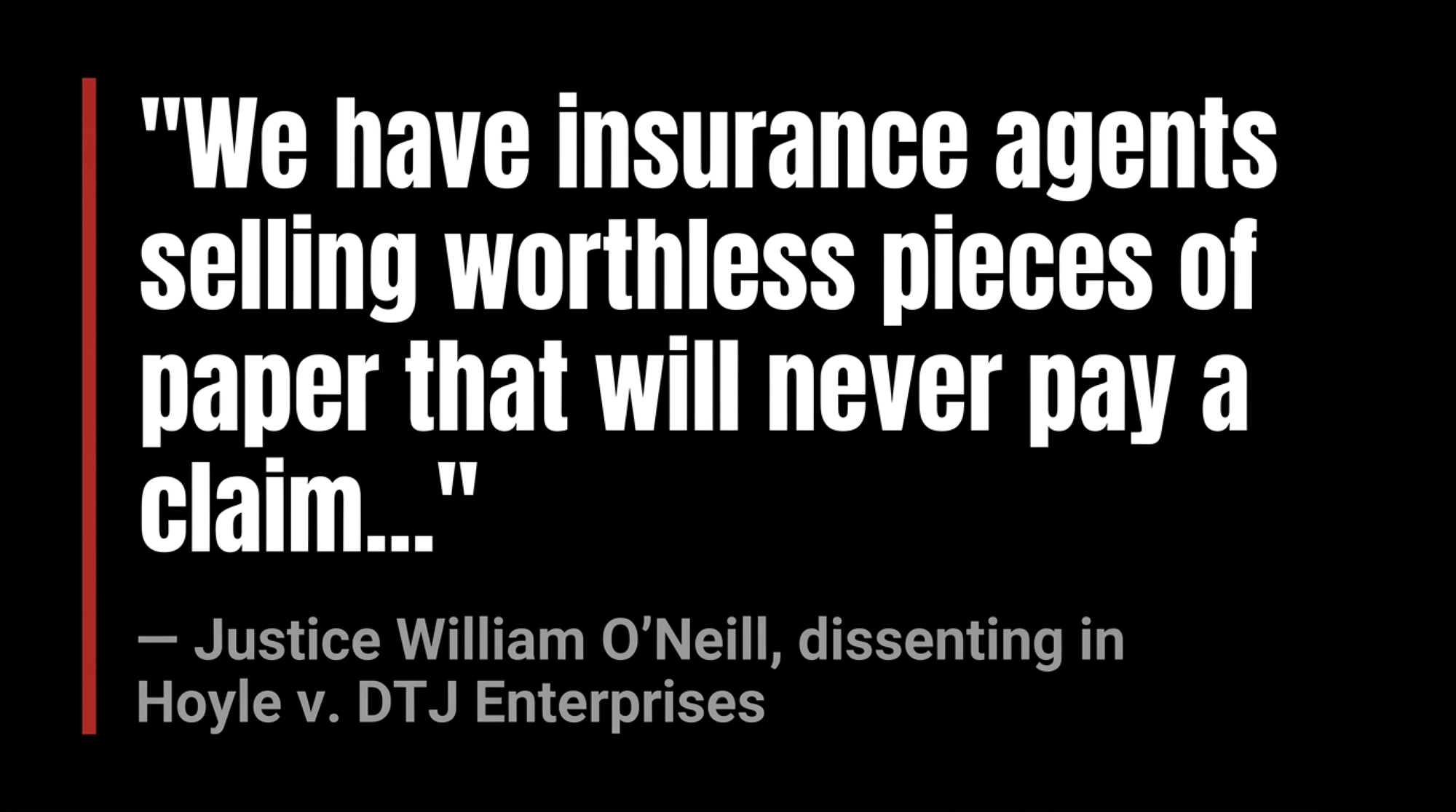
“Now we have insurance agents selling worthless pieces of paper that will never pay a claim to assuage the fears of managers as they, in the name of increased production and reduced labor costs, remove saw guards, disable air-filtration systems, and store time-consuming safety equipment in their offices.”
— Justice William O’Neill, dissenting, Hoyle v. DTJ Enterprises, 2015-Ohio-843
He also asked whether a court can “countenance an insurance company’s assertion that it should be permitted to collect a premium for an event that is never going to happen.” He was writing about intentional-tort endorsements in a construction case, not farm policies generally — but the mechanism he described is the one now sitting behind Camara.
The Hoyle record also reflects that after the Ohio Supreme Court upheld R.C. 2745.01 in Kaminski, Cincinnati Insurance stopped issuing indemnity coverage for employer intentional torts in Ohio and shifted to defense-only coverage. The opinion does not state the company’s reasons. And the Sixth Circuit applied the same reasoning unanimously in Encore Industries v. Travelers Property Casualty Co. of America, No. 25-3076, decided December 8, 2025 — a case arising from an employee’s death, where the court held the insurers owed no duty to indemnify for either the settlement or the judgment.
What Would One Missing Guard Cost You Against Your Premium?
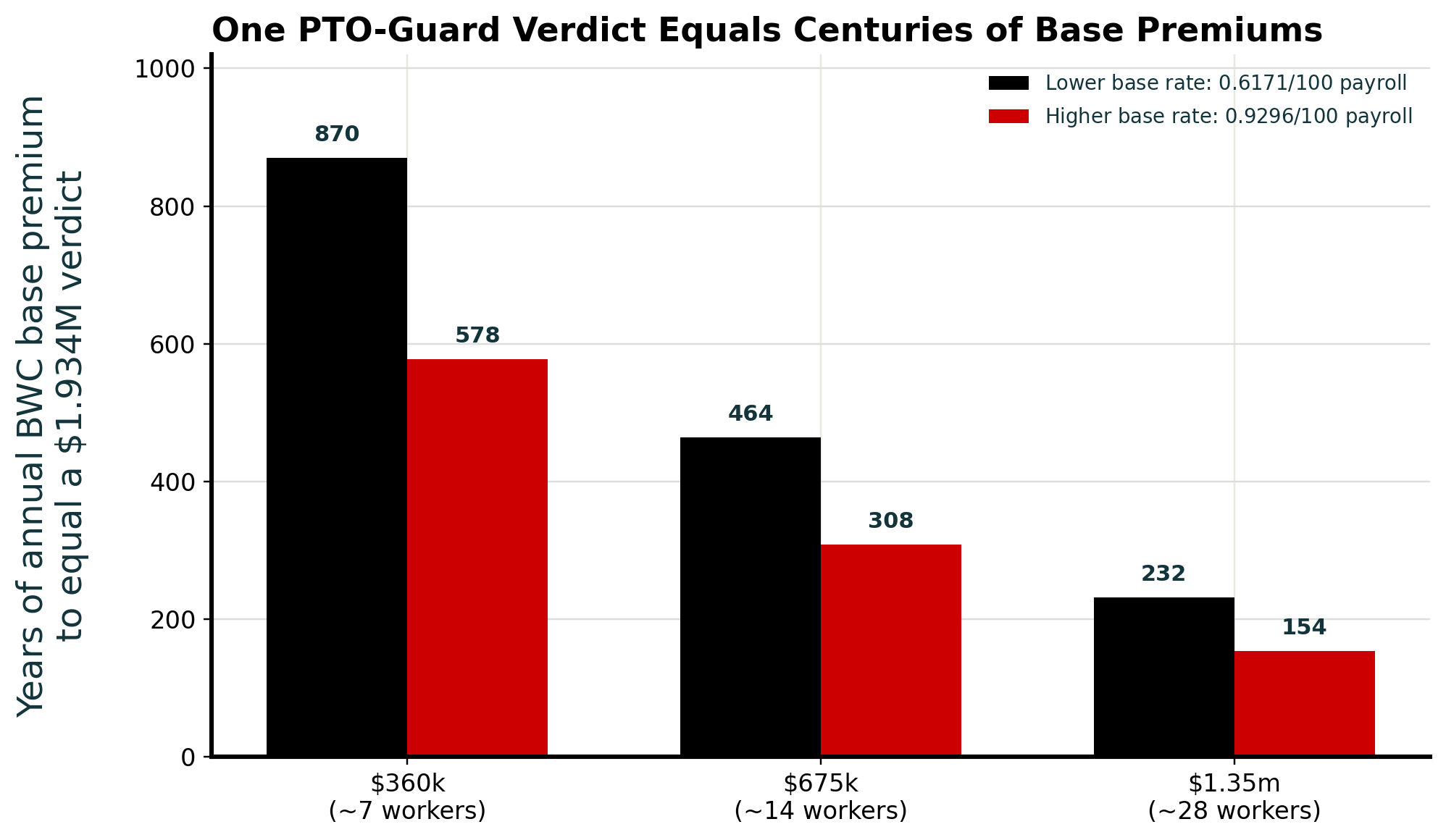
Run your own numbers, because the ratio is the argument.
BWC premium comes to base rate × payroll ÷ 100, then your experience modifier, then any program discounts. Base rates live in Ohio Administrative Code 4123-17-06, Appendix A. In the appendix effective July 1, 2025, the two farm classifications a dairy is most likely to occupy carried base rates of $0.6171 and $0.9296 per $100 of payroll. BWC approved roughly a 1% average reduction for the year beginning July 1, 2026, so your current figure sits a little below those. Confirm your assigned classification with BWC directly — the bureau publishes classification numbers and rates without descriptions, so third-party tables attach their own labels, and those labels disagree.
| Annual payroll | Estimated annual BWC premium at $0.6171 rate | Estimated annual BWC premium at $0.9296 rate | Years of premiums to equal $1.934M verdict |
| $360,000 (~7 workers) | $2,222 | $3,347 | 870 to 578 years |
| $675,000 (~14 workers) | $4,165 | $6,275 | 464 to 308 years |
| $1,350,000 (~28 workers) | $8,331 | $12,550 | 232 to 154 years |
| $1,934,000 verdict benchmark | 870 premium-years at $2,222/year | 154 premium-years at $12,550/year | One incident; one missing guard |
Worker counts assume a 2,600-hour year at the $18.55 average hourly wage for livestock farmworkers reported in an American Farm Bureau Federation analysis of federal Occupational Employment and Wage Statistics data published December 5, 2025. Farm Bureau lobbies on farm labor policy, and the figure is a national average, so treat it as a planning benchmark rather than an Ohio wage.
Now put the verdict in milk. USDA announced the August 2026 Class III price at $16.64 per hundredweight, up $1.12 from July and well off January’s $14.59 — the lowest Class III since July 2023. At $16.64, a $1,934,000 judgment equals about 116,200 cwt. A 200-cow herd shipping 75 pounds a day produces roughly 54,750 cwt a year. So one verdict runs a little over two years of that herd’s gross milk revenue at the Class III price, before feed, before labor, before the note. Your mailbox price won’t match Class III exactly, so run it against your own.
One more thing the table leaves out: Appendix A states that base rates exclude the Disabled Workers’ Relief Fund assessment and the additional DWRF assessment, with administrative costs billed separately. Your actual bill runs higher.
Does Your State Work the Same Way as Ohio?
Not remotely, and the spread is wider than most producers assume. Ohio’s presumption route is close to the most plaintiff-accessible standard in the dairy belt.
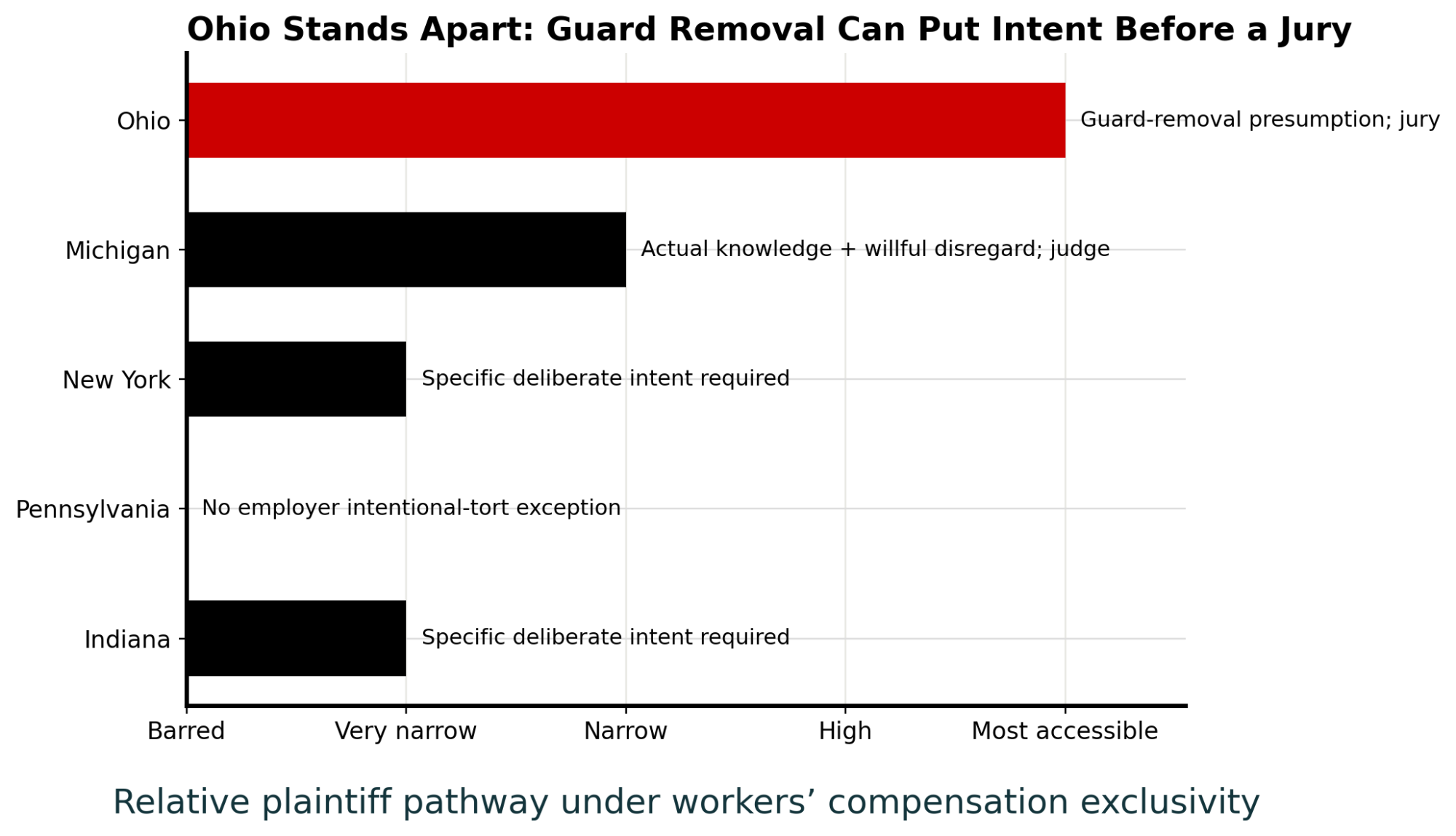
| State | Intentional Tort Standard | Who Decides | Key Precedent / Statute |
| Ohio | Presumption of intent from guard removal; proven via circumstantial evidence | Jury (8 members) | R.C. 2745.01(C); Camara (2026) |
| Michigan | Specific intent to injure, or actual knowledge of certain injury + willful disregard | Judge (as a matter of law) | MCL 418.131(1); Travis (1996) |
| New York | Deliberate act aimed at causing harm to that specific employee | Court (on the pleadings) | WCL § 11; Acevedo |
| Pennsylvania | No intentional-tort exception to comp exclusivity | N/A (Total Bar) | 77 P.S. § 481(a); Poyser (1987) |
| Wisconsin | Strict exclusivity; extended to loaned/temp workers | N/A (Comp Only) | Wis. Stat. § 102.03 |
| Indiana | Deliberate intent to inflict injury required; “substantially certain” is not enough | Court | Ind. Code § 22-3-2-6; Ins. Co. of the West v. High Performance Alloys (7th Cir. 2026) |
Michigan is the sharpest procedural contrast. MCL 418.131(1) makes whether an act was an intentional tort “a question of law for the court,” and in Travis v. Dreis & Krump, 453 Mich. 149 (1996), the Michigan Supreme Court called the plaintiff’s burden extremely high. Camara’s case went to an eight-person jury in Madison County, where six concurring votes carry a verdict under Ohio Civ.R. 48. Six people. In Michigan, a judge decides before a jury ever hears it.
Pennsylvania is the sharpest substantive contrast, and it’s genuinely startling. In Poyser v. Newman & Co., 514 Pa. 32 (1987), the Pennsylvania Supreme Court held that § 303(a) barred an employee’s tort action against an employer accused of willful and wanton disregard for employee safety — including fraudulently misrepresenting factory safety conditions to federal safety inspectors. No exception exists in the provision, and the Pennsylvania Supreme Court revisited that framework as recently as April 2023, with Poyser still standing. Same conduct, opposite outcome from Ohio.
Indiana closes the loop from the other direction. In Insurance Company of the West v. High Performance Alloys, Inc., decided August 4, 2026, an employee’s estate alleged the employer knew of dangerous conditions, failed to implement available safety measures, and acted with actual intent to cause injury. The Seventh Circuit held the insurer owed no duty to defend either way: if the injury was accidental, comp exclusivity applied; if it was intentional, the policy’s intentional-acts exclusion applied. Same trap as Ohio, reached by a different route.
The question for your counsel is narrow: does my state allow intent to be presumed from a physical act like guard removal, or must specific intent be proven — and does a judge or a jury decide? Those two answers determine whether your file drawer is a nice-to-have or the entire defense.
Does Your Herd Size Change Your Exposure?
Less than you’d think. Your premium scales with payroll in a straight line. This exposure doesn’t — it attaches to one incident and one machine, so a small operation and a large one face the same order of magnitude from a single unguarded shaft.
What drives it is your shop, not your parlor. The trigger is an affirmative act of removal, so the farms holding most of this risk are the ones pulling guards for their own repairs, or paying somebody else to. A 200-cow dairy doing its own maintenance carries more than a 900-cow operation that sends everything to the dealer.
The exposure isn’t limited to the farm gate either. In February 2026, a Madison County, Illinois jury returned $241 million against Prairie Farms and its subsidiary over a contract courier’s death — $49.5 million compensatory, $191.5 million punitive — landing on a farmer-owned co-op and, through it, on roughly 500 member families. Two Madison Counties, two very different numbers, same question: who carries the risk when a safety protocol goes missing? We’ve walked through the $241M Prairie Farms verdict and what it did to member equity in detail.
Options and Trade-Offs for Farmers
Start a guard-removal log within 30 days, and keep the whole maintenance trail with it. For any operation doing in-house or contracted work on guarded equipment. Dobres spells out the fields: work orders “should identify who removed a guard, why removal was necessary, when it was reattached, and who verified that the machine was safe before returning it to service.” He also flags repair histories, photographs, inspection logs, vendor records, and purchase records as the material that decides whether circumstantial proof reaches a jury — and recommends routing anything you send to OSHA, the BWC, insurers, or counsel through one person so it stays “accurate, consistent, and preserved.” That’s an attorney’s list, not mine. Where it fails: documentation gives you evidence to rebut the presumption, not immunity from it, and a log recording removals you never fixed is worse than no log.
The 4-Field Guard Log
Keep it on the shop wall.
1. Date & Machine — Equipment ID and the specific guard removed. Name it: PTO driveline shield, coupling guard tractor-end, coupling guard implement-end, master shield, gearbox shield. Not “guard.”
2. Reason & Tech — Why removal was necessary, and who performed it. Employee name or dealer/service company.
3. Reinstallation Date — The date the guard went back on and was bolted into place.
4. Safety Verification Sign-Off — Manager or lead operator initials confirming run-readiness before the machine returned to service.
One line per removal. No line means no record, and no record is what turned a 2016 pump repair into evidence a jury heard in 2026.
Take inadequately guarded equipment out of service, and write a return-to-service rule. Today, if you know of a missing guard. Dobres recommends “a written lockout, repair, and return-to-service process” because it cuts accident risk and evidentiary uncertainty at once. Where it gets tricky: recordkeeping cuts both ways, since a dated record of a hazard you left running is itself evidence. Correct first, document the correction second. If an injury has already happened, talk to counsel before you write anything.
Put the coverage question to your agent in writing this month. Ask plainly: If a jury finds a guard was removed and not reattached on this farm, does anything we carry — BWC, farm liability, umbrella, stop-gap — pay a dollar of that judgment? In both Hoyle and the 2025 Sixth Circuit case, the policy language at issue excluded injury the insured deliberately or directly intended, and in both the courts found no duty to indemnify. Whether your policy reads the same way is a question only your policy and your agent can answer. Get it in writing either way.
Confirm your BWC coverage is active and your true-up is filed. Do it every year; it’s the cheapest protection here. R.C. 4123.74 grants immunity only to employers who comply with R.C. 4123.35. Fall out of compliance, and R.C. 4123.77 says private employers “are not entitled to the benefits” of the entire comp chapter during that period — they’re liable for injuries caused by the employer’s “wrongful act, neglect, or default,” and in that action they cannot use the fellow-servant rule, assumption of risk, or contributory negligence as defenses. Under R.C. 4123.75, the employee still collects, and the state comes after you for the money. That’s not a narrow intentional-tort exception. That’s ordinary negligence, undefended. BWC lists August 31 as the payroll true-up deadline for policy year 2026, and missing it disqualifies you from BWC discount and rating programs for the year.
Don’t treat OSHA’s small-farm exemption as liability protection. An appropriations rider dating to 1976 bars OSHA from spending enforcement funds on farming operations with 10 or fewer non-family employees that haven’t kept a temporary labor camp in the prior 12 months. What it doesn’t do: block a post-incident investigation, override the General Duty Clause, or apply once you cross the ten-employee line. An OSHA investigator examined the spreader after Camara’s injury, and that report reached the jury. Ohio’s state plan covers public employees only, so private-sector farms here answer to federal OSHA — and when OSHA does show up after a fatality, the penalties tend to look small next to a civil verdict. In the Colorado manure-pit case we covered in February, it came to $246,609 in proposed fines for six dead workers.
Key Takeaways
In the Shop
- A guard that came off any machine in the last five years without a dated record showing it went back on is your first file. Start there, not with a policy review.
- Any machine running with a missing guard right now needs a return-to-service rule, not a note in a file. Take it out of service, fix it, then document the correction.
- Contractor invoices that don’t record guard removal and reinstallation leave you relying on a mobile mechanic’s memory instead of your own paperwork.
- Keep the parts quotes. Gill Dairy’s January 2019 shaft-assembly quote became part of the record three months before anyone was hurt.
At the Agent’s Desk
- If your agent can’t answer the coverage question in writing within two weeks, treat it as unresolved — then ask what specific policy language would have to change for the answer to be yes.
- Verify whether you actually hold a stop-gap endorsement and read its intentional-act exclusion yourself. At least one major carrier moved to defense-only coverage in Ohio after Kaminski upheld the statute.
- Lapsed BWC coverage is the bigger hole by far. Under R.C. 4123.77, you lose the benefits of the whole comp chapter and three common-law defenses with them, so ordinary negligence becomes the exposure — not just the narrow intentional-tort exception.
Across State Lines
- Ohio sends this question to an eight-person jury on circumstantial evidence, where six concurring votes decide it. Michigan hands it to a judge as a matter of law, which means your documentation argues to a different audience entirely.
- Pennsylvania’s § 303(a) has no intentional-tort exception, and Poyser has stood since 1987. That changes your litigation risk, not your safety obligation.
- Indiana requires deliberate intent to inflict injury — “substantially certain” doesn’t clear it — and High Performance Alloys confirms the insurance gap sits there too.
- Above ten non-family employees in the last 12 months? Don’t count on the OSHA rider. And in a state-plan state, it may not apply to you at all.
Where This Leaves You
O’Neill wrote that dissent in 2015 and lost. Eleven years on, a farmworker’s leg went into an unguarded shaft, a jury put a number on it, and the Supreme Court of Ohio declined to narrow the path to that number any further. The dissent nobody adopted turned out to describe the machinery pretty well.
So here’s the question worth answering before your next repair: when somebody on your place takes a guard off a machine this week — your hired man or a dealer’s service tech — who writes it down, and where does that paper live? At $16.64 Class III, you’re not going to milk your way out of a seven-figure judgment.
This article is based on the Supreme Court of Ohio’s published opinion in Camara v. Gill Dairy, L.L.C., 2026-Ohio-3056, released August 12, 2026; the Court’s opinion in Hoyle v. DTJ Enterprises, Inc., 2015-Ohio-843; and Ohio Civ.R. 38(B) and 48 on civil jury composition and majority verdicts. It is journalism, not legal advice. The Camara case remains on remand and is not finally resolved. Ohio court interpretations and BWC classifications change. Consult an attorney licensed in your state before changing your safety program or your coverage.
Learn More
- Six Men Died in a Manure Pit This August: Here’s the $450 Fix That Could Have Saved Them — Arms you with a low-cost protocol to neutralize catastrophic confined-space hazards before federal inspectors arrive, contrasting seven-figure civil exposure with an immediate $450 hardware safeguard that prevents fatal multi-worker manure storage entries.
- The $241M Prairie Farms Verdict: What Co-op Liability Means for Member Equity — Follows the money on catastrophic third-party litigation to expose how systemic off-farm safety breakdowns can wipe out member capital, expanding your liability perimeter from single-machine shop incidents directly into cooperative equity risk.
 The Sunday Read Dairy Professionals Don’t Skip.
 The Sunday Read Dairy Professionals Don’t Skip.
Every week, thousands of producers, breeders, and industry insiders open Bullvine Weekly for genetics insights, market shifts, and profit strategies they won’t find anywhere else. One email. Five minutes. Smarter decisions all week.