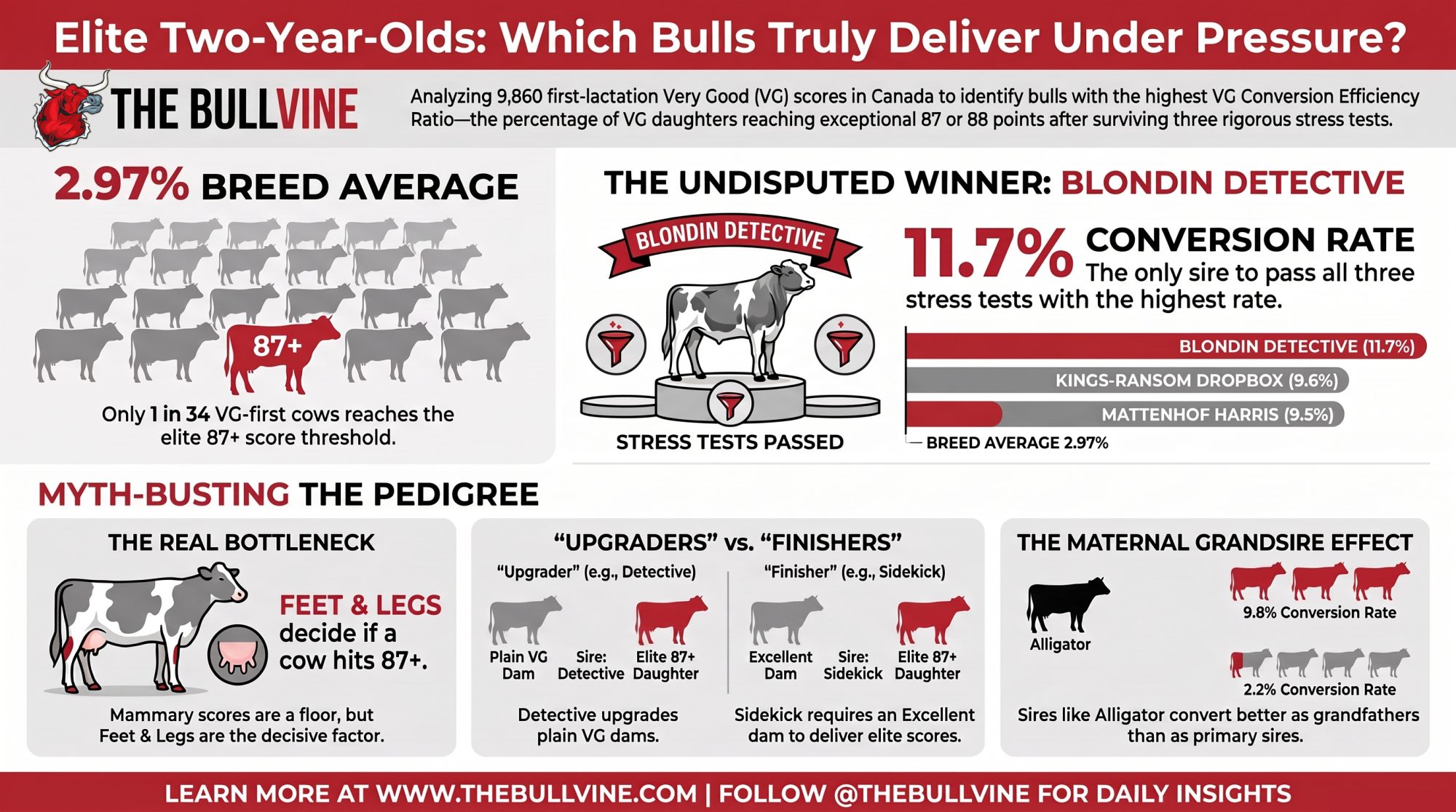
Every first-lactation VG score in Canada for a year — 9,860 head, 46 bulls ranked. Then we tried three ways to break the leaders. Detective held every time. Sidekick got zero from 102 VG-dam daughters.
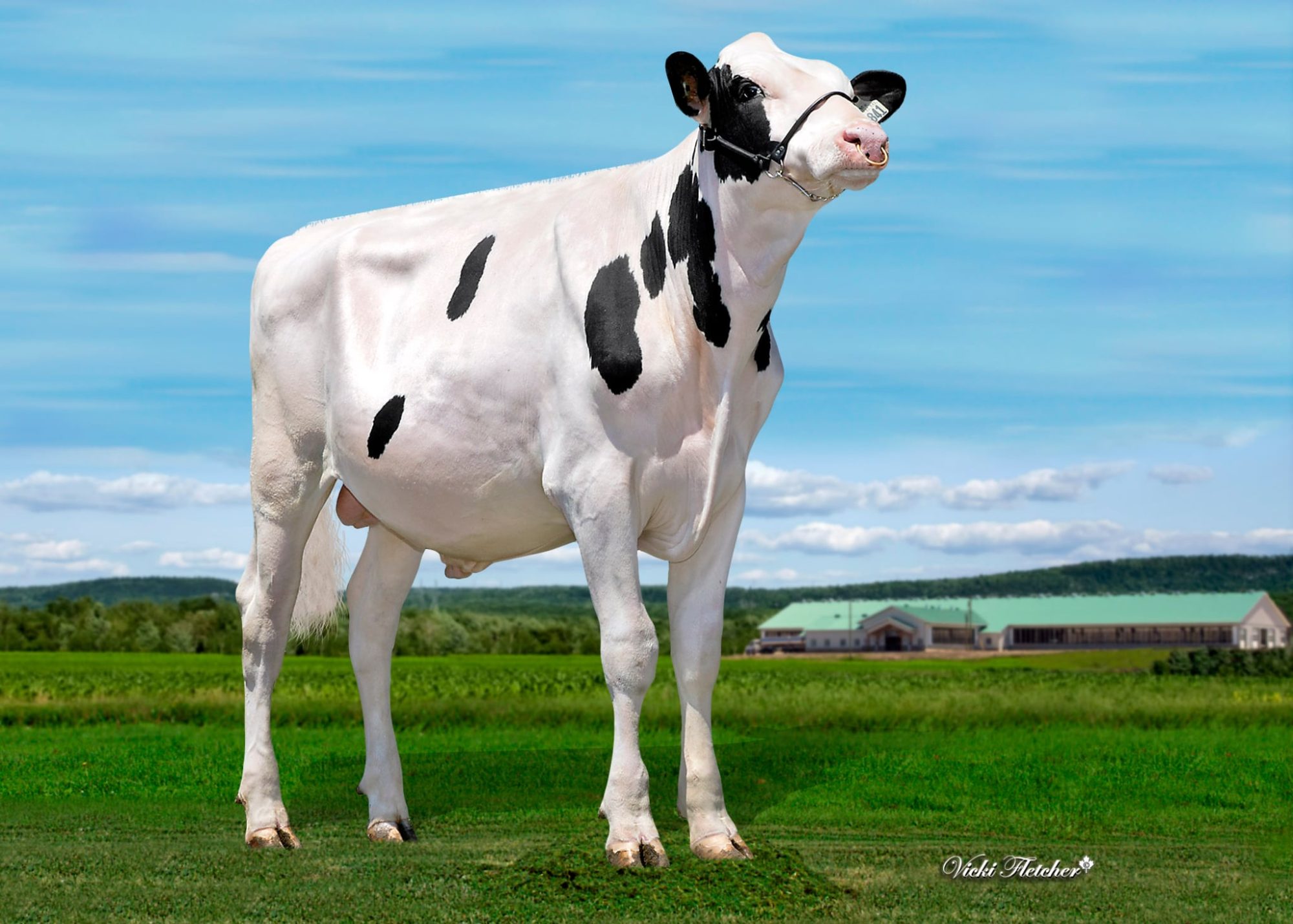
Blondin Detective. Fifteen of his 128 VG first-lactation daughters classified 87 or better this year — 11.7%, against a national rate of 2.97%. Take the ten biggest show herds out and he still holds 9.57%.
The short version: 46 bulls ranked on 9,860 first-lactation VG scores. Six beat the breed rate by enough to prove it. Then we stripped out the ten biggest show barns, levelled the field by dam score, and demanded the same performance in both halves of the year. Blondin Detective passed all three. Nobody else did. Then we checked the whole board against Holstein Canada’s August 2026 official proofs — and found that the trait that predicts a top-end two-year-old isn’t the one being sold.
Every breeder has had the barn argument at a show. Is that bull truly stamping the elite ones, or does he just have thousands of milking daughters padding his counts?
Touting raw numbers of 87-point two-year-olds is a semen-sales metric, not an efficiency metric. So we pulled all 9,860 first-lactation Very Good scores Holstein Canada recorded over the past twelve months, opened 3,756 complete family trees by hand across the 46 major sires, and then put the leaders through three stress tests:
- Strip out the top ten show barns.
- Level the field by dam score — EX versus VG.
- Demand it twice, in both halves of the same year.
One sire passed every test without flinching: Blondin Detective. Meanwhile some of the most-used type names in the country stumbled the moment the show halter came off.
What we’re measuring — and what we’re not
Understanding the metric. This study measures the VG Conversion Efficiency Ratio: of a bull’s first-lactation daughters that scored Very Good, what share reached VG-87 or VG-88. It does not look at daughters scoring Good Plus or lower, and it does not replace a multi-trait genetic evaluation like LPI or TPI, which account for contemporaries, herd management and production. It answers one question and one only: when a bull makes a good one, how often does he make an exceptional one?
That distinction matters, and any stud whose bull lands badly on this board will raise it — correctly — so let’s put it up front.
The denominator here is VG daughters, not total classified daughters. Take a hypothetical: Sire A gets 20% of his heifers to VG and converts 10% of those to 87+. Sire B gets 75% of his heifers to VG and converts 5%. Per straw used, Sire B is producing more elite two-year-olds — even though Sire A wins on this board. Conversion efficiency inside the VG class and absolute probability across all daughters are two different questions, and this dataset can only answer the first one.
Breed-wide, that VG Conversion Efficiency Ratio is 2.97%. About one in thirty-four. That’s the bar.
The six that clear the bar
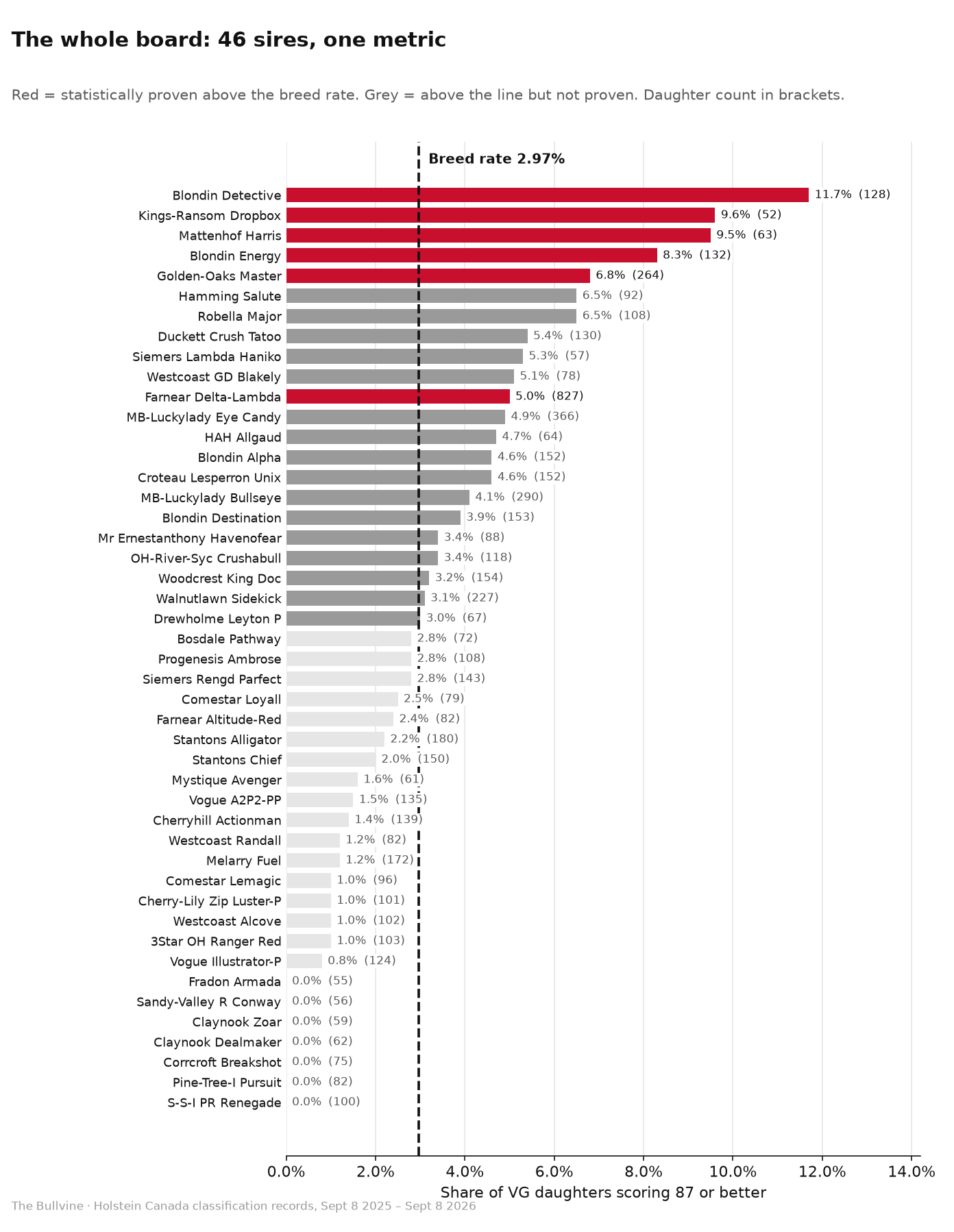
The last column asks one thing: is this bull’s edge big enough, on enough daughters, to rule out luck? A small edge takes a lot of daughters to prove. A big edge takes fewer. And checking forty-six bulls at once will always throw up a fluke or two, so the bar allows for it. Provenmeans we’d argue the number with the bull’s owner and not blink. A dash means he might be exactly that good — there just aren’t enough daughters on the ground yet to say.
| Sire | VG dtrs | 86+ | 87+ | Rate | Could really be | Proven? |
| Blondin Detective | 128 | 42.2% | 15 | 11.7% | 6.1–17.3 | Proven |
| Kings-Ransom Dropbox | 52 | 25.0% | 5 | 9.6% | 1.6–17.6 | Proven |
| Mattenhof Harris | 63 | 31.7% | 6 | 9.5% | 2.3–16.8 | Proven |
| Blondin Energy | 132 | 34.8% | 11 | 8.3% | 3.6–13.0 | Proven |
| Golden-Oaks Master | 264 | 34.1% | 18 | 6.8% | 3.8–9.9 | Proven |
| Farnear Delta-Lambda | 827 | 31.9% | 41 | 5.0% | 3.5–6.4 | Proven |
The “could really be” column is the humbling one. Dropbox shows 9.6%. On 52 daughters his real number is somewhere between 1.6% and 17.6%. Only more daughters will narrow that. Anybody quoting you a rate without telling you how many daughters it came off is selling semen.
One bull under the 50-daughter cutoff is worth watching: Blondin Driven, 4 of 25 at 87+ — too few head to say anything yet, but the best feet-and-legs average of any sire in this dataset. Ask me again next year.
The middle of the board
Anything between about 3% and 6.5% here could just be the breed rate having a good year. Salute and Major both show 6.5% and I’d like to believe it — but on 92 and 108 daughters, that’s a lead, not a fact.
The five strongest of the middle:
| Sire | VG dtrs | 86+ | 87+ | Rate | Could really be |
| Robella Major | 108 | 32.4% | 7 | 6.5% | 1.8–11.1 |
| Hamming Salute | 92 | 27.2% | 6 | 6.5% | 1.5–11.6 |
| Duckett Crush Tatoo | 130 | 33.8% | 7 | 5.4% | 1.5–9.3 |
| Siemers Lambda Haniko | 57 | 31.6% | 3 | 5.3% | 0.0–11.1 |
| Westcoast GD Blakely | 78 | 21.8% | 4 | 5.1% | 0.2–10.0 |
| Sire | VG dtrs | 86+ | 87+ | Rate | Could really be |
| MB-Luckylady Eye Candy | 366 | 29.2% | 18 | 4.9% | 2.7–7.1 |
| HAH Allgaud | 64 | 26.6% | 3 | 4.7% | 0.0–9.9 |
| Croteau Lesperron Unix | 152 | 23.7% | 7 | 4.6% | 1.3–7.9 |
| Blondin Alpha | 152 | 26.3% | 7 | 4.6% | 1.3–7.9 |
| MB-Luckylady Bullseye | 290 | 25.9% | 12 | 4.1% | 1.8–6.4 |
| Blondin Destination | 153 | 24.8% | 6 | 3.9% | 0.8–7.0 |
| OH-River-Syc Crushabull | 118 | 27.1% | 4 | 3.4% | 0.1–6.7 |
| Mr Ernestanthony Havenofear | 88 | 21.6% | 3 | 3.4% | 0.0–7.2 |
| Woodcrest King Doc | 154 | 22.1% | 5 | 3.2% | 0.4–6.0 |
| Walnutlawn Sidekick | 227 | 30.8% | 7 | 3.1% | 0.8–5.3 |
| Drewholme Leyton P | 67 | 19.4% | 2 | 3.0% | 0.0–7.1 |
| Siemers Rengd Parfect | 143 | 14.0% | 4 | 2.8% | 0.1–5.5 |
| Progenesis Ambrose | 108 | 37.0% | 3 | 2.8% | 0.0–5.9 |
| Bosdale Pathway | 72 | 18.1% | 2 | 2.8% | 0.0–6.6 |
| Comestar Loyall | 79 | 27.8% | 2 | 2.5% | 0.0–6.0 |
| Farnear Altitude-Red | 82 | 30.5% | 2 | 2.4% | 0.0–5.8 |
| Stantons Alligator | 180 | 29.4% | 4 | 2.2% | 0.1–4.4 |
| Stantons Chief | 150 | 22.7% | 3 | 2.0% | 0.0–4.2 |
| Mystique Avenger | 61 | 18.0% | 1 | 1.6% | 0.0–4.8 |
| Vogue A2P2-PP | 135 | 10.4% | 2 | 1.5% | 0.0–3.5 |
| Cherryhill Actionman | 139 | 21.6% | 2 | 1.4% | 0.0–3.4 |
| Melarry Fuel | 172 | 23.3% | 2 | 1.2% | 0.0–2.8 |
| Westcoast Randall | 82 | 17.1% | 1 | 1.2% | 0.0–3.6 |
And the five lowest that still produced an 87:
| Sire | VG dtrs | 86+ | 87+ | Rate | Could really be |
| 3Star OH Ranger Red | 103 | 15.5% | 1 | 1.0% | 0.0–2.9 |
| Westcoast Alcove | 102 | 8.8% | 1 | 1.0% | 0.0–2.9 |
| Cherry-Lily Zip Luster-P | 101 | 13.9% | 1 | 1.0% | 0.0–2.9 |
| Comestar Lemagic | 96 | 13.5% | 1 | 1.0% | 0.0–3.1 |
| Vogue Illustrator-P | 124 | 21.0% | 1 | 0.8% | 0.0–2.4 |
Zero for the year
Seven bulls put 50 or more VG daughters through classification and produced no 87s at all.
Context matters. Several of these sires were sampled hard for commercial profitability, milk solids and health traits rather than show type. Semex introduced Pine-Tree-I Pursuit as Canada’s number one new-release sire for both GLPI and Pro$, later publishing him at +3649 GLPI, +$3,173 Pro$, and +8 Conformation (1.66 PTAT). A bull built and sold to that spec is not being bought to make an 87-point two-year-old. The absence of high scores here reflects breeding intent and buyer intent, not commercial failure. We did not obtain current published proofs for all seven and are not characterising the other six beyond what this dataset shows.
| Sire | VG dtrs | 86+ | 87+ |
| S-S-I PR Renegade | 100 | 12.0% | 0 |
| Pine-Tree-I Pursuit | 82 | 9.8% | 0 |
| Corrcroft Breakshot | 75 | 12.0% | 0 |
| Claynook Dealmaker | 62 | 14.5% | 0 |
| Claynook Zoar | 59 | 16.9% | 0 |
| Sandy-Valley R Conway | 56 | 3.6% | 0 |
| Fradon Armada | 55 | 12.7% | 0 |
That’s 489 VG daughters between them. At the breed rate you’d expect 14 or 15 at 87. They got none — and Renegade, Pursuit and Dealmaker each classified 30-plus daughters in both halves of the year without one in either half.
The claim is narrow and it’s worth repeating: if you were after a big score on a two-year-old, these seven didn’t deliver it this year, at these daughter numbers, in these herds. Conway is the one I’d look at twice on type either way — only 3.6% of his VG daughters even reached 86, lowest figure on the whole board.
About Delta-Lambda
He’s the reason a lot of breeders will argue with this whole metric, so let’s deal with him now.
He sired 41 of the country’s 293 top scorers, and second place has 18. He also had 827 VG daughters classify this year — one in every twelve VG-first cows in Canada.
Divide it out and he converts at 5.0%. Against the breed at 2.97%, that’s genuinely good, and on 827 daughters it’s about as solid a number as exists in this business. Against the twenty leading type sires as a group — 5.17% — he’s exactly par.
Both are true at once, and that’s the trap. Counting a bull’s 87s measures how much semen he sold. He passed away in 2023 with over 11,000 daughters on the ground (The Bullvine), so what we’re watching is the long tail of the biggest type-sire run this country has seen.
Hold onto his 5.0%. It doesn’t survive the first test unchanged.
Then we tried to break it
A ranking like that has three obvious ways to be wrong. So we ran all three at the numbers.
Test one: take the show herds out
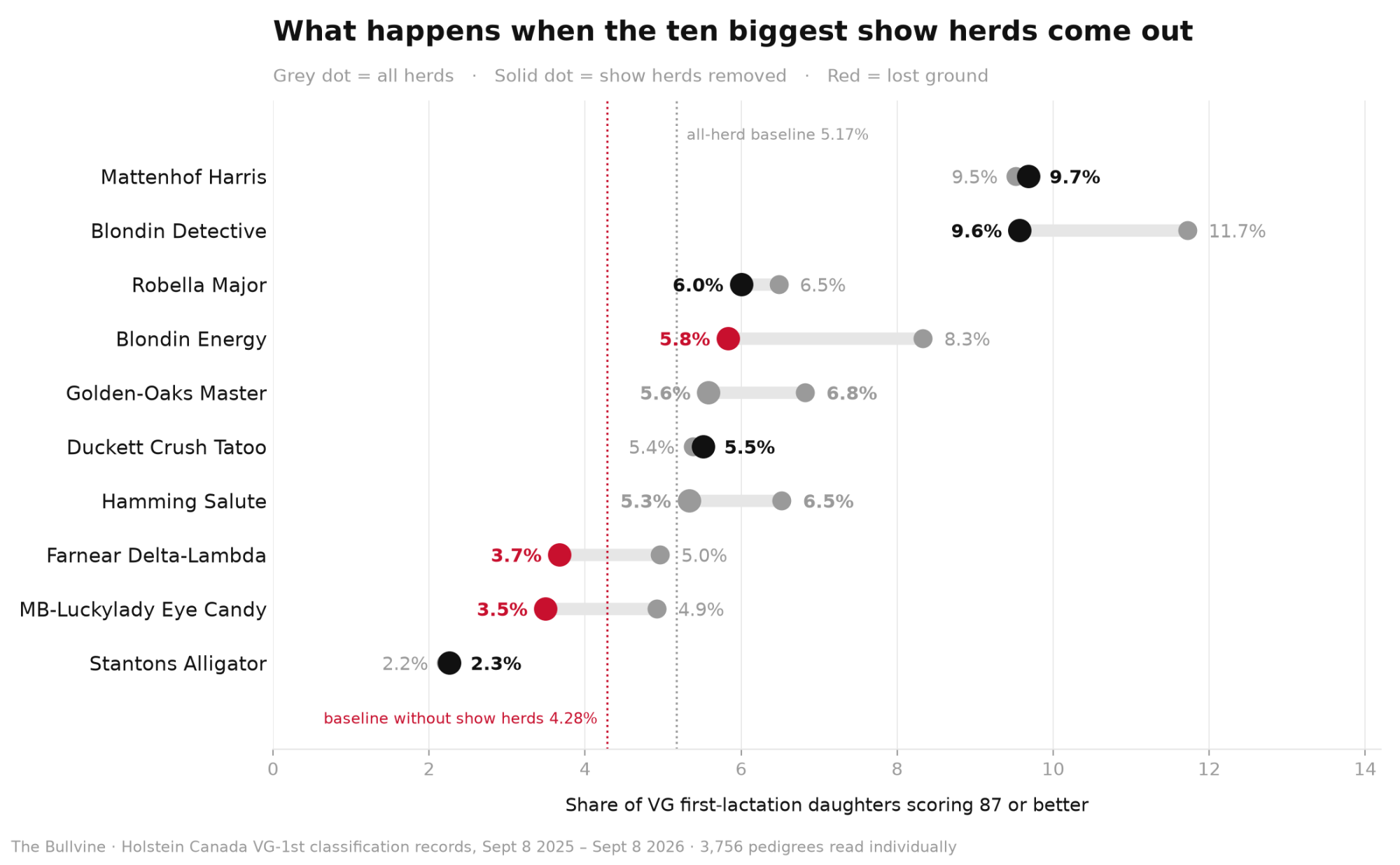
The fair objection to any classification analysis is that it measures barns, not bulls. The big show herds feed a two-year-old right, grow her properly and have her looking her best on classification day. If a bull sold heavily into those herds, his rate rides along.
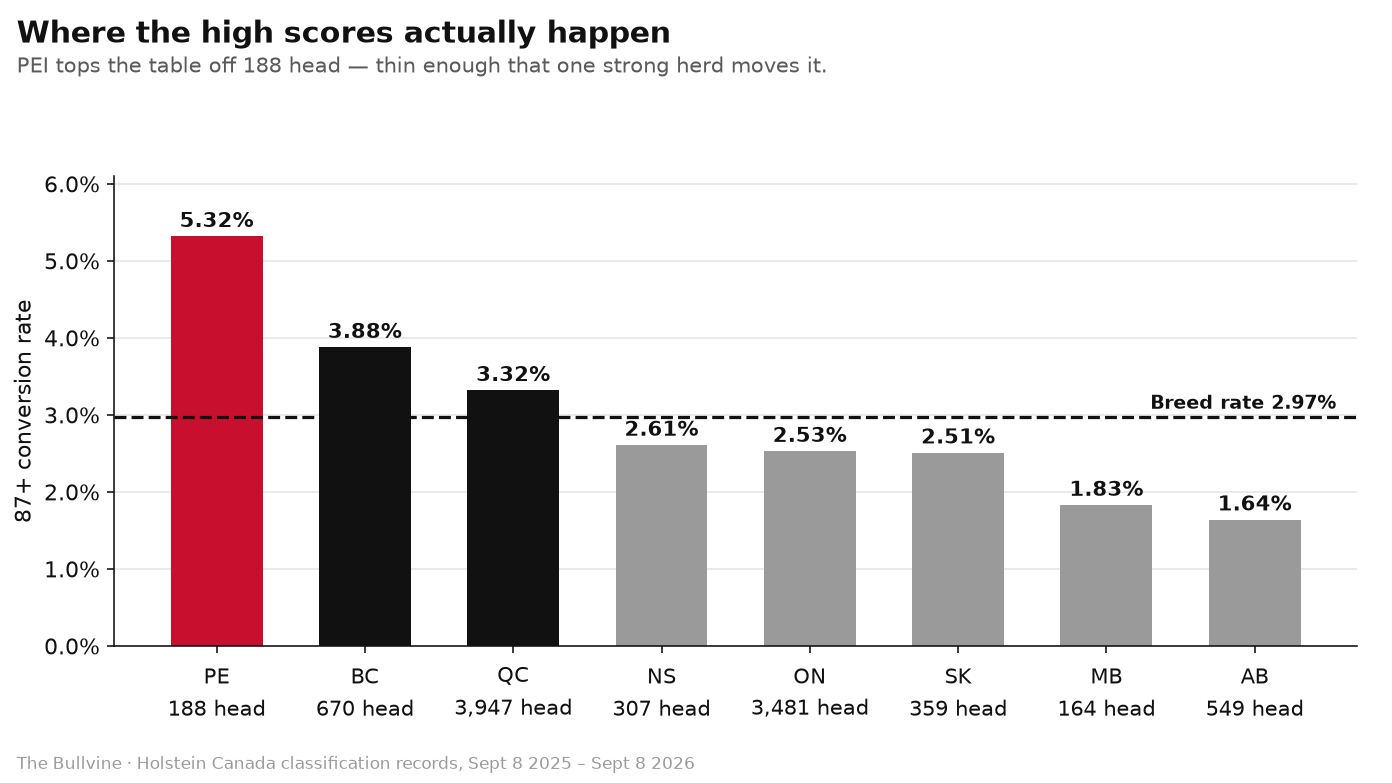
The concentration is real. Among the 293 top scorers, counting every listed owner: Ferme Blondin, Saint-Placide, QC is on 21 of them. Blondin Sires, same village, on 14.Hamming Holsteins (Vernon, BC) and Westcoast Holsteins (Chilliwack, BC), 8 each. Beckridge, Quality Farms and Weeksdale, 7 each. Stanton Bros (Ilderton, ON), Kingsway Farms (Hastings, ON) and T & L Cattle, 6 each. Provincially, Quebec makes 40% of the country’s VG-first two-year-olds and 44% of the 87s; BC converts at 3.89%, Quebec 3.31%, Ontario 2.53%, Alberta 1.64%. PEI tops the table at 5.32% off 188 head, thin enough that one strong herd moves it.
Those herds have earned their reputations — we’ve profiled Ferme Blondin and Blondin Siresbefore. But if you milk 60 in a tie stall, their results aren’t your results.
So we pulled every cow owned by those ten herds — 184 head — and re-ranked what was left. The baseline drops from 5.17% to 4.28%, which tells you how much those barns carry on their own.
| Sire | All herds | Show herds removed | What happened |
| Mattenhof Harris | 9.52% (63) | 9.68% (62) | held — and took over first |
| Blondin Detective | 11.72% (128) | 9.57% (115) | held, still more than double the baseline |
| Duckett Crush Tatoo | 5.38% (130) | 5.51% (127) | held |
| Robella Major | 6.48% (108) | 6.00% (100) | mostly held |
| Golden-Oaks Master | 6.82% (264) | 5.58% (251) | slipped |
| Hamming Salute | 6.52% (92) | 5.33% (75) | slipped |
| Blondin Energy | 8.33% (132) | 5.83% (120) | dropped hard |
| Farnear Delta-Lambda | 4.96% (827) | 3.67% (791) | dropped hard |
| MB-Luckylady Eye Candy | 4.92% (366) | 3.49% (344) | dropped |
| Stantons Alligator | 2.22% (180) | 2.26% (177) | unchanged |
That reshuffles the top. Harris and Detective don’t need the big barns. Harris actually goes up. Energy loses a third of his edge the moment those herds come out, and so does Delta-Lambda — there’s the answer to the question we left hanging.
It isn’t an accusation against anybody. It’s the honest arithmetic of where a bull’s semen landed. But it’s the size of effect the sceptics always claimed, and now it’s measured instead of argued.
Test two: give every bull the same cows
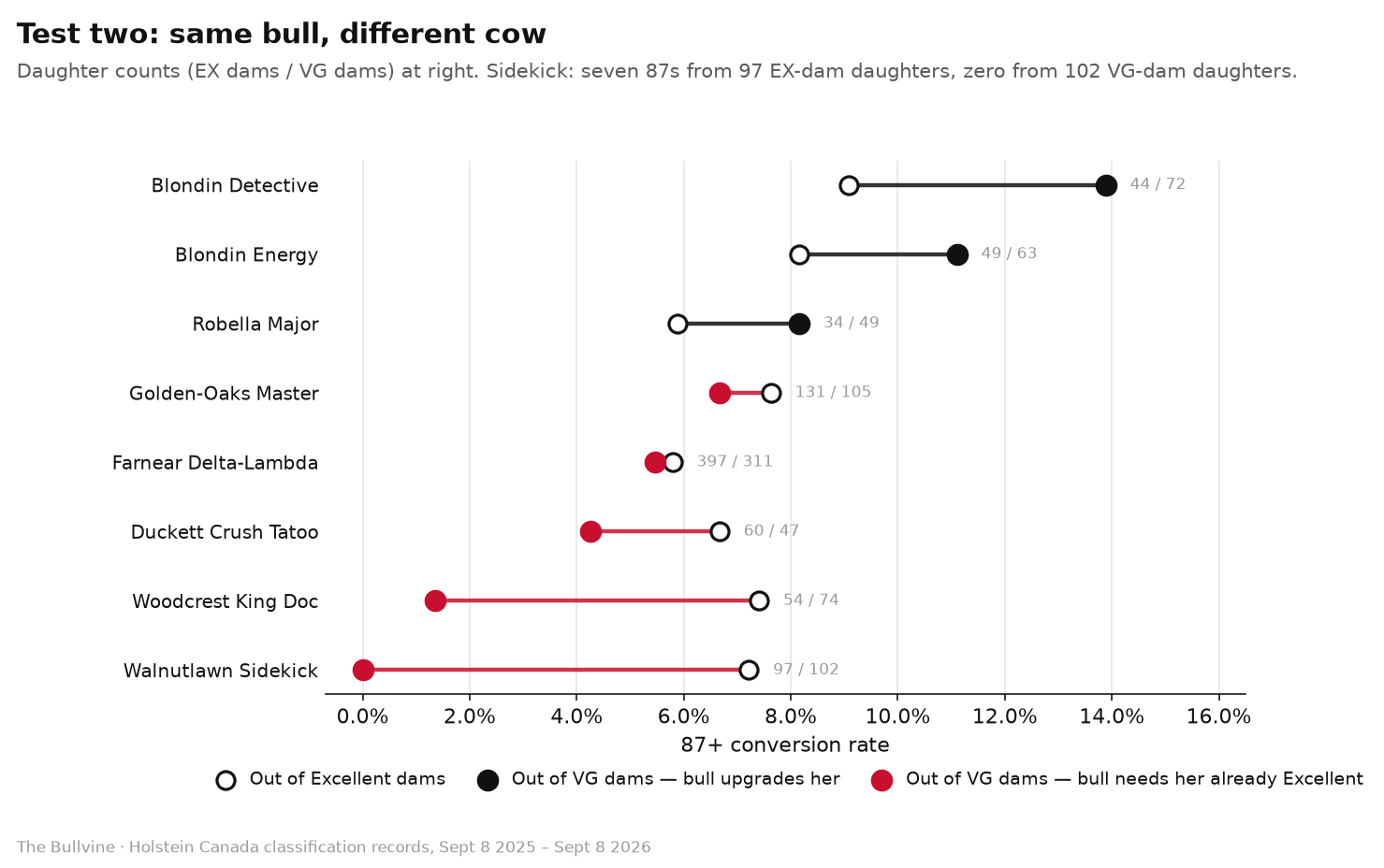
Second objection: the good bulls get put on the good cows. Of course Detective looks strong if he’s used on the best families in the country.
So we split every sire’s daughters by what the dam herself classified, and compared like with like.
Read this table as a snapshot, not a proof line. Subgroups under 50 head per dam tier are observational. Robella Major sits on 34 EX-dam daughters and 49 VG-dam daughters — one animal moving either way swings his rate 2.5 to 3.0 points. Only Delta-Lambda, Eye Candy, Master, Bullseye and Sidekick carry 50-plus head in both tiers.
| Sire | Out of EX dams | Out of VG dams | Read |
| Blondin Detective | 4/44 = 9.09% | 10/72 = 13.89% | upgrades the cow |
| Blondin Energy | 4/49 = 8.16% | 7/63 = 11.11% | upgrades the cow |
| Robella Major | 2/34 = 5.88% | 4/49 = 8.16% | upgrades the cow — thin sample |
| Golden-Oaks Master | 10/131 = 7.63% | 7/105 = 6.67% | same either way |
| Farnear Delta-Lambda | 23/397 = 5.79% | 17/311 = 5.47% | same either way |
| Duckett Crush Tatoo | 4/60 = 6.67% | 2/47 = 4.26% | wants the better cow |
| Woodcrest King Doc | 4/54 = 7.41% | 1/74 = 1.35% | wants the better cow |
| Walnutlawn Sidekick | 7/97 = 7.22% | 0/102 = 0.00% | needs an EX cow, full stop |
There’s a whole mating philosophy in that table — and note that the two strongest lines in it, Sidekick and Delta-Lambda, are also the two with the biggest samples.
Detective and Energy are upgraders. Put them on a plain VG cow and they still find you an 87 — Detective actually does it more often on VG dams than on Excellent ones. That’s the bull for the good-not-great family you’re trying to move forward.
Sidekick is the opposite, and it’s stark. Ninety-seven daughters out of Excellent dams gave seven 87s. One hundred and two daughters out of VG dams gave zero. Both groups are big enough to mean something. He doesn’t build a cow; he finishes one that’s already there.
King Doc reads the same way — 7.41% out of EX dams, 1.35% out of VG.
Test three: did they do it twice?
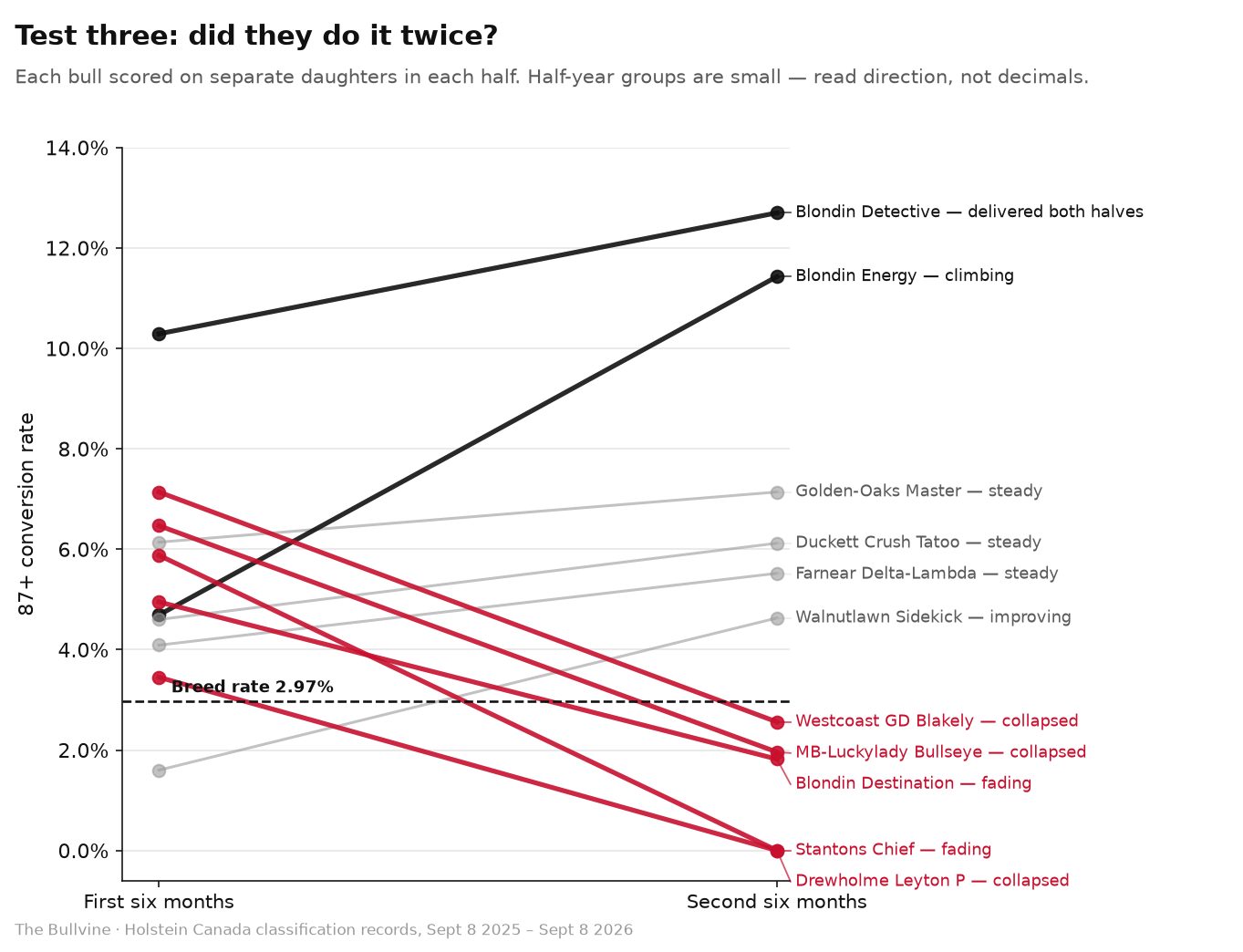
Third objection, and the one that catches most single-season rankings: one hot classification round in one big herd can carry a bull’s whole year.
So we split the twelve months in half and scored every bull twice, on separate daughters.
| Sire | First six months | Second six months | Verdict |
| Blondin Detective | 10.29% (68) | 12.70% (63) | delivered in both halves |
| Blondin Energy | 4.69% (64) | 11.43% (70) | climbing hard |
| Golden-Oaks Master | 6.14% (114) | 7.14% (154) | steady |
| Duckett Crush Tatoo | 4.60% (87) | 6.12% (49) | steady |
| Farnear Delta-Lambda | 4.09% (416) | 5.52% (435) | steady, average both times |
| Walnutlawn Sidekick | 1.60% (125) | 4.63% (108) | improving off a low base |
| Blondin Destination | 4.95% (101) | 1.82% (55) | fading |
| Stantons Chief | 3.45% (87) | 0.00% (67) | fading |
| MB-Luckylady Bullseye | 6.47% (139) | 1.96% (153) | collapsed |
| Westcoast GD Blakely | 7.14% (42) | 2.56% (39) | collapsed |
| Drewholme Leyton P | 5.88% (34) | 0.00% (35) | collapsed |
Note: half-year totals may sum slightly higher than the 12-month unique totals — a cow classified in both rounds counts once in each half, but only once across the year.
Bullseye is the cautionary tale. He was running 6.47% at the halfway mark — the kind of number that sells semen — then came in at 1.96% on 153 daughters in the second half. Same bull, same year. Buy him on a six-month number and you bought a mirage. Half-year groups are small and noisy, so don’t over-read any single line; the point is which bulls are steady, not which one moved most.
And the bull left standing
Blondin Detective is the only sire in Canada that passed all three tests. He clears the statistical bar on the full board. He holds with the big show herds stripped out. He converts better on ordinary VG cows than on Excellent ones. And he did it in both halves of the year, on separate sets of daughters.
Harris is right behind him and arguably cleaner on the herd test, on 63 daughters instead of 128. Energy is the most exciting bull on the board and the one with the biggest question mark — a superb second half, and a third of his edge gone without the show herds.
Then we checked it against the official proof
Three tests down, and every one of them was ours — our metric, our data handling, our judgement calls. So here’s the fourth check, and it isn’t ours at all: does Holstein Canada’s own genetic evaluation reach the same conclusions?
We pulled the August 2026 CAN-GEBV conformation proof for every bull that matters here, straight off the individual AIS records. If you want a refresher on how those figures are built and what the percentile ranks mean, we’ve written the cheat sheet.
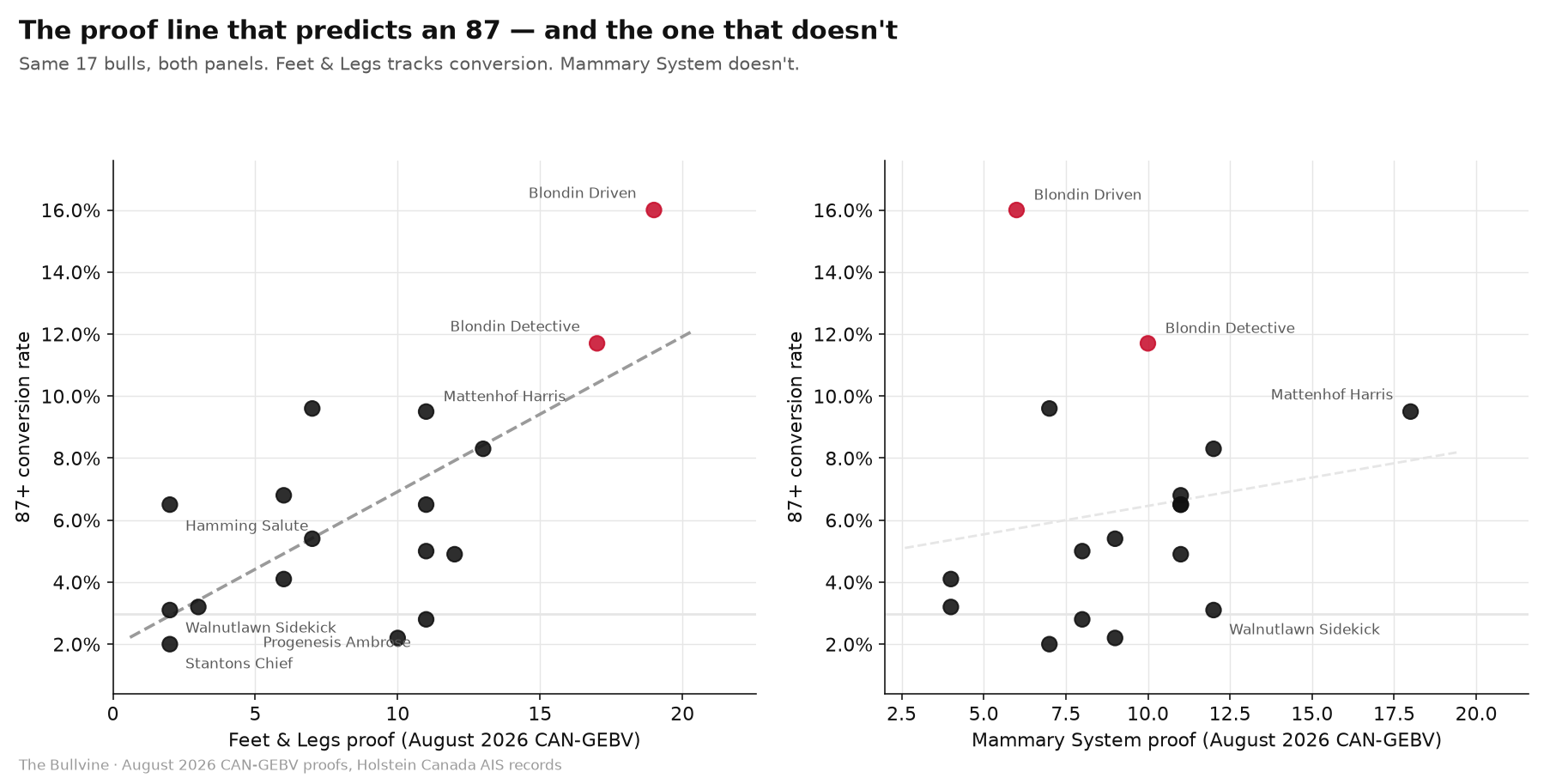
| Sire | Rel. | Classified dtrs | Conformation | Mammary | Feet & Legs | Our conversion |
| Blondin Driven | 93% | 117 | +16 (99%) | +6 (88%) | +19 (99%) | 16.0% (25 dtrs) |
| Blondin Detective | 95% | 319 | +16 (99%) | +10 (96%) | +17 (99%) | 11.7% |
| Kings-Ransom Dropbox | 95% | 311 | +9 (95%) | +7 (91%) | +7 (90%) | 9.6% |
| Mattenhof Harris | 94% | 224 | +20 (99%) | +18 (99%) | +11 (98%) | 9.5% |
| Blondin Energy | 97% | 768 | +15 (99%) | +12 (98%) | +13 (99%) | 8.3% |
| Golden-Oaks Master | 98% | 1,463 | +13 (98%) | +11 (98%) | +6 (87%) | 6.8% |
| Robella Major | 94% | — | +17 (99%) | +11 (98%) | +11 (98%) | 6.5% |
| Hamming Salute | 92% | — | +13 (98%) | +11 (98%) | +2 (65%) | 6.5% |
| Duckett Crush Tatoo | 99% | 1,572 | +12 (98%) | +9 (95%) | +7 (90%) | 5.4% |
| Farnear Delta-Lambda | 99% | 11,128 | +12 (98%) | +8 (93%) | +11 (98%) | 5.0% |
| MB-Luckylady Eye Candy | 98% | 1,219 | +15 (99%) | +11 (98%) | +12 (98%) | 4.9% |
| MB-Luckylady Bullseye | 98% | 1,574 | +9 (95%) | +4 (77%) | +6 (87%) | 4.1% |
| Woodcrest King Doc | 99% | 8,089 | +6 (87%) | +4 (77%) | +3 (72%) | 3.2% |
| Walnutlawn Sidekick | 99% | 7,949 | +13 (98%) | +12 (98%) | +2 (65%) | 3.1% |
| Progenesis Ambrose | 94% | 188 | +14 (99%) | +8 (93%) | +11 (98%) | 2.8% |
| Stantons Alligator | 99% | 7,220 | +11 (97%) | +9 (95%) | +10 (97%) | 2.2% |
| Stantons Chief | 99% | 7,443 | +8 (93%) | +7 (91%) | +2 (65%) | 2.0% |
Rank those bulls by their official Conformation rating, then rank them by our conversion rate, and the two lists agree about half the time. That’s reassuring — the daughter scores aren’t telling a different story from the national evaluation.
But split the proof into its parts and something jumps out.
Rank them on Feet & Legs and the agreement barely drops. Rank them on Mammary System and it disappears into noise. Run it properly and only two of the five conformation measures clear the significance bar for a set this size — the Conformation composite and Feet & Legs. Mammary, Rump and Dairy Strength don’t. Statistically, they tell you nothing about which bull makes an 87.
Look at the top of the table. Driven is +19 on Feet & Legs. Detective is +17. Both 99th percentile. They’re the two highest converters in the country.
Now look at the bottom. Sidekick carries a +13 Conformation proof — 98th percentile — with Feet & Legs at +2, the 65th. He converts at 3.1%. Stantons Chief is the same shape: +2 legs, 2.0% conversion. King Doc is weak everywhere and converts at 3.2%.
Progenesis Ambrose is the sharpest disagreement on the board. A +14 Conformation proof at the 99th percentile, +11 on legs — and 2.8% conversion, below breed average, with the second-highest 86+ rate of any bull we measured. His proof says elite. His daughters say nice, not exceptional.
And then there’s the number that should stop anybody who thinks a published proof settles this.
Braedale Goldwyn’s own conformation proof is +2 — the 65th percentile — off 36,899 classified daughters at 99% reliability. That’s a middling type bull by the national evaluation. He is also, on our data, the most productive maternal grandsire in the country at 16.2%.
A proof measures what a bull’s own daughters are. It doesn’t measure what those daughters go on to breed. That’s the entire argument of the next two sections.
Look at what’s behind the ones that are working
This is the part that made me sit back.
| Sire | Born | His sire | His dam | His maternal grandsire |
| Blondin Detective | 2021 | Stantons Alligator | VG-86-2YR | OH-River-Syc Crushabull |
| Kings-Ransom Dropbox | 2020 | AOT Highjump | EX-96-2E | Claynook Casper |
| Mattenhof Harris | 2021 | Farnear Delta-Lambda | VG-85-2YR | Duckett Crush Tatoo |
| Blondin Energy | 2020 | Siemers Lambda Haniko | VG-86-2YR | Walnutlawn Solomon |
| Golden-Oaks Master | 2017 | Dymentholm Mr Apples Avalanche | EX-90-4YR | Val-Bisson Doorman |
| Hamming Salute | 2022 | Mystique Avenger | EX-93-2E | Stantons Chief |
| Robella Major | 2021 | Farnear Delta-Lambda | EX-91 | Walnutlawn Sidekick |
| Blondin Driven | 2021 | Brabantdale Alleyoop | VG-85-2YR | Walnutlawn Sidekick |
| Farnear Delta-Lambda | 2015 | Mr Mogul Delta 1427 | EX-91-5YR | Amighetti Numero Uno |
They’re young. Every bull converting over 6% was born 2017 or later; five are 2020 or newer. Delta-Lambda was born in 2015. If your mating program runs on a list from three years ago, it’s running on the wrong generation.
And look who’s behind them. Detective is an Alligator son. Major and Driven are both out of Sidekick daughters. Salute is out of a Stantons Chief daughter, Master out of a Doormandaughter, Energy out of a Solomon daughter.
Delta-Lambda is behind them too — as a grandfather, not as a competitor. Harris and Major are both direct Delta-Lambda sons. Energy is by Siemers Lambda Haniko, himself a Delta-Lambda son. Three of the bulls now out-converting him carry his name one generation up. That’s what 11,128 classified daughters buys you: not the best conversion rate in the country, but the paternal side of the bulls that have it.
Half of them also came out of an Excellent cow — Dropbox out of an EX-96, Salute out of an EX-93, Major EX-91, Master EX-90. Whatever the ad says about the bull, somebody bred a very good cow first. Which is its own argument for the brood cows that built the breed.
Now flip the pedigree around
Same 3,756 head, counted this time by maternal grandsire — the bull who sired the dam. Average inside this group: 5.17%.
| Sire of the dam | Granddaughters | 87+ | Rate | Proven? |
| Braedale Goldwyn | 37 | 6 | 16.2% | Proven |
| Col DG Crushtime | 32 | 4 | 12.5% | borderline |
| Golden-Oaks Master | 26 | 3 | 11.5% | — |
| Blondin Legend | 28 | 3 | 10.7% | — |
| Stantons Alligator | 133 | 13 | 9.8% | Proven |
| Duckett Crush Tatoo | 32 | 3 | 9.4% | — |
| Maple-Downs-I G W Atwood | 33 | 3 | 9.1% | — |
| Walnutlawn Sidekick | 177 | 15 | 8.5% | borderline |
| Farnear Delta-Lambda | 155 | 12 | 7.7% | — |
| Val-Bisson Doorman | 202 | 13 | 6.4% | — |
| Stantons Chief | 151 | 9 | 6.0% | — |
| Croteau Lesperron Unix | 217 | 12 | 5.5% | — |
| Woodcrest King Doc | 96 | 4 | 4.2% | — |
| LIRR Drew Dempsey | 68 | 2 | 2.9% | — |
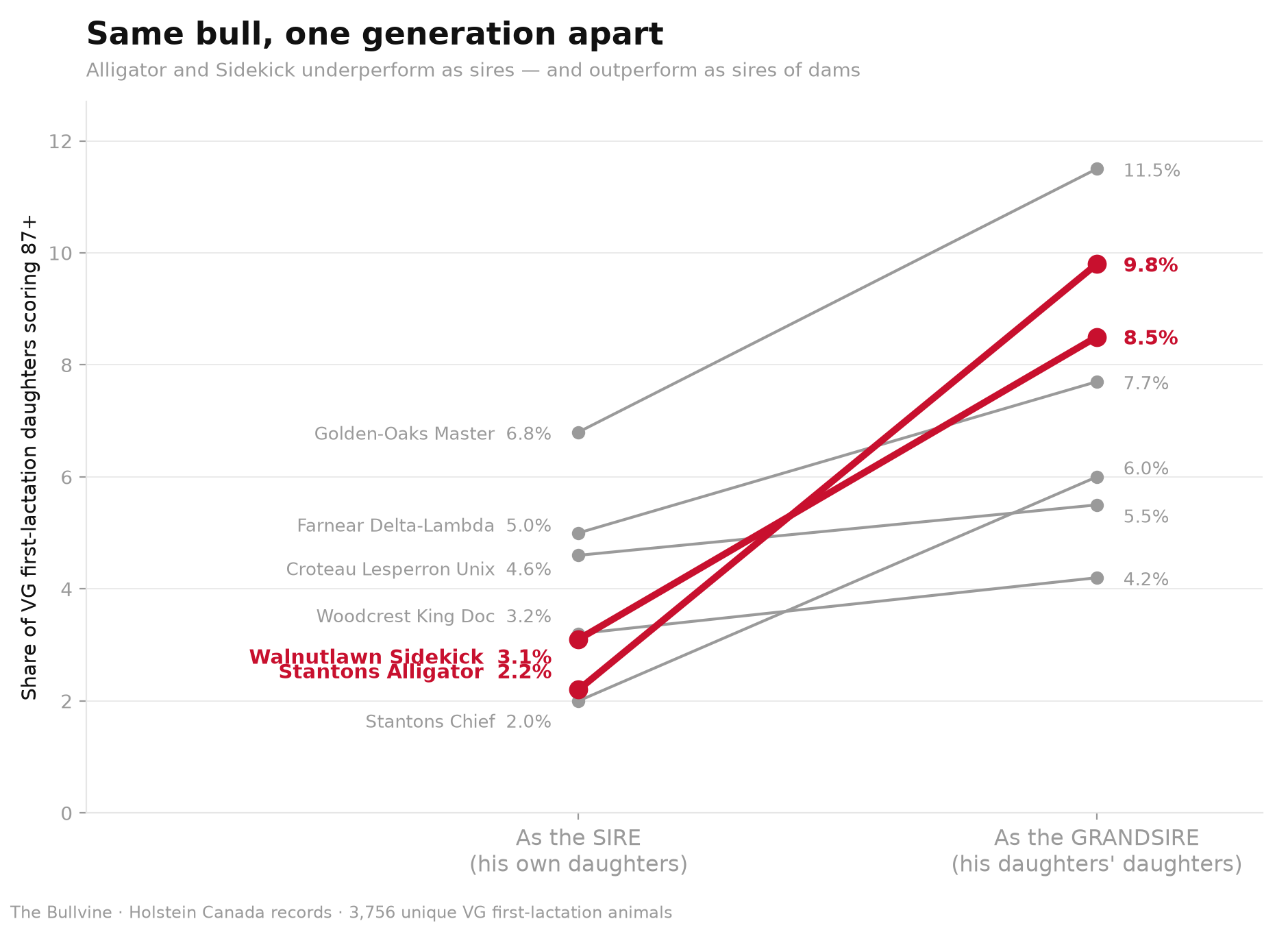
Put that beside the sire board and there it is.
Stantons Alligator: 2.2% as a sire. 9.8% as a grandsire. Same bull, one generation apart, on 180 daughters and 133 granddaughters. And he’s one of the few bulls whose rate doesn’t move at all when you strip the show herds out, so that 2.2% is genuinely him.
Sidekick does the same thing — 3.1% as a sire, 8.5% as a grandsire, on 227 and 177.
Sitting on top of the maternal list: Braedale Goldwyn at 16.2%. Born January 3, 2000. Classified GP-84 himself.
His own August 2026 conformation proof is +2, the 65th percentile, off 36,899 classified daughters at 99% reliability. The best maternal grandsire in Canada is, by the national evaluation, an average type bull.
Read Goldwyn’s number carefully, though. A Goldwyn daughter still breeding in 2025–26 is, by definition, a survivor from a bull whose daughters have been culled for twenty years. The ones left are sitting in deep, protected maternal lines that have had generations of deliberate high-type matings laid on top of them. That 16.2% measures Goldwyn’s transmitting ability and two decades of selection on the cows carrying his name — and this dataset can’t separate the two. It’s still the most striking number on the board. It just isn’t a clean read on the bull alone.
Now go back to that pedigree table. Alligator sired the best young bull in Canada. Sidekick is the grandsire of two more. Chief, Doorman and Solomon each sit behind one. The bulls that look ordinary on their own daughter sheet are the ones building the sires that are getting it done.
The 86 machines: high conformation, low conversion
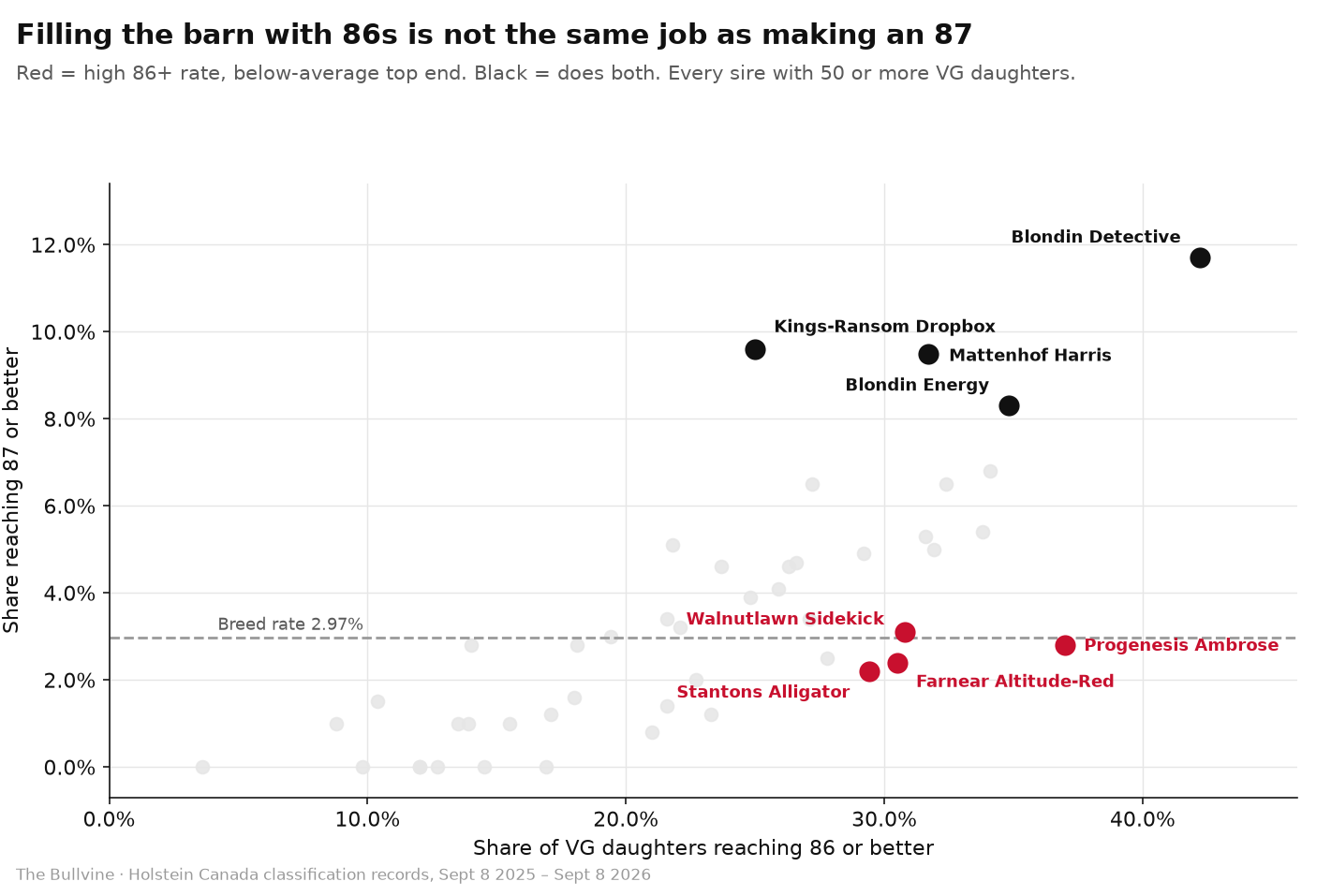
| Sire | VG dtrs | 86+ | 87+ |
| Progenesis Ambrose | 108 | 37.0% | 2.8% |
| Walnutlawn Sidekick | 227 | 30.8% | 3.1% |
| Stantons Alligator | 180 | 29.4% | 2.2% |
| Farnear Altitude-Red | 82 | 30.5% | 2.4% |
Ambrose puts 37% of his VG daughters at 86 or better — second-best on the whole board, behind only Detective — and converts to the top end at 2.8%, below breed average. He fills your barn with really nice 86-point two-year-olds and rarely gives you the one.
Milking for herd average, that’s a heck of a bull. Trying to breed the heifer that leads your string, it’s a different product. Two jobs. One number won’t measure both.
Polled and Red: the name-designated gap
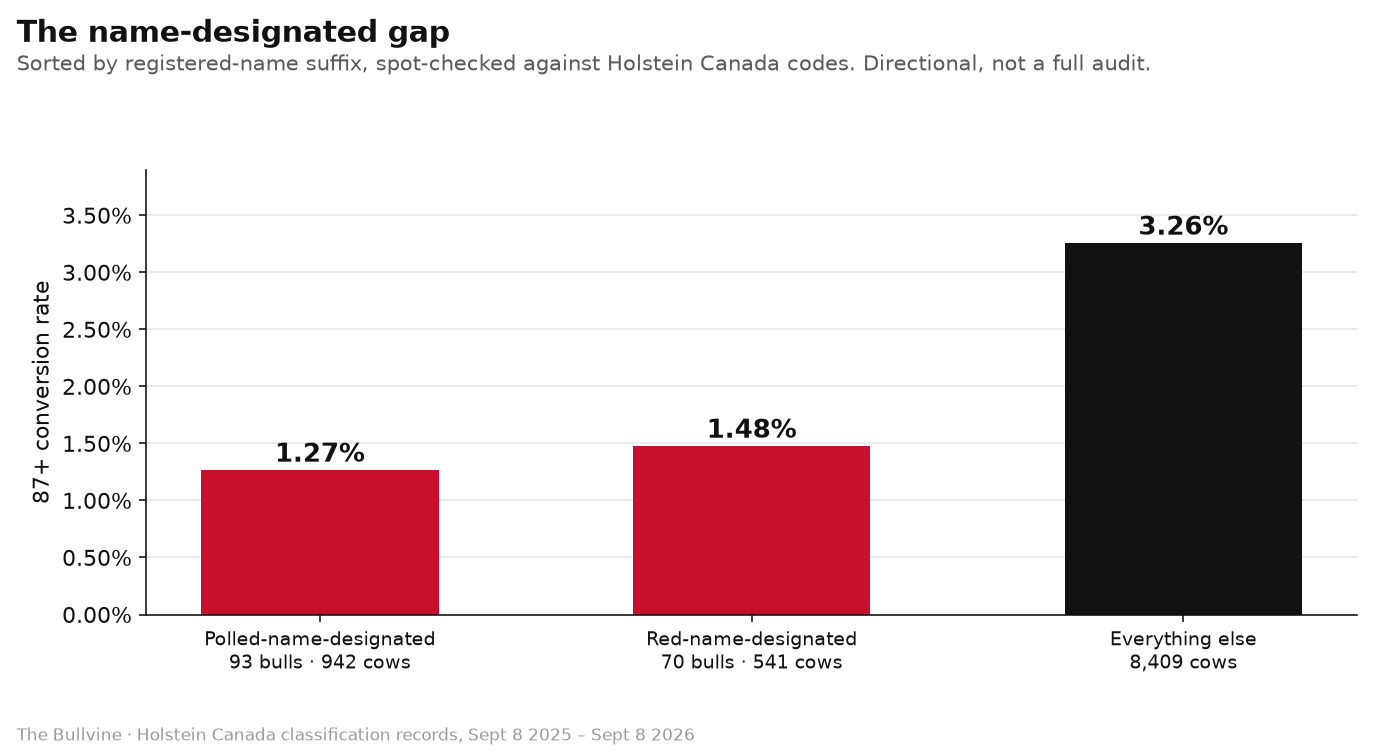
Uncomfortable, so let’s put it up — with the caveat attached, not buried.
| Group | VG-first cows | 86+ | 87+ | Rate |
| Polled-name-designated sires (93 bulls) | 942 | 17.0% | 12 | 1.27% |
| Red-name-designated sires (70 bulls) | 541 | 19.4% | 8 | 1.48% |
| Everything else | 8,409 | 23.0% | 274 | 3.26% |
These groups are sorted by registered-name designation — the -P, -PP and RED suffixes — not by a full genotype audit of all 834 sires. That matters, because a name suffix and a genetic test code aren’t the same thing.
So we spot-checked it against Holstein Canada’s own codes, which appear on every AIS record: POC (polled carrier), POS (homozygous polled), POF (tested polled-free), and coat colour as R&W or B&W with RDC for red carriers.
Where we hold those codes, the name-sorting held up. Nine polled-named sires, covering 536 of the group’s 942 daughters — 57% — all came back POC or POS: Vogue A2P2-PP (POS), Vogue Illustrator-P (POC), Cherry-Lily Zip Luster-P (POC), Drewholme Leyton P (POC), Vogue Impact-P (POC), Drewholme Logic PP (POS) and others. Six red-named sires covering 257 of 541 red-group daughters — 48% — all came back R&W. Among every sire whose code we hold, exactly one carried polled genetics without a polled suffix, and none was coded R&W without RED in the name.
That’s a spot-check, not a full audit. Call the finding directional: polled-designated daughters are reaching the top end at less than half the rate of everybody else across 942 head, and the biggest polled-named sires say the same thing alone — Vogue A2P2-PP, 135 VG daughters, two at 87 and only 10.4% at 86+.
Two more honest caveats. Polled bulls skew younger with smaller daughter groups, which drags a top-end rate down by itself. And this is type at the extreme — no production, no health, no polled premium at the calf sale.
If the type gap on polled has closed, it hasn’t closed at the top of the Canadian score sheet yet.
Feet and legs: the trait nobody’s buying
Canadian classification weights it Mammary 42%, Feet & Legs 28%, Dairy Strength 20%, Rump 10%.
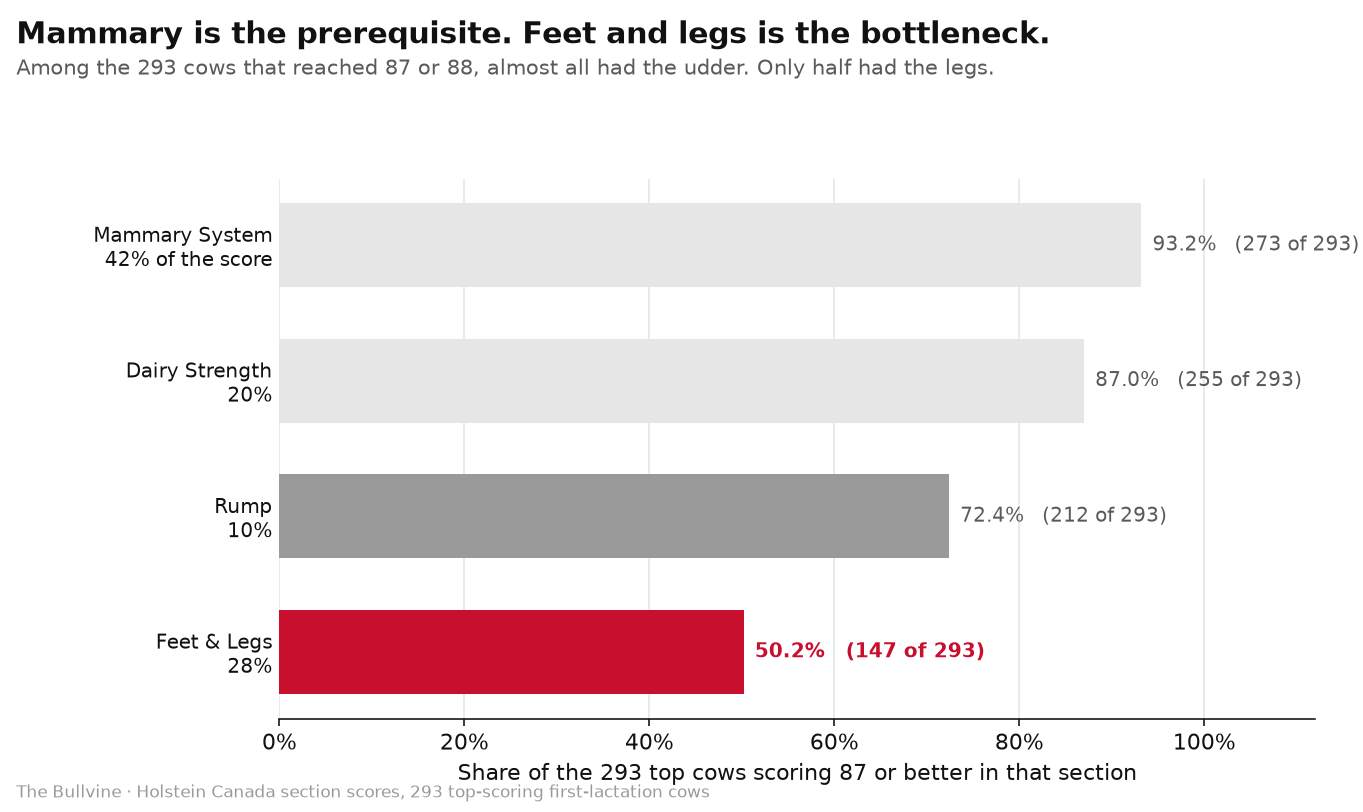
Of the 293 cows at 87 and 88: 273 scored 87 or better on mammary. Only 147 — barely half — scored 87 or better on feet and legs. Feet and legs was the weakest of the four sections on 42% of all 3,756 head, when chance says 25%.
Look at how differently the two sections behave inside that top group. Mammary acts like a floor: not one of the 293 scored below 85 on it, and 290 of them were 86 or better. Feet and legs acts like a spread — it runs from 83 all the way to 91 inside that same group of cows, and it sits below the cow’s own mammary score on 178 of the 293. Across all 3,756 animals, feet and legs averages 0.83 of a point lower than mammary on the very same cows.
So mammary is the prerequisite and feet and legs is the bottleneck. She isn’t in the conversation without the udder; she doesn’t get out of the 85s without the legs. That fits what breeders have always said about classifiers grading legs harder than udders on a young cow — though that’s our reading of the spread, not a published rule.
All of which is before you count what those legs are worth in her third lactation, which we’ve been through elsewhere.
And you can see it on the bulls, twice over. In their daughters: the five sires averaging 85.0 or better on feet and legs are Driven (85.96), Energy, Detective, Alpha and Dropbox — three of them top-six converters, and Driven would be first on the board if he had the daughters to qualify. And in their proofs: F&L rating tracks top-end conversion almost as closely as the whole Conformation composite does, while Mammary System barely tracks it at all.
The bulls getting it done are, mostly, the bulls fixing the thing everybody buys last.
What about the magic cross?
I went looking for it. Genuinely expected to find it.
We tested 147 sire-on-grandsire combinations with five or more daughters. Three came back looking special: Eye Candy on King Doc dams (3 of 16), Bullseye on Alligator dams (4 of 28), Destination on Delta-Lambda dams (2 of 12).
Here’s the problem. Check 147 combinations and roughly seven will look special by pure chance. We found three — fewer than random noise would have handed us. That includes the most-repeated cross in the country, Delta-Lambda on Sidekick dams: 64 head, 9.4% against his 5.0%, still inside the range of luck.
So no. The magic nick isn’t in this data. What’s real is the bull, the maternal line, and — as test two showed — the match between a bull and the kind of cow you’re putting him on.
The nine at 88
| Cow | Sire × grandsire | Dam | MS | F&L | DS | RP |
| Craila Memory Blackout | Blondin Memory × Delta-Lambda | VG-86-3YR | 88 | 87 | 90 | 91 |
| Desperle Chalou Delta Lambda | Delta-Lambda × Sidekick | EX-90 | 89 | 87 | 90 | 88 |
| Earincliffe Unix Destiny | Unix × Mystique Avenger | VG-89-2YR | 88 | 87 | 90 | 88 |
| Eastriver Lambda Life 38 | Delta-Lambda × Claynook Barolo | VG-86-2YR | 88 | 89 | 87 | 90 |
| Fraeland Beckridge Energy Brie | Blondin Energy × Sidekick | VG-87-2YR | 89 | 87 | 89 | 90 |
| Karnview Harris Reflex | Mattenhof Harris × Alligator | VG-86-2YR | 91 | 87 | 89 | 90 |
| Maifield Lambda Monique | Delta-Lambda × Val-Bisson Doorman | EX-90-2E | 89 | 86 | 91 | 88 |
| Milibro Enzo Roselianza | Wilt Enzo × Duckett Crush Tatoo | EX-93-4E | 89 | 90 | 86 | 90 |
| Walnutlawn Bullseye Sadie | Bullseye × Alligator | VG-87-4YR | 89 | 88 | 90 | 87 |
Three Delta-Lambdas — out of 827 daughters. One Harris, one Energy — out of 63 and 132. Sidekick twice as grandsire, Alligator twice. Not one of the nine came out of a GP cow.
So what do you do with all this?
Detective is the bull of the year, and it isn’t close. Only sire to pass all three tests.
Match the bull to the cow you actually have. Detective and Energy upgrade a plain VG cow. Sidekick and King Doc need her to already be Excellent — Sidekick got seven 87s out of 97 EX-dam daughters and zero out of 102 VG-dam daughters. Same bull. Different cow. Completely different outcome.
Don’t judge a bull only on his own daughters. Alligator converts at 2.2% and sired the best young bull in Canada. Sidekick converts at 3.1% and is behind two more. If you’ve got Alligator or Sidekick daughters in the barn, you’re sitting on a maternal group other people are paying for.
Read the legs line on the proof, not the composite. Detective is +17 on Feet & Legs and Driven is +19, both 99th percentile — the two best converters in the country. Sidekick carries a 98th-percentile Conformation proof with legs at the 65th, and converts at 3.1%. The composite hides exactly the trait that decides an 87.
Ask how many daughters, and ask for two seasons. Twenty-two of the 46 bulls beat the breed average. Six beat it by enough to prove it. And Bullseye beat it at the halfway mark before falling to 1.96%.
And remember what this metric is. It’s conversion efficiency inside the VG class. A bull who gets three-quarters of his heifers to VG in the first place may hand you more elite two-year-olds per straw than a bull who ranks above him here. Read this board next to a real proof, not instead of one.
And keep type in its place. Our own look at Canada’s twenty most-used Holstein sires found them averaging the 96th percentile for LPI and the 31st percentile for reproduction, at 11.9% inbreeding (The Bullvine, March 2026). A barn full of 87-point two-year-olds that won’t settle isn’t a breeding program. Make the type call after the fertility and health call, not before it.
That’s the board, the three tests, and the proof check. Six bulls beat the breed rate on the numbers. One beat every attempt we made to break him.
So — which bull on this board would you defend? We have the figures on all 834 sires. Name one in the comments and we’ll pull his card.
Quick answers
- Which Holstein sire produces the most VG 87 two-year-olds in Canada? By raw count, Farnear Delta-Lambda — 41 of the country’s 293 top scorers in the twelve months to September 8, 2026. By conversion efficiency, Blondin Detective, who converted 11.7% of his VG daughters to 87 or better against a breed average of 2.97%.
- What percentage of VG first-lactation cows score 87 or better? 2.97%. Of 9,860 females receiving a first-time VG score in Canada over the twelve months to September 8, 2026, 284 scored 87 and nine scored 88.
- Does the maternal grandsire affect classification score? On this evidence, more than most breeders price in. Stantons Alligator daughters produced 87-point granddaughters at 9.8% while Alligator’s own daughters converted at 2.2%. Braedale Goldwyn, himself only GP-84, is the top maternal grandsire at 16.2% — though that figure carries twenty years of maternal selection inside it.
- Does a high Conformation proof mean a bull will make 87-point two-year-olds? Only partly. Ranking bulls by August 2026 CAN-GEBV Conformation and by their VG conversion rate produces broadly similar lists, but the Feet & Legs figure tracks conversion nearly as well as the whole composite while Mammary System barely does. Progenesis Ambrose holds a +14 Conformation proof at the 99th percentile and converts at 2.8%, below breed average.
- Which trait decides whether a two-year-old scores 87? Feet and legs. Mammary is close to a precondition — 273 of the 293 top cows had 87 or better there — while only 147 reached 87 on feet and legs, the section carrying 28% of the Canadian scorecard.
How we did it
Where the numbers come from. Holstein Canada’s public Top Classifying Cows report, “VG 1st” setting, visit dates September 8, 2025 to September 8, 2026, pulled September 8, 2026 (holstein.ca). Pedigrees, birth dates, dam scores, genetic and coat-colour codes and section scores from individual Holstein Canada Animal Inquiry Service records (portal.holstein.ca).
Counting rules. The report returned 11,226 owner rows and 10,190 animal-score records. Co-owned cows appear once per owner, and 327 cows were classified more than once inside the window. Every figure is built on unique animals at their highest score: 9,860 head, 834 sires. Breakdown: 85 (7,666), 86 (1,901), 87 (284), 88 (9). The herd counts in Test One are the one place we count owner listings instead of animals, and say so.
The metric. VG Conversion Efficiency Ratio = share of a bull’s VG first-lactation daughters that scored 87 or better. Breed baseline 2.97% (293 of 9,860). This is conditioned on the daughter having classified VG — it is a within-VG efficiency measure, not an absolute probability across all a bull’s daughters, and a sire with a higher share of heifers reaching VG in the first place may produce more elite two-year-olds per straw than his position here suggests. The 5.17% figure in the maternal-grandsire, cross and stress-test sections is the rate inside the twenty-leading-sire group those tables are drawn from — a tougher benchmark, kept separate throughout.
The three tests. Test one removes every cow whose listed owners include any of the ten herds appearing most often among the 293 top scorers (184 cows) and re-computes on what remains; that table’s baseline is 4.28%, not 5.17%. Test two splits each sire’s daughters by the dam’s own final classification (EX or VG), for sires with at least 30 daughters in both tiers — subgroups under 50 head per tier are observational snapshots, not established proof lines, and only Delta-Lambda, Eye Candy, Master, Bullseye and Sidekick carry 50-plus in both. Test three splits the twelve months into September 8, 2025 – March 8, 2026 and March 9 – September 8, 2026, computing each half independently at unique-animal level, for sires with 30 or more daughters in both halves; half-year movements are consistency checks, not trends.
Polled and red classification. Groups were assembled from registered-name designations (-P, -PP, RED), then spot-checked against Holstein Canada’s AIS genetic and coat-colour fields (POC / POS / POF; R&W / RDC / RDF). Codes were available for nine polled-named sires covering 57% of that group’s daughters and six red-named sires covering 48% of the red group’s daughters; every one matched its name designation. Exactly one sire in our code set carried polled genetics without a polled suffix. A full genotype audit of all 834 sires was notperformed, so these are name-designated groups and the finding is directional.
Official proofs. Conformation ratings, section ratings, percentile ranks, reliability figures and classified-daughter counts are the August 2026 CAN-GEBV evaluation as published on each bull’s Holstein Canada AIS Genetics record, read individually. Agreement between proof rankings and conversion rankings is measured with Spearman rank correlation across the 17 bulls we hold both figures for: Conformation +0.54, Feet & Legs +0.50, Mammary System +0.19, Dairy Strength +0.02, Rump +0.12. With 17 pairs, the 5% significance threshold sits at roughly ±0.48. Conformation (+0.54) and Feet & Legs (+0.50) clear it; Mammary System (+0.19), Rump (+0.12) and Dairy Strength (+0.02) do not, and are effectively indistinguishable from zero. Seventeen bulls is still a small set — treat the ordering as a signal, not a settled result. Robella Major’s and Hamming Salute’s classified-daughter counts were not displayed on their records and are shown as dashes.
Statistics. “Could really be” is a 95% normal-approximation confidence interval. Each sire is compared against the rest of the population with a two-sided two-proportion z-test. The “Proven?” column applies a Benjamini-Hochberg false-discovery correction across all 46 sires; the same logic applied to the 147 crosses kills every one of them. Bulls with zero 87s have no valid interval. The three stress tests are descriptive comparisons, not significance tests — the sub-groups are too small, and we’ve said so rather than dressing them up.
What this is not. The report lists only cows that classified VG, so daughters scoring GP or lower are invisible and this is not a daughter proof and not a genetic evaluation. A bull with 300 VG and 700 GP daughters looks identical here to one with 300 VG and 50 GP. There’s no reliability figure, no contemporary-herd adjustment, and no correction for the fact that semen doesn’t land randomly across herds. Classification is round-based and regional. On age: a 200-record sample found 179 scored 2-YR, 14 3-YR and 7 1-YR — a two-year-old population, but not purely. Twelve months is one window. National figures may not match your region, your barn or your management.
Corrections. We publish them. If you have a figure that doesn’t match what’s here — especially your own herd’s — send it and we’ll check it against the source records.
Disclosure. No bull, stud, owner or breeder named here had anything to do with this analysis, saw it before publication, or paid The Bullvine a cent. Every number came out of Holstein Canada’s public records.
Learn More
- From “Worst Dairy” to Zero Lame Cows: How CDCB’s New h² = 0.27 Trait Could Rewrite Lameness Genetics— Arms you with an operational sire-selection strategy that replaces static foot angle with camera-measured mobility, slashing $337-per-case clinical lameness costs and stopping $117-per-cow lactation losses dead in their tracks.
- Understanding Conformation and PTAT: Key Differences in Dairy Cattle Genetic Evaluations in Canada and the USA — Breaks down why Canadian Conformation and American PTAT cannot be used interchangeably, equipping you to cross-reference North American proofs accurately before committing five-figure semen budgets to cross-border mating programs.
- Is Type Classification Dead? — Exposes how visual linear scoring prioritizes aesthetic show ring ideals over functional herd longevity, challenging conventional pedigree metrics by contrasting subjective classification data against high-ROI automated sensors, robotics, and commercial genomic indices.