


Genus’s pig arm posted a 29.3% adjusted operating margin; its cattle arm, 7.5%. One mostly bills after weaning, the other at the straw. What should a per-calf deal prove?
Key Takeaways
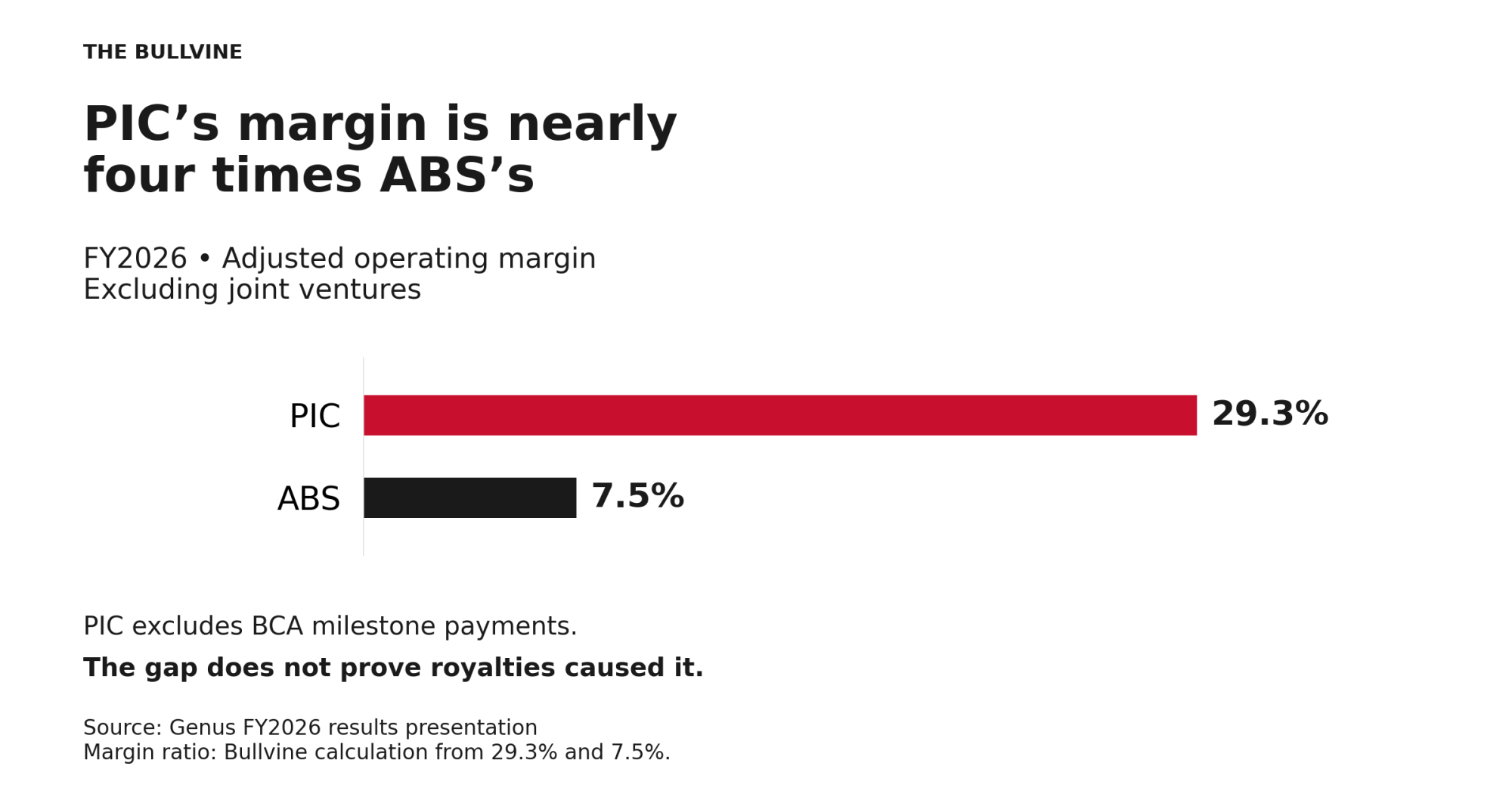
- Genus’s pig arm posted a 29.3% adjusted operating margin excluding BCA milestones; its cattle arm posted 7.5%. That’s nearly four times ABS’s margin, by Bullvine’s math, but it’s not proof royalties caused the gap.
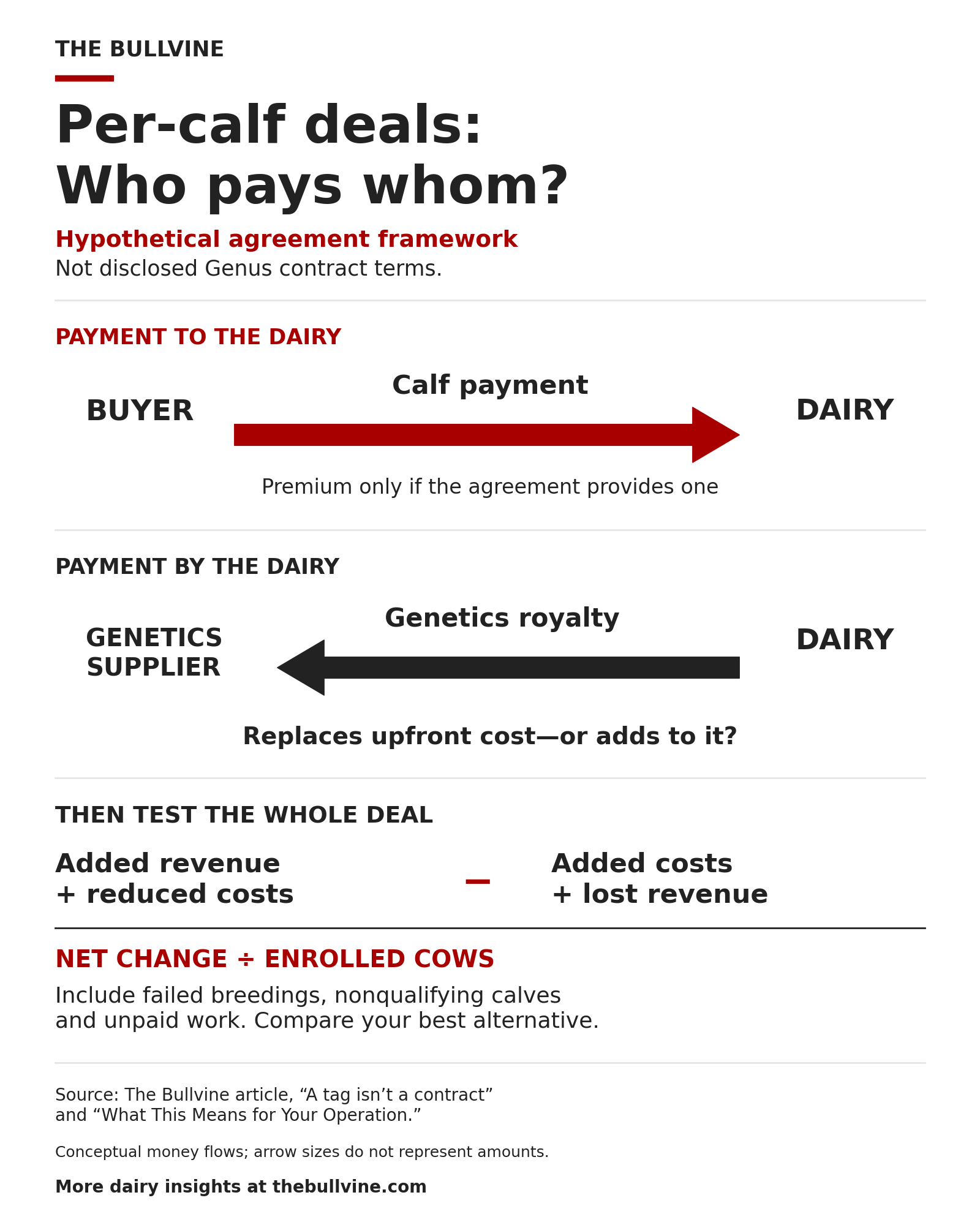
- A per-calf payment to the dairy and a royalty to the supplier can run in opposite directions. Find out who pays whom, and whether any charge replaces part of the semen price or comes on top of it.
- Judge any offer with a partial budget across every enrolled cow, against your best realistic alternative, with unsuccessful breedings and unpaid hours counted.
Genus’s pig genetics business, PIC, ran a 29.3% adjusted operating margin in the year to June 30, 2026, excluding milestone payments, according to Genus’s FY2026 results presentation. Its cattle genetics business, ABS, ran at 7.5%. By Bullvine’s math (29.3 ÷ 7.5), that’s nearly four times ABS’s margin.
The two businesses also get paid at opposite ends. PIC mostly collects on the back end, after the genetics are working in a customer’s barn. ABS mostly collects up front, when the straw is sold. Genus also says it wants to “Develop more ‘pull-through’ partnerships” in beef, though that describes deals with downstream buyers, not a royalty on dairy calves.
Genus FY2026 adjusted operating margins, excluding joint ventures. PIC reported 30.9%, or 29.3% excluding the £5.6 million in milestone payments from Chinese partner BCA (£3.7 million the year before); ABS 7.5%. Sources: Genus 2026 annual report; FY2026 results presentation.
Here’s how each one works. PIC can sell breeding animals at cost and collect royalties later, “typically a piglet being weaned from the original genetics.” ABS mostly sells straws of semen. Genus says “the majority of our bovine sales are transactional,” with a growing share on multiyear contracts.
That difference matters to any dairy weighing a per-calf genetics offer, and dairies are already changing how they use beef genetics. ABS’s beef volume rose 9% last year, and its conventional dairy volume fell 5%. Genus says dairy farmers in some markets swapped sexed genetics for beef-on-dairy to prioritize near-term beef production. So here’s the question: when genetics builds a better animal, what lets the company behind it get paid past the original sale, and would the dairy come out ahead if it did?
Three things the margins don’t prove
- That royalties caused the gap. Genus says, “As their market structures are different, PIC and ABS employ different business models and have different financial profiles.” ABS’s adjusted operating profit, including joint ventures, rose 17% in actual currency to £22.9 million. Genus names its Value Acceleration Program, a restructuring of ABS, as the major driver and credits it with £9.0 million of benefit.
- That the pig model can be lifted into cattle, the margin gap describes two different markets, not a template.
- That anyone is offering dairies a per-calf royalty. Nothing in Genus’s disclosures describes the kind of offer this article evaluates. What follows is a way to judge one if it lands on your desk.
How the royalty actually works
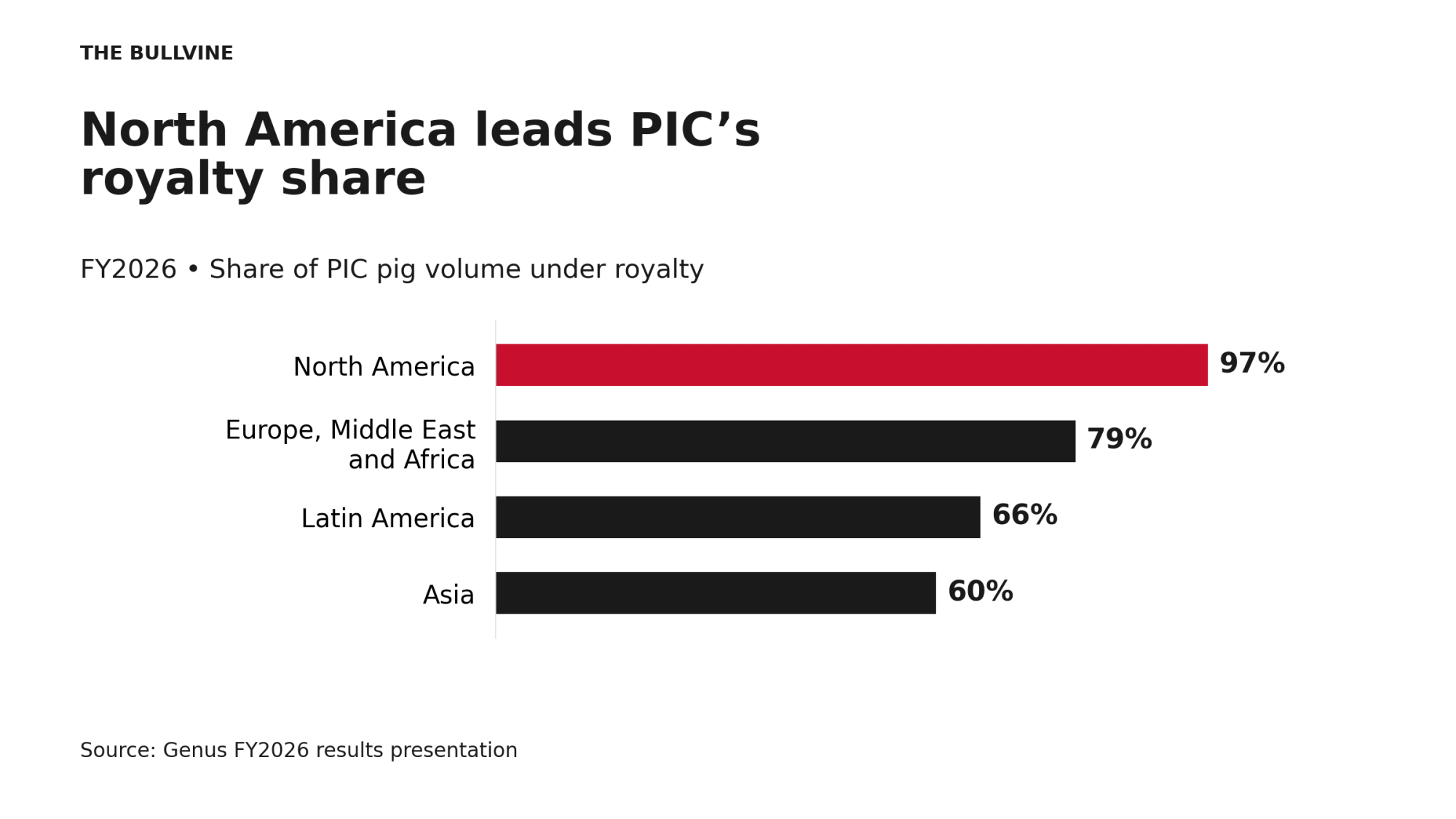
In North America, 97% of PIC’s pig volume ran under royalty in fiscal 2026, Genus reports. The share was 79% in Europe, the Middle East and Africa, 66% in Latin America and 60% in Asia. Those shares moved: Latin America’s has eased from 84% in FY2022, and Asia’s has ranged between 57% and 71% over the same period. Genus’s slide shows the figures without explaining the changes.
| PIC (pigs) | ABS (cattle) | |
|---|---|---|
| Adjusted operating margin, excl. joint ventures | 29.3% (30.9% including £5.6M BCA milestones) | 7.5% |
| Main payment point | Back end: royalty after the genetics work in the customer’s barn, typically per weaned piglet | Front end: straw sold, “the majority of our bovine sales are transactional” |
| Share of volume on royalty | 97% in North America (FY2026) | NOT IN FILES |
| Multiyear contracts | Not applicable | Growing share, including GENEadvance (1,000+ herds) |
| Per-calf charge to dairies disclosed? | Not applicable | No |
Source: Genus FY2026 results presentation and 2026 annual report. The margin ratio (29.3 ÷ 7.5) is Bullvine’s math.
On its investor slides, Genus calls the model “Independent of commodity prices.” That means the royalty isn’t indexed to the pork price. It doesn’t mean royalty revenue can’t move: Genus says North American royalty revenue grew just 1% last year because of customer disease challenges.
The royalty settles an argument before it starts. Nobody has to fight over what share of the pork price belongs to genetics every time a pig changes hands. The contract names an event, usually a weaned piglet, and the bill follows the count. A weaned piglet doesn’t prove genetics earned every dollar it’s worth. It’s an event both sides agreed to count, and that’s the commercially useful part.
The reach is large, too: PIC genetics showed up in 249.6 million market-pig equivalents last year. That’s Genus’s standardized count of slaughter pigs carrying its genetics, with each parent’s genes counting for half.
ABS starts somewhere else. Genus’s website says its bovine genetics are priced on indices of genetic merit, so a better bull can command a higher semen price. ABS also runs two contract models:
- GENEadvance. ABS is the sole genetics partner for large producers. The program now covers more than 1,000 herds, and Genus says it generated a 9.5% increase in revenue.
- Pull-through contracts in beef. Genus says ABS uses “‘pull-through’ contracts”: prove the value to processors, packers and retailers, so they give their own suppliers an incentive to use ABS genetics.
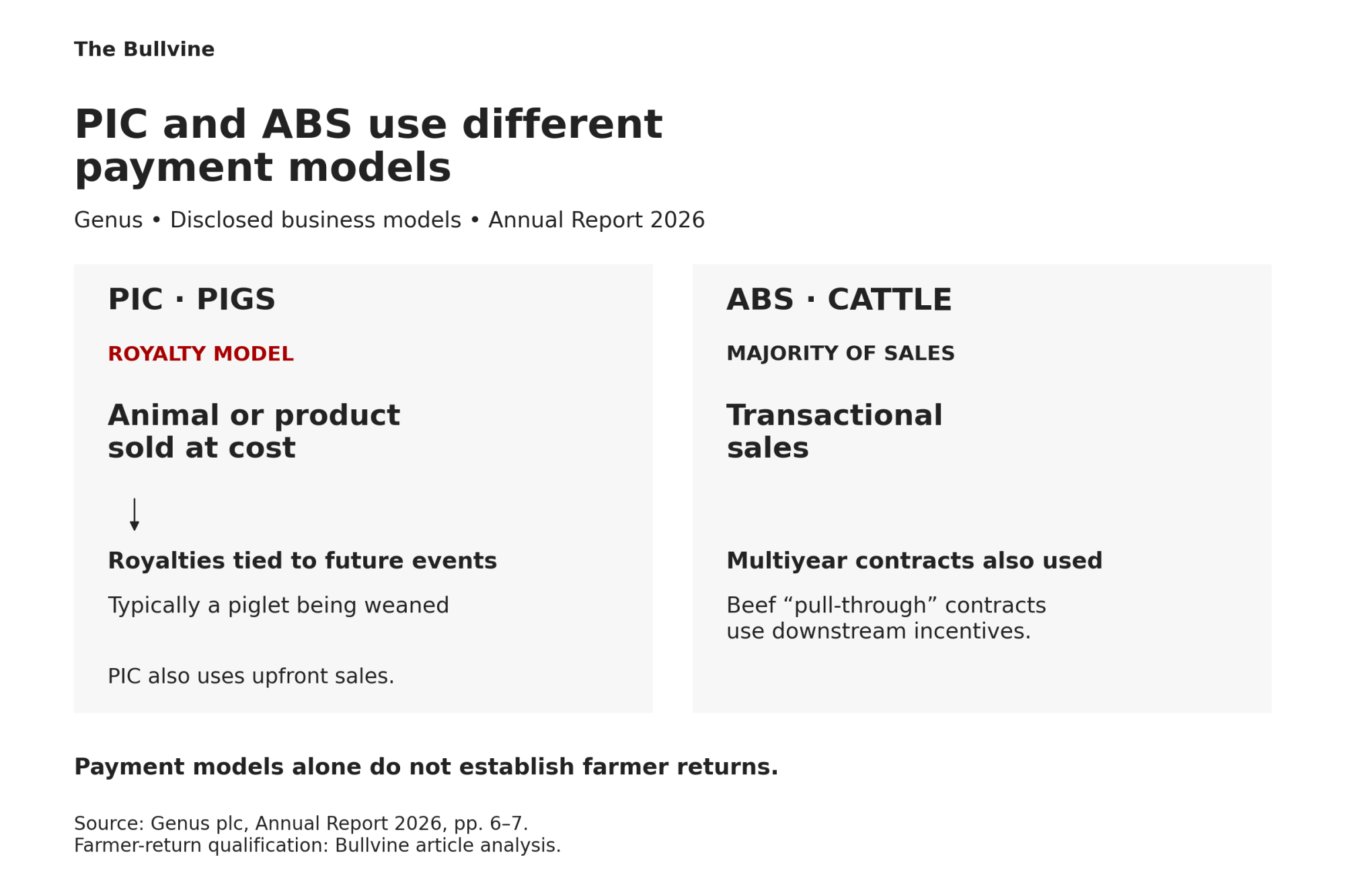
The 2026 report’s business-model section doesn’t give the terms of either, and nothing in these disclosures shows either is a per-calf charge to a dairy. Pricing the expectation before breeding is a different business from billing against what happens after it. Which model serves the farmer better depends on the price, the result, and who carries the risk.
Why a $430 beef-on-dairy calf premium isn’t a royalty pool
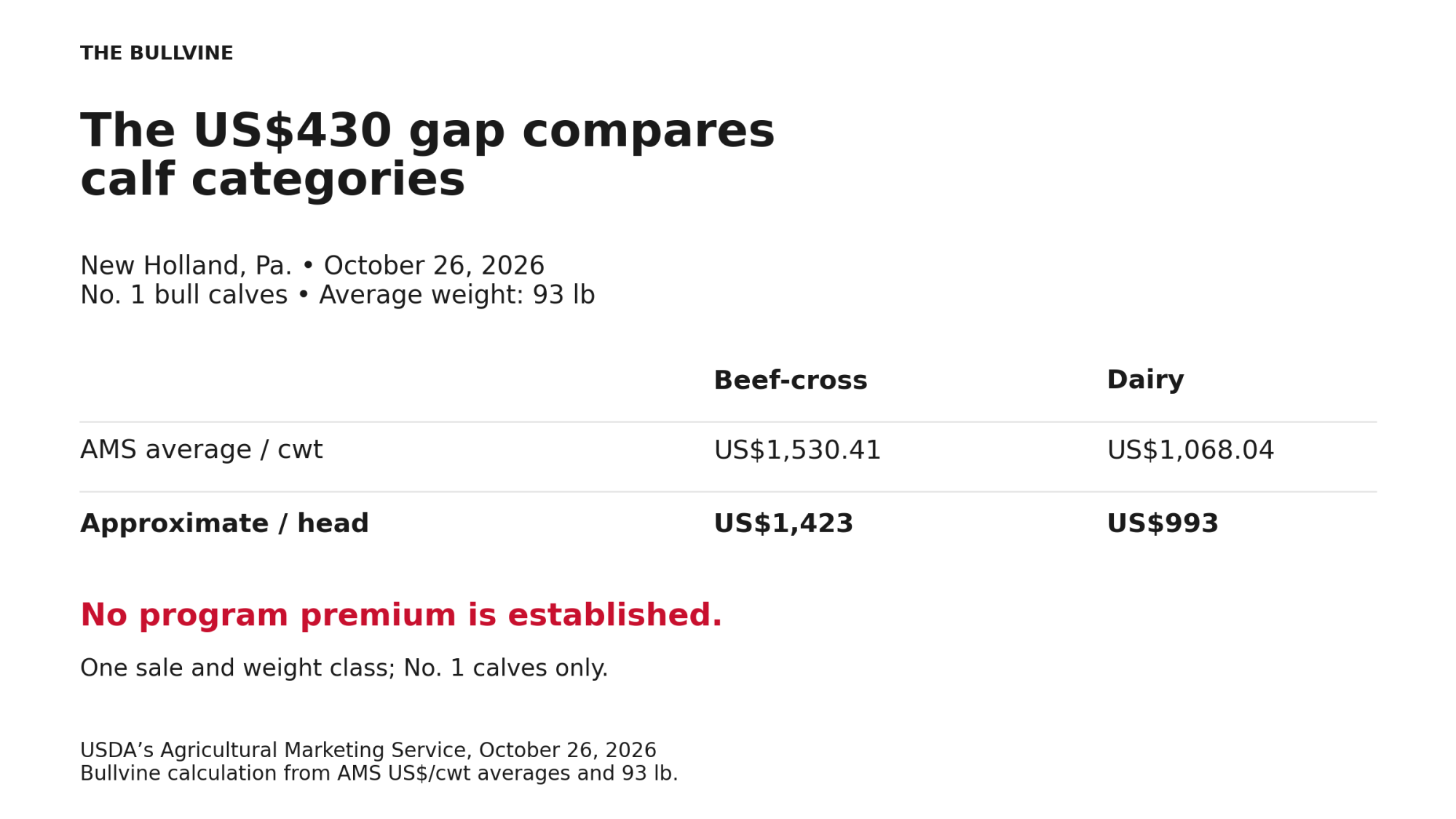
At New Holland, Pa., on October 26, 2026, USDA’s Agricultural Marketing Service (New Holland Monday report, Oct. 26, 2026 edition) reported these averages for No. 1 bull calves in the 90–95 lb class (averaging 93 lb):
New Holland, Pa., No. 1 bull calves, 90–95 lb class (avg. 93 lb), Oct. 26, 2026
| Calf type | Head | Average (US$/cwt) | Range (US$/cwt) | Approx. US$/head |
|---|---|---|---|---|
| Beef-cross | 33 | 1,530.41 | 1,150–1,750 | 1,423 |
| Dairy | 42 | 1,068.04 | 850–1,175 | 993 |
| Gap | 462.37 | about 430 |
Source: USDA AMS New Holland Monday report, Oct. 26, 2026. Per-head figures and the gap row are Bullvine’s conversion of the AMS averages. One sale, one weight class, one week.
- Beef-cross: US$1,530.41/cwt (approx. US$1,423/head)
- Dairy: US$1,068.04/cwt (approx. US$993/head)
That leaves a gap of roughly US$430 per head. The per-head figures are Bullvine’s conversion of the AMS averages.
Prices ranged from US$1,150 to US$1,750/cwt for the 33 beef-cross calves and US$850 to US$1,175/cwt for the 42 dairy calves. Compared with the previous week’s sale, AMS reported beef-cross bull calves US$40–$60 lower and dairy bull calves US$60–$80 higher. The report doesn’t label the unit on that line, but every price in it is quoted per hundredweight. So treat it as a snapshot of one sale, one weight class, and one week, not a trend. It only counts calves that reached the ring as No. 1s, and it can’t see the cows that didn’t settle.
The comparison has a second limit. It sets beef-cross calves against dairy calves, not program calves against comparable beef-cross calves sold outside a program. So it can’t establish a premium for joining any particular program. Nor can it tell the dairy how much of the gap belongs to one sire, rather than the crossbreeding decision, calf quality, the buyer’s specs, or that week’s market. The premium isn’t a royalty pool waiting to be split. And the dairy’s whole beef-semen bill isn’t the cost of earning it, because the Holstein alternative needed a breeding too.
For the producer, that boils down to one question: what does the proposed breeding option leave after its costs and conditions, compared with what the dairy does now? The supplier’s question is harder: what result can it prove well enough that someone will pay for it?
A tag isn’t a contract.
Genus’s 2026 report says it wants profit “resulting from the performance of our products in customers’ systems.” In beef-on-dairy, that breaks into four separate jobs: give the calf an identity, record its parentage, measure its performance, and give somebody a reason to pay.
An ear tag provides an identity. A parentage test provides a sire. A performance record shows what the calf did. None of them gets anyone paid for the genetics. Only a contract does.
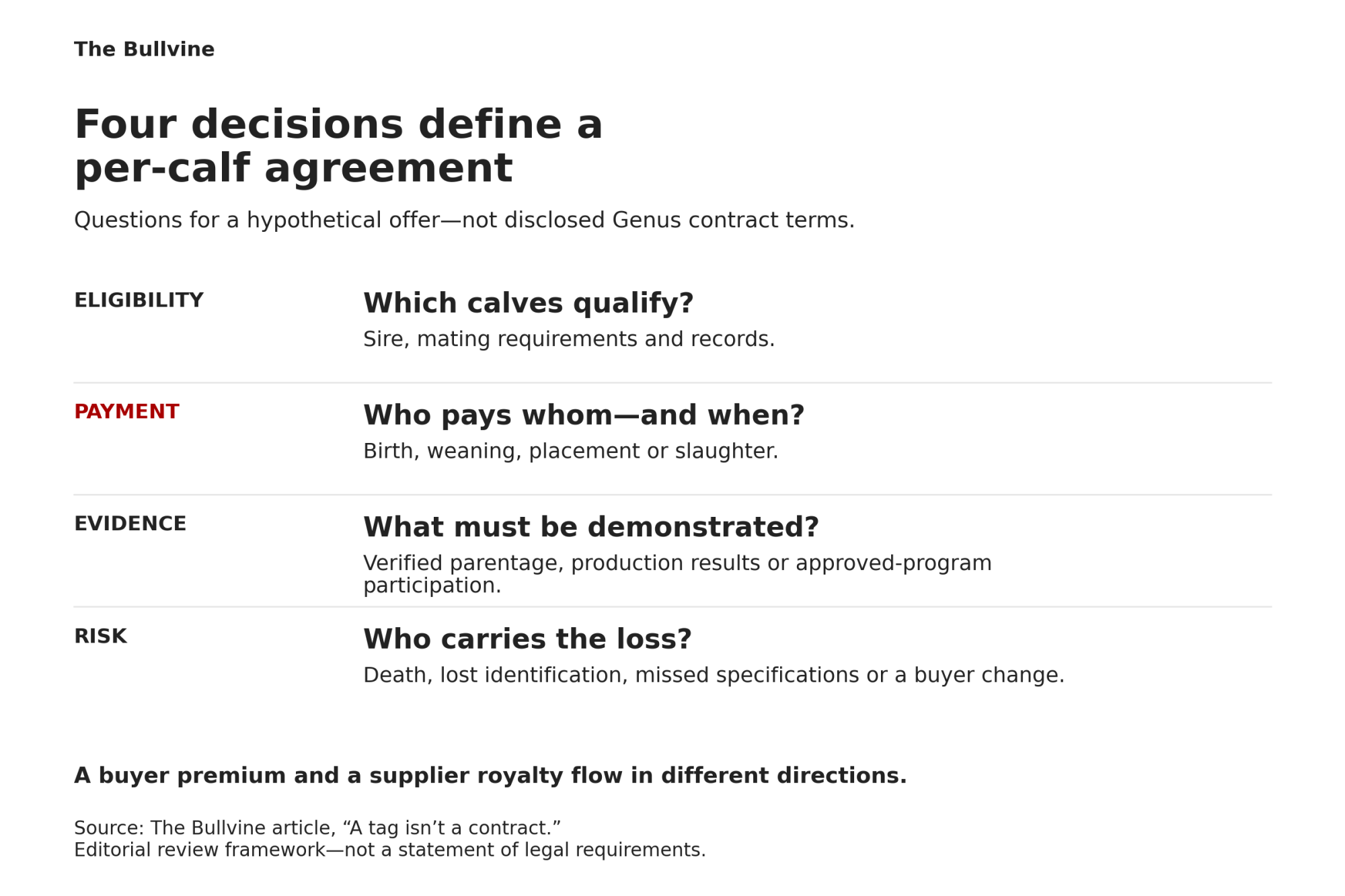
Four decisions make or break a per-calf genetics agreement:
| Decision | What to define | Question to put on the table |
|---|---|---|
| Eligible calf | Sire, mating requirements, records needed to qualify | Which calves count, and what proof qualifies them? |
| Payment event | Who pays whom, then the milestone: birth, weaning, placement or slaughter | Is a buyer paying the dairy, or is a supplier billing the dairy? At which event? |
| Evidence | Verified parentage, production results, or participation in an approved program | What has to be shown before money moves? |
| Risk | Calf death, lost ID, missed spec, change of buyer | Who pays when something goes wrong? |
- Define the eligible calf. Specify the sire, mating requirements, and records needed to qualify.
- Define the payment event. Start with who pays whom: a buyer paying the dairy for the calf, or a supplier billing the dairy for the genetics. Then set the milestone, because birth, weaning, placement, and slaughter are different commercial events.
- Define the evidence. State whether payment depends on verified parentage, production results, or simply participation in an approved breeding program.
- Define the risk. Decide who pays when a calf dies, loses its identification, misses a spec, or changes buyers.
A supplier could bill on a qualifying calf without guaranteeing its carcass. A buyer could pay a premium for approved genetics without sending a cent to the breeding company. Both designs work on paper, and the dairy should know which one is on the table before anyone calls it value capture.
Owning cattle isn’t required.
PIC also shows a genetics supplier can stay tied to production without owning the commercial animals. Genus says PIC “only owns proprietary assets at the top of the pyramid,” which Genus says reduces its exposure to “feed costs, disease and pork price volatility.”
So cattle genetics doesn’t have to get into cattle feeding to move past the straw. A genetics company could bill against an agreed event. A downstream buyer could reward qualifying sires, as ABS’s pull-through partnerships aim to. And a dairy could join because its numbers work. Who owns the calf matters less than who holds the information, the purchase commitment, and the contract.
What This Means for Your Operation
Genus’s 2026 report is blunt about what royalties do for PIC: the model “decreases our exposure to cyclical producer profitability and increases our revenue visibility and customer retention.” Those are supplier benefits. What any arrangement does for the dairy is a separate calculation.
Start with the price structure. Does a per-calf charge replace part of the upfront genetics price, or come on top of an unchanged semen price? Compare the total price and the total obligations under each option, not the per-calf figure alone.
If the agreement promises a market outlet, ask whether a named buyer is obligated to buy calves that meet the written specs, or whether the dairy has only qualified to offer them. Ask how the price is set, who pays for testing and recordkeeping, and what happens when pickup runs late, or a calf misses a spec. An agreement that covers only genetics may not involve a buyer at all, but it still needs a defined payment event, evidence standard, and risk split.
The breeding plan still has to work for the cow. A downstream carcass target is no excuse to override the dairy’s fertility, calving-ease and replacement targets. Ownership doesn’t settle the question either. Genus’s report notes bovine genetics has “large genetic co-ops having significant market share.” A co-op can return value through members’ calf checks, just as a private company can earn more by proving a better result.
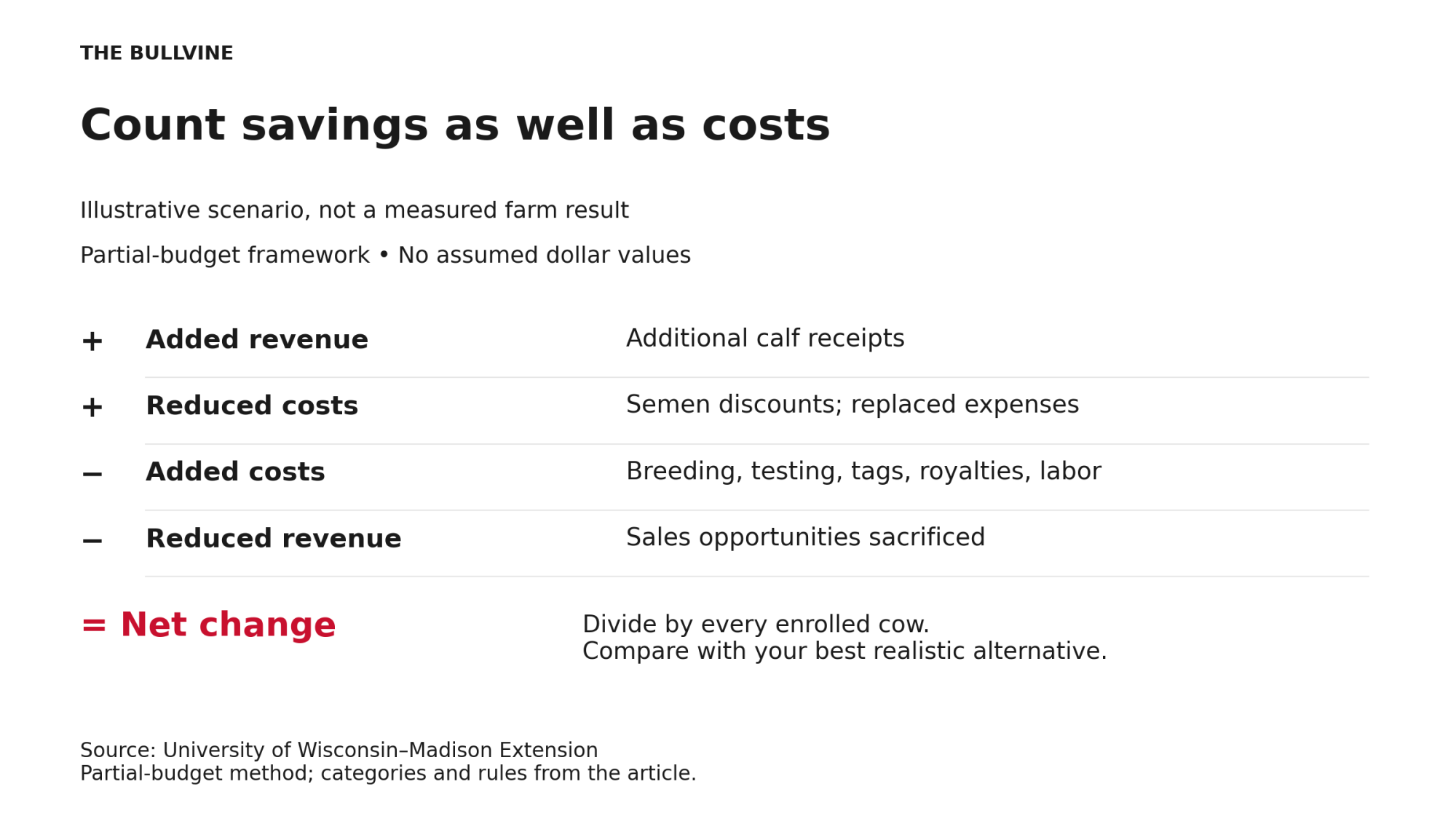
Then run a partial budget. This follows the University of Wisconsin–Madison Extension’s partial-budget method, which also counts unpaid labor and management time.
| Budget line | What changes under the proposed agreement? |
| Added revenue | Additional calf receipts and other supported revenue gains |
| Reduced costs | Semen discounts or expenses the program replaces |
| Added costs | Additional breeding, testing, tags, royalties, labor and holding costs |
| Reduced revenue | Lost sales opportunities or other revenue sacrificed |
| Net change | Added revenue + reduced costs − added costs − reduced revenue |
Five rules keep the budget honest:
- Compare the same enrolled group over a period long enough to capture the relevant costs and receipts.
- Include unsuccessful breedings and nonqualifying calves.
- Count each change once.
- Compare against the dairy’s best realistic alternative, not a weaker option that flatters the deal.
- Divide the net change by the number of enrolled cows.
What to watch
Genus has told investors it wants ABS at a double-digit margin in the medium term. Its next results, or any separate partnership announcement, would show whether pull-through partnerships come with disclosed terms. Until a dairy can read an actual agreement in full, the useful test isn’t whether a supplier deserves a bigger share. It’s whether the whole package (price, obligations and market access together) beats the dairy’s next-best breeding and marketing plan.
Per-Calf Deal Evaluator
Run the partial budget before you sign. Compare the whole package against your best alternative.
Count every cow in the program, including those that won’t settle.
Total calf premiums/receipts.
Semen discounts or saved expenses.
Tags, testing, royalties, and holding.
Sacrificed sales or opportunity costs.
Net Impact Per Enrolled Cow
Total Herd Impact: $0.00
Complete references and supporting documentation are available upon request by contacting the editorial team at editor@thebullvine.com.
Learn More
- The Angus Advantage: Revolutionizing Dairy Profitability Through Strategic Beef Crossbreeding — Breaks down the $100–$300 immediate calf premium available by choosing Angus over other beef breeds. This performance comparison arms you with feedyard efficiency metrics to justify your sire selections and capture top-tier crossbred pricing.
- $90K Less Margin, 214K More Cows: Beef‑on‑Dairy, Calf Checks and Your 2026 Survival Playbook — Follows the money on how beef-cross revenue keeps cows milking longer, inflating the national herd size. Map out your 2026 survival strategy by tracking Class III futures, cheese exports, and component margins before the downcycle hits.
- Beef-on-dairy math: the $575 premium that cancels out — Dismantles the logic behind chasing immediate cash flow from every beef-cross calf. Once you factor in the $585 replacement opportunity cost on a cow worth keeping, the seemingly obvious financial win vanishes completely.
The Sunday Read Dairy Professionals Don’t Skip.

Every week, thousands of producers, breeders, and industry insiders open Bullvine Weekly for genetics insights, market shifts, and profit strategies they won’t find anywhere else. One email. Five minutes. Smarter decisions all week.