






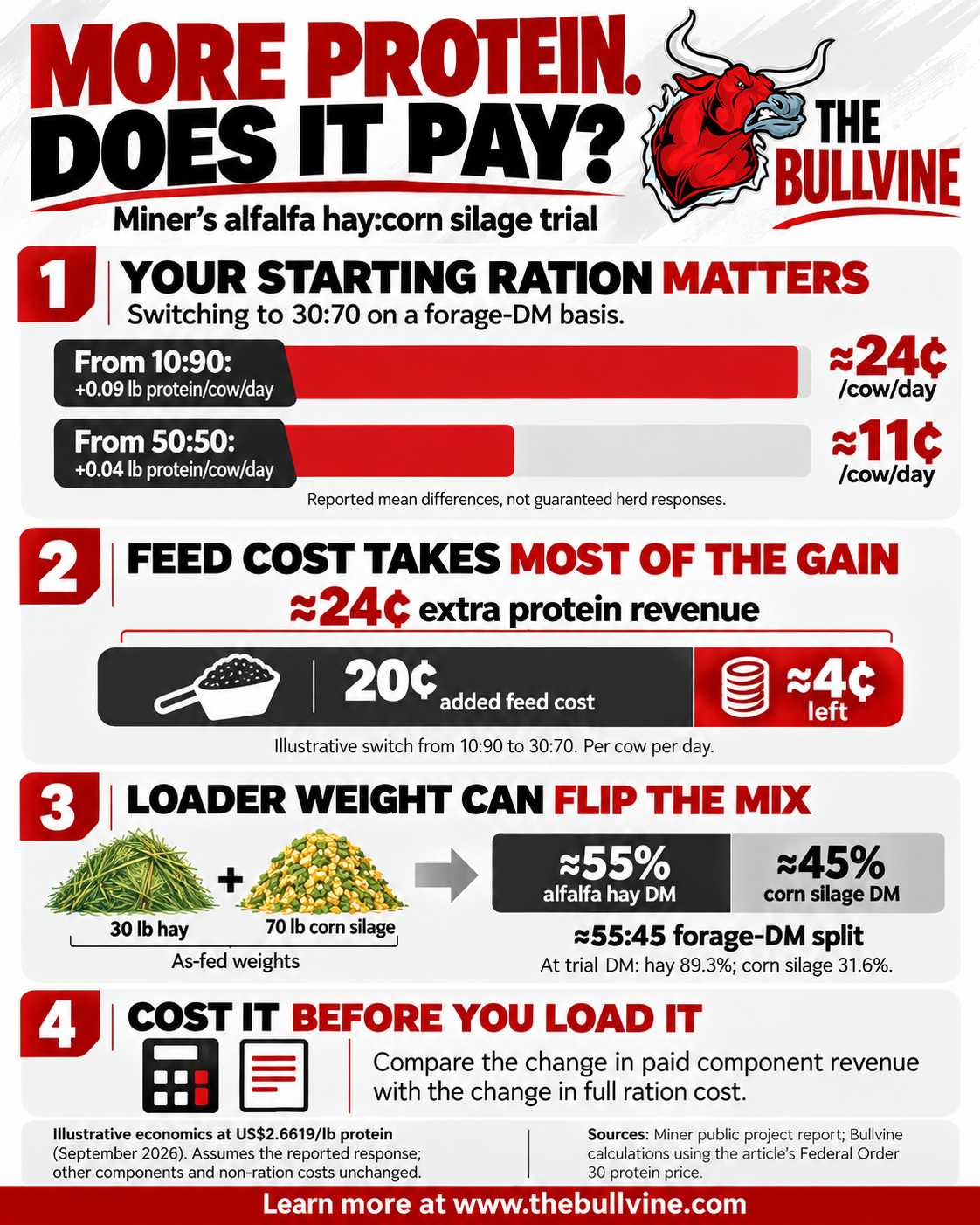
Coming from a 10:90 mix, Miner’s reported 0.09-lb protein edge is worth about 24 cents a cow a day. Add 20 cents to the ration and roughly 4 cents is left. Load the mix by weight and you may not be feeding 30:70 at all.
Miner Institute’s corn silage-alfalfa ratio trial reported 3.02 lb of milk true protein per cow per day on a 30:70 alfalfa hay-to-corn silage forage mix (30% alfalfa hay, 70% corn silage, forage DM basis). That’s 0.09 lb more than the 10:90 mix. At the September 2026 Federal Order protein price of $2.6619/lb, The Bullvine’s math puts that difference at about 24 cents a cow a day in protein revenue. It pays only if a herd reproduces the difference and the full ration-cost change comes in under it.
Sarah Morrison, Rick Grant and colleagues at the William H. Miner Agricultural Research Institute in Chazy, N.Y., published the trial in the Journal of Dairy Science on September 3, 2026. They enrolled 105 Holsteins (45 first-lactation, 60 older) in two enrollment cohorts, blocked them by parity, milk yield and days in milk, and randomly assigned them within blocks to one of five diets. Each diet was 62% forage on a DM basis, with chopped alfalfa hay making up 10% to 90% of the forage. Cows had a one-week covariate period, then four weeks on treatment.
Crossref lists USDA’s Agricultural Research Service as a funder. The researchers’ public report credits the U.S. Alfalfa Farmer Research Initiative of the National Alfalfa & Forage Alliance, which describes itself as “a voice for alfalfa farmers across the country.” Co-author David Weakley lists Forage Genetics International as his affiliation.
No intake or ECM effect, one protein exception
The abstract reports no statistically significant diet effect on:
- Dry-matter intake (public report range: 58.0 to 59.1 lb DM/day)
- Energy-corrected milk (103.6 to 107.4 lb/day)
- energy-corrected milk (ECM) per unit of intake
Protein yield moved.
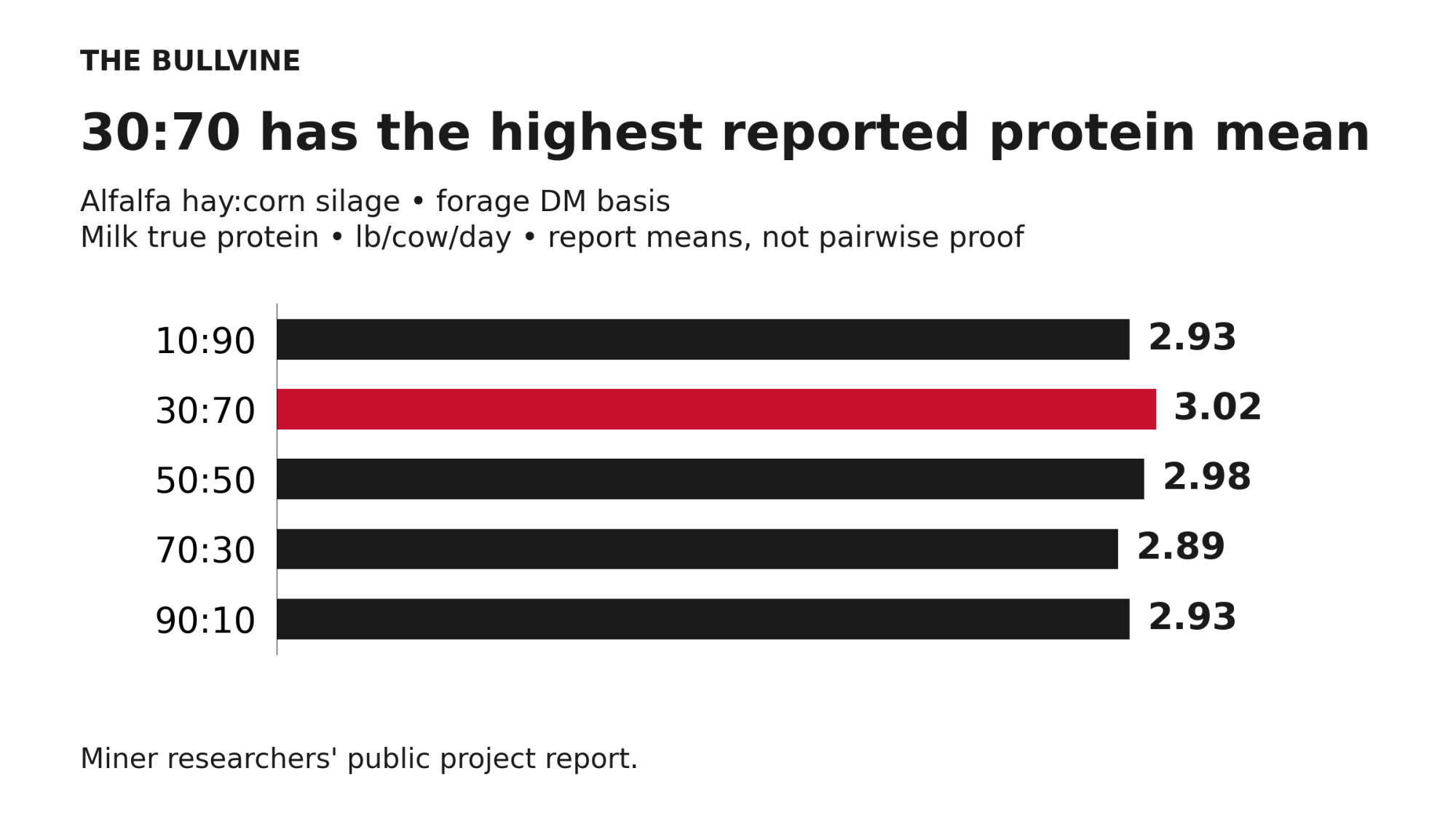
| Alfalfa hay:corn silage (forage DM) | True protein, lb/cow/day |
| 10:90 | 2.93 |
| 30:70 | 3.02 |
| 50:50 | 2.98 |
| 70:30 | 2.89 |
| 90:10 | 2.93 |
Source: Miner researchers’ public project report. The journal abstract says its statistical analysis used week-four data, adjusted for the covariate period. The public report doesn’t say which window or adjustment its displayed means use, and The Bullvine hasn’t confirmed the two match. The final journal tables weren’t in the materials reviewed.
Milk Urea Nitrogen (MUN) was lowest at 30:70 too: 8.5 mg/dL, against 9.8 to 12.0 on the other diets. The researchers read the protein and MUN pattern as “likely reflecting greater microbial protein synthesis.” That’s their interpretation; the trial didn’t measure it directly. Rumination fell linearly as alfalfa rose, from 499 to 396 min/day, which matters for the DA cases below.
The diets weren’t nutritional clones. They were formulated for similar metabolizable energy and protein, but post-study ingredient analysis put metabolizable protein (MP) supply 5 g/kg of dry-matter intake (DMI) higher on 90ALF than on 10ALF. Crude protein ran from 15.7% of DM at 10:90 to 17.6% at 90:10.
The researchers drew their own line: “the appropriate mix of alfalfa and corn silage for a specific farm will be based on nutritional and non-nutritional considerations.” Their public report put the optimum at “approximately 30:70 to 50:50.” The journal abstract narrows that to approximately 30:70.
What the cubic effect tests
The public report flags a significant cubic effect on protein yield (P ≤ 0.05). A cubic term tests the shape of the response across all five diets. It doesn’t test whether 30:70 beat 50:50, which sit only 0.04 lb apart, or whether it beat 10:90. Those are separate pairwise comparisons, and confidence intervals for them weren’t in the materials we reviewed.
Across the five diets, protein rose, fell and rose again, and the test found evidence of that pattern. That supports calling 30:70 the highest reported mean. Nothing in the reviewed material shows it beat the diets on either side of it.
Two DAs and a mid-trial diet change
Two cows, one on 70ALF and one on 90ALF, were diagnosed with displaced abomasums within the first 7 to 11 days of the first enrollment, the authors’ supplement records. They wrote that the cases were “perhaps attributed to small dietary particle size.” To reduce the risk of more, they added chopped wheat straw at 1.5% of diet DM, replacing alfalfa and corn silage equally. In the second enrollment, half the hay went into the mixer unchopped.
The supplement doesn’t establish high alfalfa as a cause of DAs. The protocol changes do mean the published diets aren’t a recipe to copy, and particle size needs checking along with the ratio.
The loader-sheet error that flips the ration
The “30” in 30:70 is a share of the forage DM. From the nominal formulation (62% forage, before the straw adjustment), 30% alfalfa is 18.6% of total diet DM and corn silage is 43.4%. Feed alfalfa at 30% of total DM instead, with total forage still at 62% and made up only of those two feeds, and the forage split runs about 48:52 (Bullvine calculations).
Moisture is the second denominator. Miner’s hay tested 89.3% DM and its corn silage 31.6%.
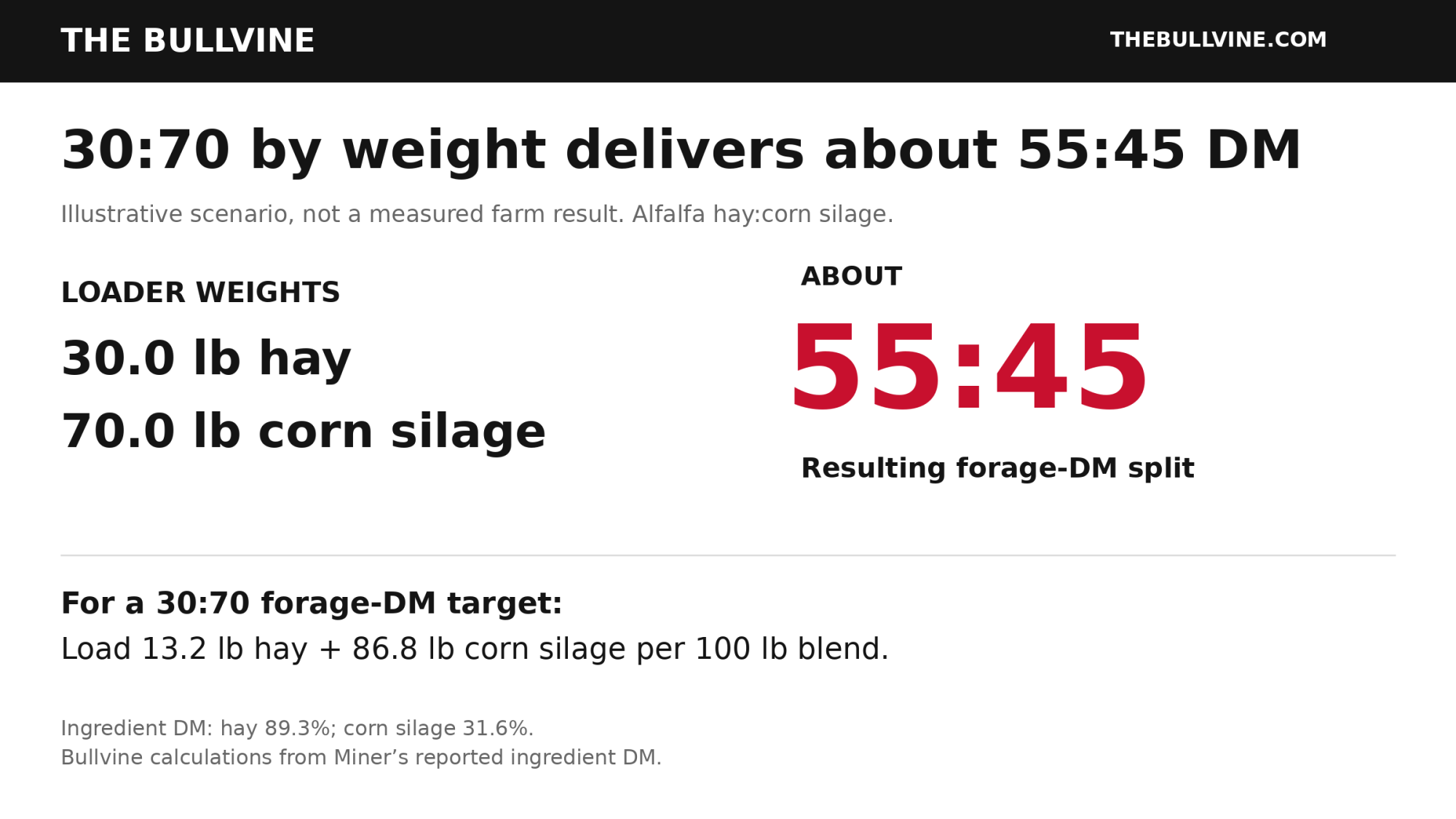
With forages at Miner’s tested dry matter, a feeder who loads 30% hay and 70% corn silage by weight delivers roughly a 55:45 ration on a forage-DM basis.
| Loading instruction | Hay, as-fed lb | Corn silage, as-fed lb | Hay DM, lb | Corn silage DM, lb | Forage-DM split |
| 30:70 by weight | 30.0 | 70.0 | 26.8 | 22.1 | about 55:45 |
| Loaded for 30:70 DM | 13.2 | 86.8 | 11.8 | 27.4 | 30:70 |
Per 100 lb of the two-forage blend, as fed. Bullvine calculations from Miner’s reported ingredient DM.
A 55:45 split is mostly alfalfa, a diet the trial didn’t feed.
Haylage adds a third problem that a moisture correction won’t fix. Penn State Extension notes digestibility shifts with plant species, maturity and storage method, and recommends checking particle distribution in the delivered TMR and watching for sorting: refusals shouldn’t differ by more than 3 to 5 percent from the TMR as fed. A haylage ration needs its own formulation and its own check.
Running the numbers
Reported inputs: the protein means above (Miner public report) and the September 2026 Federal Order 30 protein price of $2.6619/lb (USDA AMS).
Assumptions: the herd reproduces the reported difference; the farm is paid $2.6619 for each extra pound of protein; other components and non-ration costs stay constant.
| Switching to 30:70 from… | Extra protein, lb/cow/day | Protein revenue, $/cow/day | 400 cows, $/day |
| 50:50 | 0.04 | $0.11 | $42.59 |
| 10:90 | 0.09 | $0.24 | $95.83 |
| 70:30 | 0.13 | $0.35 | $138.42 |
Bullvine calculation: protein revenue from switching to 30:70, US$.
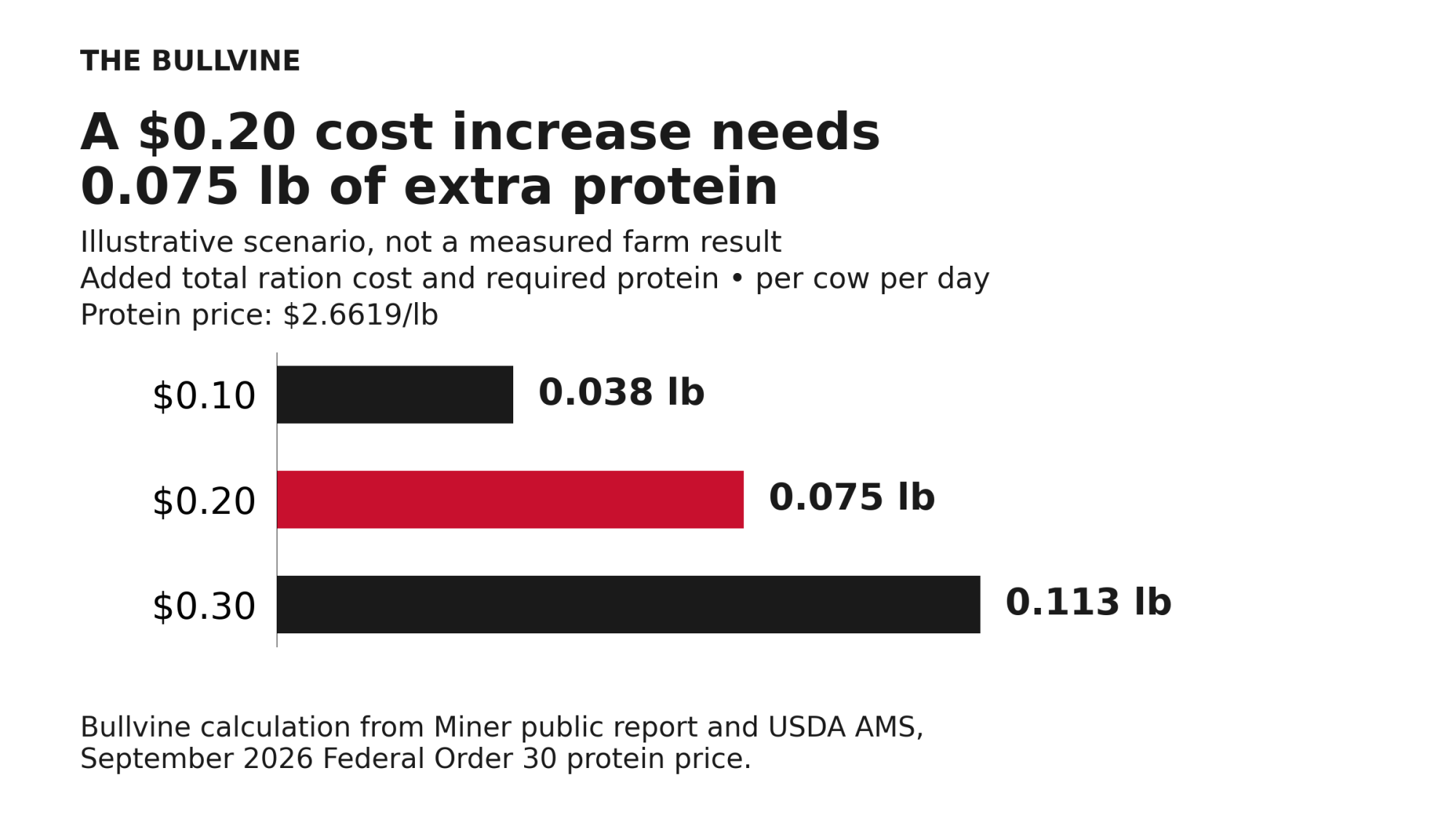
| Added ration cost, $/cow/day | Extra protein needed, lb/cow/day | 400 cows, lb/day |
| $0.10 | 0.038 | 15.0 |
| $0.20 | 0.075 | 30.1 |
| $0.30 | 0.113 | 45.1 |
Bullvine calculation: added ration cost ÷ $2.6619/lb. Cost levels are illustrative.
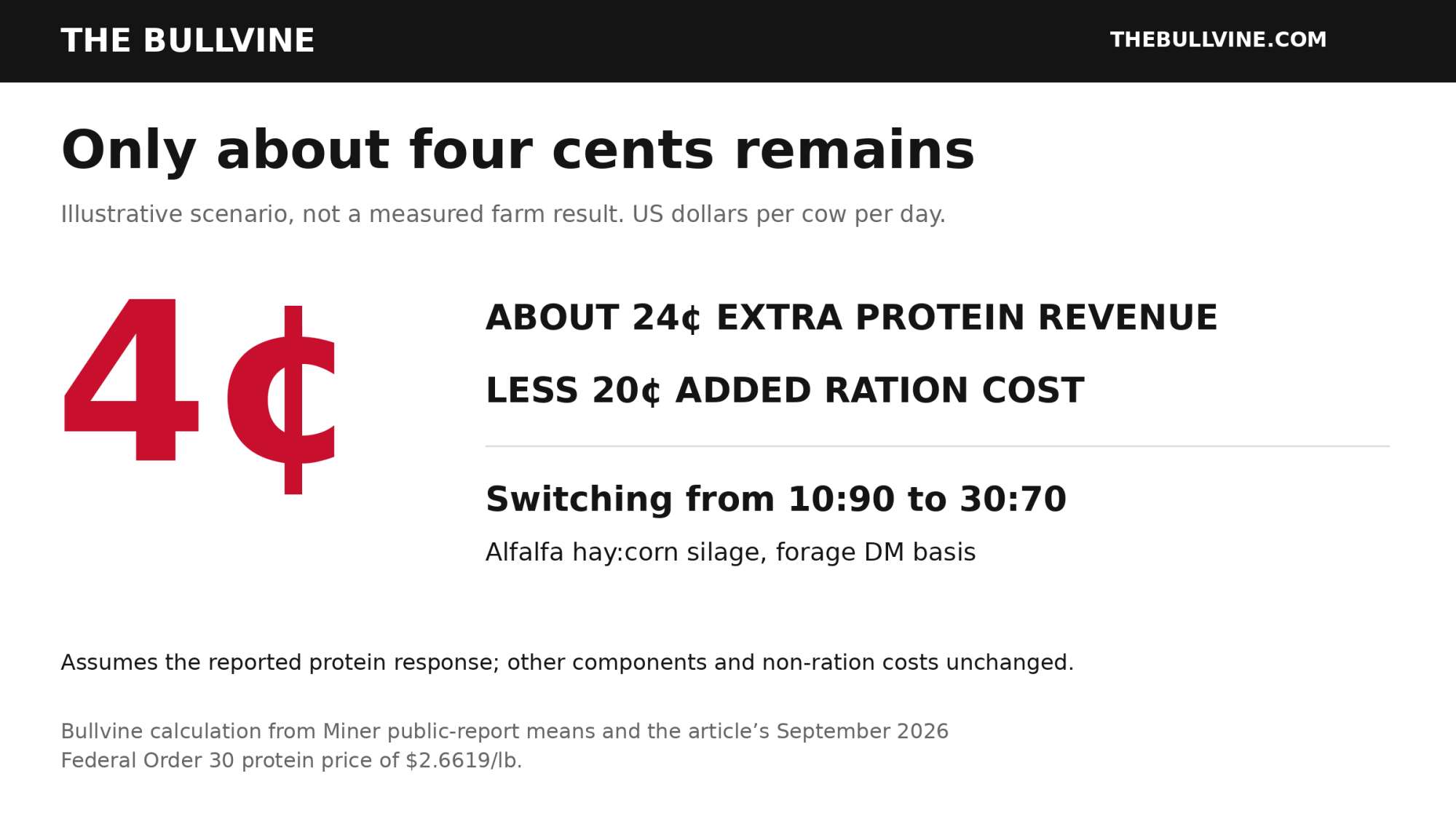
A 20-cent ration increase needs 0.075 lb of extra protein to break even. Coming from 10:90, the reported 0.09 lb clears it narrowly, leaving about 4 cents a cow a day after the added feed cost, roughly $16 a day for a 400-cow herd. Coming from 50:50, the reported 0.04 lb falls about 9 cents short.
At the same ration cost, the break-even needs no extra protein. A cheaper ration needs no protein increase at all, provided other changes don’t erase the savings. At this price, a 10-cent saving could absorb up to 0.038 lb less protein, as long as other paid output and non-ration costs hold.
The trial fed each diet for four weeks, and nothing here shows the response persists, so no annual figures are shown.
What the numbers mean for a ration decision
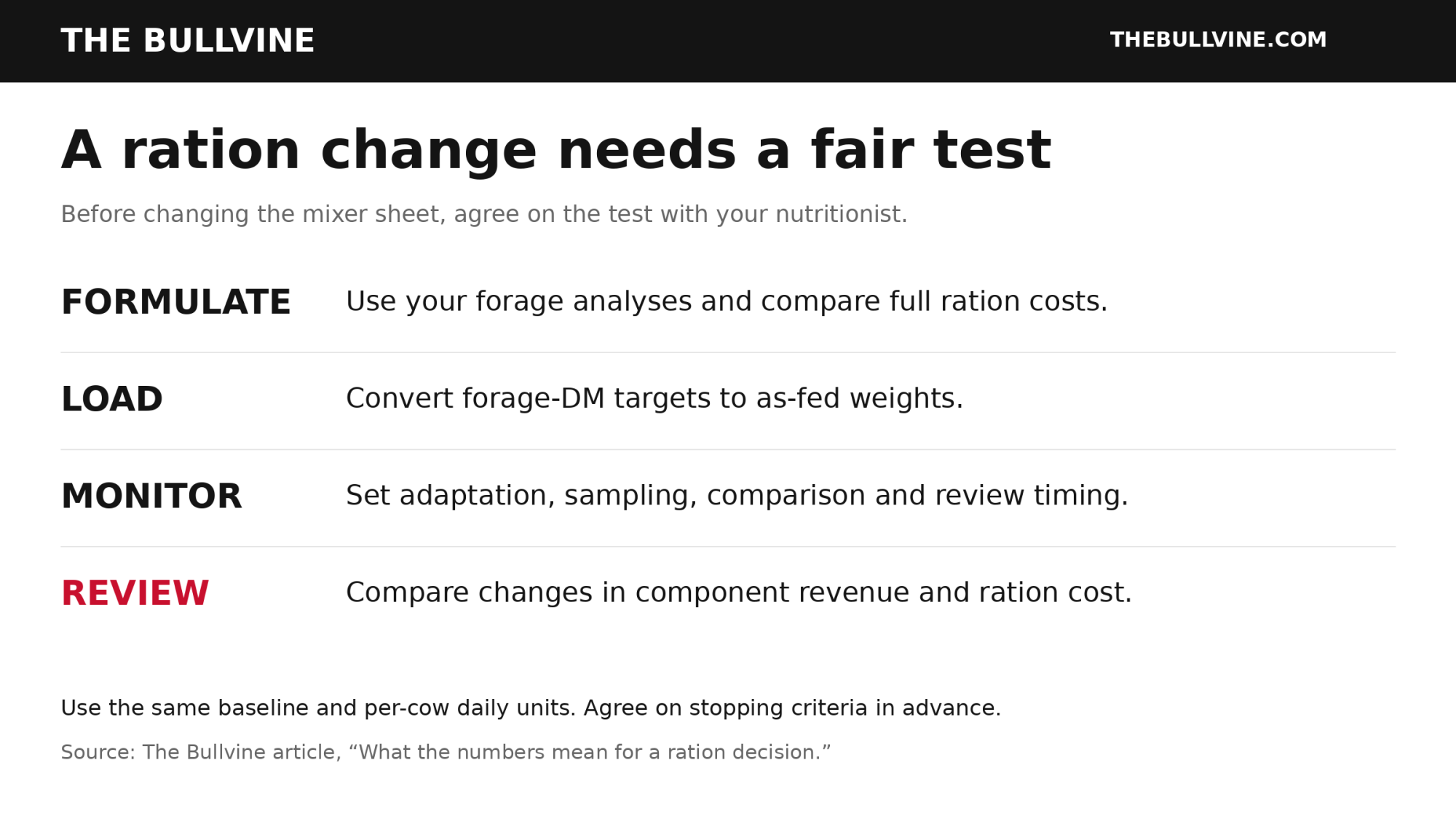
On these numbers, a 30:70-style ration earns a costing run. The mixer sheet changes only if the farm’s own figures clear the break-even.
Before changing the ration
✅ Do: Have the nutritionist formulate a moderate-alfalfa ration from the farm’s own forage analyses, stated as % of forage DM and % of total DM, then converted to as-fed loads.
📋 Requires: Current DM and nutrient tests on every forage, the farm’s marginal protein payment (see September’s component prices) and the full ration cost of both diets.
🎯 Worth pursuing if: The extra protein the cost increase requires (table above) is well under the gain Miner reported from the farm’s starting ration.
❌ Backfires if: The farm books the 24 cents as revenue, or applies the hay result to haylage without reformulating.
During a monitored feeding change
✅ Do: Switch one group. Track protein pounds, intake, MUN, rumination and other paid components against cost.
📋 Requires: A DM-based loader sheet, regular silage DM checks, particle-separator checks on the delivered TMR and refusals, and a review point, comparison method and stop rule agreed up front.
⚠️ Act if: Change in paid component revenue is running below the full ration-cost change at the review point.
❌ Backfires if: The farm reads shifts in days in milk, season or group makeup as a ration effect. A before-and-after comparison can’t, on its own, isolate what caused the change.
Before changing acreage
✅ Do: Weigh the feeding result against what Miner’s researchers list: production cost of each crop, agronomy and water use, nutrient variability across cuttings, and the price of other protein sources and feeds.
📋 Requires: Per-ton DM production costs for alfalfa and corn silage, including shrink, plus a forage inventory plan.
❌ Backfires if: The farm rebuilds a multi-year crop rotation around a four-week, 105-cow trial before its own monitored results are in.
At the review point, the test is the change in paid component revenue against the full ration-cost change, measured the way the farm and nutritionist agreed before the switch. Farm records can show whether that target was met. They can’t show the ration alone delivered it.
Forage Ratio Margin Calculator
Test the Miner Institute 30:70 trial against your farm’s economics.
Your Daily Projections
Methodology note
Inputs.
- Protein, MUN, rumination, intake, ECM, ingredient DM and crude protein come from the Miner researchers’ public project report.
- Design, analysis window, directions of effect, MP drift and the quoted conclusion come from the Journal of Dairy Science abstract (DOI 10.3168/jds.2026-28496).
- The protein price is the announced September 2026 component price in the USDA AMS Federal Order 30 announcement.
- Protocol changes come from the authors’ Mendeley Data supplement (DOI 10.17632/rpffnk4d59.1).
- Funding comes from Crossref and the public report. The NAFA description comes from NAFA’s Regeneration Nation site.
Bullvine calculations.
- Protein revenue = protein difference × $2.6619/lb.
- Break-even = added ration cost ÷ $2.6619/lb.
- Whole-diet share = forage share × 62%.
- DM = as-fed weight × DM fraction.
- Figures are rounded at the end.
Not confirmed in the materials reviewed.
- Whether the public-report means are the journal’s week-four, covariate-adjusted estimates.
- Any animal exclusions, including the two DA cows.
- Which diets the straw change applied to, and from when.
- How the analysis accounts for the protocol changes beyond an enrollment term.
- Pairwise comparisons and their confidence intervals.
The Bullvine will update this article if the published tables differ.
Excluded. Fat, other solids, premiums, health effects and anything beyond the four-week feeding period. The U.S. Federal Order price is an illustration; other markets should use their own component payment.
Learn More
- $60 silage, $220 delivered: forage’s hidden 28% premium — Run the math on your actual delivered dry matter. Re-pricing a $60 as-fed silage with a 12% shrink loss exposes a $220/ton true cost, giving you the exact metrics to stop bleeding $0.89 per cow daily.
- Your Silage Is Lying to You: The $180,000 Annual Loss Most Farms Never Calculate — Position your herd against market volatility by confronting hidden feed variation. Breaks down how a five-percent moisture drift silently strips $180,000 annually from mid-sized dairies, and proves why capping production targets at 88 pounds actually increases income-over-feed-cost.
- Feed Center Revolution: Why Your Current Design Is Costing Your Dairy Six Figures Annually — Stop treating commodity storage like a 1990s afterthought. Dismantles outdated facility assumptions to show how strategic layouts and dust-recovery systems cut shrink from 6.5% to 2%, returning over $100,000 monthly to a 4,500-cow operation.
The Sunday Read Dairy Professionals Don’t Skip.

Every week, thousands of producers, breeders, and industry insiders open Bullvine Weekly for genetics insights, market shifts, and profit strategies they won’t find anywhere else. One email. Five minutes. Smarter decisions all week.