








Your bunker’s hiding a $15K monthly bleed—and the fix costs less than your next vet call
EXECUTIVE SUMMARY: What farmers are discovering through painful experience this season is that feed variability isn’t just another management challenge—it’s become a $15,000 monthly profit drain that compounds invisibly across their operations. Cornell’s dairy research team documented that weather-damaged forages force cows to consume 2.67 extra pounds of feed daily just to maintain production, while Wisconsin Extension’s October data show that this translates to over $5,000 monthly in direct waste alone for a typical 377-cow dairy. However, what’s truly compelling is that Jake, an organic producer near Middlebury, Vermont, transformed his bottom-third performance into nearly $90,000 in recovered profitability with just $1,100 in strategic investments—primarily a $340 moisture tester and joining Cornell PRO-DAIRY’s discussion group. Dr. Chris Wolf’s economic analysis at Cornell’s Dyson School reveals that farms adapting now with 18-24 month forage inventories experience 30-40% less income volatility during weather events, with some actually turning market disruptions into premium selling opportunities. The convergence of climate unpredictability, tightening margins, and consolidation pressure means farms have roughly 18-24 months to implement these proven strategies before compounding losses create structural challenges. The good news? Every farm we studied that took action—from 285-cow organic operations to 5,000-head Western dairies—recovered their investment within weeks and positioned themselves to thrive rather than just survive.

So I’m watching Carlos, grab a handful of corn silage during morning feeding last week. Eighteen years of experience, right? He just shakes his head and says quietly, “Feels different.”
You know what’s interesting? That simple observation—when caught early—can save anywhere from $20,000 to $30,000, based on our current industry observations. Problem is, most of us miss these signals for months.
The 2025 growing season has been brutal, hasn’t it? We’ve got drought from Michigan through Ohio. Flooding across Iowa and southern Wisconsin. And what’s sitting in our bunkers isn’t just variable feed anymore—it’s become this profit drain that many farms haven’t fully calculated yet. Industry-wide, we’re talking billions in hidden losses that compound year after year.
Here’s what’s fascinating, though. While some operations are bleeding thousands monthly—we’re talking $5,000, $10,000, sometimes even $15,000—others have actually turned this volatility into a competitive advantage. The difference? Well, it’s not what you’d expect.

At a Glance: What You Need to Know
- Feed variability costs: Typically $5,000-15,000+ monthly for mid-sized dairies
- Simple fix: Weekly moisture testing prevents about 80% of losses
- Best ROI: Discussion groups often deliver 300%+ returns for just $200-600 annually
- Critical window: You’ve got 18-24 months to adapt before losses start compounding
- Industry impact: Estimated $2.4 billion annually across U.S. dairy operations
Where Your Money’s Actually Going
Let me walk you through where these losses hide in a typical 377-cow operation, because once you see the full picture, the opportunities become pretty obvious.
When feed efficiency drops just 5% from weather-damaged forages—and Cornell’s dairy folks have been documenting this extensively—your cows need about 2.67 extra pounds of feed daily to maintain that 80-pound production average. We’re talking over 1,000 pounds of wasted feed. Every single day.
At current Midwest feed prices—Wisconsin Extension’s October report has them around eighteen cents per pound dry matter—you’re looking at $5,000-plus monthly just from excess consumption alone.
But here’s where it gets really interesting.
Dr. Randy Shaver from Wisconsin’s dairy science department shared something with me that really resonates: “Most nutritionists formulate assuming 35% dry matter in corn silage. When that silage actually tests at 36% DM due to face exposure, farms systematically overfeed without realizing it.”
Do the math with me here. One percentage point drift equals 580 pounds of annual overfeeding per cow. For 377 cows? That’s several thousand more walking out the door, based on typical silage running anywhere from $45 to $55 per ton these days.
The Cost Cascade Most Farms Don’t See
| Loss Category | Monthly Impact | Annual Total |
| Direct feed waste | $5,000 | $60,000 |
| Moisture drift | $2,000 | $24,000 |
| Production loss | $4,500 | $54,000 |
| Health issues | $3,500 | $42,000 |
| Total Impact | $15,000+ | $180,000+ |
Look at those numbers carefully—what hits you first? It’s the direct feed waste and production losses, right? They account for nearly two-thirds of the total impact. Most farms I visit focus on the health issues, but the silent killers are those daily inefficiencies that just compound month after month.
Penn State’s feed management team found something else worth noting—TMR particle size variation. Most farms operate with an 8% variation without even realizing it. Each percentage point costs somewhere between 0.2 and 0.4 pounds of milk per cow. We’re talking about another 900 pounds of lost production daily, or $4,000 to $5,000 per month, at October’s Class III prices of around $16.80.
Dr. Mike Hutjens from Illinois—he’s been tracking these patterns for decades—puts it pretty bluntly: “Research shows metabolic disorders can increase 15 to 20 percent when feed consistency varies. Add in reproduction hits from energy imbalance, and what seems like a manageable $5,000 problem becomes $15,000 or more in total monthly impact.”
Thing is, these losses don’t show up as “Feed Variability Loss” on your P&L. They hide in slightly higher vet bills, components that drift lower, feed costs that creep up…
Corn Silage Moisture Management: Your First Line of Defense
The Meeting That Changed Everything—let me tell you about something remarkable at a Pennsylvania dairy last spring.
Tom—not his real name, privacy matters—runs 420 cows, and he’d assembled this unusual group around his beat-up office table. His veterinarian is Dr. Sarah Chen. Nutritionist Mike Rodriguez with fifteen years of experience working in Pennsylvania dairies. Jennifer Hayes from Penn State Extension. And Carlos Martinez, his herd manager, who’d never been invited to a meeting like this before.
Tom’s problem? Income-over-feed-cost running $2.80 below his benchmark group. On 420 cows, we’re talking over $400,000 annually, he couldn’t explain. Painful doesn’t even begin to describe it.
Jennifer—she’s facilitated dozens of these through Penn State’s Dairy Excellence program—started with an unusual rule: “Let’s observe this data for fifteen minutes. No talking. No solutions. Just observe.”
The silence was uncomfortable, I must admit. But patterns started emerging.
Mike noticed that milk was holding at 79 pounds, while the butterfat dropped from 3.8% to 3.6%. Dr. Chen spotted MUNs trending from 14.2 to 16.8—that’s classic protein imbalance according to Cornell’s guidelines. The December ration showed 16.5% crude protein. Overfeeding shouldn’t be happening.
Then Carlos, hesitant about speaking up, mentioned: “The corn silage has been feeding different lately. Drier. The cows are sorting more, leaving stems.”
Mike’s response was immediate: “When did you last test moisture, Tom?”
The pause said everything. “September. At harvest.”
This was March.
Mike’s calculator came out. If silage had drifted from 35% to 37% dry matter—and that’s completely normal with an exposed face—they were overfeeding 1.1 pounds DM per cow daily. That’s 462 pounds of daily waste across 420 cows.
“We’re looking at 84 tons annually at $50 per ton—over $4,000 just from corn silage overfeeding,” Mike explained. “Plus, you’re diluting the entire nutrient profile, so Tom’s compensating with extra grain.”
Tom nodded slowly. “Yeah, I added about a pound of high-moisture corn per cow in January when body conditions started slipping.”
The room went quiet as everyone calculated. Extra grain: $12,000-plus annually. Elevated ketosis, Dr. Chen had been treating: another $4,000 to $5,000. Total identified loss from moisture drift alone: over $20,000 annually.
Jennifer’s observation still sticks with me: “Everyone in this room had important pieces, but nobody had the complete picture. This is why collaboration matters.”
“Cows tolerate slightly sub-optimal nutrition better than frequent changes. A ration that’s 95% correct but consistent outperforms theoretical perfection with weekly modifications.” – Dr. Heather Dann, Miner Institute
Success Story Snapshot: Jake’s Transformation Timeline
Month 0 (January): IOFC at $9.80 vs. $11.20 goal | 62 pounds production
Month 1: Joined Cornell PRO-DAIRY discussion group ($300)
Month 2: Discovered moisture drift issue, purchased Koster tester ($800)
Month 3:Implemented weekly moisture testing protocol
Month 4: Adjusted rations based on actual dry matter
Month 5:Production recovering to 60 pounds
Month 6: Production at 61 pounds | IOFC at $10.90 | Ketosis cases: 18→6
Annual benefit: Nearly $90,000 |
Total investment: $1,100 | ROI: Over 8,000%
Small Farms Finding Big Solutions Through Smart Collaboration
What’s really encouraging—and I’ll admit, kind of surprising—is how smaller operations are pioneering sophisticated approaches without massive investment.
Take Jake—another name I’ve changed for privacy—organic dairy near Middlebury, Vermont. Third generation, 285 cows. His numbers were unflattering: IOFC dropped from $11.20 to $9.80 per cow per day. Milk slipped from 62 to 58 pounds. You’d think he’s too small for sophisticated management, right?
Wrong. Instead of buying technology, Jake joined Cornell PRO-DAIRY’s discussion group. Cost? Three hundred bucks annually. Jason Karszes, who runs the program as Cornell’s Farm Management Specialist, tells me they have dozens of groups across New York now, with hundreds of farms participating.
“That first benchmarking meeting was humbling,” Jake told me over coffee recently. “We were $2.20 below the group average on IOFC. Do the math—that’s over $200,000 in unrealized annual revenue. I wanted to crawl under the table.”

But here’s where it gets good. Through the group, Jake learned that a neighboring farm had identified moisture drift as the cause of systematic overfeeding. He tested immediately with a Koster tester. Same problem—moisture had shifted from 32% to 35% dry matter.
Six months later? Production recovered to 61 pounds. IOFC hit $10.90. Fresh cow ketosis cases dropped from 18 to 6. Jake’s meticulous records indicate that annual benefits are approaching $90,000, based on a total investment of approximately $1,100.
“We stopped operating in isolation,” Jake explains simply. “Eight farms sharing real numbers, genuine problems, proven solutions. For $300 annually, I basically gained a management team.”
Dairy Feed Efficiency Monitoring: Making Sense of Starch Digestibility
Now, Jake’s success story leads us to another piece of the puzzle—one that gets a bit technical but really matters for your bottom line. Remember that corn silage Carlos noticed was “feeling different”? There’s hard science behind why that observation matters so much.
Dr. Luiz Ferraretto, from the dairy science department at the University of Wisconsin, has been researching this topic for years. Fresh corn silage typically has a starch digestibility of 60-65% when tested using the 7-hour in vitro method. After 240 days of fermentation? That can hit 85 to 90 percent.
“This isn’t minor variation—it’s fundamentally different feed,” as Dr. Ferraretto explained at last year’s Four-State conference in Dubuque.
Research published this year in the Journal of Dairy Science from Wisconsin confirms that this evolution follows predictable patterns. Starch digestibility generally increases by about 2% per month during peak fermentation—that’s between days 21 and 90.
Dr. Bill Weiss from Ohio State, who’s been at this for three decades, shared his framework with me:
“Silage under 21 days old? Avoid it unless you’re desperate—that starch is basically locked up. Days 21 to 90? Test bi-weekly with NIR analysis and adjust when digestibility increases by four percentage points or more. After 90 days? Monthly testing, quarterly adjustments usually work fine. Beyond 180 days? You’re just monitoring for stability at that point.”
What surprises many folks—surprised me too, honestly—is that sometimes patience beats immediate adjustment.
“When silage is 30 to 60 days old and climbing 2% monthly in digestibility, adjusting now means you’re readjusting in two weeks,” explains Dr. Heather Dann from the Miner Institute up in northern New York. “Better to wait until that 90-day plateau for one comprehensive adjustment.”
Fecal starch analysis provides validation; Wisconsin’s feed lab processes thousands of these samples monthly. Above 5% indicates that you have undigested energy walking out the back end. But if that silage is only 60 days old, Dr. Dann suggests patience while fermentation completes its job.
When Your Advisors Won’t Work Together
This might be uncomfortable to discuss, but after numerous conversations this year, it needs to be addressed.
I know a Wisconsin nutritionist—let’s call him Rick—serving 40 dairies. He told his client Mark: “Team meetings produce more talk than action. After 20 years, I understand nutrition, your vet understands health. That’s efficient specialization.”
Three months later? Mark’s IOFC had declined another 40 cents per cow daily despite following Rick’s recommendations precisely.
Dr. Sarah Roche at Guelph has been researching advisor-farmer relationships, and she’s identified some predictable resistance patterns: “Professional identity plays a huge role—collaboration can feel threatening. Business models optimized for volume rather than depth create challenges. Past territorial conflicts teach advisors to maintain boundaries.”
How do you assess whether resistance is fixable? Try this approach:
Ask your advisor: “I’ve been learning about quarterly collaborative meetings between vets and nutritionists. What’s been your experience?”
A constructive response sounds like: “Some work well with proper structure, others lose focus. What outcomes are you seeking?”
A closed response: “Complete waste of time. Never effective.”
Mark ultimately switched nutritionists. His new advisor embraces collaboration, telling me, “Every joint meeting teaches me something valuable. Professional growth requires acknowledging that nutrition expertise, while important, isn’t the only expertise that matters.”
Building for Whatever Comes Next: The 18-24 Month Adaptation Window
Examining operations positioned for long-term success reveals consistent patterns that extend beyond technology.
Dr. Chris Wolf, the agricultural economist at Cornell’s Dyson School, has documented how farms maintaining 18 to 24 month forage inventories experience 30 to 40 percent less income volatility during weather events.
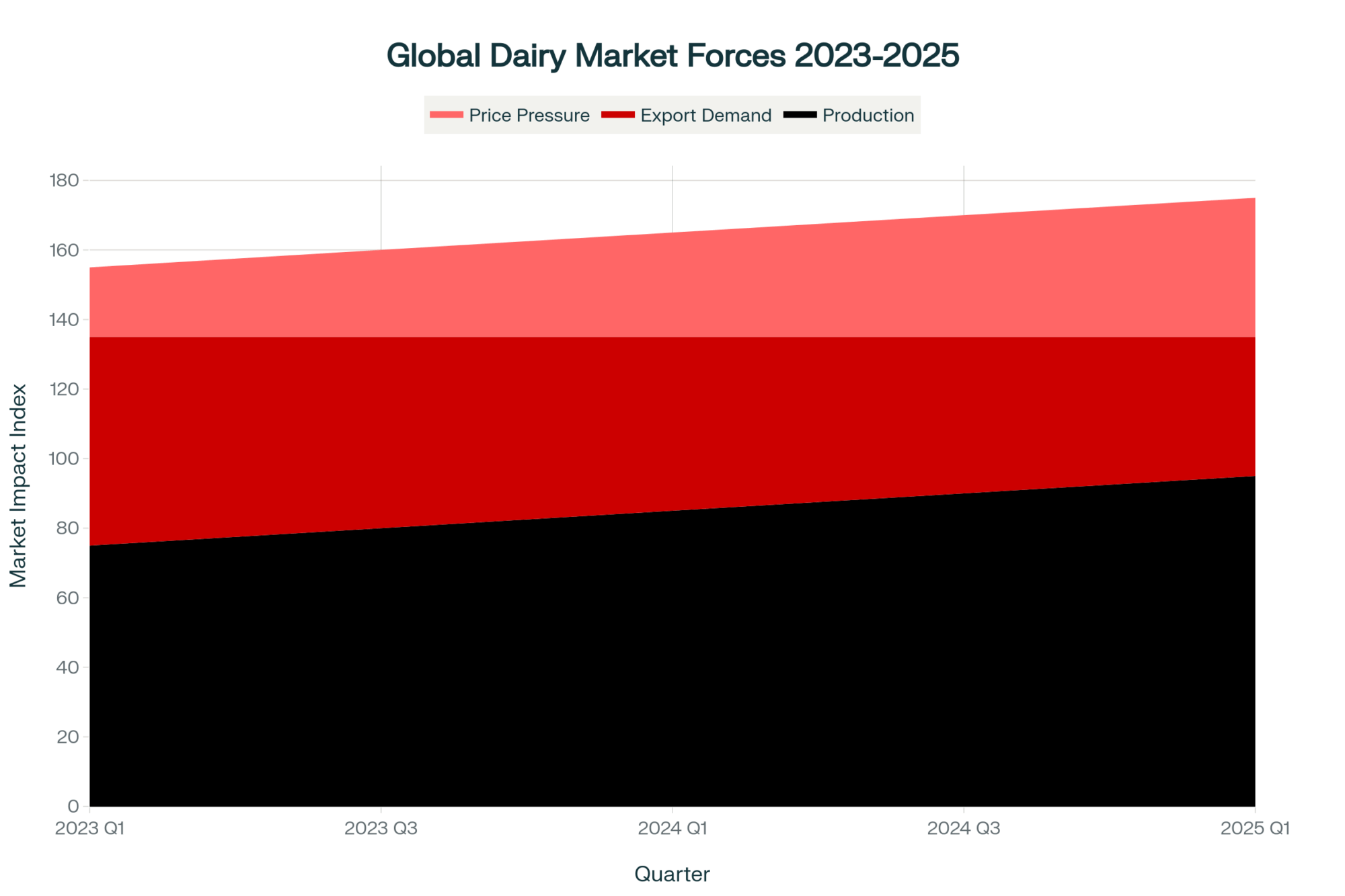
“When drought creates spot market spikes—and we’ve seen regional prices exceed $250 per ton in some areas—farms with deep inventory continue feeding from reserves. Some strategically sell excess at premium prices, turning crisis into opportunity,” his research shows.
They’re also diversifying before they have to. During my recent visit to Dr. Tom Overton’s Cornell research plots, the impacts of PRO-DAIRY’s forage diversity were really evident. Farms reducing corn silage from 60-70% down to 40-50% of forage dry matter while adding small grains, sorghum, and cover crop silages show remarkable stability.
“Multiple crop failures become unlikely when you’ve diversified appropriately. It’s basically portfolio management applied to forage,” Dr. Overton explains.
What’s particularly interesting—counterintuitive even—is deliberate production moderation. These operations target a weight of 85 to 88 pounds, rather than aiming for 95.
Dr. Mike Van Amburgh at Cornell quantified it for me: “Lower peaks, sure, but when forage quality varies 5%, these herds barely notice. Result: $1.50 to $2.00 improved income-over-feed-cost despite producing 7 to 10 pounds less milk daily.”
Different Regions, Different Challenges
While I’ve been emphasizing Pennsylvania and Vermont examples, this challenge looks different depending on where you farm.
Dr. Jennifer Heguy, UC Extension’s Central Valley dairy advisor, deals with completely different issues: “We’re not fighting moisture drift—we’re managing extreme heat impacts on fiber digestibility. Alfalfa that tests 42% NDF in June can reach 48% by September after heat stress.”
Dr. Jim Salfer from Minnesota Extension describes their unique situation: “Transition timing creates our challenge. Switching from old to new crop silage in December coincides with the onset of cold stress. Perfect storm for metabolic issues.”
Dr. Rick Norell at Idaho Extension makes an interesting observation: “Large dairies assume size provides protection, but when you’re feeding 5,000 cows, a 2% efficiency loss becomes massive. Precision becomes more critical as you grow, not less.”
And Dr. Ellen Jordan from Texas A&M AgriLife adds another dimension entirely: “Aflatoxin risk in drought-stressed corn can halt milk shipments immediately. That’s a whole different variability challenge.”
Your Action Plan—Starting This Week
Ready to tackle feed variability? Here’s your prioritized approach based on what’s actually working out there:
This Week
Calculate your actual IOFC using Penn State’s online tools or Wisconsin’s DairyComp app. Compare to regional benchmarks. Dr. Kevin Harvatine at Penn State tells me that simply understanding your position often catalyzes change all by itself.
Within Two Weeks
Invest in moisture testing. The AgraTronix MT-PRO costs approximately $340, the Delmhorst F-2000 is around $395, and the Koster units range from $280 to $ 320. They typically pay for themselves within weeks. Iowa State Extension research confirms weekly moisture testing prevents most variability losses before they compound.
Within 30 Days
Schedule a collaborative meeting with your veterinarian and nutritionist. Dr. Jessica McArt from Cornell’s veterinary college has documented that farms conducting even annual joint advisory meetings show significantly improved problem resolution.
Within 90 Days
Join a peer discussion group. Extension programs operate nationwide, including PRO-DAIRY in New York, UW Dairy Management in Wisconsin, and the Center for Dairy Excellence in Pennsylvania. Annual costs typically range from $200 to $ 600, with documented returns often exceeding 300%.
Quick Wins for Under $500
For immediate impact with minimal investment:
- Moisture tester ($340): Weekly testing prevents thousands in losses
- Fecal starch analysis ($15-20/sample): Monthly validation of ration effectiveness
- Discussion group ($200-600): Immediate access to peer experience
- Employee training: Teaching feeders to recognize changes costs nothing but prevents everything
The Clock’s Ticking
Dr. Normand St-Pierre, Professor Emeritus at Ohio State, shared something pretty sobering with me recently: “The window for addressing these challenges isn’t infinite. We’re looking at maybe 18 to 24 months before compounding losses create structural challenges.”
Think about it—delaying doesn’t defer costs. It compounds them. A 350-cow dairy losing $5,000 monthly faces more than $60,000 in annual losses. By year three? You’re looking at over $200,000 accumulated, plus deferred maintenance, reduced genetic progress, and good employees leaving for better-managed operations.

USDA Economic Research Service data from their 2024 farm financial report shows that most closures follow years of declining indicators. These operations attended conferences, understood best practices, yet never actually started implementing changes.
The 2025 growing season wasn’t an anomaly, you know. NOAA’s Climate Prediction Center October outlook shows this variability is becoming our new baseline. The question isn’t whether you’ll face feed variability—that’s certain. It’s whether you’ll manage it proactively or just react to it.
That Vermont producer I mentioned? He transformed bottom-third performance into nearly $90,000 in recovered profitability through about $1,100 in strategic investment. The Pennsylvania operation identified over $20,000 in losses during one collaborative meeting. Their success wasn’t extraordinary—they just took action.
The knowledge exists. Extension support operates nationwide. Research validates the economics. The only missing element? Implementation.
Twenty years ago, we could wait for normal to return. Five years from now, based on USDA National Agricultural Statistics Service consolidation trends, only adaptive operations will remain.
The industry isn’t failing—it’s evolving. The divide forms between operations that accept excellence and require different approaches in 2025 and those that are still resisting change.
Your corn silage keeps evolving. Costs keep accumulating. Competitors keep adapting.
So what’s your first step going to be?
KEY TAKEAWAYS:
- Weekly moisture testing prevents 80% of feed losses: A $340 investment in an AgraTronix MT-PRO or similar tester pays for itself within 2-3 weeks by catching drift before it compounds into thousands in monthly overfeeding—Wisconsin’s feed lab data shows fecal starch above 5% means you’re literally watching profits walk out the back end
- Discussion groups deliver 300%+ ROI for $200-600 annually: Cornell PRO-DAIRY’s Jason Karszes reports dozens of groups where farms like Jake’s recover $200,000+ in unrealized revenue simply by benchmarking with peers and sharing what’s actually working in their specific regions
- The 18-24 month adaptation window is real: USDA Economic Research Service’s 2024 data shows farms that delay implementation face compounding losses exceeding $200,000 by year three, plus talent migration to better-managed operations—but those acting now are turning $1,100 investments into $90,000 annual gains
- Regional challenges require regional solutions: From California’s heat-stressed alfalfa jumping from 42% to 48% NDF to Minnesota’s December silage transitions during cold stress, successful farms are adapting strategies to their specific climate realities rather than following one-size-fits-all approaches
- Deliberate production moderation beats pushing for peaks: Dr. Mike Van Amburgh’s Cornell research proves farms targeting 85-88 pounds instead of 95 gain $1.50-2.00 better IOFC despite lower production—when forage quality varies 5%, these herds barely notice while high-pushers hemorrhage profits
Complete references and supporting documentation are available upon request by contacting the editorial team at editor@thebullvine.com.
Learn More
- 11 Proven Strategies to Lower Feed Costs and Boost Efficiency on Your Dairy – This how-to guide provides practical strategies for reducing feed costs and optimizing efficiency, including rumen health management and herd grouping strategies. It offers a tactical roadmap to complement the primary article’s high-level economic analysis.
- 2025 Dairy Market Reality Check: Why Everything You Think You Know About This Year’s Outlook is Wrong– This strategic analysis reveals how policy changes and market shifts are creating new opportunities for farms focused on components over volume. It provides a crucial economic context, demonstrating why precision feeding is more profitable than ever.
- Robotic Milking Revolution: Why Modern Dairy Farms Are Choosing Automation in 2025 – This article presents an innovative solution to the labor crisis, showcasing how robotic milking systems are a long-term investment that reduces costs and improves data collection. It provides a real-world case study on using technology to enhance efficiency.
The Sunday Read Dairy Professionals Don’t Skip.

Every week, thousands of producers, breeders, and industry insiders open Bullvine Weekly for genetics insights, market shifts, and profit strategies they won’t find anywhere else. One email. Five minutes. Smarter decisions all week.




