





An Ontario plant turns New York milk into brie, and Gellert says it pays a 50% duty to import it. Its US$40M annual estimate is a border cost, not a measure of lost Canadian milk demand.
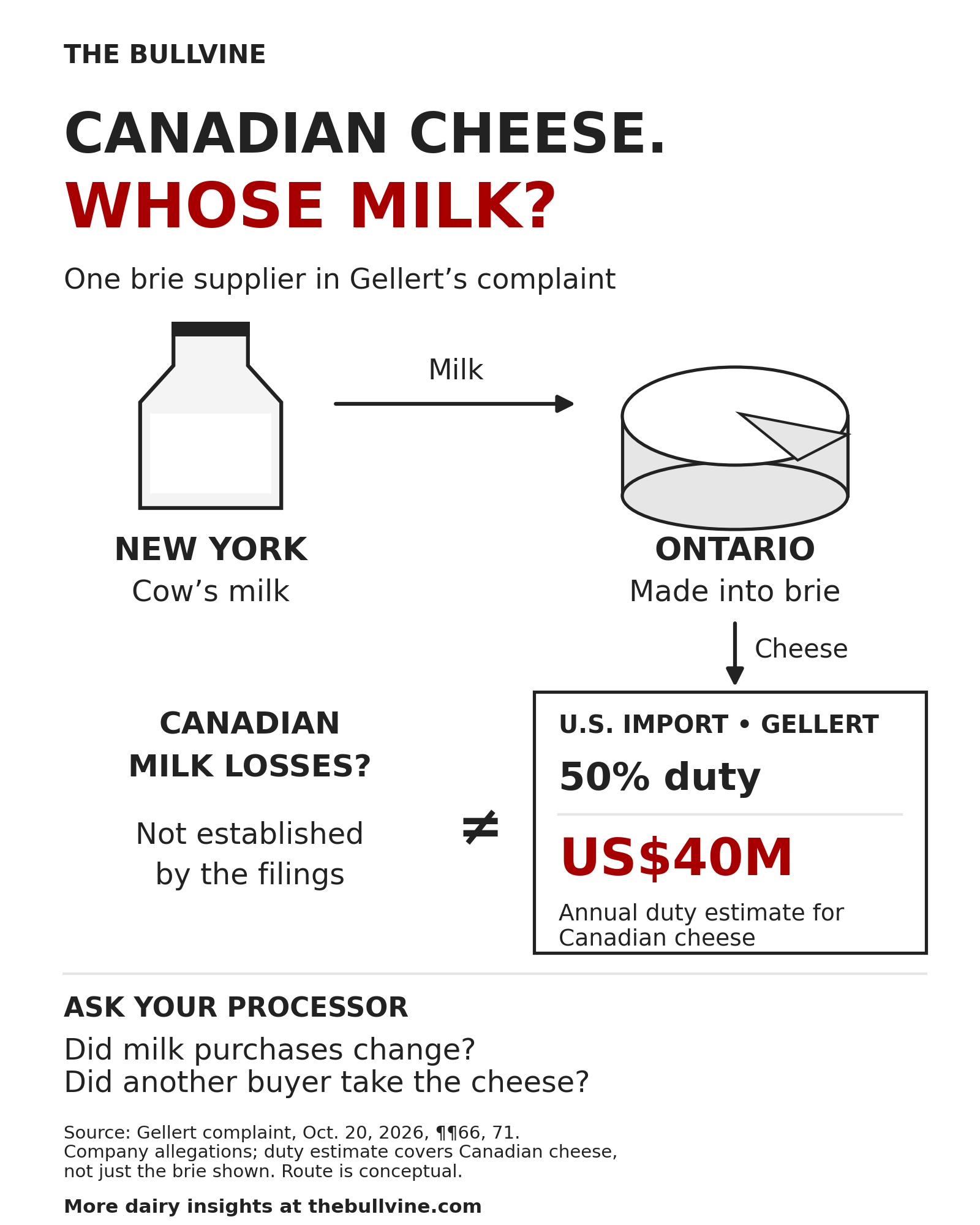
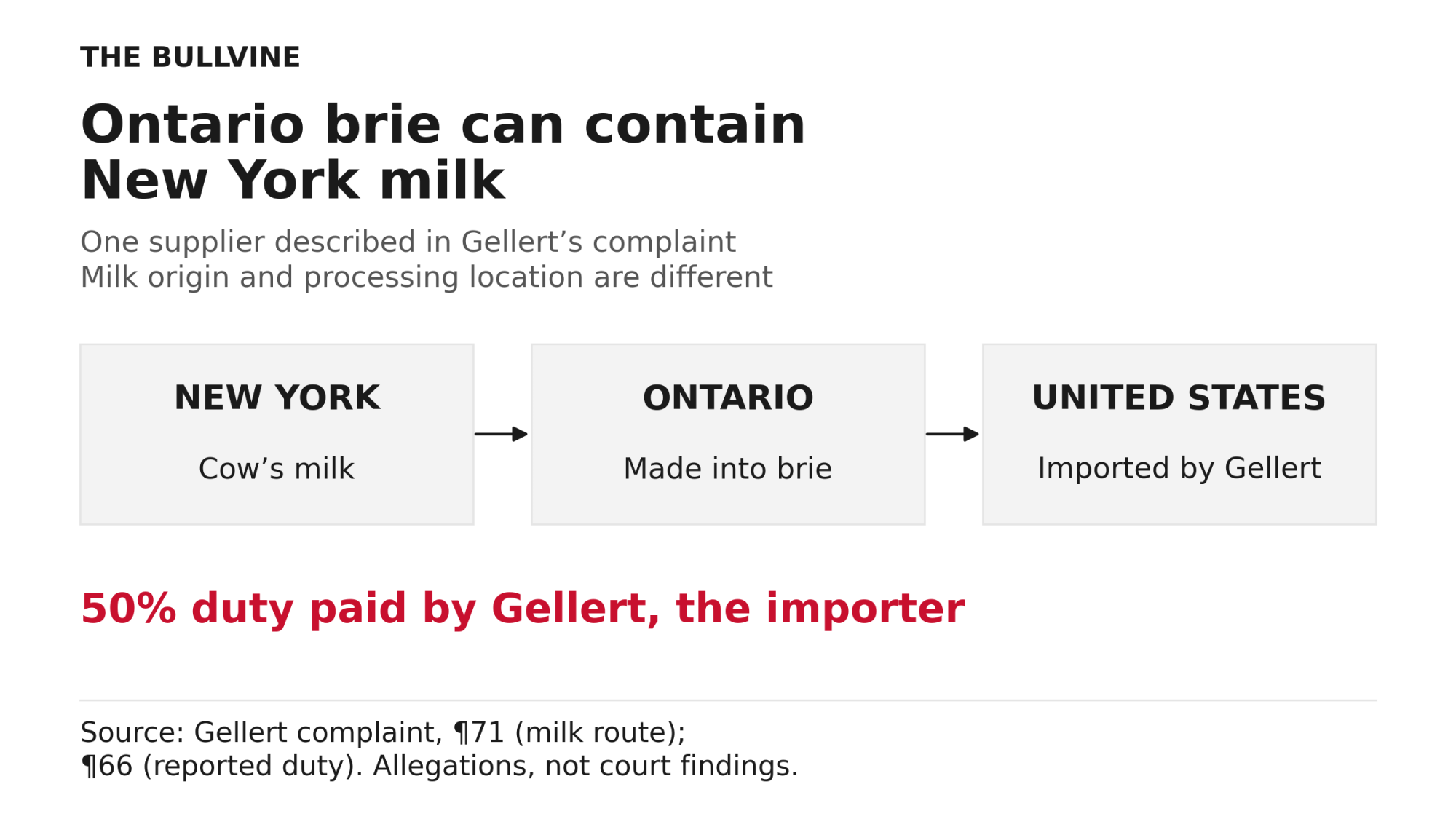
An Ontario cheesemaker buys cow’s milk from dairies in upstate New York, turns it into brie and ships it back to the United States. That’s according to a complaint filed by importer Gellert Global Group (¶71). Once that brie crosses the border, Gellert says, it pays a 50% duty on it. Gellert says its Canadian cheeses enter at Alexandria Bay and Champlain, New York, and at Detroit (¶68).
The U.S. began applying the 50% duties under Section 338 of the Tariff Act of 1930 on August 22, 2026, according to the Congressional Research Service. The duties target selected Canadian goods and carry no exemption for USMCA-qualifying products. Gellert estimates the duties will cost it US$40 million a year on Canadian cheese (¶66). It says it has already paid at least US$520,538 on 22 entries made between September 16 and October 11, 2026 (¶67). Neither figure shows how much Canadian cow’s-milk demand is at risk.
The Elizabeth, New Jersey-based importer filed its complaint at the U.S. Court of International Trade on October 20, 2026 (Case No. 26-cv-04636). It asks the court to declare the duties unlawful, stop their collection, and order refunds with interest. On October 23, Gellert filed a motion asking the court to halt collection immediately while the case proceeds and to rule against the tariffs on the merits.
On October 28, the court granted Gellert’s motion in part and denied it in part. The docket entry doesn’t say which parts. The scheduling order, as reproduced on CourtListener, sets December 11 for the government’s response and January 11, 2027, for Gellert’s reply. The October 28 order leaves the oral-argument date to be determined. Those are briefing dates, not a timetable for refunds.
What the filings show about milk exposure
Paragraph 71 says one Ontario supplier makes its brie from New York cow’s milk. It doesn’t say what share of that supplier’s milk comes from the United States.
Gellert’s portfolio runs to more than 15 product lines (¶62). It includes sheep’s milk and goat’s milk cheeses, which can’t simply be counted as Canadian cow’s-milk demand. Gellert’s declaration identifies its brie and mascarpone as cow’s-milk cheeses.
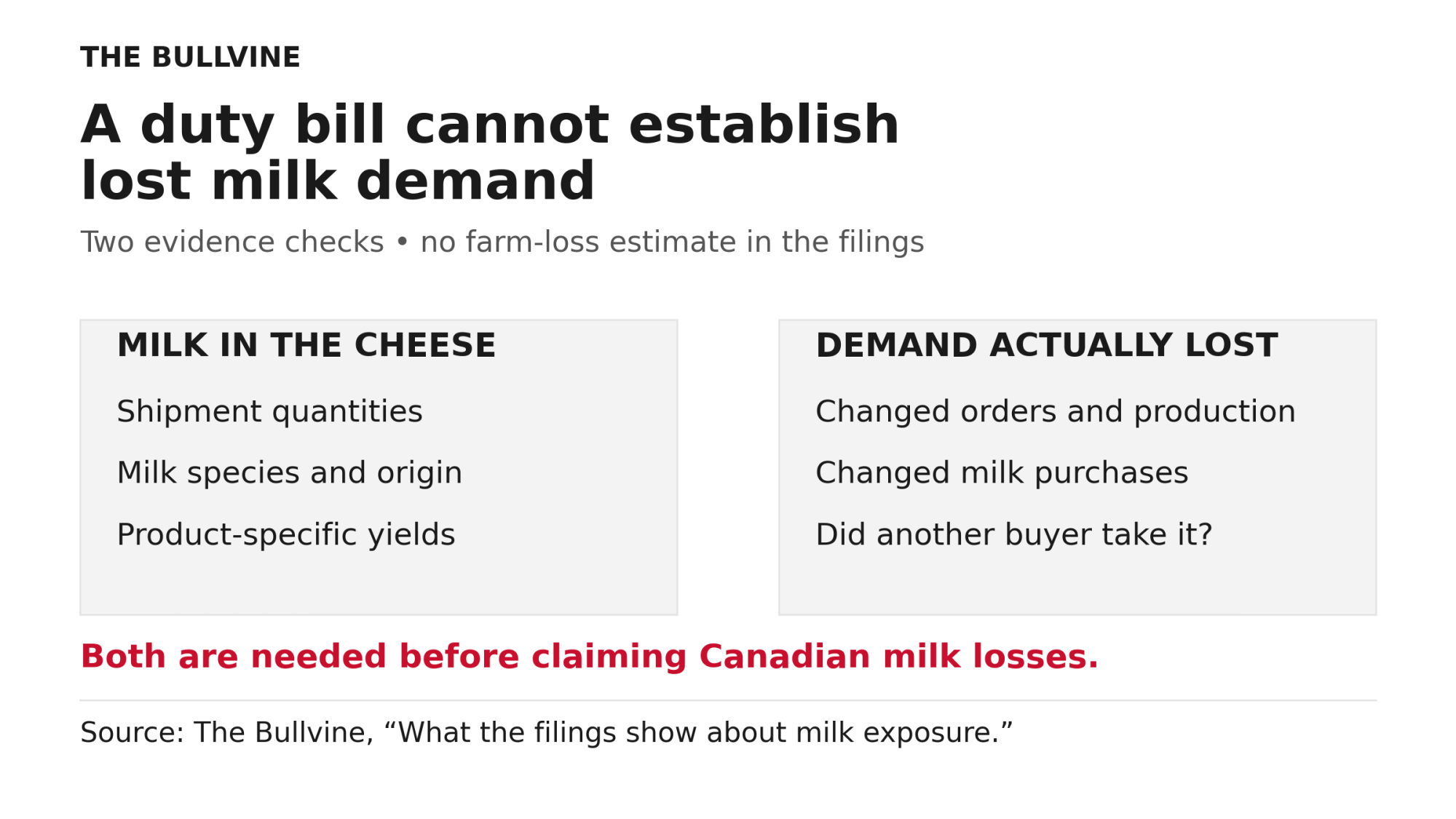
Calculating the milk used to make the affected cheese requires:
- shipment quantities
- milk species
- where the milk came from
- product-specific yields
Proving lost milk demand requires evidence that sales or production actually declined:
- changed orders
- changed production
- changed milk purchases
- whether the cheese, or the milk, found another buyer
In a declaration filed October 23, co-CEO Thomas S. Gellert says the company is absorbing the duty through the end of 2026. He attributes delayed hiring and investment, pressure on working capital, and reduced margins to absorbing those costs. These are the company’s own statements, not court findings.
Separately, Gellert forecasts that if the tariffs continue, it will have to raise prices. It expects lost or reduced sales and supply-chain disruption as producers scale back (¶70). The filings reviewed don’t quantify the timing or size of any losses, or any actual change in orders or milk purchases.
What the US$40 million measures
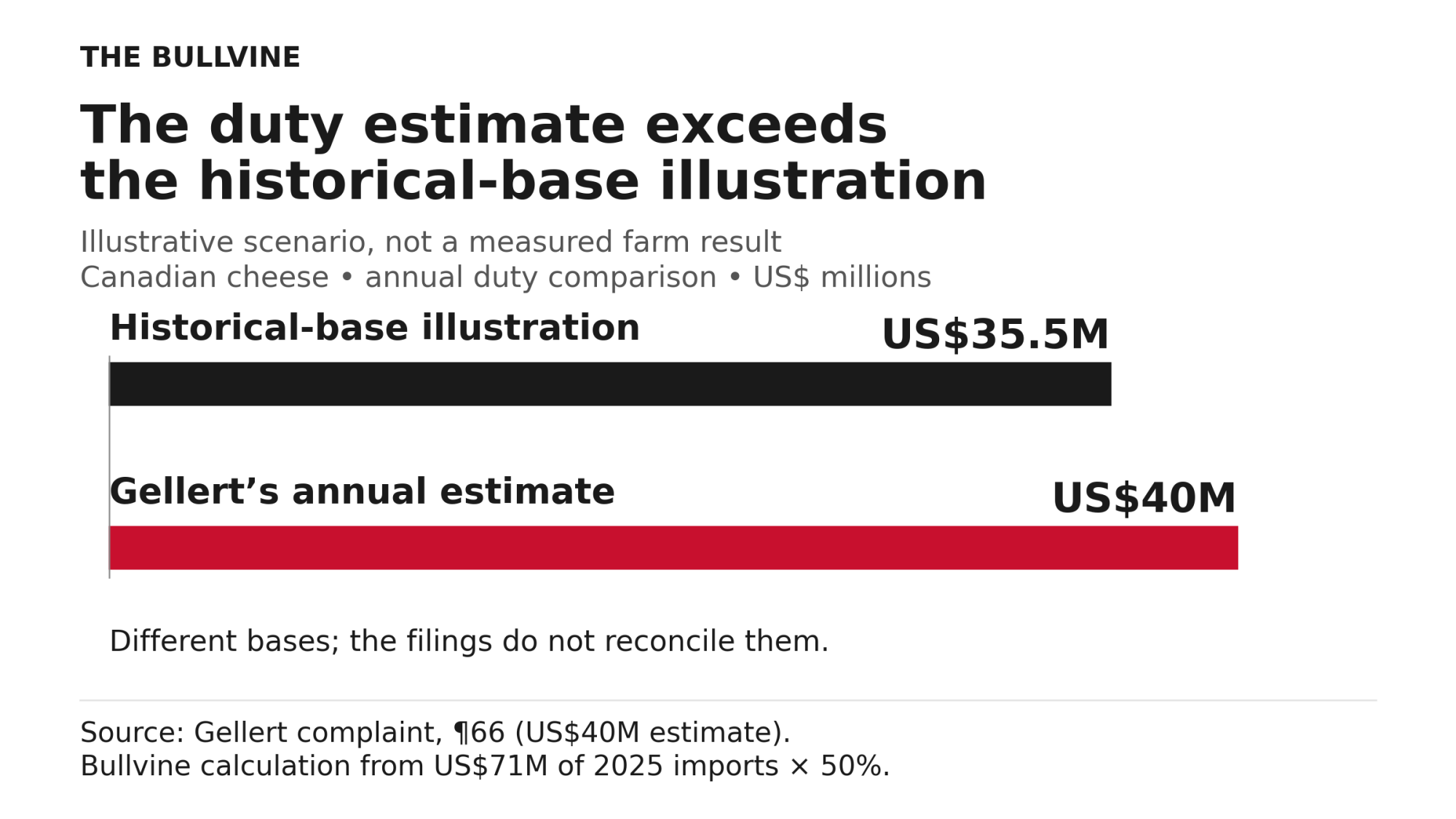
Gellert says it imported roughly US$71 million of Canadian cheese in 2025, duty-free under USMCA. It now pays 50% of the entered value, which is the customs value the duty is calculated on. It estimates that comes to US$40 million a year (¶¶62, 66).
- 2025 Canadian cheese imports (Gellert): roughly US$71 million
- Annual duty estimate (Gellert): US$40 million
- Historical-base illustration (Bullvine math, not an expected bill): US$71 million × 50% = US$35.5 million
- Annual taxable value implied by the estimate (Bullvine math): US$40 million ÷ 50% = US$80 million
The US$80 million implied taxable value sits roughly US$9 million above Gellert’s reported 2025 import value. Neither the complaint’s paragraphs cited here nor Gellert’s declaration reconciles the two, so the gap is unexplained. That doesn’t show the forecast is wrong, and both underlying figures are rounded.
Why cheese falls under the alcohol and auto tariffs
The administration says the duties offset Canadian discrimination against U.S. trade. In a statement to Fox Businessafter the suit was filed, an unnamed administration official said Section 338 lets the President offset “Canada’s continued discrimination against American dairy, alcohol, and auto exports.” The official said the administration “will defend vigorously the President’s actions in court.”
On dairy, the administration’s grievance is about quota access for retailers. According to the CRS summary of the dairy proclamation, Canada lets retailers hold cheese-quota allocations under its trade agreement with the EU, but not dairy-quota allocations under USMCA.
Gellert says that same dairy proclamation “does not reach cheese at all” (¶60). Its cheeses were added on September 8 through amendments to the alcohol and motor-vehicle actions, and collection started September 15.
Every import is classified under the U.S. tariff schedule, known as the HTSUS. Goods covered by these duties also carry a second tariff code that identifies the extra charge. Gellert’s filings report both for its cheese (¶66):
- Chèvre-style goat’s milk cheese, brie and camembert: tariff schedule line 0406.90.99, extra-duty code 9903.03.14, under the motor-vehicle action as amended by Proclamation 11065.
- Sheep’s milk cheese, mascarpone and borgonzola: tariff schedule line 0406.40.54 for borgonzola, extra-duty code 9903.03.12, under the alcohol action as amended by Proclamation 11064. The filings don’t give the regular lines for sheep’s milk cheese or mascarpone.
These are the classifications and treatment Gellert reports for its own products. They aren’t blanket classifications for every cheese with the same name.
The product list keeps changing. Proclamation 11076 rewrote the motor-vehicle product list again for goods entered from October 30, 2026. “Canadian cheese” isn’t a customs description. A broker’s check against current rules covers four items:
- the product’s classification
- its origin
- the extra-duty provision that applies
- the date that provision took effect
The legal fight and the narrow timing claim
Gellert challenges both the legal authority for the tariffs and the timing of collection on newly added goods. Duties on products added September 8 began September 15, seven days later, instead of after the 30-day wait Gellert says the law requires. Gellert’s declaration says it paid at least US$381,000 on entries made between September 15 and October 7, 2026, the window that timing claim covers.
An order stopping collection would change duties on future covered entries. A refund order would return duties on eligible past entries. How far either reaches depends on what the order actually covers. A win on the timing claim alone would address that window, not later collections.
What this means for operations
Processors and exporters
Each affected product needs its classification, origin, extra-duty provision, and effective date confirmed by a customs broker against current rules, including the October 30 list change. That check matters most when a U.S. customer changes prices, volumes, or delivery plans. September 15 isn’t the start date for every product. The file for each product should also hold:
- shipment value and volume
- the documented milk source
- any order change
- the contract terms on who carries tariff costs and who would receive any refund
Importers
A broker or counsel should review entries carrying these duties, especially products newly added to the tariff list and entered between September 15 and October 7. That window comes from Gellert’s own claim and doesn’t establish refund eligibility. Nor does the briefing schedule establish whether collection has been halted or refunds authorized. Even a court order can leave scope, eligibility, implementation, or a stay unresolved. Until entitlement and payment timing are clear, a potential recovery isn’t available cash.
Producers
Milk-marketing organizations and processors can say whether changes in milk requirements or market outlets tied to U.S. cheese orders have been documented. The useful answer comes with quantities and dates, and says whether affected product found another buyer. The filings don’t establish a production loss for an individual Canadian farm.
What is Section 338 costing your U.S. exports?
Calculate your farm or plant’s potential duty exposure based on the 50% tariff rate applied to Canadian cheese. Assess your border risk in under 60 seconds.
How we calculate this
Taxable Value Exposed = Total Export Value × (Percentage on List ÷ 100).
Duty Cost = Taxable Value Exposed × 50%. The 50% penalty rate is stipulated by Section 338 of the Tariff Act of 1930, applied to Canada starting August 22, 2026.
Complete references and supporting documentation are available upon request by contacting the editorial team at editor@thebullvine.com.
Learn More
- New 25% Border Tax Hits Dairy Trade: What It Means For Your Farm — Calculates the exact financial fallout of the escalating trade war on your milk check. Breaks down a projected +$1.70/cwt Class III swing and equips you to protect margins before the 2026 USMCA review hits.
- Trump’s Dairy Tariff War: How U.S. Farmers Could Benefit from Canada’s Trade Barriers — Exposes the specific TRQ loopholes currently restricting northern market access. Follows the money on $8.2 billion in exports to reveal how aggressive reciprocal duties could permanently unlock massive new market share for American producers.
- 438,000 Missing Heifers. $4,100 Price Tags. Beef-on-Dairy’s Reckoning Has Arrived — Delivers a recalibrated breeding strategy to survive the current replacement shortage. Dismantling the aggressive beef-on-dairy trends of 2023 proves exactly why cutting terminal matings immediately preserves hundreds of thousands in farm equity.
The Sunday Read Dairy Professionals Don’t Skip.

Every week, thousands of producers, breeders, and industry insiders open Bullvine Weekly for genetics insights, market shifts, and profit strategies they won’t find anywhere else. One email. Five minutes. Smarter decisions all week.