










By summer 1994, just two Holsteins had sold a million doses. Mogul and Supersire later joined the club, but genomics changed how bulls earned their place and passed on their influence.
A Bull at the Royal
In November 2000, the guest of honor at Toronto’s Royal Agricultural Winter Fair wasn’t a cow. It was a bull.
Madawaska Aerostar was more than 15 years old. He’d been flown thousands of kilometers from his home barn in British Columbia and given a private pen. Thousands of visitors from around the world came to see him. According to reports, he was likened to Wayne Gretzky, a comparison Canadian cattle people could appreciate. It was the first time in decades that a mature bull had visited the Royal.
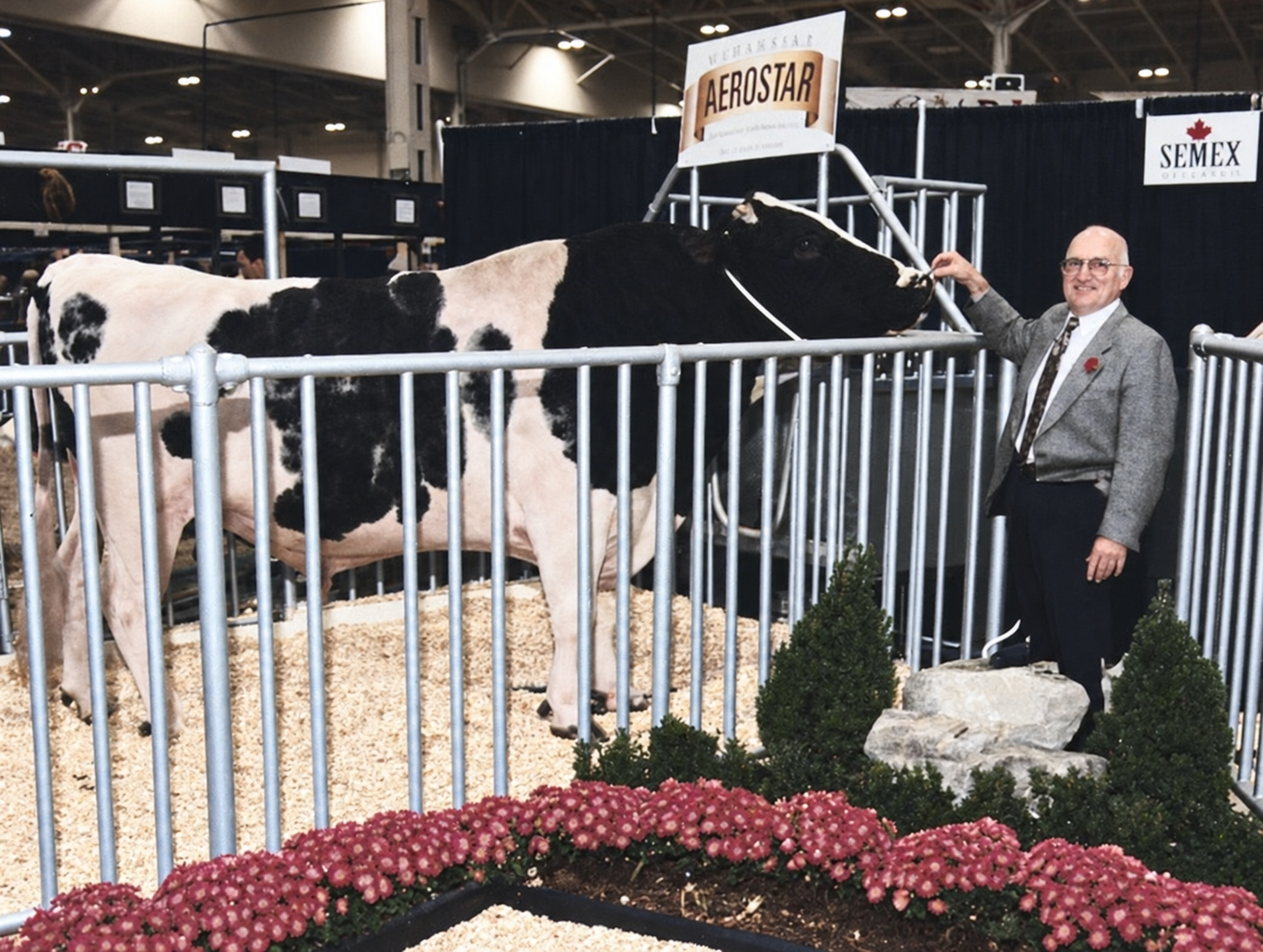
The crowds came for the cows he had already put in their barns.
Aerostar’s career eventually accounted for 1,230,476 doses of semen sold. His sons Startmore Rudolph and Oliveholme Aeroline also became millionaires. Through his daughter Condon Aero Sharon, he was the maternal grandsire of Picston Shottle, another member of the club.
A bull earned that kind of following slowly in those days. He went to stud, sired test daughters and waited for them to calve and milk. The successful ones returned as daughter-proven sires with working cows behind their figures, and farmers could order them again for years.
Select Sires called Fisher-Place Mandingo the “Come-Back Bull” because farmers who used him came back. A Valiant son out of Wapa Bootmaker Mandy, bred at Wapakoneta, Ohio, by Alison Place and Philip Fisher, Mandingo became the first bull to pass a million doses sold. Media reports remembered him as a uniform all-rounder, positive for milk, fat and type, without many extremes in either direction.
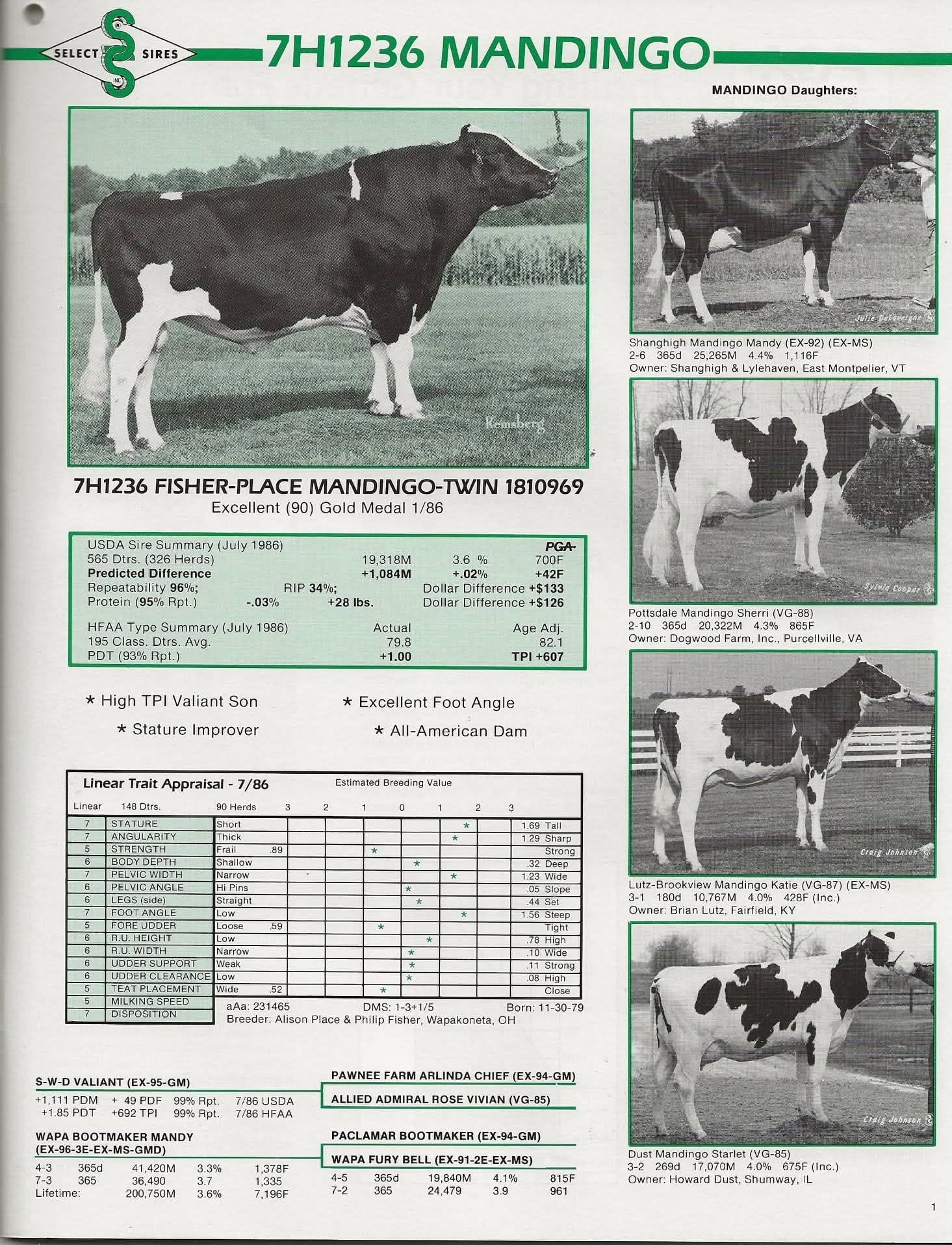
By the summer of 1994, the entire Holstein millionaire club had two members, Mandingo and the Dutch-bred Skalsumer Sunny Boy. Sunny Boy’s lifetime total, built on fresh as well as frozen semen, reached 1,767,000 doses. His semen went to North America in 1992. For decades the traffic had run the other way, with North American Holstein genetics heading to Europe.
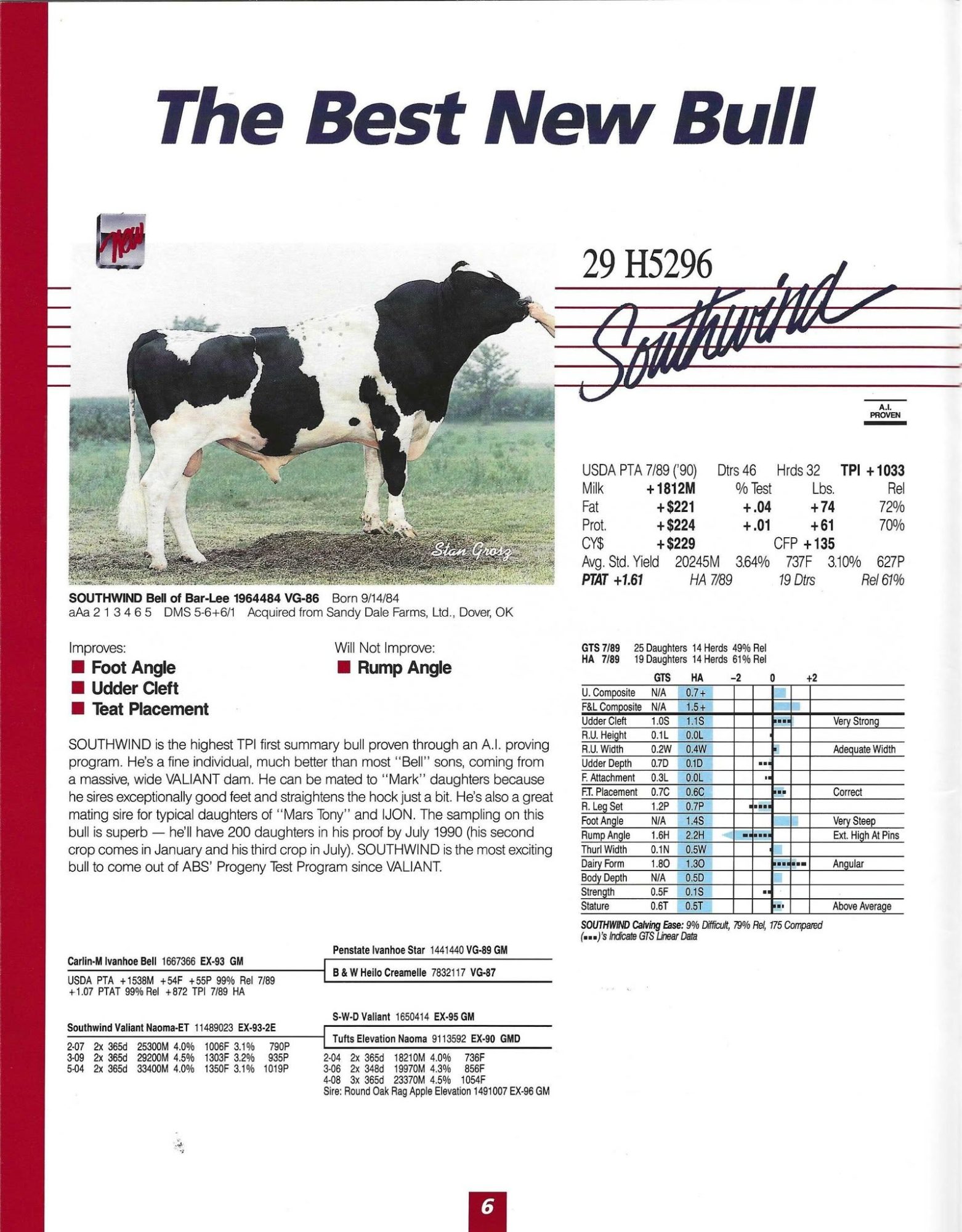
Robert Yeoman of Oklahoma hadn’t wanted to buy Southwind Valiant Naoma. The pregnant Valiant heifer’s teat placement concerned him, and she was carrying a calf by Bell, “a bull that did not appeal to me at all,” he recalled. He was persuaded to buy her anyway.
When the bull calf arrived, Yeoman kept him while he watched Naoma develop. Once she was milking, her teat placement “was not disappointing,” in his words. She was only about two months into that lactation, and not yet classified, when ABS sire analyst Dick Smith came to see her and asked what Yeoman wanted for the calf. Yeoman named his price and, by his own account, thought he’d never hear from Smith again. The next morning Smith called with a counter-offer of less cash up front plus a share of semen sales. The deal closed quickly, Yeoman recalled, because the calf had to leave the state before bluetongue season began.
Naoma went on to score VG-88 as a two-year-old and later EX-93. Her calf, born in 1984, was Southwind Bell of Bar-Lee.
“Southwind paid for my retirement!” Yeoman later said.
Jenny-Lou Mrshl Toystory took the count past two million. His breeder at Jenny-Lou Farms in Wisconsin named him after the favorite movie of the Breunig children. The publication recorded 2.36 million doses sold, 2.3 million conventional and 60,000 sexed. In 2010 alone he supplied approximately 386,000 doses, more than a thousand a day across the year.
By summer 2016, the publication’s millionaire book counted 53 bulls. It also forecast that probably no other bull would reach two million doses.
Genomic selection was changing the business. Young bulls could be selected and used on far more information than pedigree alone supplied, before their daughters established a conventional proof. Proven sires now faced stronger competition from younger animals, among them two calves born in 2010 to separate branches of one cow family, Mogul and Supersire.
At a Glance
- In summer 1994, only two Holsteins had sold a million doses, Fisher-Place Mandingo and Skalsumer Sunny Boy. By summer 2016, there were 53.
- In 2008, the Andersens bought the pick of a flush. Genomic test results in August 2009 helped them choose Shauna from three full sisters.
- S-S-I Montross Jedi joined the Mogul and Supersire lines. At his August 2021 death announcement, Select credited him with more than 600,000 units and seven daughter-proven sons.
- Descent from Supersire doesn’t make an animal a carrier of early-onset muscle weakness (MW), and avoiding carrier-to-carrier matings reduces the risk of affected calves.
The Pick of a Flush
At the 2008 Eastern Elite Sale, the Andersen family of Seagull Bay Dairy in American Falls, Idaho, bought a first-choice female opportunity from the Rudy Missy family.
Greg Andersen later told The Bullvine that the family genomic-tested Shauna as a calf, along with her two full sisters, to decide which of the three to take. When the results came back in August 2009, Shauna ranked fourth among heifers in the breed.
Ammon-Peachey Shauna was a Planet daughter whose maternal pedigree ran through Shottle and O-Man to Wesswood-HC Rudy Missy, a Rudolph daughter. Through Rudolph, the bull honored at the Royal stood in the pedigree of a heifer chosen by genomic test.
Farther back stood Mandingo. His daughter Wesswood Mandingo Ivy produced Wesswood Elton Mimi, the dam of Rudy Missy.
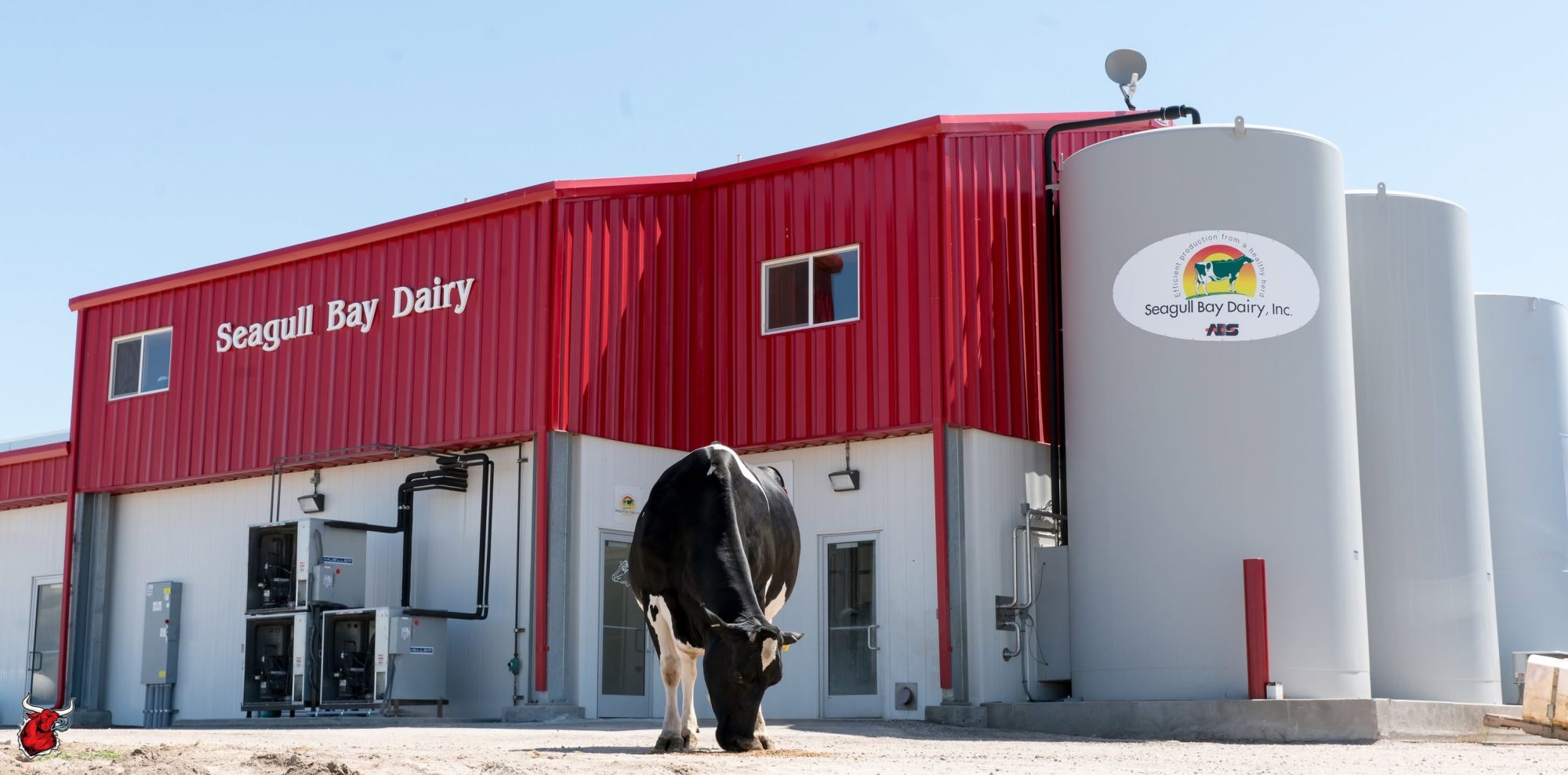
Shauna scored VG-87 as a two-year-old and later reached EX-92-2E.
“If a hot genomic bull falls out of favor when milking daughters enter his proof, then you have a hole in a previously solid pedigree,” the family told The Bullvine in April 2012.
IVF let them use several young sires on Shauna. “We used Robust on Shauna because we knew the cows behind him so well that it gave us confidence in him,” the family said.
The Robust mating produced Seagull-Bay Supersire, born December 28, 2010. By April 2012, Supersire and his full brother Headliner were both among the breed’s top five young sires for GTPI, Holstein USA’s Total Performance Index calculated with genomic information.
Alan Andersen raised a longer-term concern. “As genetic progress accelerates with genomics so will the increase in the breed’s inbreeding percentages,” he said.
Across the country, Roger and Phil Marshfield of Mountfield Farms at Marcellus, New York, were working with another Rudy Missy branch. Their cow Mountfield Marsh Maxine descended through Pine-Tree Missy Miranda, an O-Man daughter of Rudy Missy. The Marshfields later said they’d believed in Maxine’s sons before the science could prove it.
Select Sires purchased Maxine’s Dorcy son as an embryo. He entered its Aggressive Reproductive Technologies program, ART, and became Mountfield SSI DCY Mogul, born June 22, 2010.
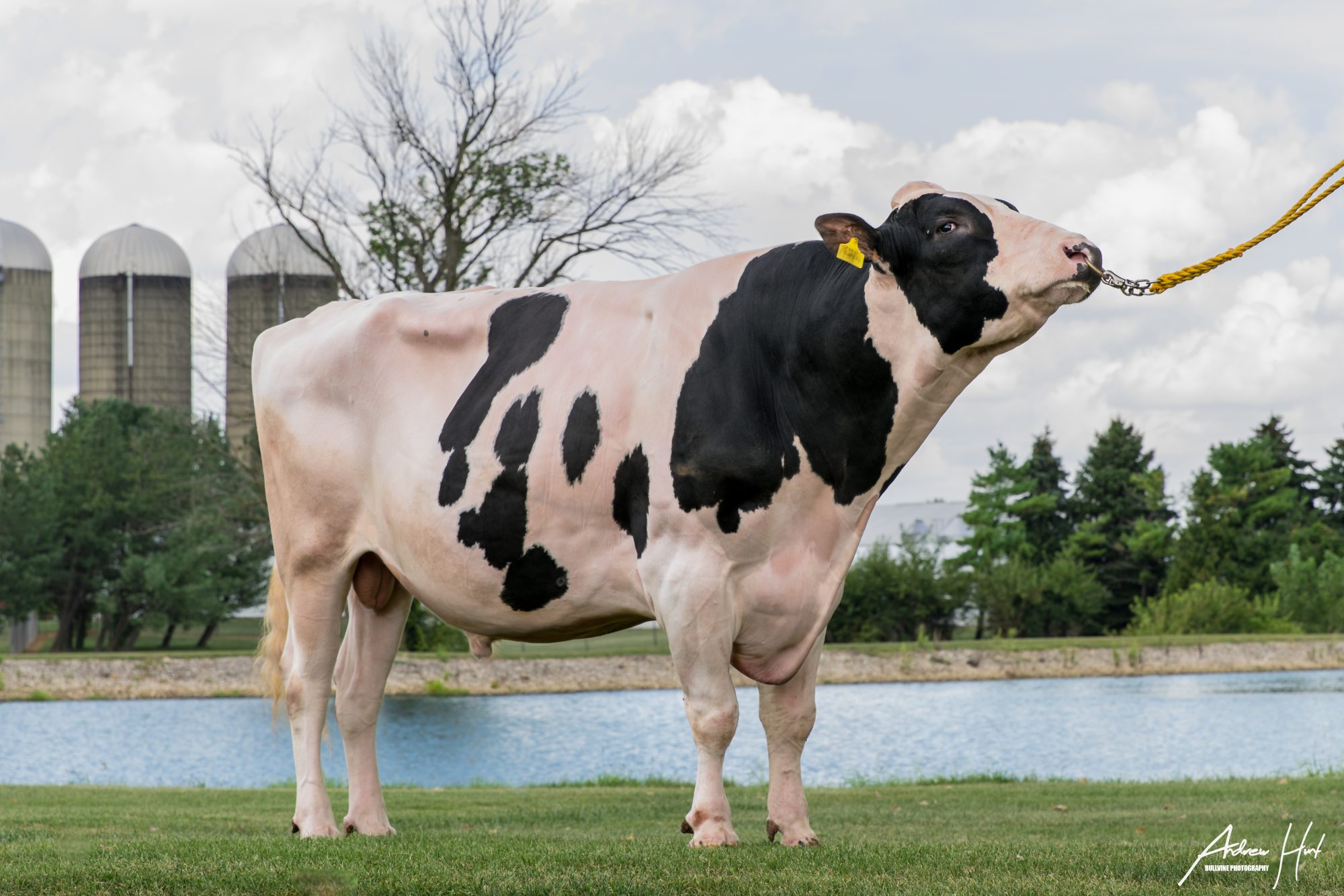
In December 2011, Mogul debuted as the breed’s second-ranked genomic young sire. When his daughters reached breeding age, Select’s own account recorded the complaint about “fat bred heifers.” Once those heifers calved, Select reported extraordinary udders, feet and legs, and strong milking ability. Three years after his debut, Mogul reached the top of the TPI list.
The full episode appears in The Bullvine’s “They Called Mogul’s Heifers Fat. Then Came the Million Doses.”
The Daughter Proof
In April 2015, Supersire entered Select Sires’ daughter-proven lineup as the breed’s No. 1 GTPI sire, and he held the lead for four consecutive evaluations. Three years earlier, Alan Andersen had reminded other breeders that genomic reliabilities were “still well below daughter proven bulls with over 100 daughters.” Supersire’s first daughter proof upheld the genomic ranking that had put him among the top five young sires.
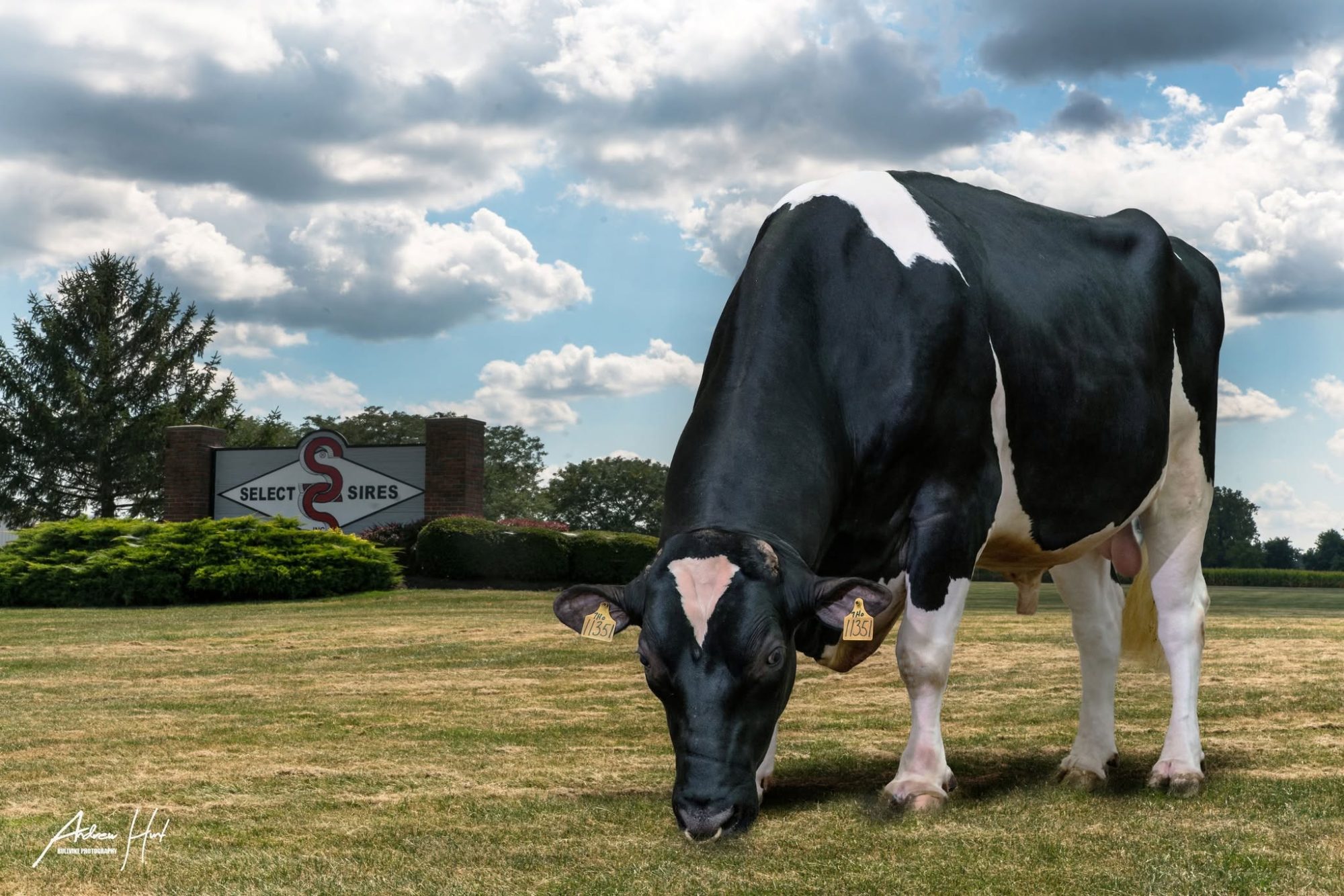
Mogul exceeded a million units in September 2017, at seven years old, as Select’s tenth millionaire and its youngest at the time. Supersire followed in 2018, at seven years and ten months.
Bacon-Hill Montross was a Mogul son out of Unique-Style Bolton Money. He was bred by the Peck family of Welcome-Stock Farm and their partners in Bacon-Hill Holsteins LLC, Tom Kugler and Jim Copper, at Schuylerville, New York.
While Montross was still unproven, he was mated to S-S-I Suprsire Miri 8679, a young Supersire daughter who hadn’t freshened. The resulting calf, S-S-I Montross Jedi, joined the two branches in one pedigree. Nobody waited for Montross’s daughter proof, then waited again for Miri’s mature performance. Select’s account identified the mating as an example of ART’s aim to shorten the generation interval.
Jedi debuted as the industry’s No. 1 available GTPI young sire in August 2015. He graduated within the breed’s top ten when he entered Select’s daughter-proven lineup in August 2018.
In April 2015, Supersire entered Select Sires’ daughter-proven lineup as the breed’s No. 1 GTPI sire.
At its August 30, 2021 death announcement, Select credited Jedi with more than 600,000 units sold, more than 26,000 daughters in 18 countries, seven sons in its daughter-proven lineup and a position as maternal grandsire of more than 55 sires.
On September 9, 2020, Select announced Mogul’s passing. Later that September, Select welcomed Montross to the millionaire club as he approached his eighth birthday.
In late July 2021, Select announced Montross’s death. Holstein sire analyst Rick VerBeek called him “one of those rare bulls to sire extreme production, medium size, great strength and tremendous high, wide rear udders.” Jedi died the following month. On November 29, 2021, Select announced Supersire’s passing.
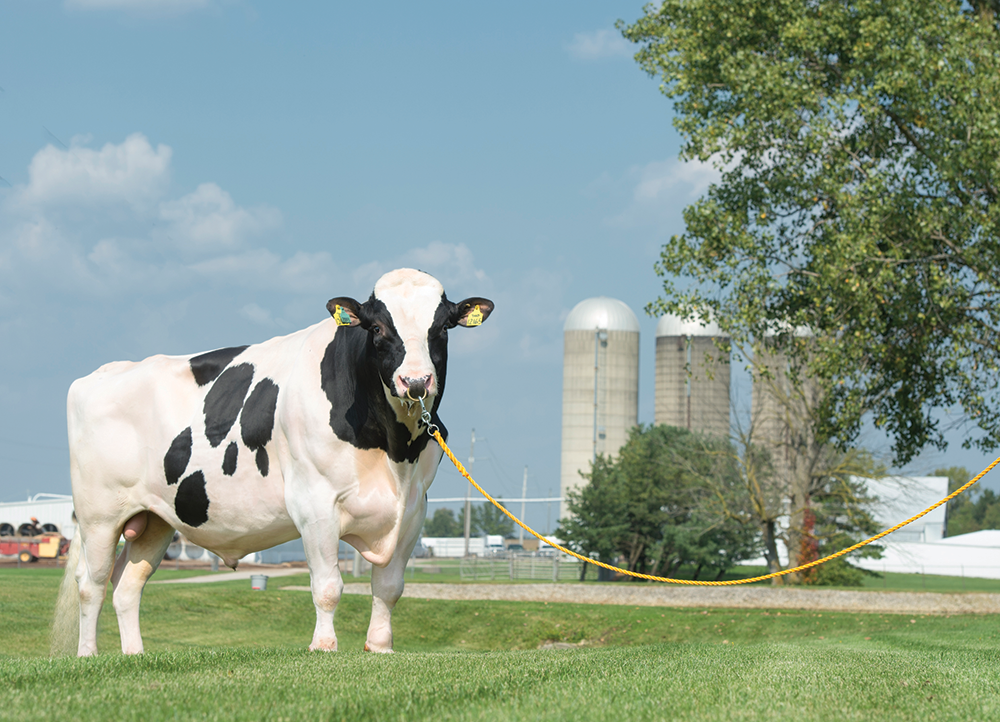
Four closely connected bulls had died in little more than fourteen months.
Supersire’s production proof already contained more than 72,000 daughters. His obituary identified influence on both sides of pedigrees, maternally behind bulls including Helix and Duke, and paternally behind others including Frazzled.
Four closely connected bulls had died in little more than fourteen months.
What Rode Along
Early-onset muscle weakness, or MW, first showed up as calves that couldn’t stand, a condition called recumbency. The affected calves traced to a common ancestor, Roylane Socra Robust, born in 2008. Working through genotypes from 5.6 million Holsteins, the team behind a Journal of Dairy Science study followed the associated haplotype, a block of DNA inherited together, four generations further back to a key ancestor born in 1984, Southwind Bell of Bar-Lee. From there it went back to Osborndale Ivanhoe, born in 1952.
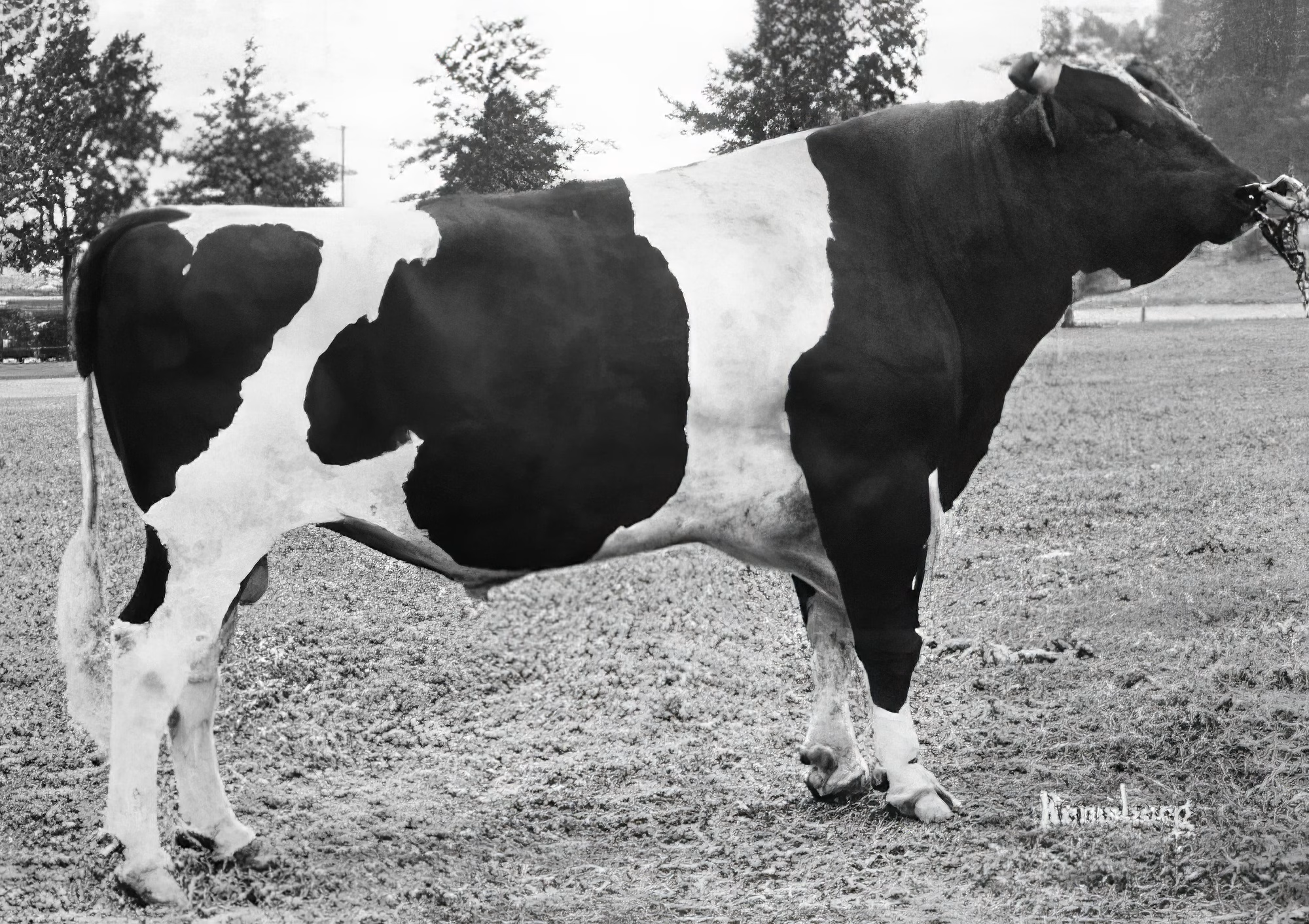
Genomics didn’t create the problem. The ancestral DNA segment long predated genomic selection, and nothing in this account identifies Jedi as a carrier.
A mutation is a change in DNA sequence. This one occurred within that inherited block, in the CACNA1S gene. Southwind carried two copies of the old haplotype but one copy of the mutation, which is recessive, so a calf has to inherit it from both parents to be at risk. The paper found that the popularity of Robust and his descendants, Supersire among them, amplified its spread.
Among 46 heifers with livability records that carried two copies of the haplotype and traced on both sides through Robust, 52% died before 18 months. Those that died averaged 1.7 months of age. For noncarriers, the death rate was 2.4%. The authors cautioned that the death rate may be underestimated if only healthier calves were genotyped.
The researchers called the condition “not fully penetrant,” meaning not every calf with two copies is affected the same way. Some calves homozygous for the mutation became normal, productive adults.
U.S. evaluations introduced an HMW haplotype call, and on April 17, 2024, Lactanet published its notice on the new genetic condition and its haplotypes.
Ancestry isn’t a test result. Descending from Supersire doesn’t automatically make an animal a carrier, and avoiding carrier-to-carrier matings reduces the risk of producing affected calves.
In July 2026, Swiss researchers reported the first confirmed European case in a Holstein calf.
Lactanet’s August 2026 inbreeding update reported average inbreeding of 10.32% among registered Canadian Holstein heifers born in 2025, up about 0.25 percentage points a year since 2010. Alan Andersen had warned in 2012 that inbreeding would rise as genomics sped up genetic progress. The Lactanet figure describes the population, not any one bull’s contribution, and it measures something different from MW carrier status.
Still Coming Back
In May 2022, shortly before his tenth birthday, Mr OCD Epic Dragonheart exceeded a million units sold. “In the era of genomics, when no one thought a bull would reach millionaire status, DRAGONHEART has achieved that coveted milestone,” said Jonathan Lamb of Oakfield Corners Dairy.
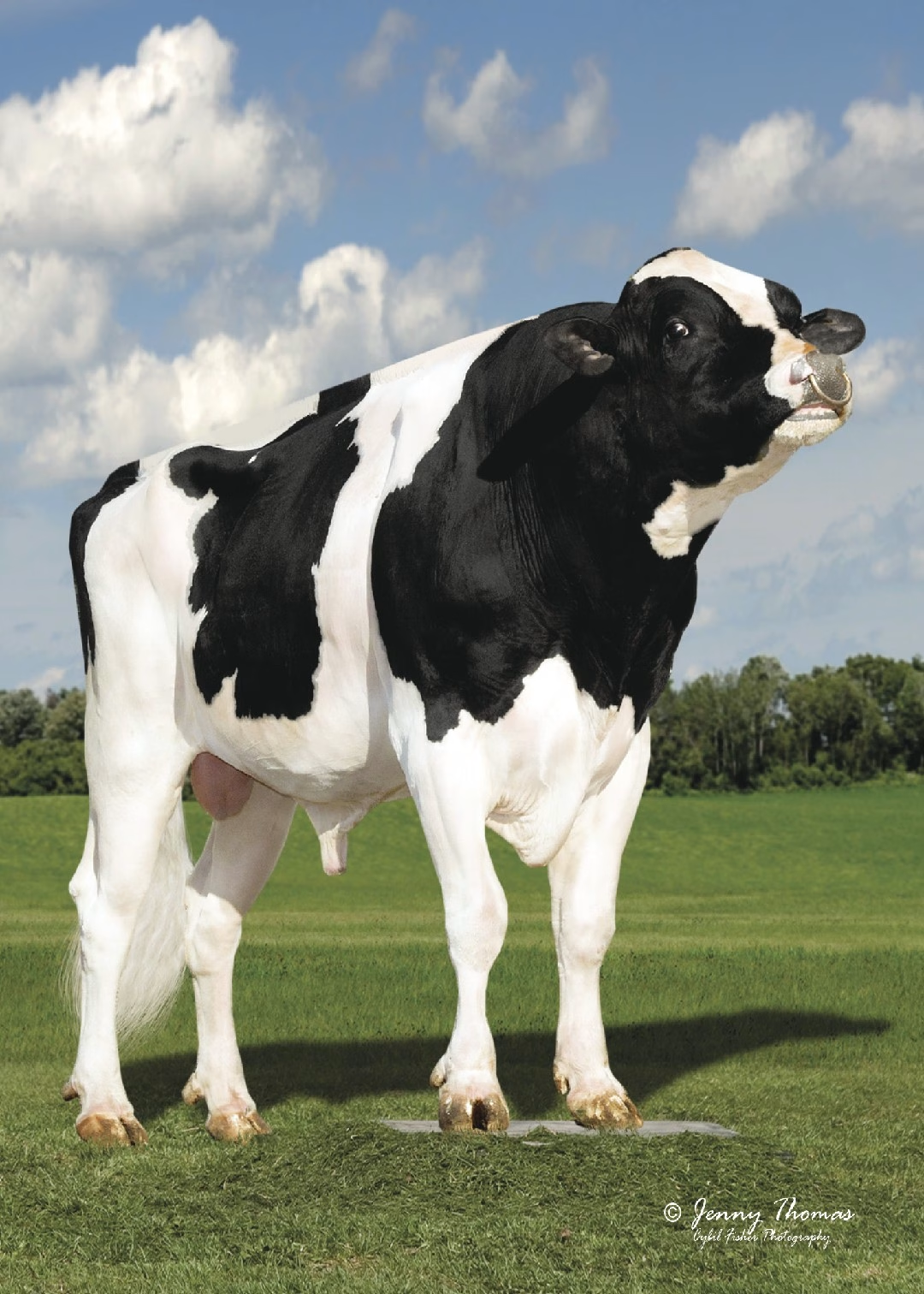
Woodcrest King Doc came from the Cruikshank family’s Woodcrest Dairy in Lisbon, New York. Select described his dam, WCD-ZBW Mack Daddy, as a “barn favorite of the Cruikshank family.” In June 2022, at a Wisconsin auction, Doc’s daughter S-S-I Doc Have Not 8784 sold for US$1.925 million.
Select’s Kevin Jorgensen said that “within the Showcase program, DOC defined crossover for the past decade.” Doc died in June 2025. That September, Select announced he had exceeded a million units sold, the first sire in its Showcase program to do so.
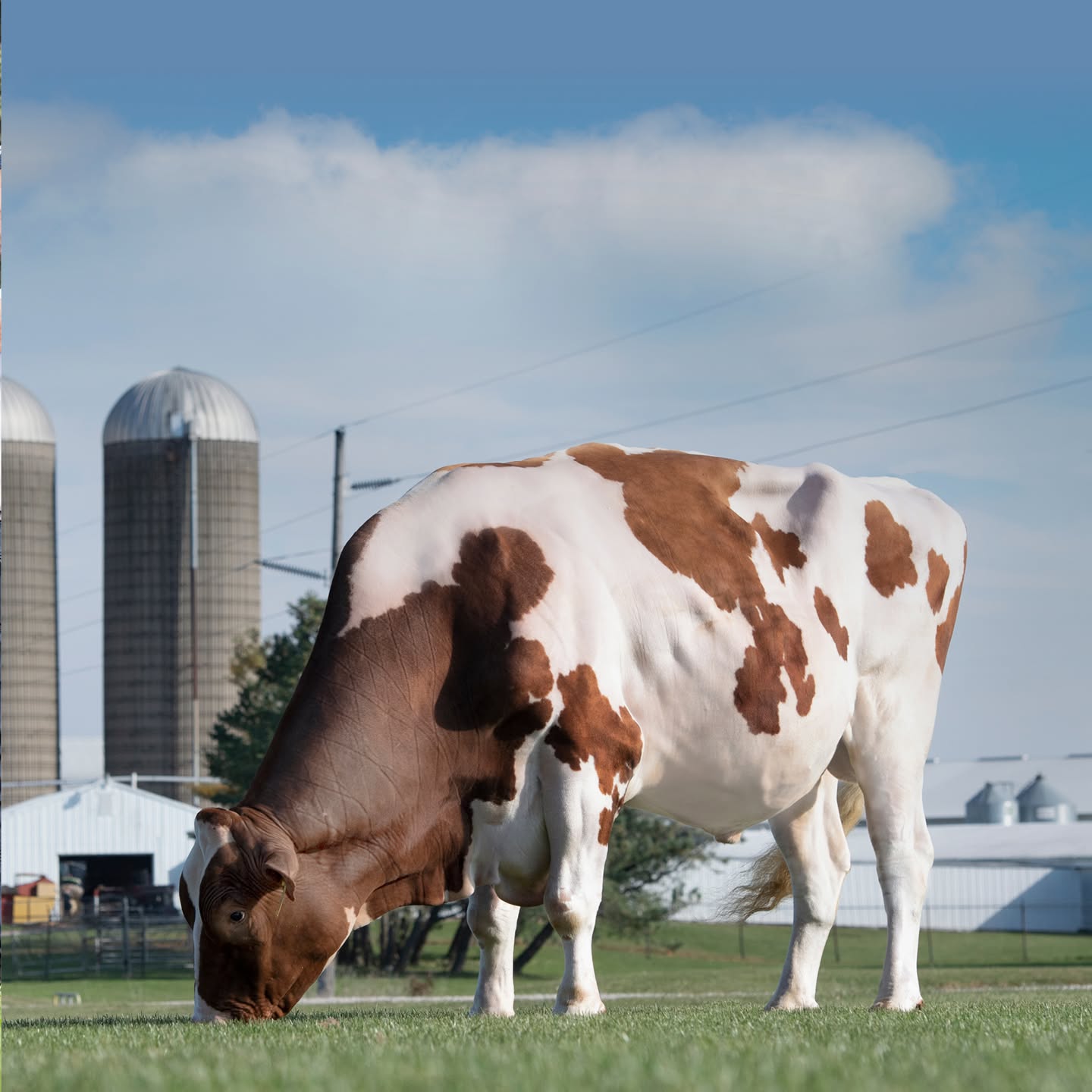
Bred at Webberville, Michigan, Ri-Val-Re Rager-Red became the first Red & White sire in North America to surpass a million units sold, according to Select’s August 31, 2026 announcement. He was 13. More than half of those units had gone abroad, to approximately 50 countries.
“He had such an outcross pedigree,” Jorgensen said. He also described Rager-Red as one of the breed’s lowest bulls for Expected Future Inbreeding, a measure of how closely a sire is related to the wider population. In 2012, Alan Andersen had told The Bullvine, “Top sires with outcross pedigrees will continue to be very important as well.”
“When you see fifth- and sixth-lactation daughters still performing at high levels – that’s what helps farmers remain profitable,” said Brian Albertoni of World Wide Sires.
Holstein USA’s August 2026 influence ranking, which measures genes in common with the top 400 progeny-proven U.S. TPI bulls, placed Mogul fourth and Supersire eleventh.
Learn More
- HapchIQ and Hapcheck Split on 67,024 Holstein HMW Calls in 2025. What’s a Test Worth? — Protect your next flush with a method for deciding when direct MW testing pays. Breaks down conflicting haplotype calls and an eight-embryo risk calculation, turning the millionaire sires’ inherited legacy into concrete mating decisions.
- From $1.5 Million to $150,000: The Dairy Genetics Shakeout and Your Next Move — Control over semen rights, female purchase options and genomic data shapes what breeders keep. This analysis follows the money beyond million-dose fame, identifying contract questions and business alternatives for your next breeding investment.
- Polled Just Hit 3371 TPI. The Dehorning Iron Is Now a Choice, Not a Necessity. — See how genomic selection accelerated hornless breeding through elite cow families. Tracing Luster-P and his descendants reveals a different measure of genetic influence: changing the calf-care work required in the next generation.
The Sunday Read Dairy Professionals Don’t Skip.

Every week, thousands of producers, breeders, and industry insiders open Bullvine Weekly for genetics insights, market shifts, and profit strategies they won’t find anywhere else. One email. Five minutes. Smarter decisions all week.