

Your donor reads code 0 on Hapcheck and carrier on HapchIQ. At even odds, a carrier sire and a $300 calf, that split carries about $88 of expected loss a flush, nearly 3x a $30-class test.
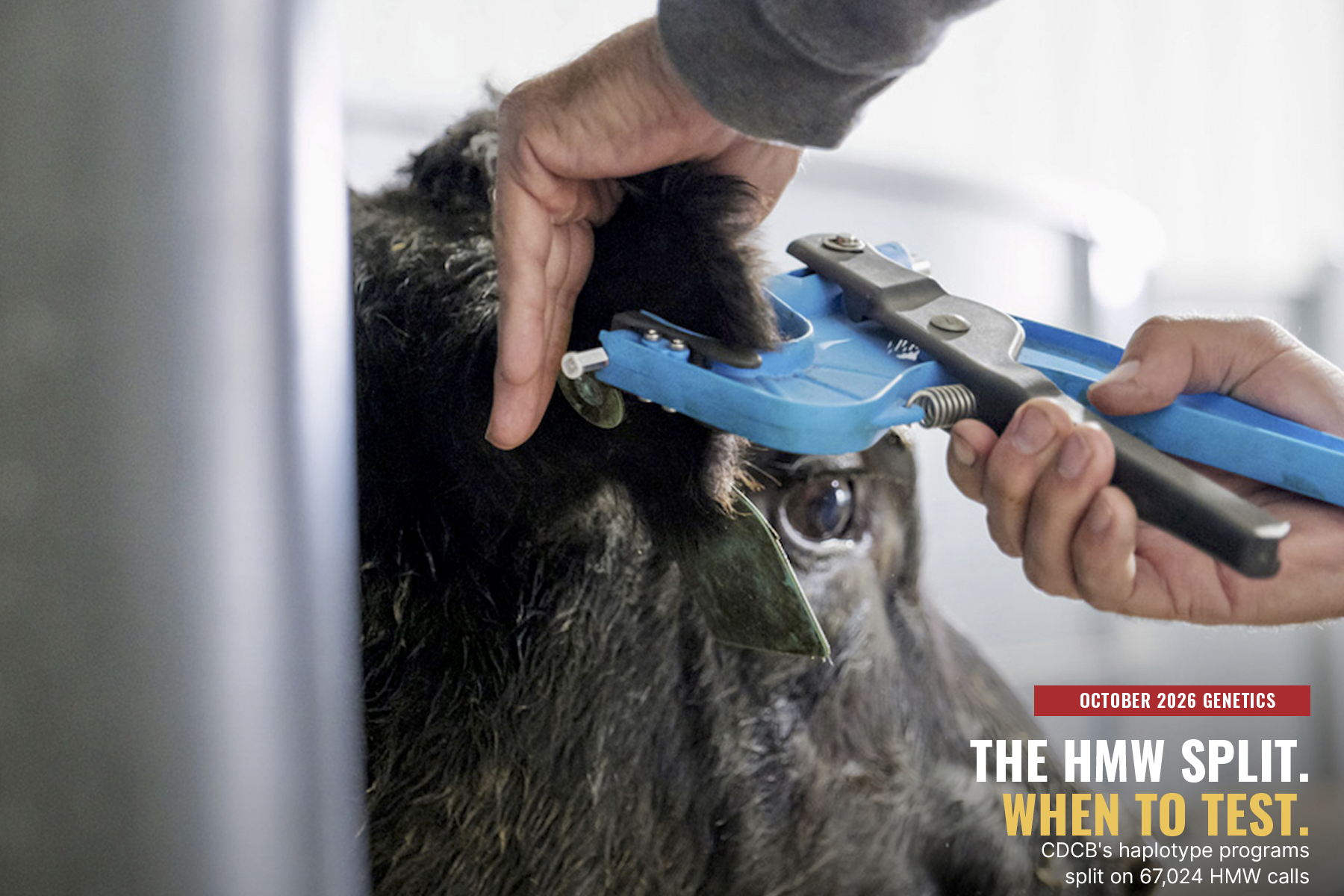
Executive Summary: CDCB’s August 2025 comparison of HapchIQ and Hapcheck split 67,024 of 8,173,668 U.S. Holstein HMW calls, and CDCB hasn’t published which side direct gene tests support. Its 2023 check traced all 41 HMW misses to the pedigree step, with 39 carriers coded 0, and CDCB’s deck indicates HapchIQ doesn’t yet use pedigree. Donor programs, carrier-by-carrier matings and HMW-free sale claims carry the exposure. The Bullvine’s Eight-Embryo Risk Test, built on Journal of Dairy Science gene-test and loss data, prices a direct test by code for a donor mated to a carrier sire: under $12 a flush for code 0 at a $5,000 calf, about $30 for code 3 at $300.
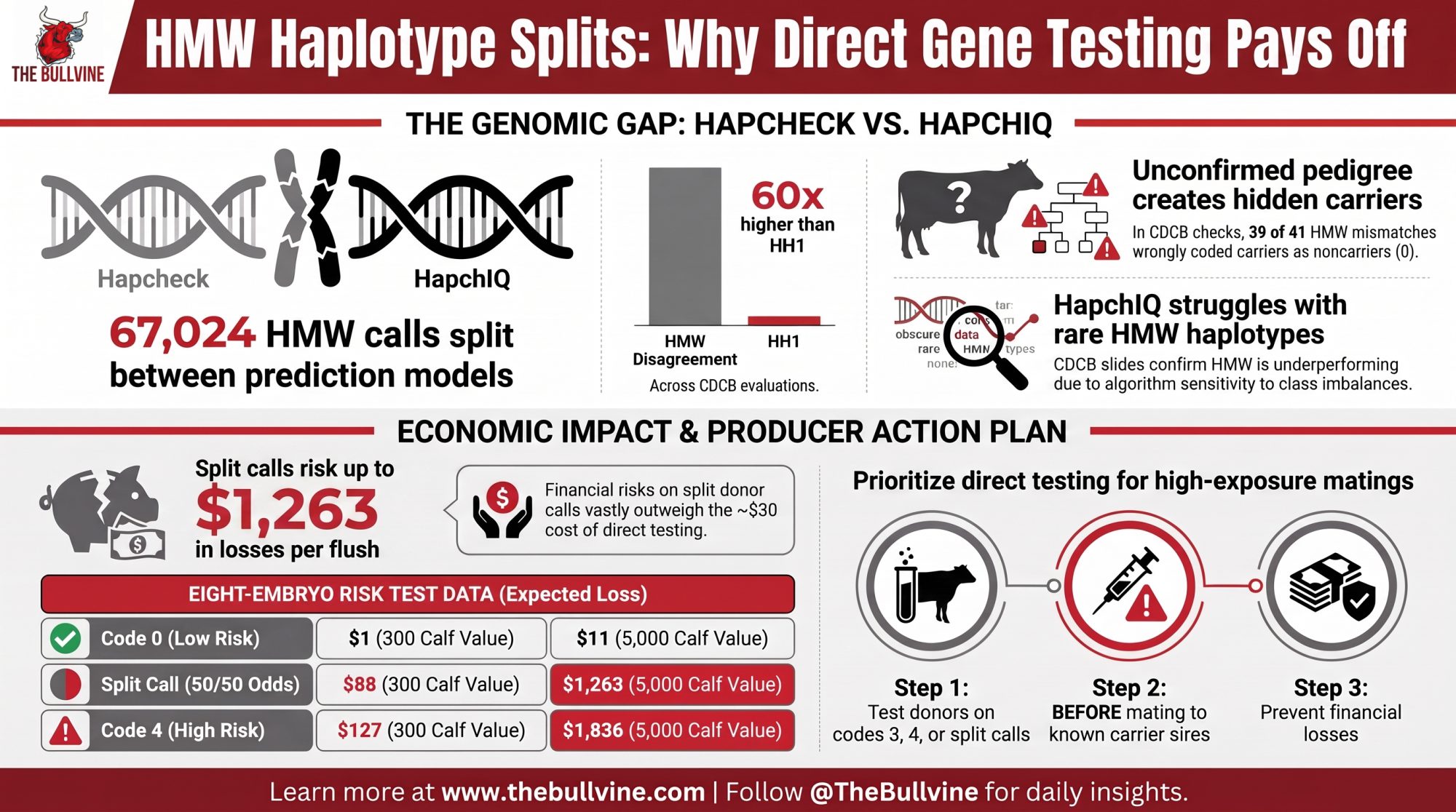
That donor is hypothetical. The split isn’t: 67,024 Holsteins got different HMW calls from Hapcheck, the program CDCB has used for years, and HapchIQ, the machine-learning model CDCB built to replace it, in CDCB’s August 2025 comparison presented at the 2026 Interbull meeting.
A 99.18% agreement rate measures how often two programs match. Which one is right takes a gene test, and none sits in that comparison. That matters most if she’s flushing next month, sitting in a sale catalog, or about to be mated to a known carrier. The Bullvine Eight-Embryo Risk Test, below, joins the 2024 Journal of Dairy Science (JDS) paper’s own gene-test and loss figures to price a direct test at each haplotype code.
What did CDCB actually compare?
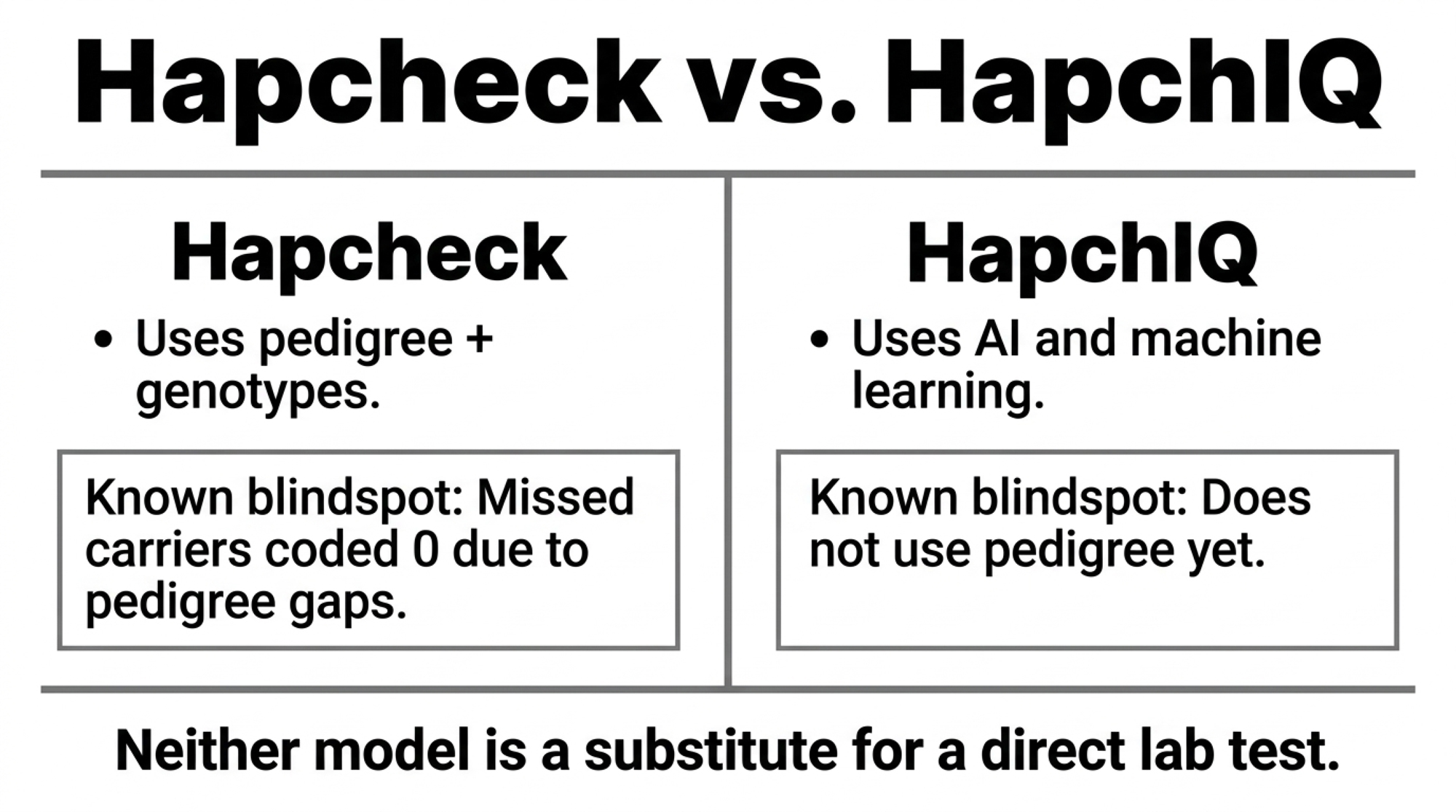
CDCB calculates the U.S. genetic evaluations, so every call in this story is a U.S. haplotype call. Hapcheck runs on methods Paul VanRaden and colleagues published in 2011, and it uses genotypes plus pedigree. At the CDCB Industry Meeting at World Dairy Expo on September 30, 2026, CDCB chief technology officer Nathan Blair said Hapcheck had worked well for several years. He said CDCB’s data setup and Hapcheck’s limits made newer haplotypes hard to add. CDCB’s Interbull deck says new haplotypes typically required SNP-list updates and re-imputing every genotype.
HapchIQ, pronounced “hap-sheek,” uses gradient-boosted decision trees built with XGBoost, with a separate model for each condition. Each model trains on imputed SNP genotypes, labeled with gene-test results or Hapcheck calls CDCB trusts, then predicts status for animals that haven’t been tested. CDCB says research on adding pedigree to its predictions is under way. Blair told the meeting HapchIQ can’t discover an unknown lethal haplotype.
HMW had the most disagreements of any Holstein haplotype
CDCB’s August 2025 comparison, from its 2026 Interbull deck:
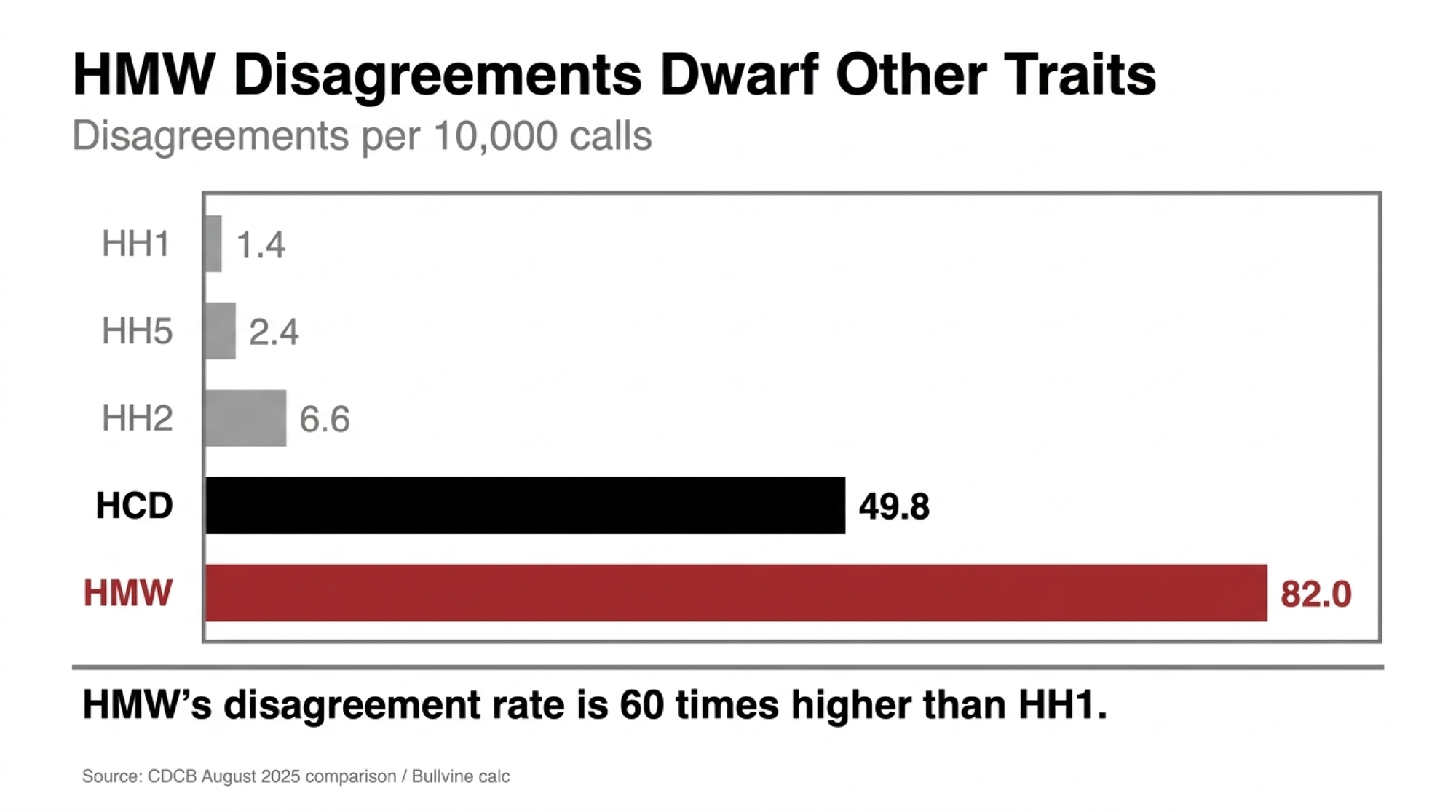
| Haplotype | Calls that differed | Genotypes compared | Agreement | Disagreements per 10,000 (Bullvine calc.) |
| HH1 | 1,233 | 9,088,709 | 99.99% | 1.4 |
| HH2 | 5,963 | 9,089,160 | 99.93% | 6.6 |
| HH5 | 2,170 | 9,088,709 | 99.98% | 2.4 |
| HCD | 44,410 | 8,914,901 | 99.50% | 49.8 |
| HMW | 67,024 | 8,173,668 | 99.18% | 82.0 |
HMW’s disagreement rate runs about 60 times HH1’s. CDCB hasn’t said how many of the 67,024 are living females, active bulls, or current donors. A split on a cow culled years ago costs nothing. On a current donor, the same split can redirect an embryo program.
Why 99.18% agreement isn’t HMW accuracy
Agreement means two programs gave the same answer. Accuracy needs a third reference, usually a direct test, to say which one was right. CDCB hasn’t published how many of the 67,024 carry a direct MW test, or which program those tests support.
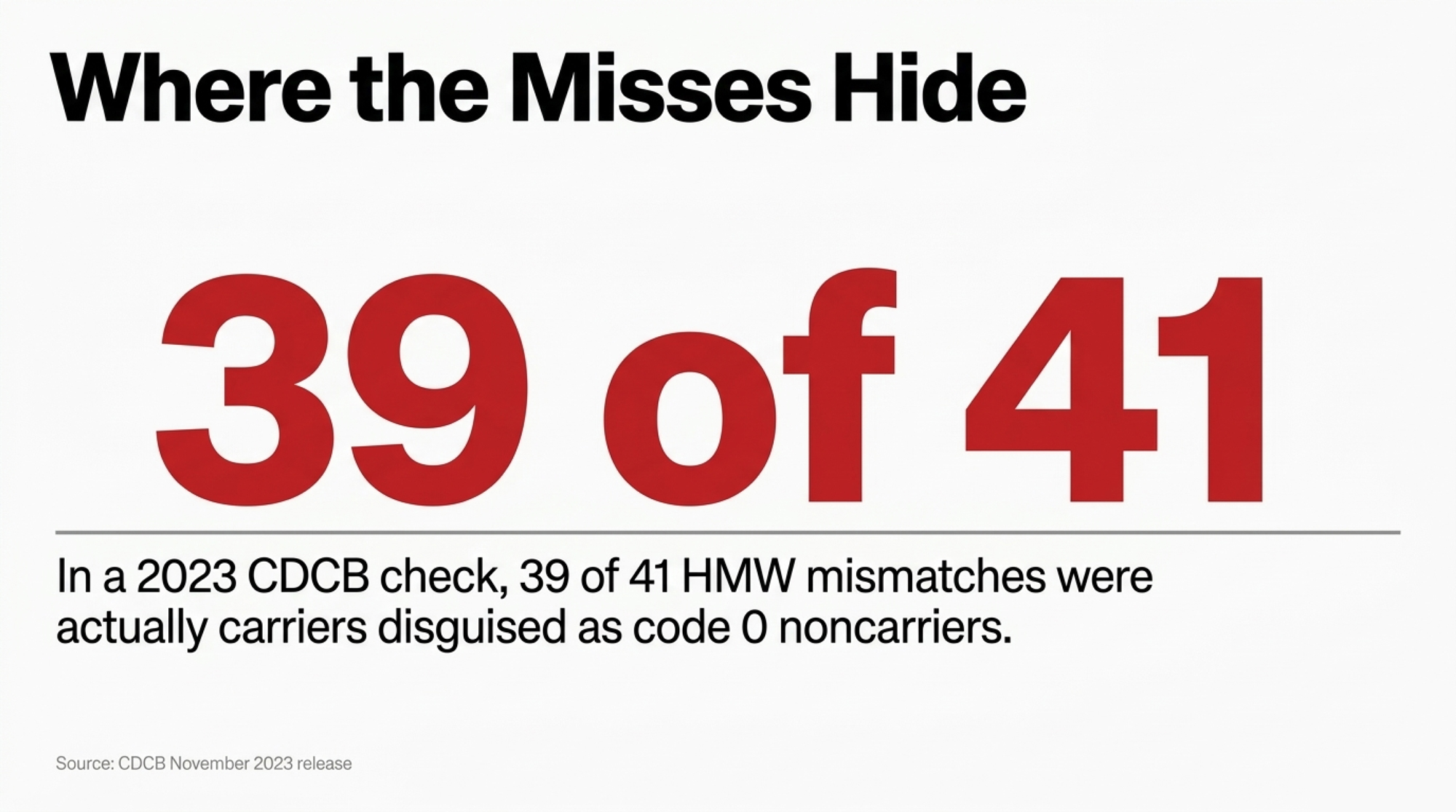
CDCB has run that check before. Its November 16, 2023 release, which The Bullvine carried at the time, compared haplotype calls with more than 7,000 direct MW gene tests that Holstein Association USA had shared. Only 41 didn’t match. In 39 of them, the gene test showed a carrier, but the haplotype coded the animal 0 because pedigree couldn’t confirm it. The other 2 were gene-tested homozygotes coded 0 and 1.
So 39 of 41 mismatches put a carrier on code 0. That’s the miss that can turn into an “HMW-free” sale claim resting on a haplotype code instead of a test.
Bulls look better. In the 2024 Journal of Dairy Science study, 733 of 736 bulls on a definite code (0, 1, or 2) matched their gene test, 99.6% concordance. That count leaves out 92 bulls on suspect codes 3 and 4. Of those, 70 tested noncarrier and 22 tested carrier, and none of the 11 code 4 bulls were homozygous. Neither check lines up directly with the 67,024, because both compare haplotype calls with direct tests, while the 2025 figure compares one prediction program with another.
| Evidence set | Comparison | Animals or calls examined | Reported finding | What it cannot establish |
|---|---|---|---|---|
| CDCB, August 2025: HMW | Hapcheck versus HapchIQ | 8,173,668 calls | 67,024 differed; 99.18% agreement | Which program was right on disputed calls |
| CDCB, November 2023: HMW | Haplotype calls versus direct MW tests | More than 7,000 animals | 41 mismatches; 39 were tested carriers coded 0 | HapchIQ’s HMW error rate |
| JDS, 2024: definite codes 0–2 | Haplotype calls versus direct gene tests | 736 bulls | 733 matched; 99.6% concordance | Performance across all five codes |
| JDS, 2024: suspect codes 3–4 | Haplotype calls versus direct gene tests | 92 bulls | 70 tested noncarrier; 22 tested carrier | Carrier probability for an individual female donor |
What CDCB hasn’t published yet is the link: of the disputed calls backed by a direct test, which program did the test agree with? The Bullvine put that question to CDCB on October 6, 2026.
HapchIQ hasn’t added the pedigree step behind the 2023 misses
The 2023 direct-test check can’t answer that question for HapchIQ, but it does show exactly where the old calls broke. Hapcheck calls carrier status from genotypes plus pedigree. In CDCB’s 2023 check, every one of the 41 HMW misses traced to the pedigree step. The 39 carriers coded 0 got that code because pedigree couldn’t confirm them. The 2 miscoded homozygotes failed the same step on one or both sides of the pedigree.
CDCB’s own deck indicates HapchIQ’s predictions don’t yet use pedigree. It lists “Research is underway to see if pedigree information can be incorporated into HapchIQ predictions” among its opportunities for improvement. Both HMW gene-test checks cited here, CDCB’s 7,000-plus tests and the JDS bulls, were run on pedigree-based calls. So neither says anything about HapchIQ’s HMW error rate, in either direction. Leaving pedigree out could remove the 2023 failure mode or open a new one. CDCB hasn’t published HMW gene-test concordance for HapchIQ.
That’s the strongest case for a lab test on any HMW call that matters to you. Today’s official code comes from Hapcheck, a method whose known misses trace to pedigree. Its replacement, per CDCB’s deck, doesn’t yet incorporate pedigree and has no published gene-test check on HMW. A direct test is the one result that doesn’t depend on either program.
Why HMW is the hard one: the penetrance numbers
Al-Khudhair and co-authors at the USDA Animal Genomics and Improvement Laboratory, ABS Global and Penn State traced the HMW haplotype through 5.6 million genotyped Holsteins back to 1952. The key ancestor was Southwind Bell of Bar-Lee (HOUSA1964484), born in 1984, whose chip genotype showed two copies of the haplotype. Sequencing found only one copy of the suspected cause, a missense mutation in the CACNA1S gene at 79,613,592 bp on chromosome 16. Across 299 other sequenced Holsteins, the mutation matched the haplotype 97% of the time (89% call rate).
The haplotype is common, and the mutation arose inside it later, so carrying the haplotype doesn’t automatically mean carrying the mutation. The team matched haplotype status to heifer livability records for 558,000 calves. Only 46 heifers with records were homozygous and traced only to Southwind on both sides. 52% of those died before 18 months, at an average of 1.7 months, against 2.4% for noncarriers.
A confirmed two-copy heifer died at roughly 22 times the noncarrier rate, and about half survived. Suspect homozygotes on code 4 died at just 4.2% across 2,211 records, which fits the bull tests, where none of the 11 code 4 bulls were actually homozygous. The authors warn the 52% may run low if only healthier calves got genotyped. They’re plain about testing: “Direct tests are needed for new mutations within existing common haplotypes because tracking can be difficult even with accurate pedigrees when the original haplotype has a high frequency.”
What CDCB’s slides say about HMW and HCD under HapchIQ
CDCB’s own slides say HMW “is not performing as well” under HapchIQ, which “may not work as well for haplotypes with incomplete penetrance.” The deck flags a second limit: training is “very sensitive to class imbalances,” and because 2s are rare relative to 0s and 1s, “the algorithm discards them as likely genotyping/imputation errors.” The deck doesn’t single out HMW on that point. But HMW 2s are about as rare as they get, at 0.02% of Holsteins in CDCB’s November 2023 test run. Blair told the meeting that CDCB is still working on HMW, trying multi-chromosome inputs and model tuning.
The HCD mutation traces to Maughlin Storm (HOCAN5457798), born in 1991, and the haplotype has been reported for all genotyped Holsteins since 2015. CDCB’s 2023 HCD update drew on a far larger direct-test base: more than 1.3 million female lab tests from Holstein Association USA, and only 0.09% got a haplotype call that didn’t match. In most of those cases, CDCB said, a likely carrier was set to noncarrier (0) because pedigree couldn’t confirm it. Holstein Association USA recommends that breeding stock called a carrier on the haplotype be confirmed with the direct gene test. HapchIQ and Hapcheck still split on 44,410 HCD calls.
Brown Swiss BH6: where HapchIQ earns its keep
Brown Swiss haplotype 6 is the model’s biggest gain over Hapcheck. Homozygous BH6 embryos die early, so on the farm the loss shows up as open days and repeat breeders. Blair showed the causal site on chromosome 2 at position 86,191,230, between two markers on CDCB’s SNP list. No marker sits on the site itself.
| BH6 method | Concordance with gene tests |
| Hapcheck, official SNP list | 46.5% |
| Hapcheck, modified SNP list | 92.2% |
| HapchIQ, official SNP list | 90.7% |
Dan Null’s modified list worked. But CDCB’s deck notes that adding markers means re-imputing every genotype, which was done only for Brown Swiss internal testing. HapchIQ got close on the existing list by reading neighboring markers. That still leaves about one BH6 call in eleven disagreeing with the gene test.
Run on new data with the same trained model, BH6 calls barely moved: 3 of 82,553 animals changed between December 2024 and April 2025, and 2 of 83,829 between April and August 2025. A retrained model on December 2025 data changed 124 of 90,062, with 78 going from noncarrier to carrier and 46 the other way. New data alone moved 2 or 3 calls a run, so most of that change came with the retrain.
Brown Swiss USA recognizes Weaver, Spiderleg, SDM and SMA as undesirable recessives, and its genomics page doesn’t list BH6. Its abnormality policy requires anyone offering semen from designated carriers, or embryos from parents of known carriers, to make that known to potential buyers. A Brown Swiss donor with BH6 risk on both sides of her pedigree is worth a direct test before an IVF cycle, if your lab offers one for BH6.
Polled genomic calls: HapchIQ lifts Jersey concordance from 63.9% to 99.1%
Polled is HapchIQ’s other big gain. Blair said producers had reported horned cows flagged polled and polled animals flagged horned. On the official SNP list, Hapcheck matched the reference results 85.3% of the time in Brown Swiss, 63.9% in Jerseys and 95.4% in Holsteins. HapchIQ hit 99.9%, 99.1% and 99.3%, missing 29 of 20,726, 256 of 27,487 and 409 of 58,657. With CDCB’s SNP name fix, Hapcheck rose to 99.7%, 97.6% and 99.0%, and the gap mostly closed.
CDCB’s slide doesn’t say whether every check was a direct mutation test. It does warn that more than one polled variant segregates in some breeds, and that many lab gene tests include only the Friesian mutation. The UC Davis VGL polled test, for one, reports both the Friesian and Celtic markers. If you sell an animal as homozygous polled, ask the lab which variants it tested and put that on the sale paperwork.
Is HMW moving to HapchIQ in December?
Nothing CDCB has published says so. Its 2026 Interbull deck says CDCB “will distribute test files beginning in August, with a goal of implementation for BH6 and POLLED in December 2026.” HMW isn’t named in that goal. In her closing remarks on September 30, CDCB’s Katie Schmitt described the HapchIQ implementation as coming up.
HMW calls use five codes: 0 noncarrier, 1 carrier, 2 homozygous, 3 probable carrier, and 4 probable homozygous. CDCB calls 3 and 4 “probable”; the JDS paper calls them “suspect,” as does Holstein USA for code 3. Direct results appear on Official Holstein Pedigrees as TE (tested free), MW (heterozygous carrier), or MW2 (homozygous carrier). CDCB’s deck says HapchIQ can attach a measure of certainty to each prediction, “eliminating the need for ‘3’ and ‘4’ calls.” It hasn’t said whether historical calls will be recalculated, or whether nominators will get animal-level change files.
What a direct HMW test is worth on one flush: the Eight-Embryo Risk Test
This is Bullvine math. Published inputs, our assumptions, and the calculation are kept separate, so you can swap in your own numbers.
Published inputs
- A carrier-by-carrier mating gives each embryo a 25% chance of two copies.
- The JDS authors costed MW losses per homozygous heifer calf at a $300 calf value, 50% death penetrance, and another 25% needing extra care worth $100: 0.50 × $300 + 0.25 × $100 = $175. That 50% sits right on the observed excess, since 52% deaths minus the 2.4% baseline is 49.6 points.
- JDS Table 6 compared gene tests with haplotype codes in 828 bulls under CDCB’s 2023 method. Carriers turned up in 3 of 678 code 0 bulls, 14 of 81 code 3 bulls, and 8 of 11 code 4 bulls. All 828 bulls are used as published, and none are excluded.
Bullvine assumptions
- One flush yields 8 transferable sexed (female) embryos, and 50% become pregnancies, for 4 heifer calves.
- The donor is mated to a confirmed carrier sire. If you only use TE sires, testing has no genetic-risk value.
- The $2,000 and $5,000 calf values are illustrative values for registered and elite heifers. They aren’t survey figures.
- When the two programs disagree, and CDCB hasn’t said which is right, we treat it as even odds (50%).
- Recipient costs aren’t included, so these losses run low.
Step 1. If she’s a carrier: 4 calves × 25% = 1 expected two-copy calf per flush, a loss of $175, $1,025, or $2,525.
Step 2. Expected loss a direct test prevents = chance she’s actually a carrier × the Step 1 loss.
| Donor’s current HMW status | Chance she’s a carrier | $300 calf (JDS) | $2,000 calf | $5,000 calf |
| Code 0 | 0.44% (3 of 678 bulls) | $1 | $5 | $11 |
| Code 3 | 17.3% (14 of 81 bulls) | $30 | $177 | $436 |
| Calls split between programs | 50% (Bullvine assumption) | $88 | $513 | $1,263 |
| Code 4 | 72.7% (8 of 11 bulls) | $127 | $745 | $1,836 |
| Code 1, or tested MW | 100% | Known carrier; mate to a TE sire | Known carrier; mate to a TE sire | Known carrier; mate to a TE sire |
When a direct test pays, and when it doesn’t
For scale, the UC Davis Veterinary Genetics Laboratory lists its Holstein CD direct test at $30 per animal (checked October 6, 2026). It’s a different test, so get a current MW quote. Genetic Visions-ST and Feanix Biotechnologies offered CACNA1S tests as of May 2023.
At the JDS commercial calf value, testing a code 0 donor for risk alone doesn’t pay on one flush. A code 3 donor sits right at a $30-class fee, and a split call clears it about three times over. At registered or elite values, everything above code 0 clears it easily. One result covers every later flush, a carrier disclosure can cut sale value, and the authors say the death rate may be underestimated, so each of these pushes the value up. The limits run the other way: the rates come from bulls, not females, the code 3 and code 4 samples are small (81 and 11), and they reflect CDCB’s 2023 method, not HapchIQ.
Code 0 is still where most misses hide, because it’s where most animals sit: 87.7% of Holsteins in CDCB’s November 2023 test run. For any one animal, the odds are small.
Methodology Note: The Eight-Embryo Risk Test uses JDS Table 6 (Al-Khudhair et al., 2024: 828 U.S. bulls, haplotype codes from CDCB’s 2023 method compared with CACNA1S gene tests) and the paper’s loss inputs ($300 young heifer calf, 50% death penetrance, 25% needing $100 of extra care). Bullvine assumptions are 8 sexed embryos, a 50% pregnancy rate, a confirmed carrier sire, even odds on a split call, and no recipient costs. Dollar figures are USD. No proof run is cited; haplotype counts come from CDCB’s August 2025 comparison. National figures and bull-sample rates may not reflect your region, herd, or donor. If your direct-test results contradict a haplotype code, send them for future coverage. Corrections and data: editor@thebullvine.com.
Which animals need a direct MW gene test first?
- Donors on code 3 or code 4, or whose call differs between programs, before you set carrier-sire matings. One result covers every embryo she produces.
- Bulls and females marketed as HMW-free or HCD-free on a haplotype code. In CDCB’s 2023 checks, most mismatches for both conditions were likely carriers set to 0.
- Any carrier-by-carrier mating where one side’s status comes from a haplotype instead of a test.
- Brown Swiss animals with BH6 risk on both sides of the pedigree, given 90.7% gene-test concordance.
- Polled animals whose appearance contradicts their genomic call, and any homozygous-polled sale claim.
- Last: code 0 commercial cows always bred to TE sires. The mating already prevents a two-copy calf.
A confirmed carrier doesn’t need culling. Mate her to a TE sire, and you keep her genetics without producing a two-copy calf.
What This Means for Your Operation
- Before your next flush, check whether each donor’s pedigree shows TE, MW, or MW2 (a direct result) or only a 0–4 haplotype code.
- If a donor is code 3, code 4, or split between programs, and a carrier sire is on the mating list, test her first.
- If she only ever meets TE sires, the test buys a clean sale claim and mating freedom. Price it on that basis.
- Send direct MW results to labresults@holstein.com so they reach Holstein Association USA’s genetic-conditions database. In 2023, that pool supplied the 7,000-plus tests CDCB used to build and check its HMW calls.
- If you sell polled genetics, put the lab’s variant coverage on the sale paperwork.
- Brown Swiss breeders: ask the association (608-365-4474) whether BH6 will be reported, and whether it’ll fall under the carrier disclosure policy.
Key Takeaways
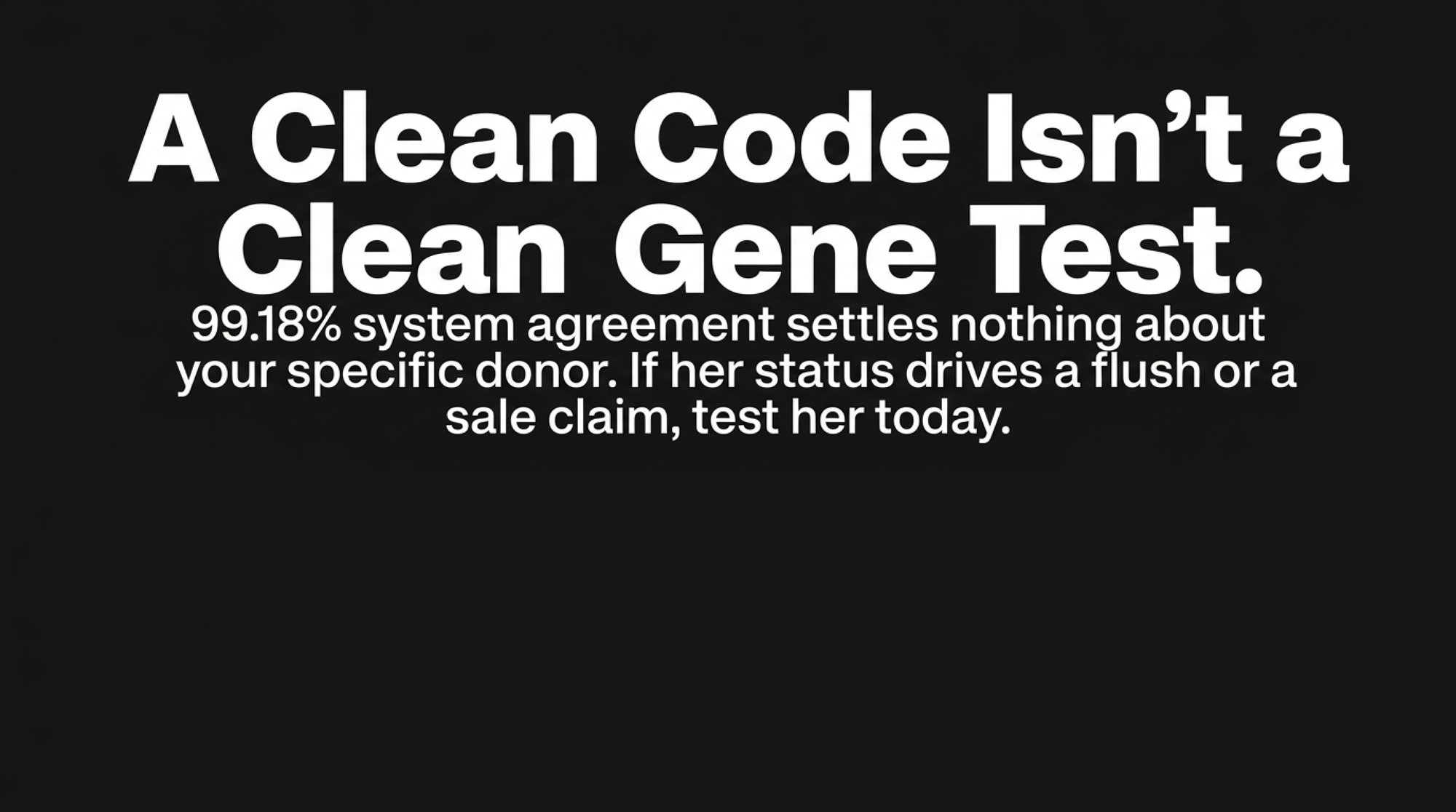
- If a donor’s HMW status drives a flush or a sale claim, test her. A 99.18% agreement rate between two programs settles nothing about one animal.
- A clean haplotype code isn’t a clean gene test. In 2023, all 41 HMW misses traced to pedigree, and CDCB’s deck says pedigree isn’t yet part of HapchIQ’s predictions. If a donor’s call could move when HapchIQ arrives, test her now.
- If she’s code 0 and only meets TE sires, skip the test for risk purposes. The expected loss is under $12 a flush even at a $5,000 calf value.
- If you’re waiting on December to fix HMW calls, don’t. CDCB’s published goal names BH6 and polled.
CDCB will eventually say which side the gene tests support. Until then, your donors carry codes from whichever program last scored them, and the BH6 data show a retrain can move calls. If one of your donors flipped tomorrow, would you know which result to trust?
Run Your Numbers
Genomic Testing ROI Calculator — Turns your testing strategy into a hard number. Pressure-test your lab invoices against your actual replacement costs to see exactly when spending $30 on a genetic test generates a real return for your breeding program.
Learn More
- From “Worst Dairy” to Zero Lame Cows: How CDCB’s New h² = 0.27 Trait Could Rewrite Lameness Genetics— Dismantles traditional foot angle scoring to reveal how camera-driven mobility traits deliver triple the genetic leverage. Arms you with three distinct investment paths to eliminate clinical cases and recapture $131 per cow in lost milk.
- Super Bowl LX and the $869-Per-Cow Sire Gap: The Breeding Strategy Your Dairy Can’t Ignore — Follows the money across a nine-year study, proving that top-quartile genetics generate an $869 lifetime profit advantage. Exposes the financial drain of delegating your semen roster while outlining exactly how to build a complementary depth chart.
- BANNs CRUSH Traditional Models: The AI Secret Weapon Reshaping Dairy Genetics — Breaks down the 100kb genomic windows Biologically Annotated Neural Networks use to boost milk yield prediction accuracy by over 7%. Delivers a hard warning against the overfitting algorithms threatening your herd’s long-term genetic diversity.
 The Sunday Read Dairy Professionals Don’t Skip.
 The Sunday Read Dairy Professionals Don’t Skip.
Every week, thousands of producers, breeders, and industry insiders open Bullvine Weekly for genetics insights, market shifts, and profit strategies they won’t find anywhere else. One email. Five minutes. Smarter decisions all week.