






Coca-Cola’s last fairlife check: $6.173B in March 2025. The SEC filings stop at the payment. Members need co-op records; suppliers need the clause that prices the next pound of protein.
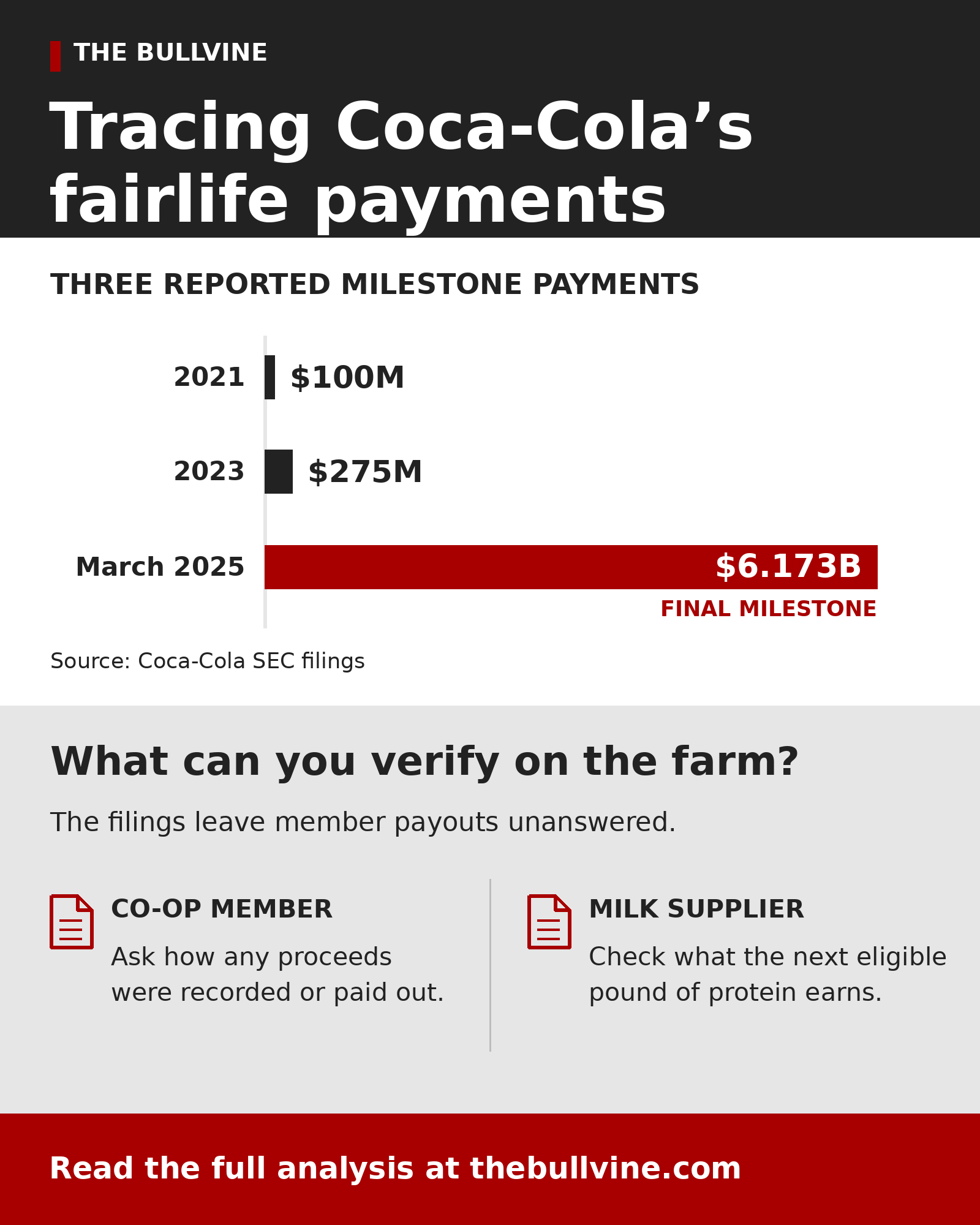
In March 2025, The Coca-Cola Company made the final milestone payment on its fairlife acquisition: $6.173 billion. For a dairy farmer, the natural question is whether any of that money reached the people who produce the milk.
The filings we reviewed establish the acquisition payment. They don’t disclose how the proceeds were allocated or distributed to Select Milk Producers members. That leaves two questions: what a co-op member received as an owner, and what a milk supplier is paid for components. One farmer can hold both roles, and each question needs different records.
New York and fairlife marked the production ramp-up at the $650 million Webster, N.Y. plant in August 2026. For Northeast shippers, the document that matters is the buyer’s written payment terms, and the rate it sets for the next eligible pound of protein.
What Coca-Cola actually paid for
In January 2020, Coca-Cola bought the 57.5% of fairlife it didn’t already own. fairlife identified Select Milk Producers as the seller, the dairy cooperative that had been Coca-Cola’s joint-venture partner.
Coca-Cola paid $979 million in cash, net of cash acquired. It also agreed to milestone payments, payable in 2021, 2023 and 2025 if fairlife met financial targets through 2024, each based on agreed formulas tied to fairlife’s operating results and with no ceiling.
Coca-Cola reported milestone payments of $100 million in 2021, $275 million in 2023 and $6.173 billion in March 2025. By Bullvine’s math, the three totaled $6.548 billion.
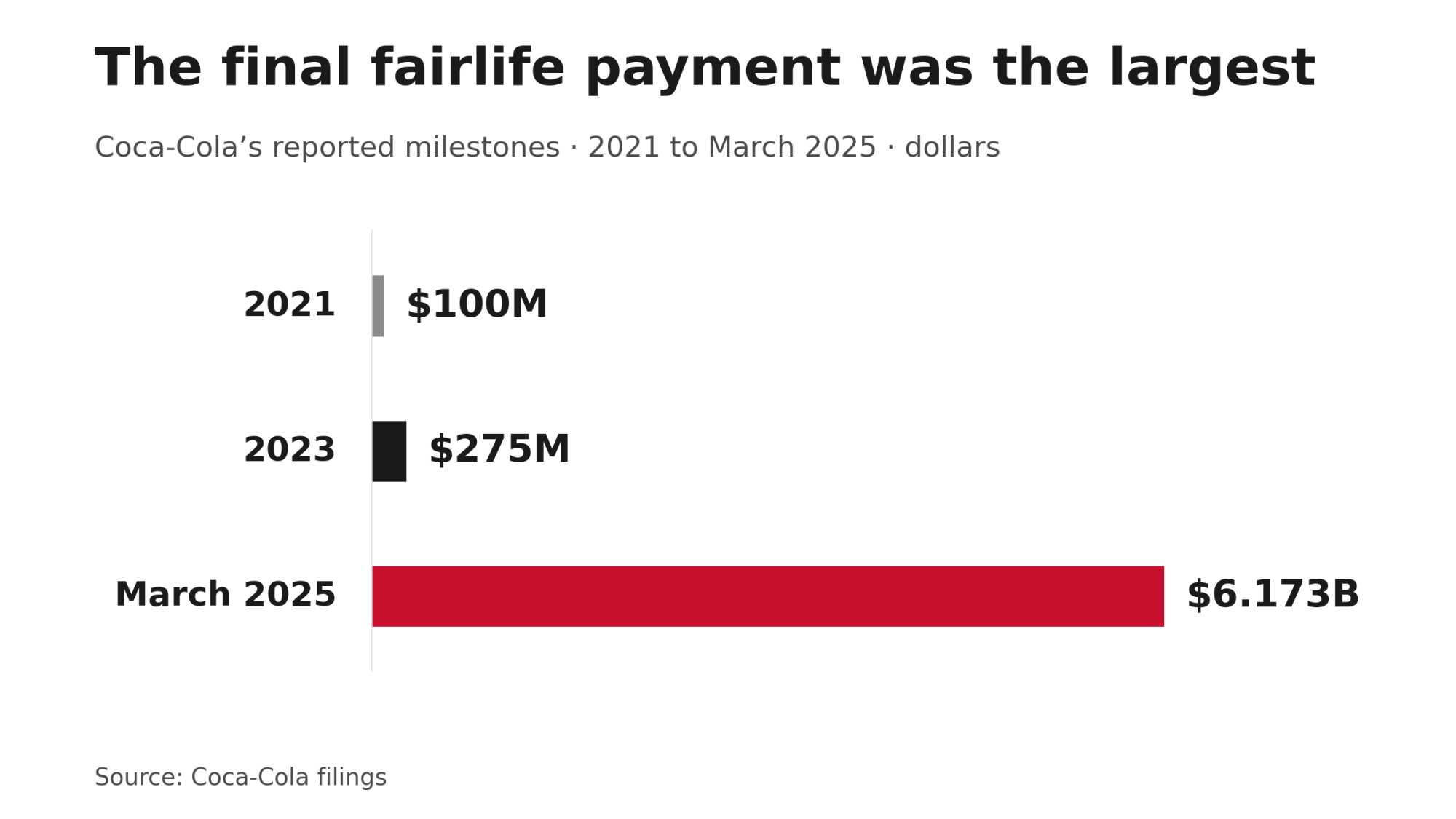
At acquisition, Coca-Cola booked $270 million as the estimated fair value of those contingent payments. The filings give the amounts paid but leave out the formula details, so they can’t show how much of the final payment came from volume, price or margin.
What the filings don’t tell Select members
Select sold the stake and its members are dairy farms, so it’s easy to assume the earnout reached those farms. Identifying the seller doesn’t establish what any member received, and the filings we reviewed don’t settle who received each milestone payment or whether any of it went to members.
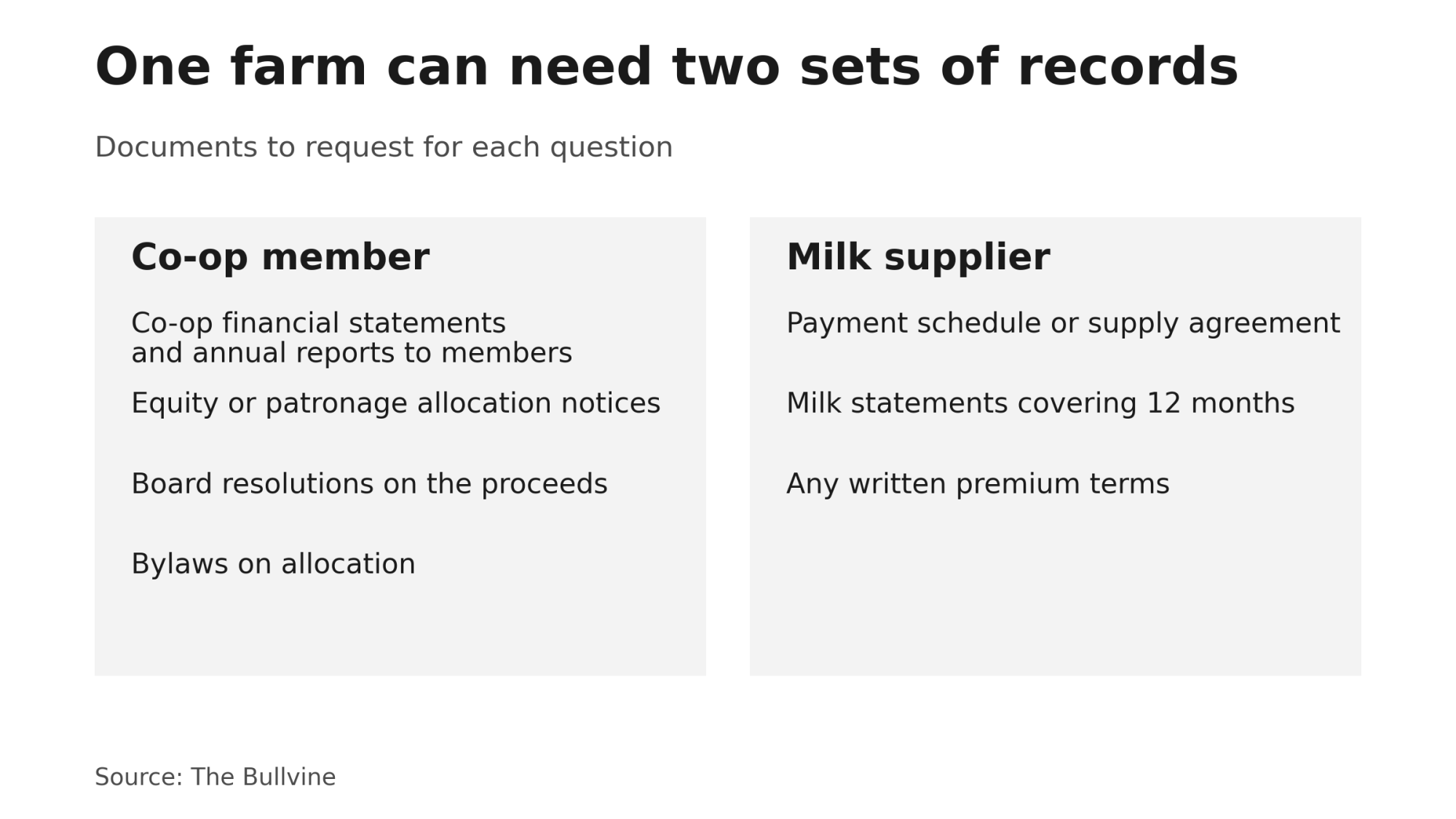
For a co-op member, the question is what the co-op received from the sale and any milestone payments, and whether it allocated, retained, credited or distributed that money. The board can show how it recorded them. The records that answer it are:
- co-op financial statements and annual reports to members
- equity or patronage allocation notices
- board resolutions on the proceeds
- bylaws on allocation
For a milk supplier, the question is what the payment schedule pays for additional components, and under what conditions. That answer sits in a different set of documents:
- the payment schedule or supply agreement
- 12 months of milk statements
- any written premium terms
Bylaws may explain allocation rules without showing how these particular proceeds were treated. A milk statement can’t resolve the ownership question, and co-op equity records can’t price the next pound of protein.
Two roles, two sets of records
| Co-op member (owner) | Milk supplier | |
|---|---|---|
| The question | What did the co-op receive from the sale and any milestone payments, and did it allocate, retain, credit or distribute that money? | What does the payment schedule pay for additional components, and under what conditions? |
| Who can answer | The board can show how it recorded them | The buyer, through written payment terms |
| Records to request | Co-op financial statements and annual reports to members; equity or patronage allocation notices; board resolutions on the proceeds; bylaws on allocation | The payment schedule or supply agreement; 12 months of milk statements; any written premium terms |
How big is Webster’s milk draw at design capacity?
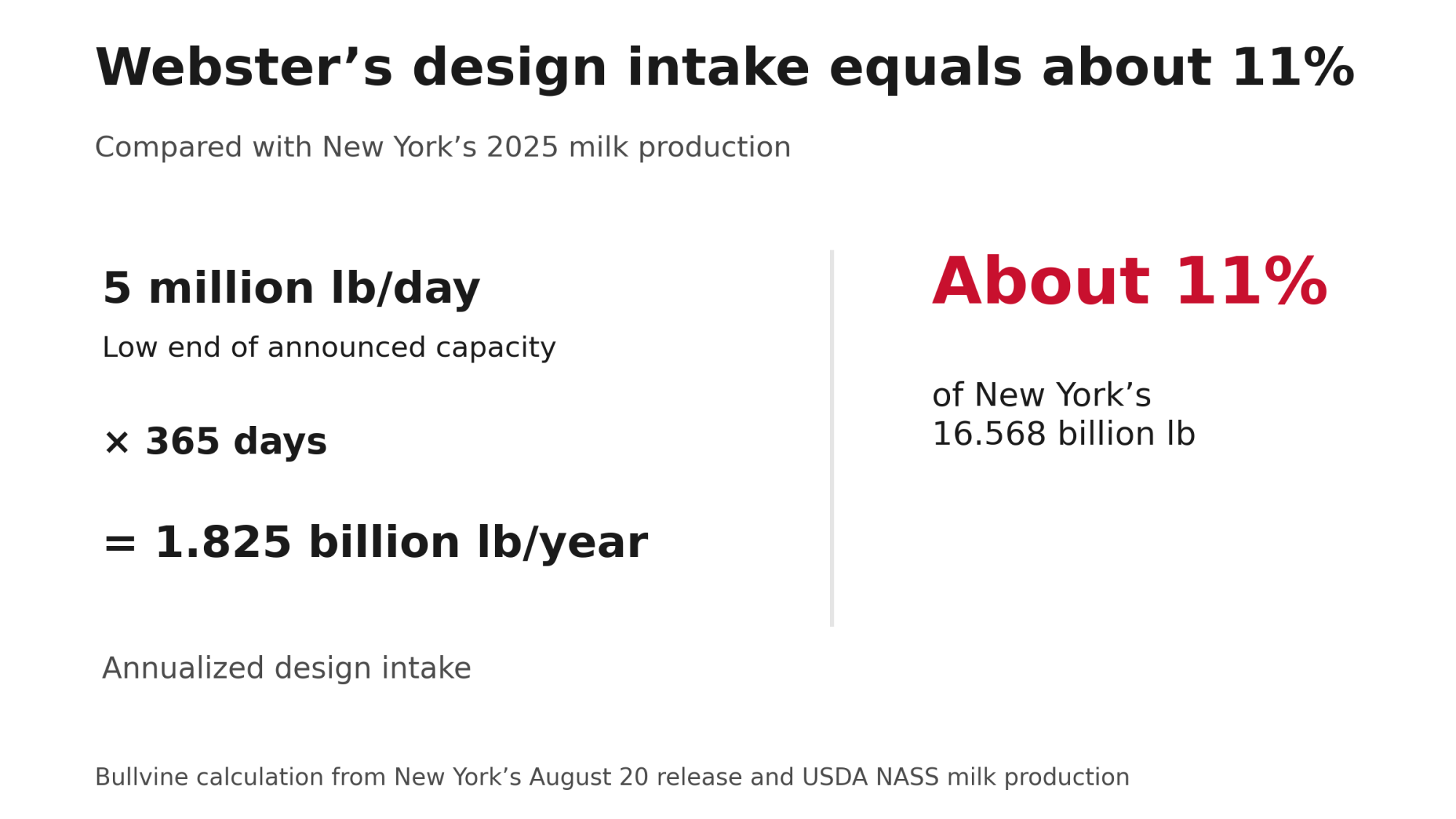
At the low end of announced capacity, 5 million lb a day × 365 days comes to 1.825 billion lb a year. By Bullvine’s math, that’s about 11% of New York’s 16.568 billion lb of milk production in 2025.
New York’s August 20 release describes a 745,000-square-foot facility designed to take 5 to 6 million lb of milk a day. In its Aug. 20 release, fairlife said the plant was already sourcing milk daily from more than 40 local dairy farms. Reports showed that commercial shipments of fairlife ultra-filtered milk, Core Power protein shakes and Nutrition Plan shakes began there in January 2026. As of late August the plant was still ramping toward full capacity, and fairlife expected full operation later in 2026.
Webster: on the record vs. not disclosed
| On the public record | Not disclosed in sources reviewed |
|---|---|
| $650 million, 745,000 sq ft plant | Actual milk intake |
| Designed for 5–6 million lb of milk a day | Supplier openings |
| Sourcing daily from 40+ local farms (Aug. 2026) | What suppliers are paid |
| Commercial shipments began January 2026 | Any effect on Northeast premiums |
| Full operation expected later in 2026 | Supplier agreements |
We didn’t locate public supplier agreements. The sources reviewed don’t disclose actual intake, supplier openings, what suppliers are paid or any effect on Northeast premiums.
What the next pound of protein earns
Under a U.S. component-pay schedule, one clause sets the rate for the next eligible pound of protein. Where a statement has no protein line, the buyer can say whether protein enters the payment formula at all. Canadian producers are paid under a different system, so the USDA figures below don’t apply to them.
USDA’s federal order protein price uses wholesale cheddar and the butterfat price calculated from wholesale butter. In 2025, the average of USDA’s 12 monthly announced component prices was $2.4495/lb for protein and $2.4416/lb for butterfat. Those are announced federal order prices, not proof of what any particular supplier was paid.
Before a ration or contract change
1. Audit 12 months of statements before renewal or a feeding change
Three numbers from 12 months of statements
| Calculation | Formula | What it tells you |
|---|---|---|
| Historical protein revenue per cwt | Total protein dollars ÷ total shipped cwt | How much protein contributed to each cwt |
| Historical average realized price per lb | Total protein dollars ÷ total paid protein lb | The average price paid per pound in the past |
| Marginal payment per added lb | Payment at current protein lb, then again with one extra lb, holding milk volume and other components constant | What the next pound earns under the farm’s terms |
A year of statements supports three separate calculations:
- Historical protein revenue per cwt: total protein dollars ÷ total shipped cwt
- Historical average realized price per lb: total protein dollars ÷ total paid protein lb
- Marginal payment per added lb: the payment at current protein pounds, then again with one extra pound, holding milk volume and other components constant. The difference is what that pound earns under the farm’s terms.
The second number is useful, but it isn’t the third. An average only works as a marginal value once three things are confirmed: the extra pound is eligible, no threshold or cap blocks it, and the deduction changes are known. Where the statement doesn’t break out protein revenue, the buyer should be able to explain how protein enters the calculation. The Bullvine’s $28,614 tenth works through an Upper Midwest example.
Question for the buyer: Which line on the statement pays for the next pound of protein, and at what rate?
2. Get premium terms in writing
When a buyer offers a protein premium or a UF/high-protein line, these terms belong in writing:
- eligible pounds and test method
- thresholds and caps
- deductions
- duration, notice and exit terms
Question for the buyer: What happens to this premium at renewal?
3. Change the ration only when total margin holds
This protein-only screen holds only when other revenue and cost changes are negligible or counted separately:
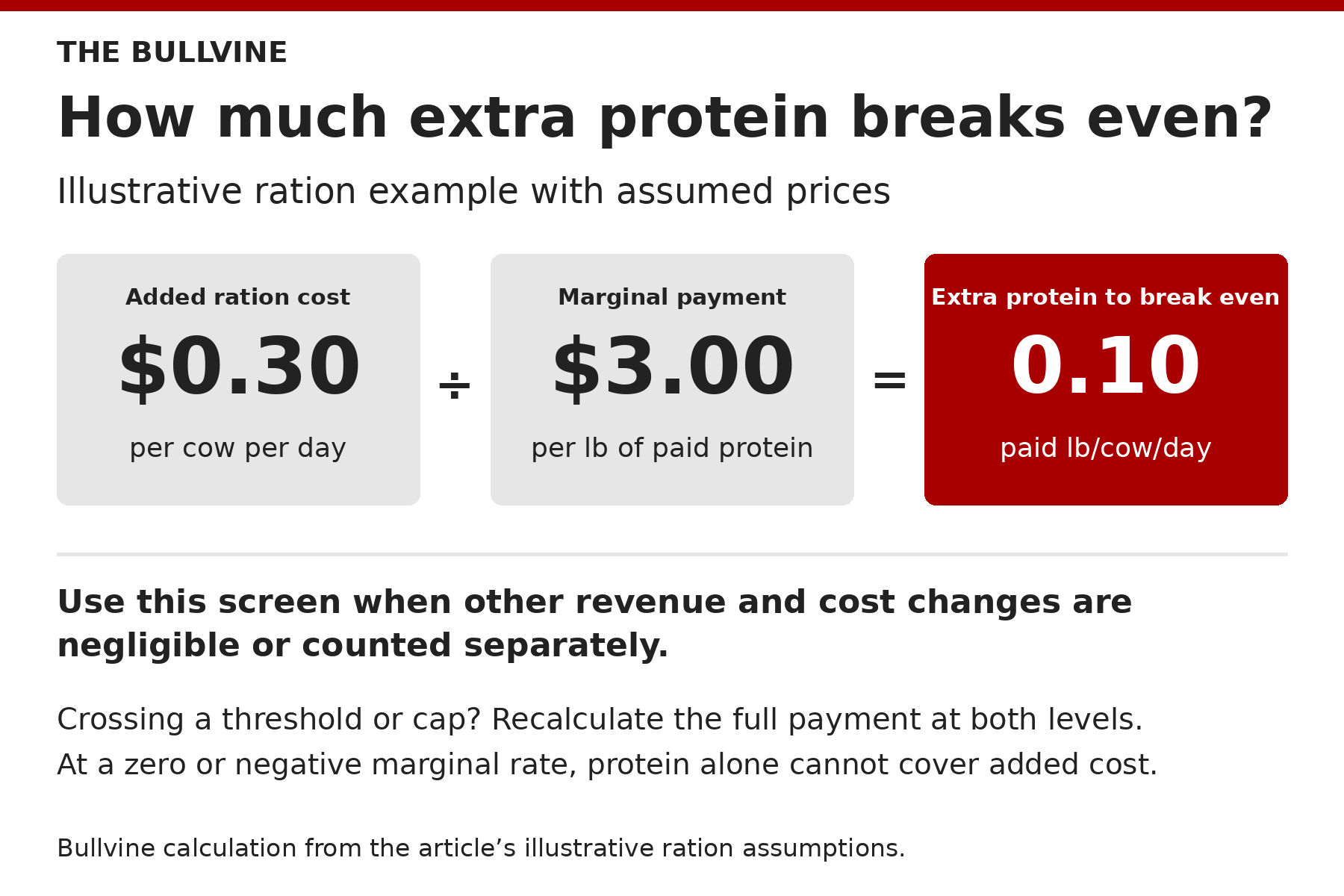
Break-even extra paid protein (lb/cow/day) = added cost per cow per day ÷ marginal protein payment per lb
As an illustration with assumed prices, not a market quote or forecast: a ration adding $0.30/cow/day, against an assumed marginal payment of $3.00/lb of eligible protein, breaks even at 0.10 additional paid lb/cow/day. If the projected increase crosses a threshold or cap, run the full payment formula at both production levels. At a zero or negative marginal rate, extra protein alone can’t cover the added cost.
A ration change can also move milk volume, butterfat, other solids and costs. The full test compares the change in total milk revenue with the change in feed and other relevant costs.
Question for the nutritionist: Does the change in the total milk check beat the change in total cost?
4. Keep sire selection balanced
Genetic emphasis should match how the farm is actually paid, inside a balanced breeding objective built on current CDCB and Holstein USA evaluations rather than protein compensation alone. The Bullvine’s analysis of TPI 2026’s protein trap covers how the 2026 revision treats protein.
Question for the breeding plan: Would this mating still make economic sense if the special premium ended before the resulting daughters entered the milking herd?
If payment depends on processor performance, require a way to verify it
A payment tied to a product, plant or margin is only as good as the records that come with it. A farm’s delivery records prove what it shipped. They can’t prove how big a performance pool was or how it was split among suppliers.
The terms to request and weigh are:
- defined inputs and calculation periods
- a statement the supplier can reconcile
- independent review provisions
- a correction process with deadlines
Not every supplier will get these terms. A buyer that won’t provide them has told the supplier something about the payment.
Question for the buyer: If the payment depends on the buyer’s results, how can the supplier check the calculation?
Coca-Cola’s filings account for the $6.173 billion on Coca-Cola’s side of the deal. The farm side still runs through two other documents: the co-op’s books and the buyer’s protein clause.
Methodology note: Bullvine calculations
- Milestone payments: $100M (2021) + $275M (2023) + $6.173B (March 2025) = $6.548B.
- Webster capacity vs. New York production: 5M lb/day × 365 = 1,825M lb. Dividing by 16,568M lb of New York milk production in 2025 gives 11.0%.
- Ration example inputs: the $3.00/lb and $0.30/cow/day figures are illustrative assumptions.
Learn More
- Protein Will Drive Your 2026 Milk Check: Are Your Components Still Built for the Butterfat Era? — Audit your protein-to-fat ratio before you lose money on the next bulk tank. Breaks down the structural shift pushing cheese plants to penalize fat-heavy milk, arming you with the exact formulas to adjust your feeding protocols.
- $19.85 milk price forecast 2026: your base year decides — Flat nominal milk prices hide a brutal $1.87/cwt inflation haircut by 2030. Exposes the financial dangers of fixed versus rolling base contracts, proving exactly why your expansion volume might ship at a massive discount.
- The Fonterra “Settlement” That Proves Your Co-Op is Playing You for a Fool — Behind closed doors, cooperative management leverages regulatory shields to dodge antitrust oversight. Follows the money on international asset sales to reveal how boards prioritize financial transactions over member equity, handing you a contrarian blueprint for demanding accountability.
The Sunday Read Dairy Professionals Don’t Skip.

Every week, thousands of producers, breeders, and industry insiders open Bullvine Weekly for genetics insights, market shifts, and profit strategies they won’t find anywhere else. One email. Five minutes. Smarter decisions all week.