







In 1967, three dairymen put their farms up as collateral on a $100,000 note so North America’s best cattle would have a ring worth hauling to. Buck Owens and Dolly Parton played the first few years to rows of empty seats, and Expo came within an inch of taking Crescent Beauty, Gray View and Norvic down with it. Next week, cattle from 37 states, seven Canadian provinces and one Australian state walk into that building again. Their names are on the trophies. Almost nobody reading them knows what they cost.
Norm Magnussen came home to Lake Mills in 1967 carrying news no farm wife wants to hear.
“I might have mortgaged the farm today.”
A farmer can insure a barn. He can book feed, cull hard, study a pedigree until the paper’s worn soft at the folds. What Magnussen couldn’t do was calculate this one. He and Allen Hetts and Gene Nelson were putting their farms behind a $100,000 bank note for a dairy show that had never opened a gate, sold a ticket, or judged a class. Howard Voegeli was down in Madison convincing the state that the same untested idea could sell Wisconsin genetics to the world. Wisconsin had pledged $50,000. The rest of the risk drove home at night and sat down at Wisconsin kitchen tables.
The line comes down through family recollection, and it’s the truest sentence in the whole founding story.
Because 1967 was no time to be guessing. Frozen semen was rewriting how genetics moved. Bulk tanks, pipeline milkers and mechanical barn cleaners were remaking every dairy that could afford them, and quietly finishing the ones that couldn’t. Cattle still rode to the big shows in railway boxcars — when a railroad could be bothered. A grand champion bull used to advertise himself standing on the tanbark; now a stud could sell him in ampules without walking him past a single breeder.
The registered cattle business was getting faster, more scientific, more international by the season.
And the show that had anchored it for half a century was falling apart.
What Waterloo Meant
You can’t understand why four solvent breeders would bet their ground unless you understand what they were trying to replace.
The National Dairy Cattle Congress opened in Waterloo, Iowa, in October 1910. Within a decade, its 7,000-seat Hippodrome had become the fall meeting place of American dairying — 87,000 people through the gates by 1919. In 1948, four national purebred dairy organizations named Waterloo the site of their national shows, and that settled it. Waterloo wasn’t a dairy show. It was where the breed decided what it wanted to look like.
Now, the thing about that era is that a national show didn’t just hand out ribbons. It set the price of your herd.
There was no video of a fresh two-year-old circling the world before morning milking. No genomic profile landing on a phone. No livestream carrying the aged cow class to a farm office in Brittany or a barn in Lancaster County. If you wanted the industry to see your cattle, you loaded them and you hauled them to wherever the industry happened to be standing.
For fifty-five years, that was Waterloo.
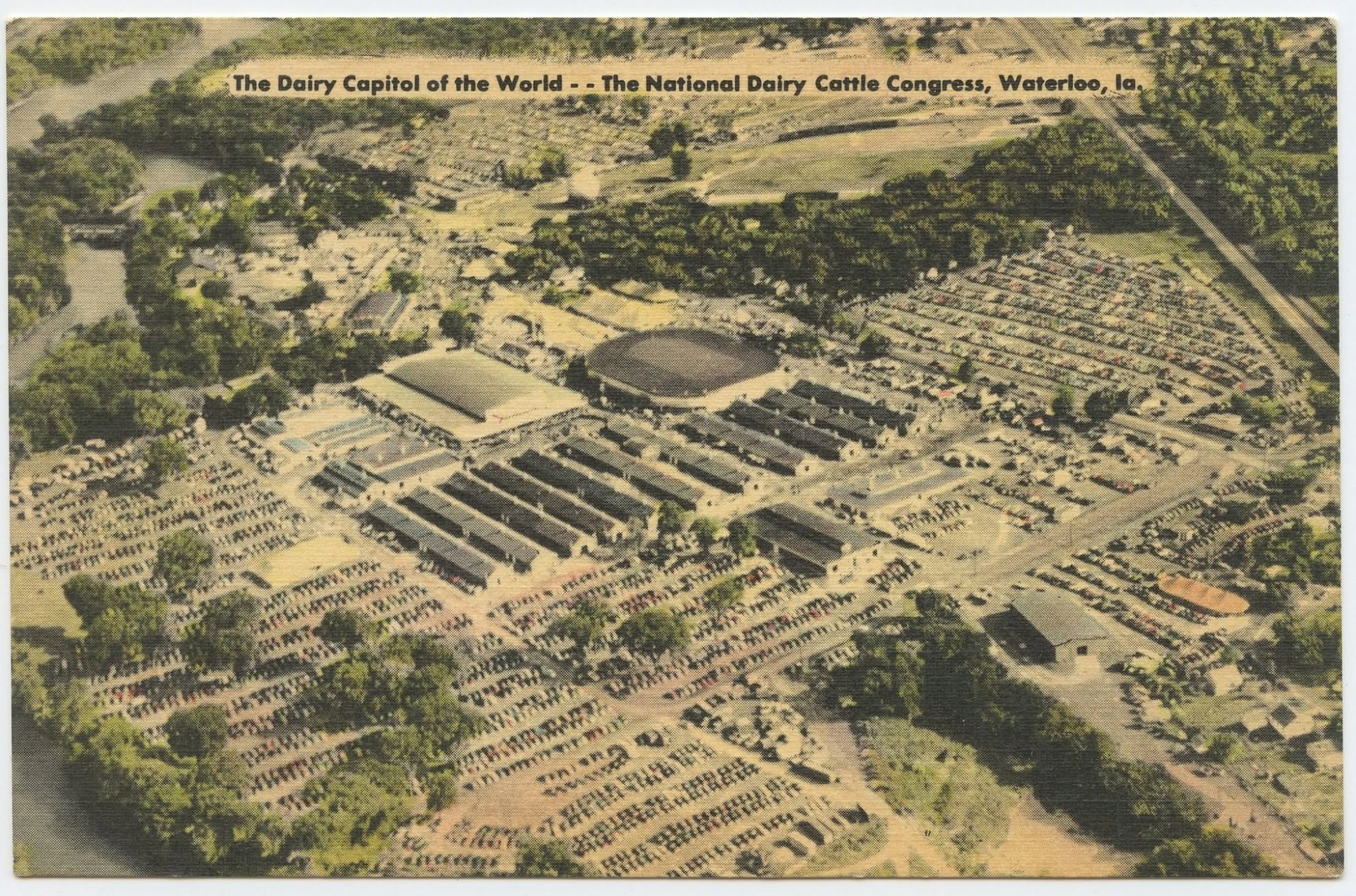
The aisles smelled like every good show smells — fresh bedding, liniment, feed, and cattle that had been worked over since four in the morning. Fitters argued across stall partitions. Breed secretaries, AI men and judges wandered through pretending not to look hard at anybody’s udder, looking hard at everybody’s udder. Deals got started at the wash rack and finished over supper.
Then the math turned on them.
The Congress needed a bigger gate, so it stretched to nine days and went shopping for a crowd. Picture a fitted Holstein string standing in the alley, tails wrapped, waiting on a handler to walk them past a midway ride and a novelty stand to reach a ring that used to be the entire point of the week. The cattle accommodations got worse while the attractions got louder, and the railroads made shipping a show string slower, dearer, and less dependable every single year.
Allen Hetts smelled it before most.
By 1963 he was telling anyone who’d listen that Waterloo was losing what it had held since before his grandfather’s day. He was right, and the proof came fast. The major breed organizations pulled their national designations mid-decade. By 1966, only the Milking Shorthorn show still carried national standing at Waterloo — with cut classes and no premium money at all.
You can hear those conversations, because dairy people still have them in exactly the same tone. Did you see where they put the cattle this year? You hear what they’re cutting next fall? Who’s going to haul nine hours for that?
Hetts wasn’t fretting over ribbons. Strip away the national show and the best herds in North America lose the one place where genetics get valued, reputations get made, and the breed argues out what a good cow actually is.
So after the 1965 Dairy Cattle Congress, he pulled cattlemen into Waterloo’s Kit Kat Klub and said it out loud. Nobody drew up a business plan that night. What came out of that room was smaller and harder than a plan — a group of breeders deciding they weren’t going to stand there and watch it go.
They needed a show.
Four Men, One Problem
Allen Hetts was the one who wouldn’t let it drop.
He took over Crescent Beauty Farm at Fort Atkinson at eighteen, when his father died at forty-seven. That’ll finish a young man’s education in a hurry. The herd’s roots went back to the Crescent Beauty cattle registered by George Hart in Michigan in 1896, and to Crescent Beauty Buttermaid — bought by Allen’s grandfather and named National Grand Champion in 1913.
Allen’s contribution was blending: the stylish, clean-boned Crescent Beauty cattle crossed onto the scale and strength of the Admiral line. Then he proved it where proof counts. Crescent Beauty Lady Gloria stood Grand Champion Female at Waterloo in 1949. Da-co-ton Crescent Fannie did it again in 1958. Crescent Beauty Talent was Reserve Grand Champion Bull at that first Madison show and came back to win it outright in 1969.
And in 1970, his peers handed him the Klussendorf Award.
If you’re new to the business, here’s what that means. The Klussendorf isn’t voted on for wins. It goes to the person who carries himself the way the industry wants to be represented — sportsmanship, skill with cattle, character under pressure. Show people decide it about show people. There isn’t a higher compliment in this line of work.
So the men who knew him best had already said what they thought of him. Three years before he died, while the show he’d mortgaged his farm for was still fighting to prove it deserved to exist.
Here’s what matters about that record — Hetts wasn’t lobbying for a show from the safe side of the rail. He’d bred cattle that needed one.
In 1969, he and his brother Roy bought a three-year-old cow from Gene Acres Farm. Local records credit farm manager Ray Potter with the decision to let her go to Fort Atkinson, on the strength of what the Hetts brothers could do with a good one. Her name was Gene-Acres Felicia May Fury, and her biggest afternoon was still five years out.
Allen wouldn’t live to see it.
The family said that once Allen went into show mode, he stayed there all twelve months. But Crescent Beauty’s part in this wasn’t Allen alone. Doris Hetts handled the correspondence, typing the letters he dictated as the campaign spread across the country.
Hold onto that detail.
Institutions get announced by men at microphones. They get built by somebody at a kitchen table keeping the names, the letters, the appointments and the promises straight.
Gene Nelson brought a different kind of weight.
Gray View Farms sat in Racine County, out near Union Grove, and had been in the family since his great-grandfather started it in 1882. By the 1950s, the operation was Harvey Nelson and Sons — Harvey, Gene, and Pete. Gene took his agriculture degree at Wisconsin in 1941 and got cut from the university’s dairy judging team. So he went to livestock judging instead and helped take that squad to a national intercollegiate championship.
Think about what that does to a man. He’d been told by the people whose opinion he most wanted that his eye wasn’t good enough. He spent the rest of his life proving otherwise on somebody else’s ground, then came back to dairy and made his reputation the slow way — by being right about cattle, in public, for forty years. Breeders remembered him for total recall on pedigrees and an eye that didn’t miss much. That’s why they trusted him later, and why his name would eventually end up on an award for the cow that finishes second in the hardest Holstein class in North America. A man who’s been underestimated doesn’t hand out easy opinions, and he doesn’t forget what a close placing costs.
At Gray View, type had to earn its keep. Gray View B D Skyanne classified EX-95 and went three-time All-American, and family records credit her with putting up 29,780 pounds of milk with 1,128 pounds of fat in a mature lactation.
Twice-a-day milking.
Think about that for a second. That’s not a show cow excused from work. That’s a cow winning at the top of the breed while milking like the best cow in somebody’s herd. In 1960s Wisconsin, that combination was the entire argument.
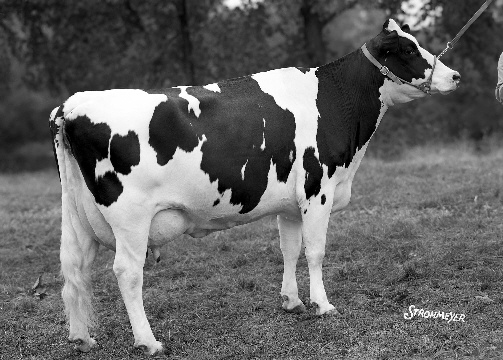
Gray View B D Skyanne, EX-95, three-time All-American, bred by the Nelson family at Gray View Farms, Union Grove, Wisconsin.
And it paid, too. In 1959, her son Gray View Skyliner sold to Curtiss Improved Stud Service for $50,000 — reported at the time as a new high for a Holstein bull sold publicly or privately in the modern era. Later that same year, her son Gray View Skylighter topped a sale at $8,500 and followed his maternal brother to the same stud.
Fifty thousand dollars. In 1959. For a bull out of a Wisconsin farm cow.
That’s what a great one was worth when the whole industry could see her — which is precisely the argument Nelson would be making in a room eight years later.
Norm Magnussen asked the question the other three couldn’t answer: fine, but who pays for it?
Norm came to Brown Swiss through a 4-H project in 1925. He worked with good herds, including Judd’s Bridge Farm in Connecticut, then came home and started Norvic Farm at Lake Mills with his brother Vic in 1945. The prefix is in both their names, which tells you something about how that family operated.
As owner of Brown Swiss Sales Service, Magnussen managed sales in 39 states and across Canada over a thirty-year career. He knew exactly what a purple ribbon did to a catalog page four hours later. He also knew the thing breeders forget in the glow of a championship — admiration doesn’t cover the trucking bill unless something changes hands afterward.
Howard Voegeli brought the rest of the world into the room.
While Hetts, Nelson and Magnussen put their deeds behind the bank note, Voegeli pledged something just as scarce and just as hard to replace: the international credibility and political leverage to bring the State of Wisconsin to the table. Money can be borrowed. Access can’t.
Voegeli Farms near Monticello was homesteaded by Swiss immigrant Yost Voegeli in 1854, purebred Brown Swiss since 1895. Howard, a University of Wisconsin dairy science graduate by the family’s account, built international cattle contacts through Voegeli International — and his obituary credits him with helping start Expo in 1965 and serving as a director for more than 35 years.
He also played in local polka bands, which is where he met Alice.
Don’t skip past that. The man who could work a room, make a delegation from Mexico City feel welcome in Madison and talk a state agriculture secretary into believing in a cattle show — that man learned something standing on a bandstand in Green County on a Saturday night.
His line to Wisconsin Agriculture Secretary Donald McDowell was the one that mattered. This wasn’t a cattle show asking for a handout. It was a shop window for Wisconsin genetics, Wisconsin equipment and Wisconsin know-how, and the buyers would fly in from everywhere.
Four different men, four different doors.
Which was the only reason the next part was even possible.
The Farms Behind the Note
Madison had what Waterloo had stopped having: a new building and a state willing to listen.
Dane County’s Veterans Memorial Coliseum sat on a 164-acre campus off John Nolen Drive — enclosed, climate-controlled, room for around 10,000. Add the University of Wisconsin, the state agriculture department, and a dense ring of dairy organizations and businesses, and you had the makings.
Minnesota was discussed. So were Illinois, Ohio, and Chicago. Wisconsin won because Wisconsin’s breeders, university people, businesses, and officials would actually show up to the meetings.
Showing up, though, is cheaper than signing.
The state put in $50,000. The organizers still needed $100,000 from the Bank of Sun Prairie. Expo’s own official history is careful here, and so should we be: recollections differ on exactly who pledged what, but the general consensus is that Hetts, Nelson and Magnussen put their farms behind that note.
There’s no way to make that sound quaint. Crescent Beauty. Gray View. Norvic. Not investment property — working farms, breeding programs, three families’ entire livelihood and three generations of decisions standing in the barns.
And here’s what a mortgage meant in 1967, in a business where the milk cheque is somebody else’s decision. A wet spring shortens the first crop. A bad month in the tank shortens everything else. Every farmer signing that note had lived through a year where the numbers went the wrong way through nobody’s fault, and every one of them knew that this time there’d be a second set of numbers underneath the first — a show’s gate receipts, in a city, in front of a public that had never been asked to care.
If Madison failed badly enough, the failure wasn’t going to stay in Madison.
It was going to follow them home, into barns their grandfathers built.
Magnussen went at the problem the only way a sale manager knows how. He ran a fundraising sale — 78 head, $21,156, a $271 average, with ABS donating breeding service on every consignment.
Read those numbers next to a modern genomic sale and they look small. Read them right and they’re breeders turning live cattle into working capital for a show that existed only as letters, meetings, and a promise. A heifer steps up, the auctioneer finds one more bid, and a little more of the Coliseum gets paid for.
Around the four gathered everybody else — breed men, veterinarians, bankers, university people, ag businesses, state officials, farm families. Nobody built Expo alone, and the founders would have been the first to say so. What the four did was give all those other people a reason to think the risk might be worth taking.
Ten Days in September
It opened September 15, 1967, and ran ten days.
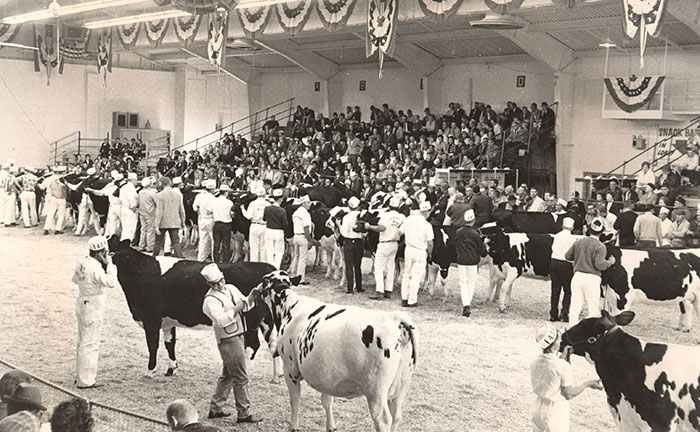
It wasn’t called World Dairy Expo. Not yet. The billing was World Food Expo, staged by the newly created World Food and Agricultural Foundation — cattle shows in the Arena Building, banquets, World Food Forums, a tractor pull, “Cinderella of the Dairy World,” entertainment, attractions.
The name tells you everything about what the founders knew and what they didn’t. They were certain dairy needed a gathering place. They weren’t certain dairy alone could fill ten days of one.
The cattle came.
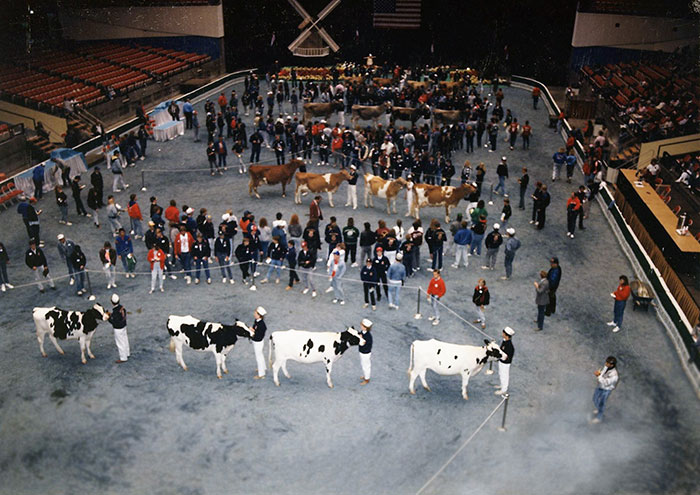
They rolled in by truck and rail, unloaded near where the Sheraton stands now and led roughly half a mile across John Nolen Drive to the barns. Picture it: strings of clipped, blanketed cattle moving through Madison traffic, halters short, handlers watching the cars and each other — the city getting its first look at what these farmers meant by a world show.
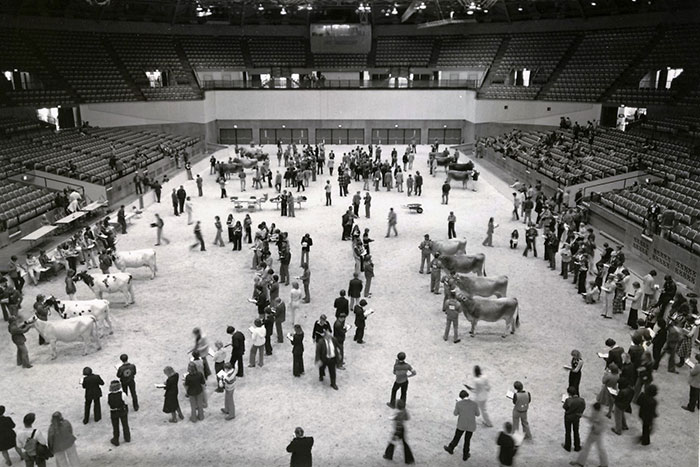
The entry numbers landed hard. 1,433 head entered. 1,182 through the ring.
That gap matters. Entries are intentions. Cattle through the ring are the people who actually hooked up the trailer.
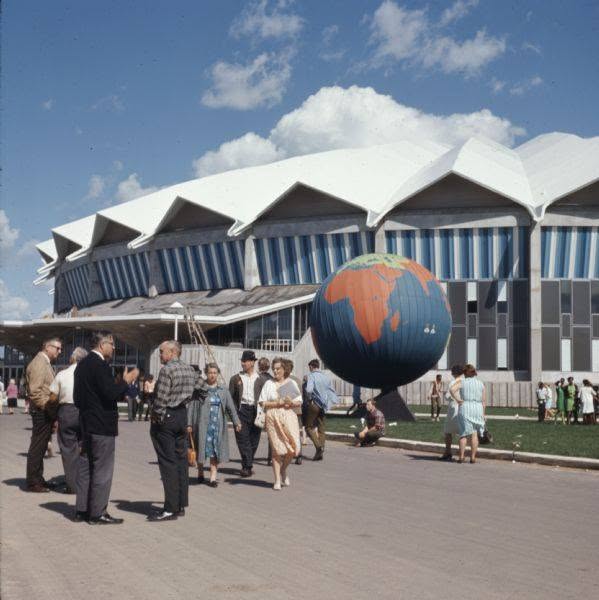
Inside the Arena Building, the whole idea finally stood up on its feet. Breeders leaned on the rail studying cows they’d only ever seen in a Holstein World ad. Judges worked deep classes. Sale talk moved up and down the aisles. And out front turned a great revolving globe, built out of two silo roofs, a motor and an axle off a ten-ton truck.
Wisconsin farm ingenuity, welding a world out of silo roofs. If you wanted one object to explain these men, that’s it.
Bayland Crescent Charmaine was named Grand Champion Holstein, and there’s a photograph of Allen Hetts standing at her head — the man who’d argued for the show, in the winner’s spot, at the first one. Crescent Beauty Talent, bred and shown by Hetts, stood Reserve Grand Champion Bull.
The cattle standard was there from day one.
And this is where it gets interesting — because the cows came, and the crowd didn’t.
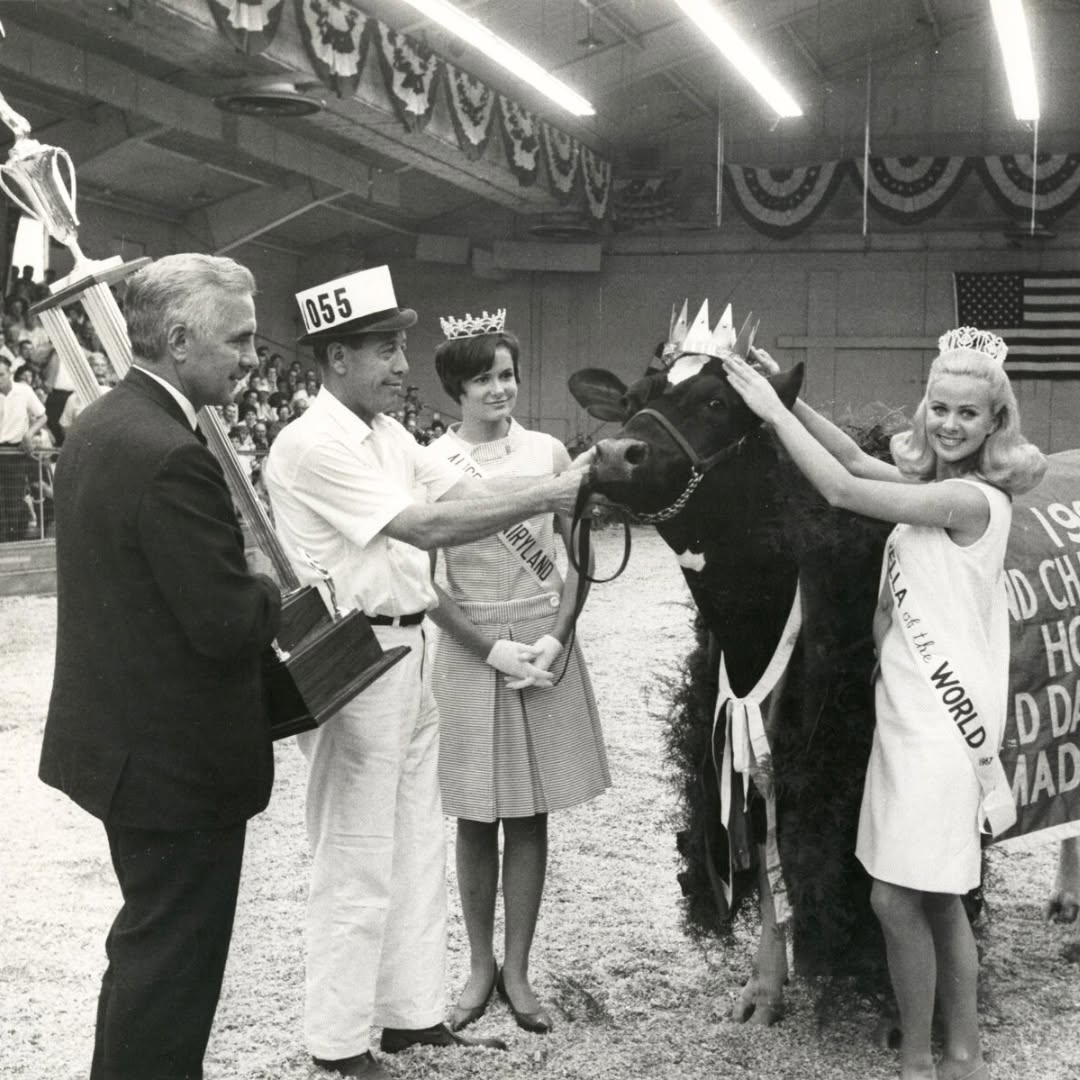
Too Much Show, Not Enough Audience
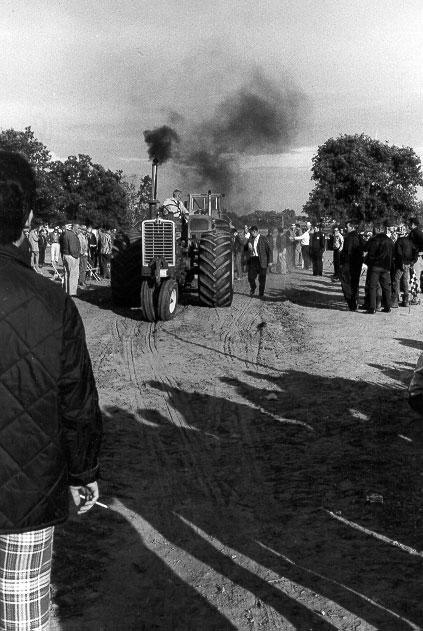
Early evening, shadows all the way across the track, the stack throwing black smoke — and maybe fifty people strung out along the rail to watch it. The man in the foreground has his back to the camera and a cigarette down at his side. Somebody had to book this, stage it, staff it and pay for it, the same as the banquets and the country acts, and it was all running on money three families had borrowed against their farms. Nobody in this picture looks like they’re at a world exposition.
The founders had solved the part they understood. They’d built a show good enough to pull elite cattle out of New York and Ontario and California.
They had not solved the gate.
Joe Gilbert, recruited as a volunteer by then-executive director Bev Craig and later central to the trade show, put those years about as plainly as they can be put: “Getting some interest, getting some money, getting anything.”
Then came the entertainment gamble. Big bands hired for nightly entertainment. Buck Owens. Porter Wagoner and Dolly Parton. Bobby Vinton. The Cowsills.
Stop and look at that lineup for a minute. That is a genuine late-1960s bill. Wagoner and Parton were on television every week. Vinton had a stack of hits. And in Madison, Wisconsin, they played to a house that didn’t come close to covering them. R. Dale Jones later joked that two people showed up — an exaggeration that survived fifty years because everybody who was there recognized the truth inside it.
Funny in hindsight. Not funny when the invoices came.
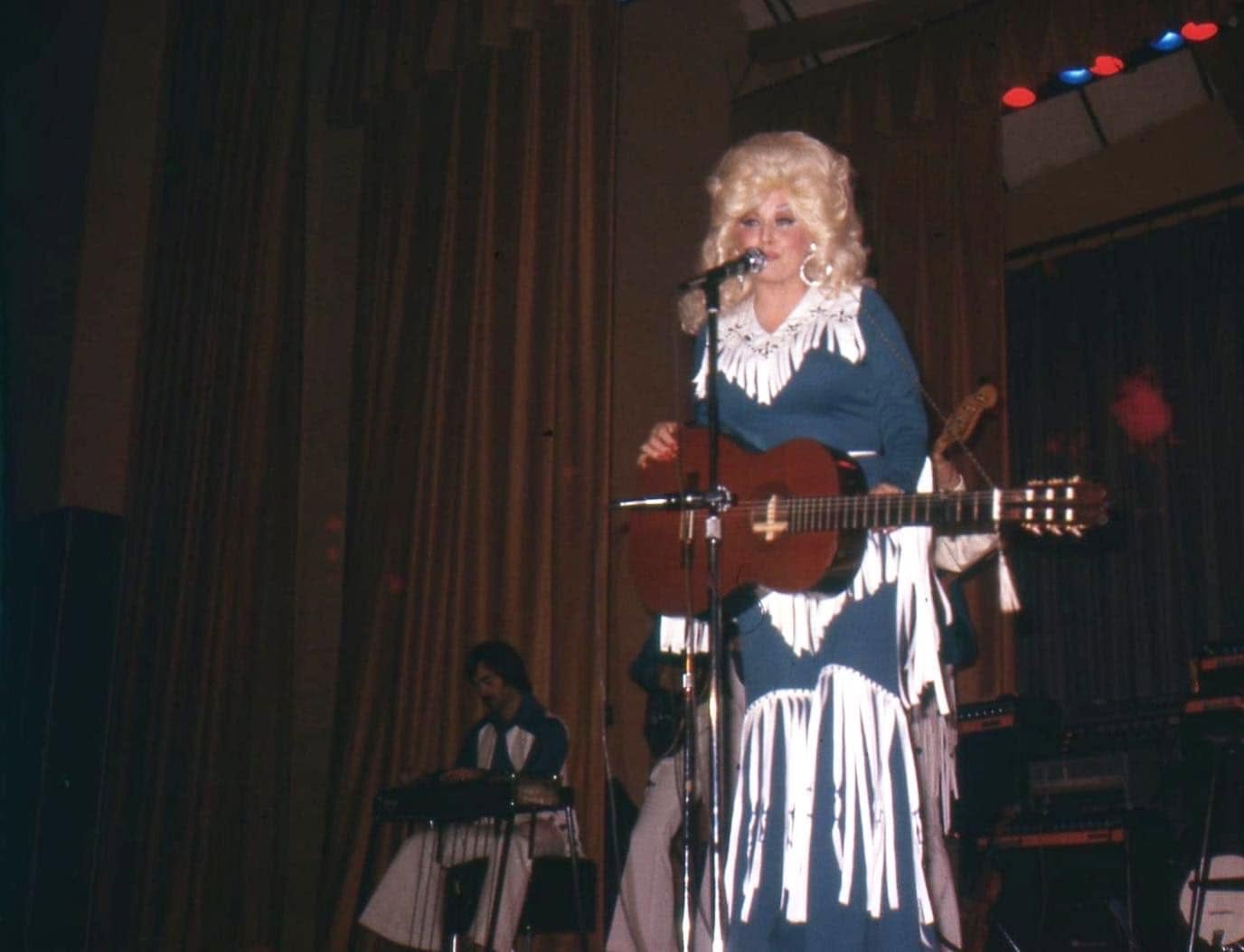
Sitting in those empty seats — and knowing now that this building would hold the best dairy cattle on the continent every October for the next sixty years — is the strangest thing about the whole story. Nothing about that room in 1968 promised it. The men who’d signed the note were looking at rows of nobody.
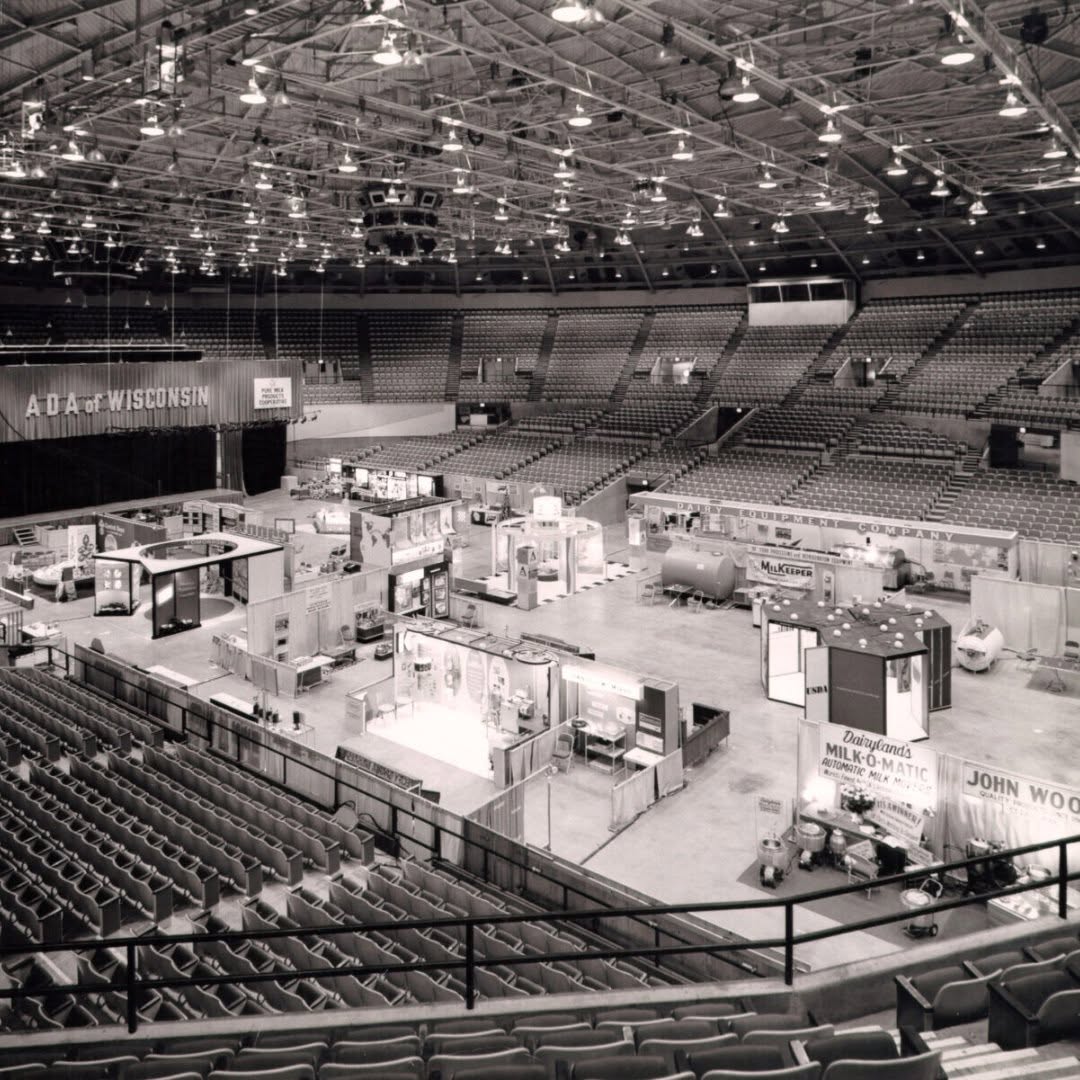
Here’s what the organizers had actually done. Chasing everybody, they’d nearly lost the only people who couldn’t be replaced. Waterloo had already demonstrated where that road ends: blur what a dairy institution is for, and it stops being one.
Looking back, the fix seems obvious. It was not obvious in the middle of it.
They cut to five days and sharpened the dairy focus. The national collegiate and 4-H dairy cattle judging contests brought farm families and young cattle evaluators onto the grounds for a reason that made sense to them. Commercial exhibits grew because they served the same people the cattle show served — producers shopping genetics, milking equipment, nutrition and animal health.
The bleeding didn’t stop. Dr. Robert Walton, who’d go on to thirty-eight years on the Expo board, said it without decoration: the show “struggled through not being successful as a Food Expo and was about to go bankrupt,” with three farms still behind that note.
The Meeting That Saved It
By 1971 the question was no longer whether four cattlemen believed in the show. It was whether the dairy industry would own it.
The answer was a corporation — World Dairy Expo, Inc. Dairy businesses and producers bought stock, and stock bought a seat on the board. Walton bought in on behalf of ABS and started the board service that lasted the better part of four decades.
That was the turn.
The first cow crossing John Nolen Drive in 1967 proved breeders would support a new national stage. 1971 proved the industry would carry it.
From there, the model finally made sense. Cattle show for aspiration and genetic prestige. Trade show for revenue and commercial purpose. Education so a producer without a show animal still had a reason to drive over. Youth contests so the next generation could test its eye against the best in the country.
The trade show took its own sweet time. It crawled along until general manager Tom McKittrick handed it to Gilbert in 1988. Gilbert protested that he knew nothing about selling exhibit space. McKittrick dropped a stack of farm magazines on his desk and told him there were a lot of ads in there — call those people. Inside a year, 300 booths became more than 600.
No strategy deck. No consultant. Here are the names; start dialing. Anybody who’s run a farm business recognizes that solution.
The show was going to live. What nobody in that room could have known was which cow would prove it — or whose name she’d be carrying.
The Afternoon Allen Never Saw
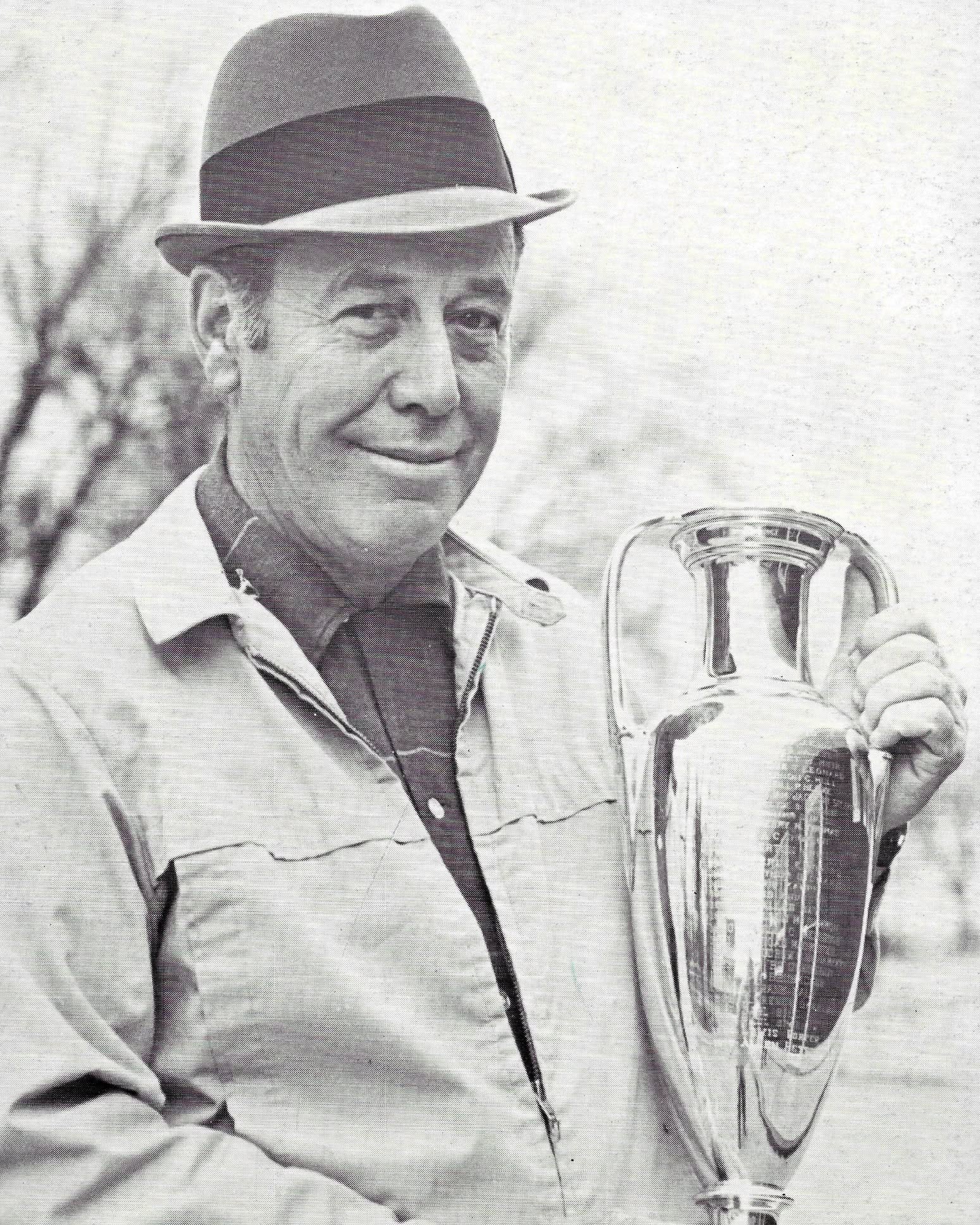
Allen Hetts with the Klussendorf Award, 1970 — the highest honour given to a dairy cattle showman in the United States, awarded since 1937 for character, sportsmanship and dedication to the shows. He was the twenty-ninth man to receive it. Note the hat, the work jacket, the grin. He had taken over Crescent Beauty at eighteen when his father died, and he had two years left himself. He never saw what the show became. But every Grand Champion named at World Dairy Expo since — in every breed, every year — has been handed the Allen Hetts Trophy.
Allen Hetts died of cancer on November 14, 1973. He was fifty-two.
Five years younger than his father made it, and Allen had been eighteen when that happened. Two generations of Crescent Beauty men gone before the work was finished.
He’d seen the danger first. He’d rallied the breeders, put the farm behind the note, watched the thing nearly fail and watched it steady. Six Madison shows. A Klussendorf on the wall. And then he was gone, at an age when most good cattlemen are just getting to the part where the breeding decisions pay off.
A year later, Roy Hetts led Felicia May into the Coliseum for the last class of the week.
Think about what that walk was. The barns half-emptied already, trailers loading outside, and the Supreme Champion selection still to come — every breed’s grand champion, one ring, one decision. Holstein beside Jersey beside Brown Swiss beside Guernsey beside Ayrshire beside Milking Shorthorn. Six cows that had each already beaten everybody who looked like them.
She was eight years old, and she’d been with Crescent Beauty five of those years. Two-time All-American Aged Cow. Four-time Reserve All-American. Eventually scored EX-97-5E — a number that still stops a Holstein breeder mid-sentence, and one earned the hard way: five times through classification as an Excellent cow, by a system that made you prove it again with every re-score, in a decade when a 97 was close to the ceiling of what anyone believed a Holstein could be.
By 1974 she’d been doing this a long time. An aged cow that deep into a show career doesn’t win on freshness. She wins because everything is still in the right place — the udder still carried high and level after five campaigns, the frame still clean, still moving like she meant it on the last day of a long week. Anybody who has tried to hold a great cow together through a fifth show season knows precisely how rare that is.
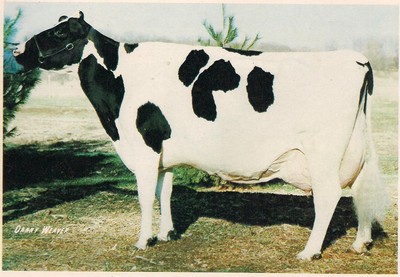
Hand-tinted for the breed magazines, the way every good cow was photographed then — set up square on the grass, head up, the light put deliberately on the udder because that is what a buyer was being asked to look at. This is the cow the prose is trying to describe: rear attachment still high and wide at the end of a long career, the fore udder still blended, nothing about her breaking down. Allen Hetts bought her in 1969 and never saw her best afternoon.
The associate judges conferred. Roy set her up one more time — the way Allen had taught him, the way he’d done since 1969 — and waited with a hand on the halter while a man walked a line of six champions deciding which one was the best animal at World Dairy Expo.
He stopped at the Holstein.
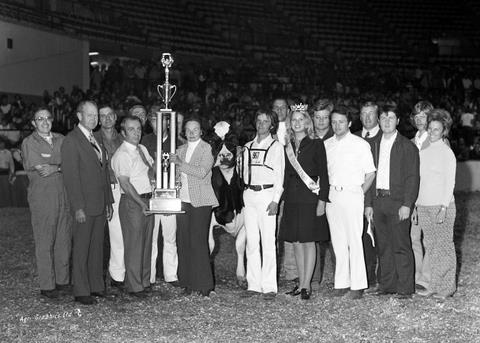
Supreme Champion of World Dairy Expo, 1974. Gene-Acres Felicia May Fury, Felicia May Associates, Fort Atkinson, Wisconsin.
Not grand champion of her breed. Supreme — the top of the entire thing, any breed, any color.
Allen Hetts had spent the last decade of his life fighting to build a ring worthy of North America’s best dairy cattle.
One year after he was buried, a cow he’d bought stood above every other animal in it.
The record doesn’t need help from anybody.
What Their Names Mean Now
Walk into the Coliseum on the Saturday of Expo, and you’ll hear all four of them, whether you know it or not.
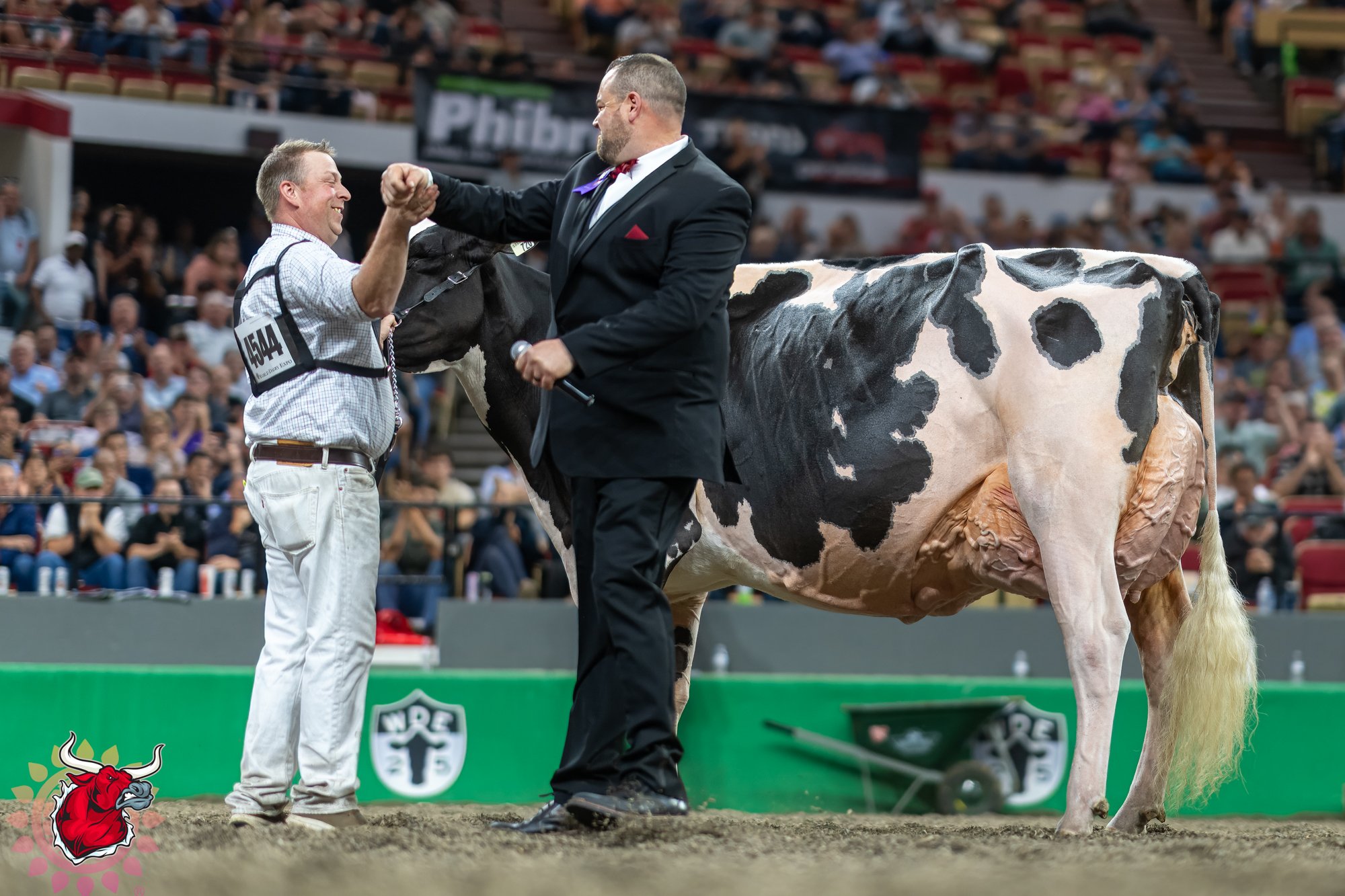
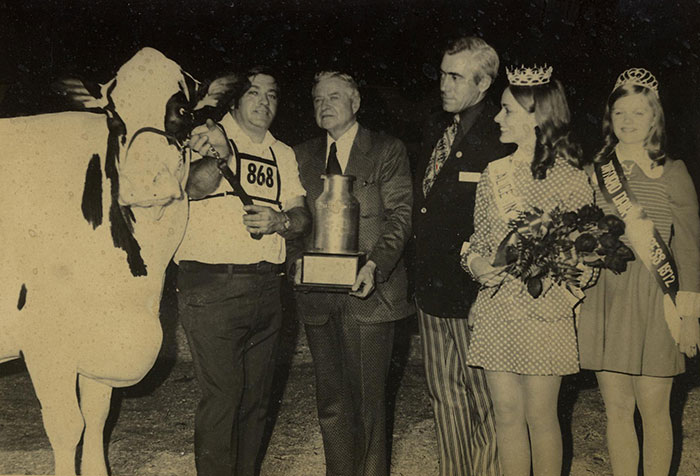
Lovhill Sidekick Kandy Cane won the Five-Year-Old class in 2025, took Senior Champion, and then Grand Champion of the International Holstein Show — 468 head judged by Aaron Eaton. The Saskatchewan-bred cow, exhibited by Alicia and Jonathan Lamb of Oakfield, New York, went on to stand Reserve Supreme Champion of the entire show, behind the Red & White Grand Champion, Golden-Oaks Temptres-Red-ET (owned by Milk Source, Fischer, Steincrest, and Crescentmead of Kaukauna, Wisconsin). With the Grand banner came the Allen Hetts Grand Champion Trophy.
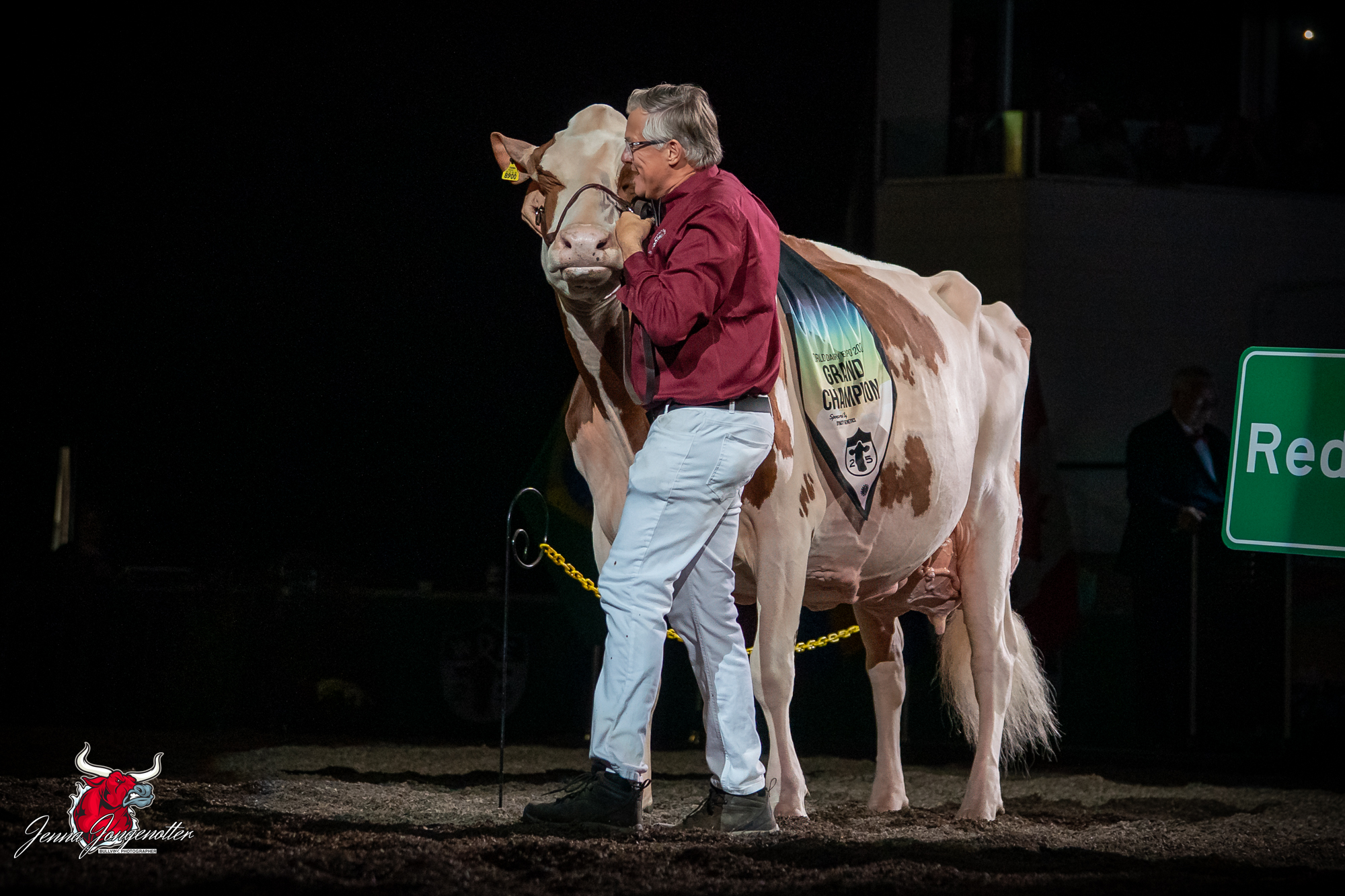
Fifty-one years after Felicia May stood Supreme in that building, a cow standing Reserve Supreme in the same ring carried home hardware named for the man who put his farm behind the bank note so there’d be a ring at all. How many exhibitors have heard that name read over the loudspeaker without ever knowing what it cost him?
Gene Nelson and Norm Magnussen left the two halves of the same conviction — that good cattle have to be both judged honestly and sold well.
Nelson’s half is the standard. Cattle evaluated seriously on a respected stage, type measured against production instead of excused from it, breeders confident in the people running the thing. His name goes to the Reserve Grand Champion of the International Holstein Show, and in 2025 that was West-Adub Lambda Sadie, the Intermediate Champion, exhibited by Butlerview Farm of Chebanse, Illinois.
But Gray View’s real footprint isn’t a trophy. It’s in pedigrees.
Alongside Skyanne, the Nelsons bred Gray View B D Crissy, and out of Crissy came a bull calf on May 14, 1959, by Bond Haven Rag Apple Maple. They called him Gray View Crisscross.
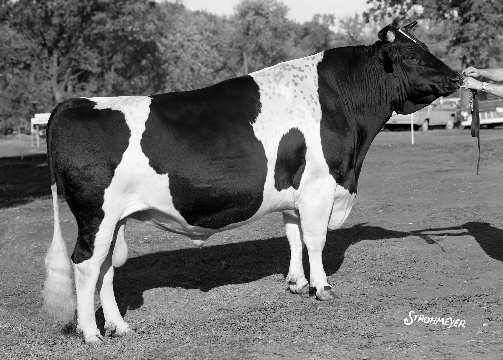
Gray View Crisscross, born at Union Grove on May 14, 1959 — EX-96, Gold Medal, out of Gray View B D Crissy by Bond Haven Rag Apple Maple. Strohmeyer shot him square and full-length, chest forward, nothing coy about it: a bull is sold on scale, a cow on dairyness, and the photographer knew the difference. His sons and daughters took over the show rings of the 1960s and the Crissy breeding went worldwide. An Illinois herd has since recorded an eleventh-generation Excellent descendant.
He scored EX-96 himself and earned Gold Medal status.
Now, if you’re under fifty, that second part needs unpacking — because Gold Medal wasn’t a show award and it wasn’t handed out for a pretty head. A bull earned it when his daughters came back with the numbers and the type. Both. Proven in other men’s barns, on other men’s feed, by other men’s management.
Which is to say that the man who got cut from the university’s judging team bred a bull whose daughters settled the argument he’d spent his whole life making.
His sons and daughters worked the show rings hard through the 1960s, and his breeding sold worldwide. In 2002, Wisconsin Holstein named Crisscross its Bull of the Year and Skyanne its Cow of the Year, honoring Harvey, Eugene and Pete Nelson of Union Grove.
And the Crissy family kept going. Holbrich Farm in Illinois earned Excellent recognition on an eleventh-generation Crissy descendant.
Eleven generations of Excellent cows out of a Racine County barn.
Magnussen’s half is the commerce. The World Premier Brown Swiss Sale, and that whole understood relationship between a championship on Thursday and what a pedigree’s worth on Friday, traces back to a man who knew breeders can’t keep hauling elite cattle unless excellence turns into opportunity.
His name went to the young stock, and in 2025 the Norman E. Magnussen Memorial Junior Champion Award in the Holstein ring went to Echo Glen Master Ivy, the winning Winter Yearling owned by Ronald Grandy of Beaverton, Ontario.
An Ontario yearling heifer carrying the name of a Lake Mills Brown Swiss man who signed away his farm in 1967. That’s what an institution does with a memory.
Nelson lived until 2004 — long enough to watch the whole gamble come good, which of the four is the one who most deserved to. Magnussen died October 22, 1976, nine years in, before any of it matured.
Howard Voegeli’s legacy doesn’t have a trophy. It has an address on an envelope.
He died August 21, 2003, at seventy-two, after more than thirty-five years as a director. What he left is the reason a Wisconsin cattleman, a Quebec breeder, a Latin American buyer, and an equipment engineer all end up in the same aisle in October. His son Bryan later served on the Expo board and the Dairy Cattle Executive Committee, and handled the Brown Swiss cow at the 2023 signing that kept Expo in Dane County long-term.
That’s how it moves in farm families. Not a speech about succession. Somebody’s son takes the chair and does the work.
The Warning They Left With It
Here’s the part of this story that isn’t comfortable.
In 2014, 77,204 people came through Expo’s gates. In 2025, using the new counting technology Expo itself adopted that year, the estimate was 51,525 — down roughly a third. The trade floor that held 884 companies in 2017 listed around 461 in 2025, as farm consolidation and direct-to-farm selling changed how suppliers reach producers.
That doesn’t mean Madison has stopped mattering. In 2025, the cattle show still drew 2,625 head from 1,829 owners across 37 states, seven Canadian provinces and one Australian state — and the International Holstein Show put up the largest class in Expo history.
The gates open again on September 29 this year, with the cattle show starting September 27 and running through October 2. Fifty-nine years on from the note.
And on Wednesday the 30th at six o’clock, the gavel falls in the Tanbark for the 37th World Classic in 38 years — the last one Tom and Sandy Morris will manage. Twenty-one documented World Classics between 1999 and 2024 moved $24.1 million across 955 lots. Magnussen would have understood exactly what’s ending. He built the same thing in Brown Swiss, one catalog at a time, and he’d have told you what these four learned the hard way: an institution is only ever as permanent as the people who keep showing up to run it.
But history doesn’t hand out exemptions for being famous.
Waterloo went down because it lost track of what it was for. Madison nearly went down doing the same thing.
Four years in, with three farms on the line. It survived because somebody had the sense to shorten the show, hand ownership to the industry, and build the whole operation around the people who actually milk cows.
The founders’ lesson was never “build a great show and it stays great.” It was: keep deciding what you cannot afford to lose, and be willing to tear up the program to protect it. Every board, every breed association, every farm business restructuring right now is working the same problem the four of them worked in 1971.
Why the Ring Still Has to Exist
Ask around long enough and somebody will tell you the show ring is a costly antique.
They’ve got an argument. Genomic mating programs flag a heifer calf’s index before she’s dry behind the ears, and they’ll build her whole mating plan without anybody laying a hand on her. Robots milk her, score her gait, weigh every kilogram she eats, and email the results before breakfast. Consolidation has replaced hundreds of the registered herds that used to fill a show string with a smaller number of much larger operations, and the trade floor numbers show exactly where those suppliers went. Ten days out of the parlor at the worst time of year, the entry fees, the fuel, the bedding, the hired help covering chores — every August, somebody runs those numbers and concludes the whole exercise is sentiment.
They go anyway.
Because the ring is still the only place in this industry where pedigree, balance, functional conformation and public accountability all meet in real time, in front of witnesses, with somebody obliged to stand up and say out loud why one cow beat another.
No index does that. No robot report does that. An algorithm never has to defend its reasons to 468 head worth of breeders leaning on a rail.
They want to see her walk. They want to hear the judge say why. And they want to find out, in front of everybody, whether the good one at home can stand up to whatever Quebec and New York brought this year.
That part never changed.
Three Farms Beneath the Ring
Fort Atkinson put Felicia May on a street corner.
She stands there now in fiberglass, painted in the likeness of the Crescent Beauty champion, part of a trail of cows through the town where Allen Hetts took over his father’s herd at eighteen. A cow that won one October afternoon in 1974, still being looked at by people who have no idea what a Supreme Champion is.
That’s the thing about what those four men built. It got into the ground.
Stand at the rail during the Holstein show and listen. Pedigrees getting argued. A judge getting second-guessed before he’s finished his reasons. Somewhere in the barns, a fifteen-year-old asleep in the straw beside a heifer she’s been washing since May. Somewhere on the grounds, a breeder shaking hands with a buyer from a country he’ll never visit. Somewhere in that crowd, somebody seeing a cow that resets what they thought a dairy animal could be.
That’s what Hetts, Nelson, Magnussen and Voegeli were trying to keep.
They weren’t prophets. They overreached badly — ten days, a tractor pull, a country music bill and a globe made of silo roofs. They misjudged the public. They ran up debt and came within an inch of losing the whole thing. Other people restructured it in 1971, and later generations built most of the trade show, the education program, and the youth contests anybody recognizes today.
Their greatness sits somewhere more believable than perfection. They saw the loss coming before the rest of the industry did. They gathered the right men around it. And they signed their names to the risk back when nobody could promise them it would work.
Every autumn, the cattle walk into a Madison ring their industry came close to never having.
Over them hang the lights, the banners, and names that now get read aloud to crowds who mostly don’t know where they came from. Under them — under every championship, every international handshake, every kid learning to defend a placing out loud — are three Wisconsin farms once pledged to a bank, a fourth cattleman who talked a state into believing, and four families who let an uncertain idea leave the kitchen table.
World Dairy Expo stands because Gene Nelson, Norman E. Magnussen, Allen Hetts and Howard Voegeli decided dairy cattle still deserved a stage — and when nobody could promise that stage would survive, they put their own ground underneath it.
 The Sunday Read Dairy Professionals Don’t Skip.
 The Sunday Read Dairy Professionals Don’t Skip.
Every week, thousands of producers, breeders, and industry insiders open Bullvine Weekly for genetics insights, market shifts, and profit strategies they won’t find anywhere else. One email. Five minutes. Smarter decisions all week.




