







The Hendricksons of Belleville, Wisconsin built most of their herd off one maternal line. Holstein Association USA just named them 2026 Elite Breeders — and the family’s top cow is the reigning Royal Winter Fair Grand Champion.
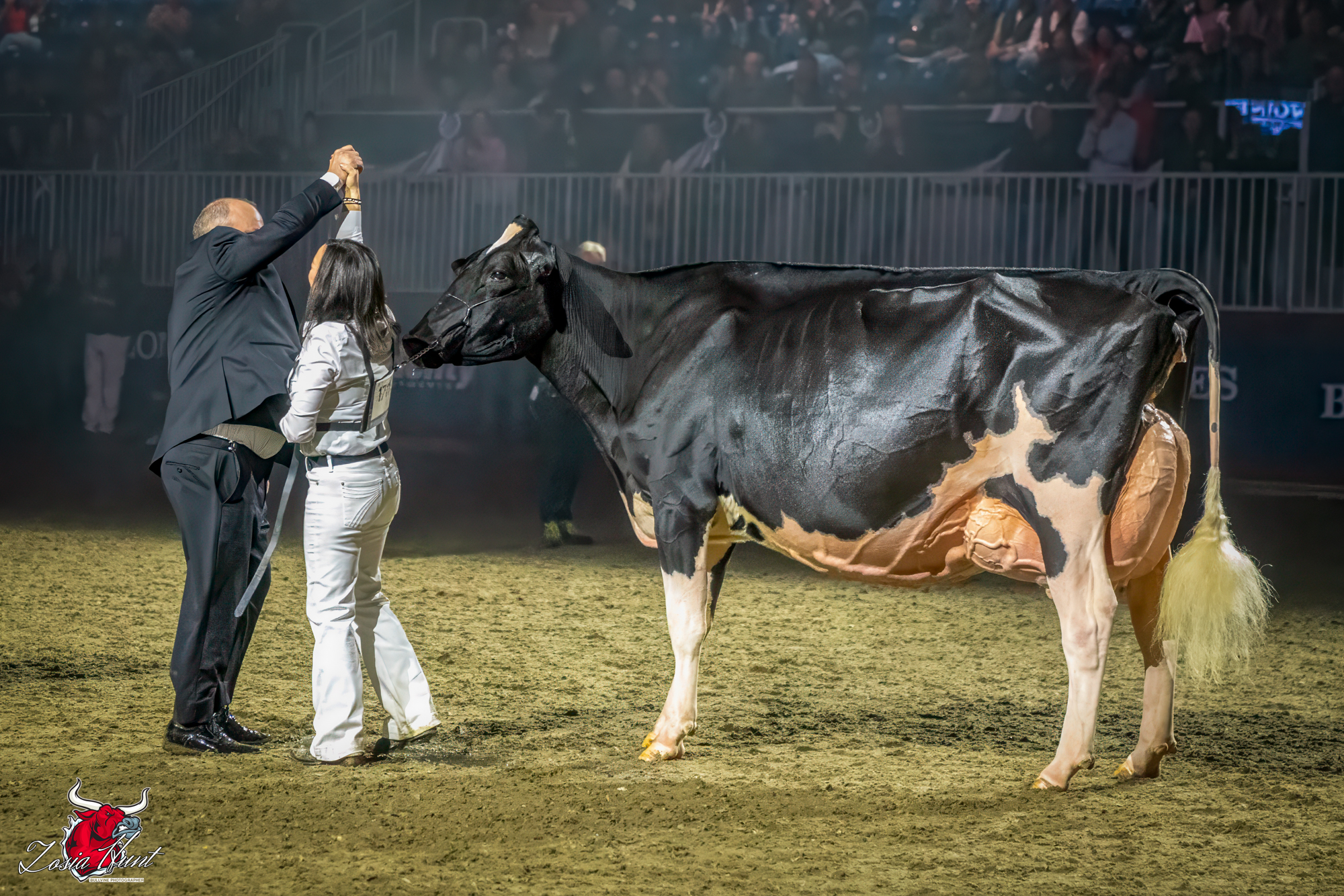
Start with the cow on top. Jeffrey-Way Hard Rock Twigs scored EX-96 and was named Grand Champion at the 2024 Royal Winter Fair — a second-generation EX-96, out of a Doorman dam, sired by Cookiecutter MD Hardrock. She didn’t come from a checkbook or an outcross gamble. She came from a maternal line Jeff and Kate Hendrickson have been building since the early 1980s.
That’s the story Holstein Association USA just honored, naming the Hendricksons its 2026 Elite Breeders, to be recognized at the National Holstein Convention in Orlando this June 22–25. Roughly 90% of the Jeffrey-Way herd traces to one cow family. This isn’t about chasing the hot bull every August. It’s a study in what concentrating a maternal line actually does to a herd over four decades — the upside, the risk, and the discipline it takes.
Where the “T” Family Started
The line runs back generations, and it shows in the pedigrees. Look at a recent Jeffrey-Way sale lot and the dams stack up like a family tree carved in stone: Tanawood EX-95, then Tanaya EX-92, Tameka EX-94, Tranquil EX-92, and deeper still. That’s the “T” family — a tail-female line the Hendricksons have bred forward, one daughter at a time, for 40 years.
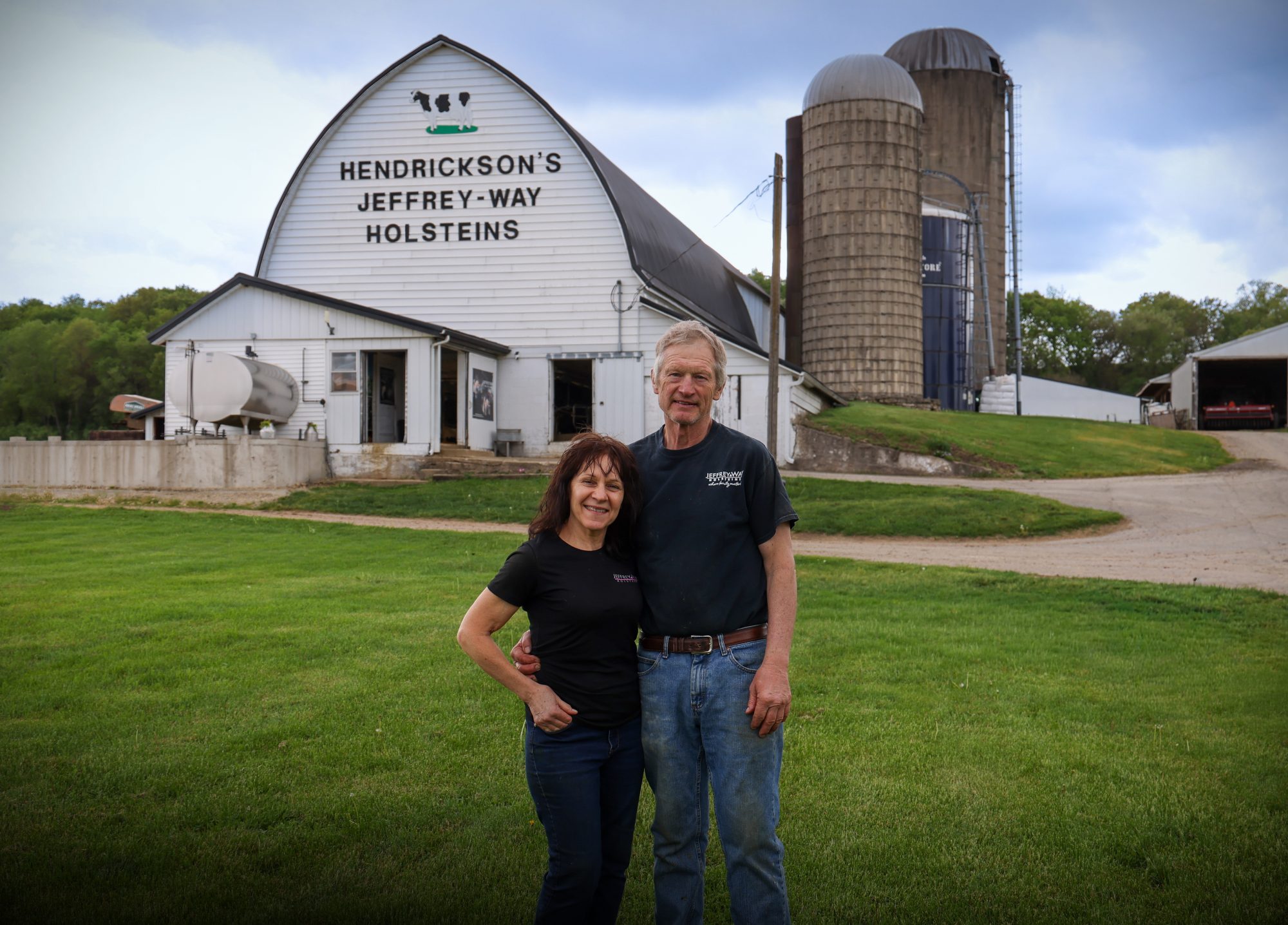
Forty years ago this was a youth project. Jeff and Kate started with Registered Holsteins as kids, and the prefix grew up alongside them. What’s striking isn’t the start — plenty of breeders begin with one good cow. It’s that they never traded out of the line. Decade after decade, as genomics arrived and proof sheets reshuffled the breed, they kept breeding back into the “T” family instead of chasing whatever topped the August run.
That choice is the whole story. A breeder who commits to one maternal line is betting that depth beats breadth — that a family proven across generations is a safer foundation than the newest number on the list. The Hendricksons made that bet for 40 years, and the trophy case says it paid.
More Than One Branch on the Tree
Here’s the part that gets missed when people hear “90% from one family”: it isn’t 90% from one cow. A tail-female line that deep grows branches, and the Hendricksons have worked more than one. The “T” prefix is the trunk — Tanawood, Tanaya, Tameka, Tranquil — but the herd also carries a “Tina family” running through cows like Jeffrey-Way Saphire RC P EX-94 and Jeffrey-Way Mascot Tina-ET EX-91. Same maternal foundation, different limbs.
That branching is what keeps a concentration strategy from becoming a dead end. When you’ve got several proven sub-families inside one line, you can mate within the strength of the family without doubling up on the exact same animals every generation. It’s the difference between linebreeding and backing yourself into a corner. The Hendricksons have enough branches to keep choosing.
And it’s why a number like 384 Excellent cows is even possible off one foundation. You don’t get there by flushing a single donor over and over. You get there by building out the whole tree — Tate branch here, Tina branch there — and letting each one throw its own string of high-scoring daughters.
A Family That Markets Itself
The “T” prefix isn’t just a pedigree anymore. It’s a brand buyers chase. This past March, Jeffrey-Way ran its first-ever public online sale through CattleClub.com — “this decision wasn’t easy,” the family wrote — offering “the best ‘T’ family members” and billing it as buyers’ first chance to get into the Twigs branch, with animals selling off the farm at N9385 Cty CC in Belleville.
For a herd that spent 40 years keeping its best genetics in-house, opening the gate at all is a strategy shift worth noticing. You don’t sell into your own foundation lightly. The Hendricksons did it because demand finally outran what they could use themselves — when buyers are asking for a branch by name, holding everything back leaves money and reach on the table.
The depth shows up in the family’s newest stars. Jeffrey-Way Addison Sauna EX-95 is, as the farm put it, “the Holstein breed’s newest Excellent 95 scored cow” — and she’s polled and a Red Carrier, straight out of the “T” family. That matters. The Hendricksons built polled and Red genetics into a line better known for black-and-white show type, hitting two of the hottest market traits in the breed without abandoning their base.
That optionality runs deeper than one cow. The herd has put homozygous polled and Red-carrier genetics into multiple “T” branches, so a buyer chasing polled, or Red, or just bulletproof show type can find it inside the same family. When the breed’s priorities shift — and they always do — a line with that many doors stays marketable. The reach has gone international, too. Twigs’ descendants and embryos move through European genetics outlets, marketed as a foundation worth buying into. When a Belleville cow family shows up in embryo catalogs across the Atlantic, that’s not luck. That’s 40 years of consistency the rest of the breed can finally see.
Does 90% From One Family Mean an Inbreeding Wall?
It’s the first question a serious breeder asks. Concentrate a maternal line that hard and you risk stacking the bad in with the good — and breed-wide inbreeding has climbed for years as popular sire stacks narrow the gene pool. Our reporting on how one foundation sire ended up with a 15.8% relationship to the entire U.S. Holstein population shows how fast that concentration compounds. Read more: To-Mar Blackstar: The One-Embryo Holstein Sire Behind 15.8% of Today’s DNA – and the Genetic Debt in Your Herd.
The Hendricksons’ answer is in their classification record. Holstein International, profiling the herd, counted 59 Excellent cows among 109 milking — more than half the working string scored EX. Across the herd’s history, Holstein Association USA credits Jeffrey-Way with 384 Excellent cows. A deep cow family is the closest thing in dairy breeding to a moat: type, longevity, and components that show up generation after generation. The same one-daughter-at-a-time patience built the great franchise cow families that reshaped the modern Holstein. Read more: How Seven Franchise Cows: Roxy, Dellia, Blackrose, and Four Others Built Modern Holstein – One Daughter at a Time.
But concentration only pays when you cull as hard as you breed. A herd that holds 59 EX in the milking string is also shipping the animals that didn’t make the cut — and the discipline is in moving them, not falling in love with a pedigree. That’s the part of the Jeffrey-Way story the trophy doesn’t show. The inbreeding risk is real; the herd’s answer is that a family this deep, with this many branches, gives you enough good animals to stay selective, and modern genomic mating tools let you steer around the worst of the stacking.
The Cow That Proved It at the Royal
Twigs is where the strategy stops being theory. A second-generation EX-96 doesn’t happen by accident — it means the dam was good enough to score 96, and her daughter was good enough to match her. That’s the line working exactly the way a concentration strategy is supposed to: each generation holding or improving on the last.
She backed it up in the colored shavings. Twigs was named Grand Champion at the 2024 Royal Winter Fair — the kind of banner that puts a cow family on the international map and sends buyers looking for full sisters and embryos. The Royal isn’t a county show. Winning it tells every breeder watching that this isn’t a one-good-cow operation. It’s a program.
The Rest of the Roll Call
The family runs deep, and the cows the association named in its announcement read like a herdbook highlight reel — confirmed against breed records and the farm’s own listings: q106
- Jeffrey-Way Hard Rock Twigs EX-96 — Grand Champion, 2024 Royal Winter Fair
- Jeffrey-Way Tanawood EX-95 — a 250,000-lb (≈113,000 kg) cow still milking on her 8th calf
- Jeffrey-Way Addison Sauna-PO-RC EX-95 — polled, Red Carrier, the breed’s newest EX-95 at scoring
- Jeffrey-Way Saphire RC P EX-94 — “Tina family,” more than 337,000 lb (153,000+ kg) lifetime
- Jeffrey-Way Format Tate-ET EX-93
- Jeffrey-Way Tranquil-ET EX-92 and Jeffrey-Way Mascot Tina-ET EX-91
- Jeffrey-Way Mars Tara-ET EX-90
Look at the sire prefixes — Hardrock, Addison, the polled Red & White lines coming through Saphire and Sauna. That’s a breeder reading each daughter, correcting where she needed it, and moving the herd forward across decades. No single bull built this. The cow family did, with a different sire layered on top each generation to fix what the last one left short.
What Does a 384-EX Record Actually Take?
The Hendricksons have held a spot on the Progressive Breeder’s Registry for 35 years — that part is confirmed. Run the arithmetic: 384 Excellent cows across a span like that works out to close to one new Excellent cow a month — though the figure isn’t broken down by year, so treat it as a rough pace, not a steady cadence.
Put it against your own barn. A solid registered herd might score a handful of cows Excellent in a good year. To hold 59 EX in a 109-cow milking string, you need cows that last — high lifetime production, low involuntary culling, and a type base that holds up to a classifier’s eye through multiple lactations. Tanawood’s 250,000 pounds on her 8th calf, and Saphire’s 337,000-plus pounds, are the kind of numbers that make the point: this isn’t show type at the expense of the tank.
And it pencils into milk. A million-cow classification study — the one we broke down in our Ed Bos feature — tied the functional traits classification rewards, the udders, feet and legs that keep a cow in the herd, to roughly $2,678 in extra lifetime milk revenue per cow. Read more: Ed Bos Picked the Same Traits for 50 Years. A Million-Cow Study Just Proved He Was Right — by $2,678 Per Cow. Type and index usually pull in different directions. Doing both off one cow family — a Royal Grand Champion and a herd that more than half-classifies Excellent — is the rare trick most herds never crack.
“It gives us a sense of pride to be recognized by this award,” Jeff Hendrickson said in the association’s announcement. “It’s a good feeling to know you’re recognized by your peers, and it provides a sense of accomplishment.”
The Second Generation Is Already Winning
A cow family is only a legacy if someone carries it forward. The Hendricksons have that covered. The farm is now owned and operated by Jeff and Kate alongside son Brooks and Riley Hendrickson — and Brooks took a Grand Champion banner at the Royal with a four-year-old in 2024, the same show where Twigs went Grand.
The bench runs deeper still. Trent Hendrickson has built his own operation, Trent-Way Genetics in Blanchardville, and in 2024 Holstein Association USA named him its Distinguished Young Holstein Breeder. That’s not a participation ribbon — it’s the association’s signal that a young breeder is already building a program worth watching. And he built it on the same foundation, the “T” family genetics he grew up with, now running under a second prefix on a second farm.
Think about what that says about the original bet. One cow family didn’t just fill one barn — it seeded two operations, in two Wisconsin towns, both winning at the Royal, with a national young-breeder award between them. Most herds spend a generation hoping the next one stays in dairy at all. The Hendricksons handed theirs a foundation deep enough to start over with. The “T” line built more than a herd. It built a bench.
What This Means for Your Operation
The Elite Breeder award goes each year to a living Holstein Association USA member, family, or partnership that’s bred outstanding animals and moved U.S. Registered Holsteins forward. Strip away the Orlando ceremony and the Hendrickson record leaves five decisions worth weighing in your own barn.
- If one cow family already throws your best type and longevity, concentrate toward your strength — but pair it with a culling rule strict enough to keep the misses out of the milking string. A family becomes a moat only if you ship the misses as honestly as you keep the hits; 59 EX in a 109-cow string is a culling story as much as a breeding one.
- If you’re going hard on one maternal line, run an inbreeding check on every mating, not annually. That’s the difference between Jeffrey-Way’s moat and a genetic corner — genomic mating tools make it manageable, but only if you actually run them. Branches help too: the more proven sub-families you’ve got inside the line, the more room you have to mate without doubling up.
- If you doubt classification pays, look at the milk. The functional traits it rewards — udders, feet and legs — tied to roughly $2,678 per cow in lifetime revenue in a million-cow study.
- If you want a family with staying power, breed in optionality. The Hendricksons put polled and Red genetics into a show-type line through Addison Sauna and Saphire, chasing emerging market traits without abandoning their base.
- If you’ve got genetics worth seeing, open the gate. A public sale, a Royal banner, an embryo listing overseas — visibility is how a single line earns a national, even international, audience.
If you want to put this to work in the next month, pull your own herd’s classification history and find the single cow family quietly carrying your type. Map its branches while you’re at it — which dams trace where, and where you’ve got room to mate within the family without stacking the same animals. That’s your “T” family, and you can’t build a 40-year line until you know which one you’d bet on.
Key Takeaways
- One deep cow family can carry a whole herd, but only if you cull as hard as you breed — 59 EX in a 109-cow string is a culling record as much as a breeding one.
- Concentration pays when the line has branches. Several proven sub-families inside one foundation give you room to mate within your strength without stacking the same animals every generation.
- Pull your classification history this month and find the one family quietly carrying your type. Map its branches and run an inbreeding check on every mating, not just once a year.
- Build in optionality. Layering polled and Red genetics into a show-type line, plus a public sale, is how Jeffrey-Way turned one tail-female line into national and European demand.
Forty years ago this was a youth project and a string of “T” cows. Now it’s the breed’s top breeding honor, a cow family selling off the farm, embryos moving through Europe, two generations winning at the Royal, and a Grand Champion standing on top of it all. So here’s the question worth taking back to your barn: which cow in your herd today is the one your grandkids will be tracing back to?
Learn More
- Roybrook 2026: The $15,000 Holstein Cow Family Test — Delivers a blueprint for balancing tight linebreeding with genomic tools to lock in structural uniformity. Learn how to write strict family rules that map identical DNA strands, preventing hidden genetic defects from crashing your next generation.
- Your Top Heifers All Trace to Three Cow Families. That’s a $93300-A-Year Trap. — Exposes the hidden financial penalties of extreme maternal line concentration in commercial setups. Breaks down how cow family fragility impacts turnover rates, showing that a longevity gap can tie up $93,300 in annual replacement capital.
- Ed Bos Picked the Same Traits for 50 Years. A Million-Cow Study Just Proved He Was Right — by $2,678 Per Cow. — Arms you with hard economic numbers connecting commercial profitability to functional classification scores. Shows why direct selection for udder depth and heel depth drives structural longevity, generating $2,678 in extra lifetime milk revenue per cow.
 The Sunday Read Dairy Professionals Don’t Skip.
 The Sunday Read Dairy Professionals Don’t Skip.
Every week, thousands of producers, breeders, and industry insiders open Bullvine Weekly for genetics insights, market shifts, and profit strategies they won’t find anywhere else. One email. Five minutes. Smarter decisions all week.




